


Abstract
In this quantitative study, we investigated the conditional mediating role of students’ mathematical language self-efficacy in the relationship between self-regulation and mathematics anxiety. The study employed a relational research design and included survey data from 706 middle school students attending public schools in Turkey. Findings indicated that both self-regulation and perceived self-efficacy in mathematical language use were significantly associated with mathematics anxiety. Moreover, the effect of self-regulation on mathematics anxiety was significantly mediated by students’ perceptions of their ability to understand and use mathematical language self-efficacy. The indirect effect was negative while the direct effect was positive, indicating a suppression (competitive mediation) effect, whereby self-regulation exerts both anxiety-reducing and potentially anxiety-inducing influences through different pathways. Conditional mediation analysis further revealed that this mediating effect varied as a function of students’ perceived academic support, with the indirect effect being non-significant for students who did not receive support. Measurement invariance across gender and grade level was examined to ensure that the constructs were measured equivalently across groups. These findings highlight the importance of fostering both self-regulation skills and mathematical language proficiency, particularly in contexts where students may lack sufficient support. These findings provide a theoretically grounded and practically relevant framework for understanding mathematics anxiety within inclusive mathematics education contexts.
1. Introduction
Mathematics anxiety has been a focus of research in mathematics education since the latter half of the 20th century. In recent years, growing attention has been paid to understanding the factors that contribute to mathematics anxiety and to exploring the mechanisms through which these factors operate [1,2,3]. Recent studies have further emphasized the importance of examining mathematics anxiety through integrated cognitive, affective, and contextual frameworks, particularly aiming to increase attention to students’ emotional well-being and inclusive education practices [4,5,6]. Despite the growing body of research examining the factors associated with mathematics anxiety, the mechanisms through which these factors jointly operate remain insufficiently specified. Prior studies have typically examined self-regulation, mathematical language self-efficacy, and social support as separate predictors of mathematics anxiety [7,8,9]. However, limited attention has been given to how these variables interact within an integrated framework to explain mathematics anxiety. In particular, it remains unclear whether and how self-regulation influences mathematics anxiety through students’ confidence in mathematical language self-efficacy, and under what conditions this relationship may be strengthened or weakened by academic support. Addressing this gap is essential for developing a more comprehensive understanding of the cognitive, affective, and contextual processes underlying mathematics anxiety.
To this end, researchers have conducted numerous studies examining a range of variables associated with mathematics anxiety. These investigations have explored cognitive [10], emotional [11], physiological [12,13], and dispositional factors (e.g., gender and age) [14]. Recent research has increasingly emphasized the need to examine mathematics anxiety within integrated models that account for cognitive, affective, and contextual factors [4,5]. These issues are particularly important in inclusive education contexts, where students differ in their cognitive, linguistic, and emotional characteristics, and may have unequal access to academic support. In such settings, understanding how internal resources (e.g., self-regulation) and contextual factors (e.g., support) interact is essential for ensuring equitable learning opportunities and reducing disparities in mathematics anxiety.
Building on these developments, the present study adopts an inclusive education perspective by examining how self-regulation, mathematical language self-efficacy, and academic support interact within a conditional process framework. This approach allows for a more nuanced understanding of mathematics anxiety as a phenomenon shaped by both individual differences and contextual inequalities, which are central concerns in inclusive education. Notably, recent scholarship has increasingly highlighted the relationship between mathematics anxiety and self-regulation [8]. For instance, [8] examined the influence of self-regulated learning on mathematics anxiety and found that increased self-regulation was associated with reduced anxiety. However, the mechanisms underlying this relationship remain insufficiently understood. In the present study, we investigated the mediating role of mathematical language self-efficacy in the relationship between self-regulation and mathematics anxiety, along with the moderating role of perceived social support. The findings from this research are expected to advance the literature by providing insights into how self-regulation influences mathematics anxiety.
2. Theoretical Framework
2.1. Mathematics Anxiety
Mathematics anxiety is defined as a feeling of tension, anxiety, or fear that affects mathematics-related performances [15]. Ref. [16] defined mathematics anxiety as feelings of panic and helplessness that are presented in some people when they encounter a mathematical problem. Mathematics anxiety may cause students to be unable to solve problems they are competent to solve or learn subjects they are ready to learn [17]. Therefore, it can be said that mathematics anxiety is expected to have a significant negative effect on students’ mathematical attainments [18]. The Program for International Student Assessment (PISA) confirmed that mathematics anxiety has a vital role in students’ mathematics achievement and may negatively affect success; additionally, students’ failure may also generate a reciprocal cycle of mathematics anxiety [19]. Also, meta-analytic evidence has consistently demonstrated a robust negative relationship between mathematics anxiety and mathematics achievement [20,21], highlighting the importance of identifying the mechanisms underlying mathematics anxiety. However, while the relationship between mathematics anxiety and achievement is well established, the underlying cognitive and affective mechanisms explaining this association remain insufficiently understood.
Due to the fact that the emotions of individuals with low mathematics achievement may trigger mathematics anxiety as a psychological factor [4], it is essential to examine mathematics anxiety as a multifactorial phenomenon. Existing research on the phenomenon revealed the contribution of cognitive, affective, physical, and neuroscientific factors [17]. Cognitive and affective factors that are more closely related to the field of education are discussed in the literature. Also, in cases of studies examining the effect of mathematics anxiety on cognitive variables, the focus was set on the relationship between mathematics anxiety and mathematics achievement [4,18,19]. However, the contribution of mathematics language self-efficacy has not been adequately researched [7].
According to [7], determining the relationship between mathematics anxiety and mathematical language self-efficacy will contribute not only to finding ways to improve students’ mathematical language self-efficacy but also to reducing their mathematics anxiety. In this study, emphasis is placed on students’ mathematical language self-efficacy rather than on objectively assessed mathematical language skills, since anxiety is linked more to students’ perceived self-image than to their actual performance. Within this framework, mathematical language self-efficacy was considered to be a cognitive parameter in this study. While self-regulation was considered to be an affective parameter, it has been identified as a factor affecting metacognition [22].
Gaining insights into the relationship between mathematics anxiety and self-regulation will contribute not only to the development of students’ self-regulation (study skills, attention regulation, metacognition, etc.) but also to reducing their mathematics anxiety [23]. From an inclusive education perspective, mathematics anxiety may be particularly pronounced among students who experience Specific Learning Disorders (SLD), language barriers, or limited access to instructional support. These students may face additional challenges in understanding mathematical language and regulating their learning processes, which can exacerbate anxiety. Therefore, examining the interaction between self-regulation, mathematical language self-efficacy, and academic support is especially important in inclusive classrooms, where learner variability is inherent.
2.2. Mathematics Anxiety and Self-Regulation
Despite common agreement on the significant relationship between self-regulation and mathematics anxiety, there is a need to gain insights into the specific way that this relationship occurs [8]. For example, [22] determined that there was a negative relationship between self-regulation and anxiety. They also stated that self-regulation and mathematics anxiety were predictive of mathematics achievement. However, they did not explain how the relationship between self-regulation and mathematics anxiety occurs. In one of the studies examining this relationship, [23] emphasized that students who lack study skills may not be able to demonstrate appropriate metacognitive (self-regulation) skills because they do not know how to plan or monitor their actions and, therefore, may fail. They stated that this situation may cause mathematics anxiety in students. [24] stated that students with adequate study skills but cannot control their worrying thoughts may experience cognitive overload due to their inability to control (self-regulate) their thoughts unrelated to the task. [8] stated that this situation may increase students’ anxiety.
In line with this perspective, [25] highlighted that metacognitive abilities, which are closely related to self-regulation processes, play a significant role in students’ mathematical achievement and are negatively associated with mathematics anxiety. Their findings further suggest that students with stronger metacognitive regulation are better able to manage performance-related pressure and emotional responses in mathematical contexts.
Beyond its direct association with anxiety, self-regulation may also play an important role in facilitating students’ engagement with mathematical language self-efficacy. Self-regulated learners actively plan, monitor, and evaluate their learning processes, which enables them to identify gaps in their understanding and adjust their strategies accordingly [22,23]. In mathematics, such processes are particularly relevant for interpreting problem statements, understanding symbolic representations, and translating between verbal and mathematical expressions. Students who effectively regulate their learning are more likely to engage in meaning-making processes, such as re-reading problems, organizing information, and reflecting on the correctness of their interpretations, all of which are essential for mastering mathematical language self-efficacy [26]. Conversely, students who lack self-regulation skills may struggle to process mathematical terminology and representations, which can lead to misunderstandings and increased anxiety [24]. Therefore, self-regulation can be conceptualized as a foundational process that supports the development of self-efficacy in mathematical language. This perspective further supports the conceptualization of self-regulation as a multidimensional construct that encompasses metacognitive processes, which are critical for both cognitive performance and emotional regulation in mathematics.
2.3. The Role of Mathematics Language Self-Efficacy in the Relationship Between Self-Regulation and Mathematics Anxiety
Identifying and reducing mathematics anxiety is a complex and demanding task. Existing research highlights the importance of early educational interventions that support the development of self-regulation strategies [27,28]. Within this framework, mathematical language self-efficacy has emerged as a critical factor associated with mathematics anxiety. Empirical evidence consistently indicates a significant negative relationship between students’ confidence in their ability to understand and use mathematical language and their levels of anxiety [7,29]. More broadly, mathematics anxiety has been shown to be inversely related to self-efficacy, suggesting that students who perceive themselves as more competent tend to experience lower anxiety. Furthermore, self-regulation appears to play a key role in this process, as it is associated with both mathematics anxiety and self-efficacy. Specifically, self-regulation may influence mathematics anxiety indirectly by shaping students’ confidence in their ability to engage with mathematical language [30].
In inclusive education settings, this relationship becomes even more critical, as students often differ in their access to linguistic resources and instructional support. Within this context, mathematical language self-efficacy may function as a key mechanism through which educational inequalities are either reduced or reinforced, depending on the availability of support. Although quantitative research has extensively examined mathematics anxiety, it has most often been treated as an independent variable, with emphasis placed on its effects rather than its underlying determinants [7,29,30]. Consequently, there remains a need for a more comprehensive understanding of the factors that contribute to mathematics anxiety. Existing evidence suggests that both self-regulation and mathematical language self-efficacy are important predictors of mathematics anxiety, with higher levels of these constructs generally associated with lower anxiety [27,28,31]. This highlights the importance of examining how these variables interact within a unified framework. In addition, contextual factors such as academic support have been shown to play a significant role, with greater support being associated with lower levels of mathematics anxiety [9]. Within this perspective, the present study examines the mediating role of mathematical language self-efficacy in the relationship between self-regulation and mathematics anxiety, while also considering the conditional role of academic support.
Although prior research has established a negative association between academic support and mathematics anxiety [9], the role of support may extend beyond a direct effect. Academic support can be understood as a contextual resource that shapes how students utilize their self-regulation skills and develop confidence in mathematical language self-efficacy [32]. For instance, guidance from teachers or peers may provide scaffolding that helps students interpret mathematical terminology, clarify misunderstandings, and apply appropriate problem-solving strategies [33]. In this way, support may enhance the effectiveness of self-regulatory processes by directing students’ attention to relevant aspects of mathematical language self-efficacy and reinforcing successful comprehension experiences [34]. Conversely, in the absence of adequate support, students may struggle to translate their self-regulation efforts into meaningful understanding, limiting the development of mathematical language self-efficacy [32]. Therefore, perceived academic support is expected to condition the strength of the indirect relationship between self-regulation and mathematics anxiety through mathematical language self-efficacy, strengthening this pathway when support is present [35]. This conceptualization is closely aligned with inclusive education principles, which emphasize the provision of differentiated support and scaffolding to ensure that all students, regardless of their individual differences, can access and engage with mathematical content [36].
To better understand the mechanisms underlying mathematics anxiety, it is important to consider how self-regulation, mathematical language self-efficacy, and academic support interact within a unified framework. Previous research has shown that self-regulation plays a key role in managing cognitive and emotional processes related to learning and is negatively associated with anxiety [8,22]. In the context of mathematics, students who can effectively regulate their learning are better able to plan, monitor, and evaluate their understanding, which facilitates engagement with mathematical language self-efficacy [26]. At the same time, difficulties in understanding mathematical language self-efficacy have been identified as a significant source of mathematics anxiety [31,37], while higher levels of mathematical language self-efficacy and self-efficacy are associated with lower anxiety [7]. This suggests that students’ confidence in mathematical language self-efficacy may function as a key explanatory mechanism linking self-regulation to mathematics anxiety. However, these processes are embedded within broader learning contexts. Research indicates that academic support from teachers and peers is negatively related to mathematics anxiety [9] and may enhance students’ engagement and confidence. Therefore, academic support can be conceptualized as a contextual factor that strengthens the pathway through which self-regulation influences mathematical language self-efficacy and, in turn, mathematics anxiety.
2.4. The Present Study
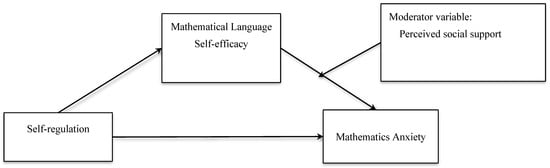
A growing body of research has examined mathematics anxiety in relation to academic achievement, performance, and self-efficacy [38]. However, the mechanisms through which key cognitive, affective, and contextual factors jointly contribute to mathematics anxiety remain insufficiently understood. In particular, prior research has typically examined self-regulation, mathematical language self-efficacy, and self-efficacy, and social support as separate predictors of mathematics anxiety [7,9,27], with limited attention to how these variables operate together within an integrated framework. Addressing this gap, the present study examines the conditional mediating role of students’ self-efficacy in mathematical language self-efficacy in the relationship between self-regulation and mathematics anxiety, as well as the moderating role of perceived academic support. By focusing on the interplay among these variables, this study aims to examine the relationships among self-regulation, mathematical language self-efficacy, academic support, and mathematics anxiety within a conditional process model. More specifically, the study seeks to identify whether mathematical language self-efficacy mediates the relationship between self-regulation and mathematics anxiety, and whether this mediating relationship varies as a function of academic support. Based on the conceptual model presented in Figure 1, the following hypotheses were formulated:
Figure 1.
The Conceptual Framework—suggested theoretical model.
H1:
Self-regulation is positively associated with mathematical language self-efficacy.
H2:
Mathematical language self-efficacy is negatively associated with mathematics anxiety.
H3:
The relationship between self-regulation and mathematics anxiety is mediated by mathematical language self-efficacy, and this indirect effect varies as a function of academic support.
The model tested in the research is shown in Figure 1.
Method
This study employed a quantitative research design based on the relational survey model, which is appropriate for examining relationships among variables and determining their strength and direction [39]. Structural equation modeling (SEM) was used to test a conditional mediation model, examining the mediating role of mathematical language self-efficacy in the relationship between self-regulation and mathematics anxiety. In addition, multi-group SEM analyses were conducted to assess measurement invariance across gender and grade level, ensuring that the measurement model operated equivalently across groups prior to structural comparisons. SEM was selected due to its ability to simultaneously test complex relationships among variables, compare alternative models, and evaluate overall model fit [39].
The conditional mediation model integrates mediation and moderation within a single analytical framework. Specifically, it examines whether the indirect effect of a predictor variable (X) on an outcome variable (Y) through a mediator (M) varies as a function of a moderator (W) [40]. In this study, perceived academic support was operationalized as a binary variable (receiving support vs. not receiving support while studying mathematics). Although this operationalization does not capture variations in the quality, source, or type of support, it was considered appropriate for the study, as it allows for a clear comparison between students with and without access to support. This aligns with the study’s aim of examining whether the presence of support conditions the strength of the indirect relationship between self-regulation and mathematics anxiety. Accordingly, the analysis focused on testing whether the effect of self-regulation on mathematics anxiety is transmitted through mathematical language self-efficacy and whether this indirect effect varies depending on the presence of academic support. For this purpose, structural equation modeling (SEM) was employed.
2.5. Participants
Participants were selected using a multi-stage cluster sampling method. Initially, seven provinces from distinct geographical regions of Turkey were randomly selected to ensure geographic diversity. Subsequently, two public middle schools were randomly selected from each province, and students were recruited from these schools. Data collection was conducted face-to-face by the research team in coordination with school administrators and teachers, during scheduled class periods. Participation was voluntary, and instruments were administered in classroom settings. This approach was adopted to enhance the representativeness of the sample across different regions. The final sample consisted of 706 middle school students. Of these, 347 (49.15%) were girls, and 359 (50.85%) were boys. The mean age of participants was 14.22 years (s.d. = 2.13). The final analytic sample reflects data screening procedures conducted before analysis.
2.6. Measures
2.6.1. Self-Regulation Scale
To measure middle school students’ self-regulation, we administered the Self-Regulation Scale developed by [41]. This 9-item scale assesses two domains, namely forethought and volitional control, and self-reflection. Sample items include statements such as “I set my goals before I start working” and “I strategize how I will learn before I start working”. Cronbach’s alpha coefficient for the full scale was 0.87. In the present study, confirmatory factor analysis further supported the adequacy of the measurement model.
2.6.2. Math Anxiety Scale
To assess students’ mathematics anxiety, we administered the adapted and validated Turkish version of the Mathematics Anxiety Scale [42]. This 26-item scale assesses five domains, namely mathematical operations anxiety, mathematics application anxiety, mathematics course anxiety, mathematics teacher anxiety, and mathematics exam anxiety. Sample items include questions such as “How excited would you be if the teacher called you to the board to solve a math problem?” and “How excited do you get after buying something and calculating how much change you should get?”. Cronbach’s alpha coefficient for the full scale was 0.94.
2.6.3. Self-Efficacy in Understanding and Using Skills in Mathematics Language Scale
The Efficacy in Understanding and Using Skills in Mathematics Language scale was developed by [41]. It is a self-report measure designed to assess students’ perceptions of their ability to understand and use mathematical language self-efficacy, rather than their actual competence. Therefore, in the present study, it is conceptualized and used as a measure of mathematical language self-efficacy. This 9-item scale assesses two domains, namely understanding mathematical language and using mathematical language. Item factor loadings ranged from 0.58 to 0.82, indicating strong construct validity. Reliability analyses yielded an internal consistency coefficient of 0.75 for the overall scale, and a Cronbach’s alpha of 0.86 was calculated for the scale in this study. Sample items include statements such as “I can understand the mathematical expression of situations represented graphically” and “I can express given real-life situations mathematically”. In the present study, confirmatory factor analysis further supported the adequacy of the measurement model.
2.7. Data Analysis
To conduct data analysis, we used SPSS (Version 24.0, IBM Corp., Armonk, NY, USA) and the R statistical software (4.4.3, R Foundation for Statistical Computing, Vienna, Austria) environment. We began by performing a missing data analysis, through which 22 observations with missing values were excluded from the initial dataset of 732 observations. The remaining 710 observations were assessed for univariate normality. Following [43], we considered skewness and kurtosis values between −1 and +1 to indicate acceptable normality. In this respect, we found that “Self-Regulation” (Skewness: 0.589; Kurtosis: 0.205), “Mathematics Anxiety” (Skewness: 0.159; Kurtosis: 0.581), and “Self-Efficacy in Understanding and Using Mathematics Language” (Skewness: −0.480; Kurtosis: 0.013) demonstrated distributions consistent with normality.
We further examined multivariate normality by calculating Mahalanobis distance coefficients and identified four extreme observations (S311, S338, S349, S508), which were subsequently removed from the dataset. The final analytic sample thus comprised 706 observations. To examine the relationships among the variables, we first conducted bivariate correlation analyses. Mediation analyses were conducted using structural equation modeling in R with the lavaan package. Indirect effects were evaluated using standardized path coefficients and bootstrapped confidence intervals. In addition, we tested the statistical significance of the mediating model using the Sobel test.
For the scales used in the study, we conducted validity and reliability analyses using both SPSS (Version 24.0, IBM Corp., Armonk, NY, USA) and LISREL(Scientific Software International, Skokie, IL, USA). We began by calculating Cronbach’s alpha coefficients to assess internal consistency. We then conducted first-order confirmatory factor analysis (CFA) to evaluate construct validity. Following the confirmation of the measurement model, measurement invariance was tested across gender and grade level using multi-group confirmatory factor analysis. Configural, metric, and scalar invariance models were sequentially evaluated using changes in CFI and RMSEA as decision criteria. These analyses were conducted in R using the lavaan package and the WLSMV estimator, appropriate for ordinal data. To determine model fit, we examined several fit indices, including X2/df, RMR, SRMR, IFI, CFI, RMSEA, GFI, and AGFI. We followed the cut-off criteria established by [44] in interpreting these indices.
3. Results
3.1. The Relationship Between Self-Regulation, Mathematics Anxiety, and Mathematical Language Self-Efficacy
Internal consistency and convergent validity of the latent constructs were examined using Cronbach’s alpha, ordinal alpha, McDonald’s omega, composite reliability (CR), and average variance extracted (AVE). All constructs demonstrated strong internal consistency, with Cronbach’s alpha values ranging from 0.85 to 0.94 and omega coefficients ranging from 0.86 to 0.95. Composite reliability values exceeded the recommended threshold of 0.70 for all constructs (CR range = 0.88 − 1.02). AVE values were close to or above the 0.50 criterion, indicating acceptable convergent validity (Table 1).
Table 1.
Reliability and Convergent Validity of the Measurement Model.
To address our first research hypothesis, we examined the bivariate relationships among middle school students’ self-regulation, mathematics anxiety, and self-efficacy in mathematical language self-efficacy. These results are presented in Table 2.
Table 2.
Bivariate correlation coefficients between variables and descriptive statistics.
As shown in Table 2, a strong positive correlation was found between self-regulation and self-efficacy in mathematical language self-efficacy (r = 0.70, p < 0.01). A small but statistically significant negative correlation was observed between self-regulation and mathematics anxiety (r = −0.07, p < 0.05). Similarly, self-efficacy in mathematical language self-efficacy was negatively correlated with mathematics anxiety (r = −0.21, p < 0.01). These findings provide preliminary support for the hypothesized relationships among the study variables.
3.2. The Mediating Role of Understanding and Using Mathematics Language in the Effect of Self-Regulation on Mathematics Anxiety
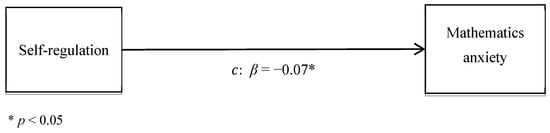
We evaluated the direct effect of self-regulation on mathematics anxiety. The results of the structural equation modeling analysis are presented in Figure 2.
Figure 2.
Total Effect of Self-Regulation on Mathematics Anxiety.
Figure 2 shows that the total effect of self-regulation on mathematics anxiety was statistically significant (path c: β = −0.07, SE = 0.03, p < 0.05), providing support for the second hypothesis. Next, the mediating role of students’ self-efficacy in mathematical language self-efficacy was examined using structural equation modeling. These findings are reported in Table 3.
Table 3.
Regression coefficients, standard errors, and model summary information for mathematical language self-efficacy as a mediator.
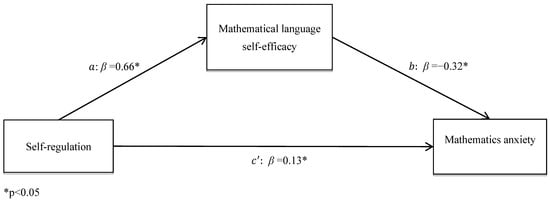
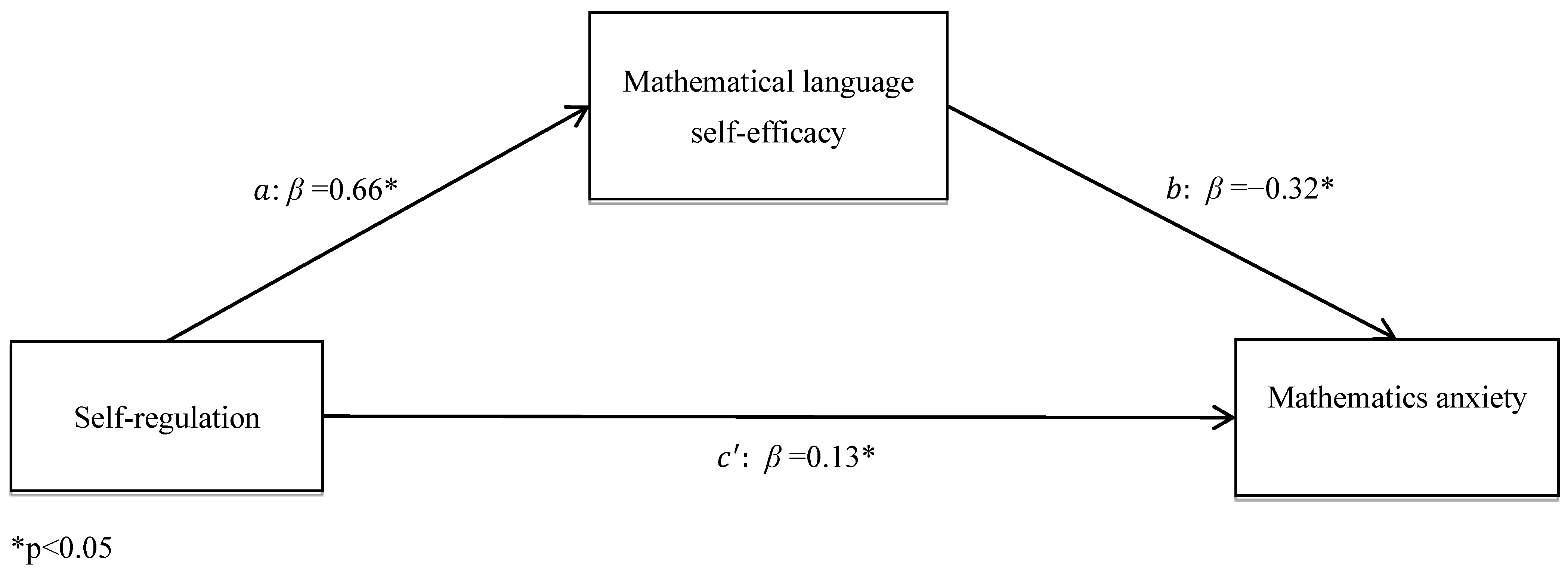
As shown in Table 3, self-regulation significantly predicted self-efficacy in mathematical language self-efficacy (path a: β = 0.66, SE = 0.02, p < 0.05). In turn, self-efficacy significantly predicted mathematics anxiety (path b: β = −0.32, SE = 0.05, p < 0.05). The indirect effect of self-regulation on mathematics anxiety via self-efficacy was also significant (path ab: β = −0.21; 95% CI [−0.29, −0.14], SE = 0.03). After accounting for the mediating effect, the direct effect of self-regulation on mathematics anxiety remained significant (path c’: β = 0.13, SE = 0.04, p < 0.05), indicating a competitive mediation (suppression) effect, as the direct effect became positive after accounting for the negative indirect pathway, suggesting the presence of opposing underlying processes. The fully standardized indirect effect size (K2 = −0.21) was both statistically significant and of moderate magnitude. Furthermore, the Sobel test confirmed the significance of the mediation effect (Sobel z = −5.91, SE = 0.03, p < 0.05). These results support the third hypothesis. The validated mediation model is shown in Figure 3.
Figure 3.
The mediating role of mathematical language self-efficacy in the effect of self-regulation on mathematics anxiety.
A suppression (or competitive mediation) effect is observed, in which the inclusion of a mediator reveals opposing underlying mechanisms that are not apparent in the total effect. This result supports the hypothesis that the predictor variable operates through multiple pathways with contrasting influences. More specifically, it is observed that self-regulation reduces anxiety by enhancing mathematical language self-efficacy. However, it is observed that (positive direct effect c’), when this pathway is controlled for, certain components of self-regulation may be associated with increased anxiety. As a robustness check, an alternative latent-variable mediation model was estimated in which mathematics anxiety was specified as the mediator between self-regulation and mathematical language self-efficacy. Although the indirect effect was statistically significant, the standardized effect size was very small (β = 0.03), indicating a negligible mediating role. In contrast, the direct effect of self-regulation on mathematical language self-efficacy remained strong. These results suggest that mathematics anxiety does not meaningfully mediate this relationship, thereby supporting the robustness of the hypothesized model (Table 4).
Table 4.
Findings Regarding the Latent Variable Mediation Analysis (Alternative Model).
3.3. Conditional Mediation Role of Mathematics Language Self-Efficacy in the Effect of Self-Regulation on Mathematics Anxiety
Results from conditional mediation analysis supported that the indirect effect of self-regulation on mathematics anxiety through self-efficacy varied depending on whether students received support while studying mathematics (Table 5).
Table 5.
Conditional mediation model formed by the variable of receiving support while studying mathematics.
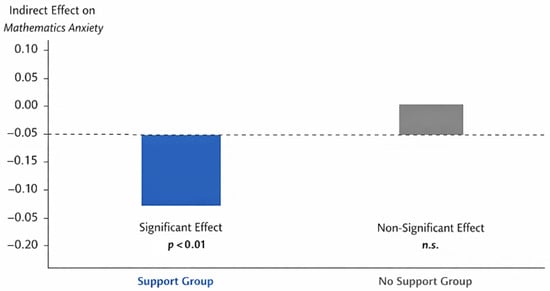
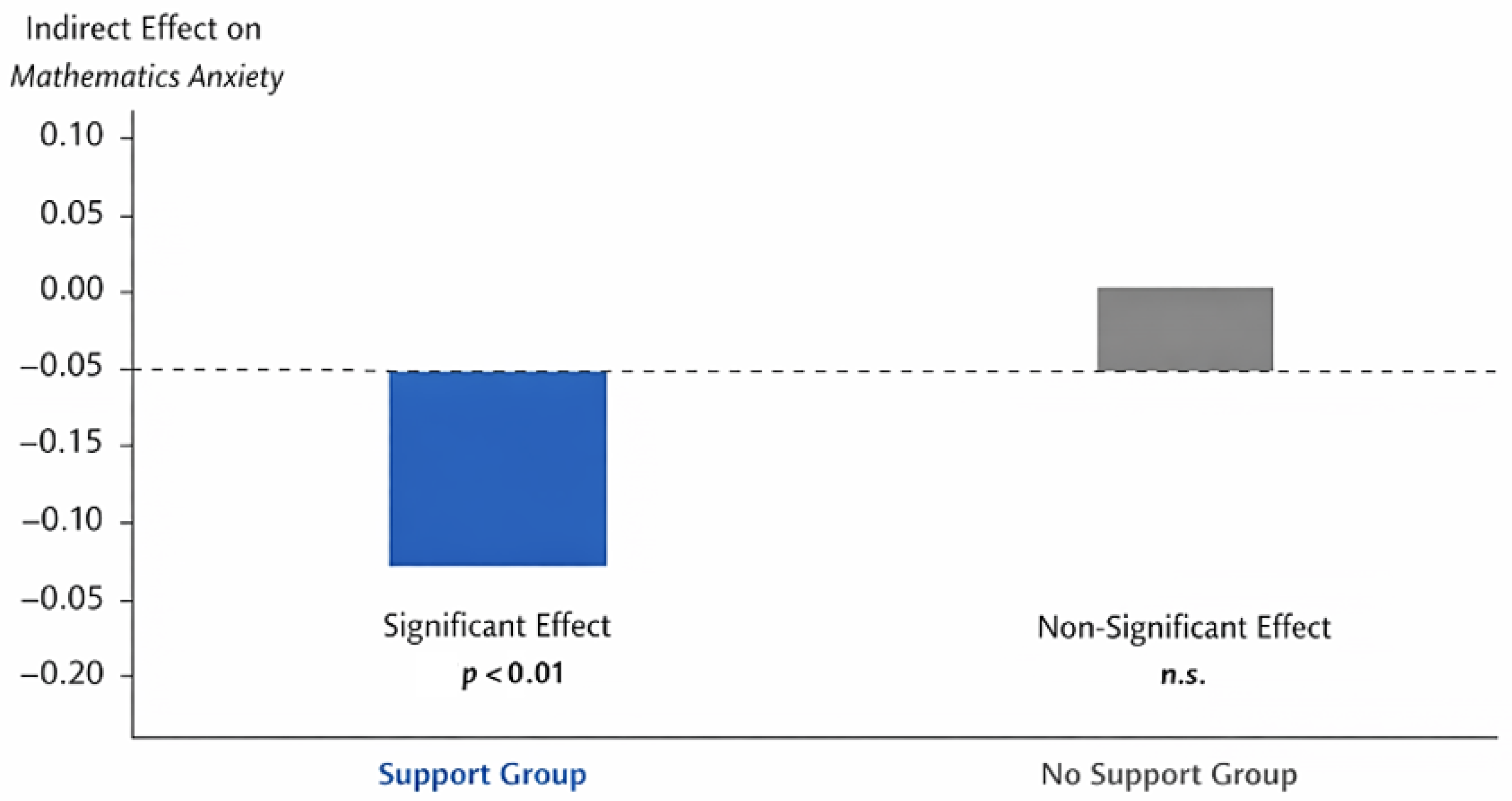
As shown in Table 4, the indirect effect of self-regulation on mathematics anxiety through self-efficacy differed significantly based on students’ reported access to support (β = 0.16 for AB, SE = 0.05, 95% CI [0.05, 0.28]). Specifically, the indirect effect was significant for students who reported receiving support (β = −0.26, SE = 0.04, 95% CI [−0.34, −0.18]), but not significant for those who did not receive support (β = −0.09, SE = 0.05, 95% CI [−0.19, 0.01]) (Figure 4).
Figure 4.
Conditional indirect effects of self-regulation on mathematics anxiety through mathematical language self-efficacy across levels of academic support.
These findings indicate that receiving support while studying moderates the mediating effect, providing support for the conditional (moderated mediation) hypothesis. Specifically, the indirect effect of self-regulation on mathematics anxiety through mathematical language self-efficacy was significant for students who reported receiving support, whereas it was non-significant for those who did not receive support. This pattern suggests that the mediating effect of mathematical language self-efficacy is present only under conditions of academic support. In contrast, for students who did not receive support, the indirect pathway was not statistically significant, indicating that the mediating mechanism was not activated in this group. Overall, these results indicate that the strength of the indirect effect varies across groups defined by access to academic support.
3.4. Measurement Invariance Across Gender and Grade Level
Measurement invariance testing indicated that configural, metric, and scalar invariance were supported across gender and grade level, as changes in fit indices between successive models were within recommended thresholds (Gender: ΔCFI ≤ 0.003 and ΔRMSEA ≤ 0.005; Grade level: ΔCFI ≤ 0.003 and ΔRMSEA ≤ 0.005) (Table 6).
Table 6.
Measurement invariance fit indices across gender and grade level.
Finally, a post hoc power analysis indicated that the sample size of the present study was adequate to detect small effect sizes. Specifically, the analysis showed that the study had 80% statistical power to detect correlations as small as r = 0.11 at α = 0.05, supporting the robustness of the reported findings.
4. Discussion
One of the most critical findings of the present study is the emergence of a suppression (competitive mediation) effect, as indicated by the opposite signs of the direct and indirect effects, a pattern widely documented in the mediation literature when multiple underlying mechanisms operate simultaneously [46]. While the total effect of self-regulation on mathematics anxiety was negative, suggesting that self-regulation is generally associated with reduced anxiety, the direct effect became positive after controlling for mathematical language self-efficacy, indicating the presence of competing pathways [25,28]. This finding suggests that the relationship between self-regulation and mathematics anxiety is not uniform, but instead reflects a complex interplay of mechanisms that may operate differently depending on contextual and individual conditions.
More specifically, the negative indirect effect suggests that self-regulation may reduce mathematics anxiety by enhancing students’ confidence in their ability to understand and use mathematical language, a relationship consistently supported in prior research [7,29] Students who effectively regulate their learning are more likely to engage with mathematical representations, interpret terminology accurately, and construct meaning from symbolic expressions, processes that have been linked to reduced uncertainty and lower anxiety [6,37]. As their confidence in mathematical language increases, mathematical tasks become more predictable and controllable, which reduces emotional distress and facilitates engagement [5].
This relationship can be further specified by considering the role of self-regulation in supporting different dimensions of mathematical language competence, including mathematical writing, problem comprehension, and conceptual understanding [26]. Students with well-developed self-regulation are more likely to plan their approach, monitor their understanding, identify gaps in knowledge, and engage in self-evaluation, processes that are critical for the development of mathematical language self-efficacy [26]. These findings suggest that mathematical language is not simply an outcome of learning, but an active process shaped by regulatory behaviors.
At the same time, the positive direct effect indicates that certain dimensions of self-regulation may be associated with increased anxiety under specific conditions, particularly when regulatory effort is not supported by sufficient domain-specific competence [25,28]. Self-regulation involves processes such as self-monitoring, performance evaluation, and sustained cognitive effort, which may heighten awareness of errors and performance expectations [8]. When students lack confidence in their ability to understand mathematical language, these processes may amplify uncertainty and performance-related stress, thereby increasing anxiety [5,6]. In this sense, self-regulation may function as a double-edged mechanism, supporting learning under favorable conditions but increasing pressure when cognitive and linguistic resources are insufficient.
This dual-process interpretation suggests that self-regulation should not be conceptualized as uniformly adaptive, but rather as a multidimensional construct whose effects depend on the alignment between internal processes and contextual support [25,28]. In such cases, self-regulation efforts may remain procedurally active but cognitively unproductive, meaning that students attempt to regulate their learning without successfully constructing meaning. This distinction helps explain why increased effort does not always lead to improved outcomes and may, in some cases, intensify anxiety.
A second major finding of the study concerns the conditional nature of the mediating effect. Specifically, the indirect effect of self-regulation on mathematics anxiety through mathematical language self-efficacy was significant only for students who reported receiving academic support, whereas it was not significant for those who did not receive support. This finding highlights that self-regulation alone may not be sufficient to reduce mathematics anxiety, particularly in the absence of supportive learning environments [5,9].
From an inclusive education perspective, this finding is especially important because it demonstrates that internal resources such as self-regulation do not operate in isolation, but depend on external conditions that enable their effective use. In classrooms characterized by diversity in learning needs, linguistic backgrounds, and cognitive profiles, students may require differentiated forms of support in order to benefit from self-regulation strategies [6]. Students who lack such support may be at risk of being excluded from the benefits of self-regulated learning, even if they possess regulatory potential.
This result can be further understood by considering the distinction between general and domain-specific processes. Self-regulation provides learners with general strategies such as planning, monitoring, and evaluation; however, successful engagement with mathematics requires the ability to interpret and use specialized mathematical language, which often poses challenges for students [37]. Academic support may serve as a bridge between these general regulatory processes and the specific cognitive demands of mathematical language, enabling students to apply their strategies more effectively [5,6].
When such support is available, students may receive guidance, feedback, and scaffolding that help them focus on relevant information, interpret mathematical terminology, and regulate their learning more effectively. Through this process, self-regulation can be transformed into meaningful understanding, which strengthens mathematical language self-efficacy and reduces anxiety [29]. From a classroom perspective, this suggests that self-regulation should be explicitly taught and supported through structured instructional practices. For example, teachers may guide students to set specific problem-solving goals, monitor their understanding during tasks (e.g., “Do I understand what this symbol represents?”), and reflect on their solutions after completing an activity. The use of structured worksheets, self-check prompts, and reflection questions may support the systematic development of these skills.
In contrast, when academic support is absent, this process may fail to occur. Students may attempt to regulate their learning, but without sufficient guidance, they may be unable to determine whether their interpretations are accurate or their strategies are appropriate [7]. As a result, self-regulatory efforts may remain procedural rather than conceptual, preventing the development of mathematical language self-efficacy [29]. This misalignment between regulatory processes and domain-specific demands interrupts the pathway through which self-regulation would otherwise reduce anxiety.
From a cognitive perspective, this breakdown can also be explained in terms of cognitive load. In the absence of support, students must simultaneously regulate their learning processes and interpret complex mathematical language, a combination that may exceed their cognitive capacity [6,37]. This dual demand may reduce the effectiveness of self-regulation and contribute to increased frustration and anxiety [5]. Under such conditions, self-regulation may no longer function as a protective factor, but may instead intensify cognitive and emotional strain.
From a sociocultural perspective, the absence of academic support reflects a lack of scaffolding that would normally facilitate the internalization of cognitive and linguistic processes [22,23]. Without guidance, feedback, or modeling, students may struggle to bridge the gap between their regulatory intentions and their actual understanding of mathematical content, resulting in ineffective learning and increased anxiety [6].
These findings are particularly relevant for inclusive education, as they suggest that students who rely solely on internal resources may be disadvantaged in the absence of structured support. Students with learning difficulties, limited language proficiency, or limited access to academic assistance may be especially vulnerable, as they may struggle to interpret mathematical language and apply self-regulation strategies effectively [9]. When students are unable to follow classroom discourse or feel disconnected from the mathematical language used during instruction, their anxiety may increase [17].
The significant negative relationship between mathematical language self-efficacy and mathematics anxiety further underscores the importance of language in shaping students’ emotional experiences in mathematics [7,29]. Students who feel confident in their ability to interpret and use mathematical language are more likely to perceive tasks as manageable and controllable, thereby reducing anxiety [37]. In contrast, difficulties in understanding mathematical language may disrupt comprehension, reduce perceived competence, and increase emotional distress [31].
Within the framework of self-regulated learning theory, this mediating relationship reflects the process through which cognitive and metacognitive regulation influence emotional outcomes [22,23]. Self-regulation facilitates engagement with task-relevant representations, such as mathematical language, which in turn enhances perceived competence and reduces uncertainty [25]. In this sense, mathematical language self-efficacy functions as a cognitive-affective interface that connects learning processes with emotional experiences. Importantly, the effectiveness of this mechanism depends on the presence of supportive learning conditions. Academic support does not merely reduce anxiety directly, but enhances the functional impact of internal resources by guiding attention, providing feedback, and facilitating meaning-making processes [5,6]. In contrast, when support is absent, self-regulatory efforts may remain insufficiently directed, limiting their influence on both self-efficacy and emotional outcomes.
Taken together, these findings suggest that the relationship between self-regulation and mathematics anxiety is not solely an individual cognitive process, but rather the result of an interaction between internal regulatory resources and external contextual support. In this sense, self-regulation may be necessary but not sufficient for reducing mathematics anxiety. Its effectiveness depends on the extent to which learners are supported in translating regulatory strategies into meaningful engagement with mathematical language. Importantly, both mathematics anxiety and mathematical language competence develop over time through accumulated learning experiences rather than as short-term outcomes. Students who gradually develop stronger proficiency in mathematical language are more likely to experience lower levels of anxiety, suggesting a developmental dimension in this relationship.
Furthermore, the relationship between self-regulation and mathematics anxiety may be embedded within a broader network of variables. Previous research has suggested that mathematics anxiety may also mediate relationships between motivation and problem-solving performance [47]. This indicates that the present findings represent part of a more complex system involving multiple cognitive and affective processes. Overall, the present findings suggest that mathematics anxiety emerges from the dynamic interplay between cognitive processes, affective experiences, and contextual factors, rather than from any single variable in isolation [20,21]. By integrating these dimensions within a unified framework, the study contributes to a more comprehensive and nuanced understanding of mathematics anxiety, particularly within inclusive educational settings.
5. Conclusions
In conclusion, the findings demonstrate that mathematics anxiety is shaped by a conditional process in which self-regulation operates through mathematical language self-efficacy and depends on the presence of academic support. This highlights the importance of designing inclusive mathematics instruction that integrates cognitive, linguistic, and contextual support.
6. Implications and Future Research
The findings of the present study have several practical implications for classroom practice and instructional design. First, the findings suggest that mathematical language should be explicitly taught as a core component of mathematics instruction rather than being treated as implicit knowledge. Curriculum designers are encouraged to integrate structured mathematical vocabulary modules into instructional materials, including pre-teaching of key terms, use of visual word walls, and systematic activities that require students to translate between verbal descriptions, symbolic expressions, and graphical representations. This may include pre-teaching key vocabulary before introducing new topics, using visual word walls with mathematical terms, and engaging students in activities that require them to explain concepts in their own words. Teachers can also design tasks that require students to translate between verbal descriptions, symbolic expressions, and graphical representations, thereby strengthening their understanding of mathematical language.
Second, the findings indicate that self-regulation training should not be implemented in isolation, but should be systematically paired with structured academic support. For example, self-regulation strategies (e.g., goal setting, self-monitoring, and reflection) can be embedded within guided instructional practices such as peer tutoring, teacher-led scaffolding, and collaborative problem-solving activities. More specifically, pairing students in structured peer-assisted learning formats or providing step-by-step guided problem-solving frameworks can help ensure that self-regulatory efforts are effectively translated into an understanding of mathematical language. This combination appears to be critical, as the present findings suggest that self-regulation alone may not reduce mathematics anxiety in the absence of support. For example, during problem-solving activities, teachers can provide partially completed examples, ask guiding questions, and gradually reduce support as students gain confidence. Peer tutoring and small-group instruction can also be used to provide additional support for students who need it. Also, teachers could pair self-regulation strategies (e.g., goal setting, self-monitoring, reflection) with peer tutoring, guided practice, or teacher-led scaffolding to ensure that students are able to apply these strategies effectively in mathematical contexts. This combination may help students translate their regulatory efforts into meaningful understanding and increased confidence in mathematical language.
Third, classroom practices should create opportunities for supported engagement with mathematical language, particularly for students who may lack access to external support outside the classroom. This could include collaborative problem-solving activities, structured classroom dialog, and targeted feedback on students’ use of mathematical terminology and representations. Such practices may be especially important for students with high levels of mathematics anxiety, as they provide both cognitive and emotional support.
Overall, the findings are particularly relevant for inclusive mathematics classrooms, where students may differ in their self-regulatory capacities, language abilities, and access to support. To address this diversity, teachers can adopt differentiated instructional practices, such as providing multiple entry points to tasks, offering alternative explanations, and using flexible grouping strategies. For instance, some students may benefit from visual supports and guided instruction, while others may be ready for more independent problem-solving. By combining explicit instruction in mathematical language, structured self-regulation strategies, and differentiated support, teachers can create inclusive learning environments that reduce mathematics anxiety and promote meaningful engagement for all students.
To further translate the findings of the present study into classroom practice, Table 7 presents a set of targeted instructional applications aligned with inclusive mathematics education principles. Specifically, the table illustrates how the relationships identified in the model, namely the roles of self-regulation, mathematical language self-efficacy, and academic support, can be operationalized in mathematics teaching. Emphasis is placed on concrete instructional strategies that support diverse learners, including students with SLD, by integrating structured guidance, explicit language support, and differentiated instruction.
Table 7.
Linking study findings to classroom applications in inclusive mathematics education (with a focus on students with SLD).
The examples included in the table are drawn from common mathematical domains (e.g., algebra, fractions, and word problems), ensuring that the proposed strategies are directly applicable to everyday classroom instruction. More specifically, the instructional applications presented in Table 7 are directly derived from the hypothesized model, reflecting the mediating role of mathematical language self-efficacy and the conditional nature of this mechanism as a function of academic support, thereby illustrating how the identified pathways can be translated into inclusive mathematics teaching practices.
As shown in Table 7, the findings of the study can be systematically translated into concrete instructional practices that address both cognitive and affective dimensions of mathematics learning. More specifically, the results indicate that reducing mathematics anxiety requires not only the development of internal resources such as self-regulation, but also the explicit teaching of mathematical language and the provision of structured support during key mathematical tasks. These practices are particularly critical in inclusive mathematics classrooms, where students with learning disabilities may experience difficulties in processing mathematical language, regulating their learning, and managing cognitive load. By aligning instructional strategies with these mechanisms, teachers can create learning environments that both reduce anxiety and enhance access to mathematical understanding.
These practices are particularly important in inclusive classrooms, where students may differ in their linguistic, cognitive, and self-regulatory capacities. Providing differentiated levels of support, such as visual representations, simplified language explanations, or additional guided practice, may help ensure that all students can benefit from self-regulation strategies and develop mathematical language self-efficacy.
7. Limitations
The present study has several limitations that should be acknowledged. First, the cross-sectional nature of the data limits the ability to draw definitive causal conclusions. Although structural equation modeling (SEM) allows for the testing of theoretically specified relationships, it does not establish causality. Therefore, the directionality of the observed relationships should be interpreted cautiously, as alternative causal pathways cannot be ruled out. Future research employing longitudinal or experimental designs is needed to more rigorously examine the causal mechanisms underlying the relationships identified in this study. Although the proposed model is theoretically grounded and the statistical analyses support the hypothesized relationships, the directionality of these effects cannot be firmly established. This limitation was partially mitigated by the use of a well-specified theoretical framework and advanced analytical techniques, including structural equation modeling with bootstrapping, to enhance the robustness of the estimated relationships. Future research employing longitudinal designs is needed to confirm the developmental trajectory of the relationships among self-regulation, mathematical language self-efficacy, academic support, and mathematics anxiety over time.
A key limitation of the present study concerns the measurement of academic support as a single-item binary variable. This operationalization does not capture the complexity of support, such as its quality, frequency, or source (e.g., teachers, peers, or family members). However, this limitation was partially addressed by the study’s large and geographically diverse sample, as well as the use of structural equation modeling with bootstrapping procedures, which enhance the robustness of the estimated indirect effects. In addition, the binary operationalization allowed for a clear comparison between students with and without access to support, aligning with the study’s focus on whether the presence of support conditions the strength of the mediation pathway. Nevertheless, the findings related to the moderating role of support should be interpreted with caution. Future research could benefit from using multi-dimensional measures of academic support to better capture qualitative differences in support experiences.
Another limitation concerns the use of measurement instruments developed by [41], for which limited external validation evidence is available in the broader literature. Although the scales demonstrated strong internal consistency and acceptable construct validity in the present study, their use may limit the generalizability of the findings across different contexts. This limitation was partially mitigated by conducting confirmatory factor analysis and measurement invariance testing across gender and grade level, which supported the robustness and stability of the measurement model. Nevertheless, future research is encouraged to replicate these findings using more widely established instruments.
Moreover, the selection of moderating variables in the relationship between self-regulation and mathematics anxiety was limited to gender, grade level, and receipt of social support. Future studies might expand upon this work by including additional moderating variables, such as academic achievement or metacognitive skills. These lines of inquiry could be further enriched by subsequent experimental studies. For instance, researchers might examine changes in mathematics anxiety among individuals with low self-regulation by implementing self-regulation training interventions, particularly in cases where social support is lacking.
Author Contributions
Conceptualization, M.Ö. and K.A.Y.; methodology, M.Ö., K.A.Y. and G.C.; software, M.Ö., K.A.Y. and G.C.; validation, M.Ö., K.A.Y. and G.C.; formal analysis, M.Ö., K.A.Y. and G.C.; investigation, M.Ö., K.A.Y. and G.C.; resources, M.Ö., K.A.Y. and G.C.; data curation, M.Ö., K.A.Y. and G.C.; writing—original draft preparation, M.Ö., K.A.Y. and G.C.; writing—review and editing, M.Ö., K.A.Y. and G.C.; visualization, M.Ö., K.A.Y. and G.C.; supervision, M.Ö., K.A.Y. and G.C.; project administration, M.Ö., K.A.Y. and G.C.; funding acquisition, M.Ö. and K.A.Y. All authors have read and agreed to the published version of the manuscript.
Funding
This work was financially supported by the Scientific and Technological Research Council of Turkey (TÜBİTAK) under grant number 121K859.
Institutional Review Board Statement
The study was conducted in accordance with the Declaration of Helsinki, and approved by the Ethics Committee of University of Bayburt (protocol code 36868 and 14 October 2021).
Informed Consent Statement
Informed consent was obtained from all individual participants included in the study. There are no identifying images or other personal or clinical details of participants that compromise the anonymity of the participants. For the participants’ individual data in any form, written consent to publish was obtained from all parents.
Data Availability Statement
The datasets analyzed during the current study are available from the corresponding author on reasonable request.
Acknowledgments
We acknowledge all students enrolled in the study.
Conflicts of Interest
The authors declare that they have no conflict of interest.
References
- Antoniou, A.S.; Charitaki, G.; Pavlidou, K.; Alevriadou, A. Examining the Relationships Among Burnout, Mathematics Self-Efficacy, Anxiety, and Mathematical Competence in Primary and Secondary Students with Dyscalculia. Educ. Sci. 2025, 16, 48. [Google Scholar] [CrossRef] [Scilit]
- Charitaki, G.; Andreou, G.; Alevriadou, A.; Soulis, S.G. Assessing Causal Links Between Mathematics Teaching Efficacy, Attitudes Towards Inclusion, and Efficacy in Implementing Inclusive Practices: A Cross-Lagged Panel Autoregressive Model Analysis. Educ. Sci. 2026, 16, 267. [Google Scholar] [CrossRef] [Scilit]
- Radević, L.; Milovanović, I. Current Trends in Math Anxiety Research: A Bibliometric Approach. Int. J. Sci. Math. Educ. 2023, 22, 1345–1362. [Google Scholar] [CrossRef] [Scilit]
- Jamaludin, A.; Jabir, A.I.; Wang, F.; Tan, A.L. Low-progress math in a high-performing system: The role of math anxiety in Singapore’s elementary learners. Asia-Pac. Educ. Res. 2024, 33, 1071–1082. [Google Scholar] [CrossRef] [Scilit]
- Putwain, D.W.; Wood, P. Anxiety in the mathematics classroom: Reciprocal relations with control and value, and relations with subsequent achievement. ZDM–Math. Educ. 2023, 55, 285–298. [Google Scholar] [CrossRef] [Scilit]
- Ryan, M.; Fitzmaurice, O.; Johnson, P. Investigating mathematics anxiety among mature students in service mathematics courses using the Mathematics Anxiety Scale UK. Int. J. Math. Educ. Sci. Technol. 2025, 56, 4–28. [Google Scholar] [CrossRef] [Scilit]
- Hiller, S.E.; Kitsantas, A.; Cheema, J.E.; Poulou, M. Mathematics anxiety and self-efficacy as predictors of mathematics literacy. Int. J. Math. Educ. Sci. Technol. 2022, 53, 2133–2151. [Google Scholar] [CrossRef] [Scilit]
- Kramarski, B.; Weisse, I.; Kololshi-Minsker, I. How can self-regulated learning support the problem-solving of third-grade students with mathematics anxiety? ZDM Math. Educ. 2010, 42, 179–193. [Google Scholar] [CrossRef] [Scilit]
- Sultan, S.; Amin, R.; Naseem, M.S. Math achievement as a function of math anxiety and perceived teachers’ social support among elementary students. Bahria J. Prof. Psychol. 2015, 14, 32–43. [Google Scholar]
- Ramirez, G.; Gunderson, E.A.; Levine, S.C.; Beilock, S.L. Math anxiety, working memory, and math achievement in early elementary school. J. Cogn. Dev. 2013, 14, 187–202. [Google Scholar] [CrossRef] [Scilit]
- Marušić, I.; Matić, J. The role of personality, self-concept, and defensive motivation in predicting maths anxiety. In Stress and Anxiety: Coping and Resilience; Moore, K.A., Buchwald, P., Eds.; Logos Verlag Berlin GmbH: Berlin, Germany, 2017; pp. 95–103. [Google Scholar]
- Avancini, C.; Szucs, D. Psychophysiological correlates of mathematics anxiety. In Mathematics Anxiety: What is Known and What is Still to Be Understood; Mammarella, I.C., Caviola, S., Dowker, A., Eds.; Routledge: Oxfordshire, UK, 2019; pp. 42–61. [Google Scholar]
- Supekar, K.; Iuculano, T.; Chen, L.; Menon, V. Remediation of childhood math anxiety and associated neural circuits through cognitive tutoring. J. Neurosci. 2015, 35, 12574–12583. [Google Scholar] [CrossRef] [Scilit] [PubMed]
- Milovanović, I. Math anxiety, math achievement and math motivation in high school students: Gender effects. Croat. J. Educ. 2020, 22, 175–206. [Google Scholar] [CrossRef] [Scilit]
- Ashcraft, M.H. Math anxiety: Personal, educational, and cognitive consequences. Curr. Dir. Psychol. Sci. 2002, 11, 181–185. [Google Scholar] [CrossRef] [Scilit]
- Tobias, S.; Weissbrod, C. Anxiety and mathematics: An update. Harv. Educ. Rev. 1980, 50, 63–70. [Google Scholar] [CrossRef] [Scilit]
- Öztürk, M. Mantıksal akıl yürütme [Logical reasoning]. In Akıl Yürütme ve Üstbiliş [Reasoning and Metacognition]; Erdem, E., Ed.; Pegem Akademi: İzmir, Turkey, 2022; pp. 275–294. [Google Scholar]
- Caviola, S.; Toffalini, E.; Giofrè, D.; Ruiz, J.M.; Szűcs, D.; Mammarella, I.C. Math performance and academic anxiety forms, from sociodemographic to cognitive aspects: A meta-analysis on 906,311 participants. Educ. Psychol. Rev. 2022, 34, 363–399. [Google Scholar] [CrossRef] [Scilit]
- Organization for Economic Cooperation and Development. PISA 2022 Results: The State of Learning and Equity in Education; OECD Publishing: Paris, France, 2023. [Google Scholar]
- Barroso, C.; Ganley, C.M.; McGraw, A.L.; Geer, E.A.; Hart, S.A.; Daucourt, M.C. A meta-analysis of the relation between math anxiety and math achievement. Psychol. Bull. 2021, 147, 134–168. [Google Scholar] [CrossRef] [Scilit]
- Zhang, J.; Zhao, N.; Kong, Q.P. The relationship between math anxiety and math performance: A meta-analytic investigation. Front. Psychol. 2019, 10, 1613. [Google Scholar] [CrossRef] [Scilit]
- Villavicencio, F.T.; Bernardo, A.B.I. Beyond math anxiety: Positive emotions predict mathematics achievement, self-regulation, and self-efficacy. Asia-Pac. Educ. Res. 2016, 25, 415–422. [Google Scholar] [CrossRef] [Scilit]
- Veenman, M.V.J.; Kerseboom, L.; Imthorn, C. Test anxiety and metacognitive skillfulness: Availability versus production deficiencies. Anxiety Stress Coping 2000, 13, 391–412. [Google Scholar] [CrossRef] [Scilit]
- Sweller, J. Cognitive load during problem solving: Effects on learning. Cogn. Sci. 1988, 12, 257–285. [Google Scholar] [CrossRef]
- Buzzai, C.; Filippello, P.; Puglisi, B.; Mafodda, A.V.; Sorrenti, L. The relationship between mathematical achievement, mathematical anxiety, perfectionism and metacognitive abilities in Italian students. Mediterr. J. Clin. Psychol. 2020, 8, 1–18. [Google Scholar] [CrossRef]
- Hughes, E.M.; Lee, J.Y.; Cook, M.J.; Riccomini, P.J. Exploratory study of a self-regulation mathematical writing strategy: Proof-of-concept. Learn. Disabil. A Contemp. J. 2019, 17, 185–203. [Google Scholar]
- Ader, E.; Erktin, E. Coping as self-regulation of anxiety: A model for math achievement in high-stakes tests. Cogn. Brain Behav. Interdiscip. J. 2010, 14, 311–332. [Google Scholar]
- Weissgerber, S.C.; Grünberg, C.; Neufeld, L.; Steppat, T.; Reinhard, M.-A. The interplay of math anxiety and math competence for later performance. Soc. Psychol. Educ. 2022, 25, 977–1002. [Google Scholar] [CrossRef] [Scilit]
- Donolato, E.; Giofrè, D.; Mammarella, I.C. Working memory, negative affect, and personal assets: How do they relate to mathematics and reading literacy? PLoS ONE 2019, 14, e0218921. [Google Scholar] [CrossRef] [Scilit]
- Gabriel, F.; Buckley, S.; Barthakur, A. The impact of mathematics anxiety on self-regulated learning and mathematical literacy. Aust. J. Educ. 2020, 64, 227–242. [Google Scholar] [CrossRef] [Scilit]
- Jackson, C.D.; Leffingwell, R.J. The role of instructors in creating mathematics anxiety in students from kindergarten through college. Math. Teach. 1999, 92, 583–586. [Google Scholar] [CrossRef] [Scilit]
- Dai, L.; Jin, W.; Zhu, B.; Liao, R.; Xu, G.; Jiang, H.; Guan, J. Exploring the role of social media in mathematics learning: Effects on self-efficacy, interest, and self-regulation. BMC Psychol. 2025, 13, 829. [Google Scholar] [CrossRef] [Scilit]
- Sacco, D.M.; Spies, T.; Pfannenstiel, K. Scaffolding language for learning in mathematics for English learners receiving intensive intervention. Learn. Disabil. Res. Pract. 2022, 37, 204–215. [Google Scholar] [CrossRef] [Scilit]
- Cai, J.; De Backer, F.; Vandermeersche, G.; Li, S.; Lombaerts, K. Unpacking the effect of classroom social environment on self-regulated learning in mathematical education: The mediation of self-efficacy. Educ. Stud. Math. 2026, 3, 1–23. [Google Scholar] [CrossRef] [Scilit]
- Guntur, M.; Purnomo, Y.W. Unravelling the interplay of self-efficacy, self-regulation, metacognition in alleviating math anxiety among primary school student: A conditional process analysis. Education 3–13 2024, 4, 1–17. [Google Scholar] [CrossRef] [Scilit]
- Lindner, K.T.; Schwab, S. Differentiation and individualisation in inclusive education: A systematic review and narrative synthesis. Int. J. Incl. Educ. 2025, 29, 2199–2219. [Google Scholar] [CrossRef] [Scilit]
- Ramirez, G.; Shaw, S.T.; Maloney, E.A. Math anxiety: Past research, promising interventions, and a new interpretation framework. Educ. Psychol. 2018, 53, 145–164. [Google Scholar] [CrossRef] [Scilit]
- Alkan, V. A systematic review research: ‘mathematics anxiety’ in Turkey. Int. J. Assess. Tools Educ. 2018, 5, 567–592. [Google Scholar] [CrossRef] [Scilit]
- Schreiber, J.B.; Nora, A.; Stage, F.K.; Barlow, E.A.; King, J. Reporting structural equation modeling and confirmatory factor analysis results: A review. J. Educ. Res. 2006, 99, 323–338. [Google Scholar] [CrossRef] [Scilit]
- Gürbüz, S. Sosyal Bilimlerde Aracı ve Düzenleyici Etki Analizleri [Agent, Moderator and Conditional Impact Analyses in Social Sciences]; Seçkin Publishing: Ankara, Turkey, 2019. [Google Scholar]
- Öztürk, M.; Albayrak, S.; Albayrak, M. Developing the scale of understanding and using language of mathematics: A validity and reliability study. Gümüşhane Univ. J. Soc. Sci. 2023, 14, 564–574. [Google Scholar]
- Baloğlu, M.; Balgalmiş, E. Matematik kaygısını derecelendirme ölçeği ilköğretim formu’nun Türkçe’ye uyarlanması, dil geçerliği ve psikometrik incelemesi. Kuram Ve Uygulamada Eğitim Bilim. 2010, 10, 77–110. [Google Scholar]
- Çokluk, Ö.; Şekercioğlu, G.; Büyüköztürk, Ş. Sosyal Bilimler Için Çok Değişkenli Istatistik SPSS ve LISREL Uygulamaları [SPSS and LISREL Applications of Multivariate Statistics for the Social Sciences]; Pegem Academy: Istanbul, Turkey, 2016. [Google Scholar]
- Schumacker, R.E.; Lomax, R.G. A Beginner’s Guide to Structural Equation Modeling; Routledge: New York, NY, USA, 2010; pp. 73–120. [Google Scholar]
- Fornell, C.; Larcker, D.F. Evaluating structural equation models with unobservable variables and measurement error. J. Mark. Res. 1981, 18, 39–50. [Google Scholar] [CrossRef] [Scilit]
- MacKinnon, D.P.; Krull, J.L.; Lockwood, C.M. Equivalence of the mediation, confounding and suppression effect. Prev. Sci. 2000, 1, 173–181. [Google Scholar] [CrossRef] [Scilit]
- Strohmaier, A.R.; Schiepe-Tiska, A.; Chang, Y.P.; Müller, F.; Lin, F.L.; Reiss, K.M. Comparing eye movements during mathematical word problem solving in Chinese and German. ZDM–Math. Educ. 2020, 52, 45–58. [Google Scholar] [CrossRef] [Scilit]


Disclaimer/Publisher’s Note: The statements, opinions and data contained in all publications are solely those of the individual author(s) and contributor(s) and not of MDPI and/or the editor(s). MDPI and/or the editor(s) disclaim responsibility for any injury to people or property resulting from any ideas, methods, instructions or products referred to in the content. |
© 2026 by the authors. Licensee MDPI, Basel, Switzerland. This article is an open access article distributed under the terms and conditions of the Creative Commons Attribution (CC BY) license.