


Abstract
Although sexuality education is delivered in schools, Chinese adolescents’ preferred sources may still be inconsistent with where they currently receive sex education. Based on two theories (Objectivism and Sex-Positivity) that emphasize the use of information and rational choice in seeking information with a desire to learn more, this explanatory study analyses survey data on sexual health topics, the sources Chinese adolescents used and preferred, and the gender differences in how they seek information on sexual topics. From 17 secondary schools, Chinese adolescents in Hong Kong, aged 14–18 (n = 4869), took a 51-question survey on sexual risks and sex education sources conducted by a local agency. Using the secondary dataset, a discrepancy score was computed by matching 15 actually used and 15 preferred sources for getting sexual knowledge listed in the survey. The discrepancy scores were shifted along the X-axis to eliminate negative values and create the dependent variable, ‘Discrepancy-S’, which ranged from 1 to 11, where 1 = no discrepancy, and 11 = wide discrepancy (Cronbach Alpha = 0.750). The higher the score, the higher the discrepancy. Regression results indicated that the youth’s prior coitus and different information sources (except school) could explain the “use–prefer” discrepancy. Although these adolescents regarded parents as the primary sex educators, most did not consult with their families. They preferred electronic media and peers as their top “go-to” choices. Sex education should come from sources that teenagers rely on and choose to access. Personal responsibility must be explicitly discussed in various sexual health sources as teens prepare for transitions to adulthood.
1. Introduction
Researchers have noted an increase in risky sexual behaviours among Chinese adolescents in Hong Kong [1,2,3]. The Family Planning Association of Hong Kong (FPAHK) [4] reported that, from 1991 to 2016, the proportion of male teens who had sexual intercourse increased more than 12 times (from 1.2% to 14.1%) and that of female teens increased more than 40 times (from 0.2% to 8.3%). In 2021, these percentages were reduced to 5.7% for boys and 4.2% for girls. However, 10% of Hong Kong youth had experienced high-risk sexual behaviours such as multiple sex partners, running against the risk of STD and HIV/AIDS [2].
1.1. History of Sex Education in Hong Kong
Although Hong Kong began its Early Childhood Sexuality Education Development Project in 2001, many advocates criticized its lack of comprehensiveness, particularly in age-appropriate and gender-specific content [5,6]. Since 2011, sex education has been part of the educational directives in Hong Kong. Legislation was enacted to require sex education from kindergarten to secondary school to provide developmentally appropriate information for preventing sexual abuse [7]. Due to the cultural belief that sex is a taboo topic, the Hong Kong government has applied its best effort to normalize sex education topics discussed within the school system [8]. This future-oriented idea aims to dispute the thinking that sexual health is associated with high-risk sexual behaviours and sexually transmitted diseases (STDs) [9].
Public health studies with data from 2005 to 2019 estimated STD prevalences of 4–5% among adolescents (aged 15-24 years) in China, but these rates vary depending on reporting sources [6]. This statistic increased significantly and persisted until the COVID-19 pandemic hit the country in 2020 [10]. The 2020 policy for compulsory sex education in schools continues its efforts to reduce risky actions and consequences in youth transitioning into adulthood. Still, it has invited public debates due to backlash from concerned parents [6,11]. Even with the continuation of this provision mandate, Hong Kong studies have started to evaluate attitudes and the timing of sex education preferences among Chinese preteens [12]. Adolescents’ preferred choices, however, may be inconsistent with where they currently receive sex education. This explanatory study analyses survey data on sexual health topics and sources that Chinese secondary school adolescents used and preferred; it also compares gender differences in how they seek information on sexual topics.
1.2. Sexual Health Responsibility
Historically, sex education has been under-prioritized in Hong Kong [6]. Sex education provided in schools has been integrated into the general curriculum rather than taught as a discrete subject [13]. While formal guidelines have existed since 1997 to guide content and curriculum, sex education was not established as a universal educational requirement [14]. Cultural norms advocate for formalized sexual relations within the confines of marriage and prioritize premarital chastity [15]. The responsibility for sex education now devolves onto parents as “the core people who accompany their children as they grow up” [16]. Even when parents are considered the most appropriate sex educators, only 59% of girls (n = 3713) and 42% of boys (n = 4630) in secondary school years obtained sexual health knowledge from family members [3].
Although the Hong Kong AIDS Concern study [17] showed that these numbers have skyrocketed to 17.5% among women, and there was little growth in the male statistics, which is primarily attributed to the mores that describe women as “easy” if they ask a partner to use a condom. According to the FPAHK report [3], 17.7% of girls and 26.4% of boys agreed that 16 should be the legal age of consent; however, many of them (18.4% of girls and 22.3% boys) disagreed with providing contraceptive services to unmarried youths. To counteract the spread of STDs and unguarded sex, there has been a call for improved sex education [6].
1.3. Theoretical Framework: Objectivism in Information Utilization and Sex-Positivity
The theoretical support of sex education is based on “objectivism” and “sex-positivity” to close the learner’s knowledge gap. Objectivism in information utilization is a value-oriented theory of learners’ rational decision-making grounded in knowledge [18]. At the same time, sex-positivity is a content theory on open-mindedness and clear communication about sexual behaviours and learning preferences [19]. Integrated from these two theories, there are four rational and measurable criteria for sex education design and provision: (1) to increase knowledge and comprehension about sexuality; (2) to explain the emotional content as well as values and mores towards sexuality in any given society; (3) to develop or strengthen relationship skills; and (4) to endorse risk reduction concerning sexual behaviour [20].
While Hong Kong education does appear to meet the first two criteria, a study evaluating 200 sexual education classes noted that while 33% included information on friendship, dating, and courtship, less than 15% contained information on sex, birth control, STDs, and sexual orientation [14]. Che [14] also indicated that only 52% of teachers had been trained to provide sex education. At the same time, approximately one-third were unwilling to teach, and about one-third felt embarrassed teaching specific subjects. Before transitioning into adulthood, many adolescents are uncertain of where to find and how to apply adequate sex education knowledge to resolve their sexual curiosity.
The FPAHK [3] survey also found that only 42% of female secondary schoolers (n = 2166) realized there was a chance of pregnancy from having coital behaviour 2 weeks before menstruation, and 38% of male secondary schoolers (n = 2749) believed pregnancy could occur with extra-vaginal ejaculation. In the FPAHK [3] survey, 30% of the boys (n = 4630) and 42% of the girls (n = 3713) perceived family members as reliable sexual health sources. Even though sex education is mandated in schools, the gap in sexual knowledge among youth transitioning into adulthood appears to be rooted in a time of insufficient sex education and pedagogical approaches to deliver appropriate sexuality knowledge [6]. To increase effective implementation of sex education, Jarpe–Ratner and Marshall [21] suggested that educational approaches should be student-centred and include supportive dialogues to understand adolescents’ opinions, challenges, and intersectional life experiences, while focusing on holistic, healthy sexual wellbeing.
1.4. Purpose: Use vs. Prefer
In a study in China, 53% of 392 college students reported receiving school-based sex education, with a discrepancy between their learning needs and preferred ways to obtain information [22]. In their study, “needs” and “preferences” were examined as future topics, including sources young adults want to access before and after transitioning into adulthood. Since these young adults shared their expectations about certain topics they believed should be covered in college education, the authors suggested that further studies include gendered comparisons, particularly on practical ways to deliver school-based sex education concerning gendered preferences and differences. What is missing, however, is the knowledge transfer to measure how adolescents practically use such information and improve their sexual knowledge.
This study aims to compare the disparity between “use” and “preference” connections between the current status of sex education and future acquisition of sexual knowledge among Chinese secondary schoolers. However, most of the literature identified the youth’s or their parents’ preferences without asking what information the youth already received, and without clarifying extant sexual myths [22,23,24]. We conducted this study, terming this informational gap the “use vs. prefer discrepancy,” and evaluated sexual knowledge sources that Chinese adolescents received/used vs. those they preferred, with gendered comparisons.
2. Methods
This study is a cross-sectional secondary data analysis. In Hong Kong, a local social service agency surveyed in 2020 to explore Chinese secondary school students’ attitudes towards sexual behaviours. This research team (“we”) analyzed a subset of the survey responses to examine whether there was a gap between the informational sources adolescents actually received and those they preferred for sex education. We focused on Hong Kong teenage minors’ perceptions of (1) who should be responsible for teaching sex education, (2) who has provided sex education previously, and (3) through what channels the teens preferred to learn about sexual health.
2.1. Ethical and Human Protection Approval
This research was a part of a three-survey project conducted from 2012 to 2020 by the End Child Sexual Abuse Foundation in Hong Kong. We received an exemption from the University of Houston Institutional Review Board (IRB) (Approval Reference: avargas5@central.uh.edu, on 14 November 2020) to analyze this agency’s dataset on adolescents’ knowledge and perceptions of sex education. Before obtaining the IRB exemption email, which ensured that only anonymized secondary data would be used, the research team received approval from the agency’s research committee to access and analyze the data for research, publication, and other educational purposes. This secondary data analysis study was conducted in accordance with the institution’s ethical standards and the state and national guidelines for international studies.
2.2. Sample
Emphasizing youth in transition, the agency’s research board designed a 51-question paper-and-pencil sex education survey to collect anonymous data from Hong Kong adolescents in Form 4 and Form 5 (equivalent to grades 10 and 11 in the USA) at their schools for the purpose of designing a sexual health manual based on teenagers’ input. It used 453 secondary schools (excluding international schools) as the sampling frame. The principals of 17 schools (a 3.75% school response rate) agreed to participate, with parental consent on file. The agency’s Education Officer brought surveys and explained the purpose of the study, the voluntary nature of participation, and that the responses would be analyzed collectively for reporting. After answering questions, the officer left the room with a survey-collection box.
A total of 5055 Chinese adolescents (100% student response rate) from these schools completed the survey in their health-related classes; among them, 4869 (96.32%) were under 18 years old. With this large sample size, when certain data were missing for computing a main variable in the regression analysis, the statistical procedure automatically removed the case, treating it as “missing at random.”
Sample size was calculated using G*Power 3 [25] a priori for the chi-square tests (df = 9, required sample = 116) with a Bonferroni correction of α = 0.001 to account for multiple tests. Parametric assumptions were tested with an effect size of φ = 0.05 and a power of 0.8. The sample size (n = 4869) is more than adequate for all tests. Since the sample size is large, we used p < 0.001 as the significance threshold along with the effect size.
2.3. Instrument and Data Analysis
This secondary data subset comprised responses from 4869 Hong Kong adolescents (<18 years old). The survey contained two sections: topics for sex education (e.g., STDs, interpersonal violence, and unwanted pregnancies); sources that were actually used and preferred to learn more about sex and sexuality (e.g., family, peers, school, print and electronic media). Above a list of 15 sources (see the original category in Table 1), the survey divided the source questions into two columns with the “use” question (Have you used the following sources?) and the “prefer” question (Which sources do you prefer to use to get sexual health information?) The answer to each of these sources is Yes, No, or Unsure. Data without school names were entered into SPSS for descriptive and regression analysis. Selected variables, including demographics, sources of sex education, and information-seeking preferences, were translated into English by the third author and validated by the second author, with expertise in Chinese-to-English translation and back-translation.
Table 1.
Sexual health sources.
The answers to the three research questions (responsibility for sex education, actual use of sex education sources, and preferred sex education sources) were recorded from 15 information source options. These options were consolidated into five categories using binary data to target avenues of sex education provision. (See Table 1). For the chi-square tests, the information sources were coded as one if any source in the category scored positively, and zero otherwise; raw scores were used.
Beyond descriptive analysis, chi-square tests compared gendered responses on youth perceptions for (1) the responsibility for sex education, (2) actual sources, and (3) preferred sources of sex education. The discrepancy, or the use–prefer gap, was computed as the difference between the matched numbers of used vs. preferred sources.
The explanatory analysis focuses on salient factors that account for the discrepancy between the sources these adolescents used and preferred for obtaining sexual knowledge. The variable “Discrepancy” was computed by matching 15 actual sources with 15 preferred sources (See Table 1) for sexual knowledge listed on the first survey section (including coitus, internet sex, compensated sex, STDs, etc.). Statistically, the discrepancy was leptokurtotic. Skewness was not indicated with Pearson’s (0.049) or Fisher’s skewness coefficient (0.314). Standard statistical assumptions were met. The discrepancy scores were shifted along the X-axis to eliminate negative values and create the dependent variable, ‘Discrepancy-S’, which ranged from 1 to 11, where 1 = no discrepancy, and 11 = wide discrepancy. The higher the score, the higher the discrepancy. The reliability of “Discrepancy-S” is acceptable (Cronbach’s Alpha = 0.750).
Discrepancy-S was regressed as a final model on gender (Male/Female), age (14–18), and scaled preference for education by category (see Table 1), including having coital behaviour (Y/N), and accepting premarital sex (Y/N). The dependent variable was distributed normally in the linear regression model. An examination of plots, residuals, and results indicated no multicollinearity and that all tolerance and variance inflation factor values were within acceptable ranges.
3. Results
3.1. Demographics
Among the 4869 Hong Kong adolescents, gender and grade representations were split almost equally between Form 4 (n = 2426, 49.8%) and Form 5 (n = 2443, 50.2%), and between males (n = 2363, 48.5%) and females (n = 2504, 51.4%), excluding non-responses. These adolescents were aged 14 to 18 years. On average, the participants were 16.23 years old (SD = 0.876), with almost half (43.8%) aged 16. Their fathers were about 45 years old, with a mean of 47.54 (SD = 6.99), and 48.1% were between 40 and 49 years old. Their mothers were also about 45 years old, with a mean of 42.96 (SD = 6.25), and 43.6% were between 40 and 49 years old. More than 20% of these adolescents reported “don’t know” when asked about their parents’ (father or mother) age. (See Table 2).
Table 2.
Parent demographics—age and marital status.
Household makeup (Table 3) shows that the average household size was 4.07 (SD = 1.08). Between 20% and 25% of the participants lived with an older sibling of either gender, while approximately 2% (n = 97) lived with a stepparent. Almost 11% (n = 535) had a grandparent living with them, and about 8% (n = 379) had another family member or another person living in the household.
Table 3.
Household composition.
These participants also provided information about their parents. The majority (78%, n = 3798) had both parents living in the same household; 5.4% (n = 262) lived separately, and 8.4% (n = 411) were divorced. Additionally, 97% of the participants lived with at least one parent, while 2.6% (n = 126) indicated that “they did not know” the status of their parents’ relationship. Among them, 3% had lost their father and 0.5% had lost their mother. These percentages may not sum to 100% because some participants answered more than one category, e.g., ‘father was deceased’ and ‘mother remarried’ (Table 3).
Regarding parental education levels, half of the participants answered “secondary school” for their fathers and mothers. However, over 20% of these adolescents did not answer or marked ‘unknown’. When comparing parental education answers, we found that, in the instances where a parent had remarried, the stepparent’s educational level generally exceeded that of the biological parent (Table 4).
Table 4.
Parent demographics—education levels.
3.2. Research Question 1: Who Is Responsible for Sex Education?
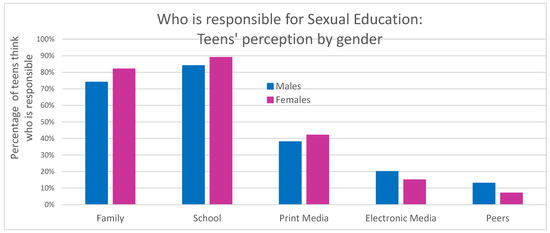
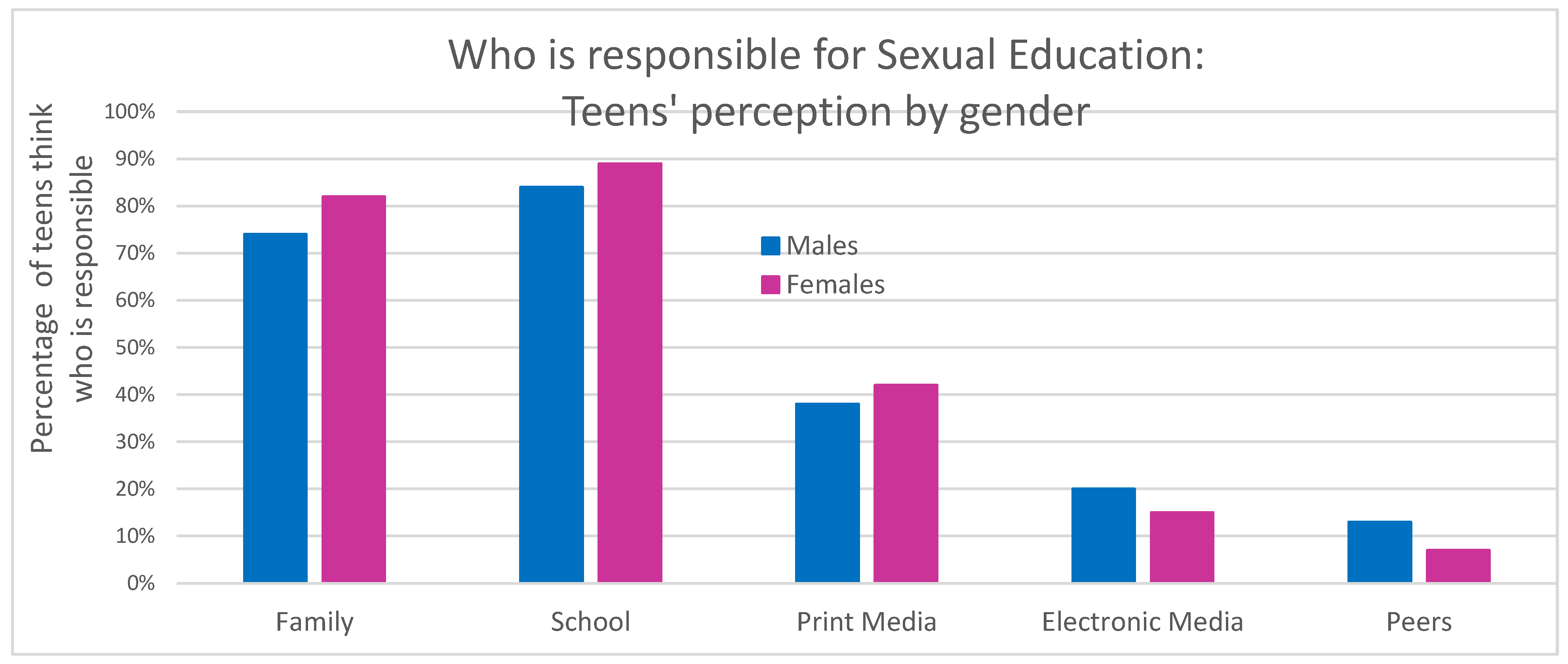
Chi-square tests were used to examine the different adolescent, gendered, and non-gendered perspectives on who should bear responsibility for sex education: family members, school, print media, electronic media (e-media), or peers. An examination of contingency tables demonstrated no violations. The results indicated identical rankings for responsibility. Over 70% of youth believed that the primary responsibility for sex education was from schools and then the family. Less than 50% felt that print media, e-media, or peers bear responsibility for sex education. However, within these sources, significant gender differences emerged. Girls were more likely than boys to be assigned responsibility for family, school, and print media. On the contrary, boys were more likely than girls to choose e-media and peers to take responsibility for delivering sex education (See Table 5 and Figure 1).
Table 5.
Responsible for sex education.
Figure 1.
Who is responsible?
3.3. Research Question 2: What Are the Actual Sources for Sexual Education?
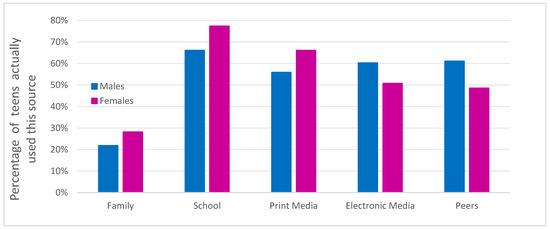
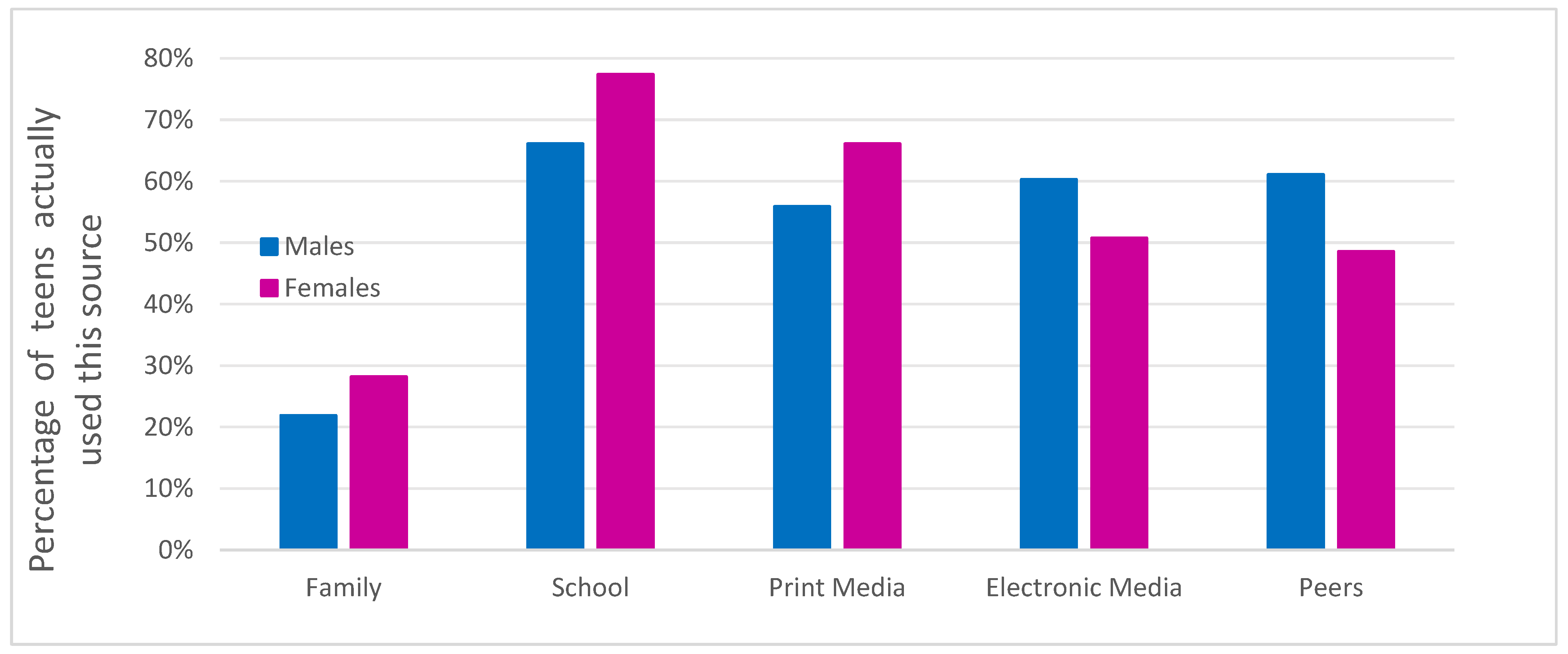
Gender differences in sources of sexual education provision were evaluated using chi-square tests. The contingency tables met all assumptions, and the difference between the genders was significant for all tests (p < 0.001). Over 60% of both genders indicated that school primarily provided sex education. Among males, the differences among three sources—school (66.10%), peers (61.10%), and e-media (60.30%)—were not particularly significant, all within a 60% range. Females indicated that school (77.40%) and printed media (66.10%) were the most frequently used sources, with almost half of them using e-media (50.8%) and peers (48.60%) as their go-to sources. Both genders ranked family at the bottom in the actual source list (boys: 21.90%; girls: 28.2%), which is inconsistent with the participants’ overall belief that their family (e.g., caregivers) should be the responsible sex educator, as demonstrated by responses to the first question (See Table 6 and Figure 2). These top five sources had meanings for the youth, as discussed under Questions 3 and 4.
Table 6.
Use: sources teens actually used.
Figure 2.
Sources actually used by teens.
3.4. Research Question 3: What Do Teens Prefer to Learn from?
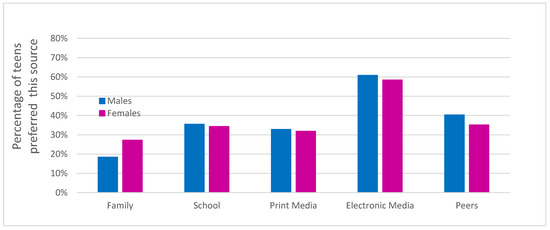
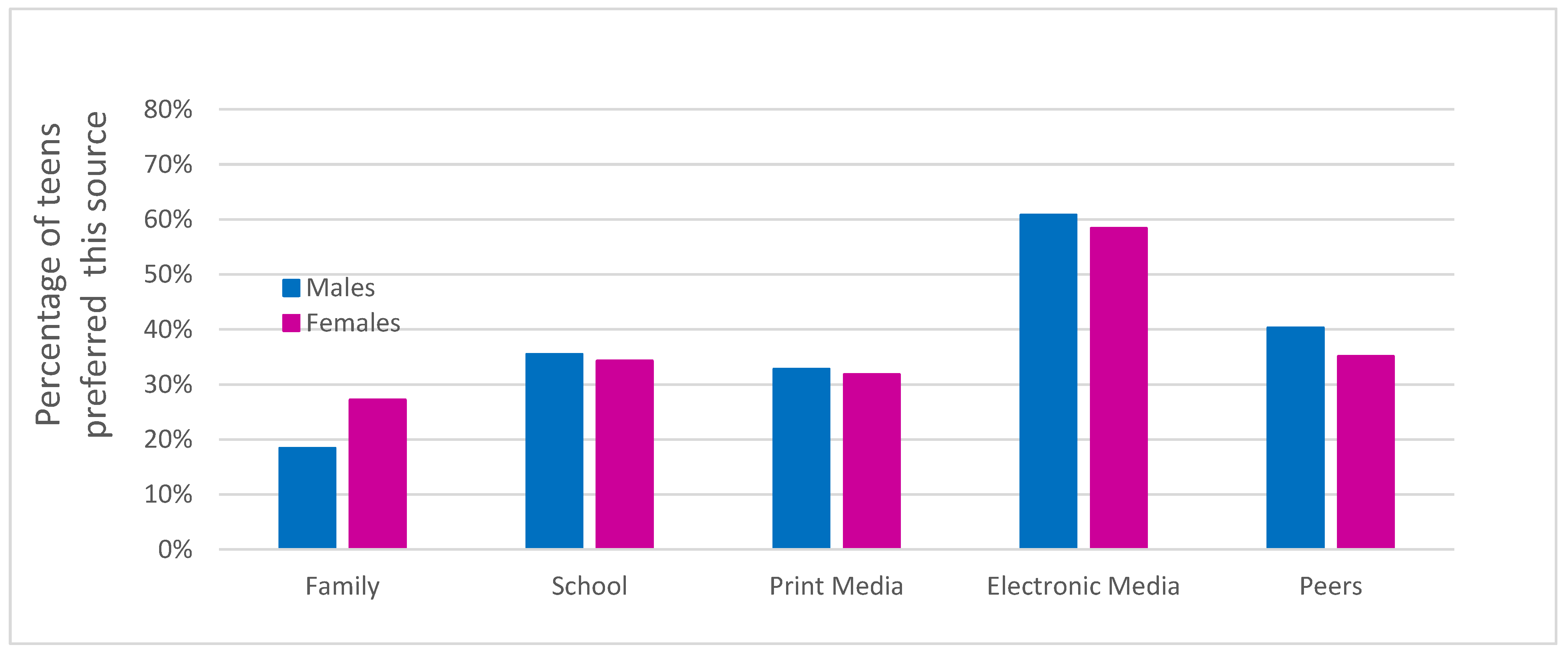
Chi-square tests examined gender-informed perspectives on teens’ preferred sources for sexual education. The contingency tables met all assumptions. Both males and females indicated that e-media was the preferred source for gaining further knowledge (males 60.8%, females 58.4%), followed by peers (males 40.3%, females 35.1%), school (males 35.4%, females 34.3%), and printed media (males 32.8%, females 31.8%). Family was considered the least preferred source of information (males 18.4%; females 27.2%). Significantly, more boys preferred the top two sources (e-media, peers), but more girls preferred the last source (family) on the list. Boys and girls showed no statistical differences in terms of preferring printed media and school as their formal sources for sex education (See Table 7 and Figure 3).
Table 7.
Prefer: sources teens prefer.
Figure 3.
Sources preferred by teens.
3.5. Factors Explaining the Use–Prefer Discrepancy
Table 6 shows the order of the sources used: school, peers, e-media, printed media, and family. Table 7 shows the sequence of the preferred channels: e-media, peers, school, printed media, and family. Regardless of gender, family has the lowest priority in both lists. Among all participants, 21% had a minimal gap between actual and preferred sources, while 79% had larger gaps; 7.02% demonstrated an extreme discrepancy of more than two standard deviations.
To evaluate factors that may underlie the incongruency between youth preferences for education and the sources they actually used, Discrepancy-S was regressed on gender (M/F), age (14–18), responsibilities by category, having coital behaviour (Y/N), and accepting premarital sex (Y/N) (see Table 1). Variables were entered into SPSS 28.0 in two blocks using the entry method with Type III SS. Block 1 included age and gender. Block 2 included the scaled variables for preferences by family, school, e-media, print media, and peers, as well as the youth’s acceptance of premarital sex and whether they had coital behaviour. The model was significant at p < 0.001 and explained 9.81% of the variance in discrepancy. Coitus and information utilization sources (family, e-media, print media, and peers) were significant at p < 0.001. Age (p = 0.010), gender (p = 0.002), school responsibility (p = 0.013), and acceptability of premarital sex (p = 0.017) were not significant. The regression equation is as follows:
Discrepancy-S = 29.072 (constant) − 0.37 (gender) − 0.178 (age) − 0.303 (family responsibility) + 0.096 (school responsibility) − 0.572 (print media responsibility) − 0.385 (e-media responsibility) − 0.477 (peer responsibility) + 0.134 (acceptability of premarital sex) − 1.199 (coital behaviour).
In this regression model, the only statistically significant “adolescent” variable is a history of coitus, which tends to yield a narrower discrepancy. Although many theoretically essential variables were included in the model with significant correlation with Discrepancy-S, these variables (i.e., child’s age, child’s gender, viewing premarital sex as acceptable behaviour, or holding school as a responsible source) were not statistically significant, at the p < 0.001 threshold when explaining the “use–prefer” discrepancy. Nonetheless, when these adolescents held family, print media, electronic media, and peers responsible for sex education, the discrepancy was significantly narrower (See Table 8 for full results).
Table 8.
Contributing factors to the “use–prefer” discrepancy.
Table 9 summarizes the top five sources across the three research questions. After combining these findings, we discovered that although the youth identified school and family as responsible sources, they used school as an informant but preferred e-media and regarded family as the last resort when having questions about sex. After combining the ranking scores of responsibilities, usage, and preferences, the importance of these top sources based on teens’ agreement is ordered as follows: (1) school, (2) e-media, (3) peers, (4) printed media, and (5) family. This is consistent with the regression result that “school” is connected to a wider discrepancy gap. Nevertheless, “school” is also linked to sex education when adolescents are unsure of where and how to seek help.
Table 9.
Top sex education sources.
4. Discussion
4.1. Youth Preferences
Historically, differences between ‘who is responsible’ and ‘what the youth prefer’ have been addressed in the design of curricula [20]. In this study, we advocate including responsibility, usage, and preferences in programme design, with evidence that youth reported on these action-oriented concepts differently. Although the rank orders differ, specific gender differences were found. Newby et al. [26] reported similar findings among over 3000 youth in England regarding the discrepancy between preferences for and receipt of education from various sources: adolescents preferred sex education from schools rather than from friends, parents, or the media [26]. While the boys and girls in this study did not differ significantly across the sources in their rank orders, Measor’s longitudinal studies from 1984 to 2003 [27] affirm male teens’ affinity for information from peers and the media outside schools and families. Results also show that the “use–prefer” discrepancy can be narrowed if sex educators work closely with the older teens in the program designs and provide age-relevant information. Thus, further analyses should focus on differentiating teens’ preferred sources to learn general sex education (e.g., body touch) vs. specific sexual behaviours (e.g., coitus). As adolescents transition into adulthood, they will have additional questions that require specific answers [22]. To motivate young people to learn from appropriate sources, curricula may be adapted to address demographic and cultural differences, helping learners resolve sexuality puzzles for self-protection.
4.2. Factors Impacting the Use–Prefer Discrepancy
The wider discrepancy between usage and preference was found in the family category. Given that 78.5% of all teens (74.4% male, 82.4% female) designated family as responsible for sex education. Of this group, only 26.9% of males and 32.6% of females utilized family as a source of education, meaning that over 65% of both genders did not use family as a source, even though they believed family held the primary responsibility for sex education.
The width of the discrepancy did not hold the inverse relationship. Of adolescents who indicated family is not a top preferred source of sexual education, 7.4% (7.3% male, 7.5% female) did use the family as their primary go-to source. While the regression accounted for 9.81% of the variance in discrepancy, other factors also impact the incongruity between teen perceptions toward sex education and their behaviour, as over 90% of the variance remains unexplained in the measurement of “gap”. Since the measurement method that created “Discrepancy-S” may be affected by how this gap is measured, which has not been previously studied, future research is warranted to examine which other factors led to the discrepancy and whether it holds in different areas of sexual behaviour. Although Discrepancy-S has an acceptable reliability score, the 15 “use” items (Cronbach’s Alpha = 0.591) had a lower reliability level than the 15 “prefer” items (Cronbach’s Alpha = 0.732).
Given the broad range of differences, with most teens falling within ±2 points of no incongruity, further studies should evaluate whether greater discrepancies are associated with higher risk-taking practices. We may ask additional research questions: “Does knowledge about safe sexual practices translate into youth action across all levels of the use–prefer discrepancy?” and “What delivery modes will be appraised and desired by the youth that can close the youth’s sexual health knowledge gap?”
5. Implications
5.1. Curriculum Design
A recent systematic review evaluated adolescent perceptions of sex education in English-speaking countries and discovered that many teens were embarrassed by sex education, felt uncomfortable in classes, and preferred a more “sex-positive” experience that was less negative, gendered, and heterosexist [19,28]. Thus, an up-to-date curriculum that approached sexuality and sexual behaviours with factual accuracy and cultural relevance was needed. Still, the teens in this study predominantly agreed that schools should be responsible for sex education. Educational curricula should be developed to address the challenges of sexuality in the 21st century. These challenges are surrounded by online dating, traps to compensated sex, sex trafficking, and pornography, while allowing adolescents the ability to discuss safety concerns with trusted teachers and mentors. As most adolescents—both male and female—indicated that school and printed media were preferred delivery methods for sex education, curricula should be designed with their preferences in mind. However, some work on preferences reached different conclusions [28]: that is, when children preferred parents as their primary source of sex education, parents were not consulted. In this study, the respondents did not provide explanations, but this phenomenon could be related to another finding: that over 20% of questions on parental age and education level remained unanswered or were marked as ‘unknown’. Although no literature has addressed the high nonresponse rate in this cultural context, a UK study highlights a similar phenomenon: 7% of students, especially those from single-parent households, did not respond to surveys about their parents’ educational history [29]. In Chinese culture, parental information, such as age and educational level, is rarely shared with children. Given that Chinese adolescents are our study target, the high non-answer rate regarding parental information may be due to cultural norms and warrants further investigation.
In this study, although the youth prefer e-media or peers as their informants, many have actually used school and peers as their top sources. The inconsistency between the current and previous studies may be due to technological changes since 2004 and to the structure of separating responsibility from the use–prefer discrepancy reported by participants in this study. Boys in this study preferred e-media and peers over printed media, which indicates that male children perceived educational platforms differently from how adults intended. According to their preference, online games and trusted peer-support groups designed by educators could serve a role. Interestingly, most adolescents rated family members as their least preferred source of education among the top five sources. Even so, at least 20% of adolescents obtained information from their parents. Other studies have also noted a preference for e-media delivery [23] across various youth populations, which may be attributed to the perceived anonymity of such sources and the worldwide increase in access to e-media. Therefore, specific programmes for discussing sexuality with adolescents on the internet or via smartphone apps must be evaluated with input from adolescents who are familiar with technological advances.
For this study, the use–prefer discrepancy is operationalized as a knowledge transfer gap between the sources actually learned from and those for future information. In further studies, for example, when comparing the “use index” and the “prefer index” before the youth turns 18, we should design questions with the same closed-ended topics (identified through sex education research) and open-ended topics (specified by the youth) with an agreement scale in two columns so that topics will be compared between current and future levels, not between topics and sources [22]. Researchers can identify whether there is a knowledge transfer gap before asking from whom and in what ways the youth prefer to obtain further information to prepare them to be responsible and healthy. Since sexual science is intended to plan better sexual health programmes for the future [30], educators should draw on multiple sources to communicate effectively with children and adolescents, deepen our understanding of what matters to them, and promote mutual responsibility among educators, parents, and learners.
5.2. Public Policy
Sex education has significant policy and public health implications. In Hong Kong, concerns about sexually related misinformation indicate that youth have an “increased exposure to pornography and image-based sexual violence” [31]. Adolescents in this study preferred receiving sexual health information from various sources. These sources are expected to be integrated into regular school curricula to normalize learning. Since both boys and girls favoured peer support, social workers and educators can collaborate to create peer-led groups and train student leaders to lead interactive activities. To ensure peer information is reliable, educators must provide training that is truthful, precise, and respectful of the youth’s preferences.
Secondly, the use–prefer discrepancy data can increase youth awareness of additional training. Hong Kong educators must endorse adolescent-driven sexual health topics not yet in the Chinese norm as a regular school curriculum. From UNESCO research [32], we know that sex education diminishes rates of STDs such as HIV/AIDs. In this Internet era, adolescents should have access to school-validated programmes with accurate knowledge to protect them from harmful sexual exposure or skewed sexual images. Since usage and preferences are not static, we suggest periodic evaluations of learning modes to ensure that curriculum designs align with technological changes.
5.3. Limitations
While this study provides an excellent start in evaluating Chinese adolescents’ preferences for sex education, certain limitations apply. First, this study comprised 17 self-selected secondary schools, with no data from adolescents from non-participating schools, which could introduce selection bias. Since sex education is not a standardized curriculum in Hong Kong schools, results may be affected by sample representativeness, as schools’ opt-in rates paint a different picture than a random selection process would. Attempts should be made to evaluate data from additional schools to ensure that the inferences made apply to a broader cross-section of Hong Kong adolescents.
Second, while this survey can serve as an excellent baseline, follow-up studies should be conducted one year after the introduction of compulsory sex education in public schools to further evaluate adolescent preferences, given the requirement for formal sex education. Future research should concentrate on comparing curricula both concerning the efficacy of sex education (lower teenage pregnancy, STD, and abuse rates) as well as preferences for education media, to develop curricula that are youth-engaging and parent-assisted while addressing the public health concerns surrounding sex education in Hong Kong.
Given that the sample size is large and the effect sizes are small in the gender comparison statistics (see Table 5, Table 6 and Table 7), the highly statistically significant results should be interpreted with caution. With this limitation in mind, further sex education research should evaluate other extraneous factors or topics unspoken in the Chinese context. Qualitative studies may target the missing link between knowledge gaps and sexual risk-taking behaviours. Constructs such as ethical behaviours in learning about sex may influence discrepancies not only in teens’ perception of who should be responsible, but also in their intention to learn more about interpersonal relationships.
6. Conclusions
Sex education serves a significant public health benefit to prepare adolescents for transitioning into adulthood, offering opportunities for teens to inquire about sexual health. In Hong Kong, 4869 Chinese adolescents provided data via a local survey. We identified a discrepancy in the sexual health sources they have used and preferred. Results show that having a history of coitus could narrow the use–prefer discrepancy. Also, when these adolescents held family, print media, electronic media, and peers responsible for providing accurate information, the discrepancy is narrower. Although other factors could widen the discrepancy, they were not statistically significant. This study employs a regression model that explains only 9.81% of the variance; thus, we must interpret the results with caution. For example, although the experience of coital behaviour partially explains why the use–prefer discrepancy is narrower, it only indicates that these youth tend to use and prefer the same sources. This finding warrants further examination, as it can only provide limited practical significance. While the youth want to access multiple sources, Hong Kong culture still considers sexuality a taboo subject to discuss. In terms of preferences, Hong Kong adolescents would benefit from direct classroom instruction and appropriate e-media that could address the myths and unspoken questions about sex. This study found that males preferred electronic and peer learning, whereas females preferred printed materials. While few adolescents in this study prioritised families as their “go-to” source, approximately one quarter wished to approach their parents and carers when questions about sex arose. While numerous studies have evaluated the impacts of rigorous, comprehensive sex education, it is also essential to assess adolescents’ knowledge utilization and modes of knowledge delivery, as well as their preferences regarding who should provide the education.
Author Contributions
Conceptualization, M.C., H.D. and Y.-J.H.; methodology, M.C., Y.-J.H. and H.D.; software, M.C., H.D. and Y.-J.H.; validation, M.C., Y.-J.H. and H.D.; formal analysis, H.D. and M.C.; investigation, M.C. and Y.-J.H.; resources, M.C.; data curation, H.D.; writing—original draft preparation, M.C., H.D. and Y.-J.H.; writing—review and editing, M.C. and H.D.; visualization, M.C.; supervision, M.C.; and project administration, M.C. All authors have read and agreed to the published version of the manuscript.
Funding
This research received no external funding.
Institutional Review Board Statement
The University of Houston IRB confirmed exempt status.
Informed Consent Statement
Not applicable.
Data Availability Statement
Not applicable.
Conflicts of Interest
The authors declare no conflicts of interest.
References
- Yip, P.S.F.; Zhang, H.; Lam, T.H.; Lam, K.F.; Lee, A.M.; Chan, J.; Fan, S. Sex Knowledge, Attitudes, and High-Risk Sexual Behaviors among Unmarried Youth in Hong Kong. BMC Public Health 2013, 13, 691. [Google Scholar] [CrossRef] [Scilit] [PubMed]
- Shek, D.T.L. Sexual Behaviour and Intention to Engage in Sexual Behaviour in Junior Secondary School Students in Hong Kong. J. Pediatr. Adolesc. Gynecol. 2013, 26, S33–S41. [Google Scholar] [CrossRef] [Scilit]
- Leung, H.; Lin, L. Adolescent Sexual Risk Behaviour in Hong Kong: Prevalence, Protective Factors, and Sex Education Programs. J. Adolesc. Health 2019, 64, S52–S58. [Google Scholar] [CrossRef] [Scilit]
- Family Planning Association of Hong Kong (FPAHK). Youth Sexuality Study 2021. Available online: https://www.famplan.org.hk/files/resources/research-studies/YSS2021Eng.pdf (accessed on 6 December 2025).
- Sheppard, A. Why Hong Kong’s New Sex Education Guidance is so Controversial, as Advocates Urge for Improvement. South China Morning Post, 1 November 2024. Available online: https://www.scmp.com/special-reports/article/3284604/why-hong-kongs-new-sex-education-guidance-so-controversial-advocates-urge-improvement (accessed on 6 December 2025).
- Wu, S. Revised Chinese Law Sparks Debate on Sexuality Education. Reuters, 26 October 2020. Available online: https://www.reuters.com/article/china-society-education-sex-idUSL4N2HG01X (accessed on 6 December 2025).
- Andres, E.B.; Choi, E.P.H.; Fung, A.W.C.; Lau, K.W.C.; Ng, N.H.T.; Yeung, M.; Johnston, J.M. Comprehensive Sexuality Education in Hong Kong: Study Protocol for Process and Outcome Evaluation. BMC Public Health 2021, 21, 197. [Google Scholar] [CrossRef] [Scilit]
- Leung Ling, M.T.W.; Chen, H.F. Hong Kong’s Parents’ Views on Sex, Marriage, and Homosexuality. J. Child Fam. Stud. 2017, 26, 1573–1582. [Google Scholar] [CrossRef] [Scilit]
- Burki, T. Sex Education in China Leaves Young People Vulnerable to Infection. Lancet Infect. Dis. 2016, 16, 26. [Google Scholar] [CrossRef] [Scilit]
- Jiang, H.; Zhang, X.; Ye, L.; Tan, S.; Chu, K.; Ye, Z.; Chai, C.; Chen, Y. HIV, Syphilis, and Gonorrhea Co-Infection and Associated Factors among Adolescents and Young Adults Aged 15–24 Years in Ningbo, China, 2005–2024. Front. Public Health 2025, 13, 1702301. [Google Scholar] [CrossRef] [Scilit]
- Facts and Details. Sex Education Controversy in 2020. 2025. Available online: https://factsanddetails.com/china/cat11/sub76/entry-4485.html#chapter-1 (accessed on 6 December 2025).
- Cheung, M.; Leung, P.; Zhou, S.; Yu, M.; Chen, X.; Ford, A.; Huang, Y. Timing of Sexuality Education: Hong Kong Preteens’ Perception of Sexual Health. Arch. Sex. Behav. 2023, 52, 95–106. [Google Scholar] [CrossRef] [Scilit] [PubMed]
- Legislative Council of the Hong Kong Special Administrative Region of the People’s Republic of China. Information Note: Sexuality Education. 9 January 2018. Available online: https://www.legco.gov.hk/research-publications/english/1718in03-sexuality-education-20180109-e.pdf (accessed on 6 December 2025).
- Che, F.S. A Study of the Implementation of Sex Education in Hong Kong Secondary Schools. Sex Educ. 2005, 5, 281–294. [Google Scholar] [CrossRef] [Scilit]
- Gao, E.; Zuo, X.; Wang, L.; Lou, C.; Cheng, Y.; Zabin, L.S. How Does Traditional Confucian Culture Influence Adolescents’ Sexual Behavior in Three Asian Cities? J. Adolesc. Health 2012, 50, S12–S17. [Google Scholar] [CrossRef] [Scilit]
- Student Health Service. Sex Education at Home: The Objectives and Importance of Sex Education. 2025. Available online: https://www.studenthealth.gov.hk/english/health/health_se/health_se_fse.html (accessed on 6 December 2025).
- AIDS Concern. Young People’s STIs Infection Rate Hits Record High: Lack of Sex Education is the Main Culprit; AIDS Concern: Hong Kong, China, 2017; Available online: https://aidsconcern.org.hk/en/young-people-stds-infection-rate-hits/ (accessed on 6 December 2025).
- Leary, M.R.; Shepperd, J.A.; McNeil, M.S.; Jenkins, T.B.; Barnes, B.D. Objectivism in Information Utilization: Theory and Measurement. J. Pers. Assess. 1986, 50, 32–44. [Google Scholar] [CrossRef] [Scilit]
- White, A.; Boehm, M.; Glackin, E.; Bleakley, A. How Sexual Information Sources are Related to Emerging Adults’ Sex-Positive Scripts and Sexual Communication. Sex. Cult. 2023, 27, 1224–1245. [Google Scholar] [CrossRef] [Scilit] [PubMed]
- United Nations Educational, Scientific, and Cultural Organization. International Guidelines on Sexuality Education: An Evidence-Informed Approach to Effective Sex, Relationships, and HIV/STI Education. June 2009. Available online: https://reliefweb.int/sites/reliefweb.int/files/resources/8556521DD9D4A9E64925762000240120-UNESCO-Aug2009.pdf (accessed on 6 December 2025).
- Jarpe-Ratner, E.; Marshall, B. Viewing Sexual Health Education through the Lens of Critical Pedagogy: A Case Study in Chicago Public Schools. Int. J. Environ. Res. Public Health 2021, 18, 1443. [Google Scholar] [CrossRef] [Scilit] [PubMed]
- Li, Y.; Cottrell, R.; Wagner, D.I.; Ban, M. Needs and Preferences Regarding Sex Education among Chinese College Students: A Preliminary Study. Int. Fam. Plan. Perspect. 2004, 30, 128–133. [Google Scholar] [CrossRef] [PubMed]
- Somers, C.L.; Surmann, A.T. Adolescents’ Preferences for Source of Sex Education. Child Study J. 2004, 34, 47–50. [Google Scholar]
- Morawska, A.; Walsh, A.; Grabski, M.; Fletcher, R. Parental Confidence and Preferences for communicating with their child about sexuality. Sex Educ. 2015, 15, 235–248. [Google Scholar] [CrossRef] [Scilit]
- Faul, F.; Erdfelder, E.; Lang, A.-G.; Buchner, A. G*Power 3: A Flexible Statistical Power Analysis Program for the Social, Behavioural, and Biomedical Sciences. Behav. Res. Methods 2007, 39, 175–191. [Google Scholar] [CrossRef] [Scilit]
- Newby, K.; Wallace, L.M.; Dunn, O.; Brown, K.E. A Survey of English Teenagers’ Sexual Experience and Preferences for School-Based Sex Education. Sex Educ. 2012, 12, 231–251. [Google Scholar] [CrossRef] [Scilit]
- Measor, L. Young People’s Views of Sex Education: Gender, Information and Knowledge. Sex Educ. 2004, 4, 153–166. [Google Scholar] [CrossRef] [Scilit]
- Pound, P.; Langford, R.; Campbell, R. What Do Young People Think about Their School-Based Sex and Relationship Education? A Qualitative Synthesis of Young People’s Views and Experiences. BMJ Open 2016, 6, e011329. [Google Scholar] [CrossRef] [Scilit]
- Times Higher Education. ‘Missing’ Family Education Data Linked to Single Parent Households. Available online: https://www.timeshighereducation.com/news/missing-family-education-data-linked-single-parent-households (accessed on 6 December 2025).
- Mosher, D.L. Advancing Sexual Science: Strategic Analysis and Planning. J. Sex Res. 1989, 26, 1–14. [Google Scholar] [CrossRef] [Scilit]
- Family Planning Association of Hong Kong (FPAHK). Report on Youth Sexuality Study 2021 (Secondary School Survey). 2022. Available online: https://www.famplan.org.hk/en/media-centre/press-releases/detail/report-on-youth-sexuality-study-2021-secondary-school-survey (accessed on 6 December 2025).
- UNESCO. Why Comprehensive Sexuality Education is Important. 15 February 2018. Available online: https://en.unesco.org/news/why-comprehensive-sexuality-education-important (accessed on 6 December 2025).

Disclaimer/Publisher’s Note: The statements, opinions and data contained in all publications are solely those of the individual author(s) and contributor(s) and not of MDPI and/or the editor(s). MDPI and/or the editor(s) disclaim responsibility for any injury to people or property resulting from any ideas, methods, instructions or products referred to in the content. |
© 2026 by the authors. Licensee MDPI, Basel, Switzerland. This article is an open access article distributed under the terms and conditions of the Creative Commons Attribution (CC BY) license.