
Use vs. Prefer: Gaps in Sexual Health Sources for Hong Kong Adolescents



Abstract
1. Introduction
1.1. History of Sex Education in Hong Kong
1.2. Sexual Health Responsibility
1.3. Theoretical Framework: Objectivism in Information Utilization and Sex-Positivity
1.4. Purpose: Use vs. Prefer
2. Methods
2.1. Ethical and Human Protection Approval
2.2. Sample
2.3. Instrument and Data Analysis
3. Results
3.1. Demographics
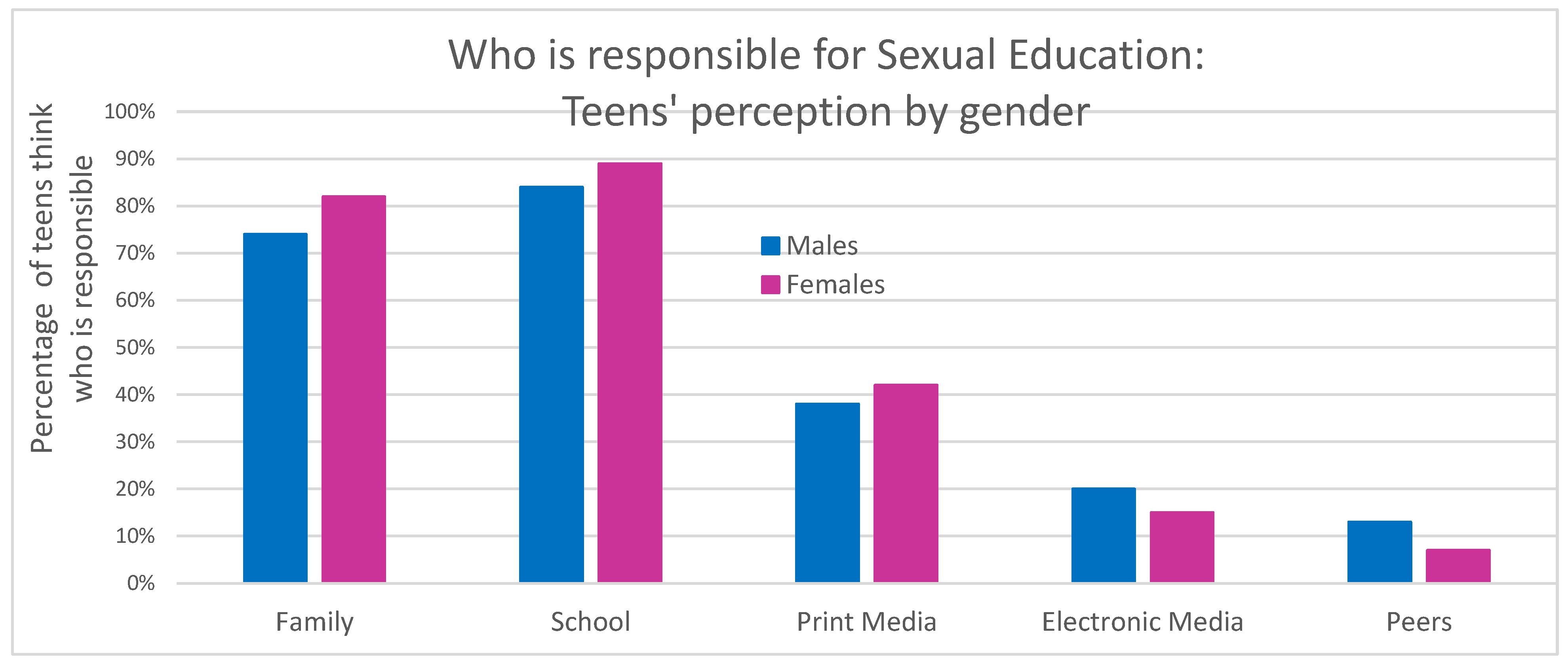
3.2. Research Question 1: Who Is Responsible for Sex Education?
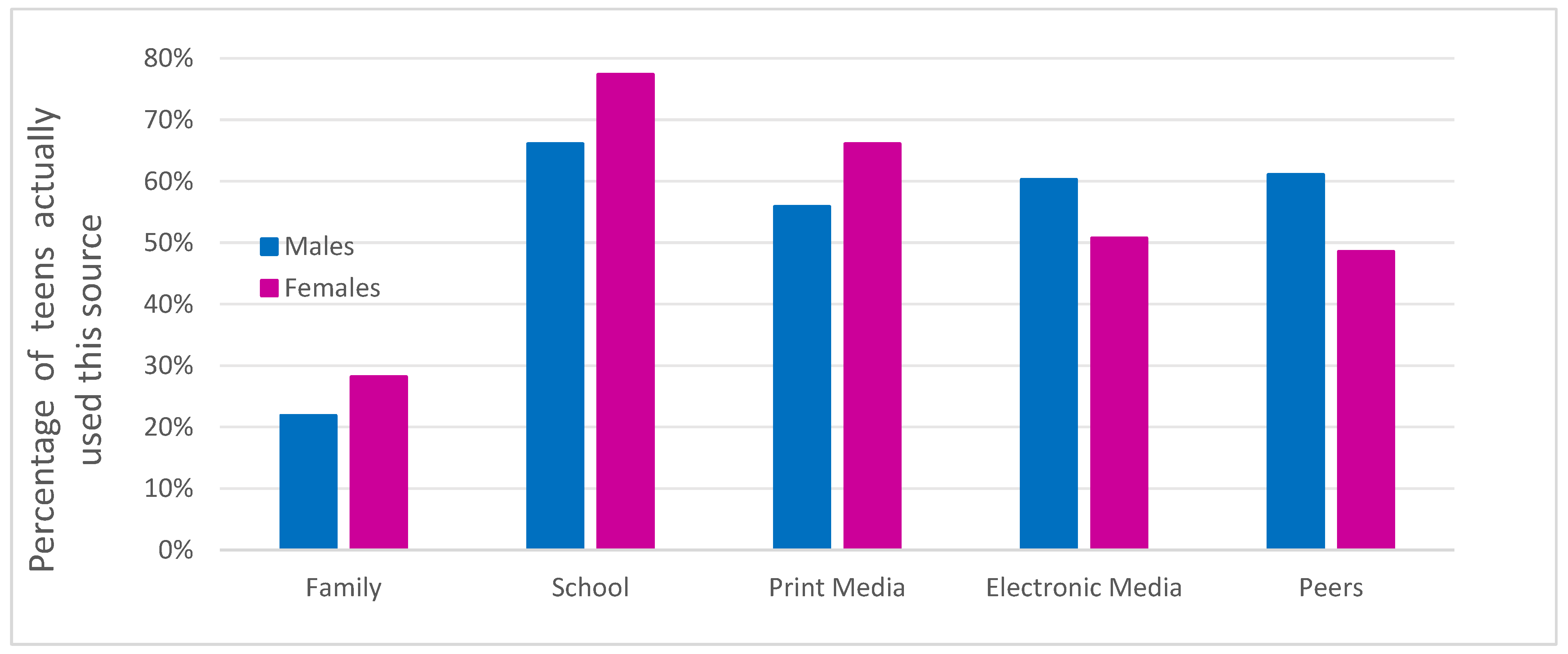
3.3. Research Question 2: What Are the Actual Sources for Sexual Education?
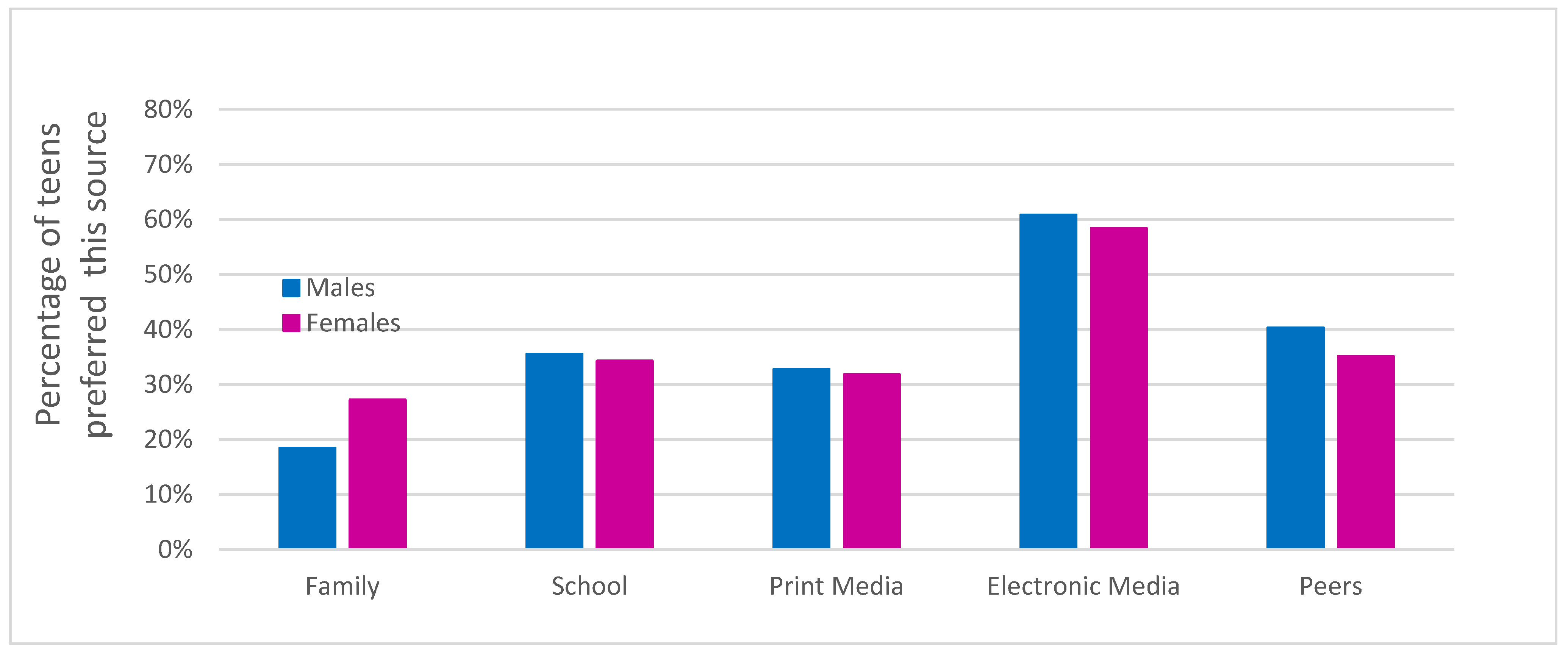
3.4. Research Question 3: What Do Teens Prefer to Learn from?
3.5. Factors Explaining the Use–Prefer Discrepancy
4. Discussion
4.1. Youth Preferences
4.2. Factors Impacting the Use–Prefer Discrepancy
5. Implications
5.1. Curriculum Design
5.2. Public Policy
5.3. Limitations
6. Conclusions
Author Contributions
Funding
Institutional Review Board Statement
Informed Consent Statement
Data Availability Statement
Conflicts of Interest
References
- Yip, P.S.F.; Zhang, H.; Lam, T.H.; Lam, K.F.; Lee, A.M.; Chan, J.; Fan, S. Sex Knowledge, Attitudes, and High-Risk Sexual Behaviors among Unmarried Youth in Hong Kong. BMC Public Health 2013, 13, 691. [Google Scholar] [CrossRef] [Scilit] [PubMed]
- Shek, D.T.L. Sexual Behaviour and Intention to Engage in Sexual Behaviour in Junior Secondary School Students in Hong Kong. J. Pediatr. Adolesc. Gynecol. 2013, 26, S33–S41. [Google Scholar] [CrossRef] [Scilit]
- Leung, H.; Lin, L. Adolescent Sexual Risk Behaviour in Hong Kong: Prevalence, Protective Factors, and Sex Education Programs. J. Adolesc. Health 2019, 64, S52–S58. [Google Scholar] [CrossRef] [Scilit]
- Family Planning Association of Hong Kong (FPAHK). Youth Sexuality Study 2021. Available online: https://www.famplan.org.hk/files/resources/research-studies/YSS2021Eng.pdf (accessed on 6 December 2025).
- Sheppard, A. Why Hong Kong’s New Sex Education Guidance is so Controversial, as Advocates Urge for Improvement. South China Morning Post, 1 November 2024. Available online: https://www.scmp.com/special-reports/article/3284604/why-hong-kongs-new-sex-education-guidance-so-controversial-advocates-urge-improvement (accessed on 6 December 2025).
- Wu, S. Revised Chinese Law Sparks Debate on Sexuality Education. Reuters, 26 October 2020. Available online: https://www.reuters.com/article/china-society-education-sex-idUSL4N2HG01X (accessed on 6 December 2025).
- Andres, E.B.; Choi, E.P.H.; Fung, A.W.C.; Lau, K.W.C.; Ng, N.H.T.; Yeung, M.; Johnston, J.M. Comprehensive Sexuality Education in Hong Kong: Study Protocol for Process and Outcome Evaluation. BMC Public Health 2021, 21, 197. [Google Scholar] [CrossRef] [Scilit]
- Leung Ling, M.T.W.; Chen, H.F. Hong Kong’s Parents’ Views on Sex, Marriage, and Homosexuality. J. Child Fam. Stud. 2017, 26, 1573–1582. [Google Scholar] [CrossRef] [Scilit]
- Burki, T. Sex Education in China Leaves Young People Vulnerable to Infection. Lancet Infect. Dis. 2016, 16, 26. [Google Scholar] [CrossRef] [Scilit]
- Jiang, H.; Zhang, X.; Ye, L.; Tan, S.; Chu, K.; Ye, Z.; Chai, C.; Chen, Y. HIV, Syphilis, and Gonorrhea Co-Infection and Associated Factors among Adolescents and Young Adults Aged 15–24 Years in Ningbo, China, 2005–2024. Front. Public Health 2025, 13, 1702301. [Google Scholar] [CrossRef] [Scilit]
- Facts and Details. Sex Education Controversy in 2020. 2025. Available online: https://factsanddetails.com/china/cat11/sub76/entry-4485.html#chapter-1 (accessed on 6 December 2025).
- Cheung, M.; Leung, P.; Zhou, S.; Yu, M.; Chen, X.; Ford, A.; Huang, Y. Timing of Sexuality Education: Hong Kong Preteens’ Perception of Sexual Health. Arch. Sex. Behav. 2023, 52, 95–106. [Google Scholar] [CrossRef] [Scilit] [PubMed]
- Legislative Council of the Hong Kong Special Administrative Region of the People’s Republic of China. Information Note: Sexuality Education. 9 January 2018. Available online: https://www.legco.gov.hk/research-publications/english/1718in03-sexuality-education-20180109-e.pdf (accessed on 6 December 2025).
- Che, F.S. A Study of the Implementation of Sex Education in Hong Kong Secondary Schools. Sex Educ. 2005, 5, 281–294. [Google Scholar] [CrossRef] [Scilit]
- Gao, E.; Zuo, X.; Wang, L.; Lou, C.; Cheng, Y.; Zabin, L.S. How Does Traditional Confucian Culture Influence Adolescents’ Sexual Behavior in Three Asian Cities? J. Adolesc. Health 2012, 50, S12–S17. [Google Scholar] [CrossRef] [Scilit]
- Student Health Service. Sex Education at Home: The Objectives and Importance of Sex Education. 2025. Available online: https://www.studenthealth.gov.hk/english/health/health_se/health_se_fse.html (accessed on 6 December 2025).
- AIDS Concern. Young People’s STIs Infection Rate Hits Record High: Lack of Sex Education is the Main Culprit; AIDS Concern: Hong Kong, China, 2017; Available online: https://aidsconcern.org.hk/en/young-people-stds-infection-rate-hits/ (accessed on 6 December 2025).
- Leary, M.R.; Shepperd, J.A.; McNeil, M.S.; Jenkins, T.B.; Barnes, B.D. Objectivism in Information Utilization: Theory and Measurement. J. Pers. Assess. 1986, 50, 32–44. [Google Scholar] [CrossRef] [Scilit]
- White, A.; Boehm, M.; Glackin, E.; Bleakley, A. How Sexual Information Sources are Related to Emerging Adults’ Sex-Positive Scripts and Sexual Communication. Sex. Cult. 2023, 27, 1224–1245. [Google Scholar] [CrossRef] [Scilit] [PubMed]
- United Nations Educational, Scientific, and Cultural Organization. International Guidelines on Sexuality Education: An Evidence-Informed Approach to Effective Sex, Relationships, and HIV/STI Education. June 2009. Available online: https://reliefweb.int/sites/reliefweb.int/files/resources/8556521DD9D4A9E64925762000240120-UNESCO-Aug2009.pdf (accessed on 6 December 2025).
- Jarpe-Ratner, E.; Marshall, B. Viewing Sexual Health Education through the Lens of Critical Pedagogy: A Case Study in Chicago Public Schools. Int. J. Environ. Res. Public Health 2021, 18, 1443. [Google Scholar] [CrossRef] [Scilit] [PubMed]
- Li, Y.; Cottrell, R.; Wagner, D.I.; Ban, M. Needs and Preferences Regarding Sex Education among Chinese College Students: A Preliminary Study. Int. Fam. Plan. Perspect. 2004, 30, 128–133. [Google Scholar] [CrossRef] [PubMed]
- Somers, C.L.; Surmann, A.T. Adolescents’ Preferences for Source of Sex Education. Child Study J. 2004, 34, 47–50. [Google Scholar]
- Morawska, A.; Walsh, A.; Grabski, M.; Fletcher, R. Parental Confidence and Preferences for communicating with their child about sexuality. Sex Educ. 2015, 15, 235–248. [Google Scholar] [CrossRef] [Scilit]
- Faul, F.; Erdfelder, E.; Lang, A.-G.; Buchner, A. G*Power 3: A Flexible Statistical Power Analysis Program for the Social, Behavioural, and Biomedical Sciences. Behav. Res. Methods 2007, 39, 175–191. [Google Scholar] [CrossRef] [Scilit]
- Newby, K.; Wallace, L.M.; Dunn, O.; Brown, K.E. A Survey of English Teenagers’ Sexual Experience and Preferences for School-Based Sex Education. Sex Educ. 2012, 12, 231–251. [Google Scholar] [CrossRef] [Scilit]
- Measor, L. Young People’s Views of Sex Education: Gender, Information and Knowledge. Sex Educ. 2004, 4, 153–166. [Google Scholar] [CrossRef] [Scilit]
- Pound, P.; Langford, R.; Campbell, R. What Do Young People Think about Their School-Based Sex and Relationship Education? A Qualitative Synthesis of Young People’s Views and Experiences. BMJ Open 2016, 6, e011329. [Google Scholar] [CrossRef] [Scilit]
- Times Higher Education. ‘Missing’ Family Education Data Linked to Single Parent Households. Available online: https://www.timeshighereducation.com/news/missing-family-education-data-linked-single-parent-households (accessed on 6 December 2025).
- Mosher, D.L. Advancing Sexual Science: Strategic Analysis and Planning. J. Sex Res. 1989, 26, 1–14. [Google Scholar] [CrossRef] [Scilit]
- Family Planning Association of Hong Kong (FPAHK). Report on Youth Sexuality Study 2021 (Secondary School Survey). 2022. Available online: https://www.famplan.org.hk/en/media-centre/press-releases/detail/report-on-youth-sexuality-study-2021-secondary-school-survey (accessed on 6 December 2025).
- UNESCO. Why Comprehensive Sexuality Education is Important. 15 February 2018. Available online: https://en.unesco.org/news/why-comprehensive-sexuality-education-important (accessed on 6 December 2025).



| Final Category | Original Category | Raw Score | Scaled Score |
|---|---|---|---|
| Family Member | Father | ||
| (5 sources) | Mother | ||
| Siblings | 0 to 5 | 0 to 5 | |
| Senior relatives | |||
| Same generation relatives | |||
| Peers | Internet friends (not met in real life) | ||
| (3 sources) | Same-gender friends outside of school | 0 to 3 | 0 to 5 |
| Classmates | |||
| School | Teachers | ||
| (2 sources) | Activities in School/Classes | 0 to 2 | 0 to 5 |
| Print Media | Textbooks | ||
| (3 sources) | Magazines | 0 to 3 | 0 to 5 |
| Pornographic books | |||
| Electronic Media | Smartphone | ||
| (2 sources) | Internet | 0 to 2 | 0 to 5 |
| Variable | n | % |
|---|---|---|
| * Maternal Age: | ||
| Under 29 | 41 | 0.8 |
| 30–39 | 1094 | 22.5 |
| 40–49 | 2341 | 48.1 |
| 50–59 | 378 | 7.8 |
| 60–89 | 5 | 0.1 |
| ** Missing | 1010 | 20.7 |
| Total | 4869 | 100.0 |
| (Mean: 42.96; Median: 45; SD: 6.25) | ||
| * Paternal Age: | ||
| 30–39 | 374 | 7.6 |
| 40–49 | 2125 | 43.6 |
| 50–59 | 1057 | 21.7 |
| 60-69 | 104 | 2.1 |
| 70-89 | 15 | 0.3 |
| ** Missing | 1194 | 24.5 |
| Total | 4869 | 100.0 |
| (Mean: 47.54; Median: 45; SD: 6.99) | ||
| Parental Living Situation: | ||
| Parents Live Together | 3798 | 78.0 |
| Parents Live Separately | 262 | 5.4 |
| Divorced | 411 | 8.4 |
| Father Deceased | 145 | 3.0 |
| Mother Remarried | 80 | 1.6 |
| Father Remarried | 79 | 1.6 |
| Separated | 67 | 1.4 |
| Mother Deceased | 26 | 0.5 |
| Unknown | 123 | 2.5 |
| Total | 4869 | *** 102.8 |
| Family Members in Household (HH) | n | % |
|---|---|---|
| Mother | 4569 | 93.8% |
| Stepmother | 34 | 0.7% |
| Total HH with Maternal | 4603 | 94.5% |
| Father | 4177 | 85.8% |
| Stepfather | 78 | 1.6% |
| Total HH with Paternal | 4255 | 87.4% |
| Total HH with Grandparent(s) | 539 | 11.1% |
| Older Brother | 1072 | 22.0% |
| Younger Brother | 1041 | 21.4% |
| Older Sister | 1222 | 25.1% |
| Younger Sister | 876 | 18.0% |
| Total HH with Siblings | 4211 | 86.5% |
| Other Relative | 203 | 4.2% |
| * Other Persons | 176 | 3.6% |
| Total HH with Others | 379 | 7.8% |
| Variable | n | % | Valid % |
|---|---|---|---|
| Maternal Educational Level: | |||
| Some Primary School | 288 | 5.9 | 7.4 |
| Primary School Graduation | 457 | 9.4 | 11.8 |
| Some Secondary School | 1259 | 25.9 | 32.5 |
| Secondary School Graduation | 1387 | 28.5 | 35.8 |
| Some College | 218 | 4.5 | 5.6 |
| Bachelor’s Degree or Higher | 263 | 5.4 | 6.8 |
| * Missing | 997 | 20.5 | NA |
| Total | 4869 | 100.0 | 100.0 |
| Paternal Educational Level: | |||
| Some Primary School | 337 | 6.9 | 9.0 |
| Primary School Graduation | 438 | 9.0 | 11.7 |
| Some Secondary School | 1216 | 25.0 | 32.4 |
| Secondary School Graduation | 1130 | 23.2 | 30.1 |
| Some College | 225 | 4.6 | 6.0 |
| Bachelor’s Degree or Higher | 402 | 8.3 | 10.7 |
| * Missing | 1121 | 23.0 | NA |
| Total | 4869 | 100.0 | 100.0 |
| Responsible as Sex Educators | ||||||||
|---|---|---|---|---|---|---|---|---|
| (n = 4869) | YES | NO | χ2 | p | φ | |||
| Gender | n | % | n | % | ||||
| School | Boys | 1996 | 84.50 | 367 | 15.50 | 24.54 | 0.010 | N.R. |
| Girls | 2235 | 89.30 | 269 | 10.70 | ||||
| Family | Boys | 1758 | 74.40 | 605 | 25.60 | 46.01 | <0.001 | 0.097 |
| Girls | 2063 | 82.40 | 441 | 17.60 | ||||
| Printed Media | Boys | 902 | 38.20 | 1461 | 61.80 | 32.29 | <0.001 | 0.081 |
| Girls | 1046 | 41.80 | 1458 | 58.20 | ||||
| Electronic Media | Boys | 477 | 20.20 | 1886 | 79.80 | 25.14 | <0.001 | 0.072 |
| Girls | 369 | 14.70 | 2135 | 85.30 | ||||
| Peers | Boys | 304 | 12.90 | 2059 | 87.10 | 44.44 | <0.001 | 0.096 |
| Girls | 179 | 7.10 | 2325 | 92.90 | ||||
| Actually Used Sources | ||||||||
|---|---|---|---|---|---|---|---|---|
| (n = 4869) | YES | NO | χ2 | p | φ | |||
| Gender | n | % | n | % | ||||
| School | Boys | 1561 | 66.10 | 802 | 33.90 | 76.74 | <0.001 | 0.130 |
| Girls | 1937 | 77.40 | 567 | 22.60 | ||||
| Peers | Boys | 1443 | 61.10 | 920 | 38.90 | 76.21 | <0.001 | 0.130 |
| Girls | 1217 | 48.60 | 1287 | 51.40 | ||||
| Electronic Media | Boys | 1425 | 60.30 | 938 | 39.70 | 44.84 | <0.001 | 0.096 |
| Girls | 1271 | 50.80 | 1233 | 49.20 | ||||
| Printed Media | Boys | 1320 | 55.90 | 1043 | 44.10 | 53.15 | <0.001 | 0.100 |
| Girls | 1654 | 66.10 | 850 | 33.90 | ||||
| Family | Boys | 517 | 21.90 | 1846 | 78.10 | 25.47 | <0.001 | 0.072 |
| Girls | 705 | 28.20 | 1799 | 71.80 | ||||
| Preferred Sources | ||||||||
|---|---|---|---|---|---|---|---|---|
| (n = 4869) | YES | NO | χ2 | p | φ | |||
| Gender | n | % | n | % | ||||
| Electronic Media | Boys | 1436 | 60.80 | 782 | 33.10 | 27.16 | <0.001 | 0.075 |
| Girls | 1462 | 58.40 | 954 | 38.10 | ||||
| Peers | Boys | 952 | 40.30 | 1411 | 59.70 | 14.14 | <0.001 | 0.054 |
| Girls | 878 | 35.10 | 1626 | 64.90 | ||||
| School | Boys | 839 | 35.50 | 1524 | 64.50 | 0.77 | 0.380 | N.R. |
| Girls | 859 | 34.30 | 1645 | 65.70 | ||||
| Printed Media | Boys | 775 | 32.80 | 1588 | 67.20 | 0.52 | 0.470 | N.R. |
| Girls | 797 | 31.80 | 1707 | 68.20 | ||||
| Family | Boys | 435 | 18.40 | 1928 | 81.60 | 52.68 | <0.001 | 0.100 |
| Girls | 680 | 27.20 | 1824 | 72.80 | ||||
| Factor (n = 4869) ab | B | SE | β | t | p |
|---|---|---|---|---|---|
| Constant | 29.072 | 1.151 | 25.263 | <0.001 | |
| Child Age | −0.178 | 0.069 | −0.036 | −2.591 | 0.010 |
| Child Gender | −0.370 | 0.122 | −0.043 | −3.043 | 0.002 |
| Premarital Sex as Acceptable | 0.134 | 0.056 | 0.035 | 2.390 | 0.017 |
| Coital behaviour | −1.199 | 0.284 | −0.060 | −4.219 | <0.001 |
| Responsible Sources: | |||||
| Family | −0.303 | 0.073 | −0.060 | −4.129 | <0.001 |
| School | 0.096 | 0.039 | 0.037 | 2.479 | 0.013 |
| Print Media | −0.572 | 0.057 | −0.148 | −9.976 | <0.001 |
| Electronic Media | −0.385 | 0.045 | −0.125 | −8.485 | <0.001 |
| Peers | −0.477 | 0.053 | −0.131 | −8.979 | <0.001 |
| Teens’ Top 5 Choices (1–5, 1 = Top Priority) | Combined Results | ||||
|---|---|---|---|---|---|
| Responsibility | USE | PREFER | Combined Score | Top 5 Sources | |
| School | 1 | 1 | 3 | 5 | 1st |
| Family | 2 | 5 | 5 | 12 | 5th |
| Printed Media | 3 | 4 | 4 | 11 | 4th |
| Electronic Media | 4 | 3 | 1 | 8 | 2nd |
| Peers | 5 | 2 | 2 | 9 | 3rd |
Disclaimer/Publisher’s Note: The statements, opinions and data contained in all publications are solely those of the individual author(s) and contributor(s) and not of MDPI and/or the editor(s). MDPI and/or the editor(s) disclaim responsibility for any injury to people or property resulting from any ideas, methods, instructions or products referred to in the content. |
© 2026 by the authors. Licensee MDPI, Basel, Switzerland. This article is an open access article distributed under the terms and conditions of the Creative Commons Attribution (CC BY) license.
Share and Cite
Davies, H.; Cheung, M.; Huang, Y.-J. Use vs. Prefer: Gaps in Sexual Health Sources for Hong Kong Adolescents. Adolescents 2026, 6, 31. https://doi.org/10.3390/adolescents6020031
Davies H, Cheung M, Huang Y-J. Use vs. Prefer: Gaps in Sexual Health Sources for Hong Kong Adolescents. Adolescents. 2026; 6(2):31. https://doi.org/10.3390/adolescents6020031
Chicago/Turabian StyleDavies, Holly, Monit Cheung, and Yu-Ju Huang. 2026. "Use vs. Prefer: Gaps in Sexual Health Sources for Hong Kong Adolescents" Adolescents 6, no. 2: 31. https://doi.org/10.3390/adolescents6020031
APA StyleDavies, H., Cheung, M., & Huang, Y.-J. (2026). Use vs. Prefer: Gaps in Sexual Health Sources for Hong Kong Adolescents. Adolescents, 6(2), 31. https://doi.org/10.3390/adolescents6020031