Article

Value Profiles as Moderators of the Relationship Between National Identification and Attitudes Towards Minorities: An Example from Croatian Youth


Ivo Pilar Institute of Social Sciences, 10000 Zagreb, Croatia
*
Author to whom correspondence should be addressed.
Adolescents 2026, 6(2), 29; https://doi.org/10.3390/adolescents6020029
Submission received: 4 December 2025 / Revised: 15 March 2026 / Accepted: 25 March 2026 / Published: 27 March 2026
(This article belongs to the Section Emerging and Contemporary Issue in Adolescence)

Abstract

Social identity approaches suggest that people favour ingroup members, yet ingroup favouritism does not necessarily translate into outgroup derogation. Using a sample of Croatian majority-group youth from a nationally and religiously homogeneous pre-COVID context, we examined whether personal values moderate the relationship between national identification and attitudes towards minorities. We conducted a latent profile analysis (LPA) on higher-order values among young Croatian Catholics who did not belong to minority groups (N = 994) and identified five value profiles that varied primarily in the prioritisation of openness to change versus conservation. Profiles differed in minority attitudes and national identification. Crucially, the association between national identification and minority attitudes varied across profiles: it was unrelated in the profile prioritising openness over conservation, whereas in the remaining profiles it tended to be negative and was most consistently negative in the profile prioritising conservation over openness. Taken together, the findings highlight the role of values in the relationship between group identification and attitudes towards outgroups, confirming their relevance for social cohesion and potential for the development of deradicalisation interventions.

1. Introduction

Social identity theory [1,2] represents a highly influential theoretical approach that explains how group memberships influence our behaviour and guide interactions with members of other groups [3,4]. The theory suggests that we deeply care about groups and group memberships because associating with groups that are considered positive is related to many beneficial outcomes [5,6,7,8]. Moreover, our prosocial intentions and interest in cooperation are biased because of group memberships [8,9].
Other disciplines, such as economics, have also recognised the biases related to social (group) identities. For example, drawing on classic social identity approaches (e.g., [1,2]), Wichardt [10] (p. 129) reviews evidence showing that identity is inherently relational—it “always necessitates an outer reference point to develop” and “there is no identity without an outer reference group”. Thus, group-based identity is fuelled by favourable comparisons with outgroups; in contexts with multiple group affiliations, individuals tend to focus on the affiliation that offers the highest positive contribution to identity. This perspective implies that national identification may not carry a uniform meaning across individuals and contexts, which makes moderation by values a theoretically plausible expectation. As Tajfel and Turner [1,2] explain, even the studies relying on random grouping of participants (the “minimal group paradigm”) exhibited arguments in favour of prioritising ingroup members (“ingroup bias”). This finding is replicated in newer studies [9,11,12]. The biases strengthen with social identification: extremely strong social identities (fused identities, i.e., a state in which individuals cannot differentiate between individual and social identity) based on shared emotions and history are related to extreme behaviours aimed at protecting the ingroup [13,14,15].
One of the key group identities in the modern world is national identity [16]. However, one may wonder how ingroup bias (favouritism) affects relationships with national outgroups and their members, particularly how this holds for minorities in these nations. Does our preference for ingroup members make us less favourable to minorities as outgroups, as well? While many majority-group members identify strongly with the nation, national belonging is often bounded in ways that render ethnic minorities and immigrants less readily recognised as full members of the national ingroup, particularly when national identity is defined in ethno-cultural terms [17,18,19].
National attachment is a concept that has been theorised and studied in multiple forms, which differ in the extent to which they are associated with “ingroup love” and “outgroup hate” relationships (for a full critique, see [20]). Despite (criticised) overlaps in nomenclature and definitions (e.g., across distinctions such as constructive vs. blind patriotism, patriotism vs. nationalism, and national narcissism), researchers generally agree that attachment to one’s nation is not inherently linked to outgroup hostility and that different forms of national attachment show different associations with intergroup attitudes [21,22,23,24,25,26].
If national identification can take different forms with different intergroup implications, the next question is what distinguishes individuals for whom it is benign from those for whom it is exclusionary. According to Nincic and Ramos [26] (p. 14), “internal factors” shape the type of attachment to the nation a person develops, with more traditional individuals being more likely to adopt less critical (and more outgroup-hostile) forms of identification. The authors’ suggestion, reflecting the role of tradition and openness, introduces personal values as a potential factor underlying the development of national identification.
Values reflect what we consider important in life and serve as emotionally grounded guiding principles that vary in relative priority for evaluating situations and individuals across contexts [27,28,29]. In Schwartz’s [28,29] framework, 10 basic values are grouped into four higher-order dimensions: conservation, self-transcendence, openness to change, and self-enhancement, which have robust links to political attitudes [30,31]. In particular, blind patriotism tends to align with higher conservation values and lower openness to change [30,31,32,33]. Values also predict prejudice and intergroup contact, with prioritising universalism and openness to change (relative to prioritising conservation) generally associated with greater tolerance towards outgroups [34,35,36,37,38].
Moreover, multiple studies have provided arguments in favour of the idea proposed by Nincic and Ramos [26] that values may underlie how a person identifies with a nation. However, none of the mentioned studies employed person-centred methods (e.g., clustering algorithms, latent class analysis, or latent profile analysis) to evaluate how different constellations of values simultaneously define the type of national identification, i.e., whether responses to the same items on national identification may have different meanings based on participants’ constellations of values. Studying the simultaneous contributions of multiple variables aligns with the definition of values [27,28,29] and complements the existing literature.

1.1. Present Study

We analysed a dataset collected from Croatian youth just before the COVID-19 pandemic started to examine whether the relationship between national identification and attitudes towards minorities varies across value profiles. At the time, Croatia was a highly homogeneous country (more than 99% had Croatian citizenship, and 92% of citizens identified as Croats, with almost 80% identifying as Roman Catholics [39]). Thus, Croatia represented a society where contact with minorities was relatively rare compared to other, more diverse countries. Moreover, national identity may also be particularly salient in Croatia given the legacy of the Homeland War following the dissolution of Yugoslavia in the early 1990s and the continued social and cultural relevance of wartime sacrifice.
As McCauley and Moskalenko [40] explain, extreme cohesion may occur when a group is exposed to threat—the value under threat (Croatian national identity) may have become sacralised, promoting identity fusion [14] and willingness to protect the ingroup [41,42]. Although the war ended in 1995, its consequences remain tangible [43]. Croatia’s post-war socialisation unfolded alongside democratisation and EU-aligned reforms, which some also perceived as challenging national identity [44,45]. Therefore, Croatian youth data offer an opportunity to examine whether distinct forms of ingroup identification can be differentiated on the basis of individuals’ value constellations. This is particularly relevant in a context where multiple objective and perceived threats to national identity make such distinctions harder to establish.

1.2. Research Questions and Hypotheses

RQ1. Do distinct value profiles emerge in the Croatian youth sample?
To address RQ1, we conducted a latent profile analysis to classify participants based on their scores on higher-order values. Because person-centred value profiling has not been conducted in Croatian youth samples, our approach was exploratory.
RQ2. Do value profiles differ in national identification and attitudes towards minorities?
To evaluate the substantive validity of the profiles, we compared them on the key variables of this study—national identification and attitudes towards minorities, as well as multicultural exposure and interaction. Based on earlier studies [36,37], we expected that profiles higher on openness to change and lower on conservation would show fewer negative attitudes towards minorities. We also expected that profiles characterised by self-transcendence being rated as more important than self-enhancement would exhibit fewer negative attitudes towards minorities than profiles characterised by self-enhancement being rated as more important than self-transcendence. We did not formulate specific hypotheses regarding differences in national identification or multicultural exposure and interaction between profiles that differed primarily in the relative importance of self-transcendence versus self-enhancement. Because we expected qualitative differences in national identification, we did not expect mean differences in national identification across value profiles.
RQ3. Do value profiles moderate the association between national identification and attitudes towards minorities?
Based on earlier studies [30,31], we hypothesised that individuals more strongly identified with their nation would also exhibit fewer positive attitudes towards minorities in value profiles characterised by conservation being prioritised over openness to change. However, no relationship between national identification and attitudes towards minorities was expected in profiles characterised by openness to change being prioritised over conservation.
Overall, our results indicate that value constellations help differentiate when national identification is more likely to coincide with exclusionary intergroup attitudes. Regarding RQ1, the latent profile analysis yielded five profiles. Specifically, the largest profile was characterised by similarly high conservation and openness, low self-enhancement, and high self-transcendence, whereas the second-largest profile was characterised by very high conservation, followed by openness, self-transcendence, and self-enhancement. Two smaller profiles were nearly identical in self-transcendence and self-enhancement, but one profile prioritised openness over conservation and the other prioritised conservation over openness. Finally, one profile showed high conservation and openness alongside comparatively lower self-transcendence and higher self-enhancement than the other profiles.
Regarding RQ2, profiles differed in attitudes towards minorities, multicultural interaction, and national identification, but not in multicultural exposure. In general, profiles characterised by higher openness (relative to conservation) showed more multicultural interaction and more positive attitudes towards minorities, whereas profiles characterised by higher conservation (relative to openness) tended to show less favourable minority attitudes.
Regarding RQ3, crucially, the association between national identification and attitudes towards minorities varied across identified value constellations: it was absent in the profile prioritising openness over conservation but tended to be negative in the remaining profiles and was consistently negative in the conservation-over-openness profile.

2. Materials and Methods

2.1. Participants and Procedure

The Croatian country dataset collected within the EU-funded project CHIEF (Cultural Heritage and Identities of Europe’s Future, grant no. 770464) was used in this study. One activity of the project was to collect survey data on youth samples in multiple countries. Each national team had the opportunity to include additional items to measure constructs of interest in more detail. The Croatian team used this flexibility to include additional items measuring prejudice towards specific national minorities in Croatia that were not present in the cross-national core questionnaire. Therefore, we based the analyses on the Croatian dataset rather than the harmonised cross-national dataset containing only variables common across countries. The fieldwork was conducted between October 2019 and January 2020, and data were collected from high school students from 30 schools across more and less urban regions of Croatia. All survey materials were approved by the CHIEF Research Ethics and Quality Group. Additionally, ethical approval was obtained from the Ivo Pilar Institute of Social Sciences, and approval for conducting surveys in schools was obtained from the Ministry of Science and Education and the Education and Teacher Training Agency. The complete international dataset has been published online [46].
The total Croatian sample consisted of 2148 high school students, with a modal age of 16 years. Of the total sample, 1439 participants reported being Roman Catholic. In addition, 387 participants reported that at least one of their parents was not born in Croatia, and a further 21 participants did not report having Croatian-only citizenship. Because Croatia was part of Yugoslavia until 1991, when it formally declared independence, it is plausible that many participants who reported having parents not born in Croatia referred to birthplaces in other former Yugoslav republics (or Yugoslavia as a whole). However, our data do not allow us to verify countries of birth in sufficient detail. To ensure that our analyses are not confounded by measurement error arising from this ambiguity, we restricted the analytic sample to participants for whom parental birthplace and citizenship information unambiguously indicated a Croatian majority-group background. The analyses were conducted on a subset of participants who did not belong to any national or religious minority groups. This was operationalised via responses on multiple questions related to participants’ and parents’ country of birth, citizenship, and religious denomination. Only participants who reported being born in Croatia, holding Croatian-only citizenship, having both parents born in Croatia, and identifying as Roman Catholic were included. This subsample (N = 1031) was further screened to exclude 1% of outliers based on personal values, resulting in a final sample of 994 participants.

2.2. Measures

National identification was measured with three items from the Scale of Global Identity [47], which in the original instrument were used to assess nationalism (“I feel intense pride when I think about my country”, “I feel most connected to members of my own country”, and “My country is one of the best in the world”). These items reflect positive attitudes, pleasant emotions, and attachment to the country, without measuring superiority or reflecting between-group competition. Responses were recorded on a 1–5 scale, with higher values indicating stronger agreement. Internal consistency of the scale was acceptable (ω = 0.79). Participants’ national identification was operationalised using factor scores extracted via principal axis factoring, with higher values indicating stronger national identification.
Personal values were measured using the ultra-brief Portrait Value Questionnaire (PVQ) [48]. The scale consists of ten items measuring ten basic values, which were averaged to form four higher-order values: self-transcendence (comprising universalism and benevolence), self-enhancement (comprising power and achievement), openness (comprising self-direction, stimulation and hedonism), and conservation (comprising tradition, security and conformity). Internal consistency of the higher-order values was relatively low, which is expected given the brevity of the scales (ωself-transcendence = 0.66, ωself-enhancement = 0.51, ωopenness = 0.62, ωconservation = 0.50). Nevertheless, the ultra-brief PVQ has been shown to produce correlation patterns with external criteria similar to those obtained with the full PVQ version, suggesting its validity for research use [48]. Participants responded on a 1–6 scale, with higher values indicating a higher perceived similarity between themselves and the described person (i.e., higher relevance of a specific value). The scores of higher-order values, obtained by averaging basic values, were centred prior to analyses.
The measure of a general attitude towards minorities was adapted from the IEA Civic Education Study (CIVED) [49]. Items were presented in the form of a question: “How comfortable would you feel having neighbours belonging to the following groups?”, followed by a list of groups. Our analyses focused on the items measuring attitudes towards people with a different skin colour than the participants, people of a different religion, and people from a different country. Participants responded on a 1–5 scale, with higher values indicating a more positive attitude towards each group. The scale exhibited acceptable internal consistency (ω = 0.87). Participants’ general attitude towards minorities was operationalised using factor scores extracted via principal axis factoring, with higher scores indicating a more positive general attitude towards minorities.
The Croatian version of the questionnaire also contained multiple items parallel in format to the general attitude towards minorities, with these items explicitly naming specific minority groups (Serbs, Roma, Italians, Jews, and Muslims). We refer to this measure as attitudes towards specific minorities and use it to corroborate findings from the general attitude towards minorities measure. The scale exhibited acceptable internal consistency (ω = 0.89). Participants’ attitudes towards specific minorities were operationalised using factor scores extracted via principal axis factoring, with higher scores indicating more positive attitudes towards the specified groups.

2.3. Analytical Approach

All the analyses were conducted in R (version 4.5.1, R Core Team, Vienna, Austria) [50]. We primarily used functions from tidySEM [51] and followed procedures described by van Lissa et al. [52]. Missingness was sparse (the variable with the most missing values had more than 97% complete data, while the participant with the most missing values responded to 96% of items) and showed no systematic pattern. Therefore, we imputed missing values using the kNN algorithm with five donors, implemented in a function from the VIM package [53]. Latent profile analyses were conducted on mean-centred scores of the higher-order values in line with the assumption of local independence (i.e., that profiles account for associations among the indicators) and homogeneity of profiles (i.e., that all profiles are determined with similar precision). After establishing the profiles, we first examined mean differences in external criteria between profiles (partly to ensure the validity of the retained profiles, partly due to the relevance of the external criteria for the research questions) using the BCH method [54]. This approach allows us to test between-profile differences while taking into account the uncertainty in profile membership. Finally, the relationship between national identification and attitudes towards minorities was compared across profiles (also using the BCH method).

3. Results

3.1. Descriptives and Correlations

Descriptive statistics and correlations among the study variables are presented in Table 1. Higher conservation was associated with stronger national identification, whereas higher openness to change and self-transcendence were associated with more positive attitudes towards minorities. Conversely, higher self-enhancement was associated with less positive attitudes towards minorities. National identification was also negatively related to both measures of attitudes towards minorities. Notably, conservation was not significantly related to either measure of attitudes towards minorities.

3.2. RQ1: Do Distinct Value Profiles Emerge?

The outputs of the latent profile analysis conducted on mean-centred scores of the higher-order values, which served as LPA indicators (Observed (manifest) variables in the context of latent profile/class analyses used to estimate latent profiles) (self-enhancement, self-transcendence, openness to change, and conservation) are presented in Table 2.

3.2.1. Model Selection and Retained Solution

We consulted multiple relevant criteria to determine the optimal number of latent profiles to retain. The outcomes of the latent profile analyses indicated multiple plausible solutions (Table 2). Values of AIC and saBIC continuously decreased as the number of profiles increased, implying that, according to these information indices, retaining 10 or even more profiles would be favoured. The LMR test, comparing each solution with the previous one, continued to favour 10 or more profiles. BIC first started increasing after the five-profile solution, followed by continuous growth after the eighth-profile solution. p-values of the omega (ω2) coefficients assessing the distinctiveness of additional profiles became non-significant from the five-profile solution onwards, suggesting that retaining more than four profiles could lead to suboptimally distinctive solutions.
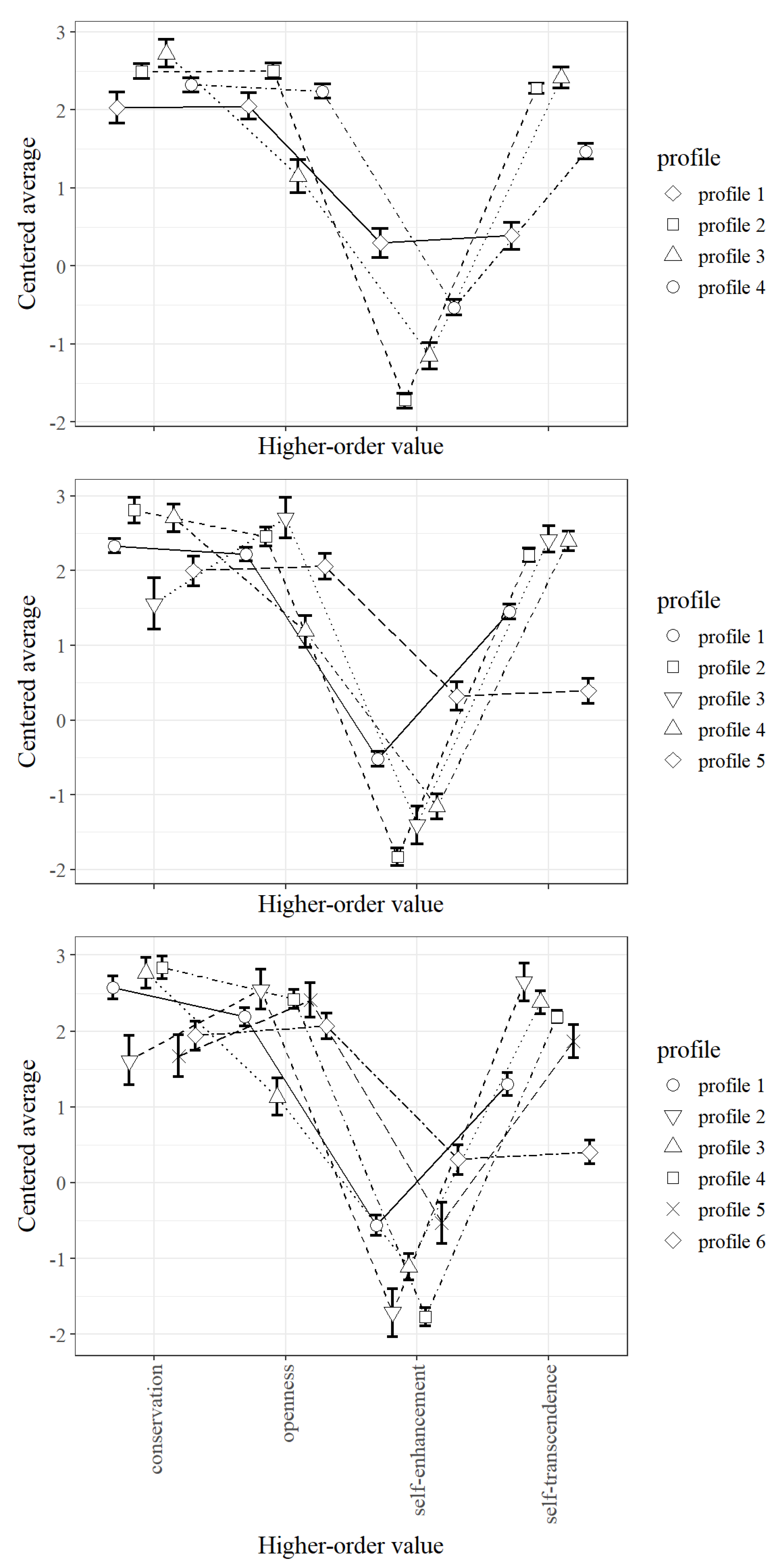
As our primary goal was not to establish all possible profiles of higher-order values among Catholic Croatian youth but to group our participants according to valid empirical criteria (ideally, in a replicable way), the main challenge was to decide whether to base our decision primarily on BIC or ω2—that is, whether to retain a four- or a five-profile solution. These solutions, along with the six-profile solution, are visualised in Figure 1. This figure depicts centred averages on the X-axis and the four higher-order values on the Y-axis, with profile-specific means connected by lines. Generally, most profiles occurred consistently across solutions (indicated by the same shapes). It can be noticed that compared to the four-profile solution (top panel), the five-profile solution (middle panel) adds a profile with a somewhat distinctive pattern of values (Profile 3, (O–T)–C–E, marked by a downward-pointing triangle). However, the six-profile solution (bottom panel) adds Profile 5 that closely resembles Profile 3 (i.e., profiles marked with an X are barely distinguishable from the profiles marked with a downward-pointing triangle). Altogether, these findings suggested retaining the five-profile solution because it provides deeper insight compared to the four-profile solution, while avoiding duplication of profiles.

3.2.2. Description of the Five Profiles

In the retained five-profile solution, Profile 1 (41% of sample; average posterior probability (APP) = 0.83) was characterised by similarly high conservation and openness, low self-enhancement, and high self-transcendence. In light of the ipsative nature of values, this profile was labelled (C–O)–T–E.
Profile 2 (30% of sample; APP = 0.77) was characterised by very high conservation, followed by openness, self-transcendence, and self-enhancement, and was labelled C–O–T–E.
Profile 3 (8% of sample; APP = 0.70) was characterised by very high openness and self-transcendence, followed by conservation and self-enhancement, and was labelled (O–T)–C–E. For simplicity, we refer to this profile as openness-over-conservation.
Profile 4 (13% of sample; APP = 0.74) was characterised by very high conservation and self-transcendence, followed by openness and self-enhancement, and was labelled (C–T)–O–E. For simplicity, we refer to this profile as conservation-over-openness.
Profile 5 (8% of sample; APP = 0.82) was characterised by high conservation and openness, followed by moderate self-transcendence and self-enhancement, and was labelled (C–O)–(T–E).
Figure 1 also highlights two profiles that are particularly relevant for our research questions: (O–T)–C–E (openness-over-conservation) and (C–T)–O–E (conservation-over-openness). These profiles are nearly identical with respect to self-enhancement and self-transcendence, yet they substantially differ regarding conservation and openness. Specifically, while both profiles are characterised by high openness and conservation, participants in the openness-over-conservation profile score significantly higher on openness compared to conservation, whereas participants in the conservation-over-openness profile score significantly higher on conservation compared to openness. Accordingly, while we report results for all five profiles, we place particular emphasis on comparisons between these two profiles in the sections that follow.

3.3. RQ2: Do Value Profiles Differ in National Identification, Attitudes Towards Minorities, and Multicultural Experience (Exposure and Interaction)?

To answer RQ2, we compared profiles on national identification, attitudes towards minorities, and multicultural experience (exposure and interaction) using the BCH three-step procedure. These comparisons served to assess the substantive validity of the retained profiles and directly address the RQ (Table 3). Detailed output of mean comparisons can be found in the Supplementary Materials, under the heading “BCH”. Overall tests revealed that our profiles significantly differed in general attitude towards minorities (ΔLL = 127.0, df = 8, p < 0.001), attitudes towards specific minorities (ΔLL = 88.8, df = 8, p < 0.001), and national identification (ΔLL = 81.4, df = 8, p < 0.001).
Table 3 reports BCH-estimated profile means—the p column tests whether each profile mean differs from zero (factor-score metric), and for each outcome, the lower triangle of the corresponding matrix presents pairwise comparisons between profiles based on BCH weights. Focusing on our two key profiles, it can be observed that Profile 3 (openness-over-conservation) generally exhibited the most positive attitudes towards minorities and the weakest national identification. On the other hand, Profile 4 (conservation over openness) exhibits a moderate (neutral) general attitude towards minorities and attitudes towards specific minorities (and much less negative compared to the (C–O)–(T–E) profile) and a moderate level of national identification.

3.4. RQ3: Do Value Profiles Moderate the Association Between National Identification and Attitudes Towards Minorities?

To answer RQ3, after ascertaining that the profiles are meaningfully different with respect to study variables, we compared the associations between national identification and attitudes towards minorities across profiles using the BCH approach. Table 4 reports BCH-estimated within-profile slopes (b) linking national identification to minority attitudes; the lower triangle summarises pairwise tests of slope differences between profiles, and the p column tests whether each profile-specific slope differs from zero. Two models were calculated, and both indicated that the profiles differ with respect to the relationship between national identification and attitudes towards minorities (ΔLL = 19.3, df = 4, p < 0.001 for the model with a general attitude towards minorities and ΔLL = 10.5, df = 4, p = 0.033 for the model with attitudes towards specific minorities).
The results for the two operationalisations partially overlap. Across the two operationalisations, the openness-over-conservation profile differed from each of the remaining profiles (at least in one model). In this profile, national identification was unrelated to attitudes towards minorities, while the relationship between national identification and attitudes towards minorities tended to be negative in the remaining profiles (and was significant in at least one operationalisation). This also means that these participants in the openness-over-conservation profile differed significantly from those in the conservation-over-openness profile, in which national identification was consistently negatively related to attitudes towards minorities.
The results of our study related to attitudes towards minorities are summarised in Table 5. Altogether, they suggest that stronger national identification is usually (mildly) negatively related to more negative attitudes towards minorities. However, the openness-over-conservation profile seems to be the exception: the relationship between national identification and attitudes towards minorities was insignificant but tended to be positive among participants belonging to this profile.

4. Discussion

4.1. Value Profiles in Croatian Youth

Our analyses revealed several relevant findings. Firstly, the calculated correlations between key variables revealed that individuals who are more identified with their national identity also exhibit slightly less favourable attitudes towards minorities, which represents an initial argument in favour of the notion of equating ingroup love with outgroup hate [20,21,22,23,24]. Additionally, individuals scoring higher on self-transcendence and openness exhibited more favourable attitudes towards minorities, while individuals scoring higher on self-enhancement exhibited more negative attitudes towards minorities. These findings are only partially aligned with the literature [28,29]: self-transcendence and openness are considered anxiety-free and growth-oriented values, unlike self-enhancement, which is considered an anxiety-based and self-protection value. However, conservation, which is also an anxiety-based value, did not correlate with attitudes towards minorities, which is not in line with its theoretical role in social relationships [28,29]. However, bivariate correlations are insufficient to describe the complex nature and contributions of personal values: according to their definition [27,28,29], values do not determine behaviour individually but in combination (hierarchy) with other values.
In order to gain deeper insight into the combination of values, we applied latent profile analysis and established five latent profiles of higher-order values in Croatian majority-group youth. Although different fit criteria pointed to different solutions, we retained the five-profile solution based on BIC and the ω2 test of profile distinguishability (and later BCH mean comparisons supported the substantive validity of the retained profiles) because we focused on a parsimonious solution likely to be replicable [56,57].
The profiles differed most clearly in whether they prioritised conservation over openness to change, or openness to change over conservation, and also in the relative prioritisation of self-transcendence versus self-enhancement. The two most prevalent profiles were characterised by similarly high conservation and openness with high self-transcendence and low self-enhancement ((C–O)–T–E; 41%) and by very high conservation, followed by openness, self-transcendence, and self-enhancement (C–O–T–E; 30%). Additionally, two smaller profiles were particularly informative for the study’s aims because they were nearly identical in self-transcendence and self-enhancement but differed sharply in whether they prioritised openness over conservation (openness-over-conservation; 8%) or conservation over openness (conservation-over-openness; 13%). Finally, one profile combined high conservation and openness with comparatively lower self-transcendence and higher self-enhancement than the other profiles ((C–O)–(T–E); 8%).
Although this pattern could be interpreted as suggesting that self-enhancement is less prominent among Croatian youth, it should be interpreted in light of the analytic sample, which consisted of majority-group adolescents who identified as Roman Catholic. Prior work on Croatian youth has shown that self-enhancement (and conservation) tends to be rated as less important than openness and self-transcendence [58], but value priorities may differ across samples [59], and these results are not representative of Croats in general [60]. Accordingly, the most accurate conclusion is that no major profile in which self-enhancement clearly outweighed self-transcendence emerged among young Catholic Croats in the present dataset.

4.2. Between-Profile Differences in Minority Attitudes and National Identification

To corroborate the distinctiveness of profiles, we compared them on key study variables (national identification and attitudes towards minorities). The conservation-over-openness profile exhibited fewer positive attitudes towards minorities than the openness-over-conservation profile, but its attitude scores were generally neutral rather than strongly negative. The least favourable minority attitudes were exhibited by the (C–O)–(T–E) profile, which was characterised by comparatively lower self-transcendence and higher self-enhancement than the other profiles. This pattern is consistent with prior research linking self-transcendence (benevolence and universalism) to greater tolerance and self-enhancement to less favourable intergroup attitudes [27,28,29,37,38].
The established profiles also differed in national identification: the conservation-over-openness profile exhibited stronger national identification than the openness-over-conservation profile, although the former profile’s mean was close to neutral, while the latter profile exhibited the lowest identification with the nation. Two non-exclusive interpretations could be explored in future research. First, lower national identification in openness-over-conservation profiles may reflect a more conditional, evaluative form of national attachment, where the level of identification is contingent on perceived national performance and characteristics [20,21,22,23,24]. Second, openness to change may be linked to lower perceived threat; consistent with this possibility, Bullock et al. [61] showed that nationalism and religiosity were simultaneously enhanced in response to social threats during the COVID-19 pandemic. From the perspective of values, the openness-over-conservation profile could be roughly interpreted as the “anxiety-free” or “self-expansion and growth” profile [28,29], which strengthens the presented argumentation.

4.3. Value Profiles as Moderators of the National Identification–Minority Attitudes Association

Our main goal was to examine whether value profiles moderate the association between national identification and attitudes towards minorities in a sample of Croatian majority-group youth.
Consistent with our hypotheses, the national identification–minority attitudes association differed across profiles: it was unrelated in the profile prioritising openness over conservation, whereas it tended to be negative in the remaining profiles and was most consistently negative in the profile prioritising conservation over openness. Thus, the hypothesis that stronger national identification would be linked to less favourable minority attitudes in conservation-over-openness profiles was supported, as was the hypothesis that no such relationship would be expected in openness-over-conservation profiles. Importantly, this moderation pattern emerged even though the two focal profiles (conservation-over-openness and openness-over-conservation) were nearly identical in self-transcendence and self-enhancement.
These findings are partially in line with evidence from an international sample showing that exclusive (vs inclusive) protesters exhibit a stronger preference for conservation values [56]. Given differences in samples and operationalisations, direct comparisons are limited, although the broadly similar pattern suggests that the openness–conservation distinction may be relevant beyond the present context, a possibility that requires testing in other populations and settings. These findings are also in line with the description of individuals high on conservation and self-transcendence as focused on society and prevention of losses (“anxiety-based values”) and individuals high on openness and self-transcendence as focused on growth (anxiety-free values, see [28,29]).
To clarify terminology, in this study, “outgroups” refers to minority groups as social categories towards which majority-group members may hold evaluative attitudes, even though these groups are part of the same state. Accordingly, our measures capture attitudes towards minority groups (as targets of evaluation), rather than implying that minorities are objectively outside the national community.
From the perspective of national attachment and identification, the results are consistent with the idea that attachment to one’s nation can, in some value configurations, coexist with neutral or positive minority attitudes, whereas in other configurations it is more likely to coincide with less favourable minority attitudes. This also aligns with Nincic and Ramos’ [26] proposal that internal factors, such as values, may shape how national attachment relates to intergroup attitudes, and it resonates with distinctions between more critical versus more uncritical forms of national attachment (e.g., critical patriotism vs. blind/uncritical patriotism [21], and related conceptualisations of patriotism vs. nationalism [22,23,24]). At the same time, explanatory accounts linking these patterns to processes such as sacralisation of ingroup values [41,42] remain speculative in the present study. For instance, if national or religious values become sacralised, perceived challenges to those values may be more likely to elicit negative responses towards outgroups, and this process may be more pronounced among individuals prioritising conservation. These possibilities should be tested directly in future research (e.g., by measuring perceived threat, sacralisation, and the conditionality of national attachment across profiles).
Finally, profile differences in slopes were not fully identical across the two attitude measures (general attitude towards minorities versus attitudes towards specific minorities). For example, differences between (C–O)–T–E and (C–O)–(T–E) were evident for the general attitude measure but not for attitudes towards specific minorities, suggesting that conclusions about moderation may depend in part on how minority attitudes are operationalised. This observation is broadly consistent with earlier discussions distinguishing generalised and group-specific prejudice [62] and underscores the value of including both types of measures in future work.
Altogether, our findings confirm that values serve as filters [27,28,29], moderating the relationship between our (social) identity and (the attitudes towards) context. Next to confirming that social (national) identification is not necessarily related to negative outgroup attitudes, our findings suggest (under the presumption of causality) that strengthening ingroup identification may lead to negative attitudes towards outgroups (and ultimately, undermine social cohesion) if openness is not a part of such efforts. The finding that openness was not negatively correlated with national identity, while conservation was only weakly positively related to national identity, confirms that a person loving their country is not necessarily conservative. From a different perspective, our study may suggest that interventions increasing openness and tolerance could represent the following step in increasing social cohesion (at least, a step that is much easier to achieve than reducing ingroup identification). While these hypotheses may sound plausible and have already been theorised in the context of terrorism from the perspective of the prevention of developing the ‘conflicting’ social identities [63,64], additional (experimental and longitudinal) research (exceeding the scope of this manuscript) is required to evaluate whether they would lead to results in the real world.

4.4. Limitations

Several limitations should be acknowledged. Firstly, the study is cross-sectional and conducted in a single national context, which precludes causal conclusions and may limit generalisability beyond Croatia. Croatia is a Central European country that has not experienced an active armed conflict since the 1990s, and the relevance of the observed value-profile patterns may differ in contexts characterised by ongoing intergroup violence or acute threat. Secondly, the analytic sample was not representative; thus, profile proportions may be misestimated, and some value configurations may be underrepresented. Thirdly, minority attitudes were assessed via self-report and relatively broad items—future research may benefit from more refined measures (e.g., by measuring the perceived warmth and competence of each outgroup) and additional behavioural indicators. Here, we also emphasise that we focused on attitudes, and additional studies are required to evaluate whether our results translate into behaviours. Fourthly, values were measured with an ultra-brief 10-item PVQ, which likely contributed to lower reliability, while national identification was derived from items originally used to assess nationalism (although we excluded items measuring concepts other than positive attitudes and emotions related to one’s own nation to ensure validity). Future research would benefit from fuller measures of personal values and national attachment. Longitudinal and cross-national research is needed to test the stability and developmental origins of value profiles and to examine whether the observed moderation pattern replicates across contexts.

4.5. Conclusions

Taken together, the findings suggest that the association between national identification and minority attitudes is not uniform and that value constellations may help differentiate when national identification is more likely to coincide with less favourable intergroup attitudes. This contributes to work linking values to intergroup attitudes and highlights the usefulness of person-centred approaches for understanding heterogeneity in national attachment.

Supplementary Materials

The following supporting information can be downloaded at: https://www.mdpi.com/article/10.3390/adolescents6020029/s1.

Author Contributions

Conceptualization, T.P., M.M., M.A. and I.M.; methodology, T.P.; software, T.P.; validation, M.M., M.A. and I.M.; formal analysis, T.P.; investigation, T.P.; resources, I.M.; data curation, T.P. and M.M.; writing—original draft preparation, T.P., M.M., M.A. and I.M.; writing—review and editing, T.P., M.M., M.A. and I.M.; visualization, T.P.; supervision, I.M.; project administration, I.M.; funding acquisition, I.M. All authors have read and agreed to the published version of the manuscript.

Funding

The data collection was conducted within the project CHIEF, which received funding from the European Union’s Horizon 2020 Research and Innovation programme under Grant Agreement No. 770464. The data analyses and manuscript preparation were conducted within the project PERSON (PERceived threats, SOcial identity and cohesioN), funded by the European Union via the NextGenerationEU grant (01/08-73/23-2519-17), which also covers the APC costs.

Institutional Review Board Statement

The data collection was conducted in accordance with the Declaration of Helsinki and was approved by the Ethics Committee of the Ivo Pilar Institute of Social Sciences, the Ministry of Science and Education, and the Education and Teacher Training Agency (approval code: 11.73/19-900) on 5 April 2019.

Informed Consent Statement

Informed consent was obtained from all subjects involved in the study.

Data Availability Statement

Data used in this manuscript can be found in the Supplementary Materials.

Conflicts of Interest

The authors declare no conflicts of interest.

References

  1. Tajfel, H.; Turner, J.C. An Integrative Theory of Intergroup Conflict. In The Social Psychology of Intergroup Relations; Austin, W.G., Worchel, S., Eds.; Brooks/Cole: Monterey, CA, USA, 1979; pp. 33–48. [Google Scholar]
  2. Tajfel, H.; Turner, J.C. The Social Identity Theory of Intergroup Behaviour. In Psychology of Intergroup Relations; Worchel, S., Austin, W., Eds.; Nelson Hall: Chicago, IL, USA, 1986; pp. 7–24. [Google Scholar]
  3. Hornsey, M.J. Social Identity Theory and Self-Categorization Theory: A Historical Review. Soc. Pers. Psychol. Compass 2008, 2, 204–222. [Google Scholar] [CrossRef] [Scilit]
  4. Trepte, S. Social Identity Theory. In Psychology of Entertainment; Bryant, J., Vorderer, P., Eds.; Routledge: London, UK, 2013; pp. 255–271. [Google Scholar]
  5. Greco, L.M.; Porck, J.P.; Walter, S.L.; Scrimpshire, A.J.; Zabinski, A.M. A Meta-Analytic Review of Identification at Work: Relative Contribution of Team, Organizational, and Professional Identification. J. Appl. Psychol. 2022, 107, 795–830. [Google Scholar] [CrossRef] [Scilit]
  6. Steffens, N.K.; Haslam, S.A.; Schuh, S.C.; Jetten, J.; van Dick, R. A Meta-Analytic Review of Social Identification and Health in Organizational Contexts. Pers. Soc. Psychol. Rev. 2017, 21, 303–335. [Google Scholar]
  7. Steffens, N.K.; LaRue, C.J.; Haslam, C.; Walter, Z.C.; Cruwys, T.; Munt, K.A.; Tarrant, M. Social Identification-Building Interventions to Improve Health: A Systematic Review and Meta-Analysis. Health Psychol. Rev. 2021, 15, 85–112. [Google Scholar]
  8. Chapman, C.M.; Spence, J.L.; Hornsey, M.J.; Dixon, L. Social Identification and Charitable Giving: A Systematic Review and Meta-Analysis. Nonprofit Volunt. Sect. Q. 2025, 54, 1308–1341. [Google Scholar] [CrossRef] [Scilit]
  9. Balliet, D.; Wu, J.; De Dreu, C.K. Ingroup Favoritism in Cooperation: A Meta-Analysis. Psychol. Bull. 2014, 140, 1556. [Google Scholar] [CrossRef] [Scilit] [PubMed]
  10. Wichardt, P.C. Identity and why we cooperate with those we do. J. Econ. Psychol. 2008, 29, 127–139. [Google Scholar] [CrossRef] [Scilit]
  11. Schmidt, K.; Drake, R.G. Minimal Group Procedures and Outcomes. Collabra Psychol. 2023, 9, 90187. [Google Scholar] [CrossRef] [Scilit]
  12. Yang, X.; Yang, F.; Guo, C.; Dunham, Y. Which Group Matters More: The Relative Strength of Minimal vs. Gender and Race Group Memberships in Children’s Intergroup Thinking. Acta Psychol. 2022, 229, 103685. [Google Scholar] [CrossRef] [Scilit]
  13. Bonin, K.; Lane, J.E. Identity Fusion, Devoted Actor Theory, and Extremism. In Routledge Handbook of Evolutionary Approaches to Religion; Routledge: London, UK, 2022; pp. 46–64. [Google Scholar]
  14. Swann, W.B.; Buhrmester, M.D. Identity Fusion. Curr. Dir. Psychol. Sci. 2015, 24, 52–57. [Google Scholar] [CrossRef] [Scilit]
  15. Varmann, A.H.; Kruse, L.; Bierwiaczonek, K.; Gomez, A.; Vazquez, A.; Kunst, J.R. How Identity Fusion Predicts Extreme Pro-Group Orientations: A Meta-Analysis. Eur. Rev. Soc. Psychol. 2024, 35, 162–197. [Google Scholar]
  16. Yogeeswaran, K.; Verkuyten, M. The Political Psychology of National Identity. In The Cambridge Handbook of Political Psychology; Osborne, D., Sibley, C.G., Eds.; Cambridge University Press: Cambridge, UK, 2022; pp. 311–328. [Google Scholar]
  17. Kunovich, R.M. The Sources and Consequences of National Identification. Am. Sociol. Rev. 2009, 74, 573–593. [Google Scholar] [CrossRef] [Scilit]
  18. Pehrson, S.; Vignoles, V.L.; Brown, R. National Identification and Anti-Immigrant Prejudice: Individual and Contextual Effects of National Definitions. Soc. Psychol. Q. 2009, 72, 24–38. [Google Scholar] [CrossRef] [Scilit]
  19. Theiss-Morse, E. Who Counts as an American? The Boundaries of National Identity; Cambridge University Press: Cambridge, UK, 2009. [Google Scholar]
  20. Bitschnau, M.; Mußotter, M. (National) Pride and (Conceptual) Prejudice: Critical Remarks on the Distinction between Patriotism and Nationalism. J. Polit. Ideol. 2024, 29, 64–78. [Google Scholar] [CrossRef] [Scilit]
  21. Staub, E. Blind versus Constructive Patriotism: Moving from Embeddedness in the Group to Critical Loyalty and Action. In Patriotism in the Lives of Individuals and Nations; Bar-Tal, D., Staub, E., Eds.; Nelson-Hall: Chicago, IL, USA, 1997; pp. 213–228. [Google Scholar]
  22. Brewer, M.B. The Psychology of Prejudice: Ingroup Love and Outgroup Hate? J. Soc. Issues 1999, 55, 429–444. [Google Scholar] [CrossRef] [Scilit]
  23. Bar-Tal, D. Patriotism as Fundamental Beliefs of Group Members. Politics Individ. 1993, 3, 45–62. [Google Scholar]
  24. Feshbach, S. Nationalism, Patriotism, and Aggression: A Clarification of Functional Differences. In Aggressive Behavior: Current Perspectives; Springer: Boston, MA, USA, 1994; pp. 275–291. [Google Scholar]
  25. Golec de Zavala, A.; Lantos, D. Collective narcissism and its social consequences: The bad and the ugly. Curr. Dir. Psychol. Sci. 2020, 29, 273–278. [Google Scholar] [CrossRef] [Scilit]
  26. Nincic, M.; Ramos, J.M. The Sources of Patriotism: Survey and Experimental Evidence. Foreign Policy Anal. 2012, 8, 373–388. [Google Scholar] [CrossRef] [Scilit]
  27. Schwartz, S.H. Universals in the Content and Structure of Values: Theory and Empirical Tests in 20 Countries. In Advances in Experimental Social Psychology; Zanna, M., Ed.; Academic Press: New York, NY, USA, 1992; Volume 25, pp. 1–65. [Google Scholar]
  28. Schwartz, S.H. Les valeurs de base de la personne: Théorie, mesures et applications [Basic human values: Theory, measurement, and applications]. Rev. Française Sociol. 2006, 42, 249–288. [Google Scholar]
  29. Schwartz, S.H. An Overview of the Schwartz Theory of Basic Values. Online Read. Psychol. Cult. 2012, 2, 1–20. [Google Scholar]
  30. Schwartz, S.H.; Caprara, G.V.; Vecchione, M. Basic Personal Values, Core Political Values, and Voting: A Longitudinal Analysis. Polit. Psychol. 2010, 31, 421–452. [Google Scholar]
  31. Schwartz, S.H.; Caprara, G.V.; Vecchione, M.; Bain, P.; Bianchi, G.; Caprara, M.G.; Zaleski, Z. Basic Personal Values Underlie and Give Coherence to Political Values: A Cross National Study in 15 Countries. Polit. Behav. 2014, 36, 899–930. [Google Scholar]
  32. Livi, S.; Leone, L.; Falgares, G.; Lombardo, F. Values, Ideological Attitudes and Patriotism. Pers. Individ. Dif. 2014, 64, 141–146. [Google Scholar] [CrossRef] [Scilit]
  33. Yazıcı, F. The Values Predicting Patriotism Attitudes in Turkey. Curr. Psychol. 2022, 41, 135–145. [Google Scholar] [CrossRef] [Scilit]
  34. Miles, E.; Crisp, R.J. A Meta-Analytic Test of the Imagined Contact Hypothesis. Group Process. Intergroup Relat. 2014, 17, 3–26. [Google Scholar] [CrossRef] [Scilit]
  35. Pettigrew, T.F.; Tropp, L.R. A Meta-Analytic Test of Intergroup Contact Theory. J. Pers. Soc. Psychol. 2006, 90, 751–783. [Google Scholar] [CrossRef] [Scilit] [PubMed]
  36. Zhou, S.; Page-Gould, E.; Aron, A.; Moyer, A.; Hewstone, M. The Extended Contact Hypothesis: A Meta-Analysis on 20 Years of Research. Pers. Soc. Psychol. Rev. 2019, 23, 132–160. [Google Scholar] [CrossRef] [Scilit]
  37. Sagiv, L.; Schwartz, S.H. Value Priorities and Readiness for Out-Group Social Contact. J. Pers. Soc. Psychol. 1995, 69, 437–448. [Google Scholar] [CrossRef]
  38. Sagiv, L.; Schwartz, S.H. Personal Values across Cultures. Annu. Rev. Psychol. 2022, 73, 517–546. [Google Scholar] [CrossRef] [Scilit]
  39. Croatian Bureau of Statistics. Objavljeni Konačni Rezultati Popisa 2021. Available online: https://dzs.gov.hr/vijesti/objavljeni-konacni-rezultati-popisa-2021/1270 (accessed on 1 December 2025).
  40. McCauley, C.; Moskalenko, S. Mechanisms of Political Radicalization: Pathways toward Terrorism. Terror. Polit. Violence 2008, 20, 415–433. [Google Scholar] [CrossRef] [Scilit]
  41. Atran, S.; Sheikh, H. Dangerous Terrorists as Devoted Actors. In Evolutionary Perspectives on Social Psychology; Springer International Publishing: Cham, Switzerland, 2015; pp. 401–416. [Google Scholar]
  42. Ginges, J.; Atran, S. Sacred Values and Cultural Conflict. In Advances in Culture and Psychology; Gelfand, M.J., Chiu, C.-Y., Hong, Y.-Y., Eds.; Oxford University Press: Oxford, UK, 2014; pp. 273–301. [Google Scholar]
  43. Primorac, D.; Anđelinović, Š.; Definis-Gojanović, M.; Škaro, V.; Projić, P.; Čoklo, M.; Marjanović, D. Identification of Skeletal Remains in Croatia and Bosnia and Herzegovina, Including the Homeland War–a 30-Year Review. Croat. Med. J. 2024, 65, 239–248. [Google Scholar] [CrossRef] [Scilit]
  44. Blanuša, N. Croatia between the “Return” to Europe and the “Remaining” in the Balkans. In Croatia and the European Union; Maldini, P., Pauković, D., Eds.; Routledge: London, UK, 2016; pp. 69–92. [Google Scholar]
  45. Butković, H.; Šelo Šabić, S. The Challenges of Euroscepticism in Croatia: Ten Years after EU Accession. Online J. Modelling New Eur. 2023, 42, 81–108. [Google Scholar] [CrossRef] [Scilit]
  46. Franc, R.; Soler-i-Marti, R.; Pavlović, T.; Popov, A.; Fooks, G. Cultural Heritage & Identities of Europe’s Future (CHIEF) Survey of Young People’s Cultural Literacy; Common Data File with Relevant Documentation (Horizon 2020, Grant Reference 770464, WP3, D3.3); Aston University: Birmingham, UK, 2021. [Google Scholar]
  47. Türken, S.; Rudmin, F.W. On Psychological Effects of Globalization: Development of a Scale of Global Identity. Psychol. Soc. 2013, 5, 63–89. [Google Scholar]
  48. Sandy, C.J.; Gosling, S.D.; Schwartz, S.H.; Koelkebeck, T. The Development and Validation of Brief and Ultrabrief Measures of Values. J. Pers. Assess. 2017, 99, 545–555. [Google Scholar] [CrossRef] [Scilit]
  49. IEA Civic Education Study (Cived). ICCS 2016 Technical Report; IEA (International Association for the Evaluation of Educational Achievement): Amsterdam, The Netherlands, 2016; pp. 202–203. [Google Scholar]
  50. R Core Team. R: A Language and Environment for Statistical Computing; R Foundation for Statistical Computing: Vienna, Austria, 2025. [Google Scholar]
  51. Van Lissa, C.J. tidySEM: Tidy Structural Equation Modeling. Available online: https://cran.r-project.org/web/packages/tidySEM/index.html (accessed on 15 October 2025). [CrossRef] [Scilit]
  52. Van Lissa, C.J.; Garnier-Villarreal, M.; Anadria, D. Recommended Practices in Latent Class Analysis Using the Open-Source R-Package tidySEM. Struct. Equ. Model. 2024, 31, 526–534. [Google Scholar] [CrossRef] [Scilit]
  53. Kowarik, A.; Templ, M. Imputation with the R Package VIM. J. Stat. Softw. 2016, 74, 1–16. [Google Scholar]
  54. Bolck, A.; Croon, M.; Hagenaars, J. Estimating Latent Structure Models with Categorical Variables: One-Step versus Three-Step Estimators. Polit. Anal. 2004, 12, 3–27. [Google Scholar]
  55. Lo, Y.; Mendell, N.R.; Rubin, D.B. Testing the number of components in a normal mixture. Biometrika 2001, 88, 767–778. [Google Scholar] [CrossRef] [Scilit]
  56. Aho, K.; Derryberry, D.; Peterson, T. Model Selection for Ecologists: The Worldviews of AIC and BIC. Ecology 2014, 95, 631–636. [Google Scholar] [CrossRef] [Scilit]
  57. Nylund, K.L.; Asparouhov, T.; Muthén, B.O. Deciding on the Number of Classes in Latent Class Analysis and Growth Mixture Modeling: A Monte Carlo Simulation Study. Struct. Equ. Model. 2007, 14, 535–569. [Google Scholar] [CrossRef] [Scilit]
  58. Pavlović, T.; Rajter, M. Razlike u odnosu osobnih vrijednosti i mračne trijade kod muškaraca i žena. Društvena Istraživanja 2020, 29, 349–371. [Google Scholar] [CrossRef] [Scilit]
  59. Alfirević, N.; Potočan, V.; Nedelko, Z. Roles of Personal Values and Information Technology Usage in Forming the University Students’ View of Environmental Sustainability: A Preliminary Regional Study of Economics and Business Students. Sustainability 2024, 16, 9830. [Google Scholar] [CrossRef] [Scilit]
  60. Dević, I.; Franc, R.; Mateša Dević, R. Stabilnost i promjene osobnih i (post) materijalističkih vrijednosti hrvatskih građana. Društvena Istraživanja 2020, 29, 263–285. [Google Scholar] [CrossRef] [Scilit]
  61. Bullock, J.; Lane, J.E.; Mikloušić, I.; Shults, F.L. Modeling Nationalism, Religiosity, and Threat Perception: During the COVID-19 Pandemic. PLoS ONE 2023, 18, e0281002. [Google Scholar] [CrossRef] [Scilit]
  62. Akrami, N.; Ekehammar, B.; Bergh, R. Generalized Prejudice: Common and Specific Components. Psychol. Sci. 2011, 22, 57–59. [Google Scholar] [CrossRef] [Scilit] [PubMed]
  63. Schwartz, S.J.; Dunkel, C.S.; Waterman, A.S. Terrorism: An Identity Theory Perspective. Stud. Confl. Terror. 2009, 32, 537–559. [Google Scholar] [CrossRef] [Scilit]
  64. Bevanda, D. Proturadikalizacija–mogu li koncepti generalne prevencije dovesti do suzbijanja terorizma? Most. Časopis Društvene Humanističke Znan. 2024, 28, 159–180. [Google Scholar]
Figure 1. Profile-specific means for the four-profile (top panel), five-profile (middle panel), and six-profile (bottom panel) LPA solutions estimated from mean-centred higher-order values.
Adolescents 06 00029 g001
Table 1. Descriptive statistics and correlations among study variables in a sample of Catholic Croatian youth (N = 994).
MSD(1)(2)(3)(4)(5)(6)(7)
(1)self-enhancement3.271.121
(2)self-transcendence5.020.97−0.61 *†1
(3)openness to change4.590.96−0.20 *†−0.11 *†1
(4)conservation4.220.97−0.30 *†0.02−0.20 *†1
(5)national identification00.90−0.04−0.050.040.26 *†1
(6)general attitude towards minorities00.93−0.12 *†0.31 *†0.15 *†−0.05−0.12 *†1
(7)attitudes towards specific minorities00.95−0.12 *†0.30 *†0.07 *−0.03−0.16 *†0.79 *†1
M = mean, SD = standard deviation, * p < 0.05, † Bonferroni-adjusted p < 0.005. Due to the use of factor scores, the mean scores of variables 5–7 are fixed to zero.
Table 2. Fit statistics and classification indices for latent profile models (1–10 profiles) estimated from mean-centred higher-order values in a sample of Catholic Croatian youth (N = 994).
ProfilesLLParametersAICBICsaBICEntropy% in the Smallest ProfileLMR
pp2)
1−4713.089442.09481.29455.81100%--
2−4508.6139043.39107.09065.70.6939%<0.001<0.001
3−4484.2189004.59092.79035.50.6311%<0.0010.089
4−4400.8238847.58960.38887.20.708%<0.001<0.001
5−4374.7288805.48942.78853.80.678%<0.0010.084
6−4358.0338782.08943.88839.00.656%0.0120.603
7−4331.2388738.38924.68803.90.693%<0.0010.699
8−4312.1438710.38921.18784.50.703%0.0350.894
9−4295.1488686.28921.48769.00.704%0.0130.956
10−4283.6538673.18932.98764.60.704%0.0200.980
LL = log-likelihood, AIC = Akaike Information Criterion, BIC = Bayesian Information Criterion, saBIC = sample-size adjusted BIC, p = p-value obtained from the Lo-Mendell-Rubin (LMR) likelihood ratio test [55] that compares the solution with the denoted number of profiles and previous solution (containing one fewer profile), p2) = p-value of the ω2 test of distinguishability of profiles.
Table 3. BCH-estimated profile means and pairwise comparisons for national identification, minority attitudes, and multicultural interaction across the five latent profiles.
ProfileNameMp12345
general attitude towards minorities1(C–O)–T–E−0.09*-
2C–O–T–E0.16*****-
3(O–T)–C–E (openness-over-conservation)0.48*********-
4(C–T)–O–E (conservation-over-openness)0.00 ***-
5(C–O)–(T–E)−0.71***************-
attitudes towards specific minorities1(C–O)–T–E−0.12*-
2C–O–T–E0.16*****-
3(O–T)–C–E (openness-over-conservation)0.40********-
4(C–T)–O–E (conservation-over-openness)0.12 * **-
5(C–O)–(T–E)−0.70***************-
national
identification
1(C–O)–T–E0.03 -
2C–O–T–E0.22*****-
3(O–T)–C–E (openness-over-conservation)−0.64*********-
4(C–T)–O–E (conservation-over-openness)−0.04 ******-
5(C–O)–(T–E)−0.04 ***** -
M = mean, * p < 0.05, ** p < 0.01, *** p < 0.001; p refers to the test of the null hypothesis: M = 0. The significance of pairwise profile comparisons calculated using BCH weights is indicated in the lower triangle of the matrix presented next to profile means. No significant differences between profiles were found for multicultural exposure.
Table 4. BCH-estimated profile-specific associations (slopes) between national identification, general attitude towards minorities and attitudes towards specific minorities.
ProfileNamebp12345
General attitude towards
minorities
1(C–O)–T–E−0.03 -
2C–O–T–E−0.12 -
3(O–T)–C–E (openness-over-conservation)0.13 *-
4(C–T)–O–E (conservation-over-openness)−0.27*** ***-
5(C–O)–(T–E)−0.34** ** -
Attitudes towards specific
minorities
1(C–O)–T–E−0.17**-
2C–O–T–E−0.15* -
3(O–T)–C–E (openness-over-conservation)0.07 **-
4(C–T)–O–E (conservation-over-openness)−0.32*** **-
5(C–O)–(T–E)−0.20 -
b = unstandardised slope, * p < 0.05, ** p < 0.01, *** p < 0.001; p refers to the test of the null hypothesis: b = 0. The significance of pairwise profile comparisons calculated using BCH weights is indicated in the lower triangle of the matrix presented next to profile-specific slopes.
Table 5. Summary of findings.
Profile NameGeneral Attitudes Towards MinoritiesAttitudes Towards Specific Minorities
Comparison of
averages
(C–O)–T–E (similar conservation and openness)about the overall averageabout the overall average
C–O–T–E (hierarchy—conservation first)about the overall averageabout the overall average
(O–T)–C–E (openness-over-conservation)above the overall averageabove the overall average
(C–T)–O–E (conservation-over-openness)about the overall averageabout the overall average
(C–O)–(T–E) (conservation-and-openness-over-self-transcendece-and-enhancement)below the overall averagebelow the overall average
Relationship (b) with
national identification
(C–O)–T–E (similar conservation and openness)negative, insignificantnegative, significant
C–O–T–E (hierarchy—conservation first)negative, (marginally) insignificantnegative, significant
(O–T)–C–E (openness-over-conservation)positive, (marginally) insignificantpositive, insignificant
(C–T)–O–E (conservation-over-openness)negative, significantnegative, significant
(C–O)–(T–E) (conservation-and-openness-over-self-transcendece-and-enhancement)negative, significantnegative, (marginally) insignificant
Disclaimer/Publisher’s Note: The statements, opinions and data contained in all publications are solely those of the individual author(s) and contributor(s) and not of MDPI and/or the editor(s). MDPI and/or the editor(s) disclaim responsibility for any injury to people or property resulting from any ideas, methods, instructions or products referred to in the content.