


Abstract
We present a first-principles investigation of the layered ternary manganese tellurides , , and using density functional theory with GGA and meta-GGA functionals. The optimized tetragonal structures (space group No. 115) satisfy the Born elastic stability criteria, with the structural derivatives exhibiting enhanced ductility. Unlike analogous alkali-based half-metals, these systems emerge as ferromagnetic semiconductors featuring substantial energy gaps in both spin channels. The calculated total spin magnetic moments are strict integers ( for and ; for ), driven predominantly by localized Mn d-states. Although advanced meta-GGA functionals modulate the magnitude of the predicted band gaps, the overarching electronic topology and magnetic character remain highly consistent. Ultimately, their calculated elastic response and intrinsic ferromagnetic semiconducting behavior identify these phases as candidates for further theoretical and experimental investigation for spintronic applications.
1. Introduction
The burgeoning demand for high-density data storage has compelled the scientific community to investigate materials that offer additional degrees of freedom, a requirement that is increasingly vital for the development of miniaturized and high-efficiency electronic devices. Over recent decades, the effort to harness the intrinsic spin of electrons has culminated in the emergence of spintronics. Unlike traditional electronics, which rely on charge transport, spintronics focuses on the manipulation of the spin degree of freedom as its primary objective [1,2,3,4]. This field experienced a paradigm shift following the discovery of giant magnetoresistance (GMR) and the subsequent development of spin-valve technology, which drastically enhanced hard-disk capacities and enabled sophisticated applications such as magnetic random access memory (MRAM) [5].
Within the landscape of spintronic materials, half-metals (HMs) have emerged as a class of significant interest [6]. These ferromagnetic or ferrimagnetic materials possess a unique electronic structure: one spin channel exhibits metallic conductivity, while the other presents a semiconducting energy gap at the Fermi level. This asymmetry results in theoretical 100% spin polarization at the Fermi level, thereby maximizing the operational efficiency of spintronic architectures [5]. Furthermore, due to the integer number of states within the semiconducting spin band, the total magnetic moment per formula unit adheres to integer values—a phenomenon described by the Slater–Pauling rule [7].
Recent research has yielded substantial progress in identifying novel spintronic candidates. Prominent examples of predicted or confirmed half-metals include magnetic semiconductors (transition- metal-doped III–V or II–VI compounds) [8,9], metastable oxides such as [10], and Heusler alloys [11]. The search for materials combining low-dimensional structural motifs with robust spintronic functionality has been a central theme in computational materials science. Building upon the experimental characterizations of layered ternary manganese chalcogenides conducted by Kim et al. [12,13], recent ab-initio investigations [14,15,16,17,18,19] have predicted the onset of half-metallicity in compounds with the general formula AMn, where A represents alkali atoms and Q denotes a chalcogen.
Within the A family, and its derivatives, and , have been cataloged in the Materials Project—a high-throughput “materials genome” initiative designed to accelerate materials discovery and innovation [20,21]. Contrary to previous studies mentioned above, in this case A is an alkaline earth metal and not an alkali. According to the ab-initio calculations provided by this database, all three compounds crystallize in a tetragonal layered structure belonging to the (No. 115) space group. These materials exhibit ferromagnetic ordering with integer total spin magnetic moments—specifically, per formula unit (f.u.) for and , and per formula unit for . The Materials Project reports negative formation energies for all three materials and small energy distances to the convex hull: approximately for and , and for . These database values place the reported tetragonal entries close to the corresponding database convex hull. Although they do not, by themselves, establish full thermodynamic stability, room-temperature accessibility, or experimental synthesizability, the reported electronic and magnetic properties nevertheless motivate further theoretical and experimental investigation of these phases. We should note here that the lattice structure and properties of the Mg–Mn–Te ternary compounds differ substantially from the properties of the widely studied MnTe and doped MnTe binary compounds which are extremely promising materials for energy applications [22].
Motivated by the aforementioned findings, the primary goal of the present study is to determine whether the layered Mg-based tellurides MgMnTe2, Mg3MnTe4, and MgMn3Te4 satisfy the mechanical stability criteria and exhibit electronic and magnetic properties of potential interest for spintronic applications. The novelty of the present work lies in the uniform comparative analysis of their complete elastic response, spin-resolved electronic structure, and atom-resolved magnetic properties, together with an assessment of the robustness of these results using three different functionals. Compared with previous studies of alkali-based AMn compounds, the present work extends the analysis to an alkaline-earth Mg-based system and its two compositional derivatives and shows that the investigated phases are ferromagnetic semiconductors rather than the half-metals reported for many related compounds. Within this scope, we first optimize their crystal structures and determine their equilibrium structural parameters. We then calculate the complete set of elastic constants and the corresponding polycrystalline elastic moduli in order to assess their mechanical stability, elastic anisotropy, and ductile or brittle behavior. Their spin-resolved electronic structures, densities of states, band gaps, and total and atom-resolved magnetic moments are subsequently examined to identify the microscopic origin of their electronic and magnetic characteristics. Furthermore, the robustness of the predicted electronic and magnetic behavior is evaluated by comparing results obtained using the PBE functional with those produced by the more advanced mBJ and r2SCAN meta-GGA approaches. Through this systematic comparison of composition, mechanical response, and exchange-correlation treatment, this study aims to provide a reliable theoretical assessment of these previously largely unexplored layered tellurides and to establish a foundation for their further theoretical and experimental assessment and further investigation as ferromagnetic semiconductors for spintronic applications.
2. Computational Details
The electronic structure calculations were carried out using the WIEN2K software package, which implements the full-potential linearized augmented plane wave (FP-LAPW) method [23]. The exchange-correlation effects were initially treated within the framework of the generalized gradient approximation (GGA) [24], using the Perdew–Burke–Ernzerhof (PBE) parameterization [25]. First, we employed PBE to determine the structural parameters (lattice parameters and atomic positions) for all three compounds under study. For the optimized structural parameters we calculated the electronic band structure and the derived magnetic and elastic properties. Although PBE is widely used to determine the electronic structure of materials, we expanded our study and employed two more functionals to determine the electronic structure (using the PBE calculated structural parameters). These two functionals belong to the so-called meta-GGA functionals [26].
The first meta-GGA functional is the so called Becke–Johnson (BJ) functional which was developed in 2006 initially to reproduce the energy band gaps of semiconductors as accurately as hybrid functionals, but in a much more efficient way [27]. It became very popular after 2009 when Tran and Blaha modified it so that the total energy is variational with respect to charge density and incorporated it in first-principles electronic band structure methods [28]. The new functional in the literature is called modified Becke–Johnson functional (mBJ) or Tran–Blaha 2009 functional (TB09). Its accuracy is often questioned despite its frequent use in modern electronic band structure calculations. This is because the model relies on nonuniversal parameters that have been specifically calibrated to the energy band gaps of certain semiconductors [29,30].
The next meta-GGA functional that we employed is the nonempirical strongly constrained and appropriately normed (SCAN) meta-GGA functional, which fulfills all known constraints that the exact density functional must fulfill, and improves, significantly over GGA functionals, the energies of diversely bonded materials (including covalent, metallic, ionic, hydrogen, and van der Waals bonds) [31]. The exchange energy in this case is a function not only of the electronic charge density and its gradient but also of its Laplacian. The most recent parameterization of SCAN is known as SCAN (second revision of SCAN) [32].
We should discuss our choice to use the PBE structural parameters to perform the meta-GGA calculations. For mBJ, this sequential procedure is required because the mBJ exchange potential is not obtained as the functional derivative of a corresponding exchange-correlation energy functional [23]. Consequently, a consistent total-energy and force-based structural optimization cannot be defined within the mBJ approach. The established procedure is therefore to optimize the structure using a GGA functional and subsequently employ the optimized geometry in the mBJ band-structure calculation [33,34]. Unlike mBJ, SCAN is a total-energy functional and can in principle be employed for structural relaxation. In the present study, however, the PBE-relaxed structures were retained also for the r2SCAN calculations in order to compare the effects of the exchange-correlation approximation on the electronic and magnetic properties of a common crystal geometry. This avoids mixing changes caused by the functional itself with those caused by functional-dependent structural relaxation. We should note here that the simple SCAN functional tends to underestimate the unit cell volume with respect to PBE and experimental values, while SCAN functional improves this behavior, leading to larger unit cell volumes which are slightly larger than the PBE values and closer to the experimental ones [35].
To ensure reliable convergence, the following computational parameters were adopted: muffin-tin radii were set to 2.10, 2.24 and 2.30 a.u. for Mg, Mn and Te, respectively, the product of the smallest muffin-tin radius and the maximum plane-wave vector was set , the plane-wave cutoff parameter was chosen at 14, and the energy cutoff for the core states was fixed at −7 Ry. A dense Monkhorst–Pack grid comprising 6000 k-points was employed to sample the Brillouin zone, thereby ensuring high accuracy in the calculated electronic properties [36]. Self-consistency was achieved using an energy-convergence criterion of 0.0001 Ry (1.36 × 10⁻³ eV). The charge density convergence threshold was set to 0.0001 e− (at convergence, the integrated difference between input and output charge densities was less than 10−5 electrons). In the case of structural relaxation calculations the force convergence criterion was set to 0.01 mRy/a.u. These settings were carefully tested to ensure numerical stability and convergence across all investigated structures. The total energies are fitted to the Birch–Murnaghan equation of state [37].
Regarding the calculation of the elastic constants, we employed the IRelast Package which is implemented within the WIEN2K software package (version: WIEN2k23.2) [38]. This package performs a polynomial fit to the energy versus strain () values and then calculates the elastic constants as the second-order derivative of this quantity, (referred to as the energy approach), for strain values close to zero (usually we expect to see a minimum when we fit the energy vs. strain values close to zero strain, and the second energy derivative is calculated at this minimum). In all cases, we checked the sensitivity of the calculated elastic constants against the order of the polynomial fit as suggested in Reference [38].
Motivated by the Materials Project database, where only the ferromagnetic configuration was considered, and previous results on the AMn compounds, as described in Section 1, we considered only the case of ferromagnetic alignment of the Mn spin magnetic moments. At the MgMnTe2 ferromagnetic equilibrium lattice, a nonmagnetic calculation yielded a total energy about 1.3 eV per unit cell larger than the ferromagnetic configuration. We did not consider antiferromagnetic (AFM) alignment of the Mn spin magnetic moments, because for MgMnTe2 five distinct configurations can already occur (A-type AFM, in-plane checkerboard AFM, G-type AFM, in-plane stripe AFM and stripe ordering alternating along z-axis), and such an investigation exceeds the scope of the present study. Spin–orbit coupling was not included in our calculations.
We should also note that we have opted not to adopt the GGA+U approach. This approach is not a universal exchange-correlation functional. Instead, it supplements the conventional GGA Hamiltonian with a semi-empirical on-site Coulomb interaction parameter, U, to improve the description of strong electronic correlations. The inclusion of this term can shift the positions of the electronic bands and, in many semiconducting systems, it increases the calculated band gap [39]. However, the appropriate value of U is strongly dependent on the atomic species, oxidation state, local coordination, and chemical environment. Consequently, even for the same element, different crystal symmetries and bonding environments may require substantially different values of U [40]. Because the determination of a physically meaningful U parameter is not straightforward, and no well-established values are available for the compounds investigated here, we have chosen to employ PBE, mBJ, and r2SCAN functionals, thereby avoiding the introduction of a material-specific Hubbard U parameter. As all three compounds are predicted to be magnetic semiconductors, as discussed below, we anticipate that the principal effect of including an appropriate U value would be an increase in the calculated energy band gaps. This should be confirmed by future calculations as the effect of including U is material dependent.
Finally, no lattice-dynamical calculations were performed in the present work; consequently, the stability discussion is restricted to mechanical stability inferred from the elastic constants and does not address dynamical stability.
3. Results and Discussion
3.1. Structural Properties
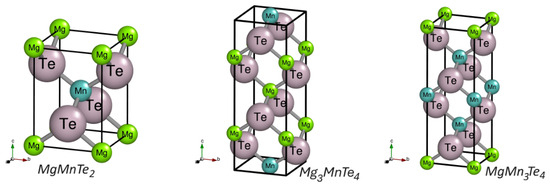
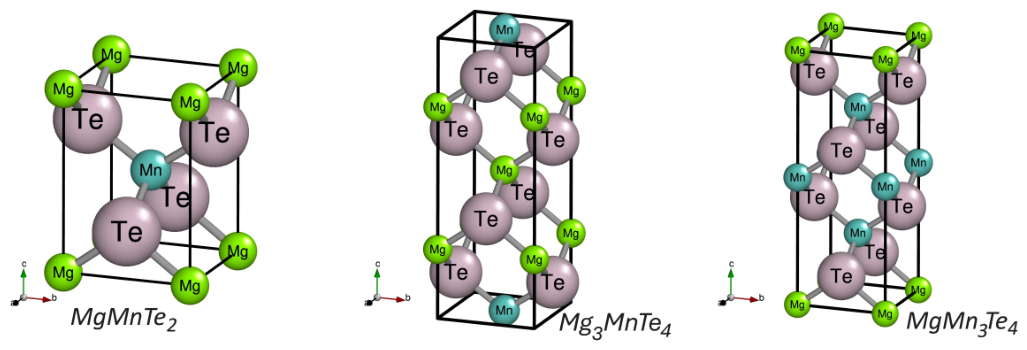
The compound crystallizes in a tetragonal lattice belonging to space group No. 115 [20,21]. A schematic representation of the crystalline architecture and its constituent atomic positions is provided in the left panel of Figure 1. The lattice is characterized by an alternating sequence of pure atomic layers in a ...-Mg–Te–Mn–Te-... arrangement, where Mg atoms occupy the corners and Mn atoms are situated at the center of the tetragonal unit cell. In this configuration, both Mg and Mn cations reside at the centers of tetrahedral pyramids coordinated by Te atoms. The structural symmetry is fundamentally facilitated by the comparable atomic radii of Mg and Mn. Furthermore, the Materials Project reports a formation energy of eV/atom and an energy distance to the convex hull of eV/atom for . These database values place the reported tetragonal entry close to the database convex hull and suggest that could potentially be synthesizable in this specific tetragonal phase [20,21]. In order to be conclusive regarding the experimental synthesizabillity of the tetragonal structure, further investigation is needed. One should also perform a thorough study among possible structures to identify potential competing phases which could possibly be the ground state. In that case, depending on the energy difference, the tetragonal phase could be grown as a metastable phase.
Figure 1.
Schematic representation of tetragonal lattice structure and atomic positions of the three compounds under study. Note that the unit cells for the and compounds are approximately twice as long as that of along the z-direction. The lattice constants and atomic positions used for this representation are summarized in Table 1 and Table 2, respectively.
The ternary derivatives and are obtained directly from the parent structure through a doubling of the unit cell along the z-axis, followed by the stoichiometric substitution of a single Mn (or Mg) atom with Mg (or Mn). As illustrated in Figure 1, both compounds retain the tetragonal symmetry associated with space group No. 115. Owing to the comparable atomic radii of Mg and Mn, the lattice undergoes negligible structural deformation; consequently, the atomic coordinates deviate only marginally from those established for the parent phase.
Table 1 summarizes the lattice parameters obtained via total energy calculations employing the PBE exchange-correlation functional. Our computed values demonstrate excellent agreement with those reported in the Materials Project database, despite the latter’s reliance on pseudopotential-based electronic structure methods [20,21]. For the derivative and systems, the lattice constants exhibit negligible deviation from the parent compound. Specifically, the in-plane lattice parameter, a, varies by approximately 0.5%. The relative change in the out-of-plane lattice parameter, c, is even less pronounced when accounting for the doubled periodicity along the z-axis in the derivative structures. Notably, doubling the ratio of yields a value of 2.814, which differs from the respective ratios of the and compounds only in the third decimal place. Consequently, the stoichiometric substitution between Mg and Mn exerts a vanishingly small influence on the fundamental structural parameters of the parent matrix.
Table 1.
Optimized lattice parameters (a and c), ratio, bulk modulus (B) and its first pressure derivative () for all three compounds (, , and ) under study.
The impact of the aforementioned substitution manifests more prominently in the internal atomic coordinates within the unit cell, particularly regarding the fractional z-coordinate of the Te atoms, as detailed in Table 2. In the parent compound, the Mg and Mn cations occupy high-symmetry Wyckoff positions. While an idealized, unrelaxed geometry dictates a fractional z-coordinate of exactly 0.25 for the Te atoms, structural optimization reveals a slight upward displacement toward the central Mn atomic layer. For the derivative Mg3MnTe4 and MgMn3Te4 phases, the Mg (or Mn) atoms introduced via substitution exhibit a minor translation along the z-axis. This structural deviation is substantially more pronounced for the Te atoms; notably, the symmetry breaking in these extended unit cells yields two crystallographically inequivalent Te sites.
Table 2.
Calculated atomic positions using Wyckoff coordinates for the , , and in the tetragonal structures shown in Figure 1.
3.2. Elastic Behavior and Mechanical Stability
To assess the mechanical behavior of the investigated MgMnTe2, Mg3MnTe4, and MgMn3Te4 compounds, the six independent elastic constants required by tetragonal symmetry, namely, , , , , , and , were calculated using first principles methods. The computed values are summarized in Table 3. All three compounds display relatively large and elastic constants, indicating a strong resistance to uniaxial strain along both the a and c crystallographic axes. Moreover, the persistent inequality in all cases suggests a noticeable elastic anisotropy, implying that the bonding strength and stiffness are more pronounced within the -plane than along the c-direction. Specifically, the axial constants and , which quantify the material’s resistance to uniaxial compression along the a- and c-directions, respectively, are systematically larger than the shear related constants and . This result indicates that all three crystals are more resistant to linear elastic deformations. A notable feature common to all studied materials is the exceptionally low magnitude of the off-diagonal elastic constants which fall in the range of 6.12 GPa and 7.69 GPa.
Table 3.
Calculated elastic constants (, in GPa), bulk, shear, and Young’s moduli (B, G, and E, respectively, in GPa).
The mechanical stability of a tetragonal structure is evaluated based on the Born stability criteria, which consist of the following set of inequalities [41]:
As observed in Table 3, all calculated elastic constants satisfy the above inequalities, indicating mechanical stability against infinitesimal homogeneous deformations within the static elastic approximation. This result does not establish dynamical stability, for which phonon calculations would be required to verify the absence of imaginary modes, nor does it establish finite-temperature thermodynamic stability.
It is of significant engineering relevance to assess the elastic behavior of polycrystalline materials, as most real-world applications involve polycrystalline phases rather than single crystals. Therefore, the isotropic elastic moduli were derived from the calculated single-crystal elastic constants using the Voigt–Reuss–Hill averaging scheme [42]. A preliminary examination of the results presented in Table 3 reveals that the bulk modulus values B derived from the Voigt–Reuss–Hill approximation show very good agreement with those previously obtained from the Birch–Murnaghan equations of state [37], as listed in Table 1; they differ by less than 6%. This consistency between the two independent approaches reinforces the reliability of the calculated mechanical properties and validates the accuracy of the first-principles elastic constant estimations. As evidenced by the data presented in Table 3, the calculated bulk modulus B varies narrowly between 35.12 GPa and 38.15 GPa, reflecting a moderate resistance to volume compression. For all the studied compounds, the significantly lower values of the shear modulus G compared to the bulk modulus B indicate that these materials offer greater resistance to uniform compression than to shear deformation.
To evaluate the ductile or brittle character of the investigated materials, we employed Pugh’s ratio () [43]. According to this criterion, materials with a ratio above 1.75 are typically classified as ductile, whereas lower values indicate brittleness. From data given in Table 3, the calculated ratios for , and are 1.76, 1.91 and 2.07, respectively. The value obtained for is close to the critical limit, indicating a borderline character between brittleness and ductility. In contrast, and exhibit significantly higher ratios, indicating enhanced ductility.
3.3. Electronic and Magnetic Properties
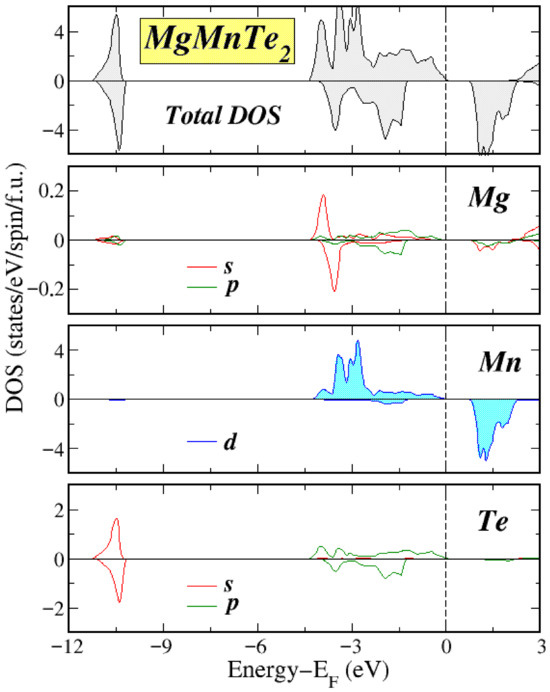
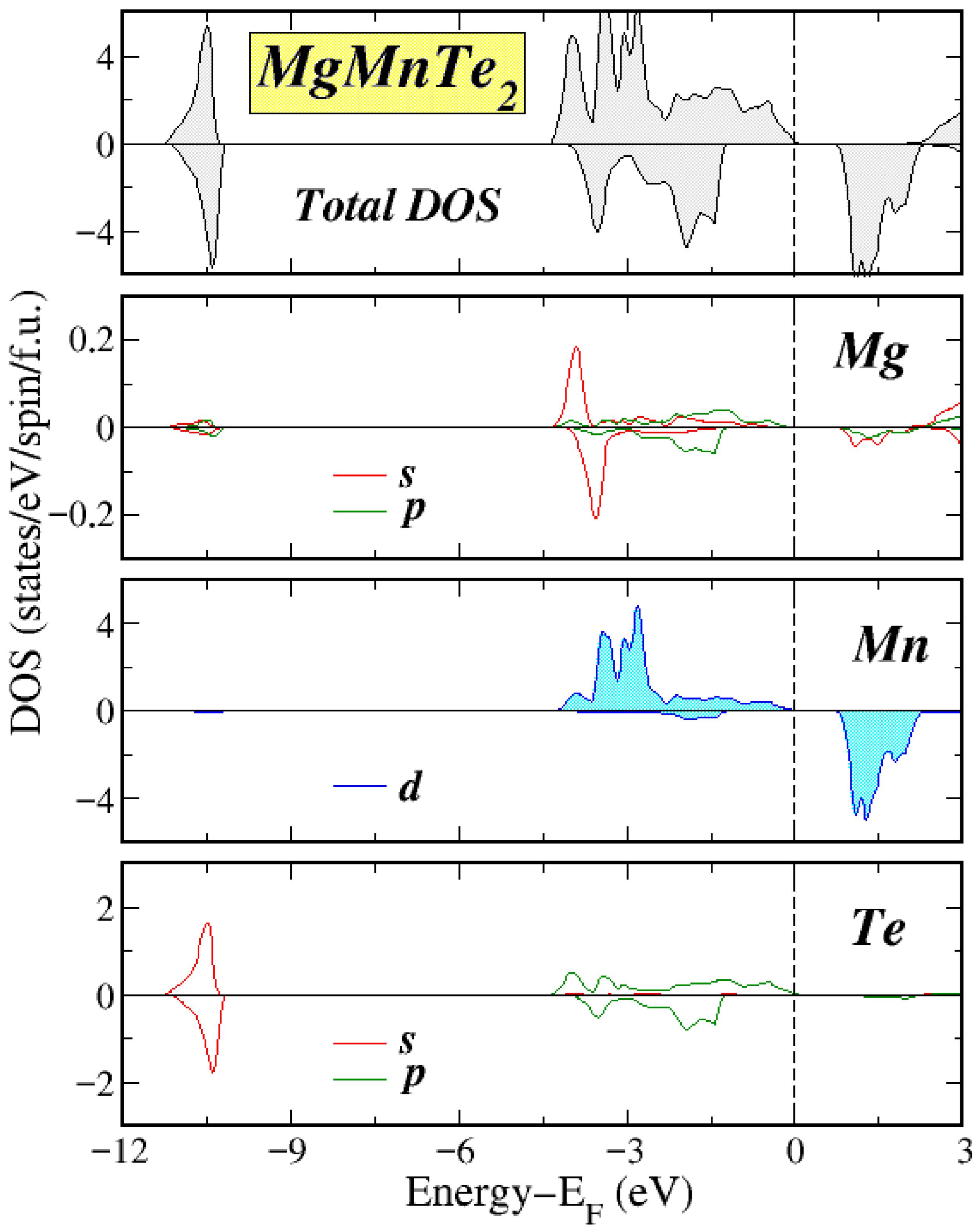
Following the characterization of the structural and elastic properties, we investigated the electronic and magnetic profiles of the three compounds using the PBE functional. Figure 2 illustrates the total density of states (DOS) per formula unit, alongside the atom- and orbital-resolved projections for . In contrast to previously reported alkali-based A-site compounds, which exhibit ferromagnetic half- metallicity [14,15,16,18,19], the present systems are identified as ferromagnetic semiconductors. As detailed in Table 4, the electronic band structure reveals a substantial fundamental gap of eV in the majority-spin (spin-up) channel and an even larger gap of eV in the minority-spin (spin-down) channel. Band structure calculations (Figures S1–S9 in the Supplementary Material) reveal that the majority-spin energy gap is a direct one located at the point in the Brillouin zone for all three compounds irrespective of the functional used to compute them. On the other hand, the valence and conduction bands just below and just above the minority-spin energy gap are relatively flat in all cases and no definitive conclusion can be drawn on the character of the energy gap. The Te s-states are situated at deep binding energies, approximately 10 eV below the Fermi level (), while the Mg s-states are localized near eV. The electronic landscape in the vicinity of is predominantly governed by the Mn d-states, which exhibit significant exchange splitting; this mechanism is responsible for the emergence of the large band gaps in both spin channels. The Mn d majority-spin states are nearly fully occupied, whereas the minority-spin states remain largely vacant. In the same energy range as the Mn d-states, the Mg and Te p-orbitals provide a minor contribution. Specifically, the p-states and the triply degenerate d-states transform according to the same irreducible representation, leading to a consistent p–d hybridization (admixture) wherever the latter are present (note that actually the lattice is not cubic but we still use the nomenclature for the tetrahedral symmetry as the Mn atoms sit at the center of pyramids created by four Te atoms).
Figure 2.
Total and atom-orbital-resolved DOS for the compound using the PBE functional. Positive (negative) DOS values correspond to the majority (minority) spin electrons. Zero energy corresponds to the Fermi level. Note that the scale for the vertical axis is different in all cases.
Table 4.
Calculated energy band gaps for spin-up and spin-down electronic band structures using PBE, mBJ, and SCAN functionals.
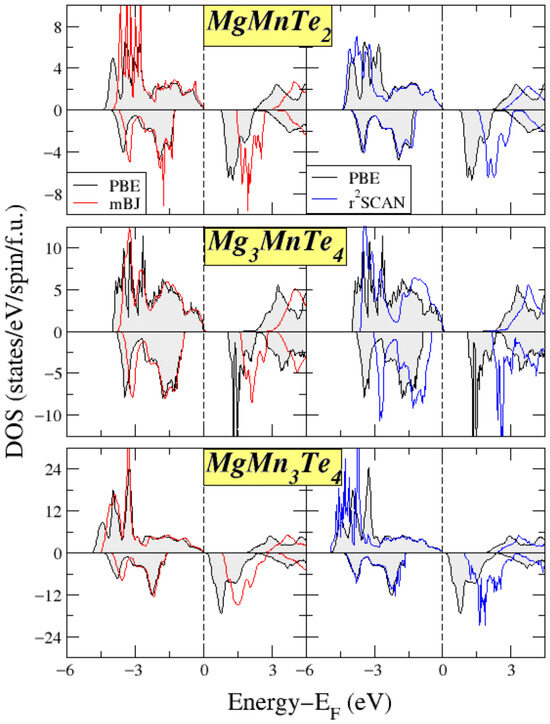
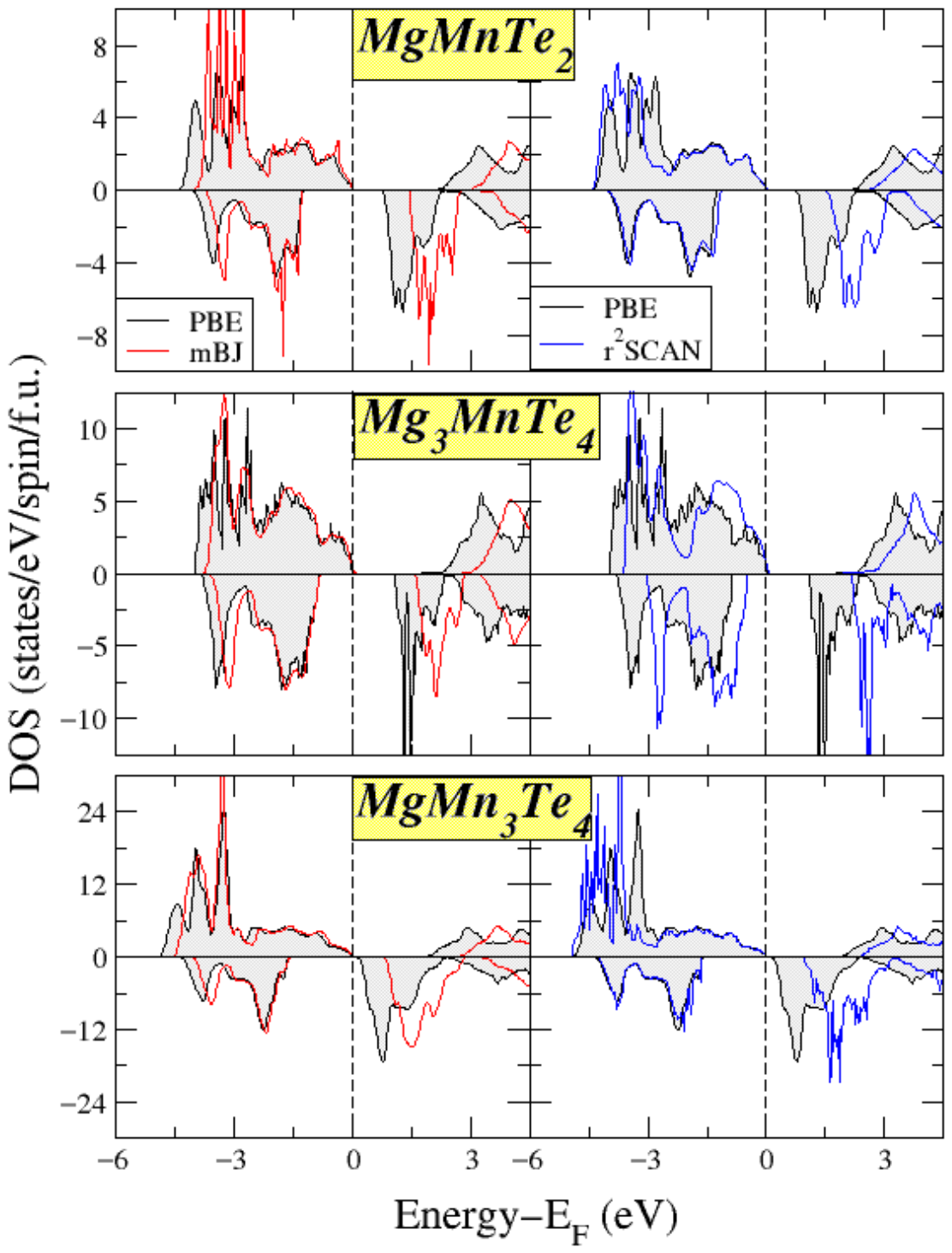
For the and derivatives, the density of states (DOS) profiles exhibit characteristics analogous to the parent compound; consequently, only the DOS per formula unit is presented in Figure 3. This similarity underscores that the Mn d-states remain the primary determinants of the electronic properties across all three investigated systems. As demonstrated in Table 4, both and maintain substantial energy gaps in both spin channels. Notably, in the specific case of , the valence band maximum of the majority-spin channel and the conduction band minimum of the minority-spin channel appear to converge. However, this feature is likely an artifact of the chosen functional rather than an intrinsic property, as subsequent calculations using alternative exchange- correlation functionals (discussed in the following section) do not replicate this near-degeneracy.
Figure 3.
For all three compounds under study we compare the DOS derived from the PBE calculations with the DOS derived from the mBJ calculations (left panel) and the SCAN calculations (right panel).
The behavior of the calculated spin magnetic moments, summarized in Table 5, aligns with the previously discussed electronic properties. In accordance with the semiconducting nature of these compounds, the total spin magnetic moment per formula unit must be an integer (in units of ), as it corresponds to the integral difference between the number of occupied majority- and minority-spin bands. The magnetic character is predominantly localized on the Mn sites, which exhibit moments exceeding . For and , each containing a single Mn atom per formula unit, the total spin magnetic moment is exactly . In the case of , which incorporates three Mn atoms per unit cell, the calculated total moment is approximately . While the moments at the Mg and Te sites are negligible, a nonzero spin magnetic moment is observed in the interstitial region. This interstitial contribution is expected due to the spatial delocalization of the valence electrons. It should be noted that the atomic magnetic moments are determined by integrating the spin-dependent charge density within the respective muffin-tin spheres. The interstitial spin density is primarily concentrated around the Mn spheres; this is evidenced by the fact that the interstitial magnetic moment in is three times larger than that observed in the compounds containing only a single Mn atom.
Table 5.
Spin magnetic moments in for , and using PBE, mBJ and SCAN functionals. For the latter two compounds there are two inequivalent Mg(Mn) and Te atoms per formula unit. int stands for the interstitial region and tot for the total per formula unit spin magnetic moment.
3.4. Effect of mBJ and SCAN Functionals
While the PBE parameterization of GGA is widely utilized for the investigation of material properties, we have also employed more advanced exchange-correlation functionals, specifically mBJ and SCAN, to evaluate the electronic and magnetic profiles of the studied systems. These functionals belong to the meta-GGA class and typically offer improved accuracy over standard GGA. Figure 3 provides a comparative analysis of the total DOS calculated using mBJ (left panels) and SCAN (right panels) relative to the PBE results. Furthermore, the calculated energy band gaps and spin magnetic moments obtained across all three functionals are summarized in Table 4 and Table 5, respectively.
A primary distinction between these two meta-GGA approaches lies in their construction. The mBJ functional was specifically designed to mimic the performance of computationally intensive hybrid functionals at a fraction of the cost; it incorporates semi-empirical parameters fitted to reproduce the experimental band gaps of specific semiconductors, making its accuracy somewhat material-dependent. In contrast, SCAN is a more universal, nonempirical functional that, like PBE, is applicable across diverse systems but achieves superior precision by incorporating the Laplacian of the electronic charge density (also called the Kohn–Sham kinetic energy density).
With respect to the electronic properties, both the mBJ and SCAN functionals yield density of states (DOS) profiles qualitatively consistent with the PBE results; observed discrepancies are primarily associated with the relative energy shifts of the unoccupied states relative to the valence band. As indicated in Table 4, mBJ yields a substantial expansion of the majority-spin (spin-up) energy gap—which, for , is approximately twice the PBE value—whereas SCAN results in a more moderate enhancement. In the minority- spin (spin-down) channel, this trend is reversed, with SCAN producing larger energy gaps compared to the mBJ functional. Given that both mBJ and SCAN exert a negligible influence on the occupied states, the Mn-site and total spin magnetic moments (summarized in Table 5) exhibit minimal sensitivity to the choice of functional. Consequently, apart from the well-known underestimation of the energy band gaps, PBE remains highly reliable for these systems, accurately characterizing interatomic orbital hybridization, band dispersion, and spin magnetic moments.
4. Summary and Conclusions
In conclusion, we have performed a rigorous first-principles study on the layered tetragonal compounds , and to assess their viability for spintronic integration. Structural relaxations and elastic constant calculations show that all three compounds satisfy the Born mechanical stability criteria and exhibit significant resistance to uniform compression within the static elastic approximation. Notably, the stoichiometric derivation of , and from the parent phase preserves the host lattice symmetry while significantly enhancing the ductile character of the materials.
From an electronic and magnetic standpoint, these systems are identified as true ferromagnetic semiconductors rather than half-metals. They display wide fundamental band gaps in both spin channels, driven primarily by the strong exchange splitting of the Mn valence d-states. Consequently, the total spin magnetic moments adhere strictly to integer values, scaling proportionally with the Mn concentration in the unit cell. To assess the robustness of our electronic structure predictions, we systematically compared the standard PBE functional with advanced mBJ and SCAN meta-GGA functionals. While the advanced functionals correct the characteristic band gap underestimation of PBE, the fundamental electronic characteristics and magnetic localization remain intrinsically robust regardless of the chosen methodology.
The small energy distances to the convex hull reported in the Materials Project motivate further investigation of , , and [20,21]. The present results identify the tetragonal phases as theoretical candidates for further energetic, lattice-dynamical, and experimental assessment. If these phases are experimentally realized and their dynamical and relative phase stability are confirmed, their calculated electronic structures suggest that they could be considered as magnetic semiconducting layers in spin-dependent electronic devices. Moreover, the elastic response and enhanced ductility indicators calculated for and may be favorable from a mechanical perspective, although their actual processability, thin-film growth, and integration into layered heterostructures remain to be established experimentally.
Experimental synthesis and characterization, together with phonon calculations and a consistent formation-energy/convex-hull analysis against the relevant competing Mg–Mn–Te phases, are needed to assess dynamical stability and relative phase stability, respectively. Further calculations of Curie temperatures, magnetic anisotropy, spin–orbit coupling, carrier transport, defect and doping effects, and interface compatibility are also required before their practical suitability for room-temperature spintronic devices can be assessed.
Supplementary Materials
The following supporting information can be downloaded at: https://www.mdpi.com/article/10.3390/compounds6030046/s1, Figure S1: Spin-resolved band structure for using the PBE functional; Figure S2: Spin-resolved band structure for using the mBJ functional; Figure S3: Spin-resolved band structure for using the SCAN functional; Figure S4: Spin-resolved band structure for using the PBE functional; Figure S5: Spin-resolved band structure for using the mBJ functional; Figure S6: Spin-resolved band structure for using the SCAN functional; Figure S7: Spin-resolved band structure for using the PBE functional; Figure S8: Spin-resolved band structure for using the mBJ functional; Figure S9: Spin-resolved band structure for using the SCAN functional.
Author Contributions
Conceptualization, I.G.; Methodology, F.F., A.B. and K.Ö.; Validation, F.F., A.B. and K.Ö.; Formal analysis, F.F., A.B. and K.Ö.; Investigation, F.F., A.B. and K.Ö.; Resources, A.B.; Data curation, F.F., A.B. and K.Ö.; Writing—original draft, A.B., K.Ö. and I.G.; Writing—review & editing, I.G.; Visualization, F.F. and A.B.; Supervision, I.G.; Project administration, I.G. All authors have read and agreed to the published version of the manuscript.
Funding
This research received no external funding.
Data Availability Statement
The original contributions presented in this study are included in the article/Supplementary Material. Further inquiries can be directed to the corresponding author.
Acknowledgments
During the preparation of this manuscript the authors used Gemini, version 3.1 Pro, for the purpose of improving the quality of English. The authors have reviewed and edited the output and take full responsibility for the content of this publication.
Conflicts of Interest
The authors declare no conflicts of interest.
Abbreviations
The following abbreviations are used in this manuscript:
| AFM | Antiferromagnetism |
| DOS | Density of states |
| f.u. | Formula unit |
| GGA | Generalized gradient approximation |
| mBJ | Modified Becke–Johnson |
| PBE | Perdew–Burke–Ernzerhof |
| SCAN | Second revision of SCAN |
| SCAN | Strongly constrained and appropriately normed |
References
- Al-Qhtani, M.; Mustafa, G.M.; Mazhar, N.; Bouzgarrou, S.; Mahmood, Q.; Mera, A.; Zaki, Z.I.; Mostafa, N.Y.; Alotaibi, S.H.; Amin, M.A. Half metallic ferromagnetism and transport properties of zinc chalcogenides ZnX2Se4 (X = Ti, V, Cr) for spintronic applications. Materials 2021, 15, 55. [Google Scholar] [CrossRef] [Scilit] [PubMed]
- Awschalom, D.D.; Kikkawa, J.M. Electron spin and optical coherence in semiconductors. Phys. Today 1999, 52, 33–38. [Google Scholar] [CrossRef] [Scilit]
- Dey, P.; Roy, J.N. Spintronics Applications. In Spintronics: Fundamentals and Applications; Dey, P., Roy, J.N., Eds.; Springer: Singapore, 2021. [Google Scholar]
- Žutić, I.; Fabian, J.; Sarma, S.D. Spintronics: Fundamentals and applications. Rev. Mod. Phys. 2004, 76, 323. [Google Scholar] [CrossRef] [Scilit]
- Kalyani, V.L.; Agrawal, V. Spintronics—A vision for future in electronics and computers. J. Manag. Eng. Inf. Tech. 2015, 2, 30–36. [Google Scholar]
- De Groot, R.A.; Mueller, F.M.; van Engen, P.G.; Buschow, K.H.J. New class of materials: Half-metallic ferromagnets. Phys. Rev. Lett. 1983, 50, 2024. [Google Scholar] [CrossRef] [Scilit]
- Galanakis, I. Slater–Pauling behavior in half-metallic Heusler compounds. Nanomaterials 2023, 13, 2010. [Google Scholar] [PubMed]
- Munekata, H.; Ohno, H.; Von Molnar, S.; Segmüller, A.; Chang, L.L.; Esaki, L. Diluted magnetic III-V semiconductors. Phys. Rev. Lett. 1989, 63, 1849. [Google Scholar] [CrossRef] [Scilit] [PubMed]
- Tanaka, M.; Higo, Y. Large tunneling magnetoresistance in GaMnAs/AlAs/GaMnAs ferromagnetic semiconductor tunnel junctions. Phys. Rev. Lett. 2001, 87, 026602. [Google Scholar] [CrossRef] [Scilit]
- Ji, Y.; Strijkers, G.J.; Yang, F.Y.; Chien, C.L.; Byers, J.M.; Anguelouch, A.; Xiao, G.; Gupta, A. Determination of the spin polarization of half-metallic CrO2 by point contact Andreev reflection. Phys. Rev. Lett. 2001, 86, 5585. [Google Scholar] [PubMed]
- Tavares, S.S.M.; Yang, K.; Meyers, M.A. Heusler alloys: Past, properties, new alloys, and prospects. Prog. Mater. Sci. 2023, 132, 101017. [Google Scholar] [CrossRef] [Scilit]
- Kim, J.; Hughbanks, T. Synthesis and structures of new layered ternary manganese selenides: AMnSe2 (A = Li, Na, K, Rb, Cs) and Na2Mn2Se3. J. Solid State Chem. 1999, 146, 217–225. [Google Scholar] [CrossRef] [Scilit]
- Kim, J.; Wang, C.; Hughbanks, T. Synthesis and Structures of New Layered Ternary Manganese Tellurides: AMnTe2 (A = Li, Na). Inorg. Chem. 1998, 37, 1428–1429. [Google Scholar] [CrossRef] [Scilit]
- Benmakhlouf, A.; Bentabet, A.; Bouhemadou, A.; Benghia, A. Prediction of half-metallic properties for the AMnSe2 (A = Rb, Cs) compounds from first-principles calculations. J. Magn. Magn. Mater. 2016, 399, 179–184. [Google Scholar] [CrossRef] [Scilit]
- Benmakhlouf, A.; Bentabet, A.; Bouhemadou, A.; Maabed, S.; Benghia, A.; Khenata, R.; Bin-Omran, S. Structural, half-metallic magnetism and elastic properties of the KMnQ2 (Q = O, S, Se, Te) chalcogenides from first-principles calculations. J. Magn. Magn. Mater. 2016, 408, 199–205. [Google Scholar] [CrossRef] [Scilit]
- Benmakhlouf, A.; Bourourou, Y.; Bouhemadou, A.; Bentabet, A.; Khemloul, F.; Maabed, S.; Bouchenafa, M.; Galanakis, I. Structural, electronic and magnetic properties of the manganese telluride layers AMnTe2 (A = K, Rb, Cs) from first-principles calculations. J. Magn. Magn. Mater. 2018, 465, 430–436. [Google Scholar] [CrossRef] [Scilit]
- Yaqoob, N.; Sabir, B.; Murtaza, G.; Khalil, R.M.A.; Muhammad, N.; Laref, A. Structural, electronic, magnetic, optical and thermoelectric response of half-metallic AMnTe2 (A = Li, Na, K): An ab-initio calculations. Phys. B 2019, 574, 311656. [Google Scholar] [CrossRef] [Scilit]
- Ghermoul, N.; Benmakhlouf, A.; Faid, F.; Bourourou, Y.; Bouhemadou, A.; Fakhreddine, K.; Maabed, S.; Bouchenafa, M.; Bentabet, A.; Galanakis, I. Ab initio prediction of half-metallicity in the NaMnZ2 (Z = S, Se, Te) ternary layered compounds. Comput. Condens. Matter 2022, 33, e00754. [Google Scholar] [CrossRef] [Scilit]
- Benmakhlouf, A.; Faid, F.; Ghermoul, N.; Özdoğan, K.; Helaimia, T.; Bouhemadou, A.; Galanakis, I. DFT Insights into the physical properties of layered LiMnSe2 and LiMnTe2 compounds. Metals 2024, 14, 1036. [Google Scholar] [CrossRef] [Scilit]
- Jain, A.; Ong, S.P.; Hautier, G.; Chen, W.; Richards, W.D.; Dacek, S.; Cholia, S.; Gunter, D.; Skinner, D.; Ceder, G.; et al. Commentary: The Materials Project: A materials genome approach to accelerating materials innovation. APL Mater. 2013, 1, 011002. [Google Scholar] [CrossRef] [Scilit]
- Horton, M.K.; Huck, P.; Yang, R.X.; Munro, J.M.; Dwaraknath, S.; Ganose, A.M.; Kingsbury, R.S.; Wen, M.; Shen, J.X.; Mathis, T.S.; et al. Accelerated data-driven materials science with the Materials Project. Nat. Mater. 2025, 24, 1522–1532. [Google Scholar] [CrossRef] [Scilit] [PubMed]
- Gadhavajhala, S.S.S.; Kannan, V.P.; Kale, A.J.; Batra, R.R.; Mishra, S.R.; Srinivasan, B. Magnetic Frameworks and Non-Magnetic Dopants: A Novel Strategy for Enhancing Thermoelectric Efficiency in Manganese Telluride—Mechanistic Insights into Charge Carrier Dynamics and Phonon Transport. Small 2025, 21, 2411481. [Google Scholar] [CrossRef] [Scilit]
- Blaha, P.; Schwarz, K.; Tran, F.; Laskowski, R.; Madsen, G.K.H.; Marks, L.D. WIEN2k: An APW+lo program for calculating the properties of solids. J. Chem. Phys. 2020, 152, 074101. [Google Scholar] [CrossRef] [Scilit]
- Wang, Y.; Perdew, J.P. Correlation hole of the generalized gradient approximation from boundary conditions. Phys. Rev. B 1991, 44, 13298. [Google Scholar] [CrossRef] [Scilit]
- Perdew, J.P.; Burke, K.; Ernzerhof, M. Generalized gradient approximation made simple. Phys. Rev. Lett. 1996, 77, 3865. [Google Scholar] [CrossRef] [Scilit] [PubMed]
- Perdew, J.P.; Schmidt, K. Jacob’s ladder of density functional approximations for the exchange-correlation energy. In AIP Conference Proceedings; AIP: New York, NY, USA, 2001; Volume 577, p. 1. [Google Scholar]
- Becke, A.D.; Johnson, E.R. A simple effective potential for exchange. J. Chem. Phys. 2006, 124, 221101. [Google Scholar] [CrossRef] [Scilit] [PubMed]
- Tran, F.; Blaha, P. Accurate band gaps of semiconductors and insulators with a semilocal exchange-correlation potential. Phys. Rev. Lett. 2009, 102, 226401. [Google Scholar] [CrossRef] [Scilit] [PubMed]
- Haas, P.; Tran, F.; Blaha, P. Calculation of the lattice constant of solids with semilocal functionals. Phys. Rev. B 2009, 79, 085104. [Google Scholar] [CrossRef] [Scilit]
- Meinert, M. Modified Becke-Johnson potential for structural, electronic, and magnetic properties of Heusler compounds. Phys. Rev. B 2013, 87, 045103. [Google Scholar] [CrossRef] [Scilit]
- Sun, J.; Ruzsinszky, A.; Perdew, J.P. Strongly constrained and appropriately normed semilocal density functional. Phys. Rev. Lett. 2015, 115, 036402. [Google Scholar] [CrossRef] [Scilit] [PubMed]
- Furness, J.W.; Kaplan, A.D.; Ning, J.; Perdew, J.P.; Sun, J. Accurate and numerically efficient r2SCAN semilocal density functional. J. Phys. Chem. Lett. 2020, 11, 8208–8215. [Google Scholar] [CrossRef] [Scilit] [PubMed]
- Koller, D.; Tran, F.; Blaha, P. Merits and limits of the modified Becke-Johnson exchange potential. Phys. Rev. B 2011, 83, 195134. [Google Scholar] [CrossRef] [Scilit]
- Camargo-Martínez, J.A.; Baquero, R. Performance of the modified Becke-Johnson potential for semiconductors. Phys. Rev. B 2012, 86, 195106. [Google Scholar] [CrossRef] [Scilit]
- Kingsbury, R.; Gupta, A.S.; Bartel, C.J.; Munro, C.J.; Dwaraknath, S.; Horton, M.; Persson, K.A. Performance comparison of r2SCAN and SCAN metaGGA density functionals for solid materials via an automated, high-throughput computational workflow. Phys. Rev. Mater. 2022, 6, 013801. [Google Scholar] [CrossRef] [Scilit]
- Monkhorst, H.J.; Pack, J.D. Special points for Brillouin-zone integrations. Phys. Rev. B 1976, 13, 5188–5192. [Google Scholar] [CrossRef] [Scilit]
- Birch, F. Finite elastic strain of cubic crystals. Phys. Rev. 1947, 71, 809. [Google Scholar] [CrossRef] [Scilit]
- Jamal, M.; Bilal, M.; Ahmad, I.; Jalali-Asadabadi, S. IRelast package. J. Alloys Compd. 2018, 735, 569. [Google Scholar] [CrossRef] [Scilit]
- Cococcioni, M.; de Gironcoli, S. Linear response approach to the calculation of the effective interaction parameters in the LDA + U method. Phys. Rev. B 2005, 71, 035105. [Google Scholar] [CrossRef] [Scilit]
- Himmetoglu, B.; Floris, A.; de Gironcoli, S.; Cococcioni, M. Hubbard-corrected DFT energy functionals: The LDA+U description of correlated systems. Int. J. Quantum Chem. 2014, 114, 14–49. [Google Scholar]
- Mouhat, F.; Coudert, F.-X. Necessary and sufficient elastic stability conditions in various crystal systems. Phys. Rev. B 2014, 90, 224104. [Google Scholar] [CrossRef] [Scilit]
- Hill, R. The elastic behaviour of a crystalline aggregate. Proc. Phys. Soc. A 1952, 65, 349–354. [Google Scholar] [CrossRef] [Scilit]
- Pugh, S. Relations between the elastic moduli and the plastic properties of polycrystalline pure metals. Philos. Mag. 1954, 45, 823–843. [Google Scholar] [CrossRef] [Scilit]

Disclaimer/Publisher’s Note: The statements, opinions and data contained in all publications are solely those of the individual author(s) and contributor(s) and not of MDPI and/or the editor(s). MDPI and/or the editor(s) disclaim responsibility for any injury to people or property resulting from any ideas, methods, instructions or products referred to in the content. |
© 2026 by the authors. Licensee MDPI, Basel, Switzerland. This article is an open access article distributed under the terms and conditions of the Creative Commons Attribution (CC BY) license.