


Abstract
Fasciolosis, caused by Fasciola hepatica and Fasciola gigantica, negatively impacts buffalo production systems worldwide as a parasitic and zoonotic disease. Due to their semi-aquatic foraging behavior, buffaloes (Bubalus bubalis) are highly exposed to Fasciola infections. The reported prevalence rates vary widely, hindering effective control strategies. This systematic review and meta-analysis estimated the global pooled prevalence of Fasciola infection in buffaloes and explored major sources of heterogeneity. Following PRISMA guidelines, major databases (PubMed/MEDLINE, Web of Science, ScienceDirect, CAB Abstracts, and Google Scholar) were searched from inception through September 2026. The primary synthesis used a random-effects binomial generalized linear mixed model (GLMM) with a logit link. Heterogeneity was quantified using Cochran’s Q, I2, and τ2; subgroup analyses and univariate meta-regression were used to explore study-level sources of variation, and Egger’s regression was used to assess funnel-plot asymmetry when at least 10 estimates were available. The final quantitative dataset comprised 64 publications contributing 73 effect estimates and 2,267,945 buffaloes after the removal of one exact duplicate estimate. The global pooled prevalence in buffaloes was 16.5% (95% CI: 12.1–22.0%), with very high heterogeneity (I2 = 99.8%; τ2 = 2.366 on the logit scale). The pooled prevalence was 45.7% in Europe, 19.5% in Asia, 4.2% in Africa, and 7.9% in the Americas. By parasite identification, the prevalence was 28.4% for F. gigantica, 16.6% for F. hepatica, and 13.0% for Fasciola spp.; by diagnostic method, it was 20.8% for fecal examination, 10.5% for post-mortem examination, and 11.7% for ELISA. Continent was a significant categorical moderator (Qm = 16.48, p < 0.001; R2 = 19.3%), whereas study period, diagnostic method, Fasciola identification, categorical sample size, and climatic zone were not. When the sample size was modeled continuously as ln(n), it was inversely associated with prevalence (Qm = 11.42, p < 0.001; R2 = 15.8%). Fasciola infections remain an important and highly heterogeneous problem in buffalo populations. The wide variation among settings, together with evidence of continent- and sample size-related effects, supports region-specific surveillance, standardized diagnostics, molecular species identification, and integrated One Health control rather than reliance on a single global prevalence estimate.
1. Introduction
Fasciola hepatica and Fasciola gigantica are parasitic trematodes that cause fasciolosis, a major zoonotic disease affecting animal production and public health worldwide [1,2]. These parasites infect a wide range of herbivorous mammals, with domestic ruminants, particularly cattle, sheep, goats, and buffaloes, serving as important definitive hosts [3,4]. Fasciolosis is characterized by hepatobiliary damage caused by larval migration through the liver parenchyma and adult flukes residing in the bile ducts [5]. Infection can reduce productivity, weight gain, and milk yield, cause liver condemnation at slaughter, and in severe cases, mortality [6,7]. Indirect losses include treatment costs, increased susceptibility to secondary infections, and trade restrictions [8,9]. The disease occurs widely outside the polar regions, and buffaloes may contribute to transmission as reservoir hosts in endemic areas [10,11].
Buffalo (Bubalus bubalis) is an important livestock species worldwide, with a global population of over 200 million. Water buffaloes are of great importance in Asia, where they provide draught power, milk, meat, and hides on an extensive scale for agricultural production [12]. The semi-aquatic lifestyle and habitat preferences of buffalo make them highly susceptible to Fasciola infection, as the life cycle of this parasite relies on freshwater snail intermediate hosts (mostly species of the genus Lymnaea) [13].
Although most of the global buffalo population remains concentrated in Asia, domestic water buffaloes are now established on all five continents. In Europe, buffalo production is concentrated, particularly in Italy, with smaller populations elsewhere, whereas the Americas include substantial and expanding buffalo industries, especially in Brazil and other South American countries [12,14]. This geographic expansion is epidemiologically relevant to fasciolosis because the establishment of buffaloes in wet, irrigated, or otherwise suitable environments can add a susceptible definitive host to transmission systems where lymnaeid snails and Fasciola spp. are already present.
The economic impact of fasciolosis in buffaloes is substantial and is likely underestimated. Direct losses include reduced milk yield, impaired growth, reduced draft performance, and mortality in severe cases [15]. Indirect losses include anthelmintic treatment costs, increased susceptibility to secondary infections, and restrictions on livestock trade [9]. Fasciolosis is an important food-borne zoonosis, and epidemiological evidence has identified buffaloes as potential reservoir hosts in endemic areas [16].
Although fasciolosis in buffaloes has been investigated in many endemic settings, the reported prevalence varies markedly from less than 1% in some surveys to more than 80% in localized buffalo populations, depending on geography, diagnostic method, and study population characteristics [17,18,19]. This heterogeneity complicates the estimation of the global burden and the development of evidence-based control strategies for this disease.
Meta-analysis provides a powerful statistical method for summarizing multiple studies to generate more precise pooled prevalence estimates and clinically valuable assessments of the sources of heterogeneity. Through the integration of data collected across geographical boundaries, time periods, and methodological designs, meta-analyses highlight trends that might be missed in single studies and provide direction for more targeted and detailed intervention approaches.
Previous meta-analyses have evaluated fasciolosis in mixed livestock populations or within individual countries, including a global multi-host synthesis and a Pakistan-focused analysis [20,21]. However, to our knowledge, no previous systematic review or meta-analysis has focused specifically on buffaloes as the global unit of synthesis. Our recently published global cattle meta-analysis addressed cattle separately [22], further supporting the need for a buffalo-specific assessment of prevalence and heterogeneity of the disease.
The objectives of this systematic review and meta-analysis were threefold: first, to estimate the global pooled prevalence of Fasciola infection in buffaloes; second, to examine the variation in prevalence across key subgroups, including geographical region, study period, diagnostic method, parasite species, sample size, and climatic zone; and third, to identify significant moderators of prevalence through meta-regression analysis.
2. Materials and Methods
2.1. Search Strategy and Study Selection
This systematic review and meta-analysis were conducted and reported in accordance with the PRISMA 2020 statement [23]. PubMed/MEDLINE, Web of Science, ScienceDirect, CAB Abstracts, and Google Scholar were searched from database inception through September 2026 for studies reporting the prevalence of Fasciola infection in buffalo populations. Reference lists of included studies and relevant reviews were also checked manually. Database-specific search strategies are provided in Supplementary Table S1.
The search strategy used three concept blocks: parasite terms (Fasciola, F. hepatica, F. gigantica, fasciolosis, fascioliasis, or liver fluke), host terms (buffalo*, water buffalo*, or Bubalus bubalis), and epidemiological terms (prevalence, epidemiology, survey, or cross-sectional). The blocks were combined with AND, with synonyms combined by OR, and syntax was adapted to the fields and operators supported by each database.
All retrieved records were imported into EndNote X9 (Clarivate, Philadelphia, PA, USA), and duplicates were eliminated. The search was restricted to publications in English. The reference lists of the included articles and relevant reviews were screened manually to identify additional eligible reports. Conference proceedings, dissertations, and other accessible grey literature were also considered to reduce the risk of publication bias.
2.2. Inclusion and Exclusion Criteria
Studies were included if they reported original data on Fasciola prevalence in buffalo populations, used a recognized diagnostic method (coproscopy, post-mortem examination, serology, or a molecular method), provided a numerator and denominator from which the prevalence could be calculated, and were published in a peer-reviewed source or accessible gray literature.
Studies were excluded if they investigated experimental rather than natural infection, reported infection intensity without prevalence data, combined host species without separate buffalo data, were case reports or case series without a denominator, duplicated an already included dataset, were conference abstracts without sufficient extractable data, or lacked essential geographic information required for the planned subgroup analyses.
Studies reporting only prevalence ranges or repeated longitudinal prevalence estimates were excluded from the quantitative synthesis when the number of buffaloes examined and the number of positives could not be extracted for a defined sampling point. Studies reporting cattle and water buffaloes jointly were also excluded when the buffalo-specific numerators and denominators could not be disaggregated.
2.3. Quality Assessment
The study-level methodological appraisal focused on the sampling frame and sampling approach, appropriateness of the diagnostic method, availability of an extractable buffalo-specific numerator and denominator, and potential selection or reporting limitations. Methodological limitations were considered qualitatively during interpretation and were not used as an exclusion criterion or as a meta-regression moderator.
2.4. Data Extraction
A standardized data extraction form in Microsoft Excel (version 16.72; Microsoft Corporation, Redmond, WA, USA) was developed and piloted on a subset of studies before full extraction. Because this systematic review has a single author, all data were extracted by the author and subsequently rechecked against the source reports before analysis. The extracted variables included first author and publication year, country and continent, study period, sample size, number of positive buffaloes, reported Fasciola identification (F. hepatica, F. gigantica, or Fasciola spp.), diagnostic method, study design, and dominant climatic region according to the Köppen–Geiger classification. In this review, “Fasciola spp.” is an operational category for reports in which infection was identified only at the genus level and does not imply exclusion of aspermic, introgressed, or hybrid Fasciola lineages when molecular resolution was insufficient. One exact duplicate estimate was removed before analysis. For the final analytical spreadsheet, event counts were reconstructed as round (reported prevalence × n/100) when only prevalence and sample size were available; the maximum discrepancy between reported and reconstructed prevalence was 0.218 percentage points.
2.5. Statistical Analysis, Heterogeneity, Meta-Regression, and Small-Study Effects
Statistical analyses were performed using the SPSS 31 software package (IBM Corp., Armonk, NY, USA) for Windows and Jamovi 2.7.38. The primary meta-analysis used a random-effects binomial generalized linear mixed model (GLMM) with a logit link and Laplace approximation, thereby modeling positive animals directly as binomial events. Pooled prevalence estimates and 95% confidence intervals were back-transformed to the prevalence scale. Forest plots were used to display individual estimates and pooled effects. Statistical heterogeneity was quantified using Cochran’s Q, I2, and the between-estimate variance τ2 on the logit scale; 95% prediction intervals were also calculated to describe the expected range of true prevalence in a comparable future setting.
Prespecified subgroup analyses were conducted for continent (Europe, Asia, Africa, and the Americas), study period (1988–2013 vs. 2014–2025), diagnostic method (fecal examination, post-mortem examination, and ELISA), Fasciola identification (F. gigantica, F. hepatica, and Fasciola spp.), sample size (≤300 vs. >300), and dominant climate (tropical, dry, and temperate). The analytical unit was the effect estimate; 73 estimates from 64 publications were retained after the removal of one exact duplicate.
Univariate meta-regression models were fitted separately for each study-level moderator. Categorical moderators were assessed with a Wald-type omnibus Qm statistic and its corresponding p-value; the proportion of between-estimate heterogeneity explained was summarized as R2, with residual τ2 and I2 also examined. Reference categories were the Americas, 2014–2025, ELISA, F. hepatica, >300 animals, and temperate climate, respectively. Sample size was additionally modeled as a continuous covariate using ln(n), because this preserves more information than dichotomization. A two-sided p < 0.05 was considered statistically significant.
Funnel plots and Egger’s regression were used to evaluate funnel-plot asymmetry and small-study effects. Egger’s test was interpreted only for analyses with at least 10 effect estimates; significant results were not considered proof of publication bias because substantial heterogeneity can also produce asymmetry. Sensitivity analyses included a two-step logit random-effects model using REML, a Freeman–Tukey double-arcsine random-effects model, inclusion of the exact duplicate estimate, a publication-cluster-robust analysis to account for repeated estimates from the same publication, and leave-one-out analyses.
2.6. Reporting Guideline and Registration
The review was reported according to PRISMA 2020 [24]. It was not prospectively registered, and no standalone review protocol was deposited before screening. The database-specific search strategies are provided in Supplementary Table S1, and the completed PRISMA 2020 checklist is provided separately as Supplementary Table S2.
3. Results
3.1. Search Results and Eligible Studies
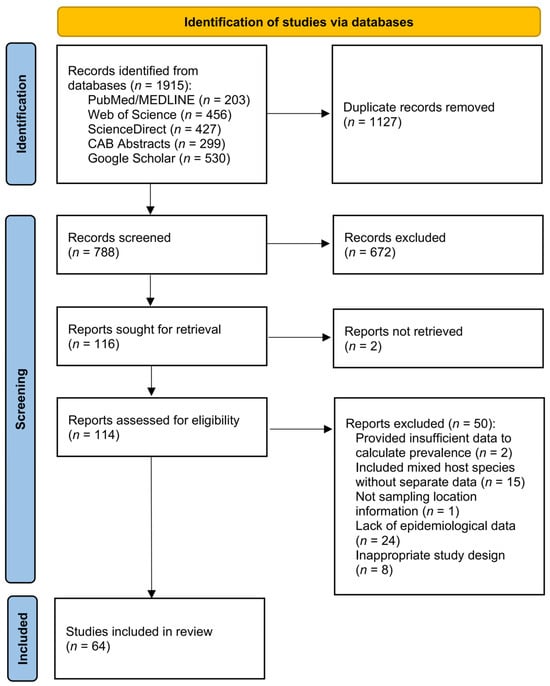
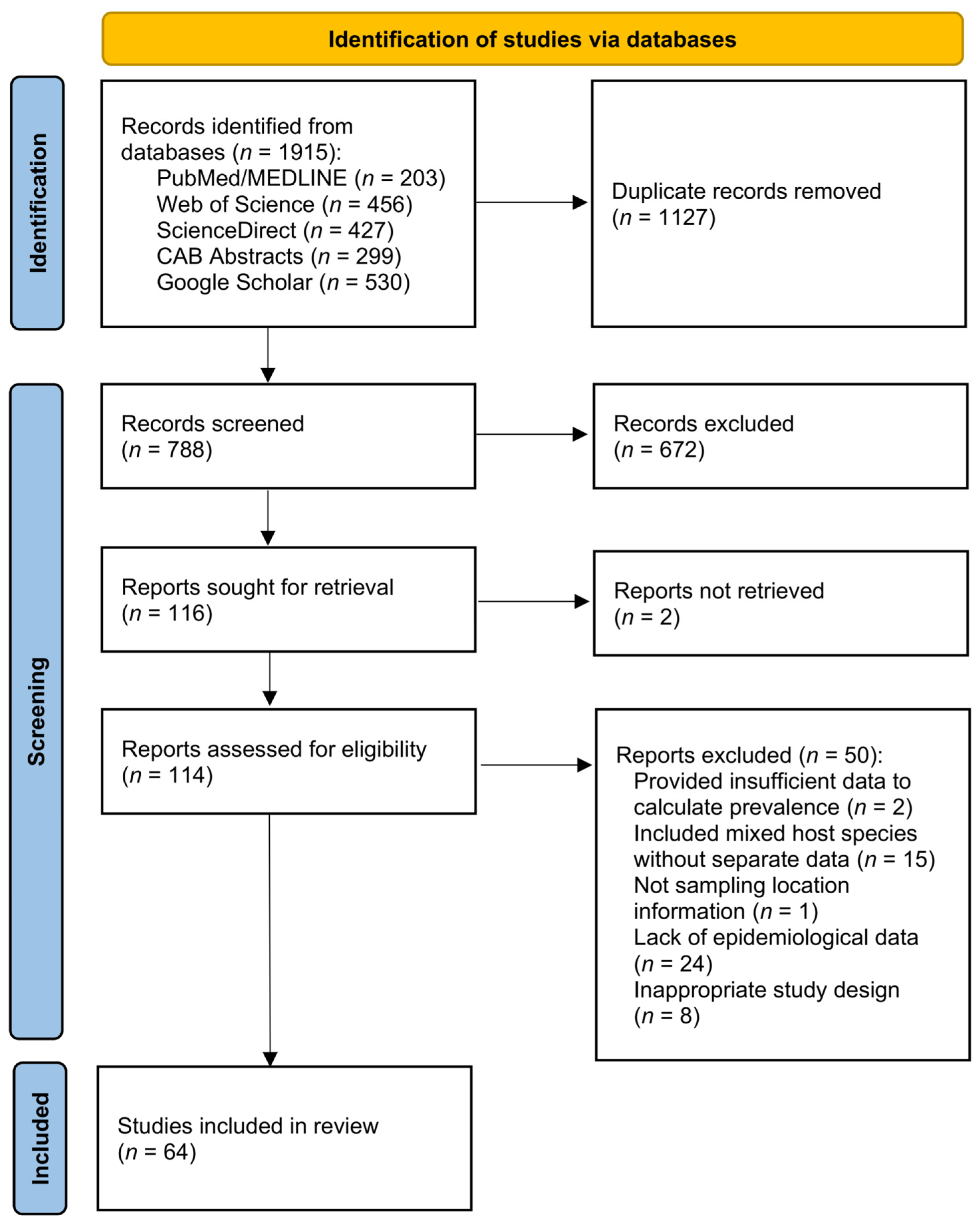
The initial database search yielded 1915 records and 64 included publications (Figure 1). The analytical table contained 73 effect estimates after the reported removal of one exact duplicate. A separate language field was not retained in the original screening log; therefore, the exact number, languages, and publication years of non-English records cannot be reliably reconstructed without repeating the entire screening process.
Figure 1.
PRISMA flow diagram of the literature search and study-selection process for buffalo fasciolosis studies. Searches were conducted in PubMed/MEDLINE, Web of Science, ScienceDirect, CAB Abstracts, and Google Scholar from database inception through September 2026; the reference lists of included studies and relevant reviews were also screened manually.
3.2. Study Characteristics
The final quantitative dataset comprised 64 publications, contributing 73 effect estimates and 2,267,945 buffaloes. The characteristics of the included studies, including geographical location, study period, diagnostic method, Fasciola identification, sample size, prevalence, and dominant climate, are summarized in Table 1. Figure 2 summarizes the geographical distribution of the evidence. At the effect estimate level, Asia contributed 53 estimates (72.6%), Africa 9 (12.3%), the Americas 6 (8.2%), and Europe 5 (6.8%). Thirty-two estimates (43.8%) were assigned to 1988–2013 and 41 (56.2%) to 2014–2025. The country-specific pooled estimates, total buffalo sample sizes, and 95% confidence intervals are presented in Table 2.
Table 1.
Characteristics of the studies included in the meta-analysis of Fasciola species worldwide in buffaloes.
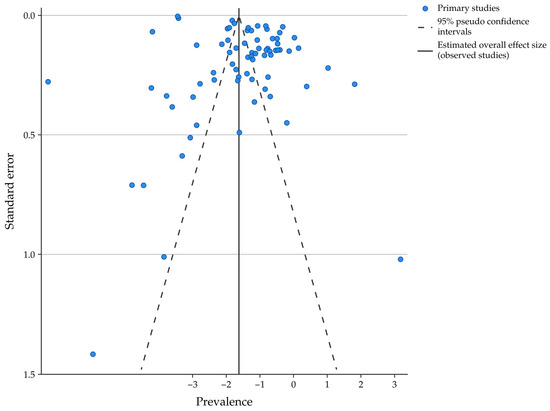
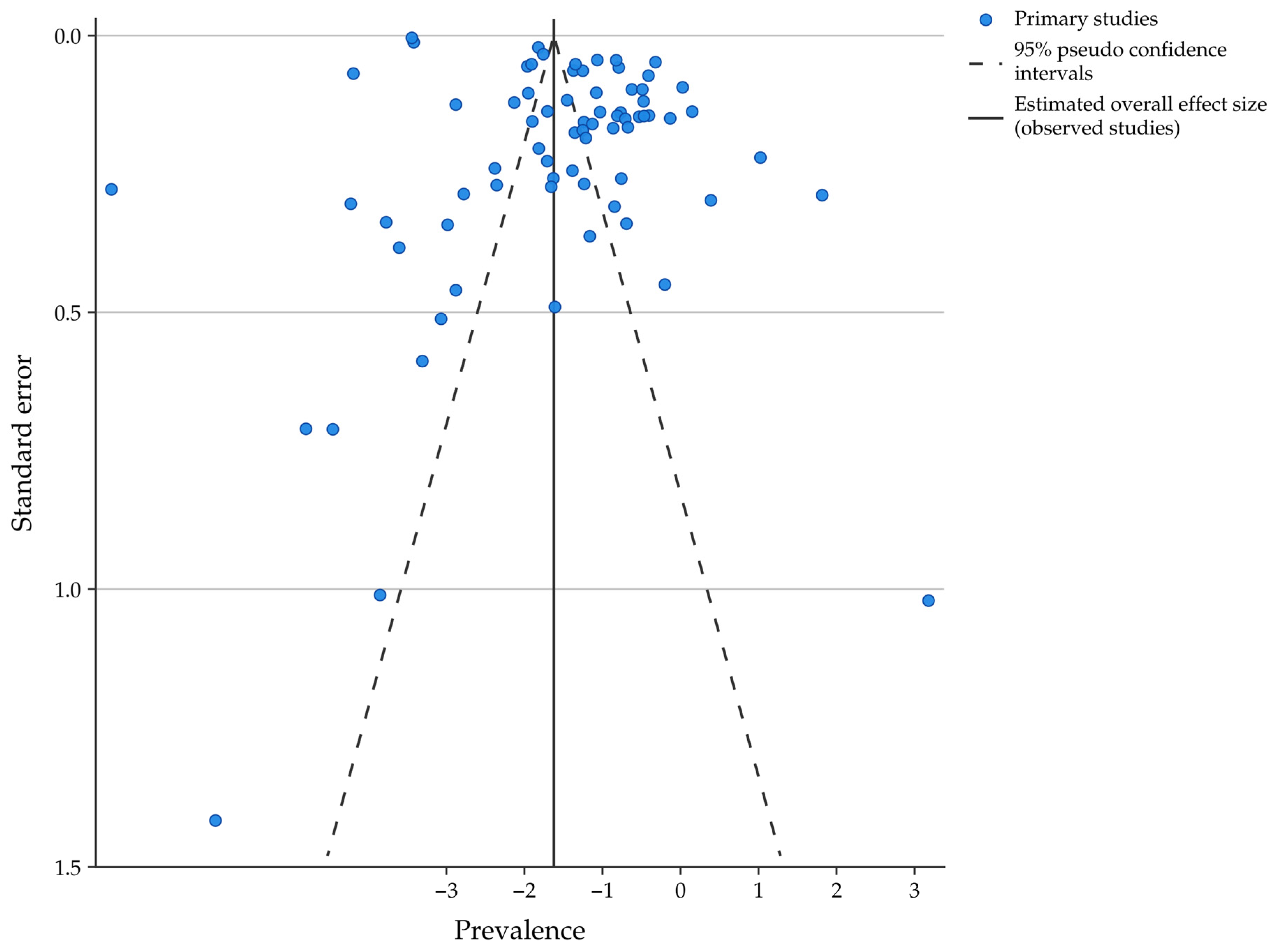
Figure 2.
Funnel plot of logit-transformed prevalence estimates used to examine funnel-plot asymmetry and small-study effects.
Table 2.
Country-specific pooled prevalence of Fasciola infection in buffaloes, with the number of effect estimates, total buffalo sample size, and 95% confidence intervals.
Fecal examination accounted for 47 effect estimates (64.4%), post-mortem examination for 23 (31.5%), and ELISA for 3 (4.1%). Fifteen estimates (20.5%) identified F. gigantica, 16 (21.9%) identified F. hepatica, and 42 (57.5%) reported Fasciola spp. without species-level identification. Forty-five estimates (61.6%) had sample sizes ≤300 animals, and 28 (38.4%) had sample sizes >300; individual sample sizes ranged from 20 to 1,947,233 buffaloes.
3.3. Publication Bias Assessment
The funnel plot (Figure 2) showed marked asymmetry, and the overall Egger small study effects test was significant (t = 7.048, p < 0.001). Among subgroups with at least 10 estimates, significant asymmetry was also observed for both study periods, post-mortem examination, F. hepatica, both sample size categories, and tropical and temperate climates, whereas the tests were not significant for Asia, fecal examination, F. gigantica, Fasciola spp., or dry climates (Table 2). Egger’s test was not performed for Europe, Africa, the Americas, or ELISA because fewer than 10 estimates were available. Given the extreme heterogeneity, these findings were interpreted as small-study/funnel asymmetry rather than definitive evidence of a publication bias.
3.4. Pooled Global Prevalence of Fasciola Infection
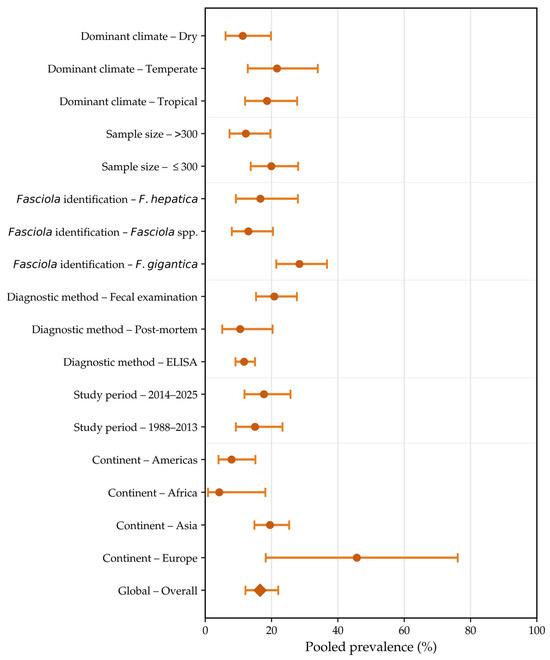
Across the 73 effect estimates (2,267,945 buffaloes), the random-effects binomial GLMM yielded a global pooled prevalence of 16.5% (95% CI: 12.1–22.0%, 95% PI:1.0–80.1%) (Figure 3; Table 3). Between-estimate heterogeneity was extreme (Q = 36,603.7, df = 72, p < 0.001; I2 = 99.8%; τ2 = 2.366), and the 95% prediction interval was 1.0–80.1%, indicating that the average prevalence summarizes highly variable epidemiological settings.
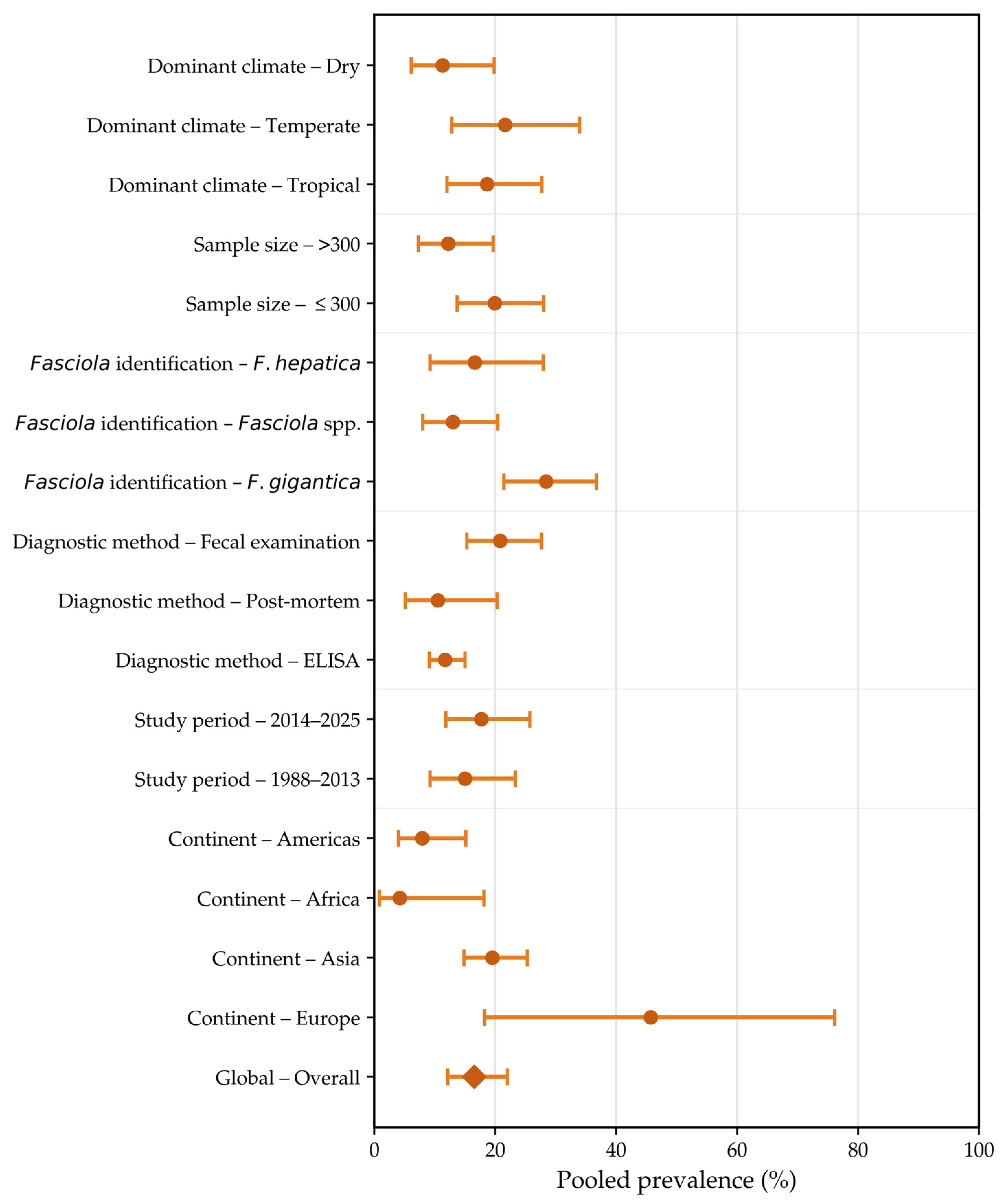
Figure 3.
Summary forest plot of pooled Fasciola prevalence estimates from the full quantitative dataset (73 effect estimates from 64 publications), shown overall and by pre-specified subgroup. Points indicate pooled prevalence, and horizontal bars indicate 95% confidence intervals. This figure presents subgroup summaries rather than a single line for each publication.
Table 3.
Pooled prevalence of Fasciola species in buffaloes and subgroup analyses.
3.5. Subgroup Meta-Analysis by Continent
Geographic variation was substantial. Europe had the highest pooled prevalence at 45.7% (95% CI: 18.2–76.1%; n = 5; 464 samples; I2 = 85.4%; τ2 = 2.091), although the small number of estimates and wide confidence intervals require cautious interpretation. Asia contributed 53 estimates (54,151 animals) with a pooled prevalence of 19.5% (95% CI: 14.8–25.3%, I2 = 98.4%, τ2 = 1.461). Africa had a pooled prevalence of 4.2% (95% CI: 0.8–18.1%; n = 9; 38,570 samples; I2 = 99.4%; τ2 = 5.876), whereas the Americas had a pooled prevalence of 7.9% (95% CI: 4.0–15.1%; n = 6; 2,174,760 samples; I2 = 97.9%; τ2 = 0.764) (Table 2).
Using the Americas as the reference category, continent was a significant moderator in univariate meta-regression (Qm = 16.48, df = 3, p < 0.001) and explained 19.3% of the between-estimate variance (R2 = 19.3%). Residual heterogeneity remained very high, indicating that continent alone did not account for most of the variability in prevalence.
3.6. Subgroup Meta-Analysis by Study Period
For 1988–2013 (n = 32; 291,254 samples), the pooled prevalence was 15.0% (95% CI: 9.2–23.3%; I2 = 99.8%; τ2 = 2.416). For 2014–2025 (n = 41; 1,976,691 samples), the pooled prevalence was 17.7% (95% CI: 11.8–25.7%; I2 = 99.6%; τ2 = 2.309). Heterogeneity was significant in both periods (p < 0.001).
With 2014–2025 as the reference category, the study period was not a significant moderator (Qm = 0.299, df = 1, p = 0.585; R2 = 0.3%). Thus, broad period grouping explained essentially none of the observed between-estimate heterogeneity.
3.7. Subgroup Meta-Analysis by Diagnostic Method
Fecal examination (n = 47; sample size = 48,869) yielded a pooled prevalence of 20.8% (95% CI: 15.3–27.6%; I2 = 98.4%; τ2 = 1.643). Post-mortem examination (n = 23; sample size = 2,217,768) yielded 10.5% (95% CI: 5.1–20.3%; I2 = 99.8%; τ2 = 3.546), and ELISA (n = 3; sample size = 1308) yielded 11.7% (95% CI: 9.1–15.0%; I2 = 73.2%; τ2 = 0.035). Heterogeneity was significant for each diagnostic subgroup (Table 2).
With ELISA as the reference category, the diagnostic method was not a significant moderator (Qm = 4.41, df = 2, p = 0.110; R2 = 6.4%). Accordingly, the differences among the pooled diagnostic method estimates should be interpreted descriptively rather than as evidence of a statistically established method effect.
3.8. Subgroup Meta-Analysis by Fasciola Species
The prevalence differed descriptively among the Fasciola identification categories. The estimates classified as F. gigantica (n = 15; sample size = 27,389) had a pooled prevalence of 28.4% (95% CI: 21.4–36.7%; I2 = 99.1%; τ2 = 0.531). Fasciola spp. (n = 42; sample size = 56,181) had a pooled prevalence of 13.0% (95% CI: 8.0–20.4%; I2 = 98.9%; τ2 = 3.083), whereas F. hepatica (n = 16; sample size = 2,184,375) had a pooled prevalence of 16.6% (95% CI: 9.2–27.9%; I2 = 99.6%; τ2 = 1.778).
Using F. hepatica as the reference category, Fasciola identification was not a statistically significant moderator (Qm = 4.51, df = 2, p = 0.105; R2 = 5.9%). Therefore, the higher pooled estimate for F. gigantica should not be interpreted as a confirmed species effect, independent of geographical and methodological differences among studies.
3.9. Subgroup Meta-Analysis by Sample Size
Studies with sample sizes ≤ 300 animals (n = 45; sample size = 6848) had a pooled prevalence of 19.9% (95% CI: 13.7–28.0%; I2 = 94.0%; τ2 = 2.240), whereas those with >300 animals (n = 28; sample size = 2,261,097) had a pooled prevalence of 12.2% (95% CI: 7.3–19.6%; I2 = 99.9%; τ2 = 2.301).
The dichotomized sample size moderator was not statistically significant (Qm = 2.46, df = 1, p = 0.116; R2 = 4.2%). However, when sample size was retained as a continuous covariate, ln(n) was inversely associated with prevalence (β = −0.293, SE = 0.087; OR = 0.746, 95% CI: 0.630–0.885; Qm = 11.42, df = 1, p < 0.001; R2 = 15.8%). This pattern supports a small-study effect but does not by itself establish publication bias or a causal effect of sample size.
3.10. Subgroup Analysis by Climate
Pooled prevalence was 18.6% in tropical climates (95% CI: 12.0–27.7%; n = 23; sample size = 1,952,506; I2 = 99.6%; τ2 = 1.523), 11.3% in dry climates (95% CI: 6.1–19.8%; n = 26; sample size = 62,851; I2 = 99.3%; τ2 = 2.884), and 21.6% in temperate climates (95% CI: 12.8–33.9%; n = 24; sample size = 252,588; I2 = 99.8%; τ2 = 2.353). Heterogeneity remained significant within all climate categories (p < 0.001).
Using the temperate climate as the reference category, dominant climate was not a significant moderator (Qm = 3.31, df = 2, p = 0.191; R2 = 4.3%). Broad macro-climatic categories therefore explained only a small fraction of the between-estimate variance in this dataset.
3.11. Sensitivity and Robustness Analyses
Sensitivity analyses supported the general robustness of the primary GLMM estimates. The two-step logit random-effects model yielded 16.9% (95% CI: 12.6–22.4%), and the publication-cluster-robust analysis yielded 16.9% (95% CI: 12.4–22.7%). Including the exact duplicate estimate produced 16.4% (95% CI: 12.1–21.8%). In contrast, the Freeman–Tukey double-arcsine model yielded a higher pooled prevalence of 20.5% (95% CI: 16.1–25.2%). The leave-one-out GLMM estimates ranged from 15.7% to 17.7%, indicating that no single estimate dominated the pooled result.
4. Discussion
The global synthesis comprised 64 publications that contributed 73 effect estimates from 2,267,945 buffaloes. The random-effects binomial GLMM estimated a pooled prevalence of 16.5% (95% CI: 12.1–22.0%, PI:1.0–80.1%), but the extreme heterogeneity (I2 = 99.8%) and broad prediction interval indicate substantial epidemiological variation among settings. Continent was the only statistically significant categorical moderator, explaining 19.3% of between-estimate variance, whereas study period, diagnostic method, Fasciola identification, categorical sample size, and dominant climate were not significant. Sample size showed an inverse association with prevalence when modeled continuously as ln(n), indicating an additional small-study pattern that warrants cautious interpretation.
4.1. Global Prevalence and Epidemiological Significance
This meta-analysis estimated a global pooled prevalence of 16.5% for fasciolosis in buffaloes. This average should not be interpreted as a universal prevalence because the underlying estimates varied markedly among regions and study settings. Buffaloes may be particularly exposed in semi-aquatic production systems because grazing, wallowing, and access to irrigated or wet habitats increase contact with environments that support lymnaeid snails and metacercariae [10]. The consequences include production losses and veterinary costs, and chronic infection can also alter hematological and biochemical indicators [54,86,87].
For context, our recently published global cattle meta-analysis estimated a pooled Fasciola prevalence of 26.5%, compared with 16.5% in the present buffalo analysis [22]. These estimates were derived from independent study sets that differed in geographic coverage, study periods, diagnostic methods, sample sizes, production systems, and statistical structure; therefore, they should not be interpreted as evidence of an intrinsic difference in host susceptibility. A robust cattle–buffalo comparison would require paired or harmonized epidemiological data collected in the same locations, periods, and diagnostic frameworks.
A survey in northern India reported a buffalo prevalence of 13.90% by fecal examination and 31.14% at slaughter [40]. A study in Pakistan reported Fasciola seropositivity in bovine hosts [88], while work in the Philippines examined relationships among infection, fluke burden, and carcass and liver weights in cattle and buffaloes [89]. These outcomes are not interchangeable: prevalence, antibody detection, and parasite burden measure different aspects of infection. Molecular work in northern India also identified Radix acuminata as an intermediate host associated with buffalo infection [90]. Local snail ecology is therefore relevant to transmission, but does not establish an intrinsic difference in susceptibility between cattle and buffaloes [91].
4.2. Geographic Variation in Prevalence
Geographic variation was substantial across the four continents represented in the final quantitative synthesis. China was not represented in the quantitative dataset, but this should not be interpreted as the absence of buffalo fasciolosis. Relevant reports were identified, including studies for which buffalo-specific animal-level numerators and denominators could not be extracted and Chinese-language evidence that fell outside the English-language eligibility criterion [92,93]. Therefore, we treat China as one example of a broader risk of geographic and language-related underrepresentation rather than discussing it as a unique exception.
The continent-specific estimates were 45.7% for Europe, 19.5% for Asia, 4.2% for Africa, and 7.9% for the Americas. Europe was numerically highest, but this estimate was based on only five effect estimates and had a wide 95% CI (18.2–76.1%); it should therefore not be interpreted as evidence that Europe has the greatest underlying burden. Asia contributed most of the evidence (53 of 73 estimates), consistent with the global concentration of buffalo production and the importance of irrigated and rice-paddy systems that can support lymnaeid snail habitats [90]. Outside Asia, buffalo populations are geographically uneven: European production is concentrated, especially in Italy, whereas important buffalo industries occur in the Americas, particularly in South America [12,14]. The relatively small number of eligible estimates from Europe, Africa, and the Americas reflects both the distribution of buffalo populations and the available surveillance literature, not necessarily a low biological capacity for Fasciola transmission.
The intensive networks of irrigated water systems that characterize Asian buffalo production create year-round transmission opportunities. For example, in the Philippines, lymnaeid snail presence was strongly associated with irrigation systems, rivers, and moderate vegetation [94]. There is substantial regional variation in Asia, with prevalence estimates ranging from 15.8% in India to 38.6% in China and 63.58% at the animal level in the Philippines [53,95,96]. An extreme endemic situation is represented by the high infection rate of 87.35% documented in a survey of 767 buffaloes in China, likely reflecting localized ecological and management factors [97]. The tropical and subtropical climates in Asia affect the seasonal patterns of snail population dynamics and parasite development, with peak prevalence during periods of optimal temperature and humidity [59,98]. In this context, animal-level prevalence means that 63.58% of the individual water buffaloes examined were positive for Fasciola infection, rather than referring to the proportion of affected herds.
The African and American pooled estimates were lower (4.2% and 7.9%, respectively), but each was based on fewer than 10 effect estimates and showed substantial heterogeneity. These sparse regional data preclude strong causal interpretations of the apparent continental differences. The lower evidence density outside Asia may reflect smaller or more geographically concentrated buffalo populations, differences in veterinary surveillance and research capacity, database indexing, language accessibility, and the likelihood that studies are initiated in settings where fasciolosis is already suspected. The significant omnibus continent effect (Qm = 16.48, p < 0.001) and R2 of 19.3% indicate that geography contributes to heterogeneity, but most between-estimate variability remains unexplained by continent alone.
4.3. Climate Factors and Temporal Trends
Continent explained 19.3% of the between-estimate variance, leaving substantial residual heterogeneity potentially related to local ecological, management, diagnostic, and sampling factors. Dominant climate was not a statistically significant moderator (Qm = 3.31, p = 0.191; R2 = 4.3%), although pooled prevalence varied descriptively across tropical (18.6%), dry (11.3%), and temperate (21.6%) settings. Broad climate categories may mask important within-zone variations in rainfall, irrigation, soil moisture, temperature, snail habitat, and seasonal grazing. Likewise, the broad study-period comparison showed 15.0% for 1988–2013 and 17.7% for 2014–2025, with no statistically significant difference between periods (Qm = 0.299, p = 0.585; R2 = 0.3%). Thus, these data do not provide evidence of a difference between the two broad periods, but they do not exclude finer temporal or seasonal changes within individual regions.
4.4. Influence of Diagnostic Methods
Diagnostic method explained 6.4% of the between-estimate variance but was not a statistically significant moderator (Qm = 4.41, p = 0.110). Fecal examination yielded a pooled prevalence of 20.8%, compared with 10.5% for post-mortem examination and 11.7% for ELISA. These differences should be interpreted descriptively because the diagnostic categories were strongly confounded by geography, study design, sample size, and only three ELISA estimates were available. Fecal examination is limited by low sensitivity during the prepatent period and in light or chronic infections [99], whereas post-mortem examination can introduce selection effects because slaughter populations may not represent the source herds. ELISA can detect exposure before patency, but results may vary with antigen, cut-off, antibody kinetics, and cross-reactivity [17,47,100].
These findings reinforce the need for diagnostic standardization, rather than indicating that one method produces a universally higher or lower prevalence. Fecal examination remains practical and non-invasive for field surveillance, post-mortem inspection provides direct evidence of flukes in slaughtered animals, and molecular approaches can improve species resolution in co-endemic areas [90,96,101]. Future prevalence studies should report assay characteristics and, where feasible, combine complementary methods to improve the comparability across settings.
4.5. Species-Specific Patterns
The pooled prevalence was highest for estimates identified as F. gigantica (28.4%), followed by F. hepatica (16.6%) and Fasciola spp. (13.0%). However, Fasciola identification was not a statistically significant moderator (Qm = 4.51, p = 0.105; R2 = 5.9%), and these descriptive differences should not be interpreted as an independent species effect. This apparent pattern is likely intertwined with geography, climate, intermediate host ecology, diagnostic methods, and study design. F. gigantica predominates in many tropical and subtropical areas of Asia and Africa, whereas F. hepatica is more common in temperate regions and the Americas [1,85,102]. Notably, 42 of 73 effect estimates (57.5%) reported only Fasciola spp., limiting species-specific inferences. Egger’s test was significant for F. hepatica (p = 0.001), but overall funnel asymmetry was also significant; therefore, the species-specific result is better interpreted as evidence of small-study effects in a highly heterogeneous evidence base rather than proof of selective publication for F. hepatica.
4.6. Sample Size
The categorical comparison suggested a higher pooled prevalence in studies with ≤300 animals (19.9%) than in larger studies (12.2%); however, the dichotomized moderator was not statistically significant (Qm = 2.46, p = 0.116; R2 = 4.2%). In contrast, ln(sample size) was significant when treated continuously (Qm = 11.42, p < 0.001; R2 = 15.8%; OR = 0.746; 95% CI: 0.630–0.885). This pattern is compatible with a small-study effect: smaller studies may be more likely to focus on localized high-transmission settings or may systematically differ in their design and sampling. Because the sample size is a study-level characteristic rather than a biological exposure, this association should not be interpreted causally.
4.7. One Health Implications
Fasciolosis has One Health relevance in buffalo-raising areas because infected buffaloes can shed Fasciola eggs into shared aquatic and grazing environments. Where suitable lymnaeid snail hosts are present, contamination of water and pasture can maintain transmission at the animal–environment–human interface. This risk may be particularly relevant in semi-aquatic agricultural systems in Asia, where buffalo husbandry, irrigation networks, grazing areas, and human activities frequently overlap. These conditions support integrated surveillance combining animal infection data, intermediate-host monitoring, environmental management, and public health awareness [2,3,90].
4.8. Limitations
This study had several limitations. First, heterogeneity was extreme in the global model (I2 = 99.8%), and the wide prediction interval indicated that the pooled prevalence was an average across highly diverse settings rather than a value expected in every buffalo population. Second, the overall Egger test was significant (p < 0.001); however, funnel plot asymmetry can arise from genuine heterogeneity, study design, sample size effects, and selective publication. Selection may also occur before publication; low-risk or apparently low-prevalence buffalo populations may be studied less often, so underrepresentation can arise from decisions about where studies are conducted as well as from decisions about which results are published. Third, Africa, the Americas, and Europe contributed relatively few effect estimates to the analysis. This imbalance is partly consistent with the global concentration of buffalo production in Asia; however, it may also reflect regional differences in surveillance intensity, research capacity, indexing, and language accessibility. The review was restricted to English-language publications, and because language was not retained as a separate field in the original screening log, the number and temporal distribution of non-English exclusions could not be reliably reconstructed. The diagnostic method was not a significant moderator (p = 0.110); however, differences in test sensitivity, specificity, sampling frames, and slaughter selection remained important sources of methodological heterogeneity. Moreover, 57.5% of the effect estimates reported only Fasciola spp., restricting species-specific inferences. The analytical dataset also contained repeated estimates from some publications; although the cluster-robust sensitivity analysis produced a similar pooled estimate, the primary subgroup models were estimate-level models. For some records, the event counts used in the binomial analysis were reconstructed from the reported prevalence and sample size, introducing minor rounding uncertainty. Finally, the study-level nature of the data prevented the evaluation of individual risk factors such as age, sex, breed, and management, and broad periods and climate categories may mask important local temporal and ecological variations.
5. Conclusions
This systematic review and meta-analysis estimated a global pooled Fasciola prevalence of 16.5% (95% CI: 12.1–22.0%, PI:1.0–80.1%) in buffaloes, with extreme between-estimate heterogeneity. Continent was a significant categorical moderator, whereas study period, diagnostic method, Fasciola identification, categorical sample size, and dominant climate were not; sample size was inversely associated with prevalence when modeled continuously. The wide regional confidence intervals and persistent residual heterogeneity emphasize that a single global estimate cannot substitute for locally calibrated surveillance. Therefore, descriptive differences among Fasciola identification categories and diagnostic methods should be interpreted cautiously. Future studies should expand evidence from underrepresented regions, use standardized and sensitive diagnostics with molecular species confirmation where possible, report complete numerator/denominator data, and apply designs that capture seasonal and management-level determinants. Integrated One Health surveillance linking buffalo infection, lymnaeid snail ecology, environmental conditions, and human exposure remains important for reducing the burden of fasciolosis in buffalo production systems worldwide.
Supplementary Materials
The following supporting information can be downloaded at: https://www.mdpi.com/article/10.3390/parasitologia6050061/s1, Table S1. Search strategies, databases, eligibility restrictions, and search dates used in the systematic review. The documented strategies reflect the reported search concepts rather than the verified original database histories; Table S2. PRISMA 2020 checklist indicating the location of the reporting items in the manuscript and identifying partially reported or unassessed items.
Funding
This research received no external funding.
Institutional Review Board Statement
Not applicable.
Informed Consent Statement
Not applicable.
Data Availability Statement
Data is contained within the article or Supplementary Material.
Acknowledgments
This study was supported by Benemérita Universidad Autónoma de Puebla (VIEP-VIMA-NAT-24-I). During the preparation of this manuscript, the author used ChatGPT (OpenAI; GPT-6) to assist with scientific writing, English-language editing, and manuscript organization. The author has reviewed and edited the output and takes full responsibility for the content of this publication.
Conflicts of Interest
The author declares no conflicts of interest.
References
- Mas-Coma, S.; Valero, M.A.; Bargues, M.D. Human and animal fascioliasis: Origins and worldwide evolving scenario. Clin. Microbiol. Rev. 2022, 35, e00088-19. [Google Scholar] [CrossRef] [Scilit] [PubMed]
- Cwiklinski, K.; O’Neill, S.M.; Donnelly, S.; Dalton, J.P. A prospective view of animal and human Fasciolosis. Parasite Immunol. 2016, 38, 558–568. [Google Scholar] [CrossRef] [Scilit] [PubMed]
- Aftab, A.; Raina, O.K.; Maxton, A.; Masih, S.A. Advances in diagnostic approaches to Fasciola infection in animals and humans: An overviews. J. Helminthol. 2024, 98, e12. [Google Scholar] [CrossRef] [Scilit] [PubMed]
- Nyagura, I.; Malatji, M.P.; Mukaratirwa, S. Occurrence of Fasciola (Digenea: Fasciolidae) species in livestock, wildlife and humans, and the geographical distribution of their intermediate hosts in South Africa—A scoping review. Front. Vet. Sci. 2022, 9, 935428. [Google Scholar] [CrossRef] [Scilit] [PubMed]
- Lalor, R.; Cwiklinski, K.; Calvani, N.E.D.; Dorey, A.; Hamon, S.; Corrales, J.L.; Dalton, J.P.; De Marco Verissimo, C. Pathogenicity and virulence of the liver flukes Fasciola hepatica and Fasciola gigantica that cause the zoonosis Fasciolosis. Virulence 2021, 12, 2839–2867. [Google Scholar] [CrossRef] [Scilit] [PubMed]
- Khademvatan, S.; Majidiani, H.; Khalkhali, H.; Taghipour, A.; Asadi, N.; Yousefi, E. Prevalence of fasciolosis in livestock and humans: A systematic review and meta-analysis in Iran. Comp. Immunol. Microbiol. Infect. Dis. 2019, 65, 116–123. [Google Scholar] [CrossRef] [Scilit] [PubMed]
- Schweizer, G.; Braun, U.; Deplazes, P.; Torgerson, P. Estimating the financial losses due to bovine fasciolosis in Switzerland. Vet. Rec. 2005, 157, 188–193. [Google Scholar] [CrossRef] [Scilit] [PubMed]
- Odeniran, P.O.; Omolabi, K.F.; Ademola, I.O. Economic model of bovine fasciolosis in Nigeria: An update. Trop. Anim. Health Prod. 2020, 52, 3359–3363. [Google Scholar] [CrossRef] [Scilit] [PubMed]
- Klimova, E.; Kudrin, M.; Krylova, T.; Reshetnikova, A. Fascioliasis and strongylatoses of cattle: Economic loss and control measures. Adv. Anim. Vet. Sci. 2020, 8, 56. [Google Scholar] [CrossRef] [Scilit]
- Carmona, C.; Tort, J.F. Fasciolosis in South America: Epidemiology and control challenges. J. Helminthol. 2017, 91, 99–109. [Google Scholar] [CrossRef] [Scilit] [PubMed]
- Mas-Coma, S.; Valero, M.A.; Bargues, M.D. Fasciola, lymnaeids and human fascioliasis, with a global overview on disease transmission, epidemiology, evolutionary genetics, molecular epidemiology and control. Adv. Parasitol. 2009, 69, 41–146. [Google Scholar] [CrossRef] [Scilit] [PubMed]
- Zhang, Y.; Colli, L.; Barker, J.S.F. Asian water buffalo: Domestication, history and genetics. Anim. Genet. 2020, 51, 177–191. [Google Scholar] [CrossRef] [Scilit] [PubMed]
- Dracz, R.M.; Lima, W.d.S. Autochthonous infection of buffaloes and cattle by Fasciola hepatica in Minas Gerais, Brazil. Rev. Bras. Parasitol. Veterinária 2014, 23, 413–416. [Google Scholar] [CrossRef] [Scilit] [PubMed]
- Minervino, A.H.H.; Zava, M.; Vecchio, D.; Borghese, A. Bubalus bubalis: A Short Story. Front. Vet. Sci. 2020, 7, 570413. [Google Scholar] [CrossRef] [Scilit] [PubMed]
- González, R.; Pérez Ruano, M.; Brito, S. Fasciolosis bovina. Evaluación de las principales pérdidas provocadas en una empresa ganadera. Rev. DE Salud Anim. 2007, 29, 167–175. [Google Scholar]
- Mas-Coma, S. Epidemiology of fascioliasis in human endemic areas. J. Helminthol. 2018, 79, 207–216. [Google Scholar] [CrossRef] [Scilit] [PubMed]
- Che-Kamaruddin, N.; Hamid, N.F.S.; Idris, L.H.; Yusuff, F.M.; Ashaari, Z.H.; Yahaya, H.; Sahimin, N.; Isa, N.M.M. Prevalence and risk factors of fasciolosis in a bovine population from farms in Taiping, Malaysia. Vet. Parasitol. Reg. Stud. Rep. 2024, 49, 100998. [Google Scholar] [CrossRef] [Scilit] [PubMed]
- Yadav, S.; Ahaduzzaman, M.; Sarker, S.; Sayeed, M.; Hoque, M. Epidemiological survey of fascioliasis in cattle, buffalo and goat in Mahottari and Dhanusha, Nepal. J. Adv. Parasitol. 2015, 2, 51–56. [Google Scholar] [CrossRef] [Scilit]
- Wenzel, C.; Zablotski, Y.; Knubben-Schweizer, G.; Strube, C.; Weber, F. Spread and dynamics of Calicophoron daubneyi and Fasciola hepatica in an extensively kept water buffalo herd and suitability of an ELISA for detecting antibodies against F. hepatica. Parasitol. Res. 2026, 125, 13. [Google Scholar] [CrossRef] [Scilit] [PubMed]
- Rizwan, M.; Khan, M.R.; Afzal, M.S.; Manahil, H.; Yasmeen, S.; Jabbar, M.; Irum, S.; Simsek, S.; Wasif, S.; Mahmood, T.; et al. Prevalence of Fascioliasis in Livestock and Humans in Pakistan: A Systematic Review and Meta-Analysis. Trop. Med. Infect. Dis. 2022, 7, 126. [Google Scholar] [CrossRef] [Scilit] [PubMed]
- Lan, Z.; Zhang, X.-H.; Xing, J.-L.; Zhang, A.-H.; Wang, H.-R.; Zhang, X.-C.; Gao, J.-F.; Wang, C.-R. Global prevalence of liver disease in human and domestic animals caused by Fasciola: A systematic review and meta-analysis. J. Glob. Health 2024, 14, 04223. [Google Scholar] [CrossRef] [Scilit] [PubMed]
- Villa-Mancera, A.; Robles-Robles, J.M.; Olivares-Pérez, J.; Olmedo-Juárez, A.; González-Garduño, R.; Ponce-Covarrubias, J.L.; Rivero-Perez, N.; Patricio, F.; Campos-García, H.; Ortega-Vargas, S. Global Prevalence and Heterogeneity of Fasciola Infection in Cattle: A Systematic Review and Meta-Analysis of 49 Million Animals over the Past Three Decades. Ruminants 2026, 6, 75. [Google Scholar] [CrossRef] [Scilit]
- Moher, D.; Shamseer, L.; Clarke, M.; Ghersi, D.; Liberati, A.; Petticrew, M.; Shekelle, P.; Stewart, L.A. Preferred Reporting Items for Systematic Review and Meta-Analysis Protocols (PRISMA-P) 2015 Statement. Syst. Rev. 2015, 4, 1. [Google Scholar] [CrossRef] [PubMed]
- Page, M.J.; McKenzie, J.E.; Bossuyt, P.M.; Boutron, I.; Hoffmann, T.C.; Mulrow, C.D.; Shamseer, L.; Tetzlaff, J.M.; Akl, E.A.; Brennan, S.E.; et al. The PRISMA 2020 statement: An updated guideline for reporting systematic reviews. BMJ 2021, 372, n71. [Google Scholar] [CrossRef] [Scilit] [PubMed]
- Founta, A.; Papadopoulos, E.; Chliounakis, S.; Bampidis, V.; Papazahariadou, M. Presence of endoparasites in the Greek buffalo (Bubalus bubalis) from northern Greece. J. Hell. Vet. Med. Soc. 2018, 69, 999–1003. [Google Scholar] [CrossRef] [Scilit]
- Kobak, P.; Pilarczyk, B. Prevalence of Gastrointestinal Parasites of Water Buffaloes Raised in the Notecka Forest Region (Poland). Bull. Vet. Inst. Pulawy 2012, 56, 33–36. [Google Scholar] [CrossRef] [Scilit]
- Kabardiev, S.S.; Karpushchenko, K.A. Seasonal and age-related dynamics of buffalo fascioliasis in the Dagestan lowlands. Vet. Sci. Today 2025, 14, 362–371. [Google Scholar] [CrossRef] [Scilit]
- Islam, F.; Rahman, M.; Chowdhury, S. Prevalence of parasites of water buffaloes in Bangladesh. Asian-Australas. J. Anim. Sci. 1992, 5, 601–604. [Google Scholar] [CrossRef] [Scilit]
- Alim, M.; Islam, M.; Mondal, M. A cross sectional study on Fasciola gigantica and Gigantocotyle explanatum burdens in naturally infected buffaloes in Bangladesh. Bangladesh J. Vet. Med. 2005, 3, 39–44. [Google Scholar]
- Ahmedullah, F.; Akbor, M.; Haider, M.; Hossain, M.; Khan, M.; Hossain, M.; Shanta, I. Pathological investigation of liver of the slaughtered buffaloes in Barisal district. Bangladesh J. Vet. Med. 2007, 5, 81–85. [Google Scholar]
- Mamun, M.; Begum, N.; Mondal, M. A coprological survey of gastro-intestinal parasites of water buffaloes (Bubalus bubalis) in Kurigram district of Bangladesh. J. Bangladesh Agric. Univ. 2011, 9, 103–109. [Google Scholar]
- Biswas, H.; Dey, A.R.; Begum, N.; Das, P.M. Epidemiological aspects of gastrointestinal parasites in buffalo in Bhola, Bangladesh. Indian J. Anim. Sci. 2014, 84, 245–250. [Google Scholar] [CrossRef] [Scilit]
- Saha, S.; Bhowmik, D.; Chowdhury, M. Prevalence of gastrointestinal helminthes in buffaloes in Barisal district of Bangladesh. Bangladesh J. Vet. Med. 2013, 11, 131–135. [Google Scholar] [CrossRef] [Scilit]
- Islam, M.S.; Das, S.; Talukdar, M.M.I.; Ariful, M.; Islam, K.K.G.; Alim, M.A.; Masuduzzaman, M. Pathological affection of liver due to hydatidosis and fascioliasis in slaughtered food animal (cattle and buffalo) in Chittagong district, Bangladesh. Wayamba J. Anim. Sci. 2014, 6, 1014–1019. [Google Scholar]
- Roy, P.P.; Begum, N.; Dey, A.R.; Sarker, S.; Biswas, H.; Farjana, T. Prevalence of gastrointestinal parasites of buffalo at Mongla, Bagerhat. Int. J. Nat. Soc. Sci. 2016, 3, 59–66. [Google Scholar]
- Alam, M.; Erfan, R.; Sen, A.B.; Das, S.; Rahman, M.M.; Nath, S.K. Prevalence of gastrointestinal helminthiasis in naturally infested buffalo in Sylhet district. Int. J. Adv. Multidiscip. Res. 2016, 3, 52–58. [Google Scholar]
- Yasin, M.G.; Alim, M.A.; Anisuzzaman; Ahasan, S.A.; Munsi, M.N.; Chowdhury, E.H.; Hatta, T.; Tsuji, N.; Mondal, M.M.H. Trematode infections in farm animals and their vector snails in Saint Martin’s Island, the southeastern offshore area of Bangladesh in the Bay of Bengal. J. Vet. Med. Sci. 2018, 80, 684–688. [Google Scholar] [CrossRef] [Scilit] [PubMed]
- Ara, I.; Ahmed, J.; Dipta, P.M.; Nath, S.D.; Akter, T.; Adnan, M.R.; Deb, B.; Alam, S.; Chowdhury, Q.; Husna, A.; et al. Prevalence and severity of gastro-intestinal parasites in buffalo calves at Sylhet division of Bangladesh. J. Parasit. Dis. 2021, 45, 620–626. [Google Scholar] [CrossRef] [Scilit] [PubMed]
- Siddiqui, M.S.I.; Mahtab, J.N.H.; Al Mamun, M.A.; Islam, S.; Hasan, R.; Islam, M.D.N.; Begum, S.; Nasrin, F.; Paul, T.K.; Amin, S.M.N. Coprological Investigation of helminths parasitic infestations of Buffalo at haor and hilly bordered areas of Sylhet district in Bangladesh. Vet. Biomed. Clin. J. 2025, 7, 59–74. [Google Scholar] [CrossRef] [Scilit]
- Garg, R.; Yadav, C.; Kumar, R.; Banerjee, P.; Vatsya, S.; Godara, R. The epidemiology of fasciolosis in ruminants in different geo-climatic regions of north India. Trop. Anim. Health Prod. 2009, 41, 1695–1700. [Google Scholar] [CrossRef] [Scilit] [PubMed]
- Patel, H.; Hasnani, J.; Patel, P.; Pandya, S.; Solanki, J.; Jadav, S. A study on helminth parasites of buffaloes brought to Ahmedabad slaughter house, Gujarat, India. Int. J. Life Sci. Pharma Res. 2015, 50, 20–27. [Google Scholar]
- Maiti, L.C.; Chowdhury, J.; Bose, D.; Bhattacharya, M. Gastrointestinal parasitic infection profile of Bovines and Caprines at Jalpaiguri. Biosci. Biotechnol. Res. Asia 2016, 5, 373–376. [Google Scholar]
- Pandya, S.S.; Hasnani, J.J.; Patel, P.V.; Chauhan, V.D.; Hirani, N.D.; Shukla, R.; Dhamsaniya, H.B. Study on prevalence of Fasciolosis in buffaloes at Anand and Ahmedabad districts, Gujarat, India. Vet. World 2015, 8, 870–874. [Google Scholar] [CrossRef] [Scilit] [PubMed]
- Kalkal, H.; Vhora, S.; Gupta, S. Prevalence of gastrointestinal parasites in buffaloes of Karnal, district, India. Pharma Innov. J. 2020, 9, 59–61. [Google Scholar]
- Brahmbhatt, N.N.; Kumar, B.; Thakre, B.J.; Bilwal, A.K. Haemato-biochemical characterization of fasciolosis in Gir cattle and Jaffrabadi buffaloes. J. Parasit. Dis. 2021, 45, 683–688. [Google Scholar] [CrossRef] [Scilit] [PubMed]
- Yadav, R.S.; Agrawal, V.; Jayraw, A.; Jamara, N.; Jatav, G.; Singh, N.; Patil, A. Prevalence and Intensity of Gastrointestinal Parasites in Buffaloes from Malwa Region of Madhya Pradesh and Coproculture Study of Strongyle Infection. Int. J. Livest. Res. 2019, 9, 207–211. [Google Scholar] [CrossRef] [Scilit]
- Malathi, S.; Shameem, U.; Komali, M. Prevalence of gastrointestinal helminth parasites in domestic ruminants from Srikakulam district, Andhra Pradesh, India. J. Parasit. Dis. 2021, 45, 823–830. [Google Scholar] [CrossRef] [Scilit] [PubMed]
- Martindah, E.; Sawitri, D.H.; Wardhana, A.H.; Ekawasti, F. Prevalence of Amphistomes and Fasciola in large ruminants reared by smallholders in Lampung and Banten Provinces, Indonesia. Vet. World 2023, 16, 2104–2109. [Google Scholar] [CrossRef] [Scilit] [PubMed]
- Kohi, A.M.; Mehdipoor, Y.; Ghasemi, E.; Khaledi, M.; Madmoli, Y. Prevalence of some liver parasites in the slaughtered livestocks in the industrial slaughterhouse of Dezful during 2015. Int. J. Adv. Biotechnol. 2017, 8, 2364–2370. [Google Scholar]
- Kadir, M.; Ali, N.; Ridha, R. Prevalence of helminthes, pneumonia and hepatitis in Kirkuk slaughter house, Kirkuk, Iraq. Iraqi J. Vet. Sci. 2012, 26, 83–88. [Google Scholar] [CrossRef] [Scilit]
- Al-Jubury, A.; Jarullah, B.; Al-Jassim, K.; Badran, M.; Mahmmod, Y. Prevalence and diffusion of gastrointestinal parasite infections in swamp water buffalo (Bubalus bubalis) populations from marshlands of Iraq. J. Buffalo Sci. 2020, 9, 38–47. [Google Scholar] [CrossRef] [Scilit]
- Abass, K.; Ibrahim, E.; Khalaf, R.; Esmail, R. Prevalence of liver fluke infections in slaughtered animals in Kirkuk Province, Iraq. J. Anim. Sci. Livest. Prod. 2018, 2, 1–5. [Google Scholar]
- Kamaruddin, N.C.; Razali, M.A.I.; Busayo, I.E.; Hamzah, N.H.; Idris, L.H.; Md Isa, N.M. The First Report of Ruminant Fascioliasis in Sabah, East Malaysia. J. Parasitol. Res. 2021, 2021, 6691483. [Google Scholar] [CrossRef] [Scilit] [PubMed]
- Sah, R.; Prasai, H.K.; Shrestha, J.; Talukder, M.H.; Rahman, A.A.; Sah, R.B. Seasonal and altitudinal prevalence of fascioliasis in buffalo in Eastern Nepal. J. Nepal Agric. Res. Counc. 2018, 4, 48–53. [Google Scholar] [CrossRef] [Scilit]
- Adhikari, R.B.; Adhikari Dhakal, M.; Ghimire, T.R. Prevalence and diversity of gastrointestinal parasites in domestic buffaloes (Bubalus bubalis Linnaeus, 1758) reared under captive and semi-captive conditions in Ratnanagar, Chitwan, Nepal. Ann. Parasitol. 2022, 68, 701–713. [Google Scholar] [PubMed]
- Neupane, A.; Bhandari, S.; Khanal, T.; Pandey, K.; Parajuli, R.P. Prevalence and Risk Factors of Gastrointestinal Parasitic Infections in Buffaloes Across Commercial and Subsistence Farming Systems in Butwal, Nepal. Vet. Med. Int. 2026, 2026, 4985465. [Google Scholar] [CrossRef] [Scilit] [PubMed]
- Subedi, J.R.; Karmacharya, A. Prevalence of gastrointestinal helminth parasites of buffaloes brought to slaughterhouse in Bhaktapur, Nepal. Ann. Parasitol. 2026, 72, 1–9. [Google Scholar] [CrossRef] [Scilit] [PubMed]
- Maqbool, A.; Sikandar Hayat, C.; Akhtar, T.; Hashmi, H.A. Epidemiology of fasciolosis in buffaloes under different managemental conditions. Vet. Arh. 2002, 72, 221–228. [Google Scholar]
- Qureshi, A.; Tanveer, A.; Maqbool, A.; Niaz, S. Seasonal and monthly prevalence pattern of fasciolosis in buffaloes and its relation to some climatic factors in northeastern areas of Punjab, Pakistan. Iran. J. Vet. Res. 2012, 13, 134–137. [Google Scholar] [CrossRef] [Scilit]
- Bhutto, B.; Arijo, A.; Phullan, M.S.; Rind, R. Prevalence of fascioliasis in buffaloes under different agro-climatic areas of Sindh Province of Pakistan. Int. J. Agric. Biol. 2012, 14, 241–245. [Google Scholar]
- Khan, M.K.; Sajid, M.S.; Khan, M.N.; Iqbal, Z.; Iqbal, M.U. Bovine fasciolosis: Prevalence, effects of treatment on productivity and cost benefit analysis in five districts of Punjab, Pakistan. Res. Vet. Sci. 2009, 87, 70–75. [Google Scholar] [CrossRef] [Scilit] [PubMed]
- Ashraf, S.; Iqbal, Z.; Ali, M.; Chaudhry, H.R.; Sial, N.; Ahsan, U.; Ali, A.; Asif, M.Z. Seasonal prevalence of Fasciola hepatica infection in buffaloes of Bahawalpur district of Punjab, Pakistan. J. Infect. Mol. Biol. 2014, 2, 30–31. [Google Scholar] [CrossRef] [Scilit]
- Ahmad, I.; Durrani, Z.; Ashraf, K.; Hameed, K.; Khan, O.; Abbasi, A.; Shakar, A.; Hameed, N.; Haq, I.; Safdar, A. Risk factors analysis of Fasciolosis in Buffaloes in Azad Jammu and Kashmir. Pak. J. Sci. 2017, 69, 351–354. [Google Scholar]
- Mateen, A.; Ahmad, U.; Chaudary, F. Prevalence of parasites and morph-metric measurements of Fasciola hepatica in the Buffaloes at Lalkurti slaughter house Rawalpindi, Pakistan. Pure Appl. Biol. 2024, 13, 483–488. [Google Scholar] [CrossRef] [Scilit]
- Deeba, F.; Qureshi, A.S.; Kashif, A.R.; Saleem, I. Epidemiology of different gastrointestinal helminths in buffaloes in relation to age, sex and body condition of the host. J. Entomol. Zool. Stud. 2019, 7, 1533–1540. [Google Scholar]
- Fayyaz, S.; Shahbaz, M.; Baboo, I.; Nazir, S.; Shaukat, M. Epidemiology and risk factor analysis of fasciolosis in buffaloes in district Bagh, Azad Kashmir, Pakistan. J. Bioresour. Manag. 2021, 8, 128–137. [Google Scholar] [CrossRef] [Scilit]
- Ullah, K.; Khan, N.U.; Khan, T.U.; Usman, T.; Saqib, M.N.; Ali, H.; Islam, N.; Sarwar, M.S.; Hussain, M.A.; Ikram, M. Epidemiology of fasciolosis in Nili Ravi and Kundi buffaloes and its effect on hematological parameters. J. Med. Health Sci. Rev. 2025, 2, 3315–3335. [Google Scholar] [CrossRef] [Scilit]
- Ullah, W.; Aimen, U.; Khan, A.; Rizwan, M.; Ali, A.; Imtiaz, K.; Yasir, M.; Ali, A.; Safiullah; Jan, A.W. Prevalence and risk factor analysis of fasciolosis in buffaloes in district Dera Ismail Khan, Pakistan. J. Media Horiz. 2025, 6, 118–1121. [Google Scholar] [CrossRef]
- Japa, O.; Phuangsri, C.; Jantaloed, B.; Saelu, C.; Hansuk, N.; Inna, P.; Namrat, S.; Rodchaona, T.; Jinda, T.; Wongnoi, W.; et al. Gastrointestinal helminth infections in cattle and buffalo from small-scale farms in Phayao Province, Northern Thailand. Trop. Anim. Health Prod. 2026, 58, 533. [Google Scholar] [CrossRef] [Scilit] [PubMed]
- Vinh, H.Q.; Levecke, B.; Dung, D.T.; Binh, V.T.L.; Hien, N.T.T.; Ha, N.N.; Thanh, D.T.H.; Devleesschauwer, B.; de Jong, T.; Paredis, L.; et al. Prevalence and risk factors related to Fasciola spp. transmission in north-Central Vietnam: A cross-sectional study in multiple host and environmental compartments. One Health 2026, 22, 101417. [Google Scholar] [CrossRef] [Scilit] [PubMed]
- Abdel-Nasser, A.; Khalifa, R. Fascioliasis prevalences among animals and human in Upper Egypt. J. King Saud Univ.-Sci. 2010, 22, 15–19. [Google Scholar] [CrossRef] [Scilit]
- Elmonir, W.; Mousa, W.; Sultan, K. The Prevalence of Some Parasitic Zoonoses in Different Slaughtered Animal Species at Abattoir in the Mid-Delta of Egypt; with Special Reference to its Economic Implications. Alex. J. Vet. Sci. 2015, 47, 97–103. [Google Scholar] [CrossRef] [Scilit]
- El-Tahawy, A.S.; Kwan, N.; Sugiura, K. Fasciola hepatica infection in water buffalo Bubalus bubalis in three provinces of the Nile Delta, Egypt: A cross-sectional study. J. Vet. Med. Sci. 2018, 80, 28–35. [Google Scholar] [CrossRef] [Scilit] [PubMed]
- Elshraway, N.T.; Mahmoud, W.G. Prevalence of fascioliasis (liver flukes) infection in cattle and buffaloes slaughtered at the municipal abattoir of El-Kharga, Egypt. Vet. World 2017, 10, 914–917. [Google Scholar] [CrossRef] [Scilit] [PubMed]
- Dyab, A.K.; Ahmed, H.A.; Hefnawy, Y.A.; Abdel-Aziz, A.R.; Gomaa, M.M. Prevalence of tissue parasites in cattle and buffaloes slaughtered in El-Minia governorate abattoirs, Egypt. PSM Vet. Res. 2019, 4, 49–58. [Google Scholar]
- El-Aziz, O.; Hassanin, F.; Shaltout, F.; Mohammed, O. Prevalence of some foodborne parasitic affection in slaughtered animals in local Egyptian abattoir. Benha Vet. Med. J. 2021, 41, 111–114. [Google Scholar] [CrossRef] [Scilit]
- Allam, A.W.H.; Elbayoumi, Z.H.; Abdelrahman, H.A. Prevalence of Meat Borne Parasites in Slaughtered Animals in Markaz Ashmoon Abattoirs with Special References to Their Economic Losses. J. Curr. Vet. Res. 2022, 4, 1–8. [Google Scholar] [CrossRef] [Scilit]
- Felefel, W.; Shabian, A.-E.L.H.; Eassa, S.M.; Loutfy, N. The prevalence of parasitic infections among slaughtered animals in mechanical abattoir. Iraqi J. Vet. Sci. 2023, 37, 469–477. [Google Scholar] [CrossRef] [Scilit]
- Selim, A.; Marzok, M.; Gattan, H.S.; AlJabr, O.A. Seroprevalence and assessment the associated risk factors for Fasciola hepatica infection in water buffaloes in Egypt. Trop. Anim. Health Prod. 2024, 56, 307. [Google Scholar] [CrossRef] [Scilit] [PubMed]
- Tietz Marques, S.M.; Scroferneker, M.L. Fasciola hepatica infection in cattle and buffaloes in the State of Rio Grande do Sul, Brazil. Parasitol. Latinoam. 2003, 58, 169–172. [Google Scholar] [CrossRef] [Scilit]
- Pritsch, I.C.; Stanula, E.C.A.; Anjos, A.D.; Bertot, J.A.; Molento, M.B. Fascioliasis in buffaloes: A 5-year forecast analysis of the disease based on a 15-year survey in Brazil. Rev. Bras. Parasitol. Veterinária 2019, 28, 410–415. [Google Scholar] [CrossRef] [Scilit] [PubMed]
- Carneiro, M.B.; Alves, D.P.; Donatele, D.M.; Pereira Júnior, O.d.S.; Martins, I.V.F. Fasciola hepatica em ovinos, caprinos e bubalinos em municípios do sul do Espírito Santo. Arq. DO Inst. Biológico 2013, 80, 442–446. [Google Scholar] [CrossRef] [Scilit]
- Quiroga-Robayo, M.A.; Uruburu, M.; Loaiza-Echeverri, E.T.; Badel-Mogollon, J.; Correa-Valencia, N.M.; Carrillo-Bonilla, L. Liver condemnation due to bovine and buffalo fasciolosis in Antioquia province, Colombia. Rev. Colomb. Cienc. Pecu. 2024, 37, 135–151. [Google Scholar] [CrossRef] [Scilit]
- Ojeda-Robertos, N.F.; Peralta-Torres, J.A.; Parra-Bracamonte, G.M.; Cruz-González, A.R.; Luna-Palomera, C.; Ulín-Yzquierdo, C.; Pires, L.A.; Molento, M.B. First report and risk of infection of Fasciola hepatica (Linnaeus, 1761) in water buffaloes (Bubalus bubalis–Linnaeus, 1758) in Mexico. Vet. Parasitol. Reg. Stud. Rep. 2022, 28, 100682. [Google Scholar] [CrossRef] [Scilit] [PubMed]
- Villa-Mancera, A.; Cortez, H.; Robles, M.; Perez, J.; Juarez, A.; Castillo, J.; Quintana, F.; Izquierdo, A.; Mendoza, N. Climatic and environmental risk factors and their role in the prevalence of Fasciola hepatica in water buffalo (Bubalus bubalis) in Mexico. Iraqi J. Vet. Sci. 2024, 38, 731–737. [Google Scholar] [CrossRef] [Scilit]
- Temesgen, A.B.; Mitiku, T.; Birhan, M.; Kebede, M.C.; Yesuf, M.; Mekonnen, M.Y.; Alemayehu, M.M.; Malede, B.A.; Geda, A.M.; Tumebo, A.W.; et al. Haematobiochemical Alterations and Pathological Lesions Induced by Fasciolosis in Slaughtered Cattle at Gondar ELFORA Abattoir, Northwest Ethiopia. Vet. Med. Sci. 2025, 11, e70461. [Google Scholar] [CrossRef] [Scilit] [PubMed]
- Sharma, R.; Godara, R.; Thilagar, M. Epizootiology, pathogenesis and immunoprophylactic trends to control tropical bubaline fasciolosis: An overview. J. Parasit. Dis. 2011, 35, 1–9. [Google Scholar] [CrossRef] [Scilit] [PubMed]
- Rehman, T.; Khan, M.; Abbas, R.; Babar, W.; Sikandar, A.; Zaman, M. Serological and coprological analyses for the diagnosis of Fasciolagigantica infections in bovine hosts from Sargodha, Pakistan. J. Helminthol. 2016, 90, 494–502. [Google Scholar] [CrossRef] [Scilit] [PubMed]
- Molina, E.; Gonzaga, E.; Lumbao, L. Prevalence of infection with Fasciola gigantica and its relationship to carcase and liver weights, and fluke and egg counts in slaughter cattle and buffaloes in southern Mindanao, Philippines. Trop. Anim. Health Prod. 2005, 37, 215–221. [Google Scholar] [CrossRef] [Scilit] [PubMed]
- Sunita, K.; Mas-Coma, S.; Bargues, M.D.; Sadaf; Khan, M.A.; Habib, M.; Mustafa, S.; Husain, S.A. Buffalo infection by Fasciola gigantica transmitted by Radix acuminata in Uttar Pradesh, India: A molecular tool to improve snail vector epidemiology assessments and control surveillance. Acta Parasitol. 2021, 66, 1396–1405. [Google Scholar] [CrossRef] [Scilit] [PubMed]
- Vázquez, A.A.; Alba, A.; Alda, P.; Vittecoq, M.; Chapuis, E.; Faugère, D.; Pointier, J.-P.; Hurtrez-Boussès, S. Lymnaeid snails and the transmission of fasciolosis: Understanding the differential risks from local to global scale. In The Lymnaeidae: A Handbook on Their Natural History and Parasitological Significance; Vinarski, M.V., Vázquez, A.A., Eds.; Springer International Publishing: Cham, Switzerland, 2023; pp. 359–394. [Google Scholar] [CrossRef] [Scilit]
- Yuan, W.; Liu, J.M.; Lu, K.; Li, H.; Duan, M.M.; Feng, J.T.; Hong, Y.; Liu, Y.P.; Zhou, Y.; Tong, L.B.; et al. Molecular identification and seasonal infections of species of Fasciola in ruminants from two provinces in China. Trop. Anim. Health Prod. 2016, 90, 359–363. [Google Scholar] [CrossRef] [Scilit] [PubMed]
- Liang, A.; Nong, Z.; Lu, X.; Shi, Y.; Zhang, W. Investigation of Fasciola spp. infection in Galba pervia and buffaloes in Guangxi. Chin. J. Parasitol. Parasit. 2020, 38, 449–453. [Google Scholar] [CrossRef]
- Portugaliza, H.P.; Balaso, I.M.C.; Descallar, J.C.B.; Lanada, E.B. Prevalence, risk factors, and spatial distribution of Fasciola in carabao and intermediate host in Baybay, Leyte, Philippines. Vet. Parasitol. Reg. Stud. Rep. 2019, 15, 100261. [Google Scholar] [CrossRef] [Scilit] [PubMed]
- Gupta, S.; Ghosh, S.; Raina, O.; Joseph, D.; Rawat, P.; Singh, B.; Mishra, A.; Chandra, D.; Samanta, S. Status and prevalence of fasciolosis in cattle and buffaloes in different agro-climatic zones of Uttar Pradesh, India. J. Vet. Parasitol. 2008, 22, 59–63. [Google Scholar]
- Ai, L.; Chen, M.-X.; Alasaad, S.; Elsheikha, H.M.; Li, J.; Li, H.-L.; Lin, R.-Q.; Zou, F.-C.; Zhu, X.-Q.; Chen, J.-X. Genetic characterization, species differentiation and detection of Fasciola spp. by molecular approaches. Parasites Vectors 2011, 4, 101. [Google Scholar] [CrossRef] [Scilit] [PubMed]
- Zhang, J.L.; Si, H.F.; Zhou, X.Z.; Shang, X.F.; Li, B.; Zhang, J.Y. High prevalence of fasciolosis and evaluation of the efficacy of anthelmintics against Fasciola hepatica in buffaloes in Guangxi, China. Int. J. Parasitol. Parasites Wildl. 2019, 8, 82–87. [Google Scholar] [CrossRef] [Scilit] [PubMed]
- Kuchai, J.; Tak, H.; Chishti, M.; Rasool, M.; Dar, S.; Ahmad, J. Impact of season, sex, age, and agro-ecology on the prevalence of fascioliasis in buffalos of Ladakh. Online J. Anim. Feed. Res. 2011, 1, 263–266. [Google Scholar]
- Alvarez-Rojas, C.A.; Jex, A.R.; Gasser, R.B.; Scheerlinck, J.P. Techniques for the diagnosis of Fasciola infections in animals: Room for improvement. Adv. Parasitol. 2014, 85, 65–107. [Google Scholar] [CrossRef] [Scilit] [PubMed]
- Neamjui, P.; Pimpukdee, K.; Nachom, C. Prevalence and risk factors of liver fluke (Fasciola spp.) infestation in cattle and buffaloes in Buriram province. KKU Vet. J. 2012, 22, 10–17. [Google Scholar]
- Chontananarth, T.; Parawat, J. Development of cytochrome B, a new candidate gene for a high accuracy detection of Fasciola eggs in fecal specimens. Vet. Parasitol. 2019, 274, 108922. [Google Scholar] [CrossRef] [Scilit] [PubMed]
- Li, F.; Liu, G. Chapter 165—Fasciola. In Molecular Medical Microbiology, 3rd ed.; Tang, Y.-W., Hindiyeh, M.Y., Liu, D., Sails, A., Spearman, P., Zhang, J.-R., Eds.; Academic Press: Cambridge, MA, USA, 2024; pp. 3249–3259. [Google Scholar] [CrossRef] [Scilit]

Disclaimer/Publisher’s Note: The statements, opinions and data contained in all publications are solely those of the individual author(s) and contributor(s) and not of MDPI and/or the editor(s). MDPI and/or the editor(s) disclaim responsibility for any injury to people or property resulting from any ideas, methods, instructions or products referred to in the content. |
© 2026 by the author. Licensee MDPI, Basel, Switzerland. This article is an open access article distributed under the terms and conditions of the Creative Commons Attribution (CC BY) license.