


Abstract
Introduction: Diminished criminal responsibility represents an intermediate determination between full and absent criminal responsibility. This scoping review aimed to map the psychiatric and clinical characteristics of offenders with diminished criminal responsibility. Methods: PubMed/MEDLINE and Scopus were searched for English-language empirical studies published from 2010 up to the date of the literature search (4 September 2026), following Joanna Briggs Institute guidance and PRISMA-ScR. The searches identified 621 records; after removal of 182 duplicates, 439 unique records were screened. Eight eligible studies were identified through database searching and one additional study through supplementary citation searching, resulting in nine included studies. Results: The nine studies represented six jurisdictions and showed substantial heterogeneity in populations, legal definitions, and clinical characteristics. No single psychiatric profile characterised diminished criminal responsibility. Intellectual impairment was one of the most consistent findings across studies. Psychotic disorders occurred among offenders with diminished responsibility but tended to be more strongly associated with severe impairment or absent responsibility. Personality pathology and substance-use disorders were also reported, although their prevalence varied across populations. The findings emphasised the importance of cognitive, volitional, behavioural, and other functional impairments rather than psychiatric diagnosis alone. Conclusions: Diminished criminal responsibility is clinically heterogeneous and cannot be attributed to a specific psychiatric diagnosis. Intellectual impairment appears particularly relevant to intermediate determinations of responsibility, while severe psychotic impairment is more frequently associated with absent responsibility. The forensic significance of psychopathology depends primarily on the extent to which it impairs capacities relevant to criminal responsibility without abolishing them entirely.
1. Introduction
One of the areas of importance between Psychiatry and Criminal Law is the relationship between the two, especially if the offender was influenced by mental disorder at the time of the offence. Forensic psychiatric assessment focuses not only on the presence and diagnosis of a psychiatric disorder, but also on the degree to which psychopathology impacted capacities related to criminal responsibility—e.g., understanding nature or wrongfulness of conduct, ability to control behaviour [1,2]. Therefore, the functional connection between the mental disorder that existed at the time of the offence and the offender’s cognitive and, as appropriate, volitional capacity must be taken into account when making an assessment of responsibility [3]. Although the definitions vary by jurisdiction and the legal criteria are distinct, there are several different systems that allow for an intermediate level of responsibility between full criminal responsibility and complete lack of responsibility, which are frequently referred to as diminished, reduced or partial criminal responsibility [1,2]. This is a step-wise progression of how some of the cognitive, reality testing, judgement, and volitional control functions are affected, which can happen in a continuum rather than in an all-or-none fashion [1].
However, diminished criminal responsibility is not a uniform legal concept across jurisdictions. Legal systems differ in whether and how they recognize intermediate levels of criminal responsibility, as well as in the legal thresholds and consequences associated with such findings [4]. In some civil-law jurisdictions, including Germany and Finland, diminished responsibility is recognized when the relevant cognitive and/or volitional capacities are substantially or significantly impaired rather than abolished [4,5]. Other jurisdictions have used more finely graded approaches. Historically, in the Netherlands, forensic experts formulated their conclusions using five categories: responsibility, somewhat diminished responsibility, diminished responsibility, severely diminished responsibility, and insanity; currently, a three-category scale of responsibility, diminished responsibility, and insanity is used [6]. In contrast, in some common-law jurisdictions, including England, diminished responsibility has traditionally had a more restricted application, primarily in the context of homicide [4]. Accordingly, similar terms such as “diminished” or “reduced” responsibility do not necessarily represent equivalent legal categories or comparable forensic populations across jurisdictions.
These differences also illustrate the interface between clinical assessment and normative legal judgment. Forensic evaluators retrospectively assess the defendant’s mental state at the time of the offence and determine whether psychopathology affected the cognitive and/or volitional capacities specified by the applicable legal standard; the relevant capacities and thresholds therefore depend on the jurisdiction in which the assessment is conducted [7]. Psychiatric diagnosis and clinical findings must consequently be related to the relevant legal criteria rather than treated as direct determinants of criminal responsibility. Forensic experts provide the clinical assessment and an opinion regarding the relationship between the defendant’s mental functioning and the legally relevant capacities, whereas the ultimate determination of criminal responsibility remains a legal decision, generally made by the court [5,7].
The relationship between psychiatric disorder and criminal responsibility is therefore not determined by diagnosis alone. In forensic psychiatric assessment, particular attention is given to the nature and severity of symptoms at the time of the offence, as individuals within the same diagnostic category may present with substantially different levels of functional impairment [2,8]. Offenders found entirely not criminally responsible are particularly likely to have psychotic disorders. In a Canadian cohort of 1800 individuals found not criminally responsible on account of mental disorder, 70.9% had a psychotic-spectrum disorder and 23.2% had a mood-spectrum disorder, while substance-use and personality disorders were reported in 30.8% and 10.6%, respectively. Psychotic symptoms at the time of the offence were documented in 57.6% of cases, including delusions in 46.1% and hallucinations in 19.8%, and 72.4% had a history of psychiatric hospitalization [9]. These findings demonstrate the substantial psychiatric morbidity associated with complete lack of criminal responsibility, but they do not necessarily apply to offenders whose responsibility is diminished rather than absent.
The smaller empirical literature concerning intermediate levels of criminal responsibility suggests a more heterogeneous clinical picture. In a French forensic sample, Mahé [10] identified differences between offenders with diminished and abolished discernment: intellectual disability and organic cerebral disorders were more common among offenders with diminished discernment, whereas schizophrenia and chronic delusional disorders were more common among those with abolished discernment. In a more recent Italian forensic sample of 187 defendants charged with homicide or attempted homicide, substantially diminished criminal responsibility was identified in 24.6% of cases, while 31.6% were considered not criminally responsible [11]. Among offenders with schizophrenia-spectrum disorders, 29.1% were assessed as having diminished criminal responsibility and 69.1% as not criminally responsible, whereas among those with a primary personality disorder, 21.3% had diminished responsibility and 69.3% were considered fully responsible [11]. Likewise, international comparisons indicate that psychiatric conditions associated with diminished responsibility are not limited to psychotic disorders and may also include intellectual disability, neurological disorders, severe personality disorders, and other conditions capable of impairing cognitive or volitional functioning [2]. Elsayed et al. [12], in a study of 100 psychiatric court reports in Saudi Arabia, found partial criminal responsibility in 11% of cases within a clinically heterogeneous forensic population that included schizophrenia, substance-use disorders, personality disorders, affective disorders, intellectual disability, and other psychiatric conditions. Similar findings have been reported in Greece, where psychiatric morbidity among defendants undergoing criminal-responsibility evaluation was substantial: 78% had previous contact with psychiatric services, while schizophrenia-spectrum disorders, personality disorders, and substance-use disorders were among the most common diagnoses [13].
Additional evidence suggests that psychiatric history and broader clinical characteristics may also be relevant alongside diagnosis. Liman et al. [14] conducted a retrospective analysis of 301 individuals referred for criminal-responsibility assessment and found that psychotic disorders, mood disorders, intellectual disability, neurological disorders, previous psychiatric consultation, psychiatric hospitalization, and a history of suicide attempt were associated with diminished or absent criminal responsibility. However, diminished and absent responsibility were combined analytically, limiting conclusions specific to the intermediate category. Offenders with reduced criminal responsibility may also exhibit substantial ongoing psychiatric needs. In Finland, prisoners with reduced criminal responsibility were significantly more likely than matched controls to require psychiatric hospitalization during imprisonment [15].
Despite these findings, the psychiatric and clinical characteristics of offenders with diminished criminal responsibility have not yet been systematically mapped. There is a lack of consensus regarding the definitions of diminished or partial criminal responsibility, while the existing literature is fragmented across jurisdictions and often focuses on specific offence groups or diagnostic categories. Moreover, differences in legal definitions, responsibility thresholds, and forensic assessment practices may influence which defendants are classified within an intermediate responsibility category, thereby limiting the direct comparability of findings across jurisdictions. Consequently, the psychiatric and clinical characteristics reported in this population, and the extent to which these characteristics vary across jurisdictions and forensic settings, remain unclear.
Aim and Objectives
The aim of this scoping review was to map the available empirical evidence on the psychiatric and clinical characteristics of offenders with diminished criminal responsibility. Specifically, the review aimed to identify the psychiatric diagnoses and comorbidities reported in this population, to describe relevant clinical characteristics, such as psychiatric history, substance use, intellectual or cognitive impairment, and psychopathology at the time of the offence, to examine the ways in which diminished criminal responsibility has been defined and operationalised across different jurisdictions and forensic settings, and to identify commonalities and gaps in the existing evidence.
2. Methods
2.1. Study Design and Reporting Framework
This review aimed to identify existing empirical data about the psychiatric and clinical profile of offenders who were found to have diminished criminal responsibility. The methodological approach was based on the Joanna Briggs Institute guidance for scoping reviews [16], and reporting was guided by the Preferred Reporting Items for Systematic Reviews and Meta-Analyses extension for Scoping Reviews (PRISMA-ScR) [17].
A scoping review design was deemed suitable because the literature was distributed across various jurisdictions, forensic settings, study populations, and legal definitions of diminished criminal responsibility. The review aimed to describe the spectrum and type of evidence available, identify psychiatric and clinical characteristics of offenders with diminished criminal responsibility, summarise the different ways that intermediate levels of criminal responsibility have been defined and operationalised, and highlight areas of variation and gaps in the existing literature.
2.2. Eligibility Criteria
Eligibility criteria were developed according to the Population–Concept–Context (PCC) framework recommended for scoping reviews [16]. The target population consisted of offenders or defendants who underwent forensic psychiatric assessment or assessment of their criminal responsibility as part of the judicial process. Central to the concept was diminished criminal responsibility, with intermediate categories of responsibility being referred to as “reduced”, “partial”, “limited”, or “substantially diminished” criminal responsibility. The context included forensic psychiatric and criminal justice settings across jurisdictions.
Empirical research was included if it presented psychiatric and/or clinically relevant data specifically for offenders who were assessed or determined to have diminished criminal responsibility. Psychiatric diagnoses and psychiatric comorbidity, as well as previous psychiatric contact or treatment, psychiatric hospitalization, substance or alcohol use, intellectual or cognitive impairment, psychopathological symptoms or mental state at the time of the offence, and other clinically relevant functional impairments were considered relevant. Studies which focused on a specific diagnostic group or offence category were eligible provided that psychiatric or clinical data for offenders with diminished criminal responsibility could be extracted separately from other data. Observational studies or empirical case series could be included, with no lower limit on sample size. No minimum sample-size threshold was applied because the empirical literature specifically addressing diminished criminal responsibility was limited, and the purpose of the scoping review was to map the full range of available evidence rather than to estimate pooled effects. Smaller empirical studies were therefore retained when they provided separately extractable psychiatric or clinical data for offenders with diminished criminal responsibility.
Studies that only considered complete lack of criminal responsibility, legal insanity, or similar categories, without specifying an intermediate level of diminished responsibility, were excluded. Studies combining diminished and absent criminal responsibility were excluded if psychiatric or clinical characteristics could not be separately identified for the diminished-responsibility group. Studies that identified a diminished-responsibility group but did not provide specific psychiatric or clinical data for that group were also excluded.
The following types of studies were not eligible: legal or doctrinal analyses, reviews, systematic reviews, or meta-analyses; individual case reports; vignette or mock-jury studies; and instrument-validation studies without relevant empirical offender-level data. Additionally, studies that addressed competency to stand trial without a relevant assessment of criminal responsibility were excluded. Only English-language studies published from 2010 up to the date of the literature search (4 September 2026) were included.
2.3. Information Sources and Search Strategy
The literature search was systematically performed in PubMed/MEDLINE and Scopus on 4 September 2026. The search strategy was formulated according to the PCC framework and aimed to identify empirical studies that focused on diminished criminal responsibility in forensic populations and reported psychiatric and/or clinical characteristics [16].
The search terms were grouped into three main themes: criminal responsibility and intermediate levels of responsibility, forensic or offender-related populations, and psychiatric or clinical characteristics. Criminal responsibility terms such as “criminal responsibility”, “diminished criminal responsibility”, “reduced criminal responsibility”, “partial criminal responsibility”, “limited criminal responsibility”, “diminished responsibility”, “reduced responsibility”, and “partial responsibility” were used. These were supplemented by terms related to forensic populations and forensic evaluation, such as offender*, defendant*, forensic, “forensic psychiatry”, “forensic psychiatric”, “forensic assessment”, and “forensic evaluation”. Psychiatric and clinical terms included psychiatr*, psychopatholog*, “mental disorder”, “mental disorders”, diagnosis, diagnoses, clinical, psychosis, psychotic, schizophrenia, “personality disorder”, “personality disorders”, “intellectual disability”, “substance use”, and comorbid*.
In addition to the database searches, supplementary citation searching and reference-list screening of relevant publications were conducted to identify potentially eligible studies not retrieved by the electronic search strategy.
Each database was searched using a strategy tailored to its syntax and indexing. In PubMed, terms were searched using the Title/Abstract field, whereas in Scopus the corresponding search was performed using TITLE-ABS-KEY. Only English-language publications from 2010 up to the date of the literature search (4 September 2026) were searched. The complete search strategies for each database are provided in Supplementary Table S1. Records identified through the database searches were evaluated using the predetermined eligibility criteria.
2.4. Study Selection
Two reviewers were responsible for study selection and followed the same predefined eligibility criteria. Records identified through the searches were screened by title and abstract, followed by full-text assessment of potentially eligible articles. At the full-text stage, the major reasons for exclusion were the lack of psychiatric or clinical characteristics reported separately for offenders with diminished criminal responsibility; the combination of diminished and absent criminal responsibility into a single analytical category without separately extractable data; the absence of an intermediate category of diminished, reduced, partial, or equivalent criminal responsibility; an ineligible population or study focus; non-English full text; or an ineligible study design or publication type.
The reviewers collaborated throughout the selection process, and any differences in their evaluations were discussed until consensus was reached. Supplementary citation searching was also used to identify additional potentially eligible studies. The study-selection process and reasons for exclusion at the full-text stage are shown in the PRISMA-ScR flow diagram [17].
2.5. Data Charting and Data Items
Two reviewers used a standardized data-charting framework, based on the objectives of the review, to chart data from the included studies. The data-charting process involved systematically mapping the characteristics and findings of the studies relevant to the review question [16]. Information was extracted and verified jointly by the two reviewers, and disagreements were discussed until consensus was reached.
The following study characteristics were extracted: author, year of publication, country and jurisdiction, study design, forensic setting, study population, sample size, terminology used to define diminished, reduced, or equivalent levels of criminal responsibility, and criteria used to define these categories.
Psychiatric and clinical information was recorded based on the information available in each study and included psychiatric diagnoses and comorbidity, intellectual or cognitive impairment, substance or alcohol use, previous psychiatric contact and treatment, previous psychiatric hospitalisation, suicidality or self-harm, if reported, psychopathological symptoms and mental state at the time of the offence, and cognitive, volitional, or other clinically relevant functional impairments, if described.
Only data that could be attributed specifically to the diminished-responsibility group were included in the primary mapping of psychiatric and clinical features in studies that included more than one level of criminal responsibility. Due to the use of different terminology and legal systems across jurisdictions, information regarding the definition, classification, or operationalisation of diminished criminal responsibility in each study was also captured.
2.6. Data Synthesis
The extracted evidence was analysed and described narratively, in accordance with the mapping objective of the scoping review. Because of the significant differences among the included studies regarding jurisdiction, legal definitions of diminished criminal responsibility, forensic populations, diagnostic categories, clinical variables, and assessment methodology, quantitative meta-analysis was not conducted.
Study characteristics, populations, and definitions of diminished criminal responsibility were summarised in tabular form. Psychiatric and clinical findings were grouped into clinically relevant categories, including psychiatric diagnoses and comorbidity, psychiatric and treatment history, substance and alcohol use, intellectual and cognitive impairment, mental state and psychopathology at the time of the offence, and cognitive, volitional, or other functional impairments.
Findings from each study were compared to identify common clinical patterns and differences between studies according to study populations, jurisdictions, and definitions of diminished criminal responsibility. Particular attention was given to areas where evidence was limited, inconsistent, or lacking in order to identify gaps in the existing literature.
Consistent with the mapping purpose of the scoping review, a formal methodological quality or risk-of-bias assessment of the included studies was not undertaken.
3. Results
3.1. Study Selection
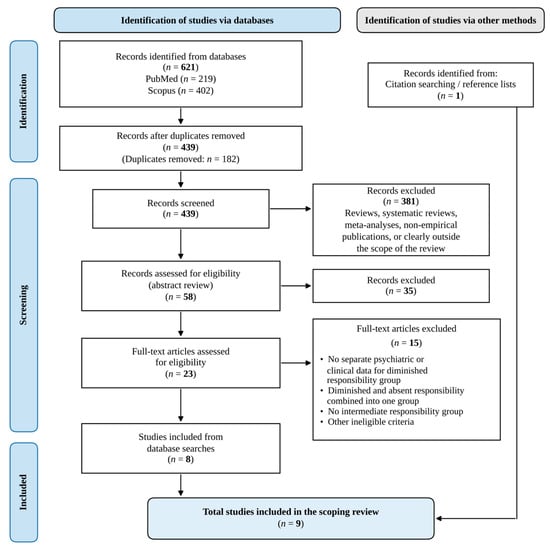
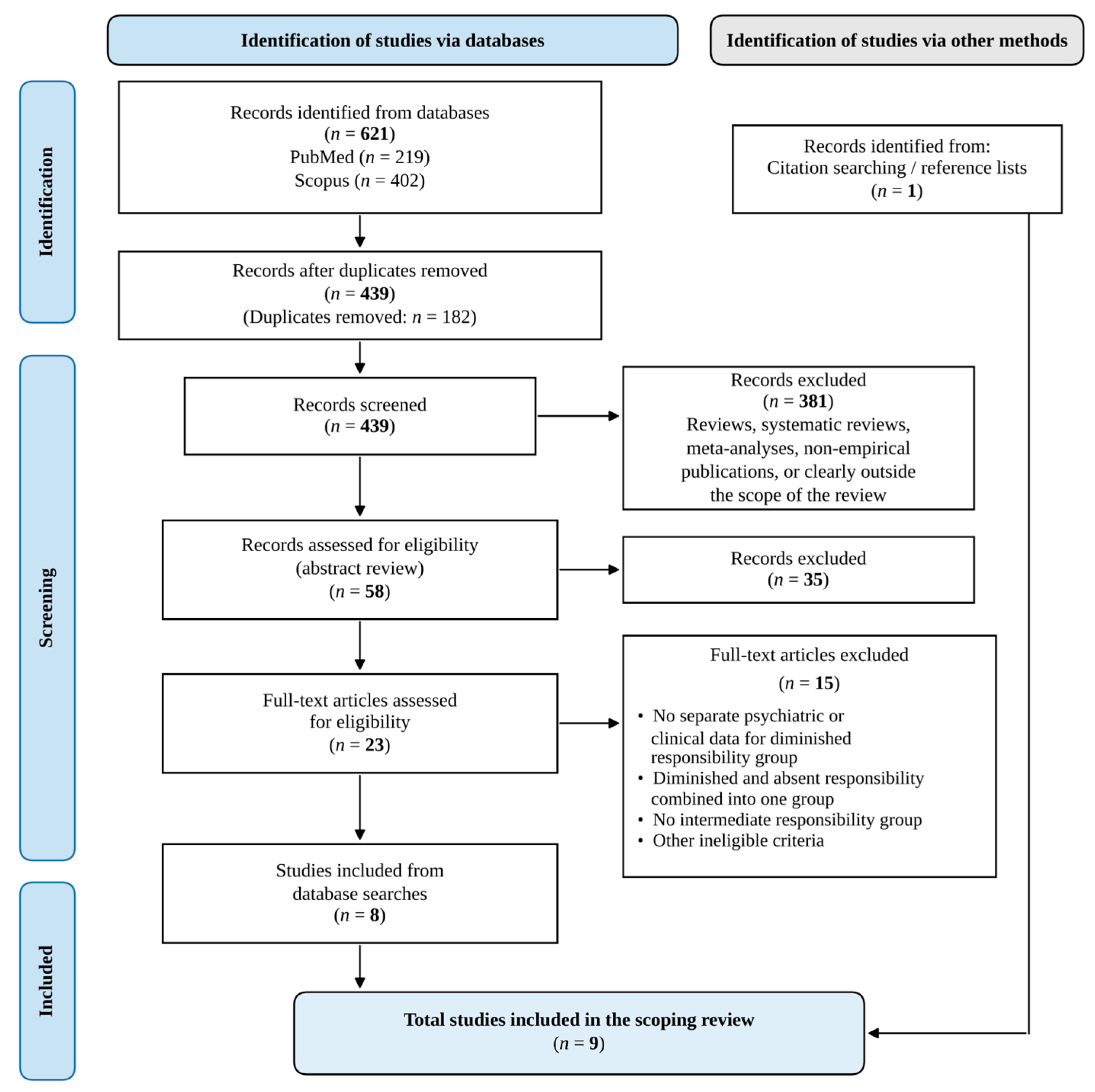
A total of 621 records were identified through database searching. After removal of 182 duplicates, 439 unique records remained for screening. Following title screening, 381 records were excluded, leaving 58 records for abstract assessment. Of these, 35 were excluded and 23 articles underwent full-text assessment. Following full-text assessment, 15 articles were excluded for not reporting psychiatric or clinical characteristics separately for the diminished criminal responsibility group; combining diminished and absent criminal responsibility into one analytical group; not including an intermediate category of criminal responsibility; or not meeting other eligibility criteria. Eight studies identified through the database searches met the eligibility criteria. One additional eligible study was identified through supplementary citation searching, resulting in a total of nine studies included in the scoping review (Figure 1).
Figure 1.
PRISMA flow diagram of study selection.
3.2. Characteristics of the Included Studies
The nine studies included were published from 2010 up to the date of the literature search (4 September 2026) and represented six jurisdictions: Finland, the Netherlands, Türkiye, Italy, Brazil, and Saudi Arabia. The study designs, settings, populations, and methodology of assessing criminal responsibility were very different. Most were based on retrospective analyses of forensic psychiatric evaluations, experts’ reports, or case files, one study in Finland was of a register-based matched case-control design, and one study in the Netherlands was a small empirical case series of women convicted of offences related to terrorism. The characteristics and main findings of the included studies are presented in Table 1.
Table 1.
Characteristics and main findings of the included studies.
The study populations were also diverse. A few studies analysed samples that were large and represented an aggregate of a wide range of population groups referred for forensic psychiatric evaluation, while others investigated specific offence and/or diagnostic settings such as homicide, sexual offences, paraphilic behaviours, terrorism-related offending, and prisoners previously assessed as having reduced criminal responsibility. The sample size varied from 14 to 843 cases or participants.
There was a wide variation in terminology and in the classification of reduced criminal responsibility between jurisdictions. There were various terms used including partial responsibility, substantially diminished responsibility, reduced criminal responsibility and graded levels of diminished responsibility. The Dutch system described by Spaans et al. [23] had five categories with increasing levels of responsibility, while other studies had three major categories of responsibility, full, diminished, and absent. Although there were some differences, generally diminished responsibility was seen as an intermediate condition where mental disorder or impairment had a negative impact on capacities relevant to responsibility, but had not destroyed them.
This also varied widely in terms of the percentage that fell into the appropriate diminished responsibility category. The percentage ranged from 10.3% in a forensic psychiatric sample of Finnish patients [18] to 43.8% in the total forensic sample assessed by Spaans et al. [23], while it was 11.0% in a sample from Saudi Arabia [12]. The percentages should be viewed with caution as the studies varied significantly in the referral processes, populations, legal criteria and responsibility classification.
3.3. Psychiatric Diagnoses and Diminished Criminal Responsibility
The psychiatric characteristics of offenders with criminal responsibility reduction were heterogeneous, and there was no consistent psychiatric profile across studies. However, several diagnostic categories recurred across studies, including intellectual impairment, personality pathology, psychotic disorders, and substance-use disorders, with mood disorders reported less consistently.
The largest diminished-responsibility subgroup was reported by Spaans et al. [23]. Of the 369 defendants specifically listed as having diminished responsibility, 289 (78.3%) had a personality disorder, 187 (50.7%) a substance-use disorder and 50 (13.6%) a psychotic disorder. 24 cases (6.5%) had comorbid psychotic and personality disorders. These diagnostic variables were not mutually exclusive. Multinomial regression analyses, with full responsibility as the reference category, showed that personality disorder, IQ <80, psychotic disorder, and substance-use disorder were all associated with diminished responsibility [23].
Diminished-responsibility offenders in other general forensic populations were also represented by psychotic disorders. In the Turkish study by Gürkan et al. [20], the diminished-responsibility cases (n = 63) included 20 cases of schizophrenia and other psychotic disorders (31.7%) and 10 cases of bipolar disorder (15.9%). However, there was no clear relationship between psychotic disorders and an intermediate level of responsibility. This trend was also demonstrated by Spaans et al. [23], who found that the prevalence of psychotic disorders increased across the five levels of responsibility, from 10/150 fully responsible defendants to 62/113 severely diminished and 66/70 not responsible.
This was also observed in the Italian sample of homicides. Of the defendants who met the criteria for schizophrenia-spectrum disorders, 29.1% were found to have substantially diminished responsibility, 69.1% were found not guilty by reason of insanity, and only 1.8% were found fully responsible. In contrast, 21.3% of defendants who were diagnosed with a primary personality disorder were found to have diminished responsibility, 69.3% were found to be fully responsible, and 9.3% were not guilty by reason of insanity [11]. The OR reported for schizophrenia-spectrum disorder referred to the combined categories of diminished responsibility and NGRI and cannot be interpreted as an OR for diminished responsibility alone.
Together, these findings indicate that psychotic disorders occurred among diminished-responsibility offenders but were even more strongly represented among individuals assessed as severely diminished or not criminally responsible. In the study in which it was possible to make detailed comparisons across several levels of responsibility, by contrast, personality pathology stood out as a common feature within the intermediate range of responsibility.
3.4. Intellectual and Cognitive Impairment
One of the most common features identified across studies reporting diagnosis-specific data for diminished-responsibility offenders was intellectual impairment. In Gürkan et al. [20], intellectual disability was the most common diagnosis in the cases where diminished responsibility played a role, with 33 of 63 (52.4%) cases being diagnosed with intellectual disability. In addition, 58.9% of all cases with intellectual disability in that study were classified as having diminished responsibility.
An even greater proportion was found by Taktak et al. [21], who found that 41/62 (66.1%) of offenders with reduced criminal responsibility were found to have intellectual impairment at varying levels. Likewise, in the male Brazilian sexual offenders sample, five of the eight (62.5%) partially responsible offenders were found to have intellectual disability [22]. Although the 11 partly responsible offenders were not described in full detail by Elsayed et al. [12], two cases were specifically described as having mild intellectual disability—IQ 69 and 65.
This was further supported by Dutch data, which also showed that lower intellectual function was associated with diminished responsibility. In Spaans et al. [23], 51/369 (13.8%) of the defendants deemed to have diminished responsibility had an IQ below 80. The prevalence was lower than in the Turkish and Brazilian samples, but having an IQ <80 was independently associated with diminished responsibility compared with full responsibility. The strength of this association increased further toward the severely diminished and not-responsible categories.
Reduced intellectual functioning, therefore, was a clinically relevant characteristic of several study groups and samples of offenders assigned an intermediate level of criminal responsibility, despite the different study populations and definitions of intellectual impairment.
3.5. Substance Use and Psychiatric Comorbidity
In some subpopulations with reduced responsibility, it was common for problems with substance use to be reported, but the proportion of these populations was highly variable across studies. In Spaans et al. [23], 50.7% (187/369) of the defendants with diminished responsibility also had a substance-use disorder, and this was independently associated with diminished responsibility as compared to full responsibility. Lieslehto et al. [18] found substance-use disorders in 19/26 (73.1%) of the defendants with reduced criminal responsibility in the Finnish study.
Valença et al. [22], however, found that only one of the eight partially responsible sexual offenders was diagnosed with alcohol dependence syndrome. The group with diminished responsibility reported by Gürkan et al. [20] could not be evaluated for substance-use disorders because persons with alcohol or substance-use disorders were evaluated by a separate specialist board and were thus not included in the study population. This methodological characteristic does not allow for direct comparisons of prevalence for substance use across studies.
At the reduced-group level, psychiatric comorbidities were not as regularly reported. Spaans et al. [23] found that 24/369 (6.5%) of the diminished-responsibility defendants had co-occurrence of psychotic and personality disorders. Psychiatric comorbidities in general forensic samples have been reported from other studies, but with very little disaggregation to estimate the prevalence of psychiatric comorbidities among offenders with diminished responsibility. Based on these data, no reliable cross-study estimate of psychiatric comorbidity can be made in this population.
3.6. Psychiatric History and Treatment Utilisation
There were few studies that gave psychiatric-history or treatment variables specifically for the diminished-responsibility subgroup. The overall samples included several people who had previously been in contact with the psychiatric system, treated for and/or been hospitalized with psychiatric illness, but these data could not be specifically attributed to the group of offenders with diminished responsibility and were therefore not presented as a subgroup result.
The best available data on treatment utilization were from Törölä and Rautanen [15], who contrasted 111 inmates in Finland who were previously judged to have reduced criminal responsibility with 111 matched imprisoned controls. Treatment-related exits occurred in 92.8% of prisoners with reduced criminal responsibility compared with 64.0% of controls. Psychiatric hospitalisation occurred in 53.2% versus 8.1%, and treatment in a civil hospital occurred in 84.7% versus 55.0%, respectively. These prisoners were also more likely to be admitted to a psychiatric hospital and to have a treatment-related exit. Treatment needs also emerged early; about half of the reduced-responsibility group had entered treatment within the first three months and 80% within the first year.
These findings suggest high levels of subsequent healthcare utilisation among prisoners previously assessed as having reduced criminal responsibility. However, diminished-specific treatment data were generally unavailable in the other studies, and this cannot yet be regarded as a consistently demonstrated characteristic across jurisdictions.
3.7. Psychopathology and Functional Impairment
In addition to formal diagnoses, some studies gave evidence for the functional and psychopathological characteristics which were considered relevant for reduced responsibility. These results highlighted that diagnosis does not determine criminal responsibility; rather, the relationship between psychopathology and capacities relevant to the offence is important.
In the five-level system used in the Dutch study, the degree of responsibility was directly linked to the severity of the psychiatric disorder and how this disorder was involved in the offence [23]. The total score and facet scores on the PCL-R were not significantly different between the categories of responsibility in the separate psychopathy analysis. But at the item level, there were significant differences in impulsivity and irresponsibility, as well as failure to accept responsibility for one’s own actions, between levels of criminal responsibility. The authors concluded that these results implied that a behavioural control deficit was important specifically for forensic assessments of accountability.
The Saudi Arabian study also made it clear that functional impairment was important. Partial responsibility was defined by Elsayed et al. [12] as applying when someone knew that their behaviour was wrong but could not control themselves sufficiently. While the entire diagnostic picture of the 11 partially responsible cases was not described, the cases that were described included mild intellectual disability, impulse-control disorder, and adjustment disorder.
Rakhshandehroo et al. [19] took another look at this issue in their case series of 14 Dutch women who were convicted of terrorism-related offences. Six were rated as having psychopathology which affected their terrorist activities to a certain degree and were therefore rated as being within the diminished-responsibility category. All six showed susceptibility to influence, five had identity problems, and five had feelings of inferiority. In all cases except one, a mental disorder was diagnosed. The results expand the clinical presentation beyond a purely psychiatric diagnosis, and suggest that personality development, susceptibility to external influences and other psychopathological features may be relevant for the evaluation of diminished responsibility.
In sum, the studies included suggest that the concept of diminished criminal responsibility is a very heterogeneous one in a clinical sense. There were frequent reports of intellectual impairment and varying degrees of personality, substance-use, psychotic and mood disorders. Importantly, there is also evidence available which indicates that the forensic relevance of a psychiatric disorder is not only dependent on whether it exists, but also on the extent to which it impairs cognitive, volitional, behavioural and/or other capacities relevant to the offence.
4. Discussion
Based on the findings of the present scoping review, diminished criminal responsibility is not associated with a single psychiatric profile but rather encompasses a clinically heterogeneous population. The included studies captured intellectual impairment, personality pathology, psychotic disorders, and substance-use disorders as well as, less consistently, mood disorders. The central finding is thus that diminished criminal responsibility cannot be presumed from diagnosis, but rather depends on the nature and consequences of the psychopathology and its relationship to capacities relevant to the crime. At the same time, the interpretation of these clinical findings cannot be separated from the legal framework within which criminal responsibility is assessed. The capacities considered legally relevant, the threshold at which their impairment is regarded as sufficient for diminished responsibility, and the categories available to forensic evaluators differ across jurisdictions [4,7]. Thus, the psychiatric characteristics reported for diminished-responsibility populations reflect not only clinical variation but also differences in the legal concepts and forensic assessment frameworks through which clinical findings are translated into determinations of criminal responsibility.
One of the most frequent findings was intellectual disability. Though there are significant differences between the forensic populations, it predominated in the studies carried out by Gürkan et al. [20], Taktak et al. [21], and Valença et al. [22]. Similarly, Spaans et al. [23] found that IQ <80 was strongly associated with diminished responsibility compared with full responsibility. The results indicate that intellectual impairment may be particularly relevant to intermediate determinations of responsibility, because deficits in understanding, judgement, or behavioural regulation may impair legally relevant capacities without necessarily abolishing them.
The relationship with psychotic disorders appears more complex. Some studies comparing different levels of responsibility suggested that psychotic disorders were more strongly associated with more severe impairment of criminal responsibility, although they were also present among diminished-responsibility offenders. Spaans et al. [23] reported that the prevalence of psychotic disorders increased toward the severely diminished and not-responsible categories, while most defendants with schizophrenia-spectrum disorders in Carabellese et al. [11] were considered not criminally responsible rather than substantially diminished. This is similar to what has been observed in entirely non-criminally-responsible populations, where psychotic-spectrum disorders are more common [9], and to the results of Mahé [10], who concluded that schizophrenia and chronic delusional disorders were more characteristic of abolished than diminished discernment. Thus, psychosis may be associated with diminished responsibility, but more severe psychotic impairment appears more closely related to complete absence of criminal responsibility.
Personality pathology can fall somewhere on this continuum. In Spaans et al. [23], personality disorder was also found to be common and strongly associated with the intermediate diminished category, while in Carabellese et al. [11] defendants with primary personality disorders were mostly regarded as fully responsible, with around one fifth in the substantially diminished category. Personality pathology may therefore become relevant to diminished responsibility when associated features substantially impair behavioural regulation or other legally relevant capacities; however, the diagnosis itself does not imply diminished responsibility. In some samples, there was also a high prevalence of substance-use disorders [18,23], but inconsistent assessment and limited diminished-specific comorbidity data make it difficult to draw firm conclusions about their independent contribution.
The other factor to consider is psychiatric comorbidity. The results were presented primarily according to the diagnostic categories reported in the included studies, although it should be kept in mind that these categories do not necessarily represent mutually exclusive clinical profiles. Co-occurring psychiatric conditions can play a role, along with other factors, in the degree and type of functional impairment relevant to criminal responsibility. This was seen in Spaans et al. [23], in which the diagnostic variables were not mutually exclusive, and some defendants with diminished responsibility had both psychotic and personality disorders. Many of the included studies did not report psychiatric comorbidities specifically in the subgroup with diminished responsibility, which makes it difficult to assess how psychiatric comorbidities might have affected the observed patterns. Therefore, analyses of findings within each diagnostic category may underestimate the clinical complexity of this population and the role of co-occurring conditions in functional impairment.
The diagnostic patterns all emphasise the importance of functional impairment, rather than diagnosis alone. Diminished responsibility was generally defined as a state in which capacities relevant to responsibility were impaired but not abolished. Spaans et al. [23] highlighted behavioural-control characteristics, while Elsayed et al. [12] described partial responsibility in terms of preserved recognition of wrongfulness accompanied by impaired control. Rakhshandehroo et al. [19] also showed that other vulnerabilities, such as susceptibility to influence and identity-related difficulties, may be relevant. This aligns with modern forensic approaches that focus on psychopathology and cognitive and, if applicable, volitional abilities instead of just psychiatric diagnosis [1,2].
Offenders with diminished criminal responsibility may also have substantial ongoing psychiatric needs. Törölä and Rautanen [15] found that prisoners with reduced criminal responsibility had significantly higher rates of healthcare utilisation and psychiatric hospitalisation compared with matched controls. This is based on one study; however, the finding suggests that an intermediate legal determination should not be equated with minor clinical needs and that psychiatric vulnerability may continue after adjudication.
However, there is significant variation across jurisdictions, which must be taken into consideration when drawing conclusions from these results. Different terms, legal thresholds, numbers of responsibility categories, forensic procedures and referral pathways were applied in the included studies. As a result, a person who is deemed to have diminished responsibility in one jurisdiction may not necessarily meet the corresponding criteria in another. This variation is also evident in international comparisons of criminal-responsibility assessment [2] and suggests that differences in reported psychiatric profiles may reflect legal and forensic practices as well as genuine clinical variation. The Dutch studies illustrate this problem particularly clearly. Spaans et al. [23] used a five-level responsibility scale, whereas the present review extracted data specifically for the 369 defendants classified in the middle category of diminished responsibility. This approach retained the category explicitly designated as diminished responsibility in the original study; however, an alternative approach could have combined the three intermediate categories of somewhat diminished, diminished, and severely diminished responsibility. Such a broader definition would have resulted in a substantially different population, illustrating how the operational definition of diminished responsibility can influence cross-study comparisons. In contrast, Rakhshandehroo et al. [19] used a three-level operationalisation based on no influence, partial influence, and full influence of psychopathology on the offence, with the six cases showing partial influence classified as diminished responsibility. Thus, the findings reported from that study refer to a single intermediate category rather than to three intermediate levels. These differences further demonstrate that responsibility categories across studies cannot be assumed to represent directly equivalent legal or clinical constructs.
Limitations of the Evidence and of the Review
A number of caveats apply to the evidence available. Nine studies were eligible to be included, from six jurisdictions with different legal systems, forensic protocols and study populations. Four of the nine studies were conducted on highly selected samples of subjects, namely homicide defendants, sexual offenders, offenders with paraphilic behaviours, and those involved in acts of terrorism, thus reducing the generalisability of their results. The majority of studies were retrospective and depended on forensic reports, case files, and/or administrative records, and there was wide variation in the extent and type of diagnostic and clinical data available.
Another drawback was the reporting of psychiatric characteristics inconsistently for the subgroup with diminished responsibility. Information regarding psychiatric history, psychiatric treatment, psychiatric hospitalisation, suicidality or self-harm, substance use, psychiatric comorbidities, and psychopathology at the time of offence was often not available or available only for the total study population. Further, the terms diminished, reduced, partial, and substantially diminished responsibility may have different meanings across jurisdictions and may not be equivalent in their legal or clinical significance. These differences make it difficult to compare one study with another, and prevent the reported proportions and diagnoses from being interpreted as directly comparable prevalence estimates.
This limitation was particularly relevant to the study by Elsayed et al. [12], in which only four of the 11 cases classified as partially responsible were explicitly characterised diagnostically, while the diagnoses of the remaining seven cases could not be determined from the published data. The study was retained because it provided separately identifiable clinical information for a subgroup with partial criminal responsibility and contributed evidence from a jurisdiction otherwise not represented in the review. However, the incomplete reporting means that the diagnostic pattern of this subgroup cannot be reliably reconstructed, and the unreported cases may have included diagnoses such as personality or substance-use disorders. Consequently, the explicitly described cases from this study should be regarded as illustrative rather than representative of the partial-responsibility group. Importantly, the overall patterns identified in the review, including the recurring association of intellectual impairment with diminished responsibility, were also supported by other included studies and did not depend on the findings of Elsayed et al. [12].
Importantly, this cross-jurisdictional heterogeneity should not be seen solely as a methodological limitation of the available studies. Criminal responsibility is a normative legal concept supported by empirical clinical evaluation, and the translation of clinical findings into legally relevant impairments draws on the criteria and thresholds adopted in each jurisdiction [4,7]. Therefore, variations in results between studies may arise not only from variations in study populations, diagnoses, or assessment methods, but also from different definitions and operationalisations of intermediate levels of criminal responsibility across legal systems. This restricts direct comparisons between different countries and makes it important to understand the clinical characteristics described in this review within the legal and forensic context in which the studies were conducted. This type of heterogeneity cannot be fully resolved through empirical methodology alone.
The review was also limited to English-language studies identified through PubMed/MEDLINE and Scopus, and relevant studies indexed elsewhere may therefore have been missed.
5. Conclusions
There is a lack of uniformity in the clinical and forensic characteristics of diminished criminal responsibility, which is not linked to a single psychiatric diagnosis. Intellectual impairment was identified consistently, while psychotic disorders were observed across diminished and absent responsibility, with more severe psychotic impairment more commonly associated with the latter. Personality pathology and substance-use disorders were also reported in some populations. Overall, the evidence suggests that the forensic significance of psychopathology lies not in the diagnosis itself, but in the extent to which it impairs cognitive, volitional, and/or behavioural capacities relevant to criminal responsibility without abolishing them entirely. However, the legal significance attributed to such impairment depends on jurisdiction-specific definitions, thresholds, and frameworks for assessing criminal responsibility. The findings should therefore be understood at the intersection of clinical impairment and the normative legal standards through which that impairment is evaluated.
Supplementary Materials
The following supporting information can be downloaded at: https://www.mdpi.com/article/10.3390/forensicsci6040093/s1, Supplementary Table S1. Search strategies used in PubMed/MEDLINE and Scopus.
Author Contributions
Conceptualization, G.T. and A.T.; methodology, P.S. and A.T.; writing- original draft preparation, G.T. and A.T.; writing-reviewing editing, P.S. and G.T.; supervision, G.T. and A.T. All authors have read and agreed to the published version of the manuscript.
Funding
This research received no external funding.
Institutional Review Board Statement
Ethical review and approval were waived for this study due to its narrative/descriptive nature and the absence of direct human subject involvement, prospective data collection, or experimental intervention.
Informed Consent Statement
Not applicable.
Data Availability Statement
No new data were created or analyzed in this study. Data sharing is not applicable to this review.
Conflicts of Interest
The authors declare no conflict of interest.
References
- Darby, W.C.; Nair, M.S.; Weinstock, R. Psychopathy, diminished capacity, and responsibility. In The Wiley International Handbook on Psychopathic Disorders and the Law: Laws and Policies, 2nd ed.; Felthous, A.R., Saß, H., Eds.; Wiley Blackwell: Hoboken, NJ, USA, 2021; pp. 413–443. [Google Scholar] [CrossRef] [Scilit]
- Pouls, C.; Jeandarme, I.; Al-Taiar, H.; Bradford, J.; Canton, W.; Kristiansson, M.; Thibaut, F.; Verreyt, V.; Konrad, N. Criminal responsibility evaluations: Benchmarking in different countries. Int. J. Law Psychiatry 2022, 81, 101775. [Google Scholar] [CrossRef] [Scilit] [PubMed]
- Gardner, B.O.; Murrie, D.C.; Torres, A.N. Insanity findings and evaluation practices: A state-wide review of court-ordered reports. Behav. Sci. Law 2018, 36, 303–316. [Google Scholar] [CrossRef] [Scilit] [PubMed]
- Johnston, E.L.; Runyan, K.D.; Silva, F.J.; Maldonado Fuentes, F. Diminished criminal responsibility: A multinational comparative review. Int. J. Law Psychiatry 2023, 91, 101919. [Google Scholar] [CrossRef] [Scilit] [PubMed]
- Seppänen, A.; Joelsson, P.; Ahlgren-Rimpiläinen, A.; Repo-Tiihonen, E. Forensic psychiatry in Finland: An overview of past, present and future. Int. J. Ment. Health Syst. 2020, 14, 29. [Google Scholar] [CrossRef] [Scilit] [PubMed]
- Kooijmans, T.; Meynen, G. Who establishes the presence of a mental disorder in defendants? Medicolegal considerations on a European Court of Human Rights case. Front. Psychiatry 2017, 8, 199. [Google Scholar] [CrossRef] [Scilit] [PubMed]
- Parmigiani, G.; Mandarelli, G.; Meynen, G.; Carabellese, F.; Ferracuti, S. Translating clinical findings to the legal norm: The Defendant’s Insanity Assessment Support Scale (DIASS). Transl. Psychiatry 2019, 9, 278. [Google Scholar] [CrossRef] [Scilit] [PubMed]
- Więcek-Durańska, A.; Malewicz-Sawicka, M. The handling of individuals with a diagnosis of mental illness by the justice system. Psychiatr. Pol. 2023, 57, 591–605. [Google Scholar] [CrossRef] [Scilit] [PubMed]
- Crocker, A.G.; Nicholls, T.L.; Seto, M.C.; Charette, Y.; Côté, G.; Caulet, M. The National Trajectory Project of individuals found not criminally responsible on account of mental disorder in Canada. Part 2: The people behind the label. Can. J. Psychiatry 2015, 60, 106–116. [Google Scholar] [CrossRef] [Scilit] [PubMed]
- Mahé, V. Auteurs d’infractions dont le discernement était altéré ou aboli au sens de l’article 122-1 du Code pénal: Étude descriptive sur 180 sujets. Rev. Med. Leg. 2015, 6, 70–77. [Google Scholar] [CrossRef] [Scilit]
- Carabellese, F.; Mandarelli, G.; Felthous, A.R.; Catanesi, R. Forensic psychiatric evaluation of 187 homicidal assailants with and without a schizophrenia spectrum disorder: Clinical, criminological and behavioral characteristics. Behav. Sci. Law 2021, 39, 190–204. [Google Scholar] [CrossRef] [Scilit] [PubMed]
- Elsayed, Y.A.; Al-Zahrani, M.; Rashad, M.M. Characteristics of mentally ill offenders from 100 psychiatric court reports. Ann. Gen. Psychiatry 2010, 9, 4. [Google Scholar] [CrossRef] [Scilit] [PubMed]
- Tzeferakos, G.; Papaliaga, M.; Papageorgiou, C.; Douzenis, A.; Bali, P. Agreement between psychiatric evaluations and court decisions concerning criminal responsibility. Eur. Psychiatry 2017, 41, S593. [Google Scholar] [CrossRef] [Scilit]
- Liman, Z.; Kayhan, U.; Izci, A. Forensic psychiatric evaluation of criminal responsibility: A retrospective study. Med. Sci. 2026, 15, 267–275. [Google Scholar] [CrossRef] [Scilit]
- Törölä, M.; Rautanen, M. Prisoners with reduced criminal responsibility stand out based on their rates of hospitalisation during their sentences. Int. J. Prison. Health 2023, 19, 641–652. [Google Scholar] [CrossRef] [Scilit] [PubMed]
- Peters, M.D.J.; Marnie, C.; Tricco, A.C.; Pollock, D.; Munn, Z.; Alexander, L.; McInerney, P.; Godfrey, C.M.; Khalil, H. Updated methodological guidance for the conduct of scoping reviews. JBI Evid. Synth. 2020, 18, 2119–2126. [Google Scholar] [CrossRef] [Scilit] [PubMed]
- Tricco, A.C.; Lillie, E.; Zarin, W.; O’Brien, K.K.; Colquhoun, H.; Levac, D.; Moher, D.; Peters, M.D.; Horsley, T.; Weeks, L.; et al. PRISMA Extension for Scoping Reviews (PRISMA-ScR): Checklist and Explanation. Ann. Intern. Med. 2018, 169, 467–473. [Google Scholar] [CrossRef] [Scilit] [PubMed]
- Lieslehto, J.; Tiihonen, J.; Lähteenvuo, M.; Seppänen, A. Large language model approach to uncover reasoning patterns in forensic psychiatric assessment. Sci. Rep. 2026, 16, 23662. [Google Scholar] [CrossRef] [Scilit] [PubMed]
- Rakhshandehroo, S.; Duits, N.; van Emmerik, L.; Pullen, E.; Verkes, R.-J.; Kempes, M. Psychopathology in Dutch women with terrorist behaviours: Empirical case series study. BJPsych Open 2025, 11, e87. [Google Scholar] [CrossRef] [Scilit] [PubMed]
- Gürkan, Ş.; Can, K.C.; Kaya, H.; Yüksel, R.N.; Göka, E. Retrospective evaluation of cases examined to determine criminal responsibilities. Arch. Neuropsychiatry 2021, 58, 321–326. [Google Scholar] [CrossRef] [Scilit] [PubMed]
- Taktak, Ş.; Yılmaz, E.; Karamustafalıoğlu, O.; Ünsal, A. Characteristics of paraphilics in Turkey: A retrospective study—20 years. Int. J. Law Psychiatry 2016, 49, 22–30. [Google Scholar] [CrossRef] [Scilit] [PubMed]
- Valença, A.M.; Meyer, L.F.; Freire, R.; Mendlowicz, M.V.; Nardi, A.E. A forensic-psychiatric study of sexual offenders in Rio de Janeiro, Brazil. J. Forensic Leg. Med. 2015, 31, 23–28. [Google Scholar] [CrossRef] [Scilit] [PubMed]
- Spaans, M.; Barendregt, M.; Haan, B.; Nijman, H.; de Beurs, E. Diagnosis of antisocial personality disorder and criminal responsibility. Int. J. Law Psychiatry 2011, 34, 374–378. [Google Scholar] [CrossRef] [Scilit] [PubMed]

Disclaimer/Publisher’s Note: The statements, opinions and data contained in all publications are solely those of the individual author(s) and contributor(s) and not of MDPI and/or the editor(s). MDPI and/or the editor(s) disclaim responsibility for any injury to people or property resulting from any ideas, methods, instructions or products referred to in the content. |
© 2026 by the authors. Licensee MDPI, Basel, Switzerland. This article is an open access article distributed under the terms and conditions of the Creative Commons Attribution (CC BY) license.