


Abstract
Background: Health assessment in custodial settings represents a core medico-legal function, particularly when clinical changes may influence detention compatibility and judicial decisions. Objective documentation of disease progression during incarceration is essential to ensure respect for the principle of healthcare equivalence and the protection of fundamental rights. Methods: A retrospective descriptive medico-legal analysis was conducted on 37 male inmates referred for forensic evaluation. Standardized assessments included anamnesis, physical and psychiatric examination, evaluation of medical records, and comparative evaluation of pre-detention and detention-period health status. Results: Pre-existing conditions accounted for 73% of pathologies, while 27% developed during imprisonment. Clinical deterioration occurred in 35.1% of inmates (13 cases). Psychiatric disorders were frequent (27%, 10 inmates), predominantly depressive. Conclusions: The findings indicate that imprisonment may constitute a setting that contributes to the progression of medical and psychiatric conditions, highlighting structural and organizational challenges within penitentiary healthcare. Strengthening standardized medico-legal assessment protocols, improving multidisciplinary collaboration, and ensuring continuity of care between prison and community health services are crucial steps toward protecting inmates’ health. This study provides an exploratory assessment of health conditions in a cohort of inmates within the Italian correctional system, emphasizing the central role of healthcare in custodial settings. Since many Italian correctional facilities are equipped with well-developed healthcare services and appropriate diagnostic and therapeutic resources, numerous acute and chronic medical conditions can be effectively managed within the prison setting, ensuring continuity of care while limiting the need for transfer to external healthcare facilities.
1. Introduction
In recent years, the health of incarcerated populations has increasingly attracted attention as a critical indicator of both public health and human rights protection. Prisons represent closed environments where multiple determinants (social, environmental, organizational, and psychological) interact to influence the onset and progression of disease. The maintenance of inmates’ physical and mental health is therefore not only a medical concern but also a legal and ethical imperative, closely linked to the principles of dignity, equality, and the right to healthcare. In the Italian context, the penitentiary system continues to face significant structural and organizational challenges, including chronic overcrowding, limited healthcare resources, and inadequate living conditions [1,2,3]. Although several Italian studies have investigated specific aspects of prison healthcare, including the high prevalence of psychiatric disorders, the organizational challenges of penitentiary healthcare services, and health risks related to infectious diseases and emergency management, the available literature has predominantly focused on individual clinical conditions or public health issues rather than on the medico-legal evolution of inmates’ health during incarceration [4]. Previous research has highlighted the need for greater integration between healthcare and correctional systems, the importance of ensuring continuity of care, and the persistent challenges posed by overcrowding and limited healthcare resources within Italian prisons. Nevertheless, evidence describing the longitudinal evolution of inmates’ health from a medico-legal perspective remains limited [3,5].
Such factors have been consistently associated with elevated levels of stress, worsening of pre-existing diseases, and the emergence of new pathologies, particularly within the psychiatric and psychosomatic domains [6]. Under these circumstances, imprisonment risks extending beyond the mere deprivation of liberty, potentially becoming an additional source of psycho-physical harm [5,7,8]. The role of medico-legal assessments is therefore essential in providing objective data that allow for a systematic evaluation of inmates’ health status and the evolution of diseases during incarceration [9].
This retrospective study aims to provide a structured medico-legal assessment of health trajectories among incarcerated individuals in Italy. To address this objective, the present study focuses on a specific population of inmates who underwent a forensic medical evaluation in the context of judicial proceedings concerning their health status. This approach provides the opportunity to analyze well-documented medico-legal cases in which comprehensive clinical information was available, allowing a systematic comparison between pre-detention and detention-period health conditions. The study analyzes whether documented health changes during detention may assume medico-legal relevance, particularly in relation to the principle of healthcare equivalence and the protection of fundamental rights By integrating clinical findings with a medico-legal evaluative framework, the research seeks to identify organizational and environmental elements that may contribute to measurable deterioration in custody and to support a more standardized and reproducible approach to judicially oriented health evaluations in penitentiary settings. The added value of the present study lies not merely in describing the prevalence of health conditions among inmates, but in applying a standardized medico-legal approach to objectively compare health status before and during incarceration. This comparative framework may support judicial decision-making and contribute to the development of more reproducible medico-legal assessment protocols in correctional settings.
2. Materials and Methods
This retrospective study involved a cohort of 37 inmates incarcerated in various Italian correctional facilities. For each participant, data were collected and analyzed regarding demographic characteristics (sex), type of institution, and overall health status, including specific physical and mental conditions. The investigation focused on the presence of pre-existing diseases, the onset or aggravation of disorders during detention, and the emergence of infectious, sexually transmitted, or psychiatric pathologies.
Health conditions observed during incarceration were compared with those documented prior to imprisonment in order to identify changes in physical and psychological status occurring during the detention period. This comparison was descriptive and was not intended to establish whether such changes were causally attributable to incarceration. The study population consisted of inmates who requested a forensic medical report on their health conditions. After an analysis of the study population, the sample was further reduced because not all met the inclusion criteria below.
Inclusion criteria were as follows:
- Inmates who underwent a standardized medico-legal health assessment during their period of incarceration;
- Without terminal illnesses;
- Subjects aged 18 years or older;
- A minimum detention period of five years, which is considered necessary to identify clinically significant changes in health status related to incarceration.
No upper age limit was applied because the study was designed to reflect routine medico-legal practice, in which requests for forensic evaluation frequently involve elderly inmates. Including older individuals allowed the assessment of health trajectories across the full spectrum of adult prisoners referred for judicial medico-legal evaluation.
Exclusion criteria included:
- Juvenile inmates (as medical-legal examinations were conducted exclusively in adult correctional facilities, whereas minors in Italy are held in juvenile institutions);
- Individuals affected by terminal illnesses and receiving palliative care;
- Inmates deemed not criminally responsible and/or hospitalized in Residences for the Execution of Security Measures (REMS).
All procedures performed in this study were in accordance with the ethical standards of the institution and with the 1964 Helsinki Declaration and its later amendments or comparable ethical standards. The study was approved by the Ethics Committee (code 262/CEL).
2.1. Procedure
All clinical assessments were performed by forensic physicians with documented experience in the penitentiary setting, in collaboration with the healthcare personnel operating in each institution.
Each evaluation included an in-depth review of the inmate’s medical history, followed by a comprehensive physical examination and systematic recording of all clinical findings.
2.2. Examination Protocol
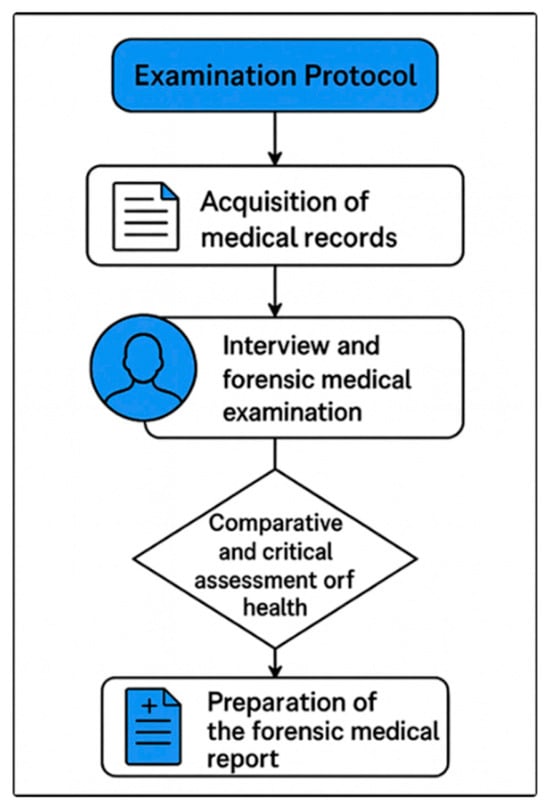
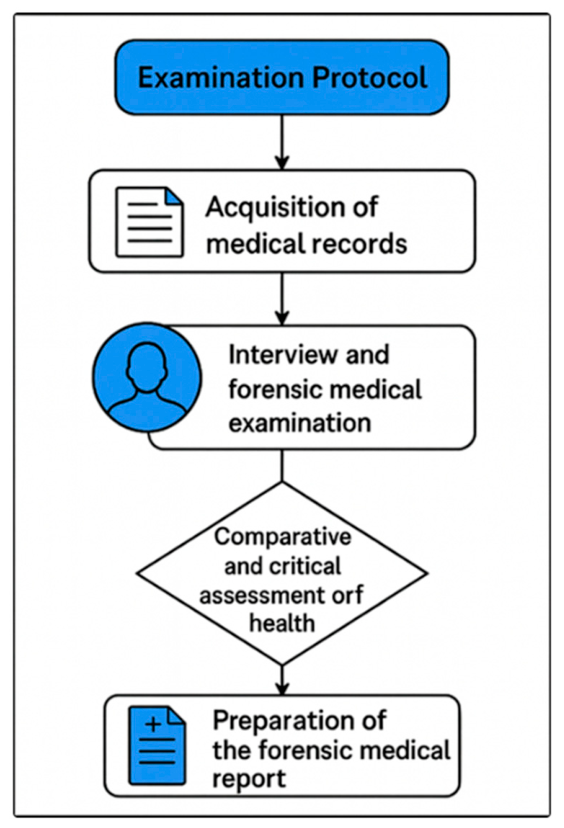
The assessment procedure was articulated into four operational phases, organized according to a standardized protocol to ensure methodological consistency, verifiability, and reproducibility of the findings (Figure 1).
Figure 1.
Flowchart illustrating the structured examination protocol adopted in the study, detailing the sequential phases from the acquisition of medical records to the preparation of the final forensic medical report.
More specifically, the process was structured as follows:
- Acquisition of medical records,
- Interview and forensic medical examination,
- Comparative and critical assessment of health conditions,
- Preparation of the forensic medical report.
2.2.1. Phase 1: Preliminary Acquisition of Medical Records
This phase involved the systematic collection of all available medical records related to each inmate. Personal files were reviewed to obtain demographic data, reasons for incarceration, penitentiary history (detention periods, transfers, special regimes, disciplinary measures), and any prior requests for sentence deferral.
Medical records produced during incarceration was also gathered, including the complete prison medical record from admission to the date of evaluation. These records comprised the initial medical history, daily clinical notes, specialist consultations, diagnostic and laboratory reports, prescribed therapies, psychiatric or psychological assessments, and any hospital admissions or transfers to external facilities.
Finally, pre-detention medical records, including hospital discharge summaries, outpatient reports, certifications of chronic conditions, and records from attending physicians, was collected to reconstruct each inmate’s baseline health status prior to imprisonment.
2.2.2. Phase 2: Interview and Forensic Medical Examination
This phase included identity verification and a structured clinical interview to collect comprehensive medical, psychiatric, familial, and social history. Information regarding pre-existing conditions, disease onset or progression during detention, and the presence of psychiatric, infectious, or sexually transmitted disorders was recorded. Psychiatric history focused on previous episodes of mental illness, suicide attempts, treatments received, and adaptation to incarceration.
A complete physical examination was performed, assessing nutritional status, major organ systems, and significant dermatological findings, including scars or signs of self-harm. The psychiatric assessment evaluated mental status, insight, and awareness of illness, and included a structured appraisal of suicide and self-harm risk.
2.2.3. Phase 3: Comparative and Critical Assessment of Health Conditions
This phase involved a systematic comparison between each inmate’s pre-detention health status and the clinical findings documented during incarceration, with the objective of identifying disease progression or the emergence of new medical conditions. The analysis focused exclusively on identifying changes in clinical status, including progression of chronic diseases, onset of new disorders, and any clinically relevant deterioration documented during incarceration.
All clinical and medico-legal variables relevant to this comparative assessment, including disease progression, timing of onset (pre-detention or during incarceration), presence of psychiatric or infectious conditions, were systematically organized and analyzed using a dedicated Excel database. This structure enabled a standardized, multidimensional evaluation of each inmate’s clinical and psychological profile, enhancing the rigor and reproducibility of the assessment.
2.2.4. Phase 4: Preparation of the Forensic Medical Report
The final phase consisted in drafting the medico-legal report to be submitted to the Judicial Authority. The report was prepared following a standardized structure that included:
- Heading, specifying the details of the medico-legal expert and the referring Judicial Authority;
- Statement of assignment, outlining the scope of the evaluation and the question formulated by the Judge;
- Documentation reviewed, listing all medical, administrative, and penitentiary records examined;
- Anamnesis, including personal, family, medical, psychiatric, and pharmacological history;
- Objective examination, comprising both general physical findings and psychiatric evaluation;
- Medico-legal assessment, summarizing the analytical considerations derived from the clinical and documentary evidence;
- Conclusions summarizing the medico-legal interpretation of the documented clinical findings.
3. Results
The analysis was conducted on a cohort of 37 male inmates. Ages ranged from 23 to 82 years, with a mean age of 48.9 years, a median of 50 years, and a standard deviation of ±12.2 years. Participants originated from multiple correctional facilities and forensic healthcare institutions across Italy, including: 7 from the Casa Circondariale di Piazza Lanza (Catania), 5 from Foggia, 4 from Messina, 3 from Bari, 3 from Caltanissetta, 3 from Bicocca (Catania), and one each from Lucera, Ancona, Benevento, Potenza, Siracusa, Naples, Perugia, Caltagirone, Lecce, Larino, and the Department of Psychiatry San Camillo (Foggia). Additionally, one inmate was under house arrest.
3.1. Health Conditions and Timing of Onset
A total of 27 medical conditions were identified as pre-existing to detention (73%), while 10 conditions (27%) developed during incarceration.
3.2. Disease Distribution
The most frequently observed conditions were as follows:
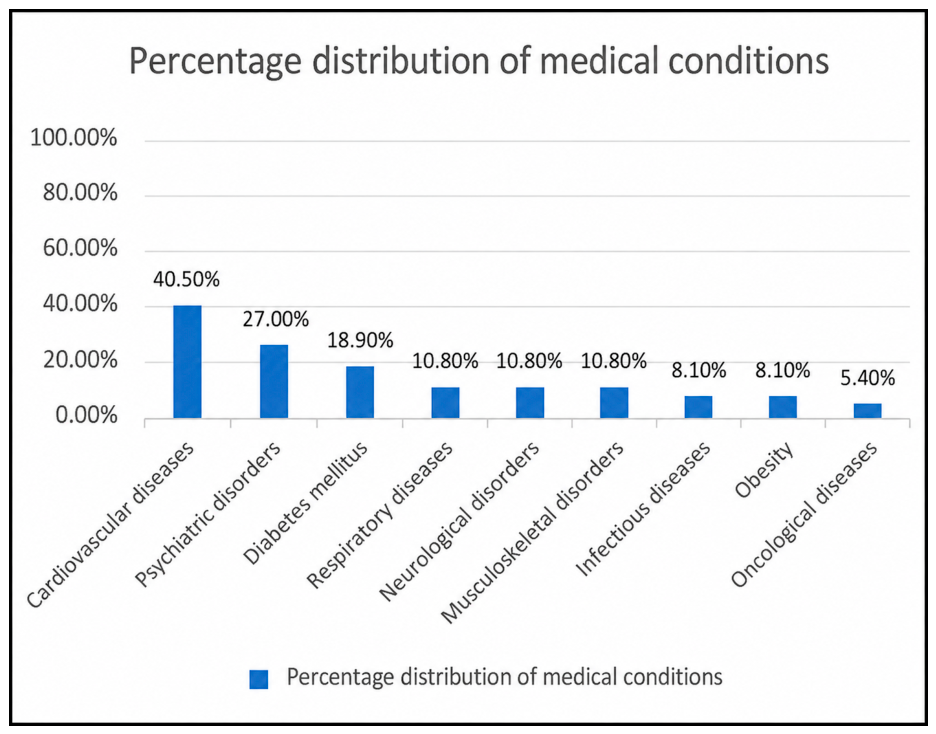
- Cardiovascular diseases, affecting 15 inmates (40.5%);
- Psychiatric disorders, identified in 10 inmates (27%);
- Type 1 and type 2 diabetes mellitus, diagnosed in 7 inmates (18.9%);
- Respiratory diseases, observed in 4 inmates (10.8%);
- Neurological and neurodegenerative pathologies, found in 4 inmates (10.8%);
- Osteo-articular pathologies of arthritic or post-traumatic origin associated with reduced autonomy, documented in 4 inmates (10.8%);
- Infectious diseases, present in 3 inmates (8.1%), including HIV and HBV infections.
Additionally, obesity was reported in 3 inmates (8.1%), and oncological diseases in 2 inmates (5.4%).
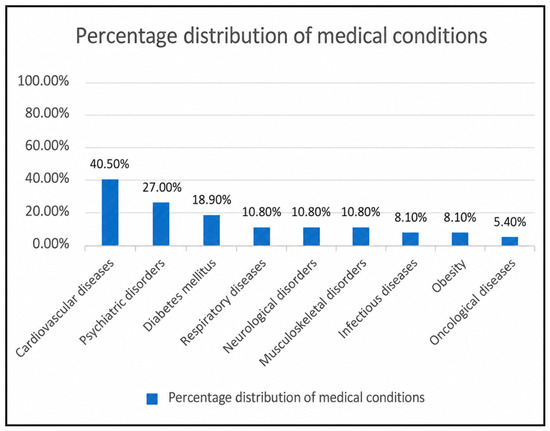
Figure 2 shows the percentage distribution of the principal pathologies observed in the study sample.
Figure 2.
Percentage distribution of the principal pathologies observed in the study sample.
3.3. Clinical Deterioration During Detention
Overall, 13 inmates (35.1%) exhibited documented clinical deterioration over the detention period, whereas 24 inmates (64.9%) showed no clinically significant worsening. This finding reflects the temporal occurrence of deterioration during incarceration and does not, by itself, establish that detention was its cause.
Mental health issues represented a clinically significant component: psychiatric disorders were present in 10 inmates (27%). Depressive disorders were most frequent (6 cases), followed by generalized anxiety disorders (3 cases), trauma- and stress-related disorders (3 cases), and personality disorders (1 cases).
Infectious diseases, despite being less prevalent, posed notable clinical and logistical challenges due to the need for isolation measures, continuous pharmacological therapy, and close monitoring. Throughout detention, inmates received clinical management according to their healthcare needs within the prison healthcare system. When clinically indicated, diagnostic investigations, specialist consultations, pharmacological treatments, and referral to external healthcare facilities were undertaken to ensure continuity of care during incarceration.
4. Discussion
Numerous acute and chronic medical conditions can be effectively managed within the prison setting, ensuring continuity of care while limiting the need for transfer to external healthcare facilities. Imprisonment represents a complex environment in which custodial, organizational, social, and individual factors may interact with pre-existing medical and psychiatric vulnerabilities [10,11]. The medico-legal evaluations performed in this study show that detainees often present pre-existing vulnerabilities that may evolve during custody, in line with international literature indicating that correctional populations bear a disproportionate burden of chronic and psychiatric conditions compared with the general community [12,13,14]. Such evidence highlights the need to interpret clinical progression in detention through a multifactorial lens.
Age distribution within the present sample, which included both young adults and older individuals, highlights the need for differentiated models of care. Age significantly influences vulnerability, adaptability to detention, clinical stability, and adaptation to detention, requiring individualized healthcare pathways within correctional institutions. The wide age range (23–82 years) reflects a heterogeneous population whose clinical and psychosocial needs vary considerably. Overall, the age distribution indicates that the sample predominantly falls within the adult age range, approximately between 45 and 50 years. However, the mean age is influenced by the presence of extreme values (“outliers”), such as the 82-year-old inmate, which slightly shifts the average upward. The close proximity between the mean (48.9 years) and the median (50 years) suggests a relatively symmetrical distribution with limited skewness.
Age-related physiological decline, the natural progression of chronic conditions, and the presence of multimorbidity at the time of admission represent essential elements in interpreting the evolution of health during imprisonment. Accordingly, the findings should be interpreted as exploratory rather than representative of the overall Italian prison population. Larger multicenter studies including more heterogeneous prison populations will be necessary to confirm the present findings and improve their external validity.
Nevertheless, multiple structural and relational factors, social isolation, rigid institutional rules, limited access to specialist care, and the lack of continuous therapeutic relationships, were frequently associated with clinical deterioration [9]. As documented by Haney (2006), the prison environment may amplify chronic stress, contributing to both psychological and physical decompensation [15]. The phenomenon of institutionalization further contributes to progressive loss of autonomy and impaired cognitive and relational functioning, with effects that may persist after release [6].
In this cohort, 73% of medical conditions pre-dated incarceration, while 27% emerged during detention. However, only 35.1% of inmates demonstrated clinically relevant deterioration.
Interpretation of clinical deterioration requires consideration of factors not solely attributable to the prison environment. Physiological aging, progression of chronic degenerative diseases, and variability in individual adaptation to incarceration play a relevant role. Moreover, medico-legal practice indicates that individual clinical trajectories during detention may be influenced by multiple subjective and contextual factors, which cannot be fully quantified within the scope of this study. This consideration underscores the need for cautious interpretation of reported health changes.
Mental health disorders represented a substantial proportion of the conditions observed (27%). This aligns with consolidated international data showing a markedly higher prevalence of psychiatric disorders, particularly depression, anxiety, and stress-related conditions, among incarcerated populations compared with the general population [16,17,18]. In the present sample, psychiatric disorders had a significant impact on medico-legal evaluations, particularly when symptom severity interfered with adaptation to detention or posed risks of self-harm. These findings mirror global reports emphasizing the vulnerability of detained individuals to mental health deterioration, the challenges in early symptom detection, and the need for continuous monitoring in custodial settings [19].
The management of infectious diseases, including HIV, chronic hepatitis, tuberculosis, and immunosuppression, poses additional clinical and logistical challenges, requiring continuous monitoring, isolation protocols, and timely therapeutic interventions that are not consistently available in correctional settings [20].
Another element emerging from the analysis is the institutional heterogeneity among the correctional facilities of origin. Differences in available resources, access to specialist care, and organizational pathways may influence the evolution of complex medical conditions. Nonetheless, the present study was not designed to assess the performance of individual institutions, and its sample size does not permit general conclusions regarding system-level disparities.
Improving prison healthcare also requires substantial investment in training programs for both clinical and correctional personnel. Implementing integrated, multidisciplinary care models is essential to ensure continuity, appropriateness, and respect for individual dignity [21]. Continuity of care, particularly during the transition from prison to the community, is a critical determinant of health outcomes, with evidence showing elevated risks of relapse, substance misuse, and mortality in the immediate post-release period [22,23].
While the present findings highlight the multifactorial nature of health deterioration during incarceration in Italy, a broader international comparison is essential to contextualize these results. Evidence from other democratic countries, such as France, Germany, the United Kingdom, and Spain, shows similar patterns of vulnerability among incarcerated populations, with chronic diseases and psychiatric disorders disproportionately represented compared to the general population. However, these jurisdictions often implement more structured health-equivalence policies and wider use of alternative custodial measures, including community-based programs and medical parole, to mitigate the impact of imprisonment on health. For instance, the United Kingdom’s National Health Service operates integrated prison healthcare systems, ensuring continuity of care post-release, whereas Italy still faces organizational fragmentation and resource constraints. Comparative studies also indicate that countries with robust multidisciplinary teams and standardized medico-legal protocols report lower rates of clinical deterioration. Incorporating these international best practices into the Italian context could strengthen prison healthcare governance and align custodial policies with European human rights standards [24,25,26].
Finally, the ethical implications of healthcare provision in custodial settings warrant serious consideration. Detention demands a careful balance between institutional security and the right to health; failure to maintain this balance can result in preventable clinical deterioration and system-level crises [27,28].
In conclusion, these findings underscore the multifactorial determinants of health deterioration in prison settings and highlight the need for strengthened clinical pathways, improved continuity of care, and standardized medico-legal evaluations focused on documenting disease progression during detention. A broad spectrum of acute and chronic health conditions can be successfully treated within prison healthcare services.
5. Strengths and Limitations
A major methodological limitation is the inability to distinguish the effect of incarceration from the natural progression of disease. This study offers a relevant empirical contribution; however, several limitations must be acknowledged. First, the sample consists exclusively of cases referred for medico-legal evaluation by Judicial Authorities and therefore reflects a selected forensic population rather than the general custodial population. Furthermore, the analysis was conducted on a sample of 37 inmates, all male and all Italian nationality. While this homogeneity allowed for an in-depth examination of this specific subgroup, it limits the generalizability of the findings to female inmates and foreign nationals, who may present distinct clinical and psychological profiles influenced by socio-cultural and biological factors.
From a medico-legal perspective, these findings reinforce the importance of standardized forensic health assessments during detention. Objective documentation of disease progression is essential not only to support judicial decision-making regarding detention compatibility but also to identify potentially preventable clinical deterioration at an early stage. Periodic multidisciplinary evaluations performed by prison physicians, specialists, psychiatrists, psychologists, and forensic experts may facilitate timely therapeutic interventions, improve continuity of care, and reduce health inequalities affecting incarcerated individuals. Furthermore, harmonization of medico-legal assessment protocols at a national level could enhance reproducibility, transparency, and consistency in judicial evaluations concerning prisoners’ health conditions.
A further limitation concerns the inclusion and exclusion criteria. Only individuals aged 18 years or older were included, thereby excluding juvenile inmates. Although this restriction reflects the study’s focus on the adult prison population, it prevents consideration of health-related dynamics affecting younger detainees, a group that may be particularly vulnerable and require dedicated evaluative approaches. In addition, the requirement of a minimum detention duration of five years may have excluded inmates who experienced clinically significant psychophysical changes during shorter periods of incarceration, thus potentially limiting the comprehensiveness of the findings. Furthermore, the absence of an upper age limit may have introduced age-related confounding factors, since older inmates are more likely to present multimorbidity and physiological disease progression independent of incarceration. Nevertheless, their inclusion reflects the characteristics of the population commonly encountered in forensic medico-legal practice. An additional limitation is that the study did not evaluate the appropriateness or effectiveness of the healthcare pathways implemented during detention. Future studies should assess standardized medico-legal care pathways to support evidence-based improvements in prison healthcare.
Finally, although the sample included inmates from various institutions across the Italian territory, differences in the structural characteristics of individual facilities and variability in the quality of healthcare services may have influenced the results. These factors complicate the uniform interpretation of the findings and underscore the need for broader, nationwide studies to fully elucidate the health implications of incarceration.
6. Conclusions
This study provides an exploratory assessment of health conditions in a cohort of inmates within the Italian correctional system, emphasizing the central role of healthcare in custodial settings. Although most individuals did not experience significant clinical deterioration, a relevant proportion showed documented worsening of physical or psychiatric conditions during detention.
The findings highlight that correctional institutions should serve not only a custodial role but also a therapeutic one, ensuring comprehensive medical and psychosocial care for incarcerated individuals. Although the Italian prison healthcare system currently appears capable of providing adequate healthcare to the prison population, further investment in healthcare infrastructure, multidisciplinary services, and preventive programs is essential to optimize the quality of care and better address the growing burden of chronic and complex diseases among prisoners.
These findings highlight the need to strengthen prison healthcare systems to ensure adequate management of complex clinical conditions. Enhanced specialist resources, timely access to diagnostic services, and integrated care pathways are essential to prevent avoidable deterioration and safeguard the fundamental right to health during detention. Beyond describing the health conditions observed in this cohort, the present study highlights the value of a standardized medico-legal approach for documenting disease progression during incarceration. Such an approach may improve the consistency of forensic evaluations, and contribute to the development of evidence-based prison healthcare policies.
Future efforts should focus on developing standardized national medico-legal assessment protocols, strengthening multidisciplinary prison healthcare teams, implementing periodic structured health evaluations, and improving continuity of care before, during, and after incarceration. Such interventions may contribute not only to better clinical outcomes but also to greater protection of prisoners’ fundamental rights and to a more objective medico-legal evaluation of health trajectories during detention.
Author Contributions
Conceptualization, M.E., F.M., V.S.; methodology, M.G.C., L.D.M., S.M.; software, F.M., E.V., F.S.; validation, L.D.M., G.R., C.F., C.P.; formal analysis, V.S., M.E., F.M.; investigation, S.M., V.S., M.G.C.; resources, E.V., L.D.M., S.M.; data curation, F.S., G.R., C.F.; writing—original draft preparation, M.E., E.V.; writing—review and editing, F.S., C.F., C.P.; visualization, G.R., C.F.; supervision, C.P.; project administration, M.E., M.G.C., C.P.; funding acquisition, C.P., M.G.C. All authors have read and agreed to the published version of the manuscript.
Funding
This research received no external funding.
Institutional Review Board Statement
The study was conducted in accordance with the Declaration of Helsinki, and approved by the Ethics Committee of Comitato Etico Locale Catania 2 (protocol code 262/CEL and date of approval 27 October 2025).
Informed Consent Statement
Informed consent was not required because this retrospective observational study was conducted using previously collected data in accordance with Article 110 of the Italian Personal Data Protection Code (Legislative Decree No. 196/2003, as amended). The study protocol and its retrospective design were reviewed and approved by the Local Ethics Committee Catania 2 (Protocol No. 262/CEL, 27 October 2025). Data were processed and reported without information permitting the identification of individual participants.
Data Availability Statement
The original contributions presented in this study are included in the article. Further inquiries can be directed to the corresponding author(s).
Conflicts of Interest
The authors declare no conflicts of interest.
References
- Favuzza, F. Torreggiani and Prison Overcrowding in Italy. Hum. Rights Law Rev. 2017, 17, ngw041. [Google Scholar] [CrossRef] [Scilit]
- Bolcato, M.; Fiore, V.; Casella, F.; Babudieri, S.; Lucania, L.; Di Mizio, G. Health in Prison: Does Penitentiary Medicine in Italy Still Exist? Healthcare 2021, 9, 1511. [Google Scholar] [CrossRef] [Scilit] [PubMed]
- Fasciana, T.; Mascarella, C.; Distefano, S.A.; Calà, C.; Capra, G.; Rampulla, A.; Di Carlo, P.; Palermo, M.; Giammanco, A. Cluster of Legionnaires’ Disease in an Italian Prison. Int. J. Environ. Res. Public Health 2019, 16, 2062. [Google Scholar] [CrossRef] [Scilit] [PubMed]
- Testoni, I.; Nencioni, I.; Arbien, M.; Iacona, E.; Marrella, F.; Gorzegno, V.; Selmi, C.; Vianello, F.; Nava, A.; Zamperini, A.; et al. Mental Health in Prison: Integrating the Perspectives of Prison Staff. Int. J. Environ. Res. Public Health 2021, 18, 11254. [Google Scholar] [CrossRef] [Scilit] [PubMed]
- Cingolani, M.; Caraceni, L.; Cannovo, N.; Fedeli, P. The COVID-19 Epidemic and the Prison System in Italy. J. Correct. Health Care 2021, 27, 3–7. [Google Scholar] [CrossRef] [Scilit] [PubMed]
- Haney, C. Prison Effects in the Era of Mass Incarceration. Prison J. 2012, 92, 1–24. [Google Scholar] [CrossRef] [Scilit]
- García-Guerrero, J.; Marco, A. Sobreocupación En Los Centros Penitenciarios y Su Impacto En La Salud. Rev. Esp. Sanid. Penit. 2012, 14, 106–113. [Google Scholar] [CrossRef] [Scilit] [PubMed]
- Cloud, D.H.; Garcia-Grossman, I.R.; Armstrong, A.; Williams, B. Public Health and Prisons: Priorities in the Age of Mass Incarceration. Annu. Rev. Public Health 2023, 44, 407–428. [Google Scholar] [CrossRef] [Scilit] [PubMed]
- Watson, R.; Stimpson, A.; Hostick, T. Prison Health Care: A Review of the Literature. Int. J. Nurs. Stud. 2004, 41, 119–128. [Google Scholar] [CrossRef] [Scilit] [PubMed]
- Wilper, A.P.; Woolhandler, S.; Boyd, J.W.; Lasser, K.E.; McCormick, D.; Bor, D.H.; Himmelstein, D.U. The Health and Health Care of US Prisoners: Results of a Nationwide Survey. Am. J. Public Health 2009, 99, 666–672. [Google Scholar] [CrossRef] [Scilit] [PubMed]
- Esposito, M.; Salerno, M.; Di Nunno, N.; Ministeri, F.; Liberto, A.; Sessa, F. The Risk of COVID-19 Infection in Prisons and Prevention Strategies: A Systematic Review and a New Strategic Protocol of Prevention. Healthcare 2022, 10, 270. [Google Scholar] [CrossRef] [Scilit] [PubMed]
- Binswanger, I.A.; Krueger, P.M.; Steiner, J.F. Prevalence of Chronic Medical Conditions among Jail and Prison Inmates in the USA Compared with the General Population. J. Epidemiol. Community Health (1978) 2009, 63, 912–919. [Google Scholar] [CrossRef] [Scilit] [PubMed]
- Munday, D.; Leaman, J.; O’Moore, É.; Plugge, E. The Prevalence of Non-Communicable Disease in Older People in Prison: A Systematic Review and Meta-Analysis. Age Ageing 2019, 48, 204–212. [Google Scholar] [CrossRef] [Scilit] [PubMed]
- McLeod, K.E.; Martin, R.E. Health in Correctional Facilities Is Health in Our Communities. Can. Med. Assoc. J. 2018, 190, E274–E275. [Google Scholar] [CrossRef] [Scilit] [PubMed]
- Haney, C. The Wages of Prison Overcrowding: Harmful Psychological Consequences and Dysfunctional Correctional Reactions. Wash. Univ. J. Law Policy 2006, 22, 265–293. [Google Scholar]
- Fazel, S.; Seewald, K. Severe Mental Illness in 33 588 Prisoners Worldwide: Systematic Review and Meta-Regression Analysis. Br. J. Psychiatry 2012, 200, 364–373. [Google Scholar] [CrossRef] [Scilit] [PubMed]
- Favril, L.; Rich, J.D.; Hard, J.; Fazel, S. Mental and Physical Health Morbidity among People in Prisons: An Umbrella Review. Lancet Public Health 2024, 9, e250–e260. [Google Scholar] [CrossRef] [Scilit] [PubMed]
- Prins, S.J. Prevalence of Mental Illnesses in U.S. State Prisons: A Systematic Review. Psychiatr. Serv. 2014, 65, 862–872. [Google Scholar] [CrossRef] [Scilit] [PubMed]
- Fazel, S.; Hayes, A.J.; Bartellas, K.; Clerici, M.; Trestman, R. Mental Health of Prisoners: Prevalence, Adverse Outcomes, and Interventions. Lancet Psychiatry 2016, 3, 871–881. [Google Scholar] [CrossRef] [Scilit] [PubMed]
- Binswanger, I.A.; Redmond, N.; Steiner, J.F.; Hicks, L.S. Health Disparities and the Criminal Justice System: An Agenda for Further Research and Action. J. Urban Health 2012, 89, 98–107. [Google Scholar] [CrossRef] [Scilit] [PubMed]
- Canada, K.; Barrenger, S.; Bohrman, C.; Banks, A.; Peketi, P. Multi-Level Barriers to Prison Mental Health and Physical Health Care for Individuals With Mental Illnesses. Front. Psychiatry 2022, 13, 777124. [Google Scholar] [CrossRef] [Scilit] [PubMed]
- Binswanger, I.A.; Blatchford, P.J.; Lindsay, R.G.; Stern, M.F. Risk Factors for All-Cause, Overdose and Early Deaths after Release from Prison in Washington State. Drug Alcohol Depend. 2011, 117, 1–6. [Google Scholar] [CrossRef] [Scilit] [PubMed]
- Mallik-Kane, K.; Visher, C.A. Health and Prisoner Reentry: How Physical, Mental, and Substance Abuse Conditions Shape the Process of Reintegration; The Urban Institute: Washington, DC, USA, 2008. [Google Scholar]
- WHO Regional Office for Europe. Status Report on Prison Health in the WHO European Region; WHO: Geneva, Switzerland, 2019. [Google Scholar]
- Burchett, J.; Weyembergh, A.; Ramat, M. Prisons and Detention Conditions in the EU; European Union: Brussels, Belgium, 2023. [Google Scholar]
- Available online: https://www.penalreform.org/global-prison-trends-2024/ (accessed on 1 January 2024).
- Gostin, L.O.; Vanchieri, C.; Pope, A. Ethical Considerations for Research Involving Prisoners; National Academies Press: Washington, DC, USA, 2007; ISBN 978-0-309-10119-6. [Google Scholar]
- Esposito, M.; Szocik, K.; Capasso, E.; Chisari, M.; Sessa, F.; Salerno, M. Respect for Bioethical Principles and Human Rights in Prisons: A Systematic Review on the State of the Art. BMC Med. Ethics 2024, 25, 62. [Google Scholar] [CrossRef] [Scilit] [PubMed]
Disclaimer/Publisher’s Note: The statements, opinions and data contained in all publications are solely those of the individual author(s) and contributor(s) and not of MDPI and/or the editor(s). MDPI and/or the editor(s) disclaim responsibility for any injury to people or property resulting from any ideas, methods, instructions or products referred to in the content. |
© 2026 by the authors. Licensee MDPI, Basel, Switzerland. This article is an open access article distributed under the terms and conditions of the Creative Commons Attribution (CC BY) license.