


Abstract
Background/Objectives: Health-related quality of life perception (HRQoL) reflects the impact of individuals’ health conditions on their physical, psychological, and social well-being, and can be compromised after an accident The general aim of this study was to analyze the effect of occupational accident (OA) outcomes on injured workers’ HRQoL. Methods: We conducted a cross-sectional study, using a convenience sample of 101 participants at the end of their recovery and professional reintegration (PR) process. They were submitted to a personal injury assessment (PIA) conducted by medico-legal specialists, and data related to injury severity (IS), permanent professional disability (PD), and PR were collected from the respective forensic reports. Subsequently, they underwent a psychological interview and filled out self-report questionnaires to measure HRQoL (SF-36) and resilience (RSA). For each variable, two groups were defined. Analyses included descriptive statistics, correlations, group comparisons, and multiple linear regression analyses. Results: Injured workers reported lower HRQoL than Portuguese norms across most domains. HRQoL scores were positively associated with resilience and PR, and negatively associated with IS and PD. In multivariable models, IS, and RSA emerged as significant independent associated variables of the physical–social HRQoL component. Conclusions: These findings highlight the importance of a biopsychosocial and multidisciplinary approach to OA victims’ professional reintegration, integrating physical treatment and psychological support with resilience-building and work rehabilitation, before medical discharge and PIA.
1. Introduction
Health-related quality of life (HRQoL) measures have been widely used to assess how health conditions impact individuals’ well-being perception across multiple domains of life (physical, psychological, and social) [1]. Individuals with traumatic injuries consistently report lower quality of life than non-injured populations, even many years after injury [2,3]. HRQoL is a multidimensional concept and may be influenced by, among other factors, personal perceptions, beliefs, life experiences, expectations, and personality [4,5].
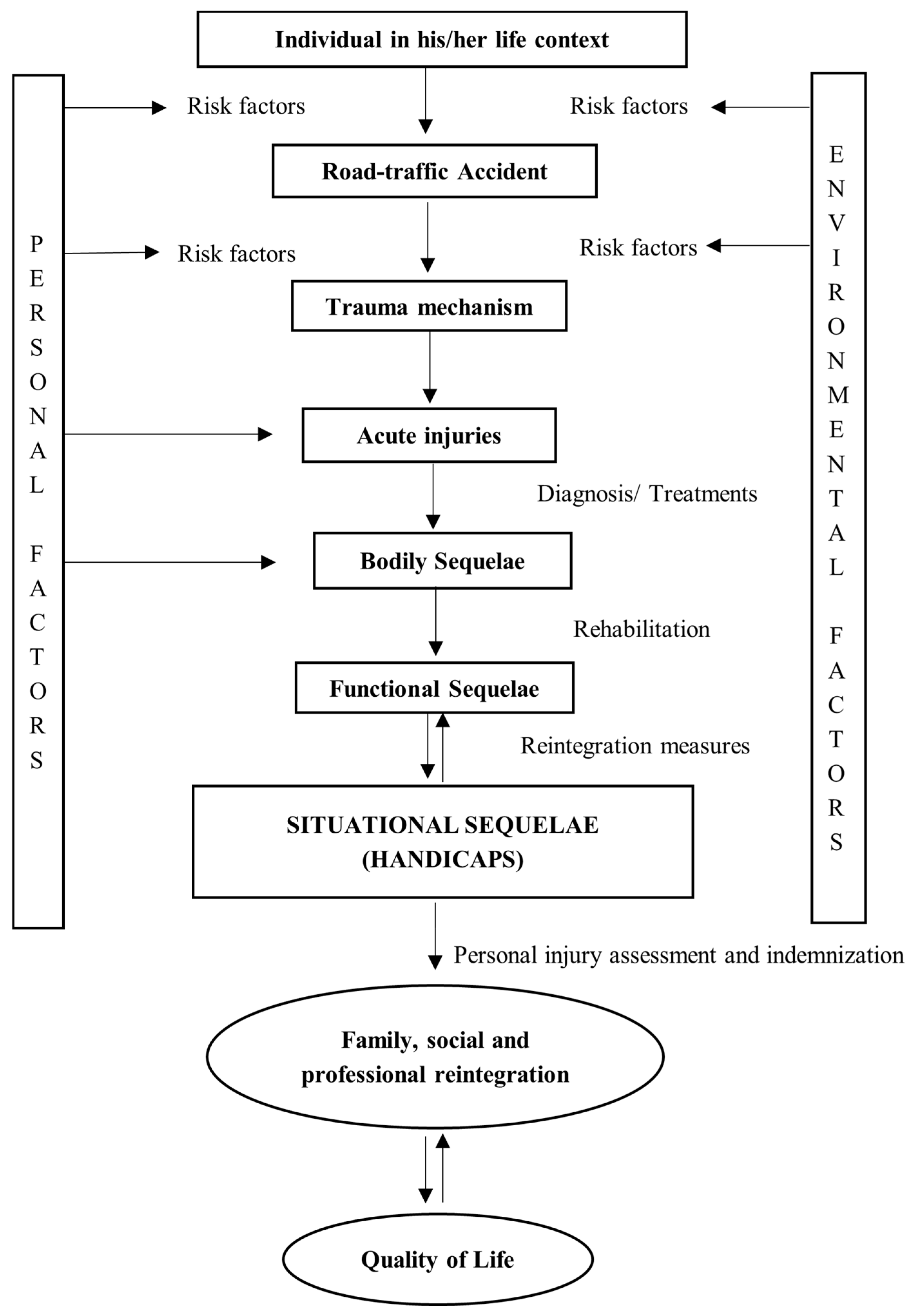
Back in 1998, Magalhães referred to this mechanism regarding road traffic accidents, as described in Figure 1 [6]. It highlights the influence of personal and environmental factors on the final personal injury and quality of life (this, in addition to the effect of experiencing the trauma, the resulting injuries, and the treatments implemented, including rehabilitation). It also clearly indicates that the final/permanent personal injury and the quality of life perceived by the victim mutually influence each other.
Figure 1.
Diagram describing evolution process of personal outcomes after an accident, including reintegration and HRQoL (authors’ free translation based on previous work [6]).
A similar model was presented by the World Health Organization (WHO) through the International Classification of Functioning, Disability and Health (ICF) [7,8], which offered a robust framework that is useful to conceptualize HRQoL. While HRQoL instruments aim to capture individuals’ perceptions, the ICF provides a standardized taxonomy to describe functioning across body functions and structures, activities and participation, as well as personal and environmental factors. Systematic linking rules between ICF categories and HRQoL questionnaire items were developed through the methodological work of Cieza et al. [9,10].
An occupational accident (OA) may directly or indirectly have a negative impact on HRQoL, due to physical, psychological, socioeconomic, familial, and professional outcomes [11,12,13,14,15,16,17,18,19], which can be temporary or permanent. Available evidence has revealed, for example, an inverse relationship between HRQoL and workers’ disability [18].
Thus, HRQoL measurement can provide useful information to better understand some personal outcomes after an OA, such as professional reintegration (PR) or permanent professional disability (PD). Moreover, HRQoL, together with personal factors (such as demographic, resilience capacity, clinical, and socioeconomic factors) can help to predict return-to-work outcomes, income, and employment stability—workers who were successfully professional reintegrated report higher HRQoL across all domains [20,21,22,23].
However, to our knowledge, there are few studies addressing these relationships [21,24,25,26]. Specifically, regarding resilience, study results are inconsistent [27,28], but some have shown that higher levels of resilience have been associated with better HRQoL [26,29], supporting its role as a personal resource that may help individuals to cope more effectively with OA outcomes, and enhance their capacity to engage in professional rehabilitation efforts.
The general aim of this study is to analyze the effect of some OA outcomes on injured workers’ HRQoL perception. The specific objectives are to: (a) describe injured workers’ HRQoL, in all its domains, and compare it with non-injured Portuguese population scores; (b) analyze the relationships between HRQoL and some personal dimensions (sex, age, marital status, and resilience); (c) analyze the relationship between HRQoL and acute injury severity (IS); and (d) analyze the relationships between HRQoL, professional disability, and professional reintegration.
2. Material and Methods
2.1. Participants
A global sample of 101 workers, all victims of OA, was recruited at the medical services of a Portuguese insurance company. This was because, in Portugal, all injured workers are assisted by these companies for treatment and professional rehabilitation/reintegration, as well as for medico-legal personal injury assessment (PIA) at discharge (Law No. 98/2009, 4 September).
The defined criteria for participant selection were: (a) having sustained an OA, irrespective of sex, age, profession, and injury typology, severity, and location; (b) being at the end of the OA recovery and professional rehabilitation/reintegration process, which means having a final PIA by a medico-legal expert, and having the respective report available for consultation; and (c) capacity to give consent for participation and to respond to a short sociodemographic interview and to a self-administered questionnaires.
Having health comorbidities and pathologies, which occurred before or after the OA, that could potentially confound responses was the only defined exclusion criteria (i.e., previous morbidities such as stroke, degenerative diseases, diagnoses of anxious and/or depressive disorders, or previous accidents resulting in major sequelae—pathological and traumatic—as obtained from personal descriptions in the subject’s PIA report).
The mean time from OA to final personal injury assessment, at the time of data collection, was 201.5 days (SD = 121.2; range: 51–789).
2.2. Methods
We conducted a cross-sectional study over a six-month period, using a convenience sample. The study protocol was approved by the Ethics Committee of the Faculty of Medicine of Porto University (No. 232/19, date 19 July 2019). Written informed consent was provided by all participants who met the inclusion criteria, prior to data collection. Explicit assurance was provided that the study was entirely independent of the insurance company’s process. Two studies were conducted using this sample, the first being already published [30].
Variables and instruments used in this study are described below:
(a) Health-related quality of life
HRQoL was measured using the Portuguese version of the 36-Item Short Form Survey (SF-36) [31,32]. This self-administrated instrument comprises 36 items covering eight domains: (a) Physical Functioning (10 items); (b) Role-Physical (4 items); (c) Bodily Pain (2 items); (d) General Health (6 items); (e) Vitality (4 items); (f) Social Functioning (2 items); (g) Role-Emotional (3 items); and (h) Mental Health (5 items). These eight domains can be aggregated into two summary measures: the Physical Composite Scale and Mental Composite Scale. Domains scores range from 0 to 100, with higher scores indicating better HRQoL. The Portuguese version of the SF-36 has shown adequate reliability and construct and clinical validity [31,32] and provides Portuguese population norms [33].
(b) Personal dimensions
Participants’ sociodemographic characteristics were gathered through a brief interview. The dimensions analyzed were sex, age (at the time of the OA), marital status, and profession. With the exception of profession, which was only used for sample description purposes, two groups were created for each personal dimension: (a) sex (female vs. male); (b) age (<50 years vs. ≥50 years)—this criteria was based on No. 5, Alinea a) of General Instructions of Annex 1 of the Decree-Law 352/2007, that establishes the age of 50 years or older as the age when PD may be increased by using a multiplying factor; and (c) marital status (living in communion vs. living alone).
Resilience was included as a personal dimension given its relevance to HRQoL outcomes. For this study’s purpose, we used the following definition of resilience: an individual’s capacity to maintain their psychological and physical well-being when facing adversity [34,35,36]. It was assessed through the Portuguese version of the Resilience Scale for Adults (RSA) [37], a 33-item self-report measure that evaluates six protective domains: (1) Perception of Self (6 items)—an individual’s confidence in their ability to manage or cope with adverse life events; (2) Planned Future (4 items)—whether individuals feel hopeful about their future and have a preference for making realistic plans and set goals that can be achieved; (3) Social Competence (6 items)—an individual’s ability to engage socially, feel at ease in social settings, and their flexibility in social interactions; (4) Family Cohesion (6 items)—shared family values, views of the future, family loyalty, and mutual appreciation; (5) Social Resources (7 items)—the degree to which the individual has resources outside the family that may provide encouragement and assistance if needed; (6) Structured Style (4 items)—an individual’s preference for establishing routines, planning ahead, and approaching tasks in an organized manner [38,39]. Furthermore, an RSA Total score can be calculated using all items. It uses a seven-point semantic differential scale, with items having a positive and a negative attribute at each end. The RSA subscale and total scores are derived by reverse-coding negatively keyed items and calculating mean scores across relevant items, with higher values representing greater resilience. This measure has shown good psychometric properties both for the original and the Portuguese version [37,40], but no Portuguese normative data are available. Several studies [38,39,41,42] have consistently reported mean RSA scores around 5.3–5.5, on the 1–7 scale, indicating that a score of 5 approximates the lower bound of average resilience. We considered that this provided a theoretically and empirically justified criterion to differentiate individuals with lower versus higher resilience resources. Based on these findings [38,39,41,42], we established a cut-off point of ≤5 for RSA total score to create two groups: low vs. adequate–high resilience.
(c) Accident characterization
OA mechanisms and resulting injuries were obtained through the PIA report and used for sample description.
(d) Acute injury severity
IS was assessed using the Injury Severity Score (ISS) [43]. In this scale, each injury is graded from 1 (minor) to 6 (maximal—unsurvivable), according to its severity. The ISS is calculated based on the three most severe injuries across different body regions [44,45]. ISS was estimated through forensic reports: 0 (non-existent), 1–8 (minor or moderate), 9–15 (serious), 16–24 (severe), and 25–75 (critical). For this study, two IS groups were considered: none–moderate (0–8) vs. serious–critical (9–75).
(e) Permanent professional disability
In Portugal, professional disability is defined as the percentage of functional impairment affecting work capacity and earning potential, resulting from OA sequelae, in accordance with Decree-Law 352/2007 [46,47]. Professional disability information was obtained from the PIA report. Firstly, PD percentage was considered according to the following scale [6]: (1) 0–5 (non-existent or minor); (2) 6–15 (moderate); (3) 16–40 (serious); (4) 41–70 (severe); (5) >70 (critical). Consequently, for the current study’s purposes, two PD groups were defined: none–moderate (0–15) vs. serious–critical (≥16). It was verified that the majority of the workers (n = 92; 91.1%) were assigned within the first two groups (PD 0–15%), which limited further statistical analysis. Furthermore, the maximum rate of PD assigned was 43.3%. Thus, we defined the following groups: none–minor (0–5) vs. moderate–severe (6–70).
(f) Professional reintegration
For this variable analysis, we considered the professional status at the time of the end of recovery and professional rehabilitation/reintegration process, described in the PIA report. Two PR groups were created: reintegrated vs. non-reintegrated.
All self-reported measures used revealed very good internal consistency in this sample (SF-36 α = 0.92; RSA α = 0.86).
2.3. Statistical Analyses
Sample characteristics, including personal variables (sex, age, marital status, profession, and resilience), OA mechanisms and resulting injury location, injury severity, professional disability rate, professional reintegration, and HRQoL scores were analyzed through descriptive statistics.
After ensuring the necessary assumptions of normality, all HRQoL domains were compared with the Portuguese norms using independent samples t-tests. Effect size differences for each comparison were calculated using Cohen’s d.
Spearman and Pearson correlations were conducted, according to variable characteristics, to explore correlations between HRQoL and sex, age, marital status, resilience domains, IS, PD, and PR. Given the exploratory nature of this analysis, findings should be interpreted as hypothesis-generating. To account for multiple testing, p-values were adjusted using the Benjamini–Hochberg false discovery rate (FDR) procedure. Given the multidimensional structure of the HRQoL instrument, FDR correction was applied separately for each HRQoL outcome, including the eight SF-36 domains and the two summary component scores, considering all correlations performed for a given domain as one family of tests. This approach was adopted because the primary objective was to identify factors associated with each specific HRQoL dimension rather than to test a single global hypothesis across all correlations. Treating each outcome as a separate family of comparisons allowed control of type I error while preserving statistical power to detect potentially meaningful associations within conceptually distinct dimensions of health-related quality of life. Statistical significance was defined as an FDR-adjusted q-value ≤ 0.05.
HRQoL scores were compared between the groups created for each variable (with the exception of profession), as described above. For these analyses, appropriate group comparison tests were applied, accordingly to prior verification of normality and homogeneity of variances assumptions. Normality was assessed using the Shapiro–Wilk test, which is recommended for small to moderate sample sizes. Homogeneity of variances was assessed using Levene’s test. Variables that met both assumptions (p > 0.05 in Shapiro–Wilk for both groups; p > 0.05 in Levene’s test) were analyzed using the independent-samples t-tests. For variables that violated the assumption of normality (p < 0.05 in at least one group), the Mann–Whitney U test was used as a non-parametric alternative. Given that each grouping variable represented a distinct research question, the Benjamini–Hochberg procedure was applied separately within each family of comparisons to control FDR. Specifically, for each grouping variable, the ten comparisons corresponding to HRQoL domains and composite summary scores were treated as a single family of tests. Statistical significance was defined as an FDR-adjusted q-value ≤ 0.05. This approach was selected to balance protection against type I error inflation while maintaining adequate statistical power within each conceptually distinct set of analyses.
Multiple linear regression analyses were conducted to investigate whether age, sex, marital status, resilience (RSA Total), IS, PD, or PR were predictors of HRQoL. To reduce dimensionality and simplify interpretation, principal component analyses (PCA) with varimax rotation was conducted on seven quality-of-life dimensions. Based on the Kaiser criterion (eigenvalues > 1), two factors were retained, accounting for 64.26% of the total variance. Two factor scores were generated: (a) Factor 1—physical and social health-related dimensions, and (b) Factor 2—mental and emotional health-related dimensions. The first factor explained 47.17% of the variance and showed high loadings for Physical Functioning (0.777), Bodily Pain (0.768), General Health (0.770), Vitality (0.874), and Social Functioning (0.837). This factor was interpreted as a physical and social well-being dimension. The second factor explained an additional 17.10% of the variance and was characterized by high loadings for Mental Health (0.753) and Role-Emotional (0.753). This factor was interpreted as a mental and emotional health-related dimension. Communalities ranged from 0.569 to 0.765, indicating that the extracted factors adequately represented the variance of the observed variables. Separate multiple linear regression models were conducted, considering each PCA factor score as the dependent variable. The enter method was used, and model assumptions were confirmed, as well as multicollinearity, which was evaluated via tolerance and variance fluctuation (VIF).
All statistical analyses were performed using SPSS for Windows Version 29.0 (IBM Corporation, Armonk, NY, USA). Statistical significance was set at a p-value of less than 0.05 and a q-value (FDR-adjuste p-value) ≤ 0.05.
3. Results
3.1. Variables Description
Participants’ mean age was 44.7 years (SD = 11.2; range 18–69), and most were male (n = 84; 83.2%) and living in communion (n = 69; 68.3%). At the time of the OA, the most common professional categories were general services and trade personnel (28.7%), construction workers (24.8%), and plant and machinery operators (19.8%). Resilience scores are presented in Table 1.
Table 1.
Resilience domains scores (mean and standard deviation) (n = 101).
The most frequent accident mechanism was effort-related trauma (n = 24; 23.8%), followed by falls from own height (n = 21; 20.8%), and injuries caused by sharp objects (n = 14; 13.9%). Crush injuries accounted for 12 OA (11.8%), while both falls from height and road traffic accidents occurring during commuting (in itinere) were each reported in 11 cases (10.9%). Less frequent mechanisms included injuries caused by blunt objects (n = 6; 5.9%), burns (n = 1; 1.0%), and dog bites (n = 1; 1.0%).
Injury location was collected considering for each participant all reported injuries. The upper limbs were the most affected region (n = 51; 50.5%), followed by the lower limbs (n = 45; 45.5%). Spinal (raquis/spinal cord) injuries were reported in 14 participants (13.9%). Injuries involving the face and/or neck occurred in 4 (4.3%), while cranial/brain injuries and chest and/or abdominal injuries were each observed in 3 participants (3.0%).
Acute injury severity was classified as none–moderate in 72 participants (71.3%), and serious–critical in 29 (28.7%).
Regarding PD, the mean rate was 5.0% (SD = 9.2; range 0–43.3%). Most of the workers (n = 71; 70.3%) were assigned a PD between 0 and 5% (none–minor), which means that they could, at least, perform essential job tasks, even if with additional effort or technical adaptations. Concerning PR, 81 participants (80.2%) were professionally reintegrated: 72 (71.3%) returned to their previous occupation, and 9 (8.9%) transitioned to different roles, including 5 with job adaptations and 4 with full professional reconversions. Non-reintegration affected 20 participants (19.8%), comprising 12 (11.9%) on general physician-assigned sick leave, 7 (6.9%) unemployed due to the OA, and 1 (1.0%) retired.
3.2. HRQoL
HRQoL scores and their comparison with Portuguese population norms are shown in Table 2. Injured workers showed lower scores of HRQoL in most of the domains, with observed effect sizes that ranged from medium to large (Table 2). Exceptions were found on General Health and Physical Composite Scale domains, where no significant differences were observed, and on the Mental Composite Scale, where injured workers showed significantly higher scores, with a small effect size, compared to general population norms [33].
Table 2.
Comparison of HRQoL scores between global study sample and Portuguese population norms (n = 101).
3.3. Correlations
Correlations between HRQoL domains and variables of interest are shown in Table 3.
Table 3.
Correlations between HRQoL and sex, age marital status, resilience, IS, PD, and PR (n = 101).
Correlation analyses revealed coherent patterns between HRQoL domains and variables of interest (Table 3). Resilience—particularly the Perception of Self—was positively associated with multiple HRQoL domains (ρ = 0.20–0.37, p ≤ 0.03), suggesting that psychological protective factors may buffer the functional and emotional impact of occupational injury. Conversely, IS and PD correlated negatively with physical and social HRQoL components (ρ = −0.20 to −0.32, p ≤ 0.04), underscoring the enduring influence of objective sequelae on subjective well-being. Professional reintegration showed modest but significant associations with Bodily Pain and Social Functioning, aligning with prior evidence that work participation supports perceived health.
After controlling for multiple comparisons using the Benjamini–Hochberg FDR procedure, fewer correlations remained statistically significant (q ≤ 0.05). Positive associations between resilience dimensions and HRQoL remained significant, particularly for Perception of Self and RSA Total (ρ = 0.25–0.37, q ≤ 0.05). Negative associations involving IS and PD also remained significant, especially in the social HRQoL dimension (ρ = −0.23 to −0.32, q ≤ 0.05). Professional reintegration negative association with Social Functioning also remained significant.
3.4. Comparison of HRQOL Scores Between Groups
The comparisons between HRQoL scores and variable of interest groups are shown in Table 4.
Table 4.
Comparison of HRQoL scores between sex, age, marital status, resilience, IS, PD, and PR groups (n = 101).
Group comparisons corroborated the correlational findings. Participants with adequate–high resilience reported significantly higher scores across the Physical, General Health, Vitality, Social, and Mental HRQoL domains, reinforcing the protective role of psychological resources. Conversely, those with serious–critical IS or moderate–severe PD demonstrated poorer outcomes in General Health, Vitality, and Social Functioning. Notably, non-reintegrated workers reported greater Bodily Pain and reduced Social Participation, suggesting that functional recovery and workplace re-engagement may mutually reinforce perceived quality of life. Due to the marked imbalance in group sizes (male n = 84; female n = 17), sex-based comparisons should be interpreted with caution and considered exploratory.
After applying the Benjamini–Hochberg FDR correction within each family of comparisons, only a subset of these previous group differences remained statistically significant. Participants aged <50 years reported significant higher General Health scores than those aged ≥50 years (although at the significance limit). Participants with adequate-to-high resilience demonstrated significantly higher scores for Physical Functioning (q = 0.044), Vitality (q = 0.015), Social Functioning (q = 0.005), Mental Health (q = 0.005), and Mental Composite Scale (q = 0.007) than those with low resilience. Furthermore, participants with none-to-moderate IS reported significantly higher Mental Composite Scale scores than those with serious-to-critical injury severity (q = 0.030). All other initially significant differences did not remain significant after controlling for the FDR.
3.5. Regression Models
The regression model predicting Factor 1 (physical and social components) was significant (F (7, 93) = 4.04, p < 0.001), explaining 23.3% of the variance (R2 = 0.233, adjusted R2 = 0.175). Significant predictors were: IS (β = −0.515, p = 0.006), indicating higher injury severity was associated with lower physical/social HRQoL; RSA total (β = 0.199, p = 0.043), suggesting higher resilience was associated with higher scores on this factor; and PD (β = 0.384, p = 0.040), which showed an unexpected positive association. Evidence of multicollinearity between IS and PD, reflected by VIF values (>4), was found, suggesting there was overlap between these predictors (Table 5). Despite the evidence of multicollinearity between these variables, both predictors were retained in the model because they represent conceptually distinct dimensions relevant to the study aims. Nevertheless, the high correlation between these variables may have affected coefficient stability and contributed to the unexpected direction of the PD coefficient. Consequently, findings regarding the independent contribution of PD should be interpreted cautiously. The other variables (age, sex, marital status, PR) were not statistically significant.
Table 5.
Multiple linear regression models predicting HRQoL factor scores.
The regression model for Factor 2 (mental and emotional components) was not statistically significant (F (7, 93) = 1.73, p = 0.111), explaining only 11.5% of the variance (R2 = 0.115, adjusted R2 = 0.049). Although no statistical significance was found, marital status (β = 0.171, p = 0.098) and age (β = 0.190, p = 0.068) showed trends suggesting potential associations with this HRQoL factor. As in the previous model, multicollinearity diagnostics indicated overlap between IS and PD, with elevated VIF values (>4), suggesting potential instability in coefficient estimation. Results are presented in Table 5.
4. Discussion
Our results revealed that OA victims report significantly lower HRQoL than the Portuguese population in most domains. Poorer HRQoL scores were mainly associated with higher IS and PD and with being professionally non-reintegrated. Personal dimensions showed limited influence, except for resilience, which was consistently related to higher HRQoL. In multivariable models, IS and RSA emerged as significant independent associated variables of the physical–social HRQoL component.
4.1. HRQoL—Injured and Non-Injured Populations
Our results showed a consistent pattern of significantly lower HRQoL among injured workers when compared with Portuguese population norms, in almost all domains.
Marked reductions were observed in Physical Functioning (p < 0.001: d = −0.70), Role-Physical (p < 0.001: d = −1.03), Bodily Pain (p < 0.001: d = −1.25), Vitality (p < 0.001: d = −0.73), Social Functioning (p < 0.001: d = −0.47), Role-Emotional (p < 0.001: d = −0.61), and Mental Health (p < 0.001: d = −0.92), all presenting medium to large effect sizes. These results are consistent with previous studies indicating that work-related injuries extend beyond physical sequelae, having persistent negative effects on self-rated pain, vitality, emotional dysregulation, psychological well-being, and social participation [2,3,17,18,19,20,21,23,27,48]. These effects may negatively influence functional recovery and long-term work outcomes [23,48,49].
No significant differences were observed in the General Health domain (p = 0.51: d = 0.07). General Health is a broad and subjective assessment of personal health status, which can remain relatively stable even when specific physical or emotional functions are compromised [1,5], especially if medical assistance is being provided. We hypothesize that since participants were being medically assisted, their overall health global perception may have remained relatively preserved, despite reporting substantial alterations in other HRQoL domains. Moreover, individuals may, and often do, adapt to changes in health conditions by adjusting their expectations and redefining their internal standards for what constitutes “good health” [4]. Such adaptive mechanisms may also explain why injured workers continue to rate their General Health positively while simultaneously reporting substantial complaints such as pain, fatigue, or emotional limitations.
No significant differences were found in the Physical Composite Scale (p = 0.15: d = 0.14) scores. Despite the lower scores in several mental-health–related HRQoL domains, the Mental Composite Scale (p = 0.001: d = 0.33) score was slightly higher than Portuguese norms, albeit with a small effect size. Mechanisms of psychological adaptations and/or resilience may be underlying this result, as will be discussed later. Furthermore, composite scores (PCS and MCS) are derived from standardized domain scores weighted using factor coefficients based on Portuguese normative data and therefore do not represent simple averages of the eight domains. These summary measures reflect relative positioning with respect to the reference population rather than absolute health status. Additionally, the presence of cross-loading negative weights between physical and mental domains may lead to higher composite scores in specific samples despite limitations in some domains. Differences in sociodemographic characteristics between the clinical sample and the Portuguese normative population, as well as possible response-shift effects, may further explain unexpectedly higher composite scores and should be considered when interpreting these results.
Overall, these results reinforce the understanding that OA injury has sustained and multidimensional associations with injured workers’ HRQoL.
4.2. HRQoL and Personal Dimensions
Our sample was predominantly composed of young male workers ( = 44.7 years), working mainly in physically demanding areas (general services and trade, construction, and plant and machinery operators), which imposes higher risks for sustaining traumatic injuries. These findings are consistent with national [50] and international [51,52,53,54,55,56] data on OA. The mean age observed aligns with previous studies indicating that middle age adults are the most affected group, with potential implications for long-term health, work capacity, and socioeconomic outcomes [13,23,57].
Personal sociodemographic variables exhibited limited influence on HRQoL.
Sex group comparisons showed that female participants reported worse scores on all HRQoL dimensions, but no significant differences were found in our study, in line with studies reporting mixed or attenuated sex effects on post-injury HRQoL [17,18]. Marked imbalance in group sizes (male n = 84; female n = 17) might account for the reduced statistical power of this comparison. Although previous studies have reported higher pain prevalence and injury vulnerability among women after OA [53,56], our results did not show the same.
Participants aged under 50 years reported significantly higher scores in General Health (64.3 vs. 54.1; q = 0.050) than those aged 50 years or older. No significant differences were found in the others HRQoL domains. These findings suggest that age is more strongly associated with subjective perceptions of overall health, as expected. Other studies in the context of occupational injuries have found associations between older age and poorer self-rated health despite comparable functional outcomes [21,56]. Overall, age appears to exert a modest influence on HRQoL after an OA, primarily through global health perception rather than broader functional domains.
Marital status differences were not significant after correction, which contrasts with previous studies that highlighted the protective effect of marital support after an injury [29,36].
Resilience domains were consistently positively associated with HRQoL (Table 3). Perception of Self correlated with the Physical and Social Functioning and Mental Health domains, suggesting self-confidence and competence help injured workers to cope with functional and psychological challenges following the OA. Planned Future correlated with General Health, Vitality, and Social Functioning, highlighting the role of goal-setting and future orientation in supporting better HRQoL [26]. Family Cohesion and Social Resources were correlated with Social Functioning and Mental Health, emphasizing the potential protective role of social and familial support as a buffer to the psychological distress that can occur after an OA [27,38,40,41,58]. Structured Style showed no correlations, suggesting that organizational habits have limited influence on HRQoL after an OA. These results were reinforced by group comparisons, where results showed that higher-resilience group had significantly higher scores across most of HRQoL domains (Table 4), with significant differences observed at Physical Functioning, Vitality, Social Functioning, Mental Health and Mental Composite Scale. Studies across clinical and occupational populations have demonstrated that high resilience is associated with better psychological adjustment, fewer psychiatric symptoms, improved quality of life, even in the presence of pain or disability [26,29,40], which is consistent with our results. Overall, these findings align with previous research showing that positive self-perception, future orientation, and social competence support better HRQoL in individuals experiencing trauma or health-related stressors [26,29,38,40,41], underscoring the importance of incorporate resilience-building strategies during rehabilitation and recovery processes.
4.3. HRQoL and Acute Injury Severity
Most participants sustained none–moderate injuries (71.3%). Acute injury severity was negatively correlated with Social Functioning. Participants with serious–critical injuries reported lower scores at all HRQoL domains, although a significant difference was only found for the Mental Composite Scale (48.1 vs. 59.8; q = 0.030). The absence of significance differences at other domains might be due to the size group imbalace and also due to the fact that HRQol might be mediated by contextual, family, or workplace factors rather than by injury severity itself [22].
Our results are in line with previous research indicating that more severe occupational injuries are strongly associated with poorer HRQoL, including reduced physical functioning, social limitations, alterations in vitality and emotional well-being, higher pain levels, and delayed return to work [1,2,3,4,17,18,21,23,48].
4.4. HRQoL and PD
Professional disability was assigned to 54.5% of the participants, reflecting the long-lasting sequelae of OA. Although PD average was low (5.0%), the range was substantial (min = 0%; max = 43.3%). However, it is known that even minor to mild disabilities can significantly affect individuals’ well-being and consequently their HRQoL [59,60], which reinforces the medico-legal relevance of evaluating the concrete personal damage (considering the different personal life contexts according to the biopsychosocial model) instead of only corporal damage [7,46]. To assure this demand, in Portugal, PIA is based on a three-dimensional methodology [6,61,62], which allows the consideration of personal factors, including self-perceptions (subjectivity) [63].
Professional disability demonstrated associations with Physical and Social Functioning and Physical Composite Scale (Table 3). Groups comparison revealed that although the moderate–severe PD group scored highly on all HRQoL domains, no significant differences were found after multiple-comparison correction. Our results did not find what was previously reported in other studies regarding the impact of professional disability on HRQoL [17,19,21].
4.5. HRQoL and PR
Although all participants were considered capable of return to work at final PIA, 20% of injured workers were not professionally reintegrated. Professional Reintegration was correlated with Social Functioning (q = 0.032). Previous studies stated that better social engagement and self-confidence [22,60,64,65,66] can be related to professional reintegration outcomes. Although the non-reintegrated group showed lower scores at all HRQoL domains, no significant differences were found between groups after the Benjamin–Hochberg procedure.
4.6. HRQoL Associated Variables
Physical and social aspects of HRQoL are significantly influenced by injury severity and resilience, whereas mental/emotional aspects show weaker associations with the same associated variables. These results seem to suggest the need to prioritize physical and social recovery and rehabilitation interventions to improve overall quality of life in occupationally injured individuals, as noted in previous studies [21,22,64,66].
4.7. Limitations and Further Studies
This study has several limitations due to difficulties in accessing case studies. First, the methodological characteristics of a cross-sectional study design prevent causal inferences. Second, the use of a convenience sample may introduce some selection bias. Third, there are limitations resulting from sample dimension. Fourth, time is a limitation, since OA was not included as a variable in the statistical analyses. Finally, HRQoL was assessed at a single time point, preventing evaluation of changes in quality of life across different stages of recovery and rehabilitation.
Given the cross-sectional design, the associations observed between RSA, IS, PD, PR, and HRQoL should be interpreted as correlational rather than causal. While regression models identify significant associated variables, the temporal directionality of these relationships cannot be established.
Despite these limitations, this work intends to be a starting point for other studies, fundamental for forensic and insurance medicine practice but mainly intended to promote injured workers’ quality of life. Further studies aimed at understanding the relationships between HRQoL and other personal dimensions (for example, previous trauma experience and motivation), as well as IS, PD, and PR, should be designed employing longitudinal methodologies; and larger, more representative, and balanced samples to enable more robust investigation. Longitudinal designs are required to determine whether, for example, lower HRQoL impedes professional reintegration or whether unsuccessful reintegration exacerbates perceived quality of life [59,67]. Furthermore, environmental factors (such as education, socioeconomic level, familial support, employer, and peer support) should be included. Such studies would provide deeper insights into the trajectory of recovery and the long-term impact of occupational injuries on HRQoL and assess if it has a potential role in determining OA outcomes such as PD and PR.
5. Conclusions
Our study showed that OA injury impacts workers’ HRQoL. We highlight the following results found on this OA sample:
- (a)
- OA is associated with multidimensional reductions in HRQoL, particularly in physical, vitality, and social domains;
- (b)
- Resilience and injury severity emerged as independent associated variables of HRQoL in multivariable models, whereas sociodemographic factors show limited influence;
- (c)
- Professionally non-reintegrated workers showed lower HRQoL scores.
Overall, OA-injured workers HRQoL was broadly affected. Lower HRQoL was consistently and significantly related to low resilience, higher IS, higher PD, and being professionally non-reintegrated. The main HRQoL domains affected were Physical Functioning, General Health, Vitality, Social Functioning, and both the Physical and Mental Composite dimensions.
Even though there is a need for further research, we consider that these results indicate that systematic assessment during OA recovery and the professional rehabilitation and reintegration process could include HRQoL measures, repeated at several points. Multimodal interventions combining pain management programs, alongside with functional restoration of mobility, strength, and endurance, as well as task-specific occupational training, can be important to promote adaptation to OA sequelae, self-perceived health, and work capacity [3,21,23]. Alongside psychological interventions (including screening for trauma-related symptoms, resilience-enhancing programs, and structured goal-setting to reinforce self-efficacy), orientation towards future professional and life pro jects and confidence in professional capacities [29,68] could help mitigate the effects of OA on the Role-Emotional, Mental Health, Vitality, and Social Functioning HRQoL domains. Lower Social Functioning of injured workers when compared with the Portuguese population could lead to considerations regarding the importance of workplace-focused strategies, including graded return-to-work programs, task modification, ergonomic adjustments, and employer and peer involvement.
All these findings underscore the need for a biopsychosocial approach to recovery, to the professional rehabilitation and reintegration process, and to medico-legal evaluation after an OA that integrates physical rehabilitation, pain management, psychological support, resilience building, and workplace accommodations.
Author Contributions
Conceptualization, I.A., P.M.T., J.M.T. and T.M.; methodology, I.A., P.M.T., J.M.T. and T.M.; formal analysis, I.A. and P.M.T.; investigation, I.A. and T.M.; data curation, I.A. and T.M.; writing—original draft preparation, I.A.; writing—review and editing, I.A., P.M.T., J.M.T. and T.M.; supervision, T.M. All authors have read and agreed to the published version of the manuscript.
Funding
The authors declare that no funding, grants, or other support was received during the study or the preparation of this manuscript.
Institutional Review Board Statement
This study was conducted in accordance with the Declaration of Helsinki and approved by the Ethics Committee of the Faculty of Medicine of Porto University (No. 232/19; date 19 July 2019).
Informed Consent Statement
Written informed consent was provided by those who fulfilled study criteria, prior to data collection.
Data Availability Statement
The results from the dataset are presented in the paper. The full dataset is available from the corresponding author upon reasonable request.
Conflicts of Interest
The authors have no relevant financial or non-financial interests to disclose.
References
- Kaplan, R.M.; Bush, J.W. Health-related quality of life measurement for evaluation research and policy analysis. Health Psychol. 1982, 1, 61–80. [Google Scholar] [CrossRef] [Scilit]
- Andelic, N.; Hammergren, N.; Bautz-Holter, E.; Sveen, U.; Brunborg, C.; Røe, C. Functional outcome and health-related quality of life 10 years after moderate-to-severe traumatic brain injury. Acta Neurol. Scand. 2009, 120, 16–23. [Google Scholar] [PubMed]
- Zwingmann, J.; Hagelschuer, P.; Langenmair, E.; Bode, G.; Herget, G.; Südkamp, N.P.; Hammer, T. Lower health-related quality of life in polytrauma patients: Long-term follow-up after over 5 years. Medicine 2016, 95, e3515. [Google Scholar] [PubMed]
- Saxena, S.; Orley, J. Quality of life assessment: The World Health Organization perspective. Eur. Psychiatry 1997, 12, 263S–266S. [Google Scholar] [CrossRef] [Scilit] [PubMed]
- Testa, M.A.; Simonson, D.C. Assessment of quality-of-life outcomes. N. Engl. J. Med. 1996, 334, 835–840. [Google Scholar] [PubMed]
- Magalhães, T. Estudo Tridimensional Do Dano Corporal: Lesão, Função e Situação (Sua Aplicação Médico-Legal); Livraria Almedina: Coimbra, Portugal, 1998. [Google Scholar]
- World Health Organization. International Classification of Functioning, Disability and Health (ICF); World Health Organization: Geneva, Switzerland, 2001. [Google Scholar]
- World Health Organization. Towards a Common Language for Functioning, Disability and Health: ICF; World Health Organization: Geneva, Switzerland, 2002. [Google Scholar]
- Cieza, A.; Geyh, S.; Chatterji, S.; Kostanjsek, N.; Ustün, B.; Stucki, G. ICF linking rules: An update based on lessons learned. J. Rehabil. Med. 2005, 37, 212–218. [Google Scholar] [CrossRef] [Scilit] [PubMed]
- Cieza, A.; Stucki, G. Content comparison of health-related quality of life (HRQOL) instruments based on the International Classification of Functioning, Disability and Health (ICF). Qual. Life Res. 2005, 14, 1225–1237. [Google Scholar] [CrossRef] [Scilit] [PubMed]
- Heo, S.; Lennie, T.A.; Moser, D.K.; Dunbar, S.B.; Pressler, S.J.; Kim, J. Testing of a health-related quality of life model in patients with heart failure: A cross-sectional, correlational study. Geriatr. Nurs. 2022, 44, 105–111. [Google Scholar] [PubMed]
- Ferrans, C.E.; Powers, M.J. Quality of life index: Development and psychometric properties. Adv. Nurs. Sci. 1985, 8, 15–24. [Google Scholar] [CrossRef] [Scilit]
- Abedzadeh-Kalahroudi, M.; Razi, E.; Sehat, M.; Asadi-Lari, M. Return to work after trauma: A survival analysis. Chin. J. Traumatol. 2017, 20, 67–74. [Google Scholar] [CrossRef] [Scilit] [PubMed]
- Concha-Barrientos, M.; Nelson, D.I.; Driscoll, T.; Sreenland, N.K.; Punnett, L.; Fingerhut, M.A.; Prüss-Üstün, A.; Leigh, J.; Taj, S.; Corvalan, C. Selevcted Occupational Risk Facors. In Comparative Quantification of Health Risks: Global and Regional Burden of Disease Attributable to Selected Major Risk Factors; Ezzati, M., Lopez, A.D., Rodgers, A.A., Murray, C.J., Eds.; World Health Organization: Geneva, Switzerland, 2004; pp. 1651–1801. [Google Scholar]
- Leigh, J.P. Economic burden of occupational injury and illness in the United States. Milbank Q. 2011, 89, 728–772. [Google Scholar] [CrossRef] [Scilit] [PubMed]
- Takala, J.; Hämäläinen, P.; Saarela, K.L.; Yun, L.Y.; Manickam, K.; Jin, T.W.; Heng, P.; Tjong, C.; Kheng, L.G.; Lim, S.; et al. Global estimates of the burden of injury and illness at work in 2012. J. Occup. Environ. Hyg. 2014, 11, 326–337. [Google Scholar] [CrossRef] [Scilit] [PubMed]
- Salah Eldin, W.; Hirshon, J.M.; Smith, G.S.; Kamal, A.A.M.; Abou-El-Fetouh, A.; El-Setouhy, M. Health-related quality of life after serious occupational injury in Egyptian workers: A cross-sectional study. BMJ Open 2012, 2, e000000. [Google Scholar]
- Golchin, M.; Attarchi, M.; Mirzamohammadi, E.; Ghaffari, M.; Mohammadi, S. Assessment of the relationship between quality of life and upper extremity impairment due to occupational injuries. Med. J. Islam. Repub. Iran 2014, 28, 15. [Google Scholar] [PubMed]
- Baragaba, B.; Alghnam, S.; Bernacki, E.J. Work-related injuries and health-related quality of life among US workers: A longitudinal study of a population-based sample. J. Occup. Environ. Med. 2016, 58, 385–390. [Google Scholar] [PubMed]
- Tang, D.; Li-Tsang, C.W.P.; Au, R.K.C.; Shen, X.; Li, K.-C.; Yi, X.-F.; Liao, L.-R.; Cao, H.-Y.; Feng, Y.-N.; Liu, C.-S. Predictors of functional independence, quality of life, and return to work in patients with burn injuries in mainland China. Burn. Trauma 2016, 4, 32. [Google Scholar] [CrossRef] [Scilit]
- Chin, W.S.; Guo, Y.L.; Liao, S.-C.; Wu, H.-C.; Kuo, C.-Y.; Chen, C.-C.; Shiao, J.S.-C. Quality of life at 6 years after occupational injury. Qual. Life Res. 2018, 27, 609–618. [Google Scholar] [PubMed]
- van Ditshuizen, J.C.; van Lieshout, E.M.; van Beeck, E.F.; Verhofstad, M.H.; den Hartog, D.; Dutch Trauma Registry Southwest. Bruijninckx MMM Cardon AYMVP den Hoed PT Roukema GR van der Vlies CH Schep NWL van de Schoot L Health-related quality of life and return to work 1 year after major trauma from a network perspective. Eur. J. Trauma Emerg. Surg. 2022, 48, 2421–2431. [Google Scholar] [PubMed]
- Hou, W.H.; Liang, H.-W.; Sheu, C.-F.; Hsieh, C.-L.; Chuang, H.-Y. Return to work and quality of life in workers with traumatic limb injuries: A 2-year repeated-measurements study. Arch. Phys. Med. Rehabil. 2013, 94, 703–710. [Google Scholar] [CrossRef] [Scilit] [PubMed]
- Freigang, V.; Müller, K.; Ernstberger, A.; Alt, V.; Herrmann-Johns, A.; Baumann, F. Sex-specific factors affecting quality of life after major trauma: Results of a prospective multicenter registry-based cohort study. Healthcare 2025, 13, 437. [Google Scholar] [CrossRef] [Scilit] [PubMed]
- Lotfalla, A.; Halm, J.A.; Schepers, T.; Giannakópoulos, G.F. Parameters influencing health-related quality of life after severe trauma: A systematic review (part II). Eur. J. Trauma Emerg. Surg. 2024, 50, 93–106. [Google Scholar] [PubMed]
- Yazdi-Ravandi, S.; Taslimi, Z.; Saberi, H.; Shams, J.; Osanlo, S.; Nori, G.; Haghparast, A. The role of resilience and age on quality of life in patients with pain disorders. Basic Clin. Neurosci. 2013, 4, 24. [Google Scholar] [PubMed]
- Ghisi, M.; Novara, C.; Buodo, G.; Kimble, M.O.; Scozzari, S.; Di Natale, A.; Sanavio, E.; Palomba, D. Psychological distress and post-traumatic symptoms following occupational accidents. Behav. Sci. 2013, 3, 587–600. [Google Scholar] [CrossRef] [Scilit] [PubMed]
- Salminen, S.; Perttula, P.; Puro, V. Psychological resilience and occupational injuries. Psychology 2020, 11, 461–466. [Google Scholar] [CrossRef]
- Zhang, H.; Zhao, Q.; Cao, P.; Ren, G. Resilience and quality of life: Exploring the mediator role of social support in patients with breast cancer. Med. Sci. Monit. 2017, 23, 5969–5976. [Google Scholar] [CrossRef] [Scilit] [PubMed]
- Almeida, I.; Teixeira, P.M.; Teixeira, J.M.; Magalhães, T. Relationship between psychological symptoms and professional reintegration after an occupational accident: A Portuguese cross-sectional forensic study. Forensic Sci. Res. 2026, 11, tfsr20250001. [Google Scholar] [CrossRef] [Scilit]
- Ferreira, P. Creation of Portuguese version of the MOS SF-36. Part I: Cultural and linguistic adaptation. Acta Med. Port. 2000, 13, 55–66. [Google Scholar] [CrossRef] [Scilit] [PubMed]
- Ferreira, P. Development of the Portuguese version of MOS SF-36. Part II: Validation tests. Acta Med. Port. 2000, 13, 119–127. [Google Scholar] [PubMed]
- Ferreira, P.L.; Noronha Ferreira, L.; Nobre Pereira, L. Medidas sumário física e mental de estado de saúde para a população portuguesa. Rev. Port. Saúde Pública 2012, 30, 163–171. [Google Scholar] [CrossRef] [Scilit]
- Richardson, G.E. The metatheory of resilience and resiliency. J. Clin. Psychol. 2002, 58, 307–321. [Google Scholar] [CrossRef] [Scilit] [PubMed]
- Connor, K.M.; Davidson, J.R. Development of a new resilience scale: The Connor-Davidson Resilience Scale (CD-RISC). Depress. Anxiety 2003, 18, 76–82. [Google Scholar] [CrossRef] [Scilit] [PubMed]
- Smith-Osborne, A.; Whitehill Bolton, K. Assessing resilience: A review of measures across the life course. J. Evid.-Based Soc. Work 2013, 10, 111–126. [Google Scholar] [CrossRef] [Scilit] [PubMed]
- Pereira, M.; Cardoso, M.; Albuquerque, S.; Janeiro, C.; Alves, S. Escala de Resiliência Para Adultos (ERA); Imprensa da Universidade de Coimbra: Coimbra, Portugal, 2016. [Google Scholar]
- Friborg, O.; Hjemdal, O.; Rosenvinge, J.H.; Martinussen, M. A new rating scale for adult resilience: What are the central protective resources behind healthy adjustment? Int. J. Methods Psychiatr. Res. 2003, 12, 65–76. [Google Scholar] [CrossRef] [Scilit] [PubMed]
- Hjemdal, O.; Friborg, O.; Martinussen, M.; Rosenvinge, J.H. Preliminary results from the development and validation of a Norwegian scale for measuring adult resilience. J. Nor. Psychol. Assoc. 2001, 38, 310–317. [Google Scholar]
- Hjemdal, O.; Friborg, O.; Stiles, T.C.; Rosenvinge, J.H.; Martinussen, M. Resilience predicting psychiatric symptoms: A prospective study of protective factors and their role in adjustment to stressful life events. Clin. Psychol. Psychother. 2006, 13, 194–201. [Google Scholar] [CrossRef] [Scilit]
- Hjemdal, O.; Roazzi, A.; Dias, M.d.G.B.B.; Friborg, O. The cross-cultural validity of the Resilience Scale for Adults: A comparison between Norway and Brazil. BMC Psychol. 2015, 3, 18. [Google Scholar] [CrossRef] [Scilit] [PubMed]
- Pereira, M.; Cardoso, M.; Alves, S.; Narciso, I.; Canavarro, M.C. Estudos preliminares das características psicométricas da Escala de Resiliência para Adultos (ERA). In Livro de Atas do VIII Simpósio Nacional de Investigação em Psicologia; Pereira, M.C., Vagos, P., Direito, I., Monteiro, S., Silva, C.F., Allen Gomes, A., Eds.; Associação Portuguesa de Psicologia: Aveiro, Portugal, 2013; pp. 93–103. [Google Scholar]
- Baker, S.P.; O’Neill, B.; Haddon, W., Jr.; Long, W.B. The injury severity score: A method for describing patients with multiple injuries and evaluating emergency care. J. Trauma 1974, 14, 187–196. [Google Scholar] [PubMed]
- Paffrath, T.; Lefering, R.; Flohé, S.; TraumaRegister DGU. How to define severely injured patients? An Injury Severity Score (ISS)-based approach alone is not sufficient. Injury 2014, 45, S64–S69. [Google Scholar] [PubMed]
- Palmer, C.S.; Gabbe, B.J.; Cameron, P.A. Defining major trauma using the 2008 Abbreviated Injury Scale. Injury 2016, 47, 109–115. [Google Scholar] [CrossRef] [Scilit] [PubMed]
- Magalhães, T.; Vieira, D.N. Personal injury assessment. In Handbook of Forensic Medicine; Madea, B., Ed.; Wiley: Oxford, UK, 2014; pp. 1239–1252. [Google Scholar]
- Magalhães, T.; Correia, A.C.; Pinheiro, V.; Mateiro, P.; Duro, H.; Cardoso, T.; Cardoso, M.B. Acidentes de trabalho e incapacidade permanente absoluta para o trabalho habitual (IPATH): Contributo para a avaliação do dano na pessoa. Rev. Minist. Público 2023, 173, 175–224. [Google Scholar]
- Dyster-Aas, J.; Kildal, M.; Willebrand, M. Return to work and health-related quality of life after burn injury. J. Rehabil. Med. 2007, 39, 49–55. [Google Scholar] [CrossRef] [Scilit] [PubMed]
- Jeong, I.; Yoon, J.-H.; Roh, J.; Rhie, J.; Won, J.-U. Association between the return-to-work hierarchy and self-rated health, self-esteem, and self-efficacy. Int. Arch. Occup. Environ. Health 2019, 92, 709–716. [Google Scholar] [PubMed]
- GEP. Estatísticas em síntese—Acidentes de trabalho 2021; Ministério do Trabalho, Solidariedade e Segurança Social: Lisboa, Portugal, 2021.
- Malta, D.C.; Stopa, S.R.; Silva, M.M.A.D.; Szwarcwald, C.L.; Franco, M.D.S.; Santos, F.V.; Machado, E.L.; Gómez, C.M. Self-reported occupational accidents among Brazil’s adult population. Cienc. Saude Coletiva 2017, 22, 169–178. [Google Scholar]
- Ramírez-Ortiz, J.; Lozano-López, I.; González-Jiménez, B.; Almendarez-Nieto, C.; Torres-Hernández, R.M.; Marquez-Celedonio, F.G. Reinserción al trabajo en trabajadores con discapacidad parcial permanente por lesión de mano. Rev. Med. Inst. Mex. Seguro Soc. 2022, 60, 402–410. [Google Scholar] [PubMed]
- Berecki-Gisolf, J.; Smith, P.M.; Collie, A.; McClure, R.J. Gender differences in occupational injury incidence. Am. J. Ind. Med. 2015, 58, 299–307. [Google Scholar] [CrossRef] [Scilit] [PubMed]
- Win, K.N.; Trivedi, A.; Lai, A.; Hasylin, H.; Abdul-Mumin, K. Non-fatal occupational accidents in Brunei Darussalam. Ind. Health 2021, 59, 193–200. [Google Scholar] [CrossRef] [Scilit] [PubMed]
- Celik, K.; Yilmaz, F.; Kavalci, C.; Ozlem, M.; Demir, A.; Durdu, T.; Sonmez, B.M.; Yilmaz, M.S.; Karakilic, M.E.; Arslan, E.D.; et al. Occupational injury patterns of Turkey. World J. Emerg. Surg. 2013, 8, 57. [Google Scholar] [CrossRef] [Scilit] [PubMed]
- Fan, J.K.; Gignac, M.A.; Harris, M.A.; Smith, P.M. Age differences in return-to-work following injury: Understanding the role of age dimensions across longitudinal follow-up. J. Occup. Environ. Med. 2020, 62, e639–e646. [Google Scholar]
- Cancelliere, C.; Donovan, J.; Stochkendahl, M.J.; Biscardi, M.; Ammendolia, C.; Myburgh, C.; Cassidy, J.D. Factors affecting return to work after injury or illness: Best evidence synthesis of systematic reviews. Chiropr. Man. Ther. 2016, 24, 32. [Google Scholar] [CrossRef] [Scilit]
- Chen, Y.H.; Lin, H.T.; Lin, Y.T.; Chao, Y.H.; Lin, C.H.; Wei, F.C.; Lien, S.H. Self-perceived health and return to work following work-related hand injury. Occup. Med. 2012, 62, 295–297. [Google Scholar]
- Krause, N.; Frank, J.W.; Dasinger, L.K.; Sullivan, T.J.; Sinclair, S.J. Determinants of duration of disability and return-to-work after work-related injury and illness. Am. J. Ind. Med. 2001, 40, 464–484. [Google Scholar] [PubMed]
- Jurisic, M.; Bean, M.; Harbaugh, J.; Cloeren, M.; Hardy, S.; Liu, H.; Nelson, C.; Christian, J. The personal physician’s role in helping patients with medical conditions stay at work or return to work. J. Occup. Environ. Med. 2017, 59, e125–e131. [Google Scholar] [PubMed]
- Magalhães, T.; Antunes, I.; Vieira, D.N. Recomendações gerais para a realização de relatórios periciais de clínica forense no âmbito do direito do trabalho. Rev. Port. Dano Corpor. 2010, 20, 69–78. [Google Scholar] [CrossRef] [Scilit]
- Magalhães, T.; Costa Santos, F.; Vieira, D.N. Recomendações gerais para a realização de relatórios periciais de clínica relativos ao dano pós-traumático. Rev. Port. Dano Corpor. 2010, 20, 53–61. [Google Scholar] [CrossRef] [Scilit]
- Hamonet, C.; Magalhães, T. Système D’identification et de Mesure des Handicaps (SIMH); Éditions ESKA: Paris, France, 2000. [Google Scholar]
- Roelfs, D.J.; Shor, E.; Davidson, K.W.; Schwartz, J.E. Losing life and livelihood: A systematic review and meta-analysis of unemployment and all-cause mortality. Soc. Sci. Med. 2011, 72, 840–854. [Google Scholar] [CrossRef] [Scilit] [PubMed]
- Almeida, I.; Teixeira, J.M.; Magalhães, T. The impact of major occupational injuries on professional reintegration. A Portuguese medico-legal contribution. J. Forensic Leg. Med. 2022, 90, 102391. [Google Scholar] [CrossRef] [Scilit] [PubMed]
- Vanichkachorn, G.; Roy, B.A.; Lopez, R.; Sturdevant, R. Evaluation and management of the acutely injured worker. Am. Fam. Physician 2014, 89, 17–24. [Google Scholar] [PubMed]
- Donker-Cools, B.H.P.M.; Wind, H.; Frings-Dresen, M.H.W. Prognostic factors of return to work after traumatic or non-traumatic acquired brain injury. Disabil. Rehabil. 2016, 38, 733–741. [Google Scholar] [PubMed]
- Brouwer, S.; Reneman, M.F.; Bültmann, U.; van der Klink, J.J.L.; Groothoff, J.W. A prospective study of return to work across health conditions: Perceived work attitude, self-efficacy and perceived social support. J. Occup. Rehabil. 2010, 20, 104–112. [Google Scholar] [PubMed]

Disclaimer/Publisher’s Note: The statements, opinions and data contained in all publications are solely those of the individual author(s) and contributor(s) and not of MDPI and/or the editor(s). MDPI and/or the editor(s) disclaim responsibility for any injury to people or property resulting from any ideas, methods, instructions or products referred to in the content. |
© 2026 by the authors. Licensee MDPI, Basel, Switzerland. This article is an open access article distributed under the terms and conditions of the Creative Commons Attribution (CC BY) license.