


Abstract
Background/Objectives: Forensic DNA analysis is a key investigative resource in sexual-violence casework, but its recorded use depends on how cases move through clinical, custody, judicial, and laboratory pathways. In Italy, this transition is organizationally heterogeneous and poorly documented through linkable procedural data. This study aimed to describe archive-based trends in archived cases, documented judicial seizures, and recorded forensic DNA analyses within a Milan-based clinical-forensic custody pathway from 2016 to 2024. Methods: A retrospective, archive-based observational study was conducted using records from the institutional UNIMI forensic custody observatory linked to the SVSeD pathway. The primary dataset included annual counts of archived sexual-violence-related cases, cases with documented judicial seizure of biological evidence, and cases with recorded forensic DNA analysis. For contextual interpretation, aggregate centre-level indicators, namely total sexual-violence cases and ex officio reports, were also reviewed as non-linkable background data. Only descriptive analyses were performed, and no causal inference was attempted. Results: Over the study period, the archive recorded 2311 cases, 102 cases with documented judicial seizure of biological evidence, and 142 cases with recorded forensic DNA analysis. The temporal series showed marked variability, including a decline in 2020, followed by recovery in subsequent years. Most recorded forensic DNA analyses were documented as being performed by the Polizia Scientifica and Carabinieri (RIS/RaCIS), whereas smaller proportions involved the university laboratory and other external laboratories. Contextual indicators showed a progressive increase in total sexual-violence cases over time, while ex officio reports did not rise proportionally. Conclusions: The findings document pathway-level attrition between archived cases, documented seizure, and recorded forensic DNA analysis, but they do not identify the exact procedural stage at which attrition occurs. The absence of standardized case-level procedural variables precludes causal attribution for non-seizure or non-analysis of biological evidence. Future evaluation of forensic DNA utilization in sexual-violence casework will require standardized tracking across clinical, custody, judicial, and laboratory stages.
1. Introduction
The integration of DNA analysis into investigative and judicial processes has profoundly transformed forensic science. Since the emergence of forensic genetics in the late 1980s, molecular identification has become a major tool for corroborating victim accounts, identifying perpetrators, and excluding innocent suspects. In sexual-violence casework, however, the practical use of DNA depends not only on technical capability but also on how cases move through clinical, forensic, judicial, and laboratory pathways [1].
In Italy, forensic genetics has expanded substantially over recent decades, including through the operationalization of the National DNA Database in 2016 [1]. Nevertheless, the expected benefits of this broader forensic infrastructure appear to have been only partially realized, as previous studies and institutional reports continue to describe the limited and heterogeneous use of DNA analyses in sexual-violence investigations [2,3,4,5]. This heterogeneity should also be interpreted within the broader Italian clinical-forensic and organizational context of violence pathways, including dedicated emergency protocols, medico-legal expertise, local procedural variability across services and territories, and the role of the public prosecutor in authorizing or prioritizing downstream forensic activity [6].
Between 2006 and 2015, studies from the Milan Service for Sexual and Domestic Violence (SVSeD) reported that DNA analyses were performed in only 7.1% of adult cases and 1.9% of adolescent cases of sexual assault in which biological material was available [2,3]. These findings documented a persistent gap between evidence collection and downstream laboratory analysis. What remains less clearly described is how that gap appears when observed from an archive-based custody perspective over time, that is, across the transition from case access to archived biological evidence, from archived evidence to judicial seizure, and from seizure to recorded forensic DNA analysis within a defined Italian institutional setting [1,7,8].
Across several European jurisdictions, sexual-violence casework has been described within structured medico-legal pathways and guidance documents intended to facilitate the collection, preservation, and downstream laboratory analysis of forensic biological samples, including DNA-based methods where appropriate [9,10]. In the United States, sexual assault evidence kits are increasingly governed by policies aimed at broader submission and testing, with the stated goals of reducing backlogs and strengthening accountability [11]. These comparative sources are useful for contextual framing, but they are not direct performance comparators, because linkable inter-agency data on forensic DNA utilization are rarely available in a standardized way across jurisdictions.
Within this context, the present study aimed to describe annual archive-based trends in archived sexual-violence-related cases, documented judicial seizures of biological evidence, and recorded forensic DNA analyses within a Milan-based clinical-forensic custody pathway over the period 2016–2024. The study was designed to clarify what can and cannot be inferred from aggregate archive-based indicators in the Italian setting. Exploratory comparisons with legislative milestones and media-reported events are presented separately in the Supplementary Material and are not used to support causal inference in the main manuscript.
2. Materials and Methods
We conducted a retrospective observational study of sexual-violence-related cases recorded in the forensic custody archive linked to the Milan SVSeD and the University of Milan (UNIMI), Italy, over the period 2016–2024. The primary source was the institutional UNIMI archival documentation relating to biological evidence collected within the SVSeD clinical-forensic pathway. Under a formal agreement between UNIMI and SVSeD, biological specimens collected within that pathway are transferred to and stored at UNIMI for secure custody and preservation. Within this study, the archive-based observatory refers to a single forensic custody hub serving cases arising from the prosecutorial catchment of Milan, Monza, and Busto Arsizio, the latter two being smaller cities in the Milan metropolitan area that host their own public prosecutor’s offices.
The study was restricted to cases entering this institutional SVSeD-UNIMI custody pathway and was not designed to capture ad hoc professional activities performed outside that archive. A case was defined as a single episode of alleged sexual violence corresponding to one access to the anti-violence referral centre during the study period. Within the pathway, biological evidence could include swabs, clothing, or other evidentiary items collected during the initial clinical-forensic management in healthcare settings connected with the referral centre; when collected, these materials entered the UNIMI custody/archive system.
For each year from 2016 to 2024, we extracted three primary archive-based indicators from the custody documentation: archived sexual-violence-related cases; cases with documented judicial seizure of biological evidence; and cases with recorded forensic DNA analysis. We also recorded the forensic entity documented as having performed the genetic analysis, categorized as Polizia Scientifica, Carabinieri (RIS/RaCIS), UNIMI, or other external laboratories.
“Judicial seizure” was coded when formal documentation indicated that biological material had been seized under judicial authority in connection with the case. “Recorded forensic DNA analysis” was coded only when custody or administrative documentation indicated that forensic genetic testing had actually been performed in relation to that case; a mere recommendation, expectation, or hypothetical downstream use was not considered sufficient for coding. The archive did not support the standardized reconstruction of every intermediate step between sample collection, judicial submission, laboratory acceptance, analytical suitability, analytical output, and later procedural use.
The number of seizures does not necessarily coincide with the number of recorded DNA analyses. In judicial practice, seizure is not an absolute prerequisite for forensic DNA testing, since the public prosecutor may request the genetic analysis of evidentiary items already lawfully acquired for investigative purposes. This may account for instances in which the number of recorded DNA analyses exceeds the number of formally documented seizures. Conversely, evidentiary items may be seized for preservation and chain-of-custody purposes without subsequent DNA analysis.
To support contextual interpretation, we also collected two annual aggregate indicators from the referral centre for the same period: the total number of sexual-violence cases managed per year and the number of ex officio reports (denunce d’ufficio) per year. These variables were only used as non-linkable background indicators and were not treated as denominators of forensic DNA utilization.
Descriptive statistics were used throughout. Annual counts were summarized as absolute frequencies and graphically represented to examine temporal patterns. Given the aggregate structure of the dataset and the limited number of annual observations, no inferential modelling was performed. Exploratory monthly contextualization with legislative milestones or nationally relevant events was retained separately in the Supplementary Material for transparency and hypothesis generation only and was not used to support causal inference.
The archive was not structured as a person-based longitudinal database; accordingly, it was not possible to determine whether the same individual generated multiple accesses over time, nor was it possible to link case-level archive records to complaint status, prosecutorial decisions, timing of reporting, suitability of traces, laboratory submission pathways, or downstream judicial outcomes. The study was based on the retrospective analysis of institutional archival data collected for operational purposes. Data were analyzed in an aggregated and de-identified form without the reconstruction of identifiable case narratives. Biological samples were received in anonymized form, and the data used in this article were not attributable to individual victims. According to the indications of the local ethics committee, the use of such fully anonymized materials for research purposes is permissible under these conditions. In the pre-judicial clinical-forensic setting, the collection, storage, and transfer of biological material are governed by informed consent and privacy requirements, including Law 22, December 2017, No. 219 and Regulation (EU) 2016/679 (General Data Protection Regulation) [12,13].
3. Results
Three sets of descriptive findings are reported: archive-based case-flow indicators, the distribution of recorded forensic DNA analyses by analyzing the entity, and contextual centre-level indicators. Across 2016–2024, the UNIMI archive-based observatory recorded 2311 sexual-violence-related cases, 102 cases with documented judicial seizure of biological evidence, and 142 cases with recorded forensic DNA analysis. Overall, judicial seizures represented 4.4% of archived cases (102/2311), whereas cases with recorded forensic DNA analysis corresponded to 6.1% of archived cases (142/2311).
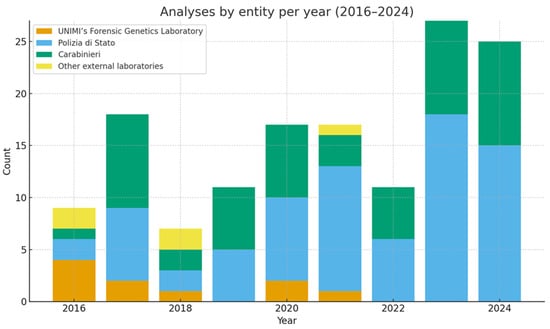
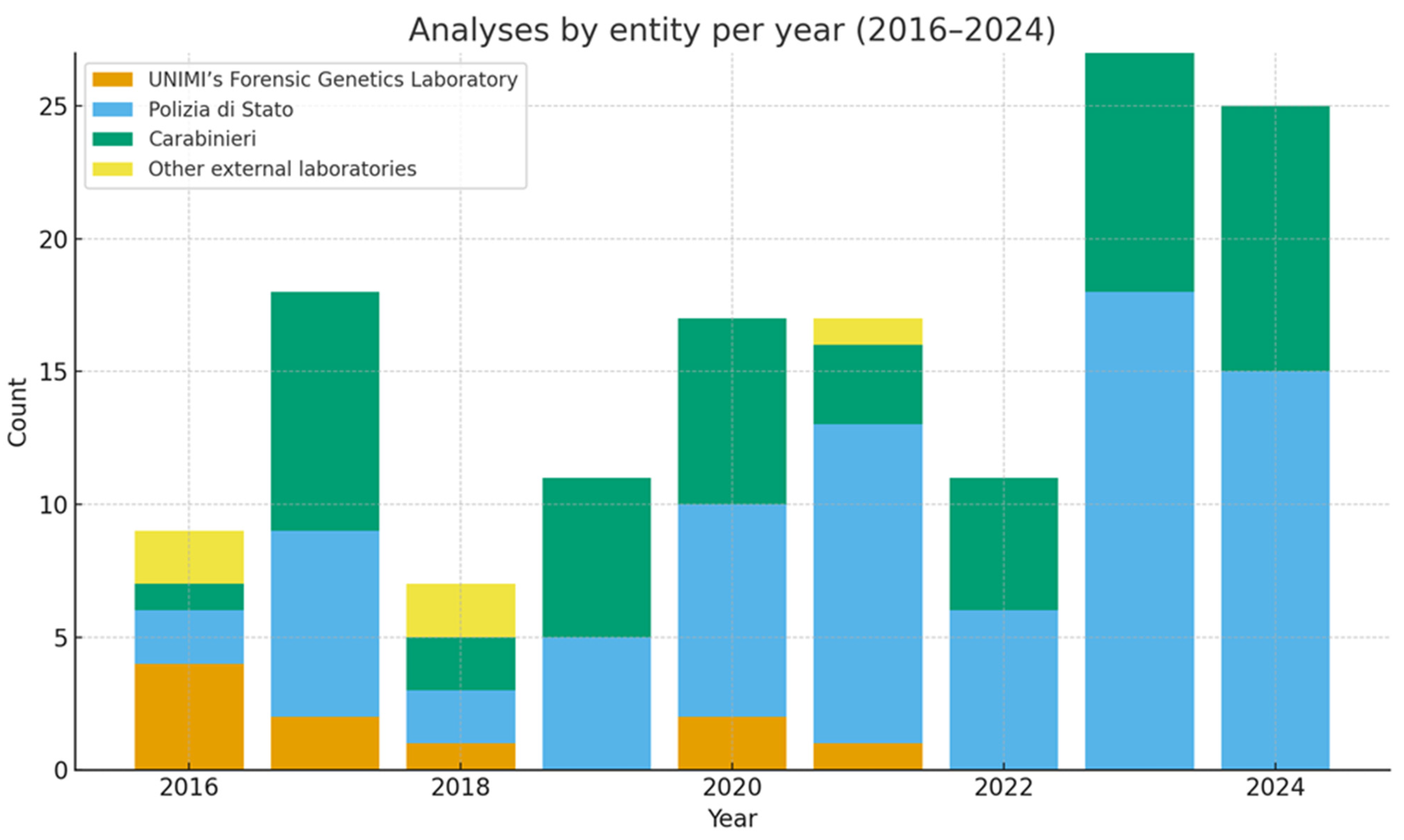
Recorded forensic DNA analyses were distributed across multiple analyzing entities (Figure 1). Of the 142 cases with recorded forensic DNA analysis, 75 (52.8%) were documented as being analyzed by Polizia Scientifica, 52 (36.6%) by Carabinieri (RIS/RaCIS), 10 (7.0%) by UNIMI, and five (3.5%) by external laboratories. These categories describe the analyzing entities documented in the UNIMI custody/archive records for the pathway captured by this observatory and should not be interpreted as official territorial totals of sexual-assault DNA analyses.
Figure 1.
Annual distribution of recorded forensic DNA analyses by analyzing entities in the UNIMI archive-based observatory, 2016–2024. The figure reports the annual distribution of cases with recorded forensic DNA analysis according to the forensic entity documented in UNIMI archival/custody records as having performed the analysis (Polizia Scientifica, Carabinieri RIS/RaCIS, UNIMI, or external laboratories).
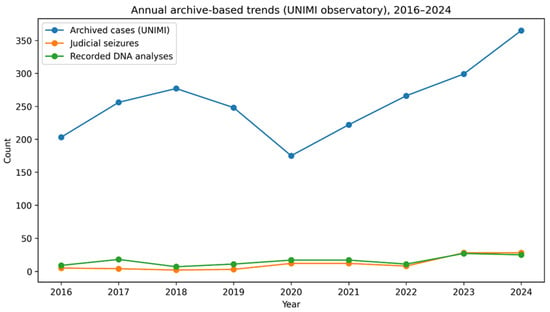
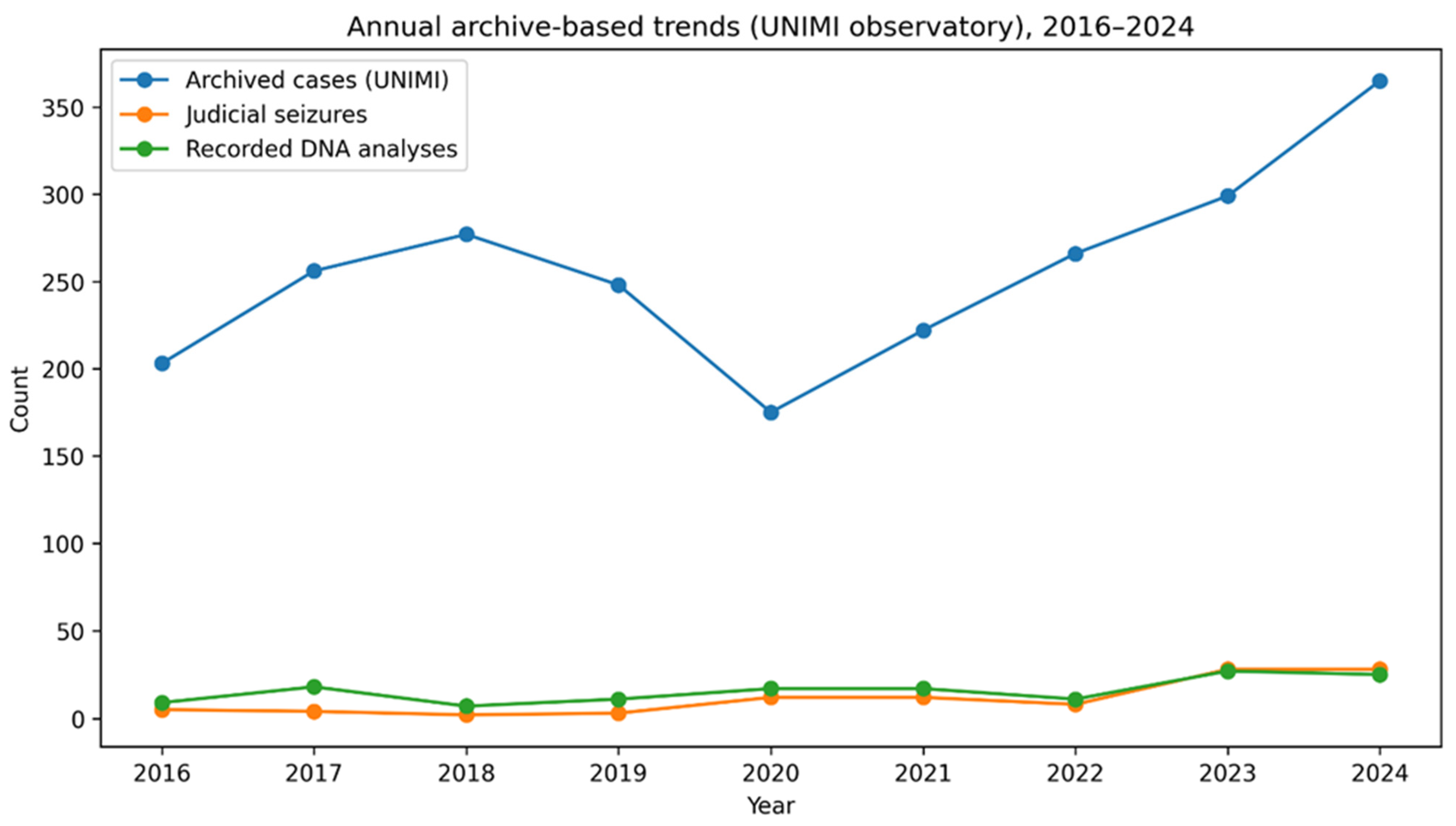
At the annual level, archived case counts increased overall from 203 in 2016 to 365 in 2024, with a marked decrease in 2020 (175 cases), followed by progressive recovery. Judicial seizures remained low in 2016–2019 (range of 2–5 per year), increased in 2020–2022 (8–12 per year), and reached their highest values in 2023 and 2024 (28 per year in both years). Cases with recorded forensic DNA analysis also fluctuated over time, with values of 9 in 2016, 18 in 2017, 7 in 2018, and 11 in 2019; they increased to 17 in both 2020 and 2021, remained at 11 in 2022, peaked at 27 in 2023, and stayed elevated at 25 in 2024. Overall, the annual series showed variability rather than a linear trend, with a clear discontinuity in 2020 and subsequent rebound (Figure 2).
Figure 2.
Annual archive-based trends in sexual-violence-related cases, judicial seizures, and cases with recorded forensic DNA analysis in the UNIMI observatory, 2016–2024. Annual counts are reported for archived sexual-violence-related cases, cases with documented judicial seizure of biological evidence, and cases with recorded forensic DNA analysis.
Monthly distributions aggregated across the study period showed that archived case counts were not evenly distributed across the calendar year, with higher cumulative volumes in summer months, particularly July and August, and lower cumulative volumes in April, January, and December. By contrast, monthly counts of judicial seizures and recorded DNA analyses remained comparatively low throughout the year and did not show a stable seasonal pattern. Exploratory monthly comparisons with selected legislative or media-reported events are presented separately in the Supplementary Material, together with the yearly and monthly raw counts underlying the archive-based indicators.
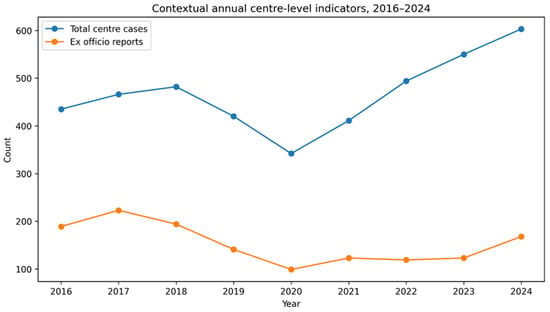
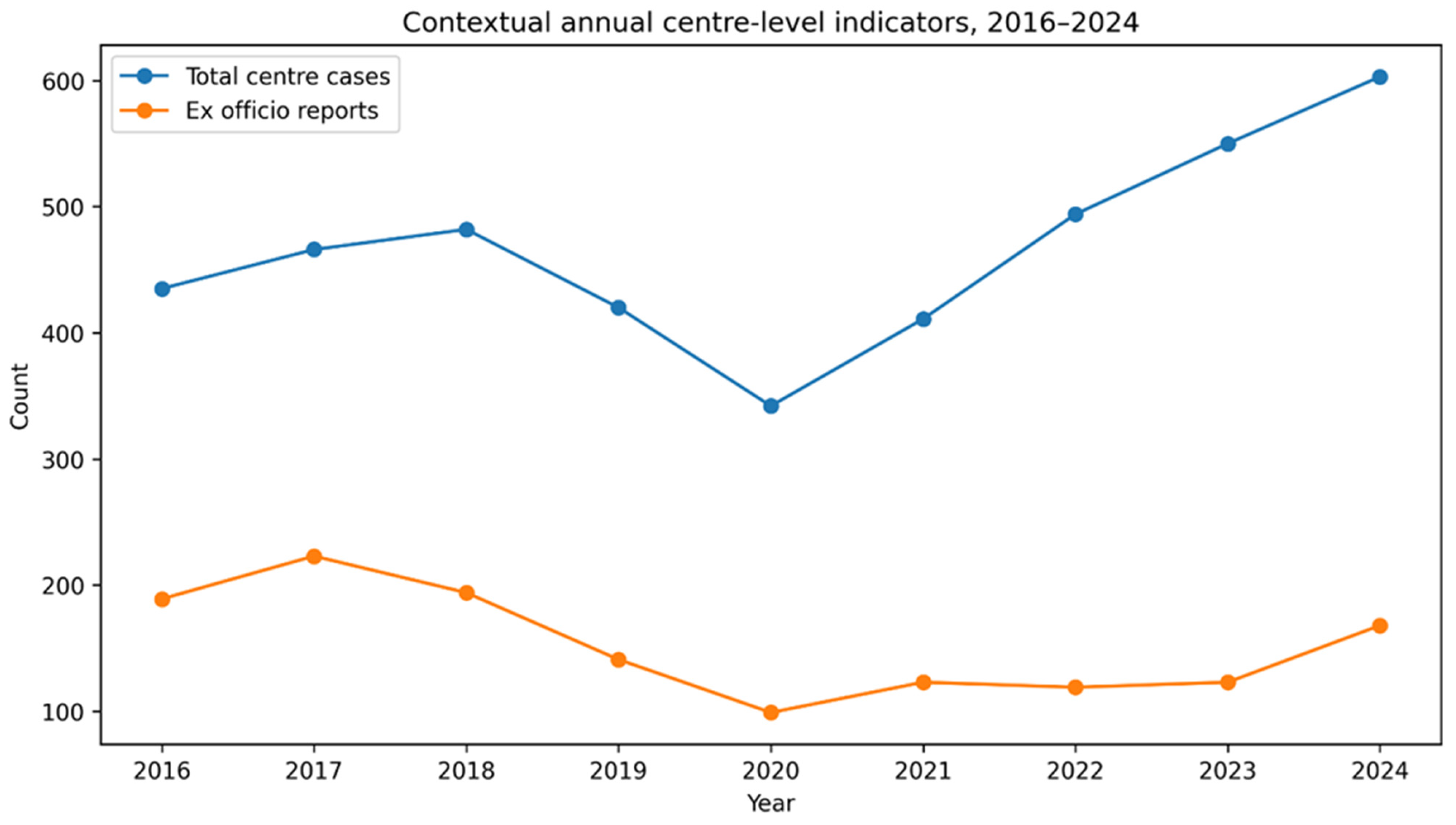
For contextual interpretation, we also examined annual aggregate centre-level indicators for 2016–2024. The referral centre recorded 4203 total sexual-violence cases overall and 1379 ex officio reports (denunce d’ufficio). The annual number of total cases increased from 435 in 2016 to 603 in 2024, with a decrease in 2020 (342), followed by sustained post-2020 growth. Ex officio reports showed greater fluctuation, ranging from 99 in 2020 to 223 in 2017, with lower values in 2022–2023 (119 and 123, respectively) and partial recovery in 2024 (168) (Figure 3). These contextual indicators were reviewed as only non-linkable background data and not as denominators of forensic DNA utilization.
Figure 3.
Contextual annual centre-level indicators: total sexual-violence cases and ex officio reports, 2016–2024. Annual aggregate centre-level indicators are shown for total sexual-violence cases and ex officio reports.
4. Discussion
The present study provides a retrospective, archive-based descriptive analysis of sexual-violence-related cases recorded in the UNIMI forensic custody observatory between 2016 and 2024. Four findings merit emphasis at the outset. First, archived case counts increased overall across the study period despite a marked 2020 disruption. Second, documented judicial seizures and recorded forensic DNA analyses remained in the minority of archived cases. Third, archived cases, judicial seizure, and recorded forensic DNA analysis are related but non-equivalent indicators. Fourth, the dataset does not permit identification of the exact procedural stage at which attrition occurs.
A central interpretive point concerns the distinction between evidence availability, judicial seizure, and recorded DNA analysis. Biological material may be collected but not judicially seized; seized material may not be submitted for forensic genetic testing; submitted material may be judged as unsuitable for analysis; and analytical activity, even when performed, may not coincide with the broader evidentiary questions that ultimately shape the case. This reading is consistent with prior forensic and medico-legal literature on sexual-violence evidence pathways and on the evidential role of biological traces [2,3,4,14,15].
The present findings are also broadly consistent with earlier evidence from the Milan setting, which documented a gap between biological evidence collection and downstream DNA testing despite substantial trace recovery in many cases. Although the denominators are not identical, and direct quantitative equivalence should therefore be avoided, the order of magnitude observed in the present archive-based series remains broadly aligned with the earlier Milan experience. The current data therefore suggest the persistence of a known gap rather than its clear resolution [2,3].
Within this framework, the finding that cases with recorded forensic DNA analysis exceeded cases with documented judicial seizure should not be treated as a contradiction. As clarified in the methodological section, seizure is not an absolute prerequisite for forensic DNA testing in judicial practice, because the public prosecutor may request the genetic analysis of evidentiary items that have already been lawfully acquired for investigative purposes. Conversely, evidentiary items may be seized for preservation and chain-of-custody purposes without subsequent DNA analysis. The observed pattern should therefore be read as reflecting the procedural non-equivalence of these indicators rather than a simple linear sequence.
The limited progression from archived case to documented seizure and from seizure to recorded DNA analysis should not be reduced to a single explanatory factor. Rather, the observed pattern may reflect a combination of pathway fragmentation, evidentiary strategy, legal-procedural filtering, timing of reporting, trace suitability, and laboratory referral dynamics [4,14,15]. This is precisely why aggregate archive-based counts are informative at the pathway level yet insufficient for mechanistic attribution.
This point is particularly relevant in the Italian context. The movement from collected biological material to downstream forensic analysis may be influenced by local organizational heterogeneity, differences in dedicated violence pathways, the presence or absence of stable custody arrangements, and the practical relationship between healthcare services, medico-legal expertise, law enforcement, and prosecutorial offices [6]. In this sense, the present Milan-based observatory should not be read as a national proxy but as a local pathway in which broader systemic constraints become empirically visible.
When collection and analysis are conducted under structured protocols, the literature supports the value of timely sampling, standardized collection procedures, rigorous chain of custody, and clear transfer to accredited laboratories [5,15,16]. This remains relevant even though the present dataset cannot reconstruct all intermediate stages. Updated professional guidance also reinforces the importance of protocol adherence, staff training, documentation quality, and inter-institutional coordination. From a systems perspective, the consistent implementation of recent recommendations, including the 2023 Ge.F.I. update on biological trace collection in the clinical-care pathway for sexual violence and maltreatment, should be regarded as an organizational priority rather than a merely technical refinement [17].
The temporal patterns observed here should be interpreted conservatively. The discontinuity in 2020 and subsequent recovery are descriptively evident in both the archive-based indicators and the contextual centre-level series, but the structure of the dataset does not support the attribution of these patterns to any specific institutional, organizational, social, or policy mechanism. For the same reason, the exploratory comparisons presented in the Supplementary Material should be read as contextual and hypothesis-generating rather than as evidence of causal relations.
The heterogeneous distribution of recorded DNA analyses across forensic entities is informative but only at the pathway level. In this study, those categories reflect the analyzing entity documented in UNIMI custody or administrative records for cases included in this observatory and do not represent the official annual territorial totals of sexual-assault DNA analyses performed by the agencies involved, nor do they exhaust all forensic providers potentially involved in Italian practice. Accordingly, these data are useful for describing recorded pathway activity within the UNIMI archive, but they cannot be used as direct denominators of forensic DNA utilization or as comparative performance indicators across institutions.
This inferential boundary is especially important in light of the legal and procedural architecture of sexual-violence casework in Italy. The present study cannot support causal claims attributing non-seizure or non-analysis to specific factors such as complaint status, prosecutorial prioritization, evidentiary assessment, resource constraints, training deficits, or broader cultural bias. Nonetheless, these dimensions remain relevant to interpretation, because the public prosecutor’s decision-making role may create a practical gap between forensic recommendation and downstream authorization, especially in systems characterized by heterogeneous resources and organizational pathways.
Further clarification concerns privacy, consent, and the distinction between pre-judicial care settings and criminal proceedings. In Italian practice, once judicial sampling or profiling is ordered within criminal proceedings, the legal basis and safeguards differ substantially from those governing pre-judicial clinical-forensic collection in anti-violence centres or emergency settings, where informed consent and privacy protection remain central [12,13,18,19,20]. In the pre-judicial phase, clinicians and counsellors cannot lawfully proceed with sample collection, storage, or transfer without valid informed consent, and this may have downstream implications for evidentiary availability and later challengeability [21,22,23]. Additional legal distinctions arise once judicial authority intervenes, including compelled biological sampling and the treatment of lawfully acquired or abandoned biological material, which follow a different normative framework from consent-based care practices [24,25].
Moreover, where sexual contact is undisputed and consent is the contested issue, the evidential value of DNA is intrinsically limited with respect to voluntariness, because DNA may attribute biological material to a source but cannot by itself resolve offence-level questions such as consent or coercion [26,27,28,29,30,31]. More broadly, Milan-based evidence on legal outcomes in sexual and intra-familial violence proceedings suggests that the probative value of medical and forensic material is shaped by its interaction with testimonial and procedural elements rather than by biological evidence alone [32].
Broader adjudicative dynamics discussed in the legal literature, including gender-biased reasoning in sexual-violence adjudication and its effects on victim credibility assessment and secondary victimization, remain relevant to interpretation of the wider field [7,8]. However, the present archive-based dataset does not capture adjudicative reasoning and therefore cannot be used to infer their role in the temporal patterns described here.
Despite these limits, the findings retain practical relevance. The observed pattern supports the need for stronger case-level data integration across the clinical, forensic, and judicial pathway, including the standardized recording of evidence-collection eligibility and actual collection, judicial seizure decisions, laboratory submission, analytical suitability, analytical outcome, and downstream procedural use. Without at least this minimum data architecture, aggregate counts may describe temporal trends but cannot distinguish attrition attributable to legal thresholding, evidentiary strategy, trace suitability, or actual laboratory utilization. Although the Italian National DNA Database has operated since 2016, the present dataset does not permit the direct evaluation of its operational impact on sexual-violence investigations [1]. International and comparative literature remains useful for framing future research questions, but its heterogeneity limits direct benchmarking against the present local dataset [33,34,35,36,37,38,39,40].
Several limitations should be stated explicitly. First, this is a single-centre, archive-based observational study linked to one referral pathway and therefore cannot provide national estimates. Second, the dataset consists of retrospective operational records and aggregate annual or monthly indicators, with limited standardized case-level process tracing. Third, the contextual centre-level indicators are non-linkable and were included for interpretation only, not as denominators. Fourth, the design does not support causal inference regarding institutional behaviour, investigative choices, or policy effects. The findings should therefore be interpreted as descriptive.
5. Conclusions
This study provides a retrospective, archive-based description of DNA-related case-flow indicators in sexual-violence investigations within the UNIMI forensic custody observatory over the 2016–2024 period. The findings document a persistent gap between archived cases, cases with documented judicial seizure of biological evidence, and cases with recorded forensic DNA analysis.
The main contribution of the study is methodological and interpretive. Within this dataset, biological evidence availability, judicial seizure, and recorded forensic DNA analysis should be treated as distinct pathway stages rather than as a simplified linear sequence, and aggregate annual counts cannot determine where or why progression between these stages is reduced.
Future evaluation of forensic DNA utilization in sexual-violence casework will require stronger data architecture, including standardized case-level tracking across clinical, custody, judicial, and laboratory stages, structured interoperability with prosecutorial and police case-management systems, and integration with official forensic-agency statistics.
Supplementary Materials
The following supporting information can be downloaded at https://www.mdpi.com/article/10.3390/forensicsci6020037/s1: Text S1: Exploratory contextual analysis and chronology documentation, including a supplementary exploratory comparison between selected legislative milestones and nationally relevant media-reported cases and the monthly DNA-analysis series, retained for transparency and hypothesis generation only; Figure S1: Exploratory monthly distribution of cases with recorded forensic DNA analysis, with selected event months highlighted; Table S1: Selected legislative milestones and media-reported cases included in the exploratory contextual timeline; Table S2: Yearly raw counts in the UNIMI archive-based observatory, 2016–2024; Table S3: Monthly raw counts in the UNIMI archive-based observatory, 2016–2024; Data S1: De-identified and anonymized tidy-format dataset containing yearly and monthly raw counts, including entity-specific recorded forensic DNA analysis counts, for the UNIMI SVSeD forensic custody observatory, 2016–2024 [41,42,43,44,45,46,47,48,49,50,51,52,53,54,55,56,57,58,59,60,61,62,63,64,65,66,67,68,69,70,71,72,73,74,75,76,77,78,79,80,81,82,83,84,85].
Author Contributions
Conceptualization, P.B., L.F., and A.P.; methodology, P.B., L.F., and A.P.; formal analysis, P.B. and M.G.; investigation, P.B., M.G., G.G., G.B., E.S., and L.F.; resources, G.G., G.B., E.S., and A.P.; data curation, M.G. and P.B.; writing—original draft preparation, P.B.; writing—review and editing, M.G., G.G., G.B., E.S., L.F., and A.P.; validation, A.P.; supervision, A.P. and L.F.; project administration, A.P. All authors have read and agreed to the published version of the manuscript.
Funding
This research received no external funding.
Institutional Review Board Statement
The present study used exclusively retrospective archival data in fully anonymized form, with no data attributable to identified or identifiable natural persons and no direct participant involvement. The relevant legal reference is Regulation (EU) 2016/679 (GDPR), Recital 26, which states that the Regulation does not apply to anonymous information, including when used for research purposes.
Informed Consent Statement
Law 22 December 2017 No. 219 was cited with reference to the underlying clinical-forensic setting, in which collection and handling of biological material are originally framed within the applicable consent requirements. It was not intended as the direct legal basis for the waiver relating to the retrospective research analysis presented in the manuscript.
Data Availability Statement
The de-identified and anonymized data supporting the findings of this study are included in the Supplementary Materials. Further inquiries can be directed to the corresponding author.
Acknowledgments
The authors wish to express their sincere gratitude to Lieutenant Colonel Alberto Marino, Reparto Carabinieri Investigazioni Scientifiche di Parma; Chiara Faraone, specialist in Legal Medicine; and Roberto Giuffrida, First Chief Technical Officer of the Italian State Police, for their valuable professional insight and for the constructive exchange that enriched the present work.
Conflicts of Interest
The authors declare no conflicts of interest.
Abbreviations
The following abbreviations are used in this manuscript:
| Ge.F.I. | Italian Forensic Geneticists Group (Gruppo Italiano Genetisti Forensi) |
| RaCIS | Carabinieri Scientific Investigations Grouping (Raggruppamento Carabinieri Investigazioni Scientifiche) |
| RIS | Scientific Investigations Department (Raggruppamento Investigazioni Scientifiche) |
| SVSeD | Sexual and Domestic Violence Service |
| UNIMI | University of Milan |
References
- Luparia, L.; Gennari, G.; Salvaderi, L. DNA forensic data bank, facts and perception: The Italian experience. Forensic Sci. Int. 2024, 354, 111907. [Google Scholar] [CrossRef] [Scilit]
- Piccinini, A.; Bailo, P.; Vignali, G.; Barbara, G.; Gennari, G.; Di Candia, D.; Albertini, V.; Kustermann, A. How many DNA analyses are performed on adult sexual assault victims in Milan (Italy): A ten-year review. Forensic Sci. Int. Genet. Suppl. Ser. 2019, 7, 164–166. [Google Scholar] [CrossRef] [Scilit]
- Piccinini, A.; Vignali, G.; Bailo, P.; Barbara, G.; Gennari, G.; Di Candia, D.; Albertini, V.; Kustermann, A. Management of DNA evidence collected on adolescents in sexual assault investigations: A 10-year review from a large Italian rape centre. Med. Sci. Law 2019, 59, 232–239. [Google Scholar] [CrossRef] [Scilit] [PubMed]
- Gino, S.; Bo, M.; Ricciardelli, R.; Alù, M.; Boschi, I.; Carnevali, E.; Fabbri, M.; Fattorini, P.; Piccinini, A.; Previderè, C.; et al. Evaluation of critical aspects in clinical and forensic management of sexual violence: A multicentre Ge.F.I. project. Forensic Sci. Int. 2020, 314, 110387. [Google Scholar] [CrossRef] [Scilit] [PubMed]
- Tozzo, P.; Nespeca, P.; Ponzano, E.; Spigarolo, G.; Caenazzo, L. Forensic genetics in sexual assault: A retrospective study on the collection of evidence at the emergency department. Forensic Sci. Int. Genet. Suppl. Ser. 2019, 7, 85–86. [Google Scholar] [CrossRef] [Scilit]
- De Paola, L.; Tripi, D.; Napoletano, G.; Marinelli, E.; Montanari Vergallo, G.; Zaami, S. Violence against Women within Italian and European Context: Italian “Pink Code”—Major Injuries and Forensic Expertise of a Socio-Cultural Problem. Forensic Sci. 2024, 4, 264–276. [Google Scholar] [CrossRef] [Scilit]
- Amato, R.; Carnevali, D. The calm after the storm? The tricky path to restoring the enjoyment of individual rights in intimate partner violence cases. Oñati Soc.-Leg. Ser. 2022, 12, 443–477. [Google Scholar]
- Crea, C. Gender-based stereotypes and the judiciary. Italy before the ECHR. Actual. Juríd. Iberoam. 2023, 19 bis, 50–71. [Google Scholar]
- National Commission for the Forensic Use of DNA. Guide to the Forensic Use of DNA. Available online: https://www.mjusticia.gob.es/es/ElMinisterio/OrganismosMinisterio/Documents/1292430976707-Guide-to-the-Use-of-Forensic-DNA.pdf (accessed on 2 March 2026).
- Fischer, L. Akutversorgung nach sexualisierter Gewalt. Zur Umsetzung von Artikel 25 der Istanbul-Konvention in Deutschland. Available online: https://www.institut-fuer-menschenrechte.de/fileadmin/Redaktion/Publikationen/Analyse_Studie/Analyse_Akutversorgung_nach_sexualisierter_Gewalt.pdf (accessed on 2 March 2026).
- Campbell, R.; Feeney, H.; Fehler-Cabral, G.; Shaw, J.; Horsford, S. The national problem of untested sexual assault kits (SAKs): Scope, causes, and future directions for research, policy, and practice. Trauma Violence Abus. 2017, 18, 363–376. [Google Scholar] [CrossRef] [Scilit]
- Italian Republic. Law 22 December 2017, No. 219. Norme in Materia di Consenso Informato e di Disposizioni Anticipate di Trattamento. Available online: https://www.normattiva.it/eli/id/2018/01/16/18G00006 (accessed on 2 March 2026).
- European Parliament; Council of the European Union. Regulation (EU) 2016/679 of the European Parliament and of the Council of 27 April 2016. Off. J. Eur. Union 2016, L119, 1–88. Available online: https://eur-lex.europa.eu/eli/reg/2016/679/oj (accessed on 2 March 2026).
- Gabbin, A.; Politi, C.; Gino, S.; Caenazzo, L. La gestione ospedaliera delle donne vittime di violenza sessuale alla luce del nuovo D.P.C.M. 24 novembre 2017. Gazz. Med. Ital. Arch. Sci. Med. 2021, 180, 301–311. [Google Scholar] [CrossRef] [Scilit]
- Cattaneo, C.; Tambuzzi, S.; De Vecchi, S.; Maggioni, L.; Costantino, G. Consequences of the lack of clinical forensic medicine in emergency departments. Int. J. Leg. Med. 2024, 138, 139–150. [Google Scholar] [CrossRef] [Scilit] [PubMed]
- Langness, M.; Zweig, J.M.; Tiry, E.; Henderson, E.; Stahlmann, N.; Bastomski, S. Examining the implementation of the National Protocol for Sexual Assault Medical Forensic Examinations. J. Forensic Nurs. 2022, 18, 67–77. [Google Scholar] [CrossRef] [Scilit] [PubMed]
- Ge, F.I. Raccomandazioni in Tema di Repertamento di Tracce Biologiche per le Analisi di Genetica Forense nel Percorso Clinico-Assistenziale in caso di Violenza Sessuale e/o Maltrattamento. Aggiornamento 2023. Available online: https://www.gefi-isfg.org/temp/2301202483249.pdf (accessed on 2 March 2026).
- Tozzo, P.; Caenazzo, L. Minors inclusion in the Italian forensic DNA database: Which safeguard between justice and individual rights? J. Civ. Leg. Sci. 2013, 2, 107. [Google Scholar] [CrossRef]
- Gennari, G.; Matsuda, T. Scientific evidence and criminal proceedings: The Italian and Japanese experience. Ital. Law J. 2018, 115–127. [Google Scholar] [CrossRef]
- Sguazzi, G.; Fasani, G.; Renò, F.; Gino, S. Biobanks: Archives or resources? Their secondary use for forensic purposes—A systematic review. Forensic Sci. 2024, 4, 42–61. [Google Scholar] [CrossRef] [Scilit]
- Sanvitale, F. Quello che il legislatore non dice in tema di prova genetica. Dalla banca dati nazionale del DNA al familial searching. Legisl. Pen. 2024, 2, 240–267. [Google Scholar]
- Biondo, R. La banca dati nazionale DNA italiana. Riv. Ital. Med. Leg. Dirit. Campo Sanit. 2016, 1, 213–232. [Google Scholar]
- Gino, S.; Canavese, A.; Pattarino, B.; Robino, C.; Omedei, M.; Albanese, E.; Castagna, P. 58 cases of sexual violence bearing forensic interest: Congruence between the victim’s report and the data from laboratory analyses. Int. J. Leg. Med. 2017, 131, 1449–1453. [Google Scholar] [CrossRef] [Scilit]
- Benozzi, C.M.; Piccinini, A.; Bailo, P.; Gentilomo, A. Prelievi biologici coattivi e res derelictae: Una difficile convivenza. Riv. Ital. Med. Leg. Dirit. Campo Sanit. 2020, 42, 1817–1829. [Google Scholar]
- Ministero della Giustizia. Modifiche al c.p.p. in Materia di Accertamenti Medici Idonei ad Incidere Sulla Libertà Personale. Available online: https://www.giustizia.it/giustizia/it/mg_1_2_1.page?contentId=SAN47366 (accessed on 2 March 2026).
- Menaker, T.A.; Campbell, B.A.; Wells, W. The use of forensic evidence in sexual assault investigations: Perceptions of sex crimes investigators. Violence Against Women 2017, 23, 399–425. [Google Scholar] [CrossRef] [Scilit] [PubMed]
- Alderden, M.; Cross, T.P.; Vlajnic, M.; Siller, L. Prosecutors’ perspectives on biological evidence and injury evidence in sexual assault cases. J. Interpers. Violence 2021, 36, 3880–3902. [Google Scholar] [CrossRef] [Scilit] [PubMed]
- Biedermann, A.; Champod, C.; Jackson, G.; Gill, P.; Taylor, D.; Butler, J.M.; Morling, N.; Hicks, T.; Vuille, J.; Taroni, F. Evaluation of forensic DNA traces when propositions of interest relate to activities: Analysis and discussion of recurrent concerns. Front. Genet. 2016, 7, 215. [Google Scholar] [CrossRef] [Scilit] [PubMed]
- Gill, P.; Hicks, T.; Butler, J.M.; Connolly, E.; Gusmão, L.; Kokshoorn, B.; Morling, N.; van Oorschot, R.A.H.; Parson, W.; Prinz, M.; et al. DNA commission of the International Society for Forensic Genetics: Assessing the value of forensic biological evidence—Guidelines highlighting the importance of propositions. Part II: Evaluation of biological traces considering activity level propositions. Forensic Sci. Int. Genet. 2020, 44, 102186. [Google Scholar] [CrossRef] [Scilit]
- Johnson, D.; Peterson, J.; Sommers, I.; Baskin, D. Use of forensic science in investigating crimes of sexual violence: Contrasting its theoretical potential with empirical realities. Violence Against Women 2012, 18, 193–222. [Google Scholar] [CrossRef] [Scilit]
- Cross, T.P.; Siller, L.; Vlajnic, M.; Alderden, M. The relationship of DNA evidence to prosecution outcomes in sexual assault cases. Violence Against Women 2022, 28, 3910–3932. [Google Scholar] [CrossRef] [Scilit]
- Blandino, A.; Maggioni, L.; Chiaffarino, F.; Parazzini, F.; Capano, D.; Florio, E.M.; Margherita, M.; Bertelle, G.M.; Franceschetti, L.; Amadasi, A.; et al. Sexual assault and abuse com-mitted against family members: An analysis of 1342 legal outcomes and their motivations. PLoS ONE 2021, 16, e0253980. [Google Scholar] [CrossRef] [Scilit]
- Carmo Rodrigues Brandão, E.C.; Fortunato Ferreira, V. A utilização do exame de DNA para fins de identificação criminal nos crimes contra a dignidade sexual. Rev. Eletrôn. Direito Process. 2024, 25, 273–304. [Google Scholar] [CrossRef] [Scilit]
- Roewer, L.; Willuweit, S. Y-chromosomale STR-Analyse in der forensischen Praxis. Rechtsmedizin 2018, 28, 149–164. [Google Scholar] [CrossRef] [Scilit]
- Laurent, F.-X.; Vibrac, G.; Rubio, A.; Thévenot, M.-T.; Pène, L. Les nouvelles technologies d’analyses ADN au service des enquêtes judiciaires. Med. Sci. 2017, 33, 971–978. [Google Scholar] [CrossRef] [Scilit]
- Buckleton, J.S.; Bright, J.-A.; Taylor, D. (Eds.) Forensic DNA Evidence Interpretation, 2nd ed.; CRC Press: Boca Raton, FL, USA, 2016. [Google Scholar]
- Lovell, R.E.; Singer, M.; Flannery, D.J.; McGuire, M.J. The case for “investigate all”: Assessing the cost-effectiveness of investigating no CODIS hit cases in a sexual assault kit initiative. J. Forensic Sci. 2021, 66, 1316–1328. [Google Scholar] [CrossRef] [Scilit]
- Campbell, R.; Fehler-Cabral, G.; Pierce, S.J.; Sharma, D.B.; Shaw, J.; Horsford, S.; Feeney, H. Changing the criminal justice system response to sexual assault: An empirical study of a participatory action research project. Am. J. Community Psychol. 2021, 67, 166–178. [Google Scholar] [CrossRef] [Scilit]
- Campbell, R.; Fehler-Cabral, G. The best way out is always through: Addressing the problem of untested sexual assault kits (SAKs) through multidisciplinary collaboration. Vict. Offenders 2020, 15, 159–173. [Google Scholar] [CrossRef] [Scilit]
- Rodriguez, J.J.R.B.; Laude, R.P.; De Ungria, M.C.A. An integrated system for forensic DNA testing of sexual assault cases in the Philippines. Forensic Sci. Int. Synerg. 2021, 3, 100133. [Google Scholar] [CrossRef] [Scilit]
- ANSA. Ragazza carbonizzata, indagine omicidio. Available online: https://www.ansa.it/lazio/notizie/2016/05/29/ragazza-carbonizzata-indagine-omicidio_fe70e020-7c26-4e49-a9c2-efe846c9ec1c.html (accessed on 2 March 2026).
- Rai News. Roma, uccise e bruciò l’ex fidanzata Sara Di Pietrantonio: Ergastolo per Vincenzo Paduano. Available online: https://www.rainews.it/archivio-rainews/articoli/Roma-uccise-e-bruciio-ex-fidanzata-Sara-Di-Pietrantonio-ergastolo-per-Vincenzo-Paduano-d32b7ec2-0f3e-4e95-a05d-41ac222bfc84.html (accessed on 2 March 2026).
- Sky TG24. Sentenza Sara, il padre: “Saremo un po’ più sereni, ma felici mai più”. Available online: https://tg24.sky.it/cronaca/2017/05/06/sentenza-omicidio-sara-di-pietrantonio-intervista-padre- (accessed on 2 March 2026).
- ANSA. Tiziana Cantone: Il Gip ordina nuove indagini alla Procura. Available online: https://www.ansa.it/campania/notizie/2023/02/15/tiziana-cantone-il-gip-ordina-nuove-indagini-alla-procura_0e867184-ceac-44cb-82be-c0b0c11efd27.html (accessed on 2 March 2026).
- Rai News. Chiuso il caso della morte di Tiziana Cantone: Archiviato il fascicolo d’indagine per omicidio. Available online: https://www.rainews.it/articoli/2024/01/la-morte-di-tiziana-cantone-archiviato-il-fascicolo-dindagine-per-omicidio-d74b0fd5-9ac0-4224-a4d0-b66147e70576.html (accessed on 2 March 2026).
- Sky TG24. Tiziana Cantone, riaperto il caso: Indagini. Available online: https://tg24.sky.it/napoli/2023/02/16/tiziana-cantone-indagini (accessed on 2 March 2026).
- ANSA. Sfregiata con acido, Gessica in aula. Available online: https://www.ansa.it/emiliaromagna/notizie/2017/06/28/sfregiata-con-acido-gessica-in-aula_1e3c3049-ecd8-4d80-9063-616cbfd1a36f.html (accessed on 2 March 2026).
- Rai News. 25 novembre. Gessica Notaro posta le immagini dell’aggressione. Available online: https://www.rainews.it/archivio-rainews/media/25-novembre-Gessica-Notaro-posta-le-immagini-dell-aggressione-Io-miracolata-a471540d-993b-4163-a2ae-d7538bc3a72f.html (accessed on 2 March 2026).
- Sky TG24. Aggressione con l’acido a Gessica Notaro: Tavares condannato a 10 anni. Available online: https://tg24.sky.it/cronaca/2017/10/20/sfregiata-acido-tavares-condannato-10-anni (accessed on 2 March 2026).
- ANSA. Donna stuprata, fidanzato picchiato in spiaggia a Rimini. Available online: https://www.ansa.it/emiliaromagna/notizie/2017/08/26/donna-stuprata-fidanzato-picchiato-in-spiaggia-a-rimini_04a07dda-5811-422c-b807-daef0dfa0d6b.html (accessed on 2 March 2026).
- Corriere della Sera. Rimini, stuprata in spiaggia dal branco davanti al ragazzo. Available online: https://www.corriere.it/cronache/17_agosto_26/rimini-stuprata-spiaggia-branco-al-fidanzato-e5320536-8a57-11e7-9cdf-af55e7113da5.shtml (accessed on 2 March 2026).
- La Repubblica. Rimini, in quattro stuprano turista in spiaggia e una trans. Available online: https://bologna.repubblica.it/cronaca/2017/08/26/news/rimini-173916473/ (accessed on 2 March 2026).
- ANSA. Sedicenne uccisa: Fidanzato confessa. Available online: https://www.ansa.it/sito/notizie/cronaca/2017/09/13/sedicenne-uccisa-fidanzato-confessa_91215eee-83f3-4c70-bcb8-f2daf44b28a3.html (accessed on 2 March 2026).
- Rai News. Sedicenne scomparsa, fidanzato confessa l’omicidio. Trovato il corpo. Available online: https://www.rainews.it/archivio-rainews/articoli/Sedicenne-scomparsa-fidanzato-confessa-l-omicidio-Trovato-il-corpo-f86ca291-bd95-410b-b109-04a8c8350078.html (accessed on 2 March 2026).
- Sky TG24. Omicidio di Noemi Durini, dalla scomparsa alla condanna. Available online: https://tg24.sky.it/cronaca/approfondimenti/omicidio-noemi-durini-tappe (accessed on 2 March 2026).
- Gazzetta Ufficiale. Decreto del Presidente del Consiglio dei Ministri 24 November 2017. Linee guida nazionali per le Aziende sanitarie e le Aziende ospedaliere in tema di soccorso e assistenza socio-sanitaria alle donne vittime di violenza. Available online: https://www.gazzettaufficiale.it/eli/id/2018/01/30/18A00520/SG (accessed on 2 March 2026).
- ANSA. Procura, ergastolo per omicidio Pamela. Available online: https://www.ansa.it/sito/notizie/cronaca/2019/05/08/procura-ergastolo-per-omicidio-pamela_e392f687-ebd5-4852-b81a-74a09e67a09e.html (accessed on 2 March 2026).
- Rai News. Omicidio di Pamela Mastropietro: Cassazione. Available online: https://www.rainews.it/articoli/2022/02/omicidio-di-pamela-mastropietro-il-sostituto-procuratore-generale-confermare-ergastolo-a-oseghale-73d5ec90-261a-4ec5-b14e-221ab83291e5.html (accessed on 2 March 2026).
- Sky TG24. Dall’omicidio all’ergastolo a Oseghale: La storia di Pamela Mastropietro. Available online: https://tg24.sky.it/cronaca/approfondimenti/pamela-mastropietro-storia (accessed on 2 March 2026).
- ANSA. L’ultima telefonata di Desiree alla nonna. Available online: https://www.ansa.it/sito/notizie/cronaca/2018/10/23/lultima-telefonata-di-desiree-alla-nonna-ho-perso-lautobus-resto-a-roma-da-unamica_14ec7311-e1ac-4da6-a071-649e0c331c05.html (accessed on 2 March 2026).
- Rai News. Omicidio Desirée, i giudici della Corte d’Appello. Available online: https://www.rainews.it/tgr/lazio/articoli/2022/11/omicidio-desire-mariottini-attesa-nel-pomeriggio-la-sentenza-di-appello-a2aa3afc-96c9-4497-a8ed-da35a42c3fc6.html (accessed on 2 March 2026).
- Sky TG24. Omicidio Desirée Roma, la ricostruzione. Available online: https://tg24.sky.it/cronaca/2018/10/24/omicidio-desiree-mariottini-san-lorenzo-roma (accessed on 2 March 2026).
- Gazzetta Ufficiale. Legge 19 July 2019, n. 69. Modifiche al codice penale, al codice di procedura penale e altre disposizioni in materia di tutela delle vittime di violenza domestica e di genere. Available online: https://www.gazzettaufficiale.it/eli/id/2019/07/25/19G00076/sg (accessed on 2 March 2026).
- Camera dei Deputati. Disposizioni in tema di violenza domestica e di genere. Available online: https://www.camera.it/temiap/documentazione/temi/pdf/1154235.pdf?_1573172555581= (accessed on 2 March 2026).
- ANSA. Saman: RIS a Novellara, trovati dei resti umani. Available online: https://www.ansa.it/emiliaromagna/notizie/2022/11/19/saman-ris-a-novellara-trovati-dei-resti-umani_cd652060-11b7-4a03-b272-e371d079b51a.html (accessed on 2 March 2026).
- Rai News. Il caso Saman: Arrestata in Pakistan la madre. Available online: https://www.rainews.it/articoli/2024/05/il-caso-saman-arrestata-in-pakistan-la-madre-la-scomparsa-gli-arresti-il-processo-le-tappe-della-vicenda-2d64825d-95f3-4e3d-885b-003d0b4d5bf4.html (accessed on 2 March 2026).
- Sky TG24. Saman Abbas, dalla scomparsa alle condanne ai familiari. Available online: https://tg24.sky.it/cronaca/approfondimenti/saman-abbas-storia (accessed on 2 March 2026).
- ANSA. Woman, 26, gunned down in street by ex near Catania. Available online: https://www.ansa.it/english/news/general_news/2021/08/23/woman-26-gunned-down-in-street-by-ex-near-catania_30c5d1ed-119d-4754-9e69-6e83ca51ae63.html (accessed on 2 March 2026).
- Rai News. Uccisa a colpi di pistola in strada, ricercato l’ex fidanzato. Available online: https://www.rainews.it/archivio-rainews/articoli/Uccisa-a-colpi-di-pistola-in-strada-ricercato-ex-fidanzato-034c9aef-4712-49e8-800d-27f3b3e3cd9f.html (accessed on 2 March 2026).
- Corriere della Sera. Omicidio ad Aci Trezza, Vanessa Zappalà uccisa a colpi di pistola. Available online: https://www.corriere.it/cronache/21_agosto_23/26enne-uccisa-strada-colpi-pistola-ricercato-l-ex-fidanzato-429b48a2-03cd-11ec-8839-6d407abf089f.shtml (accessed on 2 March 2026).
- ANSA. Il femminicidio di Alessandra Matteuzzi: Ergastolo per l’ex Giovanni Padovani. Available online: https://www.ansa.it/sito/notizie/cronaca/2024/02/12/il-femminicidio-di-alessandra-matteuzzi-ergastolo-per-lex-giovanni-padovani_7761efcb-705c-4448-990a-94cf3ab37b94.html (accessed on 2 March 2026).
- Rai News. Omicidio Matteuzzi: Ergastolo per Padovani. Available online: https://www.rainews.it/articoli/2024/02/omicidio-matteuzzi-ergastolo-per-padovani-la-sorella-in-lacrime-alessandra-non-ce-piu-eeaee666-62f4-48fb-9fbe-461a3dee1c0e.html (accessed on 2 March 2026).
- Sky TG24. Bologna, donna uccisa a colpi di mazza dall’ex compagno. Available online: https://tg24.sky.it/cronaca/2022/08/24/bologna-donna-uccisa-mazza (accessed on 2 March 2026).
- ANSA. Riprese stupro di gruppo, chiesta condanna per imputato. Available online: https://www.ansa.it/sicilia/notizie/2025/01/21/riprese-stupro-di-gruppo-chiesta-condanna-per-imputato_c7d9952f-3484-4b2c-ae02-71729d383406.html (accessed on 2 March 2026).
- Rai News. Stupro di Palermo, l’orrore di quella notte. Available online: https://www.rainews.it/articoli/2023/08/stupro-di-palermo-lorrore-della-notte-dello-stupro-1b0c145f-a77c-4f12-9058-16cc022e5211.html (accessed on 2 March 2026).
- Sky TG24. Stupro Palermo, al via la prima udienza del processo. Available online: https://tg24.sky.it/cronaca/2024/04/19/stupro-palermo-prima-udienza-processo (accessed on 2 March 2026).
- ANSA. Due ragazzine violentate al Parco Verde di Caivano. Available online: https://www.ansa.it/campania/notizie/2023/08/26/due-ragazzine-violentate-al-parco-verde-di-caivano-due-procure-al-lavoro_77d6bf55-6246-4c25-8edb-231c3683d802.html (accessed on 2 March 2026).
- Rai News. Stupro Caivano: Abusate per mesi da un gruppo. Available online: https://www.rainews.it/articoli/2023/08/stupro-caivano-in-15-nel-branco-tra-loro-2-figli-camorristi-f78c1729-3761-4376-933b-225d474adbd9.html (accessed on 2 March 2026).
- Sky TG24. Due 13enni sono state violentate dai sei ragazzi al Parco Verde di Caivano. Available online: https://tg24.sky.it/napoli/2023/08/25/violenza-sessuale-caivano (accessed on 2 March 2026).
- Gazzetta Ufficiale. Decreto-Legge 15 September 2023, n. 123. Misure urgenti di contrasto al disagio giovanile, alla povertà educativa e alla criminalità minorile, nonché per la sicurezza dei minori in ambito digitale. Available online: https://www.gazzettaufficiale.it/eli/id/2023/09/15/23G00135/SG (accessed on 2 March 2026).
- Gazzetta Ufficiale. Legge 13 November 2023, n. 159. Conversione in legge, con modificazioni, del decreto-legge 15 settembre 2023, n. 123, recante misure urgenti di contrasto al disagio giovanile, alla povertà educativa e alla criminalità minorile, nonché per la sicurezza dei minori in ambito digitale. Available online: https://www.gazzettaufficiale.it/eli/id/2023/11/14/23G00172/sg (accessed on 2 March 2026).
- ANSA. Giulia è stata uccisa, accoltellata a testa e collo. Available online: https://www.ansa.it/veneto/notizie/2023/11/18/trovato-un-corpo-di-una-donna-e-quello-di-giulia-cecchettin.-il-pm-filippo-costituisciti_345e306c-b634-4da9-83b2-70716a5482eb.html (accessed on 2 March 2026).
- Rai News. Trovato il corpo di Giulia Cecchettin. Available online: https://www.rainews.it/tgr/trento/articoli/2023/11/giulia-cecchettin-filippo-turetta-scomparsi-sabato-nordest-al-setaccio-degli-investigatori-ae01d646-5aae-46b0-8ae9-b7362c293cfc.html (accessed on 2 March 2026).
- Sky TG24. Ragazzi scomparsi, trovato corpo Giulia Cecchettin. Available online: https://tg24.sky.it/cronaca/2023/11/18/ragazzi-scomparsi-veneto-ultime-news (accessed on 2 March 2026).
- Gazzetta Ufficiale. Legge 24 November 2023, n. 168. Disposizioni per il contrasto della violenza sulle donne e della violenza domestica. Available online: https://www.gazzettaufficiale.it/eli/id/2023/11/24/23G00178/sg (accessed on 2 March 2026).
Disclaimer/Publisher’s Note: The statements, opinions and data contained in all publications are solely those of the individual author(s) and contributor(s) and not of MDPI and/or the editor(s). MDPI and/or the editor(s) disclaim responsibility for any injury to people or property resulting from any ideas, methods, instructions or products referred to in the content. |
© 2026 by the authors. Licensee MDPI, Basel, Switzerland. This article is an open access article distributed under the terms and conditions of the Creative Commons Attribution (CC BY) license.