


Abstract
This study presents an annotated list and an identification key for the Drosophilidae of Saudi Arabia, based on incidentally collected specimens and published records. It treats 16 species in 7 genera, three tribes (Colocasiomyini, Drosophilini, and Gitonini) and two subfamilies (Steganinae and Drosophilinae). Eight species are recorded for the first time from Saudi Arabia: Chymomyza cf. amoena (Loew, 1862), C. pararufithorax Vaidya and Godbole, 1973, Drosophila funebris (Fabricius, 1787), D. repleta Wollaston, 1858, Scaptomyza adusta (Loew, 1862), S. graminum (Fallén, 1823), Leucophenga bellula (Bergroth, 1894), and L. quinquemaculata Strobl, 1893. The genus Chymomyza Czerny, 1903 is also newly recorded from Saudi Arabia. For each species, taxonomic data, world and local distributions, and collection dates are given. Diagnoses for newly recorded taxa and photographs of some species are given as well. Species with documented human associations elsewhere are noted. A historical report of Drosophila simulans Sturtevant, 1919 from Saudi Arabia remains unconfirmed and is not counted. The list is a baseline and not a complete inventory.
1. Introduction
The Drosophilidae (lesser fruit flies, pomace flies, vinegar flies or wine flies) are a large and diverse acalyptrate family of small red-eyed flies (usually 1–6 mm in length), with more than 4000 species in 75 extant genera worldwide, classified in two subfamilies, Steganinae and Drosophilinae [1,2]. The majority of these flies are saprophagous, breeding in rotting fruits, fungi, slime fluxes, and other decomposing organic matter. They predominantly feed on bacteria and yeasts, the microorganisms associated with the early phases of fruit and plant material deterioration, and are regarded as important pests of numerous fruits [3,4]. These flies have been observed to oviposit in healthy fruit or, more frequently, in wounds, allowing secondary infection by insects and pathogens such as bacteria and yeasts, resulting in additional losses [5]. Many drosophilid species, including the majority of Leucophenga spp., colonize the fruiting bodies of basidiomycete fungi and use them for feeding, mating, and breeding [6]. Some drosophilids can also be seen in sap of trees or in flowers. Furthermore, some drosophilids have bizarre feeding habits as parasitoids or predators of Homoptera, while others are known as leaf miners (several species of the genus Scaptomyza). Because of the attraction of drosophilid flies to vegetables and fruits, they may also inadvertently cause gastrointestinal myiasis in humans [1,7]. Some drosophilids show some medical importance: Drosophila funebris has been known to cause intestinal myiasis in humans, and Drosophila repleta has been reported as a possible means of mechanical pathogen transmission when breeding in animal excrement [8,9]. Occasionally, some species of the genus Drosophila have been detected in the decaying matter from corpses [1].
Regional inventories that are supported by identified specimens and usable keys are the basis for judging the ecology, pest status, and biogeography of the family. Studies of drosophilid diversity range from targeted trapping studies to nationwide surveys of diverse insect populations. In European Russia, Gornostaev et al. [10] trapped flies with fermented bait at four heights in deciduous forest in the Mordovia State Nature Reserve and identified 34 species among 27,151 individuals, and Gornostaev [11] has since published annotated lists for eight further regions of the European part of Russia, based on 1909 specimens. In the Afrotropical Region, Prigent et al. [12] reported field collections on the island of São Tomé and concluded that it has the highest diversity of drosophilid flies among Afrotropical islands. The checklist of Kahanpää [13] covers the whole order Diptera of Finland, with 6920 species, and is cited as an example of a national checklist and not as a drosophilid survey.
Saudi Arabia occupies most of the Arabian Peninsula and lies across the boundary between the Palaearctic and Afrotropical regions [14], which makes its fauna relevant to biogeographic questions in addition to its practical interest for agriculture.
No comprehensive faunistic or systematic study dedicated to the Drosophilidae of Saudi Arabia has been published before the present study. Abdullah and Dawah [15] reported six drosophilid species from south-western Saudi Arabia as new records, and some species were also reported incidentally in broader checklists of Diptera [16,17,18,19,20,21]. The records in these sources are mostly given at a coarse geographic scale, several simply as the south-western part of the country, and they are not accompanied by an identification key for the Saudi Arabian fauna.
The status of one further species deserves comment. Vieira and Biémont [22] included a Saudi Arabian population of Drosophila simulans Sturtevant, 1919 [23], but the available report does not give an exact Saudi Arabian locality. This species was described from Florida, USA [23], is cosmopolitan, and is closely related to D. melanogaster Meigen, 1830, from which it can be difficult to separate without examining the male terminalia. The authors of the present paper have not collected D. simulans during their broader entomological collecting across Saudi Arabia over more than 30 years. Because no voucher specimens were available for examination, the Saudi Arabian occurrence of D. simulans remains unconfirmed for the purposes of this inventory. The species is therefore not counted among the 16 species treated here, is not included in the key, and is not presented as a verified record. It is mentioned because a historical report without a locality or voucher can easily be repeated as an established record, and targeted collecting followed by specimen-based identification would be needed to resolve it.
The present paper brings together drosophilid specimens from Saudi Arabian collections, obtained incidentally and mostly with Malaise traps and sweep nets, and the species previously reported from the country. Our objectives are (i) to provide an identification key to the 16 species treated; (ii) to document eight species and one genus recorded for the first time from Saudi Arabia, with the examined material; (iii) to compile the earlier records with their sources, distinguishing species supported by examined material from those known only from the literature; and (iv) to summarise the records by region and to indicate which species live in association with humans. The list is a baseline and not a complete inventory, because the material was not obtained through sampling designed for drosophilids.
2. Materials and Methods
The material for the newly recorded species in this study was collected incidentally while researching insect pests in the Kingdom of Saudi Arabia, and no specific methods for collecting drosophilid flies were used. The authors and/or their coworkers collected this material mostly using Malaise traps and sweeping nets.
In addition to the original descriptions, some keys were used for the identification of drosophilid taxa: [24,25,26,27,28]. Male genitalia were dissected for some species as needed or as available.
For each species, taxonomic data, world and local distributions, and dates of collection are given. Diagnoses for newly recorded taxa are given as well. Terminology used in diagnoses follows Cumming & Wood [29].
The identification key was constructed based on specimens collected during this study and those preserved in Saudi Arabian museums. For three species previously recorded from the country but not available for examination (Zaprionus vittiger Coquillett, Apenthecia brincki (Hackman), and Cacoxenus perspicax (Knab)), characters were derived from original descriptions and relevant taxonomic keys, specifically [26,30,31].
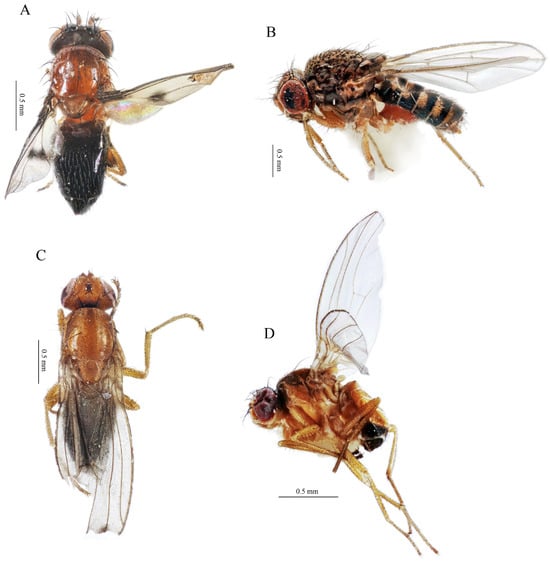
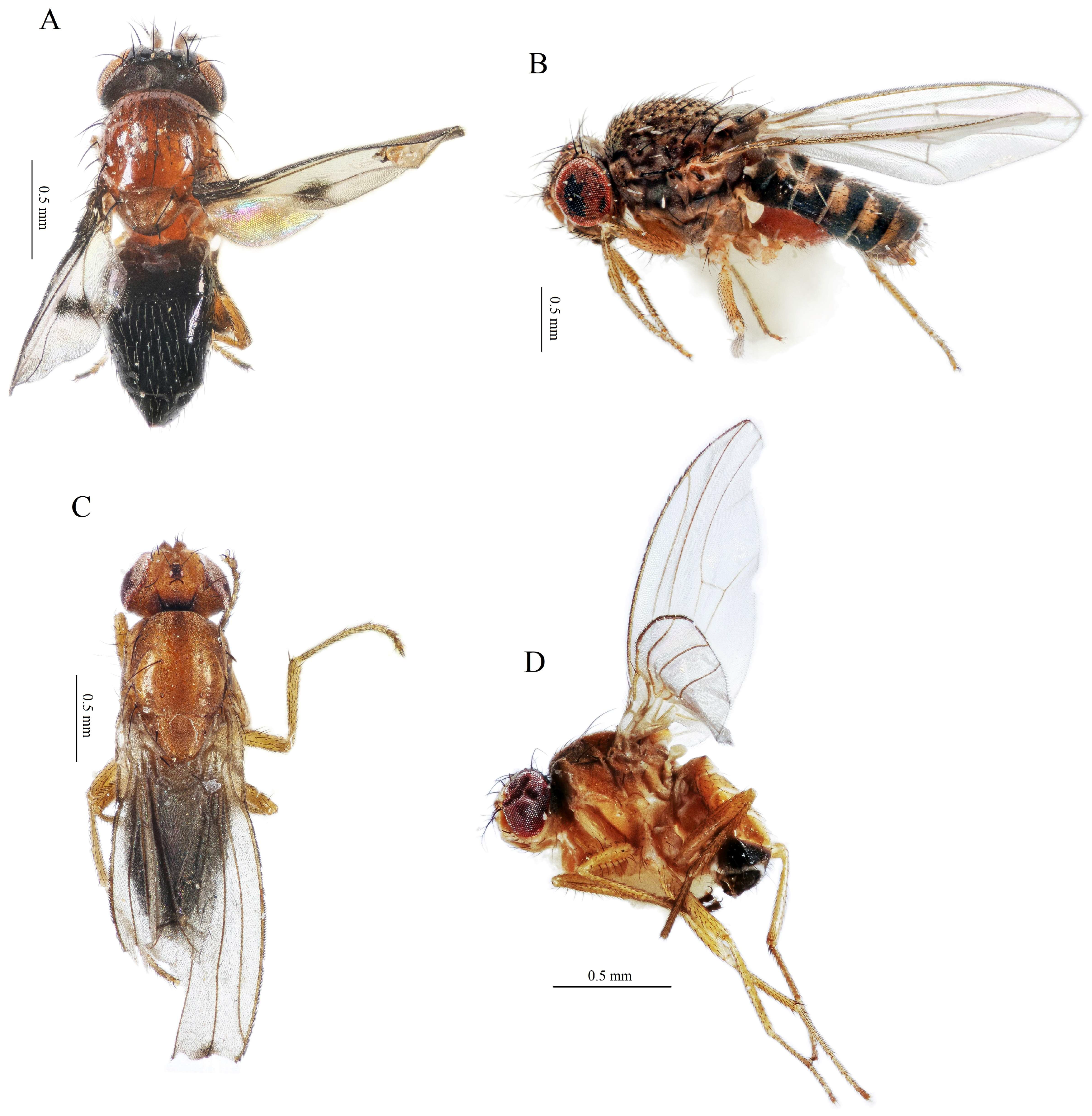
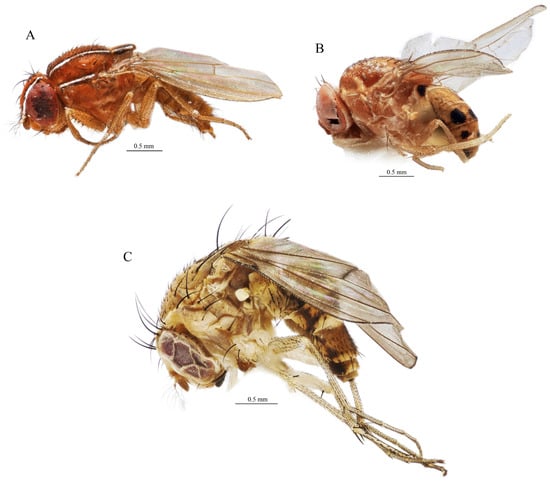
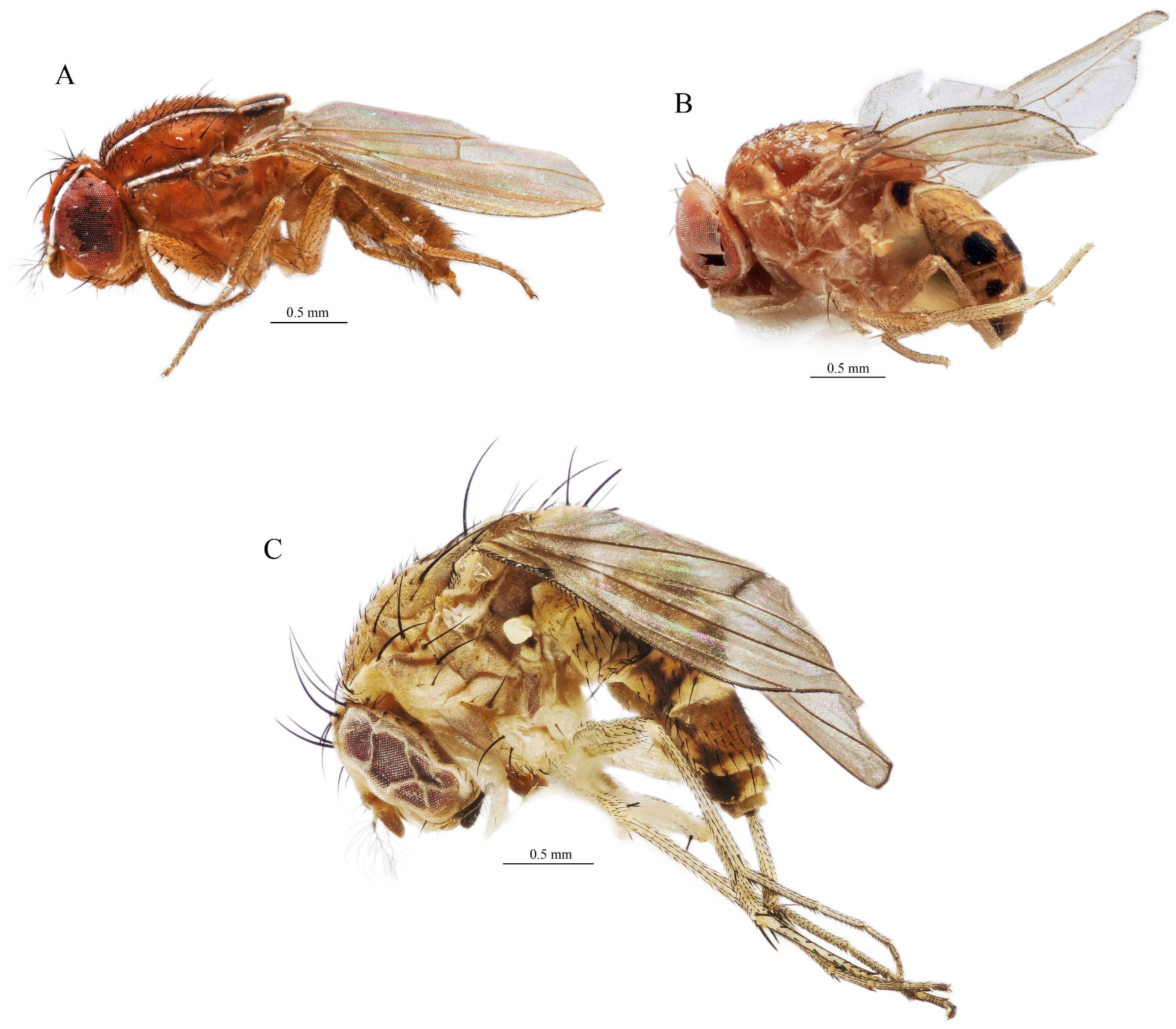
The photographs in the present study were taken at KSMA, using a Leica MZ 125 stereo microscope equipped with a digital Q-imaging Micro Publisher 5.0 RTV camera (Q-Imaging Corporation, Surrey, BC, Canada). Photographs were auto-montaged using the Zerene Stacker program, version 1.04. For the figures, the original photographs were arranged into two plates (Figure 1 and Figure 2) by cropping empty margins, scaling, and adding panel letters only; no features of the specimens were altered.
Figure 1.
Habitus of (A) Chymomyza cf. amoena, female; (B) Drosophila repleta, male; (C) Scaptomyza adusta, female; (D) Scaptomyza graminum, male. Each panel has its own 0.5 mm scale bar; panels were scaled individually.
Figure 2.
Habitus of (A) Zaprionus indianus, female; (B) Leucophenga bellula, male; (C) Leucophenga quinquemaculata, male. Each panel has its own 0.5 mm scale bar; panels were scaled individually.
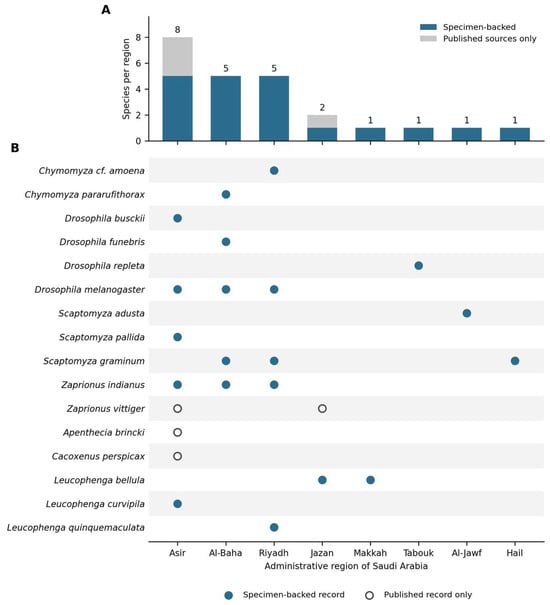
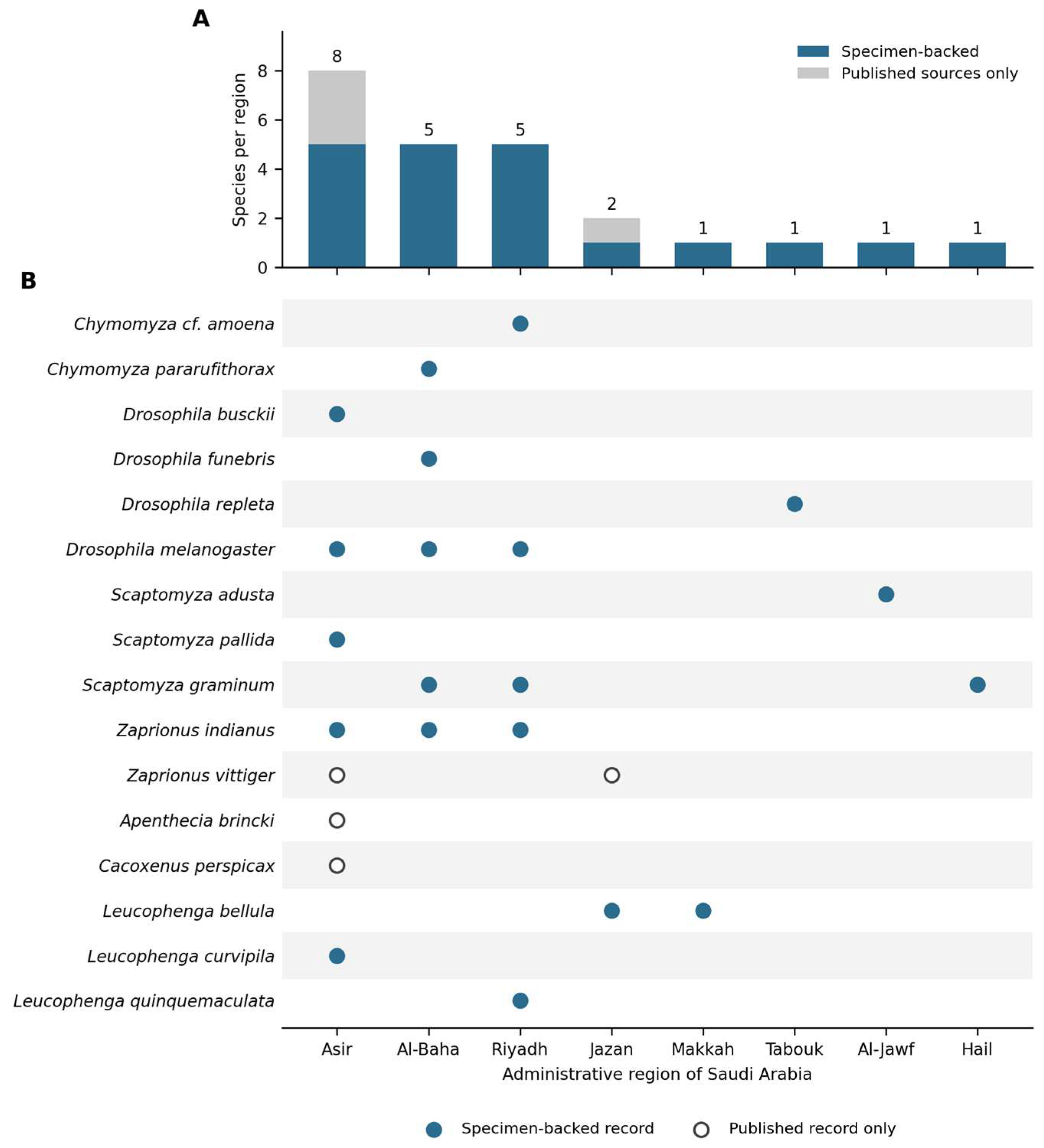
Records by region (Figure 3) were counted from the localities and Material examined entries given in Section 3.2, using the administrative region named in each entry. Each species was counted once per region. A record was classed as specimen-backed when a Material examined entry for that species and region is given in this paper, and as literature-based when the region is documented only in the cited publications; a species documented in the same region by both was counted as specimen-backed. Records given only as the south-western part of Saudi Arabia, and statements without a regional locality (for example, that Drosophila melanogaster is common), were not assigned to a region.
Figure 3.
Drosophilid species recorded in each administrative region of Saudi Arabia. (A) Number of unique species per region; dark bars, species with a Material examined entry for that region; grey bars, species recorded in that region only in published sources. (B) Species-by-region matrix; filled circles, specimen-backed records; open circles, records from published sources only. Counts overlap because five species occur in more than one region, are not corrected for sampling effort, and are not estimates of richness. Records given only as south-western Saudi Arabia and the general statement that Drosophila melanogaster is common were not assigned to regions.
Abbreviations used:
- AF, Afrotropical;
- AU, Australasian;
- KSMA, King Saud University Museum of Arthropods, Riyadh, Saudi Arabia;
- MCCB, Museum of Community College, Al-Baha University, Saudi Arabia;
- NE, Nearctic;
- NEO, Neotropical;
- OR, Oriental;
- PA, Palearctic.
3. Results
3.1. Key to Saudi Arabian Taxa of the Family Drosophilidae
| 1. | Mesonotum typically with prescutellar setae; with 8 or more rows of acrostichal setae; arista bare, micro-pubescent or plumose; mid and hind tarsi with dense rows of short setulae; surstyli in male often lacking prensisetae; oviscapt in female commonly lacking tooth-like pegs ...... (STEGANINAE) .... 2 |
| – | Mesonotum lacking prescutellar setae; with 8 or fewer rows of acrostichal setae; arista plumose, with one or more ventral branches; mid and hind tarsi usually without dense rows of short setulae; surstyli in male usually with prensisetae; oviscapt in female commonly with tooth-like pegs .... (DROSOPHILINAE) .... 4 |
| 2. | Arista entirely bare or micro-pubescent .... 3 |
| – | Arista plumose, with long branches above and below .... Leucophenga Mik, 1886 .... 14 [This genus is distinguishable also by the following characters: third costal sector with short peg-like setae ventrally; wing with cell dm and cell bm confluent] |
| 3. | Posterior reclinate fronto-orbital seta scale-like, or as short as, or shorter than, anterior reclinate fronto-orbital seta and distinctly thickened .... Apenthecia Tsacas, 1983 [A. brincki (Hackman)] [A. brincki is distinguishable also by the following characters: frons and face with slight incomplete grayish pruinescence; posterior reclinate fronto-orbital seta swollen but not distinctly scale-like; scutellum brown, yellow at posterior edge] |
| – | Posterior reclinate fronto-orbital seta long, as long as, or longer than, proclinate fronto-orbital seta, not short, not scale-like or thickened .... Cacoxenus Loew, 1858 [C. perspicax (Knab)] [This genus is distinguishable also by the following characters: facial carina rudimentary; mesonotum without strong grayish pruinescence, with 10 rows of acrostichal setae; wing clear, with crossvein bm–m strong, cell bm and cell dm separate, vein C strong beyond vein R4+5, reaching vein M1. Moreover, C. perspicax is distinguishable also by the following characters: ocellar setae large; mesonotum with many small brownish spots on paler base color; pleurites banded; abdomen with black patches] |
| 4. | Frons and mesoscutum with vivid longitudinal silvery-white stripes; wing without dark patches or spots .... Zaprionus Coquillett, 1901 .... 5 [This genus is distinguishable also by the following characters: posterior reclinate fronto-orbital seta strong, closer to inner vertical than to proclinate seta; mesonotum with 2 pairs of dorsocentral setae; prescutellar acrostichal setae undifferentiated or only slightly enlarged; male genitalia with epandrium pointed below, and hypandrium with short submedial setae] |
| – | Frons and mesoscutum without vivid longitudinal silvery-white stripes; wings hyaline or with dark patches or spots .... 6 |
| 5. | Head and thorax concolorous reddish-brown; abdomen yellowish-brown; width of black vittae surrounding white vittae at anterior dorsocentral seta not enlarged posteriorly .... Z. indianus Gupta, 1970 [32] |
| – | Head, thorax and abdomen concolorous, dark brown; width of black vittae surrounding white vittae at anterior dorsocentral seta enlarged posteriorly .... Z. vittiger Coquillett, 1901 [33] |
| 6. | Anterior reclinate fronto-orbital seta large, subequal to proclinate fronto-orbital seta, inserted well anterior to it; postocellar setae minute; face short and flat .... Chymomyza Czerny, 1903 .... 7 |
| – | Anterior reclinate fronto-orbital seta usually small or minute, not subequal to proclinate fronto-orbital seta, usually inserted only slightly before proclinate fronto-orbital seta; face convex or carinate, with facial carina nose-like, ridged, bulbous, or absent; subvibrissal or oral setae either large and subequal to vibrissa or smaller; mesoscutum with 2 or more pairs of dorsocentral setae .... 8 |
| 7. | Wing with a prominent black transverse marking on cross-vein dm-m, with a smoky cloud over the tip; legs yellowish-brown with tibiae and apical tarsi darkened .... C. cf. amoena (Loew, 1862) [34] (Figure 1A) |
| – | Wing without black transverse markings, only cells c and bc darkened; legs whitish-yellow to whitish-brown, with fore femur, fore tibia and basal fore tarsomere darkened .... C. pararufithorax Vaidya and Godbole, 1973 [35] |
| 8. | Vertex not distinctly rounded when viewed laterally; mesonotum with 4, 6 or 8 rows of acrostichal setae in between dorsocentral setae .... Drosophila Fallén, 1823 .... 9 |
| – | Vertex rounded when viewed laterally; thorax with acrostichal setae usually in 2 rows between dorsocentral setae .... Scaptomyza Hardy, 1849 .... 12 |
| 9. | Yellowish flies; mesonotum with narrow dark-brown stripes, median one posteriorly forked; pleura with two horizontal dark-brown stripes; abdominal tergites with dark bands interrupted at midline, narrowed at the sides, and not reaching lateral surface of tergites .... D. busckii Coquillett, 1901 |
| – | Yellowish, reddish-brown or dark flies; mesonotum and pleura without distinct dark stripes; abdominal tergites with dark bands, uninterrupted or narrowly interrupted at midline, reaching lateral surface of tergites, or with narrow dark uninterrupted posterior bands on 2nd to 4th tergites with last two tergites completely darkened .... 10 |
| 10. | Dark flies, with scutum grayish with numerous irregular small dark spots or patches at the base of setae and setulae, forming a mottled pattern; apical part of first costal section slightly darkened; abdominal tergites blackish-brown, interrupted at the dorsal midline by yellowish-brown areas, and with additional yellowish-brown areas laterally .... D. repleta Wollaston, 1858 [36] (Figure 1B) |
| – | Yellowish or reddish-brown flies; at least 2nd to 4th abdominal tergites with dark bands, uninterrupted or narrowly interrupted at midline, reaching lateral surface of tergites, with last two tergites completely darkened or not .... 11 |
| 11. | Reddish-brown flies; male fore tarsus without sex combs; abdominal tergites with brownish-black bands, narrowly interrupted at midline; male cercus with a series of 12 large distinct dark peg-like setae near inner margin .... D. funebris (Fabricius, 1787) [37] |
| – | Yellowish flies; male fore tarsus with a single row of peg-like setae forming a sex comb, composed of approximately 12 teeth; male 2nd to 4th abdominal tergites pale yellow with narrow dark uninterrupted posterior bands, and last two tergites completely darkened; female abdominal tergites pale yellow with narrow dark unbroken posterior bands; male cercus without large dark peg-like setae .... D. melanogaster Meigen, 1830 [38] |
| 12. | With two postpronotal setae, nearly equal or subequal in size; abdominal tergites with wide yellowish-brown bands, separated by whitish interspaces; last two abdominal segments entirely black .... S. graminum (Fallén, 1823) [39] (Figure 1D) |
| – | With only one prominent postpronotal seta, and sometimes a shorter seta-like hair (about half as long) below it; abdomen not as above .... 13 |
| 13. | Acrostichal setae present in four rows, with two external rows incomplete; wing with an apical distinct dark spot; arista with two ventral long branches behind the terminal fork .... S. adusta (Loew, 1862) [34] (Figure 1C) |
| – | Acrostichal setae present in only two rows; arista with only one ventral long branch behind the terminal fork .... S. pallida Zetterstedt, 1847 [40] |
| 14. | Scutum with three more or less definite gray or brown longitudinal stripes, median stripe may have a narrower longitudinal dark stripe running along its median line; wing slightly smoky, clouded on r-m and dm-cu crossveins, darkened at tip of vein R1; last four abdominal tergites with dark brown median longitudinal stripes forming a median longitudinal line; last five tergites with lateral dark patches or spots, appearing triangular from lateral view .... L. quinquemaculata Strobl, 1893 [41] (Figure 2C) |
| – | Scutum yellowish-brown or reddish-brown, lacking brown longitudinal stripes or patches; wing hyaline; abdominal tergites with black patches or spots, not appearing triangular from lateral view .... 15 |
| 15. | Palpi brown; halter pale brown, with brownish-yellow patch apically; 3rd to 5th abdominal tergites with black patches .... L. bellula (Bergroth, 1894) [42] (Figure 2B) |
| – | Palpi yellowish; halter reddish-yellow; 3rd tergite entirely reddish-brown without black patches or spots; 4th tergite and sometimes 5th tergite with black patches or spots .... L. curvipila Duda, 1939 [43] |
3.2. Annotated List and Taxonomic Treatment
3.2.1. Subfamily Drosophilinae
Tribe Colocasiomyini
Genus Chymomyza Czerny, 1903
Chymomyza Czerny, 1903: 199 [44]. Type species: Drosophila fuscimana Zetterstedt, 1838 [45].
Note: This is the first time the genus Chymomyza has been recorded from Saudi Arabia.
Diagnosis: Anterior reclinate fronto-orbital setae large, subequal to proclinate fronto-orbital seta, inserted well anterior to it; postocellar setae minute; face short and flat; antennal arista plumose, with at least one ventral branch; thorax with 2 large katepisternal setae; anterior dorsocentral setae smaller than posterior dorsocentral setae, inserted distant to transverse suture; prescutellar setae absent.
Drosophila amoena Loew, 1862: 230 [34]. Type locality: USA (District of Columbia).
Distribution of Chymomyza amoena: NE: Canada (Ontario), USA. PA: Austria, Croatia, Czech Republic, Dagestan, France, Germany, Hungary, Japan, Netherlands, Poland, Romania, Russia, Saudi Arabia (first record), Serbia, Slovakia, Switzerland.
Saudi Arabian localities and dates of collection: Riyadh: Diriyah (October).
Material examined: 1 female, Riyadh region, Dariya, Mohammed Arroymayzen (24.7592° N, 46.5600° E), 05.X.2021, SW, Carrot, H, Chebbi & H. Abbad, leg., KSMA.
Diagnosis: About 2.5 mm in length; eyes bright red; thorax matt brown colored; wings darkened at anterior margin, with a prominent black transverse marking on cross-vein dm-m, with a smoky cloud over the tip; legs yellowish-brown with tibiae and apical tarsi darkened; abdomen shiny, dark brown to black colored.
Note: This female specimen keys to C. amoena in all available keys; however, some slight variations are observed, particularly in the dark wing markings. Given these discrepancies, it is possible that this specimen represents an undescribed species, but confirmation would require examination of male specimens.
Chymomyza pararufithorax Vaidya and Godbole, 1973
Chymomyza pararufithorax Vaidya and Godbole, 1973: 71 [35]. Type locality: India (Maharashtra: Pune [=Poona]).
Distribution: AF: United Arab Emirates, Saudi Arabia [as “South-western part”] (first record). OR: India, Malaysia, Myanmar, Sri Lanka. PA: China, Japan.
Saudi Arabian localities and dates of collection: Al-Baha (April).
Material examined: 1 male (in a poor condition), Al-Baha, Dhe-Ayn (19.9299° N, 41.4422° E), 2.IV.2012, El-Hawagry, leg., MCCB.
Diagnosis: Antenna yellowish-brown, first flagellomere pubescent, arista with about 4 branches above and 3 below; mesonotum yellowish-orange to dark brown, shining; legs yellowish, with fore femur, fore tibia and fore metatarsus dark brown to black; fore femur swollen; wing with a white patch apically; costa and cell r1 dark; first abdominal tergite yellowish-brown, remaining totally shining black.
Tribe Drosophilini
Genus Drosophila Fallén, 1823
Drosophila Fallén, 1823: 4 [39]. Type species: Musca funebris Fabricius, 1787 [37], by subsequent designation of Macquart, 1835: 548 [46].
Subgenus Dorsilopha Sturtevant, 1942
Dorsilopha Sturtevant, 1942: 28 [47]. Type species: Drosophila busckii Coquillett, 1901 [47], by original designation.
Drosophila (Dorsilopha) busckii Coquillett, 1901
Drosophila busckii Coquillett, 1901: 18 [48]. Type locality: USA (District of Columbia: Washington).
A list of synonyms is given by El-Hawagry et al. [49].
Distribution: Cosmopolitan [2].
Saudi Arabian localities and dates of collection: Asir: Abha, Garf Raydah Nature Reserve (throughout the year) [15,20] and the present study.
Material examined: 2 male, 3 female, Asir region, Abha, Raydah Natural Reserve (18.198056° N, 42.407229° E), 06.VI.2014, Sweeping, El-Hawagry, leg., KSMA.
Note: The Saudi Arabian records cited here come from a nature reserve and do not themselves establish a synanthropic association.
Subgenus Drosophila—Nominotypical subgenus
Drosophila (Drosophila) funebris (Fabricius, 1787)
Musca funebris Fabricius, 1787: 345 [37]. Type locality: Denmark (Copenhagen [=Hafniae]).
Distribution: Widely spread worldwide [2,49]; new to the Saudi Arabian fauna.
Saudi Arabian localities and dates of collection: Al-Baha: Baiydah (October).
Material examined: 1 female, Al Baha, Baiydah, Al Gedlan village, Awad Dhafer Al Zahrani F. (20.2326° N, 41.4036° E), 1.X.2021, SW, Pomegranate, Al Dhafer, H., leg., KSMA.
Diagnosis: Reddish-brown flies, with mesonotum unicolourous brown; anterior reclinate fronto-orbital seta posterolateral to proclinate setae; frons and face yellowish-brown; antennae with scape and pedicel yellowish-brown, first flagellomere dark brown, arista with 6 branches above and 4 below; mesonotum slightly shining; acrostichal setae in 6 rows; legs yellowish; wings hyaline; costa reaches apex of vein M1; abdominal tergites with brownish-black bands, interrupted at midline, with narrow yellowish lines anteriorly and posteriorly; male cercus with series of 12 dense strong peg-like setae near inner margin.
Note: Drosophila funebris is described as synanthropic in other regions [10]. The single Saudi Arabian specimen was collected on pomegranate, which documents an agricultural occurrence but not a synanthropic association.
Drosophila repleta Wollaston, 1858: 117 [36]. Type locality: Portugal (Madeira: Funchal).
A list of synonyms is given by El-Hawagry et al. [49].
Distribution: Widely spread worldwide [2,49]; new to the Saudi Arabian fauna.
Saudi Arabian localities and dates of collection: Tabouk: Al Wajh (February).
Material examined: 1 male, Tabouk, Al Wajh, Khalil Maslamani, F. (26.2397° N, 36.4815° E), collected as larvae 9.II.2022, and reared to adults 27.II.2022, Tomato, A. Al Ansi et al., leg., KSMA.
Diagnosis: About 3 mm in length; generally dark in color; wings hyaline; apical part of first costal section slightly darkened; third costal section with heavy setation on basal half; mesonotum grayish with numerous irregular small dark spots or patches forming a mottled pattern, with one seta or bristle arising from each spot; pleura dark gray; wings hyaline; abdominal tergites blackish-brown, appears broken yellowish-brown at dorsal midline, with lateral yellowish-brown areas laterally; epandrium with about 13 lower and 3 upper bristles; anterior margins of cerci fused at lower half; surstyli with about 10 primary teeth, without secondary teeth, with 7 marginal bristles; gonopod with one sensillum.
Subgenus Sophophora Sturtevant, 1939
Sophophora Sturtevant, 1939: 139 [50]. Type species: Drosophila melanogaster Meigen, 1830 [38], by original designation.
Drosophila (Sophophora) melanogaster Meigen, 1830
Drosophila melanogaster Meigen, 1830: 85 [38]. Type locality: Germany (Schleswig-Holstein: Kiel, Hamburg) and Austria.
A list of synonyms is given by El-Hawagry et al. [49].
Distribution: Cosmopolitan [2,49].
Saudi Arabian localities and dates of collection: Common (throughout the year) [15,16,18,19,20,21,51,52] and the present study.
Material examined: 5 male, 4 female, Al-Baha, Dhe Ayn (19.929904° N, 41.442162° E), 2.IV.2012, El-Hawagry, leg., MCCB; 2 male, 5 female, Asir region, Abha, Raydah Natural Reserve (18.198056° N, 42.407229° E), 06.VI.2014, Sweeping, El-Hawagry, leg., KSMA; 1 female, Riyadh region, Ibex Protected Area (23.456789° N, 46.572296° E), 15.II.2026, MT, Abdel-Dayem M. et al., leg., KSMA.
Note: Drosophila melanogaster is described as synanthropic in other regions [10] and is reported as common in Saudi Arabia in the sources cited above. Those sources do not describe its habitats, so a local association with humans is not documented here.
Genus Scaptomyza Hardy, 1849
Scaptomyza Hardy, 1849: 364 [53]. Type species: Scaptomyza graminum Fallén, 1823 [39], by subsequent designation of Coquillett, 1910: 603 [54].
Subgenus Parascaptomyza Duda, 1924
Parascaptomyza Duda, 1924: 203 [55]. Type species: Drosophila pallida Zetterstedt, 1847 [40], by monotypy.
Drosophila adusta Loew, 1862: 231 [34]. Type locality: USA (District of Columbia).
Distribution: AF: United Arab Emirates. NE & NEO: widely distributed in North America, Mexico to Argentina. PA: Azores, Canary Islands, Great Britain, Greece, Israel, Italy, Malta, Saudi Arabia (first record), Spain, Türkiye.
Saudi Arabian localities and dates of collection: Al-Jawf: Meequa (October).
Material examined: 1 female, KSA, Al-Jawf, Meequa, E-JAW-31-20, Gasim Arrouaali F. (29.7309° N, 38.8237° E), 22.X.2021, SW, Potatoe, M. Al Harbi et al., leg., KSMA.
Diagnosis: About 3 mm in length; arista with 5 dorsal and 2 ventral long branches behind the terminal fork; palpi with very stout black bristles; mesonotum including scutellum yellowish-brown, with microtrichosity forming 2 diffuse longitudinal stripes; with one large postpronotal seta in addition to another weak and short one; acrostichal setae in 4 rows, with 2 external rows incomplete; legs yellowish-brown, with terminal tarsomeres slightly darkened; wing with an apical distinct dark spot; abdomen dark brown to black especially at apical segments; surstyli expanded slightly outwards, with 2 rows of compacted, peg-like prensisetae, separated by a gap.
Scaptomyza (Parascaptomyza) pallida Zetterstedt, 1847
Drosophila pallida Zetterstedt, 1847: 2571 [40]. Type locality: Sweden (Kristianstad: Asperod).
Distribution: Worldwide except Alaska and the colder northern and southern extremes [2,49].
Saudi Arabian localities and dates of collection: Asir: Abha (February to June) [15] and the present study.
Material examined: 1 male, 3 female, Asir region, Abha (18.238098° N, 42.508972° E), 12.V.2011, El-Hawagry, leg., MCCB.
Subgenus Scaptomyza—Nominotypical subgenus
Drosophila graminum Fallén, 1823: 8 [39]. Type locality: Sweden (Skane).
Distribution: Cosmopolitan [2,49]; new to the Saudi Arabian fauna.
Saudi Arabian localities and dates of collection: Al-Baha: Dhe Ayn (April); Hail: Janine, Rajeh (October); Riyadh: Ibex Protected Area (February), Shaqra (November) [present study].
Material examined: 1 male, 1 female, Al-Baha, Dhe Ayn (19.9299° N, 41.4422° E), 2.IV.2012, El-Hawagry, leg., MCCB; 1 male, Hail, Janine, Rajeh, Al Shammari F. (27.4820° N, 42.4420° E), 11.X.2021, SW, Potatoes, L. Hmidet & A. Busalem, leg., KSMA; 1 female, Riyadh region, Shaqra, Abdallah Achouini (25.3078° N, 45.2711° E), 23.XI.2021, SW, Carrot, H. Chebbi & H. Abbad, leg., KSMA; 1 male, 2 female, Riyadh region, Ibex Protected Area (23.456789° N, 46.572296° E), 15.II.2026, MT, Abdel-Dayem M. et al., leg., KSMA.
Diagnosis: About 2 mm in length; yellowish-brown in general color; arista with 5 dorsal and 2 ventral branches; frons velvety golden brown, with a triangular grayish pollinosity above; palpi pale yellow with several black bristles; occiput dark gray; thorax with 2 postpronotal setae, almost equal in length; acrostichal setae in 4 rows, with 2 external rows short and incomplete; scutum yellowish-brown, with 2 grayish-brown pollinose longitudinal stripes; scutellum grayish-brown; legs yellowish-brown, slightly darker toward tips; abdominal tergites with wide yellowish-brown bands, with spaces not covered by bands whitish; last 2 abdominal segments black; cerci very broad ventrally, rounded, pointed ventrally in lateral view.
Note: This species, similar to Scaptomyza pallida Zetterstedt, occurs in 2 forms, a gray form predominant through the temperate and northern regions, and a yellowish-brown form predominant through the tropical regions (Takada 1970) [56]. This difference in color occurs also in different seasons in the same region, it is partially dependent on the temperature (Stalker 1945) [57].
Genus Zaprionus Coquillett, 1901
Zaprionus Coquillett, 1901: 31 [33]. Type species: Zaprionus vittiger Coquillett, 1901 [33], by original designation.
Subgenus Zaprionus—Nominotypical subgenus
Zaprionus indianus Gupta, 1970: 63 [32]. Type locality: India (Uttar Pradesh: Badaun district, Allahpur).
A list of synonyms is given by El-Hawagry et al. [49].
Distribution: AF: Benin, Cape Verde Is., Comoros, Congo; Cote d’Ivoire, Kenya, Madagascar, Malawi, Mauritius, Mozambique, Niger, Nigeria, Oman, Réunion, Sao Tomé, Saudi Arabia [as “South-western part”], South Africa, St. Helena, Tanzania, United Arab Emirates. NE: USA. NT: Argentina, Brazil, Panama, Uruguay. OR: India, Pakistan. PA: Austria, Canary Is., Egypt, Jordan, Iran, Israel, Italy, Lebanon, Madeira, Morocco, Saudi Arabia, Seychelles.
Saudi Arabian localities and dates of collection: Al-Baha: Shada; Asir: Abha, Garf Raydah Nature Reserve; Riyadh: Ibex Protected Area, Rawdhats (throughout the year) [15,19,20,21] and the present study.
Material examined: 2 female, Al-Baha, Shada (19.847252° N, 41.318690° E), 2.IV.2012, SW, El-Hawagry, leg., MCCB; 2 male, 3 female, Asir region, Abha, Raydah Natural Reserve (18.198056° N, 42.407229° E), 06.VI.2014, Sweeping, El-Hawagry, leg., KSMA; 1 male, 1 female, Riyadh region, Ibex Protected Area (23.456789° N, 46.572296° E), 15.II.2026, MT, Abdel-Dayem M. et al., leg., KSMA.
Zaprionus (Zaprionus) vittiger Coquillett, 1901
Zaprionus vittiger Coquillett, 1901: 32 [33]. Type locality: South Africa (Cape Province).
Distribution: AF: Widespread in Afrotropical Region, including south-western part of Saudi Arabia.
Saudi Arabian localities and dates of collection: Asir: Maraba; Jazan: Abu Aresh (September) [15,17].
3.2.2. Subfamily Steganinae
Tribe Gitonini
Genus Apenthecia Tsacas, 1983
Apenthecia Tsacas, 1983: 333 [58]. Type species: Erima crassiseta Hackman, 1961 [59], by original designation.
Apenthecia brincki (Hackman, 1961)
Erima brincki Hackman, 1961: 387 [59]. Type locality: South Africa (Cape Province: Cape Peninsula, Hout Bay, Skoorsteenkop).
Distribution: AF: Kenya, Saudi Arabia [as “South-western part”], South Africa, Yemen.
Saudi Arabian localities and dates of collection: Asir: Abha (February to May) [15].
Genus Cacoxenus Loew, 1858
Cacoxenus Loew, 1858: 217 [60]. Type species: Cacoxenus indagator Loew, 1858 [60], by monotypy.
Cacoxenus perspicax (Knab, 1914)
Gitonides perspicax Knab, 1914: 166 [61]. Type locality: USA (Hawaii: Honolulu).
Distribution: AF: Central and south Africa, Saudi Arabia [as “South-western part”]. AU, OR: Australia, widespread from Hawaii to southeast Asia. PA: Egypt.
Saudi Arabian localities and dates of collection: Asir (February to June) [15].
Genus Leucophenga Mik, 1886
Leucophenga Mik, 1886: 317 [62]. Type species: Drosophila maculata Dufour, 1839 [63], by original designation.
Subgenus Leucophenga—Nominotypical subgenus
Drosophila bellula Bergroth, 1894: 75 [42]. Type locality: Australia (Queensland: central Queensland, Farm Coomooboolaro near Duaringa).
Distribution: AF: Africa (as given in Zhou & Chen (2015) [64]), Saudi Arabia [as “South-western part”] (first record). AU: Australia, Micronesia, Papua New Guinea. OR: China (Guangxi, Guizhou, Hainan, Yunnan), India, Indonesia, Malaysia, Nepal, Sri Lanka, Taiwan. PA: Japan.
Saudi Arabian localities and dates of collection: Jazan: Damad (March); Makkah: Al-Qunfudhah (April).
Material examined: 1 male, 1 female, KSA, Makkah, Al qanfadh (18.7564° N, 41.3006° E), 3.IV.2021, SW, U. El-Ghiet & B. Busalem, leg., KSMA; 1 female, KSA, Makkah, Al qanfadh, Mohammed Al Ghamdi F. (19.3678° N, 41.0725° E), 1.IV.2021, SW, Fruit, U. El-Ghiet & B. Busalem, leg., KSMA; 1 male, 1 female, Jazan, Damad, Nasser Al Hazmi F. (17.1246° N, 42.7278° E), 13.III.2012, SW, Bonecam (?Panicum), U. El-Ghiet & B. Busalem, leg., KSMA.
Diagnosis: About 3 mm in length; frons and antennae yellowish-brown; palpi brown; mesonotum, including scutellum, brownish-yellow, lacking brown longitudinal stripes or patches; postpronotal lobe pale brown; acrostichal setae in about 12 irregular rows; wings hyaline; halter pale brown, with brownish-yellow patch apically; abdominal tergites yellowish, with dark brown to black patches, especially on 3rd to 5th tergites; second abdominal tergite entirely yellowish; cercus with 10 long setae near posterior margin; paramere lacking sensilla; aedeagus thick and pubescent on distal 1/3.
Leucophenga (Leucophenga) curvipila Duda, 1939
Leucophenga guttiventris var. curvipila Duda, 1939: 52 [43]. Type locality: Uganda (Mujenje, Katona).
Distribution: AF: Saudi Arabia [as “South-western part”], widespread in Africa.
Saudi Arabian localities and dates of collection: Asir: Abha (July to October) [15] and the present study.
Material examined: 1 male, 4 female, Asir region, Abha (18.238098° N, 42.508972° E), 12.VII.2011, El-Hawagry, leg., MCCB.
Subgenus Neoleucophenga Oldenberg, 1915
Neoleucophenga Oldenberg, 1915: 93 [65]. Type species: Leucophenga quinquemaculata Strobl, 1893 [41], by automatic designation.
Leucophenga quinquemaculata Strobl, 1893: 283 [41]. Type locality: Austria (Styria).
Distribution: PA: Far-East Russia, Saudi Arabia (first record), South Korea, widespread in Europe.
Saudi Arabian localities and dates of collection: Riyadh: Dirab (February), King Saud University Education Farm (February) [present study].
Material examined: 1 male, Riyadh, KSU, Edu. Farm, (24.7374° N, 46.6199° E), 29.II.2024, BT, Ziziphus, Al-Ansi, A., leg. (KSMA); 1 female, Riyadh, Dirab, KSU Edu. Farm (24.4095° N, 46.6583° E), 27.II.2024, BT, Ziziphus, Al-Ansi A., Rasool I., El Sonbati S., leg., (KSMA).
Note: Bächli & Thunes (1992) [66] stated that this species was mentioned from Far-East Russia by Shtakel’berg (1988) [67] and from South Korea by Lee (1964, 1966, 1970) [68,69,70] and Lee & Kim (1987) [71], but all of these records may be misidentifications.
Diagnosis: About 5 mm in length; yellowish-brown with three gray longitudinal stripes on scutum, or reddish-brown with indefinite three brown longitudinal stripes on scutum; median stripe may have a narrower longitudinal dark stripe running along its median line; scutellum pale at tip; arista with 6 dorsal and 3 ventral long branches behind the terminal fork; wing slightly smoky, clouded on r-m and dm-cu crossveins; patches at tips of veins R2+3 and R4+5 exceptionally not distinct; tip of vein R1 darkened; last four abdominal tergites with dark brown median longitudinal stripes forming a median longitudinal line, and last five tergites with lateral dark brown spots, appear triangular from lateral view.
3.3. Records by Administrative Region
Figure 3 summarises the records by administrative region, as named in the localities and Material examined entries above. Each species is counted once per region, so a species recorded in several regions appears in each, and the regional totals (24 species-region records for 16 species) overlap and cannot be summed. Eight regions are represented. Asir has the most species (eight): five are supported by Material examined entries (Drosophila busckii, D. melanogaster, Scaptomyza pallida, Zaprionus indianus and Leucophenga curvipila), and three (Zaprionus vittiger, Apenthecia brincki and Cacoxenus perspicax) are known there only from published records. Al-Baha and Riyadh have five species each, all specimen-backed. Jazan has two species, Leucophenga bellula (specimen-backed) and Z. vittiger (published records only), and Makkah, Tabouk, Al-Jawf and Hail have one each, all specimen-backed. Five species occur in more than one region (D. melanogaster, S. graminum and Z. indianus in three regions each; L. bellula and Z. vittiger in two), and the other 11 are recorded from a single region. These counts reflect where collecting and reporting have taken place and not species richness. Sampling was incidental and unequal among regions, the larger count for Asir may reflect the amount of material and published records available from that region and not a richer fauna [15,20], and the absence of a record does not indicate the absence of a species.
4. Discussion
Few groups of insects have been examined as intensively as the Drosophilidae from genetic, developmental and evolutionary perspectives [72,73,74,75], yet basic faunistic knowledge of the family remains uneven in many parts of the world, including the Arabian Peninsula. Before the present study, the Saudi Arabian fauna was known from a small number of records, reported by Abdullah and Dawah [15] and incidentally in broader surveys [16,17,18,19,20,21]. The 16 species now listed, including eight recorded here for the first time from examined specimens and one genus new to the country, provide a baseline. The newly recorded species are mostly widely distributed. Drosophila funebris, D. repleta, Scaptomyza graminum and S. adusta are known from many regions [1,49], and their absence from earlier Saudi Arabian lists more probably reflects the lack of targeted work than a recent arrival, although the present data cannot distinguish between these explanations. Chymomyza pararufithorax was previously known from the Oriental Region and the United Arab Emirates [4,35], and the specimen from Al-Baha extends its known range westward. The single female assigned to Chymomyza cf. amoena could not be identified with certainty, and its status should be revisited when more material, preferably including males, is available. Leucophenga quinquemaculata is a Palaearctic species recorded from as far north as Norway [66].
Saudi Arabia occupies a critical biogeographic position between the Palaearctic and Afrotropical regions [14]. The records from the south-western highlands include Afrotropical taxa [15,26,30], and the specimens of L. quinquemaculata and C. cf. amoena from Riyadh suggest that Palaearctic elements also occur in the central part of the country. With so few specimens and unequal sampling, these observations are suggestive only and do not allow conclusions about faunal limits or patterns of richness (Figure 3).
The limitations of the study should be stated plainly. The specimens were obtained incidentally, mainly with Malaise traps and sweep nets, and not through sampling designed for drosophilids; abundance, seasonality and habitat preference cannot be assessed from them; and several species are represented by one specimen or by literature records alone. The present list is therefore almost certainly incomplete. A fuller inventory would require baited trapping, systematic sampling of different habitats and seasons across the regions of the country, rearing from fruit and fungi, and, where useful, molecular identification.
Several of the species treated here are known to live in association with humans elsewhere. In a study in European Russia, Drosophila busckii, D. funebris and D. melanogaster were described as synanthropic [10]. This is different from being cosmopolitan, being found in agricultural habitats, or being collected on fruit, and the Saudi Arabian records of these species do not themselves document an association with human dwellings or food stores. The practical importance of an accurate inventory should not be underestimated, since species such as D. funebris and D. repleta have medical or veterinary significance. A reliable identification key and a clear statement of which species occur in the country are prerequisites for any pest-management or public-health programme.
In a broader sense, the study of regional faunas continues to supply the raw material for biogeography and conservation. The unconfirmed report of D. simulans discussed in the introduction shows the value of voucher specimens: without them, such a species cannot be added to the list.
Future work should concentrate on three main directions: (i) specialised drosophilid collecting with baited traps and systematic habitat sampling in all regions, which would also allow seasonal and geographic patterns to be examined; (ii) examination of vouchers for the species known only from the literature, and specimen-based resolution of the status of D. simulans; and (iii) molecular data, especially for taxa such as Chymomyza cf. amoena.
5. Conclusions
This study provides a baseline synthesis of the Drosophilidae of Saudi Arabia, combining examined material from incidental collections with published records. Sixteen species in seven genera are treated. Eight species and the genus Chymomyza are recorded for the first time from Saudi Arabia, although some of these species rest on a single specimen each. An identification key is provided, with diagnoses compiled from the literature for three species not examined. Drosophila busckii, D. funebris and D. melanogaster are documented as synanthropic elsewhere, but the Saudi Arabian records do not themselves demonstrate this. A historical report of D. simulans remains unconfirmed and is not counted. The list is not a complete inventory of the national fauna; baited trapping, systematic sampling and specimen-based identification are needed to extend it.
Author Contributions
Conceptualization, M.S.E.-H. and H.M.A.D.; methodology, M.S.E.-H.; identification, M.S.E.-H.; investigation, M.S.E.-H., M.S.A.-D. and H.M.A.D.; resources, M.S.A.-D. and H.M.A.D.; data curation, M.S.E.-H.; writing—original draft preparation, M.S.E.-H.; writing—review and editing, M.S.E.-H., Y.N.A., M.S.A.-D. and H.M.A.D.; visualization, H.M.A.D.; supervision, M.S.E.-H.; project administration, M.S.E.-H. All authors have read and agreed to the published version of the manuscript.
Funding
This work was funded by the National Plan for Science, Technology, and Innovation (MAARIFAH), King Abdul-Aziz City for Science and Technology, Saudi Arabia, grant number 2-17-01-001-0004.
Institutional Review Board Statement
Not applicable.
Informed Consent Statement
Not applicable.
Data Availability Statement
All data generated or analyzed during this study are included in this published article.
Acknowledgments
We are extremely grateful to the late Paul Beuk, Natuurhistorisch Museum Maastricht, Maastricht, Netherlands, for checking some photographs treated in the present study. We are also thankful to the research team in KSMA for collecting, mounting, and photographing specimens.
Conflicts of Interest
The authors declare that they have no competing interests.
References
- Gerhardt, R.R.; Hribar, L.J. Flies (Diptera). In Medical and Veterinary Entomology; Mullen, G.R., Durden, L.A., Eds.; Elsevier Academic Press: London, UK, 2019; pp. 171–188. [Google Scholar]
- Bächli, G. TaxoDros: The Database on Taxonomy of Drosophilidae. Available online: https://www.taxodros.uzh.ch/ (accessed on 1 October 2024).
- Schmitz, H.J.; Valente, V.L.S.; Hofmann, P.R.P. Taxonomic survey of Drosophilidae (Diptera) from mangrove forests of Santa Catarina Island, Southern Brazil. Neotrop. Entomol. 2007, 36, 53–64. [Google Scholar] [CrossRef] [Scilit] [PubMed]
- Sidorenko, V.S.; Nakonechnaya, O.V. Order Diptera, family Drosophilidae. Arthropod Fauna UAE 2010, 3, 661–672. [Google Scholar] [CrossRef] [Scilit]
- Walsh, D.B.; Bolda, M.P.; Goodhue, R.E.; Dreves, A.J.; Lee, J.; Bruck, D.J.; Walton, V.M.; O’Neal, S.D.; Zalom, F.G. Drosophila suzukii (Diptera: Drosophilidae): Invasive pest of ripening soft fruit expanding its geographic range and damage potential. J. Integr. Pest Manag. 2011, 2, 1–7. [Google Scholar] [CrossRef] [Scilit]
- Valer, F.B.; Mendes, M.F.; Bernardi, E.; Blauth, M.L.; Gottschalk, M.S. Diversity and associations between Drosophilidae (Diptera) species and Basidiomycetes in a Neotropical forest. An. Acad. Bras. Ciênc. 2016, 88, 705–718. [Google Scholar] [CrossRef] [Scilit] [PubMed]
- Ashburner, M. Entomophagous and other bizarre Drosophilidae. In The Genetics and Biology of Drosophila; Ashburner, M., Carson, H.L., Thompson, J.N., Eds.; Academic Press: London, UK, 1981; Volume 3, pp. 395–429. [Google Scholar]
- James, M.T. The Flies That Cause Myiasis in Man; Miscellaneous Publication No. 631; US Department of Agriculture: Washington, DC, USA, 1947; 175p.
- Harrington, L.C.; Axtell, R.C. Comparisons of sampling methods and seasonal abundance of Drosophila repleta in caged-layer poultry houses. Med. Vet. Entomol. 1994, 8, 331–339. [Google Scholar] [CrossRef] [Scilit] [PubMed]
- Gornostaev, N.G.; Ruchin, A.B.; Esin, M.N.; Lazebny, O.E.; Kulikov, A.M. Vertical distribution of fruit flies (Diptera: Drosophilidae) in deciduous forests in the center of European Russia. Insects 2023, 14, 822. [Google Scholar] [CrossRef] [Scilit] [PubMed]
- Gornostaev, N.G. Addition to the fauna of fruit flies (Diptera: Drosophilidae) of the central and south regions of European Russia. Far East. Entomol. 2026, 540, 7–23. [Google Scholar] [CrossRef] [Scilit]
- Prigent, S.R.; Lang, M.; Nagy, O.; Acurio, A.; Matamoro-Vidal, A.; Courtier-Orgogozo, V.; David, J.R. Field collections reveal that São Tomé is the Afrotropical island with the highest diversity of drosophilid flies (Diptera: Drosophilidae). Ann. Soc. Entomol. Fr. (N.S.) 2020, 56, 1–14. [Google Scholar] [CrossRef] [Scilit]
- Kahanpää, J. Checklist of the Diptera (Insecta) of Finland: An introduction and a summary of results. ZooKeys 2014, 441, 1–20. [Google Scholar] [CrossRef] [Scilit] [PubMed]
- El-Hawagry, M.S.; Abdel-Dayem, M.S.; Al Dhafer, H.M. The family Oestridae in Egypt and Saudi Arabia (Diptera, Oestroidea). ZooKeys 2020, 947, 113–142. [Google Scholar] [CrossRef] [Scilit] [PubMed]
- Abdullah, M.A.; Dawah, H.A. New records of fruit flies Drosophilidae (Diptera: Brachycera: Drosophiloidae). Yemeni J. Sci. 2006, 7, 1–8. [Google Scholar]
- Abu-Thuraya, N.H. General Survey, Agricultural Pests in Saudi Arabia; Ministry of Agriculture and Water, Agriculture Research Department of Plant Protection: Riyadh, Saudi Arabia, 1982. 268p. (In Arabic); 60p. (In English)
- Abu-Zoherah, R.; Al-Taher, K.; Tilkian, S. List of Insects Recorded from Saudi Arabia; Ministry of Agriculture and Water, National Agriculture and Water Research Centre: Riyadh, Saudi Arabia, 1993; 394p.
- Al-Ahmadi, A.Z.; Salem, M.M. Entomofauna of Saudi Arabia, Part 1: Checklist of Insects; Academic Publishing and Press, King Saud University: Riyadh, Saudi Arabia, 1999; 240p. [Google Scholar]
- El-Hawagry, M.S.; Abdel-Dayem, M.S.; Elgharbawy, A.A.; Dhafer, H.M. A preliminary account of the fly fauna in Jabal Shada al-A’la Nature Reserve, Saudi Arabia, with new records and biogeographical remarks (Diptera, Insecta). ZooKeys 2016, 636, 107–139. [Google Scholar] [CrossRef] [Scilit] [PubMed]
- El-Hawagry, M.S.; Abdel-Dayem, M.S.; El-Sonbati, S.A.; Al Dhafer, H.M. A preliminary account of the fly fauna in Garf Raydah Nature Reserve, Kingdom of Saudi Arabia, with new records and biogeographical remarks (Diptera: Insecta). J. Nat. Hist. 2017, 51, 1499–1530. [Google Scholar] [CrossRef] [Scilit]
- El-Hawagry, M.S.; Abdel-Dayem, M.S.; Al Dhafer, H.M. A contribution to the knowledge of fly fauna in the Kingdom of Saudi Arabia: New country records and an account of flies identified from Rawdhats, Riyadh Region, with biogeographical remarks (Insecta: Diptera). J. Nat. Hist. 2018, 52, 1377–1393. [Google Scholar] [CrossRef] [Scilit]
- Vieira, C.; Biémont, C. Geographical variation in insertion site number of retrotransposon 412 in Drosophila simulans. J. Mol. Evol. 1996, 42, 443–451. [Google Scholar] [CrossRef] [PubMed]
- Sturtevant, A.H. A new species closely resembling Drosophila melanogaster. Psyche 1919, 26, 153–155. [Google Scholar] [CrossRef] [Scilit]
- Okada, T. Systematic Study of Drosophilidae and Allied Families of Japan; Gihodo Co. Ltd.: Tokyo, Japan, 1956; 183p. [Google Scholar]
- Okada, T. Subdivision of the genus Chymomyza Czerny (Diptera, Drosophilidae), with description of three new species. Kontyû 1976, 44, 496–511. [Google Scholar]
- McEvey, S.F.; Potts, A.; Rogers, G.; Walls, S.J. A key to Drosophilidae (Insecta: Diptera) collected in areas of human settlement in southern Africa. J. Entomol. Soc. South. Afr. 1988, 51, 171–182. [Google Scholar]
- Bächli, G.; Vilela, C.R.; Andersson, S.; Saura, A. The Drosophilidae (Diptera) of Fennoscandia and Denmark. In Fauna Entomologica Scandinavica; Brill: Leiden, The Netherlands, 2004; Volume 39, pp. 1–362. [Google Scholar]
- Fartyal, R.S.; Singh, B.K.; Toda, M.J. Review of the genus Leucophenga Mik (Diptera: Drosophilidae) in India, with descriptions of five new species from northern India. Entomol. Sci. 2005, 8, 405–417. [Google Scholar] [CrossRef] [Scilit]
- Cumming, J.M.; Wood, D.M. Adult morphology and terminology. In Manual of Afrotropical Diptera: Vol. 1. Introductory Chapters and Keys to Diptera Families; Kirk-Spriggs, A.H., Sinclair, B.J., Eds.; Suricata 4; South African National Biodiversity Institute: Pretoria, South Africa, 2017; pp. 89–133. [Google Scholar]
- Yassin, A.; David, J.R. Revision of the Afrotropical species of Zaprionus (Diptera, Drosophilidae), with descriptions of two new species and notes on internal reproductive structures and immature stages. ZooKeys 2010, 51, 33–72. [Google Scholar] [CrossRef] [Scilit] [PubMed]
- McEvey, S.F.; Grimaldi, D.A. Drosophilidae. In Manual of Afrotropical Diptera: Vol. 3; Kirk-Spriggs, A.K., Sinclair, B.J., Eds.; South African National Biodiversity Institute: Pretoria, South Africa, 2021; pp. 2295–2329. [Google Scholar]
- Gupta, J.P. Description of a new species of Phorticella and Zaprionus (Drosophilidae) from India. Proc. Indian Natl. Sci. Acad. 1970, 36, 62–70. [Google Scholar]
- Coquillett, D.W. New Diptera from Southern Africa. Proc. U. S. Natl. Mus. 1901, 24, 27–32. [Google Scholar] [CrossRef] [Scilit]
- Loew, H. Diptera Americae septentrionalis indigena. Centuria secunda. Berl. Entomol. Z. 1862, 6, 185–232. [Google Scholar]
- Vaidya, V.G.; Godbole, N.N. First report of genus Chymomyza (Drosophilidae) from India: Chymomyza pararufithorax sp. nov. Drosoph. Inf. Serv. 1973, 50, 71–72. [Google Scholar]
- Wollaston, T.V. Brief diagnostic characters of undescribed Madeiran insects. Ann. Mag. Nat. Hist. 1858, 1, 18–28. [Google Scholar] [CrossRef] [Scilit]
- Fabricius, J.C. Mantissa Insectorum Sistens Species Nuper Detectas Adiectis Synonymis, Observationibus, Descriptionibus, Emendationibus; C.G. Proft: Copenhagen, Denmark, 1787; Volume II, 382p. [Google Scholar]
- Meigen, J.W. Systematische Beschreibung der Bekannten Europäischen Zweiflügeligen Insekten, Sechster Theil; Schulz-Wundermann: Hamm, Germany, 1830; 401p. [Google Scholar]
- Fallén, C.F. Geomyzides Sveciae; Berlingianis: Lund, Sweden, 1823; 8p. [Google Scholar]
- Zetterstedt, J.W. Diptera Scandinaviae Disposita et Descripta; Lundberg: Lund, Sweden, 1847; Volume 6, pp. 2163–2580. [Google Scholar]
- Strobl, G. Neue österreichische Muscidae Acalypterae. III. Theil. Wien. Entomol. Ztg. 1893, 12, 280–285. [Google Scholar]
- Bergroth, E. Über einige australische Dipteren. Stettin. Entomol. Ztg. 1894, 55, 71–75. [Google Scholar]
- Duda, O. Revision der afrikanischen Drosophiliden (Diptera). I. Ann. Hist.-Nat. Musei Natl. Hung. (Pars Zool.) 1939, 32, 1–57. [Google Scholar]
- Czerny, L. Über Drosophila costata und fuscimana Ztt. (Dipt.). Z. Syst. Hymenopterologie Dipterol. 1903, 3, 198–201. [Google Scholar]
- Zetterstedt, J.W. Dipterologis Scandinaviae. Sectio tertia, Diptera (1838–1840). Pipunculini. In Insecta Lapponica Descripta; Leopold Voss: Lipsiae, Germany, 1838; pp. 477–868. [Google Scholar]
- Macquart, M.J. Diptères. In Histoire Naturelle des Insectes: Collection des Suites à Buffon, Tome Deuxième; Roret, N.E., Ed.; Paris, France, 1835; Volume 2, 703p. [Google Scholar]
- Sturtevant, A.H. The Classification of the Genus Drosophila, with Descriptions of Nine New Species. Univ. Tex. Publ. 1942, 4213, 5–51. [Google Scholar]
- Coquillett, D.W. Three new species of Diptera. Entomol. News 1901, 12, 16–18. [Google Scholar]
- El-Hawagry, M.S.; Zatwarnicki, T.; Ebrahim, A.M. Catalogue of the Egyptian Ephydroidea (Diptera: Schizophora: Acalyptratae). Zootaxa 2018, 4444, 201–246. [Google Scholar] [CrossRef] [Scilit] [PubMed]
- Sturtevant, A.H. On the subdivision of the genus Drosophila. Proc. Natl. Acad. Sci. USA 1939, 25, 137–141. [Google Scholar] [CrossRef] [Scilit] [PubMed]
- Dabbour, A.I. Short note on dipterous flies in western and central regions of Saudi Arabia. J. Agric. Res. Riyadh Univ. 1979, 4, 81–83. [Google Scholar]
- Dabbour, A.I. Note on dipterous flies in western and central regions of Saudi Arabia. J. Fac. Sci. Riyadh Univ. 1979, 10, 117–119. [Google Scholar]
- Hardy, J. Note on remedies for the turnip-fly amongst the ancients, and on the turnip-fly of New Holland, with notice of a new genus and species of Diptera. Hist. Berwicks. Nat. Club 1849, 2, 359–362. [Google Scholar]
- Coquillett, D.W. The type-species of the North American genera of Diptera. Proc. U. S. Natl. Mus. 1910, 37, 499–647. [Google Scholar] [CrossRef] [Scilit]
- Duda, O. Beitrag zur Systematik der Drosophiliden unter besonderer Berücksichtigung der paläarktischen u. orientalischen Arten (Dipteren). Arch. Naturgeschichte 1924, 90A, 172–234. [Google Scholar]
- Takada, H. Scaptomyza (Parascaptomyza) pallida (Zetterstedt) and two related new species, Scaptomyza (Parascaptomyza) elmoi n. sp. and Scaptomyza (Parascaptomyza) himalayana n. sp. (Diptera; Drosophilidae). Annot. Zool. Jpn. 1970, 43, 142–147. [Google Scholar]
- Stalker, H.D. On the biology and genetics of Scaptomyza graminum Fallén (Diptera, Drosophilidae). Genetics 1945, 30, 266–279. [Google Scholar] [CrossRef] [Scilit] [PubMed]
- Tsacas, L. Le nouveau genre africain Apenthecia et ses relations avec le ‘genre’ Erima Kertész de Nouvelle Guinée (Diptera: Drosophilidae). Ann. Natal. Mus. 1983, 25, 329–346. [Google Scholar]
- Hackman, W. Diptera (Brachycera): Camillidae, Curtonotidae and Drosophilidae. S. Afr. Anim. Life 1961, 7, 381–389. [Google Scholar]
- Loew, H. Ueber Cacoxenus indagator nov. sp. und seine Verwandten. Wien. Entomol. Monatschrift 1858, 2, 213–222. [Google Scholar]
- Knab, F. Drosophilidae with parasitic larvae. Insecutor Inscitiae Menstruus 1914, 2, 165–169. [Google Scholar] [CrossRef] [Scilit]
- Mik, J. Dipterologische Miscellen. III. Wien. Entomol. Ztg. 1886, 5, 317–318. [Google Scholar] [CrossRef] [Scilit]
- Dufour, L. Mémoire sur les métamorphoses de plusieurs larves fongivores appartenant à des Diptères. Ann. Sci. Nat. Second. Sér. (Zool.) 1839, 12, 5–60. [Google Scholar]
- Zhou, L.; Chen, H.W. The genus Leucophenga (Diptera, Drosophilidae), part V: The mutabilis species group from East Asia, with morphological and molecular evidence. Zootaxa 2015, 4006, 40–58. [Google Scholar] [CrossRef] [Scilit] [PubMed]
- Oldenberg, L. Berichtigung zu meiner Drosophilidenarbeit. Arch. Naturgeschichte 1915, 80A, 9–93. [Google Scholar]
- Bächli, G.; Thunes, K.H. Leucophenga quinquemaculata Strobl (Diptera, Drosophilidae) from Norway. Fauna Nor. 1992, 39, 81–84. [Google Scholar]
- Shtakel’berg, A.A. Family Drosophilidae. In Keys to the Insects of the European Part of the USSR: V. Part II; Bei-Bienko, G.Y., Ed.; Amerind Publishing Co.: New Delhi, India, 1988; pp. 651–665. [Google Scholar]
- Lee, T.J. Taxonomy, and geographical distribution of Drosophilidae (Diptera) in Korea. Chungang Univ. Theses Collect. 1964, 9, 425–459. [Google Scholar]
- Lee, T.J. A list of drosophilid fauna of Korea. Rev. Sci. Eng. Chungang Univ. 1966, 2, 1–20. [Google Scholar]
- Lee, T.J. Genetic studies in population of Drosophila auraria. Chungang Univ. Theses Collect. 1970, 15, 239–258. [Google Scholar]
- Lee, T.J.; Kim, N.W. Systematic study of the Drosophilidae in Korea. J. Nat. Sci. Chungang Univ. 1987, 9, 113–129. [Google Scholar]
- Yassin, A. Phylogenetic classification of the Drosophilidae Rondani (Diptera): The role of morphology in the postgenomic era. Syst. Entomol. 2013, 38, 349–364. [Google Scholar] [CrossRef] [Scilit]
- Grimaldi, D.A. A phylogenetic, revised classification of genera in the Drosophilidae (Diptera). Bull. Am. Mus. Nat. Hist. 1990, 197, 1–139. [Google Scholar]
- Markow, T.A.; O’Grady, P.M. Drosophila biology in the genomic age. Genetics 2007, 177, 1269–1276. [Google Scholar] [CrossRef] [Scilit] [PubMed]
- Miller, M.; Marshall, S.; Grimaldi, D. A review of the species of Drosophila (Diptera: Drosophilidae) and genera of Drosophilidae of northeastern North America. Can. J. Arthropod Identif. 2017, 31, 1–280. [Google Scholar]
Disclaimer/Publisher’s Note: The statements, opinions and data contained in all publications are solely those of the individual author(s) and contributor(s) and not of MDPI and/or the editor(s). MDPI and/or the editor(s) disclaim responsibility for any injury to people or property resulting from any ideas, methods, instructions or products referred to in the content. |
© 2026 by the authors. Licensee MDPI, Basel, Switzerland. This article is an open access article distributed under the terms and conditions of the Creative Commons Attribution (CC BY) license.