


Abstract
This paper describes three new species of the leaf beetle subfamily Cryptocephalinae Gyllenhal, 1813 (Coleoptera, Chrysomelidae) from China: one in the tribe Clytrini Kirby, 1837, Coptocephala xinjiangensis Zhou, Duan & Wang, sp. nov. from Xinjiang, and the other two in the tribe Cryptocephalini Gyllenhal, 1813, Cryptocephalus (Cryptocephalus) subtricinctus Zhou, Duan & Wang, sp. nov. from Hainan, and Cryptocephalus (Cryptocephalus) latitarsus Zhou, Duan & Wang, sp. nov. from Yunnan and Sichuan. A key to all six Chinese species of the genus Coptocephala Lacordaire is provided. For three new species, we provided colour illustrations and line drawings of general habitus and other detailed structures to benefit future identification and taxonomic studies. All the types of the new species are deposited in the collection of the Institute of Zoology, Chinese Academy of Sciences (IZ-CAS).
1. Introduction
The genus Coptocephala Chevrolat, 1836 [1] belongs to the tribe Clytrini Kirby, 1837 [2] and the genus Cryptocephalus Geoffroy, 1762 [3] belongs to the tribe Cryptocephalini Gyllenhal, 1813 [4]. They are now included in the leaf beetle subfamily Cryptocephalinae Gyllenhal, 1813 [4] (Coleoptera: Chrysomelidae) [5,6,7]. This is a commonly accepted classification.
The tribe Clytrini (or the subfamily Clytrinae in some studies) is a speciose taxon of leaf beetles including 62 genera and ca. 1300 species [5,6,7,8,9]. The current classification system tends to treat this taxon as a sub-group of the subfamily Cryptocephalinae [6,10], whereas many other taxonomists prefer to accept it as an independent subfamily [11,12,13]. More phylogenetic studies have concentrated on this problem [14,15]. Here, we treat it as a tribe of Cryptocephalinae. Within this tribe, the genus Coptocephala was established based on the type species Clytra melanocephala Olivier, 1808 [16] and can be distinguished by its very large mandibles and the rounded hind angles of the pronotum. The genus Coptocephala was once regarded as a subgenus of Clytra Lacordaire, 1848 [17], but now, it is mostly viewed as a valid genus [5,7]. To date, the genus Coptocephala includes ca. 150 species distributed mainly in the Palaearctic and Afrotropical regions, with five of them found in China. Here, we describe one new species, Coptocephala xinjiangensis Zhou, Duan & Wang, sp. nov., from Xinjiang, China.
The genus Cryptocephalus is the type genus of the tribe Cryptocephalini and the subfamily Cryptocephalinae as well. It is a megadiverse leaf beetle taxon comprising ca. 1800 known species and exhibits a wide geographical distribution in almost all zoogeographical regions [7,18,19,20,21,22]. Schöller (2002) [23] gave a brief review of the classification of the genus Cryptocephalus; he listed a catalogue of ten subgenera in total and five of them were recorded to occur in China, namely, Anteriscus Weise, 1906 [24], Asionus Lopatin, 1988 [25], Burlinius Lopatin, 1965 [26], Cryptocephalus s. str., and Heterichnus Warchałowski, 1991 [27].
The genus Cryptocephalus was established very early on as a taxon with the type species Chrysomela sericea Linnaeus, 1758 [28]. Even when our focus is limited to the subgenus Cryptocephalus, we still face a very large taxon with very high species diversity; the situation remains unchanged when looking at the Chinese fauna (data to be published in a volume of the book series Fauna Sinica). An effective approach is to divide the subgenus into different species groups and limit each study to a specific group within a given project; this approach has been used by many entomologists. For example, White (1968) [29] studied the American Cryptocephalus and divided the genus into 12 species groups according to the regular puncture rows on elytra and the coloration on pronotum and elytra; Warchałowski (2010) [19] revised the fauna of the Palaearctic region and subdivided all the species into 11 species groups according to the body dorsal hairs, the elytral puncture rows and the coloration of pronotum, elytra and legs; Chen (1942) [30] divided the Chinese Cryptocephalus into three species groups according to the puncture rows and hairs on the elytra, namely, the C. regalis group with hairs, the C. stchukini group without hairs, and the C. trifasciatus group with puncture rows; Gressitt and Kimoto (1961) [11] revised the Cryptocephalus fauna of China and Korea and divided it into three species groups. In our previous study, we established a classification of species groups and compiled a key to all the species groups of the subgenus Cryptocephalus from China [21,22]. Despite extensive efforts, there are still some species that cannot be assigned to any species group. This paper reports two cases as new species findings from China: Cryptocephalus (Cryptocephalus) subtricinctus Zhou, Duan & Wang, sp. nov. from Hainan, and Cryptocephalus (Cryptocephalus) latitarsus Zhou, Duan & Wang, sp. nov. from Yunnan.
High-quality colour images and line drawings of adult habitus, aedeagus and other important structures are provided for the new species.
2. Materials and Methods
Dried specimens were relaxed in hot distilled water at 80 °C for about 2 h to soften the body and ease dissection. The abdomen was separated with insect pins from the rest of the body and soaked in 10% KOH solution and then in a hot water bath for 15 min to advance the process. After this procedure, the specimens were transferred to distilled water to rinse the residual KOH solution off and stop the bleaching process. Afterwards, the aedeagus, spermatheca and rectal sclerites were prepared.
The dissected parts were placed into glycerin for observation and measured with an apochromatic stereomicroscope Zeiss SteREO V12 (Jena, Germany). Colour photographs of the adults and genitalia were captured with Zeiss Axio Zoom V16 fluorescence stereo zoom microscope (Jena, Germany) and photomontage was performed with Zen 2012 (blue edition) imaging software (Zeiss, Germany). Adobe Photoshop CS6 was used in the digital post-processing of the colour images (Adobe, San Jose, CA, USA).
Morphological terminology and measurements that are used throughout the paper follow Schöller (2008) [31], except for the rectal sclerites (ventral rectal sclerites, dorsal rectal sclerites). Body length was measured to cover the whole length from the apex of the pronotum to the apex of elytra in dorsal view. Measurements are average values calculated from the values of at least five specimens or all available specimens in cases where fewer than five specimens were available.
Specimens studied in this paper, including all type specimens of the new species and other related materials, are preserved at the Institute of Zoology, Chinese Academy of Science, Beijing, China (IZ-CAS).
3. Results
This section includes only taxonomic parts and reports what we found in species identification. Three new species are described in the following subsection.
3.1. Coptocephala xinjiangensis Zhou, Duan & Wang, sp. nov. (Figure 1 and Figure 2)
LSIDurn:lsid:zoobank.org:act:34082DAC-A6C6-401E-85AE-148FE7C4AE14
Type locality. China: Xinjiang: Urumqi.
Type material examined. Holotype: male, CHINA: Xinjiang: Urumqi, 980 m, 2. IX. 1959, coll. Changqing Li (IZ-CAS). Paratypes: CHINA: Xinjiang: 1 male, Urumqi, 980 m, 30. VIII. 1959, coll. Shuyong Wang (IZ-CAS); 1 male, Urumqi, 980 m, 1. IX. 1959, coll. Shuyong Wang (IZ-CAS); 2 females, Urumqi, 980 m, 2. IX. 1959, coll. A’fu Tian (IZ-CAS); 1 female, Urumqi, 980 m, 2. IX. 1959, coll. Shuyong Wang (IZ-CAS); 2 females, Tacheng, 420 m, 8. IX, 1959, coll. Shuyong Wang (IZ-CAS); 2 females, Tacheng, 420 m, 11. IX. 1959, coll. Facai Zhang (IZ-CAS); 1 female, Tacheng, 420 m, 11. IX. 1959, coll. Shuyong Wang (IZ-CAS); 2 males, 1 female, Changji, 680 m, 21. VIII. 1959, coll. Shuyong Wang (IZ-CAS); 1 female, Qinghe, Er’tai, 940 m, 2. VII. 1960, coll. Shuyong Wang (IZ-CAS); 1 female, Qinghe, Er’tai, 940 m, 2. VII. 1960, coll. Facai Zhang (IZ-CAS); 1 female, Tuoli, 1200 m, 13. IX. 1960, coll. Facai Zhang (IZ-CAS); 1 male, Shawan, Xiayedi, 940 m, 12. VI. 1957, coll. Chunpei Hong (IZ-CAS); 2 females, Shihezi, 590 m, 25. VIII. 1959, coll. Shuyong Wang (IZ-CAS); 1 male, 2 females, Nihuoshan, 940 m, 26. VI, 1957, coll. Guang Wang (IZ-CAS).
Measurements. Body length males: 4.3–5.0 mm, females: 4.4–4.9 mm.
Description. Body (Figure 1A,B) elongate, upper side glabrous. Head reddish brown, apex of mandibles black, basal four antennomeres fulvous, others blackish brown. Pronotum reddish brown. Scutellum blue-black. Elytra yellowish brown, with two metallic blue band. Ventral side of body darkly metallic blue. Legs reddish brown, claws black.
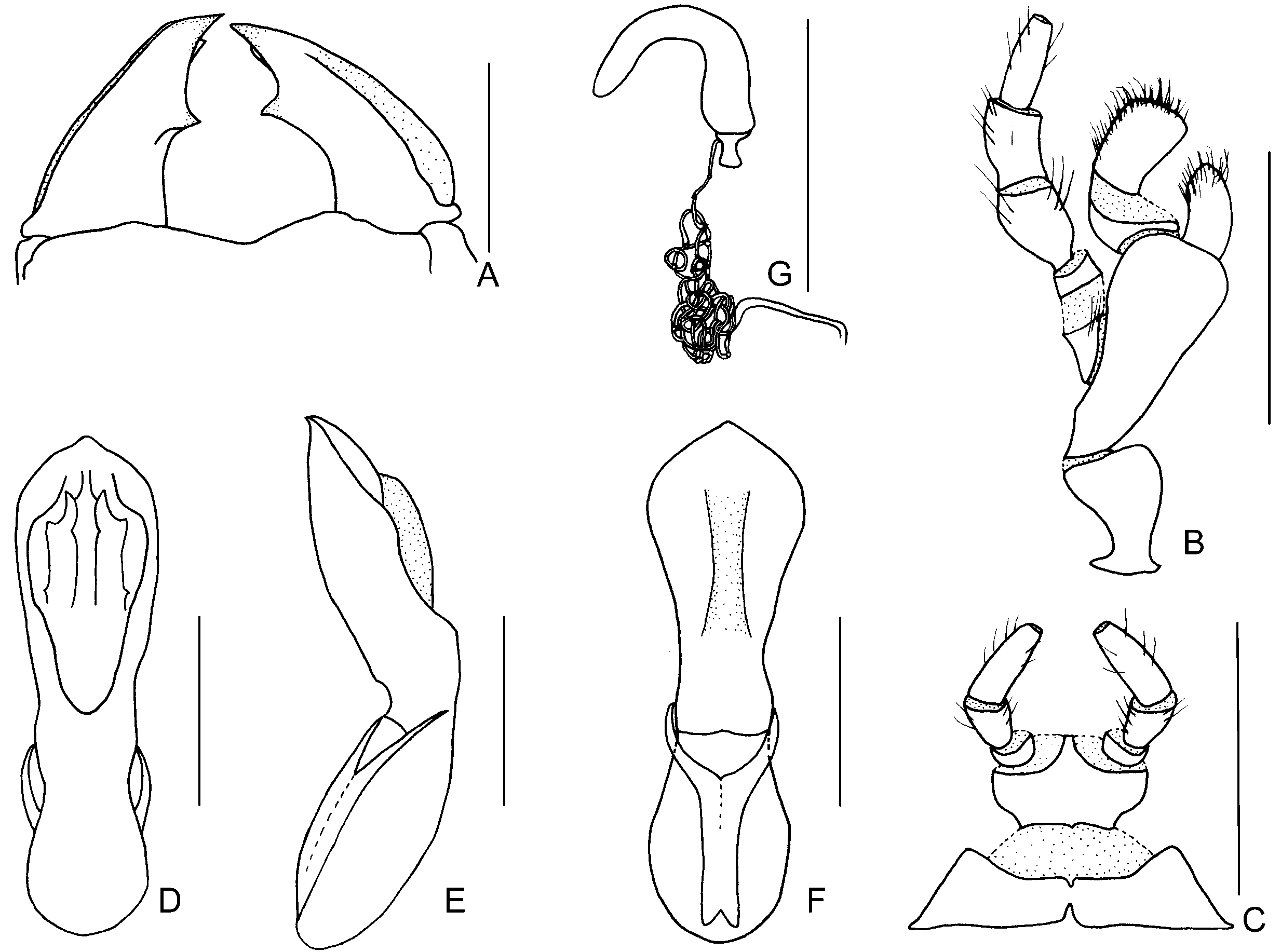
Head glabrous. Mandibles (Figure 2A) of male large, apex with three sharp teeth; labrum short, width about twice as long, central region convex, lateral angles round; length ratio of labial palpomeres: 0.4:1.1:2.6; length ratio of maxillary palpomeres: 0.5:2.3:2.0:2.6; gena wide and short, anterior margin slightly concave, posterior margin narrowly emarginated. Clypeus flat and broad, anterior margin nearly straight; frons slightly concave, glabrous; vertex convex, inside of eyes with sparse pubescence and fine punctures. Antennae extending to base of prothorax, 1st segment strongly swollen, spherical, 2nd as long as 3rd, short and narrower than 1st, 4th widely triangular, longer than 3rd, 5th–10th broad and serrate, last segment with sharp apex.
Prothorax transverse, width 2.2 times of length, glabrous, without any punctures; posterior margin sinuate; anterior and posterior angles broadly rounded. Scutellum triangular, apex slightly elevated over elytral surface.
Figure 1.
Coptocephala xinjiangensis Zhou, Duan & Wang, sp. nov.: (A). habitus; (B). lateral view of habitus; (C). spermatheca; (D). lateral view of aedeagus; (E). ventral view of aedeagus; (F). dorsal view of aedeagus; (G). apex of aedeagus; (H). ventral view of rectal sclerites; (I). dorsal view of rectal sclerites (scale bars: (A,B) = 0.5 mm, (C–I) = 0.2 mm).
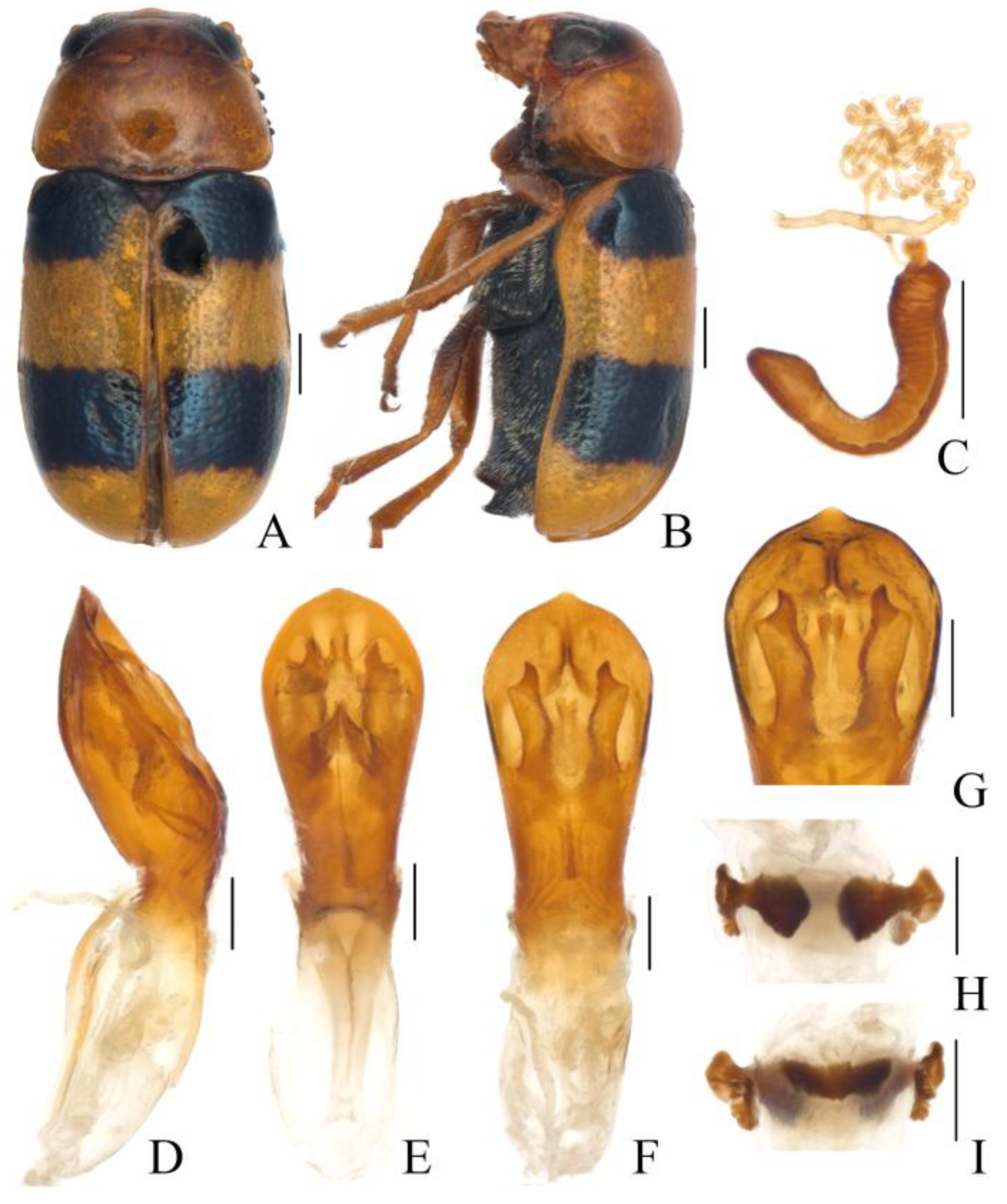
Figure 2.
Coptocephala xinjiangensis Zhou, Duan & Wang, sp. nov.: (A). mandibles; (B). maxilla; (C). labium; (D). dorsal view of aedeagus; (E). lateral view of aedeagus; (F). ventral view of aedeagus; (G). spermatheca (scale bars: 0.5 mm).
Elytron about 2.2 times as long as broad, nearly as wide as prothorax; disc with dense and coarse punctures, partly shallower on apical slope, interstices nearly without any minute punctures.
Undersides and legs thickly clothed with long silvery pubescence; apex of pygidium arcuate. Apex of foreleg tibia arched, longer than tibia of middle and hind leg distinctly.
Aedeagus (Figure 1D–G and Figure 2D–F) oblong, about 3.4 times as long as wide; bent ventrally, basal 2/3 paler and less sclerotized than apical 1/3; central region of apical part swollen.
Female. Body and head relatively small, frons narrow, mandibles small; apex of pygidium truncate; foreleg tarsus slender. Spermatheca (Figure 1C and Figure 2G) hook-shaped, duct thick, slightly sclerotized, irregularly coiling. Rectal sclerites strongly sclerotized, ventral rectal sclerites (Figure 1H,I) large, clubbed; dorsal central sclerites sub-trapezoidal; lateral sclerites large.
Distribution. China (Xinjiang).
Diagnosis. This new species Coptocephala xinjiangensis Zhou, Duan & Wang, sp. nov. is similar to C. zhaosuensis Tan, 1985 [32], but can be distinguished from each other the coloration of head and legs: the former with reddish brown ones, whereas the latter with metallic blue ones. The clypeus of new species with the straight anterior margin, rather than the slight concave one. The new species differs from the C. unifasciata (Scopoli, 1763) [33] (1) with the straighter (not sharply curved and interrupted) anterior and posterior margins of the black transverse bar at the behind-middle of elytra; (2) the aedeagus much wider and round at subapical part, thus the outline of the apex moderately and smoothly convergent to anterior end. And in lateral view, the anterior half and the posterior half with a larger angle at the middle; and (3) the spermatheca of the new species is more U-formed with normal (not widened) apical part, as shown in Rapilly (1981) [34].
Etymology. The specific epithet is named after the name (Pinyin) of the type locality, Xinjiang.
Key to Chinese species of the genus Coptocephala Lacordaire, 1848
- 1.
- Dorsal surface entirely blue with metallic lustre (body length males: 3.3 mm; females: 3.2–3.9 mm) ………………………………………………….. C. tani Regalin & Medvedev
- -
- Dorsal surface without above characters ………………………………………………… 2
- 2.
- Pronotum strongly convex, wider than elytra (body length males: 6.7–9.2 mm; females: 6.4–8.5 mm) ………………………………………………………… C. xiangchengensis Tan
- -
- Pronotum as wide as elytra or narrower ………………………………………………… 3
- 3.
- Head and legs largely reddish brown (body length males: 4.3–5.0 mm; females: 4.4–4.9 mm) ………………………………………… C. xinjiangensis Zhou, Duan & Wang, sp. nov.
- -
- Head and legs largely black ………………………………………………………………. 4
- 4.
- Large body, not less than 6 mm in male, up to now only in Tibet ………………………………………………………………………. C. vavilovi (Lopatin)
- -
- Small body, not up to 5.8 mm in length, other region in China but not in Tibet ……. 5
- 5.
- Labrum black, male body length 3.7–5.0 mm, females 3.6–5.5 mm……………………. …………………………………………………… C. orientalis Baly
- -
- Labrum pale reddish yellow, male body length males 5.8 mm, females 4.8 mm ………………………………………………………………………… C. zhaosuensis Tan
3.2. Cryptocephalus (Cryptocephalus) latitarsus Zhou, Duan & Wang, sp. nov. (Figure 3 and Figure 4)
LSIDurn:lsid:zoobank.org:act:7A44C826-0E8F-455B-8756-B054E7D709FD
Type locality. China: Yunnan, Mianning.
Type material examined. Holotype: male, China: Yunnan province, Mianning Chengguan, 1981.V.14, leg. Sha Guangzhong (IZ-CAS); Paratypes: 1 female, China: data as holotype (IZ-CAS); 1 male, Yunnan, Nanhua, 1982.IV.26, leg. Yu Peiyu (IZ-CAS); 1 female, Yunnan, Chuxiong, 1982.V.7, leg. Liao Subai (IZ-CAS); 1 female, Yunnan, Lijiang, 1979.VIII.13, leg. Liu Guoqing (IZ-CAS); 1 female, Yunnan, Lijiang, Yuhu, 1984.VII.22, leg. Wang Ruiqi (IZ-CAS); 1 female, Yunnan, Lijiang, Yuhu, 1984.VII.23, leg. Li Changfang (IZ-CAS); 1 female, Yunnan, Yongshen, 1955.VI.12, leg. unknown (IZ-CAS); 1 male, 1 female, Sichuan, Dechang, Wuxing, 1981.IV.15, leg. Gao Xianzhi (IZ-CAS); 1 female, Sichuan, Xichang, 1958.VII.8, leg. Song Shimei (IZ-CAS); 1 female, Sichuan, Xichang, Taihe, 1974.VII.17, leg. unknown (IZ-CAS); 1 female, Sichuan, Xichang, 1981.IV.20, leg. unknown (IZ-CAS).
Measurements. Length male 4.5–5.0 mm, female 6.0–6.8 mm.
Description. Body (Figure 3A,B). Head darkly reddish brown, antennal insertions surrounded by two brown circle; labrum yellowish brown, mandibles black; antennae yellowish brown on first four segments, black on terminal seven. Pronotum reddish brown, anterior margin yellow, basal margin black, and basal region pale yellow. Scutellum yellow, margins black. Elytron reddish brown, basal region and near sutural region yellow, humeral region with a small round black spot. Ventral entirely black, femora reddish brown.
Figure 3.
Cryptocephalus (s. str.) latitarsus Zhou, Duan & Wang, sp. nov.: (A), habitus; (B), lateral view of habitus; (C), spermatheca; (D), lateral view of aedeagus; (E), ventral view of aedeagus; (F), dorsal view of aedeagus (scale bars: (A,B) = 0.5 mm, (C–F) = 0.2 mm).
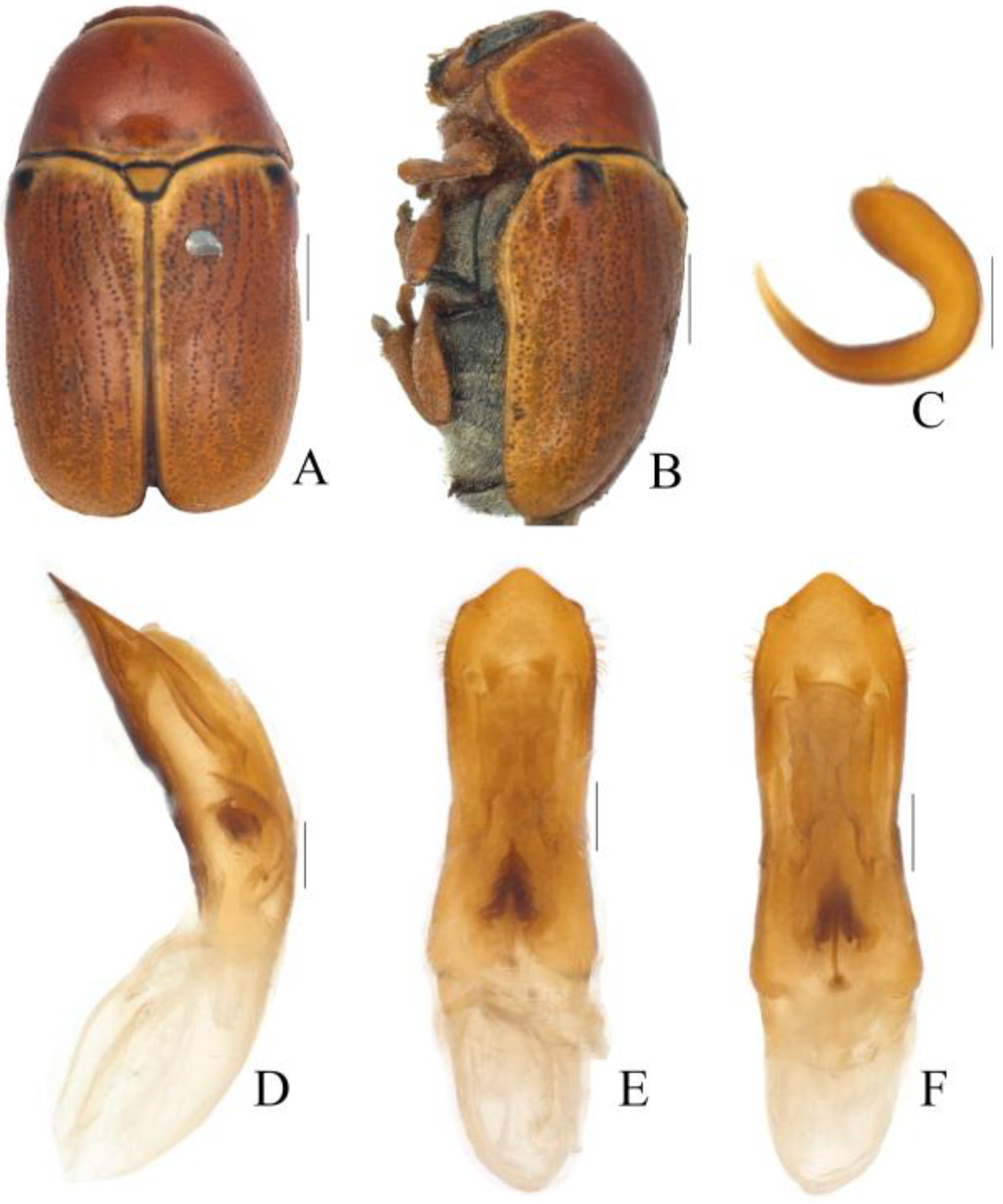
Figure 4.
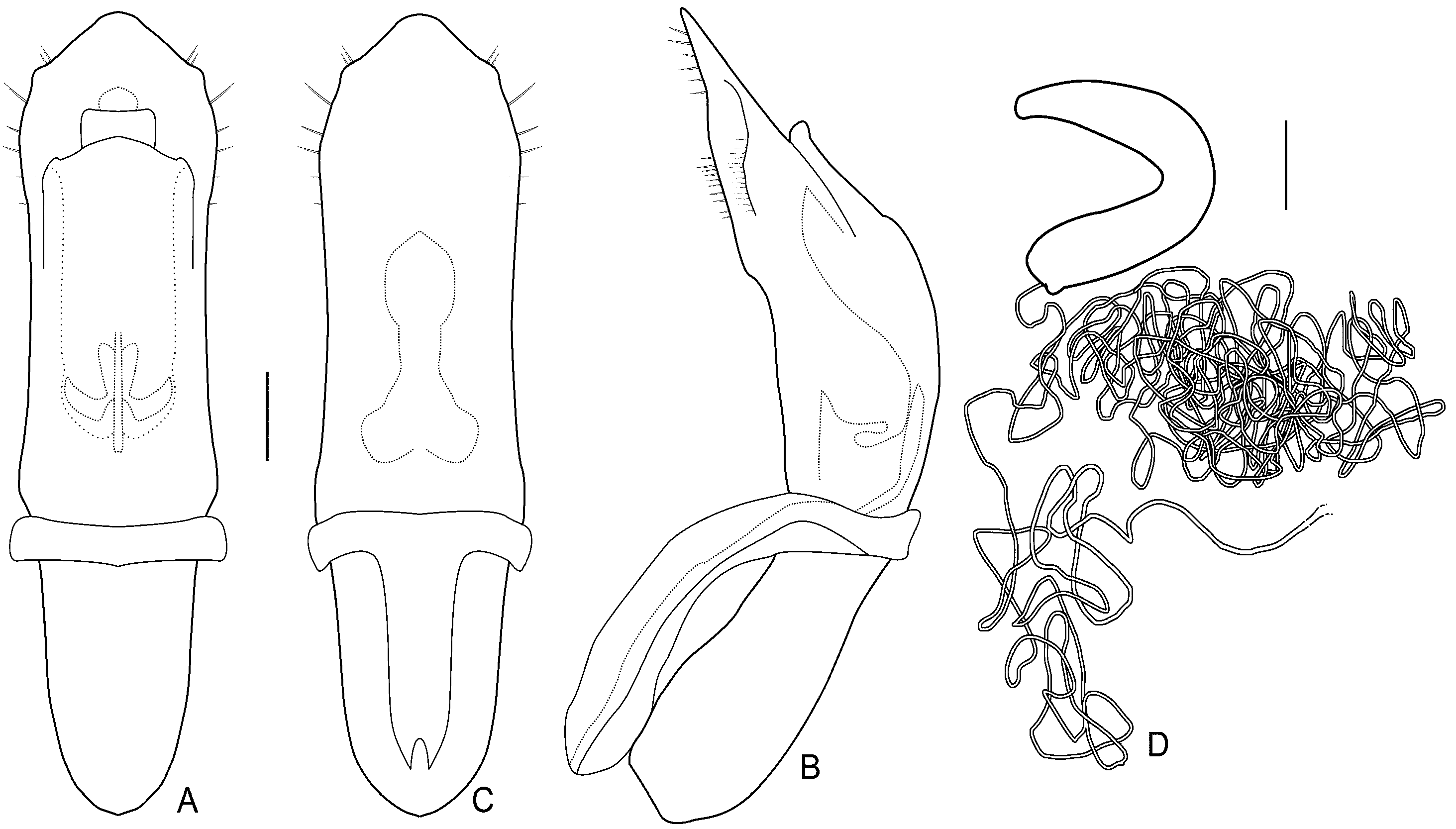
Cryptocephalus (Cryptocephalus) latitarsus Zhou, Duan & Wang, sp. nov.: (A). male genitalia in dorsal view; (B). male genitalia in lateral view; (C). male genitalia in ventral view; (D). Spermatheca. Scales = 0.2 mm.
Head more than one-half as broad as prothorax, nearly round in frontal outline, surface uneven, frons and vertex with sparse-coarse punctures and pubescence, vertex with a longitudinal groove. Eyes emarginated below middle, superior eye-lobes separated and slightly wider than antennal insertions. Clypeus uneven, with coarse and deep punctures, anterior margin concave, with long pubescence. Antennae of males long, reaching middle region of elytra; 1st segment clubbed, 2nd spherical, 2/5 as long as 1st; 1/2 as long as 3rd, 3rd–4th slender and short, 4th as long as 1st, and longer than 3rd, shorter than 5th, from 5th segment on about equal in length, broadened and flatted.
Pronotum slightly convex, nearly 0.58 time as long as broad, trapezoidal from dorsal view; anterior margin arcuate convex in anterodorsal view; basal margin sinuate and serrate, obtuse and truncate in middle; disc evenly convex, with dense but fine punctures. Scutellum trapezoidal, wider than length, loping upward apically, smooth and without punctures.
Elytron about 2.4 times as long as broad, humeri slightly prominent, glabrous, roundly truncated apically. Disc of each with eleven puncture rows somewhat oblique and regular, punctures deep and dense; interspaces without any minute punctures.
Ventral surfaces of body with rather dense but fine punctures and short pale pubescence. Prosternum length as 1.5 times as width, surface uneven, the middle part of anterior margin slightly protruding; posterior margin with a pair of protrusion. Mesoventrite anterior margin longer than posterior margin. Pygidium with densely fine punctures and short pubescence, posterior margin of male arcuate, middle legs tarsi broad, claws without teeth.
Aedeagus (Figure 3D–F and Figure 4A–C) elongate, clubbed, about 3.7 times as long as wide. Apex of median lobe triangular, strongly narrower than middle, slight rounded at apex, slightly curved in lateral view; with several short and dense pubescence on each side of apex, ventral part with punctures. Median orifice with middle sclerite bending inwards below surface. Inner sac rather thin, bell-shaped. Tegmen Y-shaped, slightly sclerotized.
Female. Body more robust than male. Antennae shorter than male; posterior margin of pygidium broad and round. Spermatheca (Figure 3C and Figure 4D) hook-shaped, acute-angled bending nearly to 1/2 from apex, very acute at apex; duct long, weakly sclerotized, irregularly coiling. Rectal sclerites weakly sclerotized, connected between two rectangular sclerites on ventral side.
Distribution. China (Sichuan, Yunnan).
Diagnosis. This new species is similar to Cr. (Cr.) nigriceps Allard, 1891 [35], but can be distinguished by the middle tarsi of male broad and by the anterior region of pronotum pale yellow with coarse and dense punctures.
Etymology. The specific epithet, latitarsus, is derived from the Latin terms “latus” and “tarsus”, it means that the males of this new species with broad tarsi.
3.3. Cryptocephalus (Cryptocephalus) subtricinctus Zhou, Duan & Wang, sp. nov. (Figure 5 and Figure 6)
LSIDurn:lsid:zoobank.org:act:B513F0C8-CBC9-41FF-8F36-37C02EB86268
Type locality. China: Hainan, Jianfengding.
Type material examined. Holotype: male, China, Hainan province, Jianfengding, 1982.VII.22, leg. Chen Zhiqing (IZ-CAS); Paratype: 1 female, Hainan, Jianfengding, 1982.VII.28, leg. Liu Yuanfu (IZ-CAS).
Measurements. Length male 4.7 mm, female 5.3 mm.
Description. Body (Figure 5A,B) medium size, yellowish brown or reddish brown. Head reddish brown, area between two eyes with small yellowish-brown spots; labrum yellowish brown, mandibles black; antennae yellowish brown on first four segments, black on terminal seven. Pronotum yellowish brown, median region with a reddish-brown longitudinal stripe, basal margin black. Scutellum reddish brown, margins black. Elytron reddish brown, upper side of basal margin with yellowish brown transverse band. Ventral entirely reddish brown, claws black.
Head nearly as broad as prothorax, nearly round in frontal outline, frons and vertex with sparse-coarse punctures and pubescence. Eyes emarginated in middle, superior eye-lobes separated and slightly narrow than antennal insertions. Clypeus uneven, with coarse and deep punctures, anterior margin nearly straight. Antennae of male broad and long, reaching middle region of elytra; 1st segment clubbed, 2nd oblong, 3rd shorter than 4th, 4th shorter than 5th, from 5th segment on about equal in length, broadened and flatted, last segment pointed.
Pronotum convex, smooth, nearly 0.49 time as long as broad, trapezoidal from dorsal view; anterior margin nearly straight in anterodorsal view; basal margin sinuate and serrate, obtuse and truncate in middle; disc evenly convex, with fine punctures. Scutellum triangular, wider than length, loping upward apically, smooth and without punctures.
Elytron about 2.3 times as long as broad, humeri weakly prominent, glabrous, roundly truncated apically, both sides near parallel. Disc of each with eleven puncture rows somewhat oblique and regular, punctures deep and dense; interspaces without any punctures.
Ventral surfaces of body with rather dense but fine punctures and sparsely short pale pubescence. Prosternum rectangle, length as 1.3 times as width, surface uneven, coarse, anterior margin arcuate concave, posterior margin straight, with two hind angles. Mesoventrite broad, posterior margin straight, surface uneven. Pygidium with densely coarse punctures and short pubescence. Claws without teeth.
Figure 5.
Cryptocephalus (s. str.) subtricinctus Zhou, Duan & Wang, sp. nov.: (A), habitus; (B), lateral view of habitus; (C), spermatheca; (D), lateral view of aedeagus; (E), ventral view of aedeagus; (F), dorsal view of aedeagus (scale bars: (A,B) = 0.5 mm, (C–F) = 0.2 mm).
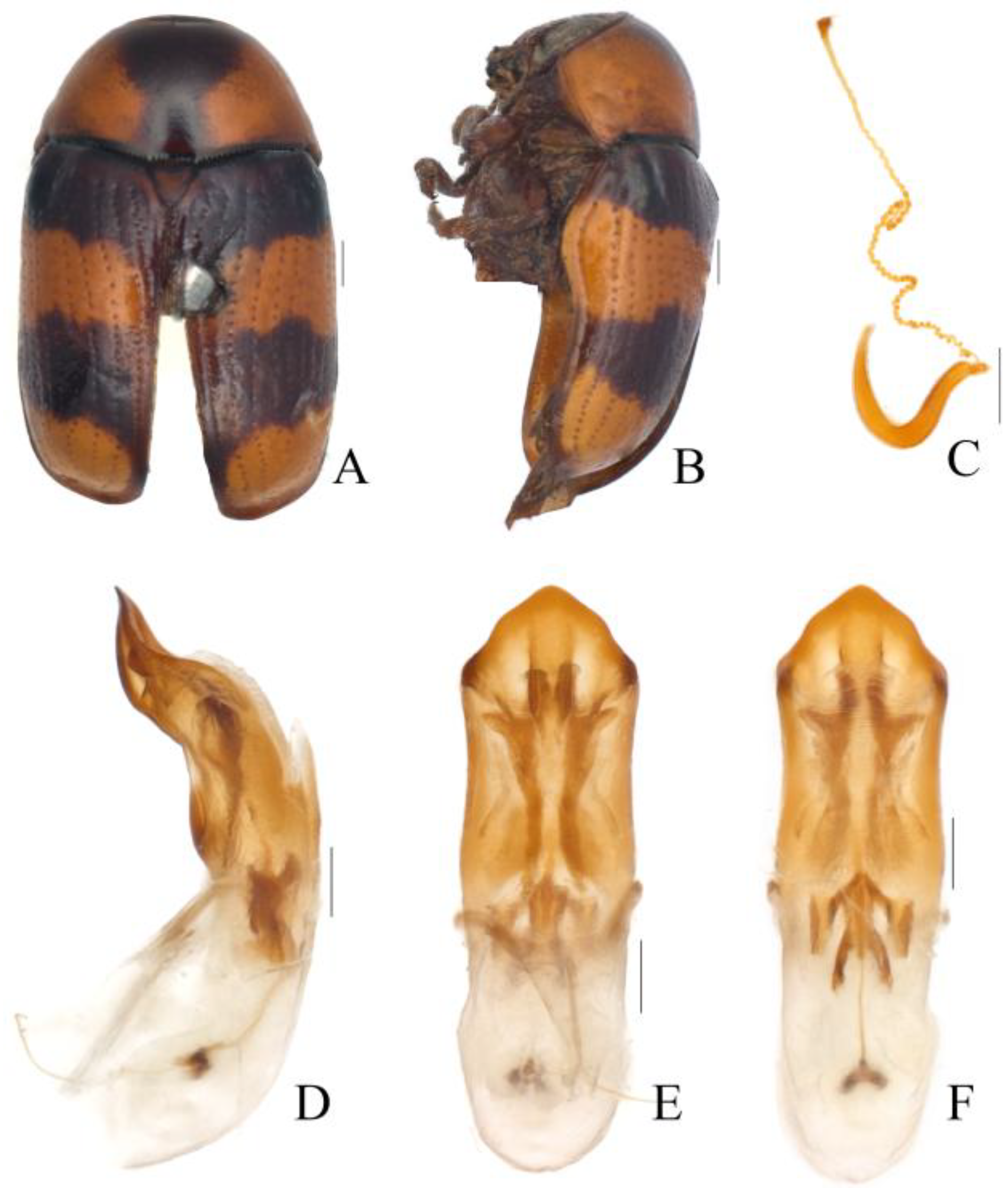
Aedeagus (Figure 5D,F and Figure 6A–C) elongate, arrow-shaped, about 3.4 times as long as wide. Apex of median lobe triangular, strongly narrower than middle, sharply round at apex, slightly curved in lateral view; with several without pubescence on each side of apex, without punctures. Median orifice with middle sclerite bending inwards below surface. Inner sac flower-shaped. Tegmen Y-shaped, slightly sclerotized.
Figure 6.
Cryptocephalus (Cryptocephalus) subtricinctus Zhou, Duan & Wang, sp. nov.: (A). male genitalia in dorsal view; (B). male genitalia in lateral view; (C). male genitalia in ventral view; (D). spermatheca. Scales = 0.2 mm.
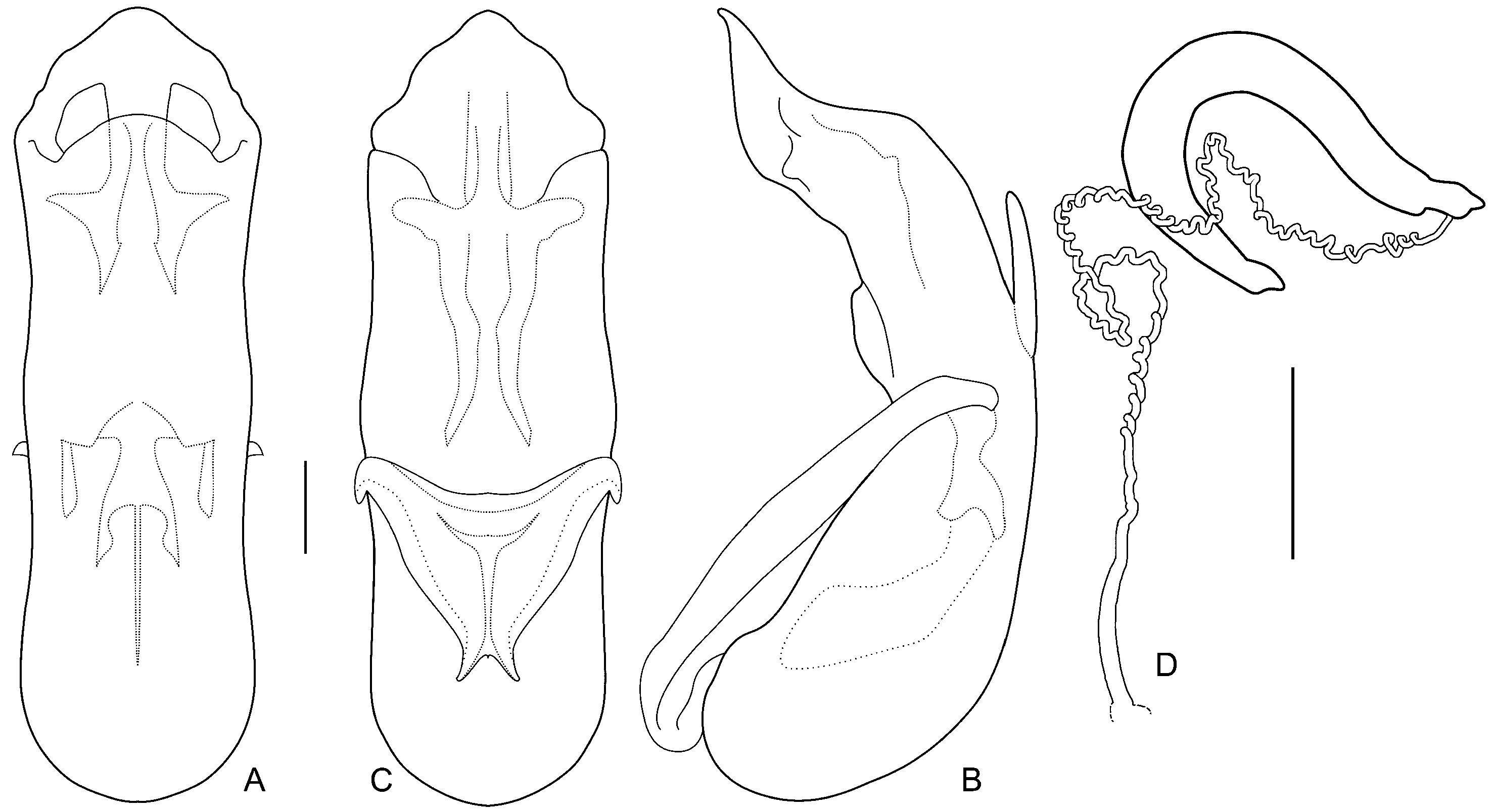
Female. Body more robust than male. Antennae shorter than in male; posterior margin of pygidium bluntly round. Spermatheca (Figure 5C and Figure 6D) thin, hook-shaped, acute-angled bending nearly to 1/2 from apex, very acute at apex; duct long, weakly sclerotized, spirally coiling. Rectal sclerites slightly sclerotized, not connected between two rectangular sclerites on ventral side.
Distribution. China (Hainan).
Diagnosis. This new species is similar to Cr. (Cr.) tricinctus Redtenbacher, 1884 [36], but can be distinguished by the margins of upper side reddish brown rather than black, basal region of pronotal stripe narrow and apex broad, ventral side of aedeagus with 6 protrudings.
Etymology. The specific epithet, “subtricinctus”, is derived from the Latin terms “sub-” and “tricinctus”; it means that this new species is similar with Cr. (Cr.) tricinctus.
4. Discussion
The genus Cryptocephalus Geoffroy, 1762 [3] is a megadiverse taxon comprising ca. 1800 known species from all over the world and these species display a wide and complicated zoogeographical distribution pattern [11,12,18,19,20,21,22,23] (Gressitt & Kimoto, 1961; Kimoto & Gressitt, 1981; Schöller, 2002; Lopatin et al., 2010; Warchałowski, 2010; Duan et al. 2021, 2025a,b). The genus has not been revised taxonomically as a whole in the last few decades (cf. Schöller, 2002) [23]. Indeed, it is very difficult to revise the whole genus taxonomically, and the same is true even if at the subgenus level. Many excellent works concentrating on local faunas have been published (e.g. [11,12,17,18,28,29]).
Schöller (2002) [23] listed a catalogue of ten subgenera in total and five of them were recorded to occur in China, namely, Anteriscus Weise, 1906 [24], Asionus Lopatin, 1988 [25], Burlinius Lopatin, 1965 [26], Cryptocephalus s. str., and Heterichnus Warchałowski, 1991 [27]. His study gives a practical way to study this megadiverse taxon, i. e. the taxonomic revision may be better at the subgenus level.
Indeed, effective approaches have been developed to divide species within a genus or subgenus into different species groups, and many previous taxonomists provided excellent cases in their studies [11,19,20,21,22,27,29,30], but as exhibited in those studies, not all species were able to be categorized into a group. There is a long way to go before a solution to this problem can be obtained. Here, we find two species of the subgenus Cryptocephalus that cannot be assigned to any species group and thus are examples as such.
Author Contributions
Conceptualization, H.Z., W.D. and F.W.; methodology, W.D. and F.W.; software, H.Z. and W.D.; validation, H.Z., W.D. and F.W.; formal analysis, H.Z., W.D. and F.W.; investigation, H.Z., W.D. and F.W.; resources, H.Z.; writing—original draft preparation, H.Z. and W.D.; writing—review and editing, H.Z. and W.D.; supervision, H.Z.; project administration, H.Z.; funding acquisition, H.Z. All authors have read and agreed to the published version of the manuscript.
Funding
This research was funded by the Ministry of Science and Technology of the People’s Republic of China (No. 2015FY210300).
Data Availability Statement
The original contributions presented in this study are included in the article. Further inquiries can be directed to the corresponding author.
Acknowledgments
We want to thank the anonymous reviewers for their many valuable and important suggestions to improve this manuscript. We also want to thank Liang Su (Beijing, China) for her help in preparing some line drawing plates.
Conflicts of Interest
The authors declare no conflicts of interest.
References
- Chevrolat, L.A.A. Chrysomelidae [Livraison 5, pp. 361–442]. In Dejean P F A M. Catalogue des Coléoptères de la Collection de le M. le Comte Dejean. Deuxième Edition, Revue, Corrigée et Augmentée; Méquignon-Marvis Père et Fils: Paris, France, 1836. [Google Scholar]
- Kirby, W. Part the fourth and last. The insects. In Richardson J. Fauna Boreali-Americana; or the Zoology of the Northern Parts of British America: Containing Descriptions of the Objects of Natural History Collected on the Late Northern Land Expedition, Under Command of Captain Sir John Franklin, R. N.; J. Fletcher: Norwich, UK, 1837; pp. xxxix + 325 + [1] pp., 8pl. [Google Scholar]
- Geoffroy, E.L. Histoire Abrégée des Insectes Qui se Trouvent Aux Environ de Paris, Dans Laquelle Ces Animaux Sont Rangés Suivant un Ordre Méthodique. Tome Première; Durand: Paris, France, 1762; pp. [4] + xxxviii + 523 + [1], 10 pls; [Reissued in identical edition in 1764]. [Google Scholar]
- Gyllenhal, L. Insecta Suecica Descripta. Class I. Coleoptera sive Eleutherata. Tome 1 pars III; Scaris: Leverentz, Germany, 1813; pp. [4] + 730 + [2]. [Google Scholar]
- Regalin, R.; Medvedev, L.N. Chrysomelidae: Cryptocephalinae: Clytrini. In Catalogue of Palaearctic Coleoptera; Löbl, I., Smetana, A., Eds.; Chrysomeloidea; Apollo Books: Stenstrup, Denmark, 2010; Volume 6, pp. 564–580. [Google Scholar]
- Chamorro, M.L. Chrysomelidae: Cryptocephalinae Gyllenhal 1813. In Handbook of Zoology. Volume 4. Coleoptera, Beetles. Morphology and Systematics (Phytophaga); Leschen, R.A.B., Beutel, R.G., Eds.; De Gruyter: Berlin, Germany, 2014; Volume 4, pp. 230–236. [Google Scholar]
- Bezděk, J.; Sekerka, L. Catalogue of Palaearctic Coleoptera, Vol. 6/2/1. Chrysomeloidea II, 2nd ed; Brill: Leiden, The Netherlands; Boston, MA, USA, 2024; pp. 1–750. [Google Scholar]
- Clavareau, C.H. Pars 53: Chrysomelidae: 5. Megascelinae, 6. Magalopodinae, 7. Clytrinae, 8. Cryptocephalinae, 9. Chlamydinae, 10. Lamprosominae. In Coleopterorum Catalogus; Schenkling, S., Ed.; W. Junk: Berlin, Germany, 1913; pp. 1–278. [Google Scholar]
- Monrós, F. Some corrections in the nomenclature of Clytrinae (Chrysomelidae). Coleopt. Bull. 1953, 7, 45–50. [Google Scholar] [CrossRef] [Scilit]
- Löbl, I.; Smetana, A. Catalogue of Palaearctic Coleoptera, Vol. 6. Chrysomeloidea; Apollo Books: Stenstrup, Denmark, 2010; pp. 1–924. [Google Scholar]
- Gressitt, J.L.; Kimoto, S. The Chrysomelidae (Coleopt.) of China and Korea, part 1. Pac. Insects Monogr. 1961, 1A, 1–299. [Google Scholar]
- Kimoto, S.; Gressitt, J.L. Chrysomelidae (Coleoptera) of Thailand, Cambodia, Laos and Vietnam. 2. Clytrinae, Cryptocephalinae and Chlamisinae, Lamprosomatinae and Chrysomelinae. Pac. Insects 1981, 23, 286–391. [Google Scholar]
- Tan, J.-J.; Wang, S.-Y.; Zhou, H.-Z. Coleoptera. Eumolpidae. Eumolpinae. Fauna Sinica. Insect; Science Press: Beijing, China, 2005; Volume 40, pp. 1–415. [Google Scholar]
- Gómez-Zurita, J.; Cardoso, A. Molecular systematics, higher-rank classification and Gondwanan origins of Cryptocephalinae leaf beetles. Zool. Scr. 2021, 50, 592–615. [Google Scholar] [CrossRef] [Scilit]
- Haddad, S.; McKenna, D.D. Phylogeny and evolution of the superfamily Chrysomeloidea (Coleoptera: Cucujiformia). Syst. Entomol. 2016, 41, 697–716. [Google Scholar] [CrossRef] [Scilit]
- Olivier, A.G. Entomologie, ou Histoire Naturelle des Insects, Avec Leurs Carctères Génériques et Spécifiques, Leur Description, Leur Synonymie et Leur Figure Enluminée. Coleopteres. Tome Sixième; Desray: Paris, France, 1808; pp. [4] + 613–1104, 46 pls. [Google Scholar]
- Lacordaire, J.T. Monographie des coléoptères subpentamères de la famille des phytophages. Tome second. Mém. Société R. Sci. Liége 1848, 5, vi+890. [Google Scholar]
- Lopatin, I.K.; Smetana, A.; Schöller, M. Chrysomelidae: Cryptocephalinae: Remaining Cryptocephalini: Genus Cryptocephalus. In Catalogue of Palaearctic Coleoptera, Chrysomeloidea; Löbl, I., Smetana, A., Eds.; Apollo Books: Stenstrup, Denmark, 2010; Volume 6, pp. 580–606. [Google Scholar]
- Warchałowski, A. The Palaearctic Chrysomelidae: Identification Keys; Natura optima dux Foundation: Warszawa, Poland, 2010; Volume 1, p. 629p. [Google Scholar]
- Duan, W.-Y.; Wang, F.-Y.; Zhou, H.-Z. Taxonomy of the Cryptocephalus heraldicus Group (Coleoptera: Chrysomelidae, Cryptocephalinae) from China. Diversity 2021, 13, 451. [Google Scholar] [CrossRef] [Scilit]
- Duan, W.-Y.; Wang, F.-Y.; Zhou, H.-Z. Four New Species and Three New Country Records for the Cryptocephalus trifasciatus Group (Coleoptera: Chrysomelidae: Cryptocephalinae) from China. Zootaxa 2025, 5653, 535–552. [Google Scholar] [CrossRef] [Scilit]
- Duan, W.-Y.; Wang, F.-Y.; Zhou, H.-Z. Two new species and one new country record for the Cryptocephalus parvulus group (Coleoptera: Chrysomelidae: Cryptocephalinae) from China. Zootaxa 2025, 5691, 341–352. [Google Scholar] [CrossRef] [Scilit]
- Schöller, M. Taxonomy of Cryptocephalus Geoffroy (Chrysomelidae: Cryptocephalinae). Mitteilungen Int. Entomol. Ver. Frankf. A. M. 2002, 27, 59. [Google Scholar]
- Weise, J. Ostafrikanische Chrysomelen und Coccinellen. Dtsch. Entomol. Z. 1906, 1906, 35–64. [Google Scholar]
- Lopatin, I.K. Asionus Lopatin, nom. n. pro Asiopus Lopatin, 1965. Vestn. Zool. 1988, 2, 8. [Google Scholar]
- Lopatin, I.K. Systematic notes on Cryptocephalus Geoffr. (Coleoptera, Chrysomelidae). Acta Entomol. Bohemoslov. 1965, 62, 451–457. [Google Scholar]
- Warchałowski, A. The establishment of a new sub-genus Homalopus Chevrolat, 1837 (Coleoptera, Chrysomelidae, Cryptocephalidae). Pol. Pismo Entomol. 1991, 61, 75–78. [Google Scholar]
- Linnaeus, C. Systema Naturae per Regna Tria Naturae, Secundum Classes, Ordines, Genera, Species, Cum Characteribus, Differentiis, Synonymis, Locis; Editio Decima, reformata; Laurentius Salvius: Stockholm, Sweden, 1758; pp. iv + 824. [Google Scholar]
- White, R.E. A review of the genus Cryptocephalus in America North of Mexico (Crhysomelidae: Coleoptera). U. S. Natl. Mus. Bull. 1968, 290, 1–124. [Google Scholar] [CrossRef] [Scilit]
- Chen, S.H. Synopsis of the coleopterous genus Cryptocephalus of China. Sinensia 1942, 13, 109–124. [Google Scholar]
- Schöller, M. Comparative morphology of sclerites used by Camptosomatan leaf beetles for formation of the extrachorion (Chrysomelidae: Cryptocephalinae, Lamprosomatinae). In Research on Chrysomelidae (Vol. 1); Jolivet, P., Santiago-Blay, J., Schmitt, M., Eds.; Brill: Leiden, The Netherlands, 2008; pp. 87–173. [Google Scholar]
- Huang, D.-S.; Han, Y.; Zhang, X. The insects fauna of the Mt. Tuomuer area in Tianshan. In Dengshan Kexue Kaochadui [Biota of Tuomuer region, Tianshan]; Xinjiang People’s Press: Urumqi, China, 1985; pp. 1–353. [Google Scholar]
- Scopoli, J.A. Entomologia Carniolica: Exhibens Insecta Carnioliae Indigena et Distributa in Ordines, Genera, Species, Varietates. Methodo Linnaeana; Ioannis Thomae Trattner: Vindobonae, Austria, 1763; pp. xxxii + 420 + [4] pp. 3 pls. [Google Scholar]
- Rapilly, Y.M. Révision des espèces françaises du genre Coptocephala (Coleoptera, Chrysomelidae). L’Entomologiste 1981, 37, 53–78. [Google Scholar]
- Allard, E. Collection d’insectes formée dans l’Indo-Chine par M. Pavie consul de France au Cambodge. Coléoptères. Phytophages. Nouv. Arch. Muséum d’Histoire 1891, 3, 229–234. [Google Scholar]
- Redtenbacher, L.; Kollar, V. Aufzählung und Beschreibung der von Freiherrn Carl von Huegel auf seiner Reise durch Kaschmir u. das Himalayagebirge gesammelten Insecten. In Hügel K F von. Kaschmir und das Reich der Siek; Vierter Band; Hallbergerischer Verlag: Stuttgart, Germany, 1844; Volume 4, Part 2, p. 482. pp. 393–564. [Google Scholar]
Disclaimer/Publisher’s Note: The statements, opinions and data contained in all publications are solely those of the individual author(s) and contributor(s) and not of MDPI and/or the editor(s). MDPI and/or the editor(s) disclaim responsibility for any injury to people or property resulting from any ideas, methods, instructions or products referred to in the content. |
© 2026 by the authors. Licensee MDPI, Basel, Switzerland. This article is an open access article distributed under the terms and conditions of the Creative Commons Attribution (CC BY) license.