


Abstract
Colocasia kerrii Gagnep. has been treated as a synonym of C. fallax Schott in both the Flora of China and the Flora of Thailand accounts of Colocasia. However, detailed examination of the type material and additional specimens clearly demonstrates that C. kerrii is a distinct species. It can be readily distinguished from C. fallax and other species of Colocasia by the combination of the following characters: a spathe that is only strongly constricted between the spathe base and limb; a spathe limb reflexed and slightly coiled at staminate anthesis; a sessile or subsessile spadix; subsessile stigmas with very short styles; and a sterile zone between the pistillate and staminate zones nearly as long as the pistillate zone and covered with elongate, rhombo-hexagonal synandrodes. The specific status of C. kerrii is therefore reinstated. It is compared with the later described C. bicolor C.L.Long & L.M.Cao, which is here placed in synonymy. The name Colocasia kerrii Gagnep. is lectotypified, and an amended description, updated distribution data, ecological notes, and a preliminary IUCN conservation assessment are provided.
1. Introduction
The tribe Colocasieae Engl. sensu Hay and Prameswara [1] is recognized as a well-supported clade in recent molecular phylogenetic studies [2,3,4,5,6,7] and comprises four genera: Ariopsis Nimmo, Colocasia Schott, Remusatia Schott, and Steudnera K.Koch [1]. The genus Colocasia includes Colocasia esculenta (L.) Schott, commonly known as taro, an ancient starchy staple and leafy vegetable cultivated across tropical and temperate regions [8,9]. It is consumed by billions of people worldwide and has a long and well-documented history of domestication throughout Asia, the Pacific and other tropical regions [8,9]. Species of Colocasia are terrestrial or helophytic, occurring in wet habitats such as stream and pond margins, in forest floor leaf litter, or in humus-filled limestone crevices across tropical humid forests from India to China and Indochina and extending into Malesia [1,10]. Their potential distribution into Australia remains uncertain due to the widespread cultivation of the edible C. esculenta and its recurring tendency to revert to wild-type forms [11].
Currently, there is no settled consensus on the number of Colocasia species. In his synopsis of the genus in Malesia and Australia, Hay [12] recognized eight species. Since then, additional new species have been described from China, India, Myanmar, and Vietnam (e.g., [13,14,15]). As of 2026, Plants of the World Online accepts 14 species [16], while Boyce et al. [17] list 20 accepted species and estimate that the genus may comprise as many as 30 species worldwide. Due to the lack of consensus on species delimitation, comprehensive taxonomic revision of the genus Colocasia remains necessary across its entire distributional range.
As part of the first author’s ongoing revisionary work on the genus Colocasia, he had the opportunity to examine one of the original materials of Colocasia kerrii Gagnep. [18], Garrett 977, housed at the Forest Herbarium, Bangkok (BKF). The specimen is in good condition and allows for detailed observation of reproductive characters. In the Flora of China account of Colocasia [19], C. kerrii is treated as a synonym of C. fallax Schott [20], which is also the treatment adopted in the Flora of Thailand [21]. However, our re-examination of high-resolution images of the type specimens of C. fallax at the Herbarium of the Royal Botanic Gardens, Kew (K) [barcodes K000499479, K000499480, K002820380], reveal that the reproductive characteristics of C. fallax differ remarkedly from those of C. kerrii (see detailed morphological comparison in the Results), supporting their recognition as distinct species.
This study aims to clarify the taxonomic status of C. kerrii. We reinstate it as a distinct species, designate a lectotype in accordance with the International Code of Nomenclature for algae, fungi, and plants (Madrid Code) Art. 9.3, 9.11 and 9.12 [22], and provide an amended description based on type material, voucher herbarium specimens and spirit collections, colour photographs, and comparisons with allied species. Updated distribution data, ecological information, and a preliminary conservation assessment are also presented.
2. Materials and Methods
Measurements and morphological descriptions were based on voucher herbarium specimens and spirit-preserved material. Araceae morphological terminology follows Mayo et al. [10], with general terminology standardized according to Beentje [23]. However, instead of using the term ‘inflorescence’ [10], which is conventionally applied to the spathe and spadix, we adopt the term ‘anthomorph’ as proposed by Wong et al. [24] to achieve family-specific precision, as there is considerable evidence suggesting the spathe and spadix is not an inflorescence per se, but rather a hybrid structure with functional and structural attributes of both a flower and an inflorescence simultaneously. We also avoid the term ‘spathe tube’ [10], as the margins of the basal portion of the spathe in Colocasia are not connate and therefore do not form a true tube. Instead, we follow Hetterscheid and Boyce [25], in which the ‘spathe base’ refers to the lower portion formed by convolute margins and the ‘spathe limb’ refers to the upper expanded portion, with the two regions being separated by a constriction.
The relevant literature including protologues and type specimens of Coloasia were examined. Herbarium acronyms conform to the Index Herbariorum [26]. Material deposited in BCU, BKF, CMU, CMUB, KKU and HN was physically examined by the first author (KZH). Additional specimens from A, C, CAS, K, L, MO and P herbaria were examined using high-resolution images accessed through the Global Plants JSTOR platform (https://plants.jstor.org/) and the Global Biodiversity Information Facility (GBIF) (https://www.gbif.org/), whereas material from HITBC, HNNU, KUN and PE was examined using high-resolution images accessed through the Chinese Virtual Herbarium (https://www.cvh.ac.cn). Phenological and ecological information of C. kerrii and its distribution were derived from voucher labels associated with herbarium specimens. A map was created using QGIS version 3.34 [27] and the geographic coordinate system WGS 84, EPSG 4326. Conservation status was assessed following IUCN guidelines [28] using their terminology for categories, criteria and subcriteria. The extent of occurrence (EOO) was estimated using GeoCAT [29]. The articles of the International Code of Nomenclature for algae, fungi, and plants follow the current edition, i.e., Madrid Code [22], hereafter cited as “ICN”.
3. Results
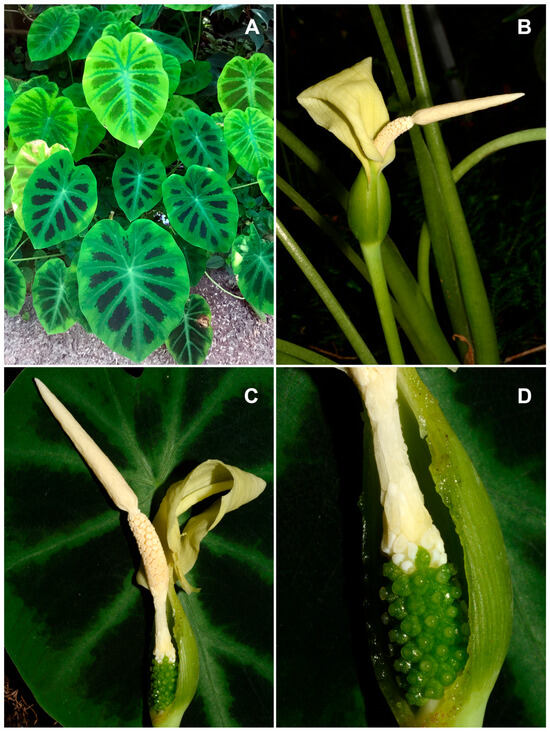
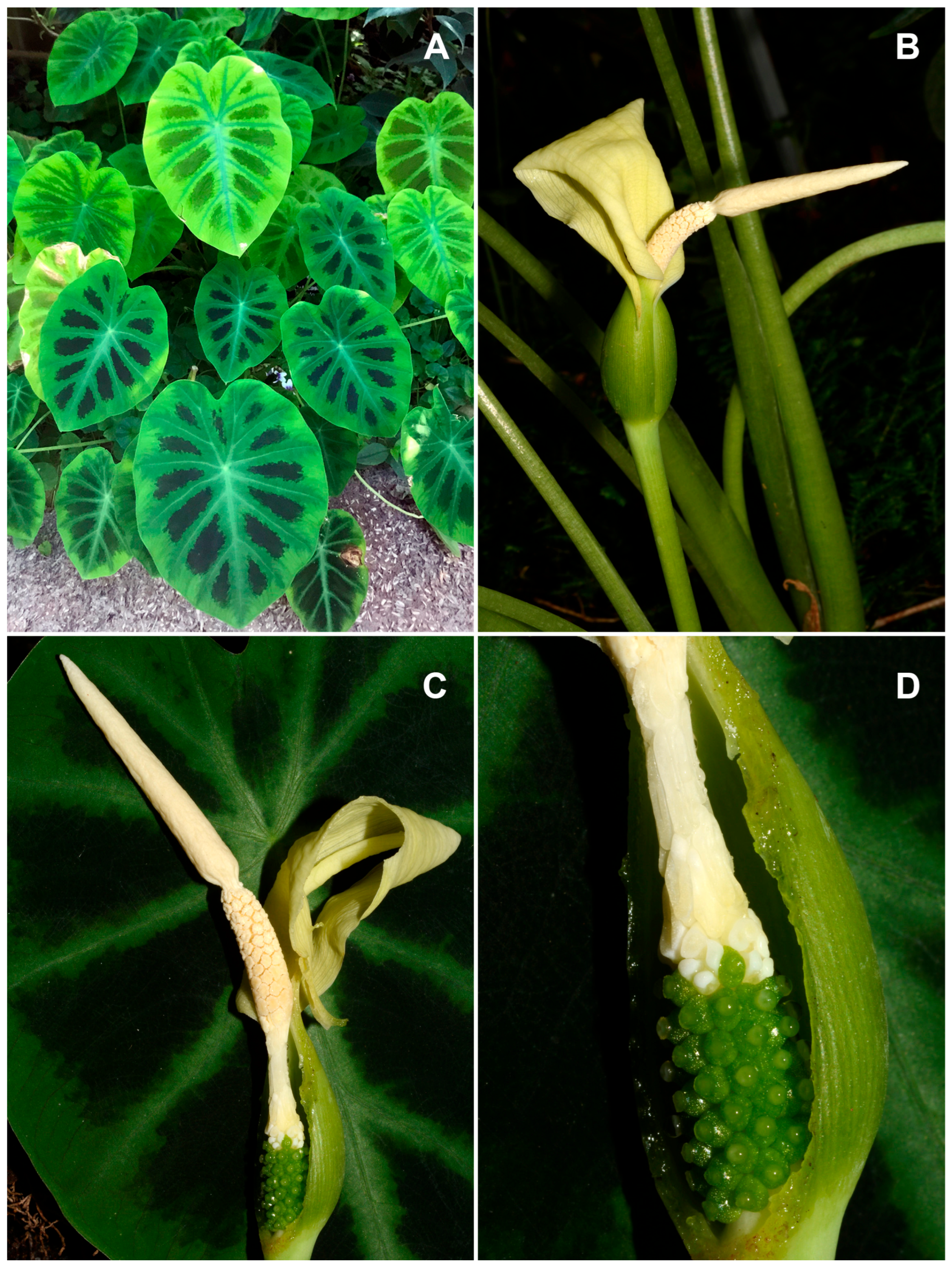
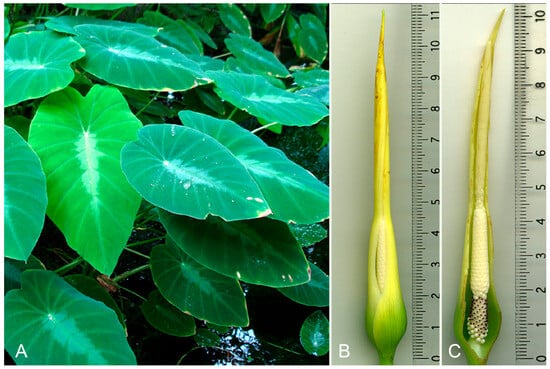
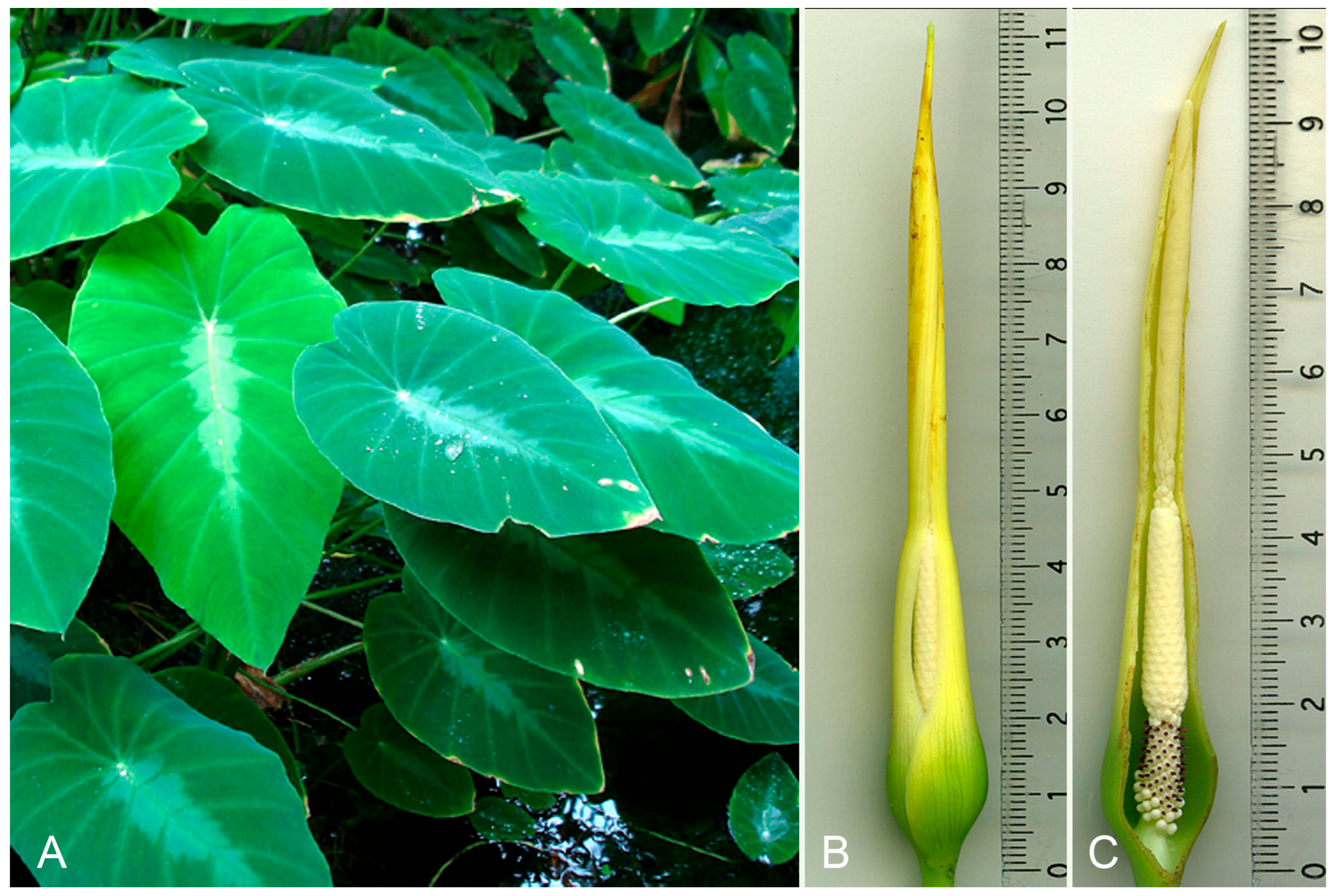
Colocasia kerrii was described by François Gagnepain (1866–1952). In the protologue, Gagnepain [18] cited a single collection by H.B.G. Garrett, number 997, collected from Doi Chiang Dao in Chiang Mai Province, Northern Thailand. We traced and re-examined three sheets of Garrett 997 at K [barcode K000291418, K000291419, K000291420] and one duplicate at BKF [barcode SN080138], all of which possess well-preserved flowering materials. We also re-examined the protologue [20] and all available type materials of Colocasia fallax at K [barcodes K000499479, K000499480, K002820380]. Our re-examination revealed notable differences in the structure of the anthomorphs between the two taxa: (1) the spathe of C. kerrii is only strongly constricted between the spathe base and spathe limb (Figure 1B), whereas in C. fallax it is very faintly constricted in this region with an additional faint constriction at the basal one-third of the spathe limb (Figure 2B); (2) the spathe limb of C. kerrii is reflexed and slightly coiled at staminate anthesis (Figure 1B), while it remains erect throughout anthesis in C. fallax (Figure 2B); (3) the spadix of C. kerrii is sessile or subsessile (Figure 1C), in contrast to the distinctly stipitate spadix of C. fallax (Figure 2C); (4) the stigmata of C. kerrii are subsessile with very short styles (Figure 1D), whereas the styles are prominent in C. fallax (Figure 2C); and (5) the sterile zone between the pistillate and staminate zones in C. kerrii is nearly as long as the pistillate zone and is covered with elongate, rhombo-hexagonal synandrodes (Figure 1C), while in C. fallax the sterile zone is much shorter than the pistillate zone and bears one or two incomplete rows of non-elongate rhombo-hexagonal synandrodes (Figure 2C). Based on these significant differences (see also Table 1), Colocasia kerrii should be recognized as a distinct species.
Figure 1.
Colocasia kerrii Gagnep. (A)—Cultivated plants, (B)—anthomorph at staminate anthesis (the spathe limb reflexed and slightly coiled), (C)—spadix at staminate anthesis (nearside spathe artificially removed), (D)—detail of spadix showing pistillate zone and sterile zone. Photos by David Scherberich.
Figure 2.
Colocasia fallax Schott. (A)—Cultivated plants, (B)—anthomorph at pistillate anthesis, (C)—spadix at pistillate anthesis (nearside spathe artificially removed). Photos by David Scherberich.
Table 1.
Morphological comparison of Colocasia kerrii Gagnep. and C. fallax Schott.
Additionally, while reviewing the nomenclature of Colocasia, we remarked that Colocasia bicolor C.L.Long & L.M.Cao [30] is treated as a synonym of C. affinis Schott [20] by Li and Boyce [19]. Cao and Long [30] described C. bicolor based on material collected from Mengla County, Yunnan Province, China, and designated C.-L. Long & L.-M. Cao 02085 at KUN as the holotype. However, we were unable to examine the type materials at KUN because both the holotype and the cited paratypes are currently missing (presumably temporarily misplaced). A careful re-examination of the protologue of C. bicolor, which includes a clear and detailed illustration of the holotype drawn by Yi-Tao Liu [30] (p. 284), shows that it is a stoloniferous herb with a condensed hypogeal stem and peltate leaves bearing dark purple blotches adaxially between the primary lateral veins. Most critically, the spathe is strongly constricted between the spathe base and the lanceolate spathe limb, which becomes reflexed and slightly coiled at staminate anthesis, and the spadix has a sterile zone nearly as long as the pistillate zone and covered with elongate rhombo-hexagonal synandrodes. Although the purple-blotched leaves correspond to those of C. affinis, the anthomorph morphology of C. bicolor does not resemble that of C. affinis, which lacks a distinct constriction between the spathe base and spathe limb and has an oblong-lanceolate spathe limb. In contrast, both the vegetative and reproductive characters of C. bicolor agree with those of C. kerrii. We therefore conclude that C. bicolor is conspecific with C. kerrii and place it here in synonymy.
Taxonomic Treatment
Colocasia kerrii Gagnep., Notul. Syst. (Paris) 9: 130 (1941) (Figure 1A–D).
Type: THAILAND. Northern: Chiang Mai Province, Doi Chiang Dao [Doi-xieng-dao], steep slope southwest of Ban Tam, in earth pockets among limestone rocks, elev. 730 m, 15 August 1935, H. B. G. Garrett 977 (Lectotype: K-image! [barcode K000291420] designated here; Isolectotypes: K-image! [barcode K000291418, K000291419], BKF! [barcode SN080138]).
= Colocasia bicolor C.L.Long & L.M.Cao, Ann. Bot. Fenn. 40 (4): 283 (2003), syn. nov.
Type: CHINA. Yunnan Province, Mengla, in moist shady places, elev. 980 m, 22 June 2002, C.-L. Long, & L.-M. Cao 02085 (Holotype: KUN, not found).
Description: Small- to medium-sized, lithophytic or terrestrial, mesophytic, seasonally dormant, stoloniferous herbs, forming colonies, 20–60 cm tall. Stem hypogeal, condensed, 1.0–1.5 cm in diam., emitting two–three hypogeal stolons; stolons horizontal, up to 40 cm long; internodes 2.5–9.0 cm long, 1–3 mm in diam., producing small, ovoid tubercles at nodes. Roots filiform, ca. 0.5 mm in diam., tough, flexuous, white. Leaves two–seven together; petioles erect, 11–46 cm long, 0.5–1.0 cm in diam. at base, 0.2–0.3 cm in diam. at apex, terete, glabrous, pale green; petiolar sheath 5–17 cm long, 1/3 to 1/2 of petiole length, persistent, wings membranous, coloured as for petiole; leaf blade (broadly) ovate-cordate, peltate, 7–20 cm long, 4.5–14.5 cm wide, widest at slightly distal to junction of petiole, chartaceous to membranous, glabrous on both sides, adaxially medium or dark green, (usually) with dark purple blotches between the primary lateral veins, abaxially (slightly) glaucous pale green, margins entire; anterior lobe 4.5–13.0 cm long, apex acute or obtuse, mucronate with mucro 1–5 mm long; anterior costa more or less flush with the leaf blade adaxially, slightly raised abaxially, with three–four primary lateral veins on each side (including one basal vein running to petiole/anterior costa nexus), diverging at 45–60° proximally, the distal ones at ca. 30°, running almost straight to the margin and joining into a submarginal (intramarginal) collective vein; one marginal vein present; interprimary veins irregularly alternating with primaries, somewhat less conspicuous than primaries; secondary venation arising from the primaries at a wide angle, then arching strongly towards leaf margin, not forming interprimary collective veins (or rarely forming a weak interprimary collecting vein), flushed with the leaf blade adaxially and abaxially; higher order venation reticulate; posterior lobes 2.1–8.4 cm long, united for 60–70% of their length, except for an acute to rather obtuse notch between the rounded tips of the posterior lobes; posterior costae diverging at 30–50°. Anthomorphs one or two (rarely three) together; peduncle 6–21 cm long, 2–4 cm in diam., erect to slightly arching at anthesis, slender, terete, glabrous, pale green; spathe 6–12 cm long, strongly differentiated into a spathe base and a spathe limb by a constriction; spathe base ellipsoid–ovoid, 1.6–4.2 cm long, 0.6–1.8 cm in diam., glabrous, externally uniformly medium green, internally pale green, margin free, convolute; spathe limb lanceolate, 4–9 cm long, 1.5–3.3 cm wide at widest point, glabrous, externally and internally pale green before anthesis, becoming pale yellowish white during and after anthesis, erect at first, and then upper half sharply reflexed and slightly coiled at staminate anthesis, margins entire, revolute (at staminate anthesis), apex acuminate. Spadix 4.5–8.5 cm long, shorter than spathe, subsessile or shortly stipitate; pistillate zone cylindric, 0.8–1.0 cm long, 5–8 mm in diam.; pistils congested, not interspersed with staminodes (rarely with the basalmost pistils sterile, forming white pistillodes in some Chinese specimens); ovaries subglobose or depressed globose, ca. 0.8 mm high, ca. 1.2 mm in diam., medium green, unilocular with ca. 30 ovules held on relatively long funicles, on parietal placentae; style very short; stigma subsessile, discoid-capitate, weakly three-lobed, ca. 0.3 mm high, ca. 0.8 mm in diam., narrower than ovary in diam., translucent pale greenish white; sterile zone between pistillate zone and staminate zone 0.7–1.1 cm long, ca. 2 mm in diam., completely covered with synandrodes; lowermost synandrodes very irregular in shape and not elongate, upper ones elongate rhombo-hexagonal, laterally compressed, with truncate tops, 3 mm × 1 mm, ivory white; staminate zone subcylindric, 1.0–1.5 cm long, 3–5 mm in diam.; synandria rhombo-hexagonal 1.5 mm × 1.4 mm, four–six-androus ivory white, occasionally tinged with reddish purple, opening by apical pores; synconnective not expanded, ivory white, occasionally tinged with reddish purple; appendix contiguous with staminate zone, elongate-conical, tapering to the top, 2–5 cm long, 2–4 mm in diam. at widest point, terete, slightly truncate at base, acute at apex, surface rugulose, ivory white, occasionally tinged with reddish purple. Infructescence on the declinate peduncle, contained in the persistent spathe base; berries not seen.
Vernacular name: In Thailand, this species is locally known as ‘Bon Doi’ (บอนดอย).
Phenology: Flowering was observed from June to September, with fruiting recorded from August to September, both coinciding with the rainy season.
Chromosome number: 2n = 28 (Cao and Long [30], as Colocasia bicolor; Saensouk et al. [31], as C. fallax).
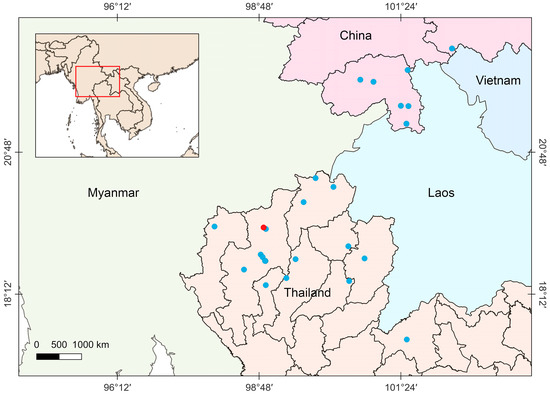
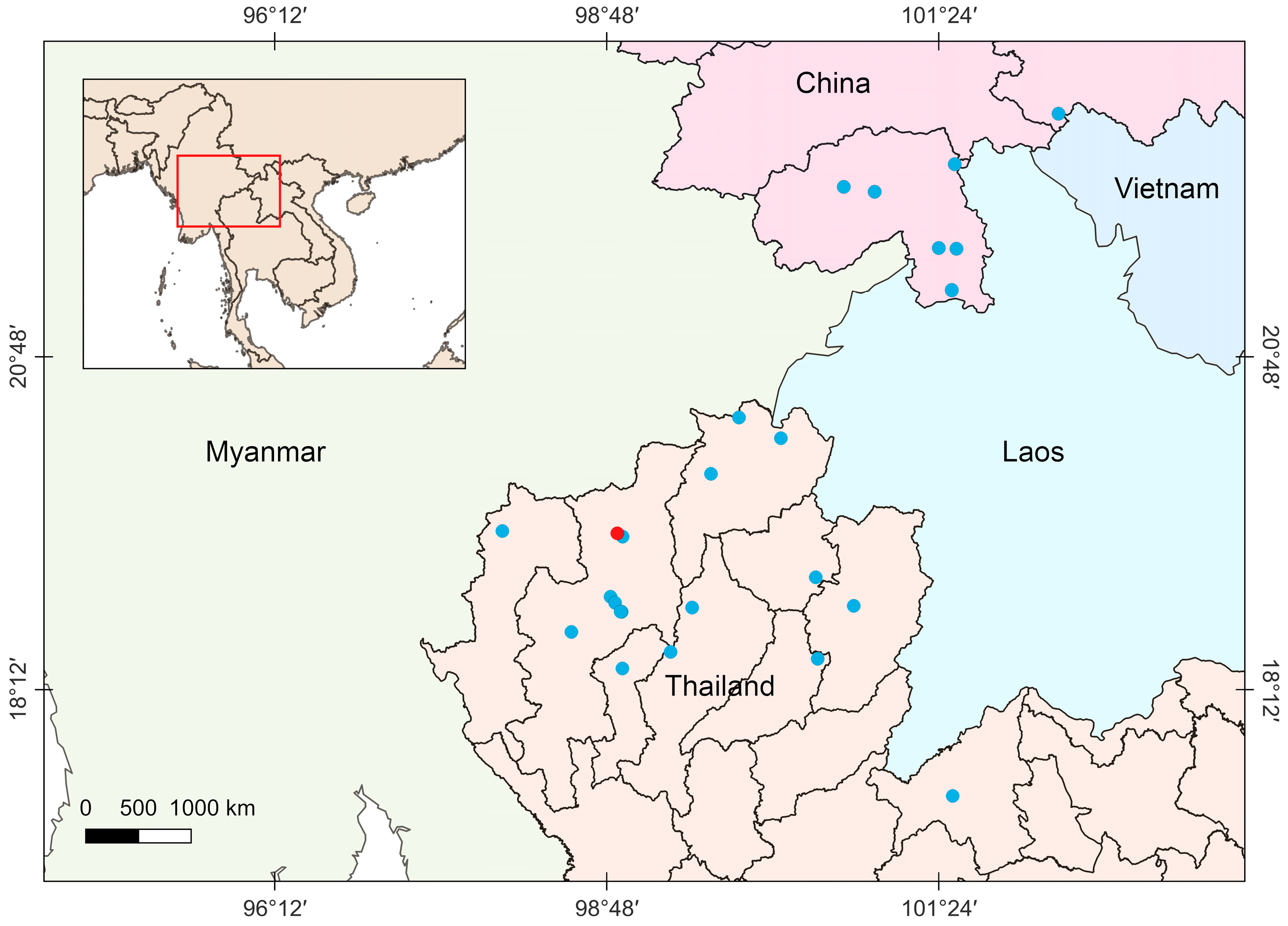
Distribution: Colocasia kerrii is currently recorded from China (Lüchun County, Jinghong City, Mengla County), Thailand (Mae Hong Son, Chiang Mai, Chiang Rai, Phayao, Nan, Lamphun, Lampang, Phrae, Loei) (Figure 3), and is represented in Vietnam only by a single spirit specimen at HN. This spirit specimen from Vietnam matches this species but was excluded from the map (Figure 3) due to the absence of precise locality data for georeferencing. Although not yet verified by voucher material, the species is perhaps to be expected in eastern Myanmar (Shan State) and Laos, which lie directly contiguous with its known ranges in Northern Thailand and Yunnan.
Figure 3.
Map showing the distribution of Colocasia kerrii with the red circle indicating its type locality (map created with “QGIS” programme ver. 3.34 [27], geographic system ID: WGS 84, EPSG 4326).
Ecology: The species grows in humus-filled crevices on limestone and in soils over granite bedrock, typically along streams and near waterfalls, in shaded to semishaded areas of tropical evergreen forests, tropical deciduous forests, and tropical seasonal rainforests, as well as in hillside grasslands at elevations of 300–1400 m a.s.l. Bröderbauer et al. [32] reported that anthomorphs of Colocasia kerrii (as C. affinis) were visited mainly by Colocasiomyia steudnerae Takenaka & Toda [33] and suggested that these drosophilid flies may serve as effective pollinators.
Provisional conservation status: Colocasia kerrii is widely distributed in the Northern Floristic Region of Thailand, extending to Loei Province in the Northeastern Floristic Region, and southern Yunnan Province of China, with an estimated extent of occurrence (EOO) of 148,441.86 km2. Most of its populations occur within legally protected areas, and based on current knowledge, it is provisionally assessed as ‘Least Concern’ (LC).
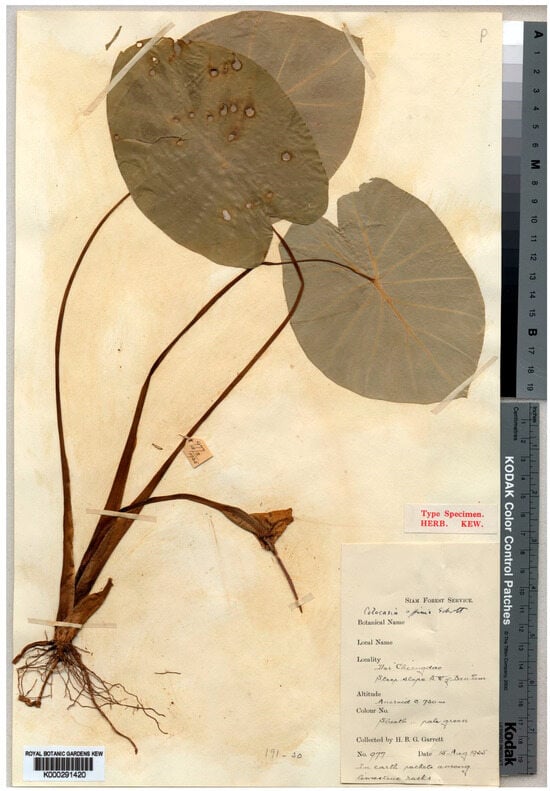
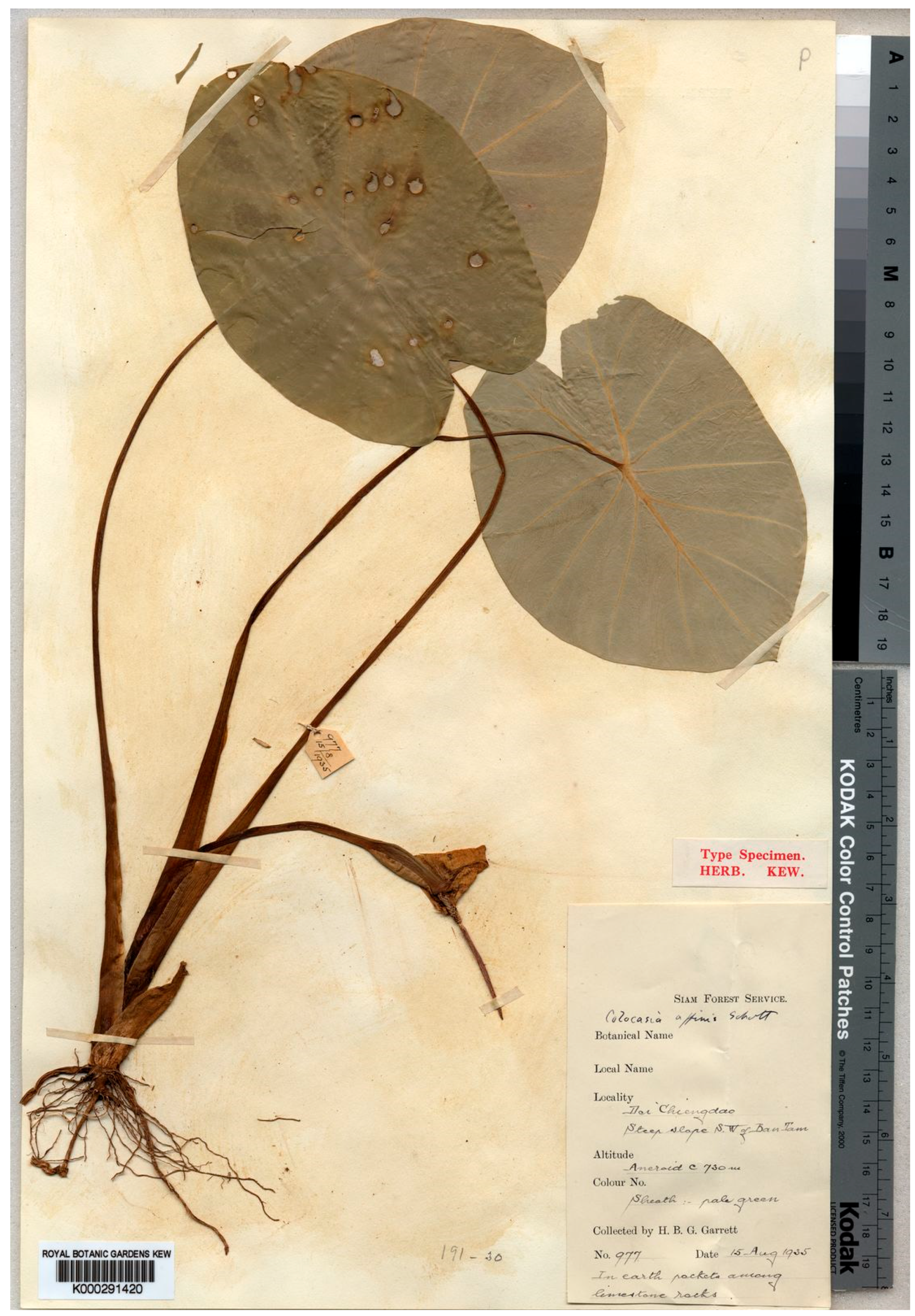
Note on typification: In the protologue, Gagnepain [18] (p. 130) cited a single gathering, Garrett 977, without specifying the herbaria where the original material was deposited. We traced four syntypes, three housed at K [barcodes K000291418, K000291419, K000291420] and one specimen at BKF [barcode SN080138]. In the Flora of Thailand treatment, Boyce and Sookchaloem [21] cited Garrett 977 at P as the holotype of C. kerrii and listed specimens at C, BKF, and K as isotypes. Because Gagnepain did not designate a single specimen as type, all must be treated as syntypes (Art. 9.6 of ICN); consequently, the citation by Boyce and Sookchaloem [21] could only have been intended as a lectotypification. Under Art. 7.11 of the ICN, however, their citation is ineffective because it lacks the required phrase “designated here” or an equivalent expression for works published on or after 1 January 2001. Moreover, we were unable to locate any specimens of Garrett 977 at P or C, although a drawing associated with K000291419 bears a note in Gagnepain’s handwriting stating, “J’ai pris un calque de ce dessin pour le Herb. Mus. Par.” indicating that at least a drawing may once have existed at P. We therefore designate here the specimen at K with barcode K000291420 (Figure 4) as the lectotype of the name Colocasia kerrii.
Figure 4.
The lectotype specimen at K of Colocasia kerrii Gagnep. Reproduced with the kind permission of the Board of Trustees of the Royal Botanic Gardens, Kew.
Additional specimens examined: CHINA. Yunnan Province: Honghe Hani and Yi Autonomous Prefecture: Lüchun County: Pinghe Township, Xiaobeijiang Management Station, 22°41′45.1″ N 102°20′18.6″ E, elev. 503 m, S.-Y. Xiao et al. KIBGX095B06 (KUN-image! [barcode 1556686]); Xishuangbanna Dai Autonomous Prefecture: Jinghong City [Che-li Hsein]: Mengyang Town [Sheau-meng-yeang], elev. 1200 m, September 1936, C. W. Wang 75938 (PE-image! [barcode 01436225, 01436226]); Jah-kuang [?], elev. 1300 m, September 1936, C. W. Wang 79107 (PE-image! [barcode 01436227, 01436228]); Gasa Town, Naban River Watershed National Nature Reserve, Mandian Village, 22°7′27.8166″ N, 100°39′24.26004″ E, elev. 995 m, 23 June 2020, J.-T. Yin et al. 2672 (HITBC-image! [barcode 0070139]); Mengla County [Meng-Na Xien]: elev. 560 m, 19 September 1987, D. D. Tao 87143 (CAS-image! [barcode 602373]); Nangong Mountain, elev. 900 m, 7 August 2004, S.-S. Zhou 2035 (PE-image! [barcode 01788621, 01788622]); Shangyong Nature Reserves, elev. 900 m, 4 July 1985, leg. ign. 167 (PE-image! [barcode 02109513]); Yiwu Town, 22°18′4.833″ N, 101°31′33.06864″ E, elev. 1259 m, 17 July 2021, S.-C. Peng P4943 (HITBC-image! [barcode HITBC0079811]); Guanlei Town, 21°38′48.65568″ N, 101°24′2.5704″ E, elev. 743 m, 31 July 2021, S. Peng P5083 (HITBC-image! [barcode HITBC0079948]); Guanlei Town, 21°38′48.65568″ N, 101°24′2.5704″ E, elev. 743 m, 31 July 2021, S.-J. Peng P5083 (HITBC-image! [barcode HITBC0079948]); originally collected from Mengla County, cultivated at Chun Lin Long Greenhouse, Kunming Institute of Botany, X.-Z. Cai 04019 (HNNU-image! [barcode HNNU00064396]). THAILAND. Northern: Mae Hong Son Province: Mueang Mae Hong Son District, Tham Chak To [Tham Jak Tok], Tham Pla—Namtok Pha Suea National Park, elev. 315 m, 10 September 2013, C. Lakoet 0341 (BKF! [barcode SN237412]); Chiang Mai Province: Chiang Dao District, Doi Chiang Dao, east side, Pa Blang Cave, elev. 575 m, 10 September 1989, J. F. Maxwell 89-1064 (A-image! [barcode 01655664], CMU! [accession number 006201], L-image! [barcode L.1415801], MO-image! [barcode 39455664]); Mae Rim District, Mae Raem Subdistrict, Doi Suthep—Pui National Park, above Nong Hoi (Hmong) village, below the summit of Doi Mon Long [Doi Mawn Lawng], elev. 1375 m, 9 August 2002, J. F. Maxwell 02-240 (A-image! [barcode 01655677], BKF! [barcode SN139894], CAS-image! [barcode 602366], CMUB! [accession number 20594]; L-image! [barcode L.141505], MO-image! [barcode 5790141]); Doi Suthep, roadside above Queen Sirikit Botanic Gardens, ca. 18°54′ N, 98°54′ E, elev. 1000 m, 14 August 1995, Parnell et al. 95-061 (BKF! [barcode SN181297], K-image! [barcode K002820446]); Mae Wang District, Mae Win Subdistrict, above Pong Lom Raeng [Bong Lohm Rang] (Karen) village, along the road to Chiang Mai Royal Agricultural Research Center, elev. 1400 m, 27 August 2004, P. Palee 708 (A-image! [barcode 01655656], CMUB! [accession number 24044], L-image! [barcode L.3719227, L.3719228], MO-image! [barcode 6270110]); Mueang Chiang Mai District, Doi Suthep—Pui National Park, ca. 18°50′ N, 98°54′ E, elev. 1000 m, 17 July 1968, K. Larsen et al. 2588 (BKF! [barcode SN066890], L-image! [barcode L.1415875]); ibid., 18°48′30.1716″ N, 98°54′33.2388″ E, elev. 1175 m, 28 June 2017, O. Sungkajanttranon 49/2017 (BKF! [barcode SN260808, SN260809]); ibid., 18°48′29.3076″ N, 98°55′1.164″ E, elev. 1054 m, 28 June 2017, O. Sungkajanttranon 53/2017 (BKF! [barcode SN261927]); ibid., 18°48′29.3076″ N, 98°55′1.164″ E, elev. 1054 m, 28 June 2017, O. Sungkajanttranon 54/2017 (BKF! [barcode SN261921]); ibid., 18°21′55.1304″ N, 98°55′23.6316″ E, elev. 695 m, 28 June 2017, O. Sungkajanttranon 73/2017 (BKF! [barcode SN260797]); Doi Suthep, elev. 1130 m, 29 July 1958, T. Sørensen et al. 4526 (A-image! [barcode 01655665], BKF! [barcode SN066888]); Chiang Rai Province: Doi Luang [previously Mae Chan] District, Nong Pa Ko [Nongbagaw] Subdistrict, Doi Luang [Kao Luang], Ban Maipattana, elev. 900 m, 22 August 1985, J. F. Maxwell 85-797 (A-image! [barcode01655667], BKF! [barcode SN066901], L-image! [barcode L.1415807]); Mae Sai District, Doi Tung, elev. ca. 1200 m, 12 September 1990, T. Smitinand 90-248 (BKF! [barcode SN066892]); ibid., elev. 1400 m, 26 July 1988, T. Smitinand 88-5 (BKF! [barcode SN116863, SN066885, SN258482]); Mueang Chiang Rai District, Khun Korn Waterfall Forest Park, elev. 1250 m, 12 August 1998, T. Boonkerd et al. 1002 (BCU! [accession number 011529]); Phayao Province: Pong District, Khun Kuan Subdistrict, Doi Pah Chang Wildlife Sanctuary, NW side, valley between Doi Pah Lohm and Doi Pah Chik, elev. 925 m, 3 August. 1998, J. F. Maxwell 98-777 (A-image! [barcode 01655660], BKF! [SN123102], CMUB! [accession number 14205], L-image! [barcode L.1415793, L.1415794], MO-image! [barcode 5622144]); Nan Province: Tham Pha Tub [Tham Pha Toop] Forest Park, near petrol station, ca. 18°52′ N, 100°44′ E, 2 September 1999, D. J. Middleton et al. 151 (A-image! [barcode 01655677], BKF! [barcode SN 153364], L-image! [barcode L.1415874], K-image! [K002820456]); Lamphun Province: Mae Tha District, Doi Khun Tan [Doi Kuhn Dahn] National Park, west side, Yaw 3, elev. 1250–1300 m, 2 August 1994, J. F. Maxwell 94-854 (A-image! [barcode 01655663], BKF! [barcode SN066884], CAS-image! [barcode 602368], CMUB! [accession number 04906], L-image! [barcode L.1415800]); Lampang Province: Mueang Pan District, Chae Son [Jae Sawn] National Park, east side, near Chae Son [Jae Sawn] waterfalls and Mae Mawn Stream, elev. 550 m, 24 August 1995, J. F. Maxwell 95-565 (BKF! [barcode SN089928], CAS-image! [barcode 602369], CMUB! [accession number 06738], L-image! [barcode L.1415797], PE-image! [barcode 01712814]); ibid., elev. 500 m, 11 August 1996, M. Panatkool 154 (CAS-image! [barcode 602372], CMUB! [accession number 11239], L-image! [barcode L.1415797]); Phrae Province: Rong Kwang District, Huai Rong (Doi Sawan) Waterfall, ca. 18°20′ N, 100°27′ E, elev. 400 m, 9 September 1995, K. Larsen et al. 46241 (BKF! [barcode SN150968]); Northeastern: Loei Province: Phu Luang Wildlife Sanctuary, first 3 km of summit trail from Huay Bang, 29 September 1990, P. Chantaranothai et al. 90/464 (K-image! [barcode K002820447, K002820448, spirit collection 59076.000], KKU! [accession number 002639]); Phu Luang, 2 September 1966, S. Phusomsaeng & K. Bunchuai 27 (BKF! [barcode SN066894], L-image! [barcode L.1415873]). VIETNAM. s.d., leg. ign. s.n. (HN! [spirit collection]).
4. Discussion
Most of the additional specimens of Colocasia kerrii examined in this study were previously misidentified as Colocasia fallax. Previous studies on the diversity and distribution of Araceae in Thailand [34,35], as well as studies on pollination [32] and karyology [31], also treated this taxon under either C. affinis or C. fallax. The present study clarifies these misidentifications and confirms that these materials represent Colocasia kerrii. Reinstating C. kerrii as a distinct species is therefore important for ensuring accurate identification and for improving the reliability of future studies on the taxonomy, ecology, and biology of this species.
The presence of white pistillodes at the basalmost part of the pistillate zone is common in Colocasia fallax, though sometimes absent in certain individuals; when present, the pistillodes are obovoid or obpyriform and slightly larger than the fertile pistils. In contrast, pistillodes at the basalmost part of the pistillate zone are uncommon in C. kerrii and are rarely observed (only in some Chinese specimens), and when present they are similar in shape and size to the fertile pistils, differing only in their white colour. Although Boyce and Sookchaloem [21] listed C. fallax from Kanchanaburi and Nong Khai Provinces, our re-examination of specimens from these localities shows that they do not correspond to either C. fallax or C. kerrii and may represent undescribed taxa. Moreover, we have not encountered any material from Thailand, Vietnam, or Yunnan Province that agrees with the morphology of C. fallax, which appears to be restricted to the Himalayan region.
Author Contributions
Conceptualization, K.Z.H., P.S., S.R., K.C. and S.S.; methodology, K.Z.H., P.S. and S.S.; software, K.Z.H.; validation, K.Z.H., P.S., S.R., K.C. and S.S.; formal analysis, K.Z.H. and S.S.; investigation, K.Z.H., K.C. and S.S.; resources, K.Z.H., K.C. and S.S.; data curation, K.Z.H., P.S. and S.S.; writing—original draft preparation, K.Z.H.; writing—review and editing, K.Z.H., P.S., S.R., K.C. and S.S.; visualization, K.Z.H.; supervision, S.S.; project administration, S.S.; funding acquisition, S.S. All authors have read and agreed to the published version of the manuscript.
Funding
This research was financially supported by Mahasarakham University.
Data Availability Statement
The original contributions presented in this study are included in the article; further inquiries can be directed to the corresponding author.
Acknowledgments
The first author, K.Z.H., gratefully acknowledges the curators and staff of BCU, BK, BKF, CMU, CMUB, KKU, HN, and SLR for granting permission to examine specimens, and for their generous assistance and kind hospitality. We sincerely thank Alyssa Landa (CM) and Yunhong Tan (HITBC) for kindly providing images of relevant specimens of Colocasia. We are also grateful to Jens Soelberg (C) and Pengrui Luo (KUN) for searching for and confirming that the types of Colocasia kerrii and C. bicolor are missing in their respective herbaria. We are most grateful to David Scherberich for his generous permission to use the images in Figure 1 and Figure 2, and we thank Phiphat Sonthongphithak for preparing the distribution map. We also thank Rachel McCarthy (K) for supplying and permitting the use of the image in Figure 4. We are especially grateful to Mark Arcebal K. Naive for his expert advice and guidance on the typification of Colocasia kerrii. We are grateful to Wei Shen for assistance with translating Chinese specimen labels into English.
Conflicts of Interest
The authors declare no conflicts of interest.
References
- Hay, A.; Prameswara. Alocasia tandurusa Prameswara & A. Hay, a new (bi)pinnatifid-leaved species from Sulawesi [Araceae, tribe Alocasieae (Schott) A. Hay], with notes on tribal classification for the paraphyletic grade of ‘Old World Colocasioids’. Aroideana 2023, 46, 388–405. [Google Scholar]
- Cusimano, N.; Bogner, J.; Mayo, S.J.; Boyce, P.C.; Wong, S.Y.; Hesse, M.; Hetterscheid, W.L.A.; Keating, R.C.; French, J.C. Relationships within the Araceae comparison of morphological patterns with molecular phylogenies. Am. J. Bot. 2011, 98, 654–668. [Google Scholar] [CrossRef] [Scilit]
- Nauheimer, L.; Boyce, P.C.; Renner, S.S. Giant taro and its relatives a phylogeny of the large genus Alocasia (Araceae) sheds light on Miocene floristic interchange in the Malesian region. Mol. Phylogenet. Evol. 2012, 63, 43–51. [Google Scholar] [CrossRef] [Scilit]
- Nauheimer, L.; Metzler, D.; Renner, S.S. Global history of the ancient monocot family Araceae inferred with models accounting for past continental positions and previous ranges based on fossils. New Phytol. 2012, 195, 938–950. [Google Scholar] [CrossRef] [Scilit]
- Nauheimer, L.; Boyce, P.C. Englerarum (Araceae, Aroideae) a new genus supported by plastid and nuclear phylogenies. Plant Syst. Evol. 2013, 300, 709–715. [Google Scholar] [CrossRef] [Scilit]
- Lý, N.-S.; Wong, S.Y.; Haevermans, T.; Nguyen, V.D.; Boyce, P.C. Vietnamocasia, a new genus from Central Vietnam belonging to the Alocasia–Colocasia clade (Araceae). Phytotaxa 2017, 303, 253–263. [Google Scholar]
- Haigh, A.L.; Gibernau, M.; Maurin, O.; Bailey, P.; Carlsen, M.M.; Hay, A.; Leempoel, K.; McGinnie, C.; Mayo, S.J.; Wong, S.Y.; et al. Target sequence data shed new light on the infrafamilial classification of Araceae. Am. J. Bot. 2023, 110, e16117. [Google Scholar] [CrossRef] [Scilit]
- Matthews, P.J.; Ghanem, M.E. Perception gaps that may explain the status of taro (Colocasia esculenta) as an “orphan crop”. Plants People Planet 2021, 3, 99–112. [Google Scholar] [CrossRef] [Scilit]
- Matthews, P.J.; Hossain, M.A.; Sookchaloem, D.; Nguyen, V.D.; Wong, S.Y.; Joling, J.; Schranz, E.; Bakker, F.T.; Tabuchi, E.; Ahmed, I.; et al. Chloroplast capture and range extension after hybridization in taro (Colocasia esculenta). Ecol. Evol. 2024, 14, e70082. [Google Scholar] [CrossRef] [Scilit]
- Mayo, S.J.; Bogner, J.; Boyce, P.C. The Genera of Araceae; Royal Botanic Gardens, Kew: Richmond, UK, 1997; pp. 1–370. [Google Scholar]
- Ahmed, I.; Lockhart, P.J.; Agoo, E.M.G.; Naing, K.W.; Nguyen, D.V.; Medhi, D.K.; Matthews, P.J. Evolutionary origins of taro (Colocasia esculenta) in Southeast Asia. Ecol. Evol. 2020, 10, 13530–13543. [Google Scholar] [CrossRef] [Scilit]
- Hay, A. A new Bornean species of Colocasia Schott (Araceae Colocasieae) with a synopsis of the genus in Malesia and Australia. Sandakania 1996, 7, 31–48. [Google Scholar]
- Gogoi, R.; Borah, S. Two new species and a new record for Colocasia (Araceae Colocasieae) from Arunachal Pradesh, Northeast India. Gard. Bull. Singapore 2013, 65, 27–37. [Google Scholar]
- Zhou, S.-S.; Quan, R.-C.; Li, R.; Liu, Q.; Yin, J.-T. Colocasia kachinensis, a new species of Araceae from Myanmar. PhytoKeys 2020, 138, 41–47. [Google Scholar] [CrossRef] [Scilit]
- Matthews, P.J.; Nguyen, V.D.; Fang, Q.; Long, C.-L. Colocasia spongifolia sp. nov. (Araceae) in southern China and central Vietnam. Phytotaxa 2022, 541, 1–9. [Google Scholar] [CrossRef] [Scilit]
- Plants of the World Online. Available online: http://www.plantsoftheworldonline.org/ (accessed on 2 February 2026).
- Boyce, P.C.; Croat, T.B.; Hay, A. The Überlist of Araceae Totals for Published and Estimated Number of Species in Aroid Genera. [CrossRef]
- Gagnepain, F. Aracées nouvelles indochinoises. Notul. Syst. 1941, 9, 116–140. [Google Scholar]
- Li, H.; Boyce, P.C. Colocasia. In Flora of China; Wu, Z.Y., Raven, P.H., Hong, D.Y., Eds.; Science Press: Beijing, China; Missouri Botanical Garden Press: St. Louis, MO, USA, 2010; Volume 23, pp. 73–75. [Google Scholar]
- Schott, H.W. Aroideenskizzen. Bonplandia 1859, 7, 26–31. [Google Scholar] [CrossRef] [Scilit]
- Boyce, P.C.; Sookchaloem, D. Colocasia. In Flora of Thailand; Santisuk, T., Larsen, K., Eds.; Forest Herbarium, Royal Forest Department: Bangkok, Thailand, 2012; Volume 11, pp. 112–118. [Google Scholar]
- Turland, N.J.; Wiersema, J.H.; Barrie, F.R.; Gandhi, K.N.; Gravendyck, J.; Greuter, W.; Hawksworth, D.L.; Herendeen, P.S.; Klopper, R.R.; Knapp, S.; et al. International Code of Nomenclature for Algae, Fungi, and Plants (Madrid Code); Regnum Vegetabile 162; University of Chicago Press: Chicago, IL, USA, 2025. [Google Scholar]
- Beentje, H. The Kew Plant Glossary an Illustrated Dictionary of Plant Terms, 2nd ed.; Royal Botanic Gardens, Kew: Richmond, UK, 2016. [Google Scholar]
- Wong, S.Y.; Boyce, P.C.; Hay, A. Schismatoglottideae (Araceae) of Borneo LXXX: Bau djinna, a new species from the Rejang Basin, Sarawak. Feddes Repert. 2026, 137, e70063. [Google Scholar]
- Hetterscheid, W.L.A.; Boyce, P.C. A reclassification of Sauromatum Schott and new species of Typhonium Schott (Araceae). Aroideana 2000, 23, 48–55. [Google Scholar]
- Thiers, B. Index Herbariorum a Global Directory of Public Herbaria and Associated Staff. Available online: http://sweetgum.nybg.org/science/ih/ (accessed on 2 February 2026).
- QGIS Development Team. QGIS Geographic Information System. Open Source Geospatial Foundation Project. Available online: https://qgis.org (accessed on 2 February 2026).
- IUCN Standards and Petitions Subcommittee. The Guidelines for Using the IUCN Red List Categories and Criteria. Version 16. Available online: https://nc.iucnredlist.org/redlist/content/attachment_files/RedListGuidelines.pdf (accessed on 2 February 2026).
- Bachman, S.; Moat, J.; Hill, A.; de la Torre, J.; Scott, B. Supporting Red List threat assessments with GeoCAT geospatial conservation assessment tool. ZooKeys 2011, 150, 117–126. [Google Scholar] [CrossRef] [Scilit]
- Cao, L.-M.; Long, C.-L. Colocasia bicolor (Araceae), a new species from Yunnan, China. Ann. Bot. Fenn. 2003, 40, 283–286. [Google Scholar]
- Saensouk, S.; Saensouk, P.; Senavongse, R. Karyological study of three Thailand species of Colocasia (Araceae). Cytologia 2019, 84, 179–182. [Google Scholar] [CrossRef] [Scilit]
- Bröderbauer, D.; Ulrich, S.; Weber, A. Adaptations for insect-trapping in brood-site pollinated Colocasia (Araceae). Plant Biol. 2014, 16, 659–668. [Google Scholar] [CrossRef] [Scilit]
- Takenaka, K.; Yin, J.T.; Wen, S.Y.; Toda, M.J. Pollination mutualism between a new species of Colocasiomyia de Meijere (Diptera Drosophilidae) and Steudnera colocasiifolia (Araceae) in Yunnan, China. Entomol. Sci. 2006, 9, 79–91. [Google Scholar] [CrossRef] [Scilit]
- Sungkajanttranon, O.; Marod, D.; Thanompun, K. Diversity and distribution of family Araceae in Doi Inthanon National Park, Chiang Mai Province. Agric. Nat. Resour. 2018, 52, 125–131. [Google Scholar] [CrossRef] [Scilit]
- Sungkajanttranon, O.; Marod, D.; Petchsri, S.; Kongsatree, K.; Peankonchong, A.; Chotpiseksit, T.; Supnuam, B. Altitudinal effect on diversity and distribution of Araceae in Doi Suthep-Pui National Park, Chiang Mai Province in Thailand. J. Agric. Sci. Technol. B 2019, 9, 49–59. [Google Scholar] [CrossRef] [Scilit]

Disclaimer/Publisher’s Note: The statements, opinions and data contained in all publications are solely those of the individual author(s) and contributor(s) and not of MDPI and/or the editor(s). MDPI and/or the editor(s) disclaim responsibility for any injury to people or property resulting from any ideas, methods, instructions or products referred to in the content. |
© 2026 by the authors. Licensee MDPI, Basel, Switzerland. This article is an open access article distributed under the terms and conditions of the Creative Commons Attribution (CC BY) license.