


Abstract
In heating and cooling processes, water is a safe, low-cost and abundant medium, but has a low thermal conductivity of ~0.61 W/m. K that needs to be improved. Reported aqueous carbon nanotube (CNT)-based nanofluids exhibited a 1.4-fold in thermal conductivity improvement. Effects of CNT type, concentration, and added surfactant on nanofluid stability and thermal conductivity were not unequivocally determined. This communication describes how CNT aqueous nanofluid stability and thermal conductivity are affected by the type and concentration of short COOH-functionalized CNTs, together with surfactant type, with the aim of optimizing nanofluid properties and lowering costs. Both single-walled CNTs (SWCNTs) and multi-walled CNTs (MWCNTs) were investigated. Visual inspection, atomic force microscopy, dynamic light scattering and zeta potential measurements confirmed high stability with Tween-80. Both CNT types formed uniform suspensions with high zeta potentials and improved thermal conductivity, with no need for increased concentrations. An MWCNT aqueous nanofluid containing 10 mg of MWCNTs in 50 mL of water and 10 mg of Tween 80, sonicated for 60 min, exhibited an unprecedented 2.62-fold thermal conductivity improvement. Contrary to earlier models, the nanofluid exhibited a nonlinear dependence on the MWCNT concentration. The results confirm the feasibility of preparing environmentally friendly and stable CNT nanofluids, with high thermal conductivity, at low cost.
1. Introduction
Nanofluids are liquid suspensions that involve particles with dimensions of less than 100 nm suspended inside base fluids. Nanofluids are being considered as heat transfer fluids [1] to facilitate heat transfer at thermal interfaces. Such technology is valuable in both cooling and heating processes. Theoretical and experimental research has focused on the potential advantages and uses of nanofluids in various applications, including electronics and transportation. Thousands of research articles on nanofluids were published in SCI journals between 2000 and 2021 [2], with special attention devoted to improving thermal conductivity [3,4]. Nanofluids are engineered in a way to form stable colloidal suspensions in the base fluid. Various factors affect nanofluid characteristics, including liquid type [5], sonication, surfactant, and temperature, in addition to the nanomaterial itself. Metal oxides (ZnO and Al2O3), carbides, and other materials have been studied. Among the newly emerging materials are carbon nanotubes (CNTs). Carbon nanotubes (CNTs) are attractive as thermal-enhancing additives due to their high intrinsic thermal conductivity (ranging ~3000–6000 W·m−1·K−1) and their large aspect ratios, which facilitate formation of thermally conductive percolation pathways that increase thermal conduction in suspensions [6]. Reported enhancements of thermal conductivity for CNT-based nanofluids vary widely and depend strongly on particle type, single-walled CNT (SWCNT) vs. multi-walled CNT (MWCNT), functionalization (or functional groups that make them form bonds with the water), dispersion method of CNTs, concentration, surfactant, and measurement technique. CNTs exist as multi-walled (MWCNTs) or single-walled (SWCNTs) with various lengths and diameters. They are commercially available as functionalized or non-functionalized products. Functionalized CNTs typically form more stable suspensions in water and are singled out for further study here.
CNTs form percolation paths in the nanofluid that are useful for thermal conductivity. Brownian motion of the nanoparticles also helps in thermal transportation by diffusion. Studies showed that a higher CNT length-to-diameter aspect ratio yields higher heat conductivity. Temperature, surfactant, size, and shape all affect heat conductivity [7,8].
The literature described how thermal conductivity in nanofluids of various nanomaterials may increase with increasing nanoparticle concentration [9,10]. Metal oxide concentrations increased aqueous nanofluid conductivity [11]. Similarly, CNT nanofluid thermal conductivity was influenced by CNT concentration. SWCNT and MWCNT concentrations linearly affected thermal conductivity of nanofluids [12]. Aqueous fluid conductivity was reported to linearly increase with CNT concentration in various surfactants [13], while nonlinearity was also reported [14]. Some classical effective-medium models predicted an increase in thermal conductivity (Keff) with particle concentration [15], at least at low concentrations.
Earlier models:
To describe the dependence of nanofluids on concentration, three major models were reported, namely:
- −
- Maxwell
For dilute suspensions of spherical particles, Equation (1) applies [16]:
where Kℓ and Kp are thermal conductivities of the base fluid and particles, respectively, and ϕ describes concentration.
- −
- Hamilton–Crosser (non-spherical particles)
This model generalizes Maxwell to particle shapes using the factor n (for spheres n = 3) [16], Equation (2):
- −
- Bruggeman effective-medium approximation
The implicit relation for Keff [16] is described in Equation (3):
These models assumed homogeneously dispersed, non-interacting particles, and colligative properties in nanofluids. As described above, the literature did not give a final answer to how CNT concentration affects the nanofluid thermal conductivity.
CNTs, however, have high aspect ratios and anisotropy, forming connected networks with solvent percolation. Therefore, CNT nanofluids should deviate from linearity due to percolation, aggregation and interfacial-thermal resistance (Kapitza resistance) [1]. Solutions assume colligative properties, independent of solute molecule types, whereas nanofluids involve nanoparticles with various shapes, lengths, widths, interactions and surface charges. Therefore, it is assumed that nanofluids should not exhibit colligative behaviors. This will be experimentally tested here using short functionalized SWCNTs and MWCNTs. The present work aims at experimentally clarifying how CNT type and concentration affect stability and thermal conductivity of aqueous CNT nanofluids, in comparison with earlier models. As colligative properties are influenced by concentration only, if nanofluid thermal conductivity changes with CNT type and with concentration non-linearly, colligative properties can then be overruled. This assumption will be tested here. Contrary to earlier reports, stable and highly thermally conductive nanofluids can be prepared with no need for high CNT concentrations. This significantly lowers the process costs by lowering the CNT concentration. Effects of surfactant and sonication time will also be tested in aqueous CNT nanofluids. The stability of the CNT dispersion in water can be determined by measuring the zeta potential. The present study will thus experimentally determine how CNT type and concentration, combined with surfactant type, may affect stability and thermal conductivity of CNT aqueous nanofluids. The findings will be useful for various heat transfer applications.
2. Materials and Methods
2.1. Materials
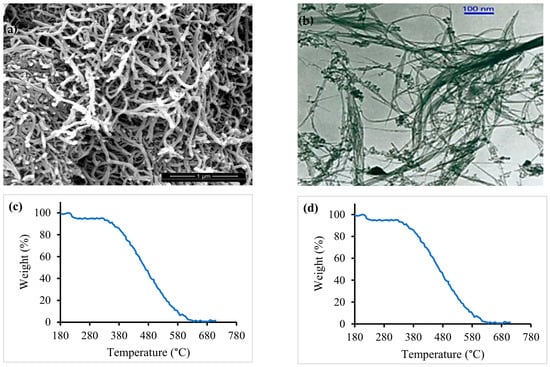
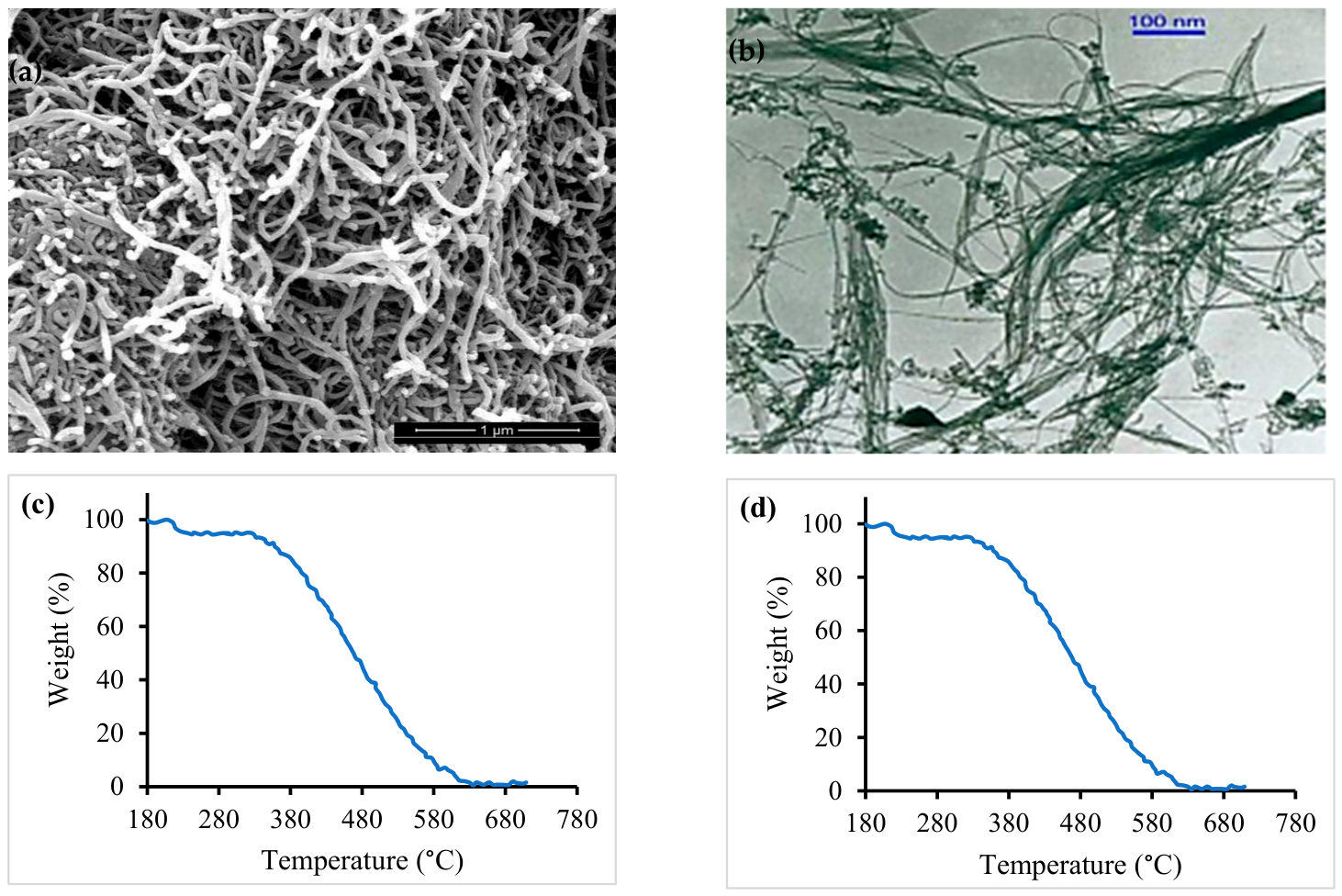
Deionized (DI) water was used as the base fluid. Short, –COOH-functionalized SWCNTs and MWCNTs were used here. The vendor specifications provided by Nanoamor (Nanostructured & Amorphous Materials, Inc., Katy, TX, USA) are summarized in Table 1. Characterization data, compiled from supplier datasheets, were further confirmed by SEM and TGA (Figure 1a–c) [17]. Six surfactants (Tween-80, Cetrimide, SDC, CTAB, PVA and Arabic Gum) procured from Sigma-Aldrich (Sigma-Aldrich, Spruce St, St. Louis, MO, 3050, USA) were tested (Table 2). Non-functionalized CNTs formed unstable nanofluids and were excluded.
Table 1.
Supplier specifications for short CNTs [18].
Figure 1.
SEM and TGA results describing the used short functionalized CNTs. (a) SEM and (b) TGA for MWCNTs. (c) TEM and (d) TGA for SWCNT. Reproduced based on supplier open page [17].
Table 2.
Supplier descriptions of surfactants [19].
2.2. Characterization
CNT morphology and thermal stability were evaluated using SEM and thermogravimetric analysis (TGA) curves provided by the supplier (Figure 1a–c) [17]. To evaluate dispersibility, a Nanosurf atomic force microscope (AFM; Nanosurf, Gräubernstrasse 12, 4410 Liestal, Switzerland), operated in non-contact mode, was utilized to characterize the CNTs by depositing a droplet of the liquid suspension onto mica, allowing it to dry, and scanning the resulting dry networks. The AFM images were measured for the suspended CNTs following standard methods. A suspension droplet was placed onto a mica substrate, allowed to dry, and the resulting dry networks were scanned.
Dynamic-light scattering (DLS) and zeta potential measurements were performed on a Brookhaven instrument (Omni) (Brookhaven Instruments Corporation, Nashua, NH, USA) to assess the hydrodynamic size distribution and suspension stability. Hydrodynamic radii and diffusion coefficients were obtained using the Stokes–Einstein’s Equation (4). The initial DLS measurements were conducted at a baseline concentration of 250 mg per 50 mL to establish a robust scattering intensity profile for the Brookhaven instrument’s detector limits within heavily functionalized systems. The choice of higher nanofluid concentration was due to optical limitations of the instrument. Highly dilute concentrations (1 to 20 mg per 50 mL) were examined and gave inconclusive results here, possibly due to the highly sparse suspensions. The CNTs absorbed most incident laser light instead of scattering it, resulting in an exceptionally low photon count rate at the detector. The signal-to-noise ratio was also lowered and made it difficult to analyze. Therefore, the higher concentration was chosen here.
Moreover, the standard DLS analysis carries inherent limitations regarding the exact size distribution of highly non-spherical, polydisperse carbon nanotube (CNT) suspensions without an internal optical standard. In the present study, the DLS method was used for comparison purposes between MWCNT and SWCNT suspensions.
The hydrodynamic radii (Rh) and diffusion coefficients (D) were calculated via the standard Stokes–Einstein equation (Equation (4)). For validation of these optical bulk approximations, these findings were strictly correlated with direct ex situ nanoscale topography captured via atomic force microscopy (AFM), ensuring an accurate assessment of tube exfoliation and bundling layout.
where D [m2/s] is the translational diffusion coefficient that describes particle motion speed, KB is the Boltzmann constant 1.380649 × 10⁻²³ (m2kg.K−1.s−2), T is the temperature (K), and η is the viscosity (Pa.s). The shape factor correction (friction coefficient) is f (1 for spherical shapes). RH is the hydrodynamic radius of a non-spherical shape (m). π is 3.14. C is a constant varying with the interface; it is typically 6 for no-slip conditions and 4 for slip boundaries [20].
The equation is accepted for large (macroscopic) particles continuously moving in a fluid. Spherical particles have no f correction factor. Brownian motion is assumed in CNT nanofluids, and the diffusion coefficient measures the speed of dispersion [20]. In dense suspensions, particles interact not only through direct forces but also through the fluid, a phenomenon known as hydrodynamic interaction [21].
2.3. Nanofluid Preparation
Nanofluids were prepared using a surfactant solution (200 ppm) prepared by adding the surfactant (10 mg) to deionized water (50 mL). Cetrimide, Tween 80, PVA, Cactus, SDM, Gum Arabic, or CTAP were attempted. MWCNTs or SWCNTs were added at fixed amounts (1, 5, 10 and 20 mg). Suspensions were sonicated for 10–60 min (Table 2). As the Tween 80 surfactant showed the best results, both SWCNT and MWCNT suspensions were studied with Tween 80 surfactant, using DLS and zeta potential. The measured pH value for the MWCNT suspension was 6.5. The stable nanofluids were singled out for the thermal conductivity study.
2.4. Thermal Conductivity Measurement
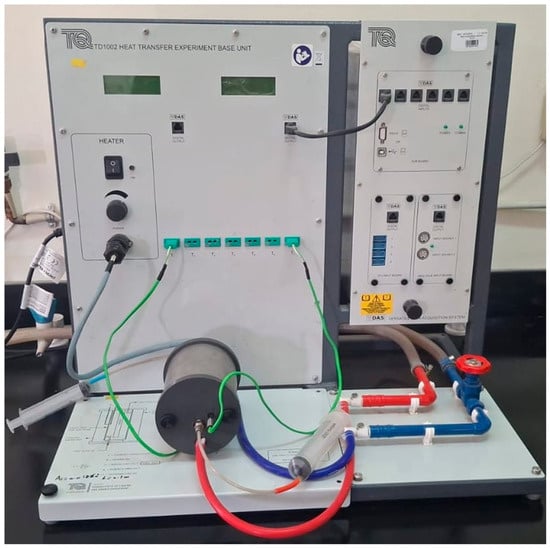
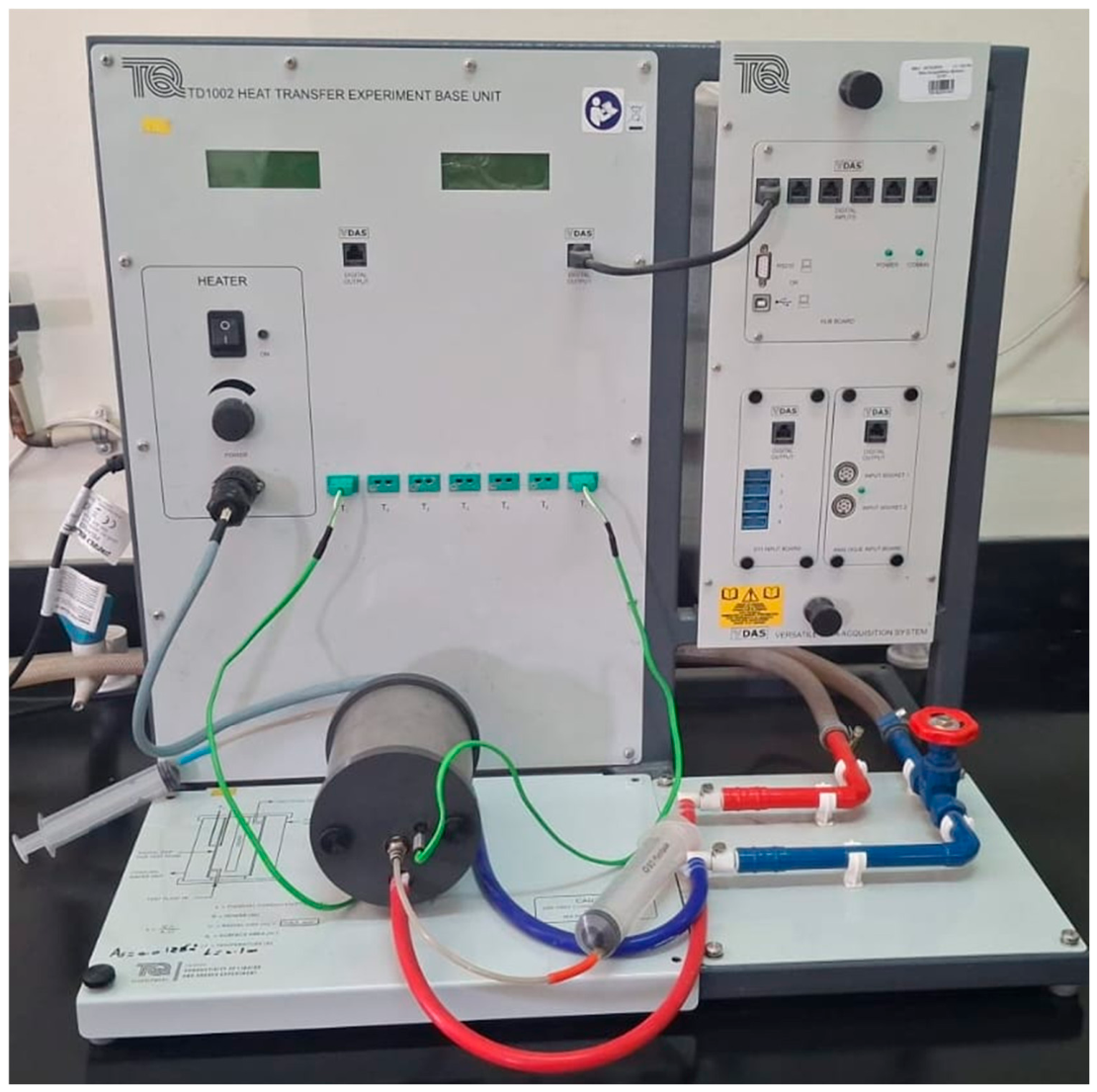
Steady-state thermal conductivity was measured on a TecQuipment Heat Transfer Experiments Base Unit (TD1002) (https://www.tecquipment.com/assets/documents/datasheets/TD1002-Heat-Transfer-Datasheet.pdf, accessed on 12 November 2026) (TecQuipment Ltd., Nottingham NG10 2AN, UK) coaxial apparatus (Figure 2). For this geometry, the effective conductivity was determined from Equation (5):
where Keff is the effective thermal conductivity (W·m−1·K−1), Q is the applied electric power (W), A is the effective area for heat transfer (m2), Δr is the radial gap (m), and ΔT is the temperature difference in Kelvin (K). Instrument calibration was performed.
Figure 2.
Heat conductivity TQ 1002 testing rig.
Unlike DLS measurements, which used a high CNT concentration of 250 mg per 50 mL, the thermal conductivity measurements involved lower CNT concentrations (1, 5, 10 and 20 mg per 50 mL). That is for practical reasons. Colligative properties should always be investigated at lower concentrations, as described above. Moreover, lower CNT concentrations lower the cost in nanofluid technology.
Measurements were repeated at least three times for each sample at room temperature. Reported values are averages of these values. The measured values, for the thermal conductivity of DI water (Kw) under the same conditions were 0.598, 0.610 and 0.623 W·m−1·K−1. The error was 2.08%, and the average value of 0.610 W·m−1·K−1 was used for comparison and percentage improvement purposes.
To ensure the reliability of the thermophysical data, all thermal conductivity measurements presented below were performed in triplicate (n = 3) under strict isothermal conditions. The instrument was calibrated prior to each testing block using high-purity deionized water as a reference standard. Total experimental uncertainty (±0.1) was calculated via a propagation of error methodology considering sensor resolution, temperature fluctuations (±0.1 °C), and multi-point calibration variances. The computed cumulative margin of error did not exceed (±2.5%), which was incorporated into the figures as standard error bars.
3. Results and Discussion
3.1. Unused Commercial CNT Characteristics
Scanning electron microscopy (SEM) and thermogravimetric analysis (TGA) for short -COOH-functionalized SWCNTs and MWCNTs were provided by the supplier [17] (Figure 1). Figure 1a describes MWCNTs (purity> 95%, 08–15 nm outside diameter, and 0.5–2.0 µm long). Figure 1b shows CNT stability ≥ 500 °C, with the highest degradation rate at 614 °C.
Figure 1c describes SEM for SWCNTs (with outside diameter of 1–2 nm, length 1–3 µm, purity >90%). Figure 1d describes TGA for SWCNTs (>90%, OD 1–2 nm, Length 1–3 µm). SWCNTs are stable at >330 °C with the highest degradation rate >450 °C. Figure 1b,d [17] confirmed MWCNT and SWCNT stabilities. CNT details are summarized in Table 1.
3.2. CNT Nanofluid Characteristics
3.2.1. Surfactant Effect
Six different surfactants were systematically evaluated to find the most stable CNT aqueous nanofluid. Polymeric, ionic, and natural dispersing agents (Table 2) were examined as described in Table 3. For each surfactant, the nanofluid was sonicated for 10, 20, 30 and 60 min. Arabic gum, sodium dodecyl sulfate (SDS), cetrimide, cetyltrimethylammonium bromide (CTAB), polyvinyl alcohol (PVA) and natural cactus extract produced CNT suspensions with low stability. CNTs rapidly agglomerated and sedimented, indicating weak interaction between surfactants and CNT surfaces.
Table 3.
Stabilities of various aqueous CNT nanofluids with various surfactants. Solutions of surfactants (10 mg) in distilled water (50 mL) were used in all experiments. Nanofluid preparations were made at various sonication times, but 60 min was optimal.
Tween-80 showed superior dispersion performance (Table 3) and successfully stabilized the short functionalized CNTs at various concentrations. Tween-80 systems exhibited highly stable suspensions. MWCNT suspensions showed exceptional stability for 18 months in Tween 80, with no observed sedimentation. Therefore, Tween-80 surfactant was singled out here for further study, unless otherwise stated.
Tween 80 (Polysorbate 80) is a low-cost, widely used surfactant. It is a nonionic material that involves polar functional groups which make it soluble in water. Tween 80 is a non-hazardous emulsifier commonly used to stabilize suspensions in food, pharmaceuticals and cosmetics formulations [22]. These characteristics encourage using Tween 80 as the surfactant of choice in the present study.
3.2.2. Atomic Force Microscopy (AFM)
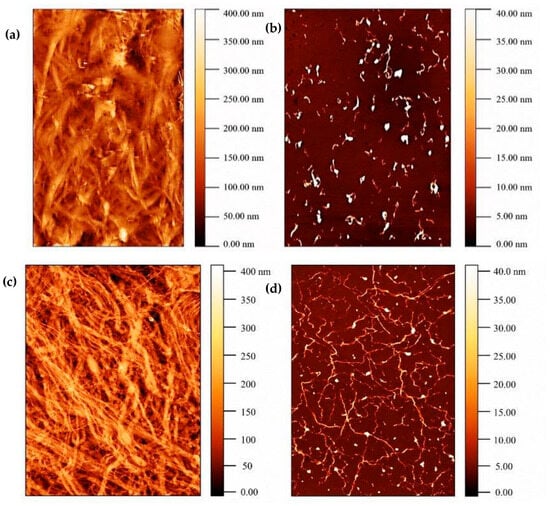
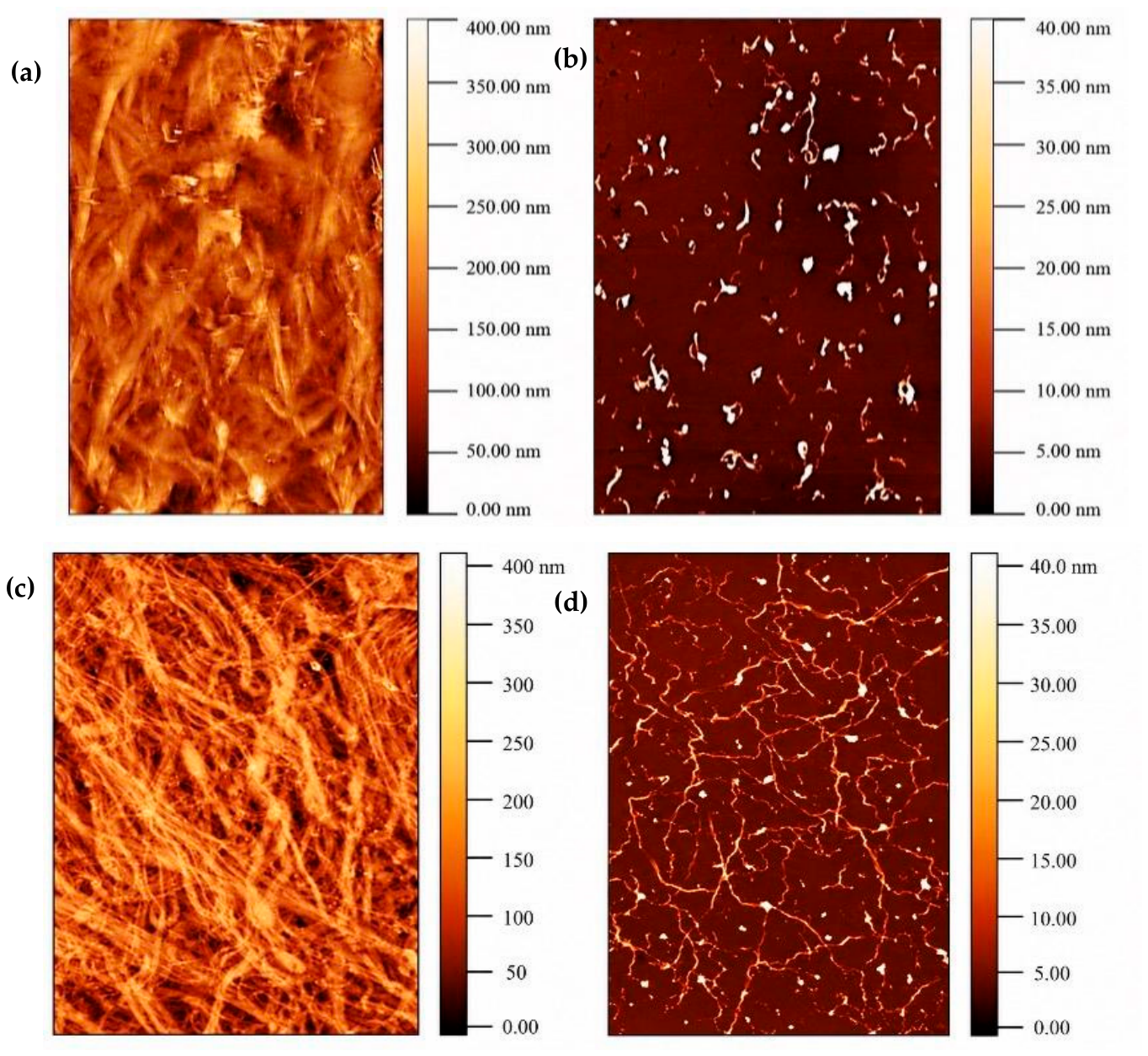
The aqueous CNT nanofluid stability, in Tween 80 solution (200 ppm), was further confirmed using AFM (Figure 3). As expected, Figure 3a showed that the fresh short MWCNTs existed in clusters, due to attractive forces between separate nanotubes. After suspension in water/Tween-80, along with ultrasonic treatment, the dried MWCNTs were more dispersed in smaller agglomerates (Figure 3b).
Figure 3.
AFM micrographs of -COOH-functionalized short CNTs imaged in their dry states: (a) as-received dry MWCNT powder, (b) dry film deposited from an aqueous MWCNT suspension, (c) as-received dry SWCNT powder, and (d) dry film deposited from an aqueous SWCNT suspension. (Suspensions were prepared in 50 mL water with 10 mg Tween 80).
Similarly, Figure 3c shows that the fresh SWCNTs are clustered due to attractive forces. When dispersed in water/Tween 80 and dried, the agglomerates were dispersed (Figure 3d). In suspended SWCNTs, the agglomerates involved larger particles with more extended fibers than in MWCNTs. This means that upon free rotations the SWCNTs assume larger hydrodynamic sizes, as discussed below.
3.2.3. Dynamic Light Scattering (DLS)
Dynamic light scattering (DLS) measurements were performed to evaluate the apparent dispersion quality and relative colloidal stability of the prepared CNT aqueous nanofluids with Tween 80. The standard DLS has inherent resolution limitations when determining the precise size distribution of polydisperse or multi-modal non-spherical suspensions. However, it was used here to serve as a tool to monitor relative variations in hydrodynamic particle size and colloidal behavior under uniform processing conditions, by comparison only. These measurements provided an indication of suspension stability and potential thermophysical performance trends. The DLS results were consistent with the AFM results.
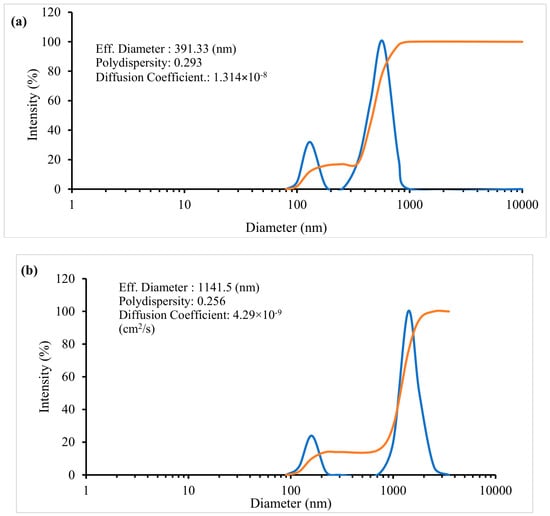
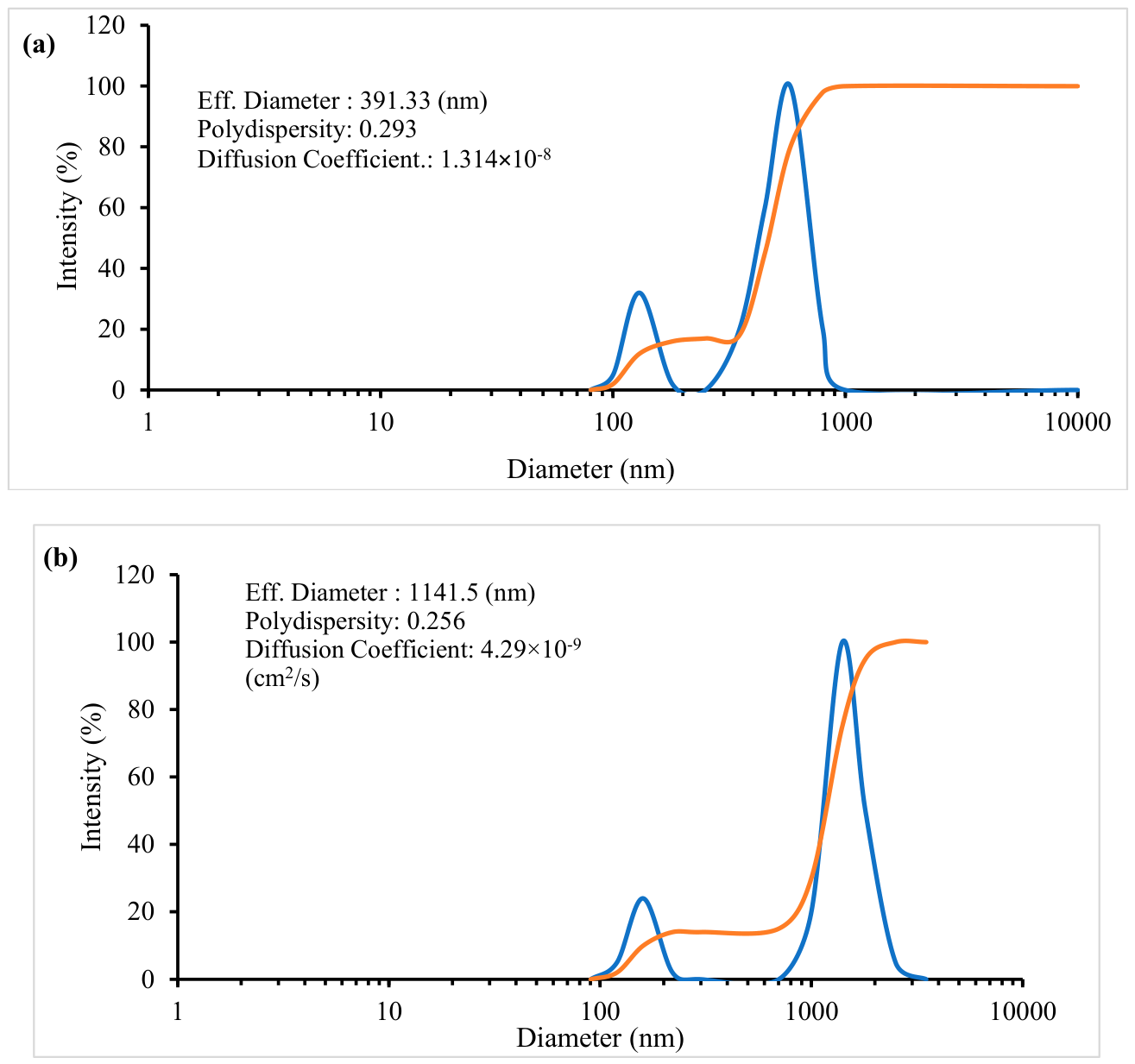
For MWCNTs, Figure 4a described intensity-weighted effective hydrodynamic diameters with reproducible peaks at 130 and 500 nm, at 25 °C. The values, calculated by Equation (4), confirmed the effectiveness of the selected dispersion protocol in producing small suspended particles, as described earlier. The values also allow for Brownian motion that increases effective conduction by convection in the nanofluid [23].
Figure 4.
Measured DLS values showing hydrodynamic sizes for dispersed CNTs. (a) for MWCNT, and (b) for SWCNT. All measurements were made in water/Tween 80 fluids. The suspensions were prepared by dispersing functionalized short CNTs (250 mg) in deionized water (50 mL) and Tween 80 (10 mg) at pH ~6.5.
For SWCNTs, Figure 4b also confirmed average effective hydrodynamic sizes with two peaks at 150 and 1500 nm. The DLS results are consistent with the AFM results discussed above, where the MWCNTs existed in smaller aggregates than in the SWCNT suspension.
From Figure 4, the MWCNT fluid exhibited a higher diffusion coefficient of 1.314 × 10⁻⁸ cm2/s compared to 4.29 × 10⁻⁹ cm2/s for the SWCNTs. This reveals higher conduction, by convection in the MWCNT fluid than in the SWCNT system.
Figure 4 showed that the MWCNT fluid exhibited a polydispersity index of 0.293, which is higher than that for SWCNTs of 0.256. The higher value for the MWCNT suspension means that it existed in more uniform particle sizes, as reported in other systems [24,25]. The presence of a minor DLS tracking peak at approximately 1500 nm indicates the coexistence of a secondary population of loose, large-scale reversible clusters. Because the present zeta potential measurements remained highly negative, vide infra, the clusters were held suspended in dynamic equilibrium by strong electrostatic repulsion forces. This allowed the nanofluid to preserve its long-term dispersion properties and stability over 18 months with continued daily monitoring. DLS, AFM and zeta potential results also confirmed the nanofluid stability.
3.2.4. Zeta Potential Analysis
Zeta potential measurements provided additional insight into the suspension stability, as described in Figure 5. For the MWCNT suspension, the zeta potential was −34 mV, and for the SWCNT the value was −29 mV. The results, summarized in Table 4, indicated sound stability for both MWCNT and SWCNT suspensions in water/Tween 80. Moreover, the more negative value for the MWCNT suspension indicated higher surface charges that keep the aggregates away from each other for longer times, as reported earlier [26]. Thus, the zeta potential values further confirmed the special stability for the MWCNT suspensions.
Figure 5.
Zeta potential results for MWCNT-COOH in 50 mL water.
Table 4.
Comparison of MWCNT and SWCNT zeta potential results with literature values.
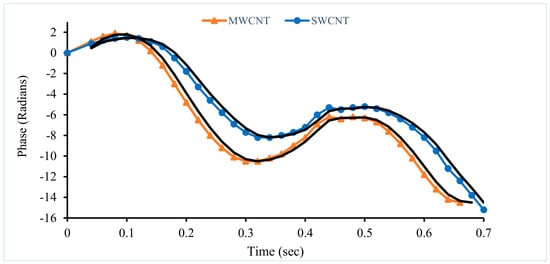
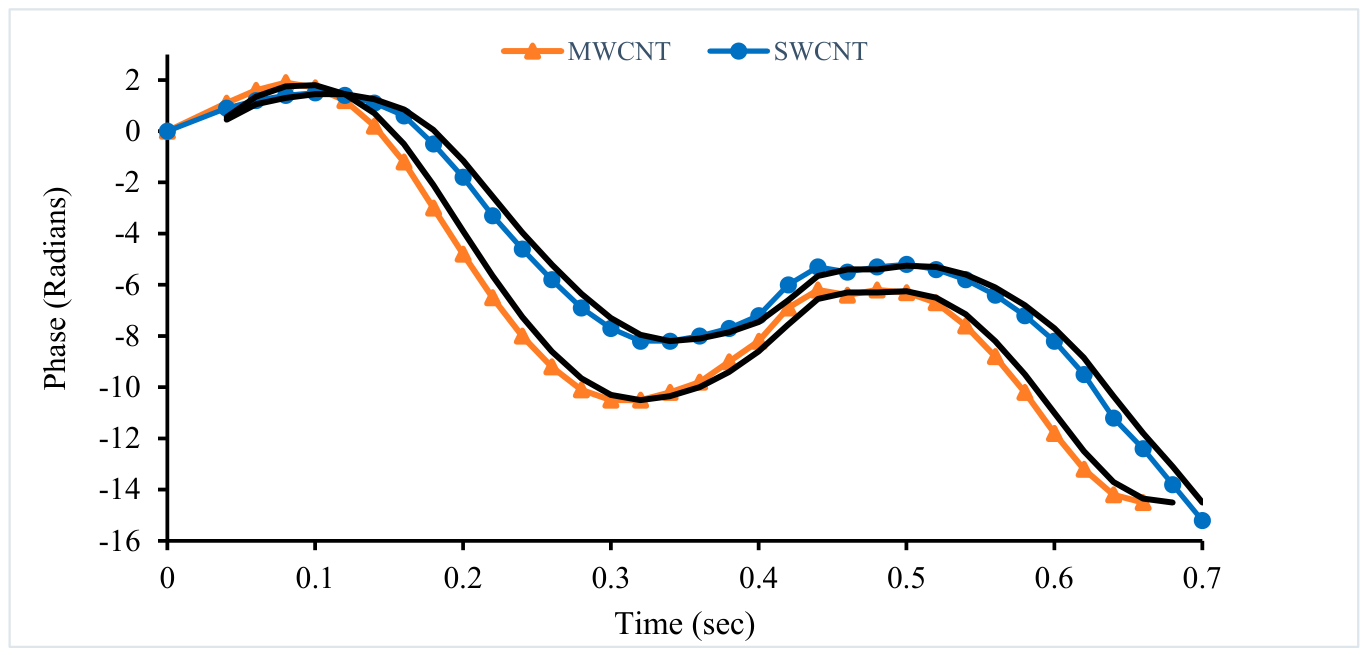
The results are also in congruence with AFM and DLS results discussed above. For MWCNTs, the highly negative zeta potential (−34 mV) with smaller AFM micrographs and large phase minimum (−14.5 rad) indicated that MWCNTs exhibited excellent electro-optical stability. These characteristics suggest that MWCNTs responded effectively to external field modulation.
In contrast, the SWCNT exhibited bulky aggregates with lower phase response (−11.2 rad) and smaller zeta potential (−28 mV). This indicated lower response and less dispersion stability compared to MWCNTs.
Table 4 compares the values with literature. The zeta potential value for the MWCNT (−34 mV) falls within the reported range of −50 to −30 mV described by Crooks [27]. MWCNT mobility (−2.41 cm2/V.s) falls within the range of −3.5 to −2.0 cm2/V.s reported earlier [27,29]. For SWCNT, the smaller zeta potential (−28 mV) was also within the range of −30 to −25 mV as described earlier [28]. The mobility for SWCNT was −1.86 cm2/V.s, falling within the range of −2.2 to −1.5 cm2/V.s reported in the literature [28].
The measured polydispersity index (PDI) values for MWCNT and SWCNT fluids were 0.293 and 0.256, respectively. Higher PDI structurally indicates broader, multi-modal size variance rather than strict geometric uniformity. Both nanofluid systems showed acceptable values below 0.7. As reported earlier [30], PDI values in the range 0.05–0.7 are acceptable. PDI values higher than 0.7 mean that the suspensions involve broad particle size distributions and are not easy to analyze using the DLS method. The present values here are within the acceptable PDI range and are suitable for DLS analysis.
3.2.5. Nanofluid Stability
To evaluate the practical viability of the prepared -COOH-functionalized CNT aqueous nanofluids for thermal conductivity, their stabilities were assessed across the targeted operational temperature range. Nanofluid stability has been studied using a number of methods. Direct observation of the suspension after prolonged shelf times was conducted monthly while maintaining the nanofluid samples in sealed borosilicate containers at room temperature without agitation. Visual sediment tracking was further confirmed with periodic zeta potential monitoring. AFM and DLS measurements were all used, as discussed above.
Compositional stability is primarily governed by the interactions of the hydrophilic functional groups (-COOH) with the aqueous environment on the one hand, and of the non-charged carbon backbone with the non-ionic surfactant (Tween 80) on the other hand. Tween 80 aqueous solutions exhibit a high cloud point well above 80 °C, ensuring that the steric stabilization layer wrapped around the short CNTs remains intact and does not undergo phase separation or thermal desorption under standard low-to-medium temperature heating cycles [31].
Furthermore, the covalent -COOH functionalization provides robust electrostatic repulsions between the functionalized CNTs. This hinders thermal agglomeration. Chemically, both the carbon nanotube backbone and the surface carboxyl groups remain highly stable against oxidation and hydrolysis within aqueous environments under these thermal constraints. The applicable temperature range for this specific nanofluid formulation is safely defined between 0 °C (above freezing) and 80 °C. Within this thermal window, the suspension retained its enhanced thermal conductivity without showing signs of chemical degradation, surfactant stripping, or accelerated sedimentation, making it a reliable candidate for closed-loop thermal management and heat exchange applications. Upon cooling with a dry ice bath, the fluid started to freeze at −4 °C. Upon heating, the fluid started vigorous bubbling at 95 °C (under 0.95 atm).
The MWCNT/Tween-80 suspension was especially stable as described above. Similar long-term stability behavior was earlier reported for other non-ionic surfactant-assisted CNT dispersions [32]. These results demonstrate that the combination of MWCNTs and Tween-80 provides a reliable and durable nanofluid formulation suitable for prolonged industrial and thermal applications.
3.3. Thermal Conductivity Results
The above results demonstrated that MWCNTs in water/Tween 80 suspensions showed especially high stability. Effects of surfactant type, CNT type and CNT concentration are discussed here. Comparisons between various systems were made in terms of relative enhancement in thermal conductivity (Keff/Kl), where the average value of Kl for water was 0.610 W·m−1·K−1.
3.3.1. Effect of Surfactant Type
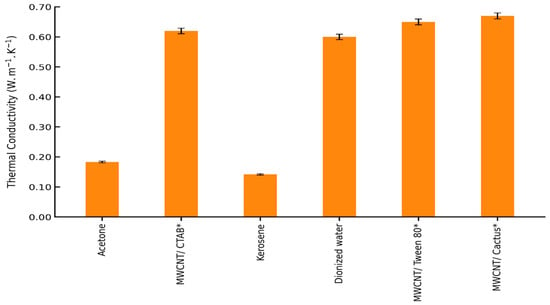
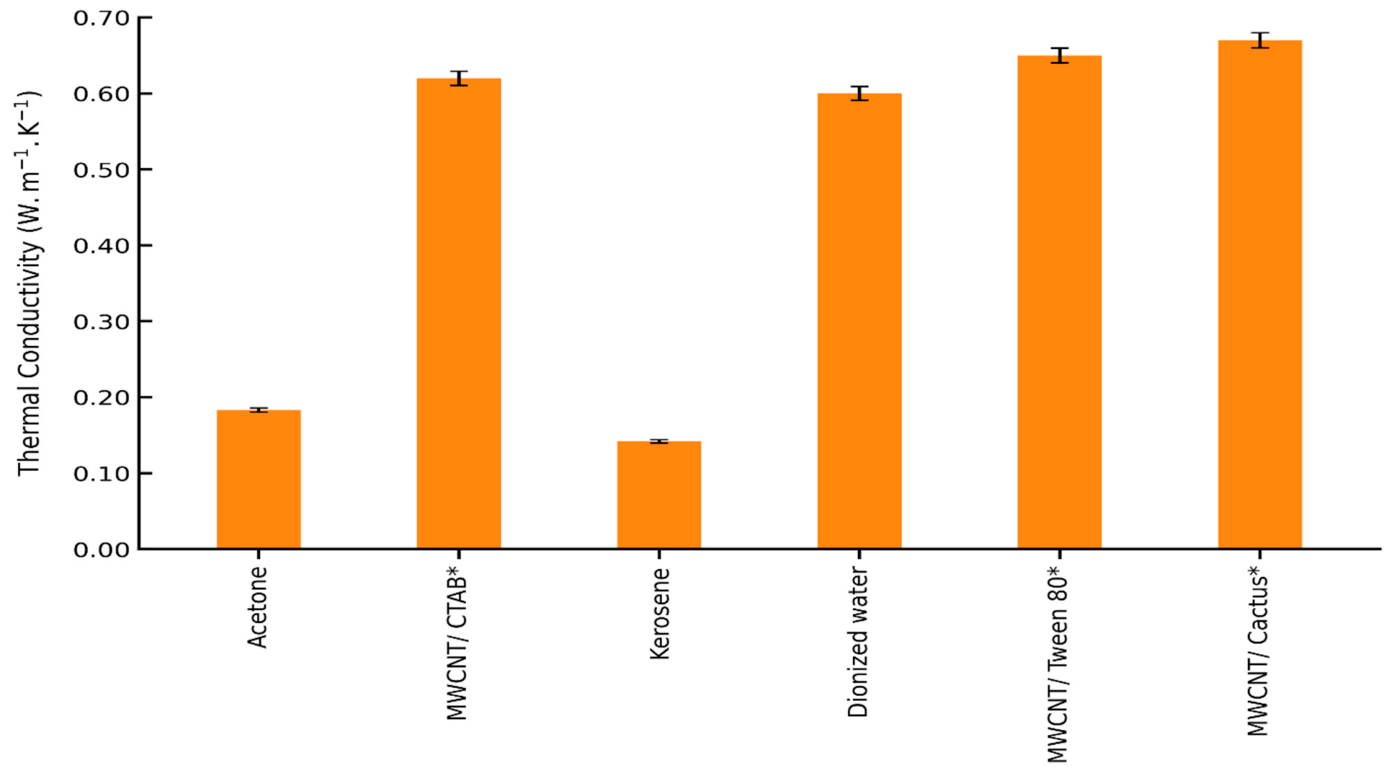
To calibrate the thermal conductivity measuring device, several reference and test fluids were examined for calibration purposes and to ensure measurement accuracy. For this purpose, kerosene, deionized (DI) water and acetone were all tested first. The average measured thermal conductivity values for the base fluids were 0.610 W·m−1·K−1 for DI water, 0.180 W·m−1·K−1 for acetone, and 0.150 W·m−1·K−1 for kerosene (Figure 6). The results are in good agreement with values reported in the literature [23], confirming the reliability and accuracy of the experimental setup prior to nanofluid characterization [33].
Figure 6.
Effect of surfactant type on nanofluid thermal conductivity. Calibration results for various liquids (kerosene, acetone, and pure DI water) are shown. * Using MWCNT (1.0 mg) inside water (50 mL) and surfactant (10 mg) after 60 min of sonication.
Functionalized MWCNT and SWCNT suspensions containing 10 mg of CNTs in water (50 mL) with surfactant (10 mg) were then examined. The surfactants showing observable stability after sonication were examined while others were ruled out. Figure 6 shows that both MWCNT and SWCNT nanofluids exhibited higher thermal conductivity than common base fluids.
Figure 6 also shows that Cactus showed the highest thermal conductivity enhancement among the series. Tween 80 showed the second highest value. However, knowing that Cactus yielded suspensions with relatively low observed stability, and Tween 80 produced the most stable suspension, Tween 80 surfactant was singled out in all thermal conductivity measurements, unless otherwise stated.
It should be noted that pure Tween 80 is known to have a low thermal conductivity (0.18–0.28 W.m−1.K−1) [34], compared to water (0.610 W.m−1.K−1). Therefore, thermal conductivity improvement in CNT aqueous nanofluids here was not due to Tween 80 itself, but rather to the CNT presence. This was confirmed by control experiments where aqueous Tween 80 solutions (10 mg in 50 mL water) exhibited no improvement in thermal conductivity compared to pure water.
3.3.2. Effect of CNT Type
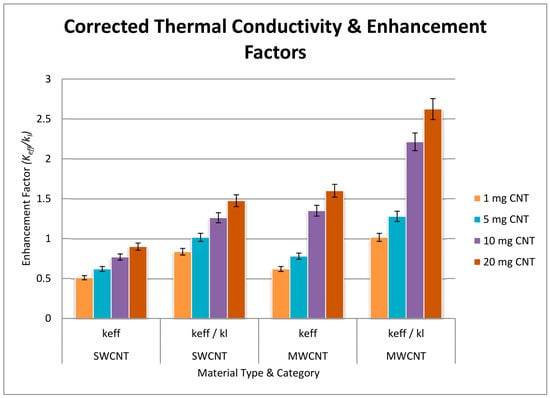
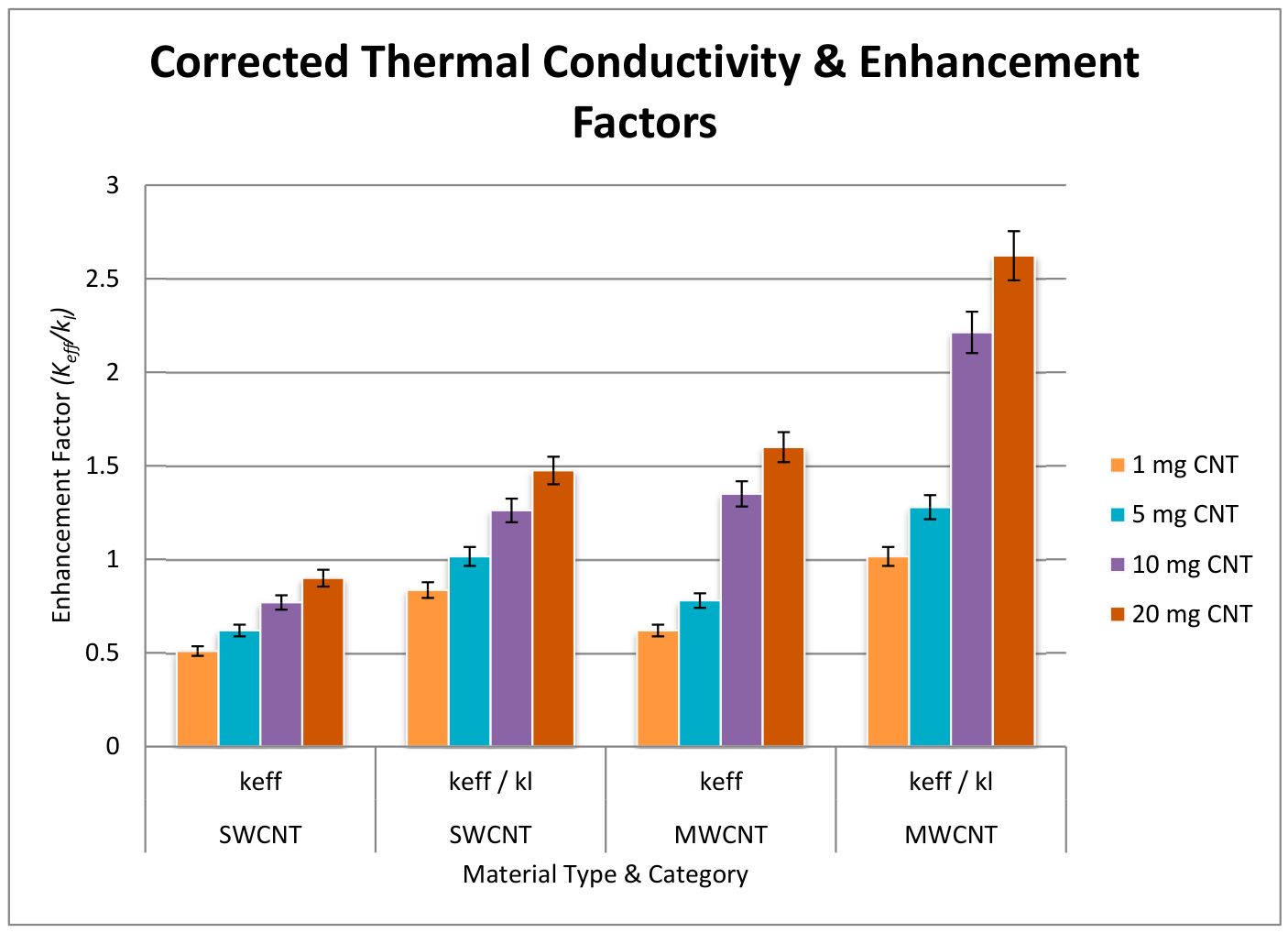
CNT type affected thermal conductivity in water/Tween 80 nanofluids. Figure 7 shows that MWCNTs were superior to SWCNTs at various corresponding concentrations. This is due to the superior characteristics of MWCNTs described above. AFM, DLS and zeta potential showed that MWCNTs were better suspended with more independent particles of smaller sizes. Naturally, MWCNTs increase the thermal conductivity of the nanofluid more than SWCNTs do.
Figure 7.
Effect of CNT type on nanofluid thermal conductivity. Results for short functionalized SWCNT and MWCNT nanofluids at various concentrations are shown. All measurements were made in water (50 mL) and surfactant Tween 80 (10 mg).
In their solid form, SWCNTs are known to exhibit higher conductivity than their MWCNT counterparts [35,36]. The reason for that could be due to the greater ability of SWCNTs to undergo vibrations that increase their conductivity. In the case of CNT mixtures, things are different. Reference [8] showed that MWCNTs exhibited higher thermal conductivity when composited with organic polymers. The higher conductivity in MWCNT nanofluids here is presumably due to the higher number of conjugated π-bonds present in the MWCNT. This increases conduction within the composited CNT itself. Small aggregate sizes, high dispersibility and high negative zeta potential associated with MWCNTs also increase the Brownian motion, which increases thermal conductivity. The polydispersity for MWCNT was also higher than that for SWCNT, which allowed higher permeability of solvent through the MWCNT particles [37], and consequently increased the conductivity. The results indicate more than one concurrent conduction mechanism in nanofluids, as described below.
3.3.3. MWCNT Concentration Effect
As described above, the MWCNT-based water/Tween 80 nanofluid exhibited the highest stability and thermal conductivity among the tested systems. For these reasons, MWCNTs have been singled out for further study here.
The effect of MWCNT concentration on the nanofluid thermal conductivity was investigated here. The results were expressed in terms of effective fluid conductivity relative to base fluid conductivity (Keff/Kl), as described in Figure 7. The Figure qualitatively shows that thermal conductivity enhancement increases with MWCNT concentration.
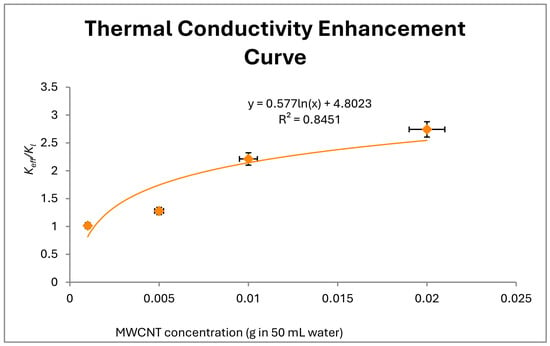
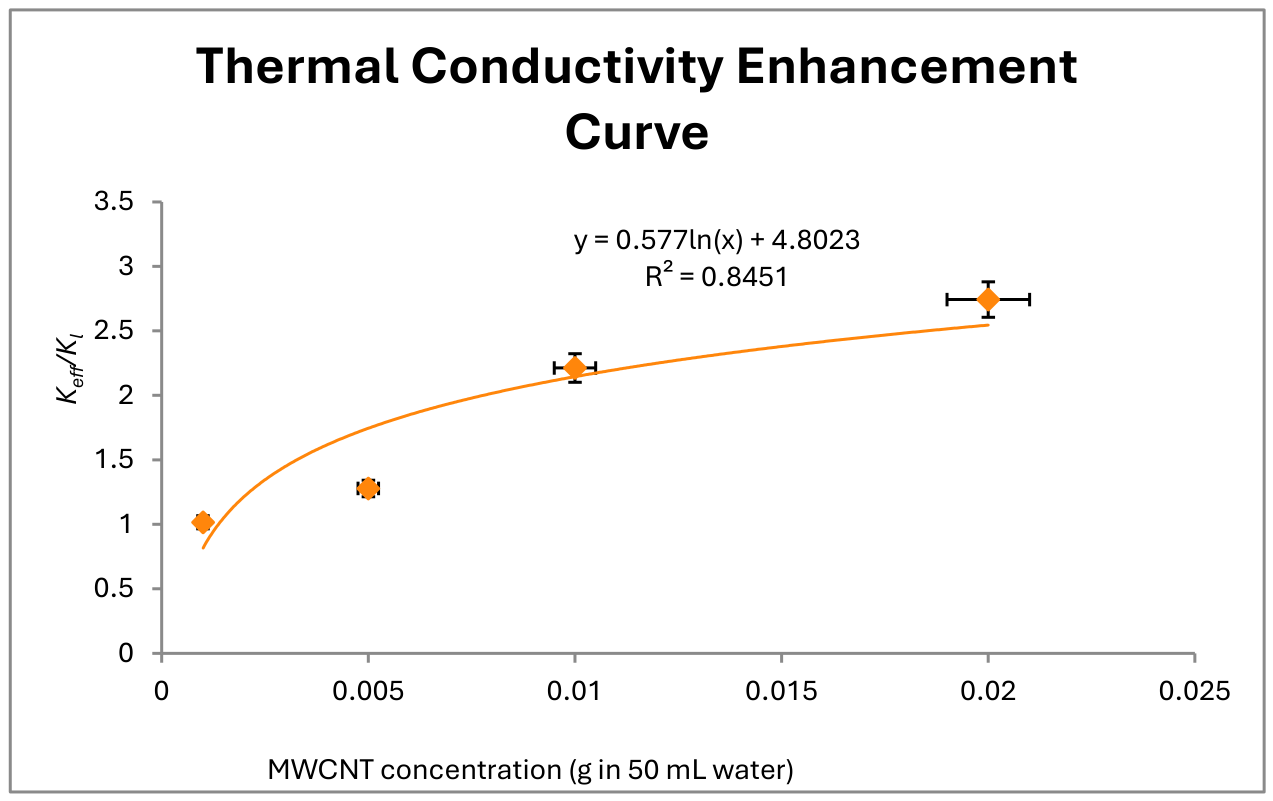
Figure 8 relates the nanofluid thermal conductivity and the MWCNT concentration. While thermal conductivity increased with increased concentration, the Figure shows that the dependence was not a simple linear relation. Even at lower concentrations, the relation was not a simple linear relationship. The best fit was a logarithmic relation as in Equation (6):
where y is Keff/Kl, and x is MWCNT concentration (g in 50 mL water), with an acceptable R2 = 0.8541.
Y = 0.577ln(x) + 4.8023
Figure 8.
Effect of MWCNT concentration on nanofluid thermal conductivity. Measurements were made using water (50 mL) and Tween 80 (10 mg).
The non-linear dependence of thermal conductivity enhancement on MWCNT concentration, even at small values, is noteworthy here. In colligative property behaviors, linear relations are observed especially at lower solute concentrations. In such cases, the nature of the solute, be it ionic or molecular, does not affect colligative properties such as boiling point elevation, freezing point depression, osmotic pressure and so on. The major factor in colligative properties is the concentration and only the concentration. At higher concentrations, colligative properties deviate from linearity due to solute-solute interactions, but strictly speaking at lower concentrations linearity is observed.
In the case of CNTs, things are different from simple molecules or ions. MWCNTs, the subject matter here, have no definite lengths. Within the same material, various tube lengths are expected. Moreover, the nanotubes do not exist as separate stand-alone tubes, but rather as aggregates, as discussed above. AFM and DLS described the MWCNTs in water/Tween 80 fluids as aggregates of various sizes. Zeta potential measurements described the aggregate surfaces as having negative charges at the given pH 6.5. Due to the -COOH functional groups, the MWCNTs have a point of zero charge (PZC) at pH values, typically lower than 3 [38]. Therefore, at pH 6.5 the MWCNTs should exist as negatively charged aggregates, with various sizes.
In CNT nanofluids, thermal conduction may occur through more than one mechanism. In dilute suspensions, the particles exist in continuous Brownian random motion [39]. At a given temperature, with various sizes and masses, independently suspended MWCNT aggregates should assume various root mean square speed (VRMS) values depending on their masses [40]. The higher Brownian motion in MWCNT fluids explains their higher thermal conductivity, by convection, compared to SWCNT counterparts. However, convection is not the only mechanism for thermal conductivity in CNT nanofluids. CNTs may improve thermal conduction through their intrinsic thermal conductivity. CNTs have six-membered rings with conjugated π bonds where electrons can move freely in the available bands causing electrical and thermal conduction along the CNT [41]. Formation of conductive heat transfer channels is another mechanism for thermal conduction in nanofluids [42]. The CNTs may also form networks inside the nanofluid, through which the base fluid percolates, causing heat conduction [43]. Solvent permeation inside the suspended MWCNT aggregates is another possible conduction mechanism. Therefore, a plausible mechanism of conduction may involve all such pathways concurrently.
Therefore, the suspended MWCNT aggregates should exhibit different behaviors from molecules or ions present in solutions. The aqueous MWCNT nanofluids should not follow colligative behaviors in thermal conduction.
Collectively, the results indicate that in CNT aqueous nanofluids, the fluid stability is influenced by the type of surfactant, sonication time and type of CNT. The most stable fluid was observed when suspending short MWCNTs in sonicated (60 min) aqueous Tween 80 solution. AFM, DLS and zeta potential rationalized the stability of this nanofluid. The stable MWCNT nanofluid exhibited high thermal conductivity, which increased non-linearly with concentration. This means that there is no need to increase MWCNT concentration in order to reach a nanofluid with much higher thermal conductivity. The above results are summarized in Table 5. In order to see the practical value of the present findings, they can be compared with other selected literature results, as summarized in Table 5.
Table 5.
Comparison of thermal conductivity results for CNT aqueous nanofluids with the literature (Keff av is the average of the three readings of Keff).
A comparison of entries 1–4 with entries 6–11 shows that the MWCNT aqueous nanofluid described here exhibited higher thermal conductivity, albeit at lower concentrations, than literature systems for MWCNT. The main reason is apparently the nature of the used surfactant, where Tween 80 was superior to other surfactants as described above. Entries 3 and 5 show that MWCNTs are superior to SWCNTs for the reasons discussed above. Comparison of entry 5 with entries 12–16 also shows that the SWCNT nanofluid described here, using a lower concentration, exhibited higher thermal conductivity than that reported in the literature, due to a difference in the surfactant.
As described above in Figure 8, entries 1–4 indicate that in MWCNT aqueous nanofluids the thermal conductivity is nonlinearly dependent on CNT concentration. Contrary to some earlier models [53], with colligative behaviors involved, the results show other behaviors. As described above, thermal conduction in MWCNT nanofluids may occur through various concurrent mechanisms [54], and should deviate from behaviors of simple ionic or molecular solutions. Therefore, high thermal conductivities can be achieved without necessarily using high MWCNT concentrations, which saves cost and chemical usage.
How adding CNTs to water increases its thermal conductivity was earlier reviewed [6]. Conductive network formation by virtue of the -COOH groups is one major conduction pathway. The networks conduct heat by the Brownian random motion. CNTs have intrinsic thermal conduction by virtue of the present conjugated π-bonds, which helps conduct heat. However, why CNTs increase thermal conductivity is beyond the scope of this work as it was earlier described.
The present study confirmed that MWCNT nanofluids have higher conductivity than their SWCNT counterparts. In the solid pristine state, the literature showed that SWCNTs have higher intrinsic thermal conductivity than MWCNTs. That was attributed to the greater ability of SWCNTs to vibrate [55,56]. On the other hand, MWCNTs are richer in free π-electrons. Moreover, the ability of MWCNTs to better disperse in the aqueous nanofluid allows more freedom for Brownian motion of the smaller aggregates, as described above.
Despite the potential value of the present study, it involved only a limited number of -COOH functionalized CNTs. Studying other types of functionalized CNTs is worthwhile. The effect of CNT length is another parameter to study [51]. Other surfactant types and concentrations, in combination with CNT type and concentration, should be studied to maximize benefits of CNT nanofluids. For practical purposes, testing the described MWCNT aqueous nanofluid in real-world heating systems on a larger scale, using temperatures up to 70 °C, is under way here.
4. Conclusions
- Aqueous solutions of various ionic and nonionic surfactants were used to prepare nanofluids of short multi-walled carbon nanotubes (MWCNTs) and single-walled carbon nanotubes (SWCNTs) with various concentrations.
- Tween 80 surfactant yielded the most stable nanofluids of -COOH-functionalized CNTs when the nanofluids were sonicated for 60 min, which was optimal. Stability was confirmed by various methods.
- Atomic force microscopy (AFM) and zeta potential measurements confirmed the existence of the suspended CNTs as aggregates with negatively charged surfaces, with MWCNTs forming smaller aggregates and exhibiting a more negative potential. Dynamic light scattering (DLS) also confirmed the smaller hydrodynamic sizes for the suspended MWCNTs that exhibited especially stable nanofluids for a prolonged period (18 months).
- Thermal conductivity was assessed for both MWCNT and SWCNT nanofluids in water/Tween 80 at room temperature. The nanofluids showed higher thermal conductivity than other literature counterparts examined in other surfactants. In the case of MWCNTs, which showed higher conductivity than SWCNTs, thermal conductivity increased with increasing concentration in a logarithmic nonlinear relation. That was contrary to earlier models that proposed colligative behavior at least at smaller concentrations.
- The non-colligative behavior, observed even at smaller concentrations here, was rationalized by the availability of more than one concurrent mechanism of conduction. The MWCNT particles behave differently from ions or molecules in solutions that follow colligative behavior, in terms of aggregate sizes, intra-tube conduction, network conducting channels and solvent percolation through the CNT networks.
- The results confirmed the possibility of optimizing non-hazardous MWCNT nanofluids with higher conductivity at lower cost.
Author Contributions
Conceptualization, Investigation, Writing—original draft preparation, Writing—review and editing, Software, I.M.I.K.; Supervision, Investigation, Modeling, Validation, A.A.; Writing—review and editing, Validation, H.N.; Supervision, Writing—review and editing, Validation, Management, H.S.H. All authors have read and agreed to the published version of the manuscript.
Funding
This research received no external funding.
Data Availability Statement
All data are included in the manuscript. Any other data will be provided upon request. Samples of the compounds are available from the authors (or from MDPI).
Acknowledgments
The authors wish to thank colleagues from the Faculty of Pharmacy and the Faculty of Engineering, An-Najah National University, for valuable technical help. The graduate student research budget, provided by An-Najah National University is acknowledged.
Conflicts of Interest
The authors declare no conflicts of interest.
References
- Choi, S.U.S. Enhancing Thermal Conductivity of Fluids with Nanoparticles. In Proceedings of the ASME International Mechanical Engineering Congress and Exposition (IMECE 1995), San Francisco, CA, USA, 12–17 November 1995; pp. 99–105. [Google Scholar] [CrossRef] [Scilit]
- Gonçalves, I.; Souza, R.; Coutinho, G.; Miranda, J.; Moita, A.; Pereira, J.E.; Moreira, A.; Lima, R. Thermal Conductivity of Nanofluids: A review on Prediction Models, Controversies and Challenges. Appl. Sci. 2021, 11, 2525. [Google Scholar] [CrossRef] [Scilit]
- Yu, W.; Choi, S. The Role of Interfacial Layers in the Enhanced Thermal Conductivity of Nanofluids: A Renovated Maxwell Model. J. Nanoparticle Res. 2003, 5, 167–171. [Google Scholar] [CrossRef] [Scilit]
- Murshed, S.S.; Lopes, M.M. Heat Exchangers: Design, Experiment and Simulation; BoD–Books on Demand: Norderstedt, Germany, 2017. [Google Scholar] [CrossRef] [Scilit] [PubMed]
- Das, S.K.; Putra, N.; Thiesen, P.; Roetzel, W. Temperature Dependence of Thermal Conductivity Enhancement for Nanofluids. J. Heat Transf. 2003, 125, 567–574. [Google Scholar] [CrossRef] [Scilit]
- Khoswan, I.; Nassar, H.; Assali, M.; AbuSafa, A.; Sawalha, S.; Hilal, H.S. Why Carbon Nanotubes Improve Aqueous Nanofluid Thermal Conductivity: A Qualitative Model Critical Review. Processes 2024, 12, 834. [Google Scholar] [CrossRef] [Scilit]
- Lee, D.-K.; Yoo, J.; Kim, H.; Kang, B.-H.; Park, S.-H. Electrical and Thermal Properties of Carbon Nanotube Polymer Composites with Various Aspect Ratios. Materials 2022, 15, 1356. [Google Scholar] [CrossRef] [Scilit] [PubMed]
- Chaichan, M.T.; Kazem, H.A.; Al-Ghezi, M.K.S.; Al-Waeli, A.H.A.; Ali, A.J.; Sopian, K.; Kadhum, A.A.H.; Isahak, W.N.R.W.; Takriff, M.S.; Al-Amiery, A.A. Optimizing Mwcnt-based Nanofluids for Photovoltaic/thermal Cooling Through Preparation Parameters. ACS Omega 2023, 8, 29910–29925. [Google Scholar] [CrossRef] [Scilit] [PubMed]
- Minea, A.A. A Review on Electrical Conductivity of Nanoparticle-enhanced Fluids. Nanomaterials 2019, 9, 1592. [Google Scholar] [CrossRef] [Scilit] [PubMed]
- Yang, L.; Hu, Y. Toward TiO2 Nanofluids—Part 1: Preparation and Properties. Nanoscale Res. Lett. 2017, 12, 417. [Google Scholar] [CrossRef] [Scilit] [PubMed]
- Davis, D.; Saleem, S.; Shah, F.; Singh, S. Development of ethylene glycol-Cr2AlC Nanofluid for Thermal Management in the Automotive Sector. Int. J. Appl. Ceram. Technol. 2020, 17, 1071–1078. [Google Scholar] [CrossRef] [Scilit]
- Hong, H.; Wensel, J.; Peterson, S.; Roy, W. Efficiently Lowering the Freezing Point in Heat Transfer Coolants Using Carbon Nanotubes. J. Thermophys. Heat Transf. 2007, 21, 446–448. [Google Scholar] [CrossRef] [Scilit]
- Wohld, J.; Beck, J.; Inman, K.; Palmer, M.; Cummings, M.; Fulmer, R.; Vafaei, S. Hybrid Nanofluid Thermal Conductivity and Optimization: Original Approach and Background. Nanomaterials 2022, 12, 2847. [Google Scholar] [CrossRef] [Scilit] [PubMed]
- Rudyak, V.Y.; Pryazhnikov, M.I.; Minakov, A.V.; Shupik, A.A. Comparison of Thermal Conductivity of Nanofluids with Single-walled and Multi-walled Carbon Nanotubes. Diam. Relat. Mater. 2023, 139, 110376. [Google Scholar] [CrossRef] [Scilit]
- Simpson, S.; Schelfhout, A.; Golden, C.; Vafaei, S. Nanofluid Thermal Conductivity and Effective Parameters. Appl. Sci. 2019, 9, 87. [Google Scholar] [CrossRef] [Scilit]
- Jabbari, F.; Rajabpour, A.; Saedodin, S. Thermal Conductivity of CNT–water Nanofluid at Different Temperatures, Volume Fractions, and Diameters: Experimental Investigation and Molecular Dynamics Simulations. Microfluid. Nanofluidics 2021, 25, 102. [Google Scholar] [CrossRef] [Scilit]
- NanoAmor. Available online: https://www.nanoamor.com/ (accessed on 9 May 2026).
- Rashmi, W.; Ismail, A.; Sopyan, I.; Jameel, A.; Yusof, F.; Khalid, M.; Mubarak, N. Stability and Thermal Conductivity Enhancement of Carbon Nanotube Nanofluid Using Gum Arabic. J. Exp. Nanosci. 2011, 6, 567–579. [Google Scholar] [CrossRef] [Scilit]
- Hamilton, R.L.; Crosser, O.K. Thermal Conductivity of Heterogeneous Two-component Systems. Ind. Eng. Chem. Fundam. 1962, 1, 187–191. [Google Scholar] [CrossRef] [Scilit]
- Arul Raja, R.A.; Sunil, J. Estimation of Thermal Conductivity of Nanofluids Using Theoretical Correlations. Int. J. Appl. Eng. Res. 2018, 13, 7932–7936. [Google Scholar] [CrossRef] [Scilit]
- Torre, K.; De Graaf, J. Hydrodynamic interactions in particle suspensions: Learning Stokesian dynamics. J. Rheol. 2026, 70, 917–933. [Google Scholar] [CrossRef] [Scilit]
- Merck/Sigma-Aldrich. Available online: https://www.sigmaaldrich.com/ (accessed on 9 May 2026).
- Liu, Y.; Block, D. Stokes–einstein Relation for Binary Mixtures. Comput. Phys. Commun. 2024, 300, 109184. [Google Scholar] [CrossRef] [Scilit]
- Everts, J.C.; Hołyst, R.; Makuch, K. Brownian Motion at Various Length Scales with Hydrodynamic and Direct Interactions. Phys. Fluids 2025, 37, 027170. [Google Scholar] [CrossRef] [Scilit]
- Rowe, R.C.; Sheskey, P.J.; Quinn, M.E. (Eds.) Handbook of Pharmaceutical Excipients, 6th ed.; Pharmaceutical Press and American Pharmacists Association: London, UK; Washington, DC, USA, 2009; ISBN 978-0-85369-792-3. [Google Scholar]
- Abdulhameed, A.; Halin, I.A.; Mohtar, M.N.; Hamidon, M.N. Optimization of Surfactant Concentration in Carbon Nanotube Solutions for Dielectrophoretic Ceiling Assembly and Alignment: Implications for Transparent Electronics. ACS Omega 2022, 7, 3680–3688. [Google Scholar] [CrossRef] [Scilit] [PubMed]
- Coleman, J.N. Liquid-phase Exfoliation of Nanotubes and Graphene. Adv. Funct. Mater. 2009, 19, 3680–3695. [Google Scholar] [CrossRef] [Scilit]
- Ito, T.; Sun, L.; Bevan, M.A.; Crooks, R.M. Comparison of Nanoparticle Size and Electrophoretic Mobility Measurements Using a Carbon-nanotube-based Coulter Counter, Dynamic Light Scattering, Transmission Electron Microscopy, and Phase Analysis Light Scattering. Langmuir 2004, 20, 6940–6945. [Google Scholar] [CrossRef] [Scilit] [PubMed]
- Hackley, V.A.; Clogston, J.D. Measuring the Size of Nanoparticles in Aqueous Media Using Batch-Mode Dynamic Light Scattering: Version 1.1; National Institute of Standards and Technology: Gaithersburg, MD, USA, 2010. [Google Scholar] [CrossRef] [PubMed]
- Danaei, M.; Dehghankhold, M.; Ataei, S.; Davarani, F.; Javanmard, R.; Dokhani, A.; Khorasani, S.; Mozafari, M. Impact of Particle Size and Polydispersity Index on the Clinical Applications of Lipidic Nanocarrier Systems. Pharmaceutics 2018, 10, 57. [Google Scholar] [CrossRef] [Scilit] [PubMed]
- Khan, M.; Amin, M.R.; Rahman, M.; Abdul Rub, M.; Hoque, M.A.; Khan, M.; Asiri, A.M. Influence of Different Additives on the Clouding Nature and Thermodynamic Behavior of Tween 80 Solution in the Absence and Presence of the Amikacin Sulfate Drug. J. Chem. Eng. Data 2019, 64, 668–675. [Google Scholar] [CrossRef] [Scilit]
- Hein, L.; Coulombe, S.; Cecere, R.; Mongrain, R. Electrophoretic Deposition of Multi-walled Carbon Nanotubes: The Key Role of Plasma Functionalization and Polymerization. Plasma Process. Polym. 2024, 21, 2400137, Correction in Plasma Process. Polym. 2025, 22, 1341. https://doi.org/10.1002/ppap.1341. [Google Scholar] [CrossRef] [Scilit]
- Rudyak, V.Y.; Pryazhnikov, M.I.; Minakov, A.V.; Shupik, A.A. Electrical Conductivity of Nanofluids with Single-and Multi-walled Carbon Nanotubes. Experimental Study. Nano-Struct. Nano-Objects 2024, 38, 101143. [Google Scholar] [CrossRef] [Scilit]
- Xie, H.; Lee, H.; Youn, W.; Choi, M. Nanofluids Containing Multiwalled Carbon Nanotubes and Their Enhanced Thermal Conductivities. J. Appl. Phys. 2003, 94, 4967–4971. [Google Scholar] [CrossRef] [Scilit]
- Islam, M.; Rojas, E.; Bergey, D.; Johnson, A.; Yodh, A. High Weight Fraction Surfactant Solubilization of Single-wall Carbon Nanotubes in Water. Nano Lett. 2003, 3, 269–273. [Google Scholar] [CrossRef] [Scilit]
- Engineering ToolBox. Thermal Conductivity of Liquids. Available online: https://www.engineeringtoolbox.com/thermal-conductivity-liquids-d_1260.html (accessed on 3 April 2026).
- Altun, A.; Şara, O.N.; Şimşek, B. A Comprehensive Statistical Approach for Determining the Effect of Two Non-ionic Surfactants on Thermal Conductivity and Density of Al2O3–water-based Nanofluids. Colloids Surf. A Physicochem. Eng. Asp. 2021, 626, 127099. [Google Scholar] [CrossRef] [Scilit]
- Yang, X.; Cui, J.; Xue, K.; Fu, Y.; Li, H.; Yang, H. Thermal Conductivity and Thermoelectric Properties in 3D Macroscopic Pure Carbon Nanotube Materials. Nanotechnol. Rev. 2021, 10, 178–186. [Google Scholar] [CrossRef] [Scilit]
- Gspann, T.S.; Juckes, S.M.; Niven, J.F.; Johnson, M.B.; Elliott, J.A.; White, M.A.; Windle, A.H. High Thermal Conductivities of Carbon Nanotube Films and Micro-fibres and Their Dependence on Morphology. Carbon 2017, 114, 160–168. [Google Scholar] [CrossRef] [Scilit]
- Thomas, D.; Bardin-Monnier, N.; Charvet, A. Effect of the Fibre Diameter Polydispersity on the Permeability of Nonwoven Filter Media. Can. J. Chem. Eng. 2023, 101, 4138–4150. [Google Scholar] [CrossRef] [Scilit]
- Bicil, Z. Synthesis, Characterization, and Their Electrokinetic Properties of Functionalized Multi-walled Carbon Nanotubes. J. Nanoparticle Res. 2025, 27, 166. [Google Scholar] [CrossRef] [Scilit]
- Poon, W.C.K. The Physics of a Model Colloid–polymer Mixture. J. Phys. Condens. Matter 2002, 14, R859–R880. [Google Scholar] [CrossRef] [Scilit]
- Yudianto, A.; Kurniadi, N.; Adiyasa, I.W.; Arifin, Z. The Effect of Masses in the Determination of Optimal Suspension Damping Coefficient. J. Phys. Conf. Ser. 2019, 1273, 012067. [Google Scholar] [CrossRef] [Scilit]
- Fasano, M.; Bigdeli, M.B.; Sereshk, M.R.V.; Chiavazzo, E.; Asinari, P. Thermal Transmittance of Carbon Nanotube Networks: Guidelines for Novel Thermal Storage Systems and Polymeric Material of Thermal Interest. Renew. Sustain. Energy Rev. 2015, 41, 1028–1036. [Google Scholar] [CrossRef] [Scilit]
- Assael, M.J.; Metaxa, I.; Arvanitidis, J.; Christofilos, D.; Lioutas, C. Thermal Conductivity Enhancement in Aqueous Suspensions of Carbon Multi-walled and Double-walled Nanotubes in the Presence of Two Different Dispersants. Int. J. Thermophys. 2005, 26, 647–664. [Google Scholar] [CrossRef] [Scilit]
- Hwang, Y.-J.; Lee, J.K.; Lee, C.H.; Jung, Y.M.; Cheong, S.I.; Lee, C.G.; Ku, B.C.; Jang, S.P. Stability and Thermal Conductivity Characteristics of Nanofluids. Thermochim. Acta 2007, 455, 70–74. [Google Scholar] [CrossRef] [Scilit]
- Chen, W.; Yan, L.; Bangal, P.R. Chemical Reduction of Graphene Oxide to Graphene by Sulfur-containing Compounds. J. Phys. Chem. C 2010, 114, 19885–19890. [Google Scholar] [CrossRef] [Scilit]
- Brownridge, P.; Beynon, R.J. The Importance of the Digest: Proteolysis and Absolute Quantification in Proteomics. Methods 2011, 54, 351–360. [Google Scholar] [CrossRef] [Scilit] [PubMed]
- Xie, H.; Chen, L. Adjustable Thermal Conductivity in Carbon Nanotube Nanofluids. Phys. Lett. A 2009, 373, 1861–1864. [Google Scholar] [CrossRef] [Scilit]
- Choi, S.U.S.; Zhang, Z.G.; Yu, W.; Lockwood, F.E.; Grulke, E.A. Anomalous Thermal Conductivity Enhancement in Nanotube Suspensions. Appl. Phys. Lett. 2001, 79, 2252–2254. [Google Scholar] [CrossRef] [Scilit]
- Ding, Y.; Alias, H.; Wen, D.; Williams, R.A. Heat Transfer of Aqueous Suspensions of Carbon Nanotubes (CNT Nanofluids). Int. J. Heat Mass Transf. 2006, 49, 240–250. [Google Scholar] [CrossRef] [Scilit]
- Yu, W.; Xie, H. A Review on Nanofluids: Preparation, Stability Mechanisms, and Applications. J. Nanomater. 2012, 2012, 435873. [Google Scholar] [CrossRef] [Scilit]
- Wantha, C. Unsteady Flow and Heat Transfer Characteristics over the Rounded and Square Leading-edge Plate. Int. J. Thermofluid Sci. Technol. 2023, 10, 100202. [Google Scholar] [CrossRef] [Scilit]
- Gao, C.; Guo, M.; Liu, Y.; Zhang, D.; Gao, F.; Sun, L.; Li, J.; Chen, X.; Terrones, M.; Wang, Y. Surface Modification Methods and Mechanisms in Carbon Nanotubes Dispersion. Carbon 2023, 212, 118133. [Google Scholar] [CrossRef] [Scilit]
- Li, Y.; Georges, G. Three Decades of Single-Walled Carbon Nanotubes Research: Envisioning the Next Breakthrough Applications. ACS Nano 2023, 17, 19471–19473. [Google Scholar] [CrossRef] [Scilit] [PubMed]
- Venkata Sastry, N.N.; Bhunia, A.; Sundararajan, T.; Das, S.K. Predicting the Effective Thermal Conductivity of Carbon Nanotube Based Nanofluids. Nanotechnology 2008, 19, 055704. [Google Scholar] [CrossRef] [Scilit] [PubMed]

Disclaimer/Publisher’s Note: The statements, opinions and data contained in all publications are solely those of the individual author(s) and contributor(s) and not of MDPI and/or the editor(s). MDPI and/or the editor(s) disclaim responsibility for any injury to people or property resulting from any ideas, methods, instructions or products referred to in the content. |
© 2026 by the authors. Licensee MDPI, Basel, Switzerland. This article is an open access article distributed under the terms and conditions of the Creative Commons Attribution (CC BY) license.