


Abstract
This work investigates the effect of Co incorporation on the physicochemical properties and dry reforming of methane (DRM) performance of Ni catalysts supported on surface-modified γ-Al2O3 containing 9 wt% MgO and 1 wt% ZrO2 (MS). Bimetallic catalysts containing 5 and 10 wt% Co with a fixed Ni loading of 10 wt% were prepared by co-impregnation. H2-TPR and H2-TPD analyses revealed the Co incorporation reducibility and hydrogen adsorption–desorption characteristics of the catalysts. These changes were accompanied by enhanced DRM activity and increased H2/CO ratios, which may reflect changes in the contributions of competing reactions, including the reverse water–gas shift reaction. Although 10Ni10Co/MS exhibited the highest CH4 and CO2 consumption rates and H2/CO ratio, its enhanced activity was accompanied by more-pronounced graphitic carbon features and greater catalytic deactivation. In contrast, 10Ni5Co/MS maintained more stable catalytic performance while retaining improved reactant utilization and H2/CO ratio. These findings suggest that controlled Co incorporation provides a favorable balance between DRM activity and resistance to carbon-associated deactivation, with 5 wt% Co providing the best activity–stability balance among the investigated catalysts.
1. Introduction
The continuous increase in greenhouse gas emissions, particularly carbon dioxide (CO2) and methane (CH4), has become a critical global challenge due to their contribution to climate change and global warming [1,2]. Among various mitigation approaches, the simultaneous utilization of CO2 and CH4 to produce value-added energy carriers and chemical feedstocks offers a promising pathway for addressing environmental concerns while improving carbon resource utilization. In particular, the conversion of these greenhouse gases into synthesis gas (syngas) provides an attractive route for producing valuable downstream chemicals and fuels [3,4,5].
Dry reforming of methane (DRM) has been widely investigated as a promising route for the simultaneous utilization of CO2 and CH4, converting these two greenhouse gases into syngas, a valuable mixture of H2 and CO (Equation (1)) [6,7]. However, the practical application of DRM remains challenging due to its high energy requirement and catalyst deactivation under harsh reaction conditions [8,9]. Therefore, the rational design of highly active and stable catalysts is crucial for advancing DRM toward practical applications. Ni-based catalysts are among the most practical candidates for DRM owing to their high catalytic activity and relatively low cost compared with noble-metal catalysts [3,10,11]. Nevertheless, Ni-based catalysts suffer from significant drawbacks, particularly carbon deposition and Ni particle sintering under high-temperature reaction conditions. Carbon deposition, mainly originating from side reactions such as methane decomposition (Equation (2)) and the Boudouard reaction (Equation (3)), can block active sites and contribute to catalyst deactivation [12]. In addition, the reverse water–gas shift (RWGS) reaction (Equation (4)) competes with DRM by consuming H2 and CO2, thereby decreasing the H2/CO ratio of produced syngas [10,13].
To address these limitations, considerable efforts have been devoted to the rational design of Ni-based catalysts, particularly through modification of catalyst supports to improve catalytic stability and resistance to carbon deposition [6,14,15]. In this context, tailoring the surface properties of Al2O3 through the incorporation of basic and oxygen-active components provides a potential strategy for promoting CO2 adsorption with the suppression of carbon formation in both quantity and structure. In previous studies, Al2O3 was modified with 9 wt% MgO and 1 wt% ZrO2, the optimum fraction of the total 10 wt% MgO–ZrO2 mixed oxide that maximizes surface basicity and oxygen mobility of γ-Al2O3 [16,17]. The presence of ZrO2 in proximity to the active metal sites, together with the development of an interconnected network-like structure, may further modify metal–support interactions and facilitate reactant accessibility [17]. Although this modified support improved the resistance of Ni catalysts to carbon deposition, its influence on CH4 activation and the H2/CO product ratio remained limited [16,17].
In addition to support modification, the development of bimetallic catalysts represents another promising strategy for improving the performance of Ni-based catalysts. Among various combinations, Ni–Co systems have attracted considerable attention because Co incorporation can influence the reduction characteristics, surface properties, and catalytic behavior of Ni-containing catalysts [18,19,20,21]. The present work addresses the remaining performance limitations of the previously developed MgO–ZrO2-modified Al2O3-supported Ni catalyst system by investigating Co incorporation, with particular emphasis on the relationship between catalytic activity and stability during DRM. Understanding how Co loading influences the relationship between catalytic performance and carbon-associated deactivation is therefore essential for identifying a suitable Ni–Co composition on this support.
Accordingly, the present study extends the application of MgO–ZrO2-modified Al2O3 (MS) as support material from monometallic Ni catalysts to bimetallic Ni–Co catalysts for DRM. Three catalysts with a fixed Ni loading of 10 wt% and Co loadings of 0, 5, and 10 wt% (10Ni/MS, 10Ni5Co/MS, and 10Ni10Co/MS, respectively) were investigated to clarify the influence of Co content on catalyst reducibility, hydrogen adsorption–desorption characteristics, catalytic performance, and stability. Catalytic behavior was evaluated using CH4 and CO2 consumption rates, H2/CO product ratios, and apparent site-normalized activity metrics, while the structural characteristics of graphitic carbon formed during DRM were examined by XRD analysis of the spent catalysts. Particular attention was given to the relationship between Co loading, reactant consumption, and the possible competition between carbon formation and removal pathways. Through this approach, the study aims to identify a Co loading that provides a favorable compromise between catalytic activity and stability on the modified support, rather than simply maximizing the Co content.
2. Materials and Methods
A series of Ni–Co catalysts supported on γ-Al2O3 modified with 9 wt% MgO and 1 wt% ZrO2 (MS) was prepared with a fixed Ni loading of 10 wt% and varying Co contents of 0, 5, and 10 wt% (10Ni/MS, 10Ni5Co/MS, and 10Ni10Co/MS). The monometallic Ni catalyst (10Ni/MS) was used as a reference to systematically evaluate the effect of Co incorporation on the physicochemical properties and catalytic performance of the bimetallic catalysts.
The fresh catalysts were characterized by the N2 adsorption–desorption isotherm, transmission electron microscopy coupled with energy-dispersive X-ray spectroscopy (TEM–EDS), X-ray diffraction (XRD), temperature-programmed reduction of H2 (H2–TPR), and temperature-programmed desorption of H2 (H2–TPD). These techniques were employed to investigate the morphology and elemental distribution, crystalline structure, reducibility, metal–support interaction, metal dispersion and H2–adsorption behavior. Following the catalytic tests, the spent catalysts were characterized by XRD to evaluate carbon deposition and structural changes occurring during DRM.
The catalytic performance of the prepared catalysts was evaluated in a fixed-bed reactor under low-temperature DRM conditions. Detailed procedures for catalyst preparation, characterization, and catalytic evaluation are described in the following sections.
2.1. Catalyst Preparation
The catalyst support was prepared by surface modification of γ-Al2O3 with MgO and ZrO2 to obtain a final composition of 90 wt% Al2O3, 9 wt% MgO, and 1 wt% ZrO2, hereafter denoted as MS. γ-Al2O3 (98%, Sigma-Aldrich, St. Louis, MO, USA) was used as the parent support, while magnesium nitrate hexahydrate (Mg(NO3)2·6H2O, 98%, Sigma-Aldrich) and zirconyl nitrate hydrate (ZrO(NO3)2·xH2O, 98%, Acros Organics™, Waltham, MA, USA) were used as MgO and ZrO2 precursors, respectively. Deionized water was used as the solvent. The modified support was prepared by an impregnation method according to the procedure reported in our previous studies [16,17]. Following impregnation, the resulting wet powder was aged under ambient conditions for 24 h, dried at 60 °C for 24 h, and subsequently calcined at 650 °C in air for 5 h to obtain the MS support.
Ni- and Ni–Co-based catalysts were subsequently prepared by incipient wetness impregnation of the MS support using aqueous solutions of Ni(NO3)2·6H2O (98%, Acros Organics™) and Co(NO3)2·6H2O (98%, Sigma-Aldrich) as the corresponding metal precursors. The precursor concentrations were adjusted to obtain catalysts containing 10 wt% Ni (10Ni/MS), 10 wt% Ni and 5 wt% Co (10Ni5Co/MS), and 10 wt% Ni and 10 wt% Co (10Ni10Co/MS).
For the bimetallic catalysts, the Ni and Co precursors were simultaneously introduced by co-impregnation. Following impregnation, the resulting samples were aged under ambient conditions for 24 h, dried at 60 °C for 24 h, and subsequently calcined in air at 650 °C for 5 h.
2.2. Catalyst Characterization
The textural properties of the MS support and the prepared catalysts were characterized by N2 adsorption–desorption measurements at −196 °C using BELSORP-mini (BEL JAPAN, INC., Osaka, Japan). Prior to analysis, approximately 0.05 g of each sample was degassed at 350 °C under N2 flow for 3 h to remove physically adsorbed moisture and other surface contaminants. The specific surface area was determined using the multipoint Brunauer–Emmett–Teller (BET) method. The total pore volume was estimated from the amount of N2 adsorbed at a relative pressure (P/P0) close to unity. The pore-size distribution and average pore diameter were determined using the Barrett–Joyner–Halenda (BJH) method.
The morphology and particle characteristics of the fresh and spent catalysts were examined by TEM using a Talos F200X Gen2 microscope (Thermo Fisher Scientific Inc., Waltham, MA, USA) operated at 300 kV. Elemental distribution was further examined by EDS coupled with TEM. Prior to analysis, the powder samples were ultrasonically dispersed in absolute ethanol (99.9%), and a drop of the resulting suspension was deposited onto a carbon-coated grid and dried under ambient conditions before analysis.
The crystalline phases of the support materials, the calcined and spent catalysts were characterized by powder XRD using a Smart Lab diffractometer (RIGAKU Corporation, Tokyo, Japan) equipped with Cu Kα radiation (λ = 1.5406 Å), operated at 40 kV and 40 mA. The diffraction patterns were recorded over a 2θ range of 10–80° with a step size of 0.02°.
The crystalline domain size and structural ordering of carbonaceous deposits formed on spent catalysts were quantitatively evaluated using X-ray diffraction (XRD) profiles around the diffraction peak at 2θ ≈ 25.9°–26.2°, corresponding to the (002) crystallographic plane of graphitic carbon. The mean crystallite size (D) of the accumulated coke was calculated using the Scherrer equation (Equation (5)) [22].
where K is the shape factor (0.9 for graphitic carbon), λ is the X-ray wavelength (λ = 0.15406 nm for Cu Kα), β represents the full width at half maximum (FWHM) of the C (002) reflection expressed in radians, and θ is the Bragg angle.
The reduction and H2 adsorption/desorption properties of the catalysts were investigated by H2-TPR and H2-TPD, respectively. These measurements were conducted sequentially using the same instrument without exposing the samples to ambient conditions between measurements, thereby minimizing surface reoxidation and preserving the reduced catalyst surface for subsequent characterization.
Approximately 0.05 g of catalyst was loaded into a U-shaped quartz reactor and analyzed using a BELCAT-Basic system (BEL JAPAN, INC., Osaka, Japan) equipped with a thermal conductivity detector (TCD). H2-TPR was first performed to investigate the reducibility of the metal oxide species and their interactions with the support. Prior to reduction, the catalyst was pretreated under Ar at 200 °C for 1 h to remove physically adsorbed species. After cooling to room temperature under Ar, the sample was exposed to 5% H2/Ar and heated from room temperature to 650 °C at a heating rate of 10 °C min−1, followed by an isothermal period of 15 min at 650 °C. This treatment also generated the reduced metal species prior to subsequent H2-TPD analysis. The reduction degree of catalysts (Equation (6)) was calculated as the ratio of the experimentally measured H2 consumption during H2-TPR to the theoretical H2 consumption required for complete reduction, both expressed per gram of catalyst. Two assumptions regarding the Co-containing oxide phases were considered. The first assumed Co3O4, with a theoretical H2/Co molar ratio of 4/3, whereas the second considered CoAl2O4, with a theoretical H2/Co molar ratio of 1. For both cases, the theoretical H2 consumption associated with Ni reduction was calculated using an H2/Ni molar ratio of 1.
where is the amount of H2 consumed during TPR and is the theoretical H2 required for complete reduction. Both quantities are expressed in mol .
Following H2-TPR, the sample was cooled to 120 °C under Ar, and H2 adsorption was performed at 120 °C for 30 min. The sample was subsequently cooled to room temperature under Ar and purged to remove gas-phase and weakly adsorbed H2. The H2-TPD profile was then recorded under Ar by heating the sample from room temperature to 650 °C at a rate of 10 °C min−1, followed by an isothermal period of 15 min at 650 °C. The H2 desorption profiles were used to evaluate the H2 adsorption/desorption characteristics and the strength of interactions between adsorbed hydrogen species and the catalyst surface.
The apparent metal dispersion was calculated using Equation (7) from the total amount of H2 desorbed, determined by integrating the calibrated H2-TPD signal over the entire heating and isothermal period. A stoichiometric factor (SF) of 2 was applied, assuming dissociative H2 adsorption with an H-to-surface-metal atomic ratio of 1:1. The theoretical amount of metal atoms was calculated from the total Ni and Co contents per gram of catalyst.
where is the total amount of H2 desorbed during H2-TPD, nmetal,Theoretical is the theoretical amount of Ni and Co atom per gram of catalyst, and SF is the stoichiometric factor (SF = 2).
2.3. Catalytic Test
The catalytic performance of the prepared catalysts for DRM was evaluated in a tubular fixed-bed reactor. Approximately 0.30 g of catalyst was loaded into the reactor and reduced in situ under H2 flow at 600 °C for 3 h prior to the catalytic test. The DRM reaction was subsequently carried out at 600 °C for 5 h using an equimolar CH4/CO2/N2 feed mixture (1:1:1) at a total flow rate of 60 mL min−1. The outlet gas composition was continuously analyzed using an online gas chromatograph (Agilent 7890A, Agilent Technologies, Santa Clara, CA, USA) equipped with a TCD. The catalytic performance was evaluated in terms of CH4 and CO2 consumption rates (Equations (8) and (9), respectively) and the H2/CO product ratio (Equation (10)). The CH4 and CO2 conversions (Equations (11) and (12), respectively) were additionally calculated to facilitate comparison with catalytic performance data reported in previous studies. The apparent turnover frequency (TOF) was calculated from the sum of the CH4 and CO2 consumption rates normalized by the number of accessible metal sites estimated from H2-TPD, as expressed in Equation (11).
where and are the CH4 and CO2 consumption rates (mol h−1 g−1), respectively. Fi,in and Fi,out represent the inlet and outlet molar flow rates of species i, respectively, and nactive sites is the estimated amount of accessible metal sites (mol g−1) calculated from the apparent metal dispersion obtained by H2-TPD.
3. Results and Discussion
This study investigates the effect of Co incorporation on the physicochemical properties, Ni–Co interactions, and catalytic performance of Ni-based catalysts supported on MgO–ZrO2-modified γ-Al2O3 (MS) for DRM. A series of catalysts with a fixed Ni loading of 10 wt% and varying Co contents (0, 5, and 10 wt%) was prepared to systematically evaluate the influence of Co addition on the structural, surface, and catalytic properties.
3.1. Fresh Catalyst Characterization
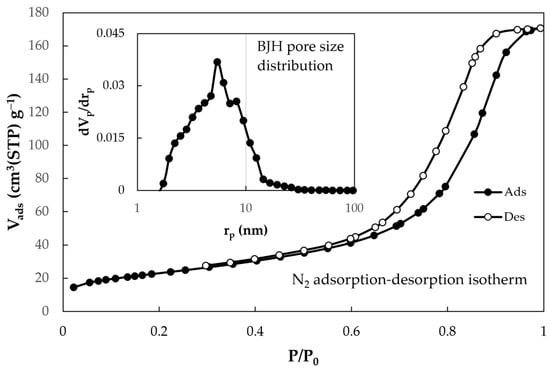
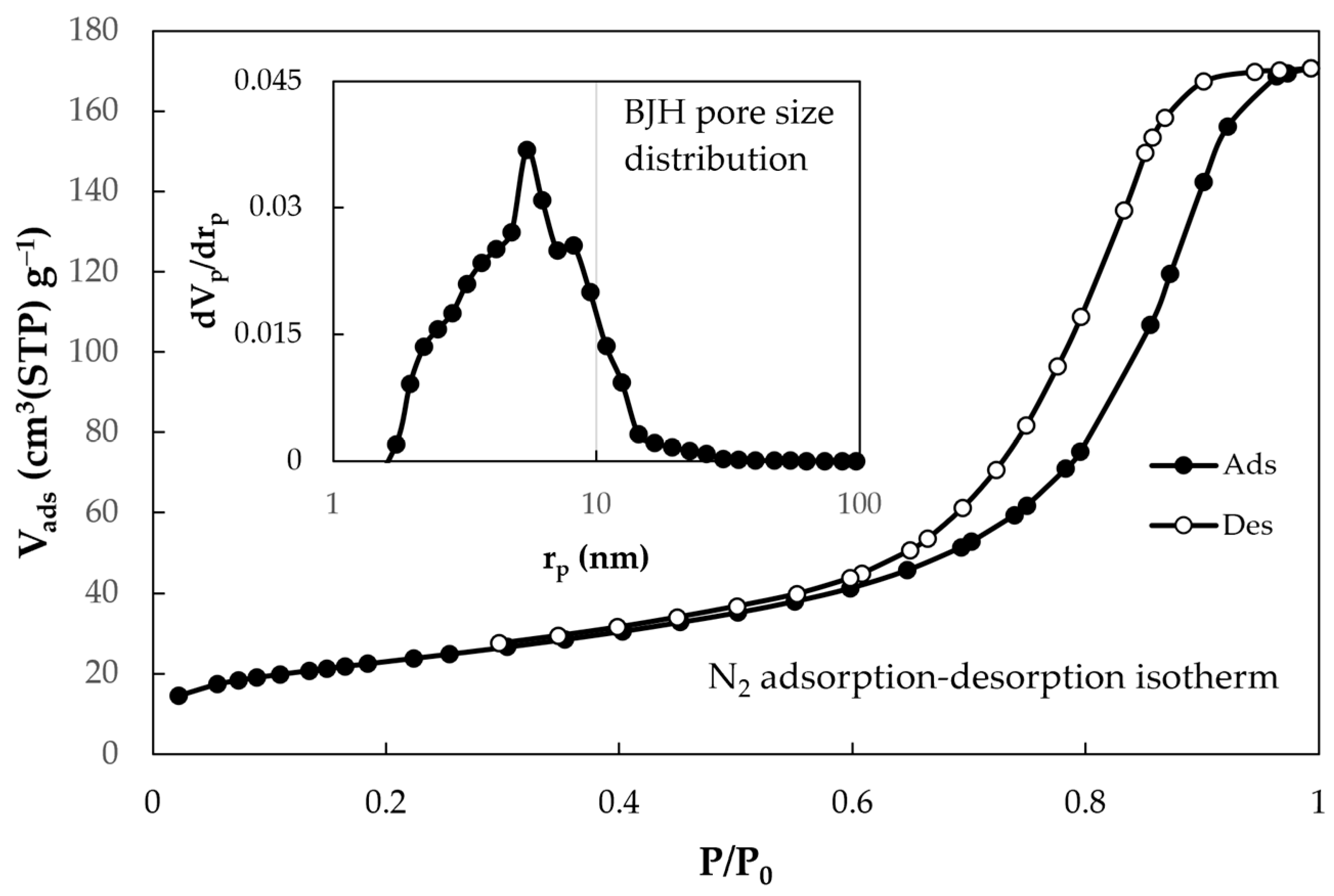
The N2 adsorption–desorption isotherms of the MS support and the corresponding Ni- and Ni–Co-based catalysts exhibited type IV(a) behavior according to the IUPAC classification, confirming the mesoporous characteristics of the materials. The observed H1-type hysteresis loops are generally associated with relatively uniform mesoporous structures with interconnected pore networks [23,24]. The preservation of the type IV(a) isotherms after metal incorporation indicates that the mesoporous characteristics of the MS support were largely retained following Ni and Co loading. The corresponding BJH pore-size distribution further confirmed the predominance of pores in the mesoporous range, consistent with the textural characteristics derived from the N2 physisorption analysis (Figure 1). Compared with the bare MS support, the metal-loaded catalysts exhibited a decrease in specific surface area (Table 1). This reduction can be attributed to the deposition of Ni and Co species on the support surface and their partial occupation or blockage of the mesopores, thereby decreasing the accessible surface area. Nevertheless, the characteristic mesoporous structure was largely retained after metal incorporation. The decrease in accessible surface area with increasing metal loading may therefore be associated with partial pore occupation or blockage by the supported metal species [23,25], as further supported by the TEM observations discussed below.
Figure 1.
Representative N2 adsorption–desorption isotherm of the 10Ni/MS catalyst, with the corresponding BJH pore-size distribution shown in the inset.
Table 1.
The textural properties of the modified support and all prepared catalysts.
For comparison with previous studies, the textural properties of the investigated catalysts and selected oxide-supported Ni-, Co-, and Ni–Co-based catalysts are summarized in Table 2. The BET surface areas of the present catalysts (35–81 m2 g−1) fall within the broad range reported for related catalyst systems, including Ni–Co/MgO–Al2O3 (108–199 m2 g−1) [18,26,27,28] and Ni–Co catalysts supported on Sc2O3–1.5CeO2– 87.5ZrO2-modified oxides (8.4–9.2 m2 g−1) [25]. The corresponding differences in pore volume and pore diameter further illustrate the dependence of textural characteristics on support composition and catalyst formulation. Although increasing Co loading decreased the BET surface area and pore volume in the present system, the mesoporous characteristics were retained. Nevertheless, direct quantitative comparisons should be interpreted cautiously because the reported catalysts differ in metal loading, support composition, preparation methods, and pore characterization procedures.
Table 2.
Comparison of the textural and porosity properties of the investigated catalysts with those of Ni- and Co-based catalysts reported in previous studies.
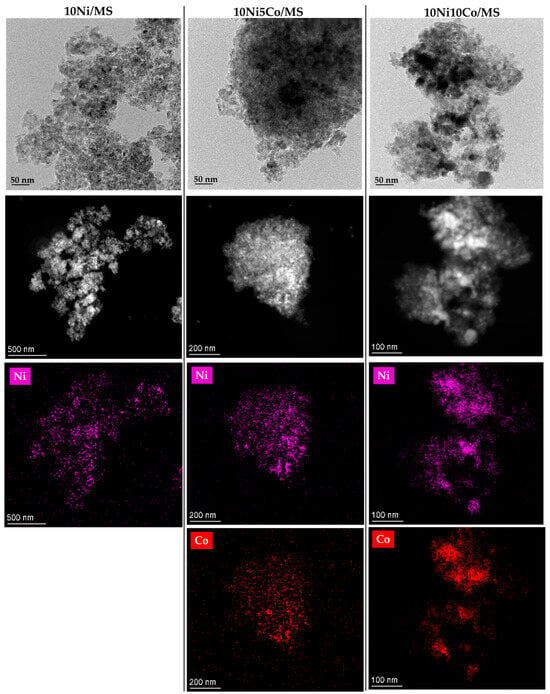
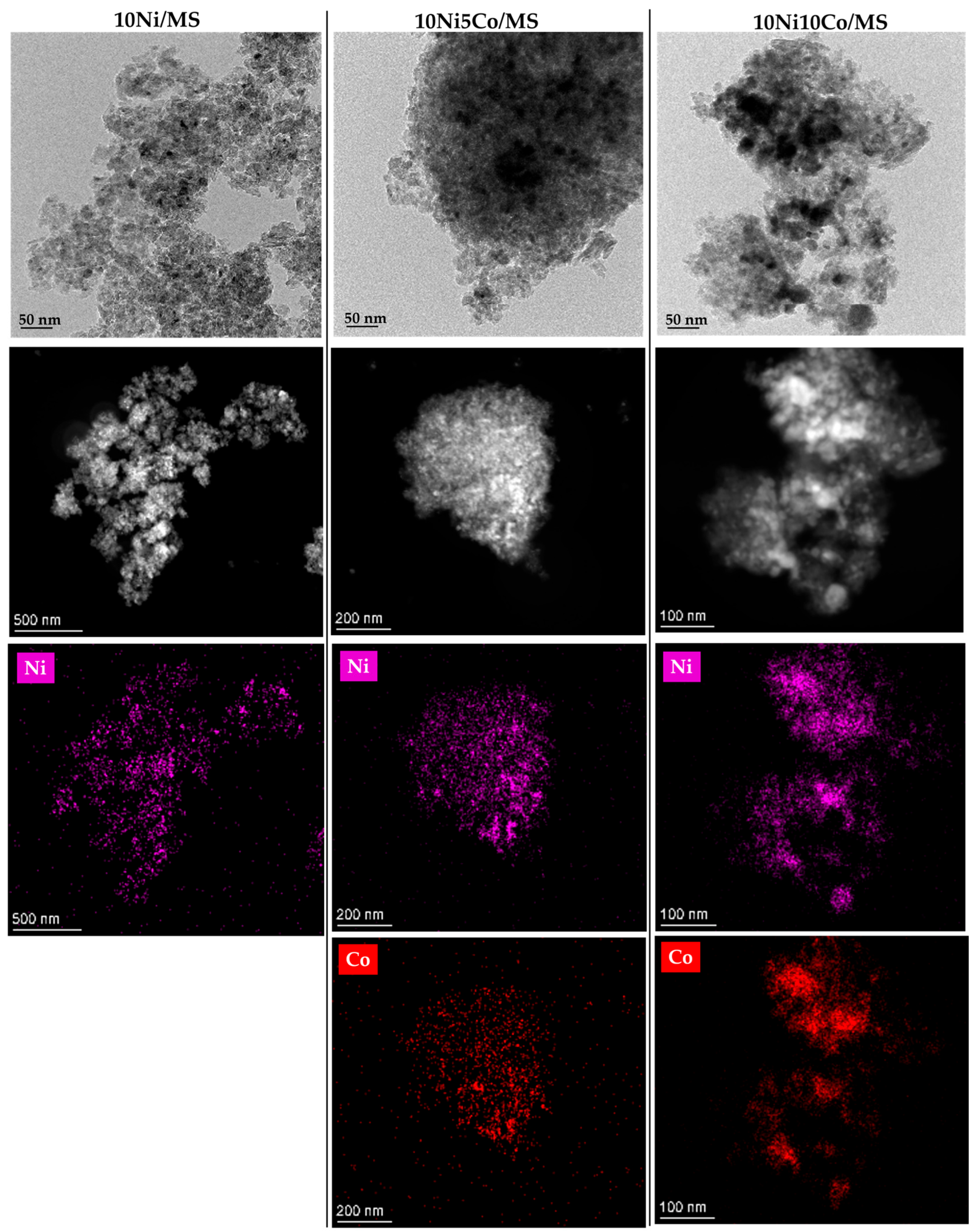
The morphology and elemental distribution of the calcined catalysts were further examined by TEM and EDS elemental mapping, as shown in Figure 2. The TEM images revealed noticeable differences in the morphology of the supported metal species with increasing Co content. The 10Ni/MS catalyst exhibited relatively small and dispersed particles over the MS support, whereas the incorporation of Co resulted in more pronounced particle aggregation. This tendency became more evident for 10Ni10Co/MS, where larger agglomerated domains were observed. The increased aggregation with increasing Co loading is consistent with the decrease in specific surface area observed from the N2 physisorption analysis, suggesting that the deposition and agglomeration of additional metal oxide species may partially occupy or block the mesopores of the MS support.
Figure 2.
TEM images and corresponding EDS elemental mapping of 10Ni/MS, 10Ni5Co/MS and 10Ni10Co/MS catalysts.
EDS elemental mapping further confirmed the distribution of Ni and Co over the MS support. For the bimetallic catalysts, Ni and Co signals were observed within similar regions, indicating close spatial contact between the two metal species. The higher Co loading in 10Ni10Co/MS was accompanied by more pronounced Co-rich regions and local aggregation, consistent with the morphological features observed by TEM. These observations suggest that increasing Co content influences not only the surface composition but also the spatial organization of the supported metal species.
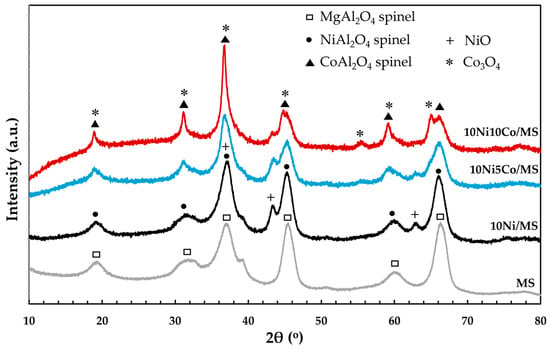
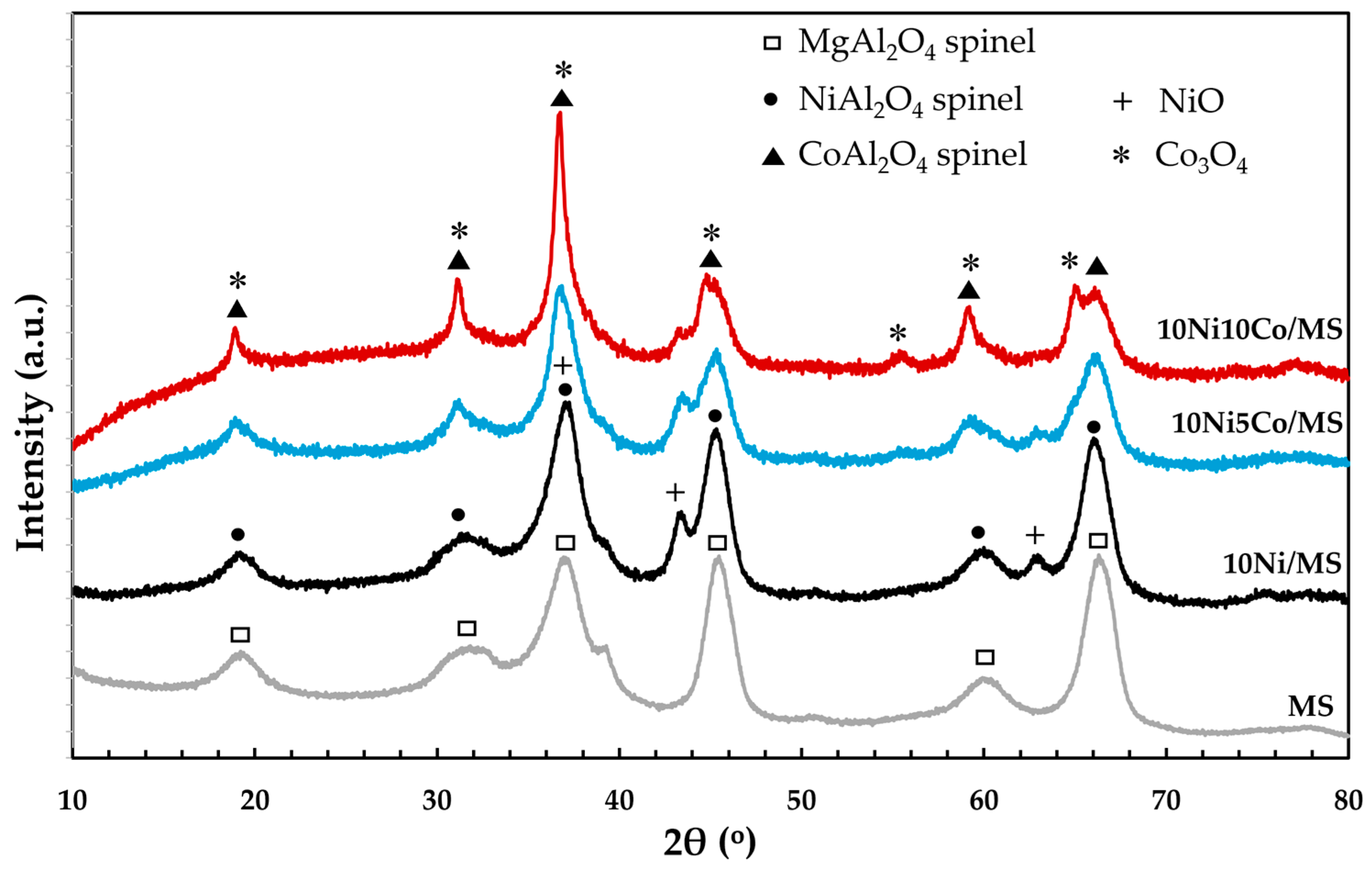
The XRD patterns of the MS support and calcined Ni- and Ni–Co-based catalysts are shown in Figure 3. The MS support exhibited characteristic diffraction peaks assigned to the MgAl2O4 spinel phase, in agreement with the standard PDF/JCPDS card and previous reports [29,30]. This indicates the formation of a spinel-type structure following modification of the Al2O3 support. No distinct diffraction peaks attributable to crystalline ZrO2 were observed, likely due to its relatively low loading (1 wt%), which may be below the detection limit of XRD. After Ni loading and calcination, additional reflections attributable to NiO [17,31] were observed for the 10Ni/MS catalyst, confirming the presence of crystalline NiO species on the modified support. However, the NiO reflections were relatively weak and not highly pronounced. Combined with the TEM–EDS results, which revealed a relatively uniform distribution of Ni over the MS support, this observation suggests that a substantial fraction of the Ni species may be highly dispersed and/or strongly associated with the support. In addition, the possible formation of a NiAl2O4-type spinel phase cannot be excluded, as its diffraction features may overlap with those of the MgAl2O4 spinel phase already present in the MS support [17,32,33], making the two phases difficult to distinguish by XRD alone. This interpretation is further supported by the H2-TPR results discussed below, which provide evidence of strong interactions between Ni species and the modified support.
Figure 3.
Diffraction patterns of all calcined catalysts and the modified alumina support.
Upon Co incorporation, additional diffraction features associated with Co3O4 were observed [34], and their intensities became more pronounced with increasing Co content, particularly for the 10Ni10Co/MS catalyst. Although the presence of CoAl2O4 spinel is plausible, its contribution to the diffraction remains uncertain due to the substantial overlap of its characteristic reflections with those of Co3O4 and the pre-exiting MgAl2O4 spinel phase. Interestingly, the characteristic NiO reflections became less distinguishable as the Co loading increased. This change in the diffraction pattern suggests that Co incorporation modifies the structural environment of the Ni oxide species. The reduced distinction of the NiO reflections, together with the development of Co-containing oxide features, may indicate increased interaction between Ni and Co oxide species and/or the formation of mixed Ni–Co oxide domains [35]. However, because of the overlapping diffraction features of Ni- and Co-containing oxide phases, the formation of a specific mixed oxide phase cannot be conclusively established from XRD alone.
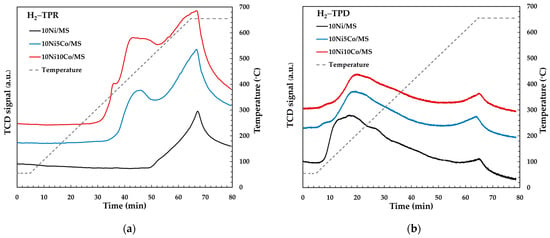
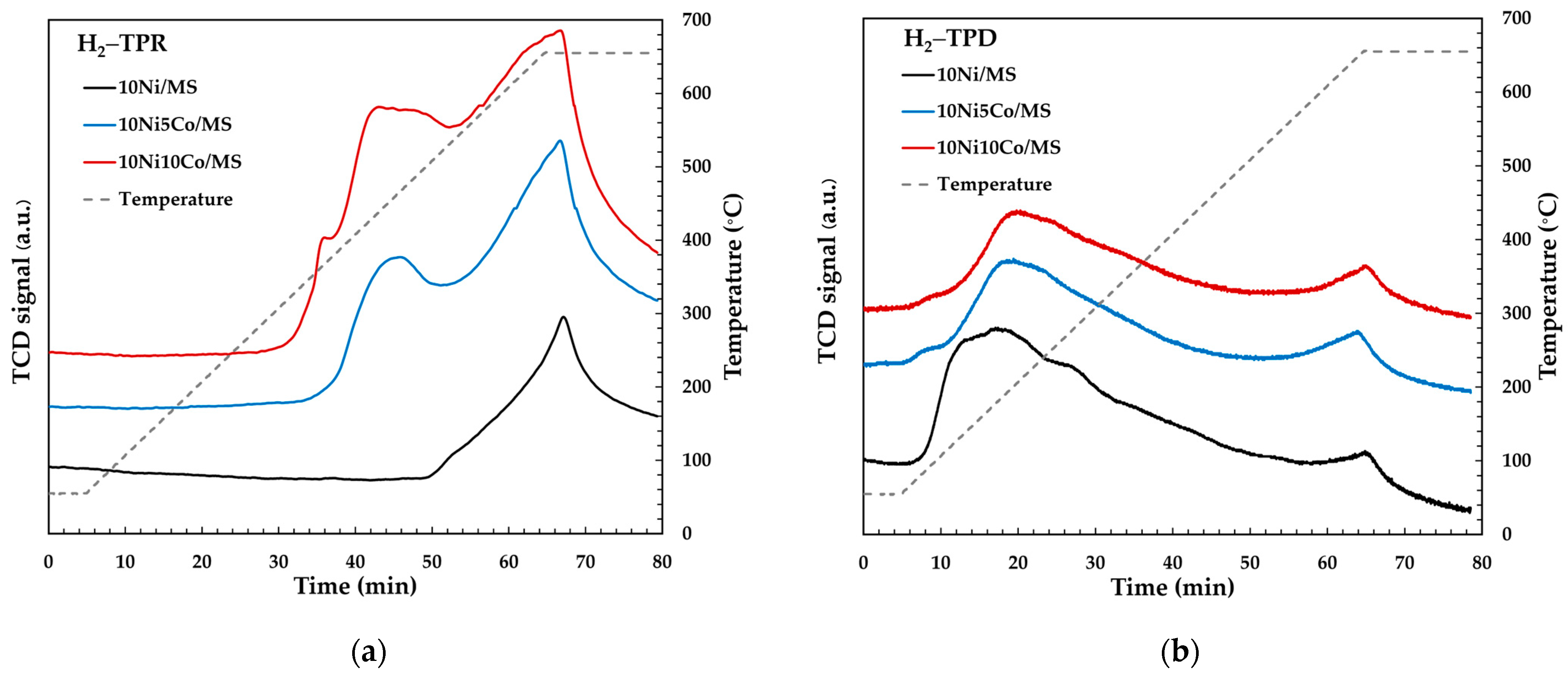
H2-TPR was employed to investigate the reducibility of the metal species and their interactions with the MS support. As shown in Figure 4a, the 10Ni/MS catalyst exhibited a broad reduction feature predominantly in the high-temperature region, suggesting the presence of Ni oxide species strongly interacting with the modified support. These species may include Ni incorporated into NiAl2O4-type spinel environments, whose diffraction features are difficult to distinguish from those of MgAl2O4 by XRD because of their overlapping spinel structures [36,37].
Figure 4.
(a) H2-TPR and (b) H2-TPD profiles of 10Ni/MS, 10Ni5Co/MS, and 10Ni10Co/MS catalysts.
Upon Co incorporation, the reduction profiles changed markedly. Both 10Ni5Co/MS and 10Ni10Co/MS exhibited additional reduction features in the low- to intermediate-temperature region [36], accompanied by a shift in the onset of reduction toward lower temperatures compared with 10Ni/MS. This effect became more pronounced with increasing Co content, particularly for 10Ni10Co/MS, indicating that Co incorporation facilitates the reduction of the supported metal oxide species. Consistent with these observations, the calculated reduction degree increased from 20.6% for 10Ni/MS to 61.5–68.3% for 10Ni5Co/MS and 79.4–68.3% for 10Ni10Co/MS, depending on the assumed Co-containing oxide phase (Table 3). These results indicate that Co incorporation enhances the overall reducibility of the catalysts.
Table 3.
Reduction degree calculated under different Co oxide phase assumption and apparent metal dispersion of the prepared catalysts.
The complex reduction profiles of the bimetallic catalysts likely reflect overlapping reduction processes involving Ni- and Co-containing oxide species with different degrees of interaction with the MS support. The lower-temperature reduction features may be associated with readily reducible Co oxide species, such as Co3O4 and possible interaction between Ni and Co species that modify their reduction behavior [38]. Meanwhile, the persistence of high-temperature reduction features suggests that strongly interacting oxide species remain present, potential including NiAl2O4- and CoAl2O4-type spinel environments. Nevertheless, the individual contributions of these species cannot be conclusively distinguished by H2-TPR alone.
Overall, the H2-TPR results demonstrate that Co incorporation significantly modifies the reduction characteristics of Ni/MS, promoting reduction at lower temperatures while increasing the calculated reduction degree. The enhanced reducibility observed upon Co incorporation may favor the formation of reduced metallic species during catalyst activation under pure H2 at 600 °C, potentially influencing catalytic behavior during DRM [38,39].
H2 temperature-programmed desorption (H2-TPD) was conducted immediately following H2-TPR without exposing the samples to ambient conditions, thereby preserving the reduced catalyst surface and minimizing reoxidation prior to H2 adsorption.
The H2-TPD profiles (Figure 4b) exhibited desorption features predominantly in the low- to intermediate-temperature regions, indicating that the majority of adsorbed hydrogen species were associated with relatively weak to moderate interactions with the catalyst surface. These desorption features may be attributed mainly to hydrogen species adsorbed on accessible metallic sites, whereas the relatively limited contribution in the high-temperature region suggests a lower abundance of strongly bound hydrogen species [30,40].
Notably, Co incorporation altered the H2 desorption profiles, with the development of more pronounced desorption features extending toward high temperatures. This behavior suggests changes in the interaction between adsorbed hydrogen species and the catalyst surface. Meanwhile, the apparent metal dispersion determined by H2 chemisorption decreased from 59.7% for 10Ni/MS to 32.6% and 29.9% for 10Ni5Co/MS and 10Ni10Co/MS, respectively (Table 3). This decrease may reflect changes in the accessibility and distribution of metallic sites upon Co incorporation. However, the relatively high apparent dispersion of 10Ni/MS may also be influenced by additional hydrogen uptake processes, such as hydrogen spillover, potentially leading to an overestimation of the accessible metallic surface sites. The changes in hydrogen desorption behavior and apparent metal dispersion suggest that Co incorporation modifies the surface characteristics of the Ni-containing active phase, possibly through interaction between Ni and Co species [40]. Nevertheless, the available characterization results do not directly establish the surface composition, electronic structure, or formation of Ni–Co alloy particles, which would require further surface-sensitive characterization such as XPS.
Overall, the H2-TPD results demonstrate that Co incorporation influences the hydrogen adsorption and desorption properties of the Ni/MS catalyst, potentially alerting the nature and accessibility of metallic active sites. These changes in surface adsorption behavior may consequently influence the catalytic behavior during DRM.
3.2. DRM Performance
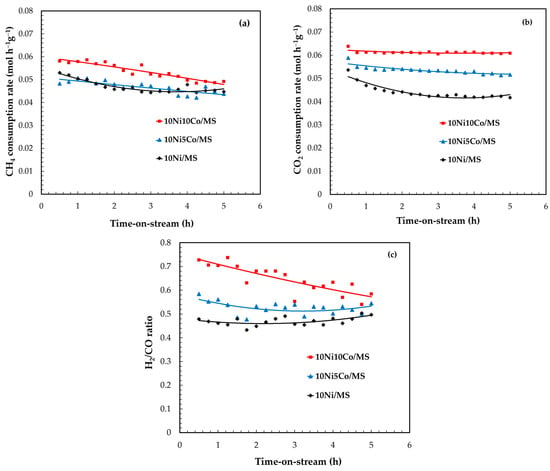
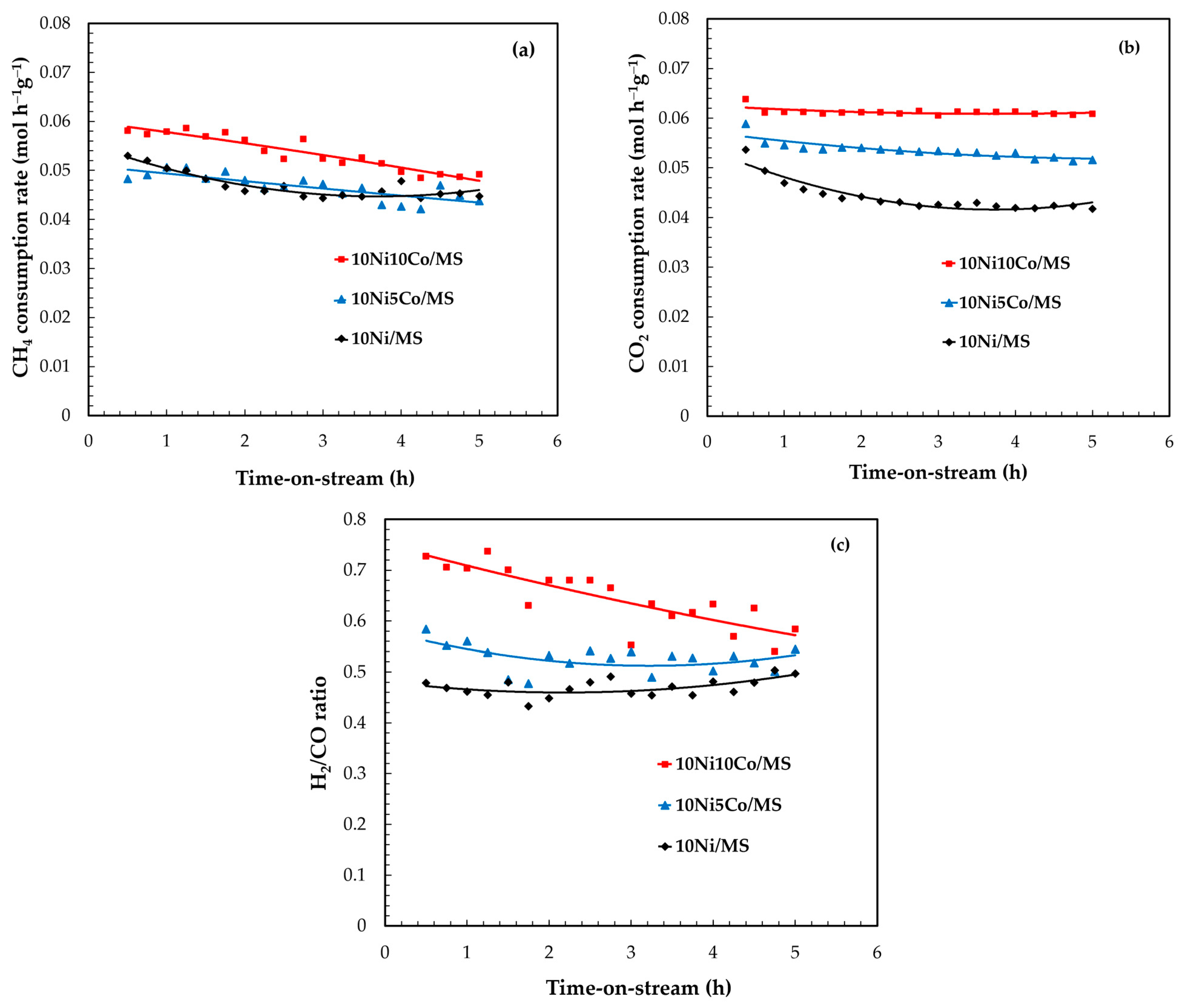
The catalytic performance of the prepared catalysts in DRM was evaluated in terms of CH4 and CO2 consumption rates and the H2/CO product ratio (Figure 5). The 10Ni/MS catalyst exhibited CH4 and CO2 consumption rates of 0.047 and 0.044 mol h−1 g−1, respectively, with an H2/CO ratio of 0.47. Upon incorporation of 5 wt% Co, the CH4 consumption rate remained nearly unchanged at 0.047 mol h−1 g−1, whereas the CO2 consumption rate increased to 0.053 mol h−1 g−1, accompanied by an increase in the H2/CO ratio to 0.53. Further increasing the Co content to 10 wt% resulted in the highest CH4 and CO2 consumption rates of 0.054 and 0.061 mol h−1 g−1, respectively, together with the highest H2/CO ratio of 0.64.
Figure 5.
(a) CH4 consumption rate, (b) CO2 consumption rates, (c) H2/CO ratio of 10Ni/MS, 10Ni5Co/MS, and 10Ni10Co/MS catalysts at 600 °C.
These results demonstrate that Co incorporation significantly modifies the catalytic behavior of Ni/MS, particularly by increasing CO2 consumption [25,41]. The changes in catalytic performance are consistent with the H2-TPR results, which showed that Co incorporation shifted the reduction features toward lower temperatures. This behavior suggests that Co-containing species may facilitate the formation of reduced metallic species during catalyst activation, potentially contributing to the observed changes in catalytic activity [41]. This effect became more pronounced with increasing Co content and is consistent with the highest reactant consumption rates observed for 10Ni10Co/MS. These results indicate improved overall catalytic performance under the investigated conditions, without necessarily implying a proportional increase in the number or intrinsic activity of accessible metal sites.
To further compare catalytic performance relative to the estimated number of accessible metal sites, apparent turnover frequencies (TOFs) were calculated by normalizing the combined CH4 and CO2 consumption rates to the number of accessible metal sites estimated from H2-TPD-derived apparent metal dispersion (Table 4). The apparent TOF increased from 89.39 h−1 for 10Ni/MS to 120.17 h−1 for 10Ni5Co/MS, followed by a decrease to 113.03 h−1 for 10Ni10Co/MS. Although 10Ni10Co/MS exhibited the highest overall reactant consumption rates, 10Ni5Co/MS showed the highest apparent TOF. This distinction indicates that the apparent site-normalized activity metric does not follow the same trend as the overall reactant consumption rates. The differences may be associated with changes in the surface properties of the catalysts following Co incorporation, although the contributions of individual Ni and Co sites cannot be distinguished from the present measurements. Moreover, because the accessible metal site concentrations were estimated from H2-TPD measurements, the calculated values may be affected by hydrogen spillover and variations in hydrogen adsorption stoichiometry. The reported apparent TOFs, which are based on the combined consumption of both DRM reactants, should therefore be interpreted as comparative activity indicators rather than conventional intrinsic DRM turnover frequencies. Similarly, the available data do not permit the determination of apparent activation energies or reaction orders.
Table 4.
Average reactant consumption rates, apparent turnover frequencies (TOFs), and graphitic carbon crystallite sizes of the investigated catalysts.
In addition to the enhanced reducibility, H2-TPD revealed that Co incorporation modified the hydrogen adsorption behavior of the reduced catalyst, including changes in the relative contributions of the desorption features at different temperatures. These observations suggest that Co affects the hydrogen adsorption–desorption characteristics of the catalyst surface, although individual desorption features cannot be assigned unambiguously to specific metallic sites or adsorption processes. Such changes may influence the behavior of hydrogen-containing surface intermediates during DRM and competing reactions, including the reverse water–gas shift (RWGS) reaction [41,42]. The H2/CO ratio increased progressively from 0.47 for 10Ni/MS to 0.53 for 10Ni5Co/MS and 0.64 for 10Ni10Co/MS, approaching the stoichiometric value of unity expected for DRM. This trend indicates a change in the relative formation of H2 and CO with increasing Co content. However, the contribution of RWGS and other possible secondary reactions cannot be determined from the H2/CO ratio alone.
Nevertheless, the improvement in catalytic performance with increasing Co content did not translate directly into enhanced catalyst stability. Although 10Ni10Co/MS exhibited the highest reactant consumption rates and H2/CO ratio, it underwent a more pronounced decline in performance with time-on-stream. In contrast, 10Ni5Co/MS exhibited more stable catalytic behavior, with the H2/CO ratio remaining relatively stable throughout the reaction period. These results suggest that increasing the Co loading does not necessarily lead to a proportional improvement in DRM stability. Instead, an intermediate Co loading may provide a more favorable combination of catalytic activity and resistance to deactivation. Since carbon deposition is widely recognized as a major cause of deactivation in Ni-based DRM catalysts [43,44], the differences in time-on-stream behaviors were further examined through XRD characterization of the spent samples.
The catalytic performance of the Ni–Co-based catalysts investigated in this study was compared with that of selected Ni–Co catalysts reported in the literature, as summarized in Table 5. At 600 °C, the 10Ni5Co/MS and 10Ni10Co/MS catalysts exhibited CH4 conversions of 31% and 35%, respectively, with corresponding CO2 conversions of 36% and 40%. Under the same reaction temperature, the previously reported 4.5Ni–4.5Co–1ZrO2/Al2O3 catalyst exhibited a lower CH4 conversion of 15% but a slightly higher CO2 conversion of 42% [18]. However, differences in feed composition and flow rate per unit catalyst mass limit direct comparisons between these systems. Other reported Ni–Co/Al2O3 or Ni–Co/MgO-Al2O3 catalysts exhibited CH4 conversions of 45–72% and CO2 conversions of 56–76% at 700 °C [27,45], while the Ni–Co/Sc2O3–CeO2–ZrO2 catalyst achieved CH4 and CO2 conversions of 51% and 92%, respectively, at 800 °C [25]. These higher reaction temperatures, together with differences in catalyst composition and operating conditions, should be considered when interpreting the reported conversion values. Overall, the comparison provides context for the catalytic performance of the present Ni–Co/MS catalysts at 600 °C without implying a direct ranking of catalyst effectiveness across different studies.
Table 5.
Comparison of CH4 and CO2 conversions over the Ni–Co-based catalysts investigated in this work and those reported in previous studies under different DRM reaction conditions.
3.3. Carbon Formation–Removal Balance and Catalyst Stability
During DRM (CH4 + CO2 → 2CO + 2H2), catalyst stability is strongly influenced by the kinetic competition between carbon formation through methane decomposition (CH4 → C + 2H2) and carbon removal through CO2-assisted gasification (C + CO2 → 2CO). Methane activation involves successive dehydrogenation steps that can generate surface carbon species, whereas CO2 activation may produce oxygen-containing intermediates capable of oxidizing these species to CO. The relative rates of carbon formation and removal influence the net accumulation of carbonaceous deposits. These processes may be affected by the characteristics of the metallic surface, carbon dissolution and diffusion behavior, and the ability of the catalyst to activate CO2.
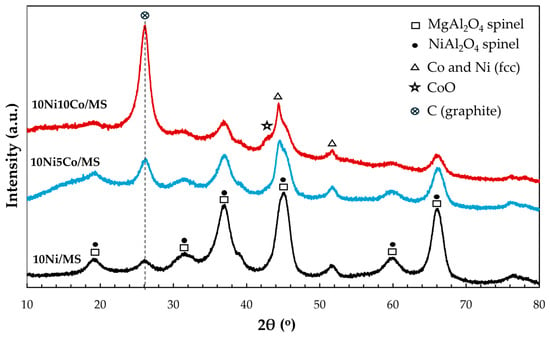
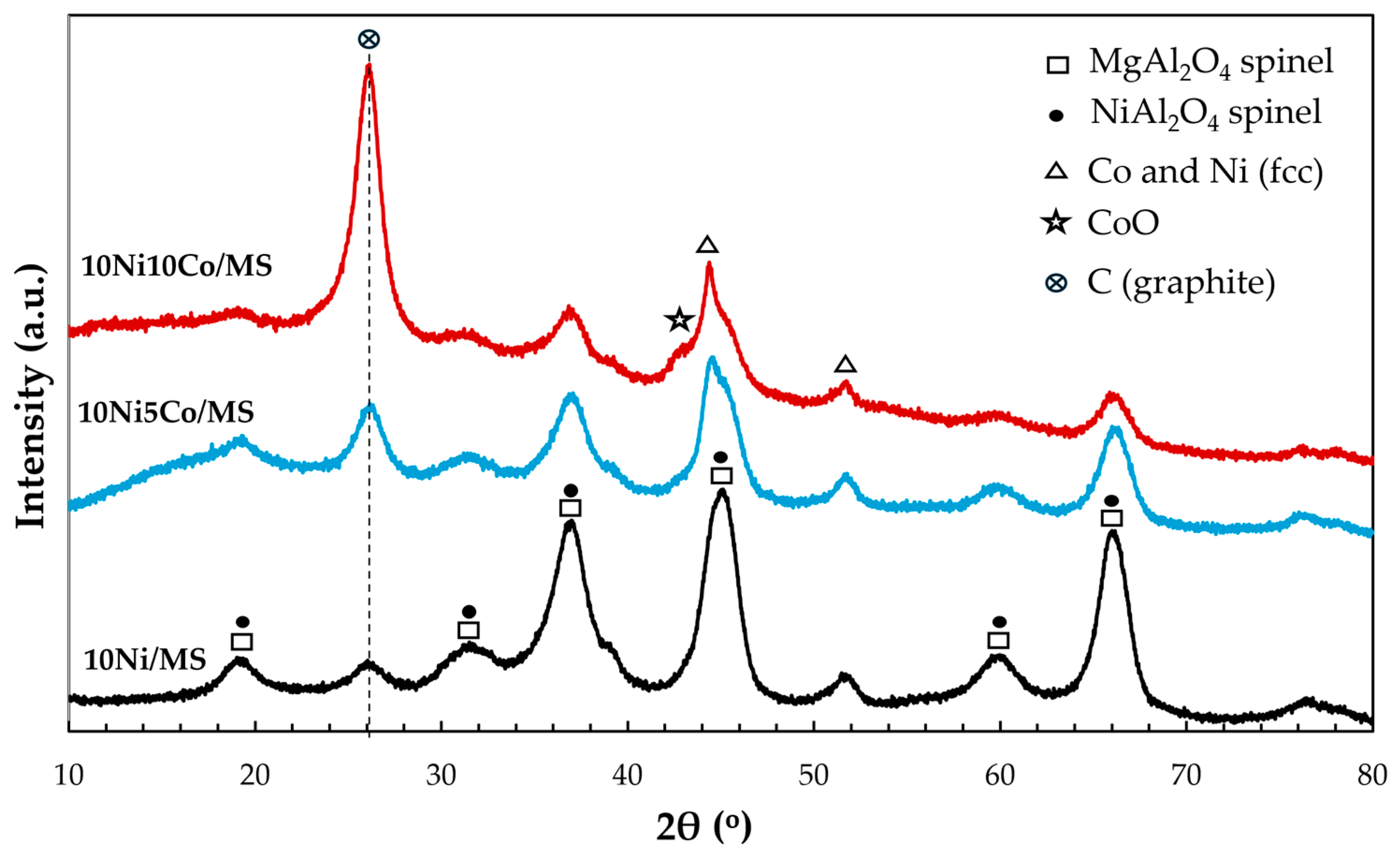
XRD analysis of the spent catalysts (Figure 6) provides further insight into the origin of the different stability behaviors. A diffraction feature at approximately 2θ = 26° was assigned to graphitic carbon [46,47], while the feature at approximately 2θ = 42° was attributed to CoO [34]. The graphitic carbon crystallite size, calculated from C(002) reflection using the Scherrer equation, increased from 3.90 nm for 10Ni/MS to 4.78 and 5.22 nm for 10Ni5Co/MS and 10Ni10Co/MS, respectively (Table 4). This trend suggests that increasing Co content influences the structural development of graphitic carbon deposits during DRM. In particular, the more pronounced graphitic carbon reflection and larger carbon crystallite size observed for 10Ni10Co/MS are consistent with its greater catalytic deactivation. In contrast, the less pronounced graphitic carbon reflection and smaller crystallite size observed for 10Ni5Co/MS are consistent with its comparatively stable time-on-stream performance. Nevertheless, the crystallite size reflects the dimensions of coherently ordered graphitic domains rather than the total amount of deposited carbon.
Figure 6.
Diffraction patterns of the spent catalysts after DRM reaction.
The CH4/CO2 consumption rate ratio decreased from 1.07 for 10Ni/MS to 0.89 for both Co-containing catalysts (Table 4), indicating a greater relative consumption of CO2 following Co incorporation. However, this ratio does not directly represent the balance between carbon formation and gasification, since CO2 may also be consumed through competing reactions such as the RWGS reaction. Interestingly, although 10Ni10Co/MS exhibited the highest CO2 consumption rate, it also showed more pronounced graphitic carbon features and greater catalytic deactivation than 10Ni5Co/MS. This observation suggests that enhanced CO2 consumption does not necessarily correspond to more effective carbon removal. since CO2 may also participate in competing reactions such as the reverse water–gas shift reaction. Co incorporation may modify the relative contributions of carbon formation and removal pathways by altering the surface properties of the catalysts, although the individual rates of these processes were not directly determined. Furthermore, the presence of CoO in the spent 10Ni10Co/MS catalyst suggests that changes in Co-containing phases may also be associated with its lower catalytic stability, although their contribution cannot be established from ex situ XRD alone. Overall, the comparatively improved stability of 10Ni5Co/MS may reflect a more favorable balance between reactant activation, carbon formation and removal, and the preservation of catalytically active species rather than simply maximizing Co content.
4. Conclusions
Previous studies demonstrated that surface modification of Al2O3 with 9 wt% MgO and 1 wt% ZrO2 (MS) significantly improved the performance of supported Ni catalysts (10 wt%Ni/MS or 10Ni//MS) for DRM, reducing carbon deposition by more than 40% compared with the corresponding 10 wt%Ni/Al2O3 catalyst. This improvement was attributed to enhanced surface basicity and oxygen mobility, although the modified support had a limited effect on CH4 activation and the H2/CO product ratio [16]. Building upon these findings, the present study explored the incorporation of Co into Ni catalysts supported on the MgO–ZrO2-modified Al2O3 system. Rather than introducing Ni–Co bimetallic catalysis as a new concept, this work focused on evaluating whether Co incorporation could complement the previously demonstrated benefits of the modified support and address the remaining limitations in DRM performance.
The characterization results showed that Co incorporation modified the reduction and hydrogen desorption characteristics of the Ni/MS catalysts. H2-TPR revealed a shift in the reduction features toward lower temperatures with increasing Co loading, indicating improved reducibility of the supported metal species. This behavior may facilitate the formation of reduced metallic species during catalyst activation. H2-TPD further revealed changes in the hydrogen adsorption–desorption behavior of the reduced catalysts, suggesting that Co incorporation alters their surface properties. However, these observations do not independently establish the nature or extent of Ni–Co interactions.
These changes were accompanied by differences in catalytic performance. Co incorporation increased CO2 consumption, while the highest CH4 consumption rate was obtained for 10Ni10Co/MS. The H2/CO product ratio increased from 0.47 for 10Ni/MS to 0.53 and 0.64 for 10Ni5Co/MS and 10Ni10Co/MS, respectively. Although 10Ni10Co/MS exhibited the highest overall reactant consumption rates, 10Ni5Co/MS achieved the highest apparent TOF of 120.17 h−1, compared with 89.39 and 113.03 h−1 for 10Ni/MS and 10Ni10Co/MS, respectively. These apparent TOFs provide a comparative measure of catalytic performance under the investigated conditions rather than intrinsic kinetic parameters.
Despite the improvement in reactant consumption with increasing Co loading, catalyst stability did not follow the same trend. The 10Ni10Co/MS catalyst exhibited more pronounced deactivation and a stronger graphitic carbon diffraction feature after DRM, whereas 10Ni5Co/MS maintained comparatively stable performance. The graphitic carbon crystallite size, estimated from the C(002) reflection, increased from 3.90 nm for 10Ni/MS to 4.78 and 5.22 nm for 10Ni5Co/MS and 10Ni10Co/MS, respectively. These findings suggest that Co loading influences the structural development of graphitic carbon deposits, although crystallite size does not directly indicate the total amount of deposited carbon. The differences in stability may be associated with changes in the competing pathways of carbon formation and removal, but their individual rates were not directly determined. Overall, the results demonstrate that incorporating an appropriate amount of Co into Ni catalysts supported on MgO–ZrO2-modified Al2O3 can provide a favorable compromise between catalytic activity and stability. This study therefore extends the application of the modified support from monometallic Ni to Ni–Co catalysts and identifies 5 wt% Co as the most promising loading among the compositions investigated.
Author Contributions
Conceptualization, M.P. and S.T.; methodology, T.R. and S.T.; validation, M.P., T.R. and S.T.; formal analysis, S.T. and T.R.; investigation, M.P.; resources, S.T.; data curation, M.P. and T.R.; writing—original draft preparation, M.P., T.R. and S.T.; writing—review and editing, M.P. and T.R.; visualization, T.R. and S.T.; supervision, S.T.; project administration, M.P.; funding acquisition, M.P. All authors have read and agreed to the published version of the manuscript.
Funding
This research was funded by the Faculty of Applied Science, King Mongkut’s University of Technology North Bangkok under Grant No. 673186.
Data Availability Statement
The raw data supporting the findings of this study are available from the corresponding authors upon request.
Conflicts of Interest
The authors declare no conflict of interest.
Abbreviations
The following abbreviations are used in this manuscript:
| DRM | Dry reforming of methane |
| RWGS | Reverse water–gas shift reaction |
| TEM | Transmission electron microscopy |
| EDS | Energy-dispersive X-ray spectroscopy |
| XRD | X-ray diffraction |
| H2–TPR | Temperature-programmed reduction of H2 |
| H2–TPD | Temperature-programmed desorption of H2 |
| BET | Brunauer–Emmett–Teller method |
| BJH | Barrett–Joyner–Halenda method |
| TCD | Thermal conductivity detector |
References
- Intergovernmental Panel on Climate Change (IPCC). Climate Change 2021–The Physical Science Basis; Cambridge University Press: Cambridge, UK, 2023; ISBN 9781009157896. [Google Scholar]
- Friedlingstein, P.; O’Sullivan, M.; Jones, M.W.; Andrew, R.M.; Hauck, J.; Olsen, A.; Peters, G.P.; Peters, W.; Pongratz, J.; Sitch, S.; et al. Global Carbon Budget 2020. Earth Syst. Sci. Data 2020, 12, 3269–3340. [Google Scholar] [CrossRef] [Scilit]
- Li, M.; Sun, Z.; Hu, Y.H. Catalysts for CO2 Reforming of CH4: A Review. J. Mater. Chem. A Mater. 2021, 9, 12495–12520. [Google Scholar] [CrossRef] [Scilit]
- Salaudeen, S.A.; Acharya, B.; Heidari, M.; Arku, P.; Dutta, A. Numerical Investigation of CO2 Valorization via the Steam Gasification of Biomass for Producing Syngas with Flexible H2 to CO Ratio. J. CO2 Util. 2018, 27, 32–41. [Google Scholar] [CrossRef] [Scilit]
- Sun, D.; Zhang, Y.; Zhou, Y.; Nie, Y.; Ban, L.; Wu, D.; Yang, S.; Zhang, H.; Li, C.; Zhang, K. Photocatalytic and Electrochemical Synthesis of Biofuel via Efficient Valorization of Biomass. Adv. Energy Mater. 2025, 15, 2406098. [Google Scholar] [CrossRef] [Scilit]
- Meloni, E.; Martino, M.; Palma, V. A Short Review on Ni Based Catalysts and Related Engineering Issues for Methane Steam Reforming. Catalysts 2020, 10, 352. [Google Scholar] [CrossRef] [Scilit]
- Mondal, K.; Sasmal, S.; Badgandi, S.; Chowdhury, D.R.; Nair, V. Dry Reforming of Methane to Syngas: A Potential Alternative Process for Value Added Chemicals—A Techno-Economic Perspective. Environ. Sci. Pollut. Res. 2016, 23, 22267–22273. [Google Scholar] [CrossRef] [Scilit] [PubMed]
- Chen, S.; Zaffran, J.; Yang, B. Dry Reforming of Methane over the Cobalt Catalyst: Theoretical Insights into the Reaction Kinetics and Mechanism for Catalyst Deactivation. Appl. Catal. B 2020, 270, 118859. [Google Scholar] [CrossRef] [Scilit]
- Wang, W.; Wang, S.; Ma, X.; Gong, J. Recent Advances in Catalytic Hydrogenation of Carbon Dioxide. Chem. Soc. Rev. 2011, 40, 3703. [Google Scholar] [CrossRef] [Scilit] [PubMed]
- Ranjekar, A.M.; Yadav, G.D. Dry Reforming of Methane for Syngas Production: A Review and Assessment of Catalyst Development and Efficacy. J. Indian Chem. Soc. 2021, 98, 100002. [Google Scholar] [CrossRef] [Scilit]
- Abdulrasheed, A.; Jalil, A.A.; Gambo, Y.; Ibrahim, M.; Hambali, H.U.; Shahul Hamid, M.Y. A Review on Catalyst Development for Dry Reforming of Methane to Syngas: Recent Advances. Renew. Sustain. Energy Rev. 2019, 108, 175–193. [Google Scholar] [CrossRef] [Scilit]
- Wei, M.; Shi, X. Research Progress on Stability Control on Ni-Based Catalysts for Methane Dry Reforming. Methane 2024, 3, 86–102. [Google Scholar] [CrossRef] [Scilit]
- Hussien, A.G.S.; Polychronopoulou, K. A Review on the Different Aspects and Challenges of the Dry Reforming of Methane (DRM) Reaction. Nanomaterials 2022, 12, 3400. [Google Scholar] [CrossRef] [Scilit] [PubMed]
- Xu, J.; Xia, P.; Zhang, Q.; Guo, F.; Xia, Y.; Tian, H. Coke Resistance of Ni-Based Catalysts Enhanced by Cold Plasma Treatment for CH4–CO2 Reforming: Review. Int. J. Hydrog. Energy 2021, 46, 23174–23189. [Google Scholar] [CrossRef] [Scilit]
- Huang, L.; Li, D.; Tian, D.; Jiang, L.; Li, Z.; Wang, H.; Li, K. Optimization of Ni-Based Catalysts for Dry Reforming of Methane via Alloy Design: A Review. Energy Fuels 2022, 36, 5102–5151. [Google Scholar] [CrossRef] [Scilit]
- Tungkamani, S.; Ratana, T.; Jadsadajerm, S.; Sumarasingha, W.; Phongaksorn, M. Enhancement of CO2 Adsorption and Oxygen Transfer Properties on γ-Al2O3 Support through Surface Modification with MgO-ZrO2 for Coke Suppression over Ni Catalyst in CO2 Reforming of Methane. Results Eng. 2024, 24, 103283. [Google Scholar] [CrossRef] [Scilit]
- Ratana, T.; Tungkamani, S.; Srisuwan, S.; Sithalo, O.; Phongaksorn, M. Synergistic Role of ZrO2 Promoter and Ni–NiO–ZrO2 Networks in Improving Ni Catalysts for Dry Methane Reforming at Low Temperature. Catalysts 2026, 16, 190. [Google Scholar] [CrossRef] [Scilit]
- Ratana, T.; Thongdee, L.; Sawansombut, S.; Sumarasingha, W.; Chutimaskul, T.; Phongaksorn, M. Study of Ni-Co-ZrO2/Al2O3 Catalysts for Carbon Dioxide Reforming of Methane at Low CO2. Trends Sci. 2024, 21, 7788. [Google Scholar] [CrossRef] [Scilit]
- Piyapaka, K.; Tungkamani, S.; Phongaksorn, M. Effect of Strong Metal Support Interactions of Supported Ni and Ni-Co Catalyst on Metal Dispersion and Catalytic Activity toward Dry Methane Reforming Reaction. King Mongkut’s Univ. Technol. North Bangk. Int. J. Appl. Sci. Technol. 2016, 9, 255–259. [Google Scholar] [CrossRef] [Scilit]
- Li, H.; Shi, L.; Jin, C.; Ye, R.; Zhang, R. Co and Ni Incorporated γ-Al2O3 (110) Surface: A Density Functional Theory Study. Catalysts 2022, 12, 111. [Google Scholar] [CrossRef] [Scilit]
- Khan, I.S.; Ramirez, A.; Shterk, G.; Garzón-Tovar, L.; Gascon, J. Bimetallic Metal-Organic Framework Mediated Synthesis of Ni-Co Catalysts for the Dry Reforming of Methane. Catalysts 2020, 10, 592. [Google Scholar] [CrossRef] [Scilit]
- Sumarasingha, W.; Tungkamani, S.; Ratana, T.; Supasitmongkol, S.; Phongaksorn, M. Combined Steam and CO2 Reforming of Methane over the Hierarchical Ni-ZrO2 Nanosheets/Al2O3 Catalysts at Ultralow Temperature and under Low Steam. ACS Omega 2023, 8, 46425–46437. [Google Scholar] [CrossRef] [Scilit] [PubMed]
- Thommes, M.; Kaneko, K.; Neimark, A.V.; Olivier, J.P.; Rodriguez-Reinoso, F.; Rouquerol, J.; Sing, K.S.W. Physisorption of Gases, with Special Reference to the Evaluation of Surface Area and Pore Size Distribution (IUPAC Technical Report). Pure Appl. Chem. 2015, 87, 1051–1069. [Google Scholar] [CrossRef] [Scilit]
- Wang, Z.; Jiang, X.; Pan, M.; Shi, Y. Nano-Scale Pore Structure and Its Multi-Fractal Characteristics of Tight Sandstone by N2 Adsorption/Desorption Analyses: A Case Study of Shihezi Formation from the Sulige Gas Filed, Ordos Basin, China. Minerals 2020, 10, 377. [Google Scholar] [CrossRef] [Scilit]
- Abasaeed, A.E.; Ibrahim, A.A.; Fakeeha, A.H.; Bayazed, M.O.; Amer, M.S.; Abu-Dahrieh, J.K.; Al-Fatesh, A.S. Ni-Co Bimetallic Catalysts Supported on Mixed Oxides (Sc-Ce-Zr) for Enhanced Methane Dry Reforming. ChemistryOpen 2024, 13, e202400086. [Google Scholar] [CrossRef] [Scilit] [PubMed]
- Dharmasaroja, N.; Ratana, T.; Tungkamani, S.; Sornchamni, T.; Simakov, D.S.A.; Phongaksorn, M. The Effects of CeO2 and Co Doping on the Properties and the Performance of the Ni/Al2O3-MgO Catalyst for the Combined Steam and CO2 Reforming of Methane Using Ultra-Low Steam to Carbon Ratio. Catalysts 2020, 10, 1450. [Google Scholar] [CrossRef] [Scilit]
- Ibrahim, A.A.; Fakeeha, A.H.; Abasaeed, A.E.; Wazeer, I.; Bentalib, A.; Siva Kumar, N.; Abu-Dahrieh, J.K.; Al-Fatesh, A.S. The Effectiveness of Ni-Based Bimetallic Catalysts Supported by MgO-Modified Alumina in Dry Methane Reforming. Catalysts 2023, 13, 1420. [Google Scholar] [CrossRef] [Scilit]
- Wang, M.; Li, F.; Dong, J.; Lin, X.; Liu, X.; Wang, D.; Cai, W. MOF-Derived CoCeOx Nanocomposite Catalyst with Enhanced Anti-Coking Property for Ethanol Reforming with CO2. J. Environ. Chem. Eng. 2022, 10, 107892. [Google Scholar] [CrossRef] [Scilit]
- High, M.; Patzschke, C.F.; Zheng, L.; Zeng, D.; Gavalda-Diaz, O.; Ding, N.; Chien, K.H.H.; Zhang, Z.; Wilson, G.E.; Berenov, A.V.; et al. Precursor Engineering of Hydrotalcite-Derived Redox Sorbents for Reversible and Stable Thermochemical Oxygen Storage. Nat. Commun. 2022, 13, 5109. [Google Scholar] [CrossRef] [Scilit] [PubMed]
- Tungkamani, S.; Intarasiri, S.; Sumarasingha, W.; Ratana, T.; Phongaksorn, M. Enhancement of Ni-NiO-CeO2 Interaction on Ni-CeO2/Al2O3-MgO Catalyst by Ammonia Vapor Diffusion Impregnation for CO2 Reforming of CH4. Molecules 2024, 29, 2803. [Google Scholar] [CrossRef] [Scilit] [PubMed]
- Beletskii, E.; Pinchuk, M.; Snetov, V.; Dyachenko, A.; Volkov, A.; Savelev, E.; Romanovski, V. Simple Solution Plasma Synthesis of Ni@NiO as High-Performance Anode Material for Lithium-Ion Batteries Application. Chempluschem 2024, 89, e202400427. [Google Scholar] [CrossRef] [Scilit] [PubMed]
- Dharmasaroja, N.; Ratana, T.; Tungkamani, S.; Sornchamni, T.; Simakov, D.S.A.; Phongaksorn, M. CO2 Reforming of Methane over the Growth of Hierarchical Ni Nanosheets/Al2O3-MgO Synthesized via the Ammonia Vapour Diffusion Impregnation. Can. J. Chem. Eng. 2021, 99, S585–S595. [Google Scholar] [CrossRef] [Scilit]
- Song, K.H.; Jeong, S.K.; Jeong, B.H.; Lee, K.-Y.; Kim, H.J. Effect of the Ni/Al Ratio on the Performance of NiAl2O4 Spinel-Based Catalysts for Supercritical Methylcyclohexane Catalytic Cracking. Catalysts 2021, 11, 323. [Google Scholar] [CrossRef] [Scilit]
- Choya, A.; de Rivas, B.; Gutiérrez-Ortiz, J.I.; López-Fonseca, R. Comparative Study of Strategies for Enhancing the Performance of Co3O4/Al2O3 Catalysts for Lean Methane Combustion. Catalysts 2020, 10, 757. [Google Scholar] [CrossRef] [Scilit]
- Kapran, A.; Hippler, R.; Wulff, H.; Olejnicek, J.; Volfova, L.; Pisarikova, A.; Nepomniashchaia, N.; Cada, M.; Hubicka, Z. Crystalline Structure and Optical Properties of Cobalt Nickel Oxide Thin Films Deposited with a Pulsed Hollow-Cathode Discharge in an Ar+O2 Gas Mixture. Coatings 2024, 14, 319. [Google Scholar] [CrossRef] [Scilit]
- Wang, Z.; Yang, Y.; Liao, Z.; Ou, D.; Dai, P.; Feng, K.; He, B.; Guo, Q.; Zou, L.; Pu, J.; et al. Steam Reforming of Liquid Hydrocarbon Boosted by a High-Performance and Durable Ni/NiAl2O4/Al2O3 Catalyst. ACS Omega 2025, 10, 58647. [Google Scholar] [CrossRef] [Scilit] [PubMed]
- Gasparetto, H. Revealing Metal–Support Interactions in Catalysts with Hydrogen Temperature-Programmed Reduction. Nat. Rev. Clean Technol. 2026. [Google Scholar] [CrossRef] [Scilit]
- Yang, Q.; Di, J.; Li, Y.; Zhai, M.; Liang, H.; Wang, Z.; Kan, Q.; Tian, Y.; Qiao, Y.; Yang, R.; et al. Synthesis of Ni–Co Bimetallic Catalyst with High Activity and Coking Resistance for Simulated Biogas Dry Reforming in a Constant Alkaline Chemical Environment. New J. Chem. 2025, 49, 7964–7974. [Google Scholar] [CrossRef] [Scilit]
- Yang, E.; Nam, E.; Jo, Y.; An, K. Coke Resistant NiCo/CeO2 Catalysts for Dry Reforming of Methane Derived from Core@shell Ni@Co Nanoparticles. Appl. Catal. B 2023, 339, 123152. [Google Scholar] [CrossRef] [Scilit]
- Valdivieso-Vera, D.A.; Patience, G.S.; Guerrero-Pérez, M.O. Experimental Methods in Chemical Engineering: Temperature-programmed Desorption—TPD. Can. J. Chem. Eng. 2026, 1. [Google Scholar] [CrossRef] [Scilit]
- Zhu, H.; Chen, H.; Zhang, M.; Liang, C.; Duan, L. Recent Advances in Promoting Dry Reforming of Methane Using Nickel-Based Catalysts. Catal. Sci. Technol. 2024, 14, 1712–1729. [Google Scholar] [CrossRef] [Scilit]
- Kim, G.; Lee, H. Developing Heterogeneous Catalysts for Reverse Water–Gas Shift Reaction in CO2 Valorization. Korean J. Chem. Eng. 2025, 42, 3101–3112. [Google Scholar] [CrossRef] [Scilit]
- Wang, Z.; Mei, Z.; Wang, L.; Wu, Q.; Xia, C.; Li, S.; Wang, T.; Liu, C. Insight into the Activity of Ni-Based Thermal Catalysts for Dry Reforming of Methane. J. Mater. Chem. A Mater. 2024, 12, 24802–24838. [Google Scholar] [CrossRef] [Scilit]
- Xu, Z.; Park, E.D. Recent Advances in Coke Management for Dry Reforming of Methane over Ni-Based Catalysts. Catalysts 2024, 14, 176. [Google Scholar] [CrossRef] [Scilit]
- Huang, X.; Mo, W.; He, X.; Fan, X.; Ma, F.; Tax, D. Effects of Promoters on the Structure, Performance, and Carbon Deposition of Ni-Al2O3 Catalysts for CO2–CH4 Reforming. ACS Omega 2021, 6, 16381–16390. [Google Scholar] [CrossRef] [Scilit] [PubMed]
- Fujimoto, H. Advanced Analysis of X-Ray Diffraction Profile of Carbon. Carbon Rep. 2022, 1, 010302. [Google Scholar] [CrossRef] [Scilit]
- Popova, A.N. Crystallographic Analysis of Graphite by X-Ray Diffraction. Coke Chem. 2017, 60, 361–365. [Google Scholar] [CrossRef] [Scilit]

Disclaimer/Publisher’s Note: The statements, opinions and data contained in all publications are solely those of the individual author(s) and contributor(s) and not of MDPI and/or the editor(s). MDPI and/or the editor(s) disclaim responsibility for any injury to people or property resulting from any ideas, methods, instructions or products referred to in the content. |
© 2026 by the authors. Licensee MDPI, Basel, Switzerland. This article is an open access article distributed under the terms and conditions of the Creative Commons Attribution (CC BY) license.