


Abstract
Obsidian is a non-crystalline volcanic silicate glass that played a major role in human technological development from the Paleolithic onward, owing to its brittle fracturing and ability to produce sharp cutting and scraping edges. From the Upper Paleolithic, its long-distance circulation enabled the reconstruction of ancient exchange networks through the identification of geological sources. This study evaluates the non-destructive elemental characterization of obsidian using handheld portable energy-dispersive X-ray fluorescence (pXRF), with emphasis on compositional variability, analytical reproducibility, and inter-instrument comparability. Two pXRF spectrometers, the Thermo Niton XL3t GOLDD+ and Bruker Tracer 5, were assessed for precision, consistency, and robustness under standardized analytical conditions. A reference dataset comprising 23 archaeological obsidian fragments attributed to Aegean geological sources, Thira/Santorini, Melos, Nisyros, and Giali, was analyzed using both instruments. Statistical comparison demonstrated strong agreement in the clustering and discrimination of samples according to geological source, although differences in absolute elemental concentrations were observed, reflecting instrument-specific calibration procedures and measurement parameters. The results highlight the importance of standardized calibration using reference materials, rigorous quality control, and comprehensive methodological documentation for reliable interlaboratory comparison. Overall, handheld pXRF provides a reliable non-destructive approach for volcanic glass characterization and supports the development of transferable and reproducible datasets for silicate solid materials.
Keywords:
obsidian; pXRF; provenance study; interlaboratory comparability; accuracy; repeatability; precision 1. Introduction
Analyzing the geochemical provenance of obsidian has long been a crucial method for comprehending the socioeconomic backgrounds of past societies. One of the first significant trading networks in the Neolithic era was located in the Eastern Mediterranean. Tool manufacturing was a key component of this network. In the Mediterranean, the principal geological sources of obsidian are located on the Greek islands of Melos, Giali, Thira, and Nissyros, as well as on the Italian islands of Lipari, Pantelleria, Sardinia, and Palmarola.
The manufacture and distribution of obsidian artifacts facilitated the circulation of both raw materials and finished tools across the region [1,2,3,4,5]. Valued for its combination of hardness and workability, obsidian was widely shaped into tools such as blades and arrow heads. Obsidian is a volcanic glass formed by the rapid cooling of high-temperature lava (>1000 °C) under conditions that inhibit crystallization, with the cooling rate and pressure both influencing the development of its disordered atomic structure [6,7,8,9].
The potential sources are limited to a small number of natural deposits in the vicinity of active or formerly active volcanoes. Nevertheless, since at least from the Paleolithic, period obsidian has been traded both in its raw and processed forms [10].
The methodological foundations of provenance research were established in the 1960s with the pioneering studies of Cann and Renfrew (1964) and Renfrew and colleagues (1965, 1966, 1968), and the field has since developed substantially, supported by increasing collaboration between historical and scientific disciplines [11,12,13,14,15,16,17,18]. Various destructive and non-destructive analytical techniques have been put forward to determine the obsidians’ geological origin [12,18,19,20,21,22,23,24,25,26,27,28,29,30,31,32,33,34,35,36,37]. Studies on the provenance of obsidian are especially useful because the material only occurs in secondary deposits or volcanic settings, and although sources frequently show internal chemical uniformity, distinct trace element signatures allow for reliable source differentiation. Simultaneously, the variation in diagnostic traits throughout geographical regions demands comparative analysis [4,38,39].
During the last two decades, the feasibility of portable X-ray fluorescence (pXRF) for non-invasive provenance studies of obsidian artifacts has been demonstrated in various case studies, e.g., [40,41,42,43,44,45,46,47,48,49,50,51,52,53,54,55]. The obsidian in archaeological assemblages is examined for elemental compositions of individual artifacts, which are evaluated in order to define compositional categories. The categories, as well as potential chemical loners, are compared with reference data of geological samples from specific sources in order to determine the provenance. The geochemical significance of the elements examined is important since concentrations of minor and trace elements, such as actinides, provide characteristic compositional patterns or ‘chemical fingerprints’ allowing for distinguishing individual sources of obsidian.
In practical terms, there are a number of significant benefits to using pXRF for elemental investigation of archaeological artefacts on-site. The method is rapid, cost-effective, and non-invasive, allowing for the analysis of large sample sets without requiring destructive sampling or receiving export permits [56,57,58,59]. Recent advancements in pXRF technology have further enhanced its utility, enabling the attribution of obsidian fragments to specific geological sources within relatively short timeframes [60,61]. On the other hand, obsidian is a comparably suitable material for pXRF analysis. Even though the artifacts have been worked, their elemental composition was not modified, and for this, their composition can be straightforwardly compared to the composition of raw materials from the comparably few potential sources. Furthermore, the homogeneous glass body shows a chemical uniformity in major, minor, as well as trace, elements [42].
However, pXRF results typically lack the accuracy and precision of laboratory-based methods; this shortcoming has led to a great deal of discussion and assessment in the most recent literature on obsidian provenance studies [60,61,62]. The accuracy of pXRF measurements is fundamentally contingent upon effective calibration [63,64]. In the case of other materials, such as ceramics or metals, calibration can be conducted through the study of certified reference materials (CRMs) and by cross-validating pXRF results against data derived from established laboratory-based techniques, such as Neutron Activation analysis (NAA) or wavelength-dispersive X-Ray Fluorescence (WD-XRF) [59,64,65,66,67,68]. However, there are no adequate CRMs for obsidian.
The lack of certified reference materials (CRMs) for pXRF analysis of obsidian, together with the absence of standardized interlaboratory protocols and repeatability assessments, has long represented a major challenge in archaeological obsidian studies. Although recognized for decades, progress has been limited, with notable advances stemming from sustained calibration efforts by the Archaeological XRF Laboratory at Yale University and the Archaeometry Laboratory at the Missouri University Research Reactor (MURR), which have produced dedicated calibration datasets. In this context, Bruker pXRF instruments incorporate an internal ‘Obsidian’ calibration routine, developed in collaboration with the MURR Archaeometry Laboratory and specifically optimized for obsidian compositions [69,70].
Nonetheless, interlaboratory comparison among different handheld pXRF devices remains a critical unresolved issue. Differences in the instrumentation, analytical working sequence, and quantification algorithm and the absence of standardized analytical protocols impede the consistent and reliable comparison of compositional data across devices. This limitation represents a significant impediment to provenance studies, as it compromises the accurate attribution of artifacts to reference groups based on in-house calibrations, thereby constraining the broader applicability and methodological robustness of pXRF in archaeological research. Specifically, the systematic comparison of different devices has become increasingly critical due to the growing need to correlate obsidian assemblages from numerous archaeological excavations in Eastern Attica, conducted by the National and Kapodistrian University of Athens, with the large reference collection maintained by NCSR Demokritos in Greece as examples [13,14]. More broadly, universities and research institutes frequently acquire new pXRF devices from a variety of manufacturers. Consequently, cross-comparison with legacy datasets produced by major research centers in previous decades has become increasingly challenging, particularly when earlier studies employed different, and in some cases considerably older, instrumentation. In the present case study, the analytical performance of two devices was compared: a Thermo NITON pXRF, which has been used at N.C.S.R. ‘Demokritos’ for more than 10 years, and a Bruker pXRF, which has been used at the National and Kapodistrian University of Athens for approximately five years. The ongoing development of new generations of pXRF devices with improved analytical performance and applications requires robust methodological frameworks that ensure analytical compatibility and support long-term comparability and integration of existing data repositories.
Despite substantial technological advances in X-ray fluorescence instrumentation and the extensive application of pXRF in archaeological research over recent decades, differences between instruments remain an important methodological consideration. Previous inter-instrument studies have shown that, although different pXRF instruments may produce comparable compositional patterns, the absolute concentrations reported in ppm can differ as a result of instrument-specific calibration procedures [71,72,73]. Thus, the interpretation and comparison of pXRF data require consideration of the calibration and measurement conditions under which the data were obtained.
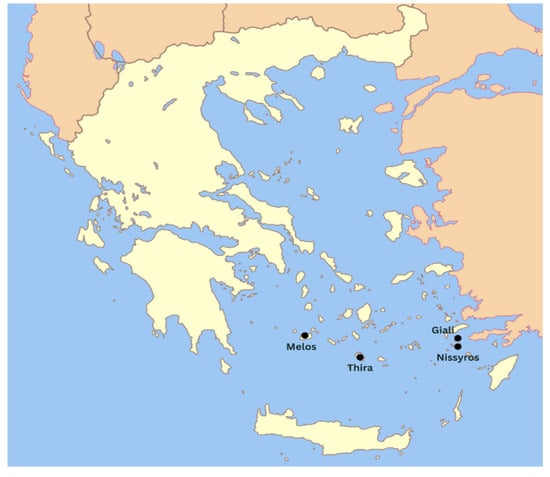
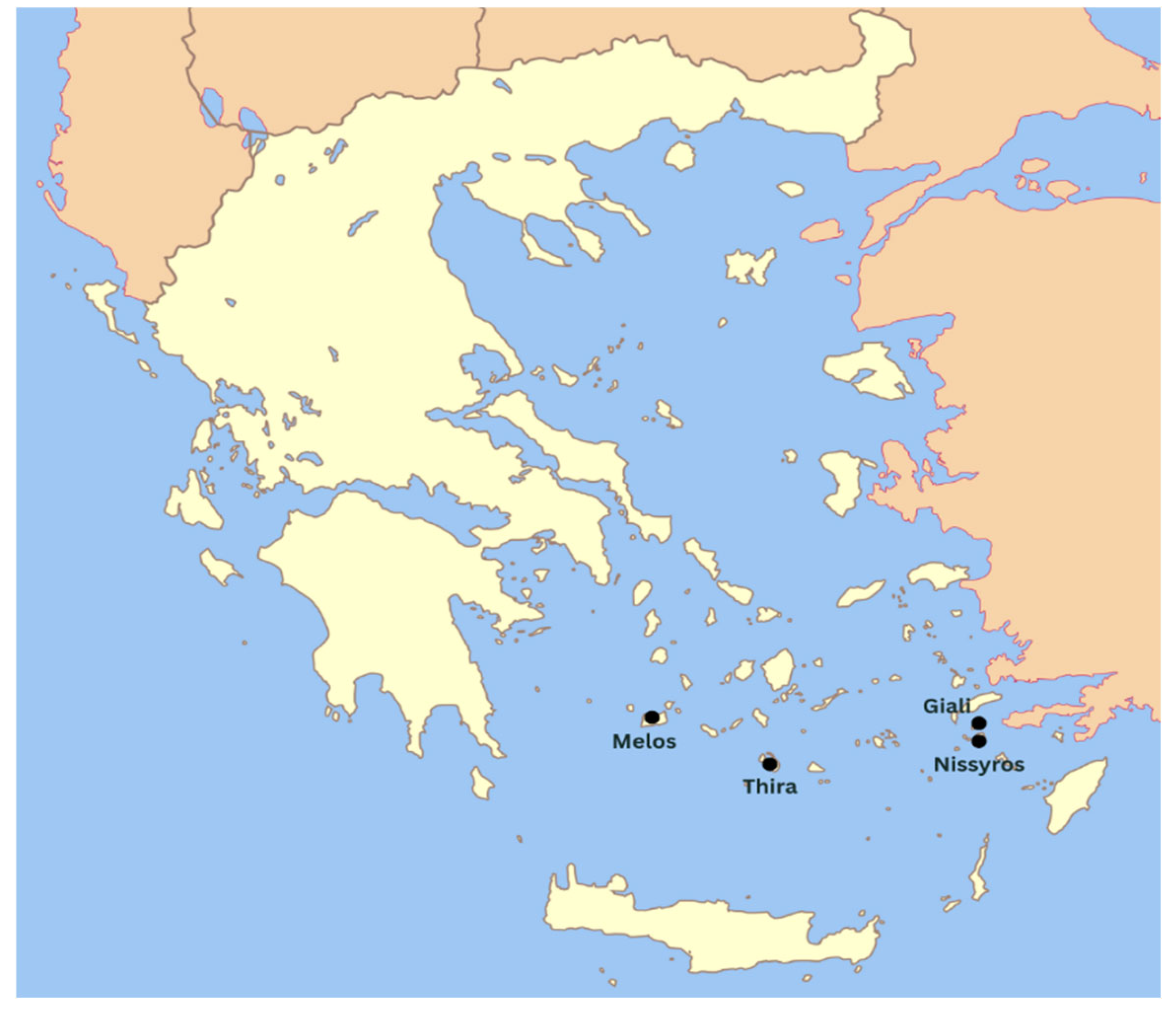
This study directly addresses this objective by presenting the measurement parameters employed for system-inherent application settings of Niton and Bruker handheld pXRF instruments and by evaluating the comparability of their results for provenance studies. In this context, a systematic assessment of the Niton pXRF ‘Soil’ mode for determining minor and trace elements in soils, sediments and geological materials, based on fundamental parameters, is undertaken through direct comparison with the Bruker ‘Obsidian Mode’ determining trace elements, based on calibration with obsidian reference materials. The comparison aims to assess the suitability of the Niton calibration for obsidian analysis, to characterize inter-instrument differences in the reported elemental concentrations, and to evaluate their implications for compositional characterization and archaeological obsidian sourcing. In the absence of suitable certified reference materials (CRMs), the present analytical case study comprises 39 natural-material samples, including 10 obsidian specimens from Thira (Santorini Island), 13 from Melos, five from Giali, and one from Nissyros Island, Greece (Figure 1; Table 1). Melos Island hosts two principal obsidian outcrops in its northeastern part, at Sta Nychia and Demenegaki, which represent important sources of obsidian in the Aegean region [14,74,75,76]. The analytical setup involved a Niton XL3t GOLDD+ handheld pXRF system (Thermo Fisher Scientific) and a Bruker TRACER 5 handheld pXRF instrument.
Figure 1.
Map showing the geographic locations of the obsidian sources investigated in this study: Thira (Santorini Island), Melos (Milos Island), Giali Island, and Nisyros Island, Greece.
Table 1.
List of the obsidian samples examined in this study, including their sample identification codes and geographic provenance (island/region of origin).
2. Materials and Methods
The experimental setup employed a handheld NITON XL3t GOLDD+ system (Thermo Fisher Scientific, Billerica, MA, USA) at the Institute of Nanoscience and Nanotechnology ‘Demokritos’, National Center for Scientific Research, and a Bruker Tracer 5 (Bruker Handheld LLC, Kennewick, WA, USA) at the Faculty of History and Archaeology, National and Kapodistrian University of Athens, providing comprehensive chemical profiles encompassing major and minor elements pertinent to obsidian analysis, as well as a suite of trace elements.
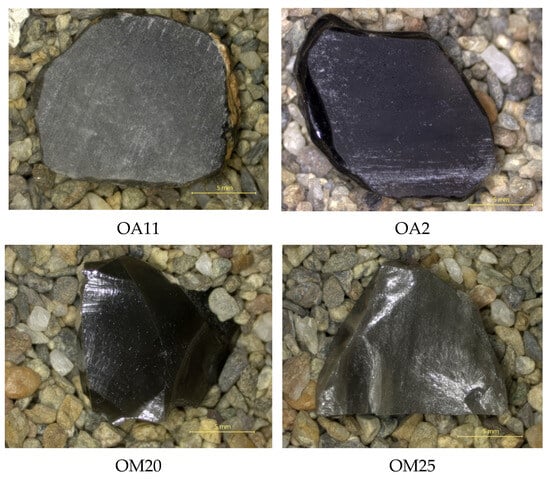
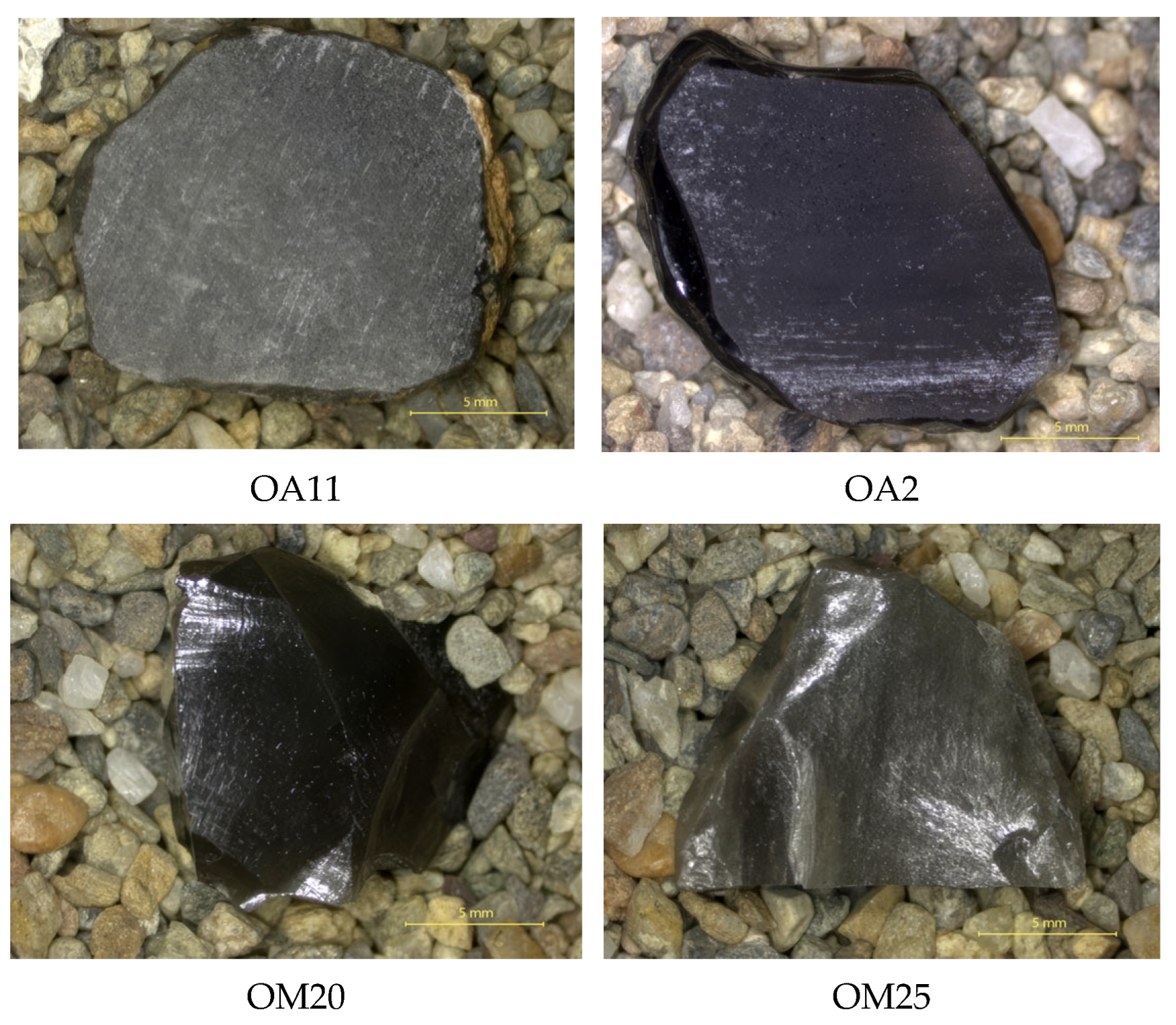
The obsidian specimens examined in this study consist of natural material, with dimensions ranging between 2 and 9 cm, except for eight samples measuring between 1.3 and 1.8 cm. A common limitation in pXRF analysis concerns small-dimension samples, i.e., sample thickness and surface geometry, both of which can significantly influence measured elemental concentrations. Many archaeological artifacts are insufficiently thick or lack adequately flat surfaces to yield optimal analytical conditions [70,71,72,73]. For the present study, natural and non-processed obsidian fragments were selected. The dimensions of the specimens exceeded critical limits, and sufficiently flat areas were selected for the pXRF analysis, minimizing geometry- and thickness-related analytical uncertainties (Figure 2).
Figure 2.
Representative obsidian samples included in the analytical dataset, showing the samples with the smallest dimensions analyzed in this study.
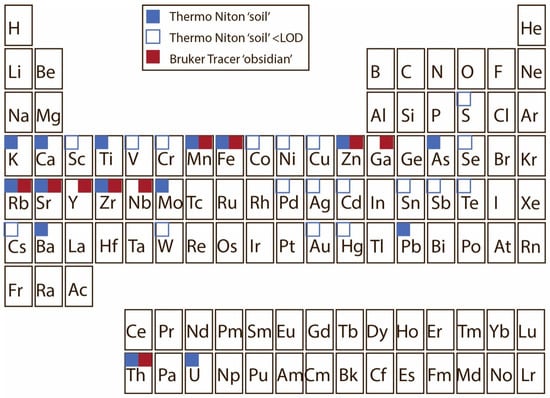
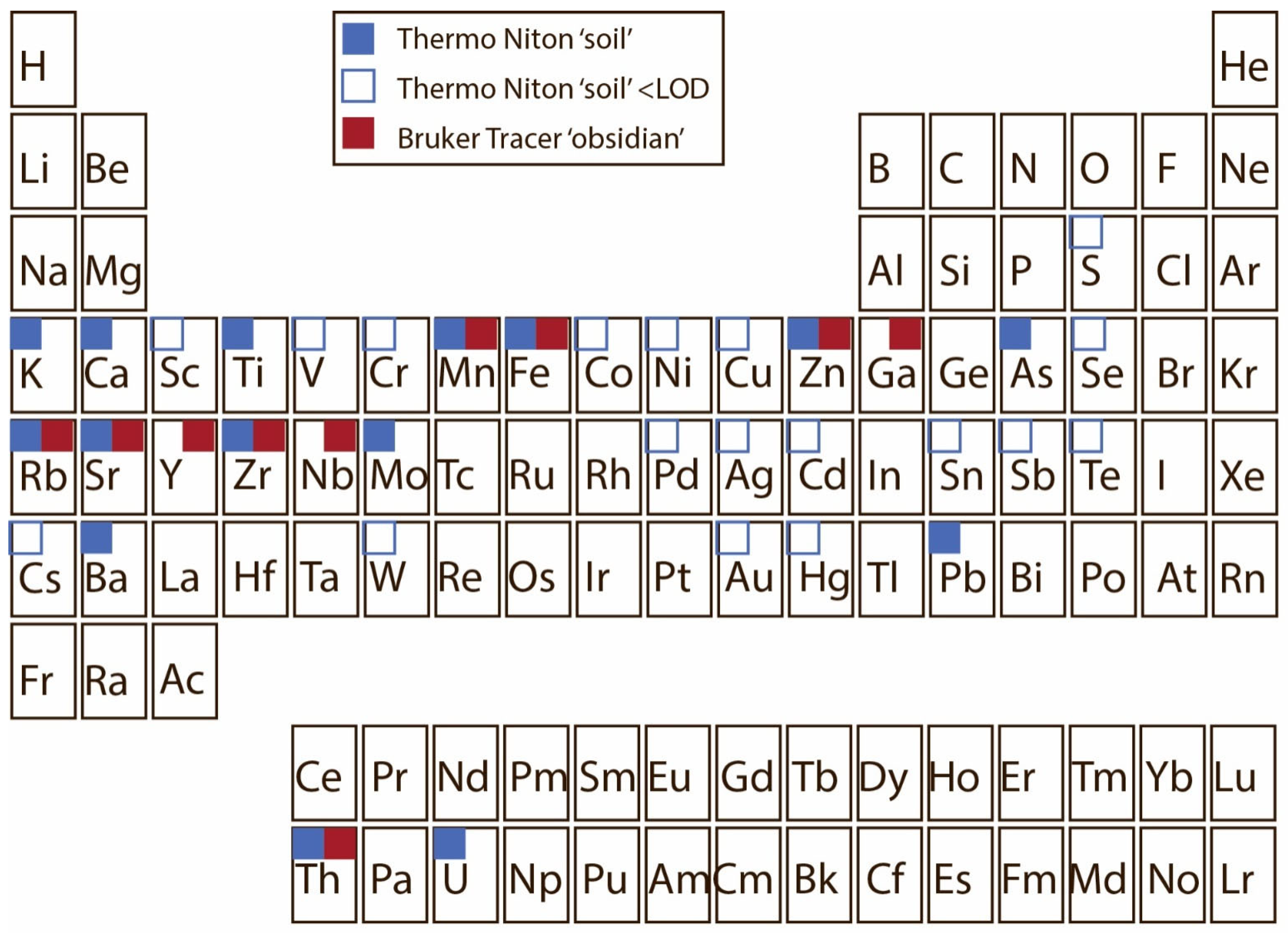
The pXRF measurements were carried out on 39 obsidian fragments using a NITON XL3t GOLDD + handheld system (Thermo Fisher Scientific) [59] and, in comparison, a Bruker TRACER 5 handheld pXRF. Each measurement was performed for 180s. In the present case study, the minor and trace element concentrations were determined using the above-mentioned system-inherent calibration modes, which provided concentrations of 33 elements in the case of the Thermo Niton pXRF and 10 elements in the case of the Bruker pXRF. The examined calibration modes were chosen following standard analytical workflows applied in the compositional study of minor and trace elements in obsidian. In both modes, major and minor elements below S (Z = 16) are not considered, while potential interferences of fluorescence peaks are taken into consideration through the verified calibration. Eventually, the selected modes provided seven element concentrations, which are provided by both devices: Mn, Fe, Zn, Rb, Sr, Zr and Th (Figure 3). The two instruments were applied to the same samples and measurement locations. The effective beam spot was estimated at approximately 6 mm in diameter for the Niton pXRF and 5 mm for the Bruker pXRF. Consequently, the analyzed areas were broadly comparable in size, although a slight difference in the measurement area cannot be excluded. The included camera was used to take a picture of the region being studied during each measurement. Since pXRF is a surface-sensitive method, it was decided not to conduct analysis in any regions that had obvious signs of surface treatment or weathering. To start with, one measurement with each pXRF device was applied on 39 samples of obsidian. To continue with, in order to evaluate potential uncertainties introduced by the method or by the choice of the measuring region, a significant number of fragments were analyzed at the same or at different spots with repeatability. Specifically, 5 samples of obsidian were selected in order for 10 measurements to be applied (5 measurements at approximately the same spots and 5 measurements at different spots). The study includes common trace elements that will be helpful, notably, for provenance purposes, as well as major and minor elements that are from experience relevant to discriminating obsidian sources [14]. AI-assisted language editing was performed using ChatGPT (OpenAI) to improve grammar, readability, and clarity. The tool was not used to generate or analyze research data. All scientific interpretations and conclusions were reviewed and approved by the author. Also, ChatGPT (OpenAI) was used at the preliminary ideation stage to explore possible concepts for the graphical abstract. The final graphical abstract was subsequently designed and prepared by the author using original materials, without AI generation of the final image.
Figure 3.
Concentrations of the seven chemical elements commonly determined by both pXRF instruments (Niton pXRF and Bruker pXRF): Mn, Fe, Zn, Rb, Sr, Zr, and Th. The figure also shows the concentrations of additional elements detected exclusively by one of the two instruments.
3. Results
3.1. Accuracy of the Niton pXRF and Bruker pXRF Results
The present comparison of the two pXRF systems is restricted to the seven chemical element concentrations commonly determined by both devices, the Niton pXRF as well as the Bruker pXRF. These elements are Mn, Fe, Zn, Rb, Sr, Zr and Th. The other element concentrations measured only by one of the devices, though, are considered in the categorization of the elemental compositions measured by each device (Figure 3). In a first attempt towards directly comparing the analytical results, the ratios of each element concentrations measured by the two different pXRF devices were calculated. Ratios were calculated to normalize compositional variations and to elucidate process-dependent relationships that might otherwise be masked by fluctuations in absolute values. In particular, the MnNiton/MnBruker ratio, as well as the FeNiton/FeBruker ratio, vary from 0.5 to 1.0. The concentrations of the other elements display slightly broader variations, with ZnNiton/ZnBruker ranging from 0.6 to 1.2; RbNiton/RbBruker from 0.8 to 1.2; SrNiton/SrBruker from 0.8 to 1.3; ZrNiton/ZrBruker from 0.9 to 1.3; and ThNiton/ThBruker, exhibiting the widest range, from 0.9 to 1.6 (Table 2).
Table 2.
Intercomparison of elemental concentrations measured using the Niton and Bruker pXRF instruments on the same obsidian samples, including the elements commonly detected by both instruments and the corresponding statistical parameters.
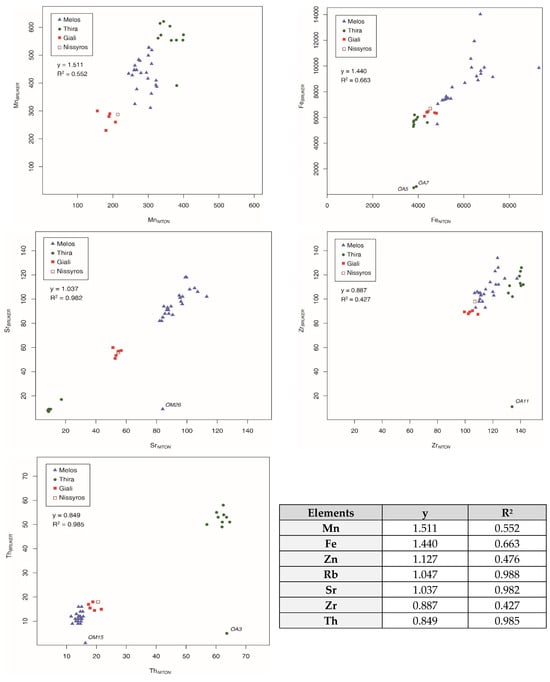
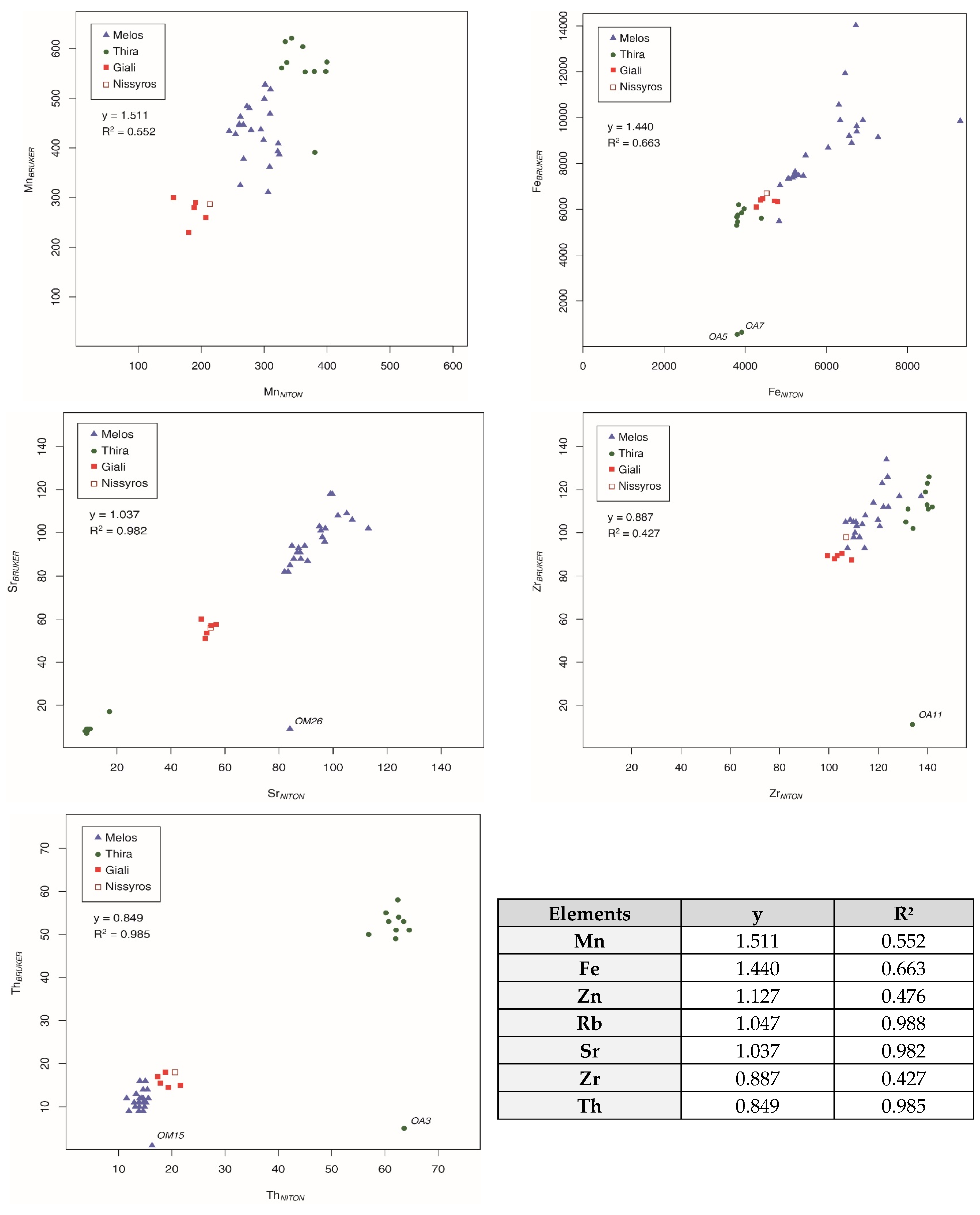
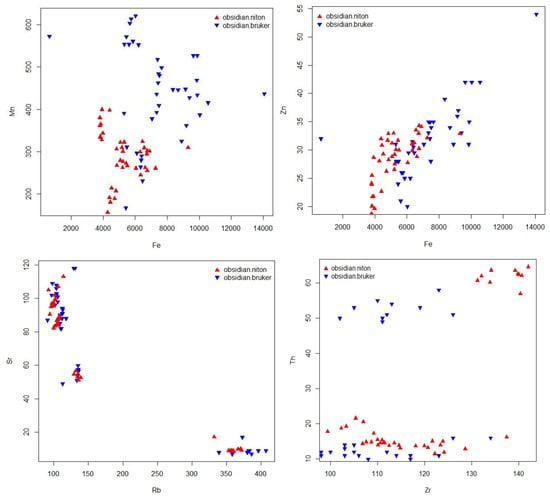
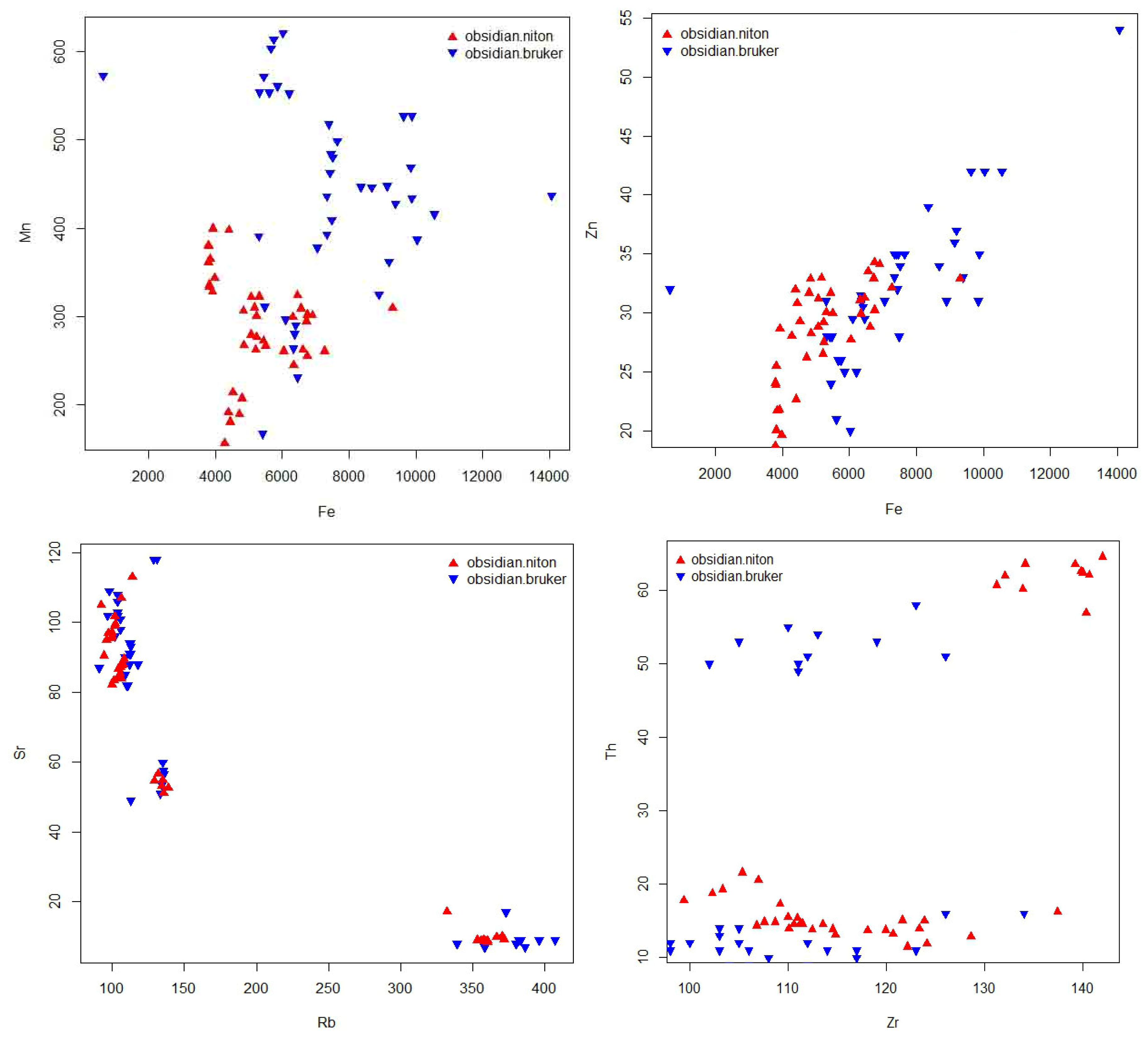
The pXRF results provided by the two devices using modes, which were based on two different calibration strategies, were further examined with linear regression. The coefficient of determination, R-squared, is used to analyze how differences in one variable (results with Niton pXRF) can be explained by a difference in a second variable (results with Bruker pXRF) (Figure 4). The R2 values for Rb, Sr, and Th are approximately 1.0, indicating a strong correlation in comparison with the rest of the elements, Mn, Fe, Zn, and Zr, whose R2 values are between 0.4 and 0.7. Y is defined as the ratio of element concentrations derived from Niton pXRF measurements to those obtained using the Bruker pXRF system. Based on the diagrams, Rb and Sr display Y ratios close to unity, indicating strong agreement between the Niton and Bruker pXRF measurements. Conversely, Zr and Th exhibit Y < 1, signifying that the Niton pXRF reports lower concentrations than the Bruker pXRF. In contrast, Zn, Fe, and Mn (from best to poorest agreement) show Y > 1, reflecting higher concentrations measured by the Bruker pXRF (Figure 4). Selected scatter plots of concentrations measured by both instruments indicate, as anticipated, that Fe versus Mn and Fe versus Zn display higher values in measurements obtained with the Bruker pXRF. Nevertheless, the element ratios remain largely comparable across the two systems. Measurements of Zr and Th obtained using the Niton pXRF are consistently higher, indicating a systematic difference relative to the Bruker pXRF data, and lastly, Rb and Sr revealed largely comparable values (Table 2, Figure 4 and Figure 5).
Figure 4.
Linear regression analysis comparing the absolute elemental concentration values measured using the Niton pXRF and Bruker pXRF instruments. The plots illustrate the relationship between the concentrations obtained by the two instruments for the elements commonly measured by both devices.
Figure 5.
Comparison of absolute elemental concentration values measured using the Niton pXRF (red) and Bruker pXRF (blue) instruments for the elements commonly analyzed by both devices. Distinct clusters according to absolute values are particularly apparent in the case of element concentrations, which present slopes ± 5% and R2 close to 1, such as Rb and Sr. In the case of elements such as Mn and Fe, distinct clusters are still apparent but are not consolidated combining the results collected with the two devices.
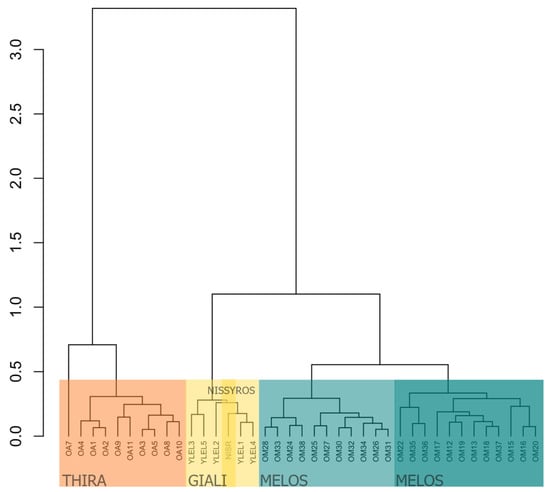
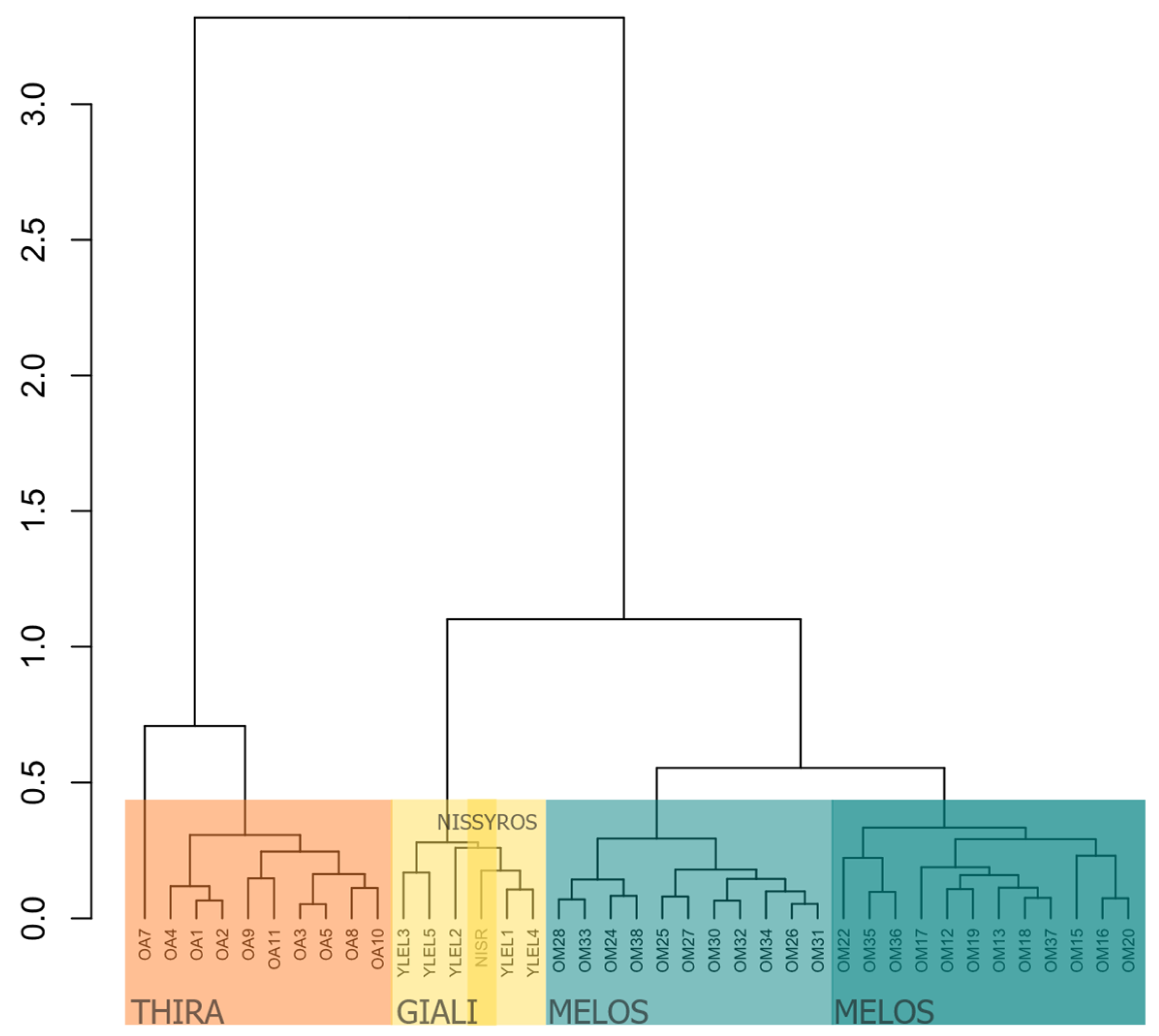
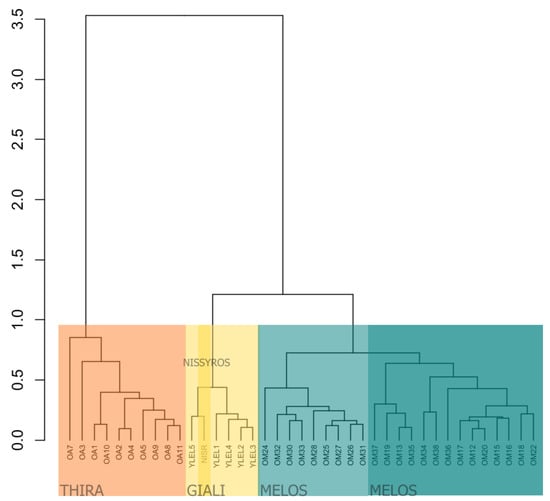
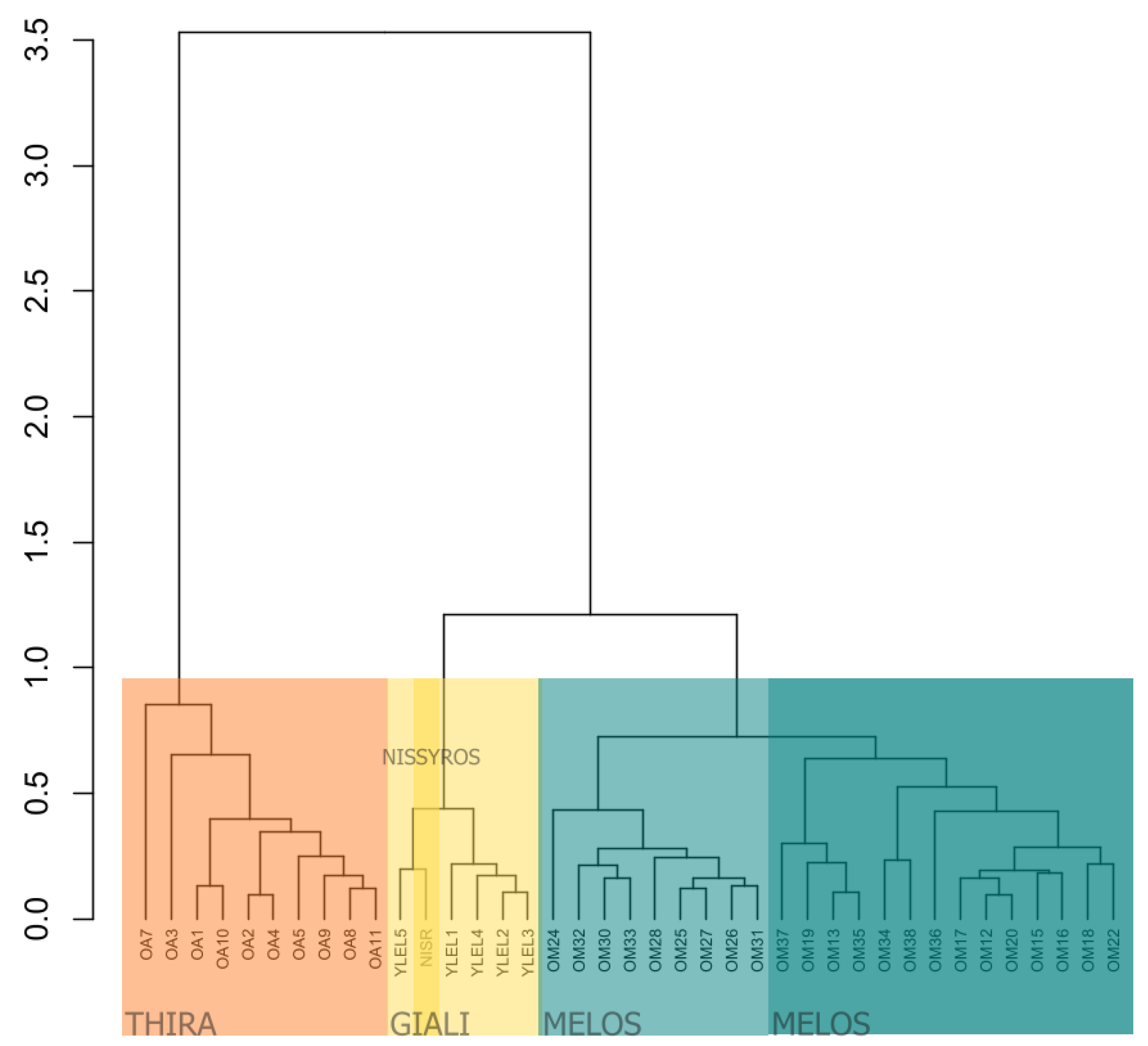
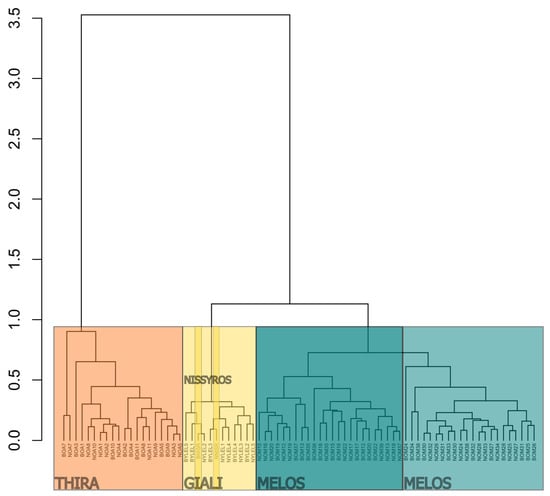
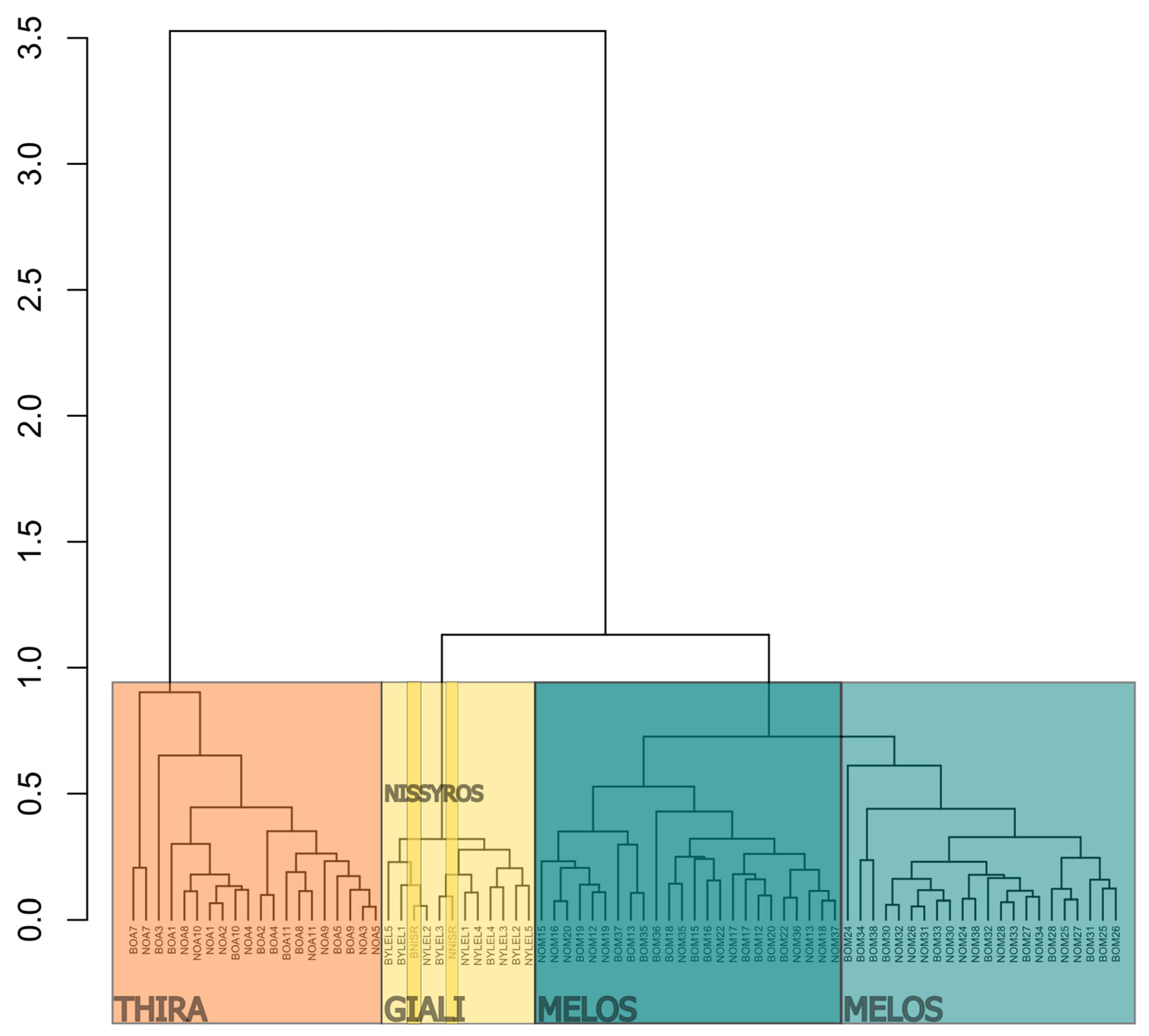
Regarding the hierarchical cluster analysis (HCA) of the obsidian samples based on elemental concentration data obtained using the Niton pXRF and the Bruker pXRF instruments, using Squared Euclidian and Centroid linkage, the samples are separated into three main groups: Thira, Giali and Melos (Figure 6 and Figure 7). The first main group is Thira and specifically includes the samples OA7, OA1, OA4, OA2, OA8, OA10, OA9, OA11, OA3, and OA5, with both of the pXRF techniques. The second main group includes all the samples from Giali, specifically, YLEL2, YLEL3, YLEL4, YLEL1, and YLEL5, as well as the sample of Nissyros, with both of the pXRF techniques. Nissyros shares similar geological characteristics with the surrounding islands, as it is characterized by active volcanic geology. The nearby island of Giali, located approximately 2 km from Nissyros and known for its obsidian deposits, exhibits the same geological features.
Figure 6.
Hierarchical cluster analysis (HCA) of the obsidian samples based on elemental concentration data obtained using the Niton pXRF instrument, using Squared Euclidian and Centroid linkage.
Figure 7.
Hierarchical cluster analysis (HCA) of the obsidian samples based on elemental concentration data obtained using the Bruker pXRF instrument, using Squared Euclidian and Centroid linkage.
Finally, the third main group includes all the samples from Melos, which separated into two subgroups, and specifically, Subgroup B1 including OM33, OM24, OM38, OM25, OM27, OM30, OM32, OM26, OM31, OM28, and OM34 and Subgroup B2 including OM15, OM22, OM17, OM16, OM20, OM35, 0M18, OM37, OM13, OM36, OM12, and OM19, with the Niton pXRF. However, a slight difference between the two distinct Melos sources was observed when comparing the results from the two pXRF devices. In the cluster analysis using the Niton pXRF, the first Melos subgroup contains 11 samples, while the second subgroup contains 12 samples. In contrast, the cluster analysis based on the Bruker pXRF results shows nine samples in the first subgroup and 14 in the second. Notably, samples OM34 and OM38 fall into the second subgroup in the Bruker-based classification.
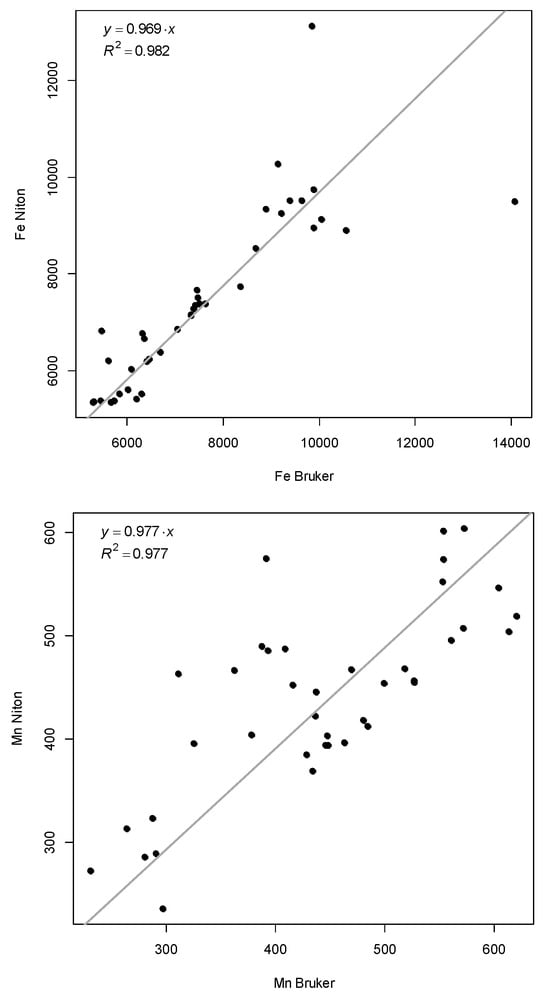
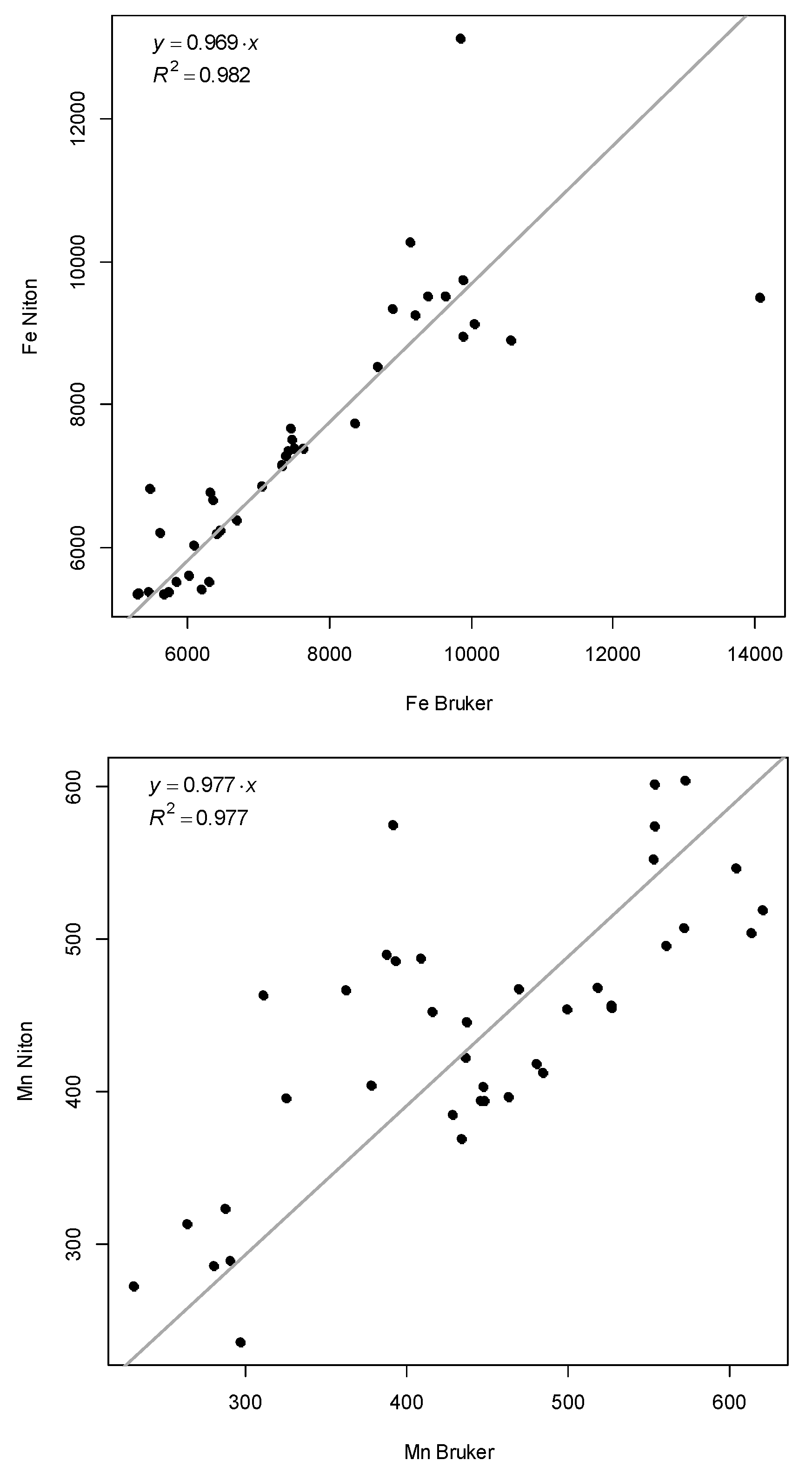
Hierarchical cluster analysis (HCA) was initially applied separately to the datasets generated by each instrument in order to evaluate whether meaningful clustering could be achieved despite the inclusion of several elements that had been identified as analytically suboptimal. Although some elements exhibited non-ideal analytical performance, the resulting cluster analyses were nonetheless sufficient to discriminate compositional groups. It was observed that the cluster analyses produced broadly consistent results across both techniques, demonstrating a high degree of methodological robustness. In particular, each method successfully identified two well-defined subgroups, differing by only two samples, which can be confidently associated with distinct raw-material sources from separate regions of Melos [14,74,75,76]. This concordance not only validates the reliability of the clustering procedures employed but also reinforces the hypothesis that the compositional variation reflects underlying geological and geographical differences in the raw material provenance (Figure 6 and Figure 7). Applying an inter-calibration of concentrations provided by the Niton pXRF device to the Bruker device, the clustering results improved substantially, yielding analytically robust and well-defined groupings. Building on this improvement, measurements from both instruments were subsequently integrated into a single comprehensive cluster analysis. A calibration step effectively eliminated the minor discrepancies previously observed, resulting in full concordance between the datasets and enabling the identification of all groups, including two well-defined subgroups that can be confidently associated with the two distinct obsidian raw-material sources at Sta Nychia (Subgroup 1) and Demenegaki (Subgroup 2) in northeastern Melos [14,74,75,76]. This unified analytical approach confirms the consistency of results across both systems and reinforces the reliability of the combined framework (Figure 8 and Figure 9).
Figure 8.
Linear regression analysis used to calibrate Fe and Mn concentrations measured by the Niton pXRF, using the corresponding Bruker pXRF measurements as the reference values.
Figure 9.
Hierarchical cluster analysis (HCA) of the combined Niton and Bruker pXRF data after applying the calibration factors for Fe and Mn, showing the resulting grouping of the obsidian samples.
3.2. Reproducibility of the Niton pXRF and Bruker pXRF Results
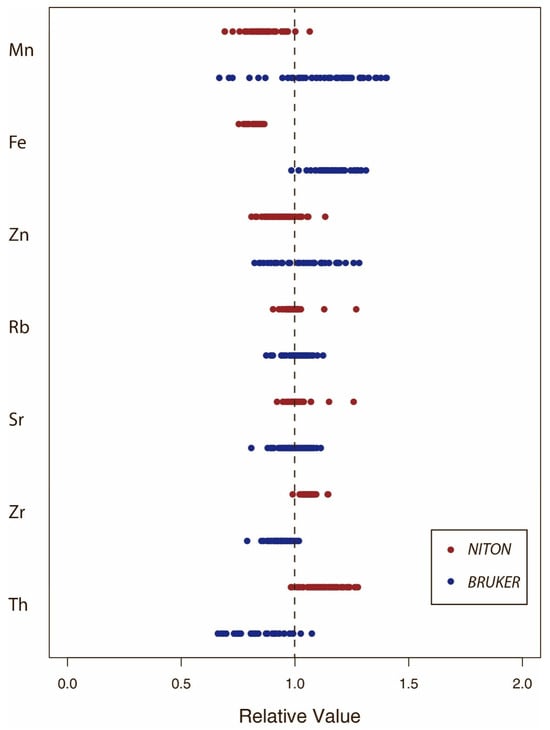
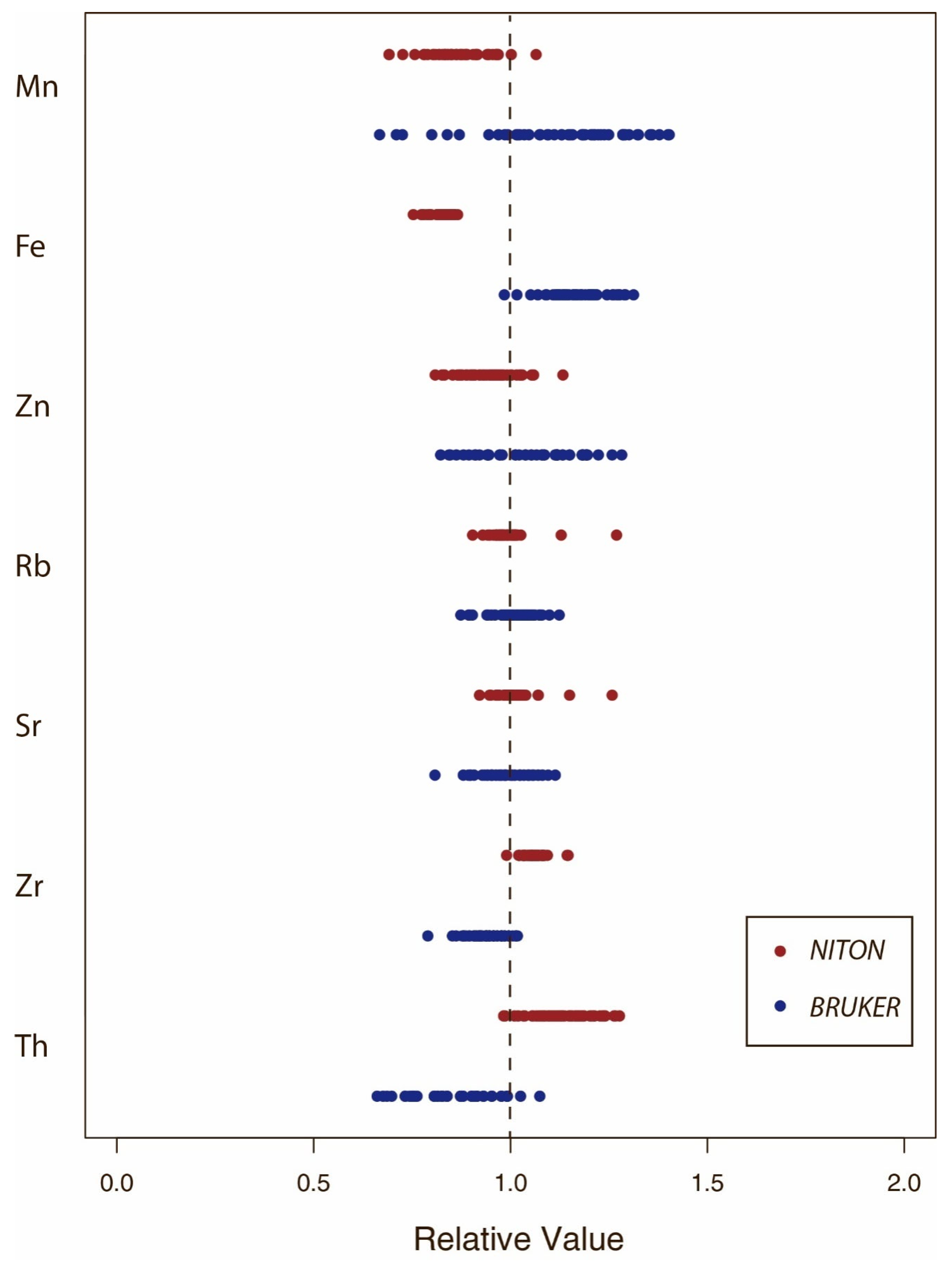
In the case of on-site analysis, the method’s reproducibility relies on both sample preparation, which in the case of obsidian artifacts primarily concerns the cleaning of potential crust from the surface, and the homogeneity of the sample. For the reproducibility assessment of the system, five measurements at approximately the same spots of each of the five obsidian samples included in the present study were taken. For the assessment of the reproducibility of the measurements of the same sample, five measurements at the different spots of the five obsidian samples were taken (Figure 10; Table 3 and Table 4). The long-term precision, or instrument’s drift, is continuously monitored and potentially corrected using reference materials. In the case of other geological materials, such as fired clays, the long-term precision of the calibration modes is monitored by measuring CRMs with every run of samples. If necessary, the concentration values provided by the device using a particular calibration mode are re-calibrated, even though in the case of the Niton pXRF, up to now, no fundamental long-term imprecision has been observed.
Figure 10.
Relative elemental concentrations for five obsidian samples, each measured 10 times using the Niton and Bruker pXRF instruments. Individual absolute concentrations were normalized to the mean concentration of the respective sample. Red circles represent Niton pXRF measurements, and blue circles represent Bruker pXRF measurements.
Table 3.
Reproducibility of elemental concentrations measured using the Niton pXRF (N) and Bruker pXRF (B) at approximately the same spots on obsidian samples. The mean, median, standard deviation (SD), and coefficient of variation (CV) are reported for each element.
Table 4.
Repeatability of Niton pXRF and Bruker pXRF results at the different spots on obsidians.
The ratio of the means of the elements at the approximately same spots, which was delimited, presented abundant information. Specifically, the ranges of the mean ratio of MnN/MnB and FeN/FeB is 0.7–0.8. The ranges of the mean ratio of ZnN/ZnB, RbN/RbB, and SrN/SrB is 0.9–1.0, and the ranges of the mean ratio of ZrN/ZrB and ThN/ThB is 1.1–1.4 (Table 3). The ratio of the means of the elements in the different spots presented abundant information too. Specifically, the ranges of the mean ratio of MnN/MnB and FeN/FeB is 0.7–1.0. The ranges of the mean ratio of ZnN/ZnB, RbN/RbB, and SrN/SrB is 0.9–1.1 (apart from the sample OM26, which has ZnN/ZnB 0.8), and the ranges of the mean ratio of ZrN/ZrB and ThN/ThB is 1.1–1.4 (Table 4).
The comparison between the two pXRF measurement approaches, measurements performed at approximately the same spots and measurements performed at different spots, shows the greatest differences in the ratios of the mean concentrations for Mn (MnN/MnB) and Fe (FeN/FeB). For measurements at approximately the same spots, these ratios range from 0.7 to 0.8, whereas for measurements performed at different spots, they range from 0.7 to 1.0 (Table 3 and Table 4). This greater variability among different spots suggests that the measured Fe and Mn concentrations are more sensitive to local variations within the analyzed material. In particular, Fe and Mn may be influenced by the heterogeneous distribution of mineral inclusions, impurities, or other compositional features at the scale of the pXRF measurement spot. Consequently, differences between measurement locations may contribute substantially to the observed variability and should be considered when assessing the reproducibility of these element measurements.
In comparison, Zn, Rb, and Sr show only a modest increase in variability when measurements are performed at different spots, indicating that their concentrations are less affected by local compositional heterogeneity under the conditions of this study. Zr and Th exhibit consistently low variability in both measurement approaches, with only minor differences between approximately the same and different spots. This relatively stable behavior suggests that these elements provide more consistent measurements across the analyzed areas and therefore demonstrate a higher degree of reproducibility. Overall, the results indicate that the reproducibility of pXRF measurements is element-dependent and can be affected by small-scale heterogeneity in the material, particularly for elements such as Fe and Mn.
As elemental measurements can be influenced by factors such as spot heterogeneity, surface roughness, and instrumental noise, the use of the median provides an alternative means of assessing variability. Unlike the mean, the median is less affected by extreme values and therefore offers a more robust estimate of the typical measurement at a given spot or across multiple spots. This approach is particularly valuable when comparing instruments with slightly different calibration or sensitivity characteristics. Therefore, the median was additionally analyzed to obtain a more reliable representation of the central tendency and to minimize the influence of outliers or localized measurement inconsistencies in the dataset.
The ratios of the median element concentrations at both the same and different spots provide valuable insights into the consistency and agreement between the Niton and Bruker pXRF measurements. At approximately the same spots, MnN/MnB and FeN/FeB exhibit ratios of ~0.7, indicating lower values in the Niton pXRF measurements, whereas ZnN/ZnB ranges from 0.8 to 1.0, and RbN/RbB and SrN/SrB fall between 0.9 and 1.1, reflecting closer agreement. In contrast, ZrN/ZrB and ThN/ThB are higher, ranging from 1.1 to 1.2 and 1.2 to 1.4, respectively, suggesting systematically elevated values in the Niton pXRF. Across different spots, a similar pattern is observed. The median ratios of FeN/FeB remain at ~0.7. MnN/MnB range from 0.7 to 1.0, and ZnN/ZnB varies between 0.8 and 1.0, while RbN/RbB is approximately 1.0.
SrN/SrB and ZrN/ZrB range from 1.0 to 1.2, and ThN/ThB ranges from 1.3 to 1.4 (Table 3 and Table 4). The results indicate that Fe, Mn, and Zn consistently show higher values when measured with the Bruker instrument compared to the Niton, whereas Rb displays a moderate level of agreement between the two devices. In contrast, Sr, Zr, and Th tend to be overestimated by the Niton pXRF.
In summary, the analysis of mean and median ratios indicates that Mn, Fe, and Zn exhibit higher values across different measurement spots compared to those obtained from the same spots. For the median values in particular, Zn also shows a consistent increase across different spots. Conversely, Rb, Sr, Zr, and Th display only minor variations between measurements, suggesting more stable behavior across sampling locations.
3.3. Precision of the Niton pXRF and Bruker pXRF Results
The precision of the measurements can be evaluated using the coefficient of variation (CV), which represents the relative standard deviation expressed as a percentage of the expected or mean value. This parameter provides a normalized measure of dispersion, allowing comparison of variability across different datasets or measurement conditions [38]. In this study, control measurements were conducted and summarized by reporting the mean values and their corresponding coefficients of variation for each sample. Each reported value is based on five independent measurements at the approximately same spots or on five independent measurements at different spots, ensuring statistical reliability and enabling an accurate assessment of analytical precision (Figure 10; Table 3 and Table 4). Furthermore, Figure 9 illustrates the individual absolute concentrations were diverted by the average concentrations of the respective samples.
Specifically, the precision of the elements at the approximately same spots for Fe is CVN 0.8 and CVB 2.3, for Mn is CVN 3.5 and CVB 8.5, for Zn is CVN 2.4 and CVB 11, for Rb is CVN 1.0 and CVB 3.8, for Sr is CVN 1 and CVB 1.5, for Zr is CVN 1.2 and CVB 2.1 and for Th is CVN 5.5 and CVB 12.3. Furthermore, the precision of the elements in the different spots for Fe is CVN 1.9 and CVB 4.2, for Mn is CVN 10.4 and CVB 16.3, for Zn is CVN 3.6 and CVB 6.4, for Rb is CVN 13.7 and CVB 4.0, for Sr is CVN 9.6 and CVB 9.1, for Zr is CVN 3.7 and CVB 4.0 and for Th is CVN 6.6 and CVB 3.6 (Table 3 and Table 4).
The difference between the maximum and minimum coefficient of variation (CV) values for each element indicates that the CVN values are consistently lower than the CVB values at approximately the same measurement spots. Based on the comparative analysis of different spot measurements, the subtraction of the maximum from the minimum CVs for Fe, Mn, Zn, and Zr reveals that the CVN values remain lower than the CVB values. In contrast, for the elements Rb, Sr, and Th, the CVN values are higher than the CVB values. Overall, the results demonstrate that both CVN and CVB measurements exhibit lower variability at approximately the same spots compared with those obtained from different spots. An exception was observed for Zn and Th, where the CVB values at the same spots were higher than the corresponding CVB values at different spots, suggesting element-specific variability in measurement precision.
Based on the control measurements, the analytical precision of the method was evaluated by comparing the coefficients of variation (CVs) obtained under different measurement conditions. The estimated precision values were CVN < 9.2% and CVB < 17.8% for analyses conducted at approximately the same spots, and CVN < 14.5% and CVB < 25.9% for measurements performed at different spots. These results demonstrate that the instrumental repeatability and spatial reproducibility of the method are within acceptable limits for trace elemental analysis. Given the high degree of compositional homogeneity of the materials analyzed, such levels of precision are considered sufficiently robust to support chemical provenance investigations, where relative rather than absolute compositional differences are typically of primary importance, as in Table 3.
To summarize the results, comparison of the Niton and Bruker pXRF measurements demonstrated good inter-instrument comparability, with highly similar concentrations for Rb, Sr, and Th and more moderate agreement for Mn, Fe, Zn, and Zr. Despite element-specific differences, cluster analysis consistently distinguished the major obsidian sources of Thira (Santorini), Melos, Nisyros, and Giali, while also resolving two distinct Melos subgroups corresponding to the Sta Nychia and Demenegaki sources in northeastern Melos. Following simple calibration of the Niton data, measurements from both instruments could be combined into a single cluster analysis, resolving the minor discrepancy between datasets and confirming the robustness of the source discrimination.
Reproducibility assessment showed greater variability for Fe and Mn, likely reflecting spot heterogeneity, surface roughness, and instrumental effects, whereas Zn, Rb, Sr, Zr, and Th exhibited comparatively greater stability. The lower coefficients of variation consistently obtained for the Niton measurements further indicated satisfactory instrumental repeatability and spatial reproducibility. Given the compositional homogeneity of the investigated obsidians, the observed precision was sufficient for provenance studies, where relative compositional differences are more critical than absolute concentration values.
Taken together, the results demonstrate that, following calibration, the two pXRF datasets are sufficiently compatible for integrated provenance analysis. Linear regression provides practical calibration relationships for harmonizing measurements from different instruments, while the consistent discrimination of both major sources and the two compositionally distinct Melos subgroups confirms the suitability of the approach. This demonstrates the potential of a limited geological reference assemblage to establish transferable calibration relationships and facilitate the integration of larger pXRF datasets generated by different instruments.
4. Conclusions
The results demonstrate a high degree of comparability between the Niton XL3t GOLDD+ and Bruker TRACER 5 for the elemental characterization of obsidian, while also highlighting element-specific differences in measurement variability and reproducibility that should be considered in provenance studies.
Both instruments produced strongly correlated compositional datasets and consistently discriminated the major Aegean obsidian sources investigated, namely, Thira/Santorini, Melos, Nisyros, and Giali. Importantly, the analyses also resolved two closely related source groups within Melos, corresponding to the distinct obsidian sources of Sta Nychia and Demenegaki. Although systematic differences in absolute concentrations were observed for certain elements, particularly Fe, Mn, and Zn, these inter-instrument differences did not substantially affect sample clustering or source discrimination. The application of empirical calibration factors further demonstrated the feasibility of harmonizing datasets generated by different pXRF instruments while preserving their discriminatory capacity.
The study also confirms satisfactory repeatability and analytical precision for the homogeneous volcanic glass materials investigated, supporting the application of pXRF to large-scale archaeological provenance studies. Its non-destructive nature, rapid analysis, relatively low operational cost, and capacity for high-throughput measurements make pXRF particularly valuable for the systematic characterization and preliminary provenance assessment of archaeological obsidian. In this context, pXRF can facilitate the screening of large sample assemblages and provide a rational basis for the selection of representative samples for subsequent laboratory-based analyses. Nevertheless, its suitability is strongly dependent on sample homogeneity and on the control of analytical and instrumental sources of variability, emphasizing the importance of appropriate quality assurance procedures.
The findings further demonstrate that reliable inter-instrument and interlaboratory comparison cannot rely solely on the observed correlation between datasets. Rather, it requires standardized acquisition protocols; appropriate reference materials; rigorous quality control procedures; and comprehensive documentation of calibration strategies, measurement conditions, and data-processing workflows. Systematic assessment and transparent reporting of analytical precision, data quality, inter-instrument differences, and methodological limitations are therefore essential for ensuring the traceability, reproducibility, and long-term validity of pXRF compositional data.
Overall, the proposed workflow provides a practical framework for harmonizing measurements obtained with different portable XRF systems and for generating transferable and reproducible compositional datasets. It offers a robust basis for the further development of the NCSR Demokritos pXRF reference database for obsidian classification and provenance assessment, while also providing a methodological framework that may be extended to other homogeneous silicate solid materials. More broadly, the study highlights that the scientific value of pXRF datasets depends not only on the analytical capabilities of individual instruments, but also on the standardization, calibration, quality control, and transparent documentation required to make measurements generated across instruments and laboratories genuinely comparable. Such harmonization is essential for strengthening the reproducibility of individual studies and for enabling the cumulative, verifiable integration of compositional data within archaeological and materials research.
Author Contributions
A.P. prepared the initial manuscript and contributed to the conceptualization and design of the study, data collection, and data analysis. A.H. and V.K. contributed to the methodology and supervision of the research. All authors have read and agreed to the published version of the manuscript.
Funding
This research received no external funding.
Data Availability Statement
The data supporting the findings of this study are available from the corresponding author upon reasonable request.
Acknowledgments
The authors acknowledge Yiannis Papadatos for generously allowing the use of Bruker Tracer 5 at the Faculty of History and Archaeology, National and Kapodistrian University of Athens, which was instrumental in conducting the experiments described in this article. The author used ChatGPT (OpenAI) to assist with language editing and improving the clarity of the manuscript. The author reviewed and revised the suggested changes and takes full responsibility for the final content. Furthermore, during the preparation of the graphical abstract, the author used ChatGPT (OpenAI) to explore preliminary ideas and obtain inspiration. The final graphical abstract was independently prepared by the author using original materials.
Conflicts of Interest
The authors declare no conflicts of interest.
References
- Renfrew, C. Trade and culture process in European prehistory. Curr. Anthropol. 1969, 10, 151–169. [Google Scholar] [CrossRef] [Scilit]
- Clark, J.E. Multi-faceted approach to the study of Mesoamerican obsidian trade: An example from early Chiapas. In Proceedings of the 46th Annual Meeting of the Society for American Archaeology, San Diego, CA, USA, 29 April–2 May 1981. [Google Scholar]
- Elam, J.M. Post-Formative Obsidian Exchange in Oaxaca, Mexico. Ph.D. Thesis, University of Missouri, Columbia, MO, USA, 1993. [Google Scholar]
- Glascock, M.D.; Braswell, G.E.; Cobean, R.H. A systematic approach to obsidian source characterization. In Archaeological Obsidian Studies: Method and Theory; Advances in Archaeological and Museum Science; Shackley, M.S., Ed.; Plenum Press: New York, NY, USA; London, UK, 1998; Volume 3, pp. 15–65. [Google Scholar] [CrossRef] [Scilit]
- Bassiakos, Y.; Kilikoglou, V.; Sampson, A. Yali Island: Geological and analytical evidence for a new source of workable obsidian. Int. Assoc. Obsidian Stud. Bull. 2005, 33, 18. [Google Scholar]
- Bonizzoni, L.; Kulchytska, O.; Ruschioni, G. XRF semi-quantitative analysis and multivariate statistics for the classification of obsidian flows in the Mediterranean area. Appl. Sci. 2023, 13, 3495. [Google Scholar] [CrossRef] [Scilit]
- Di Paola, G.M. Volcanology and petrology of Nysiros Island (Dodecanese, Greece). Bull. Volcanol. 1974, 38, 944–987. [Google Scholar] [CrossRef] [Scilit]
- Fyticas, M.; Giuliani, O.; Innocenti, F.; Marinelli, G.; Mazzuoli, R. Geochronological data on recent magmatism of the Aegean Sea. Tectonophysics 1976, 31, T29–T34. [Google Scholar] [CrossRef] [Scilit]
- Fyticas, M.; Innocenti, F.; Kolios, N.; Manetti, P.; Mazzuoli, R.; Poli, G.; Rita, F.; Villari, L. Volcanology and petrology of volcanic products from the Island of Milos and neighbouring islets. J. Volcanol. Geotherm. Res. 1986, 28, 297–317. [Google Scholar] [CrossRef] [Scilit]
- Renfrew, C. Trade as action at a distance: Questions of integration and communication. In Ancient Civilization and Trade; Sabloff, J.A., Lamberg-Karlovsky, C.C., Eds.; University of New Mexico Press: Albuquerque, NM, USA, 1975; pp. 3–59. [Google Scholar]
- Williams-Thorpe, O. Obsidian in the Mediterranean and the Near East: A provenancing success story. Archaeometry 1995, 37, 217–248. [Google Scholar] [CrossRef] [Scilit]
- Tykot, R.H.; Young, S.M.M. Archaeological applications of inductively coupled plasma-mass spectrometry. In Archaeological Chemistry V; Orna, M.V., Ed.; American Chemical Society: Washington, DC, USA, 1996; pp. 116–130. [Google Scholar]
- Kilikoglou, V.; Bassiakos, Y.; Grimanis, A.P.; Souvatzis, K.; Pilali-Papasteriou, A.; Papanthimou-Papaefthimiou, A. Carpathian obsidian in Macedonia, Greece. J. Archaeol. Sci. 1996, 23, 341–349. [Google Scholar] [CrossRef] [Scilit]
- Carter, T.; Kilikoglou, V. From reactor to royalty? Aegean and Anatolian obsidians from Quartier Mu, Malia (Crete). J. Mediterr. Archaeol. 2007, 20, 115–143. [Google Scholar] [CrossRef] [Scilit]
- Carter, T. The contribution of obsidian characterization studies to early prehistoric archaeology. In Lithic Raw Material Exploitation and Circulation in Prehistory: A Comparative Perspective in Diverse Palaeoenvironments; Yamada, M., Ono, A., Eds.; ERAUL 138; Université de Liège: Liège, Belgium, 2014; pp. 23–33. [Google Scholar]
- Freund, K.P. An assessment of the current applications and future directions of obsidian sourcing studies in archaeological research. Archaeometry 2013, 55, 779–793. [Google Scholar] [CrossRef] [Scilit]
- Orange, M.; Le Bourdonnec, F.-X.; Bellot-Gurlet, L.; Lugliè, C.; Dubernet, S.; Bressy-Leandri, C.; Scheffers, A.; Joannes-Boyau, R. On sourcing obsidian assemblages from the Mediterranean area: Analytical strategies for their exhaustive geochemical characterization. J. Archaeol. Sci. Rep. 2017, 12, 834–844. [Google Scholar] [CrossRef] [Scilit]
- Cann, J.R.; Renfrew, C. The characterization of obsidian and its application to the Mediterranean Region. Proc. Prehist. Soc. 1964, 30, 111–133. [Google Scholar] [CrossRef] [Scilit]
- Hallam, B.R.; Warren, S.E.; Renfrew, C. Obsidian in the western Mediterranean: Characterisation by neutron activation analysis and optical emission spectroscopy. Proc. Prehist. Soc. 1976, 42, 85–110. [Google Scholar] [CrossRef] [Scilit]
- Francaviglia, V. Characterization of Mediterranean obsidian sources by classical petrochemical methods. In Preistoria Alpina; Museo Tridentino di Scienze Naturali: Trento, Italy, 1984; Volume 20, pp. 311–332. [Google Scholar]
- Williams-Thorpe, O.; Warren, S.E.; Courtin, J. The distribution and sources of archaeological obsidian from southern France. J. Archaeol. Sci. 1984, 11, 136–146. [Google Scholar] [CrossRef] [Scilit]
- Biró, K.T.; Pozsgai, I.; Vladár, A. Electron beam microanalysis of obsidian samples from geological and archaeological sites. Acta Archaeol. Acad. Sci. Hung. 1986, 38, 257–278. [Google Scholar]
- Bigazzi, G.; Yegingil, Z.; Ercan, T.; Oddone, M.; Özdoğan, M. Fission track dating of obsidians in Central and Northern Anatolia. Bull. Volcanol. 1993, 55, 588–595. [Google Scholar] [CrossRef] [Scilit]
- Cirrincione, R.; Di Martino, G.; Lo Giudice, A.; Pappalardo, G.; Pappalardo, L.; Pezzino, A. Analisi non distruttiva di Ca e Sr eseguita mediante un sistema XRF portatile su diversi tipi di calcare provenienti da cave di Palazzolo e Monti Climiti. In Proceedings of the 1st International Congress on Science and Technology for the Safeguard of Cultural Heritage in the Mediterranean Basin, Catania, Siracusa, Italy, 27 November–2 December 1995. [Google Scholar]
- Acquafredda, P.; Lorenzoni, S.; Zanettin, E. Discrimination of Melos, Lipari, Palmarola obsidian using SEM-EDS. In Proceedings of the 29th International Symposium on Archaeometry; Demirci, S., Özer, A.M., Summers, G.D., Eds.; Tübitak: Ankara, Turkey, 1996; pp. 87–97. [Google Scholar]
- Acquafredda, P.; Andriani, T.; Lorenzoni, S.; Zanettin, E. Chemical characterization of obsidians from different Mediterranean sources by non-destructive SEM-EDS analytical method. J. Archaeol. Sci. 1999, 26, 315–325. [Google Scholar] [CrossRef] [Scilit]
- Kayani, P.I.; McDonnell, G. An assessment of back-scattered electron petrography as a method for distinguishing Mediterranean obsidians. Archaeometry 1996, 38, 43–58. [Google Scholar] [CrossRef] [Scilit]
- Tykot, R.H. Characterization of the Monte Arci (Sardinia) obsidian sources. J. Archaeol. Sci. 1997, 24, 467–479. [Google Scholar] [CrossRef] [Scilit]
- Shackley, M.S. (Ed.) Archaeological Obsidian Studies: Method and Theory; Kluwer Academic/Plenum Press: New York, NY, USA, 1998. [Google Scholar] [CrossRef] [Scilit]
- Shackley, M.S. Gamma rays, X-rays, and stone tools: Some current advances in archaeological geochemistry. J. Archaeol. Sci. 1998, 25, 259–270. [Google Scholar] [CrossRef] [Scilit]
- Shackley, M.S. Precision versus accuracy in the XRF analysis of archaeological obsidian: Some lessons for archaeometry and archaeology. In Archaeometry 98: Proceedings of the 31st Symposium on Archaeometry, Budapest, Hungary; Jerem, E., Biró, K.T., Eds.; BAR International Series 1043(II), Archaeopress: Oxford, UK, 2002; pp. 805–810. [Google Scholar]
- Shackley, M.S. Obsidian: Geology and Archaeology in the North American Southwest; University of Arizona Press: Tucson, AZ, USA, 2005. [Google Scholar]
- Summerhayes, G.; Bird, J.R.; Fullagar, R.; Gosden, C.; Specht, J.; Torrence, R. Application of PIXE–PIGME to obsidian characterization on west New Britain, Papua New Guinea. In Archaeological Obsidian Studies: Method and Theory; Shackley, M.S., Ed.; Plenum Press: New York, NY, USA, 1998; pp. 129–158. [Google Scholar] [CrossRef] [Scilit]
- Gratuze, B. Obsidian characterization by laser ablation ICP–MS and its application to prehistoric trade in the Mediterranean and the Near East: Sources and distribution of obsidian within the Aegean and Anatolia. J. Archaeol. Sci. 1999, 26, 869–881. [Google Scholar] [CrossRef] [Scilit]
- Glascock, M.D.; Neff, H. Neutron activation analysis and provenance research in archaeology. Meas. Sci. Technol. 2003, 14, 1516–1526. [Google Scholar] [CrossRef] [Scilit]
- Stewart, S.J.; Cernicchiaro, G.; Scorzelli, R.B.; Poupeau, G.; Acquafredda, P.; De Francesco, A.M. Magnetic properties and 57Fe Mossbauer spectroscopy of Mediterranean prehistoric obsidians for provenance studies. J. Non-Cryst. Solids 2003, 323, 188–192. [Google Scholar] [CrossRef] [Scilit]
- Bellot-Gurlet, L.; Le Bourdonnec, F.; Popeau, G.; Dubernet, S. Raman micro-spectroscopy of western Mediterranean obsidian glass: One step towards provenance study? J. Raman Spectrosc. 2004, 35, 671–677. [Google Scholar] [CrossRef] [Scilit]
- Potts, P.J. A Handbook of Silicate Rock Analysis; Springer Science and Business Media: New York, NY, USA, 1992. [Google Scholar] [CrossRef] [Scilit]
- Pollard, M.; Batt, C.; Stern, B.; Young, M.M. Analytical Chemistry in Archaeology; Cambridge University Press: Cambridge, UK, 2007. [Google Scholar] [CrossRef] [Scilit]
- Frahm, E. An evaluation of portable X-ray fluorescence for artifact sourcing in the field: Can a handheld device differentiate Anatolian obsidian sources? Geol. Soc. Am. Abstr. Programs 2007, 39, 318. [Google Scholar]
- Frahm, E. Validity of “off-the-shelf” handheld portable XRF for sourcing Near Eastern obsidian chip debris. J. Archaeol. Sci. 2013, 40, 1080–1092. [Google Scholar] [CrossRef] [Scilit]
- Frahm, E. Characterizing obsidian sources with portable XRF: Accuracy, reproducibility, and field relationships in a case study from Armenia. J. Archaeol. Sci. 2014, 49, 105–125. [Google Scholar] [CrossRef] [Scilit]
- Craig, N.; Speakman, R.J.; Popelka-Filcoff, R.S.; Aldenderfer, M.S.; Flores-Blanco, L.; Brown Vega, M.; Glascock, M.D.; Stanish, C. Macusani obsidian from southern Peru: A characterization of its elemental composition with a demonstration of its ancient use. J. Archaeol. Sci. 2010, 37, 569–576. [Google Scholar] [CrossRef] [Scilit]
- Jia, P.; Doelman, T.; Chen, C.; Zhao, H.; Lin, S.; Torrence, R.; Glascock, M.D. Moving sources: A preliminary study of volcanic glass artifact distributions in northeast China using PXRF. J. Archaeol. Sci. 2010, 37, 1670–1677. [Google Scholar] [CrossRef] [Scilit]
- Jia, P.; Doelman, T.; Torrence, R.; Glascock, M.D. New pieces: The acquisition and distribution of volcanic glass sources in northeast China during the Holocene. J. Archaeol. Sci. 2013, 40, 971–982. [Google Scholar] [CrossRef] [Scilit]
- Nazaroff, A.; Prufer, K.; Drake, B. Assessing the applicability of portable X-ray fluorescence spectrometry for obsidian provenance research in the Maya lowlands. J. Archaeol. Sci. 2010, 37, 885–895. [Google Scholar] [CrossRef] [Scilit]
- Burley, D.V.; Sheppard, P.J.; Simonin, M. Tongan and Samoan volcanic glass: PXRF analysis and implications for constructs of ancestral Polynesian society. J. Archaeol. Sci. 2011, 38, 2625–2632. [Google Scholar] [CrossRef] [Scilit]
- McCoy, M.; Mills, P.; Lundblad, S.; Rieth, T.; Kahn, J.; Gard, R. ‘A cost surface model of volcanic glass quarrying and exchange in Hawai’i. J. Archaeol. Sci. 2011, 38, 2547–2560. [Google Scholar] [CrossRef] [Scilit]
- Millhauser, J.; Rodríguez-Alegría, E.; Glascock, M.D. Testing the accuracy of portable X-ray fluorescence to study Aztec and Colonial obsidian supply at Xaltocan, Mexico. J. Archaeol. Sci. 2011, 38, 3141–3152. [Google Scholar] [CrossRef] [Scilit]
- Sheppard, P.; Irwin, G.; Lin, S.; McCaffrey, C. Characterization of New Zealand obsidian using PXRF. J. Archaeol. Sci. 2011, 38, 45–56. [Google Scholar] [CrossRef] [Scilit]
- Tykot, R.H.; Lai, L.; Tozzi, C. Intra-site obsidian subsource patterns at Contraguda, Sardinia (Italy). In Proceedings of the 37th International Symposium on Archaeometry; Turbanti-Memmi, I., Ed.; Springer: Berlin/Heidelberg, Germany, 2011; pp. 321–328. [Google Scholar] [CrossRef] [Scilit]
- Tykot, R.H.; Freund, K.P.; Vianello, A. Source analysis of prehistoric obsidian artifacts in Sicily (Italy) using pXRF. In Archaeological Chemistry VIII; Armitage, R.A., Burton, J.H., Eds.; American Chemical Society: Washington, DC, USA, 2013; pp. 195–210. [Google Scholar]
- Forster, N.; Grave, P. Non-destructive PXRF analysis of museum-curated obsidian from the Near East. J. Archaeol. Sci. 2012, 39, 728–736. [Google Scholar] [CrossRef] [Scilit]
- Goodale, N.; Bailey, D.; Jones, G.; Prescott, C.; Scholz, E.; Stagliano, N.; Lewis, C. PXRF: A study of inter-instrument performance. J. Archaeol. Sci. 2012, 39, 875–883. [Google Scholar] [CrossRef] [Scilit]
- Kellett, L.C.; Golitko, M.; Bauer, B.S. A provenance study of archaeological obsidian from the Andahuaylas region of southern Peru. J. Archaeol. Sci. 2013, 40, 1890–1902. [Google Scholar] [CrossRef] [Scilit]
- Morgenstein, M.; Redmount, C.A. Using portable energy dispersive X-ray fluorescence (EDXRF) analysis for on-site study of ceramic sherds at El Hibeh, Egypt. J. Archaeol. Sci. 2005, 32, 1613–1623. [Google Scholar] [CrossRef] [Scilit]
- Goren, Y.; Mommsen, H.; Klinger, J. Non-destructive provenance study of cuneiform tablets using portable X-ray fluorescence (pXRF). J. Archaeol. Sci. 2011, 38, 684–696. [Google Scholar] [CrossRef] [Scilit]
- Hunt, A.M.W.; Speakman, R.J. Portable XRF analysis of archaeological sediments and ceramics. J. Archaeol. Sci. 2015, 53, 626–638. [Google Scholar] [CrossRef] [Scilit]
- Hein, A.; Dobosz, A.; Day, P.M.; Kilikoglou, V. Portable ED-XRF as a tool for optimizing sampling strategy: The case study of a Hellenistic amphora assemblage from Paphos (Cyprus). J. Archaeol. Sci. 2021, 133, 105436. [Google Scholar] [CrossRef] [Scilit]
- Frahm, E.; Doonan, R.; Kilikoglou, V. Handheld portable X-ray fluorescence of Aegean obsidians. Archaeometry 2014, 56, 228–260. [Google Scholar] [CrossRef] [Scilit]
- Milić, M. PXRF characterisation of obsidian from central Anatolia, the Aegean and central Europe. J. Archaeol. Sci. 2014, 41, 285–296. [Google Scholar] [CrossRef] [Scilit]
- Forster, N.; Grave, P.; Vickery, N.; Kealhofer, L. Non-destructive analysis using PXRF: Methodology and application to archaeological ceramics. X-Ray Spectrom. 2011, 40, 389–398. [Google Scholar] [CrossRef] [Scilit]
- Conrey, R.M.; Goodman-Elgar, M.; Bettencourt, N.; Seyfarth, A.; Van Hoose, A.; Wolff, J.A. Calibration of a portable X-ray fluorescence spectrometer in the analysis of archaeological samples using influence coefficients. Geochem. Explor. Environ. Anal. 2014, 14, 291–301. [Google Scholar] [CrossRef] [Scilit]
- Hein, A.; Tsolakidou, A.; Iliopoulos, I.; Mommsen, H.; Buxeda i Garrigόs, J.; Montana, G.; Kilikoglou, V. Standardisation of elemental analytical techniques applied to provenance studies of archaeological ceramics: An inter laboratory calibration study. Analyst 2002, 127, 542–553. [Google Scholar] [CrossRef] [Scilit]
- Speakman, R.J.; Little, N.C.; Creel, D.; Miller, M.R.; Iñañe, J.G. Sourcing ceramics with portable XRF spectrometers? A comparison with INAA using Mimbres pottery from the American Southwest. J. Archaeol. Sci. 2011, 38, 3483–3496. [Google Scholar] [CrossRef] [Scilit]
- Georgakopoulou, M.; Hein, A.; Müller, N.S.; Kiriatzi, E. Development and calibration of a WDXRF routine applied to provenance studies on archaeological ceramics. X-Ray Spectrom. 2017, 46, 186–199. [Google Scholar] [CrossRef] [Scilit]
- Stapfer, R.; Heitz, C.; Hinz, M.; Hafner, A. Interdisciplinary examinations carried out on heterogeneous coarse ceramics from Neolithic lakeside settlements in the Northern Alpine Foreland (3900–3500 BCE): Analysis strategy and preliminary results from a test series using pXRF. J. Archaeol. Sci. Rep. 2019, 25, 217–238. [Google Scholar] [CrossRef] [Scilit]
- LeMoine, L.-B.; Halperin, C.T. Comparing INAA and pXRF analytical methods for ceramics: A case study with Classic Maya wares. J. Archaeol. Sci. Rep. 2021, 36, 102819. [Google Scholar] [CrossRef] [Scilit]
- Frahm, E. Introducing the Peabody-Yale Reference Obsidians (PYRO) sets: Open-source calibration and evaluation standards for quantitative X-ray fluorescence analysis. J. Archaeol. Sci. Rep. 2019, 27, 101957. [Google Scholar] [CrossRef] [Scilit]
- Glascock, M.D. A Systematic Approach to Geochemical Sourcing of Obsidian Artifacts. Sci. Cult. 2020, 6, 35–47. [Google Scholar] [CrossRef]
- Martindale Johnson, L.R.; Ferguson, J.R.; Freund, K.P.; Drake, L.; Duke, D. Evaluating obsidian calibration sets with portable X-ray fluorescence (ED-XRF) instruments. J. Archaeol. Sci. Rep. 2021, 39, 103126. [Google Scholar] [CrossRef] [Scilit]
- Hughes, R.E. Determining the Geologic Provenance of Tiny Obsidian Flakes in Archaeology Using Nondestructive EDXRF; American Laboratory: San Francisco, CA, USA, 2010; Volume 42, pp. 27–31. [Google Scholar]
- Ferguson, J.R. X-ray fluorescence of obsidian: Approaches to calibration and the analysis of small samples. In Handheld XRF for Art and Archaeology; Shugar, A.N., Mass, J.L., Eds.; Leuven University Press: Leuven, Brussels, 2012; pp. 401–422. [Google Scholar] [CrossRef] [Scilit]
- Georgiadis, M. The Obsidian in the Aegean beyond Melos: An Outlook from Yali. Oxf. J. Archaeol. 2008, 27, 101–117. [Google Scholar] [CrossRef] [Scilit]
- Riebe, D.J. Patterns of Exploitation and Exchange: Preliminary Compositional Results of the Obsidian Assemblage from Alepotrypa Cave. In Neolithic Alepotrypa Cave in the Mani, Greece; Papathanasiou, A., Parkinson, W., Pullen, D., Galaty, M., Karkanas, P., Eds.; Oxbow: Oxford, UK, 2018; pp. 242–252. [Google Scholar]
- Riebe, D.J. Long-distance Exchange of Obsidian: Diachronic Changes at the Cave Site of Alepotrypa, Greece. In Communities in Transition: The Circum-Aegean Area During the 5th and 4th Millennia BC; Dietz, S., Mavridis, F., Tankosić, Ž., Takaoğlu, T., Eds.; Oxbow: Oxford, UK, 2018; pp. 350–354. [Google Scholar]

Disclaimer/Publisher’s Note: The statements, opinions and data contained in all publications are solely those of the individual author(s) and contributor(s) and not of MDPI and/or the editor(s). MDPI and/or the editor(s) disclaim responsibility for any injury to people or property resulting from any ideas, methods, instructions or products referred to in the content. |
© 2026 by the authors. Licensee MDPI, Basel, Switzerland. This article is an open access article distributed under the terms and conditions of the Creative Commons Attribution (CC BY) license.