


Abstract
Lithium, as a Li-ion battery constituent, is pivotal for the transition to clean energy. Western Australia (WA) has become a global leader in hard-rock lithium mining, realising 10-fold growth from 2010 to 2024 and with royalty receipts to the WA government surpassing $1 billion AUD. Given the sector’s economic significance, we analyse key performance metrics including resource/reserve build, production growth, cumulative capital deployed, capital intensity, and development timelines for the new-generation lithium mines. Several enabling factors supported the rapid build-out of capacity. These include an efficient mine permitting process to manage environmental impacts and competing land use issues, a stable royalty regime, energy and logistics infrastructure, availability of a skilled workforce, and mining services capability. Contrary to the standard industry narrative that new mineral projects are constrained by legislative delay, the new lithium projects achieved development timelines of 7 years or less from first resource to production. This has broader implications for critical mineral projects where success is likely to depend less on strategic classification and more on project quality, financing, and regional capability.
1. Introduction
Lithium has a critical role in Li-ion batteries, facilitating the energy transition [1,2]. The International Energy Agency estimates that lithium demand could increase by a factor of five by 2040 from 2024 levels [3]. This paper analyses whether this increased demand can be matched with increased mining supply, with a focus on Western Australia.
There are two types of economically viable lithium deposits, lithium-bearing continental brines and hard-rock spodumene deposits comprising silicates found mostly in pegmatites [4,5,6]. Hard-rock production dominates with a 65% share of global production in 2024.
Australia is the world’s largest producer of hard-rock spodumene ore/concentrate and has 7.7% of global resources estimated at 8.9 million tonnes of contained lithium metal, predominantly in Western Australia [7]. The significant resources are aligned with the Australian Government’s Critical Minerals Strategy to 2030, citing the priorities (i) global transition to net zero, (ii) domestic and regional security, and (iii) defence and economic security [8].
Understanding the WA lithium industry development history is important to draw insights about future lithium and other critical mineral developments, for example, rare earths and vanadium. The economic opportunity for Australia is three-fold: (i) rising lithium demand for which new mines can be developed; (ii) the potential to develop increased Australian downstream refining capacity and capture more of the lithium supply chain; and (iii) the transfer of learnings from lithium into new critical minerals production.
The literature on lithium mining project economics is scarce. Most existing work examines the lithium market at commodity level. Maxwell [9] documents the shift in lithium market structure from oligopoly to a more competitive market, and Ebensperger et al. [4] provide an overview of the industry’s evolution and future prospects, but neither addresses individual mine development or project economics. Maxwell [10] provides deposit-level cost-of-production estimates for a small set of global brine and hard-rock operations at a point in time but does not examine development timelines, capital intensity, or costs over time across a cohort of projects. Gardiner et al. [5] examine lithium criticality and future supply scenarios. The geological literature has covered WA pegmatite deposits; specifically, Phelps-Barber et al. [11] examine recent spodumene discoveries in WA but do not extend to economic analysis. The existing literature also skews heavily toward brine-based lithium production in Chile and Argentina, leaving hard-rock mining underrepresented despite its 65% share of global production in 2024 [3,4,6]. No study has examined the key project dimensions covered here, including project-level development timelines, capital intensity, or operating costs across a cohort of hard-rock lithium mines. This paper fills the research gap through project-level economic analysis of all major WA lithium developments since 2010.
The rest of this paper is structured as follows. Section 2 describes lithium supply developments, placing WA production growth into a global context. Section 3 describes lithium pricing and market structure, and Section 4 is a detailed analysis of new WA projects, including key project performance metrics. Insights and conclusions from this study form Section 5.
2. Lithium Supply Developments
Global lithium resources (measured and indicated) are estimated as 115 Mt of contained lithium, led by Argentina (20%), Bolivia (20%), the United States (16.5%), Chile (9.6%), and Australia (7.7%) [7]. Economically viable lithium deposits generally fall into two categories: (a) lithium-bearing continental brines; and (b) hard-rock deposits comprising silicates in pegmatites (spodumene, petalite, lepidolite) [4,5,6]. Future sources of lithium that remain to be proven commercially viable at scale include volcano-sedimentary deposits, geothermal, and oilfield brines [12].
Global supply has been historically led by brines in Chile and Argentina, and by a limited number of market participants [4]. In the mid-1990s, there were only three major producers: FMC Corporation (United States), Cypress Foote Mineral Company (United States), and Sons of Gwalia (Australia). In 1998, the Chilean-based SQM commenced producing from low-cost brine deposits in Salar de Atacama in Northern Chile, offering significant discounts from previous prices to gain market share [4]. Subsequently, the lithium market has become more competitive, with Chinese producers Tianqi and Ganfeng emerging, and several large battery manufacturing firms becoming significant buyers [9].
In 2024, 83% of total lithium production was from four countries: Australia, Chile, China, and Argentina, with 37% of global lithium production from WA (Figure 1). The Greenbushes mine in WA produced 219 kt of Lithium Carbonate Equivalent (LCE) in 2024/2025FY or 18% of the global supply [7,12,13]. Whilst WA dominates the upstream supply chain, China dominates the downstream and battery supply chain with 85% share of lithium hydroxide refining, as well as the majority of the battery manufacturing supply chain. In 2024, 95% of Australian spodumene ore was exported to China for processing [14]. Australian lithium hydroxide refining projects produced 17 kt LiOH or 3.2% of global 2024 LiOH production [14].
Figure 1.
Geographical concentration of lithium production in 2024 (kt), data adapted from the United States Geological Survey using 1 t Li = 5.323 t LCE. Excludes US production [7].
In 2010, Greenbushes (now owned by Albemarle (49%), TLEA (51%, Tianqi and IGO joint venture)) was the only producing lithium mine in Australia. Since then, several mines have brought production online. As of December 2025, there are six operating mines, three mines in care and maintenance, and three lithium hydroxide refining facilities. The major lithium mining projects in WA span the Pilbara (north) and Yilgarn (south) regions with lithium hydroxide facilities near Kwinana, south of the WA state capital Perth (Figure 2). Figure 3 shows the number of mines and annual production.
Figure 2.
(A) WA lithium mines and refining projects in December 2025 (data from company announcements). (B) WA lithium mines and refining projects in December 2025 (data from company announcements). Note: Kemerton refinery was subsequently put into care and maintenance in February 2026 (post Dec’25 data cut-off) [15].
Figure 3.
Operating mines and yearly spodumene production 2009–2025, data from company announcements. Includes Finniss mine in the Northern Territory. Production data from Department of Industry, Science and Resources [14].
3. Lithium Pricing and Market Structure
The primary trade in lithium is the export of lithium concentrates to processing facilities in Asia (China and South Korea). The main tradable lithium products are spodumene concentrate, lithium carbonate, lithium hydroxide, and lithium chloride. These products typically only require one or two process steps [12]. Lithium carbonate and lithium hydroxide form the primary battery material feedstocks, with higher specifications (namely ‘battery grade’ versus ‘chemical grade’) and related quality control [9]. Lithium carbonate is the most widely traded lithium product on the international market. Spodumene concentrate from Australia is exported to China for processing to lithium carbonate, lithium hydroxide, or other lithium products, whilst brine producers in South America export lithium carbonate to Asian processing facilities (China, Japan, South Korea) [14,16].
Before 2010, the lithium market was a small, thin, and opaque market dominated by a small number of producers. Maxwell et al.’s 2015 paper documents the shift from a cooperative oligopoly to a more competitive market structure, with pricing data initially becoming available in 2012–2013 on industry websites such as Shanghai Metals Market, Asian Metals, and Industrial Minerals [9].
The lithium market is now a moderately sized specialty metals market and has moved to a more competitive market structure with several price reporting agencies publishing index and spot pricing for various specifications, incoterms, and delivery locations. Lithium carbonate and hydroxide products are now available in futures markets (LME, CME, SGX, Guangzhou futures exchange, and EXBSG) but remain thinly traded [17,18,19,20,21]. Lithium remains an immature market compared to larger non-ferrous metals markets such as copper, aluminium, and nickel [9].
Lithium producers utilise long-term offtake contracts which include pricing formulas for specification, quality, impurities, delivery location, and incoterms. Spot market trade is minor but increasing [22].
From 2015, published lithium pricing became more readily available on industry websites and reporting agencies. Lithium hydroxide pricing ranged from 10 to 20k USD/t LiOH from 2015 to 2018. Pilgangoora, Bald Hill, and Wodgina projects all reached final investment decision (FID) during this period, whilst spodumene product pricing began being published in 2018. Lithium prices were relatively low in 2019 to early 2021 due to a period of oversupply and increased inventories in prior years.
Lithium product prices have exhibited extreme volatility. Lithium hydroxide rose 620% from a 2020/2021 low of 10,000 USD/t in April 2020 to 72,000 USD/t in January 2023 before falling 87% to 9075 USD/t by December 2024. Spodumene concentrate showed even sharper swings, rising 1607% from 375 USD/t in August 2020 to 6401 USD/t in December 2022 before falling 88% to USD 740/t by October 2024. The 2022 peak corresponded to the final investment decision for the Kathleen Valley project. In 2024–2025, prices fell as substantial new supply was brought online, including new advanced recovery techniques in China, causing supply to outpace demand. The lithium oversupply and inventory buildup then put downward pressure on the pricing of lithium feedstocks [12,14]. Figure 4 provides prices for spodumene concentrate and lithium hydroxide from 2015 to 2025, and Table 1 provides descriptive statistics for the lithium spot prices.
Figure 4.
Lithium product spot prices 2015–2025 for Lithium Hydroxide (LHS), Lithium Carbonate (LHS), and SC6.0 Spodumene Concentrate (RHS); data adapted from Benchmark Mineral Intelligence & Asian Metals Inc. (via Bloomberg L.P. terminal 30 June 2026) [21,23].
Table 1.
Descriptive statistics for lithium product spot prices 2015–2025; data sourced from Benchmark Mineral Intelligence & Asian Metals Inc. (via Bloomberg L.P. terminal 30-Jun-26) [21,23]. Note: Asian Metals China Spodumene CIF prices have been resampled from month-end (last daily observation on or before each calendar month-end).
4. Analysis of Western Australian Lithium Projects and Key Project Performance Metrics
In this section, we analyse the new lithium project developments in WA since 2010. Key project performance metrics are calculated and analysed, with data presented at the individual project and collective level:
- Mineral resource size and grade.
- Project delivery milestones and comparison of project timelines.
- Annual production (including expansions) and life of mine.
- Capital costs and capital intensity.
- Operating costs.
This paper examines all hard-rock lithium mine developments in Western Australia that reached final investment decision or entered production since 2010, as well as those projects in the exploration phase that have a JORC-compliant first resource. Data is primarily drawn from company disclosures, including DFS, FID, and technical reports, supplemented by quarterly and annual reports. Government and industry sources are used where company disclosures are incomplete.
Finniss (Northern Territory) is included as the sole non-WA project meeting the same development-stage and scale criteria; it was retained for completeness and benchmarking. Greenbushes is retained as the benchmark for resource, production, and operating cost comparisons given its status as the world’s largest and longest-operating hard-rock lithium mine. It is excluded from resource growth and capital intensity analyses because its resource base reflects decades of exploration and mine-life extension rather than a single DFS/FID-based estimate, making it methodologically inconsistent with the recent-development metrics used elsewhere in this paper.
4.1. WA Projects Mineral Resource Estimate Size and Grade
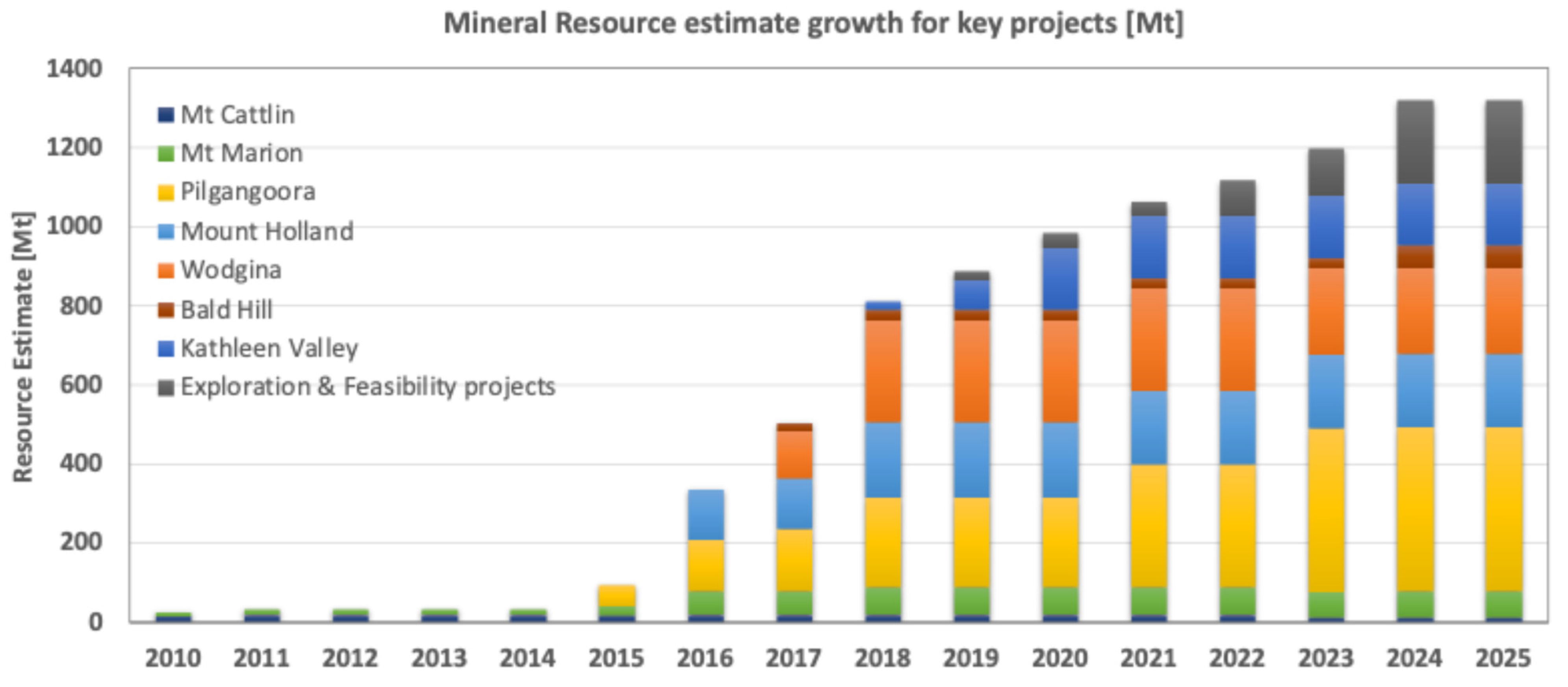
Total mineral resource estimates for key lithium projects (excluding Greenbushes) in WA have grown from 25 Mt in 2010 to 1295 Mt in 2025, a CAGR of 30%, reflecting exploration success and orders of magnitude growth in combined mineral resource estimates (Figure 5). The sharpest growth occurred between 2016 and 2019, coinciding with strong lithium demand growth from EVs. Pilgangoora and Wodgina are the largest contributors to the increase, adding 414 Mt and 217 Mt, respectively. From 2019 to 2020, there were significant resources added at Kathleen Valley. Those projects in exploration and feasibility stages have added 210 Mt of lithium ore to the resource base since 2019, indicating a sizeable pipeline of future lithium projects.
This analysis uses mineral resource estimates rather than ore reserves. Under the JORC Code (2012), a Mineral Resource requires only ‘reasonable prospects for eventual economic extraction’, whereas an Ore Reserve must be ‘defined by studies at Pre-Feasibility or Feasibility level […] that include application of Modifying Factors’—covering mining, processing, metallurgical, infrastructure, economic, marketing, legal, environmental, social, and governmental considerations [24]. Reserve declarations, therefore, require a higher level of technical study than resource estimates, and declared reserve quantities are more sensitive to changes in commodity prices and project assumptions. Resource estimates are more consistently disclosed across the project cohort and provide a more stable basis for tracking industry development over time.
Figure 5.
Mineral resource estimate growth 2010–2025 (excluding Greenbushes); data from company announcements [25,26,27,28,29,30,31,32,33,34,35,36,37,38,39,40,41,42,43,44,45,46,47,48,49,50,51,52,53,54,55,56,57,58,59,60,61,62,63].
As of December 2025, Greenbushes (440 Mt) and Pilgangoora (414 Mt) are two of the largest lithium mineral deposits in the world, with Wodgina, Mt. Holland, and Kathleen Valley forming the next tier (100–250 Mt) (Figure 6). Greenbushes and Mt. Holland have superior grades > 1.40%, with other developed projects (Pilgangoora, Wodgina, Kathleen Valley, Mt. Marion) generally having grades of 1.15–1.36% Li2O. Bald Hill has the lowest grade (0.94%) of Li2O and a 58 Mt resource estimate as of June 2024 [53]. Finniss and Mt. Cattlin are also in this category, both with a smaller resource [29,56]. All of the major lithium discoveries (in terms of resource estimate size and grade) have been developed as part of the recent wave of WA lithium projects.
Figure 6.
Mineral resource size [Mt] and grade [% Li2O] for WA lithium projects as of 2025, ranked by contained lithium [29,32,36,39,41,53,54,55,56,57,59,60,61,62,63,64,65,66].
Projects in exploration and feasibility stages continue to undergo drilling, and the resource estimate is not fully matured. Projects in this phase have a resource estimate of 10–75 Mt and grades of 0.72–1.22% Li2O. Tabba Tabba is the largest undeveloped lithium resource at 74.1 Mt of 1.00% Li2O, followed by Manna 51.6 Mt at 1.00% Li2O, indicating strong potential for future development.
Li2O grade comparisons in this section do not capture mineralogical or impurity differences between deposits, which can materially affect recovery and downstream processing performance independent of grade [67]; grade is therefore used here as a comparative indicator of deposit quality rather than a complete measure of processing economics.
4.2. Project Timelines
Approximately 30 years after Greenbushes commenced lithium production (circa 1985), Mt. Cattlin and Mt. Marion published their maiden lithium resource estimates in 2007 and 2010, respectively [27,37]. From 2014 to 2019, there was a surge of project development associated with an increase in prices for lithium hydroxide and spodumene concentrate. During this period, Pilgangoora, Bald Hill, and Wodgina brought production online, and Kathleen Valley and Mt. Holland commenced exploration and feasibility [68,69,70,71,72,73]. Figure 7 shows a Gantt chart of project timelines for mines developed in the last 20 years (7 projects).
Figure 7.
Project development timeline of key lithium projects (data from company announcements).
Project stage-gates were tracked for all lithium developments. Figure 8 compares the time to reach each key project development ‘gate’ or milestone, those being as follows: 1st resource, preliminary feasibility study (PFS), definitive feasibility study (DFS), final investment decision (FID), construction start, production start, and 1st shipment.
Figure 8.
Comparison of project timelines as they move through typical development milestones (data from company announcements).
First resource to first production timelines range from 9 months (Bald Hill) to 7 years (Mt. Holland), reflecting differences in size of the projects and the market factors that influenced feasibility timelines. Larger projects (Pilgangoora, Kathleen Valley, Mt. Holland) followed structured project development gates (scoping, PFS, DFS, FID), whilst smaller projects can move quickly through project development gates and can reach production via accelerated timelines, often bypassing scoping or pre-feasibility gates.
Contrary to the common industry narrative, new lithium projects in WA were not constrained by legislative delay, for example, environmental permitting and/or Indigenous heritage clearances [74]. Project timelines are driven by the work required to reach project economic viability, partnering for project development, and funding as well as timing the production profile with market pricing upside. Similarly, greenfield mineral project developments are often cited as 10–20 years [75], whilst all WA lithium projects were completed in less than 7.5 years.
For WA projects, the timelines reflect project scale and the prevailing lithium market conditions. Larger projects are naturally slower and more complex (Pilgangoora, Kathleen Valley, Mt. Holland, Wodgina); however, accelerated delivery can be achieved when required by ‘skipping’ scoping, PFS, or DFS stages in peak lithium pricing times to accelerate to market. Mt. Marion, Mt. Holland, and Kathleen Valley spent a significant amount of time in the feasibility and definition phases before project sanctioning and construction, whereas Pilgangoora, Bald Hill, and Wodgina were accelerated.
The next generation of WA lithium projects are in various stages of exploration, permitting, and feasibility, with engineering activities to define the projects being progressed. These projects are significantly smaller in scale than some of the first-generation projects, which will allow ‘accelerated delivery’ when market conditions permit. The status of the next generation of WA lithium projects is shown in Table 2.
Table 2.
Project status of WA lithium projects in exploration and feasibility stages as of December 2025 [54,57,58,59,60,61,62,76,77,78].
4.3. Annual Production and Life of Mine
Greenbushes dominates scale and output with a nameplate production capacity of 1300 ktpa of spodumene and operating at full or above capacity. Its remaining 25-year life of mine underlines the project’s maturity and scale [13,79]. Greenbushes is significant in terms of global supply. The other major project developments, being Pilgangoora, Wodgina, Mt. Marion, and Kathleen Valley, have production capacities of 500–1000 ktpa of spodumene and life of mine ranging from 23 to 36 years (Figure 9). Mount Holland’s plant capacity (411 ktpa) is low relative to resource size, resulting in a 50-year life of mine, and has significant potential to increase capacity and production.
Figure 9.
Key projects’ spodumene production (nameplate, actual realised FY2025) and life of mine data from company announcements, ranked by nameplate capacity [13,41,79,80,81,82,83,84,85,86,87,88,89,90,91,92].
Kathleen Valley achieved 295 kt of spodumene concentrate produced in FY25 (56% of nameplate capacity). Production in FY2025 is significantly below nameplate capacity for all operating mines (except Greenbushes and Pilgangoora), reflecting the lower lithium price environment of the time. Wodgina and Mt. Marion are operating at 40% and 44% utilisation, whilst Finniss, Bald Hill, and Mt. Cattlin were placed into care and maintenance [53,87] awaiting 2026 price recovery.
Kwinana (Tianqi/IGO) and Kemerton (Albemarle) refineries are both in the ramp-up phase since completion in 2022, and the Mt. Holland refinery was brought online in 2025. Table 3 shows the nameplate production capacity and achieved utilisation factors.
Table 3.
Refinery projects nameplate production, actual realised production in CY2024 (Kemerton), FY2025 (Kwinana TLEA) [13,41,93,94] Note: Kemerton refinery was subsequently put into care and maintenance in February 2026 (post Dec’25 data cut-off) by Albemarle [15].
The chemistry of the spodumene concentrate can impact the technical efficiency of the lithium hydroxide production and its economics. Minor deviations in the spodumene feedstock chemistry relative to design parameters can result in continued challenges with process debottlenecking [67].
The ramp-up challenges faced by the Kemerton and TLEA Kwinana refineries are multifaceted and are producing significantly below nameplate capacity [13,95]. Producing battery-grade lithium hydroxide monohydrate from spodumene is technically demanding, with tight impurity specifications and multiple processing stages [67,96]. The WA facilities face higher operating costs for labour, energy, chemical reagents, and transportation compared to Chinese or South Korean refineries. Complex joint venture partnerships and the 2024–2025 low lithium price environment have resulted in underperformance of the WA downstream supply chain [95,97]. As of the end of 2025, there is not enough data available on the Covalent Kwinana facility to assess ramp-up performance.
4.4. Capital Costs
Section 4.4 analyses capital costs and capital intensity. The Capex data is sourced from company announcements in DFS or FID phases and split into ‘initial capital’ and ‘expansion capital’. Capital costs are then normalised to June 2025 real prices using the Australian Bureau of Statistics consumer price index (CPI—All Australia) and adjusted for the foreign exchange rate AUD to USD at the rate provided in the company announcements [98]. Two forms of capital intensity are calculated: firstly, a function of total announced capital cost and nameplate production capacity, and, secondly, taking life of mine into consideration.
Announced capital expenditure for nine project developments is summarised in Figure 10, with a total capital cost of 3.9 billion USD (normalised to Q4-2025 real prices, not all projects are sanctioned). Kathleen Valley shows the largest total capital investment for a completed project at 720M USD, reflecting its large-scale greenfield mine and concentrator development. The majority of this is the stage 1 initial Capex from the FID in June 2022, indicating heavy upfront investment in the new infrastructure rather than incremental expansion. Pilgangoora closely follows with the second largest capital investment of 697M USD for its multi-stage development. The initial stage 1 development had a Capex of 208M USD (September 2016 FID) and two subsequent expansions (P680, P1000 projects), which added 672 ktpa of nameplate spodumene production at a cost of 489M USD.
Figure 10.
Announced capital expenditure USD (millions) for WA lithium projects. Notes: (i) Based on DFS, FID, or technical report data; does not account for changes in estimates during project execution. (ii) Costs normalised to Q2-2025 real terms using the Australian Bureau of Statistics CPI (All-Australia) Index [98]. (iii) Excludes sustaining capital. (iv) Data for Mt. Marion was not made publicly available. (v) Greenbushes is excluded. (vi) Mt. Holland Capex is for mine and concentrator only.
Wodgina (556M USD) and Mount Holland (480M USD, mine only) are major capital projects and large-scale investments reflecting their tier-one resource sizes and JV structures [99,100]. Mount Holland’s initial Capex was based on an integrated development of mine and lithium hydroxide refinery, with mine costs contributing to 45% and the refinery 55% [41,99,101]. Mt. Cattlin (85M USD) and Bald Hill (67M USD) have comparatively low total Capex, consistent with their mature, lower-throughput operations and limited expansion potential [29,89].
Finniss’ modest initial Capex of 63M USD (based on the April 2019 DFS) reflects the smaller resource base and throughput [56]. However, there is a significant capital investment relative to the scale for the mine-restart plan (May 2025) of circa 140M USD, which will add 68 ktpa nameplate spodumene production capacity [87].
The Tabba Tabba project has a pre-feasibility capital expenditure estimate of 746M USD for stage 1 and the stage 2 expansion. If the project reaches FID, then it would make it the largest capital investment in a lithium mine in the recent wave of WA projects [92] and of similar throughput and scale to Kathleen Valley, Mount Holland, and Mt. Marion with 4.5 Mtpa ore processing capacity. Manna’s more modest DFS capital expenditure estimate of 294M USD reflects a lower ore throughput of 1.8 Mtpa [91].
Annualised capital intensity for the projects under analysis varies widely from 433 to 1319 USD/t spodumene/yr, highlighting the construction phase efficiency, reflecting major differences in project scale, infrastructure maturity, and greenfield vs. brownfield developments (refer to Figure 11). The average capital intensity for the nine projects is 799 USD/t spod./yr. Mount Holland is the most capital-intensive of the operating projects considering the annual spodumene throughput; however, its long 50-year life of mine means that over a long time period, the initial Capex investment becomes quite efficient at a life of mine adjusted capital intensity of 23 USD/t spod. The two projects in the feasibility stage, Manna and Tabba Tabba, have the highest capital intensity per year.
Figure 11.
Capital intensity of spodumene production for key WA lithium projects [USD/t spod./yr] (data from company announcements).
When accounting for total production over each mine’s life (Figure 12), capital intensity drops significantly (average 35 USD/t spod), and the spread narrows between projects. Long-life operations have the lowest LoM-adjusted capital intensity—Pilgangoora (21 USD/t), Mount Holland (23 USD/t), and Wodgina (25 USD/t)— and highly efficient use of capital due to long mine life and high throughput rates. Similarly, shorter-life projects such as Bald Hill are less efficient (54 USD/t).
Figure 12.
Capital intensity, adjusted for life of mine for spodumene production for key WA lithium projects [USD/t spod].
Finniss’ capital intensity metrics (990 USD/t spod/yr and 50 USD/t spod) point to challenging project economics due to high costs for the mine-restart investment relative to the throughput and resource size.
Tabba Tabba and Manna projects have the highest capital intensity metrics at 78 USD/t spod and 87 USD/t spod, respectively. This is a function of their smaller resource base relative to the plant nameplate capacity, and this could be lowered significantly should the resource base expand due to drilling and resource exploration activities, or in the case of Tabba Tabba developing only the Stage 1 processing plant. The high capital intensity is likely due to the exploration and feasibility stage of the projects and would be expected to normalise as the life of mine is increased through resource estimate upgrades.
Notes to Figure 11 and Figure 12: (i) Based on DFS, FID, or technical report data; does not account for changes in estimates during or changes in the production profile during project execution. (ii) Costs normalised to Q4-2025 real terms using the Australian Bureau of Statistics CPI (All-Australia) Index [98]. (iii) Excludes sustaining capital. (v) Data for Mt. Marion was not made publicly available, and data for Mt. Cattlin life of mine is not available. (vi) Greenbushes is excluded.
These capital intensity comparisons are intended as project-level benchmarking rather than formal statistical inference; given the small number of projects and the reliance on point estimates drawn from company disclosures at different study stages (DFS, FID, or technical report), the precision of the capital intensity data is indicative only, and differences between projects should not be interpreted as statistically significant.
4.5. Operating Costs
Operating costs are the most important indicator of the viability of a mining project, and over the life of mine can be significantly more than the upfront capital investment. The cost components are mining, processing, general and administration, transport, and logistics. For all-in sustaining costs, it also includes royalties, government charges, sustaining capital, and rehabilitation costs. Operating costs reflect the resource size and grade, plant design, processing throughput, and efficiency of operations.
Greenbushes’ operating costs are far below all other projects at 316 USD/t spod LoM-avg, reflecting exceptional grade (1.50% Li2O), long-established infrastructure, and economies of scale; it is a benchmark for global spodumene and lithium mining operations [79]. New large-scale operations are mid-cost producers; Kathleen Valley, Wodgina, and Pilgangoora have FY25 operating costs of 508–627 USD/t FOB. Those mines in care and maintenance show much higher operating costs: Mt. Cattlin (804 USD/t), Finniss (875 USD/t), and Bald Hill. These higher costs reflect smaller scale, lower lithium grades, less efficient plant utilisation, as well as mine restart or ramp-down efforts. Operating costs are summarised in Table 4.
Table 4.
Operating costs for WA lithium projects at feasibility and actual (data from company announcements). Notes: (i) Based on DFS, FID, or technical report data. (ii) Costs normalised to Q4-2025 real terms using the Australian Bureau of Statistics CPI (All-Australia) Index [98]. (iii) Costs have not been normalised for spodumene grade or incoterms. (iv) Data for Mount Holland is not publicly available. (v) Actual costs are a snapshot of a single financial year and can vary significantly from year to year. (vi) Operating costs are typically represented on an equivalent 6% Li2O basis (SC6.0), and the costs were as reported by companies and not normalised for grade as per company standard practice.
The classification of Bald Hill, Finniss, and Mt. Cattlin as ‘marginal’ projects reflects a combination of resource size, grade, plant utilisation, operating costs, and capital intensity discussed throughout Section 4, rather than any single metric. Logistics and infrastructure considerations are not separately analysed but likely contribute to these outcomes. Bald Hill and Mt. Cattlin both truck spodumene concentrate to the Port of Esperance; similarly, Finniss is connected to the Port of Darwin by sealed road. Offtake contract terms for downstream processors are a further factor outside the scope of this analysis. Port proximity, haulage distance, and offtake structures are noted here as areas for further research.
The Tabba Tabba feasibility study, July 2025, outlines unit operating costs of 541 USD/t FOB for SC5.5 (real), which is in the realm of the major lithium mines (Kathleen Valley, Wodgina, and Pilgangoora) and indicates long-term financial viability. The Manna Project DFS of December 2025 indicates slightly higher unit operating costs at 647 USD/t FOB SC5.5 but considerably lower than the more marginal mines (Mt. Cattlin and Finniss).
It is important to note that actual operating costs significantly exceeded DFS cost assumptions in almost all projects, demonstrating substantial material and supply chain cost escalation. The exception is Kathleen Valley, which was the most recent project to publish the DFS in November 2021.
4.6. Pilgangoora Operating Costs Case Study
First production was achieved in September 2018, and, during the ramp-up phase, unit operating costs are not disclosed but rather stated as ‘above target’. Initial spodumene grades were at SC6.0 (6% Li2O) due to ‘contract specifications’, but, in 2021, grades began to transition to SC5.5 or lower, as this became the norm in the market, likely due to ‘lowest cost’ to produce via higher plant recoveries. The lowest unit operating costs were achieved in 2020 after ramp-up and the low lithium price environment, where PLS attempted to maximise efficiency and achieve the lowest operating costs. Figure 13 summarises the quarterly production and unit operating costs for the Pilgangoora development.
Figure 13.
PLS Pilgangoora quarterly production and unit operating costs 2018–2025 (data from company announcements and quarterly mining activities reports).
The highest unit operating costs were in 2022/2023 during the time of high lithium prices in an attempt to maximise production. In 2024 to 2025, operating costs are down (low lithium price environment) to maximise efficiency, and, in 2025, PLS transitioned to a single plant (rather than 2).
It is apparent that operating costs are also a function of the market environment and the company’s objectives. There is a trade-off between maximising efficiency and achieving the lowest unit operating costs versus maximising production. The usual economies of scale with higher quantities and lower unit costs are also apparent as Pilgangoora increased total capacity and production over time.
4.7. Future WA Lithium Projects
Tabba Tabba (74.1 Mt at 1.0% Li2O) and Manna (51.6 Mt at 1.0%) are the two largest undeveloped lithium resources in WA by total contained lithium (by published Mineral Resource; the Andover project’s 2023 exploration target is larger but has not yet been converted to a Mineral Resource) and are the most likely to be sanctioned in a favourable market cycle (the next generation). Mt. Ida (14.8 Mt at 1.21% Li2O) is also in the feasibility stage. However, given the resource size, they are unlikely to be viable in a low-lithium price environment due to significant supply from much larger, established, and lower-cost mines (Greenbushes, Kathleen Valley, Wodgina, Pilgangoora, Mt. Holland).
While Tabba Tabba’s unit operating costs are projected to be competitive with the major lithium projects, the Capex investment is significant relative to the resource base, and, hence, the capital intensity per tonne of spodumene for the project may be prohibitive for the project to reach FID. With further exploration to expand the resource base or a reduced processing throughput and Capex estimate, the financial model could support an FID decision.
Manna’s capital cost estimates are more modest, reflecting a lower processing capacity, but it faces the same challenge with high capital intensity. Similarly, Manna’s operating costs are outside the range of the tier-one projects. Similar to Tabba Tabba, an expansion of the resource base through additional exploration would improve the likelihood of a positive FID decision. Despite these challenges, Tabba Tabba and Manna are likely projects to be sanctioned in the next generation of lithium projects and in the right lithium price environment.
The Andover Lithium Project (60% Azure Minerals/40% Creasy Group), located in the West Pilbara, reported a maiden exploration target of 100–240 Mt at 1.0–1.5% Li2O in August 2023 [102]. Azure was subsequently acquired pre-resource by SQM and Hancock Prospecting for ~$1.7 billion AUD in 2024, and no JORC-compliant Mineral Resource Estimate has been publicly reported to date [103].
5. Conclusions and Implications for Future Projects
This paper has documented the rapid growth of Western Australia’s lithium industry into a globally significant hard-rock lithium supplier. It has been shown that the recent wave of lithium mine developments was enabled by the alignment of tier-one geology, strong market conditions, access to financing, and an established mining ecosystem, while downstream lithium hydroxide refining is yet to demonstrate similar commercial success. By compiling and analysing project-level metrics, including resource growth, project schedules, production scale, capital intensity, and operating costs, this study provides a set of performance benchmarks for future lithium and critical mineral projects. These benchmarks help clarify the conditions under which new supply can be developed rapidly and competitively.
Author Contributions
Conceptualisation, H.B., A.T.; methodology, H.B.; software, N/A.; validation, H.B.; formal analysis, H.B.; investigation, H.B.; resources, H.B.; data curation, H.B.; writing—original draft preparation, H.B.; writing—review and editing, H.B., A.T., D.G.B.; visualisation, H.B., A.T., D.G.B.; supervision, A.T., D.G.B.; project administration, H.B., A.T., D.G.B.; funding acquisition, N/A. All authors have read and agreed to the published version of the manuscript.
Funding
This research received no external funding.
Data Availability Statement
The data presented in this study is available on request from the corresponding author.
Acknowledgments
The authors thank our UWA Business School colleagues for a preliminary review of drafts of this manuscript.
Conflicts of Interest
The authors declare no conflicts of interest.
Abbreviations
The following abbreviations are used in this manuscript:
| ABS | Australian Bureau of Statistics |
| AUD | Australian Dollars |
| CAGR | Compound Annual Growth Rate |
| Capex | Capital Expenditure |
| CIF | Cost-Insurance and Freight (Incoterm) |
| CPI | Consumer Price Index |
| CY | Calendar Year |
| DFS | Definitive Feasibility Study |
| EV | Electric Vehicle |
| FID | Final Investment Decision |
| FOB | Free-Onboard (Incoterm) |
| FY | Financial Year |
| JV | Joint Venture |
| kt | Kilo-tonnes |
| ktpa | Kilo-tonnes per annum |
| LCE | Lithium Carbonate Equivalent |
| Li2O | Lithium Oxide |
| LiOH | Lithium Hydroxide |
| LoM | Life of Mine |
| Mt | Million tonnes |
| Mtpa | Million tonnes per annum |
| NCA | Nickel-Cobalt Aluminum |
| NMC | Nickel-Manganese-Cobalt |
| Opex | Operating Expenditure |
| PFS | Preliminary Feasibility Study |
| SC6.0 | Spodumene Concentrate 6.0% Li2O (industry standard specification) |
| SC5.5 | Spodumene Concentrate 5.5% Li2O (common industry specification, often converted on a linear basis from SC6.0 at 91.667% |
| USD | United States Dollars |
Appendix A. Detailed Project Profiles
Appendix A analyses the seven lithium projects developed in WA since 2010, across ownership structure, discovery, mineral resource estimate growth, key development timeline milestones, PFS and DFS metrics, capital and operating costs, and downstream integration initiatives. Project profiles are developed based on company announcements and reported data. Appendix A.8 and Appendix A.9 give a brief overview of the lithium hydroxide refineries and those projects currently in the exploration and feasibility stages.
Appendix A.1. Mt. Cattlin—Rio Tinto (ASX: RIO)—First Production 2010
Mt. Cattlin is a hard-rock lithium mine located approximately 2 km north of Ravensthorpe, in the Goldfields-Esperance region of Western Australia (Lat: 33°33′42″ S, Long: 120°6′54″ E) [104]. Mt. Cattlin is wholly owned (100%) by Rio Tinto (ASX: RIO), which acquired Arcadium Lithium in March 2025 [105,106].
Lithium was first discovered at Mt. Cattlin in 1962 by Western Mining Corporation, which first identified spodumene-bearing pegmatites and completed drilling, mineralogical, and metallurgical test work for a feasibility study for the production of a 10–15 ktpa spodumene concentrate facility [107,108]. Galaxy Resources acquired the Mt. Cattlin tenement from Sons of Gwalia Limited in November 2006 and published the first JORC-compliant resource in December 2007 for 12.3 Mt of 1.0% Li2O [27,107]. Through two mergers in April 2021 and January 2024, respectively, Galaxy Resources became Arcadium Lithium [109].
The deposit contains spodumene ore with a mineral resource estimate of 12.1 Mt of 1.3% Li2O (approximately 157 kt Li2O) as of June 2023, down from 18.2 Mt of 1.08% Li2O (2011) due to mining depletion [25,29]. The geology and mineralogy are described in Sweetapple et al. [110].
Galaxy Resources completed a PFS in December 2007, approximately one year after acquiring the project, followed by a DFS completed in December 2008. The project reached FID in January 2009 for a 1 Mtpa mine and concentrator facility [90,104,111]. Detailed engineering and procurement commenced in August 2009, and production commenced in October 2010, with a site construction duration of just 11 months [112,113,114,115]. The overall duration from the first resource to the first spodumene shipment was 3.2 years (39 months). The mine was placed into care and maintenance in April 2013, citing weak market conditions, and processing operations resumed in March 2016 [107].
The concentrator has 1.8 Mtpa of ore throughput, with a remaining life of mine of 4–5 years (based on the stage 4 mine expansion) [29]. After the mine restarted in 2016, the plant was progressively upgraded until 2019, when the nameplate capacity was increased from 1.0 Mtpa to 1.8 Mtpa via changes to crushing and wet screening circuits, as well as a yield optimisation project [107]. The original life of mine was 15 years based on the 2008 definitive feasibility study [90]. A feasibility study commenced in May 2023 to assess the viability of underground mining [29].
Project infrastructure includes open-pit mining operations, process infrastructure, and non-process infrastructure, including onsite camp and facilities. The 1.8 Mtpa processing plant is adjacent to the pit with multi-stage crushing, optical sorting, dense media separation, and gravity concentration circuits [29]. Spodumene concentrate is trucked to the port of Esperance, which has a 45 kt spodumene concentrate storage capacity [29]. Power is sourced from an on-site 7 MW diesel power station and water from on-site borefields.
Based on the 2008 DFS, the stage 1 development capital costs were 68M AUD (nominal) for construction of the mine and 1 Mtpa concentrator facility; the overall life of mine capital cost estimate is 80.3M USD [29,90]. Operating costs for the life of mine are estimated at 899M USD, with all-in-cash costs of 979M USD. Operating costs per ore tonne are historically 29.12 USD/t ore, with a projected average of 36.96 USD/t ore, largely in line with the 2008 DFS estimate of 28.7 USD/t ore [29,90].
Galaxy Resources completed a 2009 lithium carbonate preliminary feasibility study for a 17 ktpa battery-grade lithium carbonate facility in China using 137 ktpa of spodumene concentrate feed [116]. Galaxy Resources also completed a DFS in 2009, with the site selected in Jiangsu Province, in the Zhangjiagang free trade zone of the Yangtze River [117,118]. During the initial years of production (2011–2012), Galaxy’s strategy was vertically integrated, with 100% of the spodumene concentrate shipped to the Jiangsu lithium carbonate facility [29,119]. From 2021, Galaxy Resources expanded to other offtake agreements for spodumene to China-based facilities:
- Yahua Industrial group: five-year offtake agreement from 2021 to 2025 for up to 120 ktpa of concentrate, with market-indexed pricing [107].
- Sichuan Chengtun Lithium Co: three-year offtake agreement from 2021 to 2023 for up to 60 ktpa of concentrate, with pricing linked to spot market [107].
- From 2023, there were additional offtakes with Chinese converters with spot or short-term pricing [29].
Arcadium Lithium (now Rio Tinto Lithium) controls various downstream plants in Japan (Naraha lithium hydroxide plant), Canada (Becancour hydroxide plant joint venture), and various processing plants in China [29]. There are currently no plans for an on-site downstream processing facility in Western Australia.
Appendix A.2. Mt. Marion—Mineral Resources (ASX: MIN)/Ganfeng Lithium Co Ltd.—First Production 2017
The Mt. Marion lithium mine is located in the Eastern Goldfields region of Western Australia, approximately 40 km south-west of Kalgoorlie (Lat: 30°58′54.1″ S, Long: 121°26′22.9″ E). The Mt. Marion project is owned by Mineral Resources Limited (ASX: MIN) and POSCO holdings JV 50%, and Ganfeng Lithium Co. Ltd. (SZSE: 002460) 50%, through a joint venture entity, Reed Industrial Minerals Pty Ltd. (RIM) [120,121]. In November 2025, POSCO Holdings bought 30% of the Mineral Resources Lithium business, which includes Mt. Marion and Wodgina operations [122].
The pegmatite field was discovered in the 1960s by Western Mining Corporation and confirmed the presence of spodumene-bearing pegmatites [123]. The first resource was announced in 1996 (later updated in accordance with JORC standards) of 2.1 Mt at 1.35% Li2O [37]. Reed Resources (ASX: RDR) acquired Mt. Marion in 2009 [123].
In 2011, Mineral Resources converted a profit-sharing arrangement into 30% equity in RIM [124]. Ganfeng subsequently acquired an initial 25% equity stake in RIM from Neometals Ltd. (formerly Reed Resources) in 2015, along with an offtake agreement, which was progressively revised until a complete buyout of Neometals Limited’s 13.8% equity stake by Ganfeng and Mineral Resources in December 2018 for 103.8M AUD [121,125].
The deposit contains spodumene ore, with a mineral resource estimate of 66.1 Mt at 1.36% Li2O as of February 2024. This decrease from the peak estimate of 71.4 Mt at 1.37% Li2O in October 2018 is due primarily to mining depletion [32,35,36]. Total mineral resources increased 741% from April 2010, following significant drilling by Mineral Resources and Ganfeng Lithium Co [37].
The project commenced feasibility activities in October 2009 as part of a farm in agreement for Mineral Resources to lead project development. Mining and environmental approvals were received in February 2011, and construction immediately commenced [126,127,128]. Construction was deferred in 2012, likely to look for another partner to develop the project and re-work the engineering, but details were not publicly announced. Ganfeng Lithium Co. made an initial equity investment in September 2015 at the same time as the final investment decision to proceed with development and re-commence construction activities [125,129]. The site construction duration was 14 months, and the first shipment was in February 2017 [130]. Overall, the duration from the first resource to production was 6.8 years, but it was a function of development financing and the lithium market conditions rather than engineering or environmental permitting constraints.
The nameplate capacity for Mt. Marion is 600 ktpa of 6% spodumene concentrate (or 900 ktpa at mixed grades), implying an ore feed rate of 3.7 Mtpa based on the expansion announced in April 2022 and completed in July 2023, which increased the capacity by approximately 100% (450 ktpa to 900 ktpa at mixed grades) [84]. The life of mine has not been publicly disclosed.
Project infrastructure includes pit and underground mining operations, a processing plant comprising crushing, dense media separation, primary rejection, and flotation circuits, as well as non-process infrastructure. The plant produces spodumene as well as mica and tantalum as by-products [124]. The spodumene product is transported via road to Kwinana port for export. No details are available concerning power sources nor water supply for the project.
2024 financial year production was 656 kt of spodumene concentrate, which increased 40% from 469 kt (2023FY), reflecting the completion of the expansion [131]. 2024FY sales of 436 kt (SC 6.0 equivalent) were shipped for 1428 USD/t, with FOB unit operating costs of 754 USD/t. Realised prices and operating costs were decreased from 2023FY at 3337 USD/t and 1109 USD/t, respectively [131,132].
Preliminary and definitive feasibility study results were not announced publicly, and original construction capital and operating expenditure estimates are not available. The expansion announced in April 2022 had a capital expenditure not exceeding 120M AUD [84].
The project previously had a single offtake agreement with Ganfeng Lithium Co. Ltd. for 100% of the spodumene concentrate produced at Mt. Marion. The agreement covers 4% and 6% Li2O grades, and pricing is linked to market indices and adjusted for grade. The offtake agreement was executed in September 2015 as part of Ganfeng’s equity investment in the project [125]. Under the POSCO Holdings deal with Mineral Resources, POSCO is entitled to 30% of the MinRes, and POSCO’s share of, spodumene concentrate produced [122].
Between 2012 and 2016, Mt. Marion JV partners pursued multiple downstream lithium hydroxide development initiatives, none of which reached FID, and all of the Mt. Marion spodumene is exported to Ganfeng for conversion at Chinese processing facilities [125].
- Pre-feasibility study in 2012 for a 20 ktpa LiOH plant in Malaysia with a Capex of 83M USD [133].
- Semi-pilot LiOH plant and technology validation using the ELi process in the USA in 2014 [134].
- DFS in 2015–2016 for 20 ktpa LCE lithium hydroxide and lithium carbonate plant in Malaysia, with Capex of 158M USD [135].
- Neometals and Mineral Resources MoU to assess a 20–25 ktpa LCE lithium hydroxide plant near Kalgoorlie, WA [136].
Appendix A.3. Pilgangoora—PLS (ASX: PLS)—First Production 2018
The Pilgangoora project is a hard-rock lithium–tantalum mine in the Pilbara region of Western Australia (Lat: 21°14′16.8″ S, Long: 188°40′17.8″ E), approximately 120 km south-southeast of Port Hedland. Pilgangoora is wholly owned (100%) and operated by PLS (formerly Pilbara Minerals Limited, ASX: PLS) and was acquired in July 2014 from Global Advanced Metals [137]. In January 2021, Pilbara Minerals acquired the adjoining Altura Pilgangoora lithium operation immediately to the west of the Pilgangoora mine, which was later renamed the Ngungaju mine and plant [138,139].
The pegmatite field was discovered in 1905, worked for tantalite and tin, and subsequently explored for lithium in the 1960s [11]. The first lithium resource was announced by PLS in March 2015 using drilling data from Global Advanced Metals, notably from the 2014 drilling programme [38].
The project deposit primarily contains spodumene-bearing pegmatite ore with a mineral resource estimate of 413.8 Mt at 1.15% Li2O (approximately 4800 kt Li2O) as of August 2023, with 81.5% being measured or indicated [39]. The first resource estimate for PLS in March 2015 was 16.6 Mt at 1.16% Li2O (approximately 192 kt Li2O) [38]. Subsequently, a major and continuous drilling programme has significantly expanded the resource base, with a 2390% increase in total estimated resources from 2015 to 2023, making it one of the largest hard-rock lithium deposits in the world.
PLS completed the stage 1 project feasibility gates, PFS and DFS, in March 2016 and September 2016, respectively, following drilling programmes from 2014 onwards [140,141]. Construction commenced on site infrastructure in November 2016, and the process facilities were commissioned with production commencing in July 2018 [142,143]. The project was fast-tracked, completing Engineering, Procurement, and Construction activities (EPC) in 28 months. The time from first resource to first spodumene shipment (October 2018) was ~3.6 years [68].
Stage 2 and 3 mine expansions, named the P680 project and the P1000 project, reached FID in June 2022 and March 2023, respectively. The P680 expansion was completed in 2023, whilst the P1000 expansion was completed in early 2025 with production ramp-up throughout 2025. A preliminary feasibility study was completed in June 2024 for the P2000 (stage 4) expansion [144].
Pilgangoora is an open-pit mining operation with a nameplate plant (ore) feed capacity of 3.0 Mtpa based on FID for the P680 (stage 2) expansion project [145]. The P1000 project (stage 3 expansion) lifts the nameplate production capacity to 986 ktpa of spodumene concentrate (grade design range is between 5.2 and 6.0% Li2O) over a 25-year life of mine, equivalent to 6.3 Mtpa ore feed rate [80]. Subsequent resource estimate increases in August 2023 extended the life of mine to 36 years. The P2000 (stage 4) expansion preliminary feasibility study has the potential to further increase the production capacity to 1895 ktpa of spodumene concentrate (equivalent to 12.4 Mtpa ore feed rate) for a 23-year life of mine, giving the project significant potential to scale production capacity [144].
The project uses road transportation to Port Hedland port. Process infrastructure includes two process facilities (Pilgan and Ngunggaju plants), including crushing, screening, and two dense media separation circuits. The Pilgan plant produces spodumene concentrate and a tantalum concentrate as a byproduct. The Ngunggaju plant was acquired in 2021 and produces spodumene concentrate [146]. The Pilgangoora operation uses a combination of thermal power generation (diesel and liquified natural gas) and a 6 MW renewable energy solar farm, commissioned in 2022 [147,148]. Emissions intensity for power generation for 2023 was 0.69 tCO2-e/MWh [149]. The company’s 2030 power strategy to reduce emissions by 80% and power generation costs is to (1) transition primarily to LNG and integrate a lithium-ion battery energy storage system (BESS) by 2025, (2) expand capacity of the solar installation, and (3) integrate wind power generation [11,149].
Production in the 2024 financial year was 725 kt of spodumene concentrate with an average grade of 5.3%, operating at 107% of nameplate capacity [148]. Production guidance for the 2025 financial year is an increase of 38% associated with the ramp-up to P1000 nameplate capacity to 1000 kt of 5.7% Li2O concentrate [80].
Capital expenditure for the 2 Mtpa stage 1 mine and associated infrastructure was 161M USD based on the definitive feasibility study in 2016 [141]. Subsequently, PLS approved additional capital costs of 223M USD for the P680 expansion in June 2022 and 392M USD for the P1000 expansion in March 2023, bringing total approved Capex based on company announcements to approximately 775M USD (un-normalised) [80,145].
Unit operating costs in the 2024 fiscal year were 429 USD/t FOB Port Hedland (excluding freight and royalties), decreased from 2023FY unit costs of 613 USD/t FOB due to production scaling and improved efficiencies. CIF operating costs were 537 USD/t CIF China in the 2024 fiscal year, decreased from 735 USD/t in 2023, driven by lower freight and price-linked royalty costs. Operating costs are substantially above the 2018 stage 2 DFS study unit costs of 263 USD/t, owing to a significant change in general market conditions and global cost escalation [148,150].
As of the 2024 fiscal year, PLS made spodumene concentrate sales of 707 kt with a realised price of 1176 USD/t SC5.3, a 74% decrease compared to FY2023 (4447 USD/t), reflecting a market decline in lithium prices [148].
PLS has executed offtake agreements with several lithium converters in both China and Korea for the supply of spodumene concentrate, including:
- POSCO joint venture (October 2021): a strategic offtake agreement with POSCO as part of their joint venture to produce lithium hydroxide in South Korea; PLS supplies up to 315 ktpa to the JV’s chemical conversion facility in Gwangyang, South Korea [151].
- Ganfeng Lithium Group Co. Ltd. (January 2024): initial agreement in 2017 for the supply of 160 ktpa of spodumene concentrate, with an extended agreement in January 2024 for increased supply of up to a cumulative 310 kt of concentrate for calendar years 2024–2026 [152].
- Chengxin Lithium Group (February 2024): initial agreement in 2023 for the supply of 70 kt of concentrate in the financial year 2024, with the agreement expanded in February 2024 to supply 150 ktpa in 2025 and 2026 [153].
- Sichuan Yuhua Industria Group. Ltd. (March 2024): three-year agreement for supply of spodumene concentrate for base supply of 220 kt and optional supply of 180 kt from 2024 to 2026 [154].
- PLS has several initiatives to expand downstream lithium supply:
- The lithium hydroxide joint venture with POSCO (PLS 18% equity interest) is developing a 43 ktpa lithium hydroxide facility, made up of two trains each with a nameplate capacity of 21.5 ktpa, with full production ramp-up through 2025 [148].
- With joint venture partners Calix Limited, PLS is constructing a mid-stream demonstration plant at the Pilgangoora Project site. The project aims to produce a mid-stream lithium-enriched product using specialised processing technology, which reduces carbon emissions and improves transport efficiency. The project reached FID in August 2023 with a capital expenditure of 79M USD, with 19% funded by an Australian Government grant [155]
- PLS and Ganfeng Lithium, under a binding term sheet arrangement, are jointly conducting a feasibility study for a potential downstream lithium conversion facility with a nameplate capacity of 32 ktpa lithium hydroxide; the study is ongoing as of the end of 2025 [156].
Appendix A.4. Bald Hill—Mineral Resources (ASX: MIN)—First Production 2018
The Bald Hill project is a hard-rock lithium-tantalum mine located in the Goldfields region of Western Australia, approximately 105 km from Kalgoorlie (Lat: 31°31′13″ S, Long: 122°10′49″ E) [89,157]. Bald Hill is 100% owned by Mineral Resources and was acquired in November 2023 from Alita Resources Limited, under administration for insolvency since 2019 [158,159].
Bald Hill was originally operated as a tantalum mine by Haddington International Resources from 2001 to 2005. The tantalum operation was re-commissioned in 2015 by Alliance Mineral Assets Limited (ASX: A40), later renamed Alita Resources [160]. In 2017, Tawana Resources and Alliance Mineral Assets Limited formed a 50:50 joint venture to progress the Bald Hill lithium project, announcing the maiden lithium resource in June 2017 of 12.8 Mt at 1.18% Li2O [51,161,162]. Tawana Resources and Alliance Mineral Assets Limited later merged in December 2018 [163].
The project deposit contains spodumene-bearing pegmatite ore with a mineral resource estimate of 58.1 Mt at 0.94% Li2O as of June 2024, marking a 168% increase from the previous 21.7 Mt resource estimate in June 2018 [53]. From 2017 to 2024, the total estimated resources increased by 354%, giving Bald Hill the potential for long-term lithium operations.
The project was fast-tracked, with pre-feasibility engineering commencing in January 2017 and orders for long lead items placed in May 2017, in parallel to the PFS outcome, which was published in July 2017 [164,165]. The joint venture did not complete a definitive feasibility study or publicly announce the final investment decision. With a site construction duration of just 7 months, first production was achieved in March 2018, followed by the first spodumene shipment in April 2018 [69,166,167]. The project had the shortest duration to operation, with just 10 months from first resource to first spodumene shipment. The mine operated until December 2019, when it was placed into care and maintenance due to the insolvency of Alita Resources [159,168]. Following the acquisition by Mineral Resources in November 2023, the mine was reopened for approximately one year, and, as of December 2024, the mine was placed into care and maintenance due to the low spodumene concentrate price environment [53].
The project comprises open-pit mining operations, a dense media separation circuit, a tailings dam, waste rock dumps, and other associated process and non-process infrastructure. Spodumene concentrate is transported via road and exported from the Port of Esperance [89]. The nameplate capacity of the concentrator plant is 1.2 Mtpa, capable of producing 155 ktpa of spodumene concentrate at 6.0% Li2O alongside 260k lb of tantalum pentoxide through the existing process facility [89]. The initial PFS was based on a 3.6-year life of mine for the ‘starter pit’ for the initial identified ore reserve but with potential mine life extension to 10 years with additional drilling [89].
Capital expenditure for the mine and concentrator facilities was 53M USD based on the PFS in July 2017, including pre-production operating costs and sustaining capital [89]. Cash operating costs and all-in sustaining costs were published as 381 USD/t and 429 USD/t of spodumene FOB Esperance, respectively [89]. The project was funded through a combination of equity raising, pre-paid offtake arrangement, and debt facilities [169,170,171].
In April 2017, Tawana Resources and Alliance Mineral Assets Limited formalised a spodumene offtake agreement with Burwill Holdings for approximately five years, with two years of fixed pricing for 880 USD/t FOB Esperance. Burwill provided a 25M AUD pre-payment for project development and operational costs [172]. The offtake agreement was later amended to a three-year market-linked pricing contract (lower and upper limits of 680 USD/t and 1080 USD/t) with an annual supply commitment of 80–100 kt of concentrate between Alliance Mineral Assets Limited at a Joint venture between Burwill Lithium Company and Jiangxi Special Electric Motor Co. Ltd. These offtake agreements are assumed to have been terminated under the insolvency process of Alita Resources [159].
Although the mine was operating throughout 2018 and 2019, limited production, sales data, and realised prices are available. During the period of operation under Mineral Resources, the mine produced and shipped approximately 30 kt per quarter of concentrate [173,174,175].
Appendix A.5. Wodgina—Albemarle (NYSE: ALB)/Mineral Resources (ASX: MIN)—First Production 2019
The Wodgina lithium mine is located approximately 120 km south of Port Hedland in the Pilbara region of Western Australia (Lat: 21°11′60.0″S, long: 118°40′12.0″ E) [176]. Albemarle Corporation (NYSE: ALB) and Mineral Resources Limited (ASX: MIN) previously owned Wodgina under the MARBL lithium joint venture, currently 50% ALB, 50% MIN, whilst Mineral Resources ran mining operations [177]. In November 2025, POSCO Holdings purchased 30% of the Mineral Resources Lithium business, which includes Wodgina operations.
Before 2016, Global Advanced Metals operated Wodgina as a tantalum mine. In September 2016, Mineral Resources acquired 100% of Wodgina from Global Advanced Metals and shifted the focus to lithium exploration [178]. Global Advanced Metals maintains the rights to all tantalum produced from Wodgina [179]. In December 2018, Mineral Resources first announced the sale of 50% of the project to Albemarle Corporation, forming the joint venture. The joint venture agreement was revised on multiple occasions, including ownership percentage, marketing entitlements, and ownership of other assets, including the Kemerton lithium hydroxide refinery trains [70,177,180,181,182,183].
The Wodgina deposit contains spodumene-bearing pegmatite ore and tantalum with a lithium mineral resource estimate of 217 Mt at 1.15% Li2O (approximately 2500 kt Li2O) with 84% as indicated resources [32]. The first lithium resource was announced in February 2017 with 25.4 Mt at 1.38% Li2O and was rapidly expanded in 2017–2018, reaching 259.2 Mt at 1.17% Li2O, a 767% increase in total estimated resources [48,184].
In February 2017, Mineral Resources commenced pit mining operations and commenced production of direct shipping ore (DSO) in April 2017. Mineral Resources did not report pre-feasibility, definitive feasibility studies, or final investment decision financials for the project. We assume these project advancement and investment decision milestones to have occurred between the acquisition (September 2016) and site construction commencement in March 2018. After 19 months of construction, production started in October 2019, after which the operation was placed into care and maintenance in November 2019, citing challenging lithium market conditions [70]. First resource to first production was achieved in 32 months.
The Wodgina project involves open-pit mining operations, a crushing and concentrator plant, tailings storage facilities, and non-process infrastructure. The Wodgina nameplate plant (ore) feed rate is 5.65 Mtpa, with the three-stage crushing plant (10 Mtpa capacity) and three identical concentrator trains capable of producing 5% to 6% spodumene concentrate. Each train can produce 250 ktpa of dry SC6.0 for a combined capacity of 750 ktpa spodumene [71,185]. The life of mine is estimated at 29 years [82]. The plant was designed with the potential to add a fourth concentrator train to utilise excess crushing capacity should further expansion be required [71]. Export is via Port Hedland. The project utilises gas-fueled power generation of 64 MW, where gas is supplied via an 81 km 10” gas pipeline from the Pilbara Energy pipeline to the Wodgina site [45,71]. The project utilises existing water infrastructure (bores, pipelines) to support mining and processing.
Capital expenditure for the mine, concentrator and associated infrastructure was 610M AUD, primarily for the new crushing plant, three concentrate trains, the airport, and the power station [185]. Mineral Resources funded the early stages of Wodgina’s development and, in May 2018, announced its intent to sell up to a 49% stake in the project, aiming to share development costs and risks [82]. In December 2018, Mineral Resources executed a binding sale agreement for 50% of Wodgina to Albemarle and the formation of a 50:50 joint venture [182].
Unit operating costs were estimated in 2018 as 296 USD/t spod (real) cost at mine gate, whilst FY2024 actual operating costs were 642 USD/t spod, reflecting significant cost escalation challenges across the supply chain and labour markets [71,131].
In FY2024, Wodgina produced 424 kt of 6% spodumene concentrate (100% basis), of which 402 kt SC6.0 was sold with a realised price of 1141 USD/t [131]. Since restarting in 2022, the plant has operated below nameplate capacity at ~56% in FY2024, reflecting the low lithium price environment. Mineral Resources and Albemarle have not publicly disclosed specific offtake agreements for Wodgina; however, under the revised 2023 joint venture structure and the 2025 partial POSCO buy-in, the parties each have the right to market their respective shares of lithium products produced (Albemarle 50%, MinRes and POSCO JV 50%) [122,183,186].
The Wodgina project has gone through several downstream initiatives, including:
- Initial plans for an on-site lithium hydroxide plant were completed with a pre-feasibility study in May 2018 for 2 × 28,000-tonne lithium hydroxide modules. The capital cost was estimated at 300M USD per module [187].
- The formation of the Wodgina joint venture in December 2018, which included an agreement to jointly fund a 100 ktpa lithium hydroxide plant at Wodgina, utilising Albemarle’s expertise in lithium processing [182]. The partners subsequently agreed to jointly develop the Kemerton lithium hydroxide plant in Western Australia, which was intended to process the spodumene produced at Wodgina [181]. In July 2023, the joint venture was restructured, and Albemarle took full ownership of the Kemerton refinery, allowing Mineral Resources and Albemarle to independently pursue downstream initiatives [183,186].
Appendix A.6. Kathleen Valley—Liontown (ASX: LTR)—First Production 2024
The Kathleen Valley lithium project is located in the Northern Goldfields region of Western Australia (Lat: 27°28′50.8″ S, Long: 120°32′45.9″ E), approximately 60 km north of Leinster and 680 km northeast of Perth [188]. Kathleen Valley is wholly owned (100%) and operated by Liontown Limited and was acquired in December 2016 from Ramelius Resources [189,190].
The pegmatite field was discovered in 1966 by WMC during exploration activities targeting nickel and other base metals [191]. Before the acquisition by Liontown, Ramelius Resources conducted gold mining activities within the Kathleen Valley tenements [190]. The first lithium resource was announced in September 2018 by Liontown following an extension drilling programme post-acquisition in 2017 and 2018 [192].
The project deposit contains spodumene-bearing pegmatite ore with a mineral resource estimate of 150 Mt at 1.33% Li2O (approximately 1995 kt Li2O) as of June 2025, with 81% being measured or indicated [193]. The first resource estimate in September 2018 was 21.2 Mt at 1.40% Li2O (approximately 297 kt Li2O) and increased by 635% over 20 months to May 2020 to 155 Mt at 1.46% Li2O [65]. Since then, the total resource estimate has been stable, as drilling activities have been focused on converting inferred resources into indicated and measured categories to support mine planning and mine optimisation activities [191,194].
Liontown completed an initial scoping study in January 2019, followed by a pre-feasibility study throughout 2019 [72,195]. An update to the PFS was initiated in June 2020 following a substantial increase in the mineral resource estimate. Liontown chose to further focus on front-end engineering rather than expend further costs in the uncertain market environment at that time [196]. The updated PFS was completed in October 2020 and followed by the DFS, completed in November 2021 [197,198]. Following a 34-month engineering phase, site construction commenced in October 2022 and was completed in ~21 months, with first production in July 2024, for a total EPC duration of ~4.6 years [199]. The time from first resource to first spodumene shipment in September 2024 was ~5.8 years [200].
Initial ore supply during the first 1–2 years of production is from open pits, following which the project has transitioned to underground mining. The project uses long-hole open stoping methods with paste fill for backfilling. Initial infrastructure includes a paste fill plant to manage underground tailings [194,198]. Processing facilities include a whole-of-ore flotation plant, combined with a crushing circuit, SAG mill, flotation and magnetic separation, thickening and filtration units, as well as concentrate storage areas [194].
The nameplate project (ore mining and processing) capacity is 3.0 Mtpa, which was optimised from the original stage 1 DFS of 2.5 Mtpa [198,201]. The stage 2 expansion, which was part of the original 2021 DFS, included upgrades to 4.0 Mtpa processing capacity with a life of mine considering stage 1 and stage 2 of 23 years [198]. This expansion was deferred in January 2024, awaiting funding in the low lithium price environment [202].
The project incorporates a 95 MW hybrid power station, including a mix of wind turbines (30 MW), solar array (16 MW), thermal gas generation (27 MW) and diesel standby generation (5 MW). The power station also incorporates a battery energy storage system (19 MWh BESS), with the conventional power sources being used to supplement periods of high demand [203]. The hybrid station was designed, constructed, and operated under a long-term power supply agreement with Zenith Energy [204]. Liontown committed as part of the FID for 60% renewable energy at project start-up, giving it one of the lowest carbon emission intensities for Australian lithium projects at 0.72 t CO2-e/t LCE [199,205].
Liontown also focuses on efficient water management, maximising the amount of recycled water used in the process facilities, with a water intensity of 20 m3/t LCE [206]. Infrastructure is designed to minimise land disturbance and environmental impact, with paste-fill plants being used for tailings management, reducing surface waste. Total utilised land for project activities is 467 hectares [198].
Based on the DFS in November 2021, capital expenditure for stage 1 mine and infrastructure was 345M USD, including 78M of pre-production costs. Stage 2 upgrades to 4.0 Mtpa are estimated at an additional 48M USD. At the time of the FID, the stage 1 Capex was increased by 15% to 398M USD, citing inflation and general supply chain cost escalation. Total capital expenditure is estimated to be 446M USD (un-normalised) [198,205]. Cash operating costs for stage 1 in years 1–5 are projected to be 314 USD/t Li2O FOB, with all-in sustaining costs for the average first 10 years of 452 USD/t Li2O FOB [206].
Liontown’s financing strategy included a combination of equity and debt financing, as well as securing long-term offtake agreements with key customers [205]. In December 2021, Liontown completed a 463M AUD equity raise, providing the bulk of the capital expenditure (including pre-production costs) required for stage 1 infrastructure [207]. Liontown also secured a 300M USD debt facility with Ford Motor Company, providing sufficient capital for the stage 2 expansion, initial operating costs, as well as contingencies and escalation allowances [205]. Liontown also secured a 25M AUD guarantee facility with Export Finance Australia, which helped to fund the hybrid power station.
In October 2023, Liontown announced a 760M AUD debt funding package backed by a syndicate of lenders, including a mix of commercial banks (Commonwealth Bank of Australia, National Australia Bank) and government backed entities (Export Finance Australia, Clean Energy Finance Corporation), with the purpose of the facility to provide working capital and provide for contingencies associated with ramp-up to full production [208]. In January 2024, Liontown announced that the debt facility did not materialise due to a significant decline in spodumene pricing [202]. Liontown’s response to the withdrawn funding was to delay the stage 2 expansion to 4.0 Mtpa, optimise mine plans, and adjust mine sequencing to reduce costs and working capital requirements [202]. In March 2024, a revised, smaller debt facility of 550M AUD was announced with the same syndicate of lenders to refinance the existing Ford debt facility (which was fully utilised) and fund the construction and ramp-up to 3.0 Mtpa [209].
A condition for the drawdown of the debt facility was the submission of a revised mine plan and base case financial model, which was announced in November 2024. The revised mine plan was designed to deliver 2.8 Mtpa production (below 3.0 Mtpa nameplate capacity) from the end of FY2027, equivalent to 530 ktpa of spodumene, focusing on higher margin ores and lowering unit operating costs [85,209].
Liontown has three main offtake agreements in place for spodumene sales. At the time of FID, the offtake agreements accounted for 90% of the start-up production capacity of 511 ktpa:
- LG Energy Solution (January 2022): supply of 100 ktpa of 6% spodumene concentrate for 5 years, with provision of volume adjustment [210].
- Tesla (June 2022): supply of 100 ktpa of 6% spodumene concentrate for 5 years [211].
- Ford Motor Company (June 2022): supply of 150 ktpa of 6% spodumene concentrate for 5 years with options to extend, also tied to the 300M AUD debt facility [212].
Liontown completed a downstream scoping study for a battery-grade lithium hydroxide monohydrate refinery in November 2021, with a proposed output of 86 kt LiOH.H2O from spodumene concentrate feedstock. The scoped project had a capital investment of 2.0 billion AUD, designed to operate for a 23-year life of mine [213]. Liontown has not appeared to progress the lithium hydroxide refinery.
Appendix A.7. Mt. Holland—Covalent Lithium JV [Wesfarmers (ASX: WES)/SQM]—First Spodumene Production 2024, First Hydroxide Production 2025
The Mt. Holland lithium project is an integrated hard-rock mining and processing operation in Western Australia. The mine and concentrator are located 105 km south of Southern Cross in Western Australia (32°06′07″ S, 119°46′06″ E), with the lithium hydroxide refining operation located in Kwinana, 35 km south of Perth (32°13′06″ S, 115°46′25″ E) [214]. The project is jointly owned (50%/50%) by Wesfarmers Limited and Sociedad Química y Minera de Chile (SQM) through their joint venture, Covalent Lithium Pty Ltd.
Kidman Resources discovered the Earl Grey lithium deposit in September 2016 as part of a gold exploration programme following their acquisition of the Mt. Holland gold project in July 2016 [43,215]. Kidman Resources announced the first resource in December 2016 with 128 Mt at 1.44% Li2O (61% indicated) [44]. SQM acquired 50% of Mt. Holland in December 2017 and established the Covalent joint venture, and Wesfarmers acquired Kidman Resources in September 2019 [216,217]. The deposit contains hard-rock pegmatite ore with a mineral resource estimate of 186 Mt at 1.53% Li2O as of October 2021, with 96% of resources measured or indicated, and total resources increased by 45% from the first resource [44].
Covalent Lithium completed an integrated project pre-feasibility study in October 2018 and the initial DFS in November 2019 but decided in January 2020 to defer the final investment decision, likely due to the uncertainty of COVID-19 [73,218]. The updated DFS was completed in February 2021, and the project reached FID [99,101]. Following a prolonged engineering phase due to FID deferral, the construction of the mine, concentrator, and refinery started in Q4’21 with the construction phase of 33 months and the first spodumene shipment in March 2024 [219,220]. The time from first resource to first spodumene shipment was 7.3 years. First LiOH production was achieved in July 2025 and is the ramp-up phase, with the first lithium hydroxide shipment planned for mid-2026 [220,221]. In 2024, the Covalent JV (Wesfarmers/SQM) announced a reduced capacity for the Covalent Lithium refinery at Kwinana, reducing from the originally announced 100 ktpa to 50 ktpa LiOH, following a review of ‘project execution and market conditions’.
The project comprises an open-pit mining development for the Earl Grey deposit at Mt. Holland, with an on-site spodumene concentrator facility. The nameplate feed capacity for the concentrator is 2.0 Mtpa of ore, with a nominal production capacity of 411 ktpa of spodumene concentrate at 5.5% Li2O over a 50-year life of mine [41]. The concentrator comprises crushing facilities, ball milling, dense media separation, and flotation circuits. Supporting infrastructure includes run-of-mine pads and ore stockpiles, waste rock landforms, tailings storage, as well as non-process infrastructure, including camp and accommodation facilities. The lithium hydroxide refinery at the Kwinana site converts spodumene concentrate feedstock into battery-grade LiOH with a nameplate production capacity of 50 ktpa [41,101]. The spodumene is transported from the mine site via a combination of by road to the southern cross hub and then by rail to Kwinana, and the produced lithium hydroxide is exported via Fremantle port. The mine, concentrator, and facilities utilise a land area of 1984 ha with tenements of 4606 ha in total, whilst the refinery utilises 40.5 ha in the Kwinana industrial area. The mine operations incorporate a 12 MW solar array, which contributes 25% of the total power supply requirements, with the balance drawn from the grid [222]. Carbon emissions intensity is estimated at 6.3 t CO2−e/t LiOH produced based on a 2021 assessment report by the Western Australian Environmental Protection Authority (EPA); actual emissions data is not publicly available [223].
Capital expenditure for the mine and refinery was estimated at 1.2 billion USD based on the SQM Technical Report Summary issued in 2022, which was issued post-FID. The estimate is split between the mine and concentrator at 454M USD, refinery 552M USD, and corporate costs, contingency, and escalation 260M USD [41]. Both SQM and Wesfarmers funded their shares of the project capital requirements with existing debt and equity sources and have subsequently announced capital cost increases on their respective shares of the project [99,218] [224]. Operating costs (all-in sustaining costs) for the integrated project were estimated at 4989 USD/t LiOH based on a 50.3 ktpa production and 50-year project life [41].
Kidman Resources had established off-take agreements with several downstream partners for the supply of lithium hydroxide from the Kwinana refinery:
- Tesla Inc (May 2018): a 3-year fixed price contract, commencing at first production with two additional 3-year renewal options; quantity estimated at 5.65 ktpa Li-OH (25% of Kidman Resources’ share of production) [225].
- Mitsui & Co. Ltd. (November 2018): agreement announced for a 2-year variable pricing contract, with two 2-year extension options; quantity estimated at 3.39 ktpa (15% of Kidman Resources’ share of production) [226].
- LG Chem Ltd. (December 2018): non-binding MOU announced for a 10-year variable pricing contract for a quantity of 12 ktpa of Li-OH [227].
- It is unclear if these agreements remained in place under the Covalent Lithium JV (post Wesfarmers acquisition of Kidman Resources). More recent offtake agreements were announced by LG Energy Solution and Wesfarmers:
- LG Energy Solution (September 2022): announced a five-year offtake agreement for the supply of 50 kt Li-OH [228].
- LG Energy Solution (February 2024): for the supply of 85 kt spodumene concentrate over an undisclosed contract period to supply an LG refinery in North America [228].
Appendix A.8. Lithium Hydroxide Refineries
In addition to the Covalent Kwinana refinery described in Appendix A.7, there are two other lithium hydroxide refining facilities in Western Australia: the Albemarle (100%) Kemerton refinery and the Tianqi (51%)/IGO (49%) Kwinana facility.
The Kemerton refinery is a two-train production facility, each capable of producing 25 kta lithium hydroxide for a total nameplate capacity of 50 ktpa lithium hydroxide. The project was initially developed as a joint venture between Albemarle Corporation (60%) and Mineral Resources Limited (40%), with construction commencing in 2019 and mechanical completion in 2022 [132]. In August 2023, Albemarle took full ownership of the refinery as part of a restructuring of the MARBL JV [183]. Spodumene from the Greenbushes mine is the primary feedstock, being less than 100 km by road and requiring 250 kt of SC6.0 to produce LiOH at nameplate capacity [183,229]. In 2024, the Kemerton plant produced 6.718 kt of LiOH or 13% of nameplate capacity, reflecting persistent commissioning and production ramp-up challenges [93,97]. Kemerton plant had an emissions intensity of 4 tCO2−e/t LiOH produced in 2024 [93].
The Kwinana refinery is the first facility in Western Australia to produce battery-grade LiOH; it is operated by the TLEA joint venture with a nameplate capacity of 24 ktpa LiOH (ref). The plant is supplied with spodumene feedstock from Greenbushes, in which Tianqi and IGO also hold a joint stake through the Talison joint venture [94,230]. The plant commenced production in 2022 from train 1 and, as of FY25, operated at 28% capacity with 6.8 kt of LiOH produced [13]. In January 2025, IGO and Tianqi ceased work on train 2 construction activities and took a full impairment of the Kwinana asset in FY25 of circa 1.2 billion AUD for the TLEA joint venture, citing weak future cash flows and underperformance [13,95]. Emissions data specifically for the Kwinana plant is not publicly available.
Appendix A.9. Other Projects
The next generation of potential WA lithium projects are in various stages of exploration and feasibility, with a total of eight potential projects with a published first mineral resource estimate. In the feasibility stage: Tabba Tabba, Manna, and Mt. Ida. In the exploration stage: Yinnetharra, Marble Bar, Buldania, Pioneer Dome, and Split Rocks. The largest of the projects in terms of mineral resource are Tabba Tabba (74.1 Mt at 1.0% Li2O) and Manna (51.6 Mt at 1.0% Li2O).
The Tabba Tabba lithium project is wholly owned by Wildcat Resources (ASX: WC8) and is located ~80 km from Port Hedland in Western Australia. In November 2024, Wildcat announced a maiden mineral resource estimate of 74.1 Mt at 1.0% Li2O, with 94% indicated, making it the largest undeveloped lithium resource in WA [62]. In July 2025, the PFS was completed and the DFS commenced, with FID expected in 2026 [92]. The PFS is based on a stage 1 nameplate ore processing capacity of 2.2 Mtpa, 17-year life of mine, and 295 ktpa of 5.5% Li2O spodumene concentrate production. Stage 1 capital costs are estimated at 687M AUD and all-in sustaining costs of 658 USD/t spodumene [92].
The Manna Lithium project is located ~100 km east of Kalgoorlie and is 100% owned by Global Lithium Resources Ltd. (ASX: GL1). As of June 2024, the project’s mineral resources estimate stands at 56.1 Mt at 1.0% Li2O, representing a 421% increase from the initial resource estimate in February 2022 of 9.9 Mt at 1.14% Li2O [54,231]. Global Lithium completed the DFS in December 2025 with a 1.8 Mtpa nameplate ore processing capacity, 14-year life of mine, 237 ktpa of SC5.5 spodumene production, capital expenditure of 439M AUD, and all-in sustaining costs of 738 USD/t spodumene [91]. The project has approval for a 21-year mining lease and a native title mining agreement, which are prerequisites for an FID decision [232].
The Mt. Ida lithium project, 100% owned by Delta Lithium Ltd. (ASX: DLI), is located approximately 100 km northwest of Menzies in the Mt. Ida–Ularring Greenstone Belt in the Eastern Goldfields region of WA [233]. Delta Lithium acquired the project in September 2021 and announced an initial resource estimate in October 2022 of 12.7 Mt at 1.2% Li2O, which was increased to 14.8 Mt at 1.21% Li2O in November 2025 [58,63]. As of the end of 2025, the DFS is in progress, and all mining approvals have been secured [234].
The remaining five projects are in various stages of exploration, metallurgical and geotechnical test work, and pre-feasibility activities. These projects have significantly smaller mineral resource estimates, reflecting either the early phase of the exploration process or generally smaller mineral deposits. Pioneer Dome, 100% owned by Develop Global (ASX: DVP), has a mineral resource estimate of 11.2 Mt at 1.16% Li2O and published a pre-feasibility study in May 2024 [235,236]. Yinnetharra is the largest mineral resource in the exploration and pre-feasibility phase, with a maiden resource of 25.7 Mt at 1.0% announced in December 2023, and has announced work on a scoping study in July 2024, which is not yet complete [61,237]. Marble Bar, Buldania, and Split Rocks remain minor mineral resources and are in the exploration phase. Marble Bar, 100% owned by Global Lithium, has a mineral resource of 18 Mt at 1.0% Li2O as of December 2022 [55]. Buldania is 100% owned by Liontown and has a November 2019 maiden resource estimate of 15 Mt at 0.97% Li2O [59]. Split Rocks is the smallest published lithium resource in WA, with 11.9 Mt at 0.72% Li2O, held by Zenith Minerals [66].
References
- Cabot, C. Europe Joins the ‘White Gold’ Rush for Lithium and Faces an Energy Transition Challenge-France 24 English Ed; Disco Digital Media, Inc.: Dubai Media City, United Arab Emirates, 2022; Available online: https://www.proquest.com/other-sources/europe-joins-white-gold-rush-lithium-faces-energy/docview/2726033733/se-2?accountid=14681 (accessed on 28 July 2026).
- Price, A. The Rush for White Gold. Earth Isl. J. 2021, 36, 18–25. [Google Scholar]
- International Energy Agency. Global Critical Minerals Outlook 2025; International Energy Agency: Paris, France; Available online: https://www.iea.org/reports/global-critical-minerals-outlook-2025 (accessed on 21 May 2025).
- Ebensperger, A.; Maxwell, P.; Moscoso, C. The lithium industry: Its recent evolution and future prospects. Resour. Policy 2005, 30, 218–231. [Google Scholar] [CrossRef] [Scilit]
- Gardiner, N.J.; Jowitt, S.; Sykes, J.P. Lithium: Critical, or not so critical? Geoenergy, 2024; accepted. [CrossRef] [Scilit]
- Kesler, S.E.; Gruber, P.W.; Medina, P.A.; Keoleianc, G.A.; Everson, M.P.; Wallington, T.J. Global lithium resources: Relative importance of pegmatite, brine and other deposits. Ore Geol. Rev. 2012, 48, 55–69. [Google Scholar] [CrossRef] [Scilit]
- US Geological Survey. Mineral Commodity Summaries March 2025; U.S. Department of the Interior: Washington, DC, USA. Available online: https://pubs.usgs.gov/periodicals/mcs2025/mcs2025.pdf (accessed on 10 December 2025).
- Department of Industry Science and Resources. Critical Minerals Strategy 2023–2030-June 2023; Department of Industry Science and Resources-Australian Government: Canberra, ACT, Australia. Available online: https://www.industry.gov.au/publications/critical-minerals-strategy-2023-2030 (accessed on 15 May 2025).
- Maxwell, P. Transparent and opaque pricing: The interesting case of lithium. Resour. Policy 2015, 45, 92–97. [Google Scholar] [CrossRef] [Scilit]
- Maxwell, P. Analysing the lithium industry: Demand, supply, and emerging developments. Min. Econ. 2014, 26, 97–106. [Google Scholar] [CrossRef] [Scilit]
- Phelps-Barber, Z.; Trench, A.; Groves, D.I. Recent pegmatite-hosted spodumene discoveries in Western Australia: Insights for lithium exploration in Australia and globally. Appl. Earth Sci. Trans. Inst. Min. Metall. 2022, 131, 100–113. [Google Scholar] [CrossRef] [Scilit]
- RFC Ambrian. Lithium–Deficits Still on The Horizon But the Pace of New Supply Is Picking Up-Lithium Commodity Market Report-August 2023; RFC Ambrian: Sydney, Australia, 2023; Available online: https://www.rfcambrian.com/insights/lithium-projects-review/ (accessed on 5 January 2025).
- IGO Limited. FY25 Financial Results-Year Ended 30 June 2025. Available online: https://www.igo.com.au/site/investor-center/ASX-Announcements (accessed on 28 August 2025).
- Department of Industry Science and Resources. Resources and Energy Quarterly-Dec 2025; Australian Government-Office of the Chief Economist: Canberra, ACT, Australia, 2025. Available online: https://www.industry.gov.au/publications/resources-and-energy-quarterly (accessed on 15 June 2025).
- Albemarle Corporation. Albemarle Announces Plans to Idle Its Kemerton Lithium Hydroxide Processing Plant. Available online: https://investors.albemarle.com/news-and-events/news/news-details/2026/Albemarle-Announces-Plans-to-Idle-its-Kemerton-Lithium-Hydroxide-Processing-Plant (accessed on 15 March 2026).
- RFC Ambrian. Lithium Projects Review-Lithium Equity Market Report-November 2023; RFC Ambrian: Sydney, Australia, 2023; Available online: https://www.linkedin.com/posts/rfc-ambrian_rfc-ambrian-november-2023-lithium-projects-activity-7135481347841683456-EiM8 (accessed on 5 January 2025).
- Bloomberg. Trafigura Wants to Build Lithium Business to Tap Battery Boom. Available online: https://www.miningweekly.com/article/trafigura-wants-to-build-lithium-business-to-tap-battery-boom-2022-05-17 (accessed on 28 March 2026).
- London Metals Exchange. LME Lithium Hydroxide CIF. Available online: https://www.lme.com/metals/ev/lme-lithium-hydroxide-cif-fastmarkets-mb#Trading+day+summary (accessed on 28 March 2026).
- CME Group. Lithium Hydroxide CIF CJK. Available online: https://www.cmegroup.com/markets/metals/battery-metals/lithium-hydroxide-cif-cjk-fastmarkets.html (accessed on 28 March 2026).
- Fastmarkets. Fastmarkets-Lithium Prices. Available online: https://www.fastmarkets.com/metals-and-mining/battery-raw-materials/lithium/ (accessed on 28 March 2026).
- Benchmark Mineral Intelligence. Lithium Prices. Available online: https://www.benchmarkminerals.com/lithium/prices (accessed on 30 June 2026).
- CRU International. Lithium Market Outlook-Lithium Contract Pricing: A Different Perspective-March 2019; CRU International: London, UK, 2019; Available online: https://www.crugroup.com/en/insight/ (accessed on 18 September 2024).
- Asian Metals Inc. Lithium Price Index. Available online: https://www.asianmetal.com/LithiumPrice/Lithium.html (accessed on 30 June 2026).
- JORC (The Joint Ore Reserves Committee-Australasian Institute of Mining and Metallurgy, Australian Institute of Geoscientists and Minerals Council of Australia). The JORC Code, 2012 ed.; JORC: Heerlen, The Netherlands, 2012. [Google Scholar]
- Galaxy Resources Limited. Galaxy Extends Mt Cattlin Mine Life After Resource Upgrade-22 March 2011; Galaxy Resources Limited: Perth, Australia, 2011; Available online: https://announcements.asx.com.au/asxpdf/20110322/pdf/41xlb6j04gwl3c.pdf (accessed on 28 July 2026).
- Galaxy Resources Limited. Galaxy Increases Mt Cattlin Resource & Mine Life-20 January 2010; Galaxy Resources Limited: Perth, Australia, 2010; Available online: https://www.asx.com.au/asx/v2/statistics/displayAnnouncement.do?display=pdf&idsId=01030151 (accessed on 28 July 2026).
- Galaxy Resources Limited. Initial Resource Estimate-Mt Cattlin Lithium/Tantalum Deposit-7 December 2007; Galaxy Resources Limited: Perth, Australia, 2007; Available online: https://www.asx.com.au/asx/v2/statistics/displayAnnouncement.do?display=pdf&idsId=00792914 (accessed on 28 July 2026).
- Galaxy Resources Limited. Lithium Resource Upgrade by 26%—27 May 2009; Galaxy Resources Limited: Perth, Australia, 2009; Available online: https://www.asx.com.au/asx/v2/statistics/displayAnnouncement.do?display=pdf&idsId=00956055 (accessed on 28 July 2026).
- Allkem Limited. SEC Technical Report Summary-Mt Cattlin Lithium Project; Allkem Limited: Brisbane, Australia, 2023. Available online: https://www.sec.gov/Archives/edgar/data/1977303/000114036123045320/ny20009544x2_ex96-1.htm (accessed on 15 July 2025).
- Mineral Resources. 38% Increase to Mineral Resource Estimates at Mt Marion Lithium Project in WA-22 July 2011; Mineral Resources Limited: Perth, Australia, 2011. [Google Scholar]
- Mineral Resources. Mineral Resource Estimate Increases 160% to 60.5Mt; Mineral Resources Limited: Perth, Australia, 2016. [Google Scholar]
- Mineral Resources. Mineral Resources and Ore Reserves Update-22 September 2023; Mineral Resources Limited: Perth, Australia, 2023. [Google Scholar]
- Reed Resources Ltd. Mt Marion JORC 2012 Mineral Resource Estimate-9 December 2013; Reed Resources Ltd.: Perth, Australia, 2013. [Google Scholar]
- Mineral Resources. Mt Marion Lithium Project New Mineral Resource Estimate and Exploration Target-21 September 2015; Mineral Resources Limited: Perth, Australia, 2015. [Google Scholar]
- Mineral Resources. Mt Marion Mineral Resource Update-31 October 2018; Mineral Resources Limited: Perth, Australia, 2018. [Google Scholar]
- Mineral Resources. Mt Marion Underground Mineral Resource Update-21 February 2024; Mineral Resources Limited: Perth, Australia, 2024. [Google Scholar]
- Reed Resources Ltd. Resource at Mt Marion Lithium Project in WA Increases 220% to 128,000 Tonnes of Li2O-14 April 2010; Reed Resources Ltd.: Perth, Australia, 2010. [Google Scholar]
- Pilbara Minerals Ltd. Pilbara Reports Substantial Upgrade in Tantalum-Lithium Resource at Pilgangoora Project, WA, 9 March 2015; Pilbara Minerals Ltd.: Perth, Australia, 2015. [Google Scholar]
- Pilbara Minerals Ltd. Substantial 109Mt Mineral Resource Increase to 414Mt-Further Extends Pilgangoora’s Position as a World Class Lithium Project-7 Aug 2023; Pilbara Minerals Ltd.: Perth, Australia, 2023. [Google Scholar]
- Pilbara Minerals Ltd. Further Increase in High-Grade Lithium Resource at Pilgangoora as Deposit Continues to Grow-2 June 2015; Pilbara Minerals Ltd.: Perth, Australia, 2015. [Google Scholar]
- SQM. Technical Report Summary-Mt. Holland Lithium Project; SQM: Santiago, Chile, 2022. [Google Scholar]
- Kidman Resources. Substantial Increase in Earl Grey Lithium Mineral Resource Estimate-19 March 2018; Kidman Resources: Sydney, Australia, 2018. [Google Scholar]
- Kidman Resources. High-Grade Assays over Very Wide Intersections Confirm Earl Grey Is a Major Lithium Discovery-6 September 2016; Kidman Resources: Sydney, Australia, 2016. [Google Scholar]
- Kidman Resources. Earl Grey–A World Class Lithium Deposit-December 2016; Kidman Resources: Sydney, Australia, 2016. [Google Scholar]
- Mineral Resources. Wodgina Update-15 June 2018; Mineral Resources Limited: Perth, Australia, 2018. [Google Scholar]
- Mineral Resources. Wodgina Resource Update-28 April 2017; Mineral Resources Limited: Perth, Australia, 2017. [Google Scholar]
- Mineral Resources. Wodgina Resource UPDATE-21 March 2017; Mineral Resources Limited: Perth, Australia, 2017. [Google Scholar]
- Mineral Resources. Wodgina Mineral Resource and Ore Reserve Update-23 October 2018; Mineral Resources Limited: Perth, Australia, 2018. [Google Scholar]
- Mineral Resources. Wodgina Mineral Resource and Ore Reserve Update-1 May 2018; Mineral Resources Limited: Perth, Australia, 2018. [Google Scholar]
- Tawana Resources NL. Mineral Resource Update for Bald Hill Lithium and Tantalum Project-11 October 2017; Tawana Resources NL: Perth, Australia, 2017. [Google Scholar]
- Tawana Resources NL. Maiden Lithium Mineral Resource for Bald Hill Lithium and Tantalum Project-14 June 2017; Tawana Resources NL: Perth, Australia, 2017. [Google Scholar]
- Tawana Resources NL. Lithium Ore Reserve Increase of 105% at Bald Hill-6 June 2018; Tawana Resources NL: Perth, Australia, 2018. [Google Scholar]
- Mineral Resources. Bald Hill Operations and Mineral Resources Update-13 November 2014; Mineral Resources Limited: Perth, Australia, 2014. [Google Scholar]
- Global Lithium Resources. 43% Increase in Manna Lithium Deposit Mineral Resource to 51.6Mt @ 1.0% Li2O-12 June 2024; Global Lithium Resources: Perth, Australia, 2024. [Google Scholar]
- Global Lithium Resources. GL1 Delivers Transformative 50.7 Mt Lithium Resource Base-15 December 2022; Global Lithium Resources: Perth, Australia, 2022. [Google Scholar]
- Core Lithium. Finniss Definitive Feasibility Study and Maiden Ore Reserve-17 April 2019; Core Lithium: Cox Peninsula, Australia, 2019. [Google Scholar]
- Delta Lithium. Mt Ida Lithium Project Mineral Resource Estimate Upgrade-3 October 2023; Delta Lithium: Perth, Australia, 2023. [Google Scholar]
- Red Dirt Metals. Maiden Lithium Mineral Resource Estimate at Mt Ida-19 October 2022; Red Dirt Metals: Perth, Australia, 2022. [Google Scholar]
- Liontown Resources. Liontown Announces Maiden Mineral Resource Estimate for Its 100%—Owned Buldania Lithium Project, WA-8 November 2019; Liontown Resources Limited: Perth, Australia, 2019. [Google Scholar]
- Pioneer Resources Limited. Initial Inferred Mineral Resource for the Cade Spodumene Deposit and Initial Exploration Target for the Dome North Area-25 November 2019; Pioneer Resources Limited: Perth, Australia, 2019. [Google Scholar]
- Delta Lithium. Yinnetharra Lithium Project Maiden Mineral Resource Estimate-27 December 2023; Delta Lithium: Perth, Australia, 2023. [Google Scholar]
- Wildcat Resources. Wildcat Delivers Australia’s Largest Undeveloped Lithium Resource of 74.1 MT @ 1.0% Li2O at Tabba Tabba, WA-28 November 2024; Wildcat Resources: Perth, Australia, 2024. [Google Scholar]
- Delta Lithium. Mt Ida Lithium & Rubidium MRE Update-13 November 2025; Delta Lithium: Perth, Australia, 2025. [Google Scholar]
- IGO limited. Greenbushes CY24 Resources and Reserves; IGO Limited: Perth, Australia, 2025. [Google Scholar]
- Liontown Resources. Kathleen Valley Confirmed as a World-Class Lithium Deposit as Mineral Resource Increases to 156Mt @ 1.4% Li2O-11 May 2020; Liontown Resources Limited: Perth, Australia, 2020. [Google Scholar]
- Zenith Minerals. Maiden Lithium Minerals Resource-Split Rocks Project-Western Australia-28 September 2023; Zenith Minerals: Perth, Australia, 2023. [Google Scholar]
- Aylmore, M.G.; Wells, M.A.; Quadir, Z.; Rickard, W.D.A.; Rankenburg, K.; McInnes, B.I.A. The effect and implication of impurities on the calcination of α spodumene for lithium extraction. Hydrometallurgy 2025, 238, 106570. [Google Scholar] [CrossRef] [Scilit]
- Pilbara Minerals Ltd. First Shipment of Pilgangoora Concentrate Departs Port Hedland-2 October 2018; Pilbara Minerals Ltd.: Perth, Australia, 2018. [Google Scholar]
- Tawana Resources NL. Tawana and Alliance Complete First Shipment of Lithium Concentrate from Bald Hill-3 May 2018; Tawana Resources NL: Perth, Australia, 2018. [Google Scholar]
- Mineral Resources. Mineral Resources and Albemarle Corporation Complete Wodgina Lithium Project Transaction, Establish Joint Venture and Agree on Way Forward-1 November 2019; Mineral Resources Limited: Perth, Australia, 2019. [Google Scholar]
- Mineral Resources. Wodgina Site Tour Presentation-25 October 2018; Mineral Resources Limited: Perth, Australia, 2018. [Google Scholar]
- Liontown Resources. Kathleen Valley Pre-Feasibility Study Confirms Potential for Robust New Long-Life Open Pit Lithium Mine in WA-2 December 2019; Liontown Resources Limited: Perth, Australia, 2019. [Google Scholar]
- Kidman Resources. Integrated Pre-Feasibility Study Completed on Schedule and Maiden Ore Reserve Declared for Mt Holland Lithium Project-18 December 2018; Kidman Resources: Sydney, Australia, 2018. [Google Scholar]
- David Claughton. Minerals Council of Australia Wants Red Tape Slashed to Allow New Mines to Open Faster. Available online: https://www.abc.net.au/news/rural/2024-11-08/miners-say-critical-minerals-pipeline-blocked-by-red-tape/104542272 (accessed on 28 March 2026).
- DeCoff, S. Major Copper Discoveries-5 Sep 2024; S&P Global: New York, NY, USA, 2024; Available online: https://www.spglobal.com/market-intelligence/en/news-insights/research/major-copper-discoveries (accessed on 28 July 2026).
- Wildcat Resources. Wildcat Advances PFS for Tabba Tabba Lithium Project, WA-10 February 2025; Wildcat Resources: Perth, Australia, 2025. [Google Scholar]
- Global Lithium Resources. Manna Lithium Project Update-August 2024; Global Lithium Resources: Perth, Australia, 2024. [Google Scholar]
- Global Lithium Resources. Lithium Assets-Marble Bar Project. Available online: https://globallithium.com.au/lithium-assets/marble-bar-lithium-deposit/ (accessed on 28 March 2025).
- Albemarle Corporation. SEC Technical Report Summary Pre-Feasibility Study Greenbushes Mine Western Australia-28 January; Albemarle Corporation: Charlotte, NC, USA, 2021; Available online: https://investors.albemarle.com/news-and-events/default.aspx (accessed on 28 July 2026).
- Pilbara Minerals Ltd. P1000 Project Final Investment Decision; Pilbara Minerals Ltd.: Perth, Australia, 2023. [Google Scholar]
- PLS. FY25 Full Year Financial Results-Presentation 25 August 2025; PLS: Perth, Australia, 2025; Available online: https://pls.com/investors/reports-and-asx-announcements/ (accessed on 10 October 2025).
- Mineral Resources. Wodgina Lithium Project Update-Minority Interest Sales Process Commenced-1 May 2018; Mineral Resources Limited: Perth, Australia, 2018. [Google Scholar]
- Mineral Resources. Quarterly Activity Report-April to June 2025 (Q4 FY25); Mineral Resources: Perth, Australia, 2025. [Google Scholar]
- Mineral Resources. Lithium Business Update-5 April 2022; Mineral Resources Limited: Perth, Australia, 2022; Available online: https://www.mineralresources.com.au/investor-centre/asx-announcements/ (accessed on 28 July 2026).
- Liontown Resources. Kathleen Valley Update and H2 FY25 Guidance (Presentation)-11 November 2024; Liontown Resources Limited: Perth, Australia, 2024. [Google Scholar]
- Wesfarmers Limited. 2025 Full-Year Results Briefing Presentation-28 August 2025; Wesfarmers Limited: Perth, Australia, 2025; Available online: https://www.wesfarmers.com.au/investor-centre/company-performance-news/asx-announcements (accessed on 10 October 2025).
- Core Lithium. Finniss Lithium Project-Restart Study-14 May 2025; Core Lithium.: Cox Peninsula, Australia, 2025. [Google Scholar]
- Global Lithium Resources. Manna Lithium Project Progresses After Robust Scoping Study Results-14 February 2023; Global Lithium Resources: Perth, Australia, 2023. [Google Scholar]
- Tawana Resources, N.L. Bald Hill Lithium-Tantalum Project to Deliver Outstanding Cash-Flows and Returns-11 July 2017; Tawana Resources NL: Perth, Australia, 2017. [Google Scholar]
- Galaxy Resources Limited. Mt Cattlin DFS Indicates Strong Returns for Galaxy-12 January 2009; Galaxy Resources Limited: Perth, Australia, 2009; Available online: https://www.asx.com.au/asx/v2/statistics/displayAnnouncement.do?display=pdf&idsId=00918670 (accessed on 28 July 2026).
- Global Lithium Resources. Manna Lithium Project Takes Another Step Towards Production with Robust DFS Results-4 December 2025; Global Lithium Resources: Perth, Australia, 2025. [Google Scholar]
- Wildcat Resources. Tabba Tabba Pre-Feasibility Study Confirms Potential for Long-Life Lithium Mine in Pilbara WA-29 July 2025; Wildcat Resources: Perth, Australia, 2025. [Google Scholar]
- Albemarle Corporation. 2024 Greenhouse Gas Emissions Annual Report-Albemarle Kemerton Plant; Albemarle Corporation: Charlotte, NC, USA; Available online: https://www.albemarle.com/global/en/newsroom (accessed on 25 March 2025).
- IGO limited. IGO’S Investment in a Global Lithium Joint Venture with Tianqi Lithium Corporation-9 December 2020. Available online: https://www.igo.com.au/site/investor-center/tianqi-transaction-information (accessed on 28 March 2025).
- Batten, K. IGO Sees No Path Forward for WA Lithium Refinery. 2025. Available online: https://www.mining.com/igo-sees-no-path-forward-for-wa-lithium-refinery/ (accessed on 10 January 2026).
- Wu, F.; Shivakumar, K.R.; Konhauser, K.O.; Alessi, D.S. Lithium resources and novel strategies for their extraction and purification. npj Mater. Sustain. 2025, 3, 30. [Google Scholar] [CrossRef] [Scilit] [PubMed]
- Hewett, J. In WA, a lesson in the tough reality of processing lithium. Australian Financial Review, 4 March 2024.
- Australian Bureau of Statistics. Consumer Price Index, Australia. Available online: https://www.abs.gov.au/statistics/economy/price-indexes-and-inflation/consumer-price-index-australia/latest-release (accessed on 28 March 2026).
- Wesfarmers Limited. Mt Holland Lithium Project–Final Investment Decision-17 February 2021; Wesfarmers Limited: Perth, Australia, 2021. [Google Scholar]
- Mineral Resources. Execution of Wodgina Exclusivity Agreement with Albemarle-21 November 2018; Mineral Resources Limited: Perth, Australia, 2018. [Google Scholar]
- SQM. SQM Board Approves Mt. Holland Lithium Project-17 February 2021; SQM: Santiago, Chile, 2021. [Google Scholar]
- Azure Minerals Limited. Exploration Target Andover Lithium Project-7 August 2023; Azure Minerals Limited: Perth, Australia, 2023. [Google Scholar]
- Azure Minerals Limited. Azure Enters Joint Bid Transaction Implementation Deed with SQM and Hancock-19 December 2023; Azure Minerals Limited: Perth, Australia, 2023. [Google Scholar]
- Galaxy Resources Limited. Pre-Feasibility Returns Robust Results for Mt Cattlin Lithium/Tantalum Deposit-13 December 2007; Galaxy Resources Limited: Perth, Australia, 2007. [Google Scholar]
- Rio Tinto. Rio Tinto to Acquire Arcadium Lithium-9 October 2024; Company Announcement; Rio Tinto Limited: Melbourne, Australia, 2024. [Google Scholar]
- Rio Tinto. Rio Tinto Completes Acquisition of Arcadium Lithium-6 March 2025; Rio Tinto Limited: Melbourne, Australia, 2025. [Google Scholar]
- Galaxy Resources Limited. NI 43-101 Technical Report-Mt Cattlin Spodumene Project-Ravensthorpe, Western Australia; Mining Plus: Perth, Australia, 2021. [Google Scholar]
- Galaxy Resources Limited. Galaxy Resources Limited Prospectus 2006-Clarification Statement to Satisfy Reporting in Accordance with the JORC Criteria-30 January 2007; Galaxy Resources Limited: Perth, Australia, 2007; Available online: https://www.asx.com.au/asx/v2/statistics/displayAnnouncement.do?display=pdf&idsId=00690626 (accessed on 28 July 2026).
- Allkem Limited. Livent and Allkem to Create a Leading Global Integrated Lithium Chemicals Producer-10 May 2023; Allkem Limited: Brisbane, Australia, 2023. [Google Scholar]
- Sweetapple, M.T.; Grigson, M.W.; Tornatora, P.; Urgine, S. The Archean Mt. Cattlin spodumene pegmatite group and 3D geochemical mapping of large “unzoned’ pegmatites of economic significance. Can. Mineral. 2019, 57, 803–805. [Google Scholar] [CrossRef] [Scilit]
- Galaxy Resources Limited. Decision to Proceed with Mt Cattlin Lithium Project and $0.65M Raising-14 January 2009; Galaxy Resources Limited: Perth, Australia, 2009; Available online: https://www.asx.com.au/asx/v2/statistics/displayAnnouncement.do?display=pdf&idsId=00919133 (accessed on 28 July 2026).
- Galaxy Resources Limited. Ground Broken at the Mt Cattlin Spodumene Project-6 November 2009; Galaxy Resources Limited: Perth, Australia, 2009; Available online: https://www.asx.com.au/asx/v2/statistics/displayAnnouncement.do?display=pdf&idsId=01008239 (accessed on 28 July 2026).
- Galaxy Resources Limited. Award of Mt Cattlin EPCM Contract-4 August 2009; Galaxy Resources Limited: Perth, Australia, 2009; Available online: https://www.asx.com.au/asx/v2/statistics/displayAnnouncement.do?display=pdf&idsId=00974607 (accessed on 28 July 2026).
- Galaxy Resources Limited. Galaxy Commences Production at Mt Cattlin-5 October 2010; Galaxy Resources Limited: Perth, Australia, 2010; Available online: https://www.asx.com.au/asx/v2/statistics/displayAnnouncement.do?display=pdf&idsId=01104797 (accessed on 28 July 2026).
- Galaxy Resources Limited. Galaxy Ships First Spodumene from Mt Cattlin to China-28 March 2011; Galaxy Resources Limited: Perth, Australia, 2011; Available online: https://www.asx.com.au/asx/v2/statistics/displayAnnouncement.do?display=pdf&idsId=01165446 (accessed on 28 July 2026).
- Galaxy Resources Limited. Positive Results from Lithium Carbonate Processing Study-28 April 2009; Galaxy Resources Limited: Perth, Australia, 2009; Available online: https://www.asx.com.au/asx/v2/statistics/displayAnnouncement.do?display=pdf&idsId=00947271 (accessed on 28 July 2026).
- Galaxy Resources Limited. Appointment of Hatch China for Lithium Carbonate Final Study-5 May 2009; Galaxy Resources Limited: Perth, Australia, 2009; Available online: https://www.asx.com.au/asx/v2/statistics/displayAnnouncement.do?display=pdf&idsId=00950260 (accessed on 28 July 2026).
- Galaxy Resources Limited. Galaxy Selects Site for Lithium Carbonate Plant in China-11 May 2009; Galaxy Resources Limited: Perth, Australia, 2009; Available online: https://www.asx.com.au/asx/v2/statistics/displayAnnouncement.do?display=pdf&idsId=00951708 (accessed on 28 July 2026).
- Galaxy Resources Limited. Galaxy Finalises Long Term Shipping Arrangements to China-10 February 2010; Galaxy Resources Limited: Perth, Australia, 2010; Available online: https://www.asx.com.au/asx/v2/statistics/displayAnnouncement.do?display=pdf&idsId=01036197 (accessed on 28 July 2026).
- Mineral Resources. Our Business-Lithium-Mt Marion Lithium Operation. Available online: https://www.mineralresources.com.au/our-business/lithium/mt-marion/ (accessed on 28 March 2025).
- Mineral Resources. Acquisition of Additional Equity in Mt Marion Lithium Project-21 December 2018; Mineral Resources Limited: Perth, Australia, 2018. [Google Scholar]
- Mineral Resources. MinRes and POSCO Holdings to form Lithium Partnership-12 November 2025; Mineral Resources Limited: Perth, Australia, 2025. [Google Scholar]
- Reed Resources Ltd. Reed Resources Secures Option to Acquire High Grade Goldfields Lithium Project-13 August 2009; Reed Resources Ltd.: Perth, Australia, 2009. [Google Scholar]
- Reed Resources Ltd. Mount Marion Lithium Project Partners Agree to Amend Ownership Structure to Align Interests-16 February 2011; Reed Resources Ltd.: Perth, Australia, 2011. [Google Scholar]
- Mineral Resources. Mt Marion Lithium Project Offtake and Equity Investment-Execution of Formal Documents-21 September 2015; Mineral Resources Limited: Perth, Australia, 2015. [Google Scholar]
- Mineral Resources. Mineral Resources Reaches Farm-in Agreement with Reed Resources on Mt Marion Lithium Project-27 October 2009; Mineral Resources Limited: Perth, Australia, 2009. [Google Scholar]
- Reed Resources Ltd. Reed Resources/Mineral Resources Receive Final Mining Approval from DMP for Mt Marion Lithium Project-3 February 2011; Reed Resources Ltd.: Perth, Australia, 2011. [Google Scholar]
- Reed Resources Ltd. Works Approval Granted for Plant Construction at Mt Marion Lithium Project in WA; Reed Resources Ltd.: Perth, Australia, 2010. [Google Scholar]
- Mineral Resources. Mt Marion Lithium Project Offtake and Equity Investment-Financial Close and Final Investment Decision-28 September 2015; Mineral Resources Limited: Perth, Australia, 2015. [Google Scholar]
- Mineral Resources. First Shipment of Lithium Concentrate from Mt Marion-7 February 2017; Mineral Resources Limited: Perth, Australia, 2017. [Google Scholar]
- Mineral Resources. Mineral Resources Limited 2024 Annual Report-21 October; Mineral Resources Limited: Perth, Australia, 2024; Available online: https://reports.mineralresources.com.au/annual-report-2024/ (accessed on 10 July 2025).
- Mineral Resources. Mineral Resources Limited 2023 Annual Report-16 October 2023; Mineral Resources Limited: Perth, Australia, 2023; Available online: https://reports.mineralresources.com.au/annual-report-2023/ (accessed on 10 July 2025).
- Reed Resources Ltd. Mt Marion Lithium Update-17 October 2012; Reed Resources Ltd.: Perth, Australia, 2012. [Google Scholar]
- Reed Resources Ltd. Successful Completion of Semi-Pilot Plant for Battery Grade Lithium Hydroxide-30 June 2014; Reed Resources Ltd.: Perth, Australia, 2014. [Google Scholar]
- Mineral Resources. Lithium Hydroxide–Definitive Feasibility Study Commences-11 November 2015; Mineral Resources Limited: Perth, Australia, 2015. [Google Scholar]
- Mineral Resources. Partners Eye Downstream Lithium Processing for Kalgoorlie-30 September 2016; Mineral Resources Limited: Perth, Australia, 2016. [Google Scholar]
- Pilbara Minerals Ltd. Pilbara Completes Acquisition of Pilgangoora Tantalum-Lithium Project, WA-28 July 2014; Pilbara Minerals Ltd.: Perth, Australia, 2014. [Google Scholar]
- Pilbara Minerals Ltd. Conditional Agreement to Acquire Altura Lithium Operations-28 October 2020; Pilbara Minerals Ltd.: Perth, Australia, 2020. [Google Scholar]
- Pilbara Minerals Ltd. Acquisition of ALTURA lithium Operations Complete-20 January 2021; Pilbara Minerals Ltd.: Perth, Australia, 2021. [Google Scholar]
- Pilbara Minerals Ltd. Pilgangoora Lithium-Tantalum Project Set to Deliver Outstanding Cash-Flows and Returns: Pre-Feasibility Study-10 March 2016; Pilbara Minerals Ltd.: Perth, Australia, 2016. [Google Scholar]
- Pilbara Minerals Ltd. Pilgangoora Definitive Feasibility Study Confirms World-Class Australian Lithium Project-20 Sep 2016; Pilbara Minerals Ltd.: Perth, Australia, 2016. [Google Scholar]
- Pilbara Minerals Ltd. First Coarse Concentrates Produced-24 July 2018; Pilbara Minerals Ltd.: Perth, Australia, 2018. [Google Scholar]
- Pilbara Minerals Ltd. First Ground Broken at Pilgangoora Lithium-Tantalum Project as Site Works Begin-24 November 2016; Pilbara Minerals Ltd.: Perth, Australia, 2016. [Google Scholar]
- Pilbara Minerals Ltd. Study Delivers 2Mtpa Expansion Option Highly Accretive-21 June 2024; Pilbara Minerals Ltd.: Perth, Australia, 2024. [Google Scholar]
- Pilbara Minerals Ltd. Final Investment Decision to Increase Pilgangoora Production Capacity-29 June 2022; Pilbara Minerals Ltd.: Perth, Australia, 2022. [Google Scholar]
- Pilbara Minerals Ltd. Pilgangoora Operation. Available online: https://www.pls.com/assets/pilgangoora-operation (accessed on 28 March 2025).
- Pilbara Minerals Ltd. Annual Report 2023; Pilbara Minerals Ltd.: Perth, Australia, 2023; Available online: https://www.pls.com/documents/reports-and-disclosures/pls-annual-report-2023.pdf (accessed on 10 January 2025).
- Pilbara Minerals Ltd. Annual Report 2024; Pilbara Minerals Ltd.: Perth, Australia, 2024; Available online: https://www.pls.com/documents/reports-and-disclosures/pls-annual-report-2024.pdf (accessed on 11 October 2025).
- Pilbara Minerals Ltd. Pilbara Mineral’s Power Strategy to Reduce Emissions Intensity and Costs-21 December 2023; Pilbara Minerals Ltd.: Perth, Australia, 2023. [Google Scholar]
- Pilbara Minerals Ltd. DFS Results and Customer Confidence Support Major Expansion of Pilgangoora-3 August 2018; Pilbara Minerals Ltd.: Perth, Australia, 2018. [Google Scholar]
- Pilbara Minerals Ltd. Pilbara Minerals Finalised Joint Venture with POSCO to Participate in Downstream Lithium Chemicals Facility; Pilbara Minerals Ltd.: Perth, Australia, 2021. [Google Scholar]
- Pilbara Minerals Ltd. Pilbara Minerals Expands Ganfeng Offtake Agreement-15 January 2024; Pilbara Minerals Ltd.: Perth, Australia, 2024. [Google Scholar]
- Pilbara Minerals Ltd. Pilbara Minerals Extends Offtake Agreement with Chengxin Lithium-7 February 2024; Pilbara Minerals Ltd.: Perth, Australia, 2024. [Google Scholar]
- Pilbara Minerals Ltd. Pilbara Minerals Signs Offtake Agreement with Yahua-12 March 2024; Pilbara Minerals Ltd.: Perth, Australia, 2024. [Google Scholar]
- Pilbara Minerals Ltd. Final Investment Decision for Mid-Stream Demonstration Plant; Pilbara Minerals Ltd.: Perth, Australia, 2023. [Google Scholar]
- Pilbara Minerals Ltd. Downstream Partnering Outcome-Study Commences with Ganfeng-25 March 2024; Pilbara Minerals Ltd.: Perth, Australia, 2024. [Google Scholar]
- Mineral Resources. Bald Hill-Project Overview. Available online: https://www.mineralresources.com.au/our-business/lithium/bald-hill/ (accessed on 28 March 2025).
- Mineral Resources. MinRes Acquires Bald Hill Lithium Mine-23 November 2023; Mineral Resources Limited: Perth, Australia, 2023. [Google Scholar]
- Alita Resources Limited. Appointment of Voluntary Administrators-29 August 2019; Alita Resources Limited: Perth, Australia, 2019. [Google Scholar]
- Primero. Bald Hill Project. Available online: https://primero.com.au/project/bald-hill (accessed on 28 March 2025).
- Tawana Resources NL. Farm-in Agreement Finalised-24 February 2017; Tawana Resources NL: Perth, Australia, 2017. [Google Scholar]
- Tawana Resources NL. Bald Hill Joint Venture Agreement Completed-19 April 2017; Tawana Resources NL: Perth, Australia, 2017. [Google Scholar]
- Tawana Resources NL. Merger Update-7 November 2018; Tawana Resources NL: Perth, Australia, 2018. [Google Scholar]
- Tawana Resources NL. Tawana Commences Feasibility Study at the Bald Hill Mine-16 January 2017; Tawana Resources NL: Perth, Australia, 2017. [Google Scholar]
- Tawana Resources NL. Tawana Commences Early Works at the Bald Hill Lithium Mine-18 May 2017; Tawana Resources NL: Perth, Australia, 2017. [Google Scholar]
- Tawana Resources NL. Construction Commences on Lithium Plant at the Bald Hill Mine-15 August 2017; Tawana Resources NL: Perth, Australia, 2017. [Google Scholar]
- Tawana Resources NL. Lithium Production Commences at Bald Hill-14 March 2018; Tawana Resources NL: Perth, Australia, 2018. [Google Scholar]
- Alita Resources. Shareholder Update-(1) Release of Explanatory Statement and Expert’s Report and (2) Response to the SGX REGCO’s Notice of Compliance-14 January 2020; Alita Resources: Perth, Australia, 2020. [Google Scholar]
- Tawana Resources NL. $15 Million Capital Raising Completed to Commence Capital Works-27 April 2017; Tawana Resources NL: Perth, Australia, 2017. [Google Scholar]
- Tawana Resources NL. Tawana Fully Funded After Securing $25 Million for Bald Hill Lithium Mine-20 October 2017; Tawana Resources NL: Perth, Australia, 2017. [Google Scholar]
- Tawana Resources NL. Underwritten Placement to Advance Bald Hill-9 April 2018; Tawana Resources NL: Perth, Australia, 2018. [Google Scholar]
- Tawana Resources NL. Lithium Concentrate Offtake Signed for Bald Hill Lithium and Tantalum Project-26 April 2017; Tawana Resources NL: Perth, Australia, 2017. [Google Scholar]
- Mineral Resources. Exploration and Mining Activity Report-January to March 2024 (Q3’FY24); Mineral Resources Limited: Perth, Australia, 2024; Available online: https://www.mineralresources.com.au/news/q3-fy24-quarterly-exploration-and-mining-activity-report/ (accessed on 10 October 2025).
- Mineral Resources. Quarterly Activity Report-April to June 2024 (Q4 FY24); Mineral Resources Limited: Perth, Australia, 2024; Available online: https://www.mineralresources.com.au/news/q4-fy24-quarterly-activity-report/ (accessed on 10 October 2025).
- Mineral Resources. Quarterly Exploration and Mining Activities Report-October to December 2023 (Q2 FY24)-24 January; Mineral Resources Limited: Perth, Australia, 2024; Available online: https://www.mineralresources.com.au/news/q2-fy24-quarterly-exploration-and-mining-activities-report/ (accessed on 10 October 2025).
- Mineral Resources. Our Business-Lithium-Wodgina Lithium Operation. Available online: https://www.mineralresources.com.au/our-business/lithium/wodgina/ (accessed on 28 March 2025).
- Mineral Resources. MARBL Lithium Joint Venture with Albemarle-9 February 2022; Mineral Resources Limited: Perth, Australia, 2022. [Google Scholar]
- Mineral Resources. Completion of Wodgina Mine Assets Purchase-9 September 2016; Mineral Resources Limited: Perth, Australia, 2016. [Google Scholar]
- Global Advanced Metals. Our Resources-Wodgina and Pilbara Region–Australia. Available online: https://globaladvancedmetals.com/gam-resources/ (accessed on 28 March 2025).
- Albemarle Corporation. Albemarle Announces Completion of Lithium Joint Venture with Mineral Resources Limited-31 October 2019; Albemarle Corporation: Charlotte, NC, USA, 2019. [Google Scholar]
- Mineral Resources. Revised Arrangements with Albemarle Corporation for the Sale of 60% of Wodgina and Acquisition of 40% Interest in Two Modules at Albemarle’s Kemerton Hydroxide Facility-1 August 2019; Mineral Resources Limited: Perth, Australia, 2019. [Google Scholar]
- Mineral Resources. Execution of Agreement to Facilitate Sale of 50% of Wodgina and Joint Venture with Albemarle-14 December 2018; Mineral Resources Limited: Perth, Australia, 2018. [Google Scholar]
- Mineral Resources. Simplified MARBL JV Agreement Completed-18 October 2023; Mineral Resources Limited: Perth, Australia, 2023. [Google Scholar]
- Mineral Resources. Wodgina Resource & Exploration Update-17 February 2017; Mineral Resources Limited: Perth, Australia, 2017. [Google Scholar]
- Mineral Resources. Update on Investor Discussion on 19 July 2018–24 July 2018; Mineral Resources Limited: Perth, Australia, 2018. [Google Scholar]
- Mineral Resources. Simplified MARBL JV Agreement Reached-20 July 2023; Mineral Resources Limited: Perth, Australia, 2023. [Google Scholar]
- Mineral Resources. Estimated Capital Cost of Wodgina Lithium Hydroxide Plant-28 May 2018; Mineral Resources Limited: Perth, Australia, 2018. [Google Scholar]
- Liontown Resources. Projects-Kathleen Valley. Available online: https://www.ltresources.com.au/project/kathleen-valley/ (accessed on 28 March 2025).
- Liontown Resources. Liontown Completes Acquisition of the Kathleen Valley Lithium Project, WA-9 December 2016; Liontown Resources Limited: Perth, Australia, 2016. [Google Scholar]
- Liontown Resources. Liontown Enters into Agreement for the Acquisition of Highly Prospective WA Lithium-Tantalum Project from Ramelius Resources-August 2016; Liontown Resources Limited: Perth, Australia, 2016. [Google Scholar]
- Liontown Resources. 2022 Annual Report; Liontown Resources: Perth, Australia, 2022; Available online: https://announcements.asx.com.au/asxpdf/20220930/pdf/45fp6tllcbxtbv.pdf (accessed on 28 July 2026).
- Liontown Resources. Maiden 21.2 Million Tonne Lithium-Tantalum Mineral Resource Sets Strong Growth Foundation for Liontown at Kathleen Valley-4 September 2018; Liontown Resources Limited: Perth, Australia, 2018. [Google Scholar]
- Liontown Resources. Kathleen Valley Mineral Resource and Ore Reserve Update-23 September 2025; Liontown Resources Limited: Perth, Australia, 2025. [Google Scholar]
- Liontown Resources. FY2023 Annual Report; Liontown Resources: Perth, Australia, 2023; Available online: https://www.ltresources.com.au/wp-content/uploads/2023/09/61171202-1.pdf (accessed on 28 July 2026).
- Liontown Resources. Kathleen Valley Scoping Study Confirms Potential for a New WA Lithium Mine Development-29 January 2019; Liontown Resources Limited: Perth, Australia, 2019. [Google Scholar]
- Liontown Resources. Liontown Defines Input Criteria for Updated PFS at Kathleen Valley Confirmed as a World-Class Lithium-Tantalum Project, W.A. Resource Increases to 156Mt @ 1.4% Li2O-9 June 2020; Liontown Resources Limited: Perth, Australia, 2020. [Google Scholar]
- Liontown Resources. Updated Kathleen Valley Pre-Feasibility Study Delivers Substantial Increase in NPV to A$1.1 Billion and Mine Life to ~40 Years-9 October 2020; Liontown Resources Limited: Perth, Australia, 2020. [Google Scholar]
- Liontown Resources. Kathleen Valley DFS Confirms Tier-1 Global Lithium Project with Outstanding Economics and Sector-Leading Sustainability Credentials-11 November 2021; Liontown Resources Limited: Perth, Australia, 2021. [Google Scholar]
- Liontown Resources. First Production Delivered on Schedule at Kathleen Valley-31 July 2024; Liontown Resources Limited: Perth, Australia, 2024. [Google Scholar]
- Liontown Resources. Inaugural Shipment of Kathleen Valley Spodumene Concentrate Sails-30 September 2024; Liontown Resources Limited: Perth, Australia, 2024. [Google Scholar]
- Liontown Resources. Kathleen Valley Project Update-20 January 2023; Liontown Resources Limited: Perth, Australia, 2023. [Google Scholar]
- Liontown Resources. Project and Funding Update-22 January 2024; Liontown Resources Limited: Perth, Australia, 2024. [Google Scholar]
- Liontown Resources. Liontown Executes Binding Power Purchase Agreement for Kathleen Valley-20 December 2022; Liontown Resources Limited: Perth, Australia, 2022. [Google Scholar]
- Liontown Resources. Letter of Award for Kathleen Valley Hybrid Power Station-12 September 2022; Liontown Resources Limited: Perth, Australia, 2022. [Google Scholar]
- Liontown Resources. Liontown Board Approves Development of Kathleen Valley Lithium Project-29 June 2022; Liontown Resources Limited: Perth, Australia, 2022. [Google Scholar]
- Liontown Resources. Definitive Feasibility Study & Updated Downstream Scoping Study (Presentation)-November 2021; Liontown Resources Limited: Perth, Australia, 2021. [Google Scholar]
- Liontown Resources. Liontown Resources Successfully Completes $450m Underwritten Institutional Placement and Announces SPP-2 December 2021; Liontown Resources Limited: Perth, Australia, 2021. [Google Scholar]
- Liontown Resources. Kathleen Valley Funding Package-19 October 2023; Liontown Resources Limited: Perth, Australia, 2023. [Google Scholar]
- Liontown Resources. Kathleen Valley Debt Facility-13 March 2024; Liontown Resources Limited: Perth, Australia, 2024. [Google Scholar]
- Liontown Resources. Liontown Signs Foundational Binding Offtake Term Sheet with Premier Global Battery Maker LG Energy Solution-12 January 2022; Liontown Resources Limited: Perth, Australia, 2022. [Google Scholar]
- Liontown Resources. Liontown and Tesla Execute Binding Offtake Agreement-6 June 2022; Liontown Resources Limited: Perth, Australia, 2022. [Google Scholar]
- Liontown Resources. Liontown Executes Binding Offtake Agreement with Ford-29 June 2022; Liontown Resources Limited: Perth, Australia, 2022. [Google Scholar]
- Liontown Resources. Updated Downstream Scoping Study Highlights Next Growth Horizon for Kathleen Valley Project-11 November 2021; Liontown Resources Limited: Perth, Australia, 2021. [Google Scholar]
- Covalent Lithium. Our Project-Mount Holland. Available online: https://www.covalentlithium.com/our-project (accessed on 28 March 2025).
- Kidman Resources. Kidman Completes Acquisition of Mt Holland Gold-Lithium Project in WA-7 July 2016; Kidman Resources: Sydney, Australia, 2016. [Google Scholar]
- Wesfarmers Limited. Completion of Kidman Resources Acquisition-23 September 2019; Wesfarmers Limited: Perth, Australia, 2019. [Google Scholar]
- Kidman Resources. Kidman and SQM Complete Establishment of Mt Holland Joint Venture-21 December 2017; Kidman Resources: Sydney, Australia, 2017. [Google Scholar]
- SQM. Mt Holland Lithium Project Update-23 January 2020; Santiago Stock Exchange announcement: Santiago, Chile, 2020. [Google Scholar]
- Wesfarmers Limited. 2022 Annual Report; Wesfarmers Limited: Perth, Australia, 2022; Available online: https://www.wesfarmers.com.au/docs/default-source/2022-full-year-results/wes22-024-2022-annual-report-(including-appendix-4e).pdf?sfvrsn=690b1abb_6 (accessed on 28 July 2026).
- Wesfarmers Limited. 2024 Annual Report; Wesfarmers Limited: Perth, Australia, 2024; Available online: https://www.wesfarmers.com.au/docs/default-source/asx-announcements/2024-annual-report-(including-appendix-4e).pdf?sfvrsn=1ab4e5bb_0 (accessed on 28 July 2026).
- Covalent Lithium. Covalent Lithium Achieves First Product at Kwinana Lithium Hydroxide Refinery-14 August 2025; Covalent Lithium.: Kwinana Beach, Australia, 2025. [Google Scholar]
- Williamson, R. WA mine switches to solar in race to produce battery-grade lithium. RenewEconomy, 12 October 2022.
- Environmental Projection Authority. Covalent Lithium Hydroxide Refinery Environmental Projection Authority; Government of Western Australia: Kwinana Beach, Australia, 2024. Available online: https://epa.wa.gov.au/proposals/covalent-lithium-hydroxide-refinery (accessed on 18 May 2025).
- Wesfarmers Limited. 2023 Half-Year Results; Wesfarmers Limited: Perth, Australia, 2023; Available online: https://www.wesfarmers.com.au (accessed on 28 July 2026).
- Kidman Resources. Offtake Agreement with Tesla-17 May 2018; Kidman Resources: Sydney, Australia, 2018. [Google Scholar]
- Kidman Resources. Kidman Resources Announces Binding Offtake Heads of Agreement with Mitsui-1 November 2018; Kidman Resources: Sydney, Australia, 2018. [Google Scholar]
- Kidman Resources. Kidman Resources Announces Memorandum of Understanding with LG Chem-19 December 2018; Kidman Resources: Sydney, Australia, 2018. [Google Scholar]
- LG Energy Solution. LG Energy Solution Strengthens Partnership with WesCEF, Secures Stable Lithium Supply Chain for the North American Market; Company Press Announcement; LG Energy Solution: Seoul, Republic of Korea, 2024. [Google Scholar]
- Albemarle Corporation. Australia’s Circular Economy: Unlocking the Opportunities; Letter to Productivity Commission: Docklands, Australia, 2025. [Google Scholar]
- IGO Limited. IGO to Acquire Interest in Global Lithium JV with Tianqi-Securing Exposure to the Tier 1 Greenbushes and Kwinana Assets-9 December 2020; IGO limited: Perth, Australia, 2020. [Google Scholar]
- Global Lithium Resources. 9.9 Million Tonnes @ 1.14% Li2O and 49 Ta2O5 ppm Maiden Manna Project Lithium Resource-17 February 2022; Global Lithium Resources: Perth, Australia, 2022. [Google Scholar]
- Global Lithium Resources. Mining Lease Granted for Manna Lithium Project-25 August 2025; Global Lithium Resources: Perth, Australia, 2025. [Google Scholar]
- Delta Lithium Ltd. Mt Ida Lithium Project-A Unique Geological Deposit in the Goldfields. Available online: https://deltalithium.com.au/mt-ida (accessed on 28 March 2026).
- Delta Lithium. Mt Ida Lithium Project Receives Approval of Mining Proposal and Mine Closure Plan-3 November 2025; Delta Lithium: Perth, Australia, 2025. [Google Scholar]
- Develop Ltd. Updated Scoping Study Shows Pioneer Dome Set to Generate Strong Free Cashflow-7 May 2024; Develop Ltd.: West Leederville, Australia, 2024. [Google Scholar]
- Essential Metals Limited. Dome North Lithium Upgrade Boosts Indicated Resource Tonnes by 50%—20 December 2022; Essential Metals Limited: Perth, Australia, 2022. [Google Scholar]
- Delta Lithium Ltd. June Quarterly Activities Report-29 July 2024; Delta Lithium Ltd.: Perth, Australia, 2024. [Google Scholar]
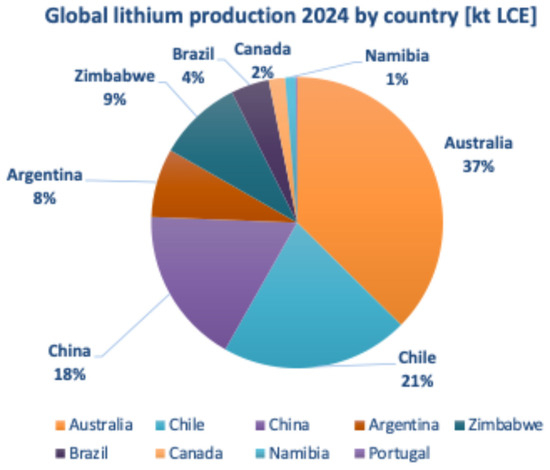
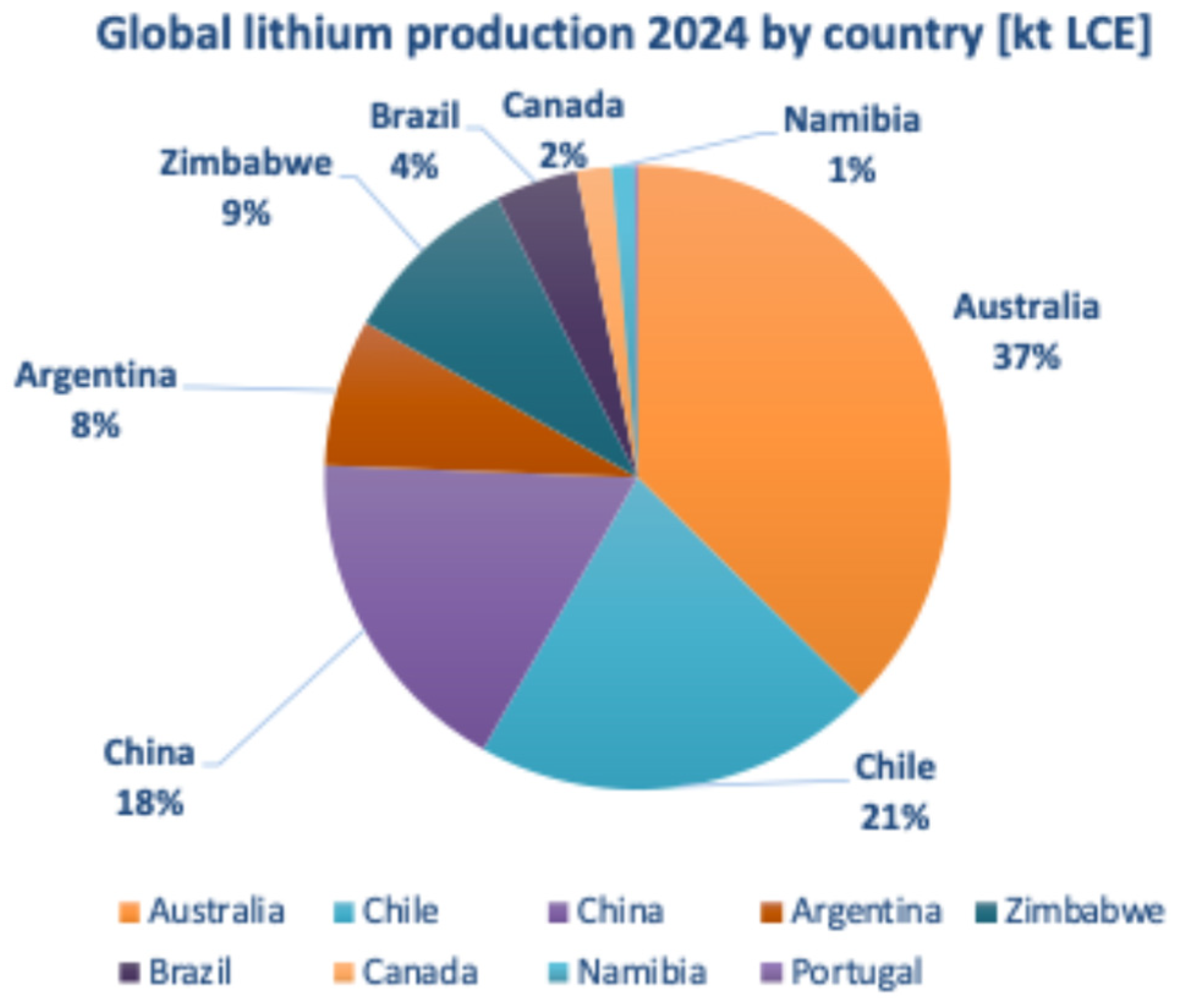
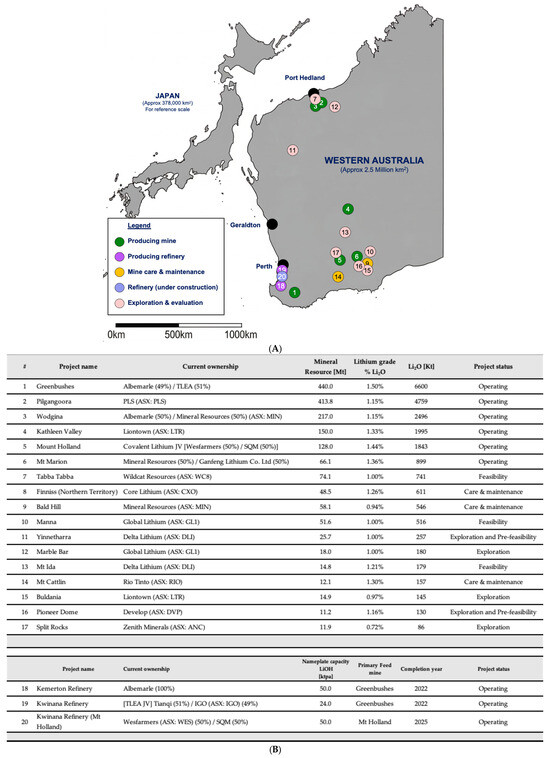
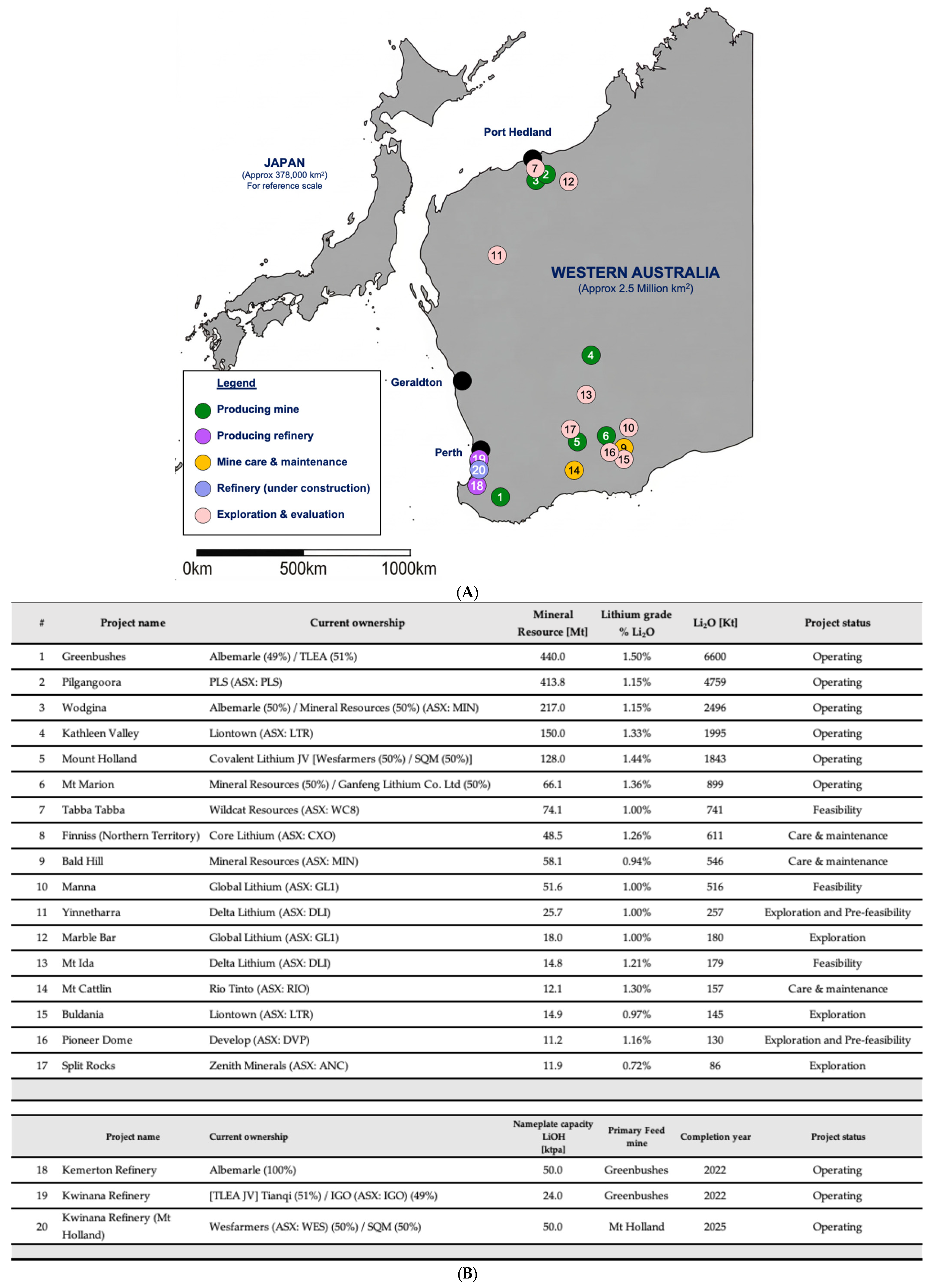
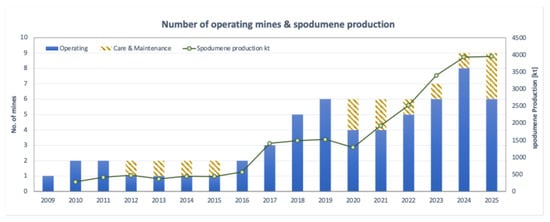
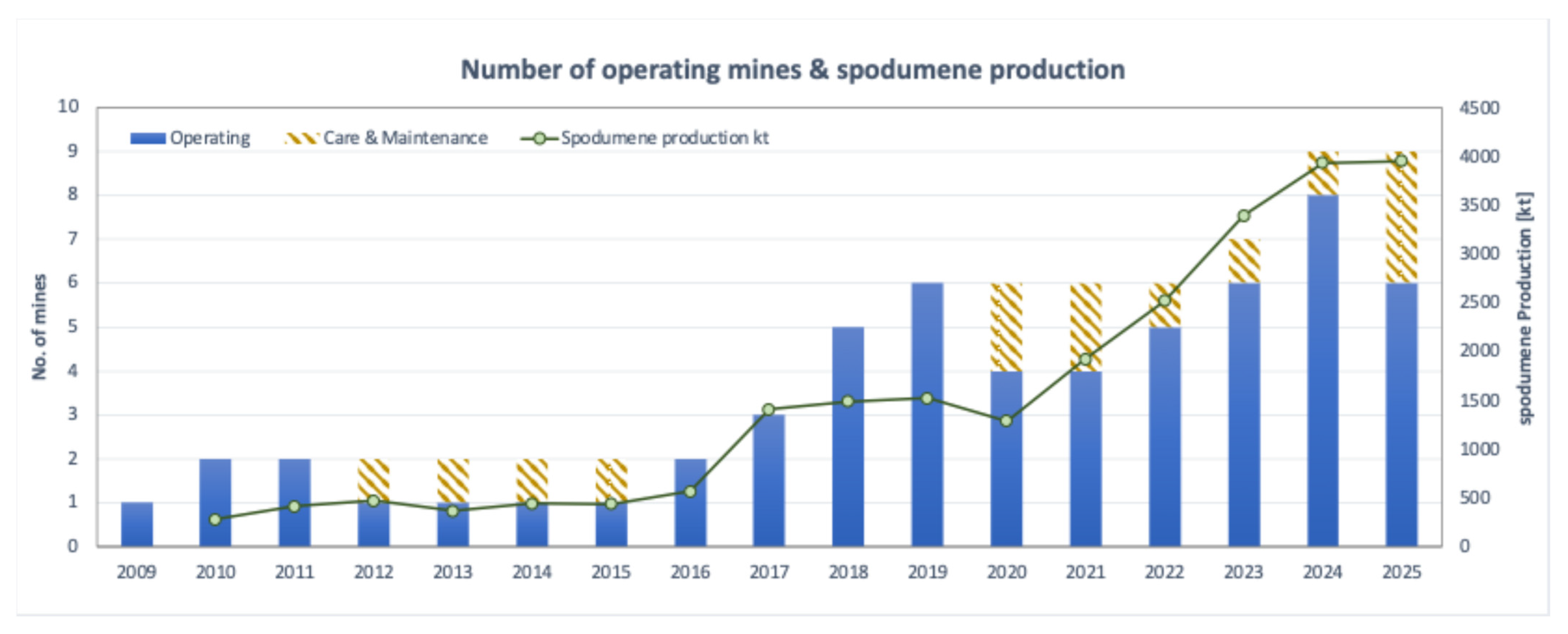
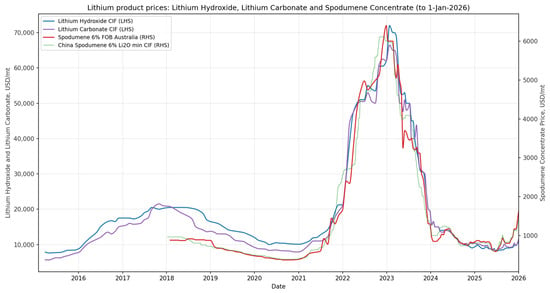
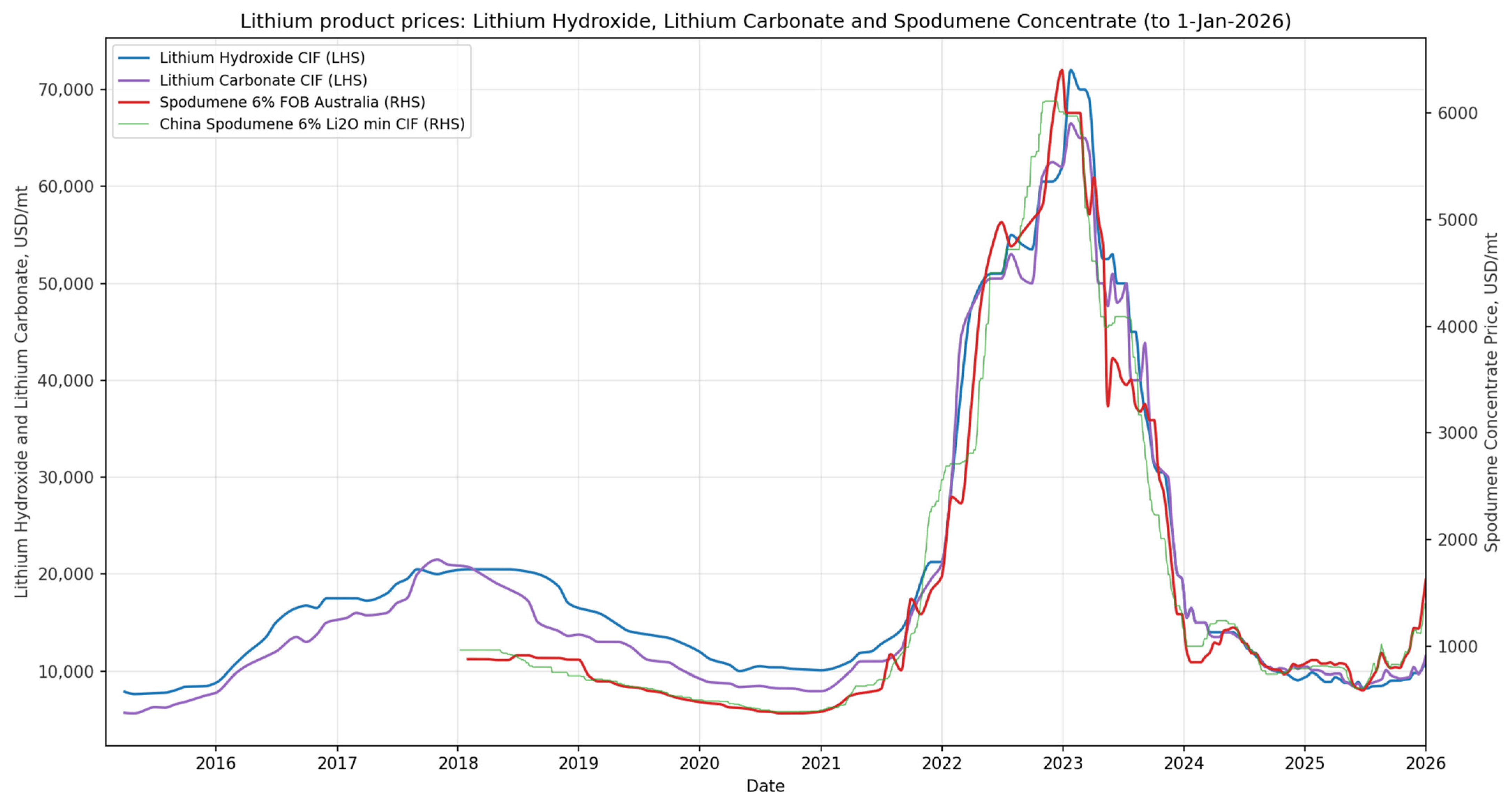
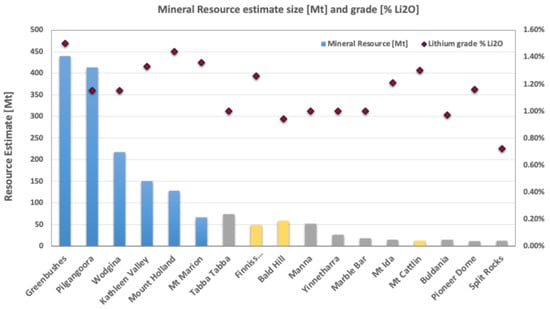
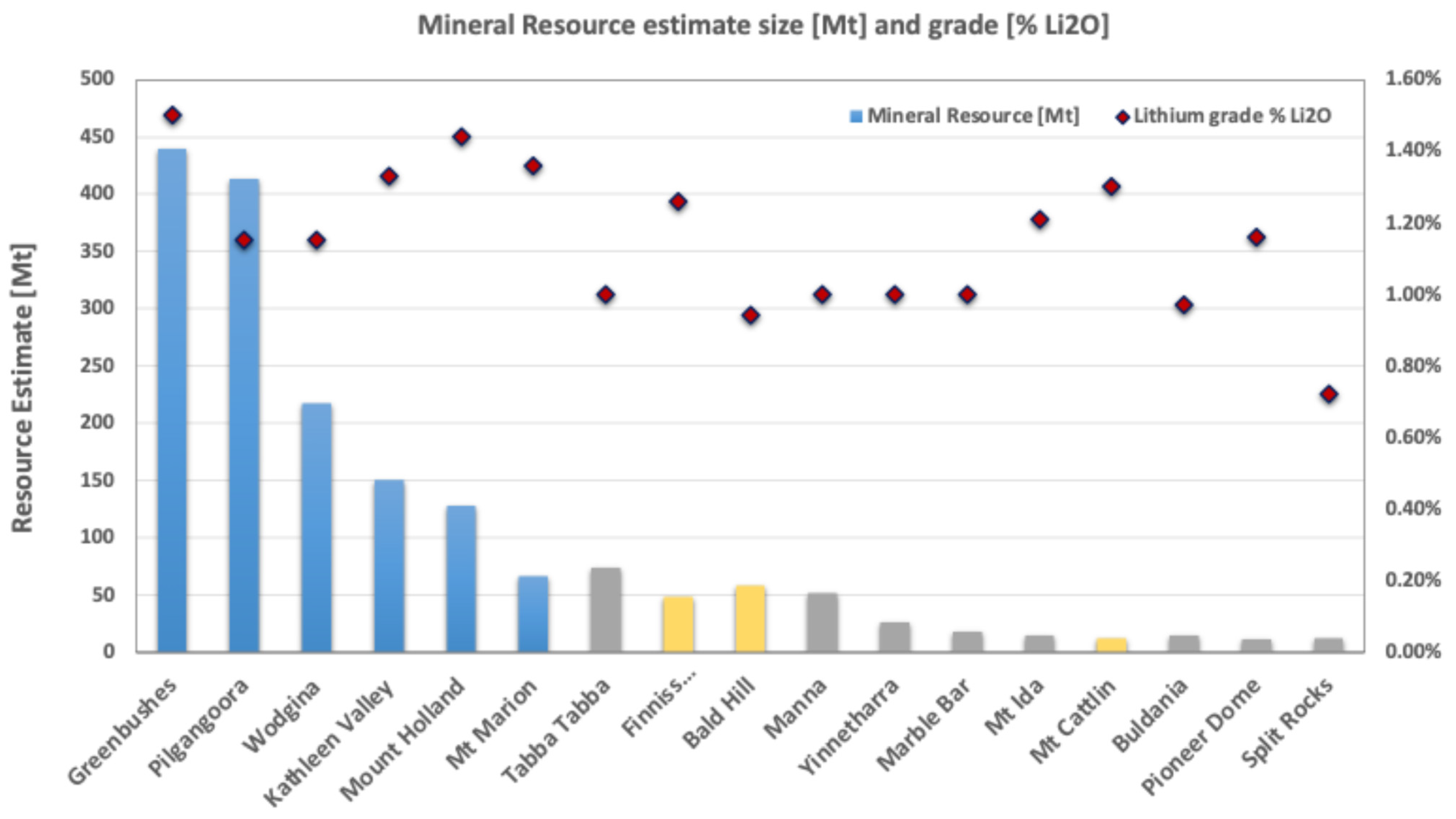
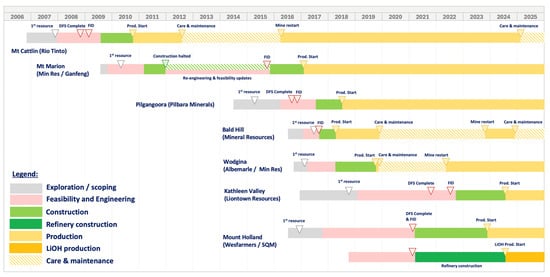
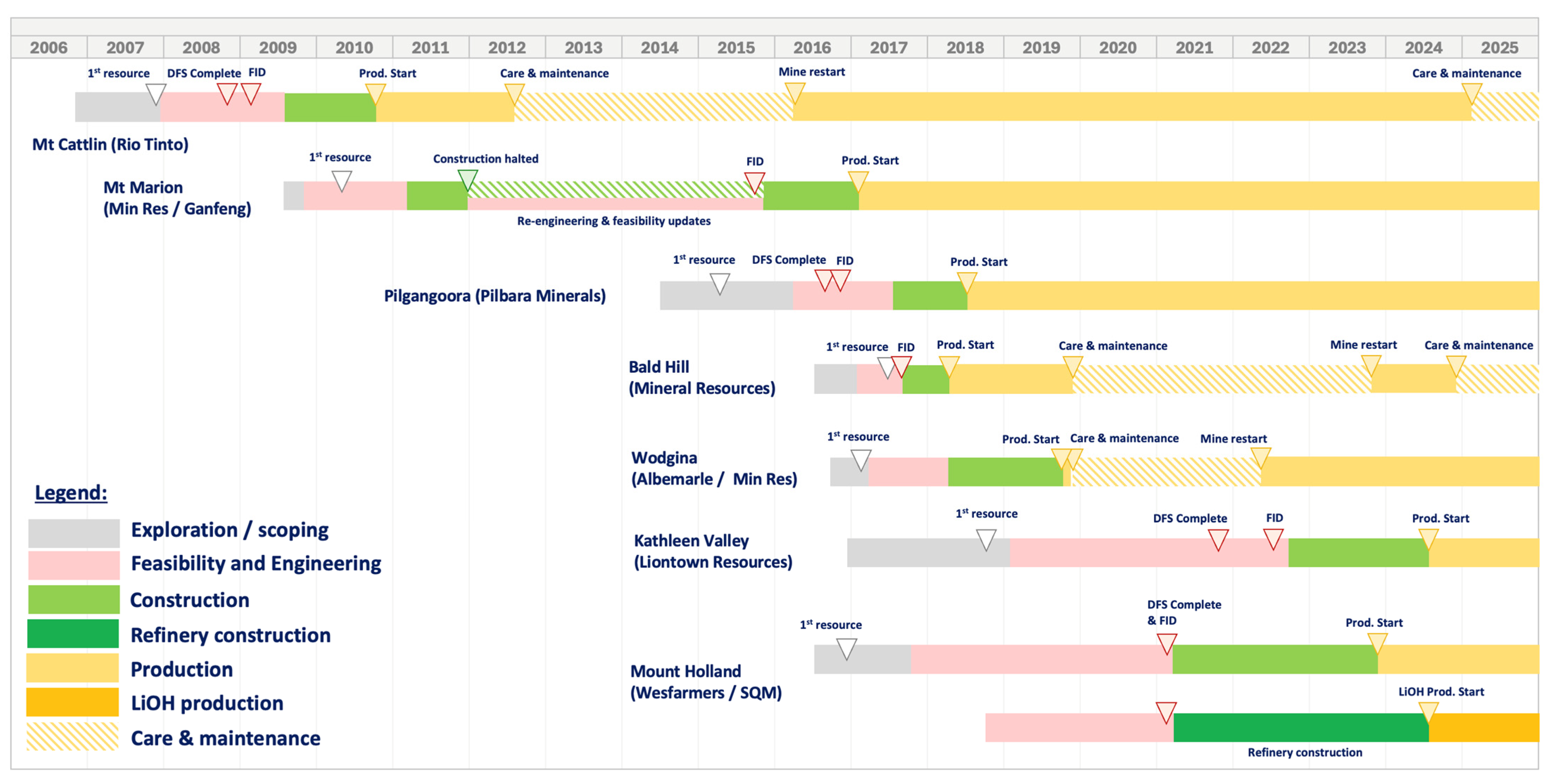
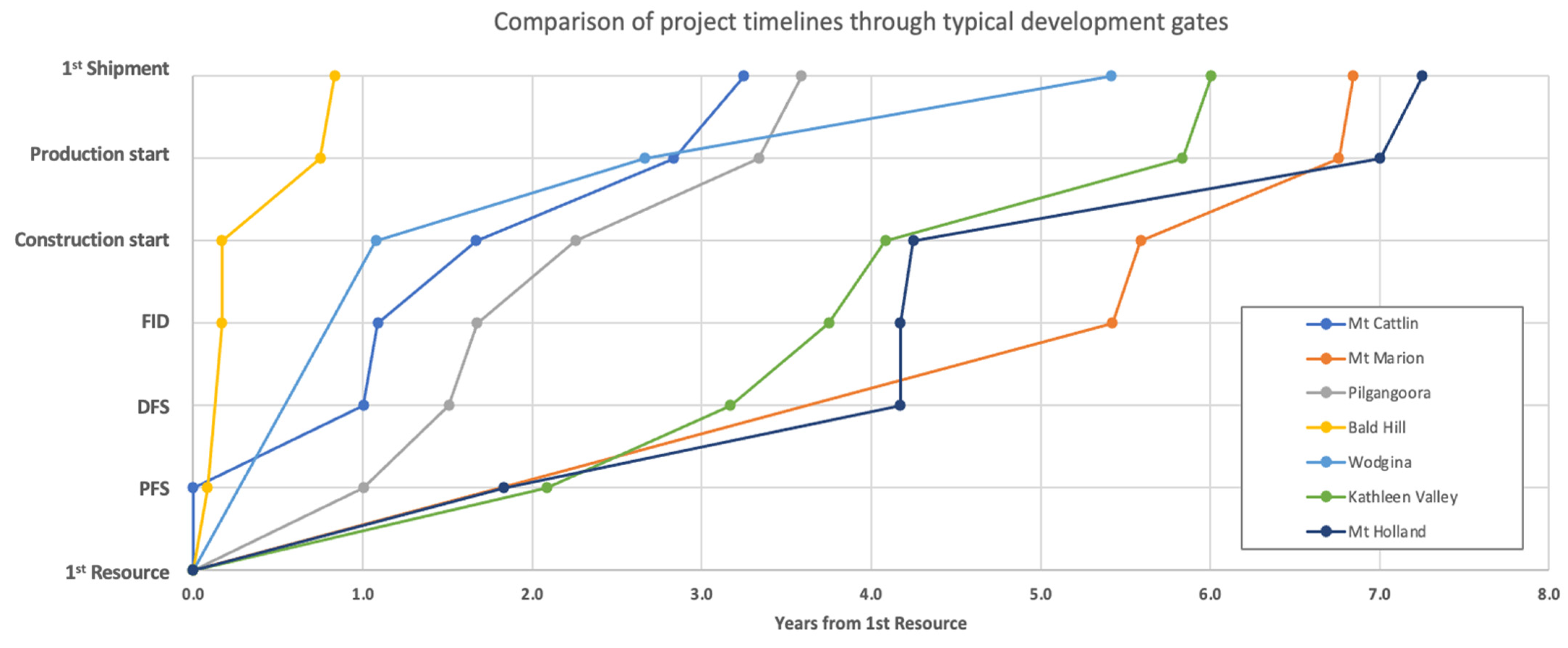
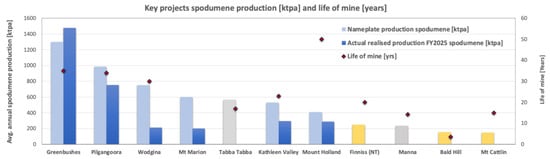
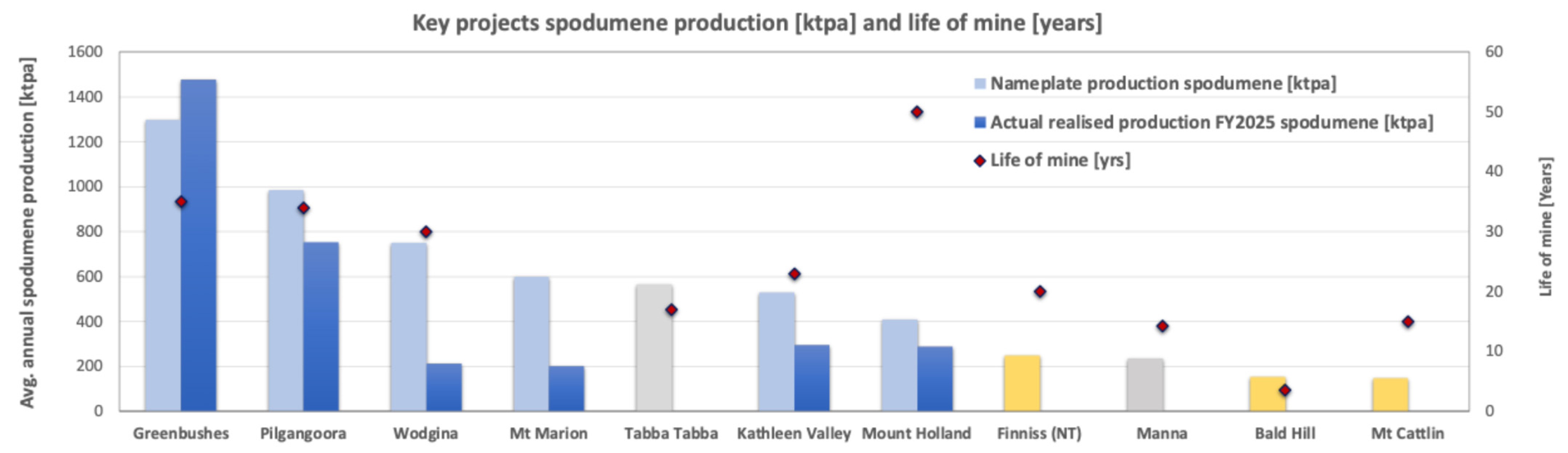
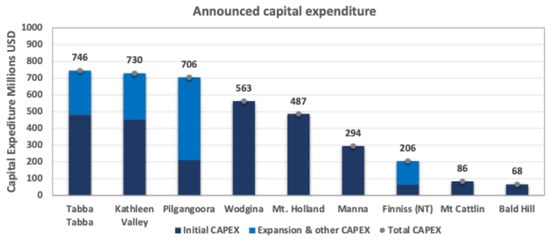
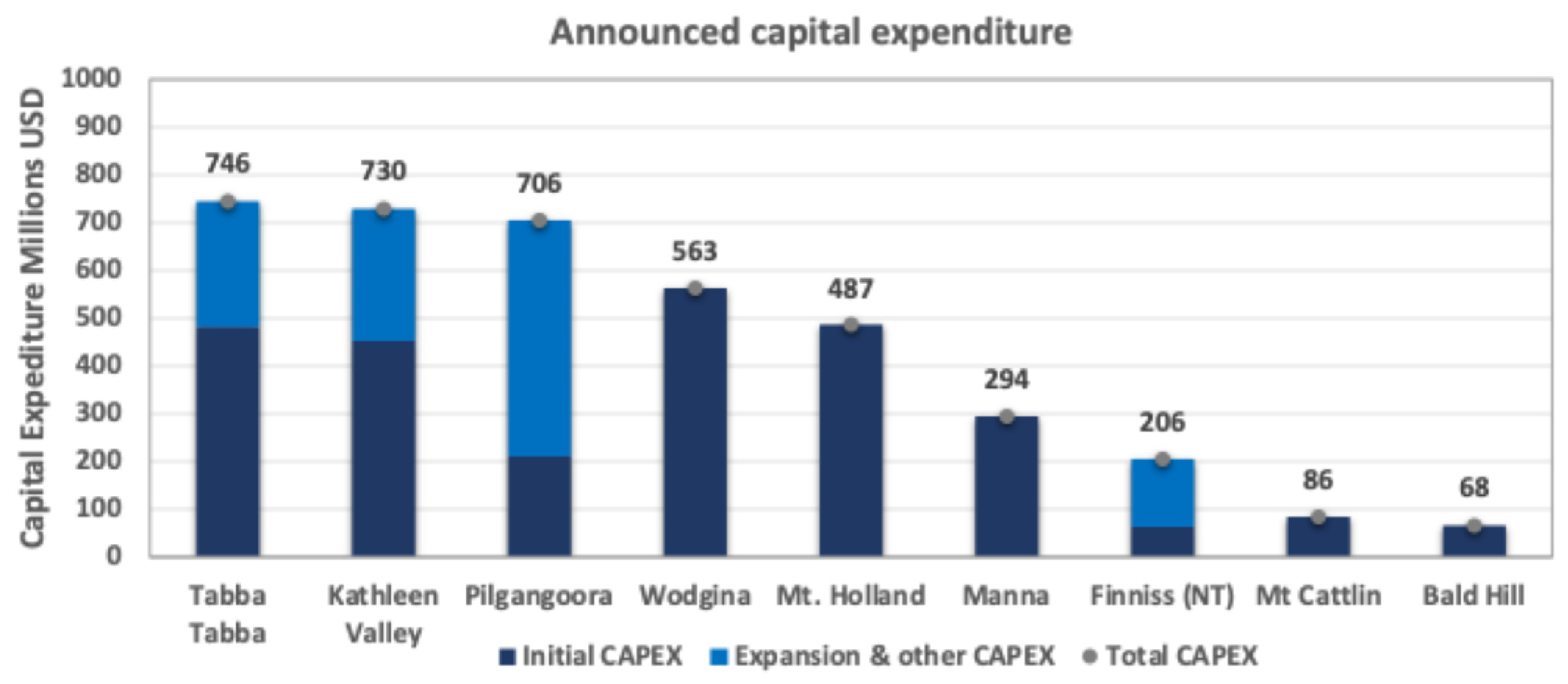
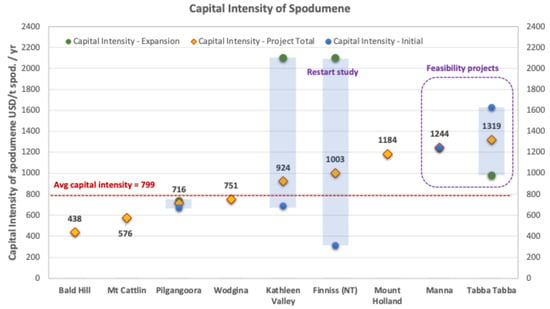
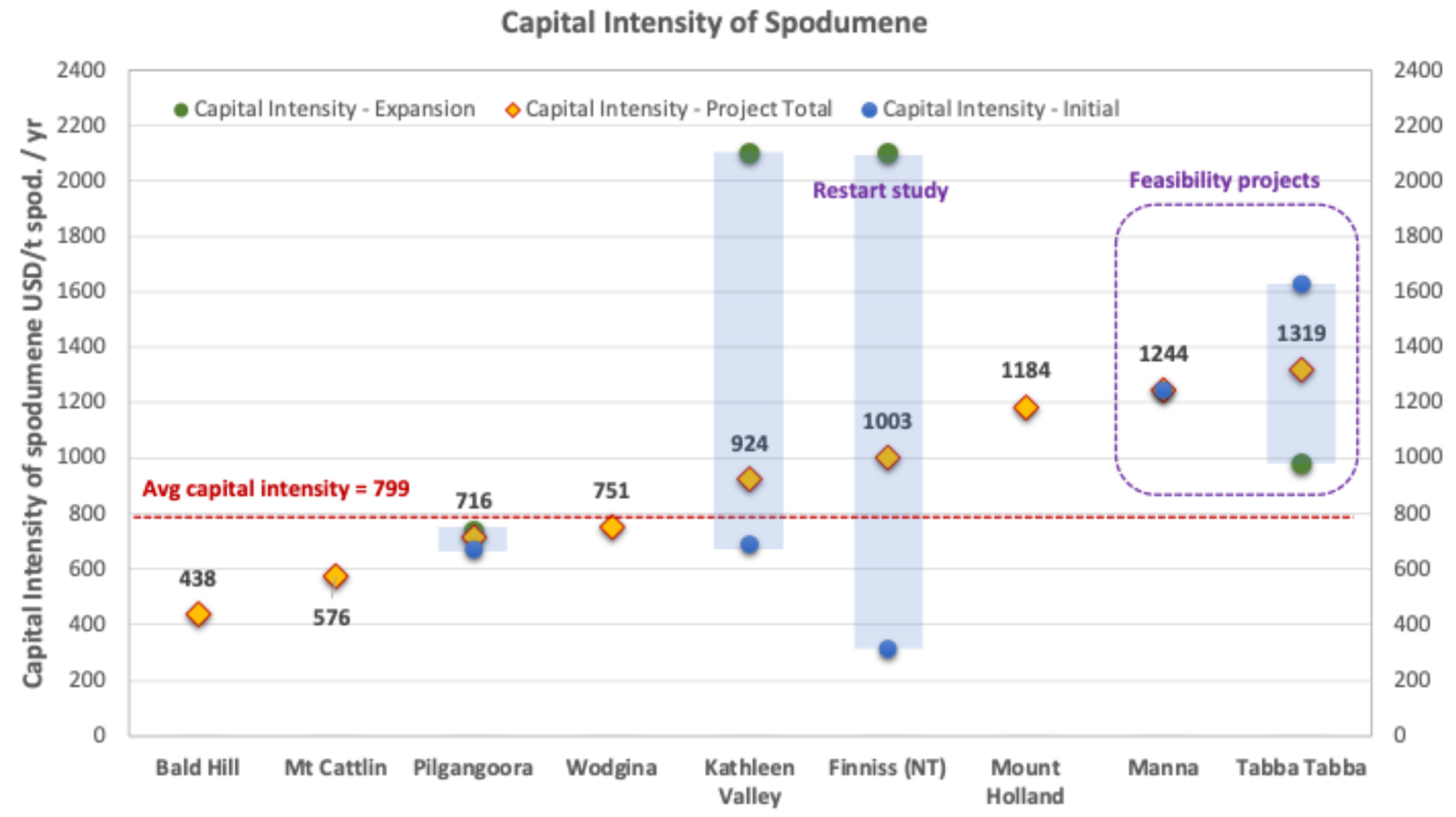
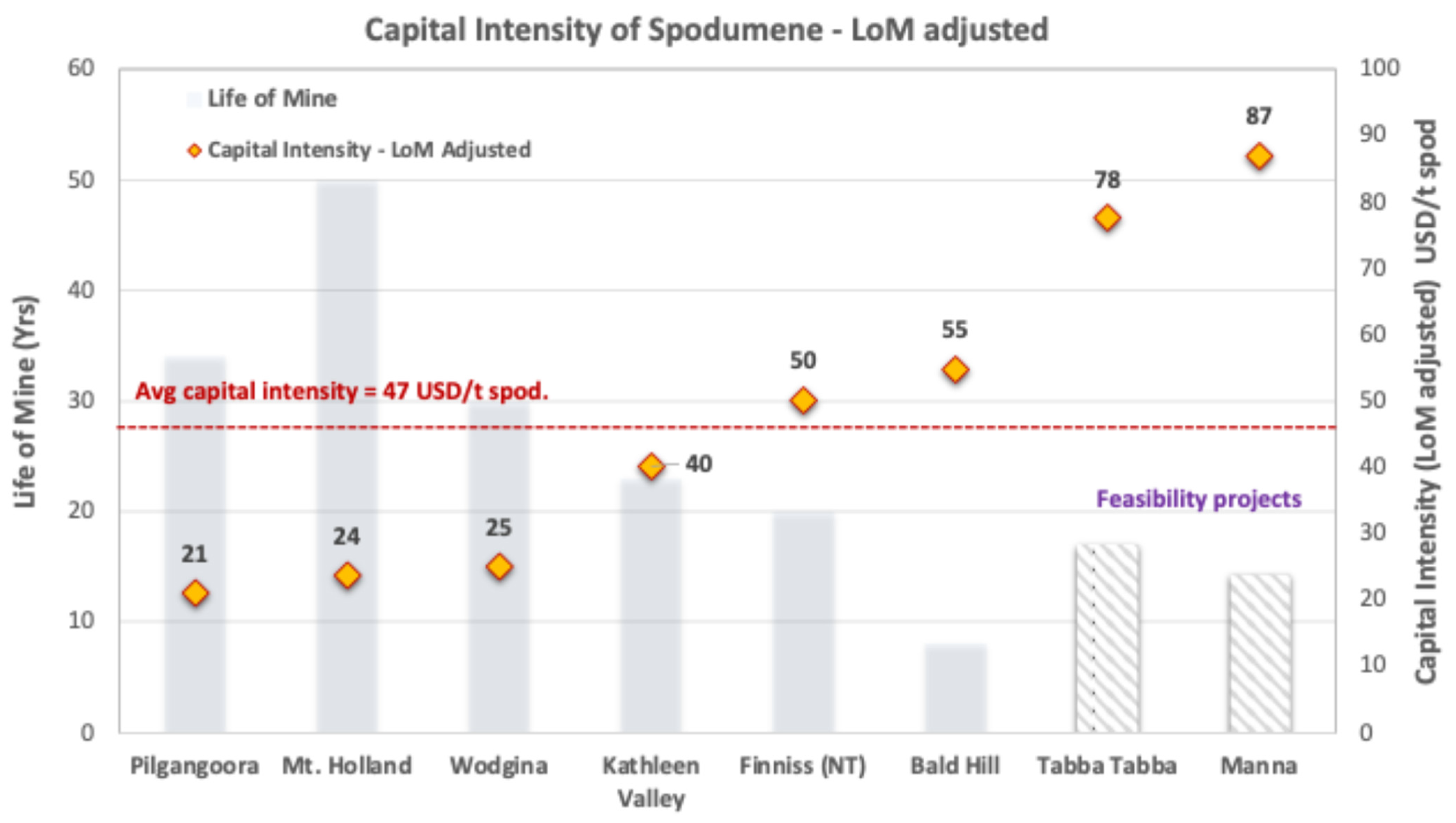
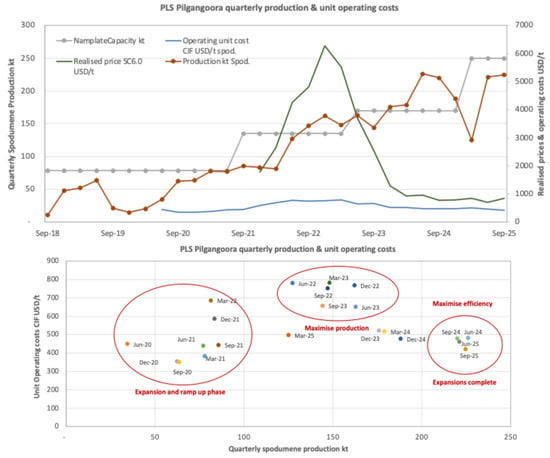
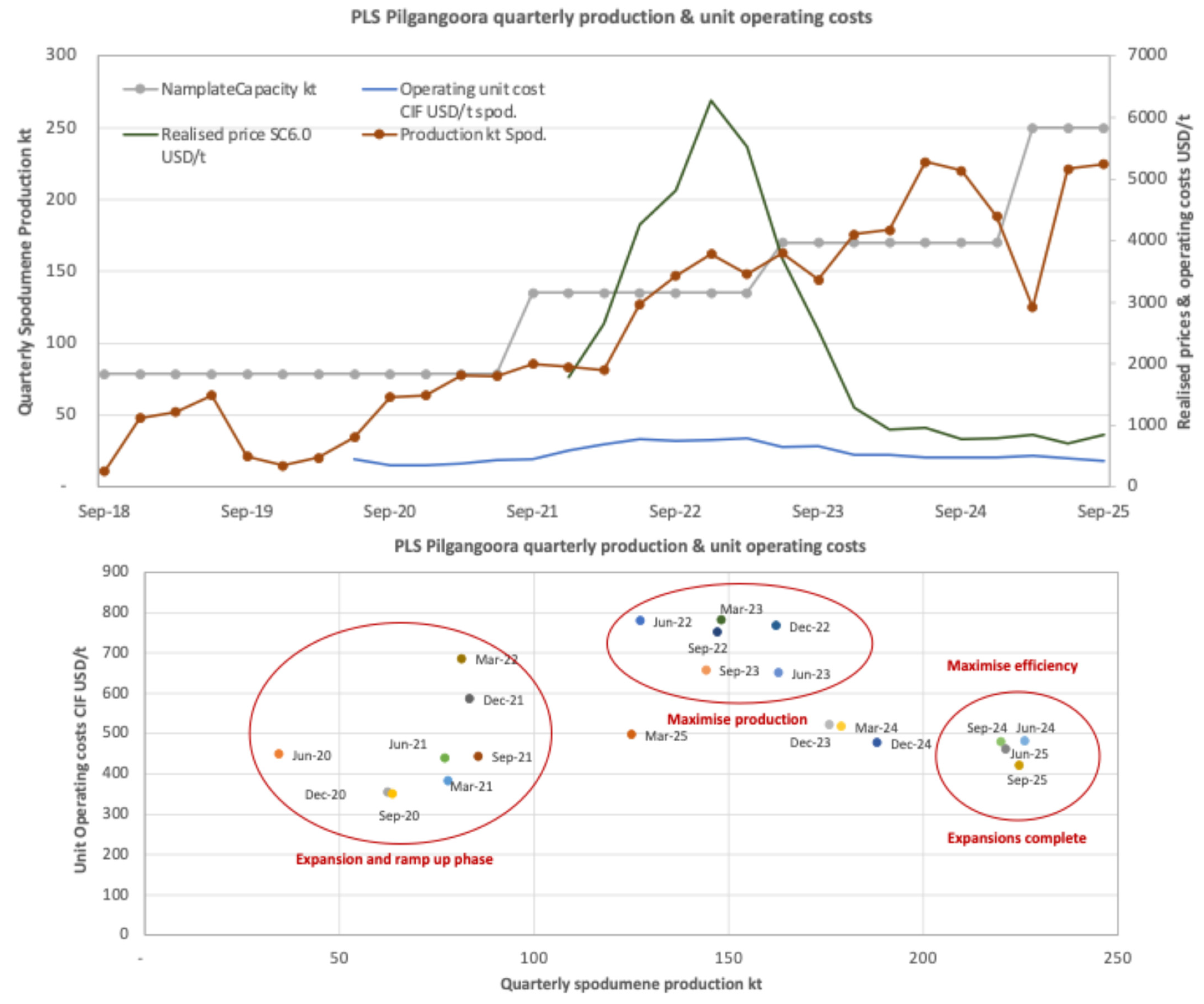

Disclaimer/Publisher’s Note: The statements, opinions and data contained in all publications are solely those of the individual author(s) and contributor(s) and not of MDPI and/or the editor(s). MDPI and/or the editor(s) disclaim responsibility for any injury to people or property resulting from any ideas, methods, instructions or products referred to in the content. |
© 2026 by the authors. Licensee MDPI, Basel, Switzerland. This article is an open access article distributed under the terms and conditions of the Creative Commons Attribution (CC BY) license.