
Digital Product Passports: A Systematic Literature Review on Framework Design and Validation


Abstract
1. Introduction
1.1. Cross-Sector DPP Research
1.2. Scope, Conceptual Definitions, and Research Questions
2. Research Methodology
2.1. Research Design
2.2. Data Source
2.3. Search Strategy
Scopus:
(TITLE-ABS-KEY("product passport*") AND TITLE-ABS-KEY(framework))
AND (LIMIT-TO (LANGUAGE, "English"))
IEEE Xplore:
("All Metadata":"product passport*") AND ("Document Title":framework) AND ("All Metadata":digital)
2.4. Eligibility Criteria
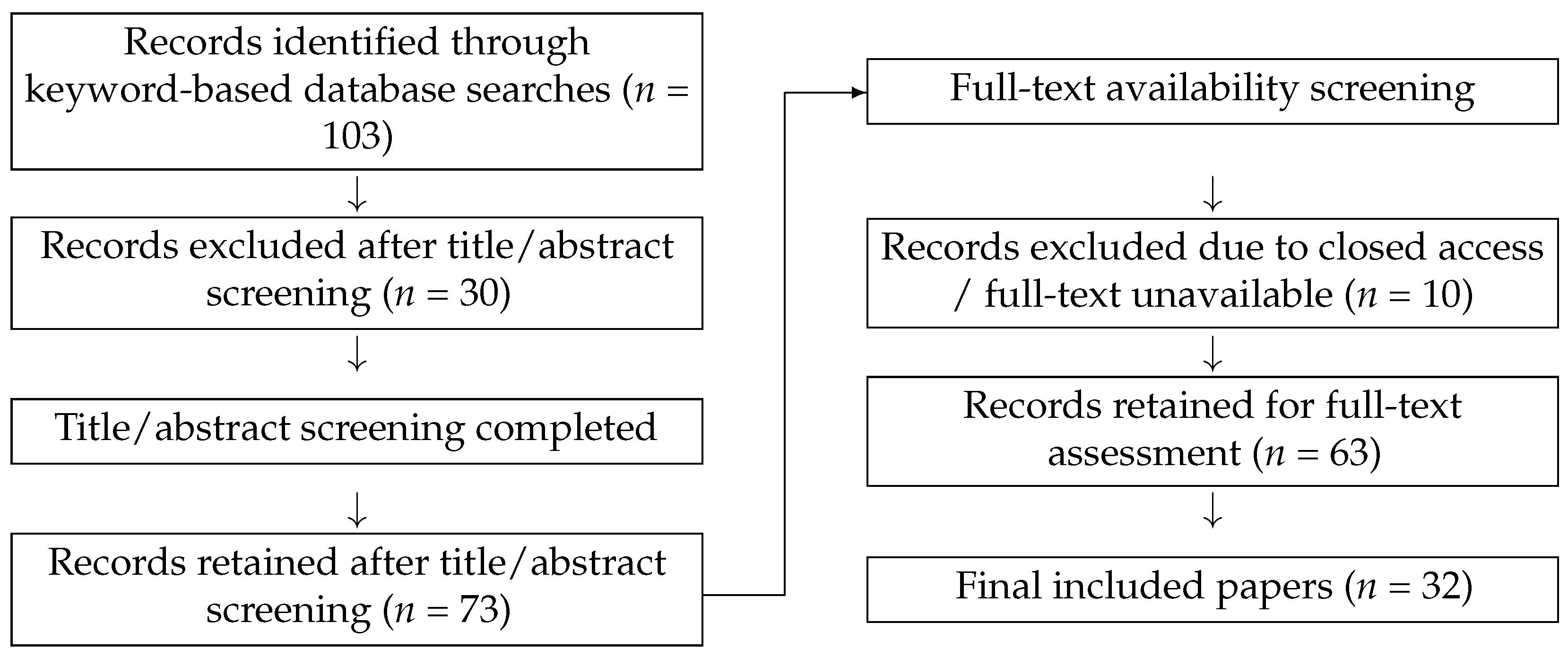
2.5. Screening Process
2.6. Data Extraction
2.7. Analytical Coding Framework
2.8. Data Synthesis
2.9. Sector Distribution of Included Studies
3. Results
3.1. Overview of Included Studies
3.2. Framework Design Elaboration and Validation Coverage
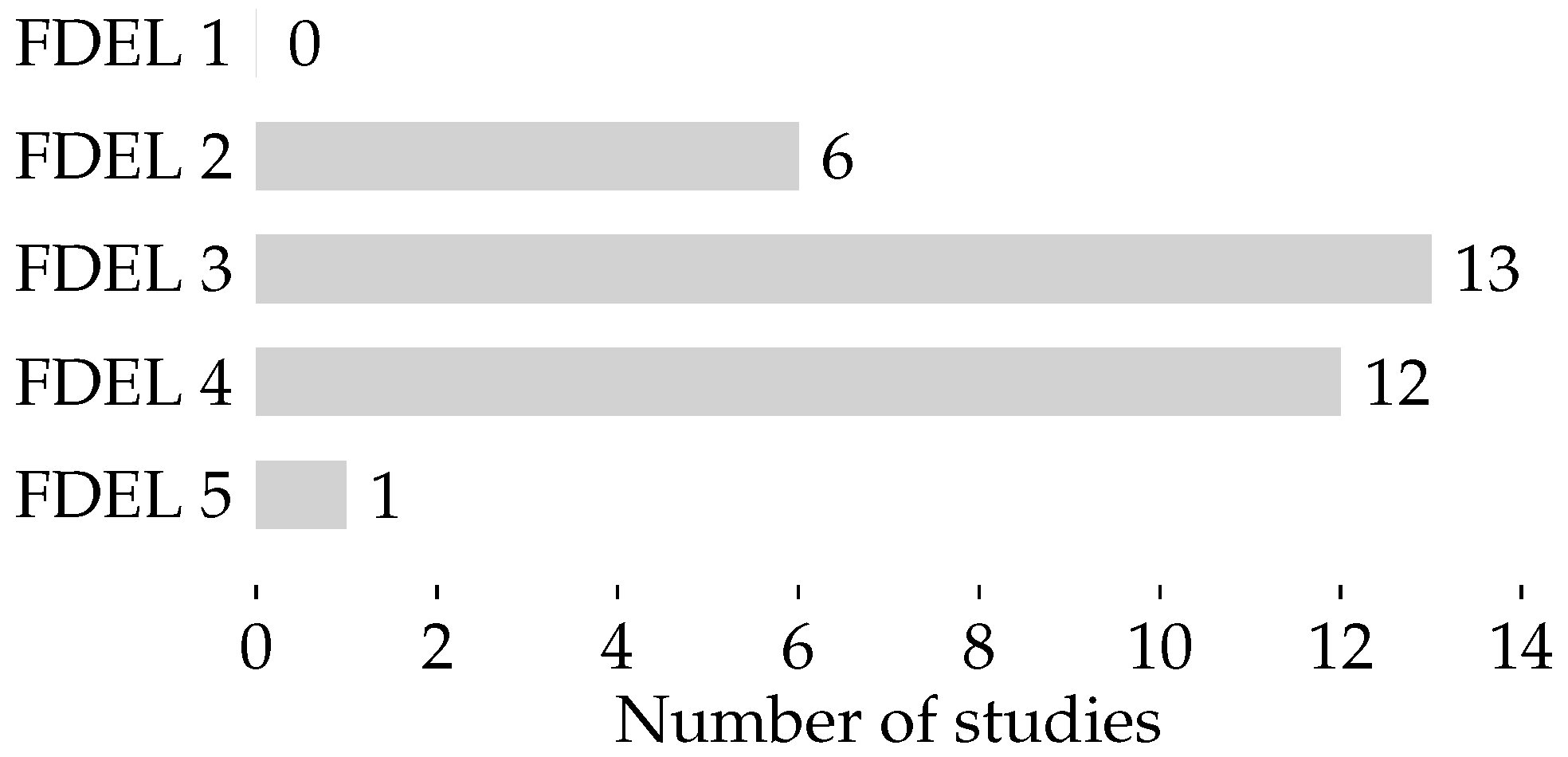
3.3. Framework Design Elaboration Levels
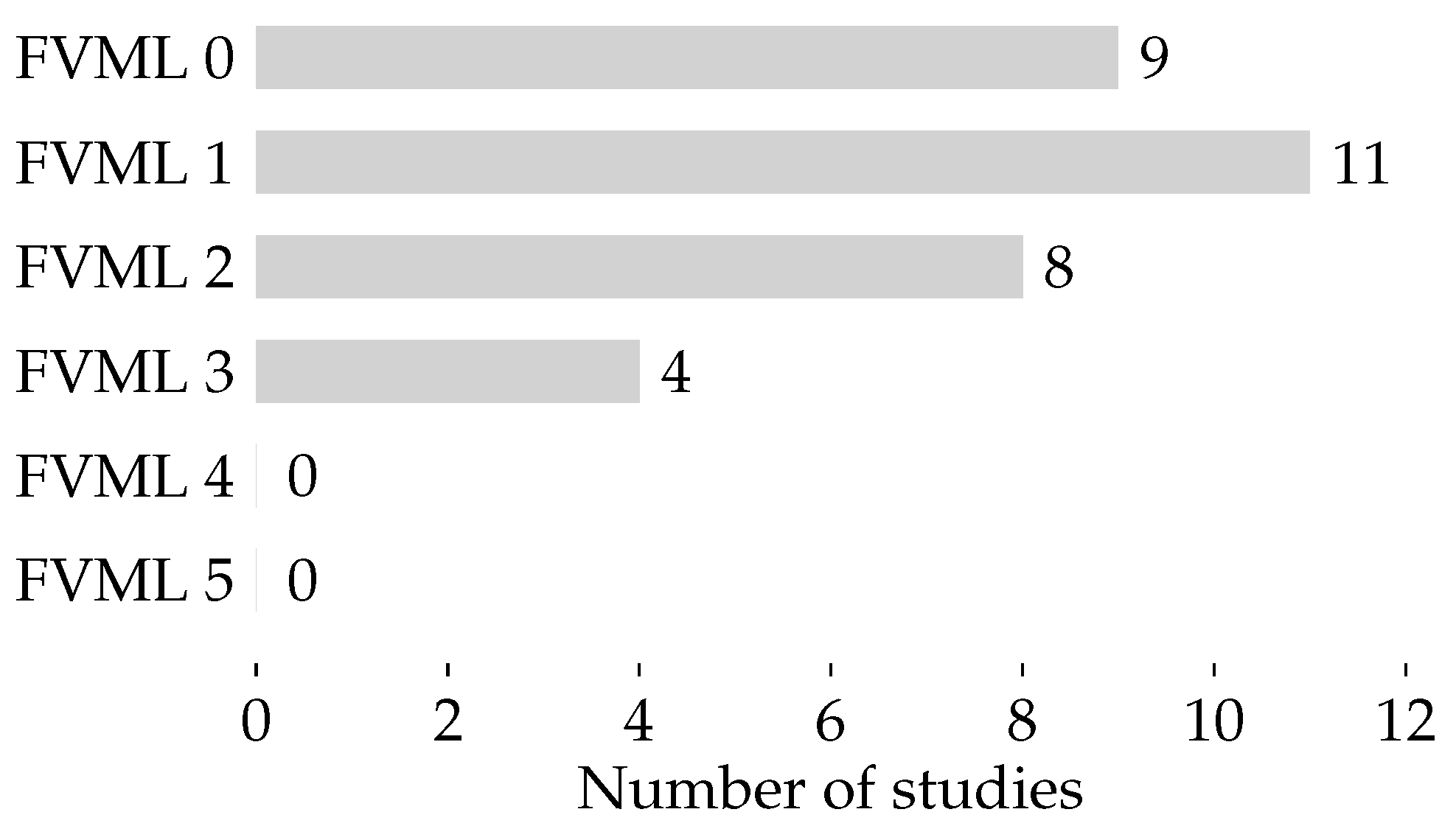
3.4. Framework Validation Maturity Levels
3.5. Framework Design Characteristics
3.6. Sectoral Distribution of Framework Approaches
3.7. Summary of Empirical Evidence
4. Discussion
4.1. RQ1: Design Characteristics of DPP Frameworks
4.2. RQ2: Validation Practices and Evidence Maturity
4.3. Validation Maturity Levels in DPP Research
4.4. Interoperability and Standards in DPP Framework Research
4.5. Sectoral Implications with Emphasis on Construction and Materials
4.6. Limitations
4.7. Summary of Discussion
5. Conclusions and Future Work
Supplementary Materials
Author Contributions
Funding
Institutional Review Board Statement
Informed Consent Statement
Data Availability Statement
Acknowledgments
Conflicts of Interest
Abbreviations
| AAS | Asset Administration Shell |
| ADR | Architectural Decision Record |
| AI | Artificial Intelligence |
| AIDEAS | AI-Driven Industrial Equipment Product Lifecycle Boosting Agility, Sustainability, and Resilience |
| BIM | Building Information Modelling |
| C-DPPO | Core Digital Product Passport Ontology |
| CBV | Core Business Vocabulary |
| CE | Circular Economy |
| CEAP | Circular Economy Action Plan |
| CEF-DPP | Circular Economy Framework integrated with a Digital Product Passport |
| DBL | Digital Building Logbook |
| DID | Decentralised Identifier |
| DID-MB | Decentralised Identifiers Management Blockchain |
| DLT | Distributed Ledger Technology |
| DPP | Digital Product Passport |
| DPP-DB | Digital Product Passport Data Blockchain |
| DPSSP | Digital Product–Service System Passport |
| EPCIS | Electronic Product Code Information Services |
| ESPR | Ecodesign for Sustainable Products Regulation |
| FDEL | Framework Design Elaboration Level |
| FLEX | Framework for Livestock Empowerment and Decentralised Secure Data eXchange |
| FVML | Framework Validation Maturity Level |
| GS1 | Global Standards One |
| IDS | International Data Spaces |
| IDTA | Industrial Digital Twin Association |
| IoT | Internet of Things |
| KG | Knowledge Graph |
| LCA | Life Cycle Assessment |
| LEV | Light Electric Vehicle |
| LTF | Light Timber Frame |
| MP | Material Passport |
| RSC | Reverse Supply Chain |
| SDF | Semantic Data-Driven Framework |
| SLR | Systematic Literature Review |
| UML | Unified Modeling Language |
| VoI | Value of Information |
References
- European Commission. Green Deal: New Proposals to Make Sustainable Products the Norm and Boost Europe’s Resource Independence. 2022. Available online: https://ec.europa.eu/commission/presscorner/detail/en/ip_22_2013 (accessed on 26 September 2025).
- European Commission. Ecodesign for Sustainable Products Regulation. 2024. Available online: https://commission.europa.eu/energy-climate-change-environment/standards-tools-and-labels/products-labelling-rules-and-requirements/ecodesign-sustainable-products-regulation_en (accessed on 1 October 2025).
- Kirchherr, J.; Reike, D.; Hekkert, M. Conceptualizing the circular economy: An analysis of 114 definitions. Resour. Conserv. Recycl. 2017, 127, 221–232. [Google Scholar] [CrossRef] [Scilit]
- Lopes, C.; Barata, J. Digital Product Passport: A Review and Research Agenda. In Proceedings of the 28th International Conference on Knowledge Based and Intelligent Information and Engineering Systems (KES 2024), Seville, Spain, 11–12 November 2024; pp. 981–990. [Google Scholar] [CrossRef] [Scilit]
- Voulgaridis, K.; Lagkas, T.; Angelopoulos, C.M.; Boulogeorgos, A.A.A.; Argyriou, V.; Sarigiannidis, P. Digital product passports as enablers of digital circular economy: A framework based on technological perspective. Telecommun. Syst. 2024, 85, 699–715. [Google Scholar] [CrossRef] [Scilit]
- Zhang, Z.; Gu, J.; Li, R.; Lian, W.; Ma, C.; Tian, J. Bridging digital and green transitions: A literature review of digital product passport systems. Renew. Sustain. Energy Rev. 2026, 228, 116600. [Google Scholar] [CrossRef] [Scilit]
- Adisorn, T.; Tholen, L.; Götz, T. Towards a digital product passport fit for contributing to a circular economy. Energies 2021, 14, 2289. [Google Scholar] [CrossRef] [Scilit]
- King, M.R.N.; Timms, P.D.; Mountney, S. A proposed universal definition of a Digital Product Passport Ecosystem (DPPE): Worldviews, discrete capabilities, stakeholder requirements and concerns. J. Clean. Prod. 2023, 384, 135538. [Google Scholar] [CrossRef] [Scilit]
- Zhang, A.; Seuring, S. Digital product passport for sustainable and circular supply chain management: A structured review of use cases. Int. J. Logist. Res. Appl. 2024, 27, 2513–2540. [Google Scholar] [CrossRef] [Scilit]
- Christensen, A.; Stingl, V.; Omair, M.; Wæhrens, B.V. Digital Product Passport in support of Data-Driven End-of-Use Strategies–a systems design perspective. Clean. Environ. Syst. 2025, 19, 100354. [Google Scholar] [CrossRef] [Scilit]
- Morganti, L.; Rudenå, A.; Brunklaus, B.; Bomark, P.; Armijo Prieto, A.; Skog, J.; Zaffagnini, T.; Pracucci, A.; Astudillo Larraz, J. Wood-for-construction supply chain digital twin to drive circular economy and actor-based LCA information. J. Clean. Prod. 2025, 520, 146074. [Google Scholar] [CrossRef] [Scilit]
- Liu, Z.; Zhou, Q.; Tian, Z.; He, B.J.; Jin, G. A comprehensive analysis on definitions, development, and policies of nearly zero energy buildings in China. Renew. Sustain. Energy Rev. 2019, 114, 109314. [Google Scholar] [CrossRef] [Scilit]
- Merli, R.; Preziosi, M.; Acampora, A. How do scholars approach the circular economy? A systematic literature review. J. Clean. Prod. 2018, 178, 703–722. [Google Scholar] [CrossRef] [Scilit]
- Denyer, D.; Tranfield, D. Producing a Systematic Review. In The SAGE Handbook of Organizational Research Methods; Buchanan, D.A., Bryman, A., Eds.; SAGE: Los Angeles, CA, USA; London, UK, 2009; pp. 671–689. [Google Scholar]
- Burnham, J.F. Scopus database: A review. Biomed. Digit. Libr. 2006, 3, 1. [Google Scholar] [CrossRef] [Scilit]
- Tolcha, Y.K.; Park, G.; Kim, D. Building digital product passports: EPCIS 2.0 meets knowledge graphs. In Proceedings of the 2025 IEEE International Conference on RFID (RFID), Atlanta, GA, USA, 22–24 April 2025. [Google Scholar] [CrossRef] [Scilit]
- Wicaksono, H.; Mengistu, A.; Bashyal, A.; Fekete, T. Digital Product Passport (DPP) Technological Advancement and Adoption Framework: A Systematic Literature Review. In Proceedings of the 6th International Conference on Industry 4.0 and Smart Manufacturing (ISM 2024), Prague, Czech Republic, 13–15 November 2024; pp. 2980–2989. [Google Scholar] [CrossRef] [Scilit]
- Psarommatis, F.; May, G. Digital Product Passport: A Pathway to Circularity and Sustainability in Modern Manufacturing. Sustainability 2024, 16, 396. [Google Scholar] [CrossRef] [Scilit]
- Jensen, S.F.; Kristensen, J.H.; Christensen, A.; Waehrens, B.V. An ecosystem orchestration framework for the design of digital product passports in a circular economy. Bus. Strategy Environ. 2024, 33, 7100–7117. [Google Scholar] [CrossRef] [Scilit]
- Rodionova, K.; Eeva, V. An Investigation of Digital Infrastructure’s Role in Repair and Reuse of Timber-Based Components in Taller Timber Buildings: An Interdisciplinary Case Study of Digital Product Passport. In Springer Tracts in Civil Engineering; Springer: Berlin/Heidelberg, Germany, 2025; pp. 335–340. [Google Scholar] [CrossRef] [Scilit]
- Miron, R.; Hulea, M. Digital Product Passport Implementation Based on Hyperledger Fabric Technology. In Proceedings of the 3rd International Conference on Innovation in Engineering (ICIE 2024), Povoação, Portugal, 26–28 June 2024; pp. 51–62. [Google Scholar] [CrossRef] [Scilit]
- Çetin, S.; Raghu, D.; Honic, M.; Straub, A.; Gruis, V. Data requirements and availabilities for material passports: A digitally enabled framework for improving the circularity of existing buildings. Sustain. Prod. Consum. 2023, 40, 422–437. [Google Scholar] [CrossRef] [Scilit]
- Morganti, L.; Esnarrizaga, P.E.; Pracucci, A.; Zaffagnini, T.; Cortes, V.G.; Rudenå, A.; Brunklaus, B.; Larraz, J.A. Data-driven and LCA-based Framework for environmental and circular assessment of Modular Curtain Walls. J. Facade Des. Eng. 2024, 12, 9–42. [Google Scholar] [CrossRef] [Scilit]
- Pracucci, A.; Giovanardi, M. Design of a Sensor-Based Digital Product Passport for Low-Tech Manufacturing: Traceability and Environmental Monitoring in Bio-Block Production. Sensors 2025, 25, 5653. [Google Scholar] [CrossRef] [Scilit] [PubMed]
- Kebede, R.; Moscati, A.; Tan, H.; Johansson, P. Circular Economy in the Built Environment: A Framework for Implementing Digital Product Passports with Knowledge Graphs. In Proceedings of the of the European Conference on Computing in Construction, Heraklion, Greece, 10–12 July 2023. [Google Scholar] [CrossRef] [Scilit]
- Nowacki, S.; Sisik, G.M.; Angelopoulos, C.M. Digital Product Passports: Use Cases Framework and Technical Architecture Using DLT and Smart Contracts. In Proceedings of the 19th Annual International Conference on Distributed Computing in Smart Systems and the Internet of Things (DCOSS-IoT 2023), Pafos, Cyprus, 19–21 June 2023; pp. 373–380. [Google Scholar] [CrossRef] [Scilit]
- Wan, P.K.F.; Jiang, S. Enabling a dynamic information flow in digital product passports during product use phase: A literature review and proposed framework. Sustain. Prod. Consum. 2025, 54, 362–374. [Google Scholar] [CrossRef] [Scilit]
- Kannappan, R.; Hatin, J.; Bertin, E.; Crespi, N. Enhancing Digital Product Passport Through Decentralized Digital Twins. In Proceedings of the 12th IFIP International Conference on New Technologies, Mobility and Security (NTMS 2025), Paris, France, 18–20 June 2025; pp. 300–308. [Google Scholar] [CrossRef] [Scilit]
- Malo, P.; Almeida, B.; Mateus, M.; Querido, F.; Inacio, D.; Teixeira, T.; Di Orio, G.; Marques, F. From Static Records to Smart Passports: Evolving Digital Product Passports Toward Product-Service System Integration. In Proceedings of the 21st Annual International Conference on Distributed Computing in Smart Systems and the Internet of Things (DCOSS-IoT 2025), Lucca, Italy, 9–11 June 2025; pp. 1087–1094. [Google Scholar] [CrossRef] [Scilit]
- Panza, L.; Bruno, G.; Lombardi, F. Integrating Absolute Sustainability and Social Sustainability in the Digital Product Passport to Promote Industry 5.0. Sustainability 2023, 15, 12552. [Google Scholar] [CrossRef] [Scilit]
- Mateo-Casali, M.A.; Boza, A.; Fraile, F.; Moya-Ruiz, L. Reference Architecture for Digital Product Passports: Leveraging AI in Industry 4.0 Systems. In Proceedings of the 31st ICE IEEE/ITMC Conference on Engineering, Technology, and Innovation (ICE 2025), Valencia, Spain, 16–19 June 2025. [Google Scholar] [CrossRef] [Scilit]
- Fares, N.; Islam, M.S.; Jauhar, S.K.; Kucukaltan, B. Towards an International Digital Product Passport: The New Paradigm of a Worldwide Circular Economy. Circ. Econ. Sustain. 2025, 5, 5475–5495. [Google Scholar] [CrossRef] [Scilit]
- Deich, J.; Loeb, L.; Meins-Becker, A.; Meisen, T.; Pomp, A. Towards Connecting General DPP Ontology Frameworks with Domain-specific Information Sources. In Proceedings of the 3rd International Workshop on Knowledge Graphs for Sustainability (KG4S 2025), Portorož, Slovenia, 1 June 2025; pp. 1–12. [Google Scholar]
- Siska, V.; Al-Akrawi, A.; Zackrisson, M. Building a Sustainable Battery Supply Chain with Digital Battery Passports. In Proceedings of the 31st Interdisciplinary Information Management Talks: New Challenges for ICT and Management (IDIMT), Hradec Kralove, Czech Republic, 6–8 September 2023; pp. 347–354. [Google Scholar] [CrossRef]
- Voulgaridis, K.; Lagkas, T.; Karampatzakis, D.; Argyriou, V.; Sarigiannidis, P. Realizing Digital Product Passports with Crowdsourcing Principles: The Case of Sustainable Smart Grids. In Proceedings of the 19th Annual International Conference on Distributed Computing in Smart Systems and the Internet of Things (DCOSS-IoT 2023), Pafos, Cyprus, 19–21 June 2023; pp. 381–388. [Google Scholar] [CrossRef] [Scilit]
- Kim, M.J.; Han, C.H.; Park, K.J.; Moon, J.S.; Um, J. A Blockchain-Based Digital Product Passport System Providing a Federated Learning Environment for Collaboration Between Recycling Centers and Manufacturers to Enable Recycling Automation. Sustainability 2025, 17, 2679. [Google Scholar] [CrossRef] [Scilit]
- Telfort, T.E.; Valilai, O.F. A Framework for Sustainable Textile Waste Management using Digital Product Passports and Artificial Intelligence. In Proceedings of the 58th CIRP Conference on Manufacturing Systems (CMS 2025), Twente, The Netherlands, 13–16 April 2025; pp. 909–914. [Google Scholar] [CrossRef] [Scilit]
- Stodt, F.; Ruf, P.; Reich, C. Blockchain-enabled digital product passports for enhancing security and lifecycle management in healthcare devices. In Proceedings of the 8th Cyber Security in Networking Conference: AI for Cybersecurity (CSNet), Paris, France, 4–6 December 2024; pp. 44–51. [Google Scholar] [CrossRef] [Scilit]
- Hammadi, M.; Merschak, S.; Diallo, T.M.L.; Hehenberger, P. CEF-DPP: A Circular Economy Framework Integrating Digital Product Passport for Improving Circularity of Sustainable Mechatronics Design. Circ. Econ. Sustain. 2025, 5, 3431–3463. [Google Scholar] [CrossRef] [Scilit]
- Sousa, C.; Ferreira, R.; Pinto, P.; Pereira, C.; Rebelo, R. Digital Product Passport Architecture for Boosting Circularity in Footwear Industry. In Proceedings of the 2023 International Conference on ENTERprise Information Systems (CENTERIS 2023), Porto, Portugal, 8–10 November 2023; pp. 1560–1567. [Google Scholar] [CrossRef] [Scilit]
- Ghafoor, A.; Symeonidis, I.; Rydberg, A.; Lindahl, C.; Abbasi, A.Q. Towards Empowering Stakeholders Through Decentralized Trust and Secure Livestock Data Sharing. Cryptography 2025, 9, 52. [Google Scholar] [CrossRef] [Scilit]
- Kühn, M.; Baumann, M.; Volz, F.; Stojanovic, L. Digital Product Passport Design Supporting the Circular Economy Based on the Asset Administration Shell. Sustainability 2025, 17, 969. [Google Scholar] [CrossRef] [Scilit]
- Boßung, N.; Severengiz, S. Digital Product Passports for Light Electric Vehicles: A Tool for Reducing Environmental Impacts, Meeting Regulatory Requirements and Implementing a Circular Economy. In Proceedings of the 19th Global Conference on Sustainable Manufacturing (GCSM 2023), Buenos Aires, Argentina, 4–6 December 2023; pp. 295–305. [Google Scholar] [CrossRef] [Scilit]
- Krüger, K.; Li, W.; Böttcher, T.P.; Krcmar, H. Ensuring Usefulness: Socio-Technical Design Principles for Digital Product Passports. In Proceedings of the 20th International Conference on Design Science Research in Information Systems and Technology (DESRIST 2025), Montego Bay, Jamaica, 2–4 June 2025; pp. 271–281. [Google Scholar] [CrossRef] [Scilit]
- Xia, H.; Li, J.; Li, Q.; Milisavljevic-Syed, J.; Salonitis, K. Integrating Blockchain with Digital Product Passports for Managing Reverse Supply Chain. In Proceedings of the 12th CIRP Global Web Conference (CIRPe 2024), Virtual, Online, 22–23 October 2024; pp. 215–220. [Google Scholar] [CrossRef] [Scilit]
- Çetin, S.; Raghu, D.; Honic, M.; Straub, A.; Gruis, V. Material Passports for Social Housing Stock. In A+BE Architecture and the Built Environment; TU Delft: Delft, The Netherlands, 2023; Volume 22, pp. 151–186. [Google Scholar]
- Page, M.J.; McKenzie, J.E.; Bossuyt, P.M.; Boutron, I.; Hoffmann, T.C.; Mulrow, C.D.; Tetzlaff, J.M.; Akl, E.A.; Brennan, S.E.; Chou, R.; et al. The PRISMA 2020 statement: An updated guideline for reporting systematic reviews. BMJ 2021, 372, n71. [Google Scholar] [CrossRef] [Scilit]



| Level | Framework Design Elaboration Level (FDEL) | Framework Validation Maturity Level (FVML) |
|---|---|---|
| 0 | Not applicable in the reviewed sample. All included studies had to present a framework-related contribution; therefore, FDEL starts at Level 1 in this review. | Conceptual only. No validation reported beyond conceptual, architectural, or theoretical description. |
| 1 | High-level conceptual framework. A broad conceptual proposal with limited structural detail. The framework idea is visible, but components, relationships, or implementation logic remain only loosely defined. | Illustrative validation. Validation is limited to illustrative scenarios, workflows, reference use cases, or theoretical demonstrations without empirical or technical testing. |
| 2 | Structured conceptual framework. The framework includes clearly identified components, categories, or thematic areas, but still provides limited operational or architectural detail. | Technical proof-of-concept. Validation is carried out through limited technical demonstrations, prototype testing, component-level implementation, or controlled-environment experiments. |
| 3 | Explicit architectural or model structure. The framework presents clearly defined layers, modules, relationships, data categories, or process elements, giving the design a recognisable internal structure. | Context-bound pilot or case validation. Validation is conducted through a specific case study, pilot, or stakeholder-informed assessment within a single product, organisation, or narrowly defined setting. |
| 4 | Implementation-oriented design. The framework specifies technical mechanisms, data models, interfaces, actor roles, or architecture elements in a way that supports implementation planning and partial operationalisation. | Operational pilot validation. Validation takes place in a realistic operational setting involving actual data, users, or multiple actors, but remains limited in scale, duration, or lifecycle scope. |
| 5 | Comprehensive implementation-oriented framework. A highly elaborated framework integrating architectural structure, data logic, governance, interoperability, lifecycle considerations, and implementation-relevant detail. | Cross-organisational and lifecycle-spanning validation. Validation extends across organisational boundaries and lifecycle stages, including evidence of interoperability, governance, and sustained operation under realistic or industrial conditions. |
| Sector | n | Distribution |
|---|---|---|
| Cross-sector | 8 |  |
| Manufacturing | 7 |  |
| Construction | 4 |  |
| Energy | 2 |  |
| Recycling | 1 |  |
| Textile | 1 | |
| Healthcare | 1 | |
| Mechatronics | 1 | |
| Footwear | 1 | |
| Livestock | 1 | |
| Battery | 1 | |
| Electric vehicles | 1 | |
| Furniture | 1 | |
| Reverse supply chains | 1 | |
| Social housing | 1 | |
| Authors | Method | Key Finding(s) | Comment(s) |
|---|---|---|---|
| Manufacturing sector (n = 7) | |||
| Tolcha et al. [16]. | System-architecture design and proof-of-concept implementation. | GS1 has developed both Core Business Vocabulary (CBV) and Electronic Product Code Information Services (EPCIS) standards. The EPCIS 2.0 standard is implemented to facilitate interoperable data capture and sharing. The study proposes a knowledge graph schema that connects events and product IDs, representing recursive relationships for transformations and aggregations through transitional and hierarchical edges. It develops an efficient traceability framework that combines data ingestion, querying capabilities, and graph processing. | Addresses the challenges of product traceability in complex supply chains under the EU DPP regulation. The system needs to be large-scale and tested in industrial environments to validate its scalability, robustness, and performance in practical supply chain environments. |
| Wicaksono et al. [17]. | Systematic literature review. | Proposes a conceptual model for DPP architecture in six layers: Data collection, Data processing, Distributed ledger, Digital passport, Data management and interoperability, and Application. Furthermore, a DPP adoption framework is proposed. | The DPP adoption framework is entirely based on findings from other papers in the systematic literature review. The framework lacks industrial validation and implementation. |
| Psarommatis and May [18]. | Literature review. | Develops a holistic unified DPP framework designed for industries and researchers. Also provides a DPP template to support the DPP standardisation phase. The DPP model is based on six main areas: how it exchanges data, connectivity of the DPP, the relation of the DPP to various product lifecycle steps, the actors that will be using the DPP, the update frequency of data, the accessibility options of the information of the DPP, and the level of detail of the DPP. | Lacks empirical validation through experiments and hands-on case studies. Furthermore, sector-specific technical performance and requirements evaluation are missing. |
| Jensen et al. [19]. | Multiple case study and conceptual framework. | The study creates an ecosystem orchestration framework for the design of DPPs to support implementation in the CE. The framework identifies orchestration practices across four stages of ecosystem maturity: ecosystem initiation, ecosystem momentum, ecosystem control, and ecosystem self-renewal. It improves data sharing for DPP implementation and provides actionable guidance for aligning industrial stakeholders. | Empirical foundation using multiple industrial cases. Conceptual design for DPPs, but the technical requirements involve uncertainties and represent an important direction for further research. The framework focuses on data-sharing and orchestration mechanisms, and has not been tested or validated. |
| Rodionova and Eeva [20]. | Framework proposal and case study. | Presents a digital framework based on Finnish national guidance, integrating Digital Building Logbooks (DBLs), Architectural Decision Records (ADRs), and DPPs to support reuse and repair of multi-storey light timber frame buildings. Identifies how missing documentation, regulatory updates, and data changes affect safety and reuse. Emphasises Architectural Decision Records as a means of documenting decision rationale and ensuring alignment with the ESPR. | The framework is not a focused DPP framework, and the Value of Information (VoI) methodology was not directly applied in the study. The prototype analytic toolset and data structure require further analysis using a wider building portfolio. It includes a DPP design outlining key information categories and lifecycle relationships. However, the study includes context-bound, case-based evaluation through four subcases based on a representative Finnish light timber frame (LTF) building. The framework is not solely a DPP design; DPPs are simply one part of the integrated structure. |
| Voulgaridis et al. [5]. | Systematic literature review. | Proposes a CE framework integrating DPPs structured around the following technologies as framework components: data collection, data curation, data leverage, and data sharing. | The framework is based on digital CE technologies that integrate DPP characteristics, but it is not presented as a complete stand-alone DPP framework. |
| Miron and Hulea [21]. | Architectural design. | Proposes a DPP framework using Hyperledger Fabric blockchain technology to enable inter-system communication in the DPP context. The DPP framework combines two distinct blockchain technologies: DPP Data Blockchain (DPP-DB) and Decentralised Identifiers Management Blockchain (DID-MB). Presents a Unified Modeling Language (UML) diagram of the DPP data model, including supplier, product, manufacturer, material, mappings, end-of-life, and lifecycle options. Develops a smart contract in JavaScript with a focus on the CRUD operations: create, read, update, and delete. The results show that blockchain can be used to manage product data transparently and securely in the context of DPPs. | Validation is a blockchain-only performance test restricted to a fabric test network. The validation lacks a CE use case, user study, or industrial deployment scenario. Lacks sector-specific data requirements, regulatory compliance, and interoperability testing across industries. |
| Construction sector (n = 4) | |||
| Çetin et al. [22]. | Mixed-method research design. | Proposes a material passport (MP) framework to address data gaps in creating MPs, including material composition, condition assessment, presence of hazardous or toxic contents, and recycling and reuse potential. | Centres on material passports, not DPPs directly, but DPPs are conceptually aligned. Technical aspects of DPP standardisation and interoperability are limited. |
| Morganti et al. [23]. | Literature review. | Proposes a Semantic Data-Driven Framework (SDF) and LCA-based framework that can work as a fundamental part to support and develop digital eco-design tools. The framework integrates environmental data and project data from IT systems and suppliers. Through this integration, the framework collects and structures essential data about components, materials, and lifecycle aspects. Afterwards, the collected data can be organised automatically into a DPP. | The framework is currently difficult to apply at building scale because large-scale projects are complex and require detailed data from multiple supply-chain actors. The framework relies on reliable, accessible data from multiple sources, and gathering comprehensive, up-to-date data can be challenging. |
| Pracucci and Giovanardi [24]. | Case study. | Outlines a conceptual sensor-based DPP architecture designed for low-tech bio-block manufacturing in the construction sector. The architecture is presented as a theoretical framework with a five-layer structure. These layers are business intelligence, user interface, integration, data processing, and data storage. | Eight sensor types were evaluated, and the optimal number of sensors depends on budget constraints, granularity requirements, and product complexity. The framework lacks the ability to determine the minimum number of sensors required per type of product. The case study is based on a single company and is limited to the production stage (A1–A3) and the construction stage (A4–A5). |
| Kebede et al. [25]. | Literature review and conceptual framework design. | Presents a conceptual framework for implementing DPPs using Knowledge Graphs (KGs) to promote the CE in the built environment. The key components of the framework are case identification, modelling, data collection, maintenance and updating, governance, integration, access, and querying. | Owing to scope limitations, the solutions to DPP implementation challenges across different organisations have not been addressed. The framework is preliminary and should be expanded to incorporate stakeholder feedback. It also lacks practical testing and validation. |
| Cross-sector (n = 8) | |||
| Nowacki et al. [26]. | Use-case framework. | Presents a use-case DPP framework across sectors, collecting core lifecycle stages including raw material, material, product, final product, consumption, and new life. The framework is also presented visually. | The framework lacks real-world validation, is limited to a code-based prototype in a non-real-world setting, and has no multi-stakeholder evaluation or industry testing. |
| Wan and Jiang [27]. | Systematic literature review. | Reviews 25 DPP-related framework papers. Proposes a conceptual DPP framework to enable dynamic information updating during the product use phase. The framework emphasises repair, maintenance, and data contribution, supported by smart contracts and blockchain technology. | The framework is conceptual and derived from literature synthesis. No prototype, real-world pilot, or technical validation is presented. Validation is limited to illustrative scenarios and workflows. |
| Kannappan et al. [28]. | Architectural design. | Presents a blockchain-based framework to facilitate DPP implementation, enabling the generation and exchange of data using a digital twin-based approach. | The framework is limited to two digital twins: a product digital twin and a component digital twin. Validation is limited to a prototype deployed on a local parity Ethereum blockchain. |
| Maló et al. [29]. | Mixed-method research design. | Proposes Digital Product–Service System Passports (DPSSPs) as a service-aware extension of the traditional DPP concept. The framework is based on the Asset Administration Shell (AAS) and provides semantic data rooms, decentralised microservices, fine-grained access control, dynamic lifecycle updates, and certification layers. | Advanced capabilities have been identified, including end-user engagement mechanisms, cross-border interoperability, AI-based decision support, and integration with design and simulation tools. However, these are not yet fully implemented or validated. |
| Panza et al. [30]. | Conceptual framework. | Proposes a conceptual DPP framework that incorporates absolute environmental sustainability thresholds (Planetary Boundaries) and social indicators, and describes how lifecycle data can be gathered using cyber–physical systems. | Lacks technical implementation and validation, and the contribution remains conceptual, with no stakeholder testing or case study. |
| Mateo-Casali et al. [31]. | Architectural design. | Presents a reference architecture that explicitly incorporates the DPP as a fundamental lifecycle element within the AIDEAS (AI-Driven Industrial Equipment Product Lifecycle Boosting Agility, Sustainability, and Resilience) framework. The architecture integrates DPP with IoT, AI, and standards. This is complemented by a Machine Passport to support sustainability, traceability, and circular-economy practices. | Lacks pilot deployment, performance evaluation, and empirical validation. |
| Fares et al. [32]. | Bibliometric analysis based on a structured and systematic literature review process. | Develops a conceptual framework for DPP adoption and implementation. The framework includes several aspects related to requirements, impact, enablers, and barriers. | The DPP framework lacks validation and is not implementation-oriented. |
| Deich et al. [33]. | Conceptual framework + literature review. | Proposes a Core Digital Product Passport Ontology (C-DPPO) integration framework that bridges baseline DPP ontologies with domain-specific standards and ontologies. | The framework validation is illustrative and conceptual only. |
| Energy sector (n = 2) | |||
| Siska et al. [34]. | Architectural design. | Outlines the system design and concept for a digital battery passport that supports a traceable, sustainable supply chain. A prototype architecture based on International Data Spaces and Gaia-X frameworks for secure, decentralised data exchange is presented. | The framework lacks operational validation and is limited to a demonstrator- level system architecture. Data gaps exist for both the usage phase and the batteries’ second life. |
| Voulgaridis et al. [35]. | Conceptual framework, systematic literature review and a reference use case scenario. | Presents a DPP framework working as a reference for smart grids. Defines DPP requirements and integrates CE principles, crowdsourcing, enabling technologies, a layered architecture, and User/Business Passport concepts, supported by a reference use case. | The use case is illustrative and has no real-world or empirical validation. |
| Recycling sector (n = 1) | |||
| Kim et al. [36]. | System architecture + prototype implementation. | Proposes a blockchain-based DPP system combining distributed storage and federated learning to enhance data security and automation in recycling. The framework enables collaboration between recycling centres and manufacturers while enhancing model performance through federated averaging. | Validation was performed only through prototype testing, and large-scale industrial validation has not yet been addressed. |
| Textile sector (n = 1) | |||
| Telfort and Valilai [37]. | Framework proposal. | Proposes a framework for sustainable textile waste management combining DPPs and AI. The model illustrates the exchange of DPP data across multiple stages of the textile value chain. These stages include production, distribution, use, reverse logistics, and recycling to facilitate circularity and traceability, as well as to support informed decision-making. | The study focuses on the design of a DPP framework for the textile sector. However, the framework has not yet been deployed at scale, and its transferability beyond textiles remains untested; the authors identify both as priorities for future research. |
| Healthcare sector (n = 1) | |||
| Stodt et al. [38]. | System-architecture design and use-case demonstration. | Proposes a blockchain-enabled DPP framework to improve traceability, management, and security for medical devices through all phases of the lifecycle. The architecture uses five principal functions to automate the DPP lifecycle: creation, updating, transferring ownership, enabling view access, and closing a smart contract. Demonstrates a use case on healthcare devices lifecycle management. | The framework faces implementation and interoperability challenges in existing healthcare systems owing to legacy incompatibilities and heterogeneity. Validation is limited to illustrative and conceptual use cases. Integration with hospital systems remains challenging and depends on further assessment of scalability and interoperability. |
| Mechatronics sector (n = 1) | |||
| Hammadi et al. [39]. | Framework development and case-study validation. | Introduces a CE framework integrated with a DPP (CEF-DPP). The framework is created to advance sustainability within mechatronic design practices and is validated through an electric motor case study. | The CEF-DPP framework remains limited to a single product type, an electric motor. Its scalability across sectors and other product types has not yet been demonstrated. Although the framework includes conceptual and implementation-oriented DPP elements, broader empirical validation is still needed. |
| Footwear industry (n = 1) | |||
| Sousa et al. [40]. | Architectural design. | Presents a DPP architecture based on data spaces and W3C Decentralised Identifiers (DIDs). The architecture is proposed as an open framework to support circularity and is illustrated using the footwear industry supply chain. | The DPP architecture is a conceptual approach, supported by an illustrative scenario, with no technical implementation, pilot testing, or empirical validation. The scenario is also limited to the footwear industry, while broader multi-industry applicability is proposed but remains to be validated. |
| Livestock sector (n = 1) | |||
| Ghafoor et al. [41]. | Design Science Research. | Presents a Framework for Livestock Empowerment and Decentralised Secure Data eXchange (FLEX). FLEX is a DPP-enabling infrastructure and a hybrid edge-global data space framework for the secure sharing of multi-stakeholder livestock data. | This is a DPP-enabling traceability and trust infrastructure rather than a full DPP framework. The study includes implementation and technical evaluation, so validation is not purely conceptual. |
| Battery industry (n = 1) | |||
| Kühn et al. [42]. | Architectural design and case study of battery passports. | Proposes a DPP model based on the AAS framework. It implements existing Industrial Digital Twin Association (IDTA) templates and introduces three new submodels: “Circularity Assessment”, “Return Options”, and “Usage Data”. CE data requirements are mapped to AAS structures, and the applicability of the model is demonstrated through a case study of a battery passport. | Framework validation remains limited to a single demonstrative battery passport case study with no technical implementation, multi-industry pilot, or interoperability testing. Usage data modelling is proposed but not empirically validated. |
| Electric vehicles sector (n = 1) | |||
| Boßung and Severengiz [43]. | Semi-systematic literature review + stakeholder questionnaires. | Presents a conceptual DPP information framework focused on defining required information for Light Electric Vehicles (LEVs). Identifies DPP information requirements including product development, use, repair, and recycling. The requirements are then supplemented by data collected through a survey of various stakeholders. | The DPP framework is conceptual and lacks detailed technical specifications, including data exchange mechanisms, system integration, and data architecture requirements. Furthermore, validation is limited to stakeholder-informed confirmation of information needs, opportunities, and challenges in the LEV context. Technical validation was not included. |
| Furniture sector (n = 1) | |||
| Krüger et al. [44]. | Design Science Research. | Develops a DPP prototype for the sustainable furniture sector and derives five socio-technical design principles for DPP development. The prototype integrates centralised lifecycle data, condition monitoring, spare parts and repair guidance, environmental context integration, and stakeholder-specific views. These support transparency, lifecycle management, and regulatory compliance. | The contribution is a structured socio-technical DPP design and high-fidelity prototype for the furniture sector, rather than a technically implemented DPP system. Validation remains preliminary, as the artefact has not yet been formally evaluated with stakeholders; the paper reports research in progress and planned future evaluation rather than technical or operational validation. |
| Reverse supply chains sector (n = 1) | |||
| Xia et al. [45]. | Conceptual framework. | Presents a conceptual DPP framework integrated with blockchain to support Reverse Supply Chain (RSC) information. DPP data across the lifecycle are structured within the framework, integrating DPP with blockchain layers including the user interface, application services, blockchain layer, and data layer. | The presented framework lacks validation and requires future qualitative and quantitative simulation-based studies. A technical implementation has not yet been developed. |
| Social housing sector (n = 1) | |||
| Çetin et al. [46]. | Mixed-method research design. | Presents a Material Passport (MP) framework for social housing stock to support the implementation of CE strategies. A data template for an MP has been created and covers the renovation, demolition, and maintenance stages. The data template is tested in a case study to identify data gaps in MP production, including material composition, the presence of hazardous or toxic constituents, condition assessment, and the potential for recycling and reuse. To address these data gaps, an MP framework is proposed by leveraging enabling digital technologies. | The validation is limited to European social housing organisations, which limits transferability to other building types, countries, and stages, such as the design stage. |
| Authors | FDEL | FVML |
|---|---|---|
| Manufacturing sector (n = 7) | ||
| Tolcha et al. [16]. | 4 | 2 |
| Wicaksono et al. [17]. | 3 | 0 |
| Psarommatis and May [18]. | 3 | 1 |
| Jensen et al. [19]. | 3 | 0 |
| Rodionova and Eeva [20]. | 3 | 3 |
| Voulgaridis et al. [5]. | 3 | 1 |
| Miron and Hulea [21]. | 4 | 2 |
| Construction sector (n = 4) | ||
| Çetin et al. [22]. | 2 | 0 |
| Morganti et al. [23]. | 4 | 2 |
| Pracucci and Giovanardi [24]. | 4 | 3 |
| Kebede et al. [25]. | 3 | 0 |
| Cross-sector (n = 8) | ||
| Nowacki et al. [26]. | 4 | 2 |
| Wan and Jiang [27]. | 2 | 1 |
| Kannappan et al. [28]. | 4 | 2 |
| Maló et al. [29]. | 5 | 2 |
| Panza et al. [30]. | 2 | 0 |
| Mateo-Casali et al. [31]. | 4 | 0 |
| Fares et al. [32]. | 2 | 0 |
| Deich et al. [33]. | 3 | 1 |
| Energy sector (n = 2) | ||
| Siska et al. [34]. | 4 | 1 |
| Voulgaridis et al. [35]. | 3 | 1 |
| Recycling sector (n = 1) | ||
| Kim et al. [36]. | 4 | 2 |
| Textile sector (n = 1) | ||
| Telfort and Valilai [37]. | 2 | 0 |
| Healthcare sector (n = 1) | ||
| Stodt et al. [38]. | 4 | 1 |
| Mechatronics sector (n = 1) | ||
| Hammadi et al. [39]. | 4 | 3 |
| Footwear industry (n = 1) | ||
| Sousa et al. [40]. | 3 | 1 |
| Livestock sector (n = 1) | ||
| Ghafoor et al. [41]. | 3 | 2 |
| Battery industry (n = 1) | ||
| Kühn et al. [42]. | 4 | 1 |
| Electric vehicles sector (n = 1) | ||
| Boßung and Severengiz [43]. | 2 | 1 |
| Furniture sector (n = 1) | ||
| Krüger et al. [44]. | 3 | 1 |
| Reverse supply chains sector (n = 1) | ||
| Xia et al. [45]. | 3 | 0 |
| Social housing sector (n = 1) | ||
| Çetin et al. [46]. | 3 | 3 |
Disclaimer/Publisher’s Note: The statements, opinions and data contained in all publications are solely those of the individual author(s) and contributor(s) and not of MDPI and/or the editor(s). MDPI and/or the editor(s) disclaim responsibility for any injury to people or property resulting from any ideas, methods, instructions or products referred to in the content. |
© 2026 by the authors. Licensee MDPI, Basel, Switzerland. This article is an open access article distributed under the terms and conditions of the Creative Commons Attribution (CC BY) license.
Share and Cite
Lyse, S.M.; Huang, L. Digital Product Passports: A Systematic Literature Review on Framework Design and Validation. Digital 2026, 6, 43. https://doi.org/10.3390/digital6020043
Lyse SM, Huang L. Digital Product Passports: A Systematic Literature Review on Framework Design and Validation. Digital. 2026; 6(2):43. https://doi.org/10.3390/digital6020043
Chicago/Turabian StyleLyse, Stig Morten, and Lizhen Huang. 2026. "Digital Product Passports: A Systematic Literature Review on Framework Design and Validation" Digital 6, no. 2: 43. https://doi.org/10.3390/digital6020043
APA StyleLyse, S. M., & Huang, L. (2026). Digital Product Passports: A Systematic Literature Review on Framework Design and Validation. Digital, 6(2), 43. https://doi.org/10.3390/digital6020043