


Abstract
Background: Tooth loss and periodontal disease have been linked to cardiovascular disease; however, the role of posterior occlusal support remains unclear, especially among older adults. This study examined the association between posterior occlusal support and a history of cerebral or myocardial infarction in 88-year-old institutionalized older adults. Methods: This cross-sectional study included 88-year-old adults who underwent dental examinations at long-term care facilities. Posterior occlusal support was categorized as “no,” “partial,” or “complete support” based on the Eichner classification. The outcome was a self-reported history of cerebral or myocardial infarction. Logistic regression analyses were adjusted for sex, obesity, diabetes mellitus, smoking history, periodontal pocket status, and number of remaining teeth. Results: Compared to participants with no occlusal support, those with partial occlusal support had lower odds of infarction history after adjusting for cardiovascular risk factors (OR: 0.21, 95% CI: 0.05–0.99). Complete occlusal support exhibited a similar direction, although the association was not statistically significant after adjusting for cardiovascular risk factors (OR: 0.40, 95% CI: 0.11–1.50). Conclusions: Preserved posterior occlusal support was associated with lower odds of a history of cerebral or myocardial infarction in 88-year-old institutionalized older adults. The findings of this exploratory study suggest that posterior occlusal support was associated with a history of myocardial or cerebral infarction independently of tooth count. However, these findings should be interpreted cautiously because of the cross-sectional design, small reference group, self-reported outcomes, and the possibility of residual confounding, and require confirmation in larger prospective studies.
1. Introduction
Myocardial and cerebral infarction are major health issues among older adults that are associated with increased mortality and declines in activities of daily living (ADLs) and quality of life (QOL) [1]. Increasing attention has been paid to the association between oral health and cardiovascular disease in recent years; epidemiological studies using indicators such as the number of remaining teeth, tooth loss, and periodontal disease have accumulated [2,3]. Nevertheless, the number of remaining teeth does not necessarily reflect actual masticatory function; functional aspects of oral health, including occlusal support, should be considered when evaluating the relationship between oral function and systemic health [4].
Posterior occlusal support is an essential structural factor that determines masticatory ability and the efficiency of food comminution. Loss of posterior occlusal support can make it challenging to consume hard foods, affecting food choice and nutrient intake [5,6,7]. Previous studies have reported that reduced masticatory function is associated with lower intake of vegetables, fruits, dietary fiber, and other foods, as well as with dietary imbalance [6,7,8,9]. Such changes may contribute to increased risk of cardiovascular disease through pathways involving glucose metabolism, obesity, and inflammation [9,10,11]. Moreover, Japanese food education policies highlight the importance of maintaining chewing function and promoting diverse food intake among older adults, positioning masticatory function as an essential aspect of dietary management in later life [12].
However, research examining the association between posterior occlusal support and cardiovascular disease is limited compared to studies focusing on the number of remaining teeth or periodontal disease. In particular, few studies have examined the association between posterior occlusal support and a history of myocardial or cerebral infarction, while accounting for the number of remaining teeth and periodontal status, among very old institutionalized adults receiving visiting dental examinations [13].
As such, the present study examined the association between posterior occlusal support based on the Eichner classification and a history of myocardial infarction or cerebral infarction among 88-year-old institutionalized older adults. We also examined whether posterior occlusal support was associated with a history of myocardial infarction and cerebral infarction as a functional indicator distinct from the number of remaining teeth, after adjusting for sex, obesity, diabetes mellitus, smoking history, periodontal status, and number of remaining teeth.
2. Materials and Methods
2.1. Study Participants
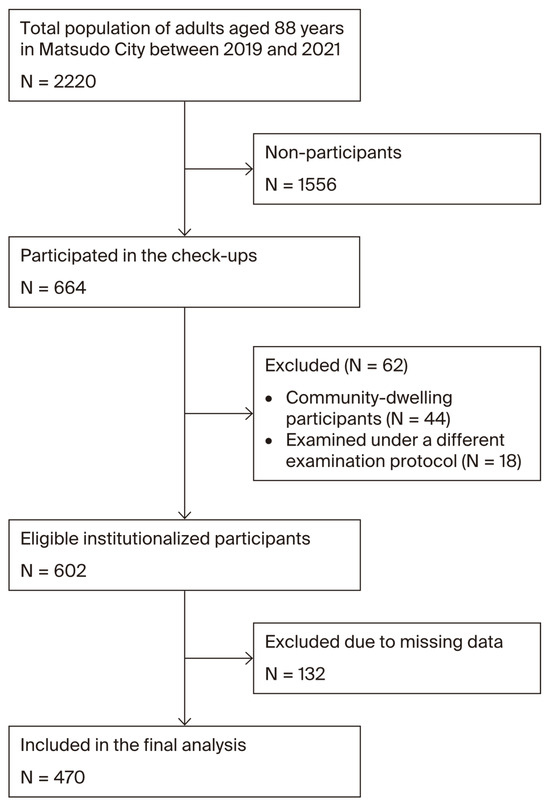
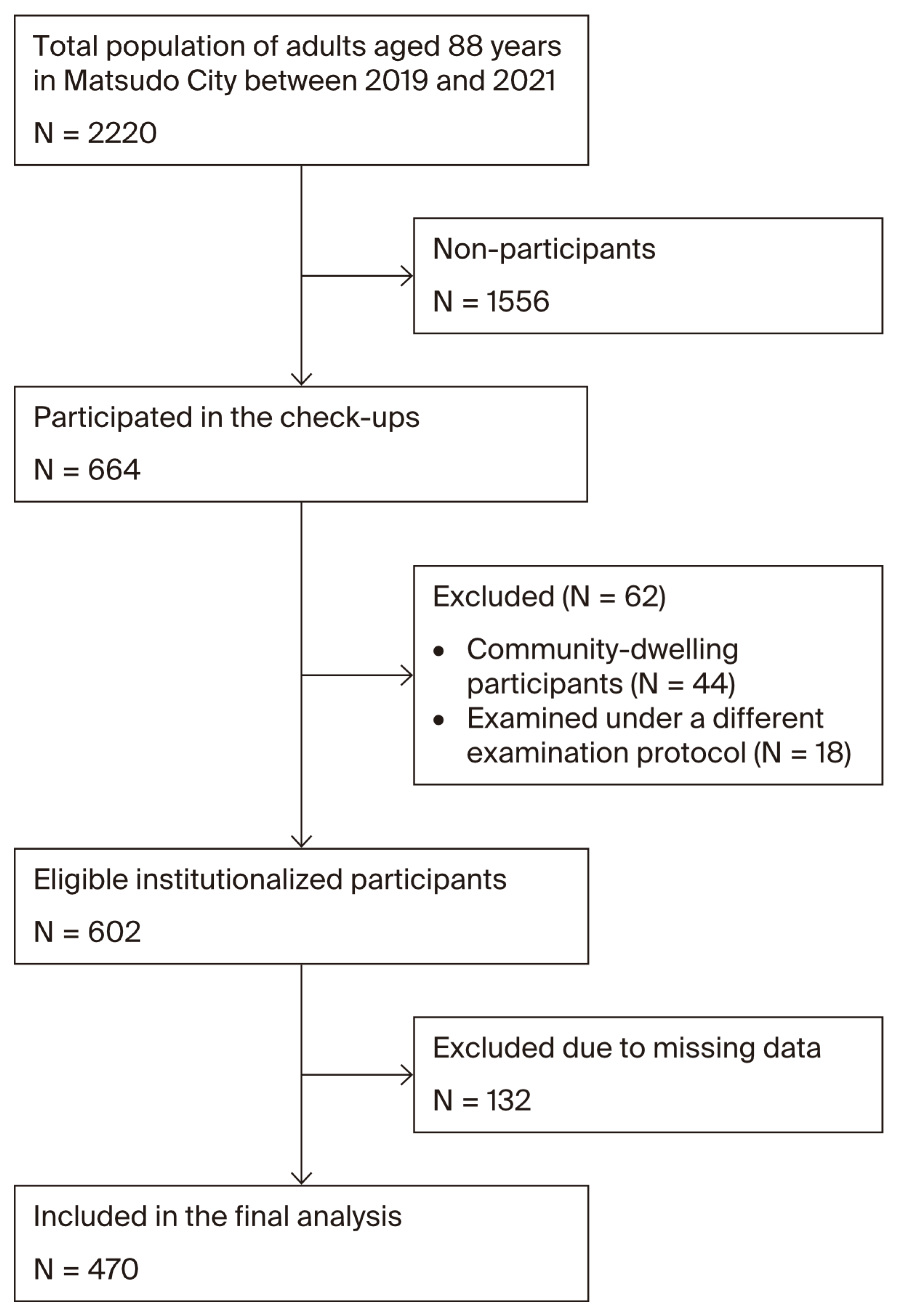
This population-based cross-sectional study analyzed administrative data from Matsudo City, Chiba Prefecture, Japan. In line with Japanese cultural traditions that commemorate longevity, dental check-ups are provided through dental clinics or house-call services for insured adults reaching the milestone age of 88. The study population included 664 individuals who participated in these check-ups out of a total population of 2220 adults aged 88 years in Matsudo City between 2019 and 2021 (Figure 1). For the present study, community-dwelling participants were excluded because the study aimed to investigate institutionalized older adults. Therefore, only participants residing in long-term care facilities were included in the analysis. Of the 664 participants, 44 community-dwelling individuals were excluded. In addition, 18 institutionalized participants examined by dentists from the Matsudo Dental Association using a different examination protocol were excluded. The remaining 602 institutionalized participants constituted the eligible study population. Of these, 132 participants with missing data for variables included in the analysis were excluded, resulting in a final analytical sample of 470 participants. Since examinations were conducted as part of routine municipal health maintenance, specific informed consent for research was not obtained from individual participants. Nevertheless, Matsudo City granted permission to use the data anonymously for health promotion purposes among insured older adults. A previous study used this dataset to examine the relationship between diabetes and periodontal pocket depth [14,15]. Our study was approved by the Ethics Committee of Wayo Women’s University (Approval No. 2261). It adhered to the ethical principles outlined in the World Medical Association’s Declaration of Helsinki; the Ethical Guidelines for Epidemiological Research by Japan’s Ministry of Education, Culture, Sports, Science and Technology; and the guidelines of the Ministry of Health, Labour, and Welfare, Japan.
Figure 1.
Flow diagram of participant selection and inclusion in the analysis.
2.2. Measurements
Clinical data were collected during dental check-ups performed by dentists. The number of remaining teeth and periodontal pocket depth were evaluated by the trained dentist participating in the municipal dental examination program.
Periodontal examination: Trained dentists counted the number of teeth and recorded the probing pocket depth at six points (buccal-mesial, mid buccal, buccal-distal, lingual-mesial, mid-lingual, and lingual-distal) on a right upper molar, an upper incisor, left upper molar, right lower molar, lower incisor, and left lower molar. Measurements were made to the nearest millimeter; where any doubt existed, a lower value was assigned. The periodontal pocket was categorized as yes (≥4 mm) or no (<4 mm).
Occlusal support was assessed using the Eichner classification [5,13]. Four posterior occlusal support zones were evaluated: the right premolar, right molar, left premolar, and left molar regions. For each zone, occlusal support was considered present when at least one opposing pair of natural teeth or prosthetic replacements was judged to be in functional occlusal contact, including fixed and removable prostheses [16]. Because the present study was restricted to institutionalized older adults, oral examinations were performed by a limited number of participating dentists, thereby reducing potential inter-examiner variability compared with examinations conducted in community-dwelling participants. Functional posterior occlusal support was determined from the recorded status of natural teeth and prosthetic restorations. Based on these data, participants were classified into three categories according to the number of posterior occlusal support zones for analysis. Participants with occlusal support in all four posterior zones were classified as having complete posterior occlusal support, those with occlusal support in at least one but not all posterior zones were classified as partial support, and those with no posterior occlusal support zones were classified as no support. The “no posterior occlusal support group” was used as a reference category for logistic regression analyses.
Data on participant demographics, health status, and lifestyle habits were obtained through a questionnaire administered by the dentists during the check-up. Variables included sex, smoking status (current, past, or never), abdominal/visceral obesity (yes or no), history of myocardial infarction or cerebral infarction (yes or no), and presence of type 2 diabetes (yes or no). History of myocardial or cerebral infarction was recorded as a single combined variable in the municipal examination dataset; therefore, the two conditions could not be analyzed separately.
2.3. Statistical Analyses
The study was based on administrative data from a municipal dental check-up program targeting all eligible residents aged 88 years; an a priori sample size calculation was not performed. Instead, a post hoc power consideration was conducted to evaluate whether the available sample size was sufficient to detect a clinically meaningful association. With a total sample size of 470 participants, including 96 individuals with a history of myocardial or cerebral infarction, the study had approximately 75–80% power to detect an odds ratio of 1.6 or greater for posterior occlusal support at a two-sided significance level of 0.05.
Chi-square tests for categorical variables and Welch’s t-test for remaining teeth were performed to examine the relationship between a history of myocardial infarction or cerebral infarction and covariates and oral hygiene. To examine the relationship between posterior occlusal support and a history of myocardial infarction or cerebral infarction, binomial logistic regression analyses were performed while adjusting for covariates. Both unadjusted and adjusted odds ratios (ORs) with 95% confidence intervals (CIs) were calculated. Models were adjusted for sex, obesity, diabetes mellitus, smoking history, periodontal pocket status, and number of remaining teeth. Statistical significance was set at p < 0.05. All analyses were conducted using Stata 16.1 (StataCorp, College Station, TX, USA).
3. Results
Of the 470 participants, 406 (86.4%), 53 (11.3%), and 11 (2.3%) were classified as having complete, partial, and no posterior occlusal support, respectively (Table 1). Participants consisted of 201 males (42.8%) and 269 females (57.2%). Most participants (340 [72.3%]) had no history of smoking; 130 (27.7%) were former or current smokers. Regarding comorbidities, 55 participants (11.7%) had diabetes, and 10 (2.1%) had obesity.
Table 1.
Participant characteristics according to myocardial infarction or cerebral infarction (N = 470).
Univariable and multivariable logistic regression analyses were conducted with myocardial or cerebral infarction as the dependent variable (Table 2). The univariable logistic regression analysis results indicate that females (OR: 0.56, 95% CI: 0.36–0.88) were significantly less likely to exhibit myocardial or cerebral infarction, and that participants who were current or past smokers (OR: 1.69, 95% CI: 1.05–2.71) and those with diabetes mellitus (OR: 1.90, 95% CI: 1.02–3.54) were significantly more likely to exhibit myocardial or cerebral infarction. Participants with complete (OR: 0.46, 95% CI: 0.13–1.62) and partial posterior occlusal support (OR: 0.27, 95% CI: 0.06–1.15) were less likely to exhibit myocardial or cerebral infarction, although the association was not statistically significant. The multivariable regression analysis results indicate that partial posterior occlusal support (OR: 0.21, 95% CI: 0.05–0.99) was significantly less likely to be associated with myocardial or cerebral infarction. Complete occlusal support exhibited a similar trend, although the association was not statistically significant (OR: 0.40, 95% CI: 0.11–1.50).
Table 2.
Association between history of myocardial or cerebral infarction and posterior occlusal support among 88-year-old adults in Japan (N = 470).
4. Discussion
In this study, posterior occlusal support was potentially associated with a history of myocardial or cerebral infarction among 88-year-old institutionalized older adults. Particularly, the association between posterior occlusal support and a history of myocardial infarction and infarction-related cardiovascular disease did not materially change after adjusting for the number of remaining teeth and periodontal status. The findings suggest that functional occlusal support, based on opposing contact between the maxillary and mandibular teeth, should be considered alongside tooth count when evaluating oral health in older adults.
In the present study, participants with partial posterior occlusal support had lower odds of a self-reported history of cerebral or myocardial infarction than those without posterior occlusal support after adjusting for potential confounders. However, this estimate should be interpreted with caution because the reference group without posterior occlusal support was very small, resulting in a wide confidence interval and limited statistical precision. Although the point estimate suggested a potentially meaningful association, the uncertainty surrounding the estimate precludes firm conclusions regarding the strength or clinical significance of this relationship. Therefore, the present findings should be regarded as exploratory and hypothesis-generating. Confirmation is required in larger longitudinal studies with a more balanced distribution of posterior occlusal support.
Several mechanisms may underlie the association observed in the present study. Loss of posterior occlusal support may reduce masticatory efficiency, making it challenging to consume hard foods while affecting food choice and nutrient intake [5,6,7]. Past research has reported that reduced masticatory function is associated with lower intake of vegetables, fruits, dietary fiber, and other foods, as well as with dietary imbalance [6,7]. Changes in dietary behavior can influence cardiovascular disease risk through metabolic abnormalities, including impaired glucose metabolism, obesity, and chronic inflammation [9,10,11]. However, since dietary intake, nutritional status, and inflammatory markers were not directly assessed in this study, these potential pathways should be examined in future research.
Posterior occlusal support is also a functional indicator that provides information distinct from the number of remaining teeth, because the presence and distribution of occlusal contacts are closely related to masticatory performance [17,18]. Ikebe et al. [17], using the Eichner classification in adults aged ≥60 years, reported that masticatory performance decreased with loss of posterior occlusal support, supporting the functional relevance of occlusal support in older adults. Higashi et al. [18] demonstrated that loss of posterior occlusal support was associated with deterioration in masticatory performance. These findings support the importance of considering the distribution of functional occlusal contacts, in addition to the number of remaining teeth, when evaluating oral function in older adults. This distinction between tooth count and functional occlusal support is also reflected in the Eichner classification, in which adequate occlusal support may be absent even when teeth remain in both arches if opposing occlusal contacts are lacking [5,13]. In contrast, a certain degree of occlusal support can be restored with prosthetics, such as dentures or fixed bridges [16,19]. In the present study, occlusal support was considered present when functional occlusal contact was restored with prosthetic devices. Notably, maintaining oral function in very old adults is an essential goal in prosthetic treatment and denture management for dietary life and nutritional status [11].
Japanese food education policies also underscore the importance of maintaining chewing function and encourage diverse food intake among older adults [12]. In institutionalized older adults, meal texture, oral care, and denture management can be influenced by the support systems of individual facilities [20]. Among institutionalized older adults requiring long-term care, denture use and denture quality have been associated with diet texture, suggesting the importance of appropriate denture management in this population [21]. Thus, maintaining occlusal support may be relevant to nutritional management in older adults [22].
The study limitations are as follows: First, the cross-sectional design precludes causal inference and increases the possibility of reverse causality. Second, although dentists assessed oral hygiene, some covariates and medical history variables were obtained through participant self-reports and may be subject to reporting bias. Third, examiner calibration and inter-examiner reliability data were not available because this study used secondary data collected through a municipal dental examination program, and some degree of examiner-related variability cannot be excluded. Because the present study was restricted to institutionalized older adults, oral examinations were performed by a limited number of participating dentists, which may have reduced inter-examiner variability compared with examinations conducted in community-dwelling participants. Fourth, the dataset did not distinguish between myocardial and cerebral infarction; thus, we could not evaluate whether the association with oral hygiene differed between myocardial and cerebral infarction since history of these issues was only available as a combined variable. Fifth, the study focused on a single municipality in Japan, which may limit the generalizability of the findings to other populations and settings. Finally, several potential confounding factors were not available in the present dataset, including educational attainment, socioeconomic status, dependency level, cognitive status, oral hygiene behaviors, access to dental care, and the specific level of nursing care required. Therefore, residual confounding due to these unmeasured factors cannot be excluded. The applicability of previous findings to very old adults remains unclear, and further studies are required to clarify the relationship between a history of cardiovascular or cerebrovascular disease and posterior occlusal support among this growing population.
This cross-sectional study of 88-year-old institutionalized older adults revealed that preserved posterior occlusal support was associated with lower odds of a history of myocardial or cerebral infarction. This association remained unchanged after adjusting for the number of remaining teeth and periodontal status. These findings suggest that posterior occlusal support may provide functional information beyond tooth count alone. However, this association should be interpreted with caution because the reference group of individuals without posterior occlusal support was small, resulting in limited statistical precision and wide confidence intervals. Therefore, these findings should be regarded as exploratory rather than conclusive and require confirmation in larger studies with more balanced distributions of posterior occlusal support categories.
Author Contributions
M.K. and S.T. contributed to the study’s concept and design and conducted the statistical analyses. M.K., S.H. and S.T. had full access to all study data and were responsible for data integrity and the accuracy of the data analyses. K.T., T.F., Y.Y., M.T. and J.F. were responsible for interpreting the results, drafting the manuscript, and conducting the critical review. All authors have read and agreed to the published version of the manuscript.
Funding
This work was supported by the Wayo Women’s University Suzuki Kazue Scholarship.
Institutional Review Board Statement
Ethics approval for this study was obtained from the Ethics Committee of Wayo Women’s University (Authorization No. 2261, date of approval: 31 January 2023).
Informed Consent Statement
Data were obtained in an anonymous format under the research agreement between the municipality and our research group. Dental health check-ups were conducted as part of routine municipal health maintenance. Therefore, specific informed consent for research was not obtained from individual participants. However, Matsudo City granted permission to use the data anonymously to promote the health of insured older adults (an opt-out method was used for administrative data).
Data Availability Statement
The data analyzed in this study are not publicly available because Matsudo City provided them for the approved research purpose and contain potentially identifiable health-related information. The authors are not permitted to share the individual-level data with third parties under the conditions of data use and ethical approval. Researchers who wish to access similar data should contact Matsudo City and obtain the necessary administrative and ethical approvals.
Acknowledgments
We thank the Health Promotion Division of Matsudo City for its excellent support in data collection and management. We also thank Naoko Adachi, Shunsaku Mizushima, Seiichi Oda, and Yukio Hattori for their advisory comments on the manuscript.
Conflicts of Interest
The authors declare no conflicts of interest.
References
- Rich, M.W.; Chyun, D.A.; Skolnick, A.H.; Alexander, K.P.; Forman, D.E.; Kitzman, D.Q.; Maurer, M.S.; McClurken, J.B.; Resnick, B.M.; Shen, W.K.; et al. Knowledge Gaps in Cardiovascular Care of the Older Adult Population: A Scientific Statement From the American Heart Association, American College of Cardiology, and American Geriatrics Society. Circulation 2016, 133, 2103–2122. [Google Scholar] [PubMed]
- Sheiham, A.; Steele, J. Does the condition of the mouth and teeth affect the ability to eat certain foods, nutrient and dietary intake and nutritional status among older people? Public Health Nutr. 2001, 4, 797–803. [Google Scholar] [CrossRef] [Scilit] [PubMed]
- Arbildo-Vega, H.I.; Cruzado-Oliva, F.H.; Coronel-Zubiate, F.T.; Meza-Málaga, J.M.; Luján-Valencia, S.A.; Luján-Urviola, E.; Echevarria-Goche, A.; Farje-Gallardo, C.A.; Castillo-Cornock, T.B.; Serquen-Olano, K.; et al. Periodontal disease and cardiovascular disease: Umbrella review. BMC Oral Health 2024, 24, 1308. [Google Scholar] [CrossRef] [Scilit] [PubMed]
- Ikebe, K.; Matsuda, K.; Kagawa, R.; Enoki, K.; Yoshida, M.; Maeda, Y.; Nokubi, T. Association of masticatory performance with age, gender, number of teeth and occlusal force in older adults. Arch. Oral Biol. 2011, 56, 991–996. [Google Scholar] [CrossRef] [Scilit] [PubMed]
- Eichner, K. Renewed examination of the group classification of partially edentulous arches by Eichner and application advices for studies on morbidity statistics. Stomatol. DDR 1990, 40, 321–325. [Google Scholar] [PubMed]
- Sheiham, A.; Steele, J.G.; Marcenes, W.; Finch, S.; Walls, A.W. The impact of oral health on stated ability to eat certain foods; findings from the National Diet and Nutrition Survey of Older People in Great Britain. Gerodontology 1999, 16, 11–20. [Google Scholar] [CrossRef] [Scilit] [PubMed]
- Kikutani, T.; Yoshida, M.; Enoki, H.; Yamashita, Y.; Akifusa, S.; Shimazaki, Y.; Hirano, H.; Tamura, F. Relationship between nutrition status and dental occlusion in community-dwelling frail elderly people. Geriatr. Gerontol. Int. 2013, 13, 50–54. [Google Scholar] [CrossRef] [Scilit] [PubMed]
- Iwasaki, M.; Taylor, G.W.; Manz, M.C.; Yoshihara, A.; Sato, M.; Muramatsu, K.; Watanabe, R.; Miyazaki, H. Oral health status: Relationship to nutrient and food intake among 80-year-old Japanese adults. Community Dent. Oral Epidemiol. 2014, 42, 441–450. [Google Scholar] [CrossRef] [Scilit] [PubMed]
- Yoshihara, A.; Watanabe, R.; Nishimuta, M.; Hanada, N.; Miyazaki, H. The relationship between dietary intake and masticatory function in the elderly. J. Oral Rehabil. 2005, 32, 735–740. [Google Scholar] [PubMed]
- Liu, S.; Willett, W.C.; Stampfer, M.J.; Hu, F.B.; Franz, M.; Sampson, L.; Hennekens, C.H.; Manson, J.E. A prospective study of dietary glycemic load, carbohydrate intake, and risk of coronary heart disease in US women. Am. J. Clin. Nutr. 2000, 71, 1455–1461. [Google Scholar] [CrossRef] [Scilit] [PubMed]
- Iwasaki, M.; Hirano, H.; Ohara, Y.; Motokawa, K. The association of oral function with dietary intake and nutritional status among older adults: Latest evidence from epidemiological studies. Jpn. Dent. Sci. Rev. 2021, 57, 128–137. [Google Scholar] [CrossRef] [Scilit] [PubMed]
- Ministry of Agriculture, Forestry and Fisheries. A Guide for Shokuiku. 2020. Available online: https://www.maff.go.jp/j/syokuiku/guide/pdf/00_en_guide.pdf (accessed on 19 July 2026).
- Miyano, T.; Tamada, Y.; Kusama, T.; Osaka, K.; Takeuchi, K. Impact of posterior occlusal contact loss on cardiovascular disease using a Japanese claims database. Sci. Rep. 2025, 15, 16693. [Google Scholar] [CrossRef] [Scilit] [PubMed]
- Komoto, M.; Toyokawa, S.; Tonai, K.; Furuhata, T.; Yanagisawa, Y. Dental pocket and type 2 diabetes among elderly people aged 88 in Japan—Report on improvements to analytical methods. Glob. J. Health Sci. 2024, 17, 30–35. [Google Scholar] [CrossRef] [Scilit]
- Komoto, M.; Toyokawa, S.; Tonai, K.; Furuhata, T.; Mizushima, S.; Oda, S.; Hattori, Y.; Hattori, Y.; Furuhata, T.; Yanagisawa, Y. Dental pocket and type 2 diabetes among elderly people aged 88 in Japan. Glob. J. Health Sci. 2024, 16, 1–6. [Google Scholar] [CrossRef] [Scilit]
- Kikutani, T.; Takahashi, N.; Tohara, T.; Furuya, H.; Tanaka, K.; Hobo, K.; Isoda, T.; Fukui, T. Relationship between maintenance of occlusal support achieved by home-visit dental treatment and prognosis in home-care patients—A preliminary study. Geriatr. Gerontol. Int. 2022, 22, 976–981. [Google Scholar] [CrossRef] [Scilit] [PubMed]
- Ikebe, K.; Matsuda, K.; Kagawa, R.; Enoki, K.; Okada, T.; Yoshida, M.; Maeda, Y. Masticatory performance in older subjects with varying degrees of tooth loss. J. Dent. 2012, 40, 71–76. [Google Scholar] [CrossRef] [Scilit] [PubMed]
- Higashi, K.; Hatta, K.; Mameno, T.; Takahashi, T.; Gondo, Y.; Kamide, K.; Masui, Y.; Ishizaki, T.; Arai, Y.; Kabayama, M.; et al. The relationship between changes in occlusal support and masticatory performance using 6-year longitudinal data from the SONIC study. J. Dent. 2023, 139, 104763. [Google Scholar] [CrossRef] [Scilit] [PubMed]
- Lopez-Cordon, M.A.; Khoury-Ribas, L.; Rovira-Lastra, B.; Ayuso-Montero, R.; Martinez-Gomis, J. Improved Masticatory Performance in the Partially Edentulous Rehabilitated with Conventional Dental Prostheses. Medicina 2024, 60, 1790. [Google Scholar] [CrossRef] [Scilit] [PubMed]
- Mehta, N.; Das, D.; Dogra, E.; Gupta, A.; Srivastava, R.; Sharda, S.; Saroya, K.K.; Goyal, A. Effectiveness of Educating Caregivers on Oral Health of Institutionalized Older Adults: A Systematic Review and Meta-Analysis. Int. J. Older People Nurs. 2025, 20, e70038. [Google Scholar] [CrossRef] [Scilit] [PubMed]
- Hirayama, M.; Hatanaka, Y.; Yamane, K.; Mukai, T.; Namikawa, K.; Teraoka, M.; Tabata, T.; Suzuki, H.; Ako, K.; Furuya, J. Association of Diet Texture with Denture Wearing and Denture Quality in Institutionalized Older Adults Requiring Long-Term Care. Cureus 2025, 17, e97796. [Google Scholar] [CrossRef] [Scilit] [PubMed]
- Mikami, R.; Komagamine, Y.; Aoyama, N.; Mizutani, K.; Sasaki, Y.; Iwata, T.; Minakuchi, S.; Kanazawa, M. Association between occlusal supports and nutritional status in older adults: A systematic review. J. Dent. Sci. 2024, 19, 813–827. [Google Scholar] [CrossRef] [Scilit] [PubMed]

Disclaimer/Publisher’s Note: The statements, opinions and data contained in all publications are solely those of the individual author(s) and contributor(s) and not of MDPI and/or the editor(s). MDPI and/or the editor(s) disclaim responsibility for any injury to people or property resulting from any ideas, methods, instructions or products referred to in the content. |
© 2026 by the authors. Licensee MDPI, Basel, Switzerland. This article is an open access article distributed under the terms and conditions of the Creative Commons Attribution (CC BY) license.