


Abstract
Background/objectives. Clostridioides difficile infection (CDI) remains a major cause of healthcare-associated infectious colitis, particularly among elderly and multimorbid patients. Disease severity and clinical evolution are influenced by the host’s systemic inflammatory response. This study aimed to evaluate the hematological and inflammatory profile of hospitalized CDI patients and to explore the prognostic value of routine laboratory parameters for prolonged hospitalization. Methods. A retrospective observational study was conducted on 50 adult patients hospitalized with laboratory-confirmed CDI (positive glutamate dehydrogenase, antigen and toxins A/B). Hematological parameters (WBC, hemoglobin, RDW) and inflammatory markers (CRP, fibrinogen) were analyzed at admission and discharge. Prolonged hospitalization was defined as length of stay (LOS) > 8 days (cohort median). Multivariable logistic regression was performed to assess admission predictors of prolonged hospitalization, and model discrimination was evaluated using leave-one-out cross-validation (LOOCV). Results. At admission, patients exhibited marked inflammatory activation accompanied by reduced hemoglobin and elevated RDW. Significant correlations were observed between inflammatory markers. All inflammatory and hematologic parameters improved at discharge. In multivariable analysis, lower admission hemoglobin and higher log-transformed CRP showed exploratory associations with prolonged hospitalization. The internally validated model demonstrated moderate discriminative performance (AUC = 0.65). Conclusions. CDI is associated with substantial systemic inflammatory activation and hematologic alterations. While no individual predictor reached statistical significance, the observed effect sizes provide hypothesis-generating estimates to inform future prospective validation studies.
1. Introduction
Clostridioides difficile infection (CDI) remains one of the leading causes of healthcare-associated infectious colitis and represents a significant global public health concern [1,2,3,4]. Over the past two decades, the epidemiology of CDI has evolved significantly: while the incidence of healthcare-associated CDI (HA-CDI) has declined in recent years, largely due to improved antimicrobial stewardship and infection control measures, community-associated CDI (CA-CDI) has shown an increasing trend, expanding the population at risk beyond traditional hospital settings [5,6,7]. Antibiotic exposure is the principal modifiable risk factor for CDI, as it disrupts intestinal microbiota homeostasis, facilitating spore germination and toxin production. Consequently, antimicrobial stewardship programs have become central to CDI prevention strategies, aiming to optimize antibiotic prescribing and reduce unnecessary exposure [6,7]. Variations in national antibiotic consumption patterns may partly account for differences in CDI incidence and severity across regions.
CDI is caused by a Gram-positive, spore-forming anaerobe whose pathogenicity is mediated primarily by toxins A and B, which induce mucosal injury and trigger local and systemic inflammatory cascades [8,9,10]. These toxins stimulate the release of proinflammatory cytokines such as interleukin-6 (IL-6), interleukin-8 (IL-8), and tumor necrosis factor alpha (TNF-α), leading to intense neutrophil recruitment and activation of acute-phase reactants, including C-reactive protein (CRP) and fibrinogen [11,12]. Globally, CDI is the most common cause of nosocomial diarrhea and is associated with substantial morbidity and mortality, particularly among elderly and immunocompromised individuals [13,14]. In Europe, reported incidence ranges between 2 and 10 cases per 10,000 patient-days, although underdiagnosis likely underestimates the true burden [15,16]. In Romania, the predominance of the hypervirulent ribotype 027 has been associated with more severe disease and unfavorable outcomes [12,17].
The systemic inflammatory response induced by CDI is reflected in characteristic hematological alterations, including leukocytosis, neutrophilia, anemia of inflammation, and elevated acute-phase markers. Pronounced leukocytosis (>15 × 109/L) and CRP levels exceeding 100 mg/L have been associated with severe disease and increased risk of complications and recurrence [18,19].
Inflammatory anemia in CDI is largely mediated by hepcidin-driven iron sequestration and impaired erythropoiesis [20,21]. Moreover, increased red cell distribution width (RDW) has emerged as a marker of systemic inflammation and adverse outcomes in infectious conditions, reflecting erythrocyte heterogeneity and oxidative stress [22,23]. Fibrinogen and erythrocyte sedimentation rate (ESR) further serve as indicators of inflammatory burden [24,25].
Although individual inflammatory markers have been linked to disease severity, the dynamic evolution of hematological parameters during hospitalization and their integrated prognostic value remain incompletely characterized in real-world cohorts.
Recent international guidelines have emphasized the importance of integrating laboratory biomarkers into CDI severity assessment and therapeutic decision-making algorithms, particularly in elderly and high-risk populations [26,27]. Emerging data from multicenter cohorts suggest that composite inflammatory indices combining CRP, leukocyte count, and erythrocyte-related parameters may improve early risk stratification compared with single biomarkers alone [28]. In a previous large cohort analysis from our institution, serum albumin, leukocyte count, and hemoglobin levels were identified as independent predictors of mortality in CDI patients [29]. Building on these findings, the present study explores the dynamic evolution of hematological markers during hospitalization. Furthermore, recent studies highlight the prognostic relevance of hematologic variability markers such as RDW in infectious and inflammatory conditions [30]. Despite these advances, real-world hospital-based analyses evaluating the dynamic evolution of these routinely available parameters during CDI hospitalization remain limited.
The aim of this study was to evaluate hematological and inflammatory changes in hospitalized patients with laboratory-confirmed CDI and to explore their potential prognostic relevance, particularly in relation to prolonged hospitalization.
2. Materials and Methods
2.1. Study Design and Population
This retrospective observational study included 50 consecutive adult patients hospitalized in 2024 at a dedicated infectious diseases hospital with laboratory-confirmed Clostridioides difficile infection (CDI). Diagnosis was established based on positive glutamate dehydrogenase (GDH) antigen testing and detection of toxins A and/or B, according to institutional diagnostic protocols. All patients in the study cohort were confirmed as GDH-positive with detectable toxins A and/or B (GDH+/Tox A+/B+). Molecular ribotyping was not routinely performed at our institution during the study period; however, this toxin profile is consistent with toxigenic strains, including the hypervirulent ribotype 027, which has been reported as the predominant circulating strain in Romania [17].
All eligible patients meeting inclusion criteria during the study period were included, resulting in a complete-case cohort. Due to the retrospective design based on archived clinical data, no a priori sample size calculation was performed. Therefore, the study should be interpreted as exploratory and hypothesis-generating.
The study protocol was approved by the Institutional Ethics Committee (Approval No. 1/21 January 2025), and all data were anonymized prior to analysis in accordance with the Declaration of Helsinki [31].
2.2. Inclusion and Exclusion Criteria
Inclusion criteria were: age ≥ 18 years; laboratory-confirmed CDI; availability of complete laboratory data at both admission and discharge; and hospitalization ≥ 24 h.
Exclusion criteria were: incomplete key laboratory data; transfer before completion of the clinical episode; and terminal-stage conditions significantly influencing hematologic parameters.
2.3. Disease Severity Classification
Disease severity was classified as mild, moderate, or severe based on inflammatory biological markers available in the study cohort. Severe CDI was defined by marked leukocytosis (WBC > 15 × 109/L) and/or serum creatinine ≥ 1.5 mg/dL, consistent with the IDSA/SHEA 2017 severity criteria [32]. However, since serum creatinine was not systematically available in the study dataset, severity classification relied primarily on WBC and CRP thresholds. Specifically, severe CDI was defined as WBC > 15 × 109/L and/or CRP > 100 mg/L; mild CDI as WBC ≤ 10 × 109/L with CRP < 50 mg/L and absence of systemic complications; and moderate CDI as intermediate laboratory values not meeting criteria for either mild or severe classification [32,33]. The absence of serum creatinine in the classification is acknowledged as a limitation.
2.4. Clinical and Laboratory Data Collection
Demographic data (age, sex, residence), comorbidities, length of hospital stay (LOS), and discharge status were extracted from electronic medical records.
Hematological parameters measured at admission and discharge included: white blood cell count (WBC), red blood cell count (RBC), hemoglobin (HGB), hematocrit (HCT), platelet count (PLT), and red cell distribution width (RDW).
Inflammatory markers included: C-reactive protein (CRP), fibrinogen, and erythrocyte sedimentation rate (ESR).
Hematological analysis was performed using the ABX Pentra XL80 automated analyzer (Horiba, Montpellier, France). CRP was measured on the ABX Pentra C400 analyzer Horiba Medical, Montpellier, France, and fibrinogen was determined using a Sysmex coagulation analyzer (Sysmex Corporation, Kobe, Japan). All measurements were conducted according to standardized laboratory procedures.
2.5. Definition of Clinical Outcomes
The primary outcome was prolonged hospitalization, defined as (LOS) greater than the cohort median (>8 days). LOS was measured as total hospitalization duration from admission to discharge and was not restricted to CDI-attributable days. While all patients in this cohort were hospitalized primarily for CDI at a dedicated infectious diseases hospital, non-CDI factors (comorbidities, functional status, institutional discharge practices) may have contributed to total LOS. This represents a recognized limitation of the study design.
The secondary outcome was non-improvement at discharge, defined as a binary variable: (a) Improved—patients discharged with documented clinical improvement (discharge status recorded as “ameliorat” or “clinic favorabil”); (b) Non-improved—patients discharged without documented clinical improvement (status recorded as “stationar”) or transferred to another facility before clinical resolution. Patients transferred to another facility were conservatively classified as non-improved due to the absence of complete follow-up data within the study center.
2.6. Statistical Analysis
Statistical analyses were performed using IBM SPSS version 26. Continuous variables were assessed for normality using the Shapiro–Wilk test. Normally distributed data are presented as mean ± standard deviation (SD), while non-normally distributed variables are presented as median (interquartile range).
Paired comparisons between admission and discharge values were performed using the paired-samples t-test or Wilcoxon signed-rank test, as appropriate. Between-group comparisons (LOS ≤ 8 vs. >8 days) were conducted using independent-samples t-tests or Mann–Whitney U tests. Correlation analyses were performed using Pearson or Spearman correlation coefficients, depending on data distribution.
To explore admission predictors of prolonged hospitalization, multivariable logistic regression models were constructed. Candidate variables were selected based on clinical plausibility and included age, admission hemoglobin, and C-reactive protein (CRP). Because CRP exhibited a right-skewed distribution, log-transformed CRP [log (CRP + 1)] was used in regression modeling.
Given the relatively small cohort size, a parsimonious modeling strategy was adopted to minimize overfitting risk. Model discrimination was evaluated using the area under the receiver operating characteristic curve (AUC). Internal validation was performed using LOOCV). Sensitivity analyses were conducted by adding WBC to the primary model. Odds ratios (ORs) with 95% confidence intervals (95% CI) were reported. A p-value < 0.05 was considered statistically significant.
3. Results
3.1. Baseline Demographic and Clinical Characteristics
A total of 50 adult patients with laboratory-confirmed Clostridioides difficile infection were included. The mean age was 67.2 ± 10.3 years, with 72% of patients aged over 60 years. The distribution of patients by age group is presented in Table 1.
Table 1.
Distribution of patients by age group.
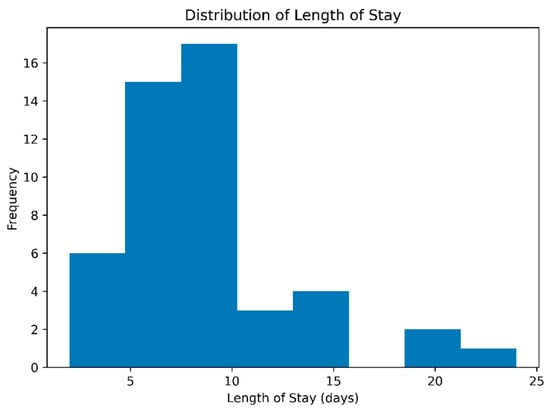
Females represented 54% of the cohort. The median length of hospital stay (LOS) was 8 days (IQR: 7–10 days), as illustrated in Figure 1. Based on this median value, patients were stratified into LOS ≤ 8 days (n = 27) and LOS > 8 days (n = 23). Baseline demographic characteristics were comparable between groups.
Figure 1.
Histogram showing the distribution of length of hospital stay (LOS). The right-skewed distribution supports the use of median-based stratification (>8 days) for defining prolonged hospitalization.
3.2. Clinical Severity
Patients were categorized as mild (28%), moderate (52%), and severe (20%). Severe forms were associated with higher admission leukocyte counts (>15 × 109/L) and CRP levels (>100 mg/L) compared with mild forms (p < 0.01). All patients were confirmed GDH+/Toxin A+/B+, a toxin profile consistent with toxigenic strains including ribotype 027, which has been reported as predominant in the Romanian epidemiological context [17]. In the absence of molecular ribotyping, strain-level attribution could not be performed.
3.3. Hematological and Inflammatory Profile at Admission
At admission, patients exhibited a marked inflammatory profile. The descriptive statistics for all hematological and inflammatory parameters at admission are summarized in Table 2.
Table 2.
Hematological and inflammatory parameters at admission.
CRP values demonstrated substantial right-skewness with several high outliers, supporting the use of log-transformation in regression modeling. These findings confirm a pronounced systemic inflammatory response at hospitalization.
3.4. Evolution During Hospitalization
Significant improvements were observed between admission and discharge (paired analysis, p < 0.05). Table 3 presents a side-by-side comparison of hematological and inflammatory parameters at admission and discharge, including the percentage of change and normal reference ranges.
Table 3.
Comparison of hematological and inflammatory parameters at admission and discharge.
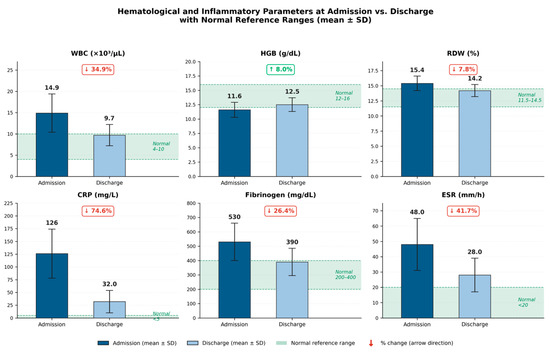
Figure 2 provides a visual comparison of admission versus discharge values alongside normal reference ranges for selected parameters.
Figure 2.
Hematological and inflammatory parameters at admission vs. discharge, with normal reference ranges (mean ± SD). Bars represent mean values with error bars indicating standard deviation, for admission (dark blue) and discharge (light blue). Colored arrows above each panel indicate the direction and percentage of change between admission and discharge: red downward arrows (↓) denote a decrease, while the green upward arrow (↑) denotes an increase (HGB). The green shaded area within each panel represents the normal reference range for that parameter, with numerical limits annotated on the right. Despite overall improvement, mild residual anemia persisted in 18% of patients.
3.5. Correlation Analysis
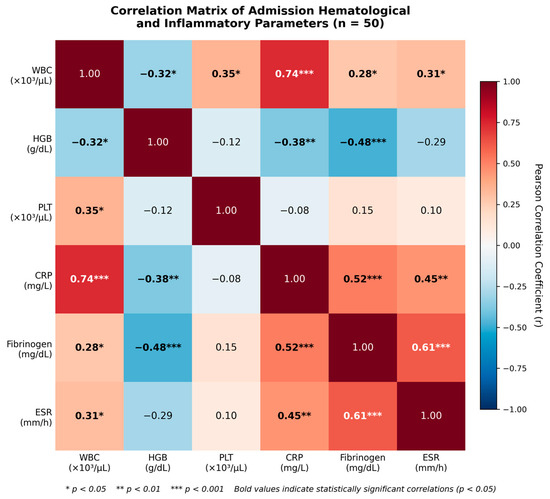
Pearson correlation analysis was performed between all key admission hematological and inflammatory parameters. The results are summarized in the correlation matrix heatmap (Figure 3).
Figure 3.
Correlation matrix heatmap of admission hematological and inflammatory parameters (n = 50). Pearson correlation coefficients (r) are displayed in each cell, color-coded according to the scale on the right (red, positive correlation; blue, negative correlation). Bold values indicate statistically significant correlations (p < 0.05). Asterisks denote significance level: * p < 0.05, ** p < 0.01, *** p < 0.001.
The strongest correlation was observed between fibrinogen and ESR (r = 0.61, p < 0.001), consistent with their shared role as acute-phase reactants. CRP showed significant positive correlations with both fibrinogen (r = 0.52, p < 0.001) and ESR (r = 0.45, p < 0.01), indicating coordinated inflammatory activation. WBC showed a strong positive correlation with CRP (r = 0.74, p < 0.001).
Fibrinogen was inversely correlated with hemoglobin (r = −0.48, p < 0.01), supporting the interaction between inflammatory burden and erythropoietic suppression.
3.6. Admission Predictors of Prolonged Hospitalization
Patients with LOS > 8 days presented lower admission hemoglobin levels and higher inflammatory marker values.
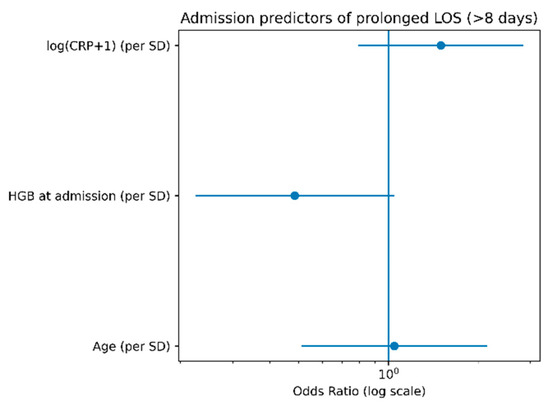
Multivariable logistic regression analysis adjusted for age and including admission hemoglobin and log-transformed CRP [log (CRP + 1)] is presented in Table 4, with odds ratios illustrated in Figure 4.
Table 4.
Multivariable logistic regression analysis for prolonged hospitalization.
Figure 4.
Forest plot showing odds ratios (OR) and 95% confidence intervals (CI) for standardized admission predictors of prolonged hospitalization (>8 days).
The multivariable logistic regression model was specified as:
where P represents the probability of prolonged hospitalization (LOS > 8 days). Based on the estimated coefficients:
logit (P) = β0 + β1 × Age + β2 × Hemoglobin + β3 × log (CRP + 1)
logit (P) = 2.847 + 0.003 × Age − 0.411 × Hemoglobin + 0.351 × log (CRP + 1)
None of the individual predictors reached conventional statistical significance (all p > 0.05). Accordingly, this model should be interpreted as exploratory and hypothesis-generating, providing effect size estimates for future sample size calculations rather than as a clinically applicable predictive tool.
Higher admission hemoglobin was associated with lower odds of prolonged hospitalization (OR 0.66, 95% CI 0.43–1.03, p = 0.065), while higher log-transformed CRP showed a positive direction of association (OR 1.42, 95% CI 0.82–2.47, p = 0.213).
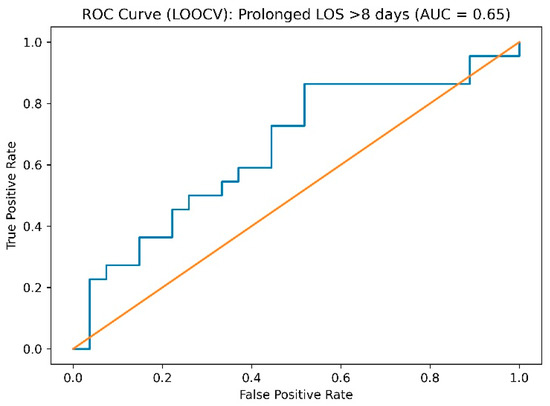
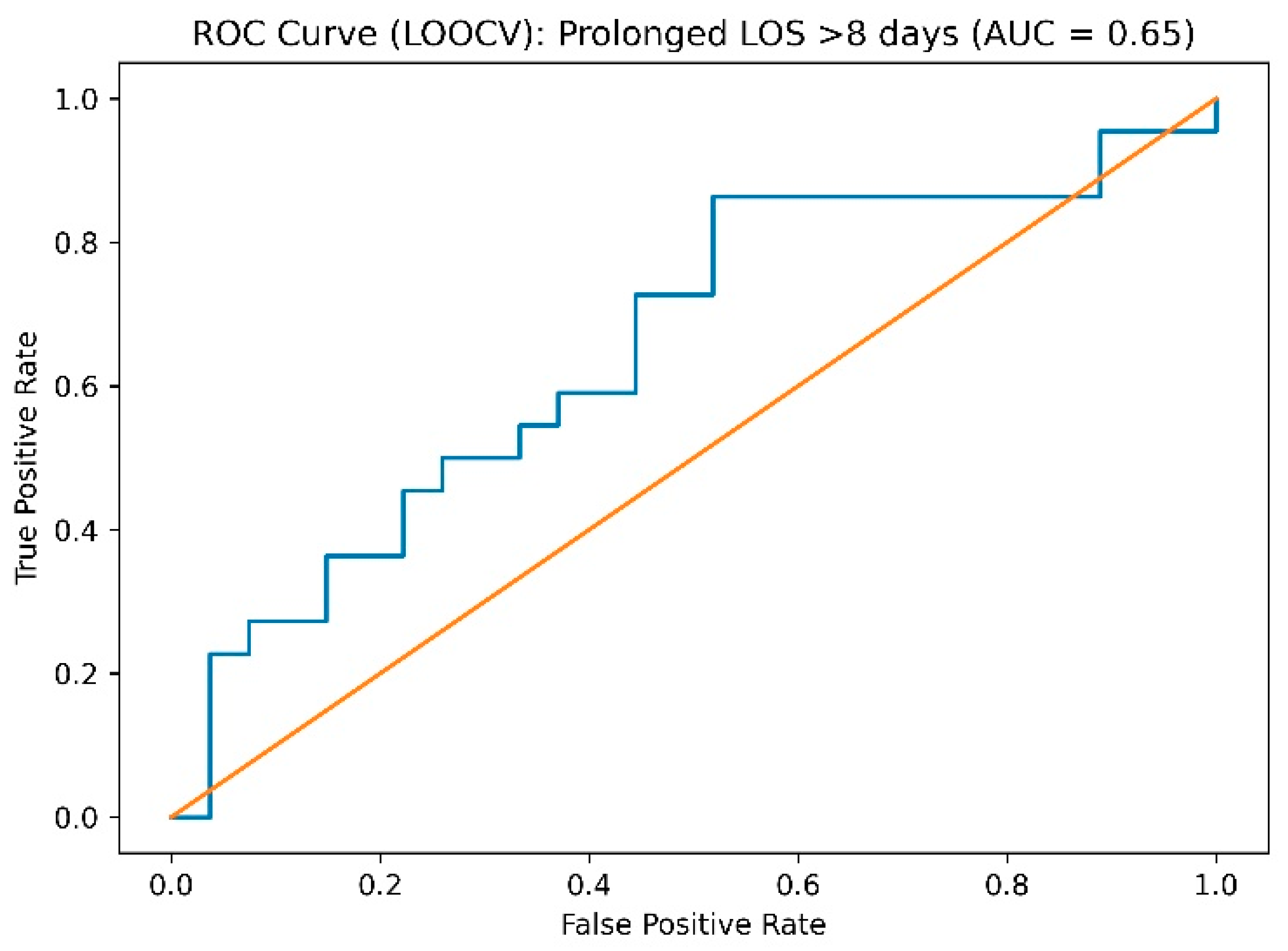
Although statistical significance was not reached, the direction of associations was biologically coherent. Internal validation using leave-one-out cross-validation yielded an AUC of 0.65 (Figure 5), indicating moderate, exploratory discriminative performance. Sensitivity analyses including WBC did not improve model discrimination.
Figure 5.
Receiver operating characteristic (ROC) curve for the multivariable logistic regression model predicting prolonged hospitalization (>8 days). AUC = 0.65.
3.7. Secondary Outcome
Non-improvement at discharge occurred in 20% of patients. Due to the limited number of events, multivariable modeling was not performed.
3.8. Influence of Age and Comorbidities
Patients aged > 70 years and those with cardiovascular disease or diabetes demonstrated slower normalization of inflammatory and hematologic parameters.
4. Discussion
4.1. Population Characteristics and Hospitalization Pattern
The demographic profile of our cohort confirms the well-established association between advanced age and CDI. More than two-thirds of patients were aged ≥ 60 years, with a predominance in the 60–74-year group (Table 1). Aging is a recognized determinant of CDI severity and delayed recovery, largely due to immunosenescence, altered microbiota resilience, and a higher burden of comorbidities.
Length of stay (LOS) demonstrated a moderately right-skewed distribution (Figure 1), with a median of 8 days. Median-based stratification allowed an objective definition of prolonged hospitalization (>8 days), minimizing arbitrary thresholds. Together, Table 1 and Figure 1 provide the clinical framework within which biological alterations must be interpreted.
4.2. Systemic Inflammatory Activation at Admission
At admission, patients exhibited a pronounced inflammatory profile. CRP values showed substantial dispersion and right-skewness (Table 2), justifying log-transformation in regression analyses. Elevated CRP levels reflect toxin-driven systemic cytokine activation, consistent with IL-6, IL-8, and TNF-α–mediated inflammatory cascades described in CDI pathophysiology [34,35].
At admission, the strongest correlation was observed between CRP and WBC (r = 0.74, p < 0.001) (Figure 3), indicating coordinated systemic inflammatory activation. Fibrinogen showed strong positive correlations with ESR (r = 0.61, p < 0.001) and CRP (r = 0.52, p < 0.001), reflecting the coordinated acute-phase response. Our findings reinforce this biological coherence within a real-world hospitalized cohort.
4.3. Inflammation and Erythropoietic Response
Beyond leukocytosis, our results highlight a relevant interaction between systemic inflammation and erythropoietic function. Reduced hemoglobin levels at admission are consistent with inflammatory anemia, likely mediated by hepcidin-induced iron sequestration and impaired erythropoiesis [36,37]. The inverse correlation between fibrinogen and hemoglobin (r = −0.48, p < 0.01) further supports the suppressive effect of inflammatory mediators on red blood cell homeostasis, consistent with hepcidin-mediated erythropoietic suppression.
Elevated RDW at admission indicates erythrocyte anisocytosis and increased cellular heterogeneity, phenomena linked to oxidative stress and cytokine-driven inflammatory states. Importantly, RDW showed partial normalization during hospitalization. Although RDW was not incorporated into the final multivariable model due to sample size constraints, its biological plausibility indicates potential utility for future predictive modeling.
The dynamic evolution of hematological and inflammatory parameters during hospitalization is visually summarized in Figure 2 and Table 3. All key inflammatory markers demonstrated significant reductions at discharge: CRP decreased by 74.6%, WBC by 34.9%, fibrinogen by 26.4%, and ESR by 41.7%. Concurrently, hemoglobin showed a modest improvement (+8.0%). These trends confirm a progressive resolution of the systemic inflammatory response during hospitalization, although most parameters remained above normal reference ranges at discharge, suggesting incomplete inflammatory resolution at the time of clinical improvement.
Despite overall improvement in inflammatory and hematologic parameters at discharge, mild residual anemia persisted in a subset of patients, particularly among older individuals. Delayed hematologic recovery may reflect sustained inflammatory signaling, underlying comorbidities, or reduced marrow responsiveness [38].
4.4. Exploratory Predictors of Prolonged Hospitalization
Building upon descriptive and correlation analyses, we explored whether admission laboratory parameters were associated with prolonged hospitalization. The multivariable logistic regression model, internally validated using LOOCV, demonstrated moderate discrimination (AUC = 0.65) (Figure 5). Although this level of performance does not support immediate clinical application, it provides internally validated, hypothesis-generating effect size estimates.
The forest plot (Figure 4) illustrates the direction and magnitude of associations. Lower admission hemoglobin showed an inverse association with prolonged hospitalization, while higher log-transformed CRP demonstrated a positive directional relationship.
It is important to note that no individual predictor in the multivariable model reached statistical significance, and the AUC of 0.65 indicates discriminative performance only marginally above chance (AUC = 0.50). This result does not support clinical application of the model in its current form. Rather, the estimated effect sizes and their directions serve as preliminary inputs for designing adequately powered prospective studies. Based on the observed effect sizes, a future validation study would require approximately 150–200 patients to achieve 80% power for detecting similar associations at a significance level of 0.05.
4.5. Clinical Implications
The integrated interpretation of Table 1, Table 2, Table 3 and Table 4 and Figure 1, Figure 2, Figure 3, Figure 4 and Figure 5 suggests a clinically relevant narrative: elderly patients presenting with high inflammatory burden and reduced hemoglobin at admission may be more vulnerable to prolonged hospitalization. Although the predictive model remains exploratory, routinely available hematological and inflammatory markers are inexpensive, accessible, and rapidly obtained. Future multicenter prospective studies should determine whether integrating these parameters into structured risk algorithms improves prognostic accuracy, in line with the persistent burden and evolving epidemiology of CDI documented in large multicenter surveillance programs [39].
4.6. Study Limitations
This study has several limitations. The relatively small sample size (n = 50) and retrospective single-center design may limit generalizability and introduce residual confounding. The limited number of events precluded extensive multivariable adjustment.
Molecular ribotyping was not performed, which limits the ability to attribute clinical and inflammatory profiles to specific C. difficile strains. While all patients were GDH+/Toxin A+/B+, consistent with toxigenic strains including ribotype 027, the absence of strain-level characterization should be considered when interpreting the severity patterns observed in this cohort.
Additionally, length of hospital stay reflects total hospitalization duration and may be influenced by non-CDI factors including comorbidities and institutional discharge practices. Serum creatinine was not available for severity classification, limiting full application of IDSA/SHEA criteria.
Although internal validation was performed using leave-one-out cross-validation, external validation in independent multicenter cohorts is necessary before clinical implementation. Additionally, molecular cytokine profiling was not available, limiting mechanistic insights into inflammatory pathways.
5. Conclusions
Hospitalized patients with CDI exhibit marked systemic inflammatory activation accompanied by hematologic alterations, including leukocytosis, inflammatory anemia, and increased RDW. Admission hemoglobin and log-transformed CRP demonstrated exploratory associations with prolonged hospitalization, with moderate internally validated discrimination.
While no individual predictor reached statistical significance and the model’s discriminative performance was limited (AUC = 0.65), the observed effect sizes and their biologically coherent directions provide hypothesis-generating estimates. These preliminary findings can inform the design of adequately powered prospective multicenter studies aimed at developing clinically actionable risk stratification tools for CDI.
Author Contributions
Conceptualization, R.-O.R. and C.N.D.; Methodology, R.-O.R., Ș.R. and I.F.; Software, A.O.D.; Validation, C.N.D., R.-O.R. and Ș.R.; Formal Analysis, R.-O.R. and M.M.; Investigation, I.F.; Resources, C.N.D.; Data Curation, A.L.; Writing—Original Draft Preparation, Ș.R. and S.T.; Writing—Review & Editing, Ș.R.; Visualization, A.V.B.; Supervision, C.N.D. Project Administration, R.-O.R.; Funding Acquisition, A.O.D. All authors have read and agreed to the published version of the manuscript.
Funding
This research received no external funding. The article processing charges were supported by “Dunarea de Jos” University.
Institutional Review Board Statement
The study was approved by the Ethics Committee of the Saint Parascheva Clinical Hospital of Infectious Diseases (approval no. 1/1, 21 January 2025) and conducted in accordance with the Declaration of Helsinki.
Informed Consent Statement
This was a retrospective study, and written informed consent was obtained from all patients at hospital admission for the use of their clinical data for research purposes.
Data Availability Statement
The data presented in this study are available from the corresponding author upon reasonable request. The data are not publicly available due to privacy considerations.
Conflicts of Interest
The authors declare no conflicts of interest.
Abbreviations
The following abbreviations are used in this manuscript:
| ACG | American College of Gastroenterology |
| AUC | area under the curve |
| CA-CDI | community-associated Clostridioides difficile infection |
| CDI | Clostridioides difficile infection |
| CI | confidence interval |
| CRP | C-reactive protein |
| ESCMID | European Society of Clinical Microbiology and Infectious Diseases |
| ESR | erythrocyte sedimentation rate |
| GDH | glutamate dehydrogenase |
| HA-CDI | healthcare-associated Clostridioides difficile infection |
| HCT | hematocrit |
| HGB | hemoglobin |
| IDSA | Infectious Diseases Society of America |
| IL-6 | interleukin-6 |
| IL-8 | interleukin-8 |
| IQR | interquartile range |
| LOOCV | leave-one-out cross-validation |
| LOS | length of stay |
| OR | odds ratio |
| PLT | platelet count |
| RBC | red blood cell count |
| RDW | red cell distribution width |
| ROC | receiver operating characteristic |
| SD | standard deviation |
| SHEA | Society for Healthcare Epidemiology of America |
| SPSS | Statistical Package for the Social Sciences |
| TNF-α | tumor necrosis factor alpha |
| WBC | white blood cell count |
References
- Finn, E.; Andersson, F.L.; Madin-Warburton, M. Burden of Clostridioides Difficile Infection (CDI)—A Systematic Review of the Epidemiology of Primary and Recurrent CDI. BMC Infect. Dis. 2021, 21, 456. [Google Scholar] [CrossRef] [Scilit] [PubMed]
- Lev, V.; Anbarchian, T.; Yao, H.; Bhat, A.; Britt, P.; Shieh, L. Health Care–Associated Clostridioides Difficile Infection: Learning the Perspectives of Health Care Workers to Build Successful Strategies. Am. J. Infect. Control 2024, 52, 284–292. [Google Scholar] [CrossRef] [Scilit] [PubMed]
- Di Bella, S.; Sanson, G.; Monticelli, J.; Zerbato, V.; Principe, L.; Giuffrè, M.; Pipitone, G.; Luzzati, R. Clostridioides difficile Infection: History, Epidemiology, Risk Factors, Prevention, Clinical Manifestations, Treatment, and Future Options. Clin. Microbiol. Rev. 2024, 37, e00135-23. [Google Scholar] [CrossRef] [Scilit] [PubMed]
- Stămăteanu, L.O.; Miftode, I.L.; Pleșca, C.E.; Hurmuzache, M.E.; Manciuc, D.C.; Leca, D.; Miftode, E.G. Healthcare-Associated Clostridioides Difficile Infection: A Hospital-Based Retrospective Study in North Eastern Romania. Microorganisms 2025, 13, 1377. [Google Scholar] [CrossRef] [Scilit]
- Feuerstadt, P.; Theriault, N.; Tillotson, G. The Burden of CDI in the United States: A Multifactorial Challenge. BMC Infect. Dis. 2023, 23, 132. [Google Scholar] [CrossRef] [Scilit]
- Sartelli, M.; Marini, C.P.; McNelis, J.; Coccolini, F.; Rizzo, C.; Labricciosa, F.M.; Petrone, P. Preventing and Controlling Healthcare-Associated Infections: The First Principle of Every Antimicrobial Stewardship Program in Hospital Settings. Antibiotics 2024, 13, 896. [Google Scholar] [CrossRef] [Scilit]
- Ke, F.; Dong, Z.-H.; Bu, F.; Li, C.-N.; He, Q.-T.; Liu, Z.-C.; Lu, J.; Yu, K.; Wang, D.-G.; Xu, H.-N.; et al. Clostridium Difficile Infection Following Colon Subtotal Resection in a Patient with Gallstones: A Case Report and Review of Literature. World J. Gastrointest. Surg. 2024, 16, 3048–3056. [Google Scholar] [CrossRef] [Scilit]
- Shrestha, A.; Mehdizadeh Gohari, I.; Li, J.; Navarro, M.; Uzal, F.A.; McClane, B.A. The Biology and Pathogenicity of Clostridium perfringens Type F: A Common Human Enteropathogen with a New(ish) Name. Microbiol. Mol. Biol. Rev. 2024, 88, e00140-23. [Google Scholar] [CrossRef] [Scilit]
- Mehdizadeh Gohari, I.; Navarro, M.A.; Li, J.; Shrestha, A.; Uzal, F.; McClane, B.A. Pathogenicity and Virulence of Clostridium perfringens. Virulence 2021, 12, 723–753. [Google Scholar] [CrossRef] [Scilit]
- Buddle, J.E.; Fagan, R.P. Pathogenicity and Virulence of Clostridioides difficile. Virulence 2023, 14, 2150452. [Google Scholar] [CrossRef] [Scilit]
- Korkmaz, H.I.; Flokstra, G.; Waasdorp, M.; Pijpe, A.; Papendorp, S.G.; de Jong, E.; Rustemeyer, T.; Gibbs, S.; van Zuijlen, P.P.M. The Complexity of the Post-Burn Immune Response: An Overview of the Associated Local and Systemic Complications. Cells 2023, 12, 345. [Google Scholar] [CrossRef] [Scilit] [PubMed]
- Czepiel, J.; Dróżdż, M.; Pituch, H.; Kuijper, E.J.; Perucki, W.; Mielimonka, A.; Goldman, S.; Wultańska, D.; Garlicki, A.; Biesiada, G. Clostridium difficile Infection: Review. Eur. J. Clin. Microbiol. Infect. Dis. 2019, 38, 1211–1221. [Google Scholar] [CrossRef] [Scilit] [PubMed]
- Al-Zahrani, I.A. Clostridioides (Clostridium) Difficile: A Silent Nosocomial Pathogen. Saudi Med. J. 2023, 44, 825–835. [Google Scholar] [CrossRef] [Scilit] [PubMed]
- Vázquez-Cuesta, S.; Villar, L.; García, N.L.; Fernández, A.I.; Olmedo, M.; Alcalá, L.; Marín, M.; Muñoz, P.; Bouza, E.; Reigadas, E. Characterization of the Gut Microbiome of Patients with Clostridioides difficile Infection, Patients with Non-C. difficile Diarrhea, and C. difficile-Colonized Patients. Front. Cell. Infect. Microbiol. 2023, 13, 1130701. [Google Scholar] [CrossRef] [Scilit]
- Wiuff, C.; Banks, A.-L.; Fitzpatrick, F.; Cottom, L. The Need for European Surveillance of CDI. In Updates on Clostridium difficile in Europe; Mastrantonio, P., Rupnik, M., Eds.; Advances in Experimental Medicine and Biology; Springer International Publishing: Cham, Switzerland, 2018; Volume 1050, pp. 13–25. ISBN 978-3-319-72798-1. [Google Scholar]
- Lee, H.S.; Plechot, K.; Gohil, S.; Le, J. Clostridium Difficile: Diagnosis and the Consequence of Over Diagnosis. Infect. Dis. Ther. 2021, 10, 687–697. [Google Scholar] [CrossRef] [Scilit]
- Popescu, G.A.; Serban, R.; Pistol, A.; Niculcea, A.; Preda, A.; Lemeni, D.; Macovei, I.S.; Tălăpan, D.; Rafila, A.; Florea, D. The Recent Emergence of Clostridium Difficile Infection in Romanian Hospitals Is Associated with a High Prevalence of Polymerase Chain Reaction Ribotype 027. Balkan Med. J. 2018, 35, 191–195. [Google Scholar] [CrossRef] [Scilit]
- Kishore, A.T.; Jose, R. Correlates of Markedly Elevated C-Reactive Protein >200 mg/L and Its Prognostic Role in Intensive Care Unit Admission and Mortality: A Record-Based Retrospective Study. J. Appl. Sci. Clin. Pract. 2025, 6, 32–38. [Google Scholar] [CrossRef] [Scilit]
- Ansar, W.; Ghosh, S. C-Reactive Protein and the Biology of Disease. Immunol. Res. 2013, 56, 131–142. [Google Scholar] [CrossRef] [Scilit]
- Weiss, G.; Gasche, C. Pathogenesis and Treatment of Anemia in Inflammatory Bowel Disease. Haematologica 2010, 95, 175–178. [Google Scholar] [CrossRef] [Scilit]
- Weiss, G.; Ganz, T.; Goodnough, L.T. Anemia of Inflammation. Blood 2019, 133, 40–50. [Google Scholar] [CrossRef] [Scilit]
- Owoicho, O.; Tapela, K.; Olwal, C.O.; Djomkam Zune, A.L.; Nganyewo, N.N.; Quaye, O. Red Blood Cell Distribution Width As A Prognostic Biomarker for Viral Infections: Prospects and Challenges. Biomark. Med. 2022, 16, 41–50. [Google Scholar] [CrossRef] [Scilit]
- Wang, J.; Xiao, Q.; Li, Y. ΔRDW: A Novel Indicator with Predictive Value for the Diagnosis and Treatment of Multiple Diseases. Int. J. Gen. Syst. 2021, 14, 8667–8675. [Google Scholar] [CrossRef] [Scilit]
- Simeon, C.; Beega, G.; Sheudeen, A.; Wofuru, C.; Eze, C. Significance of Inflammatory Biomarkers in Clinical Diagnostics: Erythrocyte Sedimentation Rate versus Other Inflammatory Biomarkers: A Review. Int. J. Sci. Res. Arch. 2024, 12, 1980–1995. [Google Scholar] [CrossRef] [Scilit]
- Chen, X.-F.; Zhao, Y.; Guo, Y.; Huang, Z.-M.; Huang, X.-L. Predictive Value of Fibrinogen in Identifying Inflammatory Bowel Disease in Active Stage. BMC Gastroenterol. 2021, 21, 472. [Google Scholar] [CrossRef] [Scilit] [PubMed]
- Johnson, S.; Lavergne, V.; Skinner, A.M.; Gonzales-Luna, A.J.; Garey, K.W.; Kelly, C.P.; Wilcox, M.H. Clinical Practice Guideline by the Infectious Diseases Society of America (IDSA) and Society for Healthcare Epidemiology of America (SHEA): 2021 Focused Update Guidelines on Management of Clostridioides difficile Infection in Adults. Clin. Infect. Dis. 2021, 73, e1029–e1044. [Google Scholar] [CrossRef] [Scilit] [PubMed]
- Kelly, C.R.; Fischer, M.; Allegretti, J.R.; LaPlante, K.; Stewart, D.B.; Limketkai, B.N.; Stollman, N.H. ACG Clinical Guidelines: Prevention, Diagnosis, and Treatment of Clostridioides difficile Infections. Am. J. Gastroenterol. 2021, 116, 1124–1147. [Google Scholar] [CrossRef] [Scilit]
- Martínez-Meléndez, A.; Cruz-López, F.; Morfin-Otero, R.; Maldonado-Garza, H.J.; Garza-González, E. An Update on Clostridioides difficile Binary Toxin. Toxins 2022, 14, 305. [Google Scholar] [CrossRef] [Scilit]
- Baroiu, L.; Dumitru, C.; Iancu, A.; Lese, A.-C.; Baroiu, N.; Drăgănescu, M. Factors That Impact the Risk of Death in Clostridium difficile Infection. Acta Medica Mediterr. 2021, 37, 403–407. [Google Scholar] [CrossRef] [Scilit]
- Salvagno, G.L.; Sanchis-Gomar, F.; Picanza, A.; Lippi, G. Red Blood Cell Distribution Width: A Simple Parameter with Multiple Clinical Applications. Crit. Rev. Clin. Lab. Sci. 2015, 52, 86–105. [Google Scholar] [CrossRef] [Scilit]
- World Medical Association. World Medical Association Declaration of Helsinki: Ethical Principles for Medical Research Involving Human Participants. JAMA 2025, 333, 71–74. [Google Scholar] [CrossRef] [Scilit]
- McDonald, L.C.; Gerding, D.N.; Johnson, S.; Bakken, J.S.; Carroll, K.C.; Coffin, S.E.; Dubberke, E.R.; Garey, K.W.; Gould, C.V.; Kelly, C.; et al. Clinical Practice Guidelines for Clostridium difficile Infection in Adults and Children: 2017 Update by the Infectious Diseases Society of America (IDSA) and Society for Healthcare Epidemiology of America (SHEA). Clin. Infect. Dis. 2018, 66, e1–e48. [Google Scholar] [CrossRef] [Scilit] [PubMed]
- van Prehn, J.; Reigadas, E.; Vogelzang, E.H.; Bouza, E.; Hristea, A.; Guery, B.; Krutova, M.; Norén, T.; Allerberger, F.; Coia, J.E.; et al. European Society of Clinical Microbiology and Infectious Diseases: 2021 Update on the Treatment Guidance Document for Clostridioides difficile Infection in Adults. Clin. Microbiol. Infect. 2021, 27, S1–S21. [Google Scholar] [CrossRef] [Scilit]
- Yu, H.; Chen, K.; Sun, Y.; Carter, M.; Garey, K.W.; Savidge, T.C.; Devaraj, S.; Tessier, M.E.; von Rosenvinge, E.C.; Kelly, C.P.; et al. Cytokines Are Markers of the Clostridium difficile-Induced Inflammatory Response and Predict Disease Severity. Clin. Vaccine Immunol. 2017, 24, e00037-17. [Google Scholar] [CrossRef] [Scilit]
- Bhandari, P.; Berezovskiy, R.; Makhani, S.; Gausman, V.; Rastogi, N.; Braude, S. Discordance in Clinical Indicators With Sequential Fecal Microbiota Transplantation: A Case of Fulminant Clostridioides difficile Infection. ACG Case Rep. J. 2025, 12, e01731. [Google Scholar] [CrossRef] [Scilit]
- Kounatidis, D.; Jahaj, E.; Geladari, E.V.; Papachristodoulou, K.; Panagopoulos, F.; Marakomichelakis, G.; Papastamopoulos, V.; Sevastianos, V.; Vallianou, N.G. Clostridioides difficile Infections: Epidemiological and Laboratory Data from the Internal Medicine Departments of a Tertiary Care Hospital in Athens, Greece, During the Past Decade. Medicina 2025, 61, 1416. [Google Scholar] [CrossRef] [Scilit]
- Bruserud, Ø.; Vo, A.K.; Rekvam, H. Hematopoiesis, Inflammation and Aging—The Biological Background and Clinical Impact of Anemia and Increased C-Reactive Protein Levels on Elderly Individuals. J. Clin. Med. 2022, 11, 706. [Google Scholar] [CrossRef] [Scilit]
- Covino, M.; Gallo, A.; Pero, E.; Simeoni, B.; Macerola, N.; Murace, C.A.; Ibba, F.; Landi, F.; Franceschi, F.; Montalto, M. Early Prognostic Stratification of Clostridioides difficile Infection in the Emergency Department: The Role of Age and Comorbidities. J. Pers. Med. 2022, 12, 1573. [Google Scholar] [CrossRef] [Scilit] [PubMed]
- Guh, A.Y.; Mu, Y.; Winston, L.G.; Johnston, H.; Olson, D.; Farley, M.M.; Wilson, L.E.; Holzbauer, S.M.; Phipps, E.C.; Dumyati, G.K.; et al. Emerging Infections Program Clostridioides difficile Infection Working Group. Trends in U.S. Burden of Clostridioides difficile Infection and Outcomes. N. Engl. J. Med. 2020, 382, 1320–1330. [Google Scholar] [CrossRef] [Scilit] [PubMed]

Disclaimer/Publisher’s Note: The statements, opinions and data contained in all publications are solely those of the individual author(s) and contributor(s) and not of MDPI and/or the editor(s). MDPI and/or the editor(s) disclaim responsibility for any injury to people or property resulting from any ideas, methods, instructions or products referred to in the content. |
© 2026 by the authors. Licensee MDPI, Basel, Switzerland. This article is an open access article distributed under the terms and conditions of the Creative Commons Attribution (CC BY) license.