


Abstract
Marine macrophytes are major components of Mediterranean coastal ecosystems and potential sources of renewable macromolecules, functional extracts, and structural materials. This review critically compares three taxonomically and chemically distinct biomasses: the endemic seagrass Posidonia oceanica, the calcified brown macroalga Padina pavonica, and the filamentous green macroalga Chaetomorpha linum. Their ecological functions and biomass-generation pathways are distinguished because beach-cast seagrass leaves, seasonally detached macroalgae, and biomass removed from eutrophic lagoons cannot be treated as equivalent feedstocks. The review examines green extraction technologies, principal macromolecular and bioactive fractions, biological activities, and application pathways in remediation, agriculture, cosmetics, nutraceuticals, packaging, composites, and construction. Particular attention is given to feedstock heterogeneity, contaminant control, evidence strength, standardization, ecological sourcing, and translational readiness. Comparative analysis identifies P. oceanica primarily as a lignocellulosic and fibrous platform, P. pavonica as a source of brown-algal polysaccharides and phlorotannins, and C. linum as a nutrient-recovery biomass with promising extractive and agronomic applications. The most credible development route is a species-specific cascading biorefinery supported by standardized feedstocks, real-world validation, regulatory planning, and integrated techno-economic and life-cycle assessment.
1. Introduction
1.1. From a Linear Economy to a Marine Circular Bioeconomy
The transition from a linear take–make–dispose model to a circular bioeconomy aims to reduce dependence on finite resources while preserving material value and limiting waste generation [1]. Environmental pressures associated with fossil-based production, greenhouse gas emissions, persistent plastics, habitat degradation, and biodiversity loss have increased interest in renewable feedstocks and resource-efficient processing [2]. Within this framework, bio-based production contributes to wider climate and sustainability objectives, including the European Green Deal, the Paris Agreement, and the United Nations Sustainable Development Goals [3], while supporting expanding markets for materials, chemicals, energy, food, and health-related products [4]. Circularity, however, cannot be inferred from biological origin alone: sourcing, processing intensity, product lifetime, and end-of-life management determine whether a pathway produces a genuine environmental benefit.
Terrestrial agriculture and forestry remain the principal sources of industrial biomass [5]. Large-scale reliance on land-based feedstocks may nevertheless intensify competition for arable land and freshwater, contribute to land-use change, and reinforce the food-versus-industrial-crops debate [6,7]. Marine and coastal biomasses can complement terrestrial resources because they generally do not require arable land or freshwater irrigation and contain distinctive structural polymers and functional metabolites [8,9,10]. Their strongest circular-bioeconomy rationale arises when residual, naturally detached, cultivated, or management-derived biomass is valorized without displacing ecological functions or transferring environmental burdens to washing, drying, extraction, or waste treatment [11,12,13].
1.2. Rationale for Selecting the Three Mediterranean Species
The Mediterranean Sea is a biodiversity hotspot characterized by high endemism, pronounced environmental gradients, and increasing climatic and anthropogenic pressure. Coastal primary producers support habitat formation, biogeochemical cycling, and food webs under these conditions [14,15]. This review focuses on Posidonia oceanica (L.) Delile, Padina pavonica (L.) Thivy, and Chaetomorpha linum (O.F. Müller) Kützing because they represent three contrasting ecological and macromolecular platforms: a marine angiosperm with a lignocellulosic architecture, a calcified brown macroalga rich in brown-algal polysaccharides and phlorotannins, and a filamentous green macroalga characterized by cellulose-rich walls and rapid nutrient assimilation. Their comparison therefore allows the review to examine how phylogeny, habitat, cell-wall chemistry, and biomass origin jointly determine processing requirements and realistic end uses.
P. oceanica provides cellulose, hemicellulose-like fractions, lignin-associated phenolics, and resistant fibres [16,17,18]. P. pavonica combines a lightly calcified thallus with alginate-, fucoidan-, and laminarin-containing fractions and phlorotannin-type phenolics [19,20,21,22]. C. linum is capable of rapid biomass development and nutrient uptake in transitional waters; its structural carbohydrates, pigments, lipids, minerals, and soluble metabolites support both material and extractive valorization [23,24,25,26]. These differences make direct extrapolation of extraction protocols, safety assumptions, or application claims among the three species inappropriate.
1.3. Scope and Critical Framework of the Review
This critical narrative review evaluates the three macrophytes as distinct ecological resources and processing platforms. It separates living ecosystems from recoverable biomass, relates composition to pretreatment and fractionation requirements, and distinguishes analytical or laboratory activity from application-level readiness. The review is organized around five questions: which biomass is ecologically and legally available; which macromolecular and low-molecular-weight fractions can be recovered; how robust is the evidence for reported functionality; which applications are technically plausible; and which safety, regulatory, economic, and environmental barriers remain. Owing to the heterogeneity of feedstocks, protocols, and endpoints, quantitative meta-analysis was not considered methodologically defensible.
1.4. Literature Search Strategy
The literature was assembled through targeted searches of Scopus, Web of Science, PubMed, and Google Scholar using combinations of the species names with terms related to ecology, beach-cast or bloom biomass, extraction, polysaccharides, cellulose, phenolics, pigments, biological activity, remediation, agriculture, cosmetics, nutraceuticals, biomaterials, and circular bioeconomy. Priority was given to peer-reviewed primary studies directly involving the three target species; methodological reviews and regulatory or institutional sources were used when broader context was required. Studies were considered most informative when biomass origin, pretreatment, extraction or processing conditions, analytical methods, and principal outcomes were sufficiently reported to permit critical interpretation. Because this was a narrative rather than systematic review, the search was designed to maximize thematic coverage and species-specific evidence rather than to support pooled effect estimates.
2. Ecological Functions, Biomass Dynamics, and Sustainable Sourcing
Sustainable valorization begins by distinguishing living habitats from biomass that is genuinely available for recovery. The three species differ in ecological role, detachment mechanism, seasonality, spatial predictability, and management context. Consequently, the same term marine biomass can refer to protected living vegetation, ecologically functional shoreline deposits, seasonal drift material, cultivated biomass, or nuisance biomass removed to prevent lagoon deterioration. These categories are not interchangeable and should be treated as separate feedstock classes.
2.1. Posidonia oceanica Meadows and Banquette Formation
P. oceanica is a slow-growing, perennial, endemic seagrass that forms extensive meadows from shallow coastal waters to depths governed largely by light penetration and water clarity [27]. Its rhizomes and roots form long-lived matte structures that retain sediment and organic matter; together with the leaf canopy, these structures attenuate hydrodynamic energy, stabilize the seabed, and contribute to coastal protection [28]. The meadows also provide habitat, nursery, and feeding grounds and represent important blue-carbon reservoirs because organic material can persist in anoxic sedimentary layers [29,30]. These ecosystem services make intact meadows categorically unsuitable as industrial feedstocks.
Seasonal leaf senescence and storm-driven detachment transport older leaves toward the shoreline, where they can form banquettes [31]. Banquettes retain sediment, reduce wave erosion, maintain moisture, return organic matter and nutrients, and support supralittoral detritivore communities linking marine and terrestrial food webs [32,33]. Their presence therefore cannot be equated with waste accumulation. Recovery should be restricted to deposits whose removal is justified by site-specific management and should preserve living plants, roots, rhizomes, matte structures, and shoreline deposits that continue to provide measurable ecological functions (Figure 1).
Figure 1.
Ecological functions of Posidonia oceanica meadows and formation of beach banquettes.
2.2. Padina pavonica in Rocky Sublittoral Habitats
P. pavonica is a fan-shaped brown macroalga whose thallus commonly displays concentric calcification and tetrasporangial bands [34]. It occurs mainly in shallow, illuminated rocky habitats, where its three-dimensional thalli provide colonization surfaces, shelter, and feeding microhabitats for benthic organisms [35]. Biomass development is strongly seasonal and commonly increases during warmer and more illuminated periods [36]. Thus, both ecological function and recoverable supply vary over space and time. Detached P. pavonica may accumulate in sheltered rocky areas, coves, or mixed coastal drift, but it does not generally form the persistent, structurally consolidated banquettes characteristic of P. oceanica [37]. Decomposition returns dissolved and particulate organic matter to nearshore food webs, while dissolution of aragonitic deposits may influence local carbonate chemistry [38,39]. A defensible sourcing strategy must therefore distinguish naturally detached thalli, cultivation-derived biomass, and removal of living algal stands; only the first two provide a generally acceptable basis for planned valorization (Figure 2).
Figure 2.
Padina pavonica in shallow rocky sublittoral habitats.
2.3. Chaetomorpha linum, Nutrient Assimilation, and Bloom Biomass
C. linum is an unattached filamentous green macroalga with high physiological plasticity and tolerance to fluctuations in salinity, temperature, and irradiance [24,40]. Under balanced conditions, its mats contribute to primary production, nutrient cycling, and structural habitat in lagoons and semi-enclosed waters [41]. Its high surface-area-to-volume ratio also enables rapid assimilation of dissolved nitrogen and phosphorus, making the species relevant to nutrient-recovery systems. Under nutrient enrichment, the same traits can drive excessive biomass accumulation [41]. Agricultural runoff, urban wastewater, aquaculture inputs, and restricted water exchange may promote dense mats and green-tide conditions [42,43,44]. When these mats collapse, microbial decomposition increases biochemical oxygen demand, reduces dissolved oxygen, and favours sulfide-producing anaerobic processes. Severe events can produce hypoxia, anoxia, hydrogen-sulfide release, fauna mortality, and economic losses in fisheries or aquaculture [24,45]. C. linum is therefore unusual among the three species: its recovery is often part of active ecosystem management rather than passive collection of detached coastal residues. When harvesting is timely and coordinated with nutrient-load reduction, the removed biomass can provide a comparatively regular secondary feedstock. This opportunity depends on rapid stabilization, traceability, and contaminant control because lagoon-derived material may contain high moisture, salts, sediments, microorganisms, metals, and site-specific pollutants. Valorization should therefore be integrated with, rather than used as a substitute for, measures addressing the upstream causes of eutrophication (Figure 3).
Figure 3.
Chaetomorpha linum nutrient assimilation, bloom development, and management-derived biomass.
2.4. Quantitative Biomass Generation and Management-Available Supply
Quantification of these marine resources requires a clear distinction between annual primary production, standing crop, and harvested or stranded biomass. Annual primary production describes the formation of new biological material over time, whereas standing crop represents the biomass present within a defined area at a specific sampling time. Harvested or stranded biomass constitutes only the fraction that enters a potentially recoverable material stream. These quantities are therefore not directly interchangeable, particularly because seagrass production is commonly expressed as dry weight, whereas bloom-forming macroalgal biomass and management removals are frequently reported as wet weight. Among the three species considered, P. oceanica is the only one for which basin-scale distribution data and multi-site annual productivity measurements permit an approximate Mediterranean-scale calculation. Satellite-based mapping estimated approximately 19,020 km2 of P. oceanica meadows between 0 and 25 m depth across 22 Mediterranean countries, with an overall classification accuracy of 72% [46]. Multi-site lepidochronological measurements reported total annual production of leaves and rhizomes ranging from approximately 130 to 1284 g dry weight m−2 year−1, depending on meadow density, depth, geographical location, and environmental condition [47]. Applying this empirical range to the mapped meadow area produces a broad theoretical envelope of approximately 2.47 to 24.42 million tonnes dry weight year−1. This calculation should not be interpreted as an estimate of harvestable biomass. Living meadows are protected ecological systems, and substantial fractions of their production remain within the meadow, are retained in belowground structures, enter detrital food webs, or are exported offshore rather than deposited on accessible beaches. Mediterranean-wide annual production data are not currently available for P. oceanica. Its distribution is spatially discontinuous, its aboveground biomass is strongly seasonal, and quantitative studies generally report local standing biomass or sample-scale collection rather than annual areal production. A documented Maltese utilization case reported the harvesting of approximately 40 tonnes year−1 for extract [48]. This value provides an indication of an operational supply scale but should not be interpreted as either total Maltese production or Mediterranean-wide biological production.
For C. linum, biomass generation is highly dependent on nutrient enrichment, water exchange, temperature, mat collapse, and management intensity. Consequently, annual basin-scale production cannot be represented by a single value. In the Orbetello Lagoon, a high-density mat consisting almost exclusively of C. linum, covered approximately 235 ha and exhibited an average biomass of 9.15 ± 0.97 kg wet weight m−2, corresponding to an estimated standing crop of 20,418 tonnes wet weight. Approximately 6000 tonnes wet weight of macroalgal material were harvested during about six months of lagoon-management activity [49]. These values demonstrate that bloom-prone lagoons may generate management-derived feedstocks on the scale of thousands to tens of thousands of wet tonnes, although the amount varies markedly among years and sites (Table 1).
Table 1.
Representative quantitative scales of biomass production, standing crop, and management-derived recovery.
These data demonstrate that the three feedstocks occur at fundamentally different quantitative and management scales. P. oceanica has a very large annual biological production but only a limited and ecologically constrained recoverable fraction. P. oceanica currently lacks a robust regional production inventory, while C. linum can generate substantial local biomass during lagoon blooms, with availability determined primarily by eutrophication dynamics and management operations.
2.5. Ecologically Acceptable Harvesting Limits
The amount of biomass that can be harvested without impairing ecological balance cannot currently be expressed as a universal species-specific quantity. No validated Mediterranean-wide thresholds, stated as tonnes per year or as a fixed percentage of standing biomass, have been established for P. oceanica, P. oceanica, or C. linum. Harvesting limits must instead account for biomass origin, habitat function, local abundance, seasonality, reproductive condition, hydrodynamics, collection technology, and post-harvest recovery.
For P. oceanica, direct harvesting from living meadows should be considered ecologically unacceptable, and the corresponding recoverable quantity should therefore be considered zero. The species is slow-growing, forms long-lived meadows and matte structures, and provides essential ecosystem services, including sediment stabilization, carbon storage, nursery functions, and coastal protection. Beach-cast leaves and banquettes cannot automatically be considered ecologically expendable because they retain sediments, attenuate wave energy, provide trophic resources, and store carbon and nutrients. Removal can also cause the permanent export of beach sediment and increase erosion risk [31,32]. Consequently, the recoverable fraction should be determined for each beach through site-specific assessment and should be restricted to material whose removal is already justified by coastal-management requirements. Maintenance in place, seasonal repositioning within the same beach, or selective removal should be prioritized over complete and permanent extraction.
For P. oceanica, no experimentally validated sustainable harvest rate is available. Natural populations display substantial spatial and interannual variation, while growth, recruitment, reproductive output, and persistence are influenced by temperature, storms, sediment burial, and physical disturbance [50]. A natural stock of approximately 112.5 tonnes fresh weight, corresponding to 25 tonnes dry weight, was estimated at Cap Zebib in northern Tunisia, but this estimate represents standing availability and does not define a sustainable harvest quota In the absence of population-specific recovery data, collection should be limited to naturally detached biomass or biomass obtained through controlled cultivation. Harvesting of attached natural stands should require multiannual monitoring of standing stock, percentage cover, recruitment, reproductive structures, and recovery following experimental low-intensity removal.
The ecological interpretation is different for C. linum because recoverable biomass frequently originates from excessive growth in eutrophic lagoons. In these systems, harvesting may contribute to ecological restoration by removing accumulated nitrogen and phosphorus and by limiting oxygen depletion and sulfide formation during biomass decay. Nevertheless, no fixed percentage can be regarded as universally safe. In the Orbetello Lagoon, disturbance and harvesting of a high-density mat produced an approximately 63% decline in biomass, although direct harvesting accounted for only about 6.5% of the observed reduction [49]. This result demonstrates that harvesting method, sediment disturbance, water depth, oxygen conditions, and operational frequency may be more important than the mass directly removed. The management objective should therefore be to maintain macroalgal biomass below site-specific thresholds associated with hypoxia or dystrophic risk, while avoiding excessive sediment resuspension and preserving non-target lagoon habitats. Accordingly, ecologically acceptable harvesting should be established through an adaptive management framework. Before collection, baseline surveys should quantify biomass density, spatial cover, species composition, reproductive status, dissolved oxygen, sediment condition, and relevant habitat functions. During and after harvesting, the same indicators should be monitored to determine whether biomass removal produces recovery, neutral effects, or ecological deterioration. Harvesting should be reduced or suspended when declines in population recovery, habitat complexity, sediment stability, water quality, or associated biological communities are detected.
2.6. Comparative Management Implications
The expression stranded marine biomass obscures major differences in ecological origin and management legitimacy. P. oceanica residues arise mainly from natural leaf abscission followed by hydrodynamic transport and shoreline deposition; P. pavonica biomass shows marked seasonal availability, with thalli undergoing seasonal detachment, while detached material may also occur within mixed coastal wrack; and C. linum can form dense blooms in eutrophic transitional waters, where biomass harvesting has been applied as part of lagoon management strategies [51,52]. Hydrodynamics, storm regimes, coastal urbanization, and nutrient enrichment further modify the amount, condition, and location of available material [53,54,55]. Mechanical removal may be necessary where accumulations create sanitation, access, odour, navigation, or tourism-related problems [56,57]. Nevertheless, indiscriminate collection can reduce sediment retention, trophic subsidies, habitat availability, and shoreline protection [58]. A defensible hierarchy is therefore to protect living habitats; retain ecologically functional deposits; prioritize biomass already removed for legitimate management; document collection location and condition; and direct each batch to the highest-value use compatible with its quality and contaminant profile. This hierarchy converts waste management into resource recovery without assuming that all accumulated biomass is ecologically expendable [37,59,60,61,62,63,64,65,66,67] (Table 2).
Table 2.
Comparative ecological and feedstock characteristics of the three marine macrophytes.
3. Green Extraction Methods and Chemical Profiling
The valorisation of Mediterranean marine macrophytes is contingent on factors beyond the mere availability of biomass. For species such as P. oceanica, P. pavonica, and C. linum, the critical point is whether reproducible and chemically interpretable fractions can be obtained through processes that are compatible with circular bioeconomy principles. This is not a trivial methodological detail, given that the three species differ markedly in evolutionary origin, morphology, cell-wall organisation, and secondary metabolism. P. oceanica has been observed to behave as a marine lignocellulosic feedstock, P. pavonica as a calcified brown macroalga that is rich in algal polysaccharides and phenolic metabolites, and C. linum as a fast-growing filamentous green macroalga with a cellulose-rich structure. For these biomasses, the choice of solvent, temperature, extraction time, solid-to-liquid ratio, particle size, and purification strategy can substantially influence both yield and biological activity. This necessitates the implementation of standardised, species-specific protocols for meaningful comparison and downstream use [68,69].
3.1. Eco-Friendly Extraction Technologies
Conventional extraction of marine bioactive compounds has traditionally relied on extended maceration or Soxhlet-type procedures, necessitating the use of considerable volumes of organic or acidic/alkaline solvents. While these approaches remain useful for analytical comparison, they are not well-suited to circular bioeconomy criteria due to their high solvent consumption, generation of chemical waste, extended processing times, and potential damage to thermolabile pigments, phenolics, and sulfated polysaccharides. For marine macrophytes, strategies include ultrasound-assisted extraction (UAE), microwave-assisted extraction (MAE), accelerated or pressurized liquid extraction (ASE/PLE), subcritical water extraction (SWE), supercritical fluid extraction (SFE), enzyme-assisted extraction (EAE), natural deep eutectic solvents (NaDES/DES), pulsed electric fields (PEF), and hydrodynamic cavitation [70,71,72].
The utilization of UAE and MAE in marine biomass processing is a prevalent practice, owing to their capacity to rely on water, ethanol, or hydroethanolic mixtures while concomitantly reducing extraction time [73]. In UAE, acoustic cavitation has been shown to promote cell-wall disruption and solvent penetration, thus facilitating the recovery of phenolic- and pigment-rich fractions, as well as matrix-dependent amounts of proteins, soluble carbohydrates, and polysaccharides. However, it is important to note that overly intense or prolonged sonication may induce oxidation or polymer fragmentation [70]. In contrast, MAE accelerates extraction through dielectric heating of intracellular water and polar solvents. However, it is imperative to exercise meticulous control over the parameters of irradiation power, temperature, and solvent composition to prevent carotenoid/chlorophyll isomerization and the degradation of sulfated polysaccharides [70,74]. The case of P. pavonica, in which drying and extraction conditions strongly affect antioxidant recovery, illustrates this matrix dependence [75]. ASE/PLE, SWE, and SFE are useful when reproducible extraction is required from heterogeneous beach-cast or drift biomass; however, they differ in solvent behaviour and target selectivity. ASE/PLE/MAE has been demonstrated to enhance diffusivity and solubilisation by maintaining pressurised solvents in the liquid phase above their atmospheric boiling points. This renders ethanol–water mixtures suitable for the extraction of phenolics, pigments, lipids and other moderately polar compounds. SWE employs a related logic, utilising subcritical water, whose reduced polarity facilitates the recovery of polar-to-medium-polar compounds without conventional organic solvents [73]. However, it should be noted that excessive temperature may result in the hydrolysis of polysaccharides or the generation of degradation products [71]. SFE, typically conducted using supercritical CO2 with ethanol as a co-solvent, is particularly well-suited for non-polar and moderately polar fractions, including lipids, pigments, terpenoids, volatiles, and selected phenolics. The advantages of this method include low solvent residues and limited oxygen exposure. In contrast, highly polar polysaccharides, proteins, and minerals generally require modifiers or sequential extraction steps [73,76]. This matrix-dependent selectivity is illustrated by the SFE recovery of phenolic-rich extracts from beach-cast P. oceanica leaves with photoprotective and antimelanogenic activity and by ASE-based recovery of phlorotannin-rich P. pavonica fractions with antioxidant, elastase-, and tyrosinase-inhibitory properties [77,78]. NaDES and DES offer a tenable alternative to conventional solvents, with their polarity, viscosity, acidity, and water content able to be adjusted to the target fraction. In the context of seaweed processing, these substances have been observed to enhance the solubilisation of phenolic compounds, with the potential to be integrated with various extraction methods, including UAE, MAE, EAE, and ASE [72]. However, the sustainability of these practices merits careful evaluation on a case-by-case basis.
EAE is complementary to these solvent-based strategies since enzymatic treatments can open cell-wall networks under mild aqueous conditions. The selection of the enzymatic system is to be made according to the matrix. The efficacy of EAE is often maximised through integration with UAE, MAE, PLE, or membrane separation, as evidenced by the application of enzyme-assisted co-extraction methodologies to Padina biomass [79,80].
3.2. Lignocellulosic Components and Complex Polysaccharides
Although P. oceanica, P. pavonica, and C. linum are all coastal primary producers, their cell-wall architecture reflects very different evolutionary histories. This distinction is pivotal to their valorisation and directly influences pretreatment requirements, extraction selectivity, material performance, and the most appropriate circular-biorefinery pathway. As a marine angiosperm, P. oceanica exhibits a greater structural similarity to terrestrial plants than to most seaweeds. The plant’s detached leaves, fibres, and egagropili contain cellulose, hemicellulose-like polysaccharides, lignin-like phenolic structures, extractives, ash, and mineral-associated components. Recent studies have utilised SWE, followed by bleaching, to recover cellulose fibres from P. oceanica waste, subsequently employing these fibres in the production of cellulose films, chitosan-cellulose biocomposites, and PLA-cellulose laminates [81]. This outcome corroborates the assertion that P. oceanica constitutes a noteworthy marine lignocellulosic feedstock for packaging-oriented materials. For this biomass, a sequential strategy is recommended. This is because mild aqueous or hydroethanolic extraction can first recover soluble phenolics, minerals and low-molecular-weight bioactives, while the insoluble fraction can subsequently be directed towards cellulose recovery, fibre modification or composite production. It is important to note that extensive purification is not always required, since partially purified fractions may be sufficient for filler or barrier applications. However, highly purified cellulose is more appropriate when colour, crystallinity, or polymer compatibility are critical [82,83]. As a brown macroalga, P. pavonica contains carbohydrate fractions typical of Phaeophyceae, including alginate, fucoidan, laminarin, and cellulose [84]. Alginate primarily supports applications involving gel formation, film formation, thickening, and stabilisation. In contrast, fucoidan, a fucose-rich sulfated polysaccharide, exhibits activity that is contingent on factors such as molecular weight, monosaccharide composition, sulfation pattern, purity, and extraction conditions. Laminarin, on the other hand, is a brown-algal storage β-glucan of nutraceutical and immunomodulatory interest [85,86,87]. A distinctive feature of P. pavonica is its calcified thallus, characterised by surface calcium carbonate and extracellular aragonite needles, which are typical of the genus Padina [88]. This mineral component has the potential to impede the process of polysaccharide extraction, necessitating demineralization or selective purification when highly purified alginate or fucoidan fractions are required. Recent data further support P. pavonica as a source of sulfated polysaccharides, although the reported antimicrobial, antidiabetic, antiviral, and antioxidant activities of its fucoidan fraction should remain preliminary until confirmed across independent batches and standardized bioassays [21]. C. linum is a filamentous green macroalga with high physiological plasticity, simple morphology, and a cellulose-rich wall suitable for material valorisation [89]. The high surface-area-to-volume ratio and unattached habit of this species have been demonstrated to facilitate rapid nutrient uptake and biomass accumulation in eutrophic lagoons [24,41]. This property renders it a potentially valuable component in the design of nutrient-recovery systems. However, these same traits can also create processing challenges, as freshly collected biomass may contain high levels of moisture, salts, sand, epiphytes, microorganisms, and lagoon-derived contaminants. Therefore, essential steps such as washing, desalting, drying, and stabilization must be taken prior to extraction or further use [90]. In contrast to P. pavonica, C. linum has been found to be an inadequate source of brown-algal hydrocolloids, including alginate and fucoidan. Its valorisation is instead associated with cellulose-rich structural material, green-algal polysaccharides, proteins, minerals, pigments, fatty acids, and low-molecular-weight bioactive compounds.
3.3. Minerals, Photosynthetic Pigments, and Fatty Acids
Marine macrophytes are characterised by their high levels of inorganic elements, a consequence of their growth in seawater and continuous exposure to dissolved ions, suspended particles, sediments and epiphytic communities. The potential applications of this mineral fraction extend to various domains, including agriculture, nutraceuticals, cosmetics, and environmental remediation. However, it is mandatory to exercise meticulous control over safety, reproducibility, and batch-to-batch variability to ensure the efficacy and reliability of the mineral fraction. In macroalgae, the mineral content can constitute a substantial proportion of the dry weight, influenced by factors such as species, tissue type, season, salinity, growth site, water chemistry, and post-harvest handling [91].
In P. oceanica, the mineral and elemental profile reflects both its nature as a marine angiosperm and the environmental history of living or beach-cast tissues. Elemental and metabolomic analyses have identified inorganic elements, carbohydrates, amino acids, organic acids, fatty acids, and polyphenols, confirming that this biomass should be treated as a chemically complex matrix rather than as a single-compound source [92]. Furthermore, trace-element studies have demonstrated that diverse plant compartments have the capacity to accumulate multiple elements, including potentially toxic metals. In this regard, tissue type has been shown to exert a substantial influence on the accumulation pattern [93]. This is of particular pertinence in the context of beach-cast residues, which have been observed to retain salts, sand, epiphytes, and elements accumulated prior to and following detachment. P. pavonica, however, represents a distinct case due to its thallus being calcified and depositing calcium carbonate, predominantly as aragonite, on the surface [88]. The carbonate fraction may be useful in calcium-rich applications, including soil amendments, remineralizing formulations, and composite fillers. However, it can also complicate the recovery of purified polysaccharides, pigments, or phenolic fractions. C. linum, conversely, accumulates nutrients and dissolved ions from eutrophic lagoon waters, a feature that supports its possible use in nutrient recovery, wastewater-related applications, and integrated aquaculture systems [41,94]. It is imperative to acknowledge the potential for lagoon-derived biomass to act as a vector for the concentration of contaminants, heavy metals, salinity, microbial load, persistent pollutants, marine biotoxins and microplastics. Consequently, a comprehensive and systematic assessment of these parameters should be a prerequisite for any utilisation of lagoon-derived biomass, be it for food, feed, cosmetic, nutraceutical or agricultural purposes [95,96]. Photosynthetic pigments represent a further relevant fraction. Brown macroalgae such as P. pavonica contain chlorophylls and carotenoids typical of Phaeophyceae, with fucoxanthin as a major accessory xanthophyll involved in light harvesting and photoprotection. Several studies have been conducted on Mediterranean Dictyotales, including P. pavonica, and these have reported the presence of fucoxanthin and phenolic fractions [97]. Furthermore, these studies have highlighted the usefulness of green extraction approaches, such as supercritical CO2, for the recovery of these substances [97]. In C. linum, the pigment profile has been shown to be consistent with that of green macroalgae, including chlorophyll a, chlorophyll b, carotenes, xanthophylls, and pheophytin-related bands [62]. These pigments may contribute to the antioxidant properties of lipid extracts [98]. In P. oceanica, chlorophylls and carotenoids are predominantly associated with photosynthetically active leaves; nevertheless, their abundance may undergo alteration during processes such as senescence, detachment, beach-cast accumulation, and environmental exposure. Consequently, fresh, recently detached, and aged residues should not be regarded as chemically equivalent [99]. Despite their typically lower abundance relative to carbohydrate and mineral fractions, lipids can nevertheless impart a biological profile to marine macrophytes through the presence of fatty acids, sterols, glycolipids, phospholipids, and other amphiphilic compounds. In P. oceanica, metabolomic analyses identified fatty acids in conjunction with other molecular classes, thereby suggesting that lipids participate in the overall phytocomplex even when they are not the primary focus of valorisation [92]. In the case of C. linum, however, the focus has been on a more direct investigation of lipid extracts. Research has identified associations between specific compounds, such as omega-6 and omega-3 polyunsaturated fatty acids, carotenoids, and chlorophylls, and antibacterial and antioxidant properties. Furthermore, recent profiling analyses have confirmed the presence of various lipid compounds, amino acids, terpenoids, flavonoids, and fatty acids in hydroalcoholic extracts [62,100].
3.4. Phenolic Compounds and Other Bioactive Fractions
Phenolic compounds represent a significant proportion of bioactive fractions in Mediterranean marine macrophytes, playing a crucial role in chemical defence, oxidative-stress protection, UV screening, microbial interactions, and adaptation to coastal stress. In P. oceanica, phenolic compounds are of particular importance due to the production of a chemically diverse pool associated with leaves, rhizomes, roots, and stress responses. High-resolution mass spectrometry has detected a plethora of phenolics, including molecules not previously reported in this species, thus emphasising the necessity for advanced analytical profiling [101]. Furthermore, the potential of beach-cast leaves as phenolic-rich feedstocks has been explored, with the presence of compounds such as gallic acid, p-hydroxybenzoic acid, vanillic acid, caffeic acid, p-coumaric acid, ferulic acid, chicoric acid, quercetin, and phloroglucinol-related molecules being reported in various extracts [77,102]. These molecules may contribute to radical scavenging, redox modulation, UV-related protection, and enzyme-modulating activities. However, when these effects are observed in complex algal extracts, they should be interpreted in the context of the whole phytocomplex rather than unequivocally attributed to individual constituents, unless supported by fractionation, compound-level identification, and mechanistic validation [103,104,105]. This caution is especially important for beach-cast biomass, whose phenolic signature may change with leaf age, senescence, residence time on the shore, microbial degradation, sunlight exposure, salinity, and sand contamination. In P. pavonica, the most characteristic phenolics are phlorotannins, brown-algal polyphenols derived from phloroglucinol units. The degree of polymerisation, linkage type, oxidation state, molecular weight distribution, and association with the cell-wall matrix influence extraction efficiency, solubility, antioxidant capacity, enzyme inhibition, and biological performance [78]. Crude extracts, solid-phase-enriched fractions, flash-chromatography fractions, and liquid–liquid extraction fractions have been shown to concentrate different phenolic subclasses and therefore to display different antioxidant, elastase-inhibitory, tyrosinase-inhibitory, or cosmeceutical profiles [78]. In this species, phenolics should also be considered in conjunction with sulfated polysaccharides, alginate-like polymers, pigments, and the carbonate fraction, because the functional properties of the biomass are likely to arise from multiple interacting components rather than from a single chemical class [21,106]. C. linum contains a heterogeneous phytocomplex rather than a dominant class of secondary metabolites. Unlike brown algae, its definition is not primarily determined by phlorotannins or fucoidan but rather by green-algal structural carbohydrates, soluble metabolites, pigments, lipids, amino acids, fatty acids, terpenoids, flavonoids, and other low-molecular-weight compounds. Hydroalcoholic extracts from lagoon-derived C. linum have been shown to possess anti-inflammatory and antimicrobial properties [64,100]. These findings lend support to the functional potential of C. linum extracts.
3.5. Quantitative Chemical Composition and Sources of Variability
The chemical composition of marine macrophytes is not a fixed species-level property. It varies with tissue type, developmental stage, season, depth, nutrient availability, salinity, collection site, senescence, shoreline residence, epiphyte and sediment contamination, washing, drying, storage, and analytical method. Direct comparison is further complicated by the use of different reporting bases. Proximate and cell-wall components are commonly expressed as a percentage of dry biomass, whereas fatty-acid profiles are percentages of total identified fatty acids, phenolics are reported relative to extract mass, and purified polysaccharides are described by yield and composition of the isolated fraction. Table 3 therefore compile quantitative species-specific data while retaining the original sample context and analytical basis. Values from whole biomass, extracts, and purified fractions should not be summed or averaged (Table 3, Table 4 and Table 5).
Table 3.
Quantitative chemical composition reported for Posidonia oceanica feedstocks.
Table 4.
Quantitative chemical composition reported for Padina pavonica.
Table 5.
Quantitative chemical composition reported for Chaetomorpha linum.
The compiled data confirm that compositional variability is substantial and cannot be represented by a single universal value. For P. oceanica, variation is driven particularly by the use of leaves, loose fibres, or egagropili and by the analytical definition of cellulose, holocellulose, and lignin. P. oceanica exhibits pronounced seasonal variation and a large mineral contribution associated with calcification, while the limited number of whole-biomass studies remains a major evidence gap. C. linum shows marked site-dependent variation, especially in ash and lipids, and its reported carbohydrate composition depends strongly on whether the analysis targets proximate carbohydrates, structural monosaccharides, soluble sugars, or an isolated polysaccharide. Future studies should report collection site, date, tissue or residue class, washing and drying conditions, storage history, analytical method, and whether results are expressed on a wet-, dry-, extract-, or fraction-mass basis.
Moisture Content, Variability, and Processing Implications
Moisture content is a critical characteristic of marine macrophyte feedstocks because it influences transport mass, storage stability, microbial degradation, salt concentration, drying demand, extraction efficiency, and overall process economics. However, comparison among studies requires attention to whether moisture is reported on a wet-mass basis or a dry-mass basis. Whenever possible, the values presented below were converted to a wet-mass basis to facilitate comparison. Beach-cast P. oceanica exhibits particularly variable moisture because the material may consist of recently deposited leaves, aged and partially air-dried residues, compacted banquette material, loose fibres, or egagropili. As-collected leaves from the Greek coastline were reported to contain 118% moisture on a dry-mass basis, equivalent to approximately 54.1% moisture on a wet-mass basis. Following drying at 105 °C, residual moisture was reduced to approximately 6.5–7% [118]. Across different ashore P. oceanica residue types and studies, moisture values of approximately 16–71% have been summarized [63]. This broad range demonstrates that beach-cast material cannot be assigned a single moisture value without recording its collection and storage history. For P. oceanica, a natural-stock assessment at Cap Zebib reported 112.5 tonnes of fresh biomass corresponding to 25 tonnes of dry biomass, equivalent to approximately 22.2% dry matter and 77.8% moisture on a wet-mass basis [119]. This calculated value is representative of fresh natural biomass at that location rather than of dried or commercially stabilized material. Separate seasonal measurements have also shown that residual water content changes among collection periods, confirming that moisture is influenced by season and sample preparation. Untreated C. linum biomass collected in Malaysia contained 78.95% moisture, measured through oven drying at 105 °C until constant mass [120]. This high moisture content is consistent with the physical characteristics of freshly harvested filamentous macroalgal biomass and supports the need for rapid dewatering or wet-processing technologies. These values should be regarded as representative measurements rather than fixed species-level properties. Future compositional and techno-economic studies should report the initial wet mass, final dry mass, drying temperature, drying duration, storage history, washing procedure, and whether moisture is expressed on a wet- or dry-mass basis (Table 6).
Table 6.
Representative moisture content reported for the three marine macrophyte feedstocks.
3.6. Macrophyte-Associated Microorganisms as Biotechnological Resources
Marine macrophytes should be considered not only as sources of plant- or algal-derived molecules but also as holobionts supporting taxonomically and functionally diverse microbial communities. Bacteria, fungi, archaea, and other microorganisms may occur as surface-associated epiphytes, internal endophytes, root or rhizome colonizers, or members of the surrounding phycosphere. These microorganisms cannot be recovered through the chemical extraction procedures used for phenolics, lipids, or polysaccharides. They must instead be isolated from fresh biomass under aseptic conditions, cultivated on appropriate marine media, identified through phenotypic and molecular methods, and screened for relevant biological or technological functions. Potential microbial products include antibacterial and antifungal secondary metabolites, antifouling compounds, extracellular polysaccharides, pigments, biosurfactants, siderophores, phytohormone-related metabolites, and enzymes such as cellulases, amylases, proteases, lipases, pectinases, chitinases, and alginate- or sulfated-polysaccharide-degrading enzymes. Associated microorganisms may also be evaluated as plant-growth-promoting or bioremediation agents because selected strains can mediate nitrogen fixation, phosphate solubilization, nutrient transformations, pollutant degradation, and stress tolerance. Microbial isolates may additionally support biomass fractionation through biological pretreatment or selective depolymerization, although such applications require direct experimental validation.
3.6.1. Posidonia oceanica-Associated Microorganisms
P. oceanica supports distinct microbial communities on its leaves, roots, rhizomes, seeds, and surrounding matte. Five novel species of Marinomonas, namely M. alcarazii, M. rhizomae, M. foliarum, M. posidonica, and M. aquiplantarum, were originally isolated from its associated microbiota, illustrating the presence of previously undescribed bacterial diversity [121]. Sequencing of healthy leaf-associated communities identified a relatively consistent core microbiota dominated by members of the Thalassospiraceae, Microtrichaceae, Enterobacteriaceae, Saprospiraceae, and Hyphomonadaceae families [122]. Recent culture-dependent analysis of P. oceanica seeds recovered 42 representative bacterial isolates affiliated with genera including Marinomonas, Celerinatantimonas, Vibrio, Halomonas, Kocuria, Bacillus, Metabacillus, Lysobacter, and Aureimonas, together with the fungi Paecilomyces maximus and Halophytophthora sp. Among the tested bacterial isolates, 86% formed biofilms, 77% produced siderophores, 36% produced indole-3-acetic acid, 22% showed nitrogen-fixation capacity, and 18% solubilized phosphate. DNase, protease, amylase, cellulase, and lipase activities were also detected [123]. These results indicate potential applications in plant-growth promotion, enzyme production, marine restoration, and crop-stress management, although efficacy outside laboratory assays remains to be demonstrated. The associated fungal diversity is also substantial. A culture-dependent survey identified 61 fungal species from P. oceanica, with differences among leaves, rhizomes, roots, and matte [124]. The root mycobiome is frequently dominated by the dark septate fungus Posidoniomyces atricolor, which was isolated from surface-sterilized roots and detected across numerous north-western Mediterranean sites [125]. These fungi represent potential sources of marine-adapted enzymes and metabolites, but their functional and biosynthetic properties remain largely unexplored. Microbial isolation from P. oceanica must not justify the collection of living meadow biomass for industrial purposes. Research sampling of living tissues should remain minimal and authorized. For circular-bioeconomy applications, priority should be given to recently detached material, seeds or tissues available through authorized research activities, and management-derived residues. The microbial community of aged beach-cast material should not be assumed to represent the microbiota of healthy plants because senescence, shoreline residence, temperature, UV exposure, and decomposition favour microbial succession.
3.6.2. Padina pavonica-Associated Microorganisms
The most direct evidence of microbial biotechnological potential among the three macrophytes is available for P. oceanica. Eighteen epiphytic bacterial strains were isolated from thalli collected during winter and summer on the northern Tunisian coast. The isolates belonged primarily to Proteobacteria, Firmicutes, and Actinobacteria. Five isolates inhibited at least one of the tested bacterial or fungal pathogens, and isolate P8, closely related to Bacillus pumilus, showed the broadest inhibitory spectrum [126]. These findings demonstrate that at least part of the antimicrobial activity associated with P. oceanica may originate from its epiphytic microorganisms rather than exclusively from algal metabolites. The cultivable fungal community of P. oceanica also differs from that of co-occurring macrophytes, indicating substrate-specific fungal recruitment [124]. However, the metabolite profiles, biosynthetic gene clusters, enzyme systems, and application-level performance of most P. oceanica-associated fungi remain unknown. Further work should combine culture-dependent isolation with metagenomics, metabolomics, genome mining, and activity-guided fermentation. Fresh thalli intended for microbial isolation should be sampled before washing, desalting, drying, or solvent treatment. Separate subsamples should be used for epiphytic and endophytic isolation. Surface-associated microorganisms may be recovered after controlled rinsing and detachment, whereas endophytes require surface sterilization followed by aseptic tissue homogenization. Washed or dried industrial biomass is unsuitable for characterizing the original living microbiota.
3.6.3. Chaetomorpha linum-Associated Microorganisms
The microbiota of C. linum remains insufficiently characterized from a biotechnological perspective. Lagoon-derived filaments are expected to support abundant surface-associated microorganisms because of their high surface-area-to-volume ratio and exposure to nutrient-rich waters. Nevertheless, direct species-specific evidence linking cultivable C. linum-associated strains to characterized enzymes or purified metabolites remains limited. Evidence from the related green macroalga Chaetomorpha linoides showed that surface-associated epiphytic bacteria could be isolated and that selected strains inhibited biofilm-forming bacteria, suggesting a possible contribution to antifouling defence [127]. This congeneric evidence supports investigation of C. linum but cannot be treated as direct proof of equivalent microbial communities or functions. Management-harvested C. linum from eutrophic lagoons represents a potentially abundant source for microbial screening, but it also requires particularly strict biosafety control. The isolated organisms may reflect wastewater, agricultural, aquaculture, sedimentary, or faecal inputs rather than stable host-specific associations. Future studies should compare firmly attached epiphytes, internal microorganisms, surrounding water, sediment, and aged harvested biomass to distinguish host-selected strains from environmental contaminants (Table 7).
Table 7.
Macrophyte-associated microorganisms, demonstrated functions, potential applications, and current evidence limitations.
3.6.4. Isolation Workflow, Quality Control, and Safety
Microbial bioprospecting should be performed on a dedicated fresh subsample collected before biomass washing and stabilization. A suitable workflow includes documented collection and transport under cooled conditions; separation of loosely associated and firmly attached microorganisms; surface sterilization for endophyte recovery; culture on multiple marine and selective media; preservation of pure strains; taxonomic identification using 16S rRNA or fungal ITS sequencing; and functional screening of both cell-free culture supernatants and intracellular extracts. Promising isolates should undergo whole-genome sequencing and biosynthetic gene cluster analysis, followed by fermentation optimization, metabolite purification, structural characterization, dose–response testing, and independent confirmation of biological activity. Strains proposed for agricultural, environmental, food, cosmetic, or health-related applications must also be screened for virulence genes, antimicrobial-resistance determinants, toxin production, haemolysis, cytotoxicity, and environmental persistence. The associated microbiome therefore represents an additional valorization layer within a cascading biorefinery. Nevertheless, its technological maturity is currently lower than that of polysaccharide, fibre, pigment, or phenolic recovery. The available evidence supports targeted bioprospecting programmes but not the direct commercial use of uncharacterized microbial consortia.
4. Biological Activities of Marine Extracts
4.1. Antioxidant and Anti-Inflammatory Properties
Antioxidant activity is one of the most frequently reported properties of P. oceanica, P. pavonica, and C. linum extracts, although the chemical drivers differ among species. In P. oceanica, the chemical composition and biological activity of beach-cast leaf extracts have been demonstrated to possess significant antioxidant potential, suggesting that stranded residues may retain active phenolic fractions despite undergoing processes such as senescence, detachment, and shoreline exposure [102]. Messina et al. demonstrated that the processing of solvents and samples exerts a significant influence on the chemical and biological profile of these extracts [102]. In more recent studies, SFE-derived extracts from beach-cast leaves have demonstrated protective effects on UV-stressed human fibroblasts, contributing to the preservation of collagen-related markers and modulating UV-induced tyrosinase activity in melanocytes [77]. These findings suggest potential for activity beyond simple radical scavenging and support a role in cellular protection under photo-oxidative stress [77]. Further evidence from Mediterranean seagrasses and psoriasis-related models supports the ability of P. oceanica extracts or fractions to modulate skin-associated inflammatory pathways [128,129,130]. For C. linum, anti-inflammatory and anti-atopic-like effects have been demonstrated in RAW 264.7 macrophages and HaCaT keratinocytes. A hydroalcoholic extract from lagoon-derived biomass has been demonstrated to reduce oxidative and inflammatory mediators in LPS-stimulated macrophages, including ROS, nitric oxide, PGE2, iNOS, and COX-2, through modulation of NF-κB-related responses [100]. In TNF-α/IFN-γ-stimulated keratinocytes, the same extract reduced chemokines and cytokines associated with skin inflammation, including TARC/CCL17, RANTES/CCL5, MCP-1/CCL2, IL-8, and IL-1β [100]. In P. pavonica, antioxidant activity has been demonstrated to be closely linked to both phenolic and polysaccharide fractions [131]. Phlorotannin-rich extracts obtained through different purification strategies showed distinct phenolic contents, antioxidant capacities, and elastase- and tyrosinase-inhibitory activities, confirming that extraction and purification strongly influence the final functional profile [78]. Sulfated polysaccharides have also been posited as a contributing factor. Fucoidan extracted from P. pavonica demonstrated concentration-dependent antioxidant activity in the FRAP assay, in addition to antimicrobial, antidiabetic, and antiviral properties. Interpretation of these effects should be in relation to molecular weight, sulfate content, monosaccharide composition, purity, and extraction conditions [21].
4.2. Antimicrobial Potential
Potential antimicrobial mechanisms of marine macrophyte-derived compounds include perturbation of microbial membranes, interference with cellular adhesion, quorum sensing and biofilm formation, and interactions with microbial proteins and essential metal ions. These effects have been associated with several classes of algal metabolites, particularly phenolic compounds, sulfated polysaccharides, and lipid-derived molecules [131,132,133]. However, given that most extant studies utilise crude or partially purified extracts, it is imperative to interpret antimicrobial effects as the outcome of a complex phytochemical mixture rather than the activity of a single compound [131]. P. pavonica is of particular interest due to the potential contribution of both brown-algal polysaccharides and phenolic metabolites to its antimicrobial profile. Sulfated polysaccharides from marine algae have been demonstrated to exhibit antimicrobial and antibiofilm activities [134,135]. Fucoidan extracted from P. pavonica has been reported to inhibit a range of clinically relevant microorganisms, showing its largest inhibition zone (18 mm) against methicillin-resistant Staphylococcus aureus (ATCC 43300), with a corresponding MIC of 1.25 mg/mL [21]. Phlorotannin-rich fractions may offer further relevance, although the extant literature on P. pavonica has chiefly addressed antioxidant, elastase-inhibitory, and tyrosinase-inhibitory endpoints rather than direct antimicrobial activity [78]. C. linum has also emerged as a source of antimicrobial extracts within the circular valorisation of lagoon-derived nuisance biomass. A hydroalcoholic extract from the Orbetello Lagoon demonstrated the most potent activity against Enterococcus faecalis ATCC 29212, with an MIC of 32 µg/mL. In contrast, weaker or limited effects were observed against Staphylococcus aureus, Escherichia coli, and Pseudomonas aeruginosa [64]. The study combined chemical profiling, microbiological assays, molecular docking, and molecular dynamics simulations. Palmitic acid was identified as one of the major fatty acids and was predicted to interact with the E. faecalis EbpA protein. However, this should be considered a mechanistic hypothesis rather than proof that palmitic acid alone accounts for the activity of the whole extract [64]. In the case of P. oceanica, antimicrobial studies remain comparatively limited, but available evidence indicates antimicrobial and antibiofilm activity in chemically distinct extracts, including phenolic-rich preparations and polypeptide-enriched fractions [136]. Ethanolic and methanolic rhizome extracts demonstrated antibacterial activity against E. faecalis, S. aureus, and drug-resistant S. aureus clinical isolates, with antibiofilm effects reported against S. aureus and E. faecalis under selected experimental conditions [137]. Furthermore, novel peptides derived from P. oceanica have been examined for their antimicrobial activity and impact on apoptosis in human cancer cells. These findings suggest that the antimicrobial profile of P. oceanica should not be exclusively ascribed to its phenolic metabolites [138].
4.3. Adsorbent and Biostimulant Potential
The extent of the adsorptive capacity of a substance is predominantly determined by the principles of structural chemistry. The cell walls, fibres, polysaccharides, mineral components, and residual phenolics of the plant material have been shown to expose functional groups with the capacity to interact with pollutants through a variety of mechanisms, including ion exchange, electrostatic attraction, complexation, precipitation, hydrogen bonding, and physical retention. Consequently, performance is contingent not solely on the species, but also on tissue type, particle size, pretreatment, pH, salinity, contact time, contaminant concentration, and competing ions [139,140]. P. oceanica residues are of relevance as low-cost biosorbents due to the combination of cellulose-rich structures, mineral components, and accessible binding sites present in their lignocellulosic fibres. Fibres and activated wastes have been subjected to rigorous testing for their capacity to remove metal-complexed dyes, heavy metals, and methylene blue. These findings provide substantial evidence supporting their utilisation as functional materials for water remediation [141,142,143]. Thermal conversion offers an alternative route: P. oceanica biochars have been investigated for their capacity to remove hydrocarbons, while ash has demonstrated phosphate-adsorption potential and could be reused as a secondary phosphorus source in soils, provided that contaminant release and agronomic safety are verified [144,145,146]. P. pavonica exhibits a distinct adsorption chemistry, associated with alginate- and fucoidan-rich cell-wall fractions, in conjunction with carbonate-rich calcified components. These features have been demonstrated to provide binding sites for metal ions and charged contaminants. The biosorption of Co(II) by P. pavonica biomass was optimised through the variation of algal dose, pH, and initial metal concentration. Under these optimised conditions, the predicted removal reached approximately 84.3%, and analyses including FTIR, SEM, and EDX confirmed the involvement of surface functional groups [147]. The calcified fraction of the material may further affect surface charge, porosity, and ion interactions. It is therefore essential that pretreatment is selected according to the final objective, whether that be pollutant adsorption, polysaccharide extraction, phenolic recovery, or biomaterial production. C. linum is of particular significance in the context of nutrient capture, owing to its rapid growth, filamentous morphology, high surface-area-to-volume ratio, and capacity to assimilate nitrogen and phosphorus in nutrient-rich waters. The availability of nitrogen and phosphorus has been demonstrated to affect growth, chlorophyll content, and tissue composition in Mediterranean lagoons [41,94]. However, the same traits can drive ecological instability when proliferation is uncontrolled, since dense mats may contribute to organic-matter accumulation, oxygen depletion, dystrophic risk, and hydrogen sulfide release during decay [24,148,149]. Consequently, the valorisation of harvested C. linum biomass represents both a technological opportunity and a management strategy for macroalgal blooms. It is evident that biostimulant activity constitutes a significant avenue for the valorisation of marine biomass. The utilisation of marine-derived biostimulants has been posited as a means of enhancing nutrient-use efficiency, abiotic-stress tolerance, crop quality, and nutrient availability in the rhizosphere. These biostimulants function more as physiological modulators than as conventional fertilisers [150,151]. The effects of these substances are attributed to complex mixtures of polysaccharides, oligosaccharides, phenolics, amino acids, peptides, minerals, betaines, pigments, fatty acids, and hormone-like or hormone-modulating compounds. However, the efficacy of this method is contingent on several factors, including the biomass species, the extraction method, the chemical composition, the dose, the crop species, and the application strategy [152,153]. Biostimulant production from marine macrophytes generally requires biomass sorting, washing and desalting, drying, milling, extraction, solid–liquid separation, and, when necessary, concentration or drying of the soluble fraction. For C. linum, the procedures investigated include room temperature water maceration, mild warm-water extraction, hydroethanolic extraction, and selective fractionation aimed at enriching hormone-related compounds. The resulting extracts are commonly clarified by centrifugation and filtration and may subsequently be concentrated or freeze-dried. For P. oceanica, aqueous extracts have been obtained from washed, dried, and milled beach-cast biomass using controlled solid-to-liquid ratios, temperature, and extraction time. These processing variables are particularly important because insufficient desalting or excessive extract concentration may produce phytotoxic effects rather than stimulation. C. linum has been the subject of direct investigation as a potential biostimulant feedstock. This study investigates the impact of extracts from lagoon-derived biomass on tomato seed germination and early seedling development. The findings demonstrate a dependence of these effects on the method of extraction employed. Specifically, mild aqueous extraction was found to enhance seedling vigour, while water maceration stimulated root elongation. In addition, hydroethanolic extraction yielded a more balanced shoot/root response, and a phytohormone-enriched fraction was observed to affect germination dynamics and root growth [154]. Furthermore, P. oceanica residues have been demonstrated to possess biostimulant properties. A study was conducted in which aqueous extracts were found to produce crop- and concentration-dependent responses in cucumber and tomato [155]. In addition, foliar application in sweet pepper under aphid-induced stress was found to reduce oxidative-stress markers and help maintain membrane integrity and photosynthetic activity [156]. Conversely, P. pavonica merits more circumspect discussion. Its alginate- and fucoidan-like polysaccharides, phenolics, minerals, and extraction-derived oligosaccharides suggest agronomic potential, but direct species-specific validation remains limited (Table 8).
Table 8.
Overview of the principal functional activities and the strength of evidence described in Chapter 4.
5. Circular-Bioeconomy Applications and Translational Potential
The application potential of these biomasses should be evaluated as a sequence of value-retention decisions rather than as a catalogue of possible products. High-value, low-volume fractions are attractive only when feedstock purity, compositional reproducibility, and downstream safety justify their recovery. Conversely, heterogeneous beach-cast or lagoon-derived material may be more credible in remediation, agriculture, composites, or construction, where larger volumes can be used but product margins are lower. A cascading biorefinery must therefore match feedstock quality to product requirements and ensure that each additional separation step creates more value than environmental and economic burden [159,160,161,162,163,164] (Figure 4).
Figure 4.
Ordered cascading pathway for the circular valorization of Posidonia oceanica, Padina pavonica, and Chaetomorpha linum. Selective sourcing and stabilization precede sequential fractionation into soluble bioactives, species-specific macromolecular fractions, fibres, mineral phases, and residual solids. The scheme emphasizes sequential value recovery and the matching of each stream to environmental, agricultural, health-related, material, or bulk applications. It represents a decision framework rather than a single experimentally validated process.
5.1. Environmental Remediation and Water Purification
Environmental remediation is among the most technically accessible routes because heterogeneous biomass can be used directly, modified, or thermally converted. P. oceanica has the broadest evidence base for lignocellulosic powders, fibres, activated materials, biochar, and ash [51]; P. pavonica offers alginate-, fucoidan-, and carbonate-associated binding sites; and C. linum is most relevant to nutrient removal during controlled growth and harvesting [165]. The key translational question is no longer whether adsorption or nutrient uptake can occur but whether performance is maintained in real waters containing salts, natural organic matter, mixed contaminants, and competing ions. Regeneration, contaminant-loaded biomass management, hydraulic performance, and life-cycle impacts must therefore be treated as core design criteria rather than follow-up considerations.
5.2. Agriculture, Soil Inputs, and Aquaculture Integration
Agricultural valorization can include seed priming, foliar or root-zone formulations, composting, mulch, substrate components, biochar, and recovered mineral nutrients. Beyond extract-based biostimulants, whole or partially processed marine biomass may be valorized through composting, mulching, soil amendment, and growing-substrate production. P. oceanica residues have been co-composted with green waste and evaluated as organic amendments for tomato and lettuce cultivation, while fresh residues have also been investigated as mulch. Additional studies have examined the co-composting of P. oceanica with dredged sediments for the production of substrate components and constructed soils, as well as the incorporation of washed leaves and fibres into peat-reduced growing media. These applications are particularly relevant for heterogeneous or lower-grade biomass that is unsuitable for high-value extracts. For C. linum, the strongest evidence currently concerns nutrient recovery and liquid biostimulant or biofertilizer-type extracts. Direct species-specific evidence for mature composts, soil-forming materials, or technosols remains limited. Composting nevertheless represents a plausible management route for harvested bloom biomass, provided that salts, sediments, moisture, microbial contamination, metals, and lagoon-specific pollutants are controlled. Dewatering, desalting, blending with carbon-rich bulking agents, aerobic stabilization, and phytotoxicity assessment would be required before agricultural application. The most credible near-term route is not the direct transfer of laboratory germination effects into broad biostimulant claims, but the development of standardized, low-salinity formulations with defined dose windows and crop-specific efficacy [166,167]. P. oceanica and C. linum currently have the clearest species-specific agronomic evidence, whereas P. pavonica remains primarily a hypothesis-driven source of polysaccharides, minerals, and oligosaccharides. Field performance, soil interactions, storage stability, microbial safety, and compliance with fertilizer-product requirements will determine whether these extracts progress beyond early-stage testing.
5.3. Cosmetic, Pharmaceutical, and Nutraceutical Applications
Cosmetic, pharmaceutical, and nutraceutical pathways offer high unit value but impose the strictest requirements for source traceability, purification, chemical standardization, toxicology, stability, and regulatory authorization. P. pavonica is particularly relevant to phlorotannin- and sulfated-polysaccharide fractions; P. oceanica to phenolic-rich photoprotective concepts; and C. linum to chemically heterogeneous anti-inflammatory or antimicrobial extracts. Existing cellular, enzymatic, microbiological, and computational results justify further development but do not establish clinical efficacy, bioavailability, or product safety. These applications are therefore scientifically promising but translationally less mature than the number of reported bioactivities might suggest.
5.4. Biomaterials, Bioplastics, Packaging, and Construction
Macromolecular and structural uses align most directly with the scope of Macromol. Alginate, cellulose, hemicellulose-like polymers, lignin-associated structures, and fibres can serve as film-forming polymers, fillers, reinforcement phases, gels, adsorbent matrices, or precursors to micro- and nanocellulose [168]. P. oceanica is currently the strongest structural platform because it can be valorized at multiple scales, from minimally processed fibres to purified or nanoscale cellulose [169,170]. P. oceanica offers alginate-based films and mineral-containing composites [171], while C. linum remains comparatively underdeveloped as a material feedstock. Progress requires standardized testing of mechanical and barrier properties, moisture sensitivity, odour, polymer-matrix adhesion, migration where relevant, durability, biodegradation under defined conditions, and realistic end-of-life scenarios.
5.5. Cascading Biorefineries and Comparative Readiness
A credible cascading process begins with feedstock classification and stabilization, followed by selective recovery of fractions whose value justifies the required purification. Residual polysaccharide-, fibre-, mineral-, and carbon-rich streams should then be directed to compatible lower-value applications rather than discarded. Process-intensification methods may reduce extraction time or solvent demand, but their benefit must be demonstrated through complete mass balances, solvent recovery, wastewater treatment, techno-economic analysis, and life-cycle assessment [172,173,174,175]. Comparatively, P. oceanica has the highest current readiness for material and sorbent applications; P. pavonica offers the most distinctive high-value polysaccharide and phenolic profile but suffers from variable supply and demanding purification; and C. linum combines management-derived availability with nutrient-recovery and agronomic opportunities but carries the greatest site-specific contamination risk. The preferred pathway is therefore species-, site-, batch-, and product-specific, as summarized in Table 9.
Table 9.
Comparative application readiness and principal development requirements.
5.6. Operating Facilities, Commercial Readiness, and Management-Driven Valorization
The transition from laboratory evidence to operating production facilities remains uneven among the three species. Commercially available examples are currently most evident for P. oceanica. Mediterranean Algae Technologies markets cosmetic ingredients containing upcycled P. oceanica, including active extracts, exfoliating formulations, and aqueous cosmetic ingredients [179]. These examples demonstrate that selected P. oceanica-based products have progressed beyond laboratory investigation, although publicly available information on annual processing capacity, complete mass balances, production costs, and long-term economic performance remains limited. For P. oceanica, the available literature primarily describes laboratory-scale extraction and purification of phlorotannin- and polysaccharide-rich fractions for potential cosmetic and other functional applications [180]. Although these studies demonstrate technical feasibility, no clearly documented production facility dedicated specifically to commercial processing of P. oceanica was identified. For C. linum, biomass harvesting may already occur at management-relevant scales in eutrophic lagoons, but this should not be confused with the operation of a facility producing a standardized commercial biostimulant, fertilizer, compost, or biomaterial. Current species-specific evidence remains largely based on nutrient-removal systems, laboratory extraction, and early plant-growth assays. In the Orbetello Lagoon context, substantial quantities of harvested biomass are still treated mainly as a disposal burden rather than as a standardized secondary raw material [86]. The absence of dedicated full-scale facilities does not by itself demonstrate that processing these biomasses is economically unfeasible. Economic performance depends on collection and transport costs, moisture and salinity, contaminant control, stabilization, process yield, product value, seasonal availability, and regulatory requirements. For management-derived C. linum, the assessment should also include avoided costs associated with biomass disposal, oxygen depletion, odour, sulfide formation, and deterioration of lagoon functions. Consequently, even when high-value extraction is not economically justified, controlled conversion into compost, soil amendments, technosol components, biochar, or other municipal-soil products may remain environmentally and operationally relevant, provided that salinity, contaminants, maturity, and phytotoxicity are adequately controlled. Dedicated techno-economic and life-cycle assessments remain necessary before feasibility can be confirmed at scale [181].
6. Safety, Standardization, Regulation, and Sustainability
6.1. Feedstock Variability and Contaminant Control
Marine biomass may contain salts, sand, shell fragments, epiphytes, microorganisms, microplastics, trace metals, persistent organic contaminants, and site-specific pollutants. Lagoon-derived material may additionally reflect wastewater, agricultural, industrial, or aquaculture inputs [95,96]. Safety specifications must be application-specific: a composite filler, biosorbent, soil amendment, cosmetic ingredient, and food-grade extract require different analytical panels, acceptance limits, and levels of traceability. A minimum characterization package should include moisture, ash, salinity, particle size, microbial load, and relevant metals, with additional testing for pesticides, hydrocarbons, persistent pollutants, microplastics, marine biotoxins, or allergens when justified by the collection site and product category. Washing and demineralization can improve purity but may remove valuable soluble compounds and generate saline wastewater. Therefore, decontamination efficiency, product yield, and wastewater burden should be assessed together rather than optimized independently.
6.2. Standardization and Quality-by-Design
Batch reproducibility should be managed through explicit feedstock classes, traceable sampling, controlled stabilization, and documented processing. Chemical composition should be considered the primary criterion for biomass evaluation because it determines both processing behaviour and the suitability of the feedstock for specific applications. Minimum compositional characterization should include the relative abundance of structural carbohydrates, soluble polysaccharides, proteins, lipids, phenolic compounds, pigments, minerals, ash, moisture, and relevant contaminants. Species-specific parameters are also required: cellulose, hemicellulose-like fractions, and lignin-associated structures for P. oceanica; alginate, fucoidan, laminarin, phlorotannins, and carbonate content for P. oceanica; and structural polysaccharides, proteins, lipids, pigments, and mineral nutrients for C. linum. These data should be reported on a dry-weight basis and linked to biomass origin, season, tissue or morphological fraction, storage history, and pretreatment, since compositional variability directly affects extraction yield, product quality, biological activity, and safety. Extract reporting should include yield, solid-to-liquid ratio, solvent composition, temperature, time, energy input, and storage conditions. Chemical standardization should combine global indicators with targeted markers and, for polysaccharides, molecular-weight distribution, monosaccharide composition, branching, and degree of sulfation. For structural materials, crystallinity, degree of polymerization, fibre dimensions, ash, moisture, and surface chemistry are equally important. Functional testing should include appropriate positive and negative controls, dose–response analysis, cytotoxicity where relevant, and independent biological replicates. Antioxidant claims should rely on complementary chemical and biological assays; antimicrobial studies should report standardized MIC or bactericidal endpoints; adsorption studies should include kinetics, isotherms, real-water validation, desorption, and regeneration; and biostimulant development should progress from germination assays to greenhouse and field trials. A quality-by-design framework can then relate critical material attributes and process parameters to defined product performance.
6.3. Ecological and Regulatory Constraints
Ecological legitimacy depends on the source and timing of collection. Living P. oceanica meadows are protected habitats, and shoreline deposits can provide erosion control and trophic functions; their removal must comply with local conservation and coastal-management rules. Similar caution applies to living P. pavonica communities. C. linum harvesting may be environmentally justified in bloom-prone lagoons, but biomass removal must be coordinated with nutrient-load reduction because harvesting alone does not address the cause of eutrophication. Regulatory requirements depend on the final product rather than on the marine origin of the feedstock. Agricultural biostimulants and fertilizers must satisfy compositional, efficacy, contaminant, and labelling requirements, including relevant provisions of Regulation (EU) 2019/1009 where applicable. Cosmetic ingredients require safety assessment and compliant product information; food and nutraceutical applications may require novel-food evaluation, contaminant and microbiological limits, and substantiation of claims. Packaging and food-contact materials require migration and safety testing, while construction products require mechanical, fire, moisture, durability, and emission assessment. Classification as waste, by-product, or secondary raw material can further determine collection, transport, processing, and market access.
6.4. Scale-Up, Techno-Economic Performance, and Life-Cycle Assessment
Laboratory yield or bioactivity is insufficient to demonstrate circularity. Collection, transport, sorting, sand removal, desalting, drying, solvent recovery, purification, wastewater treatment, and storage may dominate both cost and environmental performance. Seasonal or episodic supply can require storage, flexible multi-feedstock operation, or cultivation. High-value fractions can improve revenue but usually demand tighter quality control and lower contaminant thresholds, whereas low-value materials require reliable large-volume supply. Pilot studies should report complete mass balances, water and energy use, solvent recovery, product yield, residual-stream management, and process reproducibility. Techno-economic analysis should compare the proposed product with realistic alternatives rather than assign value solely because the feedstock is biological or residual. Life-cycle assessment should define transparent system boundaries and allocation rules for collection or lagoon management. A pathway should be described as circular only when it reduces net impacts and avoids shifting burdens to energy consumption, saline effluent, contaminant transfer, or poorly defined end-of-life routes (Table 10).
Table 10.
Main translational barriers and recommended validation steps.
6.5. Post-Harvest Transport, Stabilization, and Storage
Post-harvest stability is determined more strongly by biomass condition and intended use than by taxonomy alone. Fresh or rewetted material may promote enzymatic activity, microbial growth, oxidation, pigment degradation, and changes in soluble metabolites, whereas adequately dried material is generally more stable during storage. However, drying itself may alter the chemical composition, structural integrity, and accessibility of individual compounds, thereby affecting their subsequent extraction efficiency, bioavailability, and potential applications. Nevertheless, no controlled species-specific study has established a universal maximum storage duration for fresh P. oceanica beach-cast residues, P. oceanica, or C. linum. Published studies primarily describe sample-handling protocols rather than validated shelf-life limits. The transport and holding times given in Table 11 should therefore be understood as conservative operational recommendations for preserving composition and traceability. Wet or recently deposited P. oceanica biomass should be transported on the day of collection, preferably in clean, covered containers protected from heating and direct sunlight. Fresh P. oceanica tissues have been rapidly transported in dark coolers and maintained at 4 °C or frozen before analysis [92,182]. For heterogeneous beach-cast material, washing, sorting, dewatering, drying, freezing, or direct wet processing should preferably begin within 24 h and no later than 48 h under refrigerated temporary storage. Dry fibres and egagropili are less perishable, but outdoor stockpiles should be protected from rainfall, soil contact, compaction, and rewetting. Once dried to constant mass, P. oceanica powders should be stored in dark or sealed containers at room temperature [155]. However, drying does not preserve all metabolites equally. DMSP in oven-dried leaves decreased by 87% during the first 80 days at room temperature, whereas frozen material remained stable for 198 days [182]. Storage conditions must therefore be selected according to the target product. Fresh P. oceanica thalli should likewise be transported in the dark under chilled conditions and stabilized on the day of collection, particularly when phenolics, pigments, or other oxidation-sensitive compounds are targeted. Published protocols washed the biomass immediately and applied shade drying for approximately four to seven days, oven drying for 24 h at 60 °C, or freeze-drying for two days [75,183]. After complete drying, the biomass was stored in aerated bags in a shaded and ventilated location or as powder in airtight containers [147,183]. No study has established a validated maximum storage period. Long-term storage should therefore require periodic verification of residual moisture, odour, microbial condition, colour, and target chemical markers. C. linum requires the shortest logistics chain because fresh lagoon biomass is water-rich, rapidly compacted, and may carry sediments, microorganisms, nutrients, and site-specific contaminants. Transport should occur within the same working day, with draining and cooling used to limit heating and anaerobic decomposition. The biomass should not be stored in large sealed wet piles. Washing and stabilization should preferably begin within 12 h and no later than 24 h. Published valorization studies dried washed C. linum at 50–55 °C until constant weight and stored the resulting powder in airtight containers at room temperature [64,154]. Where drying is unavailable, freezing provides a more defensible temporary option than prolonged refrigeration, particularly for chemical or biological characterization. The proposed times are deliberately shorter than the maximum microbiological shelf-life reported for other fresh green macroalgae. In U. rigida, storage at 4 °C supported a reported shelf-life of up to 10 days, compared with 6 days at 16 °C, although sensory quality began to decline earlier [184]. Such values cannot be transferred directly to C. linum or to lagoon-management biomass. For all three feedstocks, each batch should record collection time, arrival time, temperature history, initial and final moisture, stabilization method, storage container, and storage duration. Product-specific stability studies remain necessary before assigning commercial shelf-life (Table 11).
Table 11.
Published handling practices and conservative recommendations for transport and storage of the three macrophyte feedstocks.
The allocation of cleaning, washing, desalting, and drying operations is not determined solely by the macrophyte species. It depends on the structure of the supply chain, the location of the collection site relative to the processing facility, the intended product, available infrastructure, regulatory requirements, and the quality specifications agreed between the biomass supplier and processor. In decentralized cultivated-seaweed systems, primary post-harvest handling may be performed by farmers at or near the production site, including removal of foreign materials, species-appropriate washing or rinsing, sun-drying, packing, and storage of the dried biomass until collection by buyers or transfer to processing facilities [185]. In industrial biorefinery systems, however, the supplier and processor should operate under a shared traceability and quality plan, while the most composition-sensitive and safety-critical treatments are normally controlled by the processor. A practical division of responsibility is to assign preliminary physical preparation to the harvester or collection contractor and standardized stabilization to the processor. Preliminary operations include selective collection, removal of visible plastics, stones, shells, non-target organisms, and other large foreign materials, initial drainage, hygienic handling, batch identification, and rapid transport. The processor should normally be responsible for controlled washing, desalting, final decontamination, mechanical dewatering, drying, milling, homogenization, contaminant testing, and release of the batch against predefined acceptance criteria. These operations may be performed at the main processing facility or in a processor-controlled mobile or decentralized pretreatment unit located close to the harvesting area. For management-authorized beach-cast P. oceanica, collection operators should perform coarse sorting and drainage but should avoid uncontrolled washing directly on the beach. Standardized washing and desalting should be performed at an equipped processing site because these operations modify the soluble-mineral and bioactive composition and generate saline wastewater requiring appropriate management. Drying conditions should be selected according to the intended use, since mild drying may be sufficient for structural applications, whereas bioactive recovery may require lower temperatures, freezing, or immediate wet processing [186]. For P. oceanica, the harvester may perform an initial rinse with clean seawater to remove loosely attached sand, epiphytes, and fauna. In small-scale or cultivated supply chains, shade or solar drying may also be undertaken by the producer when moisture specifications and hygienic conditions are clearly defined. However, controlled washing, desalting, and drying should remain under processor supervision when the biomass is intended for the recovery of polysaccharides, phlorotannins, pigments, cosmetic ingredients, or nutraceutical fractions, because post-harvest treatment can substantially alter extract yield and chemical composition.
For management-harvested C. linum, the lagoon operator should remove macroscopic debris, drain excess water, minimize sediment entrainment, avoid prolonged compression in wet piles, and transfer the biomass rapidly to the pretreatment site. Controlled washing, desalting, dewatering, stabilization, and contaminant assessment should be performed by the processor or by a processor-controlled unit. This allocation is particularly important because lagoon biomass may contain salts, sediments, microorganisms, metals, microplastics, and other site-specific pollutants (Table 12).
Table 12.
Recommended allocation of post-harvest operations between biomass suppliers and processors.
6.6. Feedstock Cost Ranges and Economic Boundaries
The cost of the three raw materials cannot be represented by a single species-specific market price because P. oceanica, P. oceanica, and C. linum are not currently traded as standardized bulk commodities. Their effective cost depends on biomass origin, collection authorization, moisture content, seasonality, contamination, transport distance, stabilization method, and final quality requirements. It is therefore necessary to distinguish the purchase price of the biomass from the cost of making it available at the processing facility. For beach-cast and management-derived biomass, the purchase price at the collection site may be low because the material is frequently removed as part of an existing coastal- or lagoon-management operation. However, this does not mean that the biomass is cost-free. Published estimates for the collection and removal of marine beach wrack range from approximately EUR 6 to 120 per tonne of as-collected material, with an additional reported drying cost of approximately EUR 85 per tonne [187,188]. In an Italian seagrass-wrack management case, collection and transport costs were estimated at approximately EUR 104–140 per tonne [189]. These values provide a broad logistics benchmark, but they should not be interpreted as commercial selling prices for any of the three species. For management-authorized beach-cast P. oceanica, an indicative supply-chain range of EUR 6–140 per tonne wet weight can therefore be used for preliminary scenario analysis. The upper part of this range is most relevant where mechanical collection, separation of sand and litter, transport, and controlled disposal or processing are required. The cost can be lower where collection is already undertaken by a municipality and the material is transferred directly to a nearby processing facility. Nevertheless, such arrangements are contract- and site-specific and should not be treated as a general negative-cost feedstock assumption. No directly measured commercial cost range is currently available for P. oceanica. Naturally detached thalli may provisionally be evaluated using the broader marine-wrack collection range of EUR 6–120 per tonne wet weight. Purpose-grown P. oceanica would have a fundamentally different economic profile. European macroalgal cultivation studies report costs ranging approximately from EUR 1.5 to 37/kg dry weight, with an overall mean of approximately EUR 14/kg dry weight [190]. These values derive primarily from Saccharina and Ulva systems and are included only as cultivation proxies rather than as species-specific estimates for P. oceanica. For C. linum, no published cost per tonne specific to harvesting in the Orbetello Lagoon or comparable Mediterranean lagoons was identified. Because the biomass is generated during eutrophic proliferation and is removed as part of environmental management, its economic profile is more similar to nuisance macroalgal biomass than to cultivated seaweed. A provisional range of EUR 6–120 per tons wet weight may therefore be used for screening-level calculations, while recognizing that vessel operation, sediment separation, transport, rapid stabilization, and disposal of contaminated batches may substantially alter the final cost. Drying and stabilization should be reported separately from biomass acquisition. The European Commission estimated an average macroalgal drying cost of approximately EUR 0.3/kg dry weight, although the available data are limited and vary with initial moisture content, salt concentration, dewatering efficiency, dryer technology, energy source, and target residual moisture [167]. Consequently, comparisons expressed per tons wet weight and per tons dry weight should not be combined without reporting the measured solids content and conversion assumptions (Table 13).
Table 13.
Indicative cost ranges for the acquisition, collection, cultivation, and stabilization of the three marine macrophyte feedstocks.
7. Knowledge Gaps and Research Priorities
Five priorities emerge from the evidence. First, biomass origin must be reported consistently, distinguishing living, cultivated, recently detached, aged beach-cast, and management-harvested material. This classification should be linked to collection date, site, pretreatment, storage history, and contamination profile. Second, species-specific processing must be supported by complete compositional data and mass balances. For P. oceanica, priority descriptors include cellulose crystallinity, degree of polymerization, lignin-associated structures, and fibre properties; for P. pavonica, molecular-weight distribution, sulfate content, monosaccharide composition, and phlorotannin characterization; and for C. linum, systematic accounting of structural polysaccharides, proteins, lipids, minerals, and contaminants. Third, functional claims must be linked to composition through activity-guided fractionation, orthogonal analytical methods, validated molecular targets, toxicology, bioavailability, and formulation stability. Fourth, applications must be tested under realistic conditions: mixed-contaminant waters and regeneration for sorbents; greenhouse and field trials for biostimulants; standardized mechanical, barrier, ageing, migration, and end-of-life testing for materials; and safety, stability, and regulatory development for cosmetic or nutraceutical products. Computational approaches should guide experimental prioritization rather than substitute for target validation. Fifth, regional pilot-scale biorefineries should integrate ecological sourcing criteria, flexible feedstock management, water and energy balances, solvent recovery, residual-stream treatment, techno-economic analysis, and life-cycle assessment. The decisive research question is not whether these biomasses contain useful compounds but whether reproducible products can be produced at scale with lower overall impacts and acceptable cost.
8. Conclusions
Posidonia oceanica, Padina pavonica, and Chaetomorpha linum are complementary rather than interchangeable resources. P. oceanica is the most developed lignocellulosic platform for fibres, cellulose, composites, sorbents, biochar, and selected phenolic extracts. P. pavonica provides distinctive brown-algal polysaccharides, phlorotannins, pigments, and a calcified fraction that support gels, films, functional ingredients, and biosorption. C. linum links nutrient recovery and lagoon management to extracts, biostimulants, and emerging cellulose-containing materials. The literature establishes broad compositional and functional potential but not equivalent technological maturity. Most pathways remain at laboratory or early-prototype level, and comparison is constrained by inconsistent reporting of biomass origin, season, contamination, extraction, purification, and assay design. Chemical, cellular, or computational activity should therefore be interpreted as evidence for development, not as proof of product efficacy or commercial readiness. The most defensible strategy is a species- and quality-specific cascading biorefinery that protects living habitats, prioritizes biomass already available through natural detachment, cultivation, or justified environmental management, and allocates each fraction to an application compatible with its purity and risk profile. High-value soluble fractions should be recovered only when their purification and safety requirements are justified; residual fibres, minerals, and carbonaceous streams should then be used in lower-value applications with demonstrated performance. Standardized feedstocks, contaminant control, real-world validation, regulatory planning, techno-economic analysis, and life-cycle assessment are not ancillary requirements but the conditions under which Mediterranean marine macrophytes can contribute credibly to a circular bioeconomy.
Author Contributions
Conceptualization, A.T., A.V. and A.S.; investigation and data curation, A.T., A.V., L.A. and M.G.; writing—original draft preparation, A.T., A.V., L.A. and M.G.; writing—review and editing, A.T., A.V., L.A., M.G. and A.S.; visualization, L.A. and A.T.; supervision, A.S.; project administration, A.S. All authors have read and agreed to the published version of the manuscript.
Funding
This research received no external funding.
Institutional Review Board Statement
Not applicable.
Data Availability Statement
No new data were created or analyzed in this study. Data sharing is not applicable to this article.
Acknowledgments
The authors thank PRIN: PROGETTI DI RICERCA DI RILEVANTE INTERESSE NAZIONALE—Bando2022 Prot. 2022LW54KC; PRIN: PROGETTI DI RICERCA DI RILEVANTE INTERESSE NAZIONALE—Bando2022 PNRR Prot. P2022RYR5W; F-Cur funds to M.G.; UE—FSE REACT-EU, PONRicerca e Innovazione 2014–2020; Progetto ERICA ARTES 4.0, E87G23000100001 Agenzia Coesione Territoriale; Progetto “Bioeconomia circolare di Posidonia oceanica spiaggiata” Prot. NS0000021; and Progetto OMNIALGAE—Ministero dell’Ambiente e della Tutela del Territorio e del Mare (MATTM).
Conflicts of Interest
The authors declare no conflicts of interest.
Abbreviations
| Abbreviation | Definition |
| ASE | Accelerated solvent extraction |
| BOD | Biochemical oxygen demand |
| DES | Deep eutectic solvent |
| DOM | Dissolved organic matter |
| EAE | Enzyme-assisted extraction |
| MAE | Microwave-assisted extraction |
| NaDES | Natural deep eutectic solvent |
| PEF | Pulsed electric field |
| PLE | Pressurized liquid extraction |
| POM | Particulate organic matter |
| SFE | Supercritical fluid extraction |
| SWE | Subcritical water extraction |
| UAE | Ultrasound-assisted extraction |
References
- Tavakolnia, E. Shifting to a Bio-Based Economy: Reducing Fossil Fuel Dependence. SSRN Electron. J. 2024. [Google Scholar] [CrossRef] [Scilit]
- Chand, S.K.; Yatirajula, S.K.; Dalai, A.; Singh, S.; Boorla, V.; Singh, S.; Chand, S. Strategic Pathways for Sustainable Plastic Management through a Circular Economy Approach in India. Discov. Sustain. 2025, 6, 1374. [Google Scholar] [CrossRef] [Scilit]
- The European Green Deal—European Commission. Available online: https://commission.europa.eu/strategy-and-policy/priorities-2019-2024/european-green-deal_en (accessed on 6 July 2026).
- Trezza, A.; Mahboob, L.; Visibelli, A.; Geminiani, M.; Santucci, A. Lignin Waste Valorization in the Bioeconomy Era: Toward Sustainable Innovation and Climate Resilience. Appl. Sci. 2025, 15, 8038. [Google Scholar] [CrossRef] [Scilit]
- Pashakolaie, V.G.; Gonella, S.; Muhit, I.B. Integrating Modern Bioeconomy into Macroeconomics: A Comprehensive Review of Impacts and Interactions. Bioresour. Technol. Rep. 2025, 30, 102125. [Google Scholar] [CrossRef] [Scilit]
- Purnama, I.; Mutamima, A.; Aziz, M.; Wijaya, K.; Maulida, I.D.; Junaidi, J.; Sari, K.; Effendi, I.; Dini, I.R. Environmental Impacts and the Food vs. Fuel Debate: A Critical Review of Palm Oil as Biodiesel. GCB Bioenergy 2025, 17, e70043. [Google Scholar] [CrossRef] [Scilit]
- Adlan, C.A.; Hanssen, S.V.; Luchtenbelt, H.; Hendriks, C.; Doelman, J.C.; Stehfest, E.; Wicke, B. Emissions Footprints of Agriculture Around the World 1970-2020: Decreasing Land Conversion, Regional Exceptions and Increasing Management Intensity. Glob. Change Biol. 2025, 31, e70528. [Google Scholar] [CrossRef] [Scilit]
- Rakha Aryasatya, F.; Mar, F.; Amanullah, I.; Intan Putri Apriani, M.; Hemalina Prasetyo, R. Oceanian Sovereignty in Blue Economy: Ending Unfair Dependency Constraining Small Island Developing States. J. World Trade Stud. 2024, 9, 1–14. [Google Scholar] [CrossRef] [Scilit]
- Fairoz Basha, M.; Shrikanya Rao, K.V.L. A Review on Third-Generation Biofuels from Marine Diatoms. GSC Biol. Pharm. Sci. 2023, 24, 373–379. [Google Scholar] [CrossRef] [Scilit]
- Kooren, R.; Sumithra, T.G.; Mannur, V.S.; Jaseera, K.V.; Sunithakumari, K.; Hasan, S.; Ratheesh Kumar, R.; Krupesha Sharma, S.R.; Kaladharan, P. Harnessing Seaweeds for Third-Generation Bioethanol: Opportunities in the Indian Context. Sustain. Energy Technol. Assess. 2026, 87, 104881. [Google Scholar] [CrossRef] [Scilit]
- Hosny, S.; Elshobary, M.E.; El-Sheekh, M.M. Unleashing the Power of Microalgae: A Pioneering Path to Sustainability and Achieving the Sustainable Development Goals. Environ. Sci. Pollut. Res. 2025, 32, 17312–17342. [Google Scholar] [CrossRef] [Scilit]
- Pal, P.; Singh, A.K.; Srivastava, R.K.; Rathore, S.S.; Sahoo, U.K.; Subudhi, S.; Sarangi, P.K.; Prus, P. Circular Bioeconomy in Action: Transforming Food Wastes into Renewable Food Resources. Foods 2024, 13, 3007. [Google Scholar] [CrossRef] [Scilit]
- Pakseresht, A.; Kermani, A.; Decker-Lange, C. Towards a Sustainable and Circular Blue Bioeconomy: A Scoping Review. Technol. Forecast. Soc. Change 2025, 216, 124157. [Google Scholar] [CrossRef] [Scilit]
- Danovaro, R. Climate Change Impacts on the Biota and on Vulnerable Habitats of the Deep Mediterranean Sea. Rend. Lincei 2018, 29, 525–541. [Google Scholar] [CrossRef] [Scilit]
- Baldan, D.; Chauvier-Mendes, Y.; Panzeri, D.; Cossarini, G.; Solidoro, C.; Bandelj, V. The Geography of Mediterranean Benthic Communities Under Climate Change. Glob. Change Biol. 2026, 32, e70725. [Google Scholar] [CrossRef] [Scilit]
- Vasarri, M.; De Biasi, A.M.; Barletta, E.; Pretti, C.; Degl’innocenti, D. An Overview of New Insights into the Benefits of the Seagrass Posidonia oceanica for Human Health. Mar. Drugs 2021, 19, 476. [Google Scholar] [CrossRef] [Scilit]
- Fragassa, C.; Pesic, A.; Mattiello, S.; Pavlovic, A.; Santulli, C. Exploring the Potential of Posidonia oceanica Fibers in Eco-Friendly Composite Materials: A Review. J. Mar. Sci. Eng. 2025, 13, 177. [Google Scholar] [CrossRef] [Scilit]
- Li, R.; Xing, R.; Li, H.; Ren, J.; Chen, L.; Yu, Z.; Zhang, H.; Wu, W.; Li, C.; Zhu, L.; et al. From Terrestrial Plants to Marine Macroalgae: A Comprehensive Review of Cell Wall Component-Properties, Extraction, Modification, and Application of Algal Cellulose. J. Agric. Food Chem. 2025, 73, 23759–23782. [Google Scholar] [CrossRef] [Scilit]
- Rushdi, M.I.; Abdel-Rahman, I.A.M.; Saber, H.; Attia, E.Z.; Madkour, H.A.; Abdelmohsen, U.R. A Review on the Pharmacological Potential of the Genus Padina. S. Afr. J. Bot. 2021, 141, 37–48. [Google Scholar] [CrossRef] [Scilit]
- Bürger, K.; Clifford, E.L.; Schagerl, M. Morphological Changes with Depth in the Calcareous Brown Alga Padina pavonica. Botan. Mar. 2017, 60, 171–180. [Google Scholar] [CrossRef] [Scilit]
- Akl, F.M.A.; El-Sheekh, M.M.; Makhlof, M.E.M.; Ahmed, S.I. Antimicrobial, Antidiabetic, Antiviral, and Antioxidant Activities of Fucoidan Extracted from the Brown Seaweed Padina pavonica. BMC Biotechnol. 2025, 25, 70. [Google Scholar] [CrossRef] [Scilit]
- Makhlof, M.; El-Sheekh, M.; Abbas, H.; Elsayed, A.M.; Zewail, M. Exploring the Photoprotective and Antiaging Potential of Padina pavonica Loaded Hyatocosomes: In-Vitro Evaluation and Biological Studies. Bioorg. Chem. 2026, 178, 109952. [Google Scholar] [CrossRef] [Scilit]
- Wynhorst, J.; Chung, W.H.; Fotedar, R.; Howieson, J. Growth, Antioxidant Activity and Mineral Profile of Chaetomorpha linum (O.F. Müller) Kützing (1845) Cultured in Potassium Deficient Media. Food Biosci. 2025, 63, 105702. [Google Scholar] [CrossRef] [Scilit]
- Sorce, C.; Persiano Leporatti, M.; Lenzi, M. Growth and Physiological Features of Chaetomorpha linum (Müller) Kütz. in High Density Mats. Mar. Pollut. Bull. 2018, 129, 772–781. [Google Scholar] [CrossRef] [Scilit]
- Thygesen, A.; Fernando, D.; Ståhl, K.; Daniel, G.; Mensah, M.; Meyer, A.S. Cell Wall Configuration and Ultrastructure of Cellulose Crystals in Green Seaweeds. Cellulose 2021, 28, 2763–2778. [Google Scholar] [CrossRef] [Scilit]
- Raven, J.A.; Hurd, C.L. Ecophysiology of Photosynthesis in Macroalgae. Photosynth. Res. 2012, 113, 105–125. [Google Scholar] [CrossRef] [Scilit]
- Bordoni, R.; Paoli, C.; Montefalcone, M.; Oprandi, A.; Rigo, I.; Ruggeri, F.; Vassallo, P. Habitat Suitability Modeling for Posidonia oceanica Distribution along a Mediterranean Region (NW Italy). Environ. Sustain. Indic. 2025, 25, 100587. [Google Scholar] [CrossRef] [Scilit]
- Boulenger, A.; Chapeyroux, J.; Fullgrabe, L.; Marengo, M.; Gobert, S. Assessing Posidonia oceanica Recolonisation Dynamics for Effective Restoration Designs in Degraded Anchoring Sites. Mar. Pollut. Bull. 2025, 216, 117960. [Google Scholar] [CrossRef] [Scilit]
- Monnier, B.; Pergent, G.; Mateo, M.Á.; Clabaut, P.; Pergent-Martini, C. Quantification of Blue Carbon Stocks Associated with Posidonia oceanica Seagrass Meadows in Corsica (NW Mediterranean). Sci. Total Environ. 2022, 838, 155864. [Google Scholar] [CrossRef] [Scilit]
- Bedini, R.; Bedini, M.; Trafeli, A.; Manuele, M. Study on the Ecological Situation and the Nursery Function of the Posidonia oceanica (L.) Delile, 1813 Prairies on the Islands of Ventotene e Santo Stefano. Annu. Res. Rev. Biol. 2021, 36, 58–76. [Google Scholar] [CrossRef] [Scilit]
- Astudillo-Gutierrez, C.; Pavo-Fernandez, E.; Gracia, V.; Sierra, J.P.; Llull, T.; Mosso, C.; Sanchez-Artus, X.; Sanchez-Arcilla, A. Posidonia oceanica Banquette Accumulations in Southern Catalonia: Management Approaches and Key Parameters for Coastal Protection. Front. Mar. Sci. 2025, 12, 1681826. [Google Scholar] [CrossRef] [Scilit]
- Dentamare, I.; Capasso, L.; Chianese, E.; Calicchio, R.; Franzese, P.P.; Grande, U.; Russo, G.F.; Buonocore, E. Ecological Implications of Posidonia oceanica Banquette Removal: Potential Loss of Natural Capital and Ecosystem Services. Water 2025, 17, 1362. [Google Scholar] [CrossRef] [Scilit]
- Blanfuné, A.; Boudouresque, C.F.; Thibaut, T. Distribution and Management of the Beach Banquettes of the Seagrass Posidonia oceanica along the Provence and French Riviera Mediterranean Coast. Reg. Stud. Mar. Sci. 2026, 97, 105037. [Google Scholar] [CrossRef] [Scilit]
- Benita, M.; Dubinsky, Z.; Iluz, D.; Benita, M.; Dubinsky, Z.; Iluz, D. Padina pavonica: Morphology and Calcification Functions and Mechanism. Am. J. Plant Sci. 2018, 9, 1156–1168. [Google Scholar] [CrossRef]
- Lenzo, D.; Colangelo, M.A.; Pasteris, A.; Rindi, F.; Pistocchi, R.; Pezzolesi, L. Understanding the Role of Macroalgal Complexity and Allelochemicals Production in Invasive and Non-Invasive Macroalgae in the North-Western Adriatic Sea: Effect on the Associated Communities. Water 2023, 15, 1697. [Google Scholar] [CrossRef] [Scilit]
- Mancuso, F.P.; Bisanti, L.; Picone, F.; Chemello, R. Within-Reef Biomass Partitioning in a Mediterranean Vermetid Reef: A Baseline for Future Monitoring. Front. Mar. Sci. 2025, 12, 1656826. [Google Scholar] [CrossRef] [Scilit]
- Herbert, R.J.H.; Willis, J.; Baugh, J.; Blanco, S.; Lucas Pérez-Lloréns, J. The Importance of Propagule Dispersal in Maintaining Local Populations of Rare Algae on Complex Coastlines: Padina pavonica on the South Coast of England. Phycology 2021, 1, 1–13. [Google Scholar] [CrossRef] [Scilit]
- Buapet, P.; Sinutok, S. Calcification in Three Common Calcified Algae from Phuket, Thailand: Potential Relevance on Seawater Carbonate Chemistry and Link to Photosynthetic Process. Plants 2021, 10, 2537. [Google Scholar] [CrossRef] [Scilit]
- Iluz, D.; Fermani, S.; Ramot, M.; Reggi, M.; Caroselli, E.; Prada, F.; Dubinsky, Z.; Goffredo, S.; Falini, G. Calcifying Response and Recovery Potential of the Brown Alga Padina pavonica under Ocean Acidification. ACS Earth Space Chem. 2017, 1, 316–323. [Google Scholar] [CrossRef] [Scilit]
- Wynhorst, J.; Camer-Pesci, B.; Fotedar, R.; Howieson, J. Review of Australian Seaweed Aquaculture: Limitations and Opportunities with a Focus on Two Candidate Species Asparagopsis Taxiformis (Delile) Trevisan (1845) and Chaetomorpha linum (O.F. Müller) Kützing (1845). J. Agric. Food Res. 2025, 21, 101846. [Google Scholar] [CrossRef] [Scilit]
- Ge, S.; Champagne, P. Cultivation of the Marine Macroalgae Chaetomorpha linum in Municipal Wastewater for Nutrient Recovery and Biomass Production. Environ. Sci. Technol. 2017, 51, 3558–3566. [Google Scholar] [CrossRef] [Scilit]
- Xie, J.H.; Shao, X.L.; Ma, K.; Gao, L. Algal Growth and Alkaline Phosphatase Activity of ‘Green Tide’ Chaetomorpha linum in Response to Phosphorus Stress. J. Mar. Syst. 2024, 241, 103912. [Google Scholar] [CrossRef] [Scilit]
- Avendaño, O.; Velázquez-Abunader, I.; Rocha, F.; Guerra, Á. Using Fisher’s Knowledge to Estimate Catch and Effort in the Large-Scale Octopus Fishery on the Eastern Campeche Bank (Mexico, NW Atlantic). Sci. Mar. 2022, 86, e037. [Google Scholar] [CrossRef] [Scilit]
- Wynhorst, J.; Chung, W.H.; Fotedar, R.; Vadiveloo, A.; Moheimani, N.R.; Howieson, J. Growth and Biochemical Composition of Green Seaweed Chaetomorpha linum (O.F. Müller) Kützing (1845) Cultured in a Range of Ionic Profiles. Algal Res. 2024, 84, 103769. [Google Scholar] [CrossRef] [Scilit]
- Polonelli, F.; Leporatti Persiano, M.; Melillo, C.; Lenzi, M. Evolution of a Dystrophic Crisis in a Non-Tidal Lagoon Through Microphyte Blooms. Phycology 2025, 5, 78. [Google Scholar] [CrossRef] [Scilit]
- Traganos, D.; Lee, C.B.; Blume, A.; Poursanidis, D.; Čižmek, H.; Deter, J.; Mačić, V.; Montefalcone, M.; Pergent, G.; Pergent-Martini, C.; et al. Spatially Explicit Seagrass Extent Mapping Across the Entire Mediterranean. Front. Mar. Sci. 2022, 9, 871799. [Google Scholar] [CrossRef] [Scilit]
- Pergent-Martini, C.; Rico-Raimondino, V.; Pergent, G. Primary Production of Posidonia oceanica in the Mediterranean Basin. Mar. Biol. 1994, 120, 9–15. [Google Scholar] [CrossRef] [Scilit]
- Deidun, A.L.A.N. Quantitative Assessment and Physical Characterisation of Posidonia oceanica Wrack Beached Along the Maltese Coastline. Biol. Mar. Mediterr. 2011, 18, 307. [Google Scholar]
- Lenzi, M.; Salvaterra, G.; Gennaro, P.; Mercatali, I.; Persia, E.; Porrello, S.; Sorce, C. A New Approach to Macroalgal Bloom Control in Eutrophic, Shallow-Water, Coastal Areas. J. Environ. Manag. 2015, 150, 456–465. [Google Scholar] [CrossRef] [Scilit]
- Herbert, R.J.H.; Ma, L.; Marston, A.; Farnham, W.F.; Tittley, I.; Cornes, R.C. The Calcareous Brown Alga Padina pavonica in Southern Britain: Population Change and Tenacity over 300 Years. Mar. Biol. 2016, 3, 46. [Google Scholar] [CrossRef] [Scilit]
- Restaino, O.F.; Giosafatto, C.V.L.; Mirpoor, S.F.; Cammarota, M.; Hejazi, S.; Mariniello, L.; Schiraldi, C.; Porta, R. Sustainable Exploitation of Posidonia oceanica Sea Balls (Egagropili): A Review. Int. J. Mol. Sci. 2023, 24, 7301. [Google Scholar] [CrossRef] [Scilit]
- Čagalj, M.; Fras Zemljič, L.; Kraševac Glaser, T.; Mežnar, E.; Sterniša, M.; Smole Možina, S.; Razola-Díaz, M.d.C.; Šimat, C. Seasonal Changes in Chemical Profile and Antioxidant Activity of Padina pavonica Extracts and Their Application in the Development of Bioactive Chitosan/PLA Bilayer Film. Foods 2022, 11, 3847. [Google Scholar] [CrossRef] [Scilit]
- Liang, B.; Wu, X.; Zhang, H.; Qu, Z.; Yang, B.; Wu, G. Modeling Wave Attenuation in Salt Marshes under Variable Vegetation and Wave Conditions Using XBeach Model with a New Parameterization Scheme. Ocean Eng. 2026, 343, 123595. [Google Scholar] [CrossRef] [Scilit]
- Risandi, J.; Rifai, H.; Lukman, K.M.; Sondak, C.F.A.; Hernawan, U.E.; Quevedo, J.M.D.; Hidayat, R.; Ambo-Rappe, R.; Lanuru, M.; McKenzie, L.; et al. Hydrodynamics across Seagrass Meadows and Its Impacts on Indonesian Coastal Ecosystems: A Review. Front. Earth Sci. 2023, 11, 1034827. [Google Scholar] [CrossRef] [Scilit]
- Rasmussen, J.R.; Pedersen, M.F.; Olesen, B.; Nielsen, S.L.; Pedersen, T.M. Temporal and Spatial Dynamics of Ephemeral Drift-Algae in Eelgrass, Zostera marina, Beds. Estuar. Coast. Shelf Sci. 2013, 119, 167–175. [Google Scholar] [CrossRef] [Scilit]
- Shang, F.; Goh, H.C.; Masud, M.M. Stakeholder Perceptions of Tourism’s Impacts on the Ecological Environment of Island Destinations Based on a Systematic Review and Meta-Analysis. Sci. Rep. 2025, 15, 23306. [Google Scholar] [CrossRef] [Scilit]
- Baetz, A.; Tucker, T.R.; DeBruyne, R.L.; Gatch, A.; Höök, T.; Fischer, J.L.; Roseman, E.F. Review of Methods to Repair and Maintain Lithophilic Fish Spawning Habitat. Water 2020, 12, 2501. [Google Scholar] [CrossRef] [Scilit]
- Pinardo-Barco, S.; Sanromualdo-Collado, A.; García-Romero, L. Can the Long-Term Effects of Beach Cleaning Heavy Duty Machinery on Aeolian Sedimentary Dynamics Be Detected by Monitoring of Vehicle Tracks? An Applied and Methodological Approach. J. Environ. Manag. 2023, 325, 116645. [Google Scholar] [CrossRef] [Scilit]
- Orth, R.J.; Heck, K.L. The Dynamics of Seagrass Ecosystems: History, Past Accomplishments, and Future Prospects. Estuaries Coasts 2023, 46, 1653–1676. [Google Scholar] [CrossRef] [Scilit]
- Dans, S.L.; Koen Alonso, M.; Pedraza, S.N.; Crespo, E.A. Incidental Catch of Dolphins in Trawling Fisheries Off Patagonia, Argentina: Can Populations Persist? Ecol. Appl. 2003, 13, 754–762. [Google Scholar] [CrossRef] [Scilit]
- Pergent-Martini, C.; Pergent, G.; Monnier, B.; Boudouresque, C.F.; Mori, C.; Valette-Sansevin, A. Contribution of Posidonia oceanica Meadows in the Context of Climate Change Mitigation in the Mediterranean Sea. Mar. Environ. Res. 2021, 165, 105236. [Google Scholar] [CrossRef] [Scilit]
- Stabili, L.; Acquaviva, M.I.; Angilé, F.; Cavallo, R.A.; Cecere, E.; Del Coco, L.; Fanizzi, F.P.; Gerardi, C.; Narracci, M.; Petrocelli, A. Screening of Chaetomorpha linum Lipidic Extract as a New Potential Source of Bioactive Compounds. Mar. Drugs 2019, 17, 313. [Google Scholar] [CrossRef] [Scilit]
- Hernández-Escaño, M.; Borja, R.; García-Gómez, J.C.; Raposo, F. Posidonia oceanica Ashore Waste Biomass: State-of-the-Art and Valorisation Perspectives Within the Circular Economy Framework. Clean Technol. 2026, 8, 56. [Google Scholar] [CrossRef] [Scilit]
- Barletta, R.; Trezza, A.; Geminiani, M.; Frusciante, L.; Olmastroni, T.; Sannio, F.; Docquier, J.D.; Santucci, A. Chaetomorpha linum Extract as a Source of Antimicrobial Compounds: A Circular Bioeconomy Approach. Mar. Drugs 2024, 22, 511. [Google Scholar] [CrossRef] [Scilit]
- Sari, A.; Tuzen, M. Equilibrium, Thermodynamic and Kinetic Studies on Aluminum Biosorption from Aqueous Solution by Brown Algae (Padina pavonica) Biomass. J. Hazard. Mater. 2009, 171, 973–979. [Google Scholar] [CrossRef] [Scilit]
- Zielinski, S.; Botero, C.M.; Yanes, A. To Clean or Not to Clean? A Critical Review of Beach Cleaning Methods and Impacts. Mar. Pollut. Bull. 2019, 139, 390–401. [Google Scholar] [CrossRef] [Scilit]
- Santos, I.R.; Friedrich, A.C.; Wallner-Kersanach, M.; Fillmann, G. Influence of Socio-Economic Characteristics of Beach Users on Litter Generation. Ocean Coast. Manag. 2005, 48, 742–752. [Google Scholar] [CrossRef] [Scilit]
- Cardoso, C.; Matos, J.; Afonso, C. Extraction of Marine Bioactive Compounds from Seaweed: Coupling Environmental Concerns and High Yields. Mar. Drugs 2025, 23, 366. [Google Scholar] [CrossRef] [Scilit]
- Guan, Y.; Guo, Y.; Lin, L.; Zhang, L.; Chen, W.; Zhao, C. Green Extraction of Bioactive Compounds from Marine Macroalgae: Chemistry, Pharmacological Activities, and Biotechnological Applications. Mar. Drugs 2026, 24, 198. [Google Scholar] [CrossRef] [Scilit]
- Carreira-Casais, A.; Otero, P.; Garcia-Perez, P.; Garcia-Oliveira, P.; Pereira, A.G.; Carpena, M.; Soria-Lopez, A.; Simal-Gandara, J.; Prieto, M.A. Benefits and Drawbacks of Ultrasound-Assisted Extraction for the Recovery of Bioactive Compounds from Marine Algae. Int. J. Environ. Res. Public Health 2021, 18, 9153. [Google Scholar] [CrossRef] [Scilit]
- Zhang, Y.; Hawboldt, K.; MacQuarrie, S. Extraction of Bioactive Compounds from Beach-Cast Brown Algae: A Review on Accelerated Solvent Extraction and Subcritical Water Extraction. RSC Sustain. 2024, 2, 2069–2091. [Google Scholar] [CrossRef] [Scilit]
- Zeb, L.; Shafiq, M.; Jordheim, M. Advancements in Sustainable Extraction of Seaweed Phenolics: Integrating Extraction Technologies with Natural Deep Eutectic Solvents (NADES). Food Chem. 2025, 489, 144941. [Google Scholar] [CrossRef] [Scilit]
- Ciko, A.M.; Jokić, S.; Šubarić, D.; Jerković, I. Overview on the Application of Modern Methods for the Extraction of Bioactive Compounds from Marine Macroalgae. Mar. Drugs 2018, 16, 348. [Google Scholar] [CrossRef] [Scilit]
- Lourenço-Lopes, C.; Carreira-Casais, A.; Carperna, M.; Barral-Martinez, M.; Chamorro, F.; Jiménez-López, C.; Cassani, L.; Simal-Gandara, J.; Prieto, M.A. Emerging Technologies to Extract Fucoxanthin from Undaria Pinnatifida: Microwave vs. Ultrasound Assisted Extractions. Mar. Drugs 2023, 21, 282. [Google Scholar] [CrossRef] [Scilit]
- Čagalj, M.; Skroza, D.; Tabanelli, G.; Özogul, F.; Šimat, V. Maximizing the Antioxidant Capacity of Padina pavonica by Choosing the Right Drying and Extraction Methods. Processes 2021, 9, 587. [Google Scholar] [CrossRef] [Scilit]
- Messyasz, B.; Michalak, I.; Łęska, B.; Schroeder, G.; Górka, B.; Korzeniowska, K.; Lipok, J.; Wieczorek, P.; Rój, E.; Wilk, R.; et al. Valuable Natural Products from Marine and Freshwater Macroalgae Obtained from Supercritical Fluid Extracts. J. Appl. Phycol. 2018, 30, 591–603. [Google Scholar] [CrossRef] [Scilit]
- Manuguerra, S.; Arena, R.; Curcuraci, E.; Messina, C.M.; Santulli, A. Photoprotective and Anti-Melanogenic Effects of Supercritical Fluids Extract from Posidonia oceanica Beach-Cast Leaves: From Waste Stream to Cosmeceutical Applications. Mar. Drugs 2026, 24, 27. [Google Scholar] [CrossRef] [Scilit]
- Nour, M.; Stiger-Pouvreau, V.; Guenneguez, A.; Meslet-Cladière, L.; Cérantola, S.; Ali, A.; Simon, G.; Daher, A.; Petek, S. Eco-Friendly Extraction of Phlorotannins from Padina pavonica: Identification Related to Purification Methods Towards Innovative Cosmetic Applications. Mar. Drugs 2025, 23, 15. [Google Scholar] [CrossRef] [Scilit]
- Sanjeewa, K.K.A.; Herath, K.H.I.N.M.; Kim, Y.S.; Jeon, Y.J.; Kim, S.K. Enzyme-Assisted Extraction of Bioactive Compounds from Seaweeds and Microalgae. TrAC-Trends Anal. Chem. 2023, 167, 117266. [Google Scholar] [CrossRef] [Scilit]
- Nguyen, H.C.; Ngo, K.N.; Tran, H.K.; Barrow, C.J. Enzyme-Assisted Coextraction of Phenolics and Polysaccharides from Padina Gymnospora. Mar. Drugs 2024, 22, 42. [Google Scholar] [CrossRef] [Scilit]
- Camarena-Bononad, P.; Freitas, P.A.V.; Chiralt, A.; Vargas, M. Use of Cellulose Fibres from Posidonia oceanica to Obtain Chitosan Biocomposites and Poly(Lactic Acid) Laminates. Polysaccharides 2025, 6, 27. [Google Scholar] [CrossRef] [Scilit]
- Benito-González, I.; López-Rubio, A.; Martínez-Sanz, M. Potential of Lignocellulosic Fractions from Posidonia oceanica to Improve Barrier and Mechanical Properties of Bio-Based Packaging Materials. Int. J. Biol. Macromol. 2018, 118, 542–551. [Google Scholar] [CrossRef] [Scilit]
- Camarena-Bononad, P.; Freitas, P.A.V.; González-Martínez, C.; Chiralt, A.; Vargas, M. Influence of the Purification Degree of Cellulose from Posidonia oceanica on the Properties of Cellulose-PLA Composites. Polysaccharides 2024, 5, 807–822. [Google Scholar] [CrossRef] [Scilit]
- Li, Y.; Zheng, Y.; Zhang, Y.; Yang, Y.; Wang, P.; Imre, B.; Wong, A.C.Y.; Hsieh, Y.S.Y.; Wang, D. Brown Algae Carbohydrates: Structures, Pharmaceutical Properties, and Research Challenges. Mar. Drugs 2021, 19, 620. [Google Scholar] [CrossRef] [Scilit]
- Abka-khajouei, R.; Tounsi, L.; Shahabi, N.; Patel, A.K.; Abdelkafi, S.; Michaud, P. Structures, Properties and Applications of Alginates. Mar. Drugs 2022, 20, 364. [Google Scholar] [CrossRef] [Scilit]
- Ale, M.T.; Mikkelsen, J.D.; Meyer, A.S. Important Determinants for Fucoidan Bioactivity: A Critical Review of Structure-Function Relations and Extraction Methods for Fucose-Containing Sulfated Polysaccharides from Brown Seaweeds. Mar. Drugs 2011, 9, 2106–2130. [Google Scholar] [CrossRef] [Scilit]
- Karuppusamy, S.; Rajauria, G.; Fitzpatrick, S.; Lyons, H.; McMahon, H.; Curtin, J.; Tiwari, B.K.; O’Donnell, C. Biological Properties and Health-Promoting Functions of Laminarin: A Comprehensive Review of Preclinical and Clinical Studies. Mar. Drugs 2022, 20, 772. [Google Scholar] [CrossRef] [Scilit]
- Gil-Díaz, T.; Haroun, R.; Tuya, F.; Betancor, S.; Viera-Rodríguez, M.A. Effects of Ocean Acidification on the Brown Alga Padina pavonica: Decalcification Due to Acute and Chronic Events. PLoS ONE 2014, 9, e108630. [Google Scholar] [CrossRef] [Scilit]
- Alsufyani, T.; M’sakni, N.H. Part A: Biodegradable Bio-Composite Film Reinforced with Cellulose Nanocrystals from Chaetomorpha linum into Thermoplastic Starch Matrices. Polymers 2023, 15, 1542. [Google Scholar] [CrossRef] [Scilit]
- Neifar, M.; Chatter, R.; Chouchane, H.; Genouiz, R.; Jaouani, A.; Masmoudi, A.S.; Cherif, A. Optimization of Enzymatic Saccharification of Chaetomorpha linum Biomass for the Production of Macroalgae-Based Third Generation Bioethanol. AIMS Bioeng. 2016, 3, 400–411. [Google Scholar] [CrossRef] [Scilit]
- Circuncisão, A.R.; Catarino, M.D.; Cardoso, S.M.; Silva, A.M.S. Minerals from Macroalgae Origin: Health Benefits and Risks for Consumers. Mar. Drugs 2018, 16, 400. [Google Scholar] [CrossRef] [Scilit]
- Bruno, A.; Velders, A.H.; Biasone, A.; Li Vigni, M.; Mondelli, D.; Miano, T. Chemical Composition, Biomolecular Analysis, and Nuclear Magnetic Resonance Spectroscopic Fingerprinting of Posidonia oceanica and Ascophyllum Nodosum Extracts. Metabolites 2023, 13, 170. [Google Scholar] [CrossRef] [Scilit]
- Sanz-Lázaro, C.; Malea, P.; Apostolaki, E.T.; Kalantzi, I.; Marín, A.; Karakassis, I. The Role of the Seagrass Posidonia oceanica in the Cycling of Trace Elements. Biogeosciences 2012, 9, 2497–2507. [Google Scholar] [CrossRef] [Scilit]
- Menéndez, M.; Herrera, J.; Comín, F.A. Effect of Nitrogen and Phosphorus Supply on Growth, Chlorophyll Content and Tissue Composition of the Macroalga Chaetomorpha linum (O.F. Müll), Kütz, in a Mediterranean Coastal Lagoon. Sci. Mar. 2002, 66, 355–364. [Google Scholar] [CrossRef] [Scilit]
- Banach, J.L.; Hoek-van den Hil, E.F.; van der Fels-Klerx, H.J. Food Safety Hazards in the European Seaweed Chain. Compr. Rev. Food Sci. Food Saf. 2020, 19, 332–364. [Google Scholar] [CrossRef] [Scilit]
- Cotas, J.; Tavares, J.O.; Silva, R.; Pereira, L. Seaweed as a Safe Nutraceutical Food: How to Increase Human Welfare? Nutraceuticals 2024, 4, 323–362. [Google Scholar] [CrossRef] [Scilit]
- Ktari, L.; Mdallel, C.; Aoun, B.; Chebil Ajjabi, L.; Sadok, S. Fucoxanthin and Phenolic Contents of Six Dictyotales from the Tunisian Coasts with an Emphasis for a Green Extraction Using a Supercritical CO2 Method. Front. Mar. Sci. 2021, 8, 647159. [Google Scholar] [CrossRef] [Scilit]
- Yalçln, S.; Karakaş, Ö.; Okudan, E.S.; Başkan, K.S.; Çekiç, S.D.; Apak, R. HPLC Detection and Antioxidant Capacity Determination of Brown, Red and Green Algal Pigments in Seaweed Extracts. J. Chromatogr. Sci. 2021, 59, 325–337. [Google Scholar] [CrossRef] [Scilit]
- Madonia, A.; Caporale, G.; Penna, M.; Bonamano, S.; Marcelli, M. Assessment of the Photosynthetic Response of Posidonia oceanica (Linneaus) Delile, 1813 along a Depth Gradient in the Northern Tyrrhenian Sea (Latium, Italy). Geosciences 2021, 11, 202. [Google Scholar] [CrossRef] [Scilit]
- Frusciante, L.; Geminiani, M.; Trezza, A.; Olmastroni, T.; Mastroeni, P.; Salvini, L.; Lamponi, S.; Bernini, A.; Grasso, D.; Dreassi, E.; et al. Phytochemical Composition, Anti-Inflammatory Property, and Anti-Atopic Effect of Chaetomorpha linum Extract. Mar. Drugs 2024, 22, 226. [Google Scholar] [CrossRef] [Scilit]
- Astudillo-Pascual, M.; Domínguez, I.; Aguilera, P.A.; Frenich, A.G. New Phenolic Compounds in Posidonia oceanica Seagrass: A Comprehensive Array Using High Resolution Mass Spectrometry. Plants 2021, 10, 864. [Google Scholar] [CrossRef] [Scilit]
- Messina, C.M.; Arena, R.; Manuguerra, S.; Pericot, Y.; Curcuraci, E.; Kerninon, F.; Renda, G.; Hellio, C.; Santulli, A. Antioxidant Bioactivity of Extracts from Beach Cast Leaves of Posidonia oceanica (L.) Delile. Mar. Drugs 2021, 19, 560. [Google Scholar] [CrossRef] [Scilit]
- Shanura Fernando, I.P.; Kim, M.; Son, K.T.; Jeong, Y.; Jeon, Y.J. Antioxidant Activity of Marine Algal Polyphenolic Compounds: A Mechanistic Approach. J. Med. Food 2016, 19, 615–628. [Google Scholar] [CrossRef] [Scilit]
- Papadopoulou, S.N.A.; Adamantidi, T.; Kranas, D.; Cholidis, P.; Anastasiadou, C.; Tsoupras, A. A Comprehensive Review on the Valorization of Bioactives from Marine Animal By-Products for Health-Promoting, Biofunctional Cosmetics. Mar. Drugs 2025, 23, 299. [Google Scholar] [CrossRef] [Scilit]
- Jayawardhana, H.H.A.C.K.; Jayawardena, T.U.; Sanjeewa, K.K.A.; Liyanage, N.M.; Nagahawatta, D.P.; Lee, H.G.; Kim, J.I.; Jeon, Y.J. Marine Algal Polyphenols as Skin Protective Agents: Current Status and Future Prospectives. Mar. Drugs 2023, 21, 285. [Google Scholar] [CrossRef] [Scilit]
- Schenk, S.; Bucher, M.; Herrenbauer, M.; Schmid, D.; Schmid, M. Challenges of Alginate-Based Cast Films in Plastic-Free Food Packaging Applications: An Overview. Polymers 2025, 17, 3061. [Google Scholar] [CrossRef] [Scilit]
- Mnafki, R.; Morales, A.; Sillero, L.; Khiari, R.; Moussaoui, Y.; Labidi, J. Integral Valorization of Posidonia oceanica Balls: An Abundant and Potential Biomass. Polymers 2024, 16, 164. [Google Scholar] [CrossRef] [Scilit]
- Mirpoor, S.F.; Giosafatto, C.V.L.; Di Pierro, P.; Di Girolamo, R.; Regalado-González, C.; Porta, R. Valorisation of Posidonia oceanica Sea Balls (Egagropili) as a Potential Source of Reinforcement Agents in Protein-Based Biocomposites. Polymers 2020, 12, 2788. [Google Scholar] [CrossRef] [Scilit]
- Kaal, J.; Serrano, O.; del Río, J.C.; Rencoret, J. Radically Different Lignin Composition in Posidonia Species May Link to Differences in Organic Carbon Sequestration Capacity. Org. Geochem. 2018, 124, 247–256. [Google Scholar] [CrossRef] [Scilit]
- Ansari, A.A.; Ghanem, S.M. Growth Attributes and Biochemical Composition of Padina pavonica (L.) from the Red Sea, in Response to Seasonal Alterations of Tabuk, Saudi Arabia. Egypt. J. Aquat. Res. 2019, 45, 139–144. [Google Scholar] [CrossRef] [Scilit]
- Paiva, L.S.; Lima, E.M.C.; Baptista, J.A.B.; Patarra, R.F.; Neto, A.I. Azorean Macroalgae as a Food Supplement: Determination of Proteins, Fiber, and Total of Lipids and Carbohydrates Content. In Proceedings of the 11º Encontro de Química dos Alimentos (11EQA), Bragança, Portugal, 16–19 September 2012; Abstract Book; Universidade dos Açores: Ponta Delgada, Portugal, 2012; p. 181. Available online: https://hdl.handle.net/10400.3/2212 (accessed on 7 July 2026).
- Yucetepe, A.; Aydar, E.F.; Okudan, E.Ş.; Özçelik, B.; Durmaz, G. Proximate Analysis and Fatty Acid, Mineral and Soluble Carbohydrate Profiles of Some Brown Macroalgae Collected from Türkiye Coasts. Z. Naturforsch. C 2023, 78, 261–269. [Google Scholar] [CrossRef] [Scilit]
- Kamenarska, Z.; Gasic, M.J.; Zlatovic, M.; Rasovic, A.; Sladic, D.; Kljajic, Z.; Stefanov, K.; Seizova, K.; Najdenski, H.; Kujumgiev, A.; et al. Chemical Composition of the Brown Alga Padina pavonia (L.) Gaill. from the Adriatic Sea. Bot. Mar. 2002, 45, 339–345. [Google Scholar] [CrossRef] [Scilit]
- Schultz-Jensen, N.; Thygesen, A.; Leipold, F.; Thomsen, S.T.; Roslander, C.; Lilholt, H.; Bjerre, A.B. Pretreatment of the Macroalgae Chaetomorpha linum for the Production of Bioethanol: Comparison of Five Pretreatment Technologies. Bioresour. Technol. 2013, 140, 36–42. [Google Scholar] [CrossRef] [Scilit]
- Naz, M.; Sayın, S.; Çetin, Z.; Saygılı, E.İ.; Taşkın, E.; Söyler, O. The Changes in Biochemical Compositions of Five Different Macroalgae and Seagrass (Halophila stipulacea (Forsskal) Ascherson 1867) Collected from Iskenderun Bay. J. Adv. Res. Nat. Appl. Sci. 2022, 8, 796–804. [Google Scholar] [CrossRef] [Scilit]
- Yucetepe, A.; Altuntas, U.; Sensu, E.; Izci, Y.; Ozcelik, B.; Okudan, E.Ş. Determination of Mineral, Fatty Acid, and Soluble Carbohydrate Profiles of Green Algae Ulva rigida, Chaetomorpha linum, Codium fragile, Caulerpa prolifera and Caulerpa racemosa f. requienii Collected from Türkiye Coasts. Turk. J. Fish. Aquat. Sci. 2025, 25, TRJFAS26117. [Google Scholar] [CrossRef] [Scilit]
- Hamzaoui, A.; Ghariani, M.; Sellem, I.; Hamdi, M.; Feki, A.; Jaballi, I.; Nasri, M.; Ben Amara, I. Extraction, Characterization and Biological Properties of Polysaccharide Derived from Green Seaweed ‘Chaetomorpha linum’ and Its Potential Application in Tunisian Beef Sausages. Int. J. Biol. Macromol. 2020, 148, 1156–1168. [Google Scholar] [CrossRef] [Scilit]
- Rammou, E.; Mitani, A.; Ntalos, G.; Koutsianitis, D.; Taghiyari, H.R.; Papadopoulos, A.N. The Potential Use of Seaweed (Posidonia oceanica) as an Alternative Lignocellulosic Raw Material for Wood Composites Manufacture. Coatings 2021, 11, 69. [Google Scholar] [CrossRef] [Scilit]
- Ksouri, J.; Elferjani, H.; Mensi, F. Estimation Du Stock Naturel de l’Algue Brune Padina pavonica (L)Thivy En Tunisie Septentrionale (Cap Zebib). INSTM Bull. Mar. Freshw. Sci. 2008, 35, 57–60. [Google Scholar] [CrossRef]
- Ong, M.Y.; Abdul Latif, N.I.S.; Leong, H.Y.; Salman, B.; Show, P.L.; Nomanbhay, S. Characterization and Analysis of Malaysian Macroalgae Biomass as Potential Feedstock for Bio-Oil Production. Energies 2019, 12, 3509. [Google Scholar] [CrossRef] [Scilit]
- Lucas-Elió, P.; Marco-Noales, E.; Espinosa, E.; Ordax, M.; López, M.M.; Garcías-Bonet, N.; Marba, N.; Duarte, C.M.; Sanchez-Amat, A. Marinomonas alcarazii sp. Nov., M. rhizomae sp. Nov., M. foliarum sp. Nov., M. posidonica sp. Nov. and M. aquiplantarum sp. Nov., Isolated from the Microbiota of the Seagrass Posidonia oceanica. Int. J. Syst. Evol. Microbiol. 2011, 61, 2191–2196. [Google Scholar] [CrossRef] [Scilit]
- Rotini, A.; Conte, C.; Winters, G.; Vasquez, M.I.; Migliore, L. Undisturbed Posidonia oceanica Meadows Maintain the Epiphytic Bacterial Community in Different Environments. Environ. Sci. Pollut. Res. 2023, 30, 95464–95474. [Google Scholar] [CrossRef] [Scilit]
- Crucitti, D.; Sutera, A.; Carimi, F.; Barone, S.; La Bella, F.; Badalamenti, F.; De Michele, R.; Pacifico, D. Microbial Life Inside Posidonia Seeds: Beneficial Endophytes and Implications for Marine Plant Health. Microbiologyopen 2026, 15, e70259. [Google Scholar] [CrossRef] [Scilit]
- Poli, A.; Bovio, E.; Ranieri, L.; Varese, G.C.; Prigione, V. Fungal Diversity in the Neptune Forest: Comparison of the Mycobiota of Posidonia oceanica, Flabellia petiolata, and Padina pavonica. Front. Microbiol. 2020, 11, 933. [Google Scholar] [CrossRef] [Scilit]
- Vohník, M.; Borovec, O.; Kolaříková, Z.; Sudová, R.; Réblová, M. Extensive Sampling and High-Throughput Sequencing Reveal Posidoniomyces Atricolor Gen. et Sp. Nov. (Aigialaceae, Pleosporales) as the Dominant Root Mycobiont of the Dominant Mediterranean Seagrass Posidonia oceanica. MycoKeys 2019, 55, 59–86. [Google Scholar] [CrossRef] [Scilit]
- Ismail, A.; Ktari, L.; Ahmed, M.; Bolhuis, H.; Boudabbous, A.; Stal, L.J.; Cretoiu, M.S.; El Bour, M. Antimicrobial Activities of Bacteria Associated with the Brown Alga Padina pavonica. Front. Microbiol. 2016, 7, 181765. [Google Scholar] [CrossRef] [Scilit]
- Murugan, A.; Begum, M.S.; Ramasamy, M.S.; Raja, P. Antifouling and Antipredatory Activity of Natural Products of the Seaweeds Dictyota Dichotoma and Chaetomorpha Linoides. Nat. Prod. Res. 2012, 26, 975–978. [Google Scholar] [CrossRef] [Scilit]
- Vasarri, M.; De Marchi, L.; Pretti, C.; Barletta, E.; Degl’Innocenti, D. Antioxidant and Anti-Inflammatory Properties of Four Native Mediterranean Seagrasses: A Review of Bioactive Potential and Ecological Context. Mar. Drugs 2025, 23, 206. [Google Scholar] [CrossRef] [Scilit]
- Micheli, L.; Vasarri, M.; Degl’Innocenti, D.; Di Cesare Mannelli, L.; Ghelardini, C.; Emiliano, A.; Verdelli, A.; Caproni, M.; Barletta, E. Posidonia oceanica (L.) Delile Is a Promising Marine Source Able to Alleviate Imiquimod-Induced Psoriatic Skin Inflammation. Mar. Drugs 2024, 22, 300. [Google Scholar] [CrossRef] [Scilit]
- Vasarri, M.; Degl’Innocenti, D.; Lulli, M.; Schiavone, N.; Verdelli, A.; Caproni, M.; Antiga, E.; Barletta, E. Posidonia oceanica (L.) Delile as a Marine Anti-Inflammatory Modulator of Keratinocyte Inflammatory Responses Relevant to Psoriasis. Mar. Drugs 2026, 24, 85. [Google Scholar] [CrossRef] [Scilit]
- Silva, A.; Silva, S.A.; Carpena, M.; Garcia-Oliveira, P.; Gullón, P.; Barroso, M.F.; Prieto, M.A.; Simal-Gandara, J. Macroalgae as a Source of Valuable Antimicrobial Compounds: Extraction and Applications. Antibiotics 2020, 9, 642. [Google Scholar] [CrossRef] [Scilit]
- Behzadnia, A.; Moosavi-Nasab, M.; Oliyaei, N. Anti-Biofilm Activity of Marine Algae-Derived Bioactive Compounds. Front. Microbiol. 2024, 15, 1270174. [Google Scholar] [CrossRef] [Scilit]
- Pradhan, B.; Nayak, R.; Bhuyan, P.P.; Patra, S.; Behera, C.; Sahoo, S.; Ki, J.S.; Quarta, A.; Ragusa, A.; Jena, M. Algal Phlorotannins as Novel Antibacterial Agents with Reference to the Antioxidant Modulation: Current Advances and Future Directions. Mar. Drugs 2022, 20, 403. [Google Scholar] [CrossRef] [Scilit]
- Jun, J.Y.; Jung, M.J.; Jeong, I.H.; Yamazaki, K.; Kawai, Y.; Kim, B.M. Antimicrobial and Antibiofilm Activities of Sulfated Polysaccharides from Marine Algae against Dental Plaque Bacteria. Mar. Drugs 2018, 16, 301. [Google Scholar] [CrossRef] [Scilit]
- Pereira, L.; Valado, A. Beyond Nutrition: The Therapeutic Promise of Seaweed-Derived Polysaccharides Against Bacterial and Viral Threats. Mar. Drugs 2025, 23, 407. [Google Scholar] [CrossRef] [Scilit]
- Piva, G.; Fracassetti, D.; Tirelli, A.; Mascheroni, E.; Musatti, A.; Inglese, P.; Piergiovanni, L.; Rollini, M. Evaluation of the Antioxidant/Antimicrobial Performance of Posidonia oceanica in Comparison with Three Commercial Natural Extracts and as a Treatment on Fresh-Cut Peaches (Prunus Persica Batsch). Postharvest Biol. Technol. 2017, 124, 54–61. [Google Scholar] [CrossRef] [Scilit]
- Ozbil, E.; Ilktac, M.; Ogmen, S.; Isbilen, O.; Duran Ramirez, J.M.; Gomez, J.; Walker, J.N.; Volkan, E. In Vitro Antibacterial, Antibiofilm Activities, and Phytochemical Properties of Posidonia oceanica (L.) Delile: An Endemic Mediterranean Seagrass. Heliyon 2024, 10, e35592. [Google Scholar] [CrossRef] [Scilit]
- Punginelli, D.; Catania, V.; Abruscato, G.; Luparello, C.; Vazzana, M.; Mauro, M.; Cunsolo, V.; Saletti, R.; Di Francesco, A.; Arizza, V.; et al. New Bioactive Peptides from the Mediterranean Seagrass Posidonia oceanica (L.) Delile and Their Impact on Antimicrobial Activity and Apoptosis of Human Cancer Cells. Int. J. Mol. Sci. 2023, 24, 5650. [Google Scholar] [CrossRef] [Scilit]
- Bilal, M.; Rasheed, T.; Sosa-Hernández, J.E.; Raza, A.; Nabeel, F.; Iqbal, H.M.N. Biosorption: An Interplay between Marine Algae and Potentially Toxic Elements—A Review. Mar. Drugs 2018, 16, 65. [Google Scholar] [CrossRef] [Scilit]
- Elgarahy, A.M.; Elwakeel, K.Z.; Mohammad, S.H.; Elshoubaky, G.A. A Critical Review of Biosorption of Dyes, Heavy Metals and Metalloids from Wastewater as an Efficient and Green Process. Clean. Eng. Technol. 2021, 4, 100209. [Google Scholar] [CrossRef] [Scilit]
- Ncibi, M.C.; Mahjoub, B.; Seffen, M. Investigation of the Sorption Mechanisms of Metal-Complexed Dye onto Posidonia oceanica (L.) Fibres through Kinetic Modelling Analysis. Bioresour. Technol. 2008, 99, 5582–5589. [Google Scholar] [CrossRef] [Scilit]
- Elmorsi, R.R.; El-Wakeel, S.T.; Shehab El-Dein, W.A.; Lotfy, H.R.; Rashwan, W.E.; Nagah, M.; Shaaban, S.A.; Sayed Ahmed, S.A.; El-Sherif, I.Y.; Abou-El-Sherbini, K.S. Adsorption of Methylene Blue and Pb 2+ by Using Acid-Activated Posidonia oceanica Waste. Sci. Rep. 2019, 9, 3356. [Google Scholar] [CrossRef] [Scilit]
- Boulaiche, W.; Belhamdi, B.; Hamdi, B.; Trari, M. Kinetic and Equilibrium Studies of Biosorption of M(II) (M = Cu, Pb, Ni, Zn and Cd) onto Seaweed Posidonia oceanica Fibers. Appl. Water Sci. 2019, 9, 173. [Google Scholar] [CrossRef] [Scilit]
- Cataldo, S.; Muratore, N.; Giannici, F.; Bongiorno, D.; Chiodo, V.; Maisano, S.; Pettignano, A. Hydrocarbons Removal from Synthetic Bilge Water by Adsorption onto Biochars of Dead Posidonia oceanica. Environ. Sci. Pollut. Res. 2022, 29, 90231–90247. [Google Scholar] [CrossRef] [Scilit]
- González, J.A.; Mengual, J.; Palomares, A.E. From Waste to Resource: Phosphorus Adsorption on Posidonia oceanica Ash and Its Application as a Soil Fertilizer. AgriEngineering 2025, 7, 333. [Google Scholar] [CrossRef] [Scilit]
- Mengual, J.; González, J.A. Sustainable Valorization of Posidonia Waste Ash for Phosphate Removal: A Surface Complexation Approach Under Variable Water Chemistry. Molecules 2025, 30, 3639. [Google Scholar] [CrossRef] [Scilit]
- Aloufi, A.S.; Al Riyami, B.; Fawzy, M.A.; Al-Yasi, H.M.; Koutb, M.; Hassan, S.H.A. Model-Assisted Optimization of Cobalt Biosorption on Macroalgae Padina pavonica for Wastewater Treatment. Water 2024, 16, 887. [Google Scholar] [CrossRef] [Scilit]
- Lenzi, M.; Leporatti-Persiano, M.; Gennaro, P. C, N, P, S Content of the Chlorophyta Chaetomorpha linum (Müller) Kützing in a Vast High Density Mat of a Mediterranean Non-Tidal Lagoon. Knowl. Manag. Aquat. Ecosyst. 2020, 421, 38. [Google Scholar] [CrossRef] [Scilit]
- Lenzi, M.; Cianchi, F. Summer Dystrophic Criticalities of Non-Tidal Lagoons: The Case Study of a Mediterranean Lagoon. Diversity 2022, 14, 771. [Google Scholar] [CrossRef] [Scilit]
- du Jardin, P. Plant Biostimulants: Definition, Concept, Main Categories and Regulation. Sci. Hortic. 2015, 196, 3–14. [Google Scholar] [CrossRef] [Scilit]
- Regulation-2019/1009-EN-EUR-Lex. Available online: https://eur-lex.europa.eu/eli/reg/2019/1009/oj/eng (accessed on 8 July 2026).
- Kumar, G.; Nanda, S.; Singh, S.K.; Kumar, S.; Singh, D.; Singh, B.N.; Mukherjee, A. Seaweed Extracts: Enhancing Plant Resilience to Biotic and Abiotic Stresses. Front. Mar. Sci. 2024, 11, 1457500. [Google Scholar] [CrossRef] [Scilit]
- Mamede, M.; Cotas, J.; Pereira, L.; Bahcevandziev, K. Seaweed Polysaccharides as Potential Biostimulants in Turnip Greens Production. Horticulturae 2024, 10, 130. [Google Scholar] [CrossRef] [Scilit]
- Trezza, A.; Frusciante, L.; Barua, P.; Lamponi, S.; Geminiani, M.; Santucci, A. From Lagoons to Biostimulants: Chaetomorpha linum Extracts Enhance Germination Dynamics and Early Seedling Development. Appl. Sci. 2026, 16, 2931. [Google Scholar] [CrossRef] [Scilit]
- Ferrández-Gómez, B.; Jordá, J.D.; Cerdán, M.; Sánchez, A. Valorization of Posidonia oceanica Biomass: Role on Germination of Cucumber and Tomato Seeds. Waste Manag. 2023, 171, 634–641. [Google Scholar] [CrossRef] [Scilit]
- Ferrández-Gómez, B.; Cerdán, M.; Jordá, J.D.; Sánchez-Sánchez, A. Valorization of Posidonia oceanica Biomass Extract as an Elicitor to Mitigate Aphid-Induced Stress in Sweet Pepper Plants. Plants 2025, 14, 3002. [Google Scholar] [CrossRef] [Scilit]
- Dural, M.U.; Cavas, L.; Papageorgiou, S.K.; Katsaros, F.K. Methylene Blue Adsorption on Activated Carbon Prepared from Posidonia oceanica (L.) Dead Leaves: Kinetics and Equilibrium Studies. Chem. Eng. J. 2011, 168, 77–85. [Google Scholar] [CrossRef] [Scilit]
- Photiou, P.; Koutsokeras, L.; Constantinides, G.; Koutinas, M.; Vyrides, I. Phosphate Removal from Synthetic and Real Wastewater Using Thermally Treated Seagrass Residues of Posidonia oceanica. J. Clean. Prod. 2021, 278, 123294. [Google Scholar] [CrossRef] [Scilit]
- Cardoso, S.M.; Pereira, O.R.; Seca, A.M.L.; Pinto, D.C.G.A.; Silva, A.M.S. Seaweeds as Preventive Agents for Cardiovascular Diseases: From Nutrients to Functional Foods. Mar. Drugs 2015, 13, 6838–6865. [Google Scholar] [CrossRef] [Scilit]
- Peñalver, R.; Lorenzo, J.M.; Ros, G.; Amarowicz, R.; Pateiro, M.; Nieto, G. Seaweeds as a Functional Ingredient for a Healthy Diet. Mar. Drugs 2020, 18, 301. [Google Scholar] [CrossRef] [Scilit]
- Leandro, A.; Pereira, L.; Gonçalves, A.M.M. Diverse Applications of Marine Macroalgae. Mar. Drugs 2020, 18, 17. [Google Scholar] [CrossRef] [Scilit]
- Holdt, S.L.; Kraan, S. Bioactive Compounds in Seaweed: Functional Food Applications and Legislation. J. Appl. Phycol. 2011, 23, 543–597. [Google Scholar] [CrossRef] [Scilit]
- Simeone, S.; De Falco, G. Morphology and Composition of Beach-Cast Posidonia oceanica Litter on Beaches with Different Exposures. Geomorphology 2012, 151–152, 224–233. [Google Scholar] [CrossRef] [Scilit]
- Cantasano, N. Deposition Dynamics of Posidonia oceanica “Banquettes” on Calabrian Sandy Beaches (Southern Italy). Coasts 2021, 1, 25–30. [Google Scholar] [CrossRef] [Scilit]
- Sirikwa, L.N.; Manguramas, Y.J.; Anh, N.T.N.; Giang, H.T. A Review of Biology and Applications of Chaetomorpha linum (Müller) Kützing in Global Aquaculture. J. Appl. Phycol. 2024, 36, 2417–2438. [Google Scholar] [CrossRef] [Scilit]
- Pandya, M.; Mehta, S. Seaweed Utilizing as a Biostimulants in Agriculture Sector: A Review. Int. J. Res. Appl. Sci. Eng. Technol. 2023, 11, 927–934. [Google Scholar] [CrossRef] [Scilit]
- Wazeer, H.; Shridhar Gaonkar, S.; Doria, E.; Pagano, A.; Balestrazzi, A.; Macovei, A. Plant-Based Biostimulants for Seeds in the Context of Circular Economy and Sustainability. Plants 2024, 13, 1004. [Google Scholar] [CrossRef] [Scilit]
- Sharma, A.; Dubey, S.; Singh, K.; Mittal, R.; Quille, P.; Rajauria, G. Innovative Processing and Industrial Applications of Seaweed. Phycology 2025, 5, 10. [Google Scholar] [CrossRef] [Scilit]
- Altay, P.; Koçak, E.D.; Kayıhan, M. From Bioresource Waste to Biocomposite: Modifying Posidonia oceanica Fibers for Sustainable Biocomposites. ACS Sustain. Chem. Eng. 2025, 13, 12407–12420. [Google Scholar] [CrossRef] [Scilit]
- Khiari, R.; Jawaid, M. Current Status and Opportunity in Fibre and Composites; Springer: Singapore, 2025. [Google Scholar] [CrossRef] [Scilit]
- Dalal, S.R.; El-Naggar, N.E.A.; El Naeem, G.A. Biosynthesis of Sustainable Biodegradable Bioplastics Using Alginate Extracted from Padina pavonica, Optimization and Characterization. Algal Res. 2023, 76, 103325. [Google Scholar] [CrossRef] [Scilit]
- Ummat, V.; Sivagnanam, S.P.; Rajauria, G.; O’Donnell, C.; Tiwari, B.K. Advances in Pre-Treatment Techniques and Green Extraction Technologies for Bioactives from Seaweeds. Trends Food Sci. Technol. 2021, 110, 90–106. [Google Scholar] [CrossRef] [Scilit]
- Garcia-Vaquero, M.; Ravindran, R.; Walsh, O.; O’doherty, J.; Jaiswal, A.K.; Tiwari, B.K.; Rajauria, G. Evaluation of Ultrasound, Microwave, Ultrasound–Microwave, Hydrothermal and High Pressure Assisted Extraction Technologies for the Recovery of Phytochemicals and Antioxidants from Brown Macroalgae. Mar. Drugs 2021, 19, 309. [Google Scholar] [CrossRef] [Scilit]
- Mittal, R.; Ranade, V.V. Intensifying Extraction of Biomolecules from Macroalgae Using Vortex Based Hydrodynamic Cavitation Device. Ultrason. Sonochem. 2023, 94, 106347. [Google Scholar] [CrossRef] [Scilit]
- Garcia-Vaquero, M.; Ummat, V.; Tiwari, B.; Rajauria, G. Exploring Ultrasound, Microwave and Ultrasound–Microwave Assisted Extraction Technologies to Increase the Extraction of Bioactive Compounds and Antioxidants from Brown Macroalgae. Mar. Drugs 2020, 18, 172. [Google Scholar] [CrossRef] [Scilit]
- Men’shova, R.V.; Ermakova, S.P.; Rachidi, S.M.; Al-Hajje, A.H.; Zvyagintseva, T.N.; Kanaan, H.M. Seasonal Variations of the Composition, Structural Features, and Antitumor Properties of Polysaccharides from Padina pavonica (Lebanon) as a Function of Composition. Chem. Nat. Compd. 2012, 47, 870–875. [Google Scholar] [CrossRef] [Scilit]
- Faidi, A.; Lassoued, M.A.; Becheikh, M.E.H.; Touati, M.; Stumbé, J.F.; Farhat, F. Application of Sodium Alginate Extracted from a Tunisian Brown Algae Padina pavonica for Essential Oil Encapsulation: Microspheres Preparation, Characterization and in Vitro Release Study. Int. J. Biol. Macromol. 2019, 136, 386–394. [Google Scholar] [CrossRef] [Scilit]
- Arulkumar, A.; Nigariga, P.; Paramasivam, S.; Rajaram, R. Metals Accumulation in Edible Marine Algae Collected from Thondi Coast of Palk Bay, Southeastern India. Chemosphere 2019, 221, 856–862. [Google Scholar] [CrossRef] [Scilit]
- Mediterranean Algae → Soluciones Con Macroalgas Mediterráneas. Available online: https://www.mediterraneanalgae.com/ (accessed on 6 August 2026).
- Minetti, M.; Bernardini, G.; Biazzo, M.; Gutierrez, G.; Geminiani, M.; Petrucci, T.; Santucci, A. Padina pavonica Extract Promotes In Vitro Differentiation and Functionality of Human Primary Osteoblasts. Mar. Drugs 2019, 17, 473. [Google Scholar] [CrossRef] [Scilit]
- Zhang, X.; Thomsen, M. Techno-Economic and Environmental Assessment of Novel Biorefinery Designs for Sequential Extraction of High-Value Biomolecules from Brown Macroalgae Laminaria Digitata, Fucus Vesiculosus, and Saccharina Latissima. Algal Res. 2021, 60, 102499. [Google Scholar] [CrossRef] [Scilit]
- Borges, A.V.; Champenois, W. Preservation Protocol for Dimethylsulfoniopropionate and Dimethylsulfoxide Analysis in Plant Material of the Mediterranean Seagrass Posidonia oceanica, and Re-Evaluation of Dimethylsulfoniopropionate Leaf Content. Aquat. Bot. 2017, 143, 8–10. [Google Scholar] [CrossRef] [Scilit]
- Drira, M.; Ben Mohamed, J.; Ben Hlima, H.; Hentati, F.; Michaud, P.; Abdelkafi, S.; Fendri, I. Improvement of Arabidopsis Thaliana Salt Tolerance Using a Polysaccharidic Extract from the Brown Algae Padina pavonica. Algal Res. 2021, 56, 102324. [Google Scholar] [CrossRef] [Scilit]
- Sánchez-García, F.; Hernández, I.; Palacios, V.M.; Roldán, A.M. Freshness Quality and Shelf Life Evaluation of the Seaweed Ulva Rigida through Physical, Chemical, Microbiological, and Sensory Methods. Foods 2021, 10, 181. [Google Scholar] [CrossRef] [Scilit]
- Foscarini, R.; Prakash, J. Handbook on Eucheuma Seaweed Cultivation in Fiji; FAO: Rome, Italy, 1990. [Google Scholar]
- Badmus, U.O.; Taggart, M.A.; Boyd, K.G. The Effect of Different Drying Methods on Certain Nutritionally Important Chemical Constituents in Edible Brown Seaweeds. J. Appl. Phycol. 2019, 31, 3883–3897. [Google Scholar] [CrossRef] [Scilit]
- Rudovica, V.; Rotter, A.; Gaudêncio, S.P.; Novoveská, L.; Akgül, F.; Akslen-Hoel, L.K.; Alexandrino, D.A.M.; Anne, O.; Arbidans, L.; Atanassova, M.; et al. Valorization of Marine Waste: Use of Industrial By-Products and Beach Wrack Towards the Production of High Added-Value Products. Front. Mar. Sci. 2021, 8, 723333. [Google Scholar] [CrossRef] [Scilit]
- Barbot, Y.N.; Al-Ghaili, H.; Benz, R. A Review on the Valorization of Macroalgal Wastes for Biomethane Production. Mar. Drugs 2016, 14, 120. [Google Scholar] [CrossRef] [Scilit]
- Vance, C.; Mainardis, M.; Magnolo, F.; Sweeney, J.; Murphy, F. Modeling the Effects of Ecosystem Changes on Seagrass Wrack Valorization: Merging System Dynamics with Life Cycle Assessment. J. Clean. Prod. 2022, 370, 133454. [Google Scholar] [CrossRef] [Scilit]
- Rios, S.; Luzzi, S. Algae and Climate European Maritime and Fisheries Fund; Publications Office of the European Union: Luxembourg, 2023. [Google Scholar] [CrossRef]
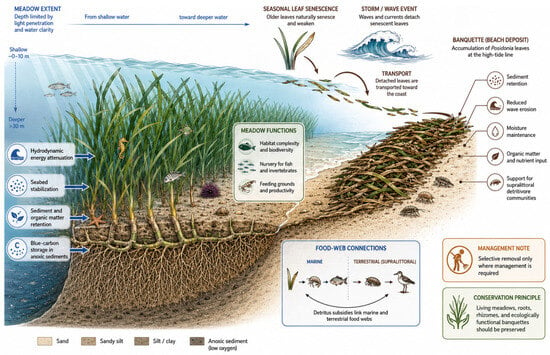
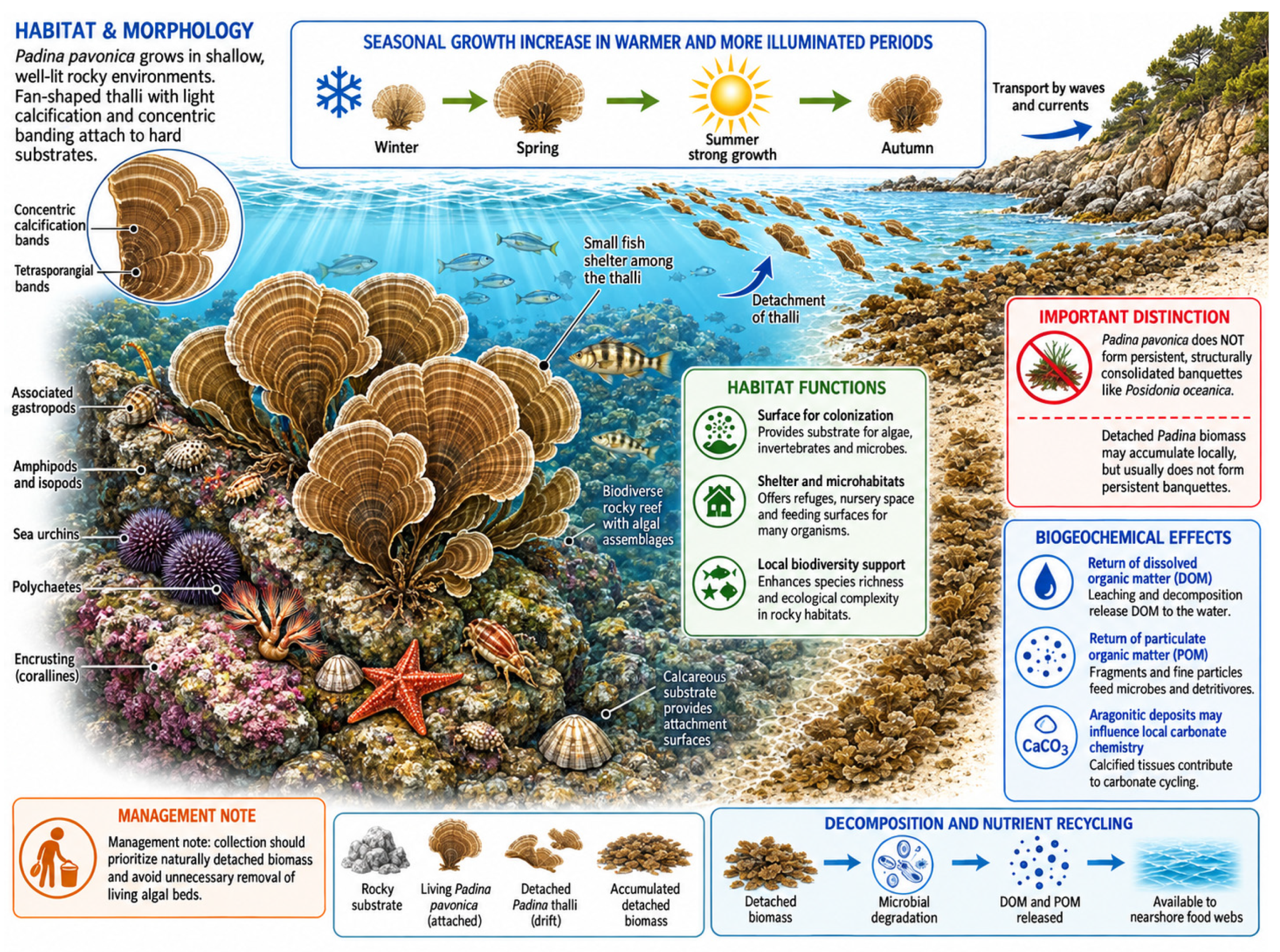
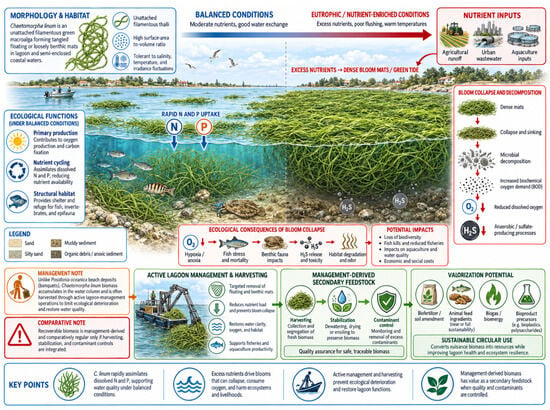
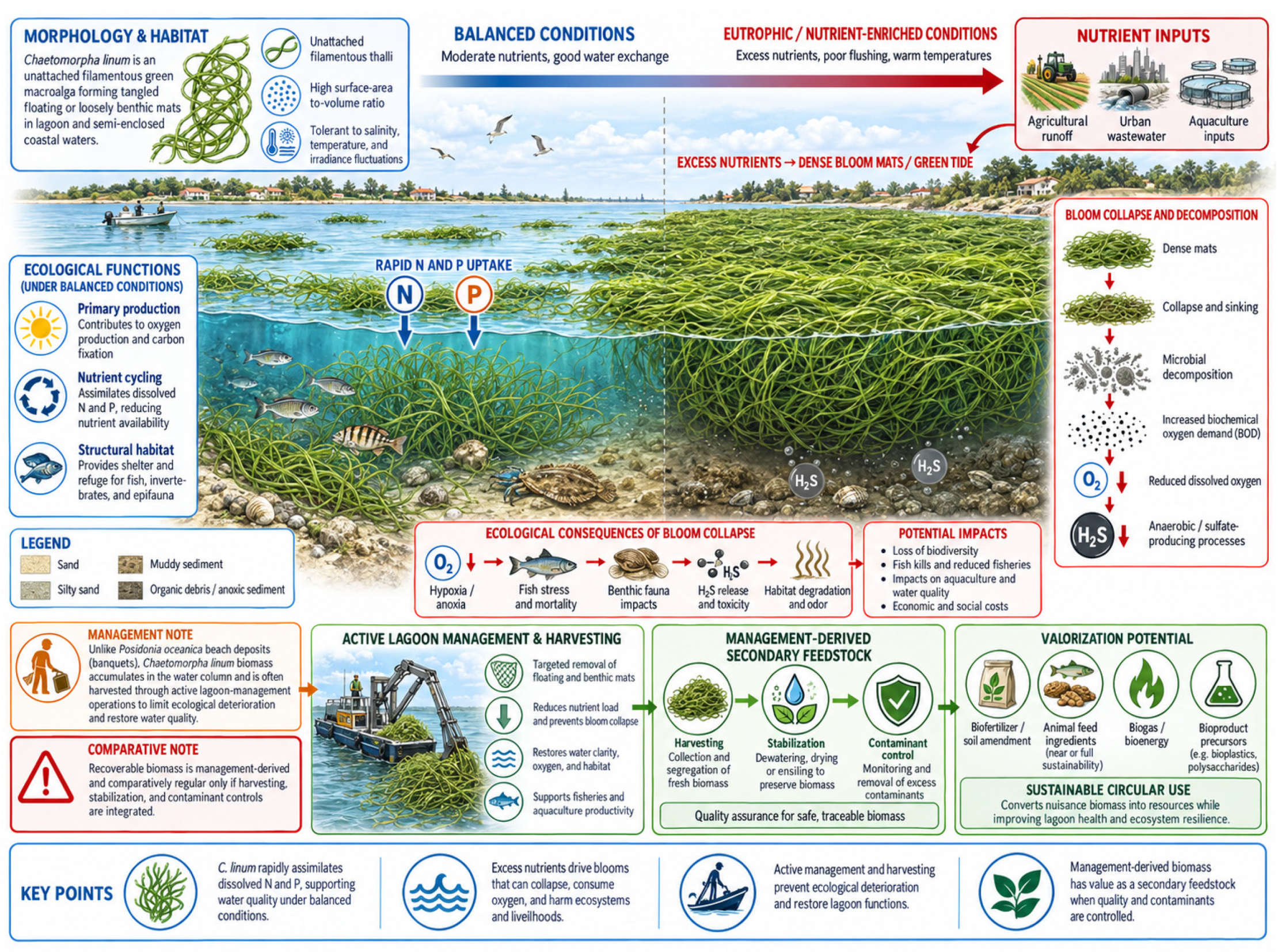
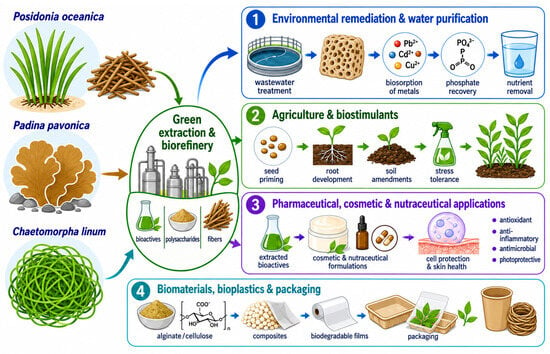
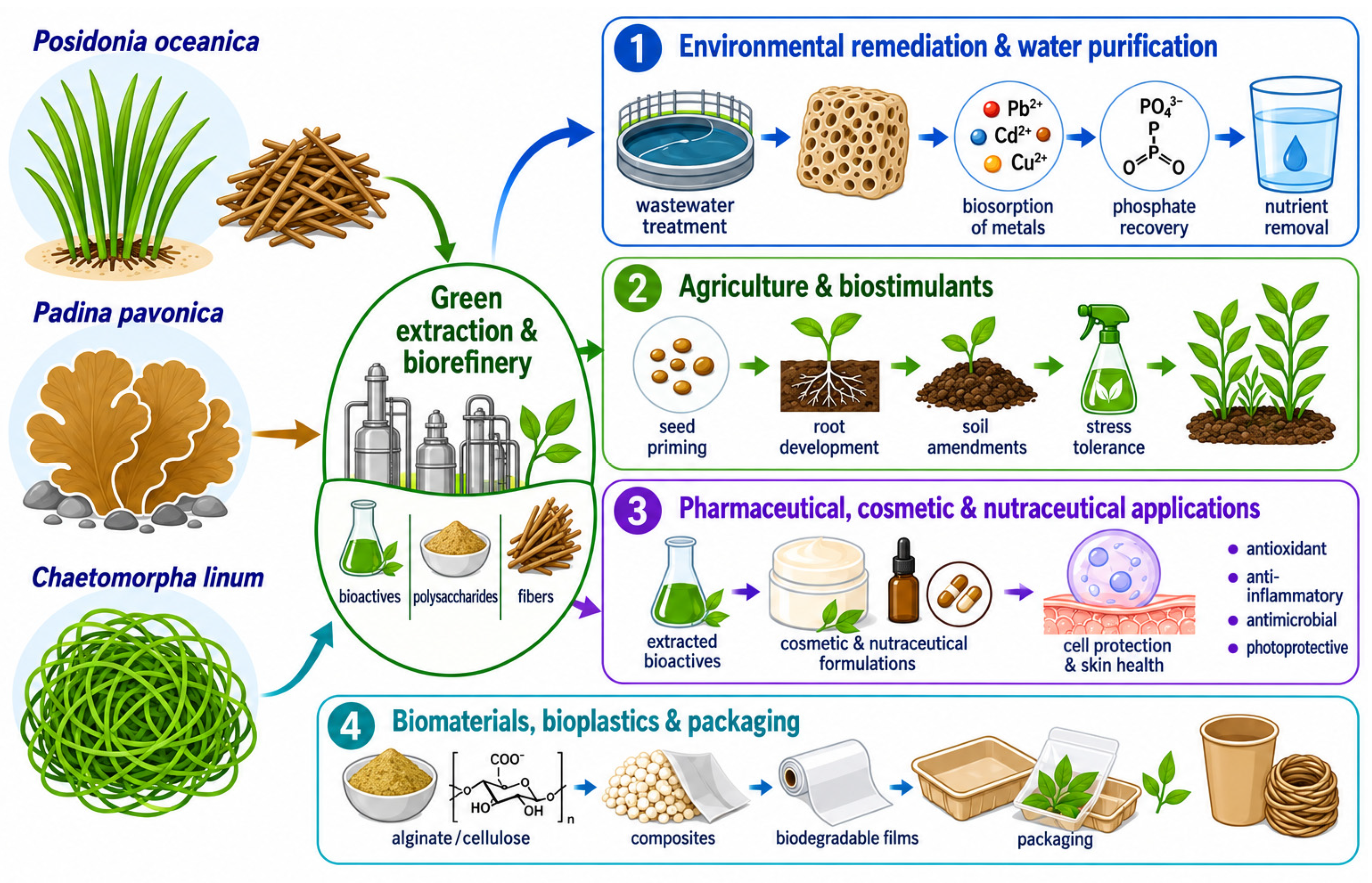

Disclaimer/Publisher’s Note: The statements, opinions and data contained in all publications are solely those of the individual author(s) and contributor(s) and not of MDPI and/or the editor(s). MDPI and/or the editor(s) disclaim responsibility for any injury to people or property resulting from any ideas, methods, instructions or products referred to in the content. |
© 2026 by the authors. Licensee MDPI, Basel, Switzerland. This article is an open access article distributed under the terms and conditions of the Creative Commons Attribution (CC BY) license.