


Abstract
In response to the environmental and health concerns associated with high-sodium brine disposal and the sodium content in table olives, this study proposes a novel, sustainable preservation method that completely replaces traditional brine with chitosan solutions. Three food-grade chitosan solutions were formulated using acetic acid, vinegar, and vinegar neutralized with baking soda as alternative liquid media for preserving Kalamata olives. Over a five-month storage period with a one-year endpoint, these solutions were evaluated against a conventional 8% NaCl brine control. The chitosan-based systems demonstrated effective microbial control, maintaining significantly lower total viable counts for most of the storage period, while yeast and mold populations were comparable to or slightly higher than the control over extended storage. Notably, they reduced the medium’s salinity by 75–85%, directly addressing the issue of high sodium content. The chitosan solutions also provided superior pH stability and color maintenance in the olives. A key finding was the distinct nature of the interaction between the olives and the chitosan medium compared to brine: while antioxidant activity within the olive flesh declined, the chitosan solutions themselves exhibited high and stable intrinsic antioxidant capacity (>78%), acting as an active antioxidant reservoir—a dynamic not observed with traditional brine. This research successfully validates chitosan solution as a viable, low-sodium, brine-free preservation medium, offering a novel strategy for sustainable olive processing that valorizes seafood waste and aligns with circular economy principles.
1. Introduction
In recent years, the global food industry has been increasingly driven by the principles of the circular economy and sustainability, aiming to minimize waste, reduce environmental impact, and valorize bio-resources [1,2,3,4]. This shift has prompted a significant re-evaluation of conventional food processing technologies, pushing innovation towards greener and more efficient alternatives. Food preservation, a significant stage for ensuring safety and extending shelf-life, is a key area for such innovation. The development of sustainable preservation methods that utilize natural, biodegradable materials, particularly those derived from agri-food waste streams, represents a significant stride towards a more sustainable and circular food system [5,6,7,8].
Table olives, a fundamental component of the Mediterranean diet and a globally cherished food, undergo post-harvest processing to remove their natural bitterness, which is predominantly achieved through fermentation in brine [9]. This traditional method relies on a complex microbiota to develop the characteristic flavor and texture, as well as to ensure preservation and safety [10]. More recently, advanced biocontrol strategies, such as the use of selected fermentation starters and bacteriocins, have been explored to enhance the safety and quality of fermented olives [11]. However, the extensive use of high-salt brine solutions, even in these advanced fermentations, presents significant drawbacks from both environmental and nutritional perspectives. The disposal of spent brines generates considerable effluent with high chemical oxygen demand (COD), biological oxygen demand (BOD), and salinity, posing a serious environmental challenge for wastewater treatment [12]. Furthermore, from a consumer health standpoint, the final product often retains high sodium levels, which is a concern given the well-established link between excessive sodium intake and hypertension and cardiovascular diseases [13].
In light of these issues, several alternative preservation technologies have been investigated. These include the use of essential oils, organic acids, and high-pressure processing, as well as the application of edible coatings and films to create a protective barrier around the olive [14,15]. Among these, biopolymer-based coatings have shown significant potential. One of the most promising biopolymers is chitosan, a linear polysaccharide obtained via the deacetylation of chitin, which is the second most abundant natural polymer after cellulose, found in the exoskeletons of crustaceans and insects. Chitosan is an ideal candidate for “green” preservation due to its unique set of characteristics: it is biodegradable, non-toxic, and biocompatible [16,17,18]. Its efficacy as a preservative stems from its inherent and broad-spectrum antimicrobial activity against bacteria, yeasts, and fungi. The primary mechanism of its antibacterial action is attributed to the interaction between its positively charged amino groups and the negatively charged components of microbial cell membranes, such as lipopolysaccharides and teichoic acids. This interaction increases membrane permeability, leading to the leakage of intracellular constituents and ultimately cell death [19,20]. Furthermore, it also exhibits notable antioxidant properties, which can retard lipid oxidation and spoilage [19,20]. Its film-forming ability and capacity to act as a matrix for other functional compounds further enhance its potential as a versatile food preservative, aligning perfectly with sustainability trends by valorizing seafood industry waste [17,21,22].
Previous research has successfully explored the application of chitosan as a coating or film for table olives, demonstrating its versatility as a preservative. For instance, studies have shown that chitosan-based coatings, particularly from different sources, can effectively control microbial growth and serve as viable preservative layers for olives [23]. Further work has confirmed the efficacy of chitosan coatings in preserving the quality of Greek-style olives, highlighting their role in reducing oxidative deterioration and maintaining firmness during storage [24]. Beyond chitosan, other innovative matrices like nanoemulgels have also been investigated for olive preservation, showing promise in controlling water migration and improving stability [25].
While these studies validate the potential of chitosan as a preservative, their application is predominantly limited to the formation of solid films or coatings on the olive surface. This approach, while effective, represents an incremental innovation over the brine-based system rather than a complete replacement. The fundamental paradigm of storing olives submerged in a liquid medium remains largely unchallenged. Herein lies the primary innovation of our study. To the best of our knowledge, this is the first report proposing the complete substitution of traditional brine with a chitosan-based solution as the liquid preservation medium for edible olives. This approach constitutes a paradigm shift. Instead of a simple coating, we utilize the chitosan solution itself as the preserving liquid, thereby eliminating the need for salt-based brine. A further innovation involves the formulation of these chitosan solutions using food-grade acids and bases, specifically vinegar as a solvent and baking soda for neutralization, to create preservation media with varying pH levels. This strategy offers a dual advantage: it circumvents the environmental issues associated with brine disposal and simultaneously produces a final product with drastically reduced sodium content, aligning with current “low-sodium” and “clean-label” consumer trends. This work builds upon the foundational research of others, such as the insights into olive fermentation and microbial dynamics provided by Mougiou et al. [24], but moves decisively beyond the state of the art by reimaging the very medium in which olives are stored.
Therefore, the objective of the present study was to comprehensively evaluate the efficacy of chitosan solutions as a total replacement for brine in the preservation of table olives. We investigated the impact of this novel method on key quality parameters, including microbial stability (against the product’s specific spoilage organisms, like yeasts and molds) and physicochemical properties (pH, acidity, color, texture) over a defined storage period. The antioxidant activity was assessed using the DPPH assay primarily as a comparative tool to evaluate the intrinsic radical scavenging capacity of the chitosan preservation medium itself, a novel aspect of this brine-free system. By demonstrating that a chitosan solution can effectively preserve olives without compromising safety or quality, this research aims to offer a potential strategy, a sustainable and nutritionally superior alternative to conventional brine preservation.
2. Materials and Methods
2.1. Materials
Food-grade chitosan was prepared in house by valorizing crayfish (Procambarus clarkii) shell waste according to the method detailed by Salmas et al. [26]. Briefly, dried and ground crayfish shells were subjected to sequential treatments:
- (i)
- Demineralization with 2 N HCl under reflux for 3 h.
- (ii)
- Deproteinization with 2 N NaOH under reflux for 18 h, yielding crude chitin.
- (iii)
- Deacetylation with concentrated NaOH (60% w/v) at 100 °C for 6 h to obtain chitosan.
The final chitosan had a deacetylation degree (DD) of 91%, determined by potentiometric titration, and a viscosity-average molecular weight (Mv) of ~220 kDa, measured using an Ubbelohde viscometer in 0.1 M acetic acid/0.2 M NaCl at 25 °C (Mark–Houwink parameters: K = 1.81 × 10⁻³, *a* = 0.93). Other materials included acetic acid, Folin–Ciocalteu reagent, 2-Diphenyl-1-picrylhydrazyl, Absolute ethanol (CH3CH2OH), sodium carbonate (Na2CO3), and acetate buffer (CH3COONa × 3H2O) (DPPH·) were supplied by Sigma-Aldrich (Co., 3050 Spruce Street, St. Louis, Missouri, MO 314-771-5765, USA). Gallic acid (3,4,5-trihydrobenzoic acid) 99% isolated from Rhus chinensis Mill. (JNK Tech. Co., Dangjin, Republic of Korea). Vinegar with the commercial name “My Kouzina Red Vinegar in Plastic Bottle 400 mL” and baking soda with the commercial name “Sun Soda Jar 350 g” were purchased from the local market. All other chemicals were of analytical grade.
For microbiological analyses, the following materials were used: Plate Count Agar (PCA) (VWR International GmbH, Vienna, Austria) was used for the enumeration of total viable count. Dichloran Rose Bengal Chloramphenicol (DRBC) agar (VWR International GmbH, Austria) was used for the enumeration of yeasts and molds, respectively. Peptone water (0.1% w/v) was used as a diluent for sample preparation. All media and reagents were prepared and sterilized according to the manufacturer’s instructions.
2.2. Preparation of Chitosan Solution
Three different chitosan solutions were evaluated as alternative preservatives for table olives stored without brine. The preparation procedures were as follows:
CS_ac: 1 g of chitosan was dissolved in 100 mL of 1% (v/v) acetic acid, resulting in a pH of 3.5 ± 0.1.
CS_vin: 1 g of chitosan was dissolved in 100 mL of 10% (v/v) vinegar, resulting in a pH of 4.5 ± 0.1.
CS_soda: First, 1 g of chitosan was dissolved in 100 mL of 5% (v/v) vinegar. The solution was then neutralized by adding 0.5 g of baking soda (NaHCO3), yielding a final pH of 6.5 ± 0.1.
2.3. Table Olive Packaging and Storage
Olives (Olea europaea) of the Kalamata variety, harvested in 2022, were obtained from a producer in the region of Agrinio, Greece. The olives had undergone natural fermentation for approximately three months and were subsequently stored in an 8% (w/v) sodium chloride brine in plastic barrels at ambient temperature until use.
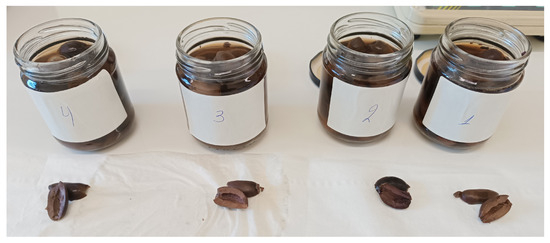
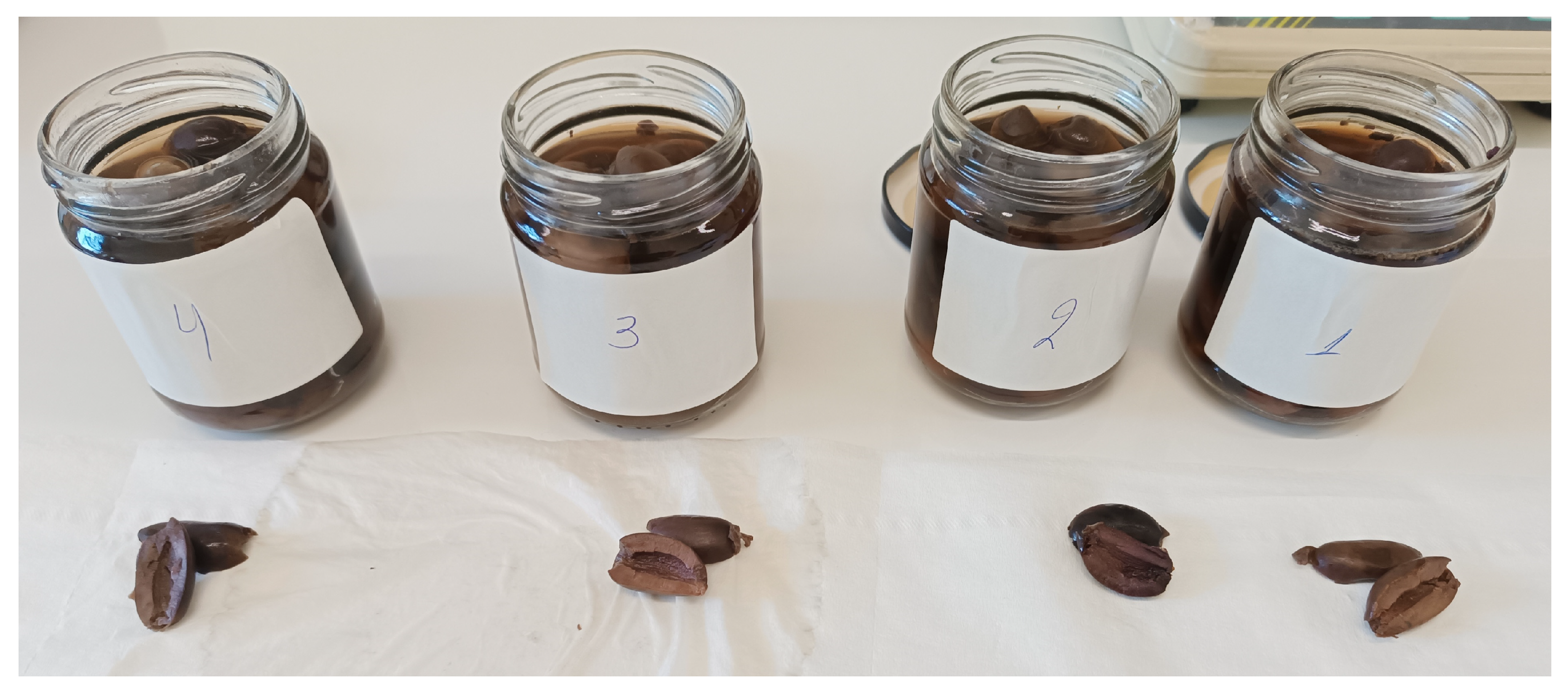
Four preservation treatments were evaluated: (i) the original 8% NaCl brine (control), and (ii–iv) the three chitosan solutions described in Section 4.2 (CS_ac, CS_vin, and CS_soda). Before packaging in the chitosan solutions, olives for treatments (ii) through (iv) were desalinated by soaking for 24 h in an aqueous citric acid solution (pH ≈ 3.5). For each treatment, two replicate jars were prepared, each containing 100 g of olives submerged in 80 g of the respective preservation medium (Figure 1).
Figure 1.
Experimental setup showing the four preservation treatments. From left to right: Jar 1: the brine control (control); Jar 2: CS_ac (chitosan in acetic acid); Jar 3: CS_vin (chitosan in vinegar); Jar 4: CS_soda (chitosan in vinegar neutralized with baking soda).
The packaged samples were stored under controlled conditions for a period of five months, with analyses conducted at regular intervals. An additional analysis was performed on samples from the same batch after one year of storage to assess the long-term effects.
2.4. Tests on Olives
2.4.1. Total Viable Count (TVC)
Total viable counts (TVCs) were enumerated on PCA after incubation at 25 °C for 48 h. Briefly, a 10 g sample of table olive was aseptically transferred to a stomacher bag, followed by homogenization with 90 mL of peptone water. Subsequently, serial decimal dilutions were performed, and 0.1 mL of the appropriate dilution was spread-plated on PCA.
2.4.2. Yeast and Mold Count (YMC)
Yeast and mold populations in the table olive samples were enumerated using standard plate count techniques on selective media, following aseptic protocols. The initial decimal dilutions (10−1) were prepared as described in Section 2.4.1.
For the enumeration of yeast and mold count (YMC), 0.1 mL aliquots of the appropriate decimal dilutions were pour-plated or spread-plated on Dichloran Rose Bengal Chloramphenicol (DRBC) agar. The plates were incubated at 25 °C for 3–5 days. Characteristic yeast and mold colonies (typically smooth, convex, and pigmented) as well as colonies exhibiting characteristic filamentous fungal morphology were counted, and the results were expressed as colony-forming units per gram of sample log (CFU/g).
All microbiological analyses were performed in duplicate.
2.4.3. pH
A portable pH meter (Milwaukee MW102 Pro+, Milwaukee Instruments, Rocky Mount, NC, USA), equipped with a penetration probe and integrated temperature sensor, was employed to determine the pH of the table olive samples. The instrument was calibrated against standard buffer solutions at pH 4.0, 7.0, and 10.0 before use and was temperature-compensated to 20 °C to match the sample temperature. To guarantee data reliability, the analysis was performed in triplicate, with ten individual measurements recorded for each treatment.
2.4.4. Salinity
The salinity of the olive preservation media and the olives themselves was determined using a digital refractometer (Kruss HRS 16, Hamburg, Germany). The instrument, which measures the refractive index and converts it to salinity (% NaCl, w/v), was calibrated by an accredited laboratory (Link Lab, Glyka Nera, Greece; certification number UNL/00361/25) before use.
Approximately 10 g of Kalamata olives was pressed into a filter paper, and a drop of this extract was placed on the prism of the refractometer. All measurements were performed in triplicate at 20 °C.
2.4.5. Total Phenolic Content (TPC)
The total phenolic content (TPC) of the table olives was determined using the Folin–Ciocalteu method with slight modifications [27]. This assay was employed as a global indicator to track the overall dynamics of phenolic compounds between the olives and the different preservation media over the extended storage period. Briefly, 10 g of table olives was transferred to a stomacher bag with 90 mL of peptone water and homogenized for 120 s
For the assay, 0.5 mL of the homogenized supernatant was mixed with 2.5 mL of Folin–Ciocalteu reagent (previously diluted 1:10 with distilled water). The mixture was vortexed and allowed to stand at room temperature for 3 min. Subsequently, 0.5 mL of a 30% (w/v) sodium carbonate (Na2CO3) solution and distilled water were added until the volume reached 5 mL. The reaction mixture was incubated in the dark for 2 h, after which the absorbance was measured at 765 nm using a spectrophotometer. A reagent blank was prepared following the same procedure without the olives.
A standard curve was constructed using gallic acid (0–500 mg/L). The TPC was calculated from the standard curve and expressed as milligrams of gallic acid equivalents per 100 g of fresh olive weight (mg GAE/100 g FW). All analyses were performed in triplicate.
2.4.6. Antioxidant Capacity
The DPPH radical scavenging activity of the table olives was evaluated using the 2,2-diphenyl-1-picrylhydrazyl (DPPH·) radical scavenging assay according to the procedure described by Brand-Williams et al. [28], with modifications.
The table olive extracts prepared for the TPC analysis (Section 2.4.3) were used. A 0.1 mM solution of DPPH· in absolute ethanol was prepared fresh daily and protected from light. For the assay, 0.1 mL of the olive extract was mixed with 2.9 mL of the DPPH· solution. The mixture was vortexed thoroughly and incubated in the dark at room temperature for 30 min. After incubation, the absorbance was measured at 517 nm using a spectrophotometer. A control sample, consisting of 0.1 mL of the extraction solvent (peptone water mixed with 2.9 mL of the DPPH· solution, was prepared concurrently. A reagent blank (ethanol) was used for zeroing the instrument.
The DPPH radical scavenging activity was calculated as a percentage using the following formula:
where Acontrol and Asample are the absorbances of the control and the olive extract, respectively. All analyses were performed in triplicate.
(%) Scavenging Activity = [(Acontrol − Asample)/Acontrol] × 100
2.4.7. Colorimetry
A LS171 colorimeter (Shenzhen Linshang Company Technology Co., Ltd., Shenzhen, China) was used to monitor changes in the CIELAB color coordinates (L, a, b*) of table olives during the storage period. The instrument was calibrated with a white standard plate before each use. Color measurements were taken directly from the olive insides and from the olive surfaces. For statistical analysis, each treatment was divided into three portions, and five random measurements were collected from each portion. The total color difference (ΔE) was calculated for each sample against the color values at day 0 (as the standard) using the following equation [29]:
where:
ΔEab = [(ΔL)2 + (Δa*)2 + (Δb*)2]1/2
ΔE*ab is the total color difference (often simply written as ΔE).
ΔL* is the difference in lightness/darkness between the sample and the standard (L sample − L standard).
Δa* is the difference in the red/green coordinate (a sample − a standard).
Δb* is the difference in the yellow/blue coordinate (b sample − b standard).
2.5. Tests on Preservation Media
The same analytical methods described in Section 2.4.3 (pH), Section 2.4.4 (Salinity), Section 2.4.5 (TPC), and Section 2.4.6 (DPPH) were applied to the preservation media (brine and chitosan solutions) at each sampling point.
2.6. Statistical Analysis
All microbiological data, specifically Total Viable Count (TVC) and Yeast and Mold count (expressed as log CFU/g), were processed using SPSS software (version 29.0, IBM Corp., Armonk, NY, USA). Mood’s median test method was used to see if there are statistically significant differences between treatments over time.
All other quantitative data, including pH, salinity, total phenolic content (TPC), antioxidant activity (DPPH), and colorimetric parameters (L*, a*, b*, ΔE), were subjected to statistical analysis using SPSS software (version 29.0, IBM Corp., Armonk, NY, USA). A one-way analysis of variance (ANOVA) was performed to determine significant differences among the preservation treatments (the brine control, CS_ac, CS_vin, CS_soda) at each sampling time point. When a significant F-value was obtained (p < 0.05), post hoc comparisons were conducted using Tukey’s Honest Significant Difference (HSD) test to identify specific pairwise differences. Results are presented as mean ± standard deviation, and significant differences (p < 0.05) are indicated by distinct superscript lowercase letters within columns and capital letters within rows in the respective tables.
3. Results
3.1. TVC of Stored Table Olives
The TVC of table olives during storage is presented in Table 1.
Table 1.
TVC values (log CFU./g) of table olives.
In the control (brine control), TVC increased from 3.44 log CFU/g in the first month to 5.34 log CFU/g after one year, indicating gradual microbial growth. All chitosan-based preservation solutions (CS_ac, CS_vin, CS_soda) initially showed significantly lower TVC than the control, with counts ranging from 2.45 to 2.69 log CFU/g in the first month. Although microbial counts in the chitosan treatments increased over the storage period, they generally remained significantly lower than the brine control by the end of storage. Notably, the CS_ac treatment consistently exhibited the lowest microbial counts throughout most of the storage period, culminating in a value of 4.16 log CFU/g after one year.
3.2. Yeasts and Molds of Stored Table Olives
The populations of yeasts and molds during the storage of table olives are summarized in Table 2.
Table 2.
Yeast and mold values of table olives.
The brine control showed variable yeast and mold counts, starting at 2.60 log CFU/g in the first month and reaching 3.85 log CFU/g after one year. For chitosan-based treatments, yeast and mold counts were generally comparable to or slightly higher than the control throughout storage. After one year of storage, the yeast and mold population in the chitosan treatments (3.98–4.07 log CFU/g) was slightly higher than that of the control (3.85 log CFU/g). This indicates that while chitosan solutions provided effective inhibition in the initial phases, they overextended storage; nevertheless, they supported yeast and mold populations at levels similar to or slightly exceeding those in traditional brine.
3.3. pH of Stored Table Olives
The pH of both the olive pulp and the preservation solution was monitored throughout the storage period as a key indicator of chemical stability and microbial activity. The results are presented in Table 3 (olive pulp pH) and Table 4 (solution pH).
Table 3.
pH values 1 of table olive pulp.
Table 4.
Table olive solution pH values.
In the olive pulp (Table 3), all chitosan-based treatments maintained pH values within a relatively narrow range over the five-month storage period. The CS_ac and CS_vin treatments, with initial pulp pH values of approximately 4.1, showed only moderate increases, reaching 4.55–4.69 by the fifth month. The CS_soda treatment, initiated at a higher pH (4.11), exhibited a slightly greater increase, reaching 4.94 in five months. After one year of storage, all chitosan treatments demonstrated a return to more acidic pH levels (3.92–4.65), indicating sustained chemical stability. In contrast, the control (brine control) exhibited more pronounced fluctuations, with pH rising to 5.41 by the fourth month before dropping sharply to 3.57 after one year.
In the preservation solutions (Table 4), a similar trend was observed. The CS_ac and CS_vin solutions maintained stable pH profiles, with values remaining between 4.18 and 4.69 over five months. The CS_soda solution, while stable, consistently recorded the highest pH values (4.58–4.88). The brine control again showed the greatest variability, with pH rising to 4.9 by the fourth month before declining to 3.52 after one year.
Statistical analysis (Tukey’s test, p < 0.05) confirmed that the pH of chitosan-treated samples, particularly CS_ac and CS_vin, was significantly more stable over time compared to the brine control, which underwent significant phase-specific shifts. This stability suggests an effective buffering capacity and inhibitory environment against spoilage microorganisms in the chitosan-based systems.
3.4. Salinity of Stored Table Olives
The salinity of the preservation media and olives was monitored as a key parameter reflecting sodium reduction and preservation efficacy. The results are presented in Table 5.
Table 5.
Salinity results (% NaCl, w/v) of the preservation media over time.
The salinity (% NaCl, w/v) of the preservation media was monitored as a key indicator of sodium content (Table 5). The brine control maintained a high salinity, ranging from 8.00% at Day 0 to 4.00% after one year. In stark contrast, all chitosan-based solutions (CS_ac, CS_vin, CS_soda) exhibited markedly and significantly (p < 0.05) lower salinity levels throughout the entire storage period. Initial salinity for all chitosan treatments was 1.10%, representing an immediate 86% reduction compared to the control. Over time, a slight increase was observed, with values reaching 1.90–2.00% after one year. The analysis of the olive flesh itself indicated a negligible and stable salinity level (<0.5% NaCl) throughout storage for all treatments, confirming that the dramatic reduction in sodium content is a property of the preservation medium itself. This demonstrates that the chitosan-based preservation method successfully achieved a drastic reduction (approximately 75–85%) in the sodium content of the preserved olives compared to the traditional brine method.
3.5. Total Phenolic Content (TPC) of Stored Table Olives
The total phenolic content (TPC) in olives and their preservation media is presented in Table 6 and Table 7, respectively.
Table 6.
Total phenolic content (mg GAE/L) of olives.
Table 7.
Total phenolic content (mg GAE/L) of brine.
In the olives (Table 6), TPC was initially very low in all chitosan treatments (1.52–2.38 mg GAE/L) during the first two months, significantly lower than in the control (5.8–6.89 mg GAE/L). A substantial increase in olive TPC was observed for all treatments in the third month, with chitosan treatments reaching values between 128.99 and 147.06 mg GAE/L, which were higher than the control (112.81 mg GAE/L). This peak was followed by a decline. After one year, the TPC in chitosan-treated olives (42.14–43.99 mg GAE/L) was lower than in the control olives (52.84 mg GAE/L).
In the preservation media (Table 7), a different trend was evident. The TPC in the control brine surged to over 500 mg GAE/L from the third month onward. The TPC in the chitosan solutions also increased but remained at significantly lower levels (185.49–233.24 mg GAE/L during months 3–5), roughly half that of the control brine. This suggests that chitosan-based media may have a different interaction with phenolic compounds, potentially retaining more within the olive fruit or interacting with them differently compared to traditional brine.
3.6. Antioxidant Capacity of Stored Table Olives
The antioxidant capacity, measured as DPPH radical scavenging activity (%), is shown in Table 8 (olives) and Table 9 (preservation media).
Table 8.
Antioxidant activity (%) of olives.
Table 9.
Antioxidant activity (%) of brine.
For the olives (Table 8), the control maintained high and stable antioxidant activity throughout the first five months (67.74–72.80%), before dropping to 50.47% after one year. In contrast, the antioxidant activity in chitosan-treated olives was significantly lower from the first month onward. It showed a consistent decreasing trend over time, with values dropping to very low levels (1.61–12.62%) after one year. This indicates a faster depletion of antioxidant compounds in olives stored in chitosan solutions.
Conversely, the antioxidant capacity of the preservation media themselves (Table 9) told a different story. The control brine exhibited variable activity (66.56–81.97%). All chitosan-based solutions (CS_ac, CS_vin, CS_soda) demonstrated high and remarkably stable antioxidant activity throughout the entire storage period, with values consistently between 77.89% and 87.22%. This suggests that the chitosan solutions themselves possess significant and stable radical scavenging activity, which may contribute to the overall preservation system.
3.7. Colorimetry of Stored Table Olives
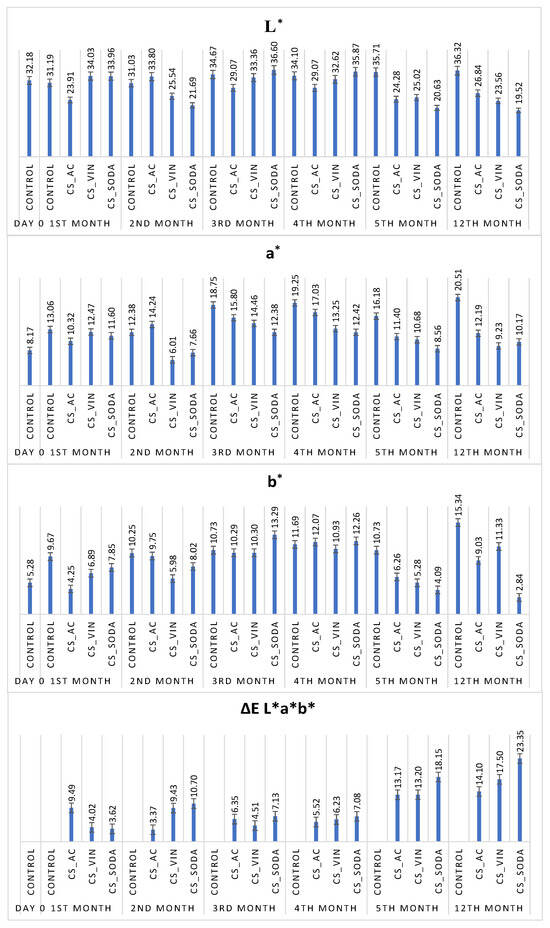
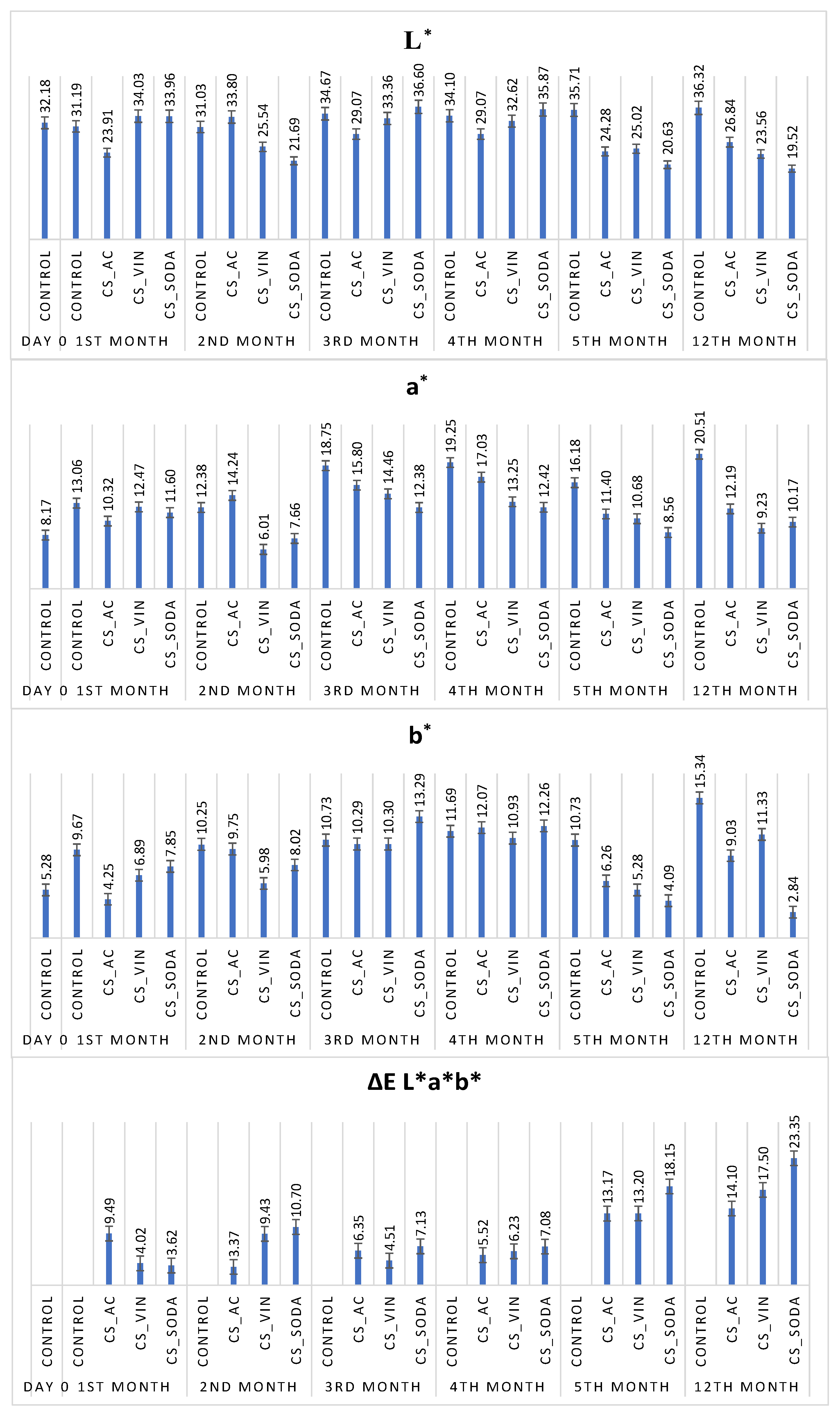
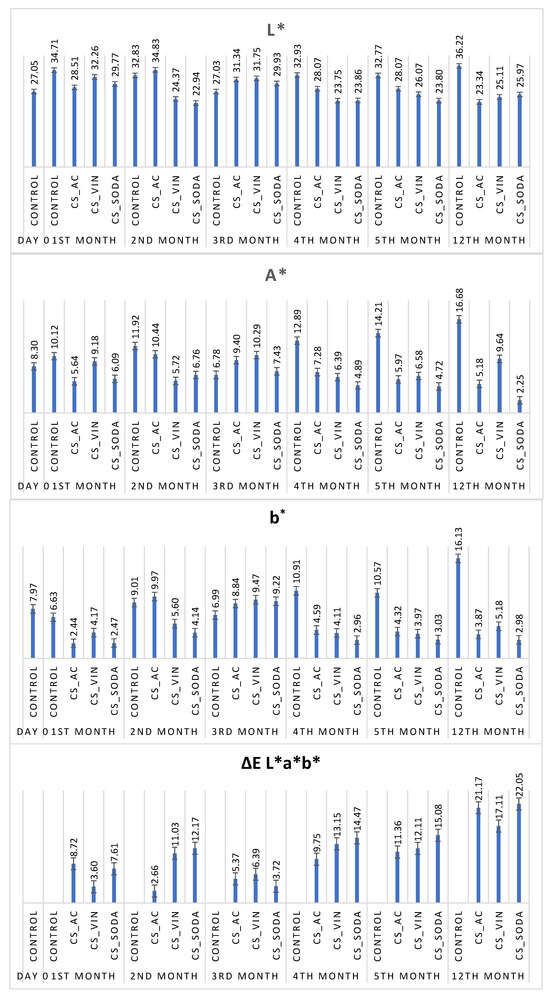
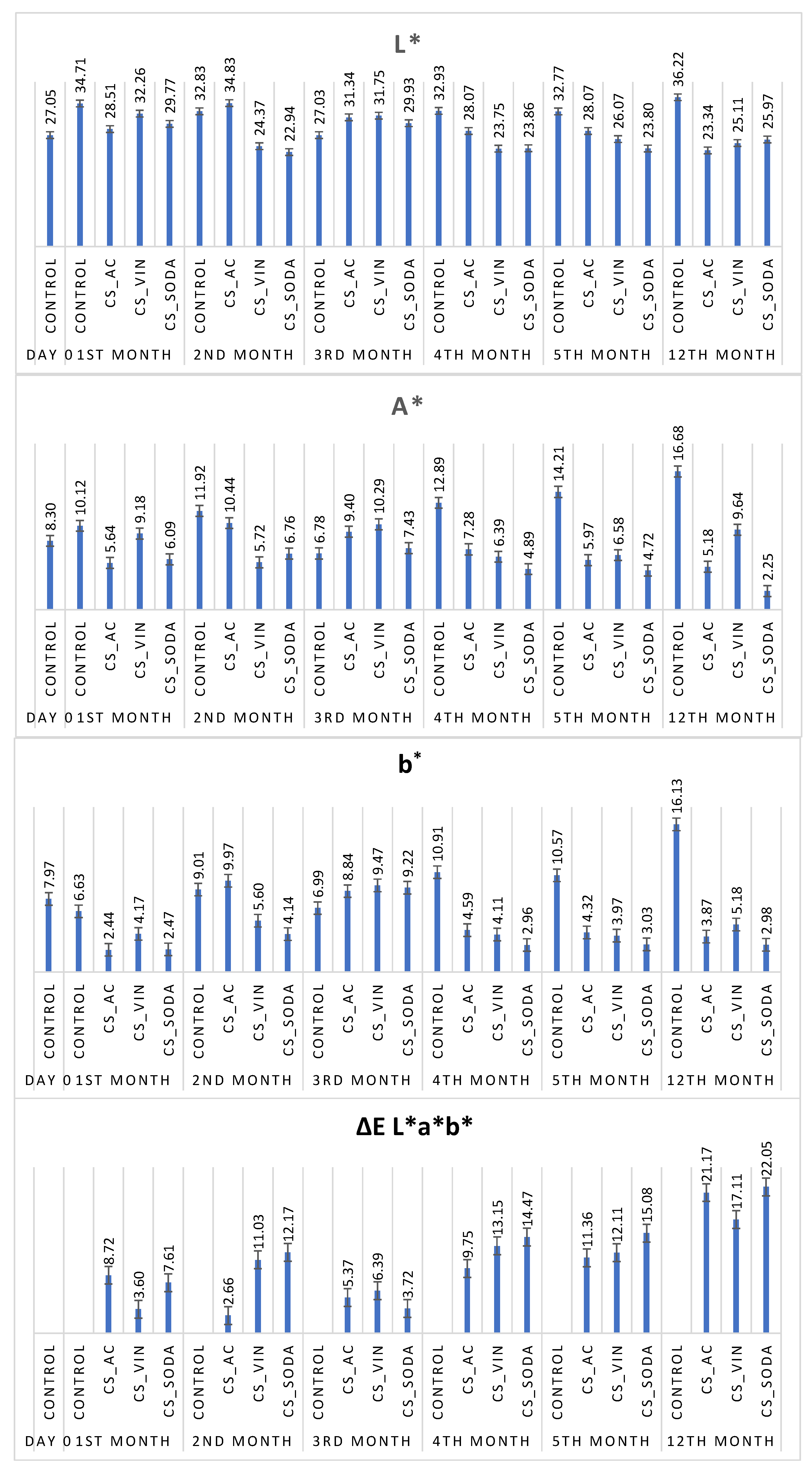
Color stability is a significant quality attribute for table olives. Changes in CIELAB color coordinates (L*, a*, b*) were monitored both on the olive surface and inside the pulp over the storage period. The results are presented in Figure 2 and Figure 3.
Figure 2.
Colorimetry results from the inside of stored table olives.
Figure 3.
Colorimetry results from the surface of stored table olives.
Overall, color changes (ΔE) in both the pulp and surface were minimal across all chitosan-based treatments throughout storage. The control (brine) samples showed slightly higher ΔE values, particularly on the surface, indicating greater color deviation over time. The chitosan-treated olives maintained better color retention, with CS_vin and CS_ac showing the least variation in L* (lightness), a* (red/green), and b* (yellow/blue) values. This suggests that chitosan solutions not only preserve microbial and physicochemical stability but also help maintain the visual quality of olives, likely due to their antioxidant properties and barrier effect against oxidative discoloration.
4. Discussion
The present study evaluated the efficacy of chitosan solutions as a total replacement for traditional brine in preserving Kalamata table olives. This innovative approach aimed to address the environmental burden of spent brine disposal and reduce the final product’s sodium content. The results demonstrate that chitosan-based solutions can effectively preserve olives while introducing distinct effects on microbial, physicochemical, and bioactive profiles compared to conventional methods.
4.1. Microbial Stability and Preservation Efficacy
The primary goal of any preservation method is to inhibit spoilage and pathogenic microorganisms. The observed Total Viable Count (TVC) and yeast and mold data (Table 1 and Table 2) reveal a nuanced and promising pattern. Initially, all chitosan solutions (CS_ac, CS_vin, CS_soda) exhibited significantly lower overall microbial loads (TVC) than the traditional brine control. This strong initial suppression aligns with the well-documented, broad-spectrum antimicrobial activity of chitosan [16,19], primarily attributed to the interaction between its positively charged amino groups and negatively charged microbial cell membranes [19,20].
However, a more detailed examination of the yeast and mold populations provides significant insight. While the chitosan solutions controlled overall bacterial growth (TVC), they did not suppress yeasts and molds below the level of the brine control; in fact, yeast and mold counts in chitosan treatments were comparable to or slightly higher than the control throughout storage, culminating in marginally higher counts after one year. This selective efficacy—stronger against bacteria than fungi—may be attributed to several factors [30,31]. First, the primary antimicrobial mechanism of chitosan involves electrostatic interaction between its positively charged amino groups and negatively charged microbial cell membranes. Bacterial cell walls, rich in anionic lipopolysaccharides (Gram-negative) or teichoic acids (Gram-positive), present a strong target. Fungal cell walls, however, contain chitosan and chitin, which may reduce this electrostatic attraction or even allow for competitive binding. Second, the dense, complex structure of the fungal cell wall may pose a greater physical barrier to chitosan penetration. Finally, certain yeasts and molds possess robust adaptive mechanisms, including the expression of efflux pumps or cell wall remodeling, which could enhance their tolerance in a chitosan-rich environment over extended storage. This behavior indicates that chitosan does not act as a broad-spectrum fungicidal agent in this liquid application over extended periods. This is a notable distinction from its performance as a coating, where stronger suppression of surface molds and yeasts has been reported [23]. The sustained yeast population in chitosan solutions could be related to the ability of certain yeasts to adapt to or even utilize components of the chitosan medium.
This observation refines our understanding of chitosan’s role in fermented food preservation. Unlike some advanced systems designed to specifically target spoilage yeasts while sparing beneficial bacteria [24], the liquid chitosan solution here did not selectively suppress yeasts relative to the brine control. Instead, it provided a generally inhibitory environment that kept total bacterial loads (TVC) lower than brine for most of the storage duration, while allowing a yeast and mold ecosystem to persist and even reach levels similar to or slightly above those obtained via the traditional method.
The efficacy of CS_ac, which maintained the lowest TVC for the longest duration, is particularly noteworthy. Its lower initial pH (~3.5), much lower than the pKa of chitosan (6.3–6.5), likely enhanced chitosan’s solubility and cationic charge, maximizing its initial interaction with bacterial cell membranes [30]. In contrast, CS_soda, with its higher pH, almost identical to the pKa of chitosan, showed TVC values intermediate between CS_ac and CS_vin, suggesting that pH adjustment can modulate the antibacterial efficacy of the chitosan solution.
Over an extended storage period (5 months to 1 year), TVC in chitosan treatments gradually increased, converging with or remaining slightly below the control. The convergence of TVC values between chitosan treatments and the brine control after one year indicates that, under these specific conditions, the antimicrobial activity of the chitosan solution as a sole hurdle may be time-limited. This underscores that for commercial applications targeting very long shelf-life (e.g., >12 months), the chitosan solution might need to be combined with additional mild hurdles, such as refrigeration, modified atmosphere packaging, or the inclusion of other natural antimicrobials, to maintain a consistently low microbial load. It is important to note that this study evaluated efficacy against the endogenous spoilage microbiota. Further dedicated challenge studies with relevant foodborne pathogens (e.g., Listeria monocytogenes, Escherichia coli O157) would be necessary to comprehensively validate the safety of this preservation system, particularly for formulations with pH values approaching the low-acid food range. In contrast, the high-salt environment of the brine control exerts a consistent osmotic stress, controlling microbial growth in table olives through a different, non-selective mechanism of osmoregulation [32]. The finding that chitosan solutions maintained significantly lower TVC than brine for most of the 5-month period, and comparable yeast/mold levels, confirms their effectiveness in stabilizing the microbial ecosystem of table olives for medium-term product preservation [33,34]. The long-term (1-year) convergence in counts highlights the need for complementary hurdles (e.g., refrigeration, mild acids) or chitosan re-formulation for very long extended shelf-life applications of chitosan in olives.
4.2. Physicochemical Stability: pH and Salinity
The pH stability of both the olive pulp and the preservation solution (Table 3 and Table 4) was markedly superior in chitosan-based systems, especially CS_ac and CS_vin, compared to the fluctuating pH of the brine control. The stability in chitosan treatments indicates a buffering effect and the absence of strong fermentative activity that leads to acid production and subsequent consumption seen in the brine [10]. The chitosan matrix likely restricts microbial metabolism and diffusion of metabolites, contributing to this stability. The sharp pH drop in the control after one year is characteristic of progressive lactic acid fermentation and possible over-acidification, which can negatively affect sensory quality [14].
The most striking advantage of the chitosan method is the drastic reduction in salinity (Table 5). While the control brine maintained 4–8% NaCl, chitosan solutions kept salinity below 2%, representing a 75–85% reduction in sodium content. This directly addresses a major public health concern linked to high sodium intake [13] and meets growing consumer demand for “low-sodium” and “clean-label” products. The slight increase in salinity in chitosan solutions over time is likely due to the migration of endogenous salts from the olives into the preservation medium, a process less pronounced in the already saturated brine.
4.3. Bioactive Compound Dynamics and Antioxidant Activity
The behavior of Total Phenolic Content (TPC) revealed a complex interaction between the olives and the preservation medium (Table 6 and Table 7). The very low TPC in olives under chitosan treatments during the first two months, followed by a significant peak in the third month, suggests delayed extraction or release of phenolics from the olive tissue into the pulp. Chitosan, being a biopolymer, may initially form weak interactions with phenolic compounds or create a microenvironment that slows their diffusion. The subsequent rise could be due to gradual tissue breakdown or changes in chitosan-phenolic interactions over time. In contrast, the high-salt brine likely facilitated faster and more continuous osmotic extraction of phenolics from the olives into the brine, as evidenced by the very high TPC in the control brine from month three onward. This aligns with studies showing that brine composition significantly affects phenolic diffusion [14]. The dynamic transfer of phenolic compounds suggested by the TPC data highlights the need for subsequent research using chromatographic techniques (e.g., HPLC-DAD/MS) to identify and quantify the specific phenolic compounds involved and to elucidate the exact mechanisms of interaction with the chitosan matrix.
The antioxidant capacity results present a compelling narrative (Table 8 and Table 9). A key finding was the distinct nature of the interaction between the olives and the chitosan medium compared to brine. The rapid decline in antioxidant activity within the olives stored in chitosan solutions, compared to the stable activity in brine-stored olives, indicates that the chitosan medium may accelerate the oxidation or consumption of olive antioxidants. Alternatively, the potent radical-scavenging activity of the chitosan solutions themselves (consistently > 78%) may have created a concentration gradient, potentially driving the diffusion, migration, or accelerated reaction of antioxidants from the olive flesh into the solution to establish equilibrium. Chitosan is known to possess intrinsic antioxidant properties due to its ability to donate hydrogen atoms and chelate metal ions [19,20]. Our results strongly support this, showing that the preservation medium itself becomes a reservoir of antioxidant activity. This is a significant finding, as it shifts the paradigm from simply protecting food antioxidants to providing an active antioxidant medium. While the DPPH assay provided a clear indication of this intrinsic property of the chitosan medium, future studies employing a battery of antioxidant assays (e.g., ABTS, FRAP, ORAC) would offer a more comprehensive analysis of the antioxidant interactions in this novel preservation system. The combined system (olive + chitosan solution) may offer a different, but potentially effective, oxidative stability mechanism compared to the traditional method, where antioxidants are retained primarily within the fruit.
4.4. Color Stability and Overall Quality
The colorimetry results (Figure 1 and Figure 2) confirm that chitosan solutions effectively maintained the visual quality of olives. Minimal ΔE values in chitosan-treated samples, compared to the brine control, indicate superior color retention. This can be attributed to the dual role of chitosan: its antimicrobial action prevents microbial discoloration, and its antioxidant property (as demonstrated in the solution) likely mitigates enzymatic browning and oxidative pigment degradation [16,22]. This finding is consistent with previous studies on chitosan coatings for fruits and vegetables, which report improved color preservation [16,23].
4.5. Comparison of Literature and Novelty
Previous research has successfully applied chitosan as edible coatings or films for olives preservation [23,24], demonstrating its ability to control surface microbes and reduce weight loss. Our work builds upon but fundamentally differs from these studies. We propose not a solid coating but a liquid chitosan solution as the complete preservation medium, eliminating brine. This marks a transition from barrier technology to immersion preservation.
Studies like that of Zaharioudakis et al. [25] explore advanced delivery systems (nanoemulgels) for olive preservation, focusing on controlled release. Our approach is simpler, utilizing food-grade acids/bases (vinegar, baking soda) to formulate the chitosan medium, enhancing its practical feasibility and alignment with clean-label trends and simple food-grade materials. It should be noted that while thermal processing (e.g., pasteurization) remains a cost-effective and reliable method for shelf-stable olives, the chitosan solution offers a non-thermal, low-sodium alternative that may be preferable for preserving raw sensory characteristics and heat-sensitive bioactive compounds. While Mougiou et al. [24] detailed the microbial biochemistry of Greek olives in brine, our work charts the unknown territory of their behavior in a chitosan-based liquid ecosystem.
The observed phenomena—especially the dynamic exchange of phenolics and the dominant antioxidant role of the chitosan medium—are novel contributions to the field. These suggest that preservation in a biopolymer solution is not a passive process but an active interaction that redefines the distribution and fate of quality-related compounds.
A recognized limitation of this proof-of-concept study is the absence of sensory evaluation, which is essential to fully assess the practical applicability and consumer acceptance of this novel preservation method.
In conclusion, chitosan solutions (particularly CS_vin and CS_soda, formulated with food-grade ingredients) serve as a viable, sustainable, and low-sodium alternative to brine for preserving table olives. They provide excellent microbial control in the short-to-medium term, outstanding physicochemical and color stability, and introduce a new preservation dynamic where the medium itself acts as an antioxidant reservoir. The main trade-off appears to be a faster depletion of intrinsic olive antioxidants and a need to monitor long-term microbial stability.
While this approach contributes to circular economy goals by valorizing seafood waste, practical implementation must consider economic and environmental trade-offs. For instance, the complete elimination of brine addresses disposal issues, but future research could explore hybrid systems that partially re-use fermentation brine, adjusted with chitosan, to further enhance eco-efficiency. The principles of a circular economy must be balanced with practical considerations of cost, scalability, and final product quality.
Furthermore, as with any new food ingredient, regulatory approval and clear labeling are essential. Chitosan is generally recognized as safe (GRAS) by some authorities, but its derivation from shellfish requires clear allergen labeling to inform consumers.
This study validates the core concept of brine-free preservation using valorized seafood waste (chitosan), contributing directly to circular economy goals [1,2,23]. Future work should focus on optimizing chitosan concentration and molecular weight, evaluating sensory acceptance, assessing the effects on volatile aroma compounds, and exploring synergistic effects with other natural antimicrobials or stabilizers to ensure safety and quality over even longer storage periods.
5. Conclusions
This study successfully demonstrated the feasibility of using chitosan solutions as a complete, sustainable replacement for traditional high-salt brine in the preservation of table olives. The innovation lies not in creating a coating, but in utilizing the chitosan solution itself as the preserving liquid medium, thereby eliminating brine and its associated environmental and nutritional drawbacks. Formulations based on food-grade acids and bases (CS_ac, CS_vin, CS_soda) proved highly effective. They ensured microbial stability, maintaining significantly lower total viable counts than brine over the medium term, while yeast and mold levels were sustained at levels comparable to traditional preservation. The chitosan systems also maintained excellent physicochemical (pH) and visual (color) quality of the olives and, most importantly, achieved a dramatic 75–85% reduction in sodium content. The research revealed a novel preservation dynamic: chitosan solutions create an active system where the medium itself provides strong and stable antioxidant protection, although this may accelerate the migration or consumption of antioxidants from the olive flesh. This trade-off opens new avenues for optimizing bioactive compounds’ retention. While the chitosan systems maintained key quality parameters effectively for 5 months, changes observed at the 1-year endpoint suggest the optimal shelf-life under these specific conditions may be within this medium-term range. This aligns with certain market segments for refrigerated or shorter-shelf-life premium products, though formulation optimization would be required for longer ambient storage. In conclusion, this brine-free preservation strategy, utilizing chitosan derived from seafood waste, offers a promising, cleaner, and healthier alternative for the olive industry. It directly contributes to waste valorization, reduces environmental pollution from spent brine, and meets consumer demand for low-sodium products, marking a significant step towards a more sustainable and circular food system. The foremost priority for future work is a comprehensive sensory analysis to evaluate consumer acceptability of olives preserved in chitosan solutions, as this is the ultimate determinant of commercial viability. Furthermore, optimization of chitosan properties (e.g., concentration, molecular weight), investigation of long-term microbial stability under commercial conditions, dedicated challenge studies against foodborne pathogens, and detailed phytochemical profiling using chromatographic techniques to characterize the specific phenolic compounds involved in the observed interactions are essential next steps.
Author Contributions
Conceptualization, V.K.K., A.V., I.K.K. and A.E.G.; methodology, V.K.K., A.V., A.K., N.D.A., I.K.K. and A.E.G.; software, V.K.K. and A.V.; validation, V.K.K., A.V., N.D.A. and A.E.G.; formal analysis, V.K.K. and A.V.; investigation, V.K.K., A.V., I.K.K. and A.E.G.; resources, V.K.K., A.V. and A.E.G.; data curation, V.K.K., A.V. and A.E.G.; writing—original draft preparation, A.E.G.; writing—review and editing, N.D.A., I.K.K. and A.E.G.; visualization, V.K.K., A.V., N.D.A., I.K.K. and A.E.G.; supervision, I.K.K. and A.E.G.; project administration, A.E.G. All authors have read and agreed to the published version of the manuscript.
Funding
This research received no external funding.
Institutional Review Board Statement
Not applicable.
Data Availability Statement
The original contributions presented in this study are included in the article. Further inquiries can be directed to the corresponding authors.
Conflicts of Interest
The authors declare that the research was conducted in the absence of any commercial or financial relationships that could be construed as a potential conflict of interest.
References
- Jurgilevich, A.; Birge, T.; Kentala-Lehtonen, J.; Korhonen-Kurki, K.; Pietikäinen, J.; Saikku, L.; Schösler, H. Transition towards Circular Economy in the Food System. Sustainability 2016, 8, 69. [Google Scholar] [CrossRef] [Scilit]
- Cooney, R.; de Sousa, D.B.; Fernández-Ríos, A.; Mellett, S.; Rowan, N.; Morse, A.P.; Hayes, M.; Laso, J.; Regueiro, L.; Wan, A.H.L.; et al. A Circular Economy Framework for Seafood Waste Valorisation to Meet Challenges and Opportunities for Intensive Production and Sustainability. J. Clean. Prod. 2023, 392, 136283. [Google Scholar] [CrossRef] [Scilit]
- Adams, D.; Donovan, J.; Topple, C. Achieving Sustainability in Food Manufacturing Operations and Their Supply Chains: Key Insights from a Systematic Literature Review. Sustain. Prod. Consum. 2021, 28, 1491–1499. [Google Scholar] [CrossRef] [Scilit]
- Baldwin, C.J. Sustainability in the Food Industry; John Wiley & Sons: Hoboken, NJ, USA, 2011; ISBN 978-1-119-94926-8. [Google Scholar]
- Schuenzel, K.M.; Harrison, M.A. Microbial Antagonists of Foodborne Pathogens on Fresh, Minimally Processed Vegetables. J. Food Prot. 2002, 65, 1909–1915. [Google Scholar] [CrossRef] [Scilit]
- Gokoglu, N. Novel Natural Food Preservatives and Applications in Seafood Preservation: A Review. J. Sci. Food Agric. 2019, 99, 2068–2077. [Google Scholar] [CrossRef] [Scilit]
- Bouarab Chibane, L.; Degraeve, P.; Ferhout, H.; Bouajila, J.; Oulahal, N. Plant Antimicrobial Polyphenols as Potential Natural Food Preservatives. J. Sci. Food Agric. 2019, 99, 1457–1474. [Google Scholar] [CrossRef] [Scilit]
- Yu, H.H.; Chin, Y.-W.; Paik, H.-D. Application of Natural Preservatives for Meat and Meat Products against Food-Borne Pathogens and Spoilage Bacteria: A Review. Foods 2021, 10, 2418. [Google Scholar] [CrossRef] [Scilit] [PubMed]
- Rocha, J.; Borges, N.; Pinho, O. Table Olives and Health: A Review. J. Nutr. Sci. 2020, 9, e57. [Google Scholar] [CrossRef] [Scilit]
- Brenes, M.; Kailis, S.G. Naturally Processed Table Olives, Their Preservation and Uses. In Olives and Olive Oil in Health and Disease Prevention; Academic Press: Cambridge, MA, USA, 2021; pp. 15–25. [Google Scholar]
- Rus-Fernández, P.; Fuentes, A. Fermentation Starters and Bacteriocins as Biocontrol Strategies for Table Olives Preservation: A Mini-Review. J. Sci. Food Agric. 2025, 105, 3550–3556. [Google Scholar] [CrossRef] [Scilit]
- Bonatsou, S.; Tassou, C.C.; Panagou, E.Z.; Nychas, G.-J.E. Table Olive Fermentation Using Starter Cultures with Multifunctional Potential. Microorganisms 2017, 5, 30. [Google Scholar] [CrossRef] [Scilit]
- He, F.J.; MacGregor, G.A. Reducing Population Salt Intake Worldwide: From Evidence to Implementation. Prog. Cardiovasc. Dis. 2010, 52, 363–382. [Google Scholar] [CrossRef] [Scilit]
- Conte, P.; Fadda, C.; Del Caro, A.; Urgeghe, P.P.; Piga, A. Table Olives: An Overview on Effects of Processing on Nutritional and Sensory Quality. Foods 2020, 9, 514. [Google Scholar] [CrossRef] [Scilit] [PubMed]
- Perpetuini, G.; Prete, R.; Garcia-Gonzalez, N.; Khairul Alam, M.; Corsetti, A. Table Olives More than a Fermented Food. Foods 2020, 9, 178. [Google Scholar] [CrossRef] [Scilit]
- Xing, Y.; Xu, Q.; Li, X.; Chen, C.; Ma, L.; Li, S.; Che, Z.; Lin, H. Chitosan-Based Coating with Antimicrobial Agents: Preparation, Property, Mechanism, and Application Effectiveness on Fruits and Vegetables. Int. J. Polym. Sci. 2016, 2016, 4851730. [Google Scholar] [CrossRef] [Scilit]
- Aider, M. Chitosan Application for Active Bio-Based Films Production and Potential in the Food Industry: Review. LWT—Food Sci. Technol. 2010, 43, 837–842. [Google Scholar] [CrossRef] [Scilit]
- Cazón, P.; Vázquez, M. Applications of Chitosan as Food Packaging Materials. In Sustainable Agriculture Reviews 36: Chitin and Chitosan: Applications in Food, Agriculture, Pharmacy, Medicine and Wastewater Treatment; Crini, G., Lichtfouse, E., Eds.; Sustainable Agriculture Reviews; Springer International Publishing: Cham, Switzerland, 2019; pp. 81–123. ISBN 978-3-030-16581-9. [Google Scholar]
- Guarnieri, A.; Triunfo, M.; Scieuzo, C.; Ianniciello, D.; Tafi, E.; Hahn, T.; Zibek, S.; Salvia, R.; De Bonis, A.; Falabella, P. Antimicrobial Properties of Chitosan from Different Developmental Stages of the Bioconverter Insect Hermetia illucens. Sci. Rep. 2022, 12, 8084. [Google Scholar] [CrossRef] [Scilit] [PubMed]
- Yilmaz Atay, H. Antibacterial Activity of Chitosan-Based Systems. In Functional Chitosan: Drug Delivery and Biomedical Applications; Jana, S., Jana, S., Eds.; Springer: Singapore, 2019; pp. 457–489. ISBN 978-981-15-0263-7. [Google Scholar]
- Qu, B.; Luo, Y. A Review on the Preparation and Characterization of Chitosan-Clay Nanocomposite Films and Coatings for Food Packaging Applications. Carbohydr. Polym. Technol. Appl. 2021, 2, 100102. [Google Scholar] [CrossRef] [Scilit]
- Zhang, X.; Ismail, B.B.; Cheng, H.; Jin, T.Z.; Qian, M.; Arabi, S.A.; Liu, D.; Guo, M. Emerging Chitosan-Essential Oil Films and Coatings for Food Preservation—A Review of Advances and Applications. Carbohydr. Polym. 2021, 273, 118616. [Google Scholar] [CrossRef] [Scilit]
- Vieira, T.M.; Moldão-Martins, M.; Alves, V.D. Composite Coatings of Chitosan and Alginate Emulsions with Olive Oil to Enhance Postharvest Quality and Shelf Life of Fresh Figs (Ficus carica L. Cv. ‘Pingo De Mel’). Foods 2021, 10, 718. [Google Scholar] [CrossRef] [Scilit]
- Mougiou, N.; Tsoureki, A.; Didos, S.; Bouzouka, I.; Michailidou, S.; Argiriou, A. Microbial and Biochemical Profile of Different Types of Greek Table Olives. Foods 2023, 12, 1527. [Google Scholar] [CrossRef] [Scilit]
- Zaharioudakis, K.; Salmas, C.E.; Andritsos, N.D.; Leontiou, A.A.; Moschovas, D.; Karydis-Messinis, A.; Triantafyllou, E.; Avgeropoulos, A.; Zafeiropoulos, N.E.; Proestos, C.; et al. Investigating the Synergistic Effects of Carvacrol and Citral-Edible Polysaccharide-Based Nanoemulgels on Shelf Life Extension of Chalkidiki Green Table Olives. Gels 2024, 10, 722. [Google Scholar] [CrossRef] [Scilit] [PubMed]
- Salmas, C.E.; Georgopoulos, S.; Leontiou, A.; Sakavitsi, V.; Cheilari, A.; Kollia, E.; Zaharioudakis, K.; Ragkava, E.; Karabagias, V.K.; Andritsos, N.D.; et al. Crayfish Waste-Shells Integrated Valorization for Added Value Materials Production: Calcium Hydroxide, Calcium Carbonate, Chitin, Chitosan, and N-S Co-Doped Carbon Quantum Dots. Waste Biomass Valorization 2024, 15, 5947–5963. [Google Scholar] [CrossRef] [Scilit]
- Singleton, V.L.; Orthofer, R.; Lamuela-Raventós, R.M. Analysis of Total Phenols and Other Oxidation Substrates and Antioxidants by Means of Folin-Ciocalteu Reagent. In Methods in Enzymology; Academic Press: Cambridge, MA, USA, 1999; Volume 299, pp. 152–178. [Google Scholar]
- Brand-Williams, W.; Cuvelier, M.E.; Berset, C. Use of a Free Radical Method to Evaluate Antioxidant Activity. LWT—Food Sci. Technol. 1995, 28, 25–30. [Google Scholar] [CrossRef] [Scilit]
- Choudhury, A.K.R. Principles of Colour and Appearance Measurement; Elsevier: Amsterdam, The Netherlands, 2014; ISBN 978-1-78242-367-6. [Google Scholar]
- Ardean, C.; Davidescu, C.M.; Nemeş, N.S.; Negrea, A.; Ciopec, M.; Duteanu, N.; Negrea, P.; Duda-Seiman, D.; Musta, V. Factors Influencing the Antibacterial Activity of Chitosan and Chitosan Modified by Functionalization. Int. J. Mol. Sci. 2021, 22, 7449. [Google Scholar] [CrossRef] [Scilit] [PubMed]
- Yan, D.; Li, Y.; Liu, Y.; Li, N.; Zhang, X.; Yan, C. Antimicrobial properties of chitosan and chitosan derivatives in the treatment of enteric infections. Molecules 2021, 26, 7136. [Google Scholar] [CrossRef] [Scilit] [PubMed]
- O’Byrne, C.P.; Booth, I.R. Osmoregulation and Its Importance to Food-Borne Microorganisms. Int. J. Food Microbiol. 2002, 74, 203–216. [Google Scholar] [CrossRef] [Scilit] [PubMed]
- Lucena-Padrós, H.; Caballero-Guerrero, B.; Maldonado-Barragán, A.; Ruiz-Barba, J.L. Microbial Diversity and Dynamics of Spanish-Style Green Table-Olive Fermentations in Large Manufacturing Companies through Culture-Dependent Techniques. Food Microbiol. 2014, 42, 154–165. [Google Scholar] [CrossRef] [Scilit] [PubMed]
- Botta, C.; Cocolin, L. Microbial dynamics and biodiversity in table olive fermentation: Culture-dependent and -independent approaches. Front. Microbiol. 2012, 3, 245. [Google Scholar] [CrossRef] [Scilit]

Disclaimer/Publisher’s Note: The statements, opinions and data contained in all publications are solely those of the individual author(s) and contributor(s) and not of MDPI and/or the editor(s). MDPI and/or the editor(s) disclaim responsibility for any injury to people or property resulting from any ideas, methods, instructions or products referred to in the content. |
© 2026 by the authors. Licensee MDPI, Basel, Switzerland. This article is an open access article distributed under the terms and conditions of the Creative Commons Attribution (CC BY) license.