


Simple Summary
The Wood Sandpiper (Tringa glareola) is a long-distance migratory wader with an extensive Eurasian breeding range. It is one of the most numerous and most frequently caught and ringed wader species during migration through inland Europe. However, researchers often had to disregard potential sexual differences in this species’ biology because males and females exhibit similar plumage, and, to date, no reliable sex identification method has been developed to determine sex based on body measurements. In this paper, we analysed differences in morphological traits between sexes and provided five discriminant equations for sexing adult Wood Sandpipers.
Abstract
The possibility of sex identification in birds is of substantial importance for studies on various aspects of their ecology and behaviour. Discriminant functions have become increasingly popular in studies of bird species that are monomorphic in plumage characteristics because these methods are inexpensive and non-invasive. In this paper, we provide the first discriminant function that could potentially aid in determining sex in a common wader species, the Wood Sandpiper, based on external body measurements. Females were larger than males in all linear body measurements; however, no single measurement can be used to determine sex due to the high degree of overlap between the sexes. Discriminant equation with the most commonly used linear measurements, wing length and bill length, was provided. Identifying birds with discriminant function values D3 < –0.409 as males and those with D3 > 0.217 as females would lead to sex misclassification of only 5% of individuals of each sex, but it would leave as many as 83% of the individuals unsexed. Allowing for a misclassification of 10% would shift the cut-off values to −0.509 for males and 0.633 for females and reduce the number of unsexed birds to 66%. The method presented here allows us to account for sex-specific patterns in future ecological studies of the Wood Sandpiper and can be applied to past data.
1. Introduction
The possibility of the sex identification of birds has substantial importance for studies on various aspects of avian behaviour, including foraging [1,2,3] and habitat selection [4,5], as well as migration phenology [6,7]. The fundamental challenge in such studies lies in the reliable determination of an individual’s sex, whether during field observations or when handling captured birds. In many bird species, sex can be readily distinguished by external traits, most commonly plumage characteristics. However, in some families, sex determination criteria must be applied with great care, especially when sexual dimorphism is subtle [8]. Clear sexual dimorphism is absent in many Charadriiformes species, where the sexes are similar in appearance and the linear measurements of males and females overlap substantially [9,10,11]. In waders, males and females often differ not only in migration timing [6,12] but also in moult [13,14], foraging ecology [4,15,16,17], and other aspects of their migratory behaviour [13,18]. Therefore, the ability to determine their sex is crucial in many studies. Although highly effective molecular methods based on various sets of primers [19,20] have been developed, they require specialized laboratory equipment, become costly when large numbers of birds are captured for research, and require DNA samples, most often blood or feathers. Therefore, in studies on migration timing that use large numbers of individuals captured at ringing stations, biometric discriminant equations are applied to determine the sex of monomorphic species with low probability of misclassification, e.g., [7,21,22]. This method is inexpensive, non-invasive, and can be applied to previously collected data, which contributes to its widespread use in studies of monomorphic bird species, e.g., [6,13,23].
The Wood Sandpiper (Tringa glareola, family Scolopacidae, subfamily Tringinae) is a long-distance migratory wader with an extensive Eurasian breeding range, and its global population estimated at approximately 3,000,000–4,800,000 individuals [24]. Populations migrating across Europe spend winter mainly in sub-Saharan Africa, but smaller numbers also spend it in the Mediterranean region [25]. Males and females of the Wood Sandpiper differ only slightly in size, with females being larger than males, and no single linear measurement can be used for reliable sex determination [26,27], except for exceptionally large or small individuals [28]. In this species, only a rough description of sex differences in linear measurements exists, studied on spring-migrating birds, based on 120 molecularly sexed individuals [27]. In ornithological handbooks, the provided biometric characteristics of Wood Sandpipers are exclusively [29] or predominantly based on the museum specimens [28], where linear dimensions differ from live individuals due to post-mortem shrinkage [30,31,32].
The Wood Sandpiper is one of the most numerous [33,34,35,36] and most frequently caught and ringed wader species [37,38,39] during migration through inland Europe. There are several papers published on its migration phenology, e.g., [27,37,40,41], stopover strategy, e.g., [42,43,44,45], and biometrics, e.g., [37,40,43,46]. However, in those studies, researchers had to disregard potential sexual differences because males and females exhibit similar plumage, and, to date, no discriminant function has been developed to determine sex in large samples of captured individuals, without the necessity of DNA analysis. Therefore, the aim of this study was to test whether a discriminant equation could be developed in order to determine the sex of adult Wood Sandpipers, and to evaluate the reliability of this approach and the extent of its applicability. If it proves effective, it will be possible to use it in the future for large-scale research on the migration of this species, as well as in the analyses of data collected in the past.
2. Materials and Methods
2.1. Fieldwork
Wood Sandpipers were caught in walk-in traps and mist-nets in the floodplain meadows of the middle Pripyat River in the vicinity of Turov, Belarus (52°04′ N, 27°44′ E), which is an important stopover site for many wader species using both the East Atlantic and the Black Sea-Mediterranean Flyways, especially during spring migration [47,48]. The field studies were conducted between 2015 and 2021, and the fieldwork was carried out from the end of March to the middle of May. This period covered the entire spring migration of this species in this area [48]. Birds were caught in walk-in traps and mist nets. The following measurements were taken: wing length and tarsus plus toe length (maximum chord method) measured with a stopped ruler with to the nearest 1 mm; total head length, bill length, nalospi length and tarsus length measured using a dial caliper to the nearest 0.1 mm [49]. Nalospi length measurement, i.e., distance between the tip of the bill and the proximal edge of the nalospi, is not commonly taken in waders, but it is recommended in species with no clear limit between the horny base of the bill and the feathering of the head [49], as in the case of the Wood Sandpiper. The age of the birds was determined at the time of capture based on plumage characteristics, allowing us to recognize two age classes: second-year birds and older individuals [26,28]. Only 10 s-year Wood Sandpipers were captured; therefore, this age class was omitted from the analyses. In total, 168 adult birds were captured and measured, and approximately 50 μL of blood was taken from the brachial vein and preserved in 70% ethyl alcohol for further laboratory analysis. About 90% of all captured Wood Sandpipers were measured by two of the authors (PP and NK), and the accuracy and repeatability of the measurements were calibrated following Busse and Meissner [49] until a consistency of up to 0.2 mm was achieved for caliper measurements and complete consistency for measurements taken with a ruler. In one male, the bill length measurement was not taken, and therefore, this individual was omitted from some analyses.
2.2. Laboratory Work
A drop of blood from each individual sample was placed on a separate, sterile tissue paper for ethanol evaporation. Later, DNA was isolated from blood samples using the Blood Mini DNA Kit (A&A Biotechnology, Gdynia, Poland) and stored in Tris buffer for further laboratory work. To amplify the intron sequences on the CHD-W and CHD-Z genes, we used 2602F and 2669R set of primers, designed for molecular sexing of wader species [50]. PCR reactions were carried out in 10 μL samples, containing 4.5 μL of DNA Taq polymerase (REDTaq ReadyMix, Sigma-Aldrich, Saint Louis, MO, USA), 1.8 μL of isolated DNA, 1.8 μL of sterile water, 0.6 μL of each primer, and 0.48 μL of MgCl2. Initial denaturation at 94 °C for 2 min was followed by 40 cycles of denaturation at 94 °C for 30 s, annealing at 62 °C for 55 s, and elongation at 72 °C for 2 min. The final elongation was performed at 72 °C for 5 min. To visualize the length difference in CHD-W and CHD-Z genes located on the W and Z avian sex chromosomes, PCR products were separated during electrophoresis at 85 mA for 30 min on a 2% agarose gel stained with 5 μL Midori Green (ABO, Gdańsk, Poland) and viewed under UV light (Figure S1). In total, 70 females and 98 males were sexed molecularly.
2.3. Data Analysis
Linear measurements met the assumptions of the homogeneity of variance between the compared sexes (Brown–Forsythe test, p > 0.144), except the wing length (Brown–Forsythe test, p = 0.002), and the assumption of the normality of the distribution (Shapiro–Wilk test, p > 0.064), except for wing, tarsus and tarsus plus toe lengths in males (Shapiro–Wilk test, p = 0.049, p = 0.028 and p = 0.001, respectively) and nalospi length in females (Shapiro–Wilk test, p = 0.034). Nevertheless, we did not transform this variable because discriminant analysis is robust to violations of homogeneity, especially when deviations are minor [51,52]. To show the degree of overlap between sexes in the two most dimorphic measurements, 95% prediction intervals were presented, a range of values likely to contain the value of any single new observation given the settings of the predictors [53].
Differences in morphological traits between males and females were tested using a two-sample Welch test to account for unequal variances and unequal sample sizes between the compared groups. To calculate the sexual dimorphism index (SDI), we used the formula for species where females are the larger sex introduced by Lovich & Gibbons [54]:
We used linear discriminant analysis (LDA) to derive a discriminant function for sexing individuals based on a set of linear measurements. Three measurements, bill, nalospi, and head length, in which one includes the other, were highly correlated with Pearson’s correlation coefficients between them ranging from r = 0.82 to r = 0.86 (p < 0.001 in all cases). Similarly, a strong correlation was found between tarsus and tarsus plus toe lengths (r = 0.84, p < 0.001). Therefore, we include only one of these highly correlated variables in the same discriminant function to avoid strong multicollinearity between independent variables. For all other pairs of measurements, the correlation coefficients were lower (r < 0.56; Table A1). First, a backward stepwise LDA was performed to determine which set of variables best classified the sexes in our sample. The inclusion of a morphometric measurement into the model was based on the Wilk’s Lambda ratio, with a default minimum partial F to enter the model equal to F = 3.84 and a maximum partial F to remove: 2.71 [55]. In LDA, the sexes were coded as ‘−1’ for males and ‘1’ for females. The equations presented in this paper are based on unstandardized canonical discriminant function coefficients, with discriminant score D < 0 indicating a male, and D > 0 indicating a female. To evaluate the relative contribution of each measurement to the discriminant function, we computed standardized coefficients by taking the absolute value of each unstandardized discriminant coefficient and dividing it by the sum of absolute values across variables. The resulting coefficients summed to 1. Hence, these coefficients reflect the relative importance of each variable in separating males and females. There was a slight male bias in the sample size; thus, a priori classification probabilities were set as proportional to group sizes. We recognize the criticisms of automated stepwise variable selection in statistical analyses [56,57]. Therefore, as in previous similar analyses [7,58], we have presented models that include combinations of measurements with the highest SDI values, as well as measurements most commonly taken for waders, to compare their effectiveness with the equation selected by the stepwise procedure.
We validated our discriminant functions using a jackknife procedure, as suggested by Dechaume-Moncharmont et al. [59]. In this approach, each case is classified using a discriminant function based on all other cases [60]. We report class-specific classification success rate (the proportion of individuals of each sex correctly classified), as well as the overall classification rate (the total proportion of misclassified cases in the entire dataset). Discriminant function analysis was performed using the R package ‘MASS’, version 7.3-65 [61]. All analyses were performed in the R version 4.4.2 environment [62]. Statistical significance was accepted at p < 0.05.
3. Results
Females were on average larger than males in all measurements (Table 1). Nalospi length showed the highest sexual dimorphism, followed by bill length, while total head, tarsus, tarsus plus toe, and wing lengths were slightly less dimorphic than bill length (Table 1).
Table 1.
Comparison of mean body measurements of adult Wood Sandpiper males and females. The size dimorphism index (SDI) is given for each trait.
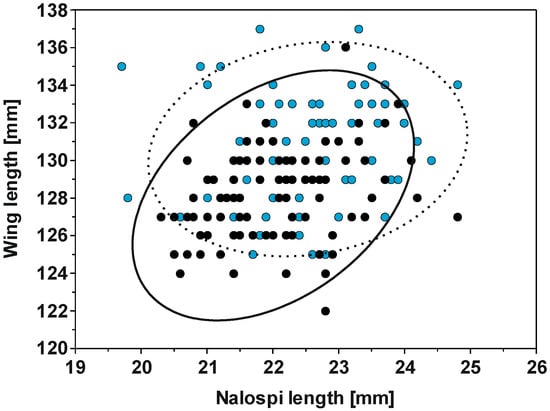
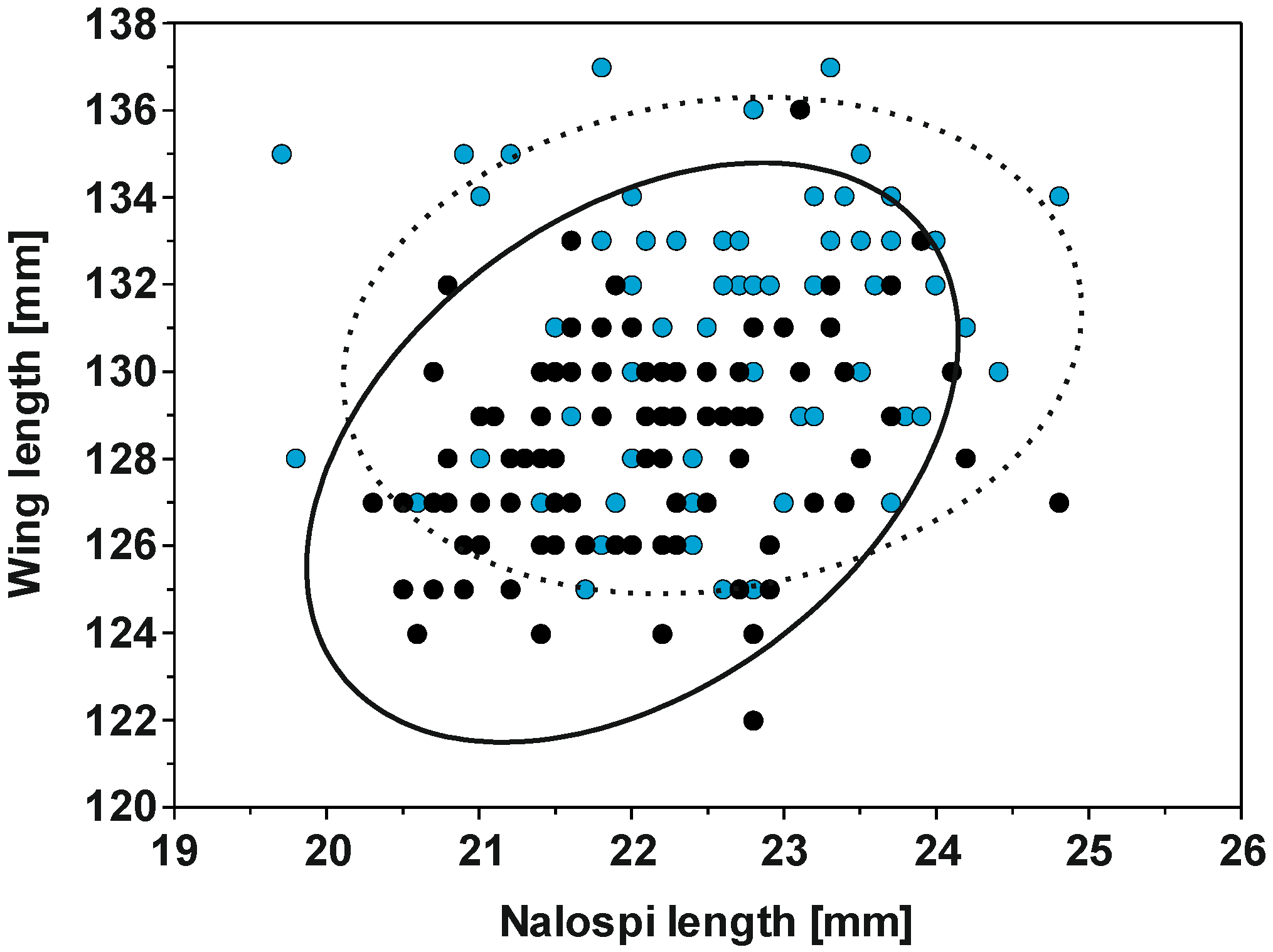
There was a large overlap in the linear measurements of males and females (Figure S2). When taking into account two most dimorphic measurements, nalospi length and wing length simultaneously, only 14% of males and 20% of females (out of 168 individuals) were found outside the overlapping 95% confidence intervals (Figure 1).
Figure 1.
Relationship between nalospi length and wing length in male (black dots) and female (blue dots) Wood Sandpipers sexed molecularly. The ellipses show the 95% prediction intervals, representing the range in which a single new observation is expected to fall, based on the bivariate distribution estimated from the male (solid line) and female (dotted line) data.
In the backward stepwise LDA procedure, nalospi length and wing length were selected for inclusion in the discriminant function (Table 2, D1). According to the jackknife procedure, this equation, as well as the one including wing and bill length (D3), showed the highest accuracy in sexing, at approximately 73%. However, the differences in the proportion of correctly sexed Wood Sandpipers among the five equations tested were small—less than 2% (Table 2). We recommend using equations D1 and D3, which have the highest discriminative power. The remaining equations also perform with similar efficiency and can be used depending on the set of measurements available. Bill length is a standard measurement taken from waders at ringing stations, whereas nalospi length is not [49,63]. Therefore, the D3 equation can be expected to be used more frequently. In all cases, sexing accuracy was consistently higher for males (approximately 82–86%) than for females (approximately 57–60%). Both leg measurements (tarsus length and tarsus plus toe length) contributed far less to the discriminant function than the other measurements (Table A2). Consequently, including them in the model with wing and nalospi length did not increase the overall proportion of correctly sexed birds (Table 2, D4). Other equations using tarsus or tarsus plus toe length (D6–D8) had lower classification efficiency (Table 2).
Table 2.
Equations for calculating discriminant scores. The percentage of correctly sexed Wood Sandpipers is given according to the jackknife procedure. NL—nalospi length, WL—wing length, THL—total head length, BL—bill length, TL—tarsus length, TTL—tarsus plus length.
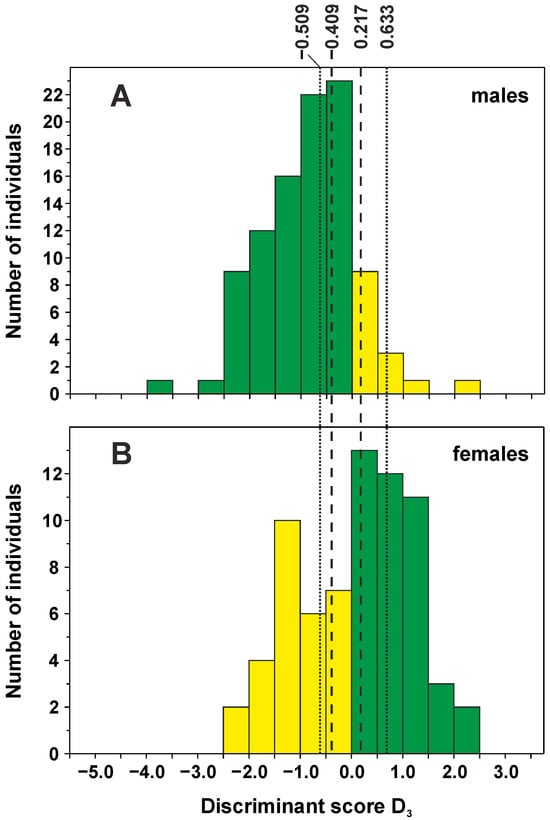
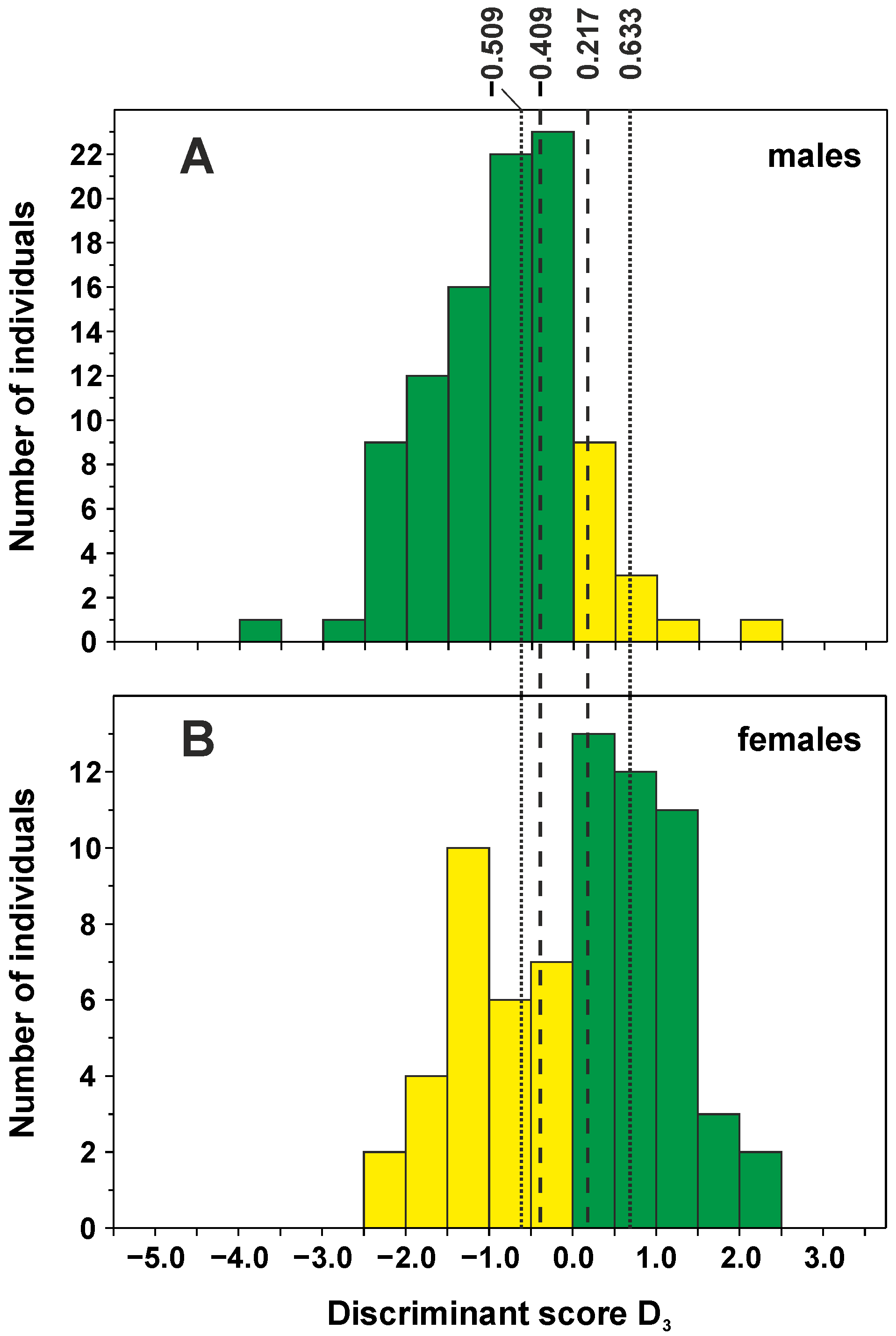
Using the D3 equation for sexing Wood Sandpipers would produce only a slightly male-biased sex ratio, as 57% of the 168 birds in the overlapping zone would be classified as males. The overlapping range between sexes in D3 score was wide and occurred between −2.076 and 2.048, but mostly between −2.0 and 0.5 (Figure 2A,B). Identifying individuals with D3 < −0.409 as males and those with D3 > 0.217 as females, only 5% of birds of both sexes would be misclassified (Figure 2A,B), but it would leave as many as 83% of the individuals unsexed. Allowing for a sex misclassification of 10% would shift the cut-off values to −0.509 for males and 0.633 for females and reduce the number of unsexed birds to 66% (Figure 2A,B).
Figure 2.
Distribution of the discriminant score (D3) calculated for males (A) and females (B) sexed molecularly. Green bars indicate correct classifications, and yellow bars indicate incorrect classifications. Dotted lines represent D3 cut-off values of −0.409 and 0.217, enabling correct classification for 95% of individuals of both sexes, while dashed lines indicate cut-off values of −0.509 and 0.633, enabling 90% correct classification.
4. Discussion
In the Wood Sandpiper, females were larger than males in all linear measurements, as in other members of the subfamily Tringinae. However, the overlap in the linear measurements of males and females was large, and only 14% of males and 20% of females fell outside the overlapping 95% confidence intervals of the two most dimorphic traits. Among five discriminant equations presented for sex determination in this species, we recommend using the equations based on wing and nalospi length or wing and bill length, as these have the highest discriminative power. The remaining equations perform with similar efficiency and can be applied depending on the measurements available.
In genus Tringa and Actitis the sexual dimorphism is quite weak, with considerable overlap of morphometrics between the sexes. This overlap results in lower sex classification accuracy rate of discriminant functions than in other genera from subfamily Tringinae. Also in other Scolopacidae subfamilies biometrical differences between sexes are, with some exceptions greater than in genera Tringa and Actitis, e.g., in Calidrinae (see Supplement in [7]), Gallinagininae [22,64,65,66], with an unclear situation in Scolopacinae e.g., [10,67,68]. Variation in linear measurements within a bird species usually reflects the evolutionary responses to selection pressures that commonly differ between males and females [69,70]. In waders the magnitude of size dimorphism is related to the mating system, where males are larger in polygynous species and females are larger in polyandrous species [71,72]. Moreover, in wader species with acrobatic aerial displays, selection favours smaller males with higher aspect ratio wings (i.e., wing span2/wing area), which enhance agility and manoeuvrability. However, this selection pressure does not apply to males that perform simple displays in the air or on the ground [73,74]. The Wood Sandpiper is socially monogamous and territorial [28,29]. Display flights are performed by both sexes and consist of circling over a particular area without any acrobatic aerial manoeuvrers but only with sharply angled-back wings displays [28,29]. Both parents provide care until fledging, although the female typically leaves the brood first, about 7–10 days after hatching [29]. In genera of Tringinae with pronounced sexual size dimorphism, such as Limosa and Numenius, biparental care is maintained for most of the breeding season [28,29,75]. Hence, this may explain the greater degree of sexual dimorphism in these species compared with the Wood Sandpiper and other Tringa and Actitis species. Therefore, the limited sexual dimorphism observed in the linear dimensions of this species may be related to weak competition, e.g., for food resources between the sexes, and consequently to weak intersexual selection. In waders, characteristics related to resource use (i.e., bill and nalospi length) are often more sexually dimorphic than those related to locomotion (i.e., tarsus and tarsus plus toe length), e.g., [76,77,78]. In the Wood Sandpiper, sexual dimorphism in tarsus and tarsus-plus-toe length was less pronounced than in bill and nalospi length. A similar pattern has been observed in the closely related Redshank (Tringa totanus; [79]) and the Common Sandpiper (Actitis hypoleucos; [11])—other members of the subfamily Tringinae. These species are strongly associated with inland wetlands, where they typically forage by walking on mud and sludge surfaces, and where males and females are likely to experience similar selection pressures.
The obtained discriminant equations showed similar misclassification rates and can therefore be used interchangeably to determine the sex of Wood Sandpipers, depending on the available measurements. Although the boundary between the horny bill sheath and the feathers on the head is poorly defined in this species, we recommend using equation D3, as it incorporates wing length and bill length—both standard measurements in wader studies [26,49,63]. Consequently, this equation is also likely to be applicable to data collected in the past. However, it should be noted that wing length may differ between birds during spring migration, when the flight feathers are fresh after moult, and autumn migration before moult, when they are worn [11,79]. Despite the relatively low effectiveness of the presented discriminant equations, when applying 5% or 10% thresholds for correct sex determination, their use on large samples of measured birds enables the detection of sex-related differences, for example, in migration phenology [6].
Similarly to other species of the subfamily Tringinae, fewer females than males are correctly identified using discriminant equations [11,79]. The presence of extremely small females and extremely large males in the sample may indicate interpopulation biometric variation within this species—a phenomenon observed in many Palearctic waders [80,81]. Although such differences have not been documented for the Wood Sandpiper [28,29,82], this species occupies a vast breeding range, and such variation cannot be ruled out. Furthermore, juvenile and adult waders often differ significantly in their linear measurements [7,10,40,68]. It is important to note that our study focuses exclusively on adult individuals (older than one calendar year). Consequently, the presented discriminant function should be applied with caution when used outside the East Atlantic and the Black Sea-Mediterranean Flyways, for non-adult individuals, and during the autumn migration, when adults migrate with worn primaries.
Further research on sexual dimorphism in the Wood Sandpiper should focus on populations inhabiting the eastern part of its breeding range. Although interpopulation biometric variation within this species has not been reported, it cannot be ruled out given its vast breeding area. Moreover, it would be advisable to examine a sufficiently large sample of measured birds to determine whether immature individuals reach adult size in their second year of life and whether the discriminant equations presented in this paper can be used to determine their sex.
5. Conclusions
The discriminant functions presented here allow for the sexing of birds with misclassification rates of approximately 27–29%. Despite this relatively low effectiveness, applying 5% or 10% thresholds for the correct sex determination on large samples of measured birds enables the detection of sex-related differences in ecological studies of the Wood Sandpiper. Moreover, when commencing biometric research on this species, it is worth considering replacing beak length measurements with measurements taken from the nalospi, as the measurement boundaries are more easily discernible.
Supplementary Materials
The following supporting information can be downloaded at https://www.mdpi.com/article/10.3390/birds7010008/s1. Figure S1: Photo of the agarose gel viewed under the UV light, with visible separation of PCR products (amplified CHD-W and CHD-Z genes located on the W and Z avian sex chromosomes). Colours of the photo were reversed to increase visibility of DNA bars. DM—DNA marker providing reference for the DNA length, M—DNA sample from a male, F—DNA sample from a female. Figure S2. Frequency distributions of different measurements in adult male (blue bars) and adult female (black bars) Wood Sandpipers.
Author Contributions
Conceptualization, W.M.; methodology, W.M.; formal analysis, W.M.; investigation, P.P. and N.K.; laboratory analyses, M.W.; data curation, P.P. and W.M.; writing—original draft preparation, W.M.; writing—review and editing, W.M., M.W., P.P. and N.K. All authors have read and agreed to the published version of the manuscript.
Funding
This research received no external funding.
Institutional Review Board Statement
Blood samples were taken at the Turov Bird Ringing Station under permits from the Ministry of Natural Resources and Environmental Protection No. 700 from 2 June 2006. Bird ringing and data collection were conducted by experienced, professional ringers having valid licences and permissions of the National Ringing Centres in Belarus.
Informed Consent Statement
Not applicable.
Data Availability Statement
The data presented in this study are available on request from the corresponding author.
Acknowledgments
We thank all the volunteers who worked at the Turov Ringing Station and helped gather the data used in this study, in particular E. Luchik, V. Khursanau, A. Khalandach, I. Kashpei, I. Bogdanovich and Y. Slizh. We are grateful to Adéla Kosinová for her help in the laboratory work.
Conflicts of Interest
The authors declare no conflicts of interest.
Appendix A
Table A1.
Pearson correlation coefficients between linear measurements in adult Wood Sandpipers. All coefficients are statistically significant (N = 167 and p < 0.001 in all cases).
Table A2.
Standardised canonical coefficients showing the relative importance of each variable in discriminating between males and females in the presented and omitted discriminant equations.
References
- Dit Durell, S.L.V.D.; Goss-Custard, J.D.; Caldow, R.W.G. Sex-related differences in diet and feeding method in the Oystercatcher Haematopus ostralegus. J. Anim. Ecol. 1993, 62, 205–215. [Google Scholar] [CrossRef] [Scilit]
- Mathot, K.J.; Elner, R.W. Evidence for sexual partitioning of foraging mode in Western Sandpipers (Calidris mauri) during migration. Can. J. Zool. 2004, 82, 1035–1042. [Google Scholar] [CrossRef] [Scilit]
- Castro, M.; Masero, J.A.; Pérez-Hurtado, A.; Amat, J.A.; Megina, C. Sex-related seasonal differences in the foraging strategy of the Kentish Plover. Condor 2009, 111, 624–632. [Google Scholar] [CrossRef] [Scilit]
- McCloskey, J.T.; Thompson, J.E. Sex-related differences in migration chronology and winter habitat use of Common Snipe. Wilson Bull. 2000, 112, 143–148. [Google Scholar] [CrossRef] [Scilit]
- Meissner, W.; Kozakiewicz, D. Local variation in sex ratios in three species of wintering ducks: The need for large-scale sampling. Ornis Fenn. 2025, 102, 28–42. [Google Scholar] [CrossRef] [Scilit]
- Meissner, W.; Krupa, R. Sex-related differences in autumn migration timing of adult common sandpipers Actitis hypoleucos (Linnaeus, 1758) (Charadriiformes: Scolopacidae). Eur. Zool. J. 2017, 84, 136–140. [Google Scholar] [CrossRef] [Scilit]
- Dorofeev, D.; Ivanov, A.; Khudyakova, E.; Verkuil, Y.; Piersma, T.; Meissner, W. Biometric variability and sexual size dimorphism in the Great Knot Calidris tenuirostris. Eur. Zool. J. 2024, 91, 64–74. [Google Scholar] [CrossRef] [Scilit]
- Waldenström, J.; Ottosson, U. The accuracy of field sex determination in the Common Whitethroat Sylvia c. communis. Ornis Svec. 2000, 10, 67–70. [Google Scholar] [CrossRef] [Scilit]
- Ottval, R.; Gunnarsson, G. Morphological and molecular sex identification of Redshanks Tringa totanus. Bird Study 2007, 54, 127–129. [Google Scholar] [CrossRef] [Scilit]
- Aradis, A.; Landucci, G.; Tagliavia, M.; Bultrini, M. Sex determination of Eurasian Woodcock Scolopax rusticola: A molecular and morphological approach. Avocetta 2015, 39, 83–89. [Google Scholar]
- Meissner, W.; Krupa, R. Identifying the sex of the common sandpiper (Actitis hypoleucos) by linear measurements. Ann. Zool. Fenn. 2016, 53, 175–182. [Google Scholar] [CrossRef] [Scilit]
- Figuerola, J.; Bertolero, A. Sex differences in the stopover ecology of Curlew Sandpipers Calidris ferruginea at a refuelling area during autumn migration. Bird Study 1998, 45, 313–319. [Google Scholar] [CrossRef] [Scilit]
- Mazur, A.E.; Remisiewicz, M.; Underhill, L.G. Sex-specific patterns of fuelling and pre-breeding body moult of Little Stints Calidris minuta in South Africa. Ibis 2021, 163, 99–112. [Google Scholar] [CrossRef] [Scilit]
- Witkowska, M.; Korniluk, M.; Pinchuk, P.; Tumiel, T.; Karlionova, N.; Meissner, W. The interplay between flight feather moult and fuelling in Eastern European great snipes Gallinago media. J. Zool. 2025, 325, 135–146. [Google Scholar] [CrossRef] [Scilit]
- Puttick, G.M. Sex-related differences in foraging behaviour of Curlew Sandpipers. Ornis Scand. 1981, 12, 13–17. [Google Scholar] [CrossRef] [Scilit]
- Catry, T.; Alves, J.A.; Gill, J.A.; Gunnarsson, T.G.; Granadeiro, J.P. Sex promotes spatial and dietary segregation in a migratory shorebird during the non-breeding season. PLoS ONE 2012, 7, e33811. [Google Scholar] [CrossRef] [Scilit]
- Hall, L.A.; De La Cruz, S.E.W.; Woo, I.; Kuwae, T.; Takekawa, J.Y. Age- and sex-related dietary specialization facilitate seasonal resource partitioning in a migratory shorebird. Ecol. Evol. 2021, 11, 1866–1876. [Google Scholar] [CrossRef] [Scilit] [PubMed]
- Nebel, S.; Piersma, T.; van Gils, J.; Dekinga, A.; Spaans, B. Length of stopover, fuel storage and a sex-bias in the occurrence of two subspecies of Red Knots Calidris c. canutus and C.c. islandica in the Dutch Wadden Sea during southward migration. Ardea 2000, 88, 165–176. [Google Scholar]
- Griffiths, R.; Double, M.C.; Orr, K.; Dawson, R.J.G. A DNA test to sex most birds. Mol. Ecol. 1998, 7, 1071–1075. [Google Scholar] [CrossRef] [Scilit] [PubMed]
- Fridolfsson, A.-K.; Ellegren, H. A simple and universal method for molecular sexing of non-ratite birds. J. Avian Biol. 1999, 20, 116–121. [Google Scholar] [CrossRef] [Scilit]
- Meissner, W. Sex determination of juvenile Dunlins migrating through the Polish Baltic region. J. Field Ornithol. 2005, 76, 368–372. [Google Scholar] [CrossRef] [Scilit]
- Sikora, A.; Dubiec, A. Sex identification of Jack snipe Lymnocryptes minimus by discriminant analysis of morphometric measurements. Ardea 2007, 95, 125–133. [Google Scholar] [CrossRef] [Scilit]
- Pagnon, T.; Etchart, L.; Teixeira, M.; Dechaume-Moncharmont, F.-X.; Hallgrimsson, G.T.; Hansen, J.; Lang, J.; Moreau, J.; Reneerkens, J.; Schmidt, N.M.; et al. Using a common morphometric-based method to sex a migratory bird along its entire flyway despite geographical and temporal variations in body size and sexual size dimorphism. J. Ornithol. 2024, 165, 923–934. [Google Scholar] [CrossRef] [Scilit]
- Wetlands International. Waterbird Population Estimates. Available online: https://wpe.wetlands.org (accessed on 2 October 2025).
- Spina, F.; Baillie, S.R.; Bairlein, F.; Fiedler, W.; Thorup, K. (Eds.) The Eurasian African Bird Migration Atlas. EURING/CMS, 2022. Available online: https://migrationatlas.org (accessed on 16 January 2026).
- Prater, A.J.; Marchant, J.H.; Vuorinen, J. Guide to the Identification and Ageing of Holarctic Waders; BTO: Tring, UK, 1977. [Google Scholar]
- Remisiewicz, M.; Wennerberg, L. Differential migration strategies of the Wood Sandpiper (Tringa glareola)—Genetic analyses reveal sex differences in morphology and spring migration phenology. Ornis Fenn. 2006, 83, 1–10. [Google Scholar]
- Glutz von Blotzheim, U.N.; Bauer, K.M.; Bezzel, E. Handbuch der Vögel Mitteleuropas; Volume 7; Charadriiformes (2. Teil); Akademische Verlag: Wiesbaden, Germany, 1977. [Google Scholar]
- Cramp, S.; Simmons, K.E.L.; Brooks, D.C.; Collar, N.J.; Dunn, E.; Gillmor, R.; Hollom, P.A.D.; Hudson, R.; Nicholson, E.M.; Ogilvie, M.A.; et al. (Eds.) Handbook of the Birds of Europe, the Middle East and North Africa: The Birds of the Western Palearctic; Volume 3, Waders to Gulls; Oxford University Press: Oxford, UK, 1983. [Google Scholar]
- Green, G.H. Decrease in wing length of skins of Ringed Plover and Dunlin. Ring. Migr. 1980, 3, 27–28. [Google Scholar] [CrossRef] [Scilit]
- Kuczyński, L.; Tryjanowski, P.; Antczak, M.; Skoracki, M.; Hromada, M. Repeatability of measurements and shrinkage after skinning: The case of the Great Grey Shrike Lanius excubitor. Bonn. zool. Beitr. 2002, 51, 127–130. [Google Scholar]
- Williams, M. From field to museum tray: Shrinking of the Mallard Anas platyrhynchos. Wildfowl 2017, 67, 123–129. [Google Scholar]
- Harengerd, M.; Prünte, W.; Speckmann, M. Zugphänologie und Status der Limikolen in den Riesefeldern der Stadt Münster. l. Teil: Haematopus bis Tringa. Vogelwelt 1973, 94, 81–118. [Google Scholar]
- Kruszyk, R.; Zbroński, R. Migration of waders (Charadrii) at the sediment-ponds and floods of coal-mines in Jastrzębie Zdrój. Ring 2002, 24, 105–119. [Google Scholar]
- Laber, J. The waders of the Austrian/Hungarian Seewinkel. Egretta 2003, 46, 1–91. [Google Scholar]
- Oldekop, W.; Hermenau, B.; Melchert, F. 25 Jahre systematischer Limikolenzählungen in den Braunschweiger Rieselfeldern von 1980 bis 2004 2006. Milvus 2006, 24, 25–46. [Google Scholar]
- Anthes, N.; Harry, I.; Mantel, K.; Müller, A.; Schielzeth, H.; Wahl, J. Notes on migration dynamics and biometry of the Wood Sandpiper (Tringa glareola) at the sewage farm of Münster (NW Germany). Ring 2002, 24, 41–56. [Google Scholar]
- Meissner, W.; Ściborski, M.; Włodarczak, A. Wader studies of the Waterbird Research Group “KULING” in 1999–2001. Ring 2002, 24, 131–135. [Google Scholar]
- Ściborski, M.; Meissner, W.; Krupa, R.; Włodarczyk, R.; Kaczmarek, K.; Bargiel, R.; Wojciechowski, A.; Raniczkowska, A.; Kozik, R.; Pietrasik, J. Fieldwork results of wader research stations working in Poland in 2002–2003. Ring 2005, 27, 93–99. [Google Scholar] [CrossRef] [Scilit]
- Meissner, W. Autumn migration of Wood Sandpiper (Tringa glareola) in the region of the Gulf of Gdańsk. Ring 1997, 19, 75–91. [Google Scholar]
- Remisiewicz, M.; Meissner, W.; Pinchuk, P.; Ściborski, M. Phenology of spring migration of Wood Sandpiper Tringa glareola through Europe. Ornis Svec. 2007, 17, 3–14. [Google Scholar] [CrossRef] [Scilit]
- Scebba, S.; Moschetti, G. Migration pattern and weight changes of Wood Sandpiper Tringa glareola in a stopover site in southern Italy. Ring. Migr. 1996, 17, 101–104. [Google Scholar] [CrossRef] [Scilit]
- Yosef, R.; Tryjanowski, P.; Remisiewicz, M. Migration characteristics of the Wood Sandpiper (Tringa glareola) at Eilat (Israel). Ring 2002, 24, 61–67. [Google Scholar]
- Minias, P.; Kaczmarek, K.; Włodarczyk, R.; Janiszewski, T. Variation in autumn migration strategy in the first-year Wood Sandpipers Tringa glareola. Acta Ornithol. 2010, 45, 131–138. [Google Scholar] [CrossRef] [Scilit]
- Vanni, L.; Cerritelli, G.; Turchi, A.; Giunchi, D. Migratory restlessness and stopover duration in Wood sandpiper Tringa glareola. Ethol. Ecol. Evol. 2021, 33, 359–375. [Google Scholar] [CrossRef] [Scilit]
- Strus, I. Migration of Wood Sandpipers Tringa glareola in the Cholgini Ornithological Reserve, Ukraine. Wader Study Group Bull. 2011, 118, 153–162. [Google Scholar]
- Meissner, W.; Karlionova, N.; Pinchuk, P. Fuelling rates by spring staging Ruffs Philomachus pugnax in southern Belarus. Ardea 2011, 99, 147–155. [Google Scholar] [CrossRef] [Scilit]
- Pinchuk, P.V.; Karlionova, N.V. Influence of climate factors on phenology of spring migration of waders in the south of Belarus. Branta 2011, 14, 12–26. (In Russian) [Google Scholar]
- Busse, P.; Meissner, W. Bird Ringing Station Manual; De Gruyter Open Ltd: Warsaw, Poland, 2015. [Google Scholar] [CrossRef] [Scilit]
- van der Velde, M.; Haddrath, O.; Verkuil, Y.I.; Baker, A.J.; Piersma, T. New primers for molecular sex identification of waders. Wader Study 2017, 124, 147–151. [Google Scholar] [CrossRef] [Scilit]
- Lachenbruch, P.A. Discriminant Analysis; Hafner Press: New York, NY, USA, 1975. [Google Scholar]
- Tabachnick, B.G.; Fidell, L.S. Using Multivariate Statistics; Harper Collins College Publishers: New York, NY, USA, 1996. [Google Scholar]
- Patel, J.K. Prediction intervals—A review. Commun. Stat.–Theory Methods 1989, 18, 2393–2465. [Google Scholar] [CrossRef] [Scilit]
- Lovich, J.E.; Gibbons, J.W. A review of techniques for quantifying sexual size dimorphism. Growth Dev. Aging 1992, 56, 269–281. [Google Scholar]
- Tacq, J. Multivariate Analysis Techniques in Social Science Research: From Problem to Analysis; SAGE Publications Inc.: Thousand Oaks, CA, USA, 1997. [Google Scholar]
- Whittingham, M.J.; Stephens, P.A.; Bradbury, R.B.; Freckleton, R.P. Why do we still use stepwise modelling in ecology and behaviour? J. Anim. Ecol. 2006, 75, 1182–1189. [Google Scholar] [CrossRef] [Scilit] [PubMed]
- Mundry, R.; Nunn, C.L. Stepwise model fitting and statistical inference: Turning noise into signal pollution. Am. Nat. 2009, 173, 119–123. [Google Scholar] [CrossRef] [Scilit]
- Meissner, W.; Remisiewicz, M.; Pilacka, L. Sexual size dimorphism and sex determination in Blacksmith Lapwing Vanellus armatus (Burchell, 1822) (Charadriiformes: Charadriidae). Eur. Zool. J. 2021, 88, 279–288. [Google Scholar] [CrossRef] [Scilit]
- Dechaume-Moncharmont, F.-X.; Monceau, K.; Cezilly, F. Sexing birds using discriminant function analysis: A critical appraisal. Auk 2011, 128, 78–86. [Google Scholar] [CrossRef] [Scilit]
- Miller, R.G. A trustworthy jackknife. Ann. Math. Stat. 1964, 35, 1594–1605. [Google Scholar] [CrossRef] [Scilit]
- Venables, W.N.; Ripley, B.D. Modern Applied Statistics with S, 4th ed.; Springer: New York, NY, USA, 2002. [Google Scholar]
- R Core Team. R: A Language and Environment for Statistical Computing; R Foundation for Statistical Computing: Vienna, Austria, 2024. [Google Scholar]
- Gratto-Trevor, C.L. The North American Bander’s Manual for Banding Shorebirds (Charadriiformes, Suborder Charadrii); North American Banding Council: Saskatoon, SK, Canada, 2004. [Google Scholar]
- McCloskey, J.T.; Thompson, J.E. Aging and sexing Common Snipe using discriminant analysis. J. Wildl. Manag. 2000, 64, 960–969. [Google Scholar] [CrossRef] [Scilit]
- Ura, T.; Azuma, N.; Hayama, S.; Higashi, S. Sexual dimorphism of Latham’s Snipe (Gallinago hardwickii). Emu Austral Ornithol. 2005, 105, 259–262. [Google Scholar] [CrossRef] [Scilit]
- Włodarczyk, R.; Minias, P.; Gogga, P.; Kaczmarek, K.; Remisiewicz, M.; Janiszewski, T. Sexing Common Snipe Gallinago gallinago in the field using biometric criteria. Wader Study Group Bull. 2011, 118, 10–13. [Google Scholar]
- Ferrand, Y.; Gossmann, F. Ageing and sexing the Eurasian Woodcock Scolopax rusticola. Wader Study Group Bull. 2009, 116, 75–79. [Google Scholar]
- Bende, A.; László, R.; Faragó, S.; Fekete, I. An investigation into the possibilities of sex and age determination of Eurasian woodcock (Scolopax rusticola L.) based on biometric parameters, using conditional inference trees and minimal important differences. J. Vertebr. Biol. 2024, 73, 23068. [Google Scholar] [CrossRef] [Scilit]
- Badyaev, A.V.; Martin, T.E. Sexual dimorphism in relation to current selection in the house finch. Evolution 2000, 54, 987–997. [Google Scholar] [CrossRef] [Scilit] [PubMed]
- Zhu, B.R.; Hassell, C.J.; Verkuil, Y.I.; Gunnarson, T.G.; Hooijmeijer, J.C.E.W.; Zhang, Z.-W.; Piersma, T. Size, shape and sex differences in three subspecies of Black-tailed Godwits Limosa limosa. Bird Study 2020, 67, 45–52. [Google Scholar] [CrossRef] [Scilit]
- Jehl, J.R., Jr.; Murray, B.G., Jr. The evolution of normal and reverse sexual size dimorphism in shorebirds and other birds. In Current Ornithology; Springer: Boston, MA, USA, 1986; Volume 3, pp. 1–86. [Google Scholar] [CrossRef] [Scilit]
- Jönsson, P.E.; Alerstam, T. The adaptive significance of parental role division and sexual size dimorphism in breeding shorebirds. Biol. J. Linn. Soc. 1990, 41, 301–314. [Google Scholar] [CrossRef] [Scilit]
- Figuerola, J. A comparative study on the evolution of reversed size dimorphism in monogamous waders. Biol. J. Linn. Soc. 1999, 67, 1–18. [Google Scholar] [CrossRef]
- Székely, T.; Reynolds, J.D.; Figuerola, J. Sexual size dimorphism in shorebirds, gulls and alcids: The influence of sexual and natural selection. Evolution 2000, 54, 1404–1413. [Google Scholar] [CrossRef] [Scilit] [PubMed]
- Currie, D.; Valkama, J.; Berg, Å.; Boschert, M.; Norrdahl, K.; Hånninen, M.; Korpimåki, E.; Pöyri, V.; Hemminki, O. Sex roles, parental effort and offspring desertion in the monogamous Erasian Curlew Numenius arquata. Ibis 2001, 143, 642–650. [Google Scholar] [CrossRef] [Scilit]
- Sandercock, B.K. Assortative mating and sexual size dimorphism in western and semipalmated sandpipers. Auk 1998, 115, 786–791. [Google Scholar] [CrossRef] [Scilit]
- Scherer, A.L.; Scherer, J.F.M.; Petry, M.V.; Valiati, V.H. Sexual dimorphism and body condition of wintering White-rumped Sandpipers in southern Brazil. Wilson J. Ornithol. 2014, 126, 553–561. [Google Scholar] [CrossRef] [Scilit]
- Witkowska, M.; Meissner, W. Sexual dimorphism in size and plumage in adult Curlew Sandpiper (Calidris ferruginea) migrating in autumn through Poland. Ornis Fenn. 2020, 97, 186–199. [Google Scholar] [CrossRef] [Scilit]
- Meissner, W.; Pinchuk, P.; Karlionova, N.; Fischer, I.; Pilacka, L. Sexual size dimorphism and sex determination by external measurements in the Redshank Tringa totanus. Turk. J. Zool. 2018, 42, 1–5. [Google Scholar] [CrossRef] [Scilit]
- Nicoll, M.; Rae, R.; Summers, R.W.; Strann, K.-B.; Brockie, K. The biometrics of Norwegian and Svalbard Purple Sandpipers Calidris maritima. Ring. Migr. 1991, 12, 67–71. [Google Scholar] [CrossRef] [Scilit]
- Engelmoer, M.; Roselaar, C.S. Geographical Variation in Waders; Kluwer Academic Publishers: Dordrecht, The Netherlands, 1998. [Google Scholar]
- del Hoyo, J.; Elliott, A.; Sargatal, J. (Eds.) Handbook of the Birds of the World, Vol. 3. Hoatzin to Auks; Lynx Edicions: Barcelona, Spain, 1996. [Google Scholar]

Disclaimer/Publisher’s Note: The statements, opinions and data contained in all publications are solely those of the individual author(s) and contributor(s) and not of MDPI and/or the editor(s). MDPI and/or the editor(s) disclaim responsibility for any injury to people or property resulting from any ideas, methods, instructions or products referred to in the content. |
© 2026 by the authors. Licensee MDPI, Basel, Switzerland. This article is an open access article distributed under the terms and conditions of the Creative Commons Attribution (CC BY) license.