
Should Zoo Food Be Chopped for Captive Turacos?


Simple Summary
Abstract
1. Introduction
2. Materials and Methods
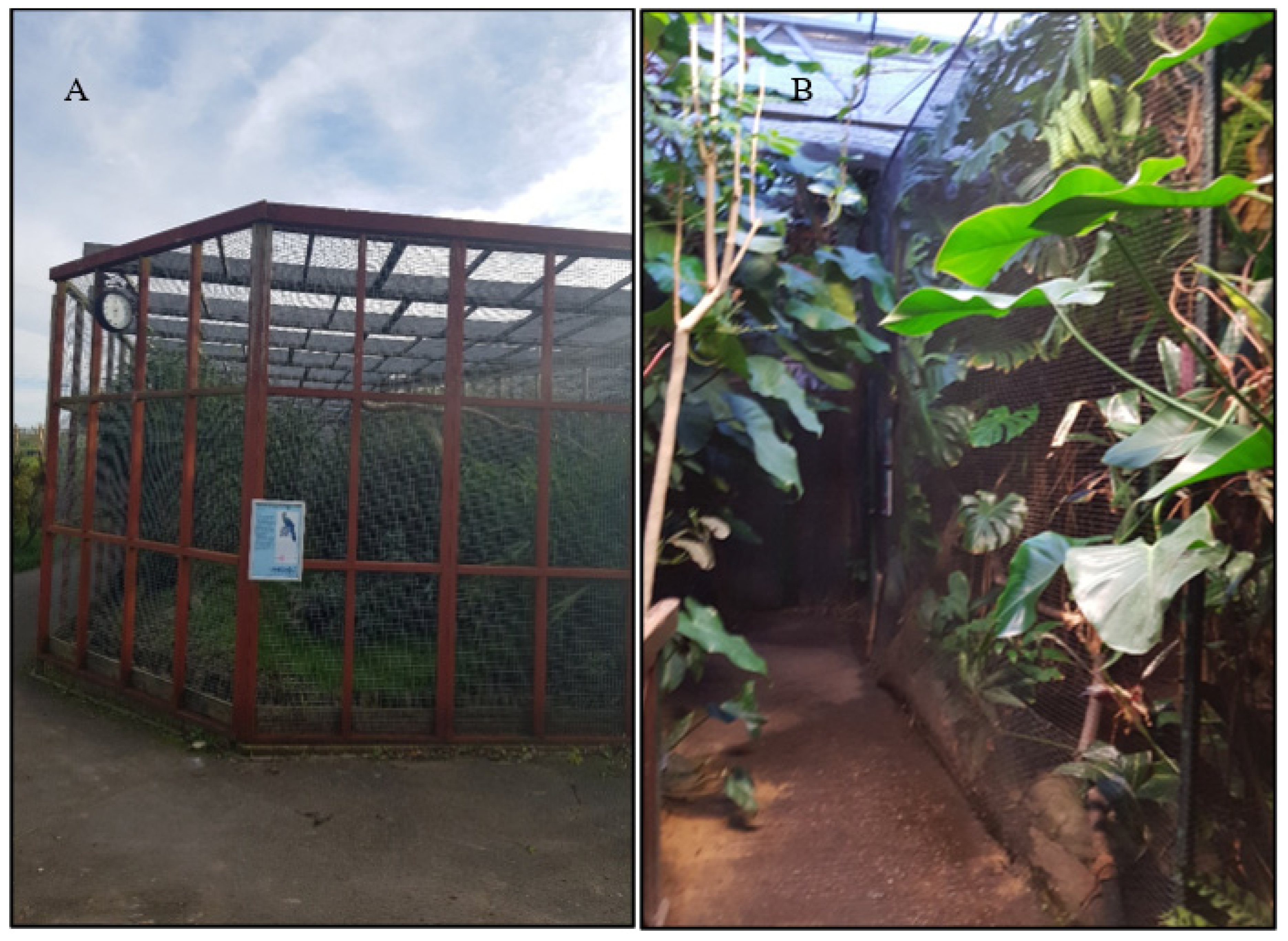
2.1. Study Subjects
2.2. Behaviour
2.3. Food Intake
2.4. Diet Preparation
2.5. Data Analysis
3. Results
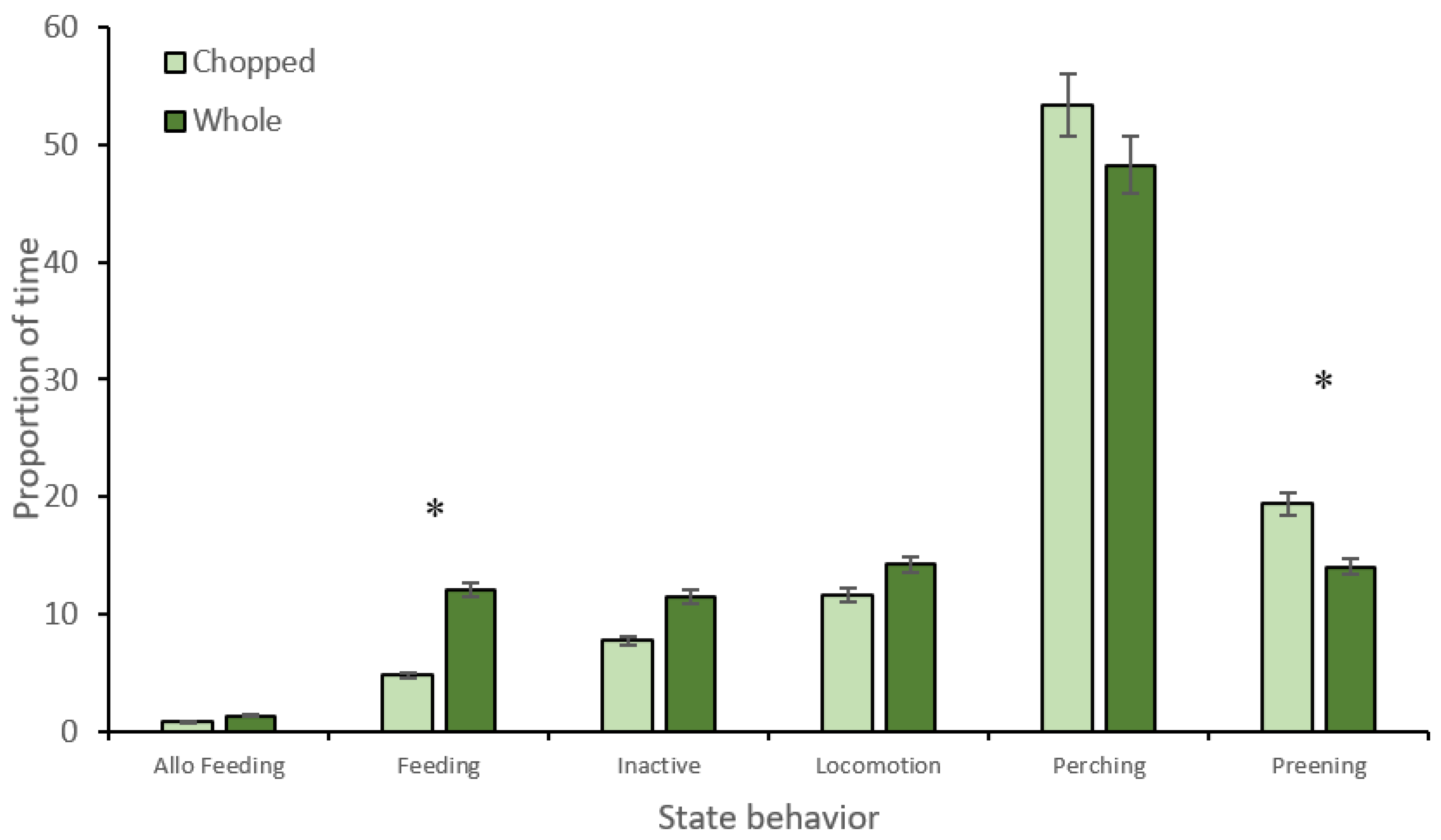
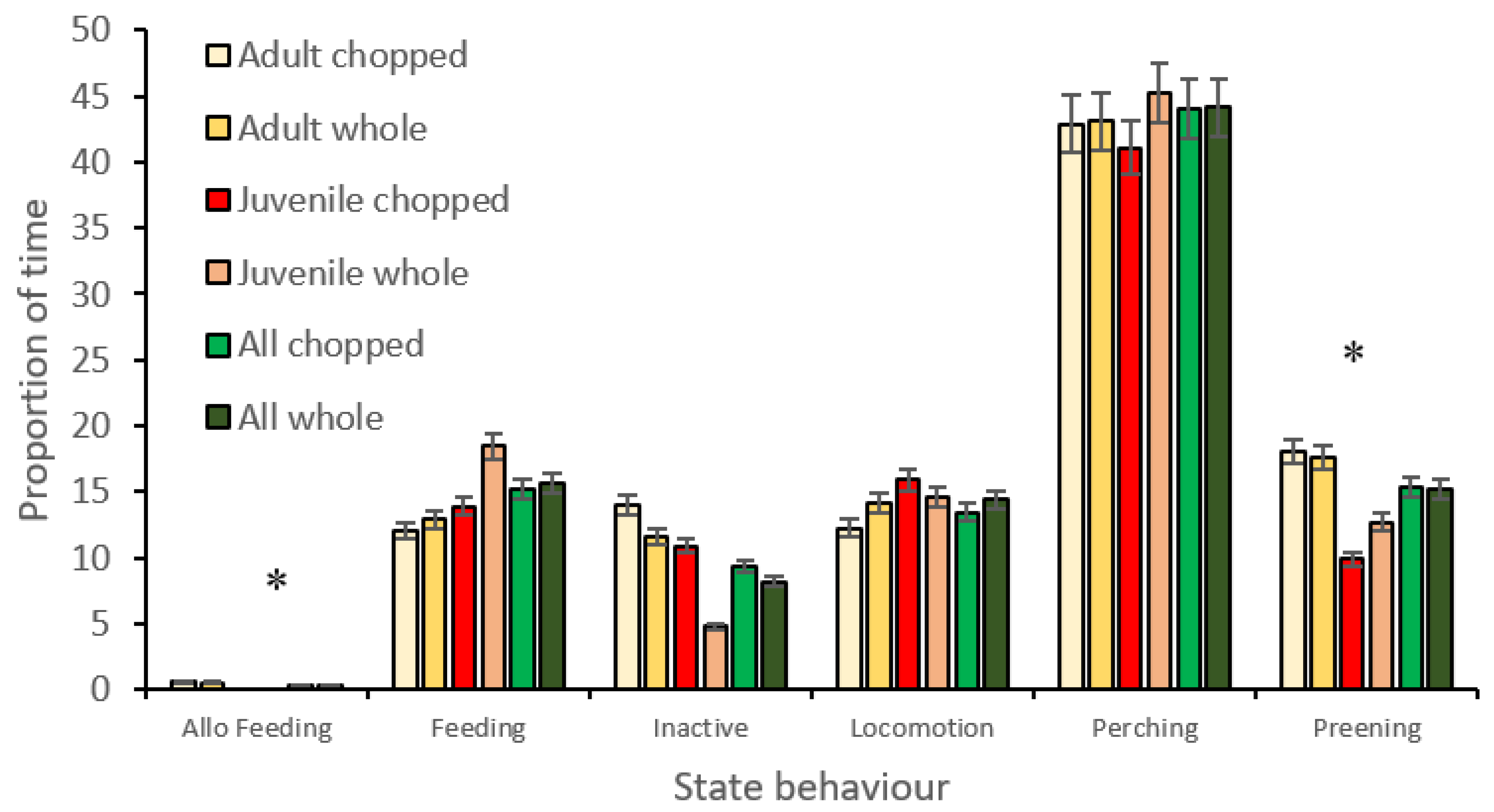
3.1. Behaviour
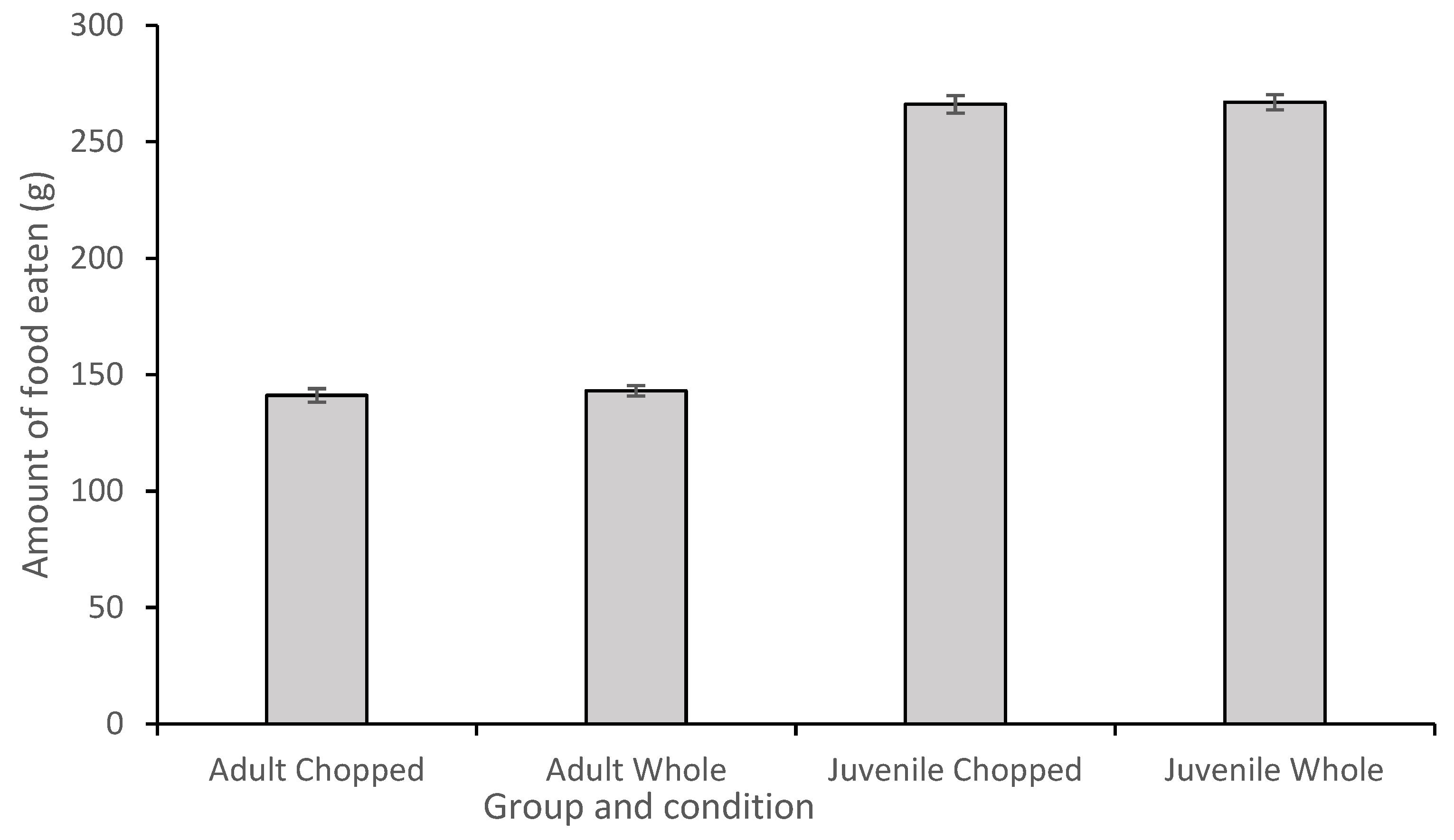
3.2. Food Intake
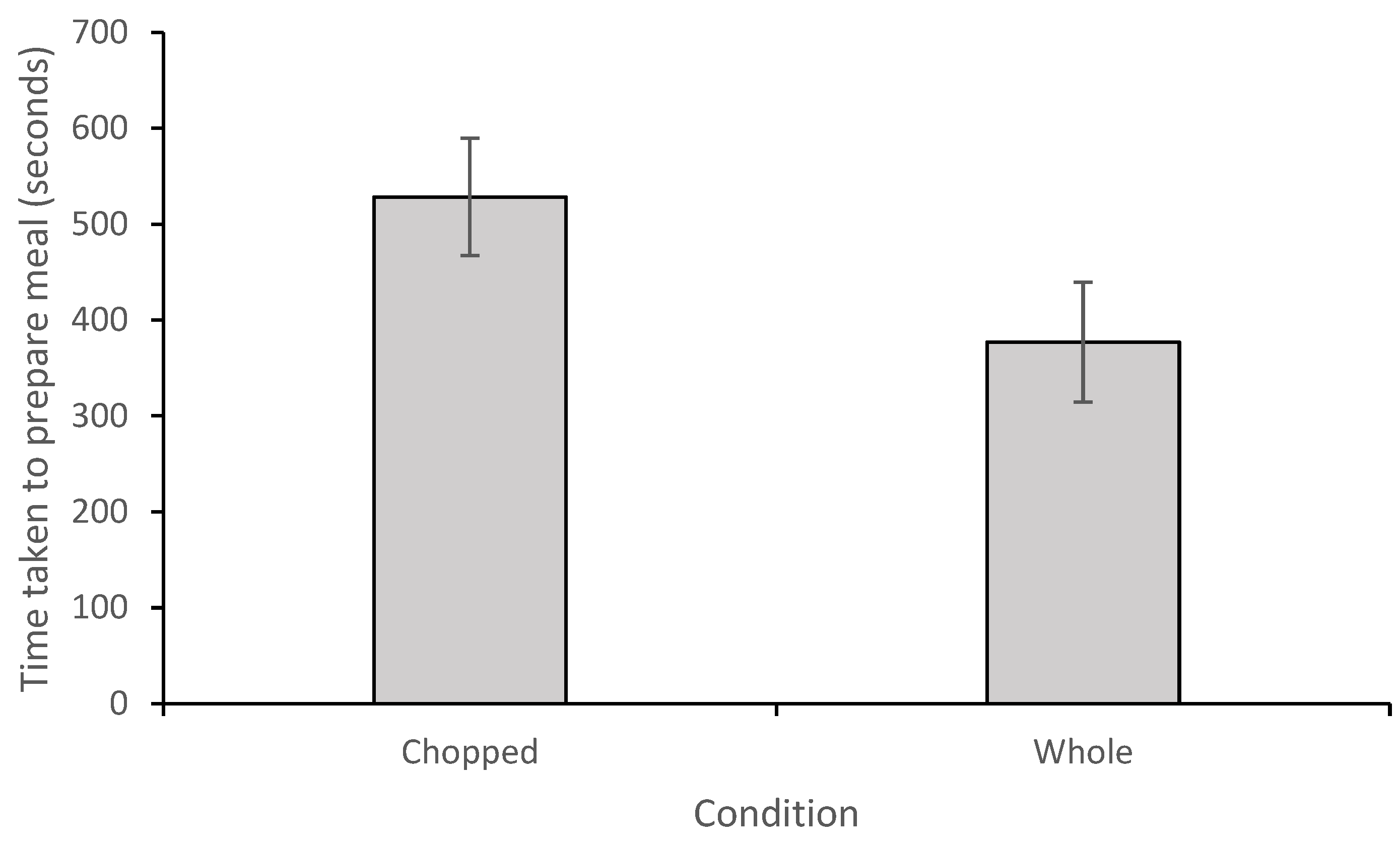
3.3. Diet Preparation
4. Discussion
4.1. Behaviour
4.2. Food Intake
4.3. Diet Preparation
4.4. Future Directions
5. Conclusions
Author Contributions
Funding
Institutional Review Board Statement
Informed Consent Statement
Data Availability Statement
Acknowledgments
Conflicts of Interest
Appendix A

| Group | Food Presentation | Food Weight in (g) | Food Weight out (g) | Amount Eaten (g) | Food Weight in (Dummy Food) (g) | Food Weight out (Dummy Food) (g) | Correction Factor | Corrected Meal (g) |
|---|---|---|---|---|---|---|---|---|
| Adult | Chopped | 158.97 | 21.73 | 137.24 | 160.56 | 160.55 | 1.00 | 137.23 |
| Adult | Chopped | 159.57 | 18.65 | 140.92 | 160.56 | 160.53 | 1.00 | 140.89 |
| Adult | Chopped | 160.43 | 20.84 | 139.59 | 160.03 | 160.04 | 1.00 | 139.60 |
| Adult | Chopped | 160.45 | 16.26 | 144.19 | 158.98 | 158.91 | 1.00 | 144.13 |
| Adult | Chopped | 161.12 | 17.25 | 143.87 | 161.11 | 161.09 | 1.00 | 143.85 |
| Juvenile | Chopped | 284.02 | 13.21 | 270.81 | 284.58 | 284.51 | 1.00 | 270.74 |
| Juvenile | Chopped | 284.72 | 22.74 | 261.98 | 284.71 | 284.71 | 1.00 | 261.98 |
| Juvenile | Chopped | 284.77 | 21.67 | 263.10 | 285.57 | 285.52 | 1.00 | 263.05 |
| Juvenile | Chopped | 284.98 | 19.06 | 265.92 | 285.22 | 285.23 | 1.00 | 265.93 |
| Juvenile | Chopped | 285.33 | 16.35 | 268.98 | 285.67 | 285.64 | 1.00 | 268.95 |
| Adult | Whole | 159.49 | 13.78 | 145.71 | 158.23 | 158.24 | 1.00 | 145.72 |
| Adult | Whole | 159.69 | 17.39 | 142.30 | 160.41 | 160.39 | 1.00 | 142.28 |
| Adult | Whole | 160.03 | 15.14 | 144.89 | 159.78 | 159.82 | 1.00 | 144.93 |
| Adult | Whole | 161.16 | 19.30 | 141.86 | 159.99 | 159.97 | 1.00 | 141.84 |
| Adult | Whole | 161.37 | 20.75 | 140.62 | 160.63 | 160.67 | 1.00 | 140.66 |
| Juvenile | Whole | 284.34 | 19.37 | 264.97 | 284.68 | 284.71 | 1.00 | 265.00 |
| Juvenile | Whole | 284.46 | 17.94 | 266.52 | 284.24 | 284.19 | 1.00 | 266.47 |
| Juvenile | Whole | 285.48 | 21.55 | 263.93 | 285.66 | 285.64 | 1.00 | 263.91 |
| Juvenile | Whole | 285.61 | 18.36 | 267.25 | 284.97 | 284.96 | 1.00 | 267.24 |
References
- Plowman, A.; Green, K.; Taylor, L. Should zoo food be chopped? Zoo Anim. Nutr. 2009, 4, 193–201. [Google Scholar]
- Melfi, V. There are big gaps in our knowledge, and thus approach, to zoo animal welfare: A case for evidence-based zoo animal management. Zoo Biol. 2009, 28, 574–588. [Google Scholar] [CrossRef] [Scilit] [PubMed]
- Rose, P.E.; Brereton, J.E.; Rowden, L.J.; de Figueiredo, R.L.; Riley, L.M. What’s new from the zoo? An analysis of ten years of zoo-themed research output. Palgrave Commun. 2019, 5, 128. [Google Scholar] [CrossRef] [Scilit]
- Regaiolli, B.; Angelosante, C.; Marliani, G.; Accorsi, P.A.; Vaglio, S.; Spiezio, C. Gum feeder as environmental enrichment for zoo marmosets and tamarins. Zoo Biol. 2020, 39, 73–82. [Google Scholar] [CrossRef] [Scilit]
- Brereton, J.E. Challenges and Directions in Zoo and Aquarium Food Presentation Research: A Review. J. Zool. Bot. Gard. 2020, 1, 13–23. [Google Scholar] [CrossRef] [Scilit]
- McPhee, M.E. Intact carcasses as enrichment for large felids: Effects on on-and off-exhibit behaviors. Zoo Biol. 2002, 21, 37–47. [Google Scholar] [CrossRef] [Scilit]
- Shora, J.A.; Myhill, M.G.N.; Brereton, J.E. Should zoo foods be coati chopped? J. Zoo Aquar. Res. 2018, 6, 22–25. [Google Scholar]
- Smith, A.; Lindburg, G.; Vehrencamp, S. Effect of food preparation on feeding behaviour of lion-tailed macaques. Zoo Biol. 1989, 8, 57–65. [Google Scholar] [CrossRef] [Scilit]
- Rico, D.; Martin-Diana, A.B.; Barat, J.M.; Barry-Ryan, C. Extending and measuring the quality of fresh-cut fruit and vegetables: A review. Trends Food Sci. Tech. 2007, 18, 373–386. [Google Scholar] [CrossRef] [Scilit]
- Mathy, J.W.; Isbell, L.A. The relative importance of size of food and interfood distance in eliciting aggression in captive rhesus macaques (Macaca mulatta). Folia Primatol. 2001, 72, 268–277. [Google Scholar] [CrossRef] [Scilit] [PubMed]
- Brereton, S.R.; Brereton, J.E. Sixty years of collection planning: What species do zoos and aquariums keep? Int. Zoo Yearb. 2020, 54, 131–145. [Google Scholar] [CrossRef] [Scilit]
- Rozek, J.; Danner, L.; Stucky, P.; Millam, J. Over-sized pellets naturalize foraging time of captive Orange-winged Amazon parrots (Amazona amazonica). Appl. Anim. Behav. Sci. 2010, 125, 80–87. [Google Scholar] [CrossRef] [Scilit]
- Meehan, C.; Garner, J.; Mench, J. Environmental enrichment and development of cage stereotypy in Orange-winged Amazon parrots (Amazona amazonica). Devel. Psychobiol. 2014, 44, 209–218. [Google Scholar] [CrossRef] [Scilit]
- Tuinen, P.V.; Valentine, M. Phylogenetic relationships of turacos (Musophagidae; Cuculiformes) based on comparative chromosome banding analysis. Ibis 1986, 128, 364–381. [Google Scholar] [CrossRef] [Scilit]
- Wilson, A.L.; Downs, C.T. The effect of seed packaging on digestion and food preference by Purple-crested (Gallirex porphyreolophus) and Knysna (Tauraco corythaix) Turacos. J. Ornithol. 2011, 152, 193–200. [Google Scholar] [CrossRef] [Scilit]
- Wilson, A.L.; Downs, C.T. Food intake rates, assimilation efficiency, and transit times of Knysna (Tauraco corythaix) Turacos fed South African indigenous fruit. J. Ornithol. 2012, 153, 285–290. [Google Scholar] [CrossRef] [Scilit]
- Hulbert, A.J.; Hunt, K.A.; Rose, P.E. A multi-zoo investigation of nutrient provision for captive red-crested turacos. Zoo Biol. 2017, 36, 152–160. [Google Scholar] [CrossRef] [Scilit]
- Sun, C.; Moermond, T.C.; Givnish, T.J. Nutritional determinants of diet in three turacos in a tropical montane forest. Auk 1997, 114, 200–211. [Google Scholar] [CrossRef] [Scilit]
- Sun, C.; Moermond, T.C. Foraging ecology of three sympatric turacos in a montane forest in Rwanda. Auk 1997, 114, 396–404. [Google Scholar] [CrossRef] [Scilit]
- Species360. Zoological Information Management System. Available online: https://zims.species360.org/ (accessed on 26 May 2021).
- Almeida, A.; Palme, R.; Moreira, N. How environmental enrichment affects behavioural and glucocorticoid responses in captive blue-and-yellow macaws (Ara ararauna). Appl. Anim. Behav. Sci. 2018, 201, 125–135. [Google Scholar] [CrossRef] [Scilit]
- Barrera, J.; Chong, L.; Judy, K.; Blumstein, D. Reliability of public information: Predators provide more information about risk than conspecifics. Anim. Behav. 2011, 81, 779–787. [Google Scholar] [CrossRef] [Scilit]
- Blanchett, M. Investigating the Use of GIS for Monitoring Visitor Effects and Enclosure Use of Captive Birds in a Mixed Species, Free-Ranging Aviary at Lowry Park Zoo, Tampa FL. 2018. Available online: http://atrium.lib.uoguelph.ca/xmlui/bitstream/handle/10214/12133/Blanchett_Mackenzie_201801_Msc.pdf?sequence=5&isAllowed=y (accessed on 20 February 2020).
- Nguyen-the, C.; Carlin, F. The microbiology of minimally processed fresh fruits and vegetables. Crit. Rev. Food Sci. Nutrit. 1994, 34, 371–401. [Google Scholar] [CrossRef] [Scilit] [PubMed]
- Fidgett, A.L.; Gardner, L. Advancing avian nutrition through best feeding practice. Int. Zoo Yearb. 2014, 48, 116–127. [Google Scholar] [CrossRef] [Scilit]
- Moss, A.; Esson, M. Visitor interest in zoo animals and the implications for collection planning and zoo education programmes. Zoo Biol. 2010, 29, 715–731. [Google Scholar] [CrossRef] [Scilit] [PubMed]
- Field, D.; Thomas, R. Environmental enrichment for psittacines at Edinburgh Zoo. Int. Zoo Yearb. 2000, 37, 232–237. [Google Scholar] [CrossRef] [Scilit]
- Cocci, E.; Rocculi, P.; Romani, S.; Rosa, M.D. Changes in nutritional properties of minimally processed apples during storage. Postharvest Biol. Tech. 2006, 39, 265–271. [Google Scholar] [CrossRef] [Scilit]
- Shewfelt, R.L. Quality of minimally processed fruits and vegetables. J. Food Qual. 1987, 10, 143–156. [Google Scholar] [CrossRef] [Scilit]
- Rose, P.E.; Scales, J.S.; Brereton, J.E. Why the “Visitor Effect” Is Complicated. Unraveling Individual Animal, Visitor Number, and Climatic Influences on Behavior, Space Use and Interactions With Keepers—A Case Study on Captive Hornbills. Front. Vet Sci. 2020, 7, 236. [Google Scholar] [CrossRef] [Scilit]
- James, C.W.; Nicholls, A.J.; Freeman, M.S.; Hunt, K.A.; Brereton, J.E. Should zoo food be chopped: Macaws for consideration. J. Zoo Aquar. Res. 2021, 9, 200–207. [Google Scholar]


| Location | Species | Sex | Life Stage | Code |
|---|---|---|---|---|
| Sparsholt College Aviary 1 | White-cheeked Turaco (Tauraco leucotis) | Unknown | Juvenile | JW1 |
| Unknown | JW2 | |||
| Unknown | JW3 | |||
| Sparsholt College Aviary 2 | Male | Adult | AW1 | |
| Female | AW2 | |||
| The Living Rainforest | Fischer’s Turaco (Tauraco fischeri). | Male | Adult | F1 |
| Female | F2 |
| State Behaviours | Description |
|---|---|
| Allo-feeding | Subject is sharing food or regurgitating to feed to another individual. |
| Feeding and Foraging | Consumption of food items. Turaco uses beak to peck or gouge food items. Smaller items may be picked up in the beak and swallowed. |
| Inactive | Subject remains stationary in one position, and may be sitting, resting or sleeping. |
| Locomotion | Subject is moving in a singular direction irrespective of speed via running, walking or by flight. |
| Perching | Subject is sat upright or is standing in place. Active eye and head movements. |
| Preening | Subject uses beak and/or feet to clean own body. |
| Feed | Adult White-Cheeked Turaco | Juvenile White-Cheeked Turaco | Fischer’s Turaco |
|---|---|---|---|
| T16 Pellet | 20 g | 45 g | 40 g |
| Zoo Diet A | 20 g | 45 g | - |
| Leafeater Pellet (halved) | 10 g | 15 g | - |
| Mixed Fruit | 100 g | 210 g | 200 g |
| Mixed Vegetables | 60 g | 75 g | - |
| Species | Behaviour | Test | Test Statistic | p |
|---|---|---|---|---|
| White-cheeked Turaco | Allo-feeding | Friedman’s ANOVA | X2(3) = 20.26 | <0.001 * |
| Feeding and foraging | Friedman’s ANOVA | X2(3) = 3.33 | 0.288 | |
| Inactive | Friedman’s ANOVA | X2(3) = 6.85 | 0.077 | |
| Locomotion | Friedman’s ANOVA | X2(3) = 5.63 | 0.566 | |
| Perching | Friedman’s ANOVA | X2(3) = 1.33 | 0.717 | |
| Preening | Friedman’s ANOVA | X2(3) = 18.13 | <0.001 * | |
| Allo-feeding | Wilcoxon | Z(18) = 20 | 0.539 | |
| Fischer’s Turaco | Feeding and foraging | Wilcoxon | Z(18) = 26.12 | 0.001 * |
| Inactive | Wilcoxon | Z(18) = 122.5 | 0.113 | |
| Locomotion | Paired t test | t(57) = −1.47 | 0.146 | |
| Perching | Paired t test | t(57) = 1.77 | 0.08 | |
| Preening | Wilcoxon | Z(18) = 365.5 | 0.006 * |
| Group | Group | Difference | Test Statistic | p |
|---|---|---|---|---|
| Adult chopped | Adult whole | −1.522 | N = 5, W = 5 | 0.295 |
| Juvenile chopped | −125.036 | W = 15 | 0.015 * | |
| Juvenile whole | −125.579 | W = 15 | 0.012 * | |
| Adult whole | Juvenile chopped | −123.233 | W = 15 | 0.012 * |
| Juvenile whole | 123.257 | W = 40 | 0.012 * | |
| Juvenile chopped | Juvenile whole | −1.311 | N = 5, W = 5 | 0.295 |
Publisher’s Note: MDPI stays neutral with regard to jurisdictional claims in published maps and institutional affiliations. |
© 2021 by the authors. Licensee MDPI, Basel, Switzerland. This article is an open access article distributed under the terms and conditions of the Creative Commons Attribution (CC BY) license (https://creativecommons.org/licenses/by/4.0/).
Share and Cite
Griffin, B.; Brereton, J.E. Should Zoo Food Be Chopped for Captive Turacos? Birds 2021, 2, 415-426. https://doi.org/10.3390/birds2040031
Griffin B, Brereton JE. Should Zoo Food Be Chopped for Captive Turacos? Birds. 2021; 2(4):415-426. https://doi.org/10.3390/birds2040031
Chicago/Turabian StyleGriffin, Beth, and James Edward Brereton. 2021. "Should Zoo Food Be Chopped for Captive Turacos?" Birds 2, no. 4: 415-426. https://doi.org/10.3390/birds2040031
APA StyleGriffin, B., & Brereton, J. E. (2021). Should Zoo Food Be Chopped for Captive Turacos? Birds, 2(4), 415-426. https://doi.org/10.3390/birds2040031