


Abstract
Coastal protected landscapes are increasingly becoming subject to high and diverse recreational use, creating complex challenges for balancing visitors’ experience with ecological protection. While visitor segmentation has been widely applied in tourism research, its integration with spatially differentiated management in frequently used natural areas remains limited. This study addresses this gap by examining visitor heterogeneity in a highly visited coastal protected landscape in Norway. Using survey data combined with behavioral indicators, an exploratory factor analysis identifies three core motivational dimensions: nature experience and environmental learning, social interaction and activity, and family-oriented recreation. Building on these dimensions, a cluster analysis reveals four distinct visitor typologies ranging from low-involvement to highly engaged users. The results demonstrate that visitor segments are primarily differentiated by psychographic characteristics, while socio-demographic and behavioral variables provide limited explanatory power. Importantly, the identified typologies correspond to distinct patterns of use and experiential expectations, offering a robust basis for differentiated management strategies. The findings highlight the need to move beyond uniform management approaches towards segment-specific interventions, particularly in landscapes dominated by experienced, locally based users. By linking motivational structures to spatial and managerial implications, this study contributes to advancing visitor research and provides practical insights for managing recreational pressure in protected coastal environments.
1. Introduction
Coastal protected landscapes are increasingly exposed to growing recreational pressure, as proximity to urban areas and accessibility make them attractive for frequent and diverse forms of use. These natural landscapes play a central role in shaping tourism experiences and are key drivers of destination attractiveness (Dax & Tamme, 2023). While such areas provide important opportunities for recreation, wellbeing and nature experience, they are also characterized by fragile ecosystems that are highly sensitive to disturbance (Defeo et al., 2009; Soto et al., 2021). While recreational use generates important benefits, it may also be associated with environmental and social pressures, highlighting the need for balanced management strategies (Engström & Kipperberg, 2015). Managing these landscapes therefore requires a careful balance between facilitating visitor use and safeguarding ecological integrity.
A central challenge in this context is the heterogeneity of visitors. Individuals use coastal environments for different purposes, ranging from everyday recreation and social interaction to nature-based experiences and personal restoration. These differences influence not only how visitors use space and time within a landscape, but also how they perceive environmental impacts and respond to management measures (Arnberger & Eder, 2015; Manning, 2011). Understanding visitor heterogeneity is therefore essential for developing effective and context-sensitive management strategies.
In highly visited coastal protected landscapes such as Jæren, recreational use is dominated by local, long-term users who visit frequently and live in close proximity to the beaches. These areas function primarily as everyday recreational landscapes rather than tourism destinations, with many visitors maintaining an enduring relationship with the area over several decades. This contextual specificity shapes both patterns of use and expectations toward management, underscoring the need for an empirically grounded examination of visitor heterogeneity in this setting.
2. Literature Review
Previous tourism research has demonstrated the value of segmentation approaches, particularly in relation to economic outcomes and activity participation (Dolničar, 2008; Mehmetoglu, 2007). However, much of this work has relied on socio-demographic or expenditure-based classifications, with more limited attention to psychographic dimensions such as motivations and experience preferences (Dolničar, 2020). Moreover, existing studies often treat visitor populations as relatively homogeneous in spatial terms, providing limited insight into how different types of users interact with specific locations within protected landscapes. Yet visitor behavior in protected landscapes is also shaped by structural conditions such as access points, spatial layout, and site-specific constraints, which influence how different user groups distribute themselves across the area. In parallel, there is a growing recognition that management approaches based on uniform regulations or infrastructure provision may be insufficient in highly frequented natural areas. Instead, differentiated strategies—such as zoning, targeted communication and context-specific interventions—are increasingly advocated (Manning, 2011). These strategies depend not only on understanding visitor motivations but also on recognizing how structural features of the landscape channel movement and shape experiential opportunities. However, the practical implementation of such approaches requires detailed knowledge of how different visitors use and value the landscape. Despite this, few studies explicitly integrate contextual or structural characteristics into segmentation frameworks, leaving limited insight into how motivations interact with the physical organization of protected landscapes. Previous tourism research has primarily examined visitor heterogeneity in relation to economic behavior (Brida et al., 2013; Divisekera, 2010). This study extends the perspective to spatial use and management preferences in protected landscapes.
Based on the literature reviewed and the argumentation surrounding visitor typologies and spatially differentiated management we have built the following three (3) hypothesis:
H1.
Visitor motivations in coastal protected landscapes are multidimensional.
Outdoor recreation motivation research consistently demonstrates that visit motivations are multidimensional, combining environmental components (enjoy nature, learning), social components (similar people, new people, family togetherness, teaching-leading others), and restorative components (escape personal–social pressures, escape physical pressure, physical rest) (Manfredo et al., 1996). This multidimensionality persists across different recreational settings, including urban green spaces where both physical site characteristics and social conditions particularly visitor density, simultaneously shape visitor preferences, with their relative importance shifting depending on whether visitors are seeking general recreation or stress relief (Arnberger & Eder, 2015). In coastal protected landscapes, where natural features, accessibility and day-use recreational functions intersect, a similarly complex motivation structure combining nature-seeking, restorative and social components is therefore expected.
H2.
Visitors to coastal protected landscapes can be segmented in terms of motivational involvement, ranging from low involvement to highly engaged users.
Recreation specialization theory (Bryan, 1977) posits that visitors develop increasingly complex motivational profiles as their engagement with a recreational setting deepens, producing a continuum from occasional, low-involvement users to committed, multifunctional visitors who center their identity around the activity (Needham et al., 2013; Scott & Shafer, 2001). Applied to coastal protected landscapes, this suggests that visitor segments will not only differ in the type of motivations they emphasize, but also in their overall level of motivational involvement. Empirical support comes from activity-based segmentation in nature-based tourism, where clusters consistently reveal motivational intensity—particularly around physical activity, novelty-seeking, and escape—as the key dimension separating passive from highly engaged visitor types (Dolničar, 2008; Mehmetoglu, 2007).
H3.
Motivation-based visitor typologies correspond to distinct patterns of use and experiential expectations, providing a relevant basis for differentiated management in coastal protected landscapes.
Visitors engaging in the same activity may pursue fundamentally different psychological outcomes—from solitude and restoration to social affiliation and physical challenge—and these motivational orientations produce systematically different attitudes toward crowding, encounter levels, and site conditions (Manning, 2011). Motivation-based segmentation reliably yields qualitatively distinct groups whose preferences for visitor density, infrastructure, and landscape character diverge in ways that average-user approaches cannot capture (Arnberger & Eder, 2015). In the coastal protected landscapes, such typologies are therefore expected to reveal patterned differences in spatial use and tolerance for management interventions sufficient to justify differentiated, zone-based strategies.
The hypotheses are examined within a highly specific empirical context, where coastal protected landscapes serve as everyday recreational environments for predominantly local and highly experienced users.
This study addresses these gaps by examining visitor heterogeneity in a highly visited coastal protected landscape in Norway. Using Jærstrendene as a case study, the research integrates survey data, behavioral indicators and motivational analysis to identify distinct visitor typologies and explore their characteristics. In contrast to approaches that emphasize socio-demographic segmentation, this study focuses on psychographic differentiation, capturing the underlying motivations that shape visitor behavior and experience.
The study pursues three main objectives. First, it develops a motivation-based typology of visitors using exploratory factor analysis and cluster analysis. Second, it examines the extent to which these typologies are associated with socio-demographic and behavioral characteristics. Third, it discusses how the identified visitor types can inform more differentiated and context-sensitive management approaches in coastal protected landscapes.
By linking visitor motivations to patterns of use and management implications, this study contributes to a more nuanced understanding of recreation in frequently visited natural areas. More broadly, it extends existing visitor research by moving beyond economic and activity-based perspectives towards a framework that integrates experiential, behavioral and management dimensions.
This study contributes to the literature in three ways. First, it extends visitor segmentation research by linking psychographic typologies to spatially differentiated management. Second, it provides empirical evidence from an intensively used, locally dominated coastal landscape, challenging tourism-centric assumptions. Third, it demonstrates how motivation-based segmentation can inform actionable management strategies in protected areas. The findings offer practical insights for destination managers and policymakers seeking to balance recreation and conservation in coastal environments.
3. Materials and Methods
Data were collected using a structured questionnaire administered to visitors at multiple access points across the Jæren coastal protected landscape. Questionnaires are commonly used to capture visitor characteristics, perceptions, and patterns of use in beach and coastal environments (Moreno-Gutiérrez et al., 2024). A field-based intercept approach was employed (Engström & Kipperberg, 2015; Manning, 2011; Veal, 2017) whereby visitors were approached in person at parking areas serving the main beach sites. These locations were selected as the primary entry points to the beaches and capture a broad cross-section of users.
Visitors were briefly informed about the purpose of the study and invited to participate on a voluntary basis. Those who agreed were provided with a self-administered questionnaire along with a prepaid return envelope addressed to the research team. To reduce time pressure during the visit and minimize disruption to recreational activities, respondents were asked to complete the questionnaire after their beach experience. Participants were encouraged to return the complete questionnaire by mail as soon as possible, preferably within one week of their visit.
This data collection approach was chosen to balance response quality and participation rates. By allowing respondents to complete the questionnaire post-visit, the design aimed to capture more reflective and experience-based evaluations while avoiding the constraints associated with on-site completion. At the same time, the use of prepaid return envelopes and a simple distribution procedure was intended to facilitate participation and reduce barriers to response.
Participation was anonymous, and no personally identifiable information was collected. Completion and return of the questionnaire were taken as informed consent to participate in the study.
A total of 379 questionnaires were distributed to visitors across the study sites. Of these, 257 complete questionnaires were returned, corresponding to a response rate of 67.8%. Following data screening, 11 questionnaires were excluded due to excessive missing data, resulting in a final sample of 246 valid responses included in the analysis. While the response rate is acceptable for mail-back surveys, potential non-response bias cannot be entirely ruled out.
Visitor motivations were measured using a set of items assessed on a five-point Likert scale ranging from 1 (not important) to 5 (very important), using items informed by the Recreation Experience Preference framework, which conceptualizes outdoor recreation participation as a search for desired psychological, social, physical, and environmental experience outcomes (Manfredo et al., 1996). The items were adapted to the coastal protected landscape context and included motivations related to tranquility, social interaction, personal goals, environmental learning, landscape experience, novelty, family-oriented recreation, escape from everyday life, sunbathing/swimming, and events. Socio-demographic variables included age, gender, education, and income, while behavioral variables captured visitation frequency, years of experience, and distance traveled.
A multi-step analytical approach was employed to identify distinct visitor segments based on their motivations for visiting the Jæren beaches. All statistical analyses were conducted using the R statistical environment version 4. 5. 2 (R Core Team, 2024).
First, variables measuring visitor motivations were subjected to exploratory factor analysis (EFA) to reduce the dimensionality of the dataset and identify underlying motivational constructs. Prior to factor extraction, the suitability of the data was assessed using the Kaiser–Meyer–Olkin (KMO) measure of sampling adequacy and Bartlett’s test of sphericity, following established guidelines (Field, 2024; Hair et al., 2019). Factor extraction was performed using maximum likelihood estimation. The number of factors to retain was determined using parallel analysis, which is considered a robust and widely recommended method for factor retention (Hayton et al., 2004; Horn, 1965). Given the expectation that motivational dimensions may be interrelated, an oblique rotation (oblimin) was applied. Oblique rotation methods are recommended when latent constructs are theoretically and empirically correlated, as is typically the case in social science research (Fabrigar et al., 1999; Osborne, 2008).
Following factor extraction, factor scores were computed using the regression method and used as input variables for subsequent clustering procedures. To identify groups of visitors with similar motivational profiles, a k-means clustering procedure was applied. This non-hierarchical clustering technique partitions observations into relatively homogeneous groups by minimizing within-cluster variance (Hair et al., 2019; Jin & Han, 2017). The optimal number of clusters was determined based on a combination of statistical criteria, including the elbow method, silhouette analysis, and the interpretability of the resulting cluster solutions.
To further characterize the identified clusters, descriptive statistics were calculated for selected socio-demographic and behavioral variables. Differences between clusters were assessed using analysis of variance (ANOVA) for continuous variables and chi-square tests for categorical variables.
Data preparation and transformation were conducted using functions from the dplyr and tidyr packages (Wickham et al., 2026b). Exploratory factor analysis and reliability testing were performed using the psych package (Revelle, 2026), while cluster analysis was implemented using base R functions, and visualization of clustering results was supported by the ggplot2 package (Wickham et al., 2026a) and factoextra package (Kassambara et al., 2026).
4. Results
The Results section presents the empirical findings of the study, structured to provide a comprehensive understanding of visitor use and experiences at the Jæren beaches. The analysis proceeds in a stepwise manner, beginning with observed visitation patterns, followed by a detailed profiling of visitors based on socio-demographic and behavioral characteristics. This is complemented by an examination of underlying motivational dimensions, which form the basis for identifying distinct visitor segments.
4.1. Visitation Patterns
Counters registered 354,260 passages towards the beaches, confirming prior annual estimates. Peaks occurred on summer weekends (14:00–17:00) and during Easter holidays. Solastranden accounted for 33% of all entries, followed by Hellestø (26%) and Bore (19%).
4.2. Visitor Profile
To provide a comprehensive understanding of the visitor population, the analysis begins with an overview of key respondent characteristics. Profiling visitors is an important step in recreation and tourism research, as it helps contextualize patterns of use, preferences, and perceptions. In this study, the visitor profile is approached through both socio-demographic attributes and behavioral characteristics, allowing for a more nuanced interpretation of the sample.
4.2.1. Socio-Demographic Profile
The socio-demographic profile of respondents indicates a relatively mature and well-established visitor population. The average age of respondents was 49.8 years (SD = 14.8), with a median age of 49 years, ranging from 12 to 79 years. In terms of gender, the sample was relatively balanced, with a slight predominance of female respondents (55.4%) compared to male respondents (44.6%).
The educational structure of the sample indicates a highly educated population. The largest share of respondents reported having higher education, with 35.6% having completed more than four years of university or college education and 33.5% holding a university or college degree (2–4 years). A further 26.4% had completed high school, while only 4.6% reported primary school as their highest level of education.
Regarding employment, respondents were distributed across a variety of work categories, with the largest groups employed in public administration and services (25.1%), followed by industry, construction, and related sectors (19.7%), and other private services (19.2%). Smaller proportions were represented in tourism (0.4%), agriculture and fishery (0.4%), and categories such as stay-at-home (2.5%), unemployed (1.3%), students (1.7%), and retired or receiving social benefits (14.6%). Additionally, 14.6% of respondents reported working in other occupations.
The income distribution further supports the relatively strong socio-economic profile of the sample. The largest proportion of respondents (24.3%) reported an annual income exceeding 750,000 NOK. Substantial shares were also observed in the middle-income categories, including 450,000–550,000 NOK (19.0%) and both 350,000–450,000 NOK and 550,000–650,000 NOK (each 16.8%). Lower income categories were less represented, with fewer than 5% of respondents in each of the three lowest income brackets.
The sample can be characterized as relatively well-educated, economically stable, and predominantly middle-aged, with a balanced gender distribution.
4.2.2. Behavioral Characteristics
The behavioral profile of respondents indicates a highly experienced and frequently visiting user group with a strong connection to the Jæren beaches. More than half of respondents (53.5%) identified themselves as very experienced visitors, defined as visiting the beaches more than 12 times per year. A further 30.0% described themselves as experienced visitors (up to 12 visits per year), while 15.6% reported occasional visits (approximately three times per year). Only a negligible share of respondents (0.8%) indicated that they were first-time visitors. Overall, this distribution highlights a visitor population dominated by regular and highly familiar users.
This pattern is further supported by respondents’ long-term engagement with the destination. On average, respondents reported approximately 28.6 years of visiting the Jæren beaches (SD = 17.1), with a median of 30 years. This suggests that many visitors have an enduring relationship with the area, often spanning several decades.
In terms of visit frequency, respondents reported an average of 28.7 visits per year (SD = 40.8), with a median of 15 visits. The relatively large standard deviation and high maximum value indicate considerable variation in visitation intensity, with some respondents visiting very frequently. Nevertheless, the median value confirms that regular visitation is typical for a substantial proportion of the sample.
The spatial dimension of visitation further emphasizes the local character of the visitor population. The average distance from home was 2.18 km (SD = 1.49), with a median distance of 2 km. On this basis, the sample should be interpreted primarily as a local user population rather than a tourist sample in the conventional destination sense. Although the survey did not formally classify respondents into local residents, regional visitors, and tourists, the short, reported travel distances, high visit frequency, and long visiting histories indicate that local and nearby users dominate the dataset.
The results suggest that the visitor population is largely composed of highly experienced, frequently visiting, and locally based users with long-standing relationships to the Jæren beaches.
4.3. Motivation Dimensions and Typologies
4.3.1. Motivation Structure
Visitor motivations for using the Jæren beaches were assessed using a set of items measured on a five-point Likert scale ranging from 1 (not important) to 5 (very important), with responses coded as “not relevant” treated as missing values. To identify underlying motivational dimensions, an exploratory factor analysis (EFA) was conducted.
Prior to the analysis, items with low communalities and insufficient sampling adequacy were removed to improve the clarity of the factor structure. The suitability of the data for factor analysis was confirmed by a Kaiser–Meyer–Olkin measure of sampling adequacy (KMO = 0.77) and a significant Bartlett’s test of sphericity (χ2 = 643.48, p < 0.001). Parallel analysis indicated a three-factor solution, which was retained based on both statistical criteria and interpretability. The final model demonstrated an acceptable fit to the data (RMSEA = 0.066; TLI = 0.899). The factors were moderately correlated, supporting the use of an oblique rotation method (oblimin), which is recommended when underlying constructs are expected to be interrelated rather than orthogonal (Fabrigar et al., 1999; Osborne, 2008). Results of the EFA with factor loadings are presented in Table 1.
Table 1.
Factor loadings for visitor motivations based on exploratory factor analysis (maximum likelihood extraction, oblimin rotation).
The three-factor solution explained 42% of the total variance, which is considered acceptable in exploratory factor analysis within the social sciences, where behavioral constructs are inherently complex and multidimensional (Hair et al., 2019; Taber, 2018).
The first factor, labeled nature experience and environmental learning, includes motivations related to experiencing protected areas and cultural landscapes, learning about plants and animals, and seeking new and different experiences. The second factor, social interaction and activity, captures motivations such as meeting new people, achieving personal goals, participating in recreational activities such as swimming, and attending events. The third factor, family-oriented recreation, reflects motivations related to spending time with family, seeking tranquility, and escaping everyday routines.
The internal consistency of the identified motivational dimensions was assessed using Cronbach’s alpha. The factor nature experience and environmental learning demonstrated good reliability (α = 0.79), while social interaction and activity (α = 0.60) and family-oriented recreation (α = 0.58) showed moderate internal consistency. These values are considered acceptable in exploratory research, particularly in studies of complex behavioral constructs (Hair et al., 2019; Taber, 2018).
Overall, the results highlight the multidimensional nature of visitor motivations, combining environmental, social, and restorative dimensions that reflect both the natural characteristics of the Jæren beaches and their role as a local recreational resource.
4.3.2. Visitor Segmentation and Cluster Profiling
To further explore heterogeneity among visitors, a cluster analysis was conducted based on the three motivational dimensions identified through exploratory factor analysis. A k-means clustering procedure was applied (Everitt et al., 2011), which was already used in tourism-related topics (Dolničar, 2020). A four-cluster solution was selected based on interpretability, cluster size balance, and inspection of the elbow criterion. Table 2 presents cluster centroids based on standardized motivational dimensions.
Table 2.
Cluster centroids based on standardized motivational dimensions (k-means clustering, k = 4).
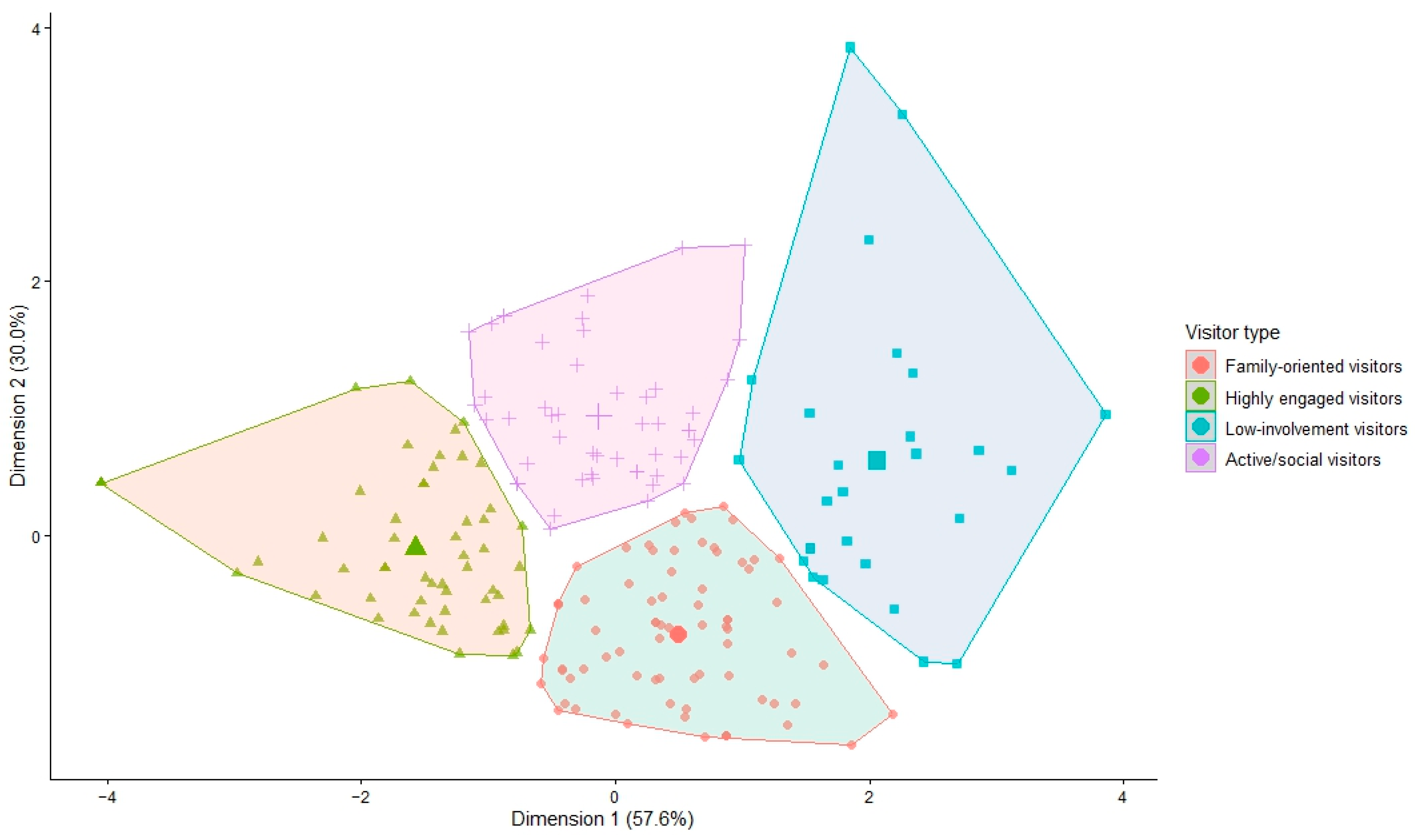
Figure 1 illustrates the spatial distribution with cluster centroids of the identified clusters based on the first two dimensions derived from the clustering solution. The clusters differed primarily in motivational structure; however, this pattern should be interpreted in light of the relatively homogeneous and locally based sample, which inherently limits the explanatory power of socio-demographic and behavioral variables. This suggests that traditional segmentation approaches based on observable characteristics may be insufficient for understanding use patterns in coastal protected landscapes.
Figure 1.
Visitor typologies based on motivational dimensions.
Analysis of variance revealed statistically significant differences in age across clusters (F = 3.24, p = 0.023), although the effect size was small (η2 = 0.047). This indicates that age contributed only modestly to the differentiation between visitor segments. The lowest mean age was observed among family-oriented visitors (45.3 years), whereas low-involvement visitors were on average the oldest (55.3 years).
In contrast, no statistically significant differences were found between clusters with respect to visitation frequency (p = 0.14, η2 = 0.027), years of experience visiting the beaches (η2 = 0.030), or distance traveled (η2 = 0.007). The corresponding effect sizes were small to negligible, indicating that these variables explain only a limited proportion of variance between clusters.
Similarly, no statistically significant differences were observed across clusters in terms of gender and education level. The distribution of experience categories could not be reliably assessed due to low frequencies in some response groups, which limited the validity of the chi-square test. These findings indicate that segmentation is best understood as a psychographic typology, rather than one based on socio-demographic or behavioral characteristics. Based on the cluster centroids (Table 2) and socio-demographic and behavioral characteristics of clusters (Table 3), four distinct visitor types were identified.
Table 3.
Socio-demographic and behavioral characteristics of clusters.
The first cluster, labeled family-oriented visitors, is characterized by relatively high scores on motivations related to escape and spending time with family, combined with low levels of interest in social interaction and environmental learning. These visitors appear to use the beach primarily as a place for relaxation, everyday escape, and family-oriented recreation.
The second cluster, highly engaged visitors, demonstrates high scores across all motivational dimensions. This group represents the most involved segment, combining interests in nature experience, social interaction, and personal restoration. These visitors can be described as highly motivated and multifunctional users of the beach environment.
The third cluster, low-involvement visitors, is characterized by consistently low scores across all motivational dimensions. This segment appears to engage with the beach in a more passive or routine manner, with limited emphasis on specific experiential or social benefits.
The fourth cluster, active/social visitors, exhibits moderate levels of nature-related and social motivations, but relatively low emphasis on escape and relaxation. This group appears to be more activity-oriented, using the beach for engagement, light recreation, and social interaction rather than for restorative purposes.
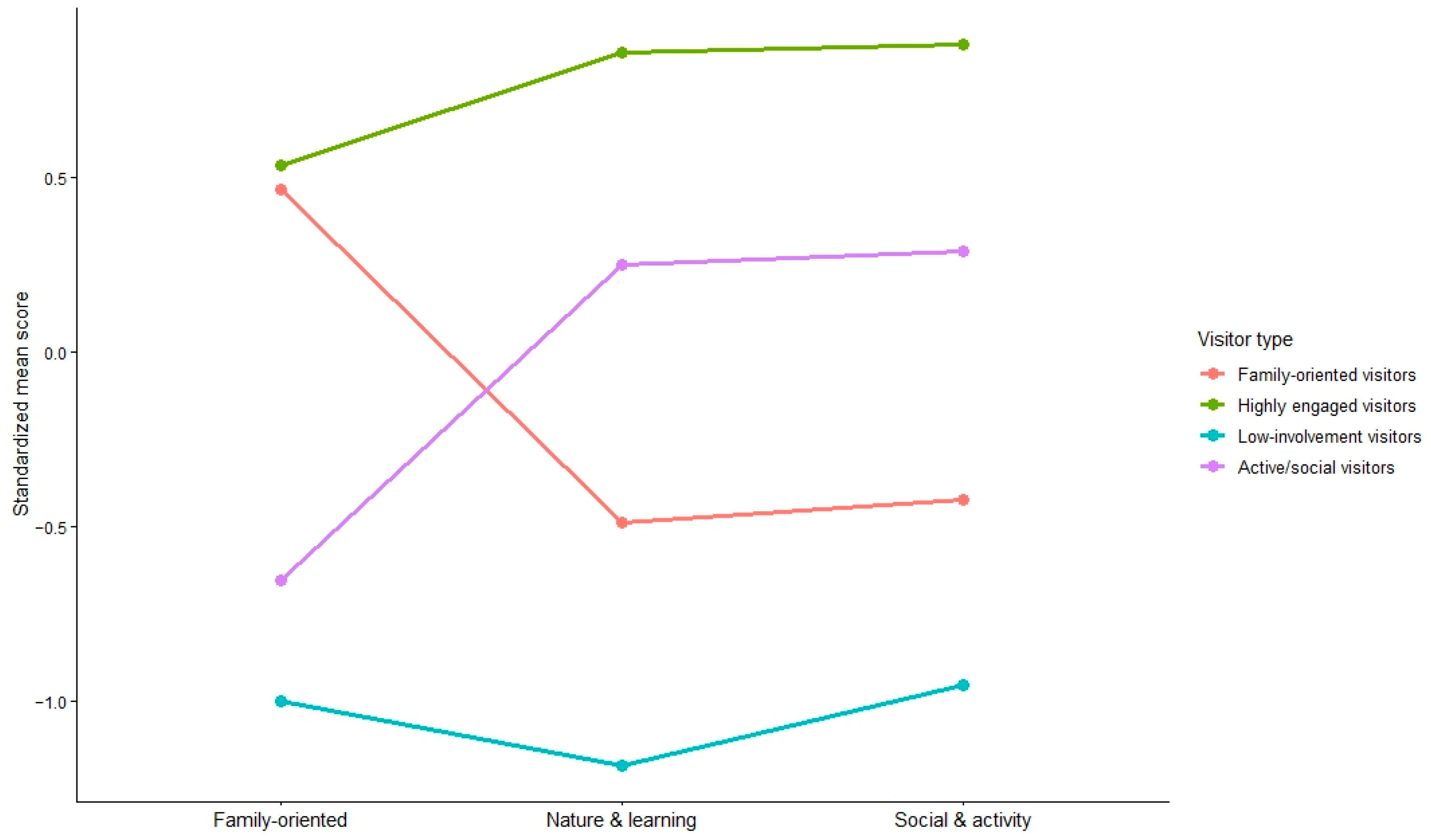
Figure 2 illustrates the motivational profiles of the identified visitor segments based on standardized factor scores. Clear differences between clusters can be observed across the three motivational dimensions. The highly engaged visitors exhibit consistently high scores across all dimensions, indicating a strong and multifaceted motivation structure. In contrast, low-involvement visitors display uniformly low scores, suggesting limited engagement with the beach experience.
Figure 2.
Motivational profiles of visitor segments based on standardized factor scores across three dimensions.
The family-oriented visitors are primarily characterized by higher scores on the family-related dimension, while showing negative values on both nature-related and social motivations. This indicates a preference for relaxation and family-oriented use rather than active or exploratory engagement. Conversely, active/social visitors demonstrate increasing scores from the family-oriented dimension towards social and activity-related motivations, reflecting a more dynamic and interaction-focused use of the beach environment.
5. Discussion
Taken together, the findings reinforce the importance of psychographic segmentation as a more informative framework than traditional socio-demographic approaches in highly frequented coastal landscapes.
The findings of our study offer broad support for all three hypotheses and contribute to a growing body of literature on visitor heterogeneity in coastal protected landscapes.
In our first hypothesis, H1: Visitor motivations in coastal protected landscapes are multidimensional, we expected visitor motivation to combine various different components rather than constitute a single undifferentiated drive. The exploratory factor analysis confirmed our expectations, yielding a three-factor solution—nature experience and environmental learning, social interaction and activity, and family-oriented recreation—that collectively accounted for 42% of total variance. This result is consistent with the multidimensional framework proposed by Manfredo et al. (1996) and with the acceptable range for exploratory factor analysis of complex behavioral constructs in the social sciences (Hair et al., 2019; Taber, 2018). The suitability of the data for factor analysis was confirmed by a Kaiser–Meyer–Olkin measure of 0.77 and a significant Bartlett’s test of sphericity (χ2 = 643.48, p < 0.001), with parallel analysis and model fit indices (RMSEA = 0.066; TLI = 0.899) supporting the retention of the three-factor structure. The factor nature experience and environmental learning demonstrated good internal consistency (α = 0.79), while social interaction and activity (α = 0.60) and family-oriented recreation (α = 0.58) showed moderate reliability—values that are not uncommon in exploratory motivation research and likely reflect genuine motivational overlap in multipurpose recreational settings rather than measurement failure. The coexistence of these three dimensions reflects the dual function of Jæren beaches as both a nature destination and a locally embedded everyday recreational resource, a pattern observed in other accessible coastal protected areas where physical site characteristics and social conditions simultaneously shape visitor preferences (Arnberger & Eder, 2015). Based on the findings above, we have decided to retain the first hypothesis.
The second hypothesis—H2: Visitors to coastal protected landscapes can be segmented in terms of motivational involvement, ranging from low-involvement to highly engaged users—is equally well supported by the data. The four-cluster solution produced clearly differentiated visitor types spanning the full range of motivational involvement: low-involvement visitors, who exhibit consistently low scores across all three motivational dimensions; family-oriented visitors, characterized by relatively high scores on escape and family-related motivations but low interest in social interaction and environmental learning; active/social visitors, who show moderate levels of nature-related and social motivations with limited emphasis on restoration; and highly engaged visitors, who demonstrate high scores across all three dimensions simultaneously. This gradient corresponds closely to the recreation specialization continuum described by Scott and Shafer (2001), whereby visitors develop increasingly complex motivational profiles as their engagement with a recreational setting deepens. The pattern is further consistent with empirical findings from nature-based tourism segmentation, where motivational intensity—particularly around physical activity, novelty-seeking, and escape—reliably separates passive from highly engaged visitor types (Dolničar, 2008; Mehmetoglu, 2007). Notably, the highly engaged segment exhibits motivational breadth rather than intensity in a single dimension, suggesting that advanced involvement at Jæren manifests as an integrative orientation encompassing nature, sociality, and restoration simultaneously. The intermediate clusters—active/social and family-oriented—further confirm a structured, rather than random, distribution of motivational profiles across the visitor population. Based on the findings above, we have decided to retain the second hypothesis.
The third hypothesis—H3: Motivation-based visitor typologies correspond to distinct patterns of use and experiential expectations, providing a relevant basis for differentiated management in coastal protected landscapes—proposed that the identified typologies would reveal patterned differences in spatial use and tolerance for management interventions sufficient to justify differentiated, zone-based strategies. The results provide clear support for this position. While a statistically significant age difference was detected across clusters (F = 3.24, p = 0.023), the effect size was small (η2 = 0.047), indicating only a marginal contribution to segment membership—the lowest mean age was found among family-oriented visitors (45.3 years), while low-involvement visitors were on average the oldest (55.3 years). No significant differences were found between clusters with respect to visitation frequency (p = 0.14, η2 = 0.027), years of experience (η2 = 0.030), distance traveled (η2 = 0.007), gender, or education level, with effect sizes small to negligible throughout. These findings confirm that the segmentation is psychographic in nature and that observable visitor characteristics are poor predictors of experiential orientation (Dolničar, 2020), a result that directly reinforces the case for motivation-based typologies as the primary analytical lens in natural area recreation research (Manning, 2011). The four typologies carry distinct and actionable management implications. The dominance of highly experienced, locally resident, and frequently visiting users—with an average distance from home of just 2.18 km (SD = 1.49), a median of 30 years of visiting experience, and a median of 15 visits per year—underscores the area’s function as an everyday landscape rather than a conventional tourism destination, a finding with direct consequences for management priorities. Family-oriented and low-involvement visitors, who collectively represent a substantial share of the population, appear to prioritize access, tranquility, and familiarity, suggesting that interventions emphasizing quiet zones, minimal infrastructure, and routine maintenance are most relevant for these groups. This aligns with Serrano de la Cruz Santos-Olmo et al. (2026) finding that infrastructure coherence and maintenance are decisive for visitor educational experience. Conversely, active/social and highly engaged visitors may respond more positively to targeted interpretation programs, facilitated nature experiences, and event-based offerings. These differences support the case for differentiated communication strategies and experience-specific infrastructure over uniform regulatory approaches, as advocated in the broader protected area literature (Arnberger & Eder, 2015). Based on the findings above, we have decided to retain the third hypothesis.
6. Conclusions
The findings must be understood within the specific context of Jæren as a highly frequented, locally dominated coastal protected landscape. The visitor population is characterized by long-term engagement, frequent visitation, and close residential proximity, indicating that the beaches function primarily as an everyday recreational resource rather than a tourism destination. This contextual setting shapes both motivational structures and management expectations, and it is central to interpreting the empirical results. Given the dominance of highly experienced, frequently visiting local users, the extent to which motivational differences appear as the primary source of heterogeneity must therefore be understood as partly shaped by the characteristics of the sample.
In this locally dominated sample, visitor segments were differentiated mainly by motivational profiles rather than by socio-demographic or basic behavioral characteristics. This finding should be interpreted in light of the relative homogeneity of the visitor population, which constrains the explanatory power of variables such as distance traveled, visitation history, gender, and education. By identifying distinct visitor typologies and linking them to patterns of use and management implications, the findings highlight the potential of psychographic segmentation as a tool for understanding recreational behavior in nature-based tourism settings. In contrast to traditional approaches that rely on observable characteristics, the results highlight that motivations provide a more nuanced and actionable basis for differentiating visitor groups.
From a theoretical perspective, the study contributes to tourism and recreation research by confirming that visitor motivations in coastal environments are multidimensional and that these dimensions translate into clearly distinguishable user segments. The identified typology—ranging from family-oriented and low-involvement visitors to highly engaged and activity-oriented users—illustrates the diversity of ways in which coastal landscapes are experienced and valued. This supports broader calls in tourism research for more behaviorally and psychologically informed approaches to segmentation, particularly in contexts where visitor populations are relatively homogeneous in socio-demographic terms.
From a practical standpoint, the findings have direct implications for the management of coastal and protected areas. In intensively used, locally dominated landscapes such as the Jæren beaches, uniform management strategies are unlikely to address the needs and impacts of all visitor groups effectively. Instead, the results suggest that differentiated interventions—such as targeted communication, zoning strategies, or tailored infrastructure provision—may better align with the motivations and behaviors of specific visitor segments. For example, family-oriented visitors may benefit from facilities supporting comfort and accessibility, while highly engaged visitors may respond more positively to interpretive information and opportunities for environmental learning. At the same time, understanding the presence of low-involvement users is important for anticipating unintended impacts, as this group may be less responsive to traditional awareness-based management approaches.
We acknowledge the following limitations to our research that further invite future research. The cross-sectional design precludes conclusions about motivational change over time or across seasons, and the predominantly local sample—with an average home distance of 2.18 km and over half of respondents visiting more than 12 times per year—limits direct generalizability to destination tourists in comparable landscapes. This dominance of highly experienced local users also shapes the interpretation of the segmentation results, as the relative homogeneity of the sample constrains the extent to which socio-demographic or structural variables can emerge as explanatory factors. Future studies might usefully extend this framework to multi-site comparisons, integrate GPS-based behavioral tracking to examine how different visitor types interact with specific locations within coastal protected landscapes, or apply longitudinal designs to capture motivational dynamics across different life stages and levels of recreational involvement. Moreover, the absence of structural variables such as infrastructure conditions, site-specific constraints, or environmental quality indicators limits the ability to assess how contextual features interact with motivational differences. Because recruitment was conducted at parking areas and formal access points, the sample may overrepresent visitors using easily accessible beach entrances and underrepresent users arriving through less formal routes or engaging in longer walks through the wider coastal landscape. Future research should therefore incorporate site-specific access conditions, walking distances from parking areas, route characteristics, and infrastructure quality to assess how structural features shape visitor composition and motivational profiles.
Examining how distinct visitor segments respond to actual management interventions—such as zoning schemes or targeted communication—would further strengthen the applied relevance of motivation-based typologies for protected area management.
Author Contributions
Conceptualization, T.E.; methodology, K.B.; software, K.B.; formal analysis, K.B.; investigation, T.E.; resources, M.G.; writing—original draft preparation, T.E. and K.B.; writing—review and editing, M.G. All authors have read and agreed to the published version of the manuscript.
Funding
This research was funded by the county major’s office of Rogaland, Norway.
Institutional Review Board Statement
Ethical review and approval were waived for this study due to Norwegian regulations. According to Norwegian regulations, projects that do not involve medical or health-related research do not require approval from the Regional Committees for Medical and Health Research Ethics (REK), as defined in the Norwegian Health Research Act (Helseforskningsloven) (https://lovdata.no/dokument/NL/lov/2008-06-20-44, accessed on 6 May 2026).
Informed Consent Statement
Informed consent was obtained from all subjects involved in the study.
Data Availability Statement
The data presented in this study are available on request from the corresponding author.
Acknowledgments
We would like to acknowledge the support of AI tools (Claude Version Sonnet 4.6) in the development of this article. These tools were instrumental in refining the clarity of the language and facilitating translations. All analyses, conclusions, and any potential errors remain our own.
Conflicts of Interest
The authors declare no conflict of interest.
References
- Arnberger, A., & Eder, R. (2015). Are urban visitors’ general preferences for green-spaces similar to their preferences when seeking stress relief? Urban Forestry & Urban Greening, 14(4), 872–882. [Google Scholar] [CrossRef] [Scilit]
- Brida, J. G., Disegna, M., & Scuderi, R. (2013). Visitors to two types of museums: Do expenditure patterns differ? Tourism Economics, 19(5), 1027–1047. [Google Scholar] [CrossRef] [Scilit]
- Bryan, H. (1977). Leisure value systems and recreational specialization: The case of trout fishermen. Journal of Leisure Research, 9(3), 174–187. [Google Scholar] [CrossRef] [Scilit]
- Dax, T., & Tamme, O. (2023). Attractive landscape features as drivers for sustainable mountain tourism experiences. Tourism and Hospitality, 4(3), 374–389. [Google Scholar] [CrossRef] [Scilit]
- Defeo, O., McLachlan, A., Schoeman, D. S., Schlacher, T. A., Dugan, J., Jones, A., Lastra, M., & Scapini, F. (2009). Threats to sandy beach ecosystems: A review. Estuarine, Coastal and Shelf Science, 81(1), 1–12. [Google Scholar] [CrossRef] [Scilit]
- Divisekera, S. (2010). Economics of tourist’s consumption behaviour: Some evidence from Australia. Tourism Management, 31(5), 629–636. [Google Scholar] [CrossRef] [Scilit]
- Dolničar, S. (2008). Market segmentation in tourism. In A. Woodside, & D. Martin (Eds.), Tourism management: Analysis, behaviour and strategy (pp. 129–150). CABI. [Google Scholar]
- Dolničar, S. (2020). Market segmentation analysis in tourism: A perspective paper. Tourism Review, 75(1), 45–48. [Google Scholar] [CrossRef] [Scilit]
- Engström, T., & Kipperberg, G. (2015). Decomposing the heterogeneous discretionary spending of international visitors to Fjord Norway. Tourism Management, 51, 131–141. [Google Scholar] [CrossRef] [Scilit]
- Everitt, B. S., Landau, S., Leese, M., & Stahl, D. (2011). Cluster analysis. John Wiley & Sons Ltd. [Google Scholar]
- Fabrigar, L. R., Wegener, D. T., MacCallum, R. C., & Strahan, E. J. (1999). Evaluating the use of exploratory factor analysis in psychological research. Psychological Methods, 4(3), 272. [Google Scholar] [CrossRef]
- Field, A. (2024). Discovering statistics using IBM SPSS statistics. Sage Publications Limited. [Google Scholar]
- Hair, J. F., Black, W. C., Babin, B. J., & Anderson, R. E. (2019). Multivariate data analysis. Cengage. [Google Scholar]
- Hayton, J. C., Allen, D. G., & Scarpello, V. (2004). Factor retention decisions in exploratory factor analysis: A tutorial on parallel analysis. Organizational Research Methods, 7(2), 191–205. [Google Scholar] [CrossRef] [Scilit]
- Horn, J. L. (1965). A rationale and test for the number of factors in factor analysis. Psychometrika, 30(2), 179–185. [Google Scholar] [CrossRef] [Scilit] [PubMed]
- Jin, X., & Han, J. (2017). K-means clustering. In Encyclopedia of machine learning and data mining (pp. 695–697). Springer. [Google Scholar]
- Kassambara, A., Mundt, F., & Erdey, L. (2026). Factoextra: Extract and visualize the results of multivariate data analyses (Version 2.0.0). Available online: https://cran.r-project.org/web/packages/factoextra/index.html (accessed on 15 February 2026).
- Manfredo, M. J., Driver, B. L., & Tarrant, M. A. (1996). Measuring leisure motivation: A meta-analysis of the recreation experience preference scales. Journal of Leisure Research, 28(3), 188–213. [Google Scholar] [CrossRef] [Scilit]
- Manning, R. E. (2011). Studies in outdoor recreation: Search and research for satisfaction (3rd ed.). Oregon State University Press. [Google Scholar]
- Mehmetoglu, M. (2007). Typologising nature-based tourists by activity—Theoretical and practical implications. Tourism Management, 28(3), 651–660. [Google Scholar] [CrossRef] [Scilit]
- Moreno-Gutiérrez, M., Hernández-Trejo, V., Valdivia-Alcalá, R., Juárez-Mancilla, J., Cruz-Chávez, P. R., & Jakes-Cota, U. (2024). Linking tourist willingness to pay and beach management: A travel cost analysis for Balandra Marine Park, Mexico. Tourism and Hospitality, 5(4), 922–941. [Google Scholar] [CrossRef] [Scilit]
- Needham, M. D., Scott, D., & Vaske, J. J. (2013). Recreation specialization and related concepts in leisure research. Leisure Sciences, 35(3), 199–202. [Google Scholar] [CrossRef] [Scilit]
- Osborne, J. W. (2008). Best practices in quantitative methods. Sage. [Google Scholar]
- R Core Team. (2024). R: A language and environment for statistical computing. R Foundation for Statistical Computing. Available online: https://www.r-project.org/ (accessed on 22 January 2026).
- Revelle, W. (2026). psych: Procedures for psychological, psychometric, and personality research (Version 2.6.3). Available online: https://cran.r-project.org/web/packages/psych/index.html (accessed on 10 February 2026).
- Scott, D., & Shafer, C. S. (2001). Recreational specialization: A critical look at the construct. Journal of Leisure Research, 33(3), 319–343. [Google Scholar] [CrossRef] [Scilit]
- Serrano de la Cruz Santos-Olmo, M. A., Jerez García, Ó., & García-Rayego, J. L. (2026). Educational tourism and landscape in protected natural areas: A diagnostic approach from Castilla-La Mancha (Spain). Tourism and Hospitality, 7(2), 45. [Google Scholar] [CrossRef] [Scilit]
- Soto, E. H., Botero, C., Milanés, C., Rodríguez-Santiago, A., Palacios-Moreno, M., Díaz-Ferguson, E., Velázquez, Y. R., Abbehusen, A., Guerra-Castro, E., Simoes, N., & Muciño-Reyes, M. (2021). How does the beach ecosystem change without tourists during COVID-19 lockdown? Biological Conservation, 255, 108972. [Google Scholar] [CrossRef] [Scilit] [PubMed]
- Taber, K. S. (2018). The use of Cronbach’s alpha when developing and reporting research instruments in science education. Research in Science Education, 48(6), 1273–1296. [Google Scholar] [CrossRef] [Scilit]
- Veal, A. J. (2017). Research methods for leisure and tourism. Pearson. [Google Scholar]
- Wickham, H., Chang, W., Henry, L., Pedersen, T. L., Takahashi, K., Wilke, C., Woo, K., Yutani, H., Dunnington, D., Brand, T., & van den Posit, P. B. C. (2026a). ggplot2: Create elegant data visualisations using the grammar of graphics (Version 4.0.2). Available online: https://ggplot2-book.org/ (accessed on 23 February 2026).
- Wickham, H., François, R., Henry, L., Müller, K., & Vaughan, D. (2026b). dplyr: A grammar of data manipulation (Version 1.2.0). Available online: https://cran.r-project.org/web/packages/dplyr/index.html (accessed on 23 February 2026).

Disclaimer/Publisher’s Note: The statements, opinions and data contained in all publications are solely those of the individual author(s) and contributor(s) and not of MDPI and/or the editor(s). MDPI and/or the editor(s) disclaim responsibility for any injury to people or property resulting from any ideas, methods, instructions or products referred to in the content. |
© 2026 by the authors. Licensee MDPI, Basel, Switzerland. This article is an open access article distributed under the terms and conditions of the Creative Commons Attribution (CC BY) license.