


Abstract
Digital platforms enable encounters with museums, heritage sites, wildlife reserves, and destination replicas without corporeal travel, yet tourism scholarship lacks a defensible rule for deciding when such an episode constitutes tourism participation and not media consumption, education, or promotion. This conceptual theory article develops an episode-level boundary model of remote tourism participation through problematisation and integrative theoretical synthesis. Three constitutive tests are derived: destination orientation, mediated spatial encounter, and visitor-position enactment. All three must be evidenced, although their empirical manifestations may vary across technologies and cultural settings. Destination-linked consequences are treated as evaluative outcomes rather than inclusion requirements. The model is stress-tested against guided virtual museum visits, interactive wildlife livestreams, metaverse destination replicas, documentaries, promotional simulations, and booking searches. It distinguishes remote participation from tourism facilitation, destination media consumption, and non-touristic virtual activities whilst differentiating between autonomous, preparatory, and complementary episodes. The study extends stationary-tourism scholarship by treating non-movement as a scope condition rather than a sufficient definition and by shifting classification from technologies to realised participant–destination relations. The model offers researchers a proposed auditable classification procedure, provides managers with design and evaluation criteria, and enables policymakers to recognise remote participation without conflating it with physical arrivals.
1. Introduction
Tourism is institutionally referred to as a temporary movement outside the usual environment (World Tourism Organization, 2019). Physical displacement is not a trivial administrative detail; it enables embodied co-presence, changes in routine, material encounters, and economic flows that distinguish travel from ordinary media use (Hall & Page, 2014; Jensen, 2025). Concurrently, contemporary tourism is increasingly encountered before, after, and sometimes instead of travel through virtual reality (VR), 360-degree tours, destination livestreams, digital heritage platforms, and persistent virtual worlds. These formats can produce spatial presence, emotional responses, learning, and destination attachments without transporting the participant to the represented physical place (Angelino et al., 2022; Bogicevic et al., 2019; Tussyadiah et al., 2018).
Most tourism-technology research treats virtual encounters as marketing stimuli, information sources, or antecedents of later visit intention (Guttentag, 2010; Hoang et al., 2023; Yung et al., 2021). This orientation assumes that the theoretically important outcome occurs when a user eventually travels. It cannot adequately interpret episodes consumed as ends in themselves: a guided virtual museum visit, a ranger-led live safari, a digitally reconstructed heritage journey, or an avatar-based destination tour undertaken by somebody with no intention of travelling physically. Yet calling all destination-related digital activity “virtual tourism” creates the opposite problem by absorbing promotional clips, gaming, and casual browsing into tourism. The unresolved issue is therefore classificatory: what must occur within an episode before digital destination engagement becomes tourism participation?
Digital tourism covers technologies throughout the visitor’s journey; virtual tourism is usually defined through representational technologies; metaverse tourism is tied to persistent, avatar-mediated environments; and stationary tourism identifies experiences accessed technologically without bodily movement (Buhalis et al., 2023; Monaco & Sacchi, 2023; Yung & Khoo-Lattimore, 2019). These concepts use different classificatory axes, such as technology, journey stage, platform architecture, or non-movement, and therefore do not provide a common rule for deciding whether a particular episode is tourism participation. The question is not whether a platform is marketed as tourism nor whether the interface is immersive; it is whether the participant–destination relationship realised in an episode has become recognisably touristic.
The theoretical challenge is evidenced by developments within tourism studies themselves. The mobilities paradigm refuses to reduce mobility to corporeal travel and attends to the interdependence of corporeal, imaginative, communicative, and virtual mobilities (Sheller & Urry, 2006). Tourist-performance scholarship similarly postulates that being a tourist involves learning gazes, scripts, embodied practices, and social performances instead of just movement alone (Edensor, 2001; Larsen & Urry, 2011). Tourism imaginaries can make distant places experientially consequential before bodies arrive (Salazar, 2012). These traditions weaken a simple equation between tourism and transport, but they do not imply that every imaginative or virtual encounter constitutes tourism. A defensible extension must preserve the material distinctiveness of embodied travel while explaining how a temporary visitor relationship might be enacted remotely.
Participation requires a more precise object than engagement with tourism-related content. The theoretical issue is whether a person can take part in destination-visiting practices while remaining outside a tourism trip, and what is lost when those practices are detached from corporeal travel. The paper treats this as a contested extension to be justified instead of assuming that presence, enjoyment, or destination interest establishes participation. Section 2.7 critically examines this extension and its limits.
This paper therefore addresses the question: under what conditions does a digitally mediated destination episode constitute remote tourism participation rather than tourism facilitation, destination media consumption, or another virtual activity? It develops a boundary model with three constitutive tests: destination orientation, mediated spatial encounter, and visitor-position enactment. The tests are deliberately episode-centred. The same platform can enable tourism in one episode, education in another, and advertising in a third, as classification depends on realised relations and practices and not supplier labels or technological potential.
The contribution is bounded in three respects. First, the paper proposes a qualified extension of tourism participation at the level of visitor practice while retaining the institutional travel-based definition for visitor status and tourism statistics. Remote participation denotes involvement in destination-visiting practices through mediation and not an institutional tourism trip or phenomenological equivalence with an embodied visit. Second, it extends Monaco and Sacchi’s (2023) notion of stationary tourism rather than presenting non-mobile destination experience as newly discovered. The advance lies in converting the absence of movement from a definition into a scope condition and adding positive inclusion and exclusion tests. Third, the model treats its three dimensions as constitutive and not as a sequence of causal mediators. It therefore produces a proposed auditable classification procedure rather than another adoption model. The remainder of the paper establishes the theoretical problem, explains the synthesis method, derives the boundary tests, applies them to contrasting episodes, and develops implications for research, design, and policy.
2. Theoretical Foundations and the Unresolved Boundary
2.1. Tourism Between Mobility, Imagination and Performance
Institutional and geographical definitions foreground displacement because tourism reorganises people, infrastructure, labour, and capital across space (Hall & Page, 2014; World Tourism Organization, 2019). Removing travel from analysis risks sanitising the material burdens and privileges through which destinations are consumed. Physical tourism entails transport, bodily exposure, unplanned contingencies, co-presence with residents, and access to material environments. A digital encounter does not reproduce these conditions and should not be described as equivalent merely because it is vivid.
However, tourism theory has long exceeded a transport-centred account. The tourist gaze is learned and mediated by images, guidebooks, photographs, and expectations; by such means, tourists do not arrive at places without prior representational scripts (Urry & Larsen, 2011). Tourism imaginaries circulate socially shared representations that make destinations desirable, intelligible, and performable (Salazar, 2012). The new mobilities paradigm further distinguishes corporeal travel from imaginative, communicative, and virtual mobilities while emphasising their interdependence (Sheller & Urry, 2006). Digital mediation therefore does not stand outside tourism. Instead, it participates in producing the places, expectations, and relations through which tourism becomes possible.
Performance scholarship makes a further move. Edensor (2001) conceptualises tourism as a patterned activity in which familiar scripts coexist with improvisation and contestation; Larsen and Urry (2011) connect gazing with embodied and social performance. These accounts direct attention to how settings are encountered and roles enacted, without providing a replacement for institutional visitor status. Business travel can qualify as tourism under the institutional definition (World Tourism Organization, 2019); a professional motive is therefore not a general exclusion. The narrower question here concerns whether a destination-visiting practice is enacted within the remote episode, including episodes that also involve work or learning.
Performance theory nevertheless cannot simply be transferred to screens. Corporeal tourism is co-produced with material places that resist, surprise, and constrain visitors (Mertena & Kaaristo, 2024). Remote participants encounter selected representations whose spatiality, narratives, and interaction possibilities are designed by institutions or platforms. This difference is a boundary condition and not a reason to end the inquiry. The relevant question is whether a mediated setting supports sufficiently destination-specific visitor performance and not whether it duplicates embodied travel.
2.2. From Technological Immersion to Mediated Spatial Encounters
VR tourism research has generated substantial knowledge about presence, attitude, and behavioural intentions. Telepresence refers to the experience of presence in an environment by means of communication technology, with vividness and interactivity shaping the mediated perception of “being there” (Steuer, 1992). Tourism studies show that spatial presence can intensify mental imagery, emotion, memory, and destination attitudes (Angelino et al., 2022; Bogicevic et al., 2019; Tussyadiah et al., 2018). Embodiment and sensory congruence can deepen engagement, although technical sophistication does not guarantee a meaningful encounter (Flavián et al., 2019; Yung et al., 2021).
The literature predominantly treats presence as an input to marketing effectiveness. A user can feel present, form a favourable image, and become more willing to visit (Hoang et al., 2023; Skard et al., 2021). The logic is appropriate when a simulation is designed to sell a trip, but it cannot determine whether participation has occurred during the simulation itself. Presence also occurs in games, remote work, and training. It is therefore neither a sufficient indicator of tourism nor a technology-level property. A headset affords immersion, while only an episode can realise an encounter with a predetermined destination.
The concept required here is a mediated spatial encounter rather than maximal immersion. An encounter occurs when a represented destination becomes spatially intelligible and explorable: the participant can orient within it, follow or select a route, attend to spatially situated features, or interact with a guide or environment as located. This may be realised through a headset, desktop panorama, or synchronous livestream. Lower-bandwidth media are not automatically disqualified, as narrations, liveness, and guided camera movements can produce situated attention without photorealistic simulation. Conversely, a technically advanced virtual world fails this test when the destination functions merely as a decorative backdrop.
2.3. Experience, Authenticity and Destination-Linked Outcomes
The experience-economy perspective explains why organisations stage memorable encounters instead of simply delivering services (Pine & Gilmore, 1999). Tourism research has used experiential value to explain enjoyment, learning, escapism, and memory. These outcomes help evaluate participation, but they do not establish whether participation occurred. An unsatisfying or unmemorable physical visit remains tourism; a remote visit should not be subject to an additional requirement to produce learning, emotion, or lasting memory.
Authenticity research reinforces this distinction. Tourism experiences need not depend solely on the objective authenticity of toured objects; they may become meaningful through negotiated or existential relations produced through activity (Wang, 1999). This does not licence the claim that a representation is interchangeable with its physical referent. It suggests that tourism value is partly enacted through what participants learn, feel, and become instead of residing only in material objects. A virtual memorial may generate reflection, a live safari may produce conservation concern, and a museum tour may generate cultural understanding. These are destination-linked consequences when participants attribute them to the encountered place, collection, community, or landscape rather than to interface novelty.
Destination-linked consequences are therefore treated as variable outcomes rather than constitutive conditions. They may include pleasure, discomfort, grief, reflection, or learning, and their attribution to destination content remains relevant to evaluation. Their absence does not disqualify an episode that meets the participation tests. Conversely, strong learning or emotion cannot establish tourism when a spatial encounter or visitor position is absent.
2.4. Tourist Performance and the Visitor Position
Tourist status is partly relational as it is produced when a person temporarily approaches a setting as a visitor and recognises hosts, guides, artefacts, attractions, or other participants within that frame. Tourist performances include route selection, gazing, photographing, listening to interpretation, asking questions, and narrating encounters to others (Edensor, 2001; Larsen & Urry, 2011; Weng et al., 2020). These practices are neither universal nor culturally neutral, but they offer observable indications that an episode has become visitor-like.
The term visitor position is preferable to tourist identity. Identity suggests a stable self-category, whereas the paper concerns a temporary episode. Position also accommodates participants who reject the label “tourist” while engaging in recognisably visitor-oriented practices. The position can be cognitively framed, behaviourally enacted and socially acknowledged. A remote museum participant may choose rooms, linger at exhibits, ask a curator questions and compare interpretations with other visitors. A trainee using the same interface to learn conservation procedures may be highly present and deeply engaged but occupies the position of a professional rather than a visitor.
The visitor-position test guards against circularity. Self-description is one indicator alongside contextual patterns of attention and interaction; calling an activity tourism cannot establish its classification. Nor does the test require stereotypical sightseeing or the absence of work, assessment, or other purposes. The question is whether a visitor role is enacted within the focal episode. An external task can coexist with that role; it excludes participation only when the evidence shows task performance without the destination-visiting practices required by the model.
2.5. Construct Domain: Remote Tourism Participation
Remote tourism participation is defined here as a digitally mediated episode in which a person deliberately encounters an identifiable destination, experiences it as an explorable spatial setting, and temporarily enacts a visitor position, without corporeal entry into the represented destination during the focal episode. Learning, emotional response, attachment and memory are possible outcomes and not requirements for participation. “Remote” identifies the relation between the participant and the represented destination; it does not imply social isolation or immobility in every sense. While remaining geographically outside the location, participants can move physically, engage socially, and connect simultaneously.
Participation is used here in a relational and practice-based sense: taking part in the organised activity of encountering a destination as a visitor. The object of participation is the destination-visiting practice rather than the physical journey. Its tourism connection lies in the conjunction of an identifiable destination, a situated encounter, and a temporary visitor role organised around attractions, interpretation, routes, or host–visitor relations (Edensor, 2001; Larsen & Urry, 2011; Urry & Larsen, 2011). A remote participant can engage with these practices through a representation without acquiring the travel-based status of a visitor under the institutional definition (World Tourism Organization, 2019). This is the conceptual extension proposed by the paper and not a claim that the institutional definition already includes non-travelling participants.
Conversely, virtual tourism is a technology-oriented umbrella and may include promotional simulations. Digital tourism covers technological practices across physical and remote journeys. Metaverse tourism identifies a platform architecture and can include shopping, work, and gaming. Stationary tourism supplies the closest conceptual foundation by recognising technologically accessed tourism without physical movement (Monaco & Sacchi, 2023). Remote tourism participation narrows that domain through positive tests, and changes the unit of classification from the technology or platform to the episode. A remote episode can be a part of such a journey, but it needs to be categorised according to its own terms. Phygital and hybrid tourism integrate embodied and digital elements.
Remote tourism participation establishes scope conditions. The participation process often entails an identifiable real, historical, or institutionally curated destination. Entirely fictional worlds may generate tourism-like practices but fall outside this model unless they have become recognised destinations with organised visitor relations. The participant must remain corporeally outside the represented destination during the episode; digitally augmented activity undertaken on-site is hybrid or embodied tourism. Finally, remote participation is not counted as a physical arrival and should not be used to inflate conventional visitor statistics.
2.6. The Embodied-Mobility Objection
The strongest objection is that tourism necessarily requires travel, and that a remote participant is therefore an audience member, irrespective of their intention or performance. This objection has analytical force; for example, movement beyond the usual environment remains indispensable to tourism statistics, thereby producing destination expenditure and exposing travellers to material conditions that cannot be selected away by an interface (Hall & Page, 2014; World Tourism Organization, 2019). If remote participation were treated as simply another arrival, the category would erase precisely the geographical relations tourism scholarship needs to explain.
The boundary model distinguishes two analytical levels. At the institutional level, tourism involves travel outside the usual environment; a remote episode alone does not meet that definition (World Tourism Organization, 2019). At the level of social practice, tourism also involves situated ways of encountering destinations, interpreting attractions, and occupying visitor roles (Edensor, 2001; Larsen & Urry, 2011; Urry & Larsen, 2011). Mobilities scholarship provides grounds for considering how these practices connect with virtual and imaginative mobilities (Sheller & Urry, 2006), but it does not, by itself, establish that digital engagement is tourism. Our additional theoretical inference is that participation in the destination-visiting component of tourism can occur through mediation when the episode enacts that practice. Thus, “remote tourism participation” is a qualified category of participation in tourism practice and not a claim to have completed a tourism trip. The distinction is substantive, as corporeal access, resident co-presence, and the material consequences of travel remain absent.
The inference depends on enactment rather than resemblance. A visually convincing replica, a pleasurable destination video, or an intention to travel does not demonstrate participation. Evidence must establish that the participant approaches the identifiable destination as a visitable spatial setting and performs a visitor role within the focal episode; the boundary tests specify the proposed inclusion rule. For example, a remote museum participant may follow a gallery route, attend to situated exhibits, and engage with interpretation as a visitor, completing a mediated visitor encounter even if no physical journey follows. A user checking admission prices participates in travel preparation, while a viewer watching disconnected museum images consumes destination media. These activities concern tourism but do not enact the destination-visiting practice. Preparation and participation can coexist within a journey, but an episode qualifies as participation only through what is enacted during it and not through its contribution to a later trip.
The opposite objection is equally important: if remote visitor relations qualify, why exclude books, films, or daydreams? The model does not exclude them by medium. It excludes episodes that fail spatial encounter or visitor-position enactment. An interactive film could theoretically pass, whereas most ordinary viewing will not. This medium-neutral position is demanding but preferable to declaring beforehand that headsets create tourism and books cannot. It locates the burden of proof within the realised episode.
2.7. A Critical Account of Tourism Participation
Tourism participation can refer to different objects: undertaking a tourism trip, taking part in destination-visiting practices, or experiencing effects associated with tourism. These objects should not be treated as interchangeable. Institutional definitions identify travellers and visits for a bounded statistical purpose (World Tourism Organization, 2019). Performance scholarship examines how tourism is enacted through socially organised activity (Edensor, 2001; Larsen & Urry, 2011), while experience and authenticity perspectives illuminate its value and meaning (Pine & Gilmore, 1999; Wang, 1999). Our synthesis uses the practice object to define remote participation and retains the other two for institutional classification and outcome evaluation. This analytical choice permits inquiry into remote visiting but does not establish that the entire tourism phenomenon can be reproduced remotely.
Mobilities and performance theories provide complementary grounds for this choice, albeit with important limits. The mobilities perspective connects corporeal travel with mediated and imaginative relations (Sheller & Urry, 2006); it helps explain why remote encounters belong within tourism research, but their association with tourism is weaker than participation in a visit. Performance theory offers the further question of what the participant does in relation to a destination (Edensor, 2001). Yet performances are shaped by material settings and social conventions, and ordinary looking, listening, or questioning also occur outside tourism. We therefore infer participation from the conjunction of a destination purpose, situated encounter, and enacted visitor relation instead of treating a familiar action or a claim to be a tourist as decisive. This is our theoretical inference from those traditions and not a boundary rule already established by them.
The strongest alternative is to retain “digital destination experience” for every remote episode. That formulation preserves the travel boundary and avoids overstating continuity with physical visits. Its limitation for the present inquiry is that it does not distinguish a completed mediated visitor encounter from promotional exposure or information retrieval. “Remote tourism participation” is useful only if that distinction can be established independently of the label. Stationary tourism supplies a precedent for considering participation without displacement (Monaco & Sacchi, 2023), but non-movement cannot discriminate between remote visiting, work, and entertainment. Our proposed category adds enacted practice and remains a qualified extension; it identifies participation in tourism’s destination-visiting component, without attributing travel-based visitor status or equivalence of bodily, economic, and social relations.
Two risks remain. First, visitor-position enactment may become circular if researchers identify it merely because an episode seems touristic. Section 4.8 therefore requires episode-specific accounts and contextual conduct, assessed separately from destination purpose and spatial apprehension. These indicators require validation; they do not remove interpretive judgement. Secondly, familiar visitor scripts may privilege culturally dominant ways of seeing and interacting. Quiet, compulsory, or unfamiliar forms of visiting must not be excluded through stereotypical behaviour. Platforms also select what can be encountered and whose interpretation is available. Passing the tests consequently establishes proposed category membership and not representational legitimacy, equal access, or meaningful reciprocity with destination communities. These questions remain essential to evaluating participation and its governance.
3. Materials and Methods: Problematisation and Integrative Theory Synthesis
This research adopts a conceptual theory-building design rather than a systematic literature review or an empirical test. Its purpose is to clarify the construct domain of remote tourism participation and reconstruct an unresolved category boundary and not to estimate effects, aggregate findings, or claim exhaustive coverage of the literature. Conceptual articles can advance knowledge by clarifying constructs, challenging assumptions, and establishing boundary conditions, provided that the reasoning connecting existing scholarship to the proposed framework is transparent (Jaakkola, 2020; Post et al., 2020). Accordingly, problematisation and integrative theoretical synthesis were used as theory-development procedures through which relevant concepts were compared, differentiated, and recombined into an original classificatory model.
Problematisation was used to identify and interrogate assumptions shared across otherwise distinct theoretical conversations (Alvesson & Sandberg, 2011). Three assumptions were examined: that physical visitation is the only theoretically consequential endpoint; that technological immersion defines virtual tourism; and that any meaningful remote destination experience can be described as tourism. The first excludes autonomous remote participation, the second introduces technological determinism and the third produces conceptual stretching. Interrogating these assumptions established the theoretical problem that the synthesis was designed to resolve the absence of a defensible rule for distinguishing remote tourism participation from adjacent forms of mediated activity.
Scholarship was selected through purposive theoretical sampling across four streams: tourism definitions, mobilities and performance; telepresence and VR tourism; experience and authenticity; and virtual, stationary and metaverse tourism. Searches combined terms such as “virtual tourism”, “remote tourism”, “stationary tourism”, “telepresence”, “virtual museum”, “virtual safari”, “tourist performance”, and “tourism mobilities”. Backward and forward citation tracing connected recent digital tourism studies with foundational theory. Selection was governed by theoretical relevance rather than comprehensive retrieval: sources were retained when they defined a neighbouring construct, supplied a concept capable of discriminating among categories, challenged the movement–tourism equation, or documented a digital destination episode useful for examining the proposed boundary. The synthesis was therefore integrative but deliberately non-exhaustive. It makes no claim to systematic-review completeness, representativeness, effect estimation, or bibliometric coverage because its purpose is to construct clarification, theory development, and boundary specification (Snyder, 2019).
The analysis proceeded through four stages. First, claims were extracted concerning what makes an activity touristic, what digital technologies enable, and what existing concepts leave unexplained. Secondly, candidate conditions were compared across analytical levels: platform affordance, participant orientation, subjective encounter, realised consequence, and performed position. Constructs that merely redescribed technological features were rejected because they could not establish category membership. Thirdly, contrasting illustrative cases were used as analytical stress tests of the candidate conditions and their capacity to discriminate remote tourism participation from neighbouring activities. Positive illustrations included guided remote museum or heritage visits; negative illustrations included booking searches, incidental destination-video exposure, and virtual professional training; and ambiguous illustrations included documentaries, livestreams, and destination-based gaming. These cases were not treated as an empirical sample or as evidence validating the model. Instead, they were used to identify foreseeable false positives and false negatives; a condition was retained when it discriminated participation from adjacent activities without excluding visitor episodes merely because their outcomes were weak or absent. Fourthly, exclusion rules, rival categories, and scope conditions were specified before the illustrative episodes were classified.
An explicit level-of-analysis matrix disciplined the synthesis. Platform properties, such as visual fidelity, interactivity, and persistence, were treated as affordances; destination orientation as a participant episode purpose; mediated spatial encounters as an episode-level relation; destination-linked consequences as a participant outcome attributable to a place; and visitor-position enactment as patterned practice. This separation prevented a common category error in which an immersive platform is assumed to generate an immersive episode or platform traffic is treated as visitor participation. It also explained why the original causal propositions were inappropriate: constructs located at different analytical levels may influence one another, but that influence does not determine category membership.
Alternative formulations were considered and rejected through this comparative reasoning. A technology-only definition could not distinguish tourism from gaming or work. A presence-only definition included virtual meetings. An experiential-value definition included concerts and online learning while excluding visits that produced little value. A self-identification rule allowed supplier prompts to manufacture tourist status. A performance-only definition risked classifying playful imitation without an identifiable destination or spatial encounter. The three-test conjunctive model was retained because each condition addresses a source of misclassification left open by the others. Destination-linked consequences were excluded from the constitutive rule because they evaluate the effects of participation rather than its existence. The model remains open to empirical challenge and is not presented as validated.
This procedure does not empirically validate the model. The illustrative cases function only as analytical stress tests, and the resulting classifications remain propositions for subsequent research. Conceptual credibility instead rests on construct clarity, the separation of analytical levels, explicit comparison with rival categories, the consistency between the definition and its application, and the disclosure of possible counterexamples. The model is falsifiable in a bounded sense, as an episode widely recognised and demonstrably enacted as remote tourism despite failing one test would require revision of the conjunctive rule. Conversely, repeated evidence that episodes coded as passing all three tests show no enacted visitor relation on closer examination would challenge the visitor-position indicators or the classification procedure. Education, entertainment, and work can coexist with participation and are not falsifiers merely because they are prominent. The methodology consequently supports theory construction and transparent classification; it does not claim the completeness of a systematic review or the evidentiary authority of empirical model testing.
4. A Boundary Model of Remote Tourism Participation
4.1. Constitutive Logic and Unit of Analysis
The proposed model contains three boundary tests: destination orientation, mediated spatial encounter and visitor-position enactment. They are constitutive dimensions of category membership and not independent variables in a causal chain. Destination-linked consequences are analytically separate, as they are concerned with what participation produces and may vary in strength, valence, and timing or be absent. The model does not require a causal sequence among the three tests or a minimum experiential outcome.
The proposed necessity of each condition follows from a different boundary problem. Destination orientation excludes an incidental setting even when it is spatially apprehended. Spatial encounter distinguishes visiting a represented place from receiving disconnected destination information or a visitor-framed presentation. Visitor-position enactment distinguishes a destination encounter from inspection, transaction or gameplay performed without a visitor role. Removing any one test would therefore admit an adjacent activity that the proposed construct is intended to distinguish. These are reasons for a provisional conceptual rule and not empirical proof of universal necessity. They derive the category from the destination-visiting practice specified in Section 2.5 and Section 2.6 and remain open to counterexamples, particularly to recognised non-spatial visitor episodes. Destination-linked consequences lack the same justificatory role, as they are concerned with what participation produces; requiring these would exclude uneventful visits. The model therefore retains three conditions and evaluates consequences separately.
The focal unit is a bounded episode: an identifiable period in which a participant engages with digitally represented destination content under a particular purpose. Episode-level analysis prevents two errors. First, it prevents platforms from being classified permanently. For example, Google Arts & Culture, a wildlife livestream, or a metaverse environment can support different activities. Second, it allows classification to change over time. A promotional encounter can lead to deliberate remote exploration, and a remote visit can later become preparatory to physical travel. Supplier intention is a contextual feature of production and not an additional inclusion or exclusion condition. A commercially produced tour can support a qualifying visitor episode, while a product labelled as tourism can be used without participation. Marketing at the product level and visitor participation at the episode level may coexist. Classification follows evidence of the participant’s purpose, spatial encounter, and enacted role during the focal episode.
The rule is conjunctive. Evidence must support every test, but manifestations and intensity can differ across contexts. Conjunction does not require numerical equality. A guided livestream may generate spatial encounter through narration and real-time camera movement, whereas a VR museum may generate it through self-directed navigation. What cannot occur is compensatory substitution; extreme visual realism cannot compensate for the absence of destination purpose, and profound learning cannot compensate for the absence of a visitor position.
The rule operationalises the practice-level account in Section 2.7. It applies within the remote destination domain and is not proposed as an additional eligibility test for conventional tourism trips. In particular, an institutional visitor need not demonstrate these three remote-episode tests to retain a travel-based status. Conversely, intense engagement or a technologically enabled sense of presence does not, by itself, establish participation in the destination-visiting practice. The tests specify the theoretical distinction; their indicators and the necessity claim remain subject to independent empirical scrutiny.
Figure 1 presents the conjunctive boundary model of remote tourism participation, showing the conditions that must be satisfied together for an episode to qualify as remote tourism participation.
Figure 1.
Conjunctive boundary model of remote tourism participation. Source: Authors’ conceptual synthesis.
4.2. Boundary Test 1: Destination Orientation
Destination orientation asks whether the focal episode is deliberately organised around encountering an identifiable place as a destination. It concerns present purpose and not eventual travel intention. A person can undertake a remote visit without wishing to travel physically, while a prospective traveller can watch an advertisement without yet participating in tourism. This distinction corrects the tendency to operationalise every virtual destination encounter through the intention to visit later (Hoang et al., 2023; Yung et al., 2021).
Destination orientation concerns what the participant intends to encounter in the focal episode and not the role subsequently enacted. The primary evidence is a contemporaneous account of purpose identifying the destination and explaining why its place-specific features are sought. Deliberate selection of that destination may corroborate the account, but entry into a tour alone is insufficient. An intention to explore supports orientation only; it does not establish spatial encounter or visitor-position enactment. Incidental exposure fails because the destination is not an intended object of encounter. For example, checking admission prices alone concerns a transaction rather than encountering the place itself.
Mixed motives do not disqualify orientation when encountering the identifiable destination is an intended part of the episode. A heritage professional who deliberately explores a reconstruction to inspect that particular site may pass destination orientation, even though the professional role may fail visitor-position enactment. Conversely, a generic technical task using an interchangeable destination backdrop does not establish orientation. This distinction keeps the purpose of encountering a place separate from the social role in which the encounter is undertaken.
Boundary Proposition 1.
A digitally mediated episode cannot constitute remote tourism participation when encountering an identifiable destination incidentally, or if the destination is merely an interchangeable setting for another task.
4.3. Boundary Test 2: Mediated Spatial Encounters
Mediated spatial encounters concern the participant’s realised spatial relation to the represented destination. The primary evidence is the demonstrated orientation between situated features; for example, an episode-linked account or screen-recorded explanation of how a gallery, courtyard, and entrance are related, or how a guided sequence moves between locations. Navigation records establish exposure and movement through the interface but do not alone establish spatial apprehension. Route selection is assigned to this test only when accompanied by evidence of situated orientation; it does not independently establish a visitor role. General immersion, enjoyment, and declared exploration intention are insufficient (Steuer, 1992; Tussyadiah et al., 2018).
A ranger’s narration can support spatial encounters by locating animals relative to landscape features and guiding attention between locations. The participant must nevertheless demonstrate situated engagement within that setting. A question about where an animal is located relative to the river provides spatial evidence, whereas asking any question does not. A question about the reserve’s opening hours is transactional. A 360-degree view may fail when its rotation remains as an interface manipulation without spatial orientation. The test concerns realised spatial apprehension rather than technological affordance alone.
The test also preserves a material difference from embodied tourism. Mediated destinations are selected, framed, and technically bounded. Participants cannot access everything, and the environment cannot resist in the same manner as a material place. Passing the test means that a spatial encounter has been realised within these limits and not that the simulation has eliminated them.
Boundary Proposition 2.
A digitally mediated episode cannot constitute remote tourism participation when destination content is received only as non-spatial information or imagery, even if that content is vivid, enjoyable, or persuasive.
4.4. Destination-Linked Consequences as an Evaluative Outcome
Destination-linked consequences concern cognitive, affective, cultural, or social outcomes attributable to the encountered destination. Relevant outcomes include learning, reflection, attachment, empathy, aesthetic responses, remembrance, and conservation concerns; these may be positive, ambivalent, or uncomfortable (Wang, 1999). They help evaluate the significance and quality of participation but are not necessary conditions for its existence.
Consider a participant who deliberately joins a virtual museum tour, follows the spatial progression through its galleries and attends to exhibits as a visitor, yet reports boredom, little learning, and no lasting memory; the episode meets all three constitutive tests and qualifies as remote tourism participation. This judgement is consistent with an unsatisfying or unmemorable physical museum visit still being recognised as tourism. The intention to physically visit is neither required nor sufficient, as the decisive evidence concerns the visitor encounter realised during the remote episode.
The converse counterexample is equally important. A documentary viewer may acquire substantial destination knowledge and feel strong emotions without experiencing an explorable spatial setting or enacting a visitor position. Such outcomes do not make conventional viewing tourism. Likewise, a conservation trainee may learn extensively from a digital reserve while occupying a professional position. Removing consequence as a requirement therefore avoids false negatives without admitting these false positives; the remaining three tests preserve the boundary.
Outcome assessment should ask whether learning, emotion or memory is attributable to destination content rather than interface novelty or transaction efficiency (Angelino et al., 2022; Bogicevic et al., 2019). However, absent or weak outcomes, or outcomes that become apparent only later, must not retrospectively revoke participation. The constitutive rule identifies whether a visit occurred, while outcome measures assess what followed from it.
4.5. Boundary Test 3: Visitor-Position Enactment
Visitor-position enactment concerns the role performed during the episode, rather than the intention to explore or the ability to navigate. The primary evidence is an episode-linked account of how the participant approached and interpreted attractions, hosts, or co-visitors, supported by a contextual pattern of conduct consistent with that account (Edensor, 2001; Larsen & Urry, 2011). For example, a participant may engage with a curator’s account as an interpretation offered to visitors and compare observations with co-visitors. A professional may traverse the same rooms while issuing an inspection report. The visitor role is inferred from the purpose and social meaning of enacted practices and not from route selection or questioning alone.
No single behaviour or self-label establishes visitor-position enactment. An intention to explore belongs to the orientation test, while navigation belongs to spatial encounters when situated apprehension is demonstrated. A question supports role enactment only when its content and context show engagement with visitor interpretations or relations rather than with technical inspections, transactions, or task completion. Quiet observation can also support a visitor role when contextual evidence establishes an engagement with the attraction as a visitor. These patterns require a culturally situated interpretation rather than a universal behavioural checklist.
The test differentiates roles enacted within episodes instead of assigning permanent categories to people or institutions. A conservation scientist, employee, student, or gamer may fail visitor-position enactment when the episode consists solely of an inspection, meeting, answer extraction, or gameplay without a visitor role. However, those activities can coexist with visitor participation when the conditions are evidenced. Learning and assessment are therefore compatible with tourism participation; neither student status nor an externally imposed assignment is an exclusion criterion. The distinction concerns enacted visitor relations and not whether learning is voluntary or assessed.
Boundary Proposition 3.
A digitally mediated episode cannot constitute remote tourism participation when the participant does not temporarily occupy a visitor position, regardless of destination realism, presence, or emotional intensity.
4.6. Combined Rule, Rival Categories and Temporal Forms
Table 1 distinguishes the classificatory question and primary evidence for each test. The conditions may co-occur and their indicators may correlate, but they must support separate inferences: intended objects of encounter, realised spatial apprehension, and enacted visitor roles. Researchers should record a distinct evidentiary statement for each condition. One undifferentiated observation, such as “selected a route” or “asked a guide a question”, must not be counted as proof of multiple tests. A single recording can contain evidence for more than one condition only if separate features of its content are identified and the inference for each is explained.
Table 1.
Constitutive boundary tests for remote tourism participation.
Passing all three tests places an episode within remote tourism participation, irrespective of the reported learning, emotion, satisfaction, or memory. Failing destination orientation indicates that destination encounter was not an intended object of the episode. Passing orientation but failing as a spatial encounter is characterised as tourism information or facilitation. Passing orientation and spatial encounters but failing visitor-position enactment identifies a destination-related activity without an enacted visitor role; education, entertainment, and professional purposes are not exclusions by themselves. These categories are theoretically different rather than inferior.
The conditions can produce different judgements. First, a person intentionally seeks a museum’s disconnected collection of images for exploration but cannot locate exhibits or apprehend relationships between galleries. The destination orientation is passed, while the spatial encounter fails; the intention to explore does not repair that failure or establish visitor enactment. Secondly, a heritage inspector deliberately enters a particular digital site and demonstrates its spatial layout, but they treat objects solely as items in a condition survey and interact with staff as an inspector. Orientation and spatial encounters are passed but visitor-position enactment fails. Professional status alone is not decisive; the failure concerns the role enacted in this episode.
Thirdly, a user is automatically placed in a spatially legible heritage replica during a routine virtual meeting and can describe its layout, yet they neither sought an encounter with that destination nor engaged with it as a visitor. While the spatial encounter may have been passed, the destination orientation and visitor-position enactment were failed. In contrast, an intentional museum visitor who demonstrates a situated gallery orientation and engages with the interpretation from a visitor role may pass all three tests, even without substantial learning or enjoyment. These are conceptual contrasts and not empirically validated classifications; they demonstrate that purpose, spatial apprehension, and role enactment are not interchangeable evidence.
Remote episodes also vary temporally. Autonomous remote participation realises its visitor encounter within the mediated episode and does not depend on later travel. Preparatory remote participation passes all three tests but is also used to orient or motivate an embodied visit. Complementary remote participation extends a physical journey before, during, or after travel—for example, through a remote revisit or access to parts of a heritage site that are closed physically. The categories describe relations within a journey and not degrees of authenticity.
The conjunctive rule is intentionally demanding. It prevents a destination organisation from counting website traffic as tourism participation and prevents researchers from treating presence or visit intention as sufficient. It also creates the possibility of disconfirmation. If well-evidenced episodes recognised across participants and institutions as remote tourism consistently lack one test, the model must be relaxed or reconfigured. If episodes coded as passing all tests are subsequently shown to lack an enacted visitor relation, the visitor-position indicators, or their application require revision, then a prominent educational, professional, or gaming purpose alone does not contradict participation.
4.7. Boundary Conditions and Expected Variation
Three boundary conditions qualify the model. First, destination institutionalisation affects whether a referent can organise a visitor relation. Museums, protected areas, and heritage districts possess recognised visitor infrastructures; contested, destroyed, or reconstructed places may require stronger evidence that participants and custodians treat the representation as a visitable destination. Second, cultural scripts affect visitor-position enactment. Quiet observation may indicate visitor participation in one context, whereas verbal interaction or image capture may be expected elsewhere. The model therefore requires contextual interpretation rather than a universal checklist of behaviours (Edensor, 2001).
Third, agency is constrained differently across formats. Self-directed VR affords route choice, guided livestreams delegate movement to a host, and recorded tours constrain both direction and timing. Limited control does not necessarily eliminate visitation, as even physically guided tours constrain movement, but participants must exercise some interpretive or attentional agency. Exposure without an intention to encounter the destination fails orientation. Compulsory attendance does not establish that absence by itself, as a school-organised participant can intentionally engage with the destination within an assigned visit. Transmission without situated engagement is unlikely to establish spatial encounter.
These qualifications imply equifinality at the level of manifestation but not at the level of the three tests. Spatial encounters can arise through navigation, guided progression, or responsive liveness, whereas visitor positions can be enacted individually or socially. Destination-linked learning, attachment, and reflection may vary independently of category membership. Empirical research should therefore test configurations rather than assume that one standardised scale works identically across museums, wildlife settings, and metaverse environments.
4.8. Evidence and Classification Procedure
Auditability means that another researcher can reconstruct the classification from an explicit episode boundary, evidence record and condition-specific reasons. It does not imply a validated instrument or universally calibrated numerical cut-offs. The following provisional decision criteria translate the conceptual tests into a transparent coding procedure; their reliability and cross-context validity require empirical assessment.
Episode specification. Before coding, we identify the represented destination, the participant, the episode’s start and end, and any transition between visiting and another activity. We assemble consented, time-linked material where available, including: screen or interaction recordings, route and viewing records, participant purpose accounts, stimulated recall and relevant guide exchanges. We record what each source can and cannot reveal. Platform labels, commercial objectives, clicks, and total dwell times cannot establish participation by themselves.
Destination orientation passes when an episode-specific account or contemporaneous choice explicitly identifies encountering that destination as an intended activity, with contextual evidence connecting the account to the focal episode. Merely intending to travel later, seeking prices or entering a destination-labelled page is insufficient. Orientation fails when evidence establishes incidental exposure, such as a booking-only purpose or the use of a place as an interchangeable backdrop. If purpose cannot be established, we code it as unresolved rather than infer it from access.
Spatial encounter passes when the participant demonstrates a situated relationship between destination features and locations encountered during the episode; for example, by locating an animal relative to a river, explaining progression between galleries, or orienting attention along a guided route. The account must be anchored to content available and attended to in the episode. A navigation log or generic claim of “being there” alone is insufficient. Spatial encounters fail when the evidence establishes only disconnected information or imagery without situated apprehension. Absent verbal reports or incomplete records leave the test unresolved unless another source establishes the relation. No minimum duration, number of clicks, or emotional intensity is prescribed.
Visitor-position enactment passes when episode-specific evidence establishes engagement with attractions, interpretation, hosts, or co-visitors from the position of a visitor’s role, as supported by a coherent contextual pattern of conduct. A role’s account should be corroborated by records or specific stimulated recall of what the participant attended and did; alternatively, recorded exchanges may directly establish the visitor’s relation. The intent to explore, route selection, and an unspecified question are insufficient by themselves. The condition fails when sufficiently complete evidence shows solely transactional or task enactment without a visitor role. Education, work, gameplay, and silence do not themselves establish failure. Where available evidence is too limited to determine the enacted role, we code it as unresolved.
Evidence priority is specific to the inference. For factual exposure, timing, and interface actions, complete contemporaneous records take priority over contradictory retrospective recollection. For purpose and experienced roles, contemporaneous participant accounts take priority over generic post-session labels; episode-anchored stimulated recall is preferable to unprompted general impressions. Logs corroborate these accounts but cannot directly reveal their intentions or roles. If an account asserts navigation absent from a complete record, that action cannot support a pass. If the record shows quiet viewing while the participant describes a situated visitor encounter, silence is not contradictory evidence; the specificity and episode anchoring of the account should be examined. We assess record completeness before treating any absence as a contradiction. Supplier labels have the lowest evidentiary weight and cannot override participant-level evidence.
Decision and reconsideration. We code each test as a pass, fail, or as unresolved, with a separate evidence excerpt and reason. All three passes support inclusion; an evidenced failure supports exclusion for the specified episode; without a failure, any unresolved conditions require deferrals. We preserve mixed or contradictory evidence rather than resolving it through a compensatory score. A second coder should independently review ambiguous cases; disagreement prompts targeted recall, recorded reviews, or justified episode segmentation. We record the original judgement, additional evidence, revised judgement, and their reasons. If disagreement or missing evidence persists, we retain the unresolved classification and report it separately from qualifying and excluded episodes. We pilot the codebook, report agreement, and examine sensitivity to disputed cases before claiming operational reliability.
Destination-linked consequences are assessed separately through destination-specific learning, affect, attachment or memory measures, including weak, absent and delayed outcomes. They receive no participation pass threshold. This separation prevents unsuccessful experiences from becoming false negatives and prevents strong outcomes from substituting for the constitutive evidence.
5. Analytical Application to Contrasting Episodes
The following applications are reasoned illustrations and not empirical findings. Unlike the earlier technology-level classification, the analysis does not assign fixed “high” or “low” scores to platforms. It asks what evidence would be required in a particular episode.
5.1. Guided Virtual Museum Visit
We consider a participant who joins a scheduled, curator-led tour of an identifiable museum. An episode-specific purpose account identifies encountering the collection for cultural exploration, supporting destination orientation. The participant demonstrates how exhibits and galleries relate along the guide’s progression, supporting spatial encounter. Recorded or recalled engagement with the curator’s interpretation establishes a visitor role rather than just the occurrence of questions. With distinct evidence for each test, the episode can qualify, even if it produces little learning, emotional response, or lasting memory. Research on online museum tours shows that design, navigation, and users’ mental models affect experience (Shikhri et al., 2023); it does not, by itself, validate this classification.
The same website can support an educational visit or a task without visitation. A student who deliberately encounters the museum’s collection, apprehends relationships between its galleries, and engages with exhibits and interpretations as a visitor passes all three conditions, even when completing a compulsory worksheet. Another student may open an isolated image solely to copy a label into an answer box without spatial apprehension or visitor engagement. That episode fails because the required encounter and role are absent and not because it is assessed. A user testing rendering performance likewise does not qualify merely by accessing museum content. Classification follows an evidenced purpose, encounter, and role rather than a student’s status, institutional labels, or task requirements.
A school-organised remote museum visit illustrates coexistence. A pupil’s purpose account identifies the collection as something to encounter, despite compulsory attendance; destination orientation passes. The pupil demonstrates how the galleries and exhibits relate within the represented setting; thus, it passes as a spatial encounter. Episode evidence shows engagement with museum interpretation and attractions from a visitor’s role alongside worksheet completion; visitor-position enactment passes. The episode therefore qualifies as educational remote tourism participation. Learning is a possible outcome and not a fourth requirement. A physical school trip similarly demonstrates why an educational purpose cannot alone rule out a visitor experience, although a remote episode does not confer institutional travel-based visitor status.
The exclusion point is a failure of a constitutive condition and not a threshold at which education becomes the dominant motive. In an otherwise comparable session, extracting answers from disconnected object records fails spatial encounter; navigating a digital gallery solely to catalogue inventory can pass orientation and spatial encounter but fail visitor-role enactment. If visitor engagement emerges during task completion, the qualifying segment should be classified accordingly. Where the evidence cannot distinguish visitor enactment from task performance, classification remains unresolved rather than being rejected on the basis of an assignment.
5.2. Interactive Wildlife Livestream
A ranger-led wildlife livestream is more ambiguous. Synchronous narration, landscape orientation, and responses to participant questions can create a mediated spatial encounter. Virtual safari research documents conservation learning, connection, and continued destination engagement during periods when physical travel was restricted (Barker & Rodway-Dyer, 2023; Blaer, 2023; Glenn, 2021). A participant who intentionally joins the safari, follows the unfolding route, attends to the reserve, and interacts as a visitor may pass the model.
A continuously running webcam does not automatically qualify. A viewer may use it as background entertainment, follow a particular animal rather than encounter the reserve, or arrive through incidental social-media exposure. Liveness can strengthen situated encounters but is not itself touristic. The case demonstrates why episode-level evidence is needed before remote view counts are reported as visitors.
Brief or quiet safari viewing requires the same evidence procedure. A participant who intentionally joins to encounter the reserve; follows a narrated relation between a waterhole and adjacent habitat; and gives specific, corroborated evidence of attending to the unfolding scene as a visitor can pass despite it being a short session or having no questions. A brief autoplay exposure without an intended destination encounter fails orientation. A silent session with a viewing log but no evidence of spatial apprehension or enacted role is unresolved and not automatically excluded. Duration and outward interaction therefore provide context rather than universal passing thresholds.
5.3. Metaverse Destination Replica
Metaverse environments provide persistence, avatars, and social interaction, but their multifunctionality makes technology-based classification especially unreliable (Buhalis et al., 2023; Dwivedi et al., 2022). A guided avatar tour of a carefully referenced heritage district may satisfy the three tests when participants deliberately encounter the destination as a spatial setting and explore as visitors, even if they report little learning or enjoyment. An avatar attending a product launch in the same replica is commercially present but is not a visitor. A player completing tasks against a recognisable skyline may be destination-oriented in a weak sense while remaining organised by gameplay.
The destination referent also matters. A fictional world can support visitor-like conduct, but including every explorable fictional environment would collapse tourism into gaming. The present model therefore limits remote tourism participation to real, historical, or institutionally curated destinations while recognising fictional-world tourism as a separate boundary problem.
5.4. Documentary, Promotional Simulation and Booking Search
A documentary can produce destination-linked learning and emotion, but conventional viewing often lacks an explorable spatial encounter and visitor-position enactment. An interactive documentary could cross the boundary if it allows for situated exploration and is approached as a visit. A promotional VR simulation must likewise be classified by the participant’s episode and not by the producer’s conversion objective. It remains as marketing exposure or tourism facilitation at the episode level when the user only receives persuasive imagery, compares offers, or accesses booking information without meeting all three participation conditions. A booking-only search is facilitative because it is transactional and lacks a realised spatial encounter and visitor role. If either activity develops into a situated visitor encounter, that segment must be reassessed under the same rule.
We consider a travel agency’s VR heritage tour designed to encourage bookings. A participant deliberately seeks to encounter that heritage district, demonstrates how sites along the route relate spatially, and engages with the guide’s interpretation from a visitor role. This episode passes as destination orientation, a mediated spatial encounter, and visitor-position enactment, and it therefore qualifies as remote tourism participation irrespective of the agency’s sales objective. Learning about the place may be an outcome but is not required. Another user of the same product may skip the tour and inspect prices and booking links; that episode remains facilitation. If the first user later opens a booking panel, the ensuing transaction does not erase the preceding visitor episode. Changes in activity should be identified from participant evidence rather than inferred from the supplier’s business model.
These negative cases demonstrate the model’s principal value. The category is not granted by destination content, immersion, intention to travel, or experiential intensity individually. It is granted only when a visitor relationship with an identifiable destination is realised across all three tests.
5.5. Boundary Cases and the Conjunctive Rule
The following contrasts examine cases nearer the boundary than a guided visit versus a booking-only search. They assess the three revised participation conditions separately and distinguish them from destination-linked outcomes. The cases are analytical counterexamples and not observations validating necessity. Because purpose and enacted roles may be related, the model does not assume that every logically imaginable pass–fail combination must occur; what matters is whether one condition can fail without the others automatically repairing that failure.
Uneventful visitation. A participant deliberately explores a virtual heritage district, demonstrates the relation between its square and adjoining streets, and engages with attractions from a visitor role, yet they report little learning, emotion, or lasting memory. Therefore, orientation, spatial encounters, and visitor enactment are passed, and the episode qualifies. Excluding it would impose an outcome requirement absent from ordinary, unsatisfying physical visits. This counterexample prompted the removal of destination-linked consequences as a constitutive condition. A visitor episode with weak outcomes is therefore included instead of being explained away.
Visitor engagement without a spatial encounter. An intentional remote museum participant attends a host-led presentation of disconnected objects, engages with the host’s interpretation as a visitor, and discusses the exhibits, but neither the presentation nor the participant’s account establishes any situated relation among objects, rooms, or locations. Orientation and visitor-position enactment may have been passed, but it fails as a spatial encounter. Under the proposed rule, this remains a visitor-framed cultural presentation rather than remote tourism participation. The case exposes a demanding boundary: if subsequent research consistently recognises such non-spatial episodes as remote tourism participation, the necessity of spatial encounter must be reconsidered. Visitor framing and strong learning cannot compensate for its absence.
Educational encounters with and without a visitor role. A pupil intentionally encounters a particular museum, demonstrates gallery relationships, and engages with interpretation as a visitor while completing an assignment. All three tests are passed, so education and participation coexist. In a closely matched episode, a pupil encounters the same museum and demonstrates the same spatial layout solely to audit an inventory without engagement from a visitor role. Orientation and spatial encounter are passed, but visitor enactment fails. The exclusion follows the missing role and not the student’s status, their assessment, or the amount learned. The evidence must establish this difference rather than infer it from the task label.
Gaming encounters with and without visitor participation. We consider a game set in a represented real heritage district, within the model’s destination scope. A player deliberately pauses a quest to encounter the district, demonstrates its spatial relationships, and engages with a guide’s interpretation and attractions as a visitor. The qualifying segment passes all three conditions and constitutes remote tourism participation, even though it occurs inside a game and may coexist with play. A matched segment in which the player intentionally traverses that district and understands its layout solely to complete a timed quest, with no visitor-role enactment, passes orientation and spatial encounter but fails the third test. Gaming is not an automatic exclusion, and route choice or questioning alone cannot establish the missing role. Entirely fictional game worlds remain outside the stated scope unless they satisfy the model’s recognised-destination qualification.
These contrasts make the conjunctive commitment explicit: evidence of two conditions does not compensate for the failure of the third, whereas an educational or gaming episode meeting all three is included. Missing evidence should not be equated with demonstrated failure. Unresolved roles or spatial evidence leave classification provisional. The comparisons also identify a possible falsifier instead of treating every departure from the model as a defective experience.
Across these contrasts, participation concerns the relation enacted during the episode rather than the institutional label attached to the person, supplier, or platform. The museum, educational, and gaming cases make the same theoretical claim: a mediated visitor encounter may coexist with another activity. The contrasts identify where the proposed practice account differs from a travel-only account or a general digital-experience category; they do not independently prove that the proposed terminology should prevail. Evidence of participant, professional, and destination-community interpretations is needed to adjudicate that question.
6. Theoretical, Managerial and Policy Implications
6.1. Theoretical Implications
The model changes the unit of analysis from technology to episode. Virtual tourism research typically asks whether a device produces presence, attitudes, or later behavioural intentions (Guttentag, 2010; Tussyadiah et al., 2018). The boundary model asks whether a visitor relationship has already been enacted, and what evidence distinguishes this from adjacent activity. This makes remote participation analytically visible without converting all digital content into tourism.
The model also connects mobilities and performance perspectives. Corporeal movement remains a defining feature of embodied tourism, but tourist participation is not inferred from movement alone. Imaginative and virtual mobilities can support destination encounter, while visitor performance supplies a social criterion for classifying the episode (Edensor, 2001; Sheller & Urry, 2006). Remote and embodied tourism are therefore neither equivalent nor mutually exclusive. They are modes with different material conditions that may share a visitor relation.
Finally, the paper separates constitutive theorising from outcome evaluation. Destination orientations, mediated spatial encounters, and visitor positions determine category membership, whereas destination-linked consequences concern the effects and quality of participation. Future empirical models can investigate relationships between these conditions and learning, emotion, or memory without treating an outcome measure as a prerequisite for tourism. The category therefore makes a theoretical claim about participation in tourism’s destination-visiting practices while preserving the institutional distinction between such participation and undertaking a tourism trip. This extension must be assessed through evidence of enacted visitor relations rather than similarity of imagery alone.
The theoretical gain is therefore a distinction between participating in destination-visiting practices and completing a tourism trip. Its cost is a narrower and more interpretive category than institutional visitor status. The model should be retained only if it discriminates realised visitor encounters more convincingly than the broader digital-destination-experience label, all without imposing culturally narrow visitor scripts. This requires a comparison with rival accounts and the scrutinisation of false exclusions, not simply evidence that remote experiences are immersive or enjoyable.
The distinction also disciplines claims about substitution. Whether remote participation reduces, stimulates, or complements travel is an empirical consequence and not part of the definition. Marketing studies often treat increased visit intention as success, while sustainability arguments sometimes imply that virtual experience substitutes for carbon-intensive mobility (Guttentag, 2010; Hoang et al., 2023). The model permits both outcomes because an autonomous remote episode can later stimulate travel, and a preparatory episode can still possess value. Classification must precede evaluation of behavioural consequences.
6.2. Managerial Implications
Destination organisations should specify whether a digital product is intended as advertising, information, education or autonomous participation, while recognising that these production objectives may overlap. Success metrics should distinguish commercial conversion from realised visitor participation. A product designed to promote bookings may also enable remote participation; its commercial purpose neither grants nor removes participation status. Where visitor participation is supported, design should enable destination-specific purpose, spatial intelligibility, interpretation and visitor agency. Photorealism alone is insufficient, and assessment must establish how participants use the product.
Evaluation should combine participant accounts with behavioural evidence. Clicks and dwell times cannot reveal visitor-position enactment, while self-reports alone may reproduce platform branding. Classification indicators include route choices, interactions with guides, spatially situated attention and participants’ descriptions of what they were doing. Destination-specific learning, satisfaction, emotion, and memory should be measured separately as outcomes, including weak or absent outcomes. Data collection should remain proportionate and transparent.
6.3. Policy Implications
Remote participation may widen access for people constrained by disability, cost, distance, conflict or environmental concern, but technical availability is not inclusion. Device costs, bandwidth, language, interface accessibility and platform governance shape who can participate. Public funding should therefore assess accessibility, representational authority and local value capture alongside user numbers.
Remote participants should be reported separately from physical arrivals. Combining them would obscure radically different economic, ecological and infrastructural effects. Appropriate indicators include completed remote episodes, interaction quality, accessibility, remuneration of guides or cultural institutions, and separately reported destination-linked outcomes; the absence of these outcomes should not exclude otherwise qualifying episodes. Recognition should expand participation without manufacturing inflated arrival statistics. Separate reporting reflects the different objects being measured, such as the involvement in mediated visitor practices rather than a travel-based visitor status.
This distinction also prevents policy recognition from becoming conceptual inflation: remote participation can be funded, measured, and valued without being reported as a physical arrival or assumed to generate the same local expenditure, employment, environmental pressure, or intercultural contact as corporeal visitations do in destinations.
7. Limitations and Future Research
The proposed model is conceptual and has not been empirically validated. Its real-destination scope excludes fictional-world tourism, and its conjunctive rule may prove too strict in cultural contexts where visitor performance is less explicit. The illustrations are analytically selected and cannot demonstrate prevalence. These limitations bound the claims rather than invalidate the classification problem (Jaakkola, 2020).
Three empirical priorities follow. First, qualitative process studies should examine how participants frame episodes and when a visitor position emerges. Screen-recording interviews, digital ethnography and stimulated recall can separate platform affordance from realised encounter. Secondly, measurement research should establish content and discriminant validity among destination orientation, general interest, mediated spatial encounters, and visitor-position enactment while measuring destination-linked consequences separately as outcomes. Necessary-condition analysis and configurational methods are better aligned with the conjunctive claim than a compensatory additive scale. Thirdly, comparative experiments should hold destination content constant whilst varying guidance, agency, liveness and spatial navigation. Such designs can test whether episodes passing all three tests are more consistently classified as tourism than presence-only or information-only encounters.
Theory discrimination should precede scale proliferation. Researchers can compare the conjunctive model with three rivals: a non-movement model in which technology-mediated destination access is sufficient; a presence model in which spatial presence predicts classification; and a prototype model in which episodes are judged through family resemblance rather than necessary tests. Participants, tourism professionals, and destination communities should classify the same vignettes before and after reporting their reasons. Cases on which the rival models diverge will be more informative than another survey of general VR attitudes.
Validation should also examine the object of participation itself. Researchers should ask participants, guides and destination communities whether an episode constitutes taking part in a visit, supporting a later visit or receiving destination media, and why. Agreement with platform terminology alone is insufficient. Persistent disagreements, grounded in the absence of corporeal or reciprocal destination relations, would challenge the proposed extension, even where operational indicators pass; systematic recognition of participation outside the three-test rule would challenge its boundaries. Such findings should inform a construct’s revision rather than be dismissed as a misunderstanding.
Longitudinal research should also examine category transitions. Experience sampling can identify when casual exposure becomes deliberate visitation, when remote participation becomes travel planning and when a returning traveller uses remote access for recollection. Such work can distinguish the emergence of a visitor position and spatial encounter from destination-linked consequences that develop later. Delayed or absent consequences do not alter participation status, although evidence that a constitutive test was not met would require reconsideration of the classification.
An emphasis on applying ethical research is also required. A remote episode may qualify as tourism while remaining exploitative, inaccessible, or culturally distorting. Classification is not certification. Future work should therefore examine who controls destination representations, whose knowledge is compensated, what participant data are extracted, and whether remote products displace or support local institutions.
Table 2 outlines an empirical validation agenda for the boundary model, identifying priorities for future research to assess its applicability.
Table 2.
Empirical validation agenda for the boundary model.
8. Conclusions
Digital mediation creates destination encounters that may be more consequential than advertising but remain materially different from embodied travel. Existing labels identify technologies or the absence of movement without adequately determining when a particular episode becomes tourism participation. This paper offers a bounded answer: remote tourism participation occurs when a digitally mediated episode is deliberately destination-oriented, realises a spatial encounter and includes temporary visitor-position enactment. The three tests are constitutive and conjunctive; technological immersion, later visit intention or supplier branding cannot substitute for any one of them. The model therefore recognises autonomous remote participation whilst excluding booking-only activity, incidental media exposure and task performance that lacks the required visitor encounter.
The central theoretical claim is that participation in tourism’s destination-visiting practices may be enacted through mediation even when no travel-based tourism trip occurs. Mobilities and performance scholarship support examining this possibility, but do not establish its classificatory validity in advance. The proposed three-test rule makes the extension explicit and contestable, while separating experiential consequences from participation and preserving the material distinctiveness of embodied travel. Its value depends on subsequent evidence that it clarifies visitor encounters without circular classification or culturally narrow exclusions.
Author Contributions
Conceptualisation, B.M. and G.M.; methodology, T.T.C. and G.M.; resources, J.M.; writing—original draft preparation, B.M.; writing—review and editing, J.M., B.M., T.T.C. and G.M.; visualisation, T.T.C.; supervision, T.T.C.; administration, T.T.C. and J.M. All authors have read and agreed to the published version of the manuscript.
Funding
This research received no external funding.
Institutional Review Board Statement
Not applicable.
Informed Consent Statement
Not applicable.
Data Availability Statement
This article presents conceptual research based on published literature. No new empirical data were created or analysed in this study. Data sharing is not applicable to this article.
Acknowledgments
The authors have reviewed and edited the output and take full responsibility for the content of this publication.
Conflicts of Interest
The authors declare no conflicts of interest.
References
- Alvesson, M., & Sandberg, J. (2011). Generating research questions through problematization. Academy of Management Review, 36(2), 247–271. [Google Scholar] [CrossRef] [Scilit]
- Angelino, F., Loureiro, S. M. C., & Bilro, R. G. (2022). Exploring tourism students’ engagement through telepresence, pleasantness of the experience and memory: A virtual reality approach. Journal of Promotion Management, 28(5), 669–685. [Google Scholar] [CrossRef] [Scilit]
- Barker, J., & Rodway-Dyer, S. (2023). The elephant in the Zoom: The role of virtual safaris during the COVID-19 pandemic for conservation resilience. Current Issues in Tourism, 26(13), 2221–2234. [Google Scholar] [CrossRef] [Scilit]
- Blaer, M. (2023). Interactive webcam travel: Supporting wildlife tourism and conservation during COVID-19 lockdowns. Information Technology & Tourism, 25(1), 47–69. [Google Scholar] [CrossRef] [Scilit]
- Bogicevic, V., Seo, S., Kandampully, J. A., Liu, S. Q., & Rudd, N. A. (2019). Virtual reality presence as a preamble of tourism experience: The role of mental imagery. Tourism Management, 74, 55–64. [Google Scholar] [CrossRef] [Scilit]
- Buhalis, D., Leung, D., & Lin, M. (2023). Metaverse as a disruptive technology revolutionising tourism management and marketing. Tourism Management, 97, 104724. [Google Scholar] [CrossRef] [Scilit]
- Dwivedi, Y. K., Hughes, L., Baabdullah, A. M., Ribeiro-Navarrete, S., Giannakis, M., Al-Debei, M. M., Dennehy, D., Metri, B., Buhalis, D., Cheung, C. M. K., Conboy, K., Doyle, R., Dubey, R., Dutot, V., Felix, R., Goyal, D. P., Gustafsson, A., Hinsch, C., Jebabli, I., … Wamba, S. F. (2022). Metaverse beyond the hype: Multidisciplinary perspectives on emerging challenges, opportunities, and agenda for research, practice and policy. International Journal of Information Management, 66, 102542. [Google Scholar] [CrossRef] [Scilit]
- Edensor, T. (2001). Performing tourism, staging tourism: (Re)producing tourist space and practice. Tourist Studies, 1(1), 59–81. [Google Scholar] [CrossRef] [Scilit]
- Flavián, C., Ibáñez-Sánchez, S., & Orús, C. (2019). Integrating virtual reality devices into the body: Effects of technological embodiment on customer engagement and behavioral intentions toward the destination. Journal of Travel & Tourism Marketing, 36(7), 847–863. [Google Scholar] [CrossRef] [Scilit]
- Glenn, I. (2021). Telesafaris, WildEarth Television, and the future of tourism. International Journal of Communication, 15, 2569–2585. [Google Scholar]
- Guttentag, D. A. (2010). Virtual reality: Applications and implications for tourism. Tourism Management, 31(5), 637–651. [Google Scholar] [CrossRef] [Scilit]
- Hall, C. M., & Page, S. J. (2014). The geography of tourism and recreation: Environment, place and space (4th ed.). Routledge. [Google Scholar] [CrossRef] [Scilit]
- Hoang, S. D., Dey, S. K., Tučková, Z., & Pham, T. P. (2023). Harnessing the power of virtual reality: Enhancing telepresence and inspiring sustainable travel intentions in the tourism industry. Technology in Society, 75, 102378. [Google Scholar] [CrossRef] [Scilit]
- Jaakkola, E. (2020). Designing conceptual articles: Four approaches. AMS Review, 10(1–2), 18–26. [Google Scholar] [CrossRef] [Scilit]
- Jensen, O. B. (2025). Watch the closing doors: Material interpellation, mobility affordance, and passenger sensations. Mobilities, 20(4), 584–600. [Google Scholar] [CrossRef] [Scilit]
- Larsen, J., & Urry, J. (2011). Gazing and performing. Environment and Planning D: Society and Space, 29(6), 1110–1125. [Google Scholar] [CrossRef] [Scilit]
- Mertena, I., & Kaaristo, M. (2024). Understanding train tourism mobilities: A practice theories perspective. Mobilities, 19(4), 704–720. [Google Scholar] [CrossRef] [Scilit]
- Monaco, S., & Sacchi, G. (2023). Travelling the metaverse: Potential benefits and main challenges for tourism sectors and research applications. Sustainability, 15(4), 3348. [Google Scholar] [CrossRef] [Scilit]
- Pine, B. J., II, & Gilmore, J. H. (1999). The experience economy: Work is theatre & every business a stage. Harvard Business School Press. [Google Scholar]
- Post, C., Sarala, R., Gatrell, C., & Prescott, J. E. (2020). Advancing theory with review articles. Journal of Management Studies, 57(2), 351–376. [Google Scholar] [CrossRef] [Scilit]
- Salazar, N. B. (2012). Tourism imaginaries: A conceptual approach. Annals of Tourism Research, 39(2), 863–882. [Google Scholar] [CrossRef] [Scilit]
- Sheller, M., & Urry, J. (2006). The new mobilities paradigm. Environment and Planning A, 38(2), 207–226. [Google Scholar] [CrossRef] [Scilit]
- Shikhri, R., Poretski, L., & Lanir, J. (2023). Analyzing behavior and user experience in online museum virtual tours. arXiv, arXiv:2310.11176. [Google Scholar] [CrossRef] [Scilit]
- Skard, S., Knudsen, E. S., Sjåstad, H., & Thorbjørnsen, H. (2021). How virtual reality influences travel intentions: The role of mental imagery and happiness forecasting. Tourism Management, 87, 104360. [Google Scholar] [CrossRef] [Scilit]
- Snyder, H. (2019). Literature review as a research methodology: An overview and guidelines. Journal of Business Research, 104, 333–339. [Google Scholar] [CrossRef] [Scilit]
- Steuer, J. (1992). Defining virtual reality: Dimensions determining telepresence. Journal of Communication, 42(4), 73–93. [Google Scholar] [CrossRef] [Scilit]
- Tussyadiah, I. P., Wang, D., Jung, T. H., & tom Dieck, M. C. (2018). Virtual reality, presence, and attitude change: Empirical evidence from tourism. Tourism Management, 66, 140–154. [Google Scholar] [CrossRef] [Scilit]
- Urry, J., & Larsen, J. (2011). The tourist gaze 3.0 (3rd ed.). SAGE Publications. [Google Scholar] [CrossRef] [Scilit]
- Wang, N. (1999). Rethinking authenticity in tourism experience. Annals of Tourism Research, 26(2), 349–370. [Google Scholar] [CrossRef] [Scilit]
- Weng, L., Liang, Z., & Bao, J. (2020). The effect of tour interpretation on perceived heritage values: A comparison of tourists with and without tour guiding interpretation at a heritage destination. Journal of Destination Marketing & Management, 16, 100431. [Google Scholar] [CrossRef] [Scilit]
- World Tourism Organization. (2019). UNWTO tourism definitions|Définitions du tourisme de l’OMT|Definiciones de turismo de la OMT. UNWTO. [Google Scholar] [CrossRef] [Scilit]
- Yung, R., & Khoo-Lattimore, C. (2019). New realities: A systematic literature review on virtual reality and augmented reality in tourism research. Current Issues in Tourism, 22(17), 2056–2081. [Google Scholar] [CrossRef] [Scilit]
- Yung, R., Khoo-Lattimore, C., & Potter, L. E. (2021). Virtual reality and tourism marketing: Conceptualizing a framework on presence, emotion, and intention. Current Issues in Tourism, 24(11), 1505–1525. [Google Scholar] [CrossRef] [Scilit]
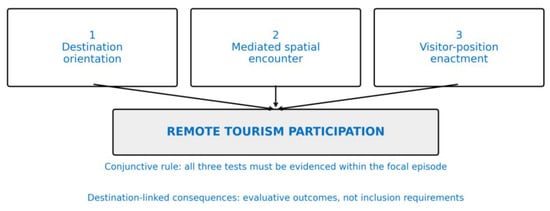
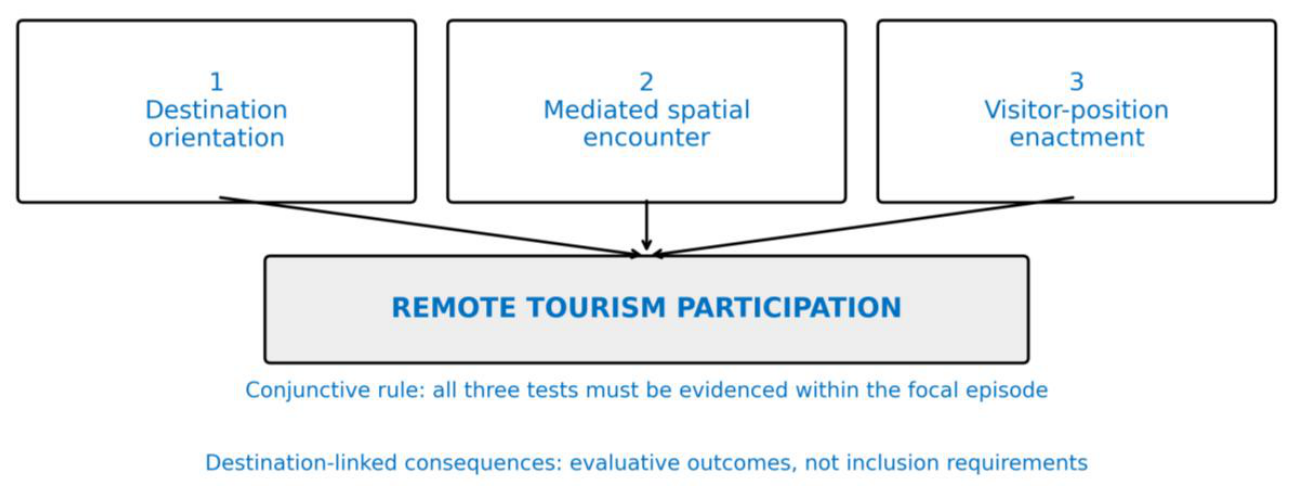

Disclaimer/Publisher’s Note: The statements, opinions and data contained in all publications are solely those of the individual author(s) and contributor(s) and not of MDPI and/or the editor(s). MDPI and/or the editor(s) disclaim responsibility for any injury to people or property resulting from any ideas, methods, instructions or products referred to in the content. |
© 2026 by the authors. Licensee MDPI, Basel, Switzerland. This article is an open access article distributed under the terms and conditions of the Creative Commons Attribution (CC BY) license.