


Abstract
Zoo habitats are now designed with a larger focus on animal wellbeing and the opportunities provided by more naturalistic environments. While such spaces are assumed to be beneficial for animal wellbeing, evidence to support that assumption is infrequently collected. Our primary objective was to evaluate changes in behavior for three primate species at the Saint Louis Zoo after they were moved from static, indoor habitats to larger, more dynamic outdoor ones. We also used this as an opportunity to document the effects of long-term nearby construction. We quantified behavior for the Zoo’s Guereza colobus (Colobus guereza), black-handed spider monkeys (Ateles geoffreyi), and Coquerel’s sifaka (Propithecus coquereli) indoors prior to construction (i.e., baseline), during the construction period, and after the animals moved to new outdoor habitats. In addition, sound data were collected during the baseline and construction phases of the study to quantify the potential effects of noise on behavior. Linear models were used to test differences in behavior between phases and associations of behavior with logarithmic daily average median sound levels while controlling for covariates such as group size and gate count. We observed evidence that construction may have been aversive, such as an increase in time spent inactive, a decrease in time spent locomoting, and an increase in self-directed behaviors. However, most models explained minimal variation in these behaviors, suggesting construction had a relatively weak impact on behavior. The differences observed between the baseline and new habitats phases indicated the new habitats were beneficial for animal wellbeing, including increases in some positive species-typical behaviors, decreases in agonistic behavior in the colobus and sifaka, and decreases in self-directed behaviors in the colobus and spider monkeys. This study provides evidence that large, dynamic, naturalistic habitats have beneficial effects on primate wellbeing, as measured using a combination of species-typical and self-directed behaviors.
1. Introduction
An animal’s environment can significantly impact its wellbeing. Historically, zoo enclosures were designed with an emphasis on hygiene and the public experience, with barren indoor spaces designed for easier cleaning and maximizing animal viewing rather than promoting natural behaviors [1,2]. However, over the past several decades, concern for animal welfare has increased. As a result, zoo habitats are now designed with a larger focus on animal wellbeing and the opportunities provided by more naturalistic environments [2,3,4,5]. While such spaces are assumed to be beneficial for animal wellbeing, evidence to support that assumption is infrequently collected [3,6]. Conducting systematic evaluations of how well an environment works for its occupants or users, or post-occupancy evaluations (POEs) [1,7], can help ensure that goals around improving animal welfare are met. For example, a POE study at Lincoln Park Zoo observed decreased abnormal behaviors in the chimpanzees (Pan troglodytes) and agonistic behaviors in the gorillas (Gorilla gorilla) after the apes were moved to new, more complex habitats [8]. Similarly, Asian elephants (Elephas maximus) at the Oregon Zoo showed an increase in activity, foraging, and exploration, and a decrease in repetitive behaviors after being moved to a new, substantially larger habitat [9].
Our primary objective was to evaluate changes in behavior for three primate species at the Saint Louis Zoo after they were moved from static, indoor habitats to larger, more dynamic outdoor ones. Outdoor habitats have been beneficial for a number of primate species. For example, in laboratory environments, common marmosets (Callithrix jacchus) showed clear preferences for outdoor cages over indoor ones [10], Verreaux’s sifaka (Propithecus verreauxi) spent the majority of time outside when given the option and Coquerel’s sifaka (P. verreauxi coquereli, now P. coquereli) were more active when moved outdoors [11], and chimpanzees displayed more species-typical behaviors and increased locomotion when transferred to a facility with both indoor and outdoor areas [12]. In zoos, ring-tailed lemurs (Lemur catta) engaged in more species-specific behaviors (e.g., sunbathing, scent marking) in their outdoor habitat compared to their indoor one [13], and both Hanuman langurs (Presbytis entellus, now Semnopithecus entellus) [14] and mandrills (Mandrillus sphinx) [15] spent more time foraging and locomoting when moved to a new outdoor habitat. These studies suggest that the increased space and complexity often provided by outdoor spaces can improve wellbeing for primates in human care.
As the new habitats at the Saint Louis Zoo were designed to attach to the existing primate space, we also used this as an opportunity to document the effects of long-term nearby construction. It can take several months or even years to build new habitats and the disruptions due to ongoing construction activity could be distressing to animals housed nearby. Effects of construction work on animals in human care are rarely reported for primates, but some reports have been published on other taxonomic groups. For example, multiple felid species have been documented as less visible during construction periods [16,17,18], suggesting construction activity is aversive. Other results are more mixed, such as a reduction in pacing during construction for some felids [17], while other felids showed either no changes or increases in pacing [19]. Similarly, giraffe exhibited more locomotion on days with construction [20] while snow leopards displayed the opposite pattern [16].
One reason construction could be disruptive is the level of noise and vibration accompanying many construction-related activities. Construction sites can generate noise levels that are several decibels (dB) greater than those animals are typically exposed to in both their natural habitats and in zoos [21,22,23]. For example, average noise levels were recorded at 20–38 dB in savanna habitats and 26–42 dB in riverine forest habitats [24], and ambient noise in enclosures at Auckland Zoo ranged from 35–65 dB [23], while construction site noise levels commonly range from 55–85 dB [25]. It can be difficult to distinguish the effects of construction-related noise from other potential influences, such as vibration or the presence of unfamiliar personnel, but some studies have specifically examined sound. For example, higher noise levels during construction were associated with fewer active and more stationary behaviors in yellow-cheeked gibbons (Nomascus gabriellae) [22], increased locomotion in giraffe, elephant, and emu [23], more active and anxiety-related behaviors in giant pandas [21], and reduced use of available space in multiple species [16,22,23]. Similarly, playing recordings of construction noise to pied tamarins (Saguinus bicolor) was associated with reduced environmental engagement and altered space use [26].
The Saint Louis Zoo began constructing the new outdoor primate habitats in late 2019 and animals were introduced to the space in May 2021. In this study, one species was selected from each major taxonomic group of the Zoo’s lemur and monkey collection, including Guereza colobus (Colobus guereza; African and Asian monkeys), black-handed spider monkeys (Ateles geoffreyi; Central and South American monkeys), and Coquerel’s sifaka (lemurs). We quantified behavior indoors prior to construction (i.e., baseline), during the construction period, and after the animals moved to new outdoor habitats. In addition, sound data were collected during the baseline and construction phases of the study to quantify the potential effects of noise on behavior. We predicted that construction would be aversive, resulting in an increase in behaviors that may be evidence of agitation or anxiety (e.g., aggression, scratching), but that moving to the new habitats would have a positive impact on wellbeing, such as an increase in species-typical behaviors (e.g., foraging, locomotion).
2. Materials and Methods
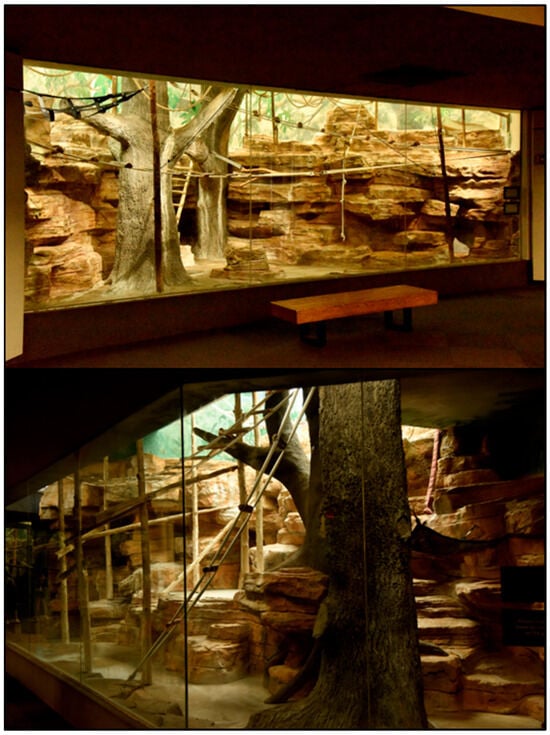
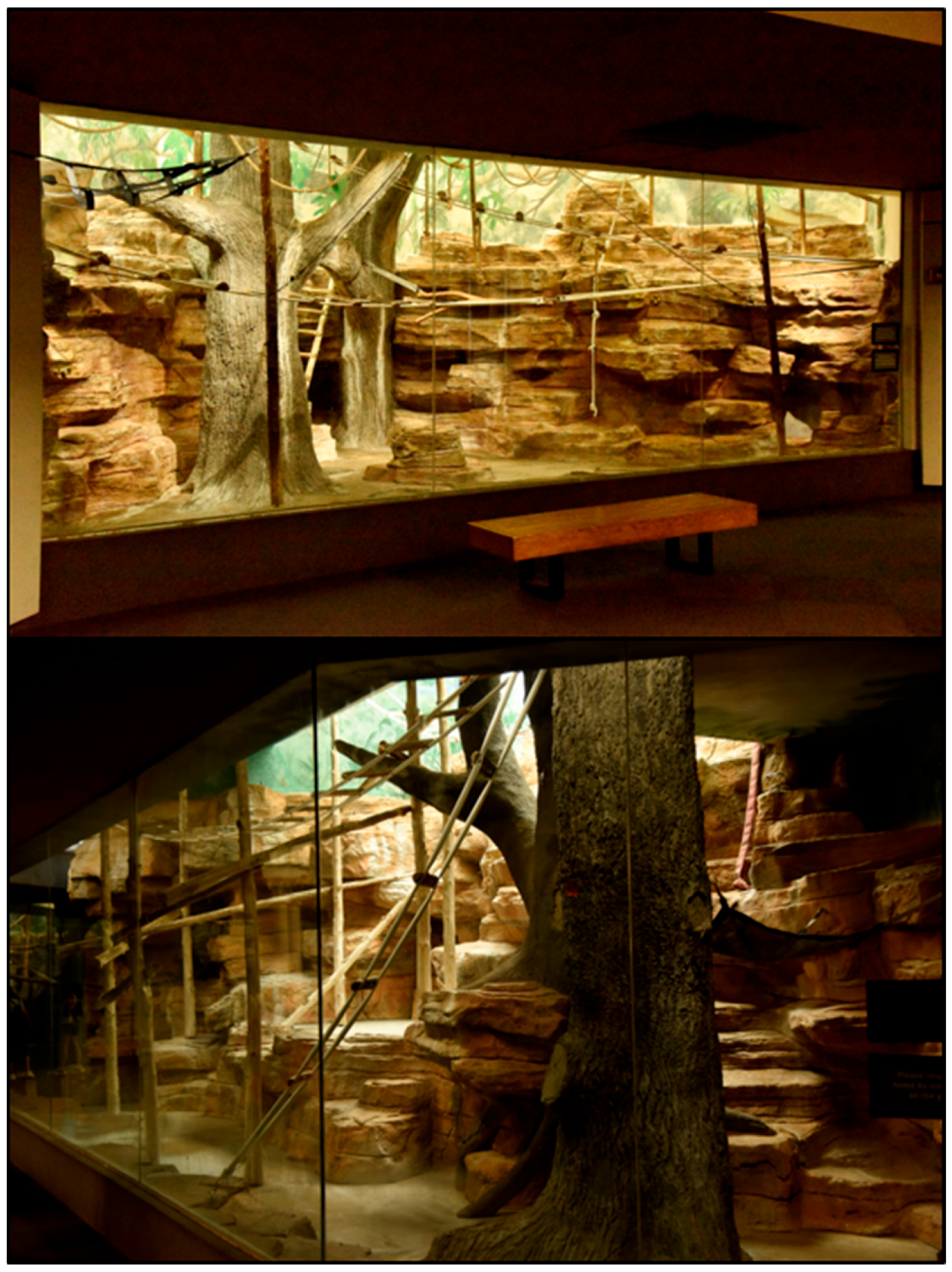
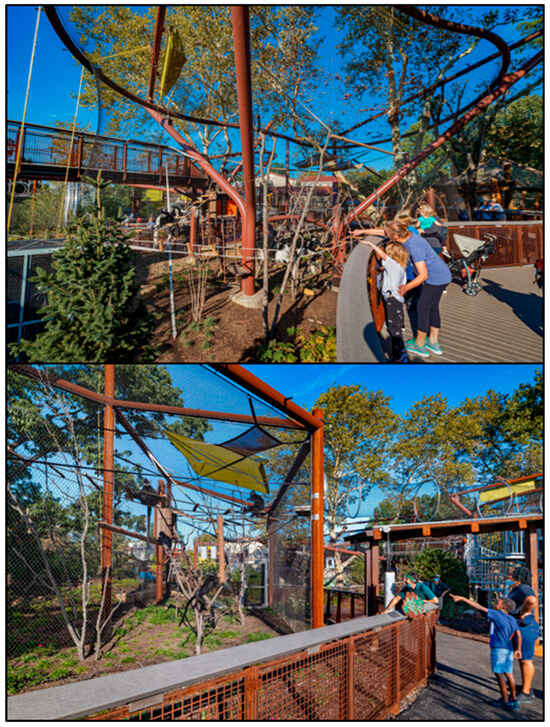
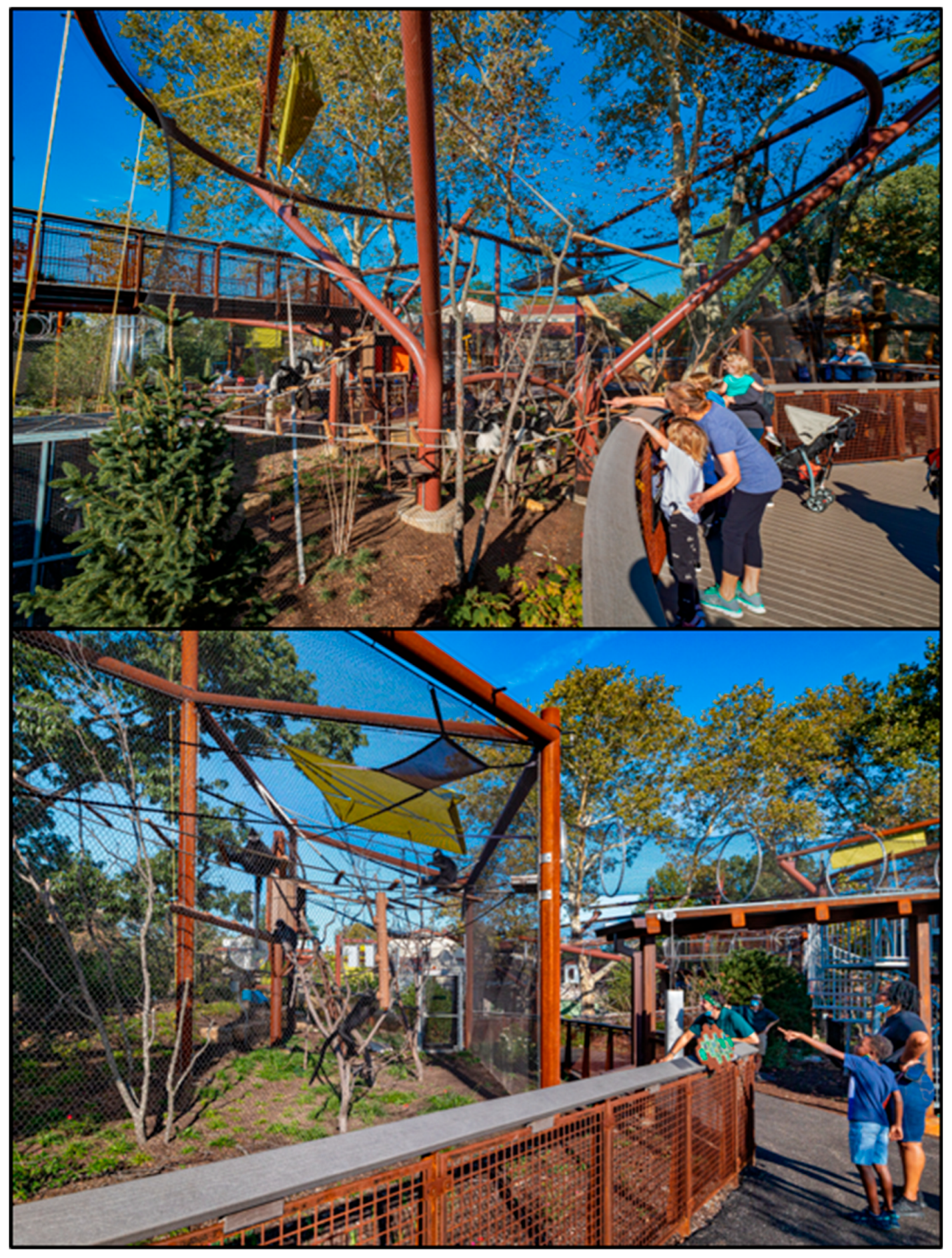
The study was conducted from July 2018 to November 2022 at the Saint Louis Zoo in St. Louis, Missouri, USA. The study site included the Primate House (Figure 1), which contained multiple indoor enclosures, and the Michael and Quirsis Riney Primate Canopy Trails (Figure 2), a multi-exhibit rotational outdoor habitat that opened to the public in July 2021. Habitats in the Primate House included artificial trees and rock ledges, and were typically furnished with removable hammocks, nets, and other options to increase environmental complexity, with guest viewing through glass windows on one side of the enclosure. In Primate Canopy Trails, habitats were larger (Table 1), irregularly shaped (e.g., some shaped like a conical frustum with a narrower floor and wider ceiling, some rectangular with slanted ceilings to provide greater height at one end than the other) with a higher maximum height than inside the Primate House, and contained live trees and/or deadfall, natural groundcover, and built-in furniture like platforms and shelters. For all outdoor habitats, walls and ceilings were made entirely of mesh and guests viewed animals on walkways 1.3–1.9 m away from the mesh, with viewing areas available around most of the periphery for many habitats. The study was split into three phases: baseline (July 2018–December 2019), construction (December 2019–April 2021), and post-construction (September 2021–November 2022). Data collection was paused from March-September 2020 due to reduced staff capacity during the COVID-19 pandemic. A gap between the end of the construction and post-construction phases exists because a break in behavioral data collection was requested by animal management to allow the primates and staff to adjust to the new area and routines.
Figure 1.
Representative photos of habitats in the Primate House at the Saint Louis Zoo. Photo credit: Saint Louis Zoo.
Figure 2.
Representative photos of habitats in the Michael and Quirsis Riney Primate Canopy Trails at the Saint Louis Zoo. Photo credit: Saint Louis Zoo.
Table 1.
Phases of the study with time period, group composition (dot separated, the first number is males, the second number is females), number of observation dates, and approximate sizes of the primary habitats for the Guereza colobus, black-handed spider monkeys, and Coquerel’s sifaka.
During the baseline and construction phases, a sound logger (3M Sound Examiner SE-402, Oconomowoc, WI, USA) was placed in a behind-the-scenes area of the Primate House adjacent to the construction site to record median sound levels in dBC every 60 s. Sound levels were measured using the C-weighted scale because it is appropriate for capturing industrial noises such as construction activity. The sound loggers were not placed next to each habitat as our purpose was to measure changes in overall sound environment rather than the specific decibels to which each species was exposed during the study. Unfortunately, we lacked a central, weather-proof location with a power supply in Primate Canopy Trails in which we could place the sound logger that would represent the noise levels to which the primates were exposed when moved outside, so we were unable to collect data on sound in the post-construction phase of the study.
Data were collected on three species (Table 1): Guereza colobus (n = 5–9, aged <1–24 years), black-handed spider monkeys (n = 3, aged 31–41 years), and Coquerel’s sifaka (n = 3–5, aged 4–18 years). There were several changes in group size throughout the study for the colobus and sifaka. Infants were born almost every year during the study in the Guereza colobus group; due to dependence on their mother, infants born into the group were not counted during scan sampling until they were approximately one year old. Due to social tension, there were also group composition changes for the sifaka; baseline data were collected on a group of five individuals, which was reduced to three animals during the construction period and eventually two sifaka by the end of the study.
Data were collected at the group-level due to difficulty identifying specific individuals. Observations were conducted using scan sampling at 1-min intervals during 30-min observation sessions with an ethogram of state and event behaviors (Table 2). For state behaviors, the number of animals in the group engaged in each behavior was recorded at the interval. Event behaviors were recorded using 1,0 sampling for each interval. Additionally, we recorded if the shift door was open or closed for each observation; an open shift door gave the primates access to their off-exhibit areas. Observations occurred twice daily up to five days each week, with the first observation between 9:00–11:00 a.m. and the second between 2:00–4:00 p.m. Observation sessions in which all individuals were out of sight for ≥50% of the data points were removed from the dataset, as were morning sessions if there were no afternoon observations on the same date, and vice versa. Additionally, if the observation was interrupted by the group being secured off-exhibit so that keepers could service the habitat, the observation was ended early, resulting in some sessions less than 30 min in length. The species observation order was randomized daily, with the same order followed for both sessions.
Table 2.
Ethogram of state and event behaviors documented in the Guereza colobus, black-handed spider monkeys, and Coquerel’s sifaka.
Quantitative Analyses
All quantitative analyses were conducted separately for each species. Data from morning and afternoon observations were combined for each date observed. For state behaviors, we calculated the proportion of group time engaged in each behavior for each date by dividing the number of times a behavior was observed by the total possible data points. For example, a group of 3 individuals observed for 60 min total would have 180 points of data for that observation date. If those three individuals spent a combined total of 90 intervals foraging, the proportion of group time engaged in foraging behavior would be 0.50. For event behaviors, we calculated the proportion of intervals during which the behavior was observed by dividing the number of scans in which the behavior was observed at least once in any group member by the total intervals observed for that date. For example, if scratching was observed at least once in 15 separate intervals and the group was observed for 60 intervals/minutes, the proportion of intervals observed for scratching would be 0.25. Sound data were summarized by calculating the logarithmic average median dBC daily between 8:00 a.m. and 5:00 p.m.
Before testing the effects of construction or new habitats on behavior, we wanted to understand and control for other factors that may affect behavior, including group size, whether the animals had access to off-exhibit areas, temperature, and gate count. Previous research has shown positive relationships between temperature and visitation levels at zoos [27,28], so we first analyzed the relationship between average temperature and gate count using nested linear, quadratic, and cubic models. We observed a strong linear association (β = 43,840.8, SE = 3513.9, p < 0.0001, R2 = 0.320) and a significant cubic relationship (β = −7612.9, SE = 3513.9, p = 0.031, R2 = 0.328) between average temperature and gate count, indicating higher visitor numbers with higher temperatures but a decrease in visitor numbers as temperatures reached their highest levels. Approximately a third of the variation in gate count was explained by average temperature. Given the strong linear relationship, we tested for multicollinearity between average temperature and gate count by calculating the variance inflation factor (VIF). Average temperature and gate count did not show evidence of multicollinearity (VIF = 1.47), suggesting we should test both independently for their effects on behavior. We then used linear models to separately test for the effects of group size (colobus and sifaka only), whether the shift door was open or closed, daily average temperature, and daily gate count on behavior for each species while controlling for phase. Dates where the status of the shift door changed during or between observation sessions were coded as “mixed” and excluded from this analysis of potential covariates, but were retained in our tests of effects of construction and new habitats described below. Because of their strong relationship, when testing for the effect of gate count on behavior, we ran models with just gate count and with both gate count and average temperature; if gate count significantly predicted a behavior when analyzed without average temperature but was no longer significant when average temperature was included, gate count was not considered to be a significant covariate for that behavior. To be conservative, covariates were included in the full models for each species (described below) when p ≤ 0.10. A checklist indicating which covariates were included in the full models for each species is available in Table 3.
Table 3.
Covariates included in the full models analyzed for each behavior by species.
We examined effects of construction on each species by comparing data from the construction phase with data from the baseline phase, and effects of moving to new outdoor habitats by comparing data from that phase with data from the baseline phase. Behavioral data were analyzed between phases for each species using linear models (LMs). LMs were also used to understand the effect of sound levels on behavior using data from the baseline and construction phases combined. The full model for the phase comparisons contained the potentially relevant covariates (Table 3), and phase was also included as a covariate in full models for sound level analyses. When a covariate was not significant within the full model, it was removed and a reduced model was analyzed as well. Model fit between full and reduced models was compared using Akaike’s Information Criterion (AIC) [29,30]. Results from the model with the better model fit, as indicated by the lowest AIC, are presented herein; the reduced model had the better model fit for all but three models tested. As a ΔAIC ≤ 2.0 between two models can be interpreted as those models being equivalent [30,31,32,33], when the ΔAIC between the full and reduced model for a behavior was ≤2.0 and they have different interpretations (i.e., one was significant but the other was not), both are presented. When reporting the results of each model, we also provide the adjusted coefficient of determination (R2) as an estimate of the variation in each behavior explained by the entire model, as well as partial omega squared () to estimate the variation in each behavior explained exclusively by the predictor of interest (i.e., study phase, median sound levels).
Certain behaviors occurred too infrequently to analyze, including play in the spider monkeys and sifaka as well as aggression as a state behavior in all species. Significance was set at p ≤ 0.05. All statistical analyses were conducted in R (v4.5.3) [34] using the “lme4” [35], “lmerTest” [36], and “effectsize” [37] packages for the LMs and the “usdm” package [38] to assess multicollinearity.
3. Results
Descriptive statistics for the proportion of group time engaged in each state behavior and proportion of intervals observed for each event behavior by species are presented in Table 4. All three species spent the majority of their time engaged in inactive and foraging behaviors. The colobus spent a greater proportion of group time inactive and a lower proportion of group time foraging compared to the spider monkeys or sifaka for the baseline and construction phases, but approximate time spent in these behaviors was roughly equivalent between the three species in the new habitat. Scratching was the most frequently observed event behavior and agonistic events were documented in a low proportion of intervals observed. The greater proportions of intervals observed for each event behavior in the colobus is likely explained by the larger group size for this species, as the more individuals there are in a group increases the likelihood of observing each behavior during any particular interval.
Table 4.
Proportion (%) of group time engaged in each state behavior and proportion (%) of intervals in which each event behavior was observed by species and phase.
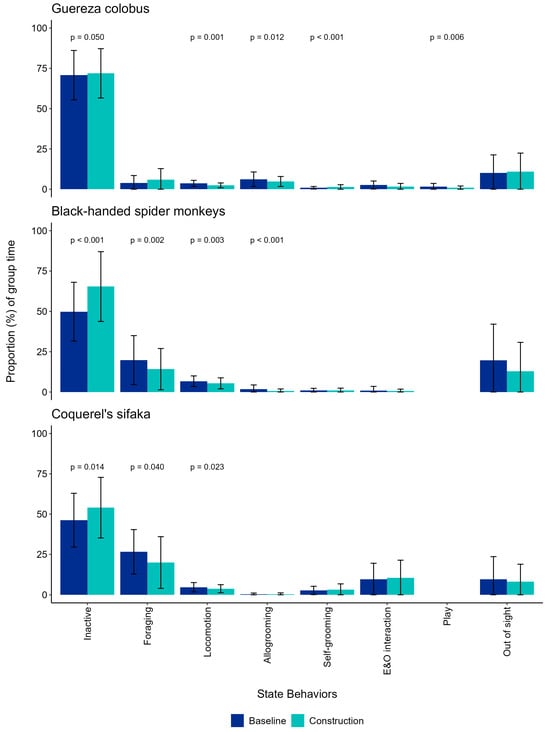
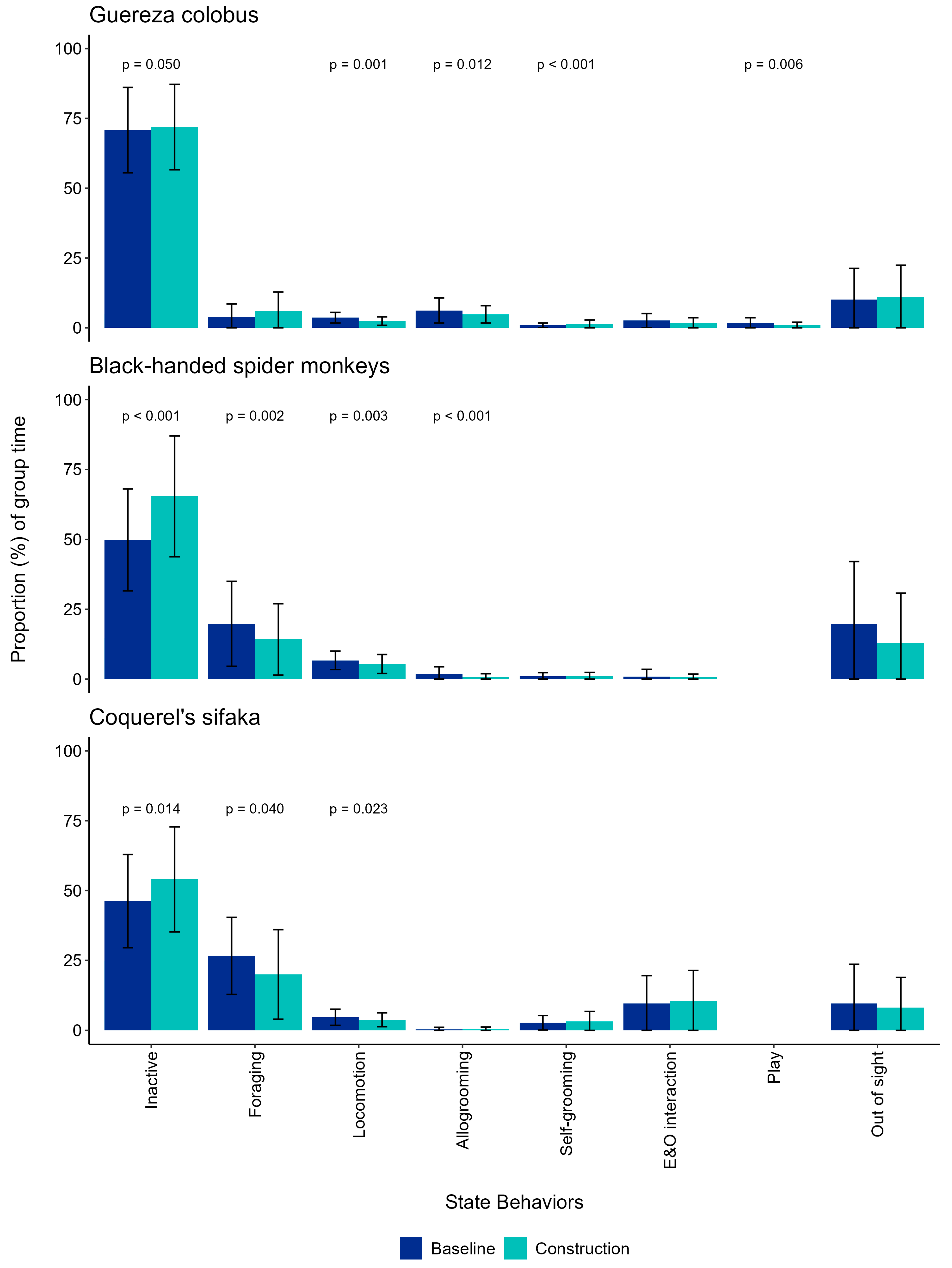
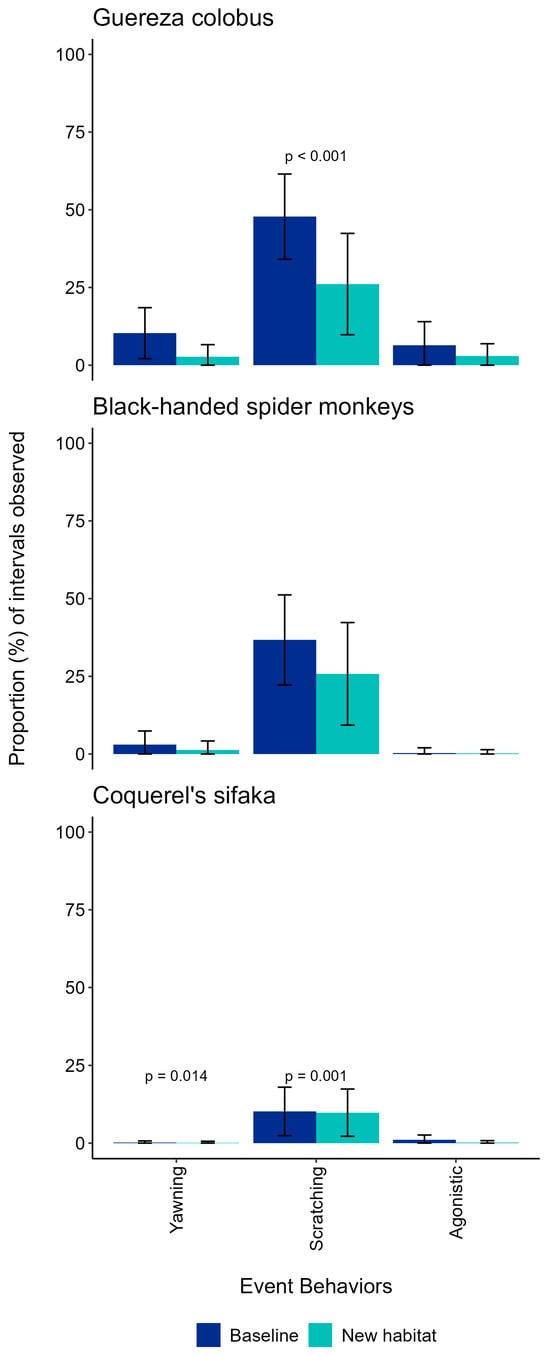
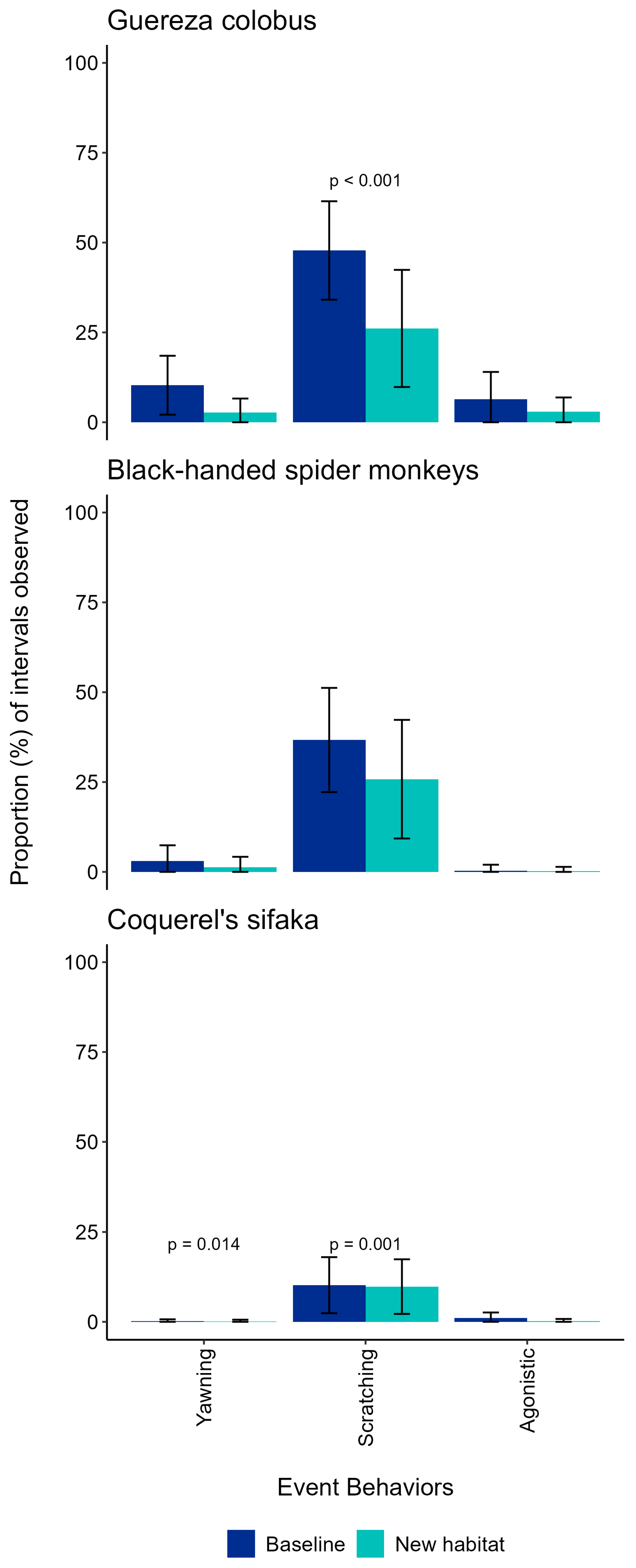
Differences in behavior between the baseline and construction phases by species are presented in Table 5 and Figure 3 and Figure 4. Several behaviors were significantly different during the construction phase when compared to baseline. A significant increase in time spent inactive and decrease in time spent locomoting during construction was observed for all three species. The colobus also showed an increase in self-grooming and a decrease in allogrooming, play, and scratching during construction. For the spider monkeys, construction was also associated with less allogrooming and foraging. While the effect of phase (i.e., construction) explained a substantial portion () of the total variation explained by each model (R2) for several behaviors in the colobus and spider monkeys (e.g., construction accounted for most of the variation in locomotion and scratching for the colobus), overall the models explained little variance in the proportion of group time spent in each behavior even when differences between the baseline and construction phases were significant. One exception to this was the model for inactive behavior in the spider monkeys, for which the model explained approximately 41% of the variation, with just under half of that variation being explained by the construction phase. Finally, the sifaka engaged in less foraging and more yawning and scratching during construction. While the models for some behaviors overall in the sifaka had a notable effect size, the portion of that variation accounted for by the construction phase was minimal (e.g., inactive behavior: R2 = 0.183, = 0.022).
Table 5.
Results from the best fit linear models testing differences in behavior between the baseline and construction phases for each species and which covariates were included in the model; significant results (p ≤ 0.05) are in bold.
Figure 3.
Behavior differences between baseline and construction phases for state behaviors; p-values are indicated for significant differences identified by linear models.
Figure 4.
Behavior differences between baseline and construction phases for event behaviors; p-values are indicated for significant differences identified by linear models.
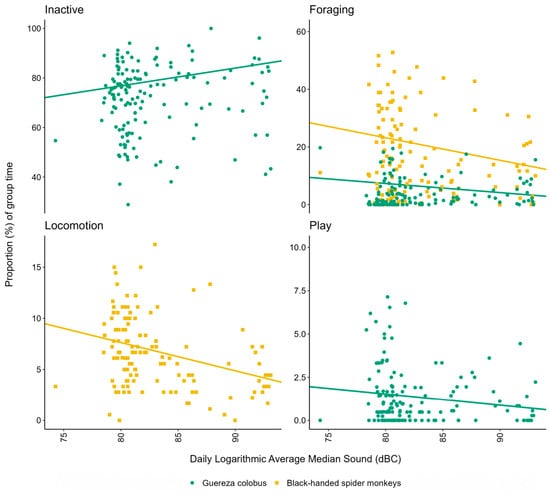
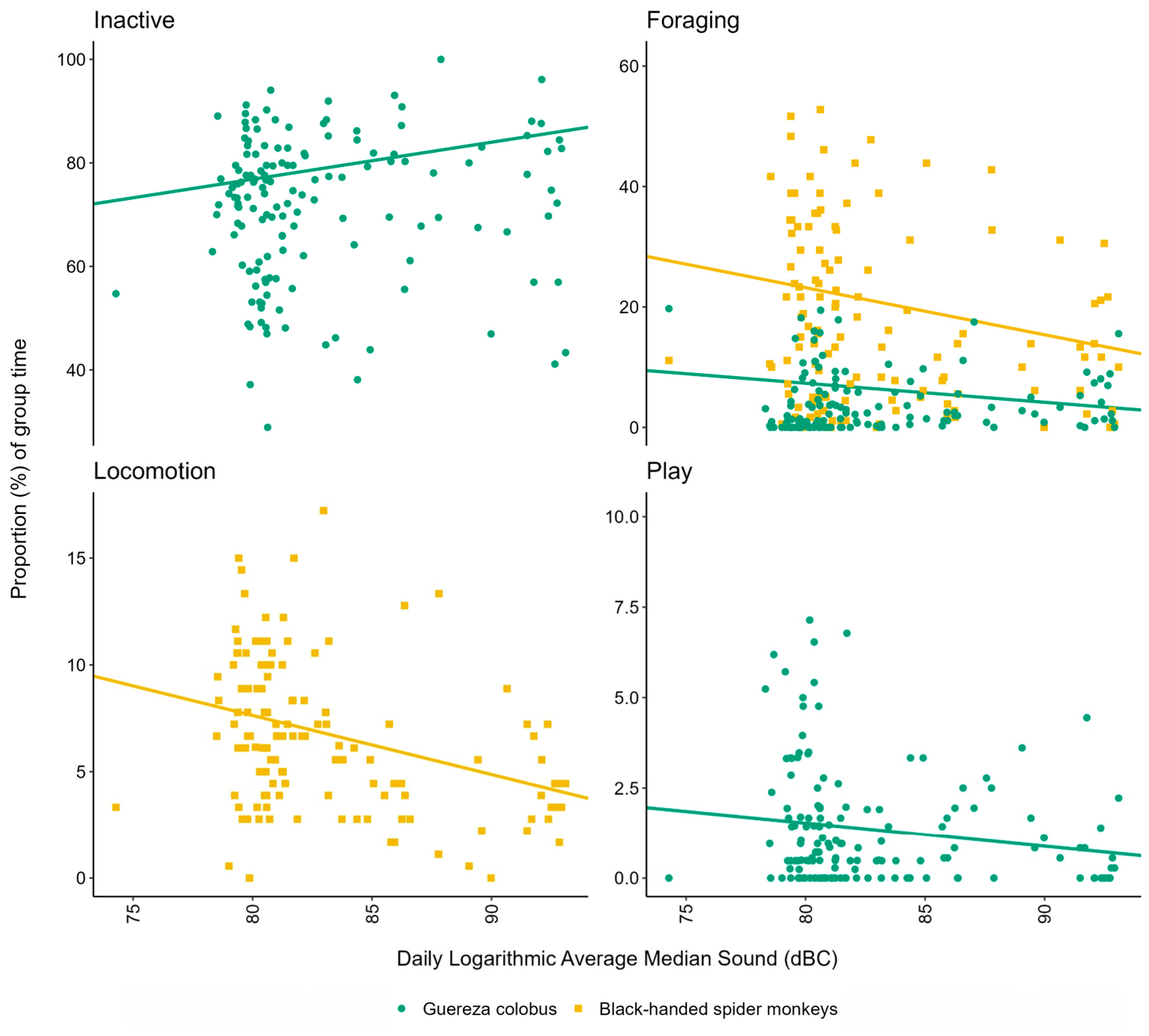
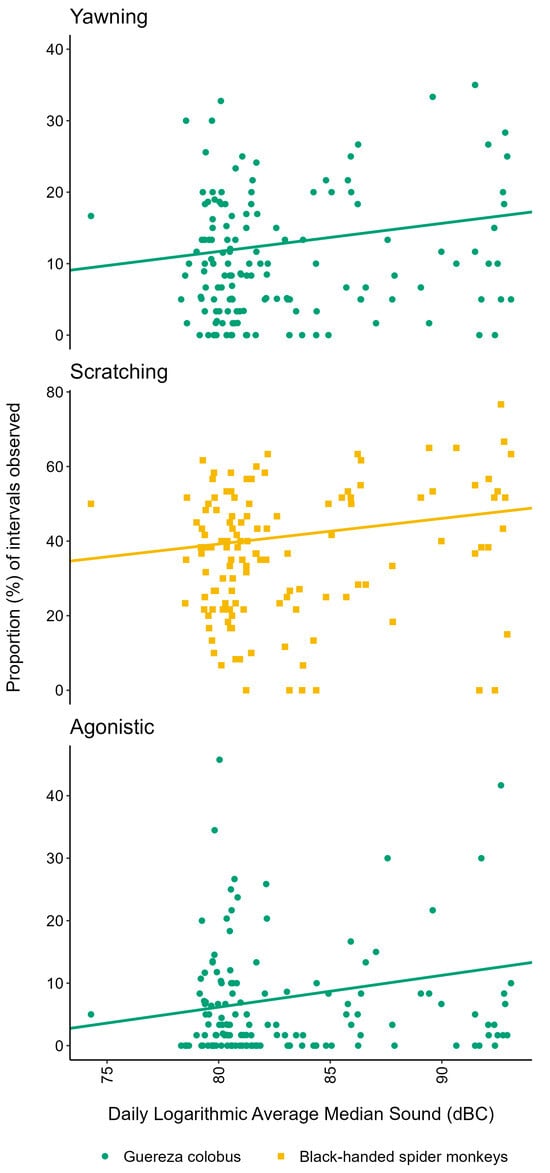
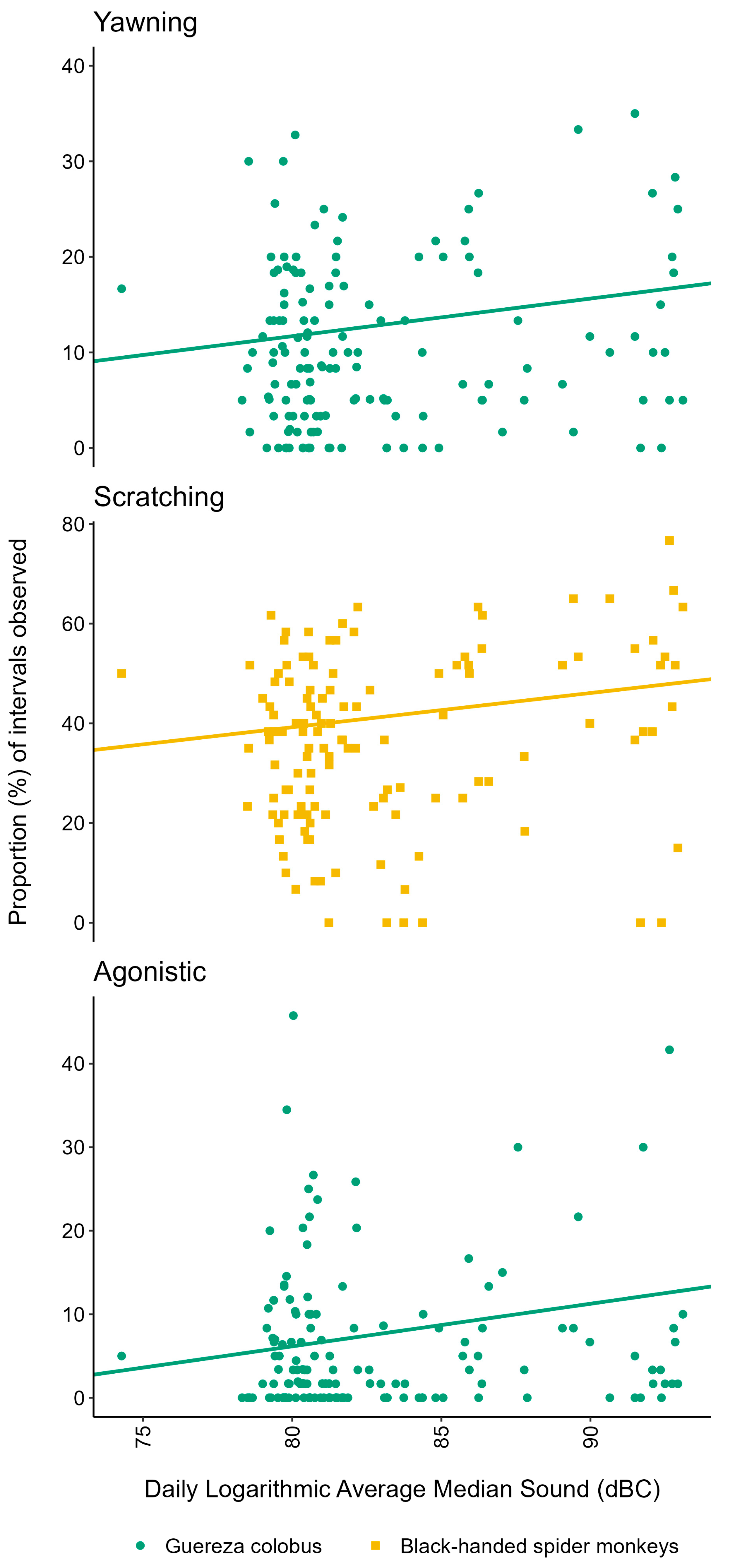
Logarithmic daily average median sound levels were significantly higher during construction ( = 86.9 dBC, SD = 4.26) compared to baseline ( = 80.5 dBC, SD = 1.23; β = 4.341, SE = 0.246, p < 0.0001, R2 = 0.331). Logarithmic daily median sound levels were not significantly associated with most behaviors (Table 6). In the colobus, higher daily average median sound levels predicted more inactive and less foraging and play behaviors (Figure 5). However, the relationship between median sound and foraging was not significant when non-significant covariates were removed from the model despite the full and reduced models being equivalent (ΔAIC = 0.97). Additionally, the median sound variable explained a minimal portion of the variation in the inactive and foraging behaviors for the colobus ( = 0.000 for both). A significant inverse association of daily median sound with foraging and locomotion was observed in the spider monkeys (Figure 5), with median sound explaining all of the variation in the latter. Daily average median sound levels were not significantly associated with state behaviors in the sifaka. Higher daily median sound was associated with a higher proportion of yawning and agonistic behavior in the colobus as well as a higher proportion of scratching in the spider monkeys (Figure 6), although the effect sizes for the colobus models were small overall (R2 = 0.000–0.014), and the median sound variable explained only a small portion ( = 0.039) of the 18.3% of variation in scratching for the spider monkeys. Higher daily median sound levels also may have predicted more yawning and scratching in the sifaka. While the full models for these behaviors, which were not significant, had the best fit, they were equivalent to the reduced models with the covariates removed (yawning: ΔAIC = 0.10; scratching: ΔAIC = 1.05), which showed significant relationships with both yawning (β = 0.000, SE = 0.000, p = 0.019, R2 = 0.031, = 0.031) and scratching (β = 0.007, SE = 0.002, p < 0.001, R2 = 0.190, = 0.086). The amount of variation explained by both the full and reduced models for yawning was minimal but fully explained by median sound levels, while the models for scratching explained approximately 20% of the variation in that behavior, with median sound levels accounting for a little less than half of that variation.
Table 6.
Results from the best fit linear models testing the relationship between logarithmic daily average median sound levels and behavior in the baseline and construction phases for each species and which covariates were included in the model; significant results (p ≤ 0.05) are in bold.
Figure 5.
Daily logarithmic average median sound (dBC) levels were significantly associated with the proportion (%) of group time inactive for the Guereza colobus, foraging for the Guereza colobus and black-handed spider monkeys, locomotion for the black-handed spider monkeys, and play for the Guereza colobus.
Figure 6.
Daily logarithmic average median sound (dBC) levels were significantly associated with the proportion (%) of intervals observed yawning for the Guereza colobus, scratching for the black-handed spider monkeys, and agonistic behavior for the Guereza colobus.
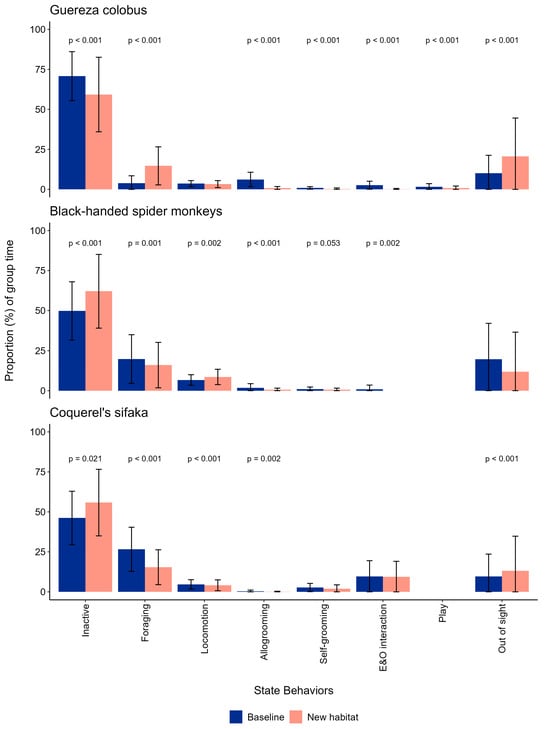
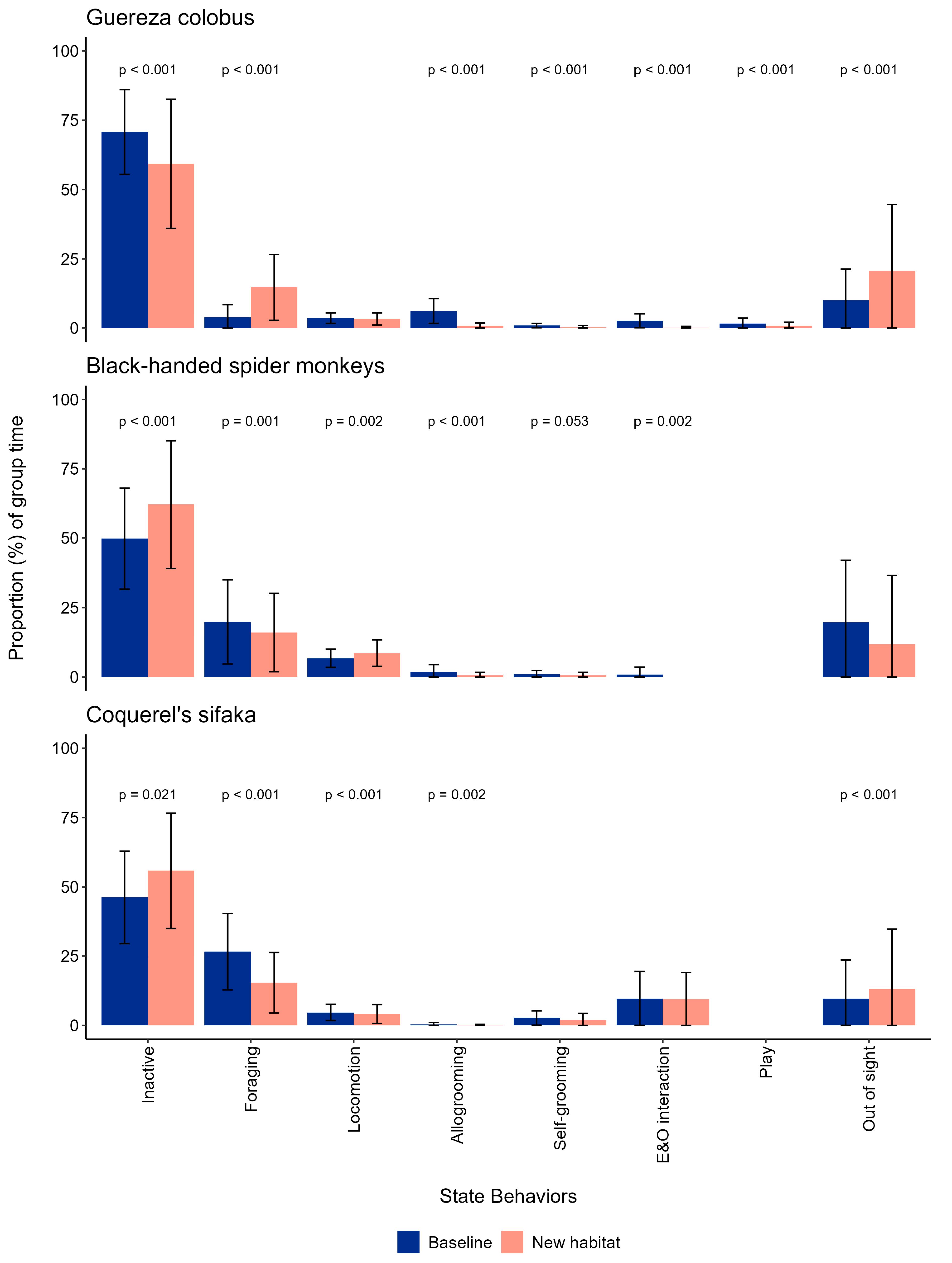
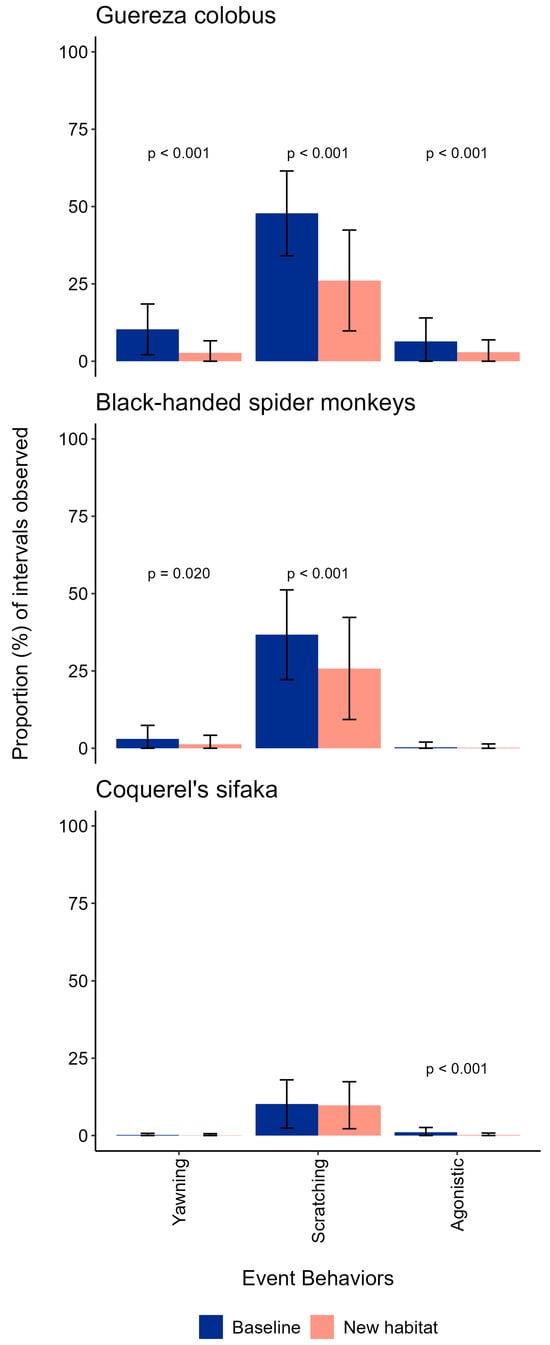
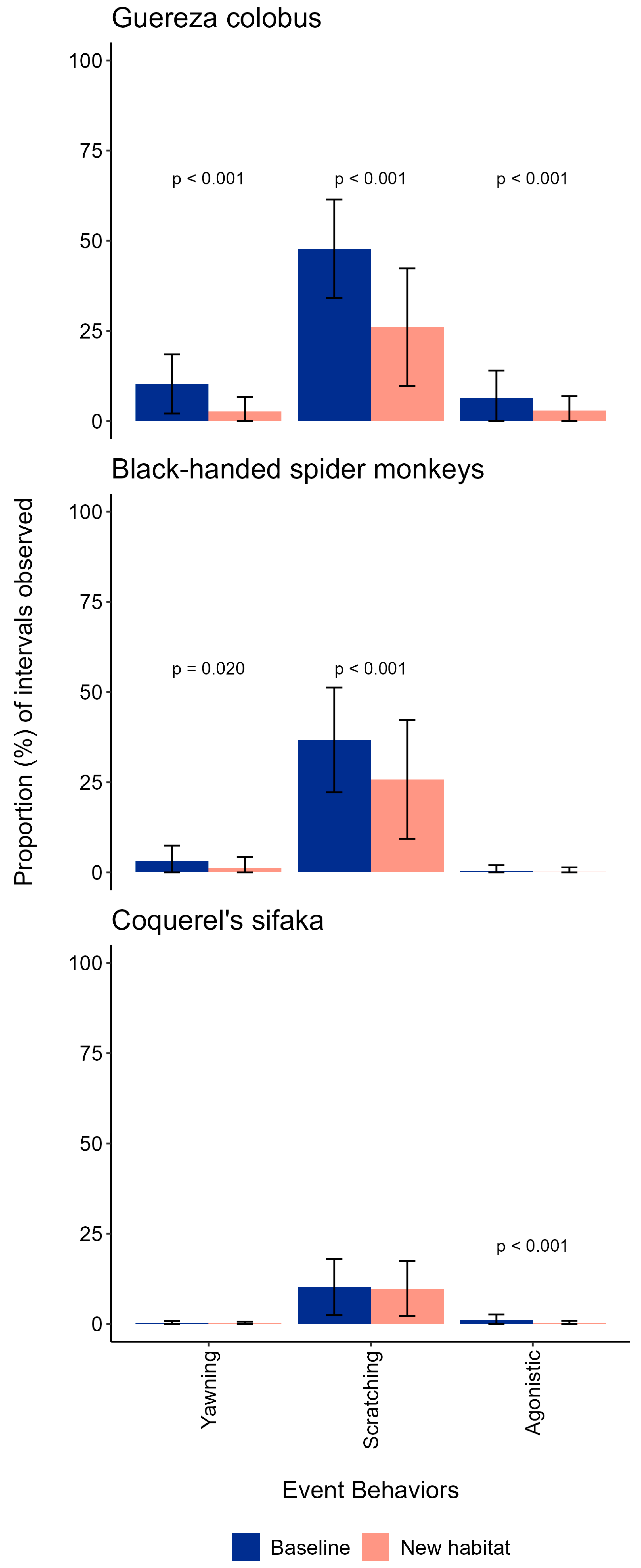
Differences in behavior between the baseline and new habitat phases by species are presented in Table 7 and Figure 7 and Figure 8. Most behaviors were significantly different in the new habitat when compared to baseline, with a relatively high amount of total variation explained by the models for many behaviors. All three species exhibited a significant decrease in allogrooming in the new habitat compared to baseline, with study phase accounting for most or all of the variation in that behavior (e.g., colobus: R2 = 0.355, = 0.337). Additionally, significant changes were observed in inactive and foraging behavior for all three species, but in different directions; the colobus spent less time inactive and more time foraging, the spider monkeys and sifaka spent more time inactive and less time foraging in the new habitat. Approximately 25% of the total variation in inactive behavior was accounted for by the new habitat phase for each species, while the phase accounted for most of the variation in foraging for the colobus (R2 = 0.330, = 0.302) and sifaka (R2 = 0.186, = 0.156) but not spider monkeys (R2 = 0.076, = 0.013). Moving to the new habitat had significant effects on all other behaviors measured in the colobus as well excluding locomotion, with an increase in time spent not visible and decreases in self-grooming, environmental and object interactions, yawning, scratching, and agonistic events, with the project phase accounting for a substantial portion of the total variation in most models. There were also several differences for the spider monkeys, with more time spent locomoting and significant decreases in self-grooming, environmental and object interactions, yawning, and scratching, with at least half of the portion of variation in each behavior accounted for by study phase for these behaviors The sifaka spent significantly less time locomoting and agonistic events occurred less often, while there was an increase in time out of sight, although study phase only explained the majority of variation for agonistic events (R2 = 0.105, = 0.104).
Table 7.
Results from the best fit linear models testing differences in behavior between the baseline and new habitat phases for each species and which covariates were included in the model; significant results (p ≤ 0.05) are in bold.
Figure 7.
Behavior differences between baseline and new habitat phases for state behaviors; p-values are indicated for significant differences identified by linear models.
Figure 8.
Behavior differences between baseline and new habitat phases for event behaviors; p-values are indicated for significant differences identified by linear models.
4. Discussion
The primary purpose of this study was to evaluate the effect of moving from smaller, static indoor spaces to larger, more dynamic outdoor habitats on behavior in three species of primates. As these new habitats were connected to the existing building, the primates were exposed to construction for several months prior to moving, allowing us to also examine the effects of construction on their behavior. Critically, our study covered long windows of time for each phase, ensuring that differences in behavior were not simply due to the novelty of a different environment. We interpreted the results for each species using a framework of time allocated to species-typical as well as self-directed and displacement behaviors. It is widely accepted that the amount of time animals spend engaged in species-typical behaviors, particularly those that have a positive valence, is an indication of how well they are coping with their environment [39,40]. As such, changes in housing or husbandry that increase species-typical behaviors are generally considered positive for wellbeing, and vice versa. An exception to this assumption is aggression; while important for establishing social hierarchies in many species [41,42], the general preference is for these behaviors to decrease or remain low, especially outside of hierarchy-related interactions.
However, interpreting shifts in some species-typical behaviors, such as inactivity and allogrooming, is less straightforward. Zoo-housed animals are often less active than their wild conspecifics, resulting in concerns about weight or body condition and overall health. As such, an increase in activity is generally interpreted as a positive change in behavior. However, increased activity levels have also been interpreted as evidence of agitation in primates [43] and African and gentoo penguins [44]. Moreover, inactivity when experiencing uncertainty is an adaptive response, as it preserves resources [45]. Counterintuitively, this indicates that increased inactivity should be expected and considered a normal response during periods of uncertainty, but also that more inactivity after a change might indicate individuals are more comfortable and experiencing less agitation. In primates, the valence of allogrooming can similarly vary based on context. As allogrooming is a social bonding behavior in primates [46,47,48], increases are often considered evidence of improved wellbeing, whereas decreases may indicate reduced social cohesion [46]. Furthermore, allogrooming may be more likely when individuals are already relaxed [48], suggesting decreases signal reduced comfort. However, allogrooming is also a strategy for reducing social tension in primates (lion-tailed macaques, Macaca silenus [48,49]; rhesus macaques, M. mulatta [50,51]; for review, see [47]), indicating that decreases may instead signal a reduction in social tension that needs mitigated via allogrooming and vice versa. Thus, while it is important to measure behaviors like these when assessing the welfare impacts of changes to the environment, their potential ambiguity suggests that additional covariate data or surrounding context should be considered when interpreting data. Moreover, the timing of increases or decreases in these behaviors within a phase may be important, as animals may habituate to stimuli.
In addition to monitoring species-typical behaviors, evaluating changes in self-directed behaviors (SDBs), including self-grooming and scratching, as well as displacement behaviors like yawning, can be used to understand how changes impact wellbeing, as these are considered stress- or anxiety-related behaviors in primates [52,53]. For example, self-grooming increased alongside other indicators of negative affective state (e.g., aggression) in gorillas on days with higher visitor density [54], both scratching and yawning increased with uncertainty in research chimpanzees [55,56], and wild ring-tailed lemurs and Verreaux’s sifaka showed increased yawning after aggression or predation events [57]. Reductions in self-directed and displacement behaviors in response to changes in housing or husbandry are considered evidence of improved wellbeing, and vice versa.
4.1. Evaluating the Impact of Construction
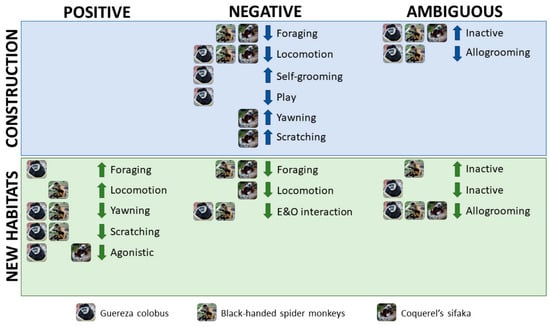
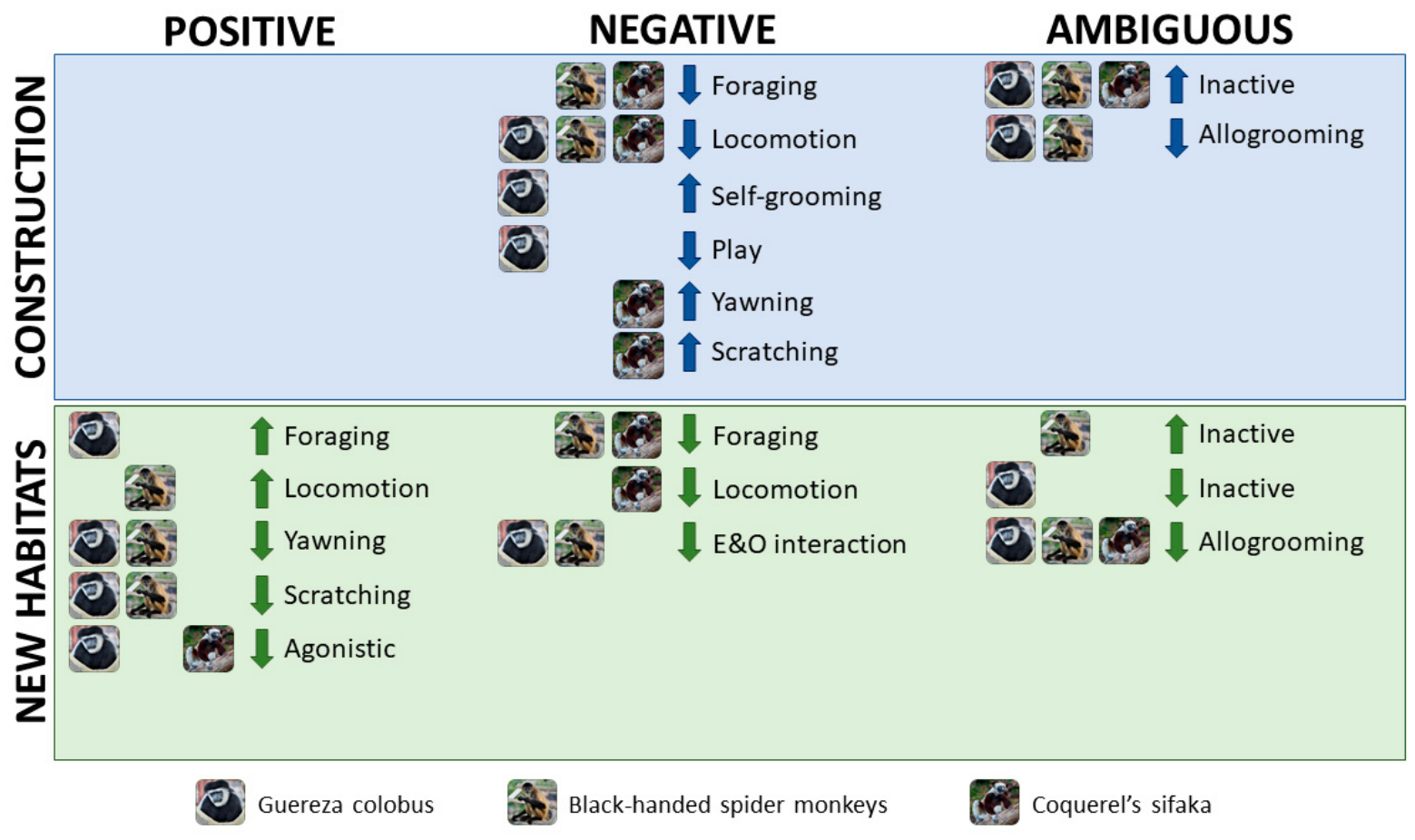
Our evidence suggests that construction had a negative effect on the species studied (Figure 9). In terms of species-typical behaviors, construction was associated with increased inactivity and a corresponding reduction in locomotion across all three species. Allogrooming decreased in both the colobus and spider monkeys. There was also a decrease in play behavior in the colobus and foraging in the spider monkeys and sifaka. We also observed an increase in self-directed and displacement behaviors during construction in two species. However, it is important to note that, with the exception of inactive behavior in the spider monkeys and locomotion and scratching in the sifaka, minimal total variation (R2 < 10%) was explained by each model. Furthermore, for locomotion and scratching in the sifaka, the study phase alone explained a minimal portion of the variation in each model. These results indicate that while construction had a negative effect on most behaviors, overall those effects were mostly weak. Moreover, while some differences were statistically significant, it is uncertain whether the magnitude of changes were biologically meaningful. For example, locomotion decreased between 0.9–1.3% per species, which was a statistically significant decrease but may not be a functional difference. There is limited research on the effects of construction on zoo-housed animals, but our results are consistent with findings such as a decrease in locomotion in snow leopards [16]. While we did not observe the reduced visibility reported in many felids during construction periods [16,17,18], it was difficult for the individuals we studied to be out of sight of the observer in their indoor habitats.
Figure 9.
Summary of the results observed in the Guereza colobus, black-handed spider monkeys, and Coquerel’s sifaka during the construction and new habitat phases of the study when compared to baseline based on the predicted valence (positive, negative, or ambiguous) of the behavior change. Up arrows indicate an increase in the behavior compared to baseline; down arrows indicate a decrease in the behavior compared to baseline.
Evaluating the Impact of Median Sound Levels During Baseline and Construction
Construction may be aversive to animals in human care due to accompanying noise. On average, daily median sound levels were 6.4 dBC higher during construction than baseline. As decibels are on a logarithmic scale, increases are not linear; instead, sound pressure doubles with every 6 dB increase and, in humans, perceived loudness doubles with every 10 dB increase [58], suggesting the primates likely perceived the environment as louder during the construction phase. Species-typical behaviors were only significantly associated with daily median sound levels in the colobus and spider monkeys. Higher median sound levels were significantly associated with more inactive and less foraging and playing in the colobus, and less foraging and locomotion in the spider monkeys. As with the baseline vs. construction phase comparisons, the total variation in these behaviors explained by each model was low for most behaviors, with the median sound variable explaining little to no variation in inactive, foraging, and agonistic behavior in the colobus, or foraging and scratching in the spider monkeys. These results are consistent with those seen in yellow-cheeked gibbons [22]. Higher daily median sound levels were also associated with increased yawning and agonistic behavior in the colobus as well as scratching in the spider monkeys. Altogether, these results indicate that higher sound levels were perceived negatively by these primate species, although the low amount of variation explained by the models may indicate the primates mostly habituated to the higher sound levels over the course of construction [59].
4.2. Evaluating the Impact of New Habitats
Changes in behavior were evident in all species when comparing behavior in the new habitats to baseline (Figure 9). All three species showed a reduction in allogrooming in the new habitats. In the colobus, there was an increase in foraging and a decrease in inactive, environmental and object interaction, and agonistic behaviors outdoors. The spider monkeys spent more time inactive but also more time locomoting, with less time foraging and engaged in environmental and object interaction, outdoors compared to indoors. The sifaka showed a reduction in foraging, locomotion, and agonistic events in the new habitats. Both the colobus and sifaka spent more time out of sight outdoors. There was also a reduction in yawning, scratching, and/or agonistic bouts for all three species. Notably, the total variation explained by the models was high for many behaviors, with the portion of variation explained by the new habitat accounting for at least half of that variation for most behaviors.
Increases in species-typical behaviors in outdoor spaces compared to indoor areas have been observed in multiple primate species, including Coquerel’s sifaka [11], ring-tailed lemurs [13], common marmosets [10], Hanuman langurs [14], mandrills [15], and chimpanzees [12]. While the primates received multiple food-based (e.g., puzzle feeders, hanging foraging logs) and non-food-based (e.g., scent enrichment, mirrors) enrichment items daily while housed indoors to increase environmental complexity, animal care staff decreased the use of non-food-based enrichment in the more complex outdoor spaces, which likely explains the decrease in environmental and object interaction observed, as use of food-based enrichment was recorded as foraging behavior. Accordingly, all of the variation in this behavior for the colobus and spider monkeys was explained by the new habitats. Increased time out of sight in the new habitats was poorly explained by the phase and, although temperature itself was not a predictor, instead is likely due to the primates having indoor access anytime temperatures exceeded 29 °C (85 °F), whereas they had access to holding areas much less frequently when housed indoors. Similarly, Guereza colobus at another zoo showed no differences in behavior between days when temperatures were above and below their cutoff (23 °C/73 °F), but they spent more time out of sight when they had access to holding areas [60]. The reduction in self-directed and displacement behaviors in the colobus and spider monkeys suggests lower levels of stress or anxiety following the move to the new habitats [52,53]. The effect sizes for most models comparing behavior between the baseline and new habitats phases are higher than many of the effect sizes observed comparing the baseline and construction phases, indicating the new habitats explain more of the behavioral variation observed.
Not all of the changes in species-typical behaviors we observed would generally be interpreted as positive when evaluated in isolation, including the decrease in foraging for the spider monkeys and sifaka, the decrease in locomotion for the sifaka, and the decrease in environmental and object interaction for the colobus and spider monkeys, although the effect sizes for most of these changes were small and the latter may be more attributable to changes in animal care routines than the new environment. Despite this, when considering all of the changes together, the differences observed when compared to baseline suggest increased comfort and reduced social tension in the new habitats overall. For example, in the new habitats, the colobus showed a decrease in environmental and object interaction, which would generally be considered a negative change, as well as less time inactive and allogrooming, which are more ambiguous. However, we also observed several changes in the new habitats that would be categorized as positive, including increased foraging and decreased yawning, scratching, and agonistic interactions. As previously discussed, lower levels of inactivity are generally considered a positive, and the levels of inactivity in this colobus group are lower than those reported in other groups (see Section 4.3), supporting this interpretation. Additionally, the positive changes provide context to help interpret the ambiguous change in allogrooming. Fewer displacement behaviors and aggressive interactions suggest decreased agitation or anxiety in the troop, which combined with lower social density due to increased space, may indicate the colobus experienced less social tension in the new habitats, contributing to the reduction in allogrooming if it was primarily used as a method to mitigate conflict (see also Section 4.3). When evaluating changes in behavior for each species holistically, we interpreted the balance of those changes as indicating that moving to the new habitats had a positive effect overall. Similarly, at Lincoln Park Zoo, chimpanzees and gorillas showed some changes in behavior that are often interpreted negatively, such as decreased activity and increased scratching, when moved to a new habitat, but the effects of the new habitats were categorized as positive overall when considering all of the changes together rather than in isolation [8].
4.3. Comparisons to Other Groups in the Wild and in Human Care
Given the ambiguity around inactivity and allogrooming, we also compared time engaged in these behaviors in the new outdoor habitats with other reports on zoo-housed and wild conspecifics to better understand if the changes we observed were consistent with other environments. While it is critical to emphasize that having activity budgets comparable to wild groups does not equate to good welfare [61,62], consistency across environment types may indicate that species’ needs are being met [39,63]. All three species spent most of their time inactive, which is typical for zoo-housed primates. Colobus are relatively sedentary due to their low energy diets and specialized digestive tracts [64,65], but inactivity was lower in our colobus compared to levels reported for some zoo-housed (78% [60]; 68% [6]) or wild groups (68–75% [66]; 52–63% [65]). While more inactive than groups in the wild (34% [67], the spider monkey troop spent less time inactive than some other zoo-housed troops (66.3% [68]; approximately 70% [69]). These results for the spider monkeys are especially encouraging given all three females were geriatric. Compared to other groups in human care, the sifaka spent a similar proportion of time inactive (approximately 40–65% when stationary behaviors like scanning were included [70]; 64% [71]). These data suggest the inactivity levels we observed in the new habitats are consistent with those observed in the wild and in human care.
The reductions in allogrooming that we observed during construction and in the new habitats compared to baseline were mostly explained by the study phase, although overall variation in the behavior explained by the models was low except for in the colobus in the new habitat. These reductions could be either positive or negative changes, and the interpretation may vary depending on the phases being compared. Given the other negatively valenced changes we observed during construction, the reduction in allogrooming during this phase is likely due to increased social tension or lower comfort levels. The reduction in allogrooming outdoors is more difficult to interpret and could indicate increased social tension and subsequently lower comfort levels, a reduction in social tension and higher comfort levels (i.e., less need to mitigate social tension through allogrooming), or, alternatively, that there were simply other activities they preferred to engage in when moved outdoors. All three species spent low amounts of time allogrooming in the new habitats. Such low levels of allogrooming actually characterize normal social dynamics in black-handed spider monkey troops in zoos (1.2% [68]; 0.03% [69]) and in the wild (0.01–0.03% [72]), suggesting they are not a concern for this species. While consistent with one zoo collection (0.8% [6]), allogrooming in the new habitats was lower in the colobus compared to another zoo (2.6% [60]) and the wild (6.2% [64]; 4–7% for all social behaviors combined [66]; 5–11% for all social behaviors combined [65]), whereas the amount of time spent allogrooming during baseline was more aligned with those reports. Some males in the colobus group were approaching the age when they would normally disperse from their natal group in the wild, which may have impacted levels of allogrooming during this phase of the study. Allogrooming was also lower in the sifaka than seen in other groups in human care (0.4–2.4% depending on environment [70]; 8% for all social behaviors combined [71]). While significant, the difference in allogrooming between baseline and the new habitats (0.3%) for the sifaka may not have been biologically meaningful, although changes in sifaka group composition across the study period were driven by incompatible social dynamics. We also observed a significant reduction in agonistic bouts between the baseline and new habitats phases for both the colobus and sifaka, with all variation in this behavior explained by the phase, which would suggest the move contributed to reductions in social tension within the groups even with low levels of allogrooming. Consistent with reports from the wild [72,73], agonistic behavior was rarely observed in our female spider monkey troop.
4.4. Limitations
There are several limitations and confounds with this study. First and foremost, collecting data over a nearly 4.5-year period resulted in multiple changes in group composition for the colobus and sifaka, due to multiple births and issues with social compatibility, respectively. While group size was a significant predictor of several behaviors and as such was included in statistical models for those behaviors as a covariate, this may not have been sufficient to completely control for the effect of group composition on behavior, and instead some other metric (e.g., the presence or absence of infants) might be more informative. The duration was also a confound for the spider monkeys, which were already geriatric at the start of the study; declines in activity levels are expected as a natural consequence of aging. Secondly, even within the same species, there can be substantial intraindividual variation in activity budgets and responses to events (e.g., gorillas [74]; squirrel monkeys, Saimiri sciureus [75]). While collecting data at the group-level was necessary due to difficulty identifying individuals in some groups, this approach lacks nuance and it is possible our interpretations of the data do not equally characterize experiences across individuals; this may be especially true for those species with dominance hierarchies where position in the hierarchy influences access to preferred resources and likely translates to differences in activity budgets (e.g., lower ranked individuals may need to spend more time foraging because higher ranked individuals monopolize high-value food items). Moreover, the way we collected data on event behaviors was not ideal. Using 1-0 sampling is often not recommended for collecting behavioral data, as it does not provide adequate information about the time spent engaged in or the frequency of a behavior [76]. Furthermore, the size of each group likely impacted how often event behaviors were documented, as the more individuals there are in a group, the more likely it is at least one of them will perform the behavior in a 60-s interval. However, given the number of animals being observed simultaneously by a single observer and not having sufficient labor for two observers per observation, 1-0 sampling was a methodological compromise for determining if there were changes in informative event behaviors (e.g., scratching, aggression). As we used in-person observations for this study, another limitation was the loss of several months of behavioral data during the construction phase due to the COVID-19 pandemic. Finally, while we accounted for as many covariates as possible, the primates received different stimuli from visitors when housed in the older, indoor habitats compared to the new, outdoor ones. For example, sounds and smells are not buffered by the mesh surrounding the outdoor habitats and the viewing perimeter is larger for these spaces relative to the inside areas, which have glass windows on only one side that help to buffer sounds and smells. Visitors are known to have a variety of effects on zoo-housed primates (for review, see [77,78]). As such, it is possible some differences we observed between the baseline and new habitats phases were the result of changes in how the animals are exposed to guests rather than the environments themselves.
5. Conclusions
In summary, we observed negative effects of construction on behavior in the Guereza colobus, black-handed spider monkeys, and Coquerel’s sifaka, although the effects were transient and mostly weak. Some changes in behavior during construction may have been due to the higher median sound levels experienced during that phase. Effect size comparisons suggest moving to a new habitat had a more substantial impact on behavior across the three species than did construction or noise levels. Overall, as measured using a combination of species-typical, self-directed, and displacement behaviors, we believe moving to the larger, more dynamic and stimulus-rich outdoor habitats was beneficial for wellbeing. Some particularly beneficial aspects of the new habitats may be that not only were they larger but they also provided increased vertical and arboreal complexity, which is biologically relevant for canopy-dwelling primates, and that they exposed the animals to natural seasonal variation (within acceptable limits for each species). Although the effects that construction and the new habitats had on behavior sometimes manifested differently across the species (i.e., only the sifaka increased scratching during construction), likely due to interspecific variation in natural history and sociality, it was notable that the overall effects of these phases were consistent when interpreting the behavioral changes as a whole (i.e., construction had a negative effect on all three species). As such, while it was not feasible to study all of the species in our collection that were affected by these changes, similar results across the three species despite their taxonomic differences indicate the other primate groups in our care likely experienced similar effects. As zoos expand existing enclosures and construct new habitats to promote improved animal wellbeing, we recommend conducting post-occupancy evaluations of behavior to ensure that these spaces are not simply aesthetically naturalistic, but that they are also biologically relevant and achieve the goal of encouraging positive, species-typical behaviors [3,6].
Author Contributions
Conceptualization, E.B., H.H. and D.M.P.; methodology, E.B. and A.N.E.; formal analysis, A.N.E. and A.P.; data curation, A.N.E., A.P. and E.B.; writing—original draft preparation, A.N.E. and A.P.; writing—review and editing, A.N.E., A.P., E.B., H.H. and D.M.P.; visualization, A.N.E. and A.P.; supervision, A.N.E., E.B. and D.M.P.; project administration, A.N.E. and E.B. All authors have read and agreed to the published version of the manuscript.
Funding
This research received no external funding.
Institutional Review Board Statement
This study was approved by the Saint Louis Zoo’s Research Review Committee in 2018.
Data Availability Statement
Data are available upon reasonable request from the corresponding author.
Acknowledgments
Thank you to the animal care staff in the Primates Unit at the Saint Louis Zoo and the interns who collected behavioral data throughout the study period, this study would not have been possible without their assistance.
Conflicts of Interest
The authors declare no conflicts of interest.
References
- Kelling, A.S.; Gaalema, D.E. Postoccupancy Evaluations in Zoological Settings. Zoo Biol. 2011, 30, 597–610. [Google Scholar] [CrossRef] [Scilit]
- Coe, J.C. Steering the Ark toward Eden: Design for Animal Well-Being. J. Am. Vet. Med. Assoc. 2003, 223, 977–980. [Google Scholar] [CrossRef] [Scilit]
- Fàbregas, M.C.; Guillén-Salazar, F.; Garcés-Narro, C. Do Naturalistic Enclosures Provide Suitable Environments for Zoo Animals?: Suitability in Naturalistic Enclosures. Zoo Biol. 2012, 31, 362–373. [Google Scholar] [CrossRef] [Scilit]
- Brereton, J.E.; Coe, J.; Fernandez, E.J. Improving Zoo Exhibit Design: Why We Need Temporary Exhibit Design. J. Zool. Bot. Gard. 2025, 6, 19. [Google Scholar] [CrossRef] [Scilit]
- Coe, J.C.; Brereton, J.E.; Fernandez, E.J. How Will Zoo Exhibit Design Benefit from Using More Research Findings? J. Zool. Bot. Gard. 2025, 6, 29. [Google Scholar] [CrossRef] [Scilit]
- Robbins, R.L.; Sheridan, J. Effect of Enclosure Expansion on the Activity Budgets of Eastern Black-and-White Colobus Monkeys, Colobus guereza. Zoo Biol. 2021, 40, 115–123. [Google Scholar] [CrossRef] [Scilit]
- Maple, T.L.; Finlay, T.W. Post-Occupancy Evaluation in the Zoo. Appl. Anim. Behav. Sci. 1987, 18, 5–18. [Google Scholar] [CrossRef] [Scilit]
- Ross, S.R.; Wagner, K.E.; Schapiro, S.J.; Hau, J.; Lukas, K.E. Transfer and Acclimatization Effects on the Behavior of Two Species of African Great Ape (Pan troglodytes and Gorilla gorilla gorilla) Moved to a Novel and Naturalistic Zoo Environment. Int. J. Primatol. 2011, 32, 99–117. [Google Scholar] [CrossRef] [Scilit]
- Glaeser, S.S.; Shepherdson, D.; Lewis, K.; Prado, N.; Brown, J.L.; Lee, B.; Wielebnowski, N. Supporting Zoo Asian Elephant (Elephas maximus) Welfare and Herd Dynamics with a More Complex and Expanded Habitat. Animals 2021, 11, 2566. [Google Scholar] [CrossRef] [Scilit]
- Pines, M.K.; Kaplan, G.; Rogers, L.J. A Note on Indoor and Outdoor Housing Preferences of Common Marmosets (Callithrix jacchus). Appl. Anim. Behav. Sci. 2007, 108, 348–353. [Google Scholar] [CrossRef] [Scilit]
- Macedonia, J.M. Effects of Housing Differences upon Activity Budgets in Captive Sifakas (Propithecus verreauxi). Zoo Biol. 1987, 6, 55–67. [Google Scholar] [CrossRef] [Scilit]
- Jensvold, M.L.A.; Sanz, C.M.; Fouts, R.S.; Fouts, D.H. Effect of Enclosure Size and Complexity on the Behaviors of Captive Chimpanzees (Pan troglodytes). J. Appl. Anim. Welf. Sci. 2001, 4, 53–69. [Google Scholar] [CrossRef] [Scilit]
- Laméris, D.W.; Verspeek, J.; Depoortere, A.; Plessers, L.; Salas, M. Effects of Enclosure and Environmental Enrichment on the Behaviour of Ring-Tailed Lemurs (Lemur catta). J. Zool. Bot. Gard. 2021, 2, 164–173. [Google Scholar] [CrossRef] [Scilit]
- Little, K.A.; Sommer, V. Change of Enclosure in Langur Monkeys: Implications for the Evaluation of Environmental Enrichment. Zoo Biol. 2002, 21, 549–559. [Google Scholar] [CrossRef] [Scilit]
- Chang, T.R.; Forthman, D.L.; Maple, T.L. Comparison of Confined Mandrill (Mandrillus sphinx) Behavior in Traditional and “Ecologically Representative” Exhibits. Zoo Biol. 1999, 18, 163–176. [Google Scholar] [CrossRef] [Scilit]
- Sulser, C.E.; Steck, B.L.; Baur, B. Effects of Construction Noise on Behaviour of and Exhibit Use by Snow Leopards Uncia uncia at Basel Zoo. Int. Zoo Yearb. 2008, 42, 199–205. [Google Scholar] [CrossRef] [Scilit]
- Chosy, J.; Wilson, M.; Santymire, R. Behavioral and Physiological Responses in Felids to Exhibit Construction. Zoo Biol. 2014, 33, 267–274. [Google Scholar] [CrossRef] [Scilit]
- Harley, J.J.; Chaisson, J.; Handel, I. Effects of Assembly and Operation of an Amusement Ride on the Behaviour of a Pair of Captive Amur Tigers (Panthera tigris altaica). J. Zoo Aquar. Res. 2019, 7, 218–222. [Google Scholar] [CrossRef] [Scilit]
- Williams, L.J.; Finch, K.; Agnew, R.; Holmes, L. Effects of Nearby Construction Work on the Behavior of Asiatic Lions (Panthera leo persica). J. Zool. Bot. Gard. 2021, 2, 66–74. [Google Scholar] [CrossRef] [Scilit]
- Jain, N.; Santymire, R.M.; Wark, J.D. Evaluating Physiological and Behavioural Responses to Social Changes and Construction in Two Zoo-Housed Female Giraffes. J. Zoo Aquar. Res. 2021, 9, 228–238. [Google Scholar] [CrossRef]
- Powell, D.M.; Carlstead, K.; Tarou, L.R.; Brown, J.L.; Monfort, S.L. Effects of Construction Noise on Behavior and Cortisol Levels in a Pair of Captive Giant Pandas (Ailuropoda melanoleuca). Zoo Biol. 2006, 25, 391–408. [Google Scholar] [CrossRef] [Scilit]
- Friel, B.M. The Effects of Construction Noise on a Family Group of Gabriella’s Crested Gibbons (Nomascus gabriellae) at the Niabi Zoo. Master’s Thesis, Western Illinois University, Macomb, IL, USA, 2010. [Google Scholar]
- Jakob-Hoff, R.; Kingan, M.; Fenemore, C.; Schmid, G.; Cockrem, J.F.; Crackle, A.; Van Bemmel, E.; Connor, R.; Descovich, K. Potential Impact of Construction Noise on Selected Zoo Animals. Animals 2019, 9, 504. [Google Scholar] [CrossRef] [Scilit]
- Waser, P.M.; Brown, C.H. Habitat Acoustics and Primate Communication. Am. J. Primatol. 1986, 10, 135–154. [Google Scholar] [CrossRef] [Scilit]
- Mir, M.; Nasirzadeh, F.; Bereznicki, H.; Enticott, P.; Lee, S.; Mills, A. Construction Noise Effects on Human Health: Evidence from Physiological Measures. Sustain. Cities Soc. 2023, 91, 104470. [Google Scholar] [CrossRef] [Scilit]
- Steinbrecher, F.; Price, E.C.; Wascher, C.A.F.; Clark, F.E.; Dunn, J.C. Disentangling Anthropogenic Stimuli: Visual and Acoustic Components Differentially Impact Captive Pied Tamarin Behaviour. Appl. Anim. Behav. Sci. 2026, 298, 106926. [Google Scholar] [CrossRef] [Scilit]
- Kidd, P.; Ford, S.; Rose, P.E. Exploring the Effect of the COVID-19 Zoo Closure Period on Flamingo Behaviour and Enclosure Use at Two Institutions. Birds N. Am. 2022, 3, 117–137. [Google Scholar] [CrossRef] [Scilit]
- Rose, P.E.; Scales, J.S.; Brereton, J.E. Why the “Visitor Effect” Is Complicated. Unraveling Individual Animal, Visitor Number, and Climatic Influences on Behavior, Space Use and Interactions with Keepers-A Case Study on Captive Hornbills. Front. Vet. Sci. 2020, 7, 236. [Google Scholar] [CrossRef] [Scilit]
- Burnham, K.P.; Anderson, D.R. (Eds.) Model Selection and Multimodel Inference: A Practical Information-Theoretic Approach; Springer: New York, NY, USA, 2002; ISBN 9780387953649. [Google Scholar]
- Symonds, M.R.E.; Moussalli, A. A Brief Guide to Model Selection, Multimodel Inference and Model Averaging in Behavioural Ecology Using Akaike’s Information Criterion. Behav. Ecol. Sociobiol. 2011, 65, 13–21. [Google Scholar] [CrossRef] [Scilit]
- Harrison, X.A.; Donaldson, L.; Correa-Cano, M.E.; Evans, J.; Fisher, D.N.; Goodwin, C.E.D.; Robinson, B.S.; Hodgson, D.J.; Inger, R. A Brief Introduction to Mixed Effects Modelling and Multi-Model Inference in Ecology. PeerJ 2018, 6, e4794. [Google Scholar] [CrossRef] [Scilit]
- Richards, S.A.; Whittingham, M.J.; Stephens, P.A. Model Selection and Model Averaging in Behavioural Ecology: The Utility of the IT-AIC Framework. Behav. Ecol. Sociobiol. 2011, 65, 77–89. [Google Scholar] [CrossRef] [Scilit]
- Arnold, T.W. Uninformative Parameters and Model Selection Using Akaike’s Information Criterion. J. Wildl. Manag. 2010, 74, 1175–1178. [Google Scholar] [CrossRef] [Scilit]
- R Core Team. R: A Language and Environment for Statistical Computing; R Foundation for Statistical Computing: Vienna, Austria, 2026. [Google Scholar]
- Bates, D.; Maechler, M.; Bolker, B.; Walker, S.; Christensen, R.H.B.; Singmann, H.; Dai, B.; Scheipl, F.; Grothendieck, G.; Green, P.; et al. lme4: Linear Mixed-Effects Models Using “Eigen” and S4. 2024. Available online: https://cran.r-project.org/web/packages/lme4/index.html (accessed on 7 July 2026).
- Kuznetsova, A.; Bruun Brockhoff, P.; Chirstensen, R.H.B.; Jensen, S.P. lmerTest: Tests in Linear Mixed Effects Models. 2026. Available online: https://cran.r-project.org/web/packages/lmerTest/index.html (accessed on 7 July 2026).
- Ben-Shachar, M.S.; Makowski, D.; Lüdecke, D.; Patil, I.; Wiernik, B.M.; Thériault, R.; Kelley, K.; Stanley, D.; Caldwell, A.; Burnett, J.; et al. effectsize: Indices of Effect Size. 2026. Available online: https://cran.r-project.org/web/packages/effectsize/index.html (accessed on 7 July 2026).
- Naimi, B. usdm: Uncertainty Analysis for Species Distribution Models. 2017. Available online: https://cran.r-project.org/web/packages/usdm/index.html (accessed on 7 July 2026).
- McPhee, M.E.; Carlstead, K. The Importance of Maintaining Natural Behaviors in Captive Mammals. In Wild Mammals in Captivity: Principles and Techniques for Zoo Management; Kleiman, D.G., Thompson, K.V., Kirk Baer, C., Eds.; The University of Chicago Press: Chicago, IL, USA, 2010; pp. 303–313. [Google Scholar]
- Kelly, R.; Freeman, M.; Rose, P.E. What Behavior Is Important Behavior? A Systematic Review of How Wild and Zoo-Housed Animals Differ in Their Time-Activity Budgets. Front. Ethol. 2025, 4, 1517294. [Google Scholar] [CrossRef] [Scilit]
- Holekamp, K.E.; Strauss, E.D. Aggression and Dominance: An Interdisciplinary Overview. Curr. Opin. Behav. Sci. 2016, 12, 44–51. [Google Scholar] [CrossRef] [Scilit]
- Hobson, E.A.; Mønster, D.; DeDeo, S. Aggression Heuristics Underlie Animal Dominance Hierarchies and Provide Evidence of Group-Level Social Information. Proc. Natl. Acad. Sci. USA 2021, 118, e2022912118. [Google Scholar] [CrossRef] [Scilit]
- Chamove, A.S.; Hosey, G.R.; Schaetzel, P. Visitors Excite Primates in Zoos. Zoo Biol. 1988, 7, 359–369. [Google Scholar] [CrossRef] [Scilit]
- Warren, I.; Parry, L.; Cuthill, I.; Barham, P. The Effects of Human Disturbance on Captive African (Spheniscus demersus) and Gentoo (Pygoscelis papua) Penguins. In Proceedings of the 4th Annual Symposium on Zoo Research; Federation of Zoological Gardens of Great Britain and Ireland: London, UK, 2003; pp. 114–115. [Google Scholar]
- Maier, S.F.; Seligman, M.E.P. Learned Helplessness at Fifty: Insights from Neuroscience. Psychol. Rev. 2016, 123, 349–367. [Google Scholar] [CrossRef] [Scilit]
- Lehmann, J.; Korstjens, A.H.; Dunbar, R.I. Group Size, Grooming and Social Cohesion in Primates. Anim. Behav. 2007, 74, 1617–1629. [Google Scholar] [CrossRef] [Scilit]
- Russell, Y.I.; Phelps, S. How Do You Measure Pleasure? A Discussion about Intrinsic Costs and Benefits in Primate Allogrooming. Biol. Philos. 2013, 28, 1005–1020. [Google Scholar] [CrossRef] [Scilit]
- Yates, K.; Stanley, C.R.; Bettridge, C.M. The Effects of Allogrooming and Social Network Position on Behavioural Indicators of Stress in Female Lion-Tailed Macaques (Macaca silenus). Behav. Process. 2022, 202, 104740. [Google Scholar] [CrossRef] [Scilit]
- Schino, G.; Scucchi, S.; Maestripieri, D.; Turillazzi, P.G. Allogrooming as a Tension-Reduction Mechanism: A Behavioral Approach. Am. J. Primatol. 1988, 16, 43–50. [Google Scholar] [CrossRef] [Scilit]
- Aureli, F.; Preston, S.D.; de Waal, F.B.M. Heart Rate Responses to Social Interactions in Free-Moving Rhesus Macaques (Macaca mulatta): A Pilot Study. J. Comp. Psychol. 1999, 113, 59–65. [Google Scholar] [CrossRef] [Scilit]
- Judge, P.G.; de Waal, F.B.M. Rhesus Monkey Behaviour under Diverse Population Densities: Coping with Long-Term Crowding. Anim. Behav. 1997, 54, 643–662. [Google Scholar] [CrossRef] [Scilit]
- Maestripieri, D.; Schino, G.; Aureli, F.; Troisi, A. A Modest Proposal: Displacement Activities as an Indicator of Emotions in Primates. Anim. Behav. 1992, 44, 967–979. [Google Scholar] [CrossRef] [Scilit]
- Troisi, A. Displacement Activities as a Behavioral Measure of Stress in Nonhuman Primates and Human Subjects. Stress 2002, 5, 47–54. [Google Scholar] [CrossRef] [Scilit]
- Wells, D.L. A Note on the Influence of Visitors on the Behaviour and Welfare of Zoo-Housed Gorillas. Appl. Anim. Behav. Sci. 2005, 93, 13–17. [Google Scholar] [CrossRef] [Scilit]
- Baker, K.C.; Aureli, F. Behavioural Indicators of Anxiety: An Empirical Test in Chimpanzees. Behaviour 1997, 134, 1031–1050. [Google Scholar] [CrossRef] [Scilit]
- Leavens, D.A.; Aureli, F.; Hopkins, W.D.; Hyatt, C.W. Effects of Cognitive Challenge on Self-Directed Behaviors by Chimpanzees (Pan troglodytes). Am. J. Primatol. 2001, 55, 1–14. [Google Scholar] [CrossRef] [Scilit]
- Zannella, A.; Norscia, I.; Stanyon, R.; Palagi, E. Testing Yawning Hypotheses in Wild Populations of Two Strepsirrhine Species: Propithecus Verreauxi and Lemur Catta. Am. J. Primatol. 2015, 77, 1207–1215. [Google Scholar] [CrossRef] [Scilit]
- Gray, L. Properties of Sound. J. Perinatol. 2000, 20, S6–S11. [Google Scholar] [CrossRef] [Scilit][Green Version]
- Erbe, C.; Thomas, J.A. (Eds.) Exploring Animal Behavior Through Sound: Volume 1: Methods, 1st ed.; Springer Nature: Cham, Switzerland, 2022; ISBN 9783030975388. [Google Scholar]
- Wark, J.D.; Kuhar, C.W.; Lukas, K.E. Behavioral Thermoregulation in a Group of Zoo-Housed Colobus Monkeys (Colobus guereza). Zoo Biol. 2014, 33, 257–266. [Google Scholar] [CrossRef] [Scilit]
- Learmonth, M.J. Dilemmas for Natural Living Concepts of Zoo Animal Welfare. Animals 2019, 9, 318. [Google Scholar] [CrossRef] [Scilit]
- Rose, P.E.; O’Brien, M. Welfare Assessment for Captive Anseriformes: A Guide for Practitioners and Animal Keepers. Animals 2020, 10, 1132. [Google Scholar] [CrossRef] [Scilit]
- Mellen, J.; MacPhee, M.S. Philosophy of Environmental Enrichment: Past, Present, and Future. Zoo Biol. 2001, 20, 211–226. [Google Scholar] [CrossRef] [Scilit]
- Oates, J.F. The Natural History of African Colobines. In Colobine Monkeys: Their Ecology, Behaviour and Evolution; Davies, G., Oates, J.F., Eds.; Cambridge University Press: Cambridge, UK, 1994; pp. 75–128. [Google Scholar]
- Fashing, P.J. African Colobine Monkeys: Patterns of between-Group Interaction. In Primates in Perspective; Campbell, C.J., Fuentes, A., MacKinnon, K.C., Panger, M., Bearder, S.K., Eds.; Oxford University Press: Oxford, UK, 2006; pp. 201–223. [Google Scholar]
- Rabineau, J.R.M. Integrated Non-Invasive Investigations of Captive Abyssinian Colobus Monkeys (Colobus guereza): Behaviour, Stress and Parasitism. Ph.D. Thesis, University of Exeter, Exeter, UK, 2009. [Google Scholar]
- Chaves, Ó.M.; Stoner, K.E.; Arroyo-Rodríguez, V. Seasonal Differences in Activity Patterns of Geoffroyi’s Spider Monkeys (Ateles geoffroyi) Living in Continuous and Fragmented Forests in Southern Mexico. Int. J. Primatol. 2011, 32, 960–973. [Google Scholar] [CrossRef] [Scilit]
- Hargrave, S. Activity Budgets and Behavior of Captive Black-Handed Spider Monkeys (Ateles geoffroyi) at the Central Florida Zoo and Botanical Gardens. Bachelor’s Thesis, University of Central Florida, Orlando, FL, USA, 2019. [Google Scholar]
- Cortés-Vesga, L.C.; Link, A. Age-sex differences in the social behavior of zoo-housed Colombian black spider monkeys (Ateles fusciceps rufiventris). Mastozool. Neotrop. 2022, 29, 1–8. [Google Scholar] [CrossRef] [Scilit]
- Wood, W.; Towers, L.; Malchow, J. Environment, Time-use, and Adaptedness in Prosimians: Implications for Discerning Behavior That Is Occupational in Nature. J. Occup. Sci. 2000, 7, 5–18. [Google Scholar] [CrossRef] [Scilit]
- Wallace, G.L.; Paquette, L.B.; Glander, K.E. A Comparison of Activity Patterns for Captive Propithecus tattersalli and Propithecus coquereli. Zoo Biol. 2016, 35, 128–136. [Google Scholar] [CrossRef] [Scilit]
- Slater, K.Y.; Schaffner, C.M.; Aureli, F. Sex Differences in the Social Behavior of Wild Spider Monkeys (Ateles geoffroyi yucatanensis). Am. J. Primatol. 2009, 71, 21–29. [Google Scholar] [CrossRef] [Scilit]
- Aureli, F.; Schaffner, C.M. Social Interactions, Social Relationships and the Social System of Spider Monkeys. In Spider Monkeys; Campbell, C.J., Ed.; Cambridge University Press: Cambridge, UK, 2008; pp. 236–265. ISBN 9780511721915. [Google Scholar]
- Stoinski, T.S.; Jaicks, H.F.; Drayton, L.A. Visitor Effects on the Behavior of Captive Western Lowland Gorillas: The Importance of Individual Differences in Examining Welfare. Zoo Biol. 2012, 31, 586–599. [Google Scholar] [CrossRef] [Scilit]
- Polgár, Z.; Wood, L.; Haskell, M.J. Individual Differences in Zoo-Housed Squirrel Monkeys’ (Saimiri sciureus) Reactions to Visitors, Research Participation, and Personality Ratings. Am. J. Primatol. 2017, 79, e22639. [Google Scholar] [CrossRef] [Scilit]
- Altmann, J. Observational Study of Behavior: Sampling Methods. Behaviour 1974, 49, 227–267. [Google Scholar] [CrossRef] [Scilit]
- Edes, A.N.; Hall, K. Through the Looking Glass: Effects of Visitors on Primates in Zoos. In Primates in Anthropogenic Landscapes: Exploring Primate Behavioural Flexibility Across Human Contexts; McKinney, T., Waters, S., Rodrigues, M.A., Eds.; Springer International Publishing: Cham, Switzerland, 2023; pp. 289–306. ISBN 9783031117367. [Google Scholar]
- Sherwen, S.L.; Hemsworth, P.H. The Visitor Effect on Zoo Animals: Implications and Opportunities for Zoo Animal Welfare. Animals 2019, 9, 366. [Google Scholar] [CrossRef] [Scilit]

Disclaimer/Publisher’s Note: The statements, opinions and data contained in all publications are solely those of the individual author(s) and contributor(s) and not of MDPI and/or the editor(s). MDPI and/or the editor(s) disclaim responsibility for any injury to people or property resulting from any ideas, methods, instructions or products referred to in the content. |
© 2026 by the authors. Licensee MDPI, Basel, Switzerland. This article is an open access article distributed under the terms and conditions of the Creative Commons Attribution (CC BY) license.