


Abstract
Quantitative comparisons of geological CO2 storage projects often compare quantities, assets, operation period, and legal obligations that relate to different services. This critical integrative review analyzes nineteen selected geological CO2 storage projects in the United States, Canada, Norway, continental Europe, Africa, Australia, Japan, China, Germany, and Iceland. The review uses explicit project-level inclusion criteria, a claim-based hierarchy of sources, and qualitative coding for physical setting, quantity basis, development architecture, economic description, and stewardship. Its contribution is an applied framework for project comparison based on the classification of evidentiary claims into five decision categories instead of a universal ranking of projects. The comparison reveals that design capacity, contracted capacity, actual injection, cumulative stored mass, and research campaign volume cannot be compared without records of operation and consistent definitions. Project experience also demonstrates the differences between subsurface dynamics and economic implications: pressure response affects development choice, monitoring quality affects evidentiary requirements for conformance and closure, and infrastructure ownership affects interpretation of disclosed expenditures. A storage-only economic comparison is possible only when the asset boundary, quantity boundary, reporting date, project maturity, and allocation of responsibility are explicitly defined. Financial assurance, post-injection stewardship, and transfer of responsibility in North America, Norway, continental Europe, and Australia are also jurisdiction-dependent and permit-dependent. The contribution of the review is a qualitative project comparison framework for the selection of analogous projects and the identification of needs for new appraisals, cost allocation, contract evidentiary support, or verification of closure requirements. The review does not evaluate project costs, estimate annual rate from cumulative injection, or provide representative global census.
1. Introduction
Geological storage is a terminal containment technology in the carbon capture and storage value chain. Capture technology determines the availability and composition of the stream, and transport determines how the stream reaches the storage interface, but the subsurface system determines the sustainable injection rate, pressure response, plume size, well design, monitoring design, closure evidence, and operator responsibility duration [1,2,3,4,5]. For this reason, geological storage performance cannot be quantified properly using a single annual nameplate. Projects with equal nameplate capacity may require a different number of wells, different pressure management strategies, and a different contingency capacity due to differences in connected pore volume, permeability architecture, completion design, boundaries, geomechanical limitations, and operating conditions [5,6,7,8,9,10,11].
Public comparisons are also vulnerable to semantic confusion. A quantified entity may stand for capacity for capturing carbon dioxide, throughput in the pipelines, service under contract, permissible injection, maximum injection rate, measured yearly injection, a limited demonstration period, and cumulative mass stored. These entities serve different purposes and should not be compared directly. Research expenditures for monitoring differ from operational investments for CO2 injection, just as planned storage capacity differs from actual stored mass. Similar confusion can arise when financial metrics are compared without clearly defined boundaries and objectives. The published expenditure may be associated with a subsurface reservoir, a transport-and-storage network, or an overall capture and storage system. Tariffs, subsidies, taxation incentives, loans, equity investment, refundable insurance, and the face value of a financial instrument are not equivalent to the cost of the resource [12,13].
The problem, thus, is not the absence of project examples but the absence of criteria that would establish what sort of evidence could respond to which inquiry. Early projects offer valuable insights into plume migration, pressure changes, well performance, monitorability, infrastructure reuse, and closure planning [7,8,9]. But, due to the dissimilarities of these projects in objectives and governance, universal ranking becomes nonsensical. A project could be a good analogue for the issue of pressure management but a bad analogue for the issue of well cost; a research facility could help in designing monitoring without dictating a commercial minimum; and network services could provide information on contract structure without disclosing the cost of storage alone.
This study solves this problem through a selection of worldwide cases, maintaining an exclusive focus on storage only. Transport and capture are mentioned only where it is necessary to identify and subtract/include their part in the reported value of the project. This review poses three related questions: What observations are compatible in their definitions? How do the physics of behavior and screening affect development and economics? How does the issue of stewardship and responsibility affect life cycle exposure? The paper does not perform estimations of the levelized cost of storage, simulation modeling, or normalization of incompatible information. Its novelty is the application of one framework of comparability to physical, economic, and stewardship evidence and the illustration of the decision to which each project is a suitable analogue or not.
First, this paper will formulate the transparent design of a critical integrative review and an evidence hierarchy. Then, it will relate storage screening to project experience, apply the framework of five classes of comparability to nineteen projects, and conduct a comparison of Canada and the United States. The following parts of the paper will address a comparison of the economic architectures of projects and specific stewardship arrangements of projects. The concluding discussion will contain the findings proven by the evidence, conjectures based on the evidence, and the evidence needed for quantitative techno-economic research in the future.
2. Review Design and Analytical Framework
2.1. Critical Integrative Review Design
An integrative review may involve empirical, technical, regulatory, and conceptual literature, provided that the decisions of searching, evaluating, and synthesizing are made explicit [5]. Since the unit of analysis in this study is a storage project rather than a homogeneous experiment, the design will be a critical, case-oriented kind of an integrative review, not a systematic or meta-review [5,6]. The goal is analytical transfer: storage project evidence is analyzed for its suitability to make a certain screening, engineering, economic, or stewardship decision.
The starting pool of cases came from the project corpus built for this manuscript. To make the selection auditable, all cases were rescreened using the same eligibility criteria, with an evidence cutoff of 12 September 2026. A project qualified when it had four features: geological storage activity identified, storage medium and project purpose specified, evidence relevant to at least one review domain, and value as a unique geographic, geological, operating, or commercial archetype. Projects with enhanced oil recovery (EOR)-led developments were disqualified because changes in oil and gas production shift the goal and financing model. Also disqualified were capture-only announcements, projects without storage concept identified, duplicate phases with undifferentiated evidence, and claims substantiated by secondary statements that could not be found in the source documentation. Nineteen projects qualified in the final set. This set is deliberately diversified and is neither a random sample nor a full-world inventory.
The evidence searches matched the exact name of projects with the words geological storage, injection, monitoring, annual report, capacity, cost, funding, closure, permit, liability, and financial assurance. Current or source-dated project information was searched in the project portal and regulator website. The peer-reviewed scientific literature was searched for the interpretation of subsurface pressure, geomechanics, trapping, and monitoring. Citation searches back from the major technical study or report complemented exact-name searches. Table 1 documents the evidence search families, the purpose of selection, and the exclusion criteria. The search does not reconstruct records considered during the earlier manuscript development stage. Thereby, no exhaustive search claim as in the PRISMA framework is made here.
Table 1.
Documented search and selection procedure for the critical integrative review.
The authority of the evidence depended on the individual claim. Legal obligations and compliance were determined on the basis of legislation, regulations, permits and governmental records. Subsurface interpretation was based on peer-reviewed project studies and technical reports from operators or joint ventures. Official announcements from operators or joint ventures were accepted as evidence for project milestones, ownership, design and commercial architecture, but not as independent evidence of sustained performance and containment. A source could therefore be authoritative evidence for one claim but weak for another. Conflicting claims were kept in the evidence record by the date and definition.
The data were classified deductively into five domains: project identity and maturity; geological and development setting; quantity definition and period of observation; economic boundary and commercial architecture; and stewardship or allocation of responsibilities. In each domain, observations were separated from the interpretation and decision-making to which the evidence was potentially applicable. Classification created the comparison classes used in Section 2.3. This was a single-author synthesis; there is no evidence extraction duplication or interviewer agreement statistic here. The project database in Appendix A provides the principal sources, the domains validated and limitations so that the reader can distinguish between the traceable evidence and the conditional interpretation.
2.2. Storage-Site Screening and Decision Gates
The storage screening is a process of gate-by-gate non-compensable selection followed by comparative assessment. Minimum technical functionality is containment, capacity, injectivity, and monitorability, in line with the established storage guidance and standards [7,8]. However, the economic development also requires legal access, permit pathway, specification-compliant gas stream, and feasible allocation of responsibilities. A positive economic scenario cannot make up for an unproved leakage path, insufficient pressure margin or lack of legal authority.
The value of a screening criterion emerges only when its evidence, scale and decision consequence become clear. A regional map identifies the formation, but it takes the well and seismic data to appraise a storage complex. Static pore volume is not a rate commitment. Completion-scale permeability alone does not determine injectivity since it depends on pressure differential, relative permeability, skin, boundary support, heterogeneity and well interference. Dynamic capacity is thus a development consequence rather than a single geological constant [14,15,16,17].
No universal cutoff criteria are provided in the framework. Depth, porosity, permeability, caprock thickness, distance to faults, and pressure margin should all be judged against the project timing, fluid composition, regulations and uncertainty. In Table 2, the criterion is applied to the specific project evidence. The project examples do not order projects; they provide insight into how a screening conclusion alters the decision at hand.
Table 2.
Applied storage screening domains and their decision consequences.
2.3. Comparability Framework
The unit of comparison is a defined project or phase. The storage service commences when the custody transfer point for a specification-conforming CO2 stream is achieved. At the opposite end of the project lifecycle, the expenditure incurred due to storage ends with project closure and post-injection management. Capture and common long-distance transportation are excluded from the cost boundary related to storage alone. They are addressed only when a published figure combines them with storage or when a network interface affects storage risk.
In advance of using the project evidence for comparison, six questions are asked. Is the set of physical storage mechanisms similar enough to answer the question? Is the reported quantity similar both in meaning and observation period? Are the asset and ownership boundaries aligned? Is the project maturity similar? Does the source of the information provide evidence to support the desired inference? Are stewardship responsibilities assigned to comparable parties and time spans? Failure on any question does not render the project irrelevant, but it limits the application to one particular module only.
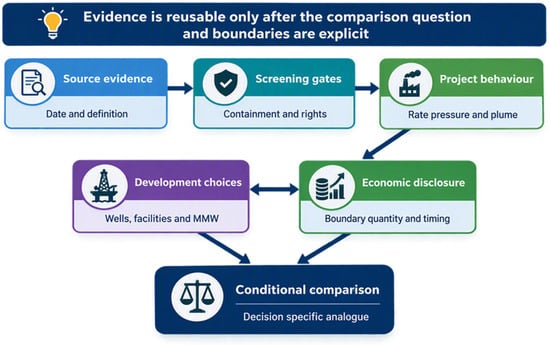
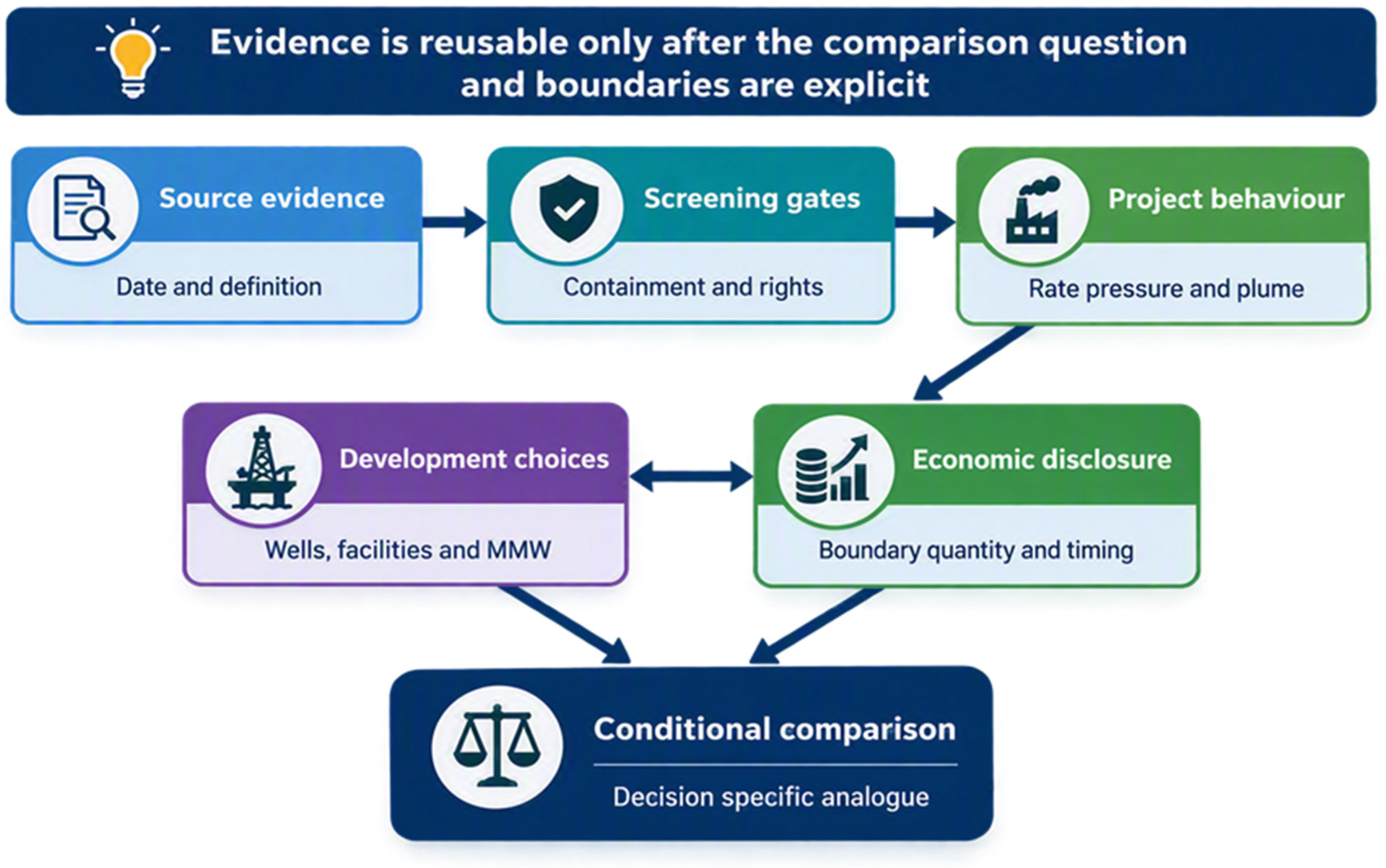
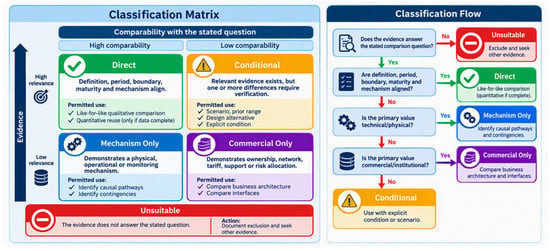
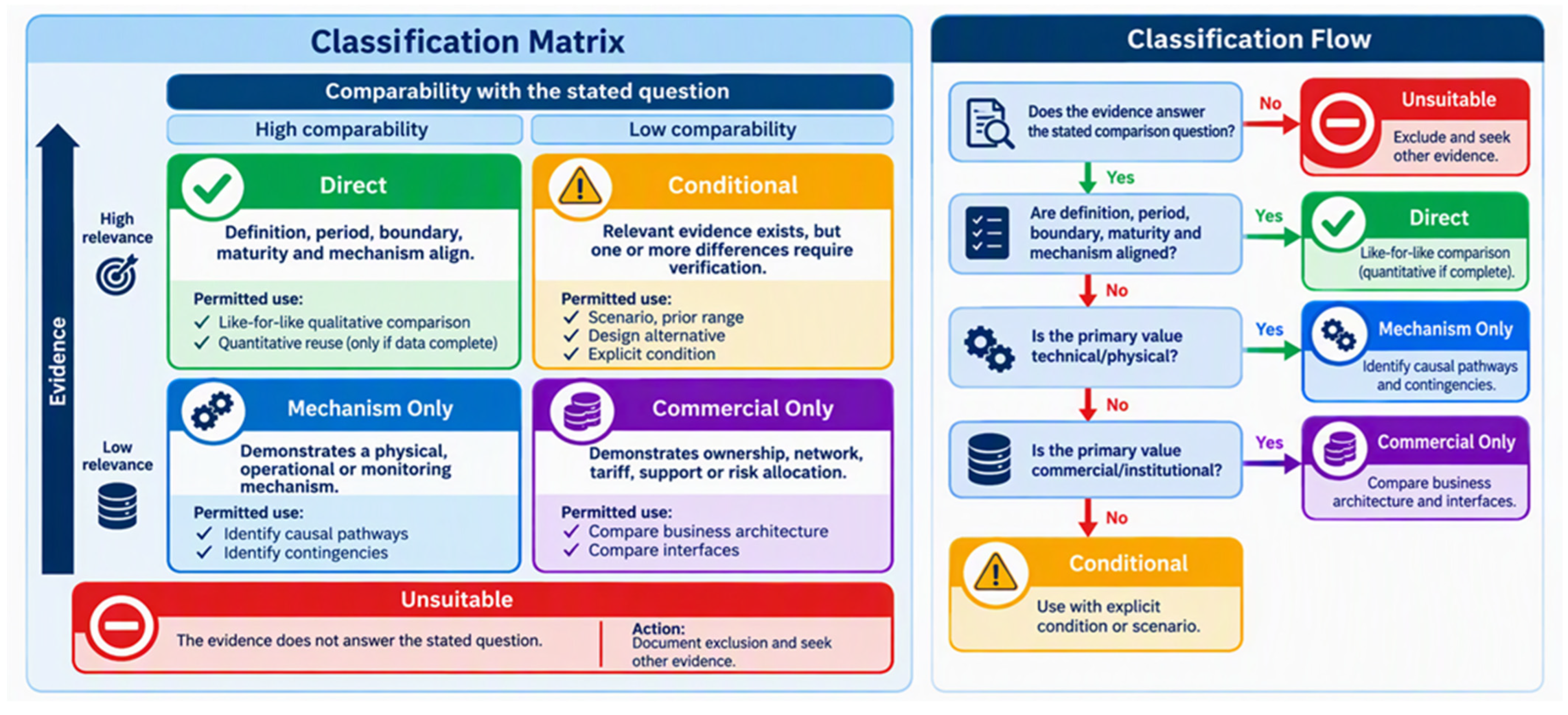
The outcome of the assessment is a five-class decision system, as illustrated in Figure 1. In Table 3 and Figure 2, directly comparable evidence aligns the variables, boundaries, dates, and purpose. Conditionally comparable evidence may be used following explicit adjustment or candidate-specific validation. Mechanism-only evidence informs the physical or monitoring process but not the economic magnitude. Commercial-only evidence informs the ownership, contracting, or funding but not the reservoir performance. Unsuitable evidence fails the criteria for a particular decision. The classification is qualitative and purpose-specific: the same project may belong to different classes for different purposes.
Figure 1.
Applied evidence-to-comparison framework.
Table 3.
Qualitative classes used to determine whether project evidence can support a specified comparison.
Figure 2.
Framework for classifying geological CO2 storage evidence.
3. Comparative Project Evidence
3.1. Selected Worldwide Project Landscape
The final set of cases was selected to represent a range of project characteristics across several dimensions. These include different storage settings (saline sandstone formations, depleted oil and gas reservoirs, and reactive basalt formations), project locations (onshore and offshore developments), and project configurations (integrated industrial projects, third-party transport and storage networks, and research or demonstration projects). The information about status and quantity basis is taken from dated references and is presented in Table 4. It is not a synchronous operating census. Design capacity, contracted capacity, injection, mass balance, and demonstration target are evidence of independent classes.
Table 4.
Selected geological CO2 storage projects and definition-aware parameters.
The sample is intentionally chosen to emphasize projects with technical or regulatory accessible data. This causes evidence selection bias: matured projects and publicly supported demonstrations are easier to examine than commercial projects with restricted information. Presence in Table 4 is associated with evidence availability and archetype representation rather than distribution of a technology in a particular geographical area. Absence in the table does not mean that the country does not have any storage activity.
3.2. Applied Project Comparability
In Table 5, the framework is applied to all nineteen projects. The table does not define the best project among them. For each project, the table gives a principal module where the project gives valuable information and a condition that prevents wholesale transfer. This makes it possible to check analogue selection: a reviewer can disagree with the classification and find the specific evidence that should change it.
Table 5.
Applied comparability of the selected projects. Classification refers to the principal use in this review.
No two cases are comparable in all domains. Even the two Illinois projects that have the same formation and location differ in purpose, period of operation and quantity basis. Therefore, the strongest comparison can be performed only module by module. Saline projects give information on pressure and plume behavior under similar geology; depleted-field projects inform reuse and pressure evolution; network projects can inform capacity booking and interface risks; and research projects can inform detection limits of monitoring and closing evidence.
3.3. Cross-Project Technical Mechanisms
The pressure behavior gives a clear link between subsurface behavior and development economics. The Snøhvit project shows that pressure response requires a different geological interval if behavior of pressure deviates from expectations [22,23]. The In Salah project informs why deformation, pressure, and faults require geomechanics analysis [30,31]. These projects do not provide generic pressure-cost multipliers. They indicate contingencies that need testing at another site: lower rate, different completion, more volume, brine management or redesign of the injection system.
Near-well injectivity and regional pressure accumulation have to be distinguished. Additional or enhanced injectors will decrease near-well pressure drop for a given injection rate, but increasing the number of wells in the same pressure-limited connected volume may not address regional pressure build-up [14]. The economic implications depend on the mechanism. Additional injectors will change drilling and completion requirements; a new interval will affect appraisal and well design; brine production will increase the number of wells, handling, treatment, and disposal; a reduced commitment will affect infrastructure usage and revenue risk.
The monitoring projects represent another type of evidence. Aquistore, Otway, Tomakomai, and Ketzin illustrate how baseline data, seismic imaging, pressure data, well data, and post-injection monitoring data add to the interpretation [47,48,49,50,51]. Their significance is not that all commercial facilities need to duplicate the same effort. They serve to show that monitoring design depends on the signal expected, geological setting, accessibility, pathway model, and decision threshold. Lack of detected leakage can only be interpreted in the context of monitoring coverage and performance.
Storage mechanisms are a clear comparability barrier if they change the physical service. Dissolved phase injection in reactive basalt by Carbfix2 is an example; it changes the conditioning, water consumption, injection process, and expected trapping mechanism [46]. It is an important case for mineralization and monitoring studies, but not as an analogue for free-phase injection in saline sandstone. Projects based on depleted fields require special attention to pressure management and depletion, thermal effects, legacy wells and infrastructure conditions.
The commercial maturity is an important factor affecting the evidence base. Northern Lights has demonstrated first storage and achieved a fully booked first-phase capacity, but reaching an initial milestone is not the same as having years of operational experience [24]. Porthos is currently under construction, and its operation is expected to start in the second half of 2027 at the earliest [32]. These are valuable examples for networks and reuse facility designs, but the design capacity should not be used as observed reservoir deliverability.
3.4. Canada and United States Benchmark
Canada and the United States present a meaningful targeted comparison as shown in Table 6. They share similar features such as industrial saline storage projects, publicly available technical documents, and mature oil and gas regulatory systems, while responsibility and financing frameworks are different. Comparison is not a ranking between two countries; it is the identification of issues where federal, provincial/state, and project-specific data and analysis are needed.
The Illinois projects highlight the differences between a finite research effort and a commercial industrial project in the same regional formation [18,19]. Red Trail is a project operating under North Dakota primacy, while federal Class VI regulations provide the reference for well construction, operations, financial accountability, post-injection management, and site closure [20,48,49,50]. The permit and primacy jurisdiction govern this operation. A statement that the project is in the United States does not provide a uniform liability outcome.
Quest combines capture, pipeline, and saline storage and has exceptionally well-documented public outreach [21,22,23]. Aquistore offers deep saline storage monitoring information in Saskatchewan, but it is run as a research project [24,25]. Alberta’s site closure and post-closure stewardship planning process might provide a possible way forward to provincial liability if all the required conditions are met [52]. This contrasts with the operator post-injection management and release upon director approval of non-endangerment and site closure within the federal Class VI approach. Both systems must not be equated to any preconceived monitoring period.
Table 6.
Focused qualitative comparison of Canadian and United States storage evidence [53,54,55,56,57].
4. Qualitative Techno-Economic Comparison
4.1. Storage-Only Boundary and Evidence Requirements
The storage-only economic evaluation starts with the asset boundary, the ownership boundary, the quantity boundary, and the time boundary. Activities contributing to storage may include screening, appraising, injectors and observation wells, storage-side compression or pumping, metering, integrity management, monitoring, site closure, corrective actions, and post-injection management. Common pipelines, terminals, ships, platforms, and utilities have to be allocated. The physical storage service can start at custody transfer, but the expenditures on storage start earlier and may extend much beyond the end of injection.
The quantity denominator is just as important even if no unit cost is calculated. Contractually accepted, metered injection, reported capture, and stored mass can vary because of stream specifications, outages, boundaries of the measurement, and timing of verification. Thus, tariff per accepted tonne of CO2 is not necessarily comparable with cost per injected tonne or with cost of a full chain per tonne captured. Project announcements linking capital expenditure to capacity do not show utilization.
Six fields have been used to evaluate economic evidence: the object reported; the assets included; the date and currency of the report; the maturity of the project; the associated quantity basis; and the treatment of site closure or other long-term responsibilities. Where one of the fields has not been provided, the data were kept to show the architecture or financing of the project. This analysis intentionally does not escalate, convert currency, divide, or calculate any unit cost by the author.
4.2. Project Economic Evidence
Table 7 shows the economic significance of selected disclosures. The table contains monetary observations only where they provide boundary information. It does not sort projects on the basis of cost. The Quest project offers a unique publicly disclosed allocation revealing that the storage was a relatively minor part of the original integrated capital structure, though the data is project- and date-specific [28]. Porthos reveals an infrastructure investment for a shared transport and storage service and separate European support [31]. The Northern Lights service project reports significant Norwegian support for phase 1 and European support for phase 2, but its service covers ships, terminal, pipeline, and offshore storage [29].
Table 7.
Qualitative economic evidence from selected projects. No values are normalized or converted.
The comparisons reveal another issue: the difference between public support and physical cost. Public funding reduced the exposure of private funding to the risk of labor, equipment, energy, wells, monitoring, and closure costs incurred by the Quest project, but it did not eliminate them [23]. Customer support under the Dutch framework represents the commercial feasibility of the entire chain of capture, transport and storage, while the infrastructure grant represents common infrastructure [31,32]. The observations have implications for bankability and risk allocation, but not storage cost evaluation.
Moomba presents yet another challenge. Geoscience Australia reports an operator’s cost claim below US$30 per tonne while describing a project covering operations including separation, capture, dehydration, compression, transport, and injection [39]. This disclosure is valuable evidence of the integrated project proposition, but it cannot be used as a subsurface storage-only benchmark. This is also true for the Gorgon project, which involves an injection system within a large-scale LNG development project [37,38,39].
4.3. Development and Commercial Architectures
The cases highlight four storage architectures. The integrated source-to-storage projects such as the Quest, Gorgon, Moomba, and Illinois industrial projects integrate the operations of capture, transport, and injection into one industrial project. The integration reduces interface uncertainty, but in published sources it often obscures the cost of storage and may tie the availability of storage to one source facility.
The field-linked storage projects at Sleipner and Snøhvit have a long operating history, but remain linked to offshore facilities and source conditions. They offer good technical insight, but not necessarily a third-party storage operation. Research and demonstration projects form the third architecture of projects, whose primary value is the research outcome. Their monitoring intensity, injection scheduling, redundancy and cost reflect their experimental nature.
Network projects like Northern Lights and Porthos give us a fourth architecture. In network projects, there is separation between emitters and a transport and storage service that shares its capacity. There is also capacity booking, custody transfer, specification, ship/pipeline interface, expansion, and distribution of interruption risk [29,31,32]. High design capacity does not mean high utilization. If emitters come late or deliver intermittently, shared resources can be available, but their utilization will be low. On the other hand, full-capacity utilization does not mean injection. Thus, network economics require both reservoir deliverability and customers’ ramp-up.
The architectures are not stages in a maturity process. Each architecture addresses a specific coordination problem. The integration architecture internalizes interfaces but may disguise the economics of components. Network architecture enhances access and diversification but generates contracts and utilization requirements. Research site architecture offers high-value proof, but no cost baseline for commercial cases. An analogy would have to match the question with the right architecture.
4.4. From Screening Outcome to Economic Consequence
The proper techno-economic analysis needs to consider the economic implications of engineering decisions rather than project names. Limited injectivity might lead to changes in completion design, drilling pattern, or committed flow rates. Pressure limitations in the region will call for a new depth, wider development, the production of brine, or reduced flowrates. Existing wells might need acquisition, diagnostics, remediation, conversion, monitoring and abandonment. Offshore access will influence intervention and monitoring logistics. Each mechanism influences a particular activity and timing.
The monitoring costs need to depend on the monitoring and decision objectives. Surveys done for mapping plume migration, the system for detecting the leakage path, and the monitoring program for providing closure assurance will have different monitoring frequencies and coverage. Research programs indicate methods that might be useful in commercial design, which should be risk-based and location-specific. Similarly, stewardship cannot be represented by adding one generic percentage to the capital cost. It includes activities, instruments, and responses that happen at different times and conditions.
Uncertainty also needs to stay linked to this set of mechanisms. The downside scenario is not a higher cost but a logical physical and economic scenario, such as limited sustainable injection leading to more wells and late acceptance by the customers, or slow pressure stabilization affecting monitoring time and assurance time. Future quantitative analysis can only evaluate such scenarios after identifying underlying decisions, probabilities, and contractual consequences.
5. Stewardship and Long-Term Responsibility
5.1. Stewardship as an Evidence and Funding Sequence
The evidence gathering starts before the injection. Baseline conditions, definitions of the area of review or storage complex, monitoring plans, corrective action plans, financial responsibility, and closure criteria will define what evidence needs to be gathered during the operation stage. Then comes injection, where a model is updated by metered mass, pressure, plume observations, well integrity information, and environmental monitoring. After ceasing the operation, the operator plugs or converts the wells if necessary, performs monitoring and corrective actions, and proves the conditions of closure or transfer.
Transferring responsibility does not mean transferring all liabilities at once. The legal result will differentiate responsibilities from regulatory duties, civil liability, ownership of stored CO2, pore-space rights, financial responsibility, indemnity, and government stewardship. It is thus important to analyze the statute, permit, contract, and closure decision independently. Table 8 gives the relationship between some of the projects and jurisdictional mechanisms currently in place without providing legal advice.
Table 8.
Comparison of CCS projects, closure evidence requirements, and long-term responsibility mechanisms.
A specific wording is needed for financial assurance. A trust, surety bond, letter of credit, insurance, escrow account, or self-insurance test may be used for ensuring future operations within the US Class VI program [44]. But the face amount of such instruments is not equal to the expenses of the project. Fees, collateral limitations, deposits, income, release, and closure or remediation expenses have different impacts on the economy. Stewardship contribution is also a unique approach, as funds are transferred due to the statute or agreement.
5.2. Project and Jurisdiction Comparison
The stewardship concepts described in Section 5.1 are implemented through a variety of regulatory, contractual, and project-specific mechanisms across jurisdictions. While most frameworks require monitoring, verification, closure planning, and demonstration of long-term containment, the evidentiary thresholds for closure and the nature of post-closure responsibility differ considerably. Table 8 compares selected CCS projects and regulatory frameworks, focusing on the evidence required before closure, the mechanisms available for long-term stewardship, and key cautions regarding interpretation of responsibility transfer. The comparison illustrates that stewardship and liability arrangements are highly jurisdiction-specific and should not be generalized across projects. Similar terms such as “closure,” “transfer,” “release,” or “stewardship” may have different legal and regulatory implications depending on the governing statute, permit conditions, and project agreements.
A common observation across the reviewed projects is that responsibility transfer, where available, is typically contingent on demonstrating compliance with prescribed monitoring, corrective action, and closure requirements rather than occurring automatically after a fixed period. Furthermore, the transfer of regulatory responsibility does not necessarily extinguish all potential future obligations or claims. Accordingly, project proponents and regulators should evaluate stewardship provisions within the context of the applicable legal and regulatory framework rather than relying solely on terminology or practices adopted elsewhere.
The examples presented in Table 8 demonstrate that there is no single international model for post-closure stewardship of geologically stored CO2. Instead, jurisdictions have adopted a range of approaches that reflect their legal systems, resource ownership regimes, and regulatory objectives. Although the specific mechanisms differ, all reviewed frameworks rely on the collection of technical evidence to support closure decisions and to provide confidence in the long-term containment of injected CO2. These differences reinforce the importance of distinguishing between regulatory closure, transfer of stewardship responsibilities, financial assurance requirements, and residual liabilities when comparing CCS projects across jurisdictions.
5.3. Comparative Implications for Storage Economics
US approach requires the approved post-injection plan and monitoring until non-endangerment is proven. The federal regulation has a 50-year default monitoring period, but it may be replaced by an approved alternative and earlier closure if site-specific evidence supports it [50]. Thus, fifty years is neither a universal assumption of the project nor a statutory transfer date. The associated financial responsibility must cover corrective action, plugging, post-injection care, closure, and emergency response, and must be updated as plans and cost estimations evolve [49].
The European Union Directive offers the possibility of conditional transferring after fulfilling certain technical, financial, and administrative requirements, using the minimum period of at least twenty years and a financial contribution covering at least thirty years of future monitoring after transfer, unless the competent authority agrees with earlier evidence [46]. But the thirty-year contribution basis should not be confused with a universal operator monitoring period. National implementation and permits still matter.
The Quest framework provides an alternative model of agreement, closure certification, and post-closure stewardship [52]. Northern Lights and other offshore projects use the national storage regime and project permits in Norway. Gorgon works according to the project-specific Western Australian legislation and permissions, but other projects in Australia may operate under other states or offshore regimes [37,53]. Each regime alters the time of expenditures, locked money, evidence gathering, and residual exposure. This set cannot be reliably accounted for by the use of a single closure period for every project.
In terms of the economic assessment, there are four items to keep apart: the physical work required for monitoring, closure, and correction; the amount covered by the instrument; the cost and liquidity effect of the instrument; and the non-refundable contribution supporting public stewardship. Mixing these can lead to a double-counting of obligations or a mistake of treating locked money as already spent. Comparisons of projects should include responsible party, trigger, duration, instrument, condition of release, and residual liability separately.
6. Critical Discussion
6.1. Contribution of the Applied Framework
The primary addition of the project review is not a new list of projects or a screening criterion. It is the separation of evidence into comparison classes depending on particular decisions. The project reviews that exist now describe capacity, injection, cost, and monitoring side by side. This review reveals that the definitions and boundaries of these quantities dictate whether or not they can be aggregated. The framework changes the analytical question from “which project is the most similar” to “which project will support this variable or decision under which condition”.
The application of the framework brings three results. First, none of the projects is a universal analogue. Second, the most useful analogies concern mechanisms and decisions rather than the magnitude of quantities. Third, commercial and stewardship architecture can render physical comparisons meaningless despite similar reservoirs. These findings justify the modular selection of analogues and avoid using one similarity measure that conceals fatal differences.
This approach is particularly relevant to techno-economic analyses of storage projects only. Without it, integrated project expenditures are divided by a variable that does not belong to the same boundary; design capacity is used instead of delivered injection, and financial assurance is added to the physical work it covers. The framework does not resolve uncertainty. It makes the source of uncertainty and the extra evidence clear.
6.2. Cross-Project Synthesis
For saline projects, pressure and connected volume recur as development constraints. Sleipner provides experience with long-term plume monitoring, Snøhvit provides interval and pressure contingency, In Salah provides geomechanically coupled behavior, and the Illinois and Canadian projects provide onshore industrial and research counterparts. The integrated lesson is not a common rate but the requirement to link rate commitments to completion-scale testing, pressure response, operating availability, and contingency options.
For depleted-field projects, the prospect of well, platform, and pipeline reuse is accompanied by integrity issues, pressure issues, thermal issues, access issues, and ownership issues. Porthos, Ravenna, Greensand, and Moomba provide examples at different stages and with different commercial models. Reuse should thus be considered a screened development option, not necessarily an economic one. The appropriate basis for comparison is therefore acquisition, inspection, conversion, remediation, surveillance, and ultimately abandonment.
For projects that rely heavily on monitoring, the transferable insight is a design principle: observations must be judged in terms of a detection objective and a decision process. While commercial projects need not feature research intensity, sparse monitoring does not justify closure conclusions because there is no anomaly in the data. For network projects, the transferable insight is another design principle: reservoir capacity, booked capacity, and throughput are three different things. The utilization of networks is as much a function of customer projects and interfaces as storage.
The economic information is asymmetric. Commercial announcements announce investment and provide more frequent support than component costs attributable to storage. Technical publications publish reservoir behavior more often than allocation. Regulatory sources publish responsibilities more frequently than their project funding schedule. A robust numerical dataset will therefore require reconciliation between engineering, financial, contractual, and legal documents rather than extraction from project databases.
6.3. Limitations and Evidence Priorities
This is an integrative review of selected cases, not a systematic inventory. Purposive sampling is employed, and the availability of sources favors mature, publicly supported, and research-oriented projects. Selection criteria and source list are included, but the initial manuscript search cannot be retraced as an inventory process. Synthesis was undertaken by a single author without replication. These limitations constrain claims about prevalence, relationships, and representativeness.
The status of projects is time-critical. Table 4 applies descriptions dated by sources and cuts off evidence after 12 September 2026. Operator statements can create milestones and design intention but may not demonstrate sustained usage, independent verification, or future schedule. The example of Porthos proves the necessity of updating status, since its earlier projection for 2026 changed to the second half of 2027 at best [32]. Such control of dates is required every time this review is updated.
Most public economic reports are incomplete and heterogeneous. In this review, we do not calculate or estimate storage costs, do not normalize currencies, and do not derive unit costs from combined investments. Moreover, we do not test the suggested framework prospectively in terms of investment decisions. Future studies need to make available the field-level dataset that will include exact source references, observation period, original units, transformations, boundaries of ownership, cost maturity, well availability, and assumptions on closure.
Also, legal summaries here serve only for comparative orientation but not for legal advice. Legal statutes, regulations, permits, project agreements, civil liabilities, pore-space rights, and indemnities can change and can exist in combination. A project-specific legal study is needed in order to determine responsibilities or financial obligations. In the same way, monitoring performance and containment conclusions should be based on a technical review of detection limits, alternative models, and permit criteria.
A further research step is not the creation of an even bigger unfiltered project list. It is the creation of a more appropriate dataset. Prioritized fields include completion-scale injectivity and pressure, history of active wells, interruption and ramp-up history, confirmed mass of injected fluid, storage-related expenditures, sharing of common facilities, monitoring objectives and performance, assurance instruments, and closure/transfer decision-making. After having such fields available for a sufficient number of comparable projects, quantitative analysis is possible without mixing economic objects.
7. Conclusions
The comparability of geological CO2 storage projects is limited to the specific question asked. The nineteen selected cases prove that capacity design, contracted services, observed injection, finite mass of the campaign, and cumulative storage represent different evidence. Pooling them into a single performance distribution or using author-derived annual rates is impossible without aligned operating records.
Screening and economic assessment are limited by development choices. Pressure response, injectivity, connected volume, well status, monitoring detection, reuse of infrastructure, and offshore accessibility impact the steps needed to achieve and confirm the storage. Project expertise reveals those mechanisms, but a site-specific assessment is necessary to translate their effect size.
In addition, the economics of storage involve boundaries. Integrated CCS cost, transport and storage infrastructure, tariffs, community acceptance, financing, and financial assurance refer to distinct entities. The selected projects do not provide a standardized public set of numbers to compare storage costs numerically. The valid application is qualitative—finding out what is included, who owns what, maturity, quantification basis, commercial interactions, and gaps in information.
Also, stewardship is a series of funded responsibilities rather than a single generic post-injection period. Examples from US Class VI, Alberta, the EU, Norway, and Australia are distinct in monitoring, closing down, financial liability, transfer, and residual liability. Those responsibilities need to be assigned to relevant organizations and permits for comparative economic assessment.
Therefore, the framework applied here classifies the evidence from each project as direct, conditional, mechanism, commercial, or unsuitable for a particular choice. The value of this approach lies in preserving the lessons learned without suggesting their general applicability. Future techno-economic analyses should start with a comparability analysis first.
Author Contributions
Conceptualization, M.H. and E.S.; Methodology, M.H. and E.S.; Validation, M.H. and E.S.; Formal analysis, M.H.; Investigation, M.H. and E.S.; Resources, M.H.; Data curation, M.H.; Writing—original draft, M.H.; Writing—review & editing, M.H. and E.S.; Supervision, E.S.; Project administration, M.H. and E.S. All authors have read and agreed to the published version of the manuscript.
Funding
This research received no external funding.
Data Availability Statement
The original contributions presented in this study are included in the article. Further inquiries can be directed to the corresponding author.
Conflicts of Interest
The authors declare no conflict of interest.
Appendix A. Project Evidence Ledger
The ledger shows the primary sources of evidence for each project case and the limitations that were considered in interpretation. It is not a replacement for the actual permit, report or study conducted.
Table A1.
Project-level source and evidence audit.
References
- Wu, J.; Li, Q.; Li, Q.; Wang, F.; Cheng, Y.; Yan, C. Design and Optimization of Bottom-Hole Temperature–Pressure Combinations in Gas Production from Gas Hydrates via Carbon Dioxide Replacement Strategy. Energies 2026, 19, 3536. [Google Scholar] [CrossRef] [Scilit]
- Li, Q.; Zhang, G.; Cao, H.; Li, Q.; Wang, F.; Wu, J.; Chen, W.; Ma, W. Multiphysics Modeling and Microscopic Analysis of Water-Based Heat Extraction from Hot Dry Rock Reservoirs. Energies 2026, 19, 4513. [Google Scholar] [CrossRef] [Scilit]
- Hamed, M.; Shirif, E. Numerical Reservoir Simulation of CO2 Storage in Saline Aquifers: Assessment of Trapping Mechanisms, Geochemistry, O2 Impurities and Brine Salinity. Processes 2026, 14, 316. [Google Scholar] [CrossRef] [Scilit]
- Hamed, M.; Shirif, E. Sustainable CO2 Storage Assessment in Saline Aquifers Using a Hybrid ANN and Numerical Simulation Model Across Different Trapping Mechanisms. Sustainability 2025, 17, 2904. [Google Scholar] [CrossRef] [Scilit]
- Li, Q.; Wang, Y.; Owusu, A.B. A modified Ester-branched thickener for rheology and wettability during CO2 fracturing for improved fracturing property. Environ. Sci. Pollut. Res. Int. 2019, 20, 20787–20797. [Google Scholar] [CrossRef] [Scilit] [PubMed]
- IPCC. IPCC Special Report on Carbon Dioxide Capture and Storage; Carbon Dioxide Capture and Storage—IPCC; Cambridge University Press: Cambridge, UK, 2005. [Google Scholar]
- Bachu, S. CO2 storage in geological media: Role, means, status and barriers to deployment. Prog. Energy Combust. Sci. 2008, 34, 254–273. [Google Scholar] [CrossRef] [Scilit]
- Benson, S.M.; Cole, D.R. CO2 sequestration in deep sedimentary formations. Elements 2008, 4, 325–331. [Google Scholar] [CrossRef] [Scilit]
- Ringrose, P. How to Store CO2 Underground: Insights from Early-Mover CCS Projects; Springer: Cham, Switzerland, 2020. [Google Scholar] [CrossRef] [Scilit]
- Shokir, E.M.E.-M.; Hamed, M.M.B.; Ibrahim, A.E.-S.B.; Mahgoub, I. Gas Lift Optimization Using Artificial Neural Network and Integrated Production Modeling. Energy Fuels 2017, 31, 9302–9307. [Google Scholar] [CrossRef] [Scilit]
- Bahaa, M.; Shokir, E.; Mahgoub, I. Soft Computation Application: Utilizing Artificial Neural Network to Predict the Fluid Rate and Bottom Hole Flowing Pressure for Gas-lifted Oil Wells. In Proceedings of the Abu Dhabi International Petroleum Exhibition & Conference, Abu Dhabi, United Arab Emirates, 12–15 November 2018. [Google Scholar] [CrossRef] [Scilit]
- Whittemore, R.; Knafl, K. The integrative review: Updated methodology. J. Adv. Nurs. 2005, 52, 546–553. [Google Scholar] [CrossRef] [Scilit] [PubMed]
- Snyder, H. Literature review as a research methodology: An overview and guidelines. J. Bus. Res. 2019, 104, 333–339. [Google Scholar] [CrossRef] [Scilit]
- U.S. DOE/NETL. Best Practices: Site Screening, Site Selection, and Site Characterization for Geologic Storage Projects. 2017. Available online: https://www.netl.doe.gov/sites/default/files/2018-10/BPM-SiteScreening.pdf (accessed on 12 September 2026).
- ISO 27914:2026; Carbon Dioxide Capture, Transportation and Storage-Geological Storage; Edition 2; Public scope consulted. International Organization for Standardization: Geneva, Switzerland, 2026. Available online: https://www.iso.org/standard/84578.html (accessed on 12 September 2026).
- Birkholzer, J.T.; Zhou, Q.; Tsang, C.F. Large-scale impact of CO2 storage in deep saline aquifers: A sensitivity study on pressure response in stratified systems. Int. J. Greenh. Gas Control 2009, 3, 181–194. [Google Scholar] [CrossRef] [Scilit]
- Wei, N.; Li, X.; Jiao, Z.; Stauffer, P.H.; Liu, S.; Ellett, K.; Middleton, R.S. A hierarchical framework for CO2 storage capacity in deep saline aquifer formations. Front Earth Sci. 2022, 9, 777323. [Google Scholar] [CrossRef] [Scilit]
- Eccles, J.K.; Pratson, L.; Newell, R.G.; Jackson, R.B. Physical and economic potential of geological CO2 storage in saline aquifers. Environ. Sci. Technol. 2009, 43, 1962–1969. [Google Scholar] [CrossRef] [Scilit] [PubMed]
- Eccles, J.K.; Pratson, L.; Newell, R.G.; Jackson, R.B. The impact of geologic variability on capacity and cost estimates for storing CO2 in deep-saline aquifers. Energy Econ. 2012, 34, 1569–1579. [Google Scholar] [CrossRef] [Scilit]
- US DOE/NETL. Illinois Basin-Decatur Project, Mt. Simon Sandstone, Decatur, Illinois. Available online: https://www.netl.doe.gov/node/5914 (accessed on 12 September 2026).
- U.S. Department of Energy. Illinois Industrial Carbon Capture and Storage Project. Available online: https://www.energy.gov/sites/prod/files/2017/10/f38/mcdonald_bioeconomy_2017.pdf (accessed on 12 September 2026).
- North Dakota Industrial Commission. Statement on First Carbon Dioxide Injection Under State Primacy. 18 July 2022. Available online: https://www.ndic.nd.gov/news/industrial-commission-statement-first-carbon-dioxide-injection-under-state-primacy (accessed on 12 September 2026).
- Government of Alberta. Quest Carbon Capture and Storage Project Annual Report 2024. 2025. Available online: https://open.alberta.ca/publications/quest-carbon-capture-and-storage-project-annual-report-2024 (accessed on 12 September 2026).
- Shell Canada. Quest Carbon Capture and Storage. Updated 13 March 2026. Available online: https://www.shell.ca/en_ca/about-us/projects-and-sites/quest-carbon-capture-and-storage-project.html (accessed on 12 September 2026).
- Natural Resources Canada. Shell Canada Energy Quest Project. Updated 27 May 2025. Available online: https://natural-resources.canada.ca/funding-partnerships/shell-canada-energy-quest-project (accessed on 12 September 2026).
- Shell Canada. Quest Project Cost Presentation to the Senate of Canada, 2016. Available online: https://sencanada.ca/content/sen/committee/421/ENEV/Briefs/ShellCanada_e.pdf (accessed on 12 September 2026).
- Rostron, B.; White, D.; Hawkes, C.; Chalaturnyk, R. Characterization of the Aquistore CO2 project storage site, Saskatchewan, Canada. Energy Procedia 2014, 63, 2977–2984. [Google Scholar] [CrossRef] [Scilit]
- Jacob, N.; Craven, J.A.; White, D.J.; Savard, M.M.; Rivard, C.; Kao, H.; Parsons, M.B.; Galloway, J.M. Public Presentations, Environmental Geoscience Program (EGP), Current Status of Research Projects. In Geological Survey of Canada, Scientific Presentation; Natural Resources Canada: Ottawa, ON, Canada, 2017; Volume 49, p. 115. [Google Scholar] [CrossRef] [Scilit] [PubMed]
- Norwegian Offshore Directorate. Carbon Capture and Storage. Updated 24 October 2024. Available online: https://www.norskpetroleum.no/en/environment-and-technology/carbon-capture-and-storage/ (accessed on 12 September 2026).
- Equinor. Snøhvit, Melkøya and Hammerfest LNG. Available online: https://www.equinor.com/energy/snohvit (accessed on 12 September 2026).
- Norwegian Offshore Directorate. Storage Capacity-Snøhvit Area. Available online: https://www.sodir.no/en/whats-new/publications/CO2-atlases/CO2-atlas-for-the-norwegian-continental-shelf/6-the-barents-sea/6.2-storage-options-of-the-barents-sea/6.2.1-saline-aquifers/storage-capacity-snohvit-area/ (accessed on 12 September 2026).
- Equinor. First CO2 Volumes Stored at Northern Lights. 25 August 2025. Available online: https://www.equinor.com/news/20250825-first-CO2-volumes-stored-at-northern-lights (accessed on 12 September 2026).
- Equinor. The Northern Lights Project. Available online: https://www.equinor.com/energy/northern-lights (accessed on 12 September 2026).
- Porthos. First CO2 Storage Project in the Netherlands is Launched. 18 October 2023. Available online: https://www.porthosCO2.nl/en/first-CO2-storage-project-in-the-netherlands-is-launched/ (accessed on 12 September 2026).
- Porthos. Schedule for the Porthos CO2 Transport and Storage Project Revised. 16 April 2026. Available online: https://www.porthosCO2.nl/en/schedule-for-the-porthos-co%E2%82%82-transport-and-storage-project-revised/ (accessed on 12 September 2026).
- Eni; Snam. Eni and Snam Launch Ravenna CCS, Italy’s First Carbon Capture and Storage Project. 3 September 2024. Available online: https://www.eni.com/en-IT/media/press-release/2024/09/eni-snam-launch-ravenna-css-italy-s-first-carbon-capture-storage-project.html (accessed on 12 September 2026).
- INEOS. INEOS-led Greensand to Become the First Full-Scale CO2 Storage Facility in the EU. 10 December 2024. Available online: https://www.ineos.com/news/shared-news/ineos-led-greensand-to-become-the-first-full-scale-CO2-storage-facility-in-eu-to-help-mitigate-climate-change/ (accessed on 12 September 2026).
- White, J.A.; Chiaramonte, L.; Ezzedine, S.; Foxall, W.; Hao, Y.; Ramirez, A.; McNab, W. Geomechanical behavior of the reservoir and caprock system at the In Salah CO2 storage project. Proc. Natl. Acad. Sci. USA 2014, 111, 8747–8752. [Google Scholar] [CrossRef] [Scilit] [PubMed]
- Ringrose, P.; Mathieson, A.; Wright, I.; Selama, F.; Hansen, O.; Bissell, R.; Saoula, N.; Midgley, J. The In Salah CO2 storage project: Lessons learned and knowledge transfer. Energy Procedia 2013, 37, 6226–6236. [Google Scholar] [CrossRef] [Scilit]
- Government of Western Australia. Gorgon Carbon Dioxide Injection Project. Updated 6 March 2026. Available online: https://www.wa.gov.au/organisation/department-of-mines-petroleum-and-exploration/gorgon-carbon-dioxide-injection-project (accessed on 12 September 2026).
- Parliament of Western Australia. Economics and Industry Standing Committee Evidence. 10 October 2025. Available online: https://www.parliament.wa.gov.au/Parliament/commit.nsf/%28Evidence%2BLookup%2Bby%2BCom%2BID%29/B7C05D58664309A448258D3B00233648/%24file/149NoCover_Redacted.pdf (accessed on 12 September 2026).
- Geoscience Australia. Carbon Capture and Storage. Australian Energy Commodity Resources 2025. Available online: https://www.ga.gov.au/aecr2025/carbon-capture-and-storage (accessed on 12 September 2026).
- Santos. Moomba Carbon Capture and Storage. Available online: https://www.santos.com/moombaccs/ (accessed on 12 September 2026).
- Jenkins, C.; Barraclough, P.; Correa, J.; Dance, T.; Dodds, K.; Ennis-King, J.; Freifeld, B.; Glubokovskikh, S.; Green, C.; Gunning, J.; et al. Field tests of geological storage of CO2 at the Otway International Test Centre, Australia: Trapping and monitoring the migrating plumes. Geoenergy 2024, 2, geoenergy2023-035. [Google Scholar] [CrossRef] [Scilit]
- CO2CRC. CO2CRC Achieves Milestone with 100,000th Tonne of CO2 Injected at Otway International Test Centre. 13 December 2024. Available online: https://CO2crc.com.au/CO2crc-achieves-milestone-with-100000th-tonne-of-CO2-injected-at-otway-international-test-centre/ (accessed on 12 September 2026).
- CO2CRC. Otway International Test Centre. Available online: https://CO2crc.com.au/otway-international-test-centre/ (accessed on 12 September 2026).
- Japan CCS Co. Report of Tomakomai CCS Demonstration Project at 300 Thousand Tonnes Cumulative Injection: Summary Report 2020. Available online: https://www.japanccs.com/en/library_category/report/ (accessed on 12 September 2026).
- GFZ German Research Centre for Geosciences. Field Experiment on Brine Injection in Geological CO2 Storage. 7 January 2016. Available online: https://www.gfz.de/en/press/news/details/field-experiment-on-brine-injection-in-geological-CO2-storage (accessed on 12 September 2026).
- Carbfix. Carbfix2. Available online: https://www.carbfix.com/carbfix2 (accessed on 12 September 2026).
- Nguyen, M.C.; Zhang, Y.; Li, J.; Li, X.; Bai, B.; Wu, H.; Wei, N.; Stauffer, P.H. A Geostatistical Study Support of CO2 Storage in Deep Saline Aquifers of the Shenhua CCS Project, Ordos Basin, China. Energy Procedia 2017, 114, 5826–5835. [Google Scholar] [CrossRef] [Scilit]
- U.S. Environmental Protection Agency. Class VI Wells Used for Geologic Sequestration of Carbon Dioxide. Available online: https://www.epa.gov/uic/class-vi-wells-used-geologic-sequestration-carbon-dioxide (accessed on 12 September 2026).
- Electronic Code of Federal Regulations. 40 CFR 146.85 Financial Responsibility. Version Current 9 September 2026. Available online: https://www.ecfr.gov/current/title-40/chapter-I/subchapter-D/part-146/subpart-H/section-146.85 (accessed on 12 September 2026).
- Electronic Code of Federal Regulations. 40 CFR 146.93 Post-Injection Site Care and Site Closure. Version Current 10 September 2026. Available online: https://www.ecfr.gov/current/title-40/chapter-I/subchapter-D/part-146/subpart-H/section-146.93 (accessed on 12 September 2026).
- European Parliament and Council. Directive 2009/31/EC on the Geological Storage of Carbon Dioxide, Articles 17–20. Available online: https://eur-lex.europa.eu/eli/dir/2009/31/oj/eng (accessed on 12 September 2026).
- Government of Alberta. Quest Closure Plan and Post-Closure Stewardship Fund framework. 2011. Available online: https://open.alberta.ca/dataset/d5694c02-019d-4650-8b09-3b5a9afff181/resource/11e65264-64d5-4a16-9944-7f9b99488625/download/quest-closure-plan.pdf (accessed on 12 September 2026).
- 56. Australian Government Department of Climate Change, Energy, the Environment and Water. Offshore Carbon Capture and Sequestration. Updated 18 September 2025. Available online: https://www.dcceew.gov.au/environment/marine/sea-dumping/dispose-CO2 (accessed on 12 September 2026).
- Hamed, M.; Shirif, E. Advances in CO2 Injection for Enhanced Hydrocarbon Recovery: Reservoir Applications, Mechanisms, Mobility Control Technologies, and Challenges. Energies 2026, 19, 1086. [Google Scholar] [CrossRef] [Scilit]

Disclaimer/Publisher’s Note: The statements, opinions and data contained in all publications are solely those of the individual author(s) and contributor(s) and not of MDPI and/or the editor(s). MDPI and/or the editor(s) disclaim responsibility for any injury to people or property resulting from any ideas, methods, instructions or products referred to in the content. |
© 2026 by the authors. Licensee MDPI, Basel, Switzerland. This article is an open access article distributed under the terms and conditions of the Creative Commons Attribution (CC BY) license.