


Abstract
This study presents experimental adsorption–desorption data of CH4 and CO2 on shale samples from the Cesar-Ranchería Basin, Colombia, a region with limited characterization of gas–rock interactions under reservoir-relevant conditions. The work addresses the behavior of early-mature shales, contributing to the understanding of gas retention mechanisms in tropical basins. Adsorption–desorption isotherms were obtained using a high-pressure manometric system at 50 °C and 80 °C, with pressures up to 3 MPa, and were fitted using the Langmuir model. The results show a consistently higher adsorption capacity for CO2 compared to CH4 across all conditions, along with a clear decrease in adsorption capacity with increasing temperature, confirming the exothermic nature of the process. No hysteresis was observed, indicating fully reversible adsorption dominated by physisorption mechanisms. The integration of adsorption data with mineralogical, BET surface area, and geochemical characterization provides insight into the factors controlling gas retention in early-mature shales. The results highlight the combined influence of surface area, organic matter, and clay mineralogy on adsorption performance, and demonstrate that CO2 exhibits a stronger affinity for the shale matrix under all tested conditions. These findings contribute experimental evidence of gas adsorption behavior in an underexplored basin and provide a reference framework for evaluating gas storage potential in similar geological settings.
1. Introduction
The increasing global demand for cleaner energy, coupled with the urgent need to mitigate greenhouse gas emissions, has positioned unconventional gas resources and geological carbon storage as relevant components of the current energy transition [1]. Methane (CH4) is widely recognized as a transitional fuel due to its lower carbon intensity, while carbon dioxide (CO2) has become a primary target for geological sequestration strategies aimed at reducing atmospheric emissions [2,3,4]. In this context, understanding gas–rock interactions—particularly adsorption and desorption processes—is essential for reliable gas-in-place (GIP) estimations, enhanced gas recovery (EGR) design, and long-term CO2 storage performance [5,6,7].
In shale systems, gas is predominantly stored through adsorption onto organic matter (kerogen) and fine-grained mineral surfaces within nano- and mesoporous structures [8,9]. This storage mechanism is controlled by multiple factors, including total organic carbon (TOC), specific surface area, mineral composition, and thermal maturity [10,11,12]. While these parameters have been extensively studied in well-established shale plays such as the Barnett, Marcellus, Longmaxi, and Sichuan formations [13,14,15,16], most available data correspond to mature to overmature systems, where microporosity and adsorption capacity are typically well developed. Previous studies have shown that thermal maturity, organic matter type, and pore structure exert a strong control on methane storage capacity in organic-rich shales [17].
However, significantly less attention has been given to early-mature shales, particularly in tropical foreland basins such as the Cesar-Ranchería Basin (Colombia). Despite its recognized hydrocarbon potential, this basin remains poorly characterized in terms of gas–rock interactions. To date, experimental adsorption–desorption data for CH4 and CO2 in these formations are scarce, limiting the understanding of gas storage mechanisms under conditions where organic matter is only partially evolved and pore systems are less developed, despite the growing recent interest in gas sorption behavior in low-maturity organic-rich source rocks [18].
Recent studies have highlighted that gas adsorption in shales is strongly influenced not only by bulk parameters such as TOC and surface area, but also by mineralogical composition, pore structure, surface chemistry and petrophysical heterogeneity [19,20,21,22]. Mechanisms such as capillary condensation, wettability, and mineral affinity have been identified as key contributors to gas retention, particularly in low-permeability systems [23,24,25,26,27]. Additionally, CO2 exhibits a consistently higher adsorption affinity than CH4 due to its greater quadrupole moment and polarizability, resulting in stronger interactions with both kerogen and mineral surfaces [28,29]. This preferential behavior forms the basis of CO2-enhanced gas recovery processes, where CO2 injection promotes methane displacement while enabling simultaneous carbon storage [30,31,32].
Experimental adsorption data are commonly interpreted using the Langmuir isotherm model, which provides physically meaningful parameters such as maximum adsorption capacity and affinity pressure [33]. Although this model has been widely applied to mature shale systems, its applicability to early-mature formations remains less explored. In such systems, characterized by Tmax values in the range of 430–435 °C, moderate TOC, and relatively limited microporosity, adsorption behavior may differ significantly from that observed in more thermally evolved shales [34,35,36]. In early-mature shales, the lower degree of organic matter transformation generally results in less-developed organic microporosity and a greater relative influence of mineral-associated adsorption sites compared to highly mature shale systems. Consequently, adsorption behavior may be controlled more strongly by mineralogical heterogeneity and mesopore accessibility than by the extensive organic nanopore networks commonly reported in overmature shales. This introduces uncertainty in predicting gas storage capacity and CO2 sequestration potential in these underexplored environments.
In this context, the present study provides an experimental evaluation of pure CH4 and CO2 adsorption–desorption behavior in shale samples from the ANH-Cañaboba1 Well in the Cesar-Ranchería Basin. Two core samples representative of early-mature organic-rich intervals were analyzed, integrating adsorption measurements obtained using a high-pressure manometric system (50 °C and 80 °C, up to 3 MPa) with detailed geochemical, mineralogical (XRD), and textural (BET) characterization.
The novelty of this work lies in the generation of original adsorption–desorption data for early-mature shales from a tropical basin, where gas storage mechanisms remain largely undocumented. In particular, the study provides insight into (i) the role of mineralogical composition and organic matter in controlling gas uptake, (ii) the comparative behavior of CO2 and CH4 under reservoir-relevant conditions, and (iii) the reversibility of adsorption processes in moderately developed pore systems.
By addressing the lack of experimental data in this type of geological setting, this study contributes to improving the understanding of gas storage mechanisms in early-mature shales and provides a valuable reference for evaluating CO2 injection strategies and unconventional gas potential in the Cesar-Ranchería Basin and similar underexplored regions.
2. Materials and Methods
In this study, two core samples (S1 and S2) were analyzed to obtain original experimental data on CH4 and CO2 adsorption–desorption behavior from the ANH-Cañaboba1 well, located in the Cesar-Ranchería Basin (CRB), northeastern Colombia. The samples were extracted at depths of 2303.8 ft (S1) and 2284.7 ft (S2), and correspond to fine-grained pelitic intervals of the Upper Cretaceous Los Cuervos Formation, an organic-rich unit associated with hydrocarbon source rocks in the region. These depths correspond to comparable stratigraphic intervals within the Los Cuervos Formation and are consistent with early-mature organic-rich shale levels previously recognized in the basin. Therefore, the results should be interpreted as representative of the analyzed early-mature shale interval rather than as a basin-wide characterization.
The Cesar-Ranchería Basin forms part of the northern Andean foreland system and is characterized by a complex tectonic evolution involving Mesozoic extensional processes followed by Andean compressional deformation [37,38,39]. Stratigraphically, the basin includes Paleozoic to Cenozoic sequences, with Upper Cretaceous and Paleogene units hosting organic-rich shales and coal-bearing intervals relevant for hydrocarbon systems [40,41,42].
Although the number of samples is limited, their selection was based on core integrity, geochemical potential, and mineralogical preservation. These samples are representative of early-mature shale intervals within the basin and provide a reliable basis for evaluating gas adsorption–desorption behavior. The combination of adsorption measurements with detailed geochemical, mineralogical, and petrophysical characterization enables a robust assessment of gas–rock interactions in a basin where such experimental data remain scarce.
2.1. Sample Characterization
2.1.1. Geochemical Analysis
Geochemical characterization was conducted at the Petroleum Geochemical Laboratory of Universidad Industrial de Santander. The following parameters were determined using Rock-Eval pyrolysis: volatile hydrocarbons (S1, mg HC/g rock), remaining hydrocarbon generative potential (S2, mg HC/g rock), carbon dioxide content (S3, mg CO2/g rock), maximum pyrolysis temperature (Tmax, °C), total organic carbon (TOC, wt%), and vitrinite reflectance (Ro, %). Derived parameters, including hydrogen index (HI, mg HC/g TOC), oxygen index (OI, mg CO2/g TOC), production index (PI = S1/(S1 + S2)), and genetic potential (PG = S1 + S2), were also calculated. The main geochemical results are summarized in Table 1.
Table 1.
Geochemical properties.
2.1.2. X-Ray Diffraction (XRD)
Mineralogical composition was determined by X-ray diffraction (XRD) using a Bruker D8 Advance diffractometer (Bruker AXS GmbH, Karlsruhe, Germany) with Cu Kα1 radiation (40 kV, 40 mA), over a 2θ range of 2–70°. The analyses were performed at the XRD Laboratory of Universidad Industrial de Santander.
This technique enabled the identification and quantification of the mineral phases present in the samples, particularly clay minerals and quartz, which play a key role in adsorption behavior. The results are presented in Table 2.
Table 2.
Mineralogical analysis.
2.1.3. BET Specific Surface Area
Specific surface area was measured using the Brunauer–Emmett–Teller (BET) method. Prior to analysis, the shale samples were reduced in size to obtain a powdered material suitable for N2 physisorption measurements. The samples were then degassed at 100 °C under vacuum (6 Pa) for 8 h using a Micromeritics Vac Prep 061 system (Micromeritics Instrument Corporation, Norcross, GA, USA). Nitrogen adsorption isotherms were then acquired at 77 K using a Micromeritics 3FLEX™ analyzer system (Micromeritics Instrument Corporation, Norcross, GA, USA) over a relative pressure range (P/P0) of 0.0025–0.9999.
The BET surface areas obtained were 20 m2/g for sample S1 and 40 m2/g for sample S2.
These values fall within the typical range reported for organic-rich shales and reflect the contribution of both organic matter and mineral phases to the available surface area for gas adsorption [43,44,45,46]. In particular, kerogen-associated microporosity is recognized as a dominant contributor to adsorption capacity in such systems [47,48,49,50].
Pore size distribution and pore volume parameters were derived from the N2 adsorption isotherms using the BJH method. The main textural properties obtained from the N2 physisorption analysis are summarized in Table 3.
Table 3.
Textural properties derived from N2 adsorption measurements.
2.2. Adsorption Experiments
2.2.1. Experimental Set Up
Gas adsorption isotherms were measured using a custom-built high-pressure manometric system based on mass balance principles [51,52]. The system consists of a dosing cell (27.63 cm3) and a measurement cell (15.23 cm3) containing the sample. Pressure was monitored using a high-precision transducer (MKS Baratron, model 121A, MKS Instruments, Andover, MA, USA) with an accuracy of 0.01% full scale, operating from vacuum to 3.5 MPa.
Temperature was controlled using a PID controller (Eurotherm 3208, Eurotherm Automation, Dardilly, France) coupled with thermocouples installed in both cells, ensuring isothermal conditions during the experiments. The system includes isolation valves that allow controlled gas transfer between cells. This configuration enables measurements over a pressure range of 0–3.5 MPa and temperatures between 30 °C and 150 °C.
2.2.2. Experimental Procedure
Prior to adsorption measurements, the samples were manually crushed into small granular fragments to increase surface exposure while preserving the original rock texture as much as possible. The material was not ground into powder, and no specific sieved particle-size fraction was selected. The samples were then dried and degassed under vacuum at 100 °C for 24 h to remove moisture and volatile compounds. This procedure was applied consistently to all samples to ensure reproducibility.
Gas adsorption was quantified by measuring pressure changes in a known volume under isothermal conditions. The excess adsorbed amount was calculated as
where ntotal is the total number of moles introduced into the system and nfree corresponds to the moles remaining in the free phase at equilibrium.
The experimental procedure involved determining the helium-accessible volume (assumed non-adsorbing) through helium expansion tests conducted over pressure ranges between approximately 0.3 and 2.6 MPa, followed by successive gas injections from the dosing cell into the measurement cell. Equilibrium was typically reached within 45–60 min for each pressure step.
The adsorption isotherm was constructed incrementally using cumulative mass balance calculations. Adsorption–desorption measurements were repeated two to three times using the same sample material to verify reproducibility. Since repeated isotherms were essentially superimposed, the isotherm with the most complete pressure-point coverage was selected for model fitting and graphical presentation. The experimental uncertainty was estimated to be below 3% [53].
2.2.3. Experimental Conditions
Adsorption measurements were conducted at 50 °C and 80 °C, with pressures up to 3 MPa. These conditions were selected to approximate the thermal and pressure environment corresponding to the sampling depths (~2280–2300 ft).
Based on reported geothermal gradients for the Cesar-Ranchería Basin, formation temperatures in this range are consistent with the selected experimental conditions [54]. The maximum pressure of 3 MPa represents typical pore pressure conditions for shallow, early-mature shale systems, while remaining below the condensation threshold of CO2 under the tested temperatures.
These conditions are consistent with previous experimental studies designed to reproduce reservoir-relevant environments for adsorption measurements in shale formations [55,56], ensuring that the obtained results are representative of in situ gas–rock interaction behavior.
3. Results
3.1. Geochemical Characterization
The geochemical parameters obtained from Rock-Eval pyrolysis are summarized in Table 1. Both samples exhibit relatively high total organic carbon (TOC) contents of 4.94 wt% (S1) and 5.18 wt% (S2), indicating good hydrocarbon generation potential [57]. The S2 values (10.66 and 6.74 mg HC/g rock for S1 and S2, respectively) further support this classification.
Thermal maturity indicators, including Tmax (433 °C for both samples) and vitrinite reflectance (Ro = 0.43% for S1 and 0.40% for S2), indicate early-mature organic matter. These values are consistent with the onset of hydrocarbon generation, although still within the immature to early-mature transition range according to established criteria [58,59,60]. The low production index (PI = 0.01) suggests limited transformation of organic matter.
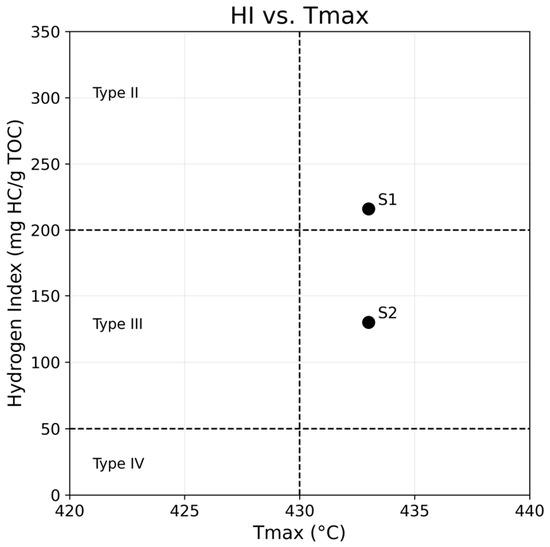
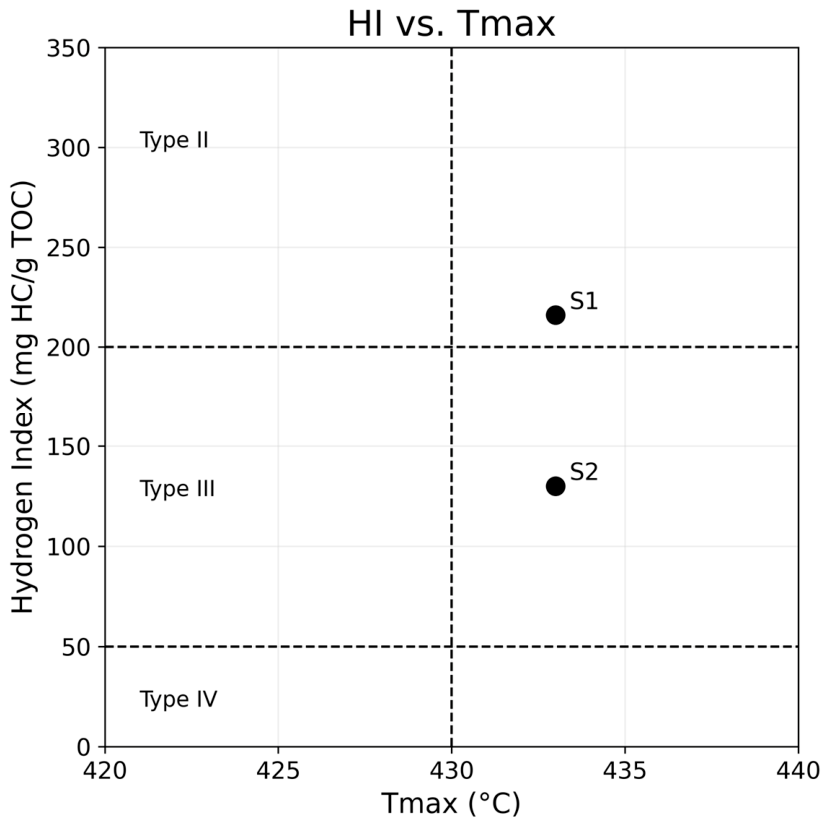
Hydrogen index (HI) values of 215.96 mg HC/g TOC (S1) and 130.2 mg HC/g TOC (S2) indicate mixed Type II/III and predominantly Type III kerogen, respectively. The corresponding oxygen index (OI) values support the gas-prone character of the organic matter. These results are consistent with the positioning of the samples in the early-mature zone in the Tmax–HI diagram (Figure 1).
Figure 1.
Tmax−HI graph. Source: own elaboration.
3.2. Mineralogical and Textural Characterization (XRD and N2 Adsorption)
The mineralogical composition obtained from X-ray diffraction analysis is presented in Table 2. Both samples are dominated by clay minerals, representing approximately 58.16% in S1 and 57% in S2, with kaolinite, ferruginous muscovite, and chlorite as the main phases.
Quartz is the dominant non-clay mineral, with contents of 40.58% in S1 and 42.24% in S2. The high clay content indicates a fine-grained matrix, which is relevant for adsorption processes due to the presence of surface-active sites and potential microporosity associated with clay structures.
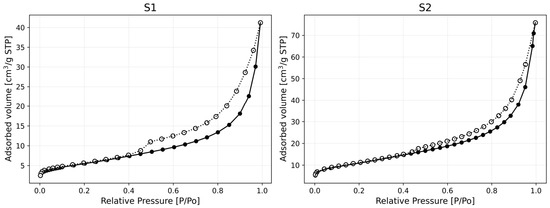
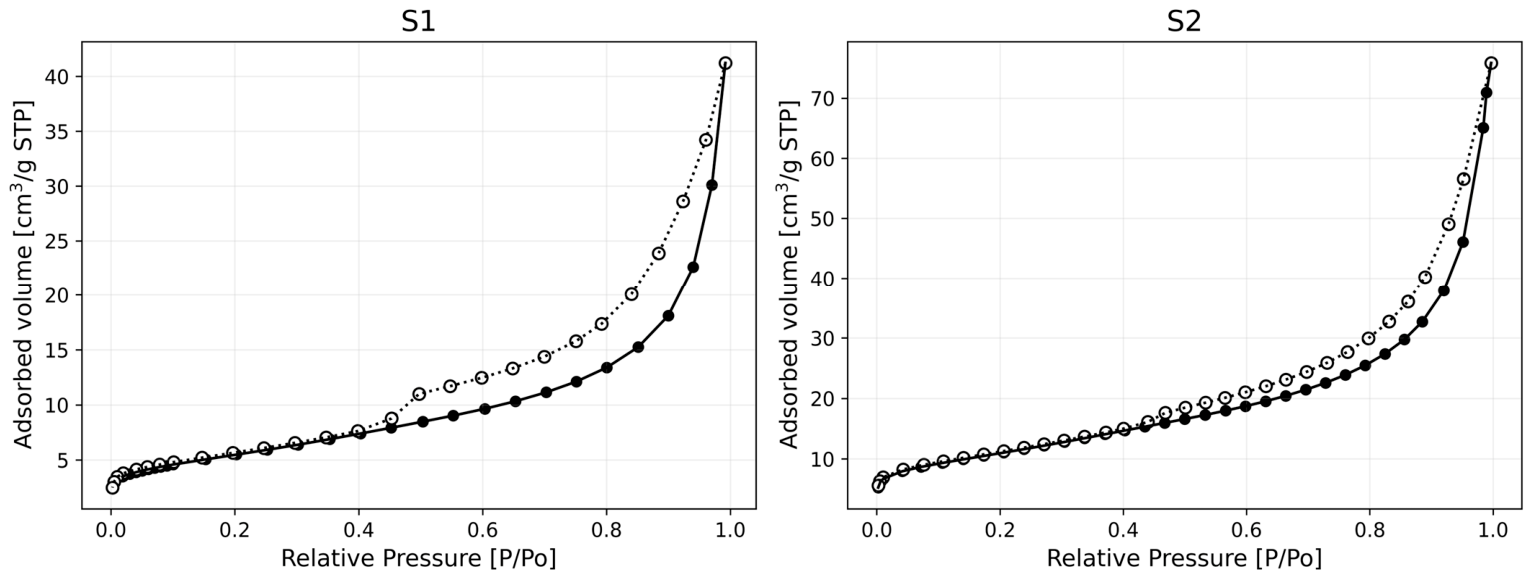
To further characterize the pore structure, N2 adsorption–desorption isotherms were analyzed (Figure 2). Both samples exhibit Type IV isotherms with hysteresis loops, characteristic of mesoporous materials. Sample S2 shows higher adsorption capacity across the entire pressure range, consistent with its larger BET surface area.
Figure 2.
N2 adsorption–desorption isotherms at 77 K for shale samples S1 (left) and S2 (right). Filled symbols represent adsorption branches, and open symbols represent desorption branches.
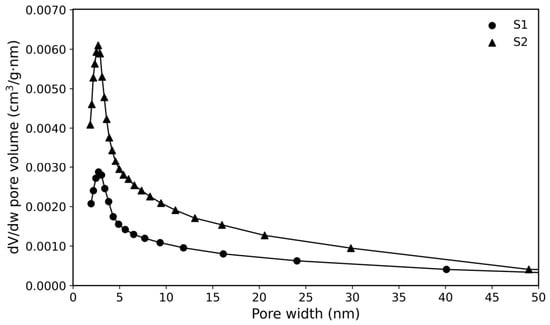
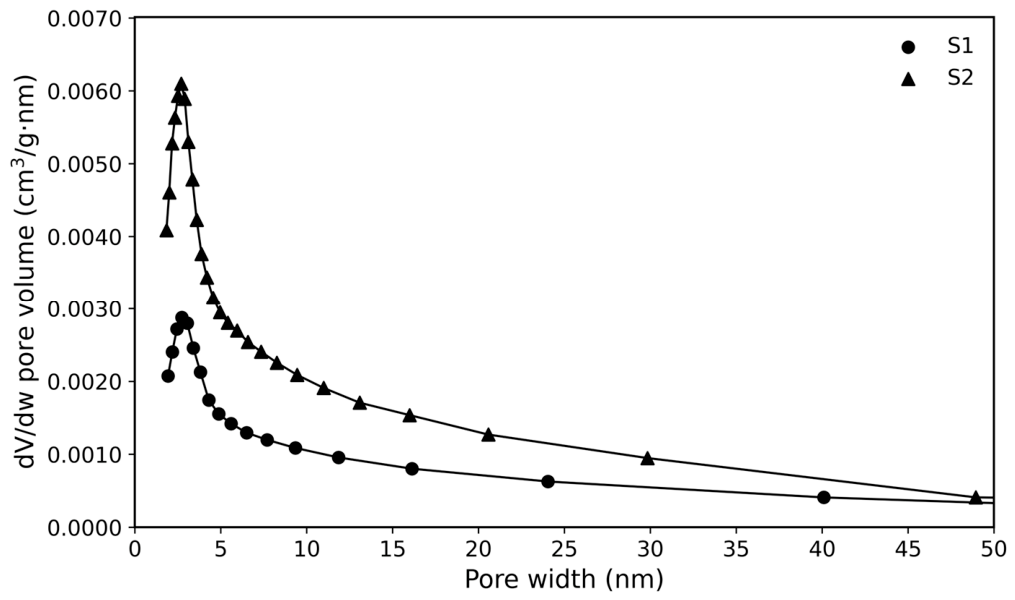
The corresponding pore size distributions derived using the BJH method (Figure 3) confirm the mesopore-dominated character of both samples. The textural parameters obtained from the N2 adsorption analysis (Table 3) indicate that sample S2 exhibits both a higher BET surface area and a larger pore volume compared to S1, consistent with its greater adsorption capacity across the measured pressure range.
Figure 3.
Pore size distribution (BJH method) for shale samples. Circles represent sample S1, and triangles represent sample S2.
3.3. Adsorption–Desorption Behavior
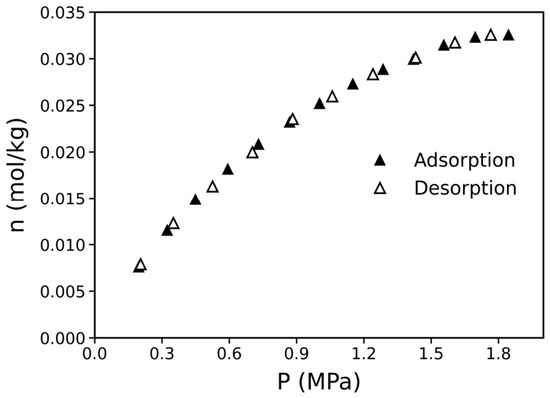
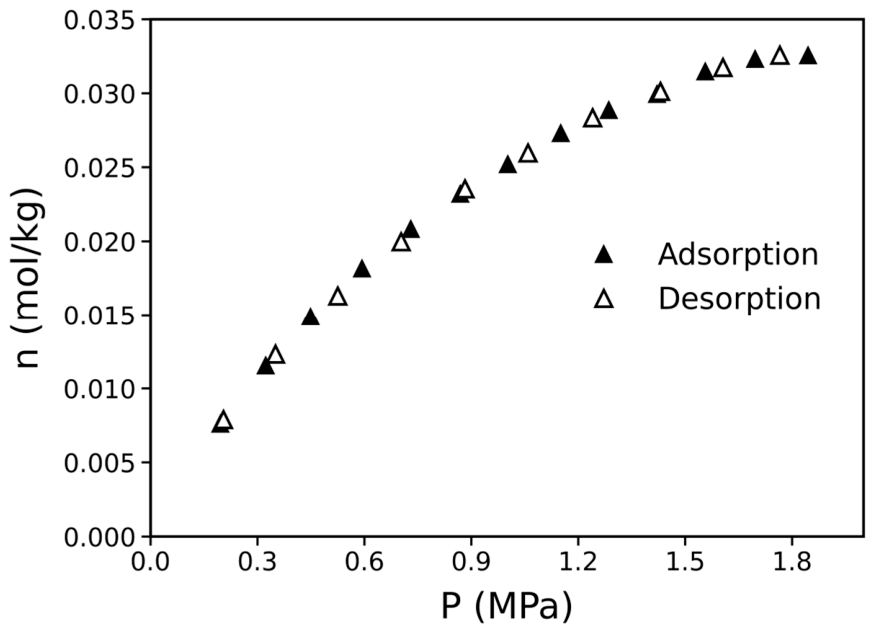
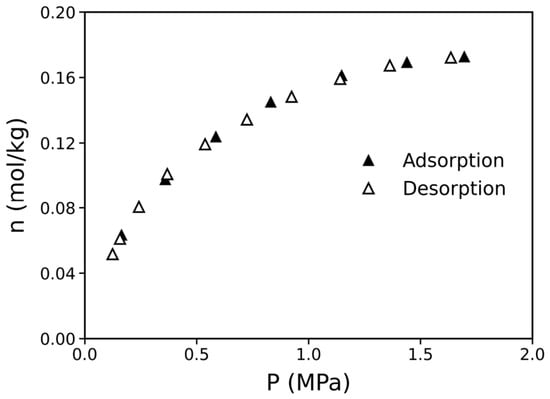
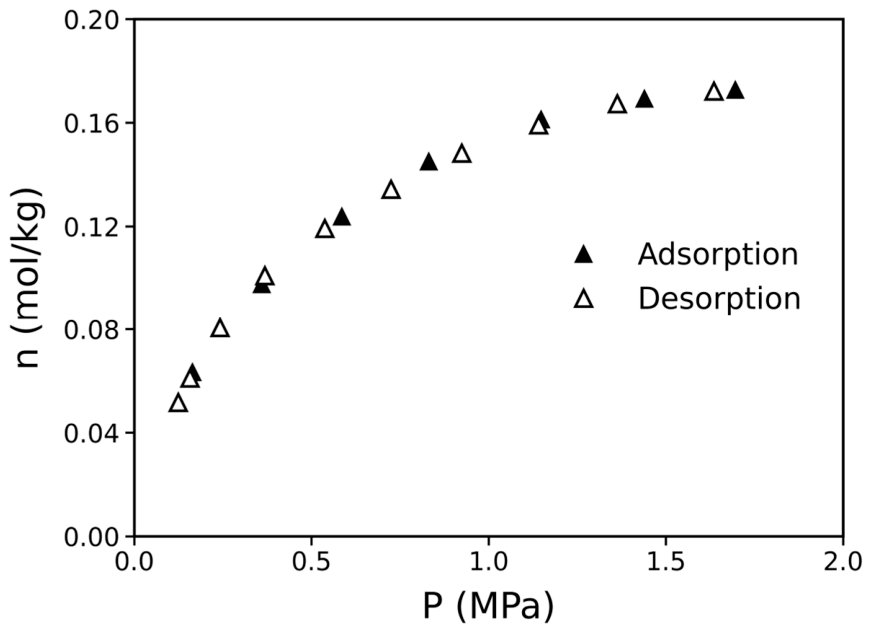
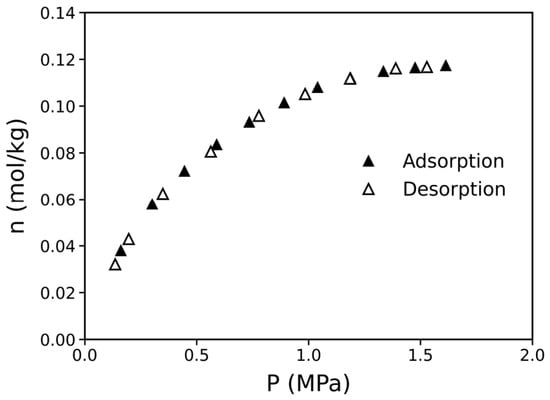
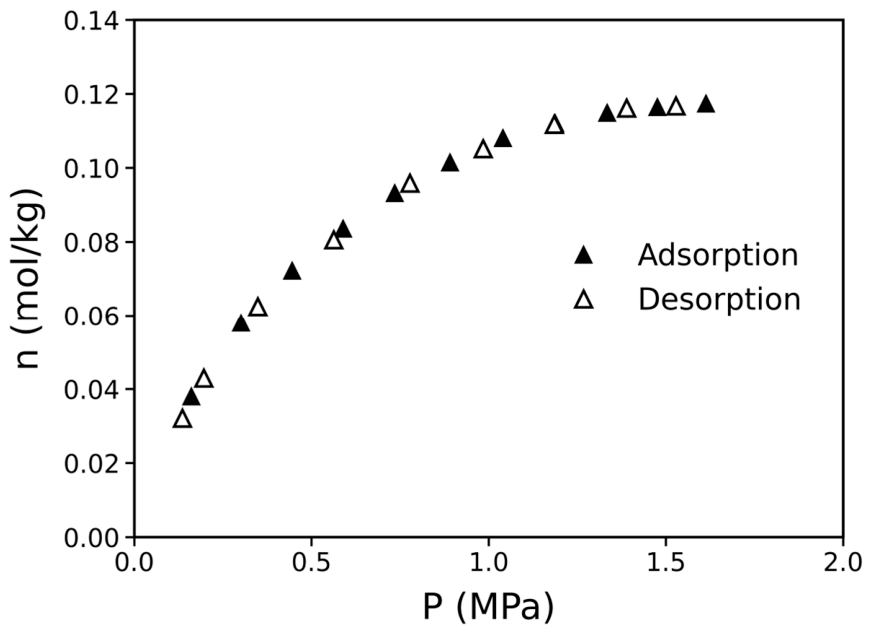
Adsorption–desorption isotherms for CH4 and CO2 were obtained at 50 °C and 80 °C. For sample S1, measurements were conducted up to 2 MPa, while for sample S2, pressures up to 3 MPa were reached. Each isotherm was repeated twice, showing high reproducibility with variations within the experimental uncertainty.
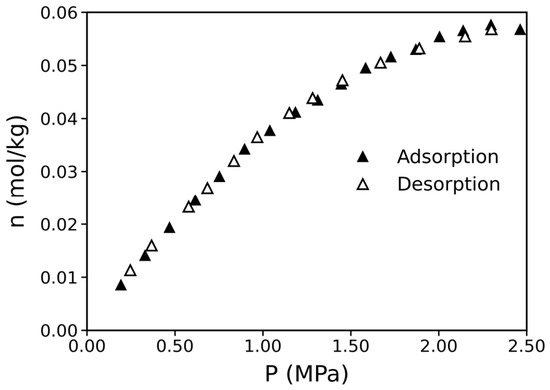
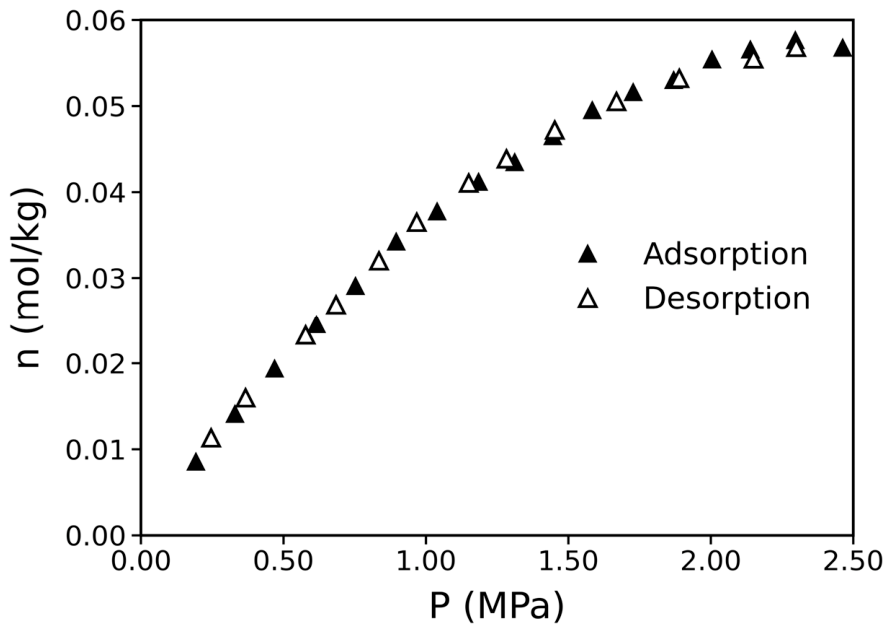
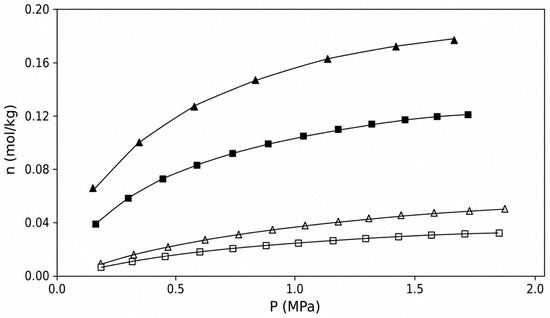
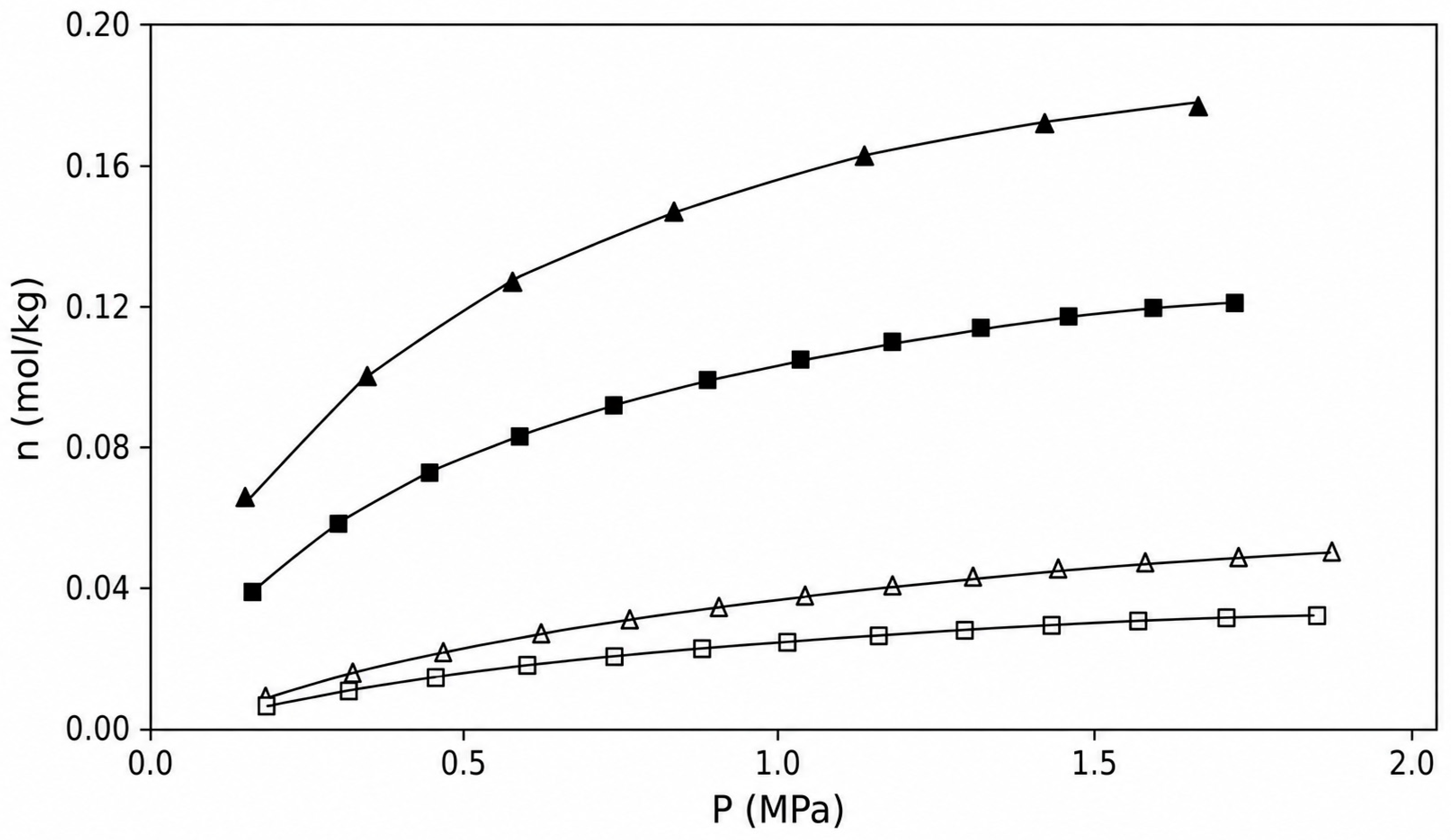
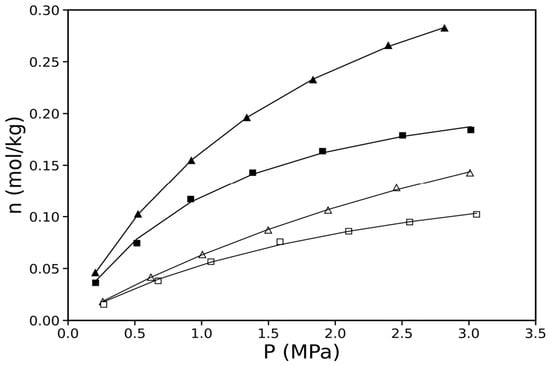
Figure 4, Figure 5, Figure 6 and Figure 7 present the adsorption–desorption isotherms for sample S1. No hysteresis was observed during the desorption cycles, indicating reversible adsorption behavior under the tested conditions. Figure 8 summarizes the adsorption behavior of S1.
Figure 4.
CH4 adsorption/desorption at 50 °C for S1. Source: own elaboration.
Figure 5.
CH4 adsorption/desorption at 80 °C for S1. Source: own elaboration.
Figure 6.
CO2 adsorption/desorption at 50 °C for S1. Source: own elaboration.
Figure 7.
CO2 adsorption/desorption at 80 °C for S1. Source: own elaboration.
Figure 8.
Adsorption isotherms and Langmuir fit for S1, ▲ CO2 adsorption at 50 °C; ■ CO2 adsorption at 80 °C; △ CH4 adsorption at 50 °C; □ CH4 adsorption at 80 °C; solid lines: Langmuir model fit. Source: own elaboration.
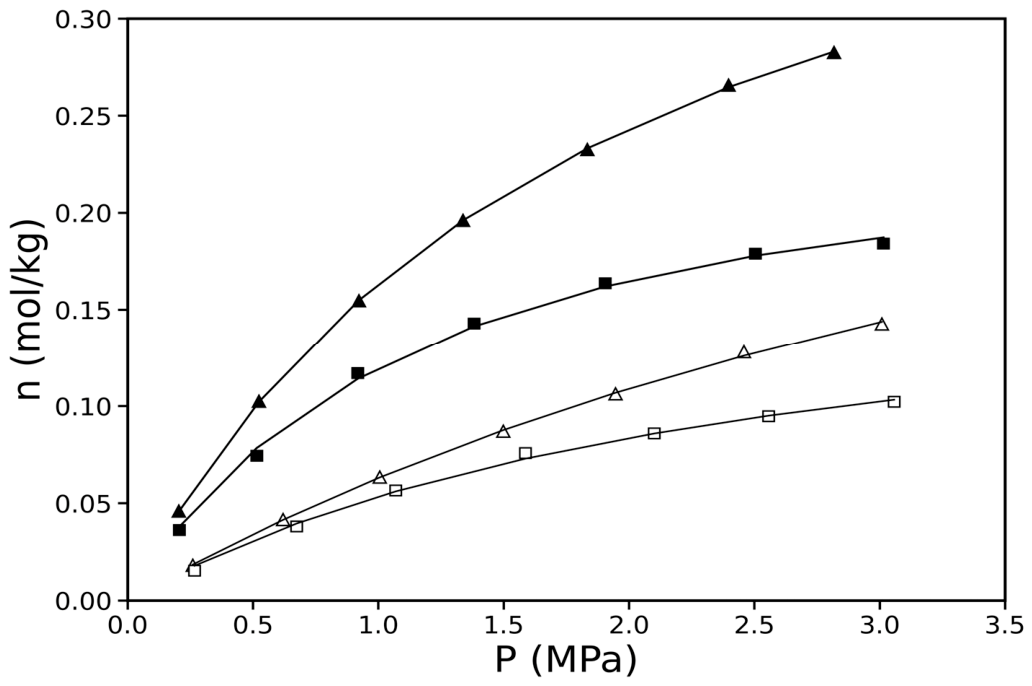
For sample S2, only adsorption data are shown (Figure 9), although desorption measurements were also performed and similarly exhibited no hysteresis. The absence of hysteresis in both samples suggests that adsorption is dominated by reversible physical interactions.
Figure 9.
Adsorption isotherms and Langmuir fit for S2, ▲ CO2 adsorption at 50 °C; ■ CO2 adsorption at 80 °C; △ CH4 adsorption at 50 °C; □ CH4 adsorption at 80 °C; solid lines: Langmuir model fit. Source: own elaboration.
CO2 consistently exhibits a higher adsorption capacity than CH4 at both temperatures. For example, at 50 °C, S2 reaches a maximum adsorption capacity of 0.508 mol/kg for CO2 compared to 0.462 mol/kg for CH4. A similar trend is observed in S1, although with lower absolute adsorption values.
An increase in temperature from 50 °C to 80 °C results in a decrease in adsorption capacity for both gases, reflecting the temperature dependence of the adsorption process.
3.4. Langmuir Model Fitting
The experimental adsorption data were fitted using a three-parameter Langmuir model. The model provided an excellent fit for both gases across all conditions, as reflected by high R2 values and low standard deviations (Table 4 and Table 5).
Table 4.
Langmuir Model Fitting Parameters for S1.
Table 5.
Langmuir Model Fitting Parameters for S2.
The Langmuir model was selected for fitting the adsorption isotherms due to its simplicity and good correlation with monolayer adsorption behavior under pure-gas conditions. Although alternative models such as BET or Dubinin–Radushkevich (D–R) can be applied to multilayer adsorption or microporous systems, they are generally more suitable for surface area characterization or low-pressure regimes rather than bulk sorption in shale under reservoir-relevant conditions. Given the pressure range used in this study (up to 3 MPa) and the nature of the rock matrix (moderately porous, mesoporous, and early-mature), the Langmuir model provided physically consistent parameters and excellent fitting performance for both CH4 and CO2, as also reported in similar studies [7,20,30].
For sample S1, the maximum adsorption capacity (nL) for CO2 at 50 °C is 0.215 mol/kg, decreasing to 0.164 mol/kg at 80 °C. For CH4, nL decreases from 0.125 mol/kg to 0.059 mol/kg over the same temperature range.
Sample S2 shows significantly higher adsorption capacities, with CO2 reaching 0.493 mol/kg at 50 °C and 0.284 mol/kg at 80 °C, while CH4 decreases from 0.462 mol/kg to 0.207 mol/kg.
The Langmuir pressure (pL) values indicate differences in adsorption affinity between gases and samples, with CO2 consistently showing stronger adsorption affinity compared to CH4.
The fitting deviation parameter, ∆n, was calculated according to Pozo et al. [53] as follows:
where N is the number of data points; is the experimental adsorption value; and is the fitted value at each adsorption pressure. This parameter was used to evaluate the deviation between experimental and fitted adsorption data.
4. Discussion
The adsorption and desorption behaviors observed in samples S1 and S2 reflect the combined influence of surface area, organic matter characteristics, and mineralogical composition on gas storage in shale formations. Although both samples exhibit similar thermal maturity (Tmax = 433 °C; PI = 0.01), notable differences in adsorption capacity are observed.
Sample S2, with a higher BET surface area (40 m2/g) compared to S1 (20 m2/g), shows significantly greater adsorption capacity for both CH4 and CO2. This trend supports the widely reported relationship between specific surface area and gas adsorption potential in organic-rich shales [4,5,6,7,60]. The higher adsorption capacity in S2 suggests a greater availability of adsorption sites, which may be associated with both organic matter and mineral-related porosity.
The adsorption isotherms reveal distinct behaviors for CO2 and CH4. CO2 adsorption increases sharply at low pressures (<1.5 MPa) and approaches a plateau at higher pressures, indicating progressive saturation of available adsorption sites. In contrast, CH4 adsorption shows a more gradual increase over the entire pressure range, reflecting weaker gas–surface interactions. These differences are consistent with the higher polarizability and quadrupole moment of CO2, which enhance its affinity for both organic and mineral surfaces [61,62].
This behavior is consistent with adsorption mechanisms reported in heterogeneous shale systems, where CO2 preferentially occupies energetically favorable adsorption sites due to its higher polarizability and quadrupole moment, particularly within clay-associated and organic-rich pore networks.
The Langmuir model provided a satisfactory representation of the experimental data, capturing the general adsorption trends across the studied conditions. The obtained Langmuir capacities fall within the range reported for similar shale systems, where CH4 adsorption typically varies between 0.1 and 1.2 mol/kg and CO2 between 0.2 and 2.0 mol/kg under comparable conditions [4,42,63,64]. While the model assumes idealized adsorption behavior, its good fit suggests that it is adequate for describing gas uptake in these early-mature shale samples.
Although adsorption capacity decreased systematically with increasing temperature, some decreases in Langmuir pressure (pL) values were also observed. This behavior may reflect the heterogeneous nature of adsorption sites and the semi-empirical character of the Langmuir fitting approach when applied to complex shale matrices under limited pressure ranges.
Differences in organic matter characteristics may also contribute to the observed behavior. Although S2 exhibits slightly higher TOC than S1, its lower S2 pyrolysis peak suggests variations in kerogen type or quality. These differences may influence pore structure and adsorption site distribution, thereby affecting gas uptake. However, the available data do not allow for a direct quantification of the relative contributions of organic matter and mineral phases.
Nevertheless, similar complexities in establishing direct quantitative relationships between pore structure, mineralogical composition, organic matter characteristics, and adsorption behavior have also been reported in other heterogeneous shale systems, where gas uptake is controlled by the combined influence of organic and mineral-associated pore networks rather than by a single dominant parameter [19,48,62].
Mineralogical composition also plays a relevant role in adsorption behavior. Quartz, being non-porous and chemically inert, contributes minimally to gas adsorption. In contrast, clay minerals such as kaolinite and chlorite provide surface-active sites that can enhance adsorption, particularly for CO2. Sample S2 exhibits a higher kaolinite content than S1, which may partially contribute to its higher adsorption capacity despite only minor differences in TOC. Clay minerals exhibit surface polarity and functional groups that promote interactions with polarizable gas molecules [48,65]. Ferruginous muscovite may also contribute to adsorption through its layered structure, although its role is likely secondary.
The absence of hysteresis in both CH4 and CO2 adsorption–desorption cycles indicates that gas uptake is dominated by reversible physical adsorption. This suggests that adsorption occurs primarily in accessible pore systems, likely associated with mesopores and well-connected structures, rather than through pore trapping or structural deformation. The non-swelling nature of the dominant clay minerals further supports this reversible behavior [66,67].
From an applied perspective, the preferential adsorption of CO2 over CH4 and the reversible nature of the adsorption process have important implications for CO2 sequestration and enhanced gas recovery strategies in shale formations. The stronger affinity of CO2 for the shale matrix suggests that injected CO2 could preferentially occupy adsorption sites and potentially promote methane displacement under reservoir conditions. In addition, the absence of hysteresis indicates reversible adsorption behavior, which may favor injectivity and gas transport within accessible pore systems. Although this study does not directly address reservoir-scale injection processes, the experimental results provide relevant insight into gas–rock interactions that may support future evaluations of CO2 storage and EGR potential in early-mature shale systems [68].
5. Conclusions
The experimental results indicate that shale samples from the ANH-Cañaboba1 Well in the Cesar-Ranchería Basin exhibit a consistently higher affinity for CO2 compared to CH4 at both 50 °C and 80 °C, as reflected in higher Langmuir adsorption capacities. This behavior is consistent with the physicochemical properties of CO2, particularly its higher polarizability and quadrupole moment.
Adsorption capacity decreases with increasing temperature for both gases, consistent with the exothermic nature of the adsorption process. This trend is characteristic of physisorption and supports the applicability of the Langmuir model under the tested conditions.
The results highlight the importance of specific surface area and rock composition in controlling adsorption behavior. Sample S2, with a higher BET surface area, consistently exhibited greater adsorption capacity than S1, suggesting a positive relationship between available surface area and gas uptake. Mineralogical components such as clay minerals may further contribute to adsorption through surface interactions.
The absence of hysteresis in the adsorption–desorption isotherms suggests that gas uptake was predominantly controlled by reversible physical adsorption under the tested conditions. This behavior further suggests that the pore system remained sufficiently accessible and structurally stable during the adsorption–desorption cycles, which may be favorable for gas storage applications.
The integration of pure-gas adsorption data with mineralogical and geochemical characterization provides new experimental insight into gas–shale interactions in early-mature formations from an underexplored basin.
Overall, the preferential adsorption of CO2 and the reversible nature of the adsorption process suggest that these shale formations may have potential for CO2 storage and methane displacement. These findings contribute to future assessments of shale reservoirs in the Cesar-Ranchería Basin for unconventional gas development and carbon management strategies.
Author Contributions
Conceptualization, O.P.O.C., N.S.S. and D.B.; data curation, O.P.O.C.; formal analysis, O.P.O.C.; investigation, O.P.O.C., N.S.S. and D.B.; methodology, D.B.; project administration, O.P.O.C. and N.S.S.; resources, N.S.S., O.P.O.C. and D.B.; supervision, D.B.; validation, O.P.O.C. and D.B.; visualization, O.P.O.C.; writing—original draft, O.P.O.C.; writing—review and editing, O.P.O.C. and D.B. All authors have read and agreed to the published version of the manuscript.
Funding
This research was funded under Contract No. FP44842-454-2017 (UIS-MINCIENCIAS), derived from Agreement 730/327 of 2016 (ANH-MINCIENCIAS).
Data Availability Statement
The data presented in this study are available on request from the corresponding author; the data are not publicly available due to privacy restrictions.
Acknowledgments
The authors acknowledge the LFCR of UPPA and the GIT of Universidad Industrial de Santander for their support of this work.
Conflicts of Interest
The authors declare no conflicts of interest. The funders had no role in the design of the study; in the collection, analyses, or interpretation of data; or in the writing of the manuscript.
References
- IPCC. Carbon Dioxide Capture and Storage; Metz, B., Davidson, O., de Coninck, H.C., Loos, M., Meyer, L.A., Eds.; Cambridge University Press: Cambridge, UK, 2005. [Google Scholar]
- Chi, Y.; Zhao, C.; Lv, J.; Zhao, J.; Zhang, Y. Thermodynamics and Kinetics of CO2/CH4 Adsorption on Shale from China: Measurements and Modeling. Energies 2019, 12, 978. [Google Scholar] [CrossRef] [Scilit]
- Guo, C.; Li, R.; Sun, J.; Wang, X.; Liu, H. A review of gas transport and adsorption mechanisms in two-component methane–carbon dioxide systems. Int. J. Energy Res. 2020, 44, 2499–2516. [Google Scholar] [CrossRef] [Scilit]
- Heller, R.; Zoback, M. Adsorption of methane and carbone dioxide on gas shale and pure mineral samples. J. Unconv. Oil Gas Resour. 2014, 8, 14–24. [Google Scholar] [CrossRef] [Scilit]
- Gasparik, M.; Ghanizadeh, A.; Bertier, P.; Gensterblum, Y.; Bouw, S.; Krooss, B.M. High-Pressure methane sorption isotherms of black shales from the Netherlands. Energy Fuels 2012, 26, 4995–5004. [Google Scholar] [CrossRef] [Scilit]
- Ross, D.J.K.; Bustin, R.M. The importance of shale composition and pore structure upon gas storage potential of shale gas reservoirs. Mar. Pet. Geol. 2009, 26, 916–927. [Google Scholar] [CrossRef] [Scilit]
- Huang, L.; Ning, Z.; Wang, Q.; Zhang, W.; Cheng, Z.; Wu, X.; Qin, H. Effect of organic type and moisture on competitive adsorption in kerogen with implications for sequestration and enhanced recovery. Appl. Energy 2018, 210, 28–43. [Google Scholar] [CrossRef] [Scilit]
- Du, X.; Gu, M.; Hou, Z.; Liu, Z.; Wu, T. Experimental Study on the Kinetics of Adsorption of CO2 and CH4 in Gas-Bearing Shale Reservoirs. Energy Fuels 2019, 33, 12587–12600. [Google Scholar] [CrossRef] [Scilit]
- Wang, J.; Samara, H.; Jaeger, P.; Ko, V.; Rodgers, D.; Ryan, D. Investigation for CO2 Adsorption and Wettability of Reservoir Rocks. Energy Fuels 2022, 36, 1626–1634. [Google Scholar] [CrossRef] [Scilit]
- Liu, J.; Xie, L.Z.; He, B.; Zhang, J.; Tang, X.; Fan, X. Performance of free gases during the recovery enhancement of shale gas by CO2 injection: A case study on the depleted Wufeng–Longmaxi shale in northeastern Sichuan Basin, China. Pet. Sci. 2021, 18, 530–545. [Google Scholar] [CrossRef] [Scilit]
- Wang, J.; Mangano, E.; Brandani, S.; Ruthven, D.M. A review of common practices in gravimetric and volumetric adsorption kinetic experiments. Adsorption 2021, 27, 295–318. [Google Scholar] [CrossRef] [Scilit]
- Zhang, K.; Li, W.; Cheng, Y.; Dong, J.; Tu, Q.; Zhang, R. Microscale Research on Effective Geosequestration of CO2 in Coal Reservoir: A Natural Analogue Study in Haishiwan Coalfield, China. Geofluids 2018, 2018, 3015038. [Google Scholar] [CrossRef] [Scilit]
- Shi, J.Q.; Mazumder, S.; Wolf, K.H.; Durucan, S. Competitive Methane Desorption by Supercritical CO2 Injection in Coal. Transp. Porous Media 2008, 75, 35–54. [Google Scholar] [CrossRef] [Scilit]
- Yang, N.; Xue, R.; Huang, G.; Ma, Y.; Wang, J. CO2 Adsorption Performance and Kinetics of Ionic Liquid-Modified Calcined Magnesite. Nanomaterials 2021, 11, 2614. [Google Scholar] [CrossRef] [Scilit] [PubMed]
- Huo, B.; Jing, X.; Fan, C.; Han, Y. Numerical investigation of flue gas injection enhanced underground coal seam gas drainage. Energy Sci. Eng. 2019, 7, 3204–3219. [Google Scholar] [CrossRef] [Scilit]
- Wang, Y.; Dai, Z.; Chen, L.; Shen, X.; Chen, F.; Soltanian, M.R. An integrated multi-scale model for CO2 transport and storage in shale reservoirs. Appl. Energy 2023, 331, 120444. [Google Scholar] [CrossRef] [Scilit]
- Gasparik, M.; Bertier, P.; Gensterblum, Y.; Ghanizadeh, A.; Krooss, B.M.; Littke, R. Geological Controls on the Methane Storage Capacity in Organic-Rich Shales. Int. J. Coal Geol. 2014, 123, 34–51. [Google Scholar] [CrossRef] [Scilit]
- Alanazi, A.; Abid, H.R.; Usman, M.; Ali, M.; Keshavarz, A.; Vahrenkamp, V.; Iglauer, S.; Hoteit, H. Hydrogen, Carbon Dioxide, and Methane Adsorption Potential on Jordanian Organic-Rich Source Rocks: Implications for Underground H2 Storage and Retrieval. Fuel 2023, 346, 128362. [Google Scholar] [CrossRef] [Scilit]
- Samara, H.; Wang, J.; Jaeger, P.; Ko, V.; Rodgers, D.; Ryan, D. Rethinking Sorption Mechanisms in Shales with Varying Petrophysical Characteristics—An Investigation of Hydrogen and Carbon Dioxide. J. Geoenergy Sci. Eng. 2026, 150, 205906. [Google Scholar] [CrossRef] [Scilit]
- Zhang, T.; Ellis, G.S.; Ruppel, S.C.; Milliken, K.; Yang, R. Effect of Organic-Matter Type and Thermal Maturity on Methane Adsorption in Shale-Gas Systems. Org. Geochem. 2012, 47, 120–131. [Google Scholar] [CrossRef] [Scilit]
- Long, H.; Lin, H.F.; Yan, M.; Bai, Y.; Tong, X.; Kong, X.G.; Li, S.G. Adsorption and diffusion characteristics of CH4, CO2, and N2 in micropores and mesopores of bituminous coal: Molecular dynamics. Fuel 2021, 292, 120268. [Google Scholar] [CrossRef] [Scilit]
- Yuan, S.; Gang, H.-Z.; Liu, Y.-F.; Zhou, L.; Irfan, M.; Yang, S.-Z.; Mu, B.-Z. Adsorption and Diffusion Behaviors of CO2 and CH4 Mixtures in Different Types of Kerogens and Their Roles in Enhanced Energy Recovery. Sustainability 2022, 14, 14949. [Google Scholar] [CrossRef] [Scilit]
- Busch, A.; Gensterblum, Y.; Krooss, B.M.; Siemons, N. Investigation of high-pressure selective adsorption/desorption behaviour of CO2 and CH4 on coals: An experimental study. Int. J. Coal Geol. 2006, 66, 53–68. [Google Scholar] [CrossRef] [Scilit]
- Zheng, S.; Yao, Y.; Elsworth, D.; Liu, D.; Cai, Y. Dynamic fluid interactions during CO2-enhanced coalbed methane and CO2 sequestration in coal seams. Part 1: CO2–CH4 interactions. Energy Fuels 2020, 34, 8274–8282. [Google Scholar] [CrossRef] [Scilit]
- Zheng, S.; Yao, Y.; Elsworth, D.; Liu, D.; Cai, Y. Dynamic fluid interactions during CO2-ECBM and CO2 sequestration in coal seams. Part 2: CO2-H2O wettability. Fuel 2020, 279, 118560. [Google Scholar] [CrossRef] [Scilit]
- Zheng, S.; Yao, Y.; Liu, D.; Cai, Y.; Liu, Y.; Li, X. Nuclear magnetic resonance T2 cutoffs of coals: A novel method by multifractal analysis theory. Fuel 2019, 241, 715–724. [Google Scholar] [CrossRef] [Scilit]
- Rezaee, R. Fundamentals of Gas Shale Reservoirs; John Wiley & Sons: Hoboken, NJ, USA, 2015; ISBN 978-1-118-65120-1. [Google Scholar]
- Zhou, J.; Hu, N.; Xian, X.; Zhou, L.; Tang, J.; Kang, Y.; Wang, H. Supercritical CO2 fracking for enhanced shale gas recovery and CO2 sequestration: Results, status and future challenges. Adv. Geo-Energy Res. 2019, 3, 207–224. [Google Scholar] [CrossRef] [Scilit]
- Pan, Z.; Connell, L.D. Reservoir simulation of free and adsorbed gas production from shale. J. Nat. Gas Sci. Eng. 2015, 22, 359–370. [Google Scholar] [CrossRef] [Scilit]
- Yu, W.; Sepehrnoori, K.; Patzek, T.W. Modeling gas adsorption in Marcellus shale with Langmuir and BET isotherms. SPE J. 2016, 21, 589–600. [Google Scholar] [CrossRef] [Scilit]
- Mora, A.; Villagómez, D.; Parra, M.; Caballero, V.M.; Spikings, R.; Horton, B.K.; Mora–Bohórquez, J.A.; Ketcham, R.A.; Arias–Martínez, J.P. Late Cretaceous to Cenozoic uplift of the northern Andes: Paleogeographic implications. In The Geology of Colombia; Gómez, J., Mateus-Zabala, D., Eds.; Volume 3 Paleogene—Neogene; Servicio Geológico Colombiano, Publicaciones Geológicas Especiales: Bogotá, Colombia, 2020; pp. 89–121. [Google Scholar] [CrossRef] [Scilit]
- Cediel, F.; Shaw, R.P.; Cáceres, C. Tectonic Assembly of the Northern Andean Block. AAPG Mem. 2003, 79, 815–848. [Google Scholar]
- Sanchez, J.; Mann, P. Integrated Structural and Basinal Analysis of the Cesar–Rancheria Basin, Colombia: Implications for Its Tectonic History and Petroleum Systems. In Petroleum Geology and Potential of the Colombian Caribbean Margin; Cediel, F., Shaw, R.P., Eds.; AAPG Memoir 108; American Association of Petroleum Geologists: Tulsa, OK, USA, 2015; pp. 431–470. [Google Scholar] [CrossRef] [Scilit]
- Ross, D.J.K.; Bustin, R.M. Impact of mass balance calculations on adsorption capacities in microporous shale gas reservoirs. Fuel 2007, 86, 2696–2706. [Google Scholar] [CrossRef] [Scilit]
- ANH—Agencia Nacional de Hidrocarburos. Ronda Colombia 2010—Tipo 3: Cuenca Cesar-Ranchería. 2010. Available online: https://www.anh.gov.co (accessed on 2 February 2026).
- Bayona, G.; Lamus-Ochoa, F.; Cardona, A.; Jaramillo, C.; Montes, C.; Tchegliakova, N. Procesos orogénicos del Paleoceno para la cuenca de Ranchería (Guajira, Colombia) y áreas adyacentes definidos por análisis de procedencia. Geol. Colomb. 2007, 32, 21–46. [Google Scholar]
- Bayona Chaparro, G.A.; Ayala Calvo, R.C.; Ojeda Marulanda, C.; Cardona, A.; Valencia, V.; Padrón, C.E.; Yoris, F.; Mesa Salamanca, J. Estratigrafía y procedencia de las unidades comprendidas entre el Campaniano y el Paleógeno en la subcuenca de Cesar: Aportes a la evolución tectónica del área. Geol. Colomb. 2009, 34, 3–34. [Google Scholar]
- Espitia, A. Estudio estructural y sedimentológico del área norte de la Cuenca Cesar-Ranchería. Master’s Thesis, Universidad Nacional de Colombia, Bogota, Colombia, 2008. [Google Scholar]
- Cardona, A.; Valencia, V.; Bayona, G.; Duque, J.; Ducea, M.; Jaramillo, C.; Montes, C.; Ojeda, G.; Ruiz, J.; Weber, M. Early-subduction-related orogeny in the northern Andes: Turonian to Eocene magmatic and provenance records from the Colombian Andes. Terra Nova 2011, 23, 26–34. [Google Scholar] [CrossRef] [Scilit]
- Barrero, D.; Pardo, A.; Vargas, C.A.; Martínez, J.F. Colombian Sedimentary Basins: Nomenclature, Boundaries and Petroleum Geology, a New Proposal; Agencia Nacional de Hidrocarburos (ANH): Bogotá, Colombia, 2007.
- Montes, C.; Guzmán, G.; Bayona, G.; Cardona, A.; Ramírez, V.; Jaramillo, C. Clockwise rotation of the Santa Marta Massif and simultaneous Paleogene to Neogene deformation of the Plato-San Jorge and Cesar-Ranchería Basins. J. S. Am. Earth Sci. 2010, 29, 832–848. [Google Scholar] [CrossRef] [Scilit]
- Chalmers, G.R.L.; Bustin, R.M. Lower Cretaceous Gas Shales in Northeastern British Columbia, Part II: Evaluation of regional potential gas resources. Bull. Can. Pet. Geol. 2008, 56, 22–61. [Google Scholar] [CrossRef] [Scilit]
- Ross, D.J.K.; Bustin, R.M. Characterizing the Shale Gas Resource Potential of Devonian–Mississippian Shales, Western Canada Sedimentary Basin: Application of an Integrated Formation Evaluation. AAPG Bull. 2008, 92, 87–125. [Google Scholar] [CrossRef] [Scilit]
- Curtis, J.B. Fractured Shale-Gas Systems. AAPG Bull. 2002, 86, 1921–1938. [Google Scholar] [CrossRef] [Scilit]
- Loucks, R.G.; Reed, R.M.; Ruppel, S.C.; Jarvie, D.M. Morphology, Genesis, and Distribution of Nanometer-Scale Pores in Siliceous Mudstones of the Mississippian Barnett Shale. J. Sediment. Res. 2009, 79, 848–861. [Google Scholar] [CrossRef] [Scilit]
- Kuila, U.; Prasad, M. Specific surface area and pore-size distribution in clays and shales. Geophys. Prospect. 2013, 61, 341–362. [Google Scholar] [CrossRef] [Scilit]
- Bernard, S.; Wirth, R.; Schreiber, A.; Schulz, H.-M.; Horsfield, B. Formation of nanoporous pyrobitumen residues during maturation of the Barnett Shale (Fort Worth Basin). Int. J. Coal Geol. 2012, 103, 3–11. [Google Scholar] [CrossRef] [Scilit]
- Curtis, M.E.; Cardott, B.J.; Sondergeld, C.H.; Rai, C.S. Development of Organic Porosity in the Woodford Shale with Increasing Thermal Maturity. Int. J. Coal Geol. 2012, 103, 26–31. [Google Scholar] [CrossRef] [Scilit]
- Sondergeld, C.H.; Newsham, K.E.; Comisky, J.T.; Rice, M.C.; Rai, C.S. Petrophysical Considerations in Evaluating and Producing Shale Gas Resources. In Proceedings of the SPE Unconventional Gas Conference, Pittsburgh, PA, USA, 23–25 February 2010. SPE Paper 131768-MS. [Google Scholar] [CrossRef] [Scilit]
- Khosrokhavar, R.; Wolf, K.H.; Bruining, H. Sorption of CH4 and CO2 on a carboniferous shale from Belgium using a manometric setup. Int. J. Coal Geol. 2014, 128–129, 153–161. [Google Scholar] [CrossRef] [Scilit]
- Belmabkhout, Y.; Frère, M.; Weireld, G.D. High-pressure adsorption measurements. A comparative study of the volumetric and gravimetric methods. Meas. Sci. Technol. 2004, 15, 848–858. [Google Scholar] [CrossRef] [Scilit]
- Pino, D.; Plantier, F.; Bessieres, D. Experimental determination of the adsorption isotherms in gas mixtures under extended pressure and temperature range. J. Therm. Anal. Calorim. 2014, 117, 1469–1477. [Google Scholar] [CrossRef] [Scilit]
- Pozo, M.; Pino, D.; Bessieres, D. Effect of thermal events on maturation and methane adsorption of Silurian black shales (Checa, Spain). Appl. Clay Sci. 2017, 136, 208–218. [Google Scholar] [CrossRef] [Scilit]
- Al-Areeq, N.M. Petroleum source rocks characterization and hydrocarbon generation. In Recent Insights in Petroleum Science and Engineering; InTech: Singapore, 2018. [Google Scholar] [CrossRef] [Scilit]
- Peters, K.E. Guidelines for Evaluating Petroleum Source Rock Using Programmed Pyrolysis. AAPG Bull. 1986, 70, 318–329. [Google Scholar] [CrossRef] [Scilit]
- Peters, K.E.; Cassa, M.R. Applied Source Rock Geochemistry. In The Petroleum System—From Source to Trap; American Association of Petroleum Geologists: Tulsa, OK, USA, 1994; pp. 93–120. [Google Scholar] [CrossRef] [Scilit]
- Gensterblum, Y.; Van Hemert, P.; Billemont, P.; Busch, A.; Charriere, D.; Li, D.; Krooss, B.M.; De Weireld, G.; Prinz, D.; Wolf, K.H. European inter-laboratory comparison of high pressure CO2 sorption isotherms. I: Activated carbon. Carbon 2009, 47, 2958–2969. [Google Scholar] [CrossRef] [Scilit]
- Weniger, P.; Kalkreuth, W.; Busch, A.; Krooss, B.M. High pressure methane and carbon dioxide sorption on coal and shale samples from the Parana Basin, Brazil. Int. J. Coal Geol. 2010, 84, 190205. [Google Scholar] [CrossRef] [Scilit]
- Gensterblum, Y.; Merkel, A.; Busch, A.; Krooss, B.M. High-pressure CH4 and CO2 sorption isotherms as a function of coal maturity and the influence of moisture. Int. J. Coal Geol. 2013, 118, 45–57. [Google Scholar] [CrossRef] [Scilit]
- Jarvie, D.M.; Hill, R.J.; Ruble, T.E.; Pollastro, R.M. Unconventional shale-gas systems: The Mississippian Barnett Shale of north-central Texas as one model for thermogenic shale-gas assessment. AAPG Bull. 2007, 91, 475–499. [Google Scholar] [CrossRef] [Scilit]
- Liu, Y.; Hou, J. Selective adsorption of CO2/CH4 mixture on clay-rich shale using molecular simulations. J. CO2 Util. 2020, 39, 101143. [Google Scholar] [CrossRef] [Scilit]
- Zardari, Z.H.; Mohshim, D.F.; Sarmadivaleh, M.; Md Yusof, M.A.; Aftab, A. Comprehensive Review of CO2 Adsorption on Shale Formations: Exploring Widely Adopted Isothermal Models and Calculation Techniques. ACS Omega 2024, 9, 50078–50096. [Google Scholar] [CrossRef] [Scilit]
- Li, X.-M.; Tang, X.; Guo, S.-B.; Shan, Y.-S.; Deng, E.-D.; Lan, C.-L.; Tan, B.-D. Methane adsorption capacity of shale in the upper Permian Longtan Formation in the eastern Sichuan–northern Guizhou region, South China. Aust. J. Earth Sci. 2025, 72, 564–590. [Google Scholar] [CrossRef] [Scilit]
- Zhang, Y.; Jiang, Y.; Wei, Q.; Huang, H.; Wang, T.; Xiong, H.; Wang, J.; Ren, Y.; Cui, X. Insight into adsorption behaviors of shale oil in kerogen slit by molecular dynamics. Fuel 2024, 374, 132432. [Google Scholar] [CrossRef] [Scilit]
- Chouikhi, N.; Cecilia, J.A.; Vilarrasa-García, E.; Besghaier, S.; Chlendi, M.; Franco Duro, F.I.; Rodríguez Castellón, E.; Bagané, M. CO2 Adsorption of Materials Synthesized from Clay Minerals: A Review. Minerals 2019, 9, 514. [Google Scholar] [CrossRef] [Scilit]
- Zhang, R.; Liu, S.M. Experimental and Theoretical Characterization of Methane and CO2 Sorption Hysteresis in Coals Based on Langmuir Desorption. Int. J. Coal Geol. 2017, 171, 49–60. [Google Scholar] [CrossRef] [Scilit]
- Wang, K.; Wang, G.; Ren, T.; Cheng, Y. Methane and CO2 Sorption Hysteresis on Coal: A Critical Review. Int. J. Coal Geol. 2014, 132, 60–80. [Google Scholar] [CrossRef] [Scilit]
- Wang, H.; Li, S.; Guo, M.; Li, Z.; Sun, Y.; Bai, H. Molecular simulation study on the mechanism of kerogen chemical heterogeneity influencing CO2 miscibility in nanoscale organic pores. J. Mol. Liq. 2025, 440, 128866. [Google Scholar] [CrossRef] [Scilit]

Disclaimer/Publisher’s Note: The statements, opinions and data contained in all publications are solely those of the individual author(s) and contributor(s) and not of MDPI and/or the editor(s). MDPI and/or the editor(s) disclaim responsibility for any injury to people or property resulting from any ideas, methods, instructions or products referred to in the content. |
© 2026 by the authors. Licensee MDPI, Basel, Switzerland. This article is an open access article distributed under the terms and conditions of the Creative Commons Attribution (CC BY) license.