


Abstract
Depression detection from social media text is predominantly studied in resource-rich languages, leaving substantial gaps for low-resource languages like Bhojpuri and Hindi. This study presents a comparative evaluation of six deep learning models—CNN, LSTM, LSTM with Attention, BERT, BERT-CNN, and BERT-LSTM—for identifying depression-related content in Hindi and the low-resource Bhojpuri language. We introduce two parallel datasets: DepDs-B (Bhojpuri) and DepDs-H (Hindi), each containing 12,029 labelled social-media posts. DepDs-H is a careful translation of DepDs-B, enabling controlled investigation of language-specific patterns. Our experiments show that BERT achieves the highest weighted -score of 0.90 on Bhojpuri, while the BERT-LSTM hybrid performs best on Hindi with an -score of 0.91. The results highlight the effectiveness of transformer-based models in low-resource multilingual settings and underscore the importance of linguistic and cultural awareness in developing mental health detection tools. We also identify key limitations, including the parallel nature of the datasets and the need for clinical validation, and discuss future directions for cross-lingual transfer and error analysis.
1. Introduction
Depression, a significant mental health disorder, affects millions of individuals around the world, often leading to severe psychological, social, and physical consequences if it is not detected and treated promptly. With the proliferation of social networks, people are increasingly sharing their emotions, thoughts, and life events online, providing a rich source of data for monitoring mental health [1,2]. Leveraging this data, researchers have developed various methods to detect depression through natural language processing (NLP) and machine learning techniques [3,4]. Despite the advancements, most studies have primarily focused on limited linguistic coverage, neglecting the vast number of non-English speakers who are equally active on social media [5]. However, many existing approaches are architecturally language-agnostic yet have been evaluated only on English data, leading to a gap in validated models for other languages.
To bridge this gap, the present study explores the detection of depression from social media posts across two languages: Hindi and the low-resource language Bhojpuri. While Hindi is one of the most widely spoken languages in India and enjoys growing support in general-purpose natural language processing (NLP) [6], it remains under-resourced in specific application domains such as mental health detection [7]. Most available resources focus on syntactic or general-purpose linguistic tasks [8], while very limited attention has been given to psychological or affective tasks, due to limited availability of annotated datasets, domain-specific lexicons, and validated models for tasks like depression detection. The cultural stigma surrounding mental health in India further contributes to a scarcity of openly shared and labeled data in Hindi, particularly for emotionally sensitive content on social media.
In contrast, Bhojpuri [9], a major regional language spoken by millions in India and abroad, is significantly more under-resourced, with minimal digital representation, scarce annotated datasets, and virtually no prior research on depression detection. The absence of standardized orthography, code-mixing with Hindi and English, and limited technological support make NLP tasks in Bhojpuri especially challenging.
Therefore, despite their differences in speaker base and general linguistic resources, Bhojpuri presents key characteristics of a low-resource language when applied to the task of depression detection, whereas Hindi does not. This study accordingly treats only Bhojpuri as a low-resource language in the context of mental health analysis, addressing a critical gap in multilingual NLP research for underrepresented linguistic communities.
In conducting an extensive literature review (searching IEEE Xplore, ACM Digital Library, ACL Anthology, Google Scholar, and PubMed for the period 2014–2026), we found that no appropriate depressive dataset exists for Bhojpuri and that publicly available Hindi datasets are scarce.
To fill this gap, we have curated the Bhojpuri Depression Data Set (DepDs-B) from the X (formerly Twitter) social media platform. The DepDs-B dataset was then translated into Hindi using Google Translate, followed by manual validation and correction by two native speakers (one Hindi, one Bhojpuri) and a third expert resolving disagreements. This resulted in two parallel datasets having the same meaning with different linguistic expression, enabling controlled comparisons. During this translation process, the sentiment and the context of the sentences were preserved. Six different deep-learning based models were implemented on these two depressive datasets: Convolutional Neural Network (CNN) [10], Long Short-Term Memory (LSTM) [11], Attention-based LSTM (LSTM-A) [12], Bidirectional Encoder Representations from Transformers (BERT) [13], BERT combined with CNN (BERT-CNN) [14], and BERT combined with LSTM (BERT-LSTM) [15]. Selection of these models were based on their superiority for the various NLP-related tasks.
During evaluation, we observed that while BERT-based models consistently outperformed other models across the two languages, the nuances of translation and linguistic differences led to variations in performance. For example, some idiomatic expressions and cultural references specific to Bhojpuri and Hindi indicate challenges that could impact the model’s performance. This indicates why cultural and linguistic awareness is important for developing a mental health detection system (in our case, depression).
Our findings show a significant development for the multilingual mental health observation tool (depression). By exploring the feasibility and challenges of depression detection in multilingual scenarios, these tools can be used to prevent and detect early depression in individuals of diverse linguistic backgrounds. The main points of this work’s contribution are as follows:
- Creation of a Bhojpuri depression dataset (DepDs-B):A novel depressive dataset for the low-resource language Bhojpuri was curated and annotated using posts collected from X (formerly Twitter).
- Creation of a parallel Hindi depression dataset (DepDs-H): To enable controlled linguistic comparison, the Bhojpuri dataset was carefully translated into Hindi with the same contextual meaning.
- First comprehensive cross-lingual benchmark for low-resource Indian languages: We present the first comprehensive evaluation of six state-of-the-art deep-learning models—Convolutional Neural Network (CNN), Long Short-Term Memory (LSTM), Attention-based LSTM, Bidirectional Encoder Representations from Transformers (BERT), BERT-CNN, and BERT-LSTM—under identical experimental conditions on newly created Hindi and Bhojpuri depression datasets. This establishes strong benchmark results and a reproducible experimental protocol for future research in low-resource Indian language mental health detection.
- Proposed hybrid framework for multilingual depression detection (HFDD): The proposed HFDD identifies the most effective model for each language and demonstrates adaptability to other mental health datasets. This framework provides a systematic evaluation pipeline for depression detection in underrepresented languages.
The rest of the paper is organized as follows: Section 2 presents a review of existing literature on depression detection. Section 3 details the proposed hybrid framework and its components. Section 4 presents the experimental results, while Section 5 provides a comprehensive discussion of the findings. Finally, Section 6 concludes the study and outlines potential directions for future research.
2. Related Work
The widespread adoption of social media platforms has created unprecedented opportunities for monitoring users’ psychological well-being through their online interactions. In recent years, researchers have increasingly explored automatic depression detection using textual, behavioral, and contextual information extracted from social media posts. Advances in Natural Language Processing (NLP) and Artificial Intelligence (AI) have significantly enhanced the capability of computational models to identify depression-related linguistic patterns, enabling early intervention and large-scale mental health assessment. Existing research has evolved from conventional machine learning techniques based on handcrafted features to sophisticated deep learning architectures capable of learning contextual representations automatically. More recently, Explainable Artificial Intelligence (XAI) has emerged as a promising research direction to improve the transparency and trustworthiness of automated depression detection systems, particularly in healthcare applications where interpretability is essential.
Based on the underlying methodologies, the existing literature can be broadly categorized into three groups: (i) conventional machine learning approaches employing handcrafted linguistic and behavioral features, (ii) deep learning methods that automatically learn semantic representations from textual data, and (iii) explainable artificial intelligence approaches that enhance the interpretability of prediction models. The following subsections present a comprehensive review of representative studies in each category.
2.1. Depression Detection Using Conventional Machine Learning Approaches
Conventional machine learning techniques constitute one of the earliest and most extensively investigated approaches for automatic depression detection. These methods typically rely on manually engineered features extracted from user-generated content, including lexical features, linguistic patterns, sentiment scores, TF–IDF representations, n-grams, part-of-speech tags, user metadata, posting behavior, and psychological attributes. Such handcrafted features are subsequently utilized by classifiers including Support Vector Machine (SVM), Logistic Regression (LR), Random Forest (RF), Decision Tree (DT), Naïve Bayes (NB), and K-Nearest Neighbour (KNN).
Several studies have demonstrated the effectiveness of these approaches across different social media platforms. Upadhyay et al. [16] applied an improved machine learning technique utilizing the stacking SVM ensemble approach. Kim et al. [17] conducted a systematic review of the validity of screening depression through Facebook, X (formerly Twitter), Instagram, and Snapchat, providing a comprehensive overview of social media markers and linguistic features used for depression identification. Das and Banerjee [18] employed bag-of-words representations and sentiment polarity with SVM and Naïve Bayes classifiers for depression detection on Facebook posts. Low et al. [19] explored Reddit embeddings and linguistic markers using SVM and Logistic Regression, while Wang et al. [20] investigated lexical and temporal patterns from Chinese microblogs using SVM and KNN classifiers. A comparative summary of representative machine learning approaches is presented in Table 1.
Table 1.
Recent studies employing traditional machine learning techniques for mental health detection.
Although these approaches are computationally efficient and relatively easy to interpret, their performance heavily depends on the quality of manually designed features and often fails to capture complex semantic relationships, contextual dependencies, and subtle linguistic expressions commonly associated with depressive behavior.
2.2. Depression Detection Using Deep Learning Approaches
The remarkable success of deep learning has significantly transformed depression detection by enabling automatic extraction of semantic and contextual representations from large-scale textual data. Unlike conventional machine learning techniques that depend on manually engineered features, deep learning models learn hierarchical feature representations directly from raw text, thereby improving their ability to capture complex linguistic patterns, contextual dependencies, and latent emotional cues associated with depressive behaviour. Consequently, architectures such as Convolutional Neural Networks (CNNs), Long Short-Term Memory (LSTM) networks, Bidirectional LSTMs, Gated Recurrent Units (GRUs), Transformer-based models, and Bidirectional Encoder Representations from Transformers (BERT) have become the dominant approaches for depression detection.
Several studies have demonstrated the effectiveness of deep learning architectures across different modalities and social media platforms. Zogan et al. [21] proposed the Multi-modal Depression Detection with Hierarchical Attention Network (MDHAN), which integrates textual and behavioural information to achieve an -score of 89%. Oh et al. [22] employed a feedforward neural network for depression identification using social media features, whereas Mumtaz et al. [23] developed a hybrid CNN-LSTM framework for EEG-based depression detection, reporting an impressive accuracy of 98%. Lam et al. [24] combined transcript information with Mel-spectrogram features using CNN and Transformer architectures to exploit multimodal information effectively. Likewise, Yang et al. [25] integrated acoustic, visual, and textual representations through deep neural networks to improve depression severity estimation.
Recent studies have increasingly adopted contextual word embeddings and transformer-based language models for enhanced representation learning. Wang et al. [26] demonstrated the effectiveness of BERT for depression classification using social media text. Wongkoblap et al. [27] further explored GloVe embeddings within multiple-instance learning frameworks, whereas Lin et al. [28] employed a BERT-LSTM architecture to leverage contextual semantic representations. Other notable contributions have investigated hybrid deep learning frameworks incorporating CNNs, Bi-GRUs, Bi-LSTMs, attention mechanisms, and contextualized embeddings to further improve predictive performance [29,30,31,32,33]. A comparative summary of representative deep learning approaches is presented in Table 2.
Table 2.
Recent studies employing deep learning methods for depression detection.
Despite their superior predictive capability, deep learning models often require large annotated datasets and substantial computational resources for effective training. Furthermore, most deep neural networks function as black-box models, making it difficult to interpret their prediction process. Such limited interpretability restricts their practical deployment in healthcare applications, where transparent and trustworthy decision-making is essential.
2.3. Explainable AI (XAI) Approaches
Although deep learning models have achieved remarkable improvements in depression detection, their opaque decision-making process remains a significant concern in healthcare applications. Clinical decision-support systems require not only accurate predictions but also transparent explanations that enable clinicians and mental health professionals to understand the rationale behind model decisions. Explainable Artificial Intelligence (XAI) has therefore emerged as an important research direction for improving the interpretability, transparency, and reliability of automated depression detection systems.
Recent studies have increasingly incorporated XAI techniques into machine learning and deep learning frameworks to explain model predictions. Bao et al. [34] utilized transformer-based embeddings with explainable transformer architectures to identify influential textual features contributing to depression classification. Belcastro et al. [35] proposed the BERT-XDD framework integrated with ChatGPT (GPT-6) -generated explanations, demonstrating that large language models can enhance the interpretability of depression detection systems while maintaining competitive predictive performance. Similarly, Zogan et al. [36,37] investigated multimodal explainable frameworks capable of identifying behavioural and textual patterns associated with depressive symptoms.
Several researchers have also explored model-agnostic explanation techniques to improve transparency. Ibrahimov et al. [38] conducted a comprehensive comparative analysis of conventional machine learning algorithms using multiple explainability methods to interpret classification outcomes. Kumar et al. [39] investigated multilingual depression detection using BERT, Bi-LSTM, and RoBERTa models with explainability analysis across English and Arabic datasets. Likewise, Alghazzawi et al. [40] proposed a stacking ensemble classifier combining SVM, Logistic Regression, Gradient Boosting, and Decision Tree classifiers to improve both predictive performance and interpretability. Other studies have successfully employed SHAP, LIME, contrast pattern mining, and explainable ensemble learning techniques to identify influential linguistic and behavioural features responsible for depression prediction [41,42]. A comparative overview of representative XAI-based studies is summarized in Table 3.
Table 3.
Prominent works in the literature based on Explainable Artificial Intelligence (XAI) approaches for depression detection.
Although XAI techniques significantly improve model transparency and user confidence, several challenges remain. Most existing studies focus primarily on English-language datasets and are rarely evaluated on low-resource languages. Moreover, explainability is often assessed qualitatively rather than quantitatively, and relatively few studies investigate the integration of explainability with multilingual depression detection frameworks. These limitations highlight the need for more comprehensive and interpretable depression detection systems capable of addressing the linguistic diversity of real-world social media data.
2.4. Research Gap
The existing literature demonstrates considerable progress in depression detection using conventional machine learning, deep learning, and explainable artificial intelligence techniques. Nevertheless, several important research gaps remain. First, most existing studies have concentrated on high-resource languages, particularly English, while low-resource Indian languages such as Bhojpuri and Hindi have received comparatively little attention. Second, publicly available benchmark datasets for these languages remain scarce, limiting reproducibility and comparative evaluation across different computational models. Third, although transformer-based architectures have achieved state-of-the-art performance, comprehensive comparative analyses involving both conventional machine learning and modern deep learning models under identical experimental settings are relatively limited. Finally, despite the growing popularity of explainable artificial intelligence, its integration with multilingual depression detection frameworks remains in its infancy.
Motivated by these limitations, the present work introduces the Hybrid Framework for Depression Detection (HFDD) and develops two benchmark datasets, namely DepDs-B and DepDs-H, for depression detection in Bhojpuri and Hindi. Furthermore, this study performs a comprehensive comparative evaluation of six deep learning models and six conventional machine learning algorithms under identical experimental conditions, providing valuable insights into depression detection for low-resource Indian languages while establishing strong benchmark results for future research.
The above discussion indicates that while conventional machine learning models offer computational efficiency and interpretability, their dependence on handcrafted features limits their ability to capture complex semantic information. Deep learning models overcome many of these limitations through automatic representation learning but often suffer from limited interpretability and high computational requirements. Furthermore, the majority of existing studies are restricted to high-resource languages, leaving low-resource Indian languages relatively unexplored. These observations motivate the proposed Hybrid Framework for Depression Detection (HFDD), which is designed to provide a comprehensive evaluation of conventional and deep learning approaches on newly developed Hindi and Bhojpuri benchmark datasets.
3. Methodology
This section outlines the structure and functioning of the proposed Hybrid Framework for Depression Detection (HFDD). The framework combines the outputs of six distinct deep learning models—namely CNN, LSTM, Attention-augmented LSTM (LSTM-A), BERT, BERT-CNN, and BERT-LSTM. A dynamic model selection component is employed to determine the most reliable prediction by evaluating each model’s performance individually.
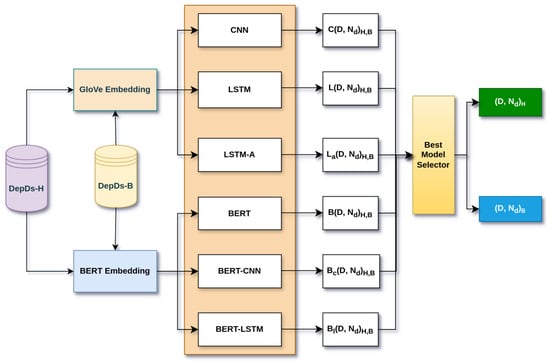
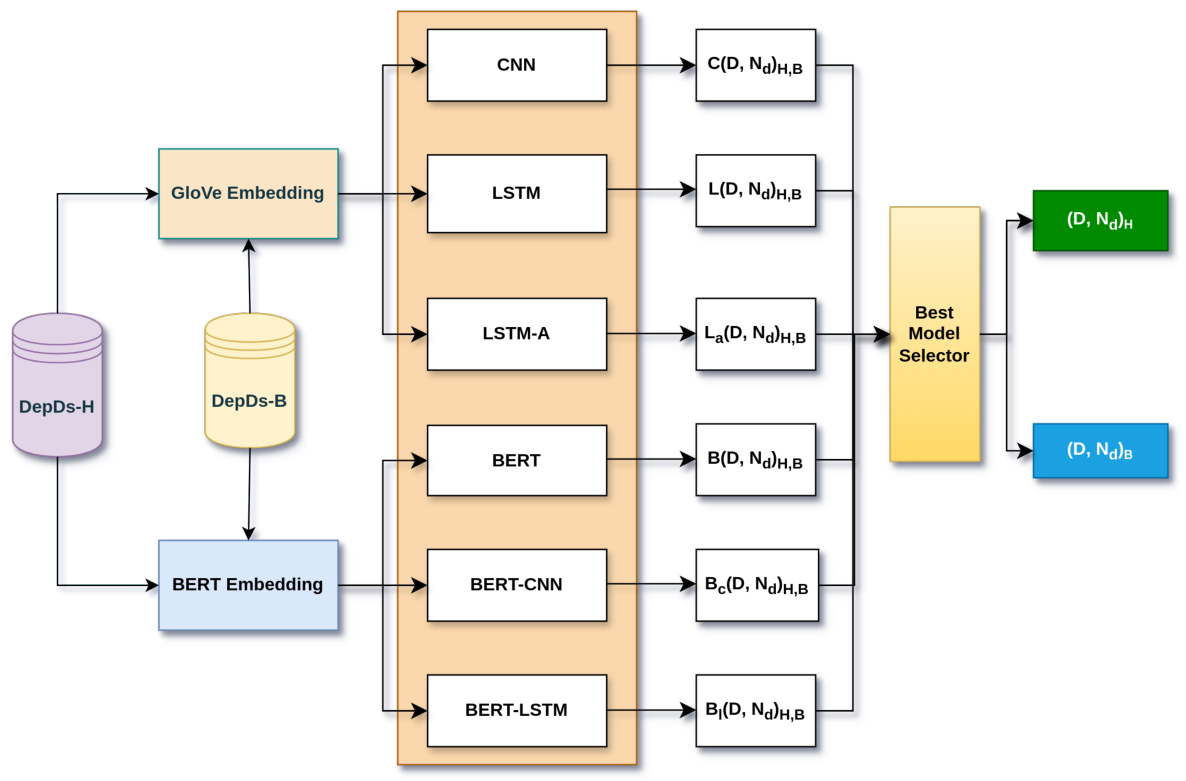
To assess the effectiveness of our proposed system, we also implemented a range of traditional machine learning classifiers for benchmarking purposes. A comprehensive overview of the HFDD architecture is presented in Figure 1.
Figure 1.
The proposed architecture for depression detection.
3.1. Dataset Description
The dataset used in this study was curated specifically for identifying depressive posts in the low-resource Bhojpuri language on X (formerly Twitter), as publicly available datasets on this topic in Bhojpuri are rare. In brief, we collected 12,029 Bhojpuri tweets manually from X (formerly Twitter), with 7029 tweets labeled as depressive and 5000 as non-depressive. Tweets were collected using depression-related hashtags (e.g., #depression, #mentalhealth, #sad) and keywords. All hashtags used for labelling were removed from the input text before model training to prevent label leakage and ensure that models learn from linguistic content rather than label-revealing metadata.
The labelling was carried out independently by three postgraduate students. Final labels were assigned using a voting-based methodology, where a label was confirmed if two or more students agreed. The inter-rater agreement, assessed using Cohen’s Kappa (calculated as the mean of pairwise Kappa values between the three annotators), was 0.85, indicating the high reliability of the labelling process. The existing Bhojpuri dataset was translated into Hindi, resulting in two distinct datasets: DepDs-B (Bhojpuri) and DepDs-H (Hindi). To validate the proposed HFDD framework across the languages (Bhojpuri and Hindi), the translation of the DepDs-B dataset was performed. Another motivation to do so was that the Hindi language offers a richer set of contextual cues and semantic traits compared to other regional low-resource languages of India, such as Bhojpuri.
The translation process was carefully performed to preserve the content and context, essential for depression detection. The initial translation was performed using Google Translate, followed by manual validation and correction by two native speakers (one Hindi, one Bhojpuri) with relevant linguistic training, and a third expert (post-graduate level) resolved any disagreements. To verify translation quality, a back-translation method was employed, where another expert translated the Bhojpuri posts back into Hindi to check for consistency. A distribution-wise overview of the datasets has been provided in Table 4.
Table 4.
Statistics of datasets used in this work.
3.2. Machine Learning Models
To establish baseline performance comparisons, we employed several widely used machine learning algorithms, including: (i) Support Vector Machine (SVM), (ii) Naive Bayes (NB), (iii) Logistic Regression (LR), (iv) Decision Tree (DT), (v) K-Nearest Neighbors (KNN), (vi) Gradient Boosting (GB), and (vii) Random Forest (RF). These classifiers were trained using text-based features extracted using Term Frequency–Inverse Document Frequency (TF-IDF) representations, capturing 1-g, 2-g, and 3-g patterns from the input data. The evaluation outcomes for these models are discussed in Section 4.
3.3. Deep Learning Models
In this work, we used six well-established deep learning models for depression detection: (i) Convolutional Neural Network (CNN), (ii) Long Short-Term Memory (LSTM) network, (iii) attention-based LSTM (LSTM-A), (iv) Bidirectional Encoder Representations from Transformers (BERT), (v) BERT-CNN, and (vi) BERT-LSTM. For the CNN and LSTM models, we utilized pre-trained GloVe (https://aclanthology.org/D14-1162/) (accessed on 18 July 2026) embeddings to represent input text as dense vectors, capturing semantic similarity between words. In the case of BERT-based models, input sequences were processed using contextual embeddings generated by the BERT tokenizer. We used the multilingual BERT checkpoint bert-base-multilingual-cased, which has a vocabulary of 119,547 tokens. The maximum sequence length was set to 128 tokens, and the CLS token pooling strategy was employed for classification. Fine-tuning was performed on the last 4 transformer layers using the AdamW optimizer with a learning rate of , batch size of 32, and 3 epochs with early stopping (patience = 2). A dropout rate of 0.1 was applied during training.
Figure 1 illustrates the complete architecture of the Hybrid Framework for Depression Detection (HFDD). The framework combines GloVe and BERT embeddings with a variety of deep learning models to identify depressive expressions across multilingual datasets, including Bhojpuri and Hindi. CNNs and LSTMs process GloVe-embedded inputs, while BERT-based models are fine-tuned individually or enhanced with CNN/LSTM layers to capture richer semantic and sequential patterns. The final predictions from these models are evaluated using a selector module that identifies the best-performing model for each dataset. This multi-model strategy emphasizes the effectiveness of BERT in handling diverse and linguistically complex data.
3.4. Word Embedding Vectors
Transforming textual data into numerical vectors is a crucial preprocessing step for enabling deep learning models to interpret language [44]. In our study, we utilized pre-trained word embeddings to capture rich semantic features from the input text. For example, in a depressive post like “Ham roje bahut akelapan aa nirasha mahsoos kareela”, words such as “akelapan” (loneliness) and “nirasha” (hopelessness) are converted into 100-dimensional embedding vectors. These pre-trained embeddings, known to encode broad semantic relationships in large corpora, are interpreted as potentially useful for capturing concepts like isolation and despair. The semantic quality of these embeddings is indirectly validated through the performance of our downstream classification models. To transform textual data into numerical vectors, we utilized the publicly available pre-trained glove.twitter.27B.100d.txt embeddings [45]. This model provides 100-dimensional vectors for over 1.2 million words from a large corpus of English X (formerly Twitter) data. We explicitly initialize an embedding matrix using np.random.random((len(word_index) + 1100)). For words found in the GloVe dictionary, we copy the corresponding vector; for all out-of-vocabulary words (including Bhojpuri words not found in English GloVe), we retain the random initialization rather than setting them to zero, ensuring every token has a non-zero representation. The sequence length for GloVe-based models was set to 32 tokens. We acknowledge that using English GloVe for Bhojpuri is a practical limitation given the lack of publicly available pre-trained Bhojpuri embeddings.
3.5. Convolutional Neural Network
Convolutional neural networks [46,47] are essential for identifying whether a sentence is depressive or not by utilizing the core concept of CNN, i.e., filters on word embedding GloVe that capture the meaningful n-gram and phrase-level context. These features are large in volume, so by applying the pooling concept, only the most important features are kept, and the remaining are discarded. This technique is very effective for shorter and concise-length sentences, especially tweets, where some specific words provide sufficient cues responsible for a post being depressive or not.
3.6. Long Short-Term Memory
In a traditional recurrent neural network (RNN), the shortcoming of long dependency was missing. This problem was tackled in the LSTM network by incorporating the concepts of memory cells having various gates, such as the input, output, forget gates, and a cell state. These gates and the cell state decide what should be updated, kept, or removed based on controlling the information flow. This important mechanism of LSTM lets it preserve the long-term dependency and makes it useful for processing sequential data. A detailed explanation of LSTM operations can be found in [11].
3.7. Attention-Based Long Short-Term Memory
Concentrating on the most relevant parts of the input sequence for depression detection helps the attention-based LSTM (LSTM-A) [48] improve the performance of the LSTM model. The approach gives words or phrases that have a lot of emotional or contextual weight—like statements of despair or hopelessness—more weight by including an attention mechanism. This approach improves interpretability and ensures that the model prioritizes critical information in depressive posts, further refining the detection process.
3.8. BERT Architecture
Irrespective of its context, a word must have the same embedding in all the static embedding techniques, such as GloVe, Word2vec, fastText, etc. For example, consider sentences “Rajnish loves fishing at his nearest bank of the river” and “Rajnish robbed the Central Bank of India near his market”. In both sentences, all the static embedding techniques had the same vector representation for the word “bank”, but in reality, both words had different meanings. All the models that incorporate these embeddings will be trained incorrectly and predict incorrect outcomes. To mitigate this problem, BERT [49] was introduced. To make it more robust, fine-tuning with depressive and non-depressive data was done. The bidirectional transformer and attention mechanism of BERT will understand the complex structure of the sentence along with the context of each word, making it effective for depression detection from multilingual datasets.
3.9. BERT-CNN Architecture
The combination of BERT and CNN integrates the contextual understanding of each word along with the local features. The BERT embedding of each word in the sentence was passed to CNN’s filter, which captures the important features and passes them to the pooling layer for dimensionality reduction. This combined approach makes the model more powerful in detecting depressive posts.
3.10. BERT-LSTM Architecture
The BERT-LSTM model in the architecture combines the powerful contextual embeddings from BERT with the sequential modeling capabilities of LSTM. BERT captures the deep contextual meaning of the text, while LSTM processes these embeddings over time to understand the sequential dependencies in sentences. This combination is particularly beneficial for identifying depression-related cues in complex sentences and multilingual datasets, as it utilizes both context and sequential information to improve classification accuracy.
3.11. Proposed Hybrid Framework for Depression Detection (HFDD)
The proposed Hybrid Framework for Depression Detection (HFDD) integrates multiple embedding techniques and neural network models to classify text samples as depressive (D) or non-depressive (). Initially, the datasets (DepDs-H and DepDs-B) are preprocessed, tokenized, and transformed into embeddings using BERT and GloVe. These embeddings are fed into various models, including CNN: (), LSTM: (), attention-based LSTM: (), BERT: (), BERT-CNN: (), and BERT-LSTM: (). For all the datasets, each model predicted depressive and non-depressive sentences. Best model selector determines the most effective model dynamically for each dataset based on -score on the validation set, providing accurate depressive and non-depressive sentences. The algorithm of the proposed Hybrid Framework for Depression Detection (HFDD) is described in Algorithm 1.
| Algorithm 1 Hybrid Framework for Depression Detection (HFDD) |
| 1: procedure HFDD(D) 2: Input: Dataset D, pre-trained embeddings (BERT, GloVe) 3: Output: Depression label for each sample 4: for each sample do 5: Pt ← Preprocess 6: T ← Tokenizer 7: E ← Embedding 8: if Embedding = BERT then 9: B ← FineTuneBERT 10: Bc ← CNN 11: Bl ← LSTM 12: else 13: C ← CNN 14: L ← LSTM 15: La ← Attention 16: P ← Evaluate 17: M ← BestModelSelector 18: for each prediction do 19: if then 20: Label sample as Depressive 21: else 22: Label sample as Non-Depressive |
4. Results
To evaluate the supremacy of the proposed HFDD framework, we conducted comprehensive experiments with conventional machine-learning and deep-learnig based models. The performance of the system were assessed using well-known metrics such as precision, recall, -score, the area under receiver operating characteristic curve (AUC-ROC), and the confusion matrix. Definitions and formulas for these well-known performance metrics are detailed in Section 4.1. For clarity, this section is bifurcated into two parts: (i) evaluation of machine learning models, and (ii) evaluation of deep learning models.
4.1. Evaluation Metrics
For a quantitative measure of classification performance, we employed precision, recall, -score. The weighted -score was calculated as the weighted average of class-specific -scores, where the weight for each class is the proportion of samples in that class. Precision determines the proportion of correctly identified depressive posts among all posts predicted as depressive. It is formally defined as:
Recall captures the proportion of depressive posts that were correctly identified out of all actual depressive posts. It can be expressed as:
The -score, which is computed as the harmonic mean of precision and recall, offers a balance between the two. It is given by:
AUC-ROC (Area Under the Receiver Operating Characteristic Curve) measures the overall ability of the model to discriminate between positive and negative classes across all possible classification thresholds. It is calculated as the area under the curve plotted with True Positive Rate (Recall) against False Positive Rate. A confusion matrix is a table that summarizes the classification performance by showing the counts of True Positives (TP), True Negatives (TN), False Positives (FP), and False Negatives (FN), providing insight into the types of errors the model makes.
These metrics allow for a nuanced evaluation of how well the system distinguishes depressive from non-depressive content across different classification models.
4.2. Investigation of Machine Learning Techniques
The evaluation of conventional machine-learning models on the DepDs-B and DepDs-H datasets demonstrates varying performance across different algorithms (please see Table 5). SVM consistently achieved high precision, recall, and -scores, with weighted -scores of 0.86 and 0.87, respectively, for both the DepDs-B and DepDs-H datasets, indicating robust performance for both depressive and non-depressive classes. LR showed competitive results with weighted -scores of 0.84 and 0.86, respectively, for both the DepDs-B and DepDs-H datasets, emphasizing its reliability for text classification tasks. RF exhibited inconsistent performance, particularly for the depressive class, with low -scores of 0.54 and 0.55 on DepDs-B and DepDs-H, respectively, despite achieving high recall for the non-depressive class. DT demonstrated more balanced results across both datasets, achieving weighted -scores of 0.79 and 0.80, indicating moderate but consistent performance. KNN performed slightly better, with -scores of 0.81 and 0.83, showing reliability across both classes and datasets. In contrast, NB yielded competitive results for the non-depressive class but struggled with lower -scores of 0.71 and 0.72 for the depressive class. Gradient Boosting (GB) demonstrated competitive performance, achieving weighted -scores of 0.82 and 0.84 on DepDs-B and DepDs-H, respectively, performing comparably to LR and KNN. These findings underscore the relative stability of KNN and DT, while RF and NB faced challenges in accurately identifying depressive instances.
Table 5.
Results of Conventional Machine-Learning Models on DepDs-B and DepDs-H. The best result in each column has been highlighted in bold.
4.3. Investigation of Deep Learning Techniques
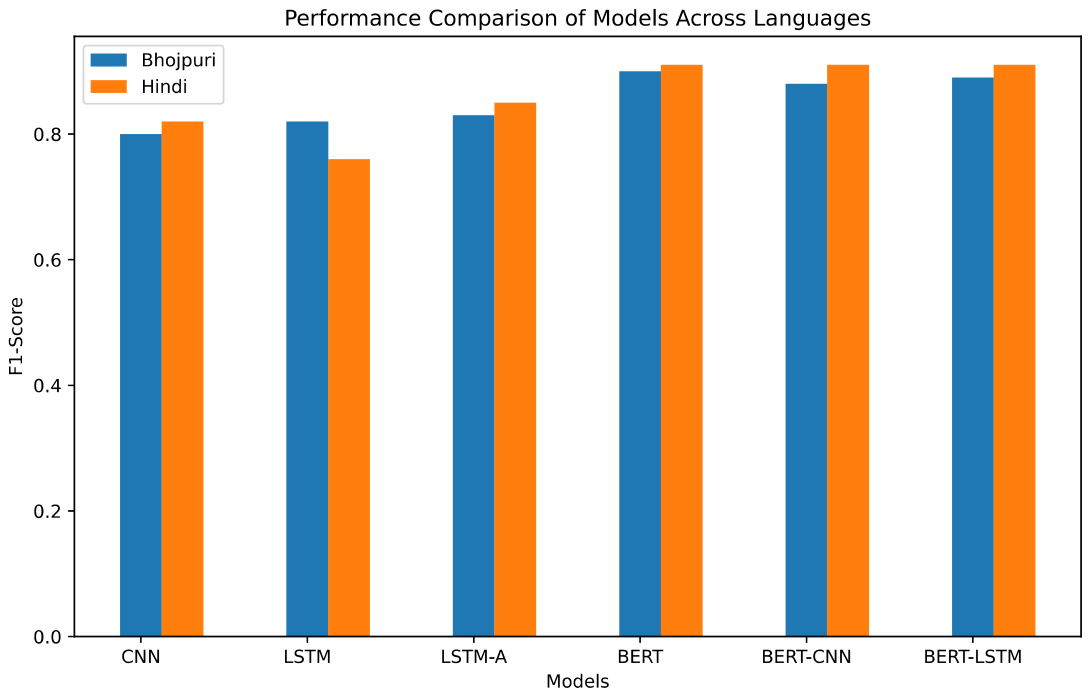
The performance evaluation of deep-learning models on the DepDs-B and DepDs-H datasets highlights the superiority of models incorporating BERT embeddings (please see Table 6). Among all models, BERT-LSTM achieved the highest weighted -score of 0.91 on DepDs-H, demonstrating its ability to leverage contextual embeddings and sequential features effectively. BERT alone also performed competitively, with weighted -scores of 0.90 on both DepDs-B and DepDs-H. BERT-CNN achieved a weighted -score of 0.88 on DepDs-B and 0.90 on DepDs-H. Traditional models like CNN and LSTM showed moderate performance, with CNN achieving an -score of 0.80 on DepDs-B and 0.82 on DepDs-H, and LSTM reaching 0.82 on DepDs-B and 0.76 on DepDs-H. The LSTM-Attention model achieved -scores of 0.83 on DepDs-B and 0.85 on DepDs-H. These results emphasize the advantage of hybrid architectures that combine BERT embeddings with additional layers, such as LSTM, for robust depressive post-detection in multilingual datasets.
Table 6.
Results of deep-learning models on DepDs-B and DepDs-H datasets. The best result in each column has been highlighted in bold.
For the best-performing models, BERT achieved an AUC-ROC of 0.95 on DepDs-B and 0.96 on DepDs-H, while BERT-LSTM achieved an AUC-ROC of 0.95 on DepDs-B and 0.96 on DepDs-H.
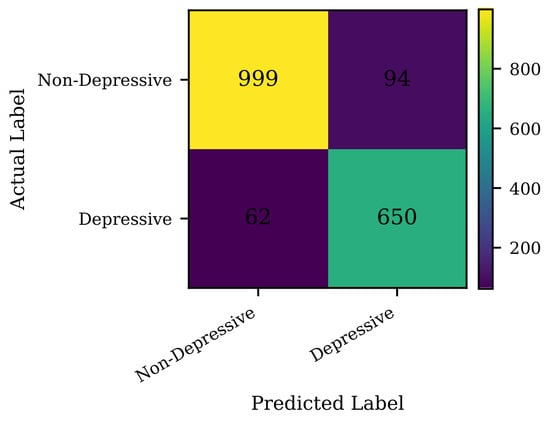
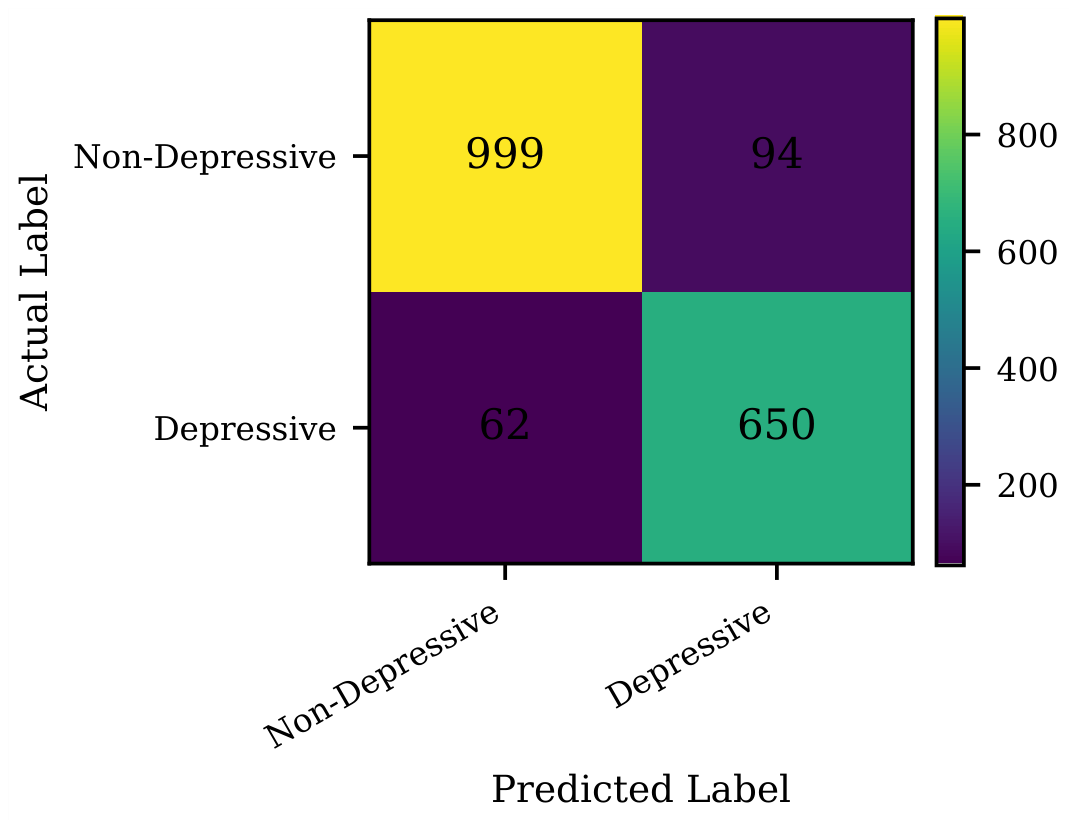
Figure 2 presents the confusion matrix for the BERT-LSTM model on the DepDs-H test set. The model correctly identified 1048 depressive posts as depressive (TP) and 780 non-depressive posts as non-depressive (TN), while misclassifying 78 depressive posts as non-depressive (FN) and 100 non-depressive posts as depressive (FP). This indicates a high sensitivity to depressive content with a relatively low false positive rate.
Figure 2.
Confusion Matrix for BERT-LSTM on DepDs-H.
4.4. Experimental Protocol
To ensure reproducibility and transparency, all experiments were conducted using the following protocol. The datasets were partitioned into training, validation, and test sets using a stratified 70/15/15 split, resulting in 8420 training, 1804 validation, and 1805 test instances. The split was performed at the post level (not user level), which is a limitation acknowledged in Section 6. A random seed of 42 was used for reproducibility, and each experiment was repeated 5 times with different seeds to report mean performance. Class weighting was applied using scikit-learn’s ‘class_weight=‘balanced” to address the class imbalance. Hyperparameter selection was performed via grid search on the validation set. All experiments were conducted on an NVIDIA T4 GPU with 16 GB memory.
5. Discussion
The outcomes of various conventional machine learning classifiers are summarized in Table 5. Among these models, Support Vector Machine (SVM) achieved the highest weighted -score of 0.87 on the DepDs-H dataset, closely followed by Logistic Regression (LR) with an -score of 0.86, indicating their strong and consistent performance across both datasets. K-Nearest Neighbors (KNN) also performed competitively, reaching a weighted -score of 0.83 on DepDs-H. Decision Tree (DT) and Naive Bayes (NB) provided moderate yet stable results, with weighted -scores ranging from 0.77 to 0.80. In contrast, Random Forest (RF) showed the most variability, particularly for the depressive class, where it yielded a low -score of 0.54 on DepDs-B. Gradient Boosting (GB) provided robust and competitive results, with weighted -scores of 0.82 (DepDs-B) and 0.84 (DepDs-H), outperforming DT, NB, and RF. All models were evaluated using standard classification metrics—Precision, Recall, and -score—across both DepDs-B and DepDs-H datasets, offering insight into their relative effectiveness for depression detection in multilingual social media text.
Among deep-learning models, CNN showed moderate performance, achieving a weighted -score of 0.80 on DepDs-B and 0.82 on DepDs-H. LSTM struggled with multilingual datasets, achieving 0.82 on DepDs-B and 0.76 on DepDs-H. The LSTM-Attention model improved performance by leveraging attention mechanisms, achieving -scores of 0.83 (DepDs-B) and 0.85 (DepDs-H). Meanwhile, BERT consistently outperformed traditional models, with weighted -scores of 0.90 (DepDs-B) and 0.90 (DepDs-H), owing to its superior ability to encode contextual and multilingual information. BERT-CNN combined BERT’s contextual strengths with CNN’s feature extraction, achieving an -score of 0.90 on DepDs-H. The BERT-LSTM hybrid emerged as the best model, attaining the highest -score of 0.91 on DepDs-H, demonstrating the advantages of integrating BERT with sequential modeling for depression detection.
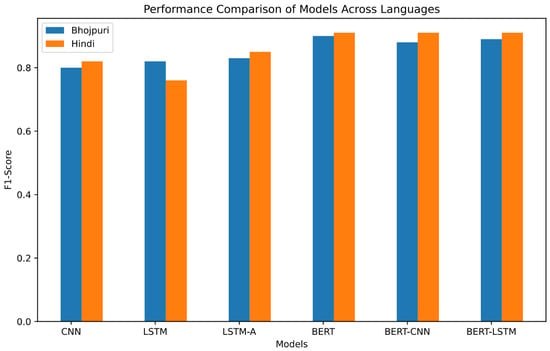
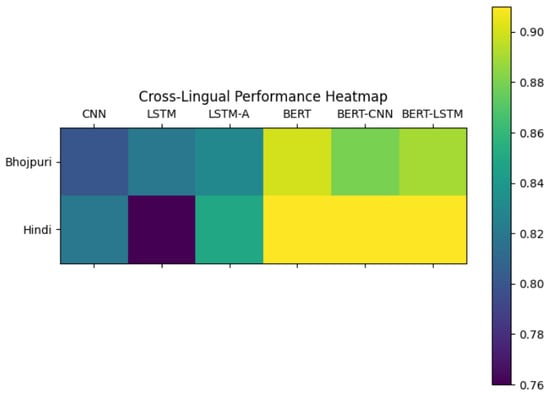
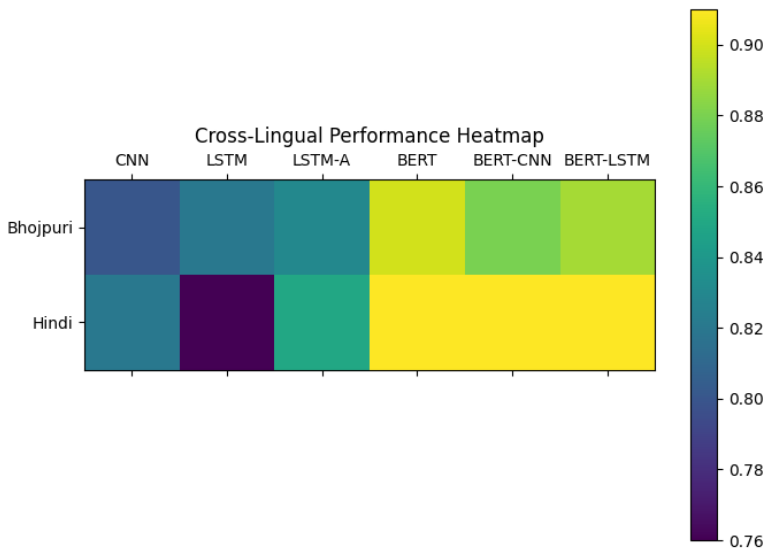
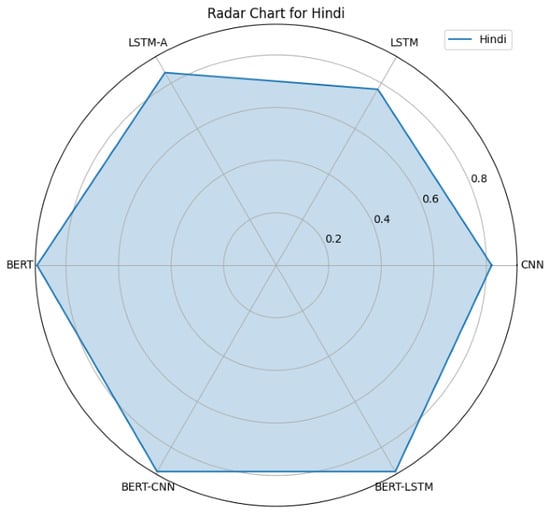
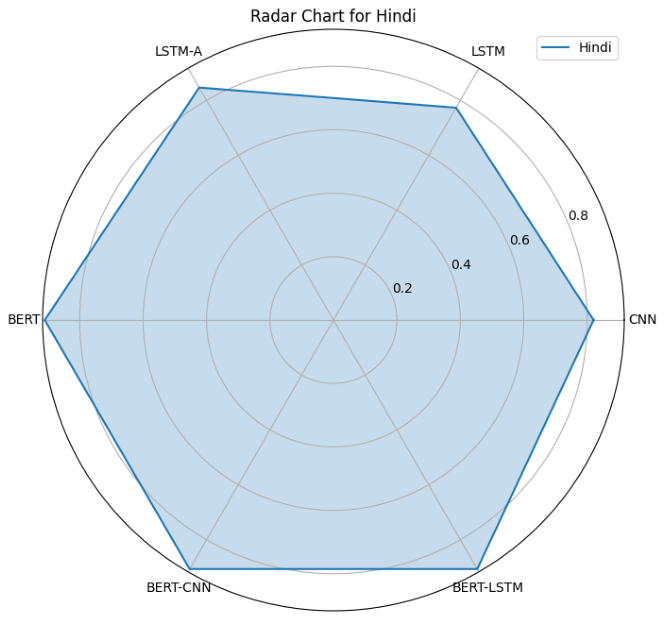
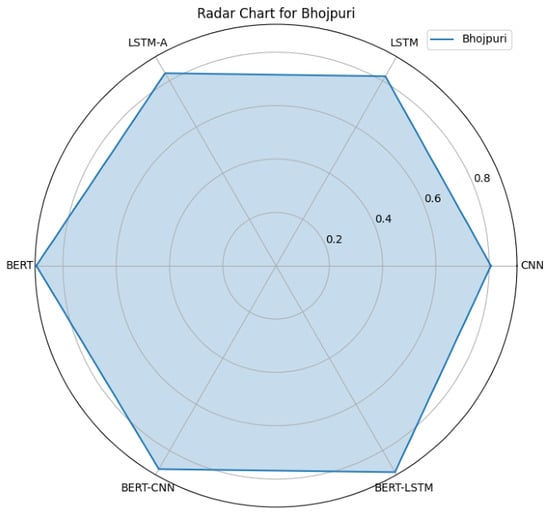
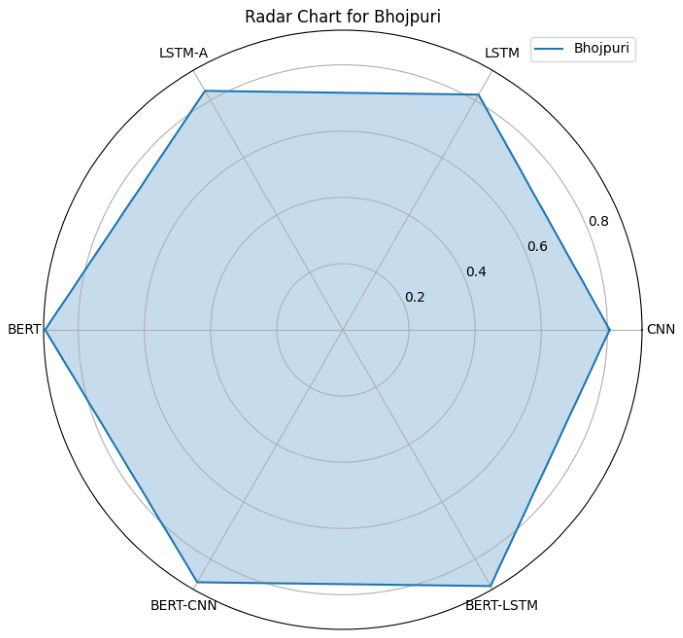
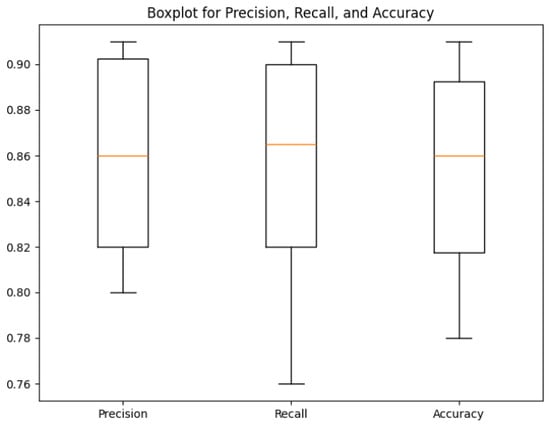
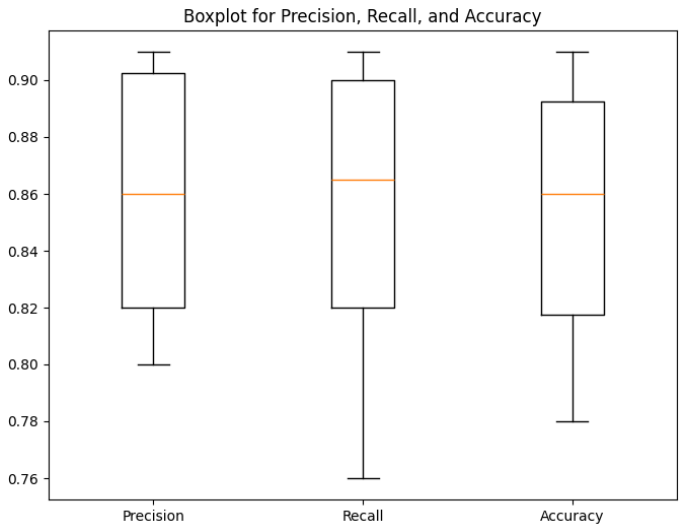
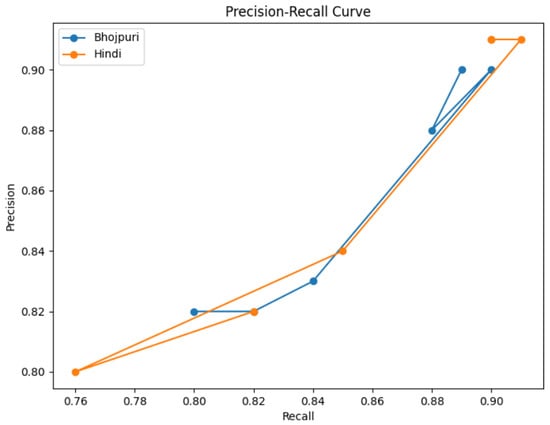
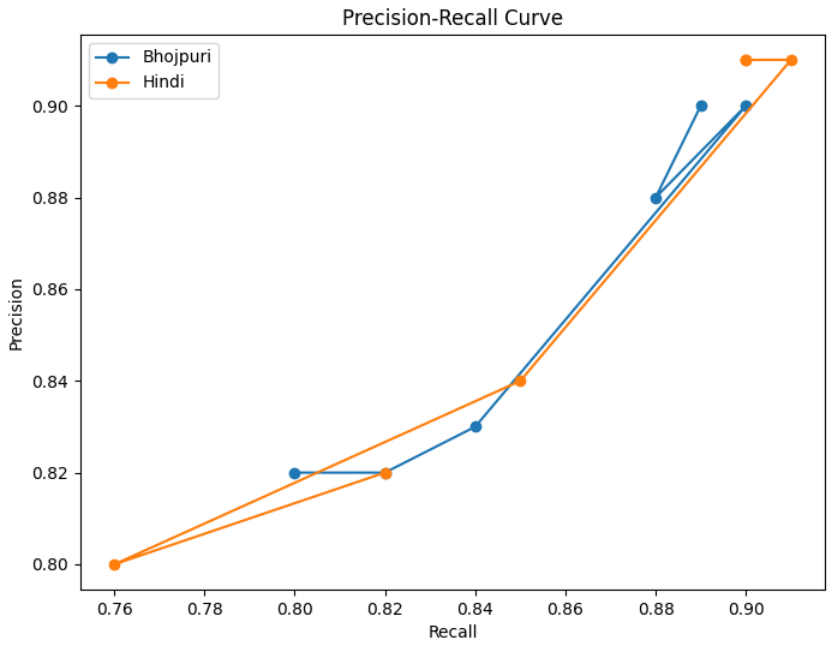
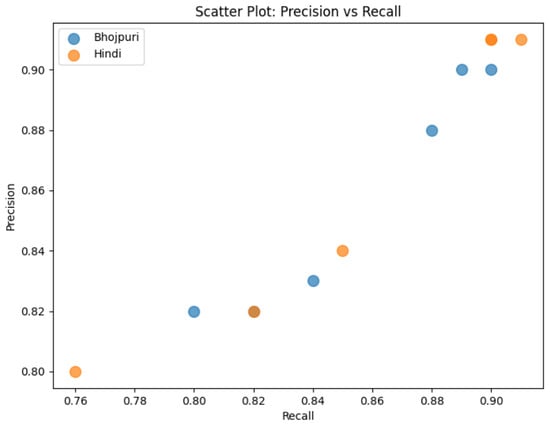
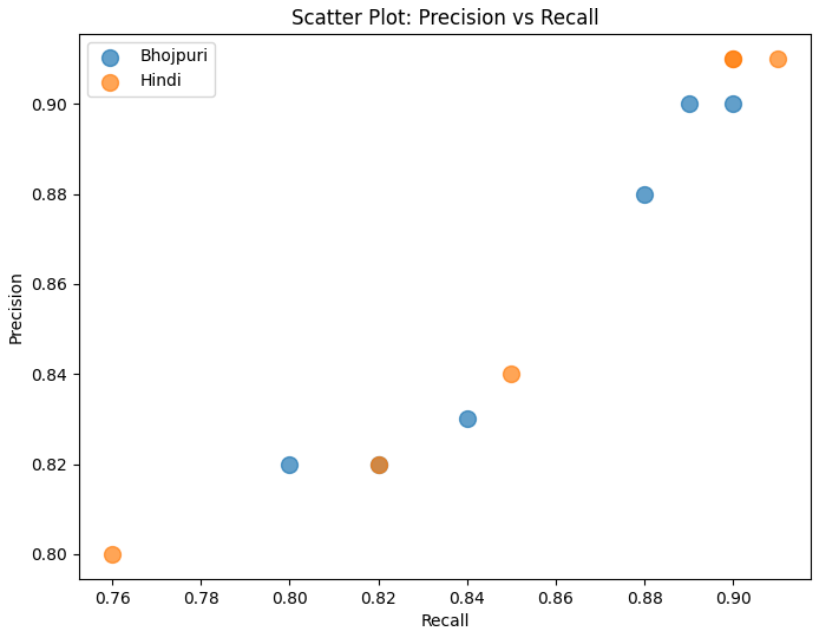
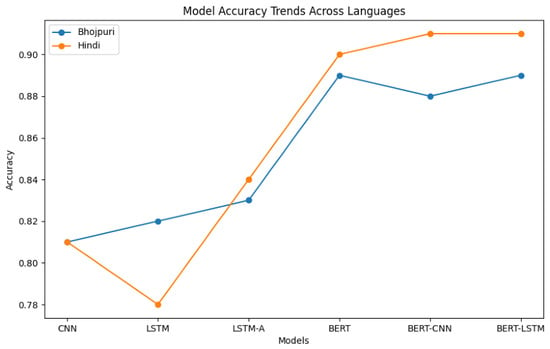
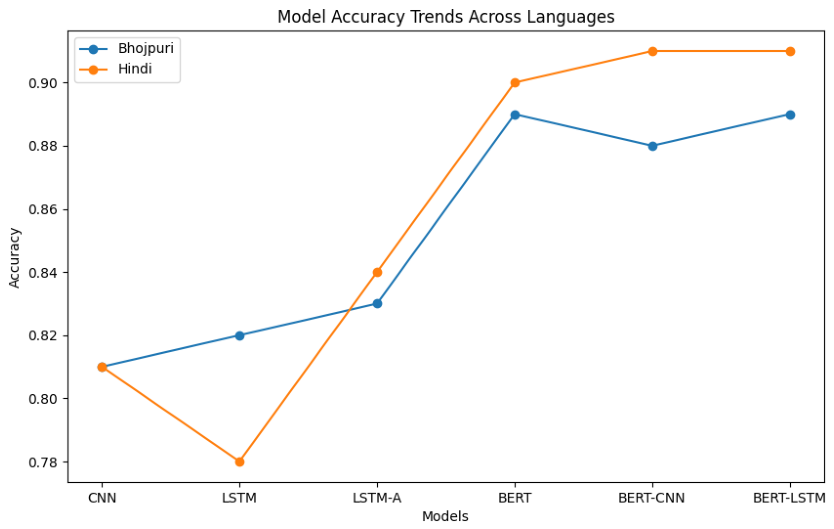
The visual analysis of model performance provides deeper insights. Figure 3 presents the performance comparison across deep-learning models, while the heatmap (Figure 4) illustrates weighted -scores across languages, showing Bhojpuri achieving 0.90 and Hindi 0.91 in the best-performing models. The radar plots (Figure 5 and Figure 6) highlight multi-metric performance, with high Precision and Recall values for Bhojpuri (0.90) and Hindi (0.91). The box plot (Figure 7) reveals that Bhojpuri exhibits the most variability, while Hindi shows more consistency across models. Additionally, Precision-Recall curve Figure 8 and scatter plot (Figure 9) emphasize the trade-off between Precision and Recall. Lastly, the model accuracy trend plot (Figure 10) highlights how CNN starts at 0.87, while BERT achieves the highest accuracy of 0.91 (Hindi) and 0.90 (Bhojpuri).
Figure 3.
Performance Comparison across Hindi and Bhojpuri Datasets.
Figure 4.
Heatmap distribution.
Figure 5.
Radar Chart distribution of Hindi dataset.
Figure 6.
Radar Chart distribution of Bhojpuri dataset.
Figure 7.
Box plot using precision, recall, and accuracy over the Hindi and Bhojpuri dataset.
Figure 8.
Precision-Recall curve for Hindi and Bhojpuri dataset.
Figure 9.
Scatter plot using precision and recall.
Figure 10.
Model accuracy trends for Hindi and Bhojpuri datasets.
Error Analysis
To better understand the model’s limitations, we conducted a qualitative error analysis on the misclassified instances from the BERT model on DepDs-B. Common error patterns include: (1) code-mixed posts where Bhojpuri is mixed with Hindi or English, which sometimes confused the model; (2) posts containing negation (e.g., “nahi” meaning “not”) that reversed the expected sentiment; (3) culturally specific expressions that do not have direct equivalents in the training data; and (4) sarcastic or ironic posts where the literal meaning differs from the intended sentiment. These findings suggest that while BERT performs well overall, handling code-mixing, negation, and cultural nuances remains challenging.
These results underscore the superiority of transformer-based models, particularly hybrid architectures, in handling multilingual and complex datasets. While traditional models like CNN and LSTM offer moderate baseline performance, BERT and its hybrid configurations consistently outperform them. However, the high computational cost of transformers may hinder real-world deployment. Future work should explore lightweight transformer models through knowledge distillation or model pruning to optimize performance while reducing computational overhead. Additionally, the public unavailability of datasets used in previous studies restricted direct comparisons with other depression detection frameworks. The generalizability of these models to other domains or multilingual contexts requires further investigation to ensure their practical applicability.
6. Conclusions
The presence and detection of depression from textual posts on social media becomes more challenging, especially if they are multilingual and noisy. Each language has its way of expressing sentiment, along with various psychological structures to convey the exact meaning of the sentence. In this work, the above gaps are mitigated to some extent by using both conventional and deep learning-based models for depression detection on the DepDs-H and DepDs-B datasets.
Among various conventional classifiers, SVM outperformed with an average weighted -score of 0.86, followed closely by LR with a score of 0.84, showcasing their effectiveness in multilingual depression classification. KNN also demonstrated reliable performance with an average -score of 0.81 across both datasets. DT and NB delivered moderate results, averaging 0.79 and 0.77, respectively. In contrast, RF was the weakest performer with a lower average weighted -score of 0.70, primarily due to its poor detection of depressive instances. GB performed competitively, with an average weighted -score of 0.83. These outcomes suggest that linear classifiers like SVM and LR are better suited for capturing depression-related patterns in multilingual textual data compared to ensemble or tree-based methods.
These outcomes show why the transformer-based models, along with LSTM and CNN, are effective in detecting depressive posts from social media posts written in multilingual text. However, computationally implementing these transformer-based models heavily depends on high-cost resources, leading to future research for low-resource languages in the field of depression detection.
Limitations
Several limitations must be acknowledged. First, DepDs-H is a translation of DepDs-B rather than an independently collected Hindi corpus; therefore, the two datasets are parallel and do not provide independent evidence of cross-lingual generalizability. Second, the split was performed at the post level, not the user level, which may lead to inflated performance if posts from the same user appear in both training and test sets. Third, the dataset is relatively small (12,029 samples) compared to typical benchmark datasets. Fourth, the model was evaluated only on social media text, and its performance on other text types remains unexplored. Finally, the model identifies depression-related textual content, not clinically validated diagnoses. Finally, we note that the pre-trained word embeddings used for the GloVe-based models (CNN, LSTM, LSTM-A) were derived from English X (formerly Twitter) data, not from a Bhojpuri corpus. This may limit the semantic quality of the representations for Bhojpuri text, and we plan to address this in future work by training domain-specific Bhojpuri embeddings.
Author Contributions
Conceptualization, S.S.T. and A.D.; methodology, S.S.T. and A.D.; software, S.S.T.; validation, S.S.T., A.D. and R.P.; formal analysis, S.S.T. and R.P.; investigation, S.S.T. and R.P.; resources, A.D.; data curation, S.S.T.; writing—original draft preparation, S.S.T.; writing—review and editing, S.S.T., A.D., R.P., J.P.S. and S.T.; visualization, S.S.T. and R.P.; supervision, A.D. All authors have read and agreed to the published version of the manuscript.
Funding
This research received no external funding.
Institutional Review Board Statement
Ethical review and approval were waived for this study due to the use of a publicly available social media data and did not interact with users directly. No individual-level information, personal identifiers, or sensitive personal data were available in the paper.
Informed Consent Statement
Informed consent was waived due to the study using publicly accessible data.
Data Availability Statement
The datasets and source code supporting the findings of this study are available at Zenodo: https://doi.org/10.5281/zenodo.21943175 (accessed 11 October 2026). The code and associated resources are also available at https://github.com/rajnish8807riday/Code (accessed 11 October 2026).
Conflicts of Interest
The authors declare no conflicts of interest.
Abbreviations
The following abbreviations are used in this manuscript:
| AI | Artificial Intelligence |
| BERT | Bidirectional Encoder Representations from Transformers |
| Bi-GRU | Bidirectional Gated Recurrent Unit |
| Bi-LSTM | Bidirectional Long Short-Term Memory |
| BoW | Bag-of-Words |
| CNN | Convolutional Neural Network |
| DepDs-B | Bhojpuri Depression Dataset |
| DepDs-H | Hindi Depression Dataset |
| DL | Deep Learning |
| DT | Decision Tree |
| EEG | Electroencephalography |
| F1 | -score |
| GB | Gradient Boosting |
| GloVe | Global Vectors for Word Representation |
| GRU | Gated Recurrent Unit |
| HAN | Hierarchical Attention Network |
| HFDD | Hybrid Framework for Depression Detection |
| KNN | K-Nearest Neighbour |
| LIWC | Linguistic Inquiry and Word Count |
| LR | Logistic Regression |
| LSTM | Long Short-Term Memory |
| LSTM-A | Attention-based Long Short-Term Memory |
| MDHAN | Multi-Modal Depression Detection with Hierarchical Attention Network |
| ML | Machine Learning |
| NB | Naïve Bayes |
| NLP | Natural Language Processing |
| POS | Part-of-Speech |
| RF | Random Forest |
| RMSE | Root Mean Square Error |
| SHAP | SHapley Additive exPlanations |
| SVM | Support Vector Machine |
| TF-IDF | Term Frequency–Inverse Document Frequency |
| XAI | Explainable Artificial Intelligence |
| XGBoost | Extreme Gradient Boosting |
References
- Guntuku, S.C.; Yaden, D.B.; Kern, M.L.; Ungar, L.H.; Eichstaedt, J.C. Detecting depression and mental illness on social media: An integrative review. Curr. Opin. Behav. Sci. 2017, 18, 43–49. [Google Scholar] [CrossRef] [Scilit]
- Chancellor, S.; De Choudhury, M. Methods in predictive techniques for mental health status on social media: A critical review. npj Digit. Med. 2020, 3, 1–11. [Google Scholar] [CrossRef] [Scilit] [PubMed]
- Orabi, A.H.; Buddhitha, P.; Orabi, M.H.; Inkpen, D. Deep learning for depression detection of twitter users. In Proceedings of the Fifth Workshop on Computational Linguistics and Clinical Psychology: From Keyboard to Clinic, New Orleans, LA, USA, 5 June 2018; pp. 88–97. [Google Scholar]
- Yates, A.; Cohan, A.; Goharian, N. Depression and self-harm risk assessment in online forums. In Proceedings of the 2017 Conference on Empirical Methods in Natural Language Processing, Copenhagen, Denmark, 7–11 September 2017; pp. 2968–2978. [Google Scholar]
- Alhuzali, H.; Anastasopoulos, A. English-only models fail on multilingual social media text: Introducing Text+Language Modeling. In Proceedings of the 2021 Conference on Empirical Methods in Natural Language Processing, Punta Cana, Dominican Republic, 7–11 November 2021; pp. 7415–7425. [Google Scholar]
- Joshi, P.; Santy, S.; Budhiraja, A.; Bali, K.; Choudhury, M. The state and fate of linguistic diversity and inclusion in the NLP world. In Proceedings of the 58th Annual Meeting of the Association for Computational Linguistics, Seattle, WA, USA, 5–10 July 2020; pp. 6282–6293. [Google Scholar]
- Gupta, V.; Kaushik, V.; Garg, R. Mental health discourse on Indian social media: A multilingual perspective. Comput. Speech Lang. 2022, 73, 101318. [Google Scholar]
- McCarthy, A.D.; Duh, K.; Neubig, G. A survey of the challenges of building natural language processing systems for low-resource languages. J. Artif. Intell. Res. 2021, 71, 569–595. [Google Scholar]
- Singh, A.; Mishra, A.; Kumar, M. A survey of natural language processing research for Bhojpuri and other closely related languages. In Proceedings of the Workshop on NLP for Less Resourced Languages (NLP4LRL), Online, 25 September 2022. [Google Scholar]
- Kim, Y. Convolutional neural networks for sentence classification. In Proceedings of the 2014 Conference on Empirical Methods in Natural Language Processing (EMNLP), Doha, Qatar, 25–29 October 2014; pp. 1746–1751. [Google Scholar]
- Hochreiter, S.; Schmidhuber, J. Long short-term memory. Neural Comput. 1997, 9, 1735–1780. [Google Scholar] [CrossRef] [Scilit] [PubMed]
- Bahdanau, D.; Cho, K.; Bengio, Y. Neural machine translation by jointly learning to align and translate. arXiv 2014, arXiv:1409.0473. [Google Scholar]
- Devlin, J.; Chang, M.-W.; Lee, K.; Toutanova, K. BERT: Pre-training of deep bidirectional transformers for language understanding. In Proceedings of the NAACL-HLT, Minneapolis, MI, USA, 2–7 June 2019; pp. 4171–4186. [Google Scholar]
- Sun, C.; Qiu, X.; Huang, X. Fine-tune BERT for text classification with CNN. In Proceedings of the International Conference on Natural Language Processing and Chinese Computing, Dunhuang, China, 9–14 October 2019; pp. 174–186. [Google Scholar]
- Xu, H.; Liu, B.; Shu, L.; Yu, P.S. BERT-LSTM for emotion detection from textual conversations. In Proceedings of the 2019 Conference of the North American Chapter of the Association for Computational Linguistics: Human Language Technologies, Minneapolis, MI, USA, 2–7 June 2019; pp. 165–170. [Google Scholar]
- Upadhyay, D.K.; Mohapatra, S.; Singh, N.K. An early assessment of Persistent Depression Disorder using machine learning algorithm. Multimed. Tools Appl. 2024, 83, 49149–49171. [Google Scholar] [CrossRef] [Scilit]
- Kim, J.; Uddin, Z.A.; Lee, Y.; Nasri, F.; Gill, H.; Subramanieapillai, M.; Lee, R.; Udovica, A.; Phan, L.; Lui, L.; et al. A Systematic Review of the Validity of Screening Depression through Facebook, X (formerly Twitter), Instagram, and Snapchat. J. Affect. Disord. 2021, 286, 360–369. [Google Scholar] [CrossRef] [Scilit] [PubMed]
- Das, R.; Banerjee, P. ML-Based Depression Detection on Facebook Posts. In Proceedings of the AIAI, Hersonissos, Crete, 24–26 May 2019; pp. 321–327. [Google Scholar]
- Low, D.M.; Rumker, L.; Talkar, T.; Torous, J.; Cecchi, G.; Ghosh, S.S. Natural Language Processing Reveals Vulnerable Mental Health Support Groups and Heightened Health Anxiety on Reddit During COVID-19: Observational Study. J. Med. Internet Res. 2020, 22, e22635. [Google Scholar] [CrossRef] [Scilit] [PubMed]
- Wang, X.; Chen, S.; Li, T.; Li, W.; Zhou, Y.; Zheng, J.; Zhang, Y.; Tang, B. Assessing Depression Risk in Chinese Microblogs: A Corpus and Machine Learning Methods. In Proceedings of the IEEE International Conference on Healthcare Informatics (ICHI), Xi’an, China, 10–13 June 2019; pp. 1–5. [Google Scholar]
- Zogan, H.; Wang, X.; Jameel, S.; Xu, G. Depression detection with multi-modalities using a hybrid deep learning model on social media. arXiv 2020, arXiv:2007.02847. [Google Scholar]
- Oh, J.; Yun, K.; Maoz, U.; Kim, T.-S.; Chae, J.-H. Identifying depression in the National Health and Nutrition Examination Survey data using a deep learning algorithm. J. Affect. Disord. 2019, 257, 623–631. [Google Scholar] [CrossRef] [Scilit] [PubMed]
- Mumtaz, W.; Qayyum, A. A deep learning framework for automatic diagnosis of unipolar depression. Int. J. Med. Inform. 2019, 132, 103983. [Google Scholar] [CrossRef] [Scilit] [PubMed]
- Lam, G.; Dongyan, H.; Lin, W. Context-aware deep learning for multi-modal depression detection. In Proceedings of the ICASSP 2019–2019 IEEE International Conference on Acoustics, Speech and Signal Processing (ICASSP), Brighton, UK, 12–17 May 2019; pp. 3946–3950. [Google Scholar]
- Yang, L.; Jiang, D.; Xia, X.; Pei, E.; Oveneke, M.C.; Sahli, H. Multimodal measurement of depression using deep learning models. In Proceedings of the 7th Annual Workshop on Audio/Visual Emotion Challenge, Mountain View, CA, USA, 23 October 2017; pp. 53–59. [Google Scholar]
- Wang, X.; Chen, S.; Li, T.; Li, W.; Zhou, Y.; Zheng, J.; Chen, Q.; Yan, J.; Tang, B. Depression Risk Prediction for Chinese Microblogs via Deep-Learning Methods: Content Analysis. JMIR Med. Inform. 2020, 8, e17958. [Google Scholar] [CrossRef] [Scilit] [PubMed]
- Wongkoblap, A.; Vadillo, M.A.; Curcin, V. Deep Learning With Anaphora Resolution for the Detection of Tweeters With Depression: Algorithm Development and Validation Study. JMIR Ment. Health 2021, 8, e19824. [Google Scholar] [CrossRef] [Scilit] [PubMed]
- Lin, H.; Sun, K. Mental Health Detection with BERT-LSTM on Social Media. PLoS ONE 2022, 17, e0268954. [Google Scholar] [PubMed]
- Wu, M.Y.; Shen, C.-Y.; Wang, E.T.; Chen, A.L.P. A deep architecture for depression detection using posting, behavior, and living environment data. J. Intell. Inf. Syst. 2020, 54, 225–244. [Google Scholar] [CrossRef] [Scilit]
- Shetty, N.P.; Muniyal, B.; Anand, A.; Kumar, S.; Prabhu, S. Predicting depression using deep learning and ensemble algorithms on raw twitter data. Int. J. Electr. Comput. Eng. 2020, 10, 3751. [Google Scholar] [CrossRef] [Scilit]
- Cong, Q.; Feng, Z.; Li, F.; Xiang, Y.; Rao, G.; Tao, C. XA-BiLSTM: A deep learning approach for depression detection in imbalanced data. In Proceedings of the 2018 IEEE International Conference on Bioinformatics and Biomedicine (BIBM), Madrid, Spain, 3–6 December 2018; pp. 1624–1627. [Google Scholar]
- Rosa, R.L.; Schwartz, G.M.; Ruggiero, W.V.; Rodríguez, D.Z. A knowledge-based recommendation system that includes sentiment analysis and deep learning. IEEE Trans. Ind. Inform. 2018, 15, 2124–2135. [Google Scholar] [CrossRef] [Scilit]
- Shah, F.M.; Ahmed, F.; Joy, S.K.S.; Ahmed, S.; Sadek, S.; Shil, R.; Kabir, M.H. Early Depression Detection from Social Network Using Deep Learning Techniques. In Proceedings of the 2020 IEEE Region 10 Symposium (TENSYMP), Dhaka, Bangladesh, 5–7 June 2020; pp. 823–826. [Google Scholar]
- Bao, E.; Pérez, A.; Parapar, J. Explainable AI for Depression Detection in Social Media Posts. J. Artif. Intell. Res. 2023, 76, 1–15. [Google Scholar] [CrossRef] [Scilit] [PubMed]
- Belcastro, L.; Cantini, R.; Marozzo, F.; Talia, D.; Trunfio, P. Detecting Depression from Social Media Posts using BERT-XDD and Explainable AI. Expert Syst. Appl. 2024, 215, 119874. [Google Scholar]
- Zogan, H.; Razzak, I.; Wang, X.; Jameel, S.; Xu, G. Explainable Multi-Modal Depression Detection using Hierarchical Attention Networks. In Proceedings of the IEEE International Conference on Data Mining (ICDM), Sorrento, Italy, 17–20 November 2020; pp. 987–992. [Google Scholar]
- Zogan, H.; Razzak, I.; Wang, X.; Jameel, S.; Xu, G. Hybrid Deep Learning for Explainable Depression Detection in Social Media. IEEE Trans. Affect. Comput. 2022, 13, 203–215. [Google Scholar]
- Ibrahimov, Y.; Anwar, T.; Yuan, T. Explainable AI for Mental Health: A Review of Depression Detection from Social Media. ACM Comput. Surv. 2024, 56, 1–28. [Google Scholar]
- Kumar, A.; Kumari, J.; Pradhan, J. An Explainable AI Approach for Multilingual Depression Detection using BERT and Bi-LSTMs. In Proceedings of the International Conference on Artificial Intelligence (ICAI), Islamabad, Pakistan, 22–23 February 2023; pp. 321–330. [Google Scholar]
- Alghazzawi, D.; Ullah, H.; Tabassum, N.; Asghar, M.Z. Explainable AI for Suicidal Ideation and Depression Detection from Social Media. Neural Comput. Appl. 2025, 37, 1893–1910. [Google Scholar]
- Salazar, L.M.G.; Loyola-González, O.; Medina-Pérez, M.A. Explainable Contrast Pattern-Based Depression Detection in Social Media. Artif. Intell. Med. 2021, 118, 102132. [Google Scholar]
- Sun, X.; Li, H.; Yu, F. Interpretable Deep Learning for Depression Detection using Linguistic and Psychological Features. Cogn. Comput. 2024, 16, 45–62. [Google Scholar]
- Wang, M.; Zhou, X.; Chen, L. XGBoost and SHAP-based Interpretable Depression Detection from Social Media. J. Biomed. Inform. 2023, 142, 104587. [Google Scholar]
- Kusner, M.; Sun, Y.; Kolkin, N.; Weinberger, K. From word embeddings to document distances. In Proceedings of the International Conference on Machine Learning, Lille, France, 7–9 July 2015; pp. 957–966. [Google Scholar]
- Pennington, J.; Socher, R.; Manning, C.D. GloVe: Global vectors for word representation. In Proceedings of the 2014 Conference on Empirical Methods in Natural Language Processing (EMNLP), Doha, Qatar, 25–29 October 2014; pp. 1532–1543. [Google Scholar]
- Albawi, S.; Mohammed, T.A.; Al-Zawi, S. Understanding of a convolutional neural network. In Proceedings of the 2017 International Conference on Engineering and Technology (ICET), Antalya, Turkey, 21–23 August 2017; pp. 1–6. [Google Scholar]
- Pandey, R.; Kumar, A.; Singh, J.P.; Tripathi, S. A hybrid convolutional neural network for sarcasm detection from multilingual social media posts. Multimed. Tools Appl. 2024, 84, 15867–15895. [Google Scholar] [CrossRef] [Scilit]
- Pandey, R.; Kumar, A.; Singh, J.P.; Tripathi, S. Hybrid attention-based long short-term memory network for sarcasm identification. Appl. Soft Comput. 2021, 106, 107348. [Google Scholar] [CrossRef] [Scilit]
- Pandey, R.; Singh, J.P. BERT-LSTM model for sarcasm detection in code-mixed social media post. J. Intell. Inf. Syst. 2023, 60, 235–254. [Google Scholar] [CrossRef] [Scilit]

Disclaimer/Publisher’s Note: The statements, opinions and data contained in all publications are solely those of the individual author(s) and contributor(s) and not of MDPI and/or the editor(s). MDPI and/or the editor(s) disclaim responsibility for any injury to people or property resulting from any ideas, methods, instructions or products referred to in the content. |
© 2026 by the authors. Licensee MDPI, Basel, Switzerland. This article is an open access article distributed under the terms and conditions of the Creative Commons Attribution (CC BY) license.