


Abstract
Background and Objectives: Sleep disturbances are common among patients with heart failure (HF), but the factors associated with insomnia severity remain incompletely characterized. This study aimed to determine the prevalence and severity of insomnia symptoms among patients with HF and to examine their associations with psychological, sociodemographic, lifestyle, and clinical factors. Materials and Methods: This observational cross-sectional study included 250 adults with HF consecutively recruited from an outpatient cardiology clinic between October 2025 and April 2026. Insomnia severity was assessed using the Insomnia Severity Index (ISI) and categorized as no clinically significant insomnia (ISI 0–7), subthreshold insomnia (ISI 8–14), moderate clinical insomnia (ISI 15–21), or severe clinical insomnia (ISI 22–28). Depression, anxiety, and stress were assessed using the Depression, Anxiety and Stress Scale-21 (DASS-21). Sociodemographic, lifestyle, and clinical characteristics were also evaluated. Group comparisons, Spearman’s rank correlation, and multinomial logistic regression were performed. Results: Of the 250 participants, 100 (40.0%) had no clinically significant insomnia, 59 (23.6%) had subthreshold insomnia, 57 (22.8%) had moderate clinical insomnia, and 34 (13.6%) had severe clinical insomnia. Overall, 60.0% had at least subthreshold insomnia symptoms, while 36.4% had moderate or severe symptoms. In group comparisons, insomnia severity was significantly associated with sex (p = 0.039) and left ventricular ejection fraction (LVEF) category (p = 0.006). The overall multinomial logistic regression model did not reach statistical significance (p = 0.095); however, sex and LVEF category showed statistically significant contributions at the predictor level. Female sex was associated with higher adjusted odds of subthreshold and moderate insomnia relative to no clinically significant insomnia. Compared with HFrEF, HFmrEF was associated with lower adjusted odds of subthreshold and moderate insomnia, whereas HFpEF was not significantly associated with either category. No significant associations were observed for severe insomnia. Depression, anxiety, and stress scores were not independently associated with insomnia severity. Conclusions: Insomnia symptoms were common among patients with HF. Sex and LVEF category showed category-specific associations with insomnia severity, whereas depression, anxiety, and stress were not significantly associated with ISI severity in this sample. These findings support routine assessment of insomnia in HF and highlight the need for further prospective studies to clarify the relationships between cardiac phenotype, psychological symptoms, and insomnia severity.
1. Introduction
Heart failure (HF) is a chronic condition associated with substantial symptom burden and impairment across multiple domains of daily functioning. Sleep disturbance is an important but frequently underrecognized component of the HF symptom complex and may include difficulties initiating or maintaining sleep, nocturnal awakenings, daytime sleepiness, and sleep-disordered breathing. The multifactorial nature of sleep disturbance in HF reflects interactions among cardiac symptoms, nocturnal respiratory abnormalities, behavioral factors, and psychological burden [1,2]. Sleep difficulties have also been associated with impaired functional performance, mental health problems, and reduced health-related quality of life, highlighting their relevance beyond sleep itself [3,4].
Sleep problems in HF are not limited to insomnia. Sleep-disordered breathing, including obstructive and central sleep apnea, is also common and may further contribute to fragmented sleep and daytime symptoms. In a large prospective study of hospitalized patients with HF, more than half had sleep-disordered breathing, with different clinical factors associated with obstructive and central phenotypes [5]. At the same time, insomnia represents a clinically relevant and potentially modifiable component of sleep disturbance in HF. An integrative review identified sociodemographic, clinical, and cognitive-behavioral factors as potential correlates of insomnia, while depression, fatigue, daytime sleepiness, impaired physical functioning, and poorer quality of life were among its important associated outcomes [6].
Psychological factors may be particularly relevant because depression and anxiety are common in patients with HF and may interact with cardiovascular symptoms through behavioral, autonomic, inflammatory, and neuroendocrine pathways [7,8]. Previous research has demonstrated associations between sleep disturbance, depressive symptoms, fatigue, and functional performance, suggesting that psychological symptoms may contribute to the clinical expression of sleep problems rather than simply coexist with them [9]. More recent longitudinal evidence further indicates that insomnia may persist or fluctuate over time in HF, with higher anxiety associated with persistent insomnia, emphasizing the importance of considering psychological characteristics when evaluating sleep problems [10].
Despite these observations, the factors associated with greater sleep disturbance severity in patients with HF remain incompletely characterized. Much of the existing literature has focused on overall sleep quality, insomnia symptoms, or specific sleep-disordered breathing phenotypes, whereas less attention has been directed toward the associations of psychological symptoms with different levels of sleep disturbance while accounting for demographic, lifestyle, and clinical characteristics.
Therefore, the aim of this study was to determine the prevalence and severity of sleep disturbance among patients with heart failure and to examine its associations with psychological, sociodemographic, lifestyle, and clinical factors.
2. Materials and Methods
2.1. Study Design and Population
This observational cross-sectional study included 250 adult patients (≥19 years) with a confirmed diagnosis of heart failure who attended the outpatient cardiology clinic of PZU Polyclinic “A3 Medical Montenegro”, Bar, Montenegro, between October 2025 and April 2026. Patients were consecutively recruited during the study period. Insomnia severity was assessed using the Insomnia Severity Index (ISI), and participants were classified into four categories according to their total ISI scores.
2.2. Inclusion and Exclusion Criteria
Eligible participants were adults (≥19 years) with heart failure diagnosed according to Framingham criteria and confirmed by clinical assessment and transthoracic echocardiography documented in medical records. Left ventricular ejection fraction (LVEF) was measured according to ESC/EACVI recommendations and classified as HFrEF (≤40%), HFmrEF (41–49%), or HFpEF (≥50%). Functional status was assessed using the New York Heart Association (NYHA) classification.
Exclusion criteria included malignant disease affecting quality of life, severe cognitive impairment, major psychiatric disorders, advanced renal or neurological disease, recent hospitalization for acute decompensated heart failure, sensory impairment preventing questionnaire completion, refusal to participate, or inability to provide informed consent.
2.3. Study Variables
The primary outcome was insomnia severity, assessed using the Insomnia Severity Index (ISI), a seven-item self-report instrument developed to evaluate the nature, severity, and impact of insomnia symptoms. The ISI assesses difficulties with sleep onset, sleep maintenance, early morning awakening, satisfaction with current sleep patterns, interference with daytime functioning, noticeability of sleep problems, and distress related to sleep difficulties. Each item is scored from 0 to 4, yielding a total score of 0–28, with higher scores indicating greater insomnia severity. Total scores were classified as follows: 0–7, no clinically significant insomnia; 8–14, subthreshold insomnia; 15–21, moderate clinical insomnia; and 22–28, severe clinical insomnia. Throughout the manuscript, these categories refer to questionnaire-defined insomnia symptom severity based on ISI scores and should not be interpreted as formal clinical diagnoses of insomnia disorder. The ISI was originally developed by Morin and subsequently validated by Bastien et al. [11].
Psychological characteristics were assessed using the Serbian version of the Depression Anxiety and Stress Scale-21 (DASS-21), originally developed by Lovibond and Lovibond and previously psychometrically evaluated in a Serbian student sample [12,13]. The DASS-21 is a 21-item self-report instrument comprising three seven-item subscales measuring depression, anxiety, and stress. Participants rated the extent to which each statement applied to them during the previous week on a four-point scale ranging from 0 (“did not apply to me at all”) to 3 (“applied to me very much, or most of the time”).
The depression subscale (Dscore) comprises items 3, 5, 10, 13, 16, 17, and 21 and assesses symptoms related to dysphoria, hopelessness, anhedonia, lack of initiative, self-devaluation, and perceived meaninglessness of life. The anxiety subscale (Ascore) comprises items 2, 4, 7, 9, 15, 19, and 20 and assesses autonomic arousal, physiological symptoms of anxiety, panic-related symptoms, and subjective fear. The stress subscale (Sscore) comprises items 1, 6, 8, 11, 12, 14, and 18 and assesses difficulty relaxing, nervous arousal, irritability, over-reactivity, and impatience.
Scores for each subscale were calculated by summing the responses to the corresponding seven items, resulting in a direct score range of 0–21 for each subscale. Higher scores indicate greater severity of the respective psychological symptoms.
For severity classification, the standard DASS-21 cut-off scores were divided by two to correspond to the direct subscale scores (0–21). For depression, the severity categories were defined as normal (0–4), mild (5–6), moderate (7–10), severe (11–13), and extremely severe (≥14). For anxiety, the corresponding thresholds were 0–3, 4, 5–7, 8–9, and ≥10, respectively. For stress, the thresholds were 0–7, 8–9, 10–12, 13–16, and ≥17, respectively. DASS-21 scores were interpreted as indicators of self-reported symptom severity rather than as diagnostic criteria for psychiatric disorders.
Information regarding previously diagnosed major psychiatric disorders was obtained exclusively through a review of patients’ medical records. Patients with documented major psychiatric disorders were excluded from the study.
Sociodemographic variables included sex, age, age group, marital status, employment status, education level, and socioeconomic status. Age was analyzed as a continuous variable and, where applicable, as a categorized variable.
Clinical variables included NYHA functional class, LVEF category, and heart failure medication regimen.
Heart failure functional status was assessed using the NYHA classification: Class I, no limitation of physical activity; Class II, mild limitation; Class III, marked limitation; and Class IV, extremely severe limitation, with symptoms occurring even at rest.
LVEF was categorized into three groups: heart failure with reduced ejection fraction (HFrEF; LVEF ≤ 40%), heart failure with mildly reduced ejection fraction (HFmrEF; LVEF 41–49%), and heart failure with preserved ejection fraction (HFpEF; LVEF ≥ 50%).
Heart failure medication regimen was classified according to the recorded combinations of pharmacological therapies, including an angiotensin receptor–neprilysin inhibitor (ARNI) plus a beta-blocker, with or without a diuretic and/or mineralocorticoid receptor antagonist (MRA); an angiotensin receptor blocker (ARB) plus a beta-blocker, with or without a diuretic; and angiotensin-converting enzyme inhibitor (ACEI)-based regimens combined with a beta-blocker, with or without a diuretic and/or MRA.
Lifestyle variables included smoking status, alcohol consumption, dietary habits, and physical activity. Smoking status was categorized as current, former, or never smoking. Alcohol consumption was classified as frequent, occasional, or none. Dietary habits were categorized as unhealthy, moderately healthy, or healthy, and physical activity as low, moderate, or high.
Information regarding sleep-disordered breathing, including obstructive or central sleep apnea, previous polysomnography, and positive airway pressure treatment, was not systematically collected. Similarly, the use of sleep-related medications, including hypnotics, sedatives, antidepressants, and anxiolytics, was not specifically assessed as a study variable.
Sample size was calculated using G*Power version 3.1.6. Assuming α = 0.05, statistical power of 95%, and a medium effect size from previous studies, a minimum of approximately 250 participants was required to detect significant associations between clinical and sociodemographic factors and quality of life [14]. The sample size was originally calculated for the parent study, which included quality of life as an outcome. The present manuscript represents a secondary analysis of the same study population, and no separate a priori sample size calculation was performed for the current outcome. The final sample included 250 patients.
2.4. Statistical Analysis
Statistical analyses were performed using IBM SPSS Statistics, version 23. Categorical variables were summarized as frequencies and percentages. Continuous variables were assessed for distributional characteristics and summarized using appropriate descriptive statistics. Continuous DASS-21 subscale scores were summarized using medians and interquartile ranges (IQRs), given their non-normal distributions. Categorical severity levels were presented as frequencies and percentages.
Expected cell frequencies were examined, and exact or Monte Carlo tests were used for comparisons with sparse categorical data, where appropriate.
Associations between insomnia severity category and categorical sociodemographic, clinical, and lifestyle variables were examined using the Pearson chi-square test. Differences in continuous variables across the four insomnia categories were assessed using the Kruskal–Wallis test where appropriate.
Spearman’s rank correlation coefficient was used to examine associations between insomnia severity scores, psychological symptom scores, age, and other continuous variables, as appropriate.
To account for potential confounding, an expanded multivariable multinomial logistic regression analysis was performed, with ISI severity category as the dependent variable and the absence of clinically significant insomnia (ISI score 0–7) as the reference category. The model included sex, age, NYHA functional class, LVEF category, number of comorbidities, and the depression, anxiety, and stress subscale scores of the DASS-21. Age, NYHA functional class, number of comorbidities, and DASS-21 subscale scores were entered as continuous or ordinal predictors, as appropriate, while sex and LVEF were entered as categorical predictors. The selection of predictors was based on their clinical relevance and the study objectives rather than solely on the results of univariable analyses. For the multinomial logistic regression analysis, the absence of clinically significant insomnia (ISI score 0–7) was used as the reference category for the dependent variable. Male sex was used as the reference category for sex, and heart failure with reduced ejection fraction (HFrEF; LVEF ≤ 40%) was used as the reference category for LVEF.
The proportional odds assumption was assessed for ordinal logistic regression; because this assumption was not satisfied, multinomial logistic regression was retained. Multicollinearity was evaluated using variance inflation factors (VIF). As a complementary analysis, multiple linear regression was performed using the total ISI score as a continuous dependent variable. The model included sex, age, NYHA functional class, LVEF category, number of comorbidities, and DASS-21 depression, anxiety, and stress scores. Sex and LVEF category were entered as categorical predictors, with male sex and HFrEF serving as reference categories. Age, NYHA functional class, number of comorbidities, and DASS-21 subscale scores were entered as continuous or ordinal predictors, as appropriate. Heteroscedasticity-consistent HC3 standard errors were used to obtain robust estimates of statistical significance and 95% confidence intervals.
For the multinomial logistic regression model, overall model significance was assessed using the likelihood-ratio chi-square test, and individual predictor contributions were evaluated using likelihood-ratio tests. Model fit was assessed using Pearson and deviance goodness-of-fit statistics, while explanatory performance was described using the Cox–Snell, Nagelkerke, and McFadden pseudo-R2 measures. For the complementary multiple linear regression model, overall significance was assessed using the HC3-robust F-test. Category-specific associations were reported as odds ratios (ORs) with 95% confidence intervals (CIs). All tests were two-sided, and p < 0.05 was considered statistically significant.
2.5. Ethical Considerations
The study was approved by the Ethics Committee of PZU Polyclinic “A3 Medical Montenegro” (Approval No. 111/25; 15 September 2025) and conducted in accordance with the Declaration of Helsinki and Good Clinical Practice principles. All participants received verbal and written information and provided written informed consent prior to enrollment.
3. Results
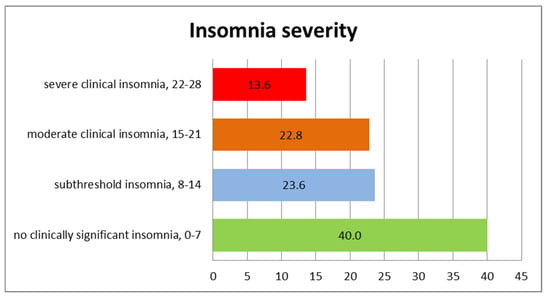
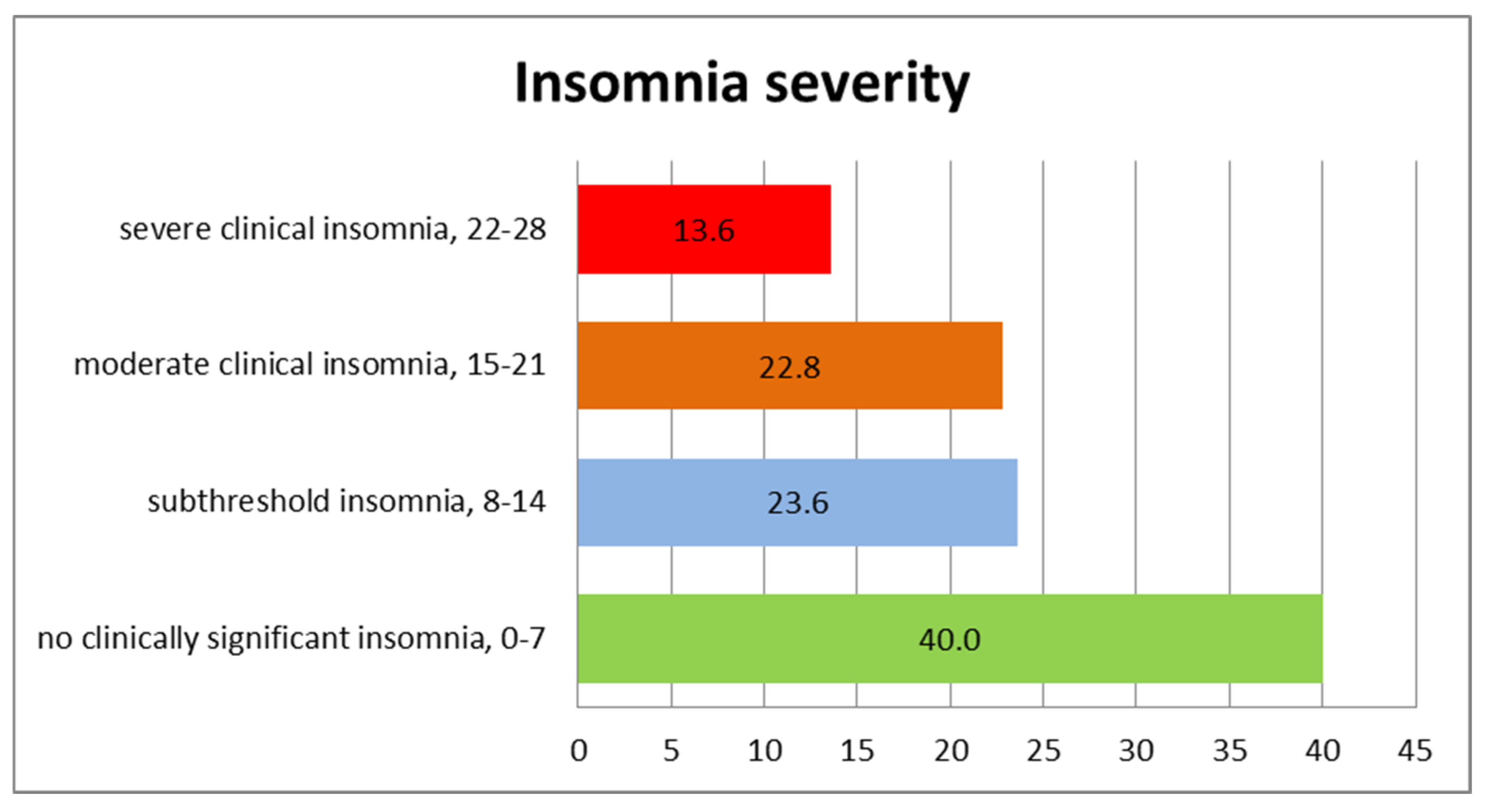
Among the 250 patients with heart failure, 100 (40.0%) had no clinically significant insomnia, 59 (23.6%) had subthreshold insomnia, 57 (22.8%) had moderate clinical insomnia, and 34 (13.6%) had severe clinical insomnia. Overall, 60.0% of participants experienced at least subthreshold insomnia symptoms, while 36.4% had moderate-to-severe insomnia (Figure 1).
Figure 1.
Insomnia symptom severity among patients with heart failure.
The distribution of sociodemographic characteristics according to insomnia severity is presented in Table 1. No statistically significant associations were found between insomnia severity and age group (p = 0.241), marital status (p = 0.517), employment status (p = 0.111), educational level (p = 0.351), or socioeconomic status (p = 0.082). However, sex was significantly associated with insomnia severity (p = 0.039).
Table 1.
Sociodemographic characteristics according to insomnia severity.
Men represented 70.0% of participants without clinically significant insomnia, whereas the sex distribution was more balanced across the subthreshold, moderate clinical, and severe clinical insomnia categories. The ≤75 -year age group was the most represented across all insomnia severity categories. The participants had a mean age of 70.52 ± 9.76 years (range: 38–90 years). Married participants predominated in all categories, accounting for the highest proportion among those with moderate clinical insomnia (75.4%). Retired individuals constituted the largest employment group across all categories, while secondary education was the most common educational level overall. Regarding socioeconomic status, low socioeconomic status was most prevalent among participants without clinically significant insomnia, whereas medium socioeconomic status predominated among those with subthreshold insomnia, moderate clinical insomnia, and severe clinical insomnia.
The associations between insomnia severity and lifestyle-related and clinical characteristics are presented in Table 2. No statistically significant associations were observed between insomnia severity and smoking status (p = 0.595), alcohol consumption (p = 0.468), dietary habits (p = 0.700), physical activity (p = 0.247), heart failure medication regimen (p = 0.251), or NYHA functional class (p = 0.245). In contrast, a statistically significant association was found between insomnia severity and left ventricular ejection fraction (LVEF) category (p = 0.006).
Table 2.
Lifestyle-related and clinical characteristics according to insomnia severity.
Heart failure with reduced ejection fraction (HFrEF) was the most common phenotype among participants without clinically significant insomnia (60.0%), those with subthreshold insomnia (79.7%), and those with moderate clinical insomnia (57.9%). Among participants with severe clinical insomnia, HFrEF remained the most frequent phenotype (52.9%), followed by heart failure with mildly reduced ejection fraction (HFmrEF; 29.4%) and heart failure with preserved ejection fraction (HFpEF; 17.6%). The distribution of NYHA functional classes did not differ significantly across insomnia severity categories, although mild functional limitation was the most frequent category among participants with subthreshold, moderate clinical, and severe clinical insomnia.
The distribution of psychological characteristics according to insomnia severity is shown in Table 3a. No statistically significant associations were observed between insomnia severity and depression (p = 0.741), anxiety (p = 0.881), or stress (p = 0.333). Extremely severe anxiety was the most frequent anxiety category across all insomnia severity groups, occurring in 51.0% of patients without clinically significant insomnia, 42.4% of those with subthreshold insomnia, 50.9% of those with moderate clinical insomnia, and 41.2% of those with severe clinical insomnia.
Table 3.
(a) Psychological characteristics according to insomnia severity. (b) Descriptive statistics of DASS-21 subscale scores.
Depression severity showed a broadly similar distribution across insomnia categories, with moderate depression reported in 30.0% of patients without clinically significant insomnia and 32.4% of those with severe clinical insomnia. Stress severity was also not significantly associated with insomnia severity, although severe stress was more frequent among patients with subthreshold insomnia (30.5%) than among those without clinically significant insomnia (17.0%). Overall, none of the categorical psychological variables demonstrated a statistically significant association with insomnia severity, although some differences in the distribution of psychological symptoms were observed across groups.
The median depression, anxiety, and stress scores were 6 (IQR: 5), 9 (IQR: 7.25), and 8 (IQR: 7), respectively. The corresponding mean scores were 6.20 ± 3.99, 8.46 ± 4.46, and 8.46 ± 4.57. Extremely severe anxiety was the most frequent anxiety category, affecting 119 participants (47.6%), whereas extremely severe depression and stress were observed in 12 (4.8%) and 5 (2.0%) participants, respectively (Table 3b).
The distribution of psychological scores according to insomnia severity was assessed using the Kruskal–Wallis test (Table 4). No statistically significant differences were observed across the four insomnia severity groups for depression scores (p = 0.967), anxiety scores (p = 0.972), or stress scores (p = 0.980). Mean ranks for depression were highest among patients with subthreshold insomnia (129.14), while anxiety and stress scores had the highest mean ranks among patients with moderate clinical insomnia (129.07) and subthreshold insomnia (128.64), respectively.
Table 4.
Comparison of psychological scores according to insomnia severity.
The Spearman correlation analysis showed no significant correlations between ISI score and depression (ρ = −0.007, p = 0.916), anxiety (ρ = −0.044, p = 0.490), stress (ρ = −0.026, p = 0.683), EF (ρ = 0.066, p = 0.297), or age (ρ = −0.016, p = 0.797). No significant association was observed between ISI score and disease duration in years (ρ = −0.075, p = 0.240).
In contrast, strong and statistically significant positive correlations were observed among the psychological variables. Depression was positively correlated with anxiety (ρ = 0.644, p < 0.001) and stress (ρ = 0.620, p < 0.001), while anxiety showed the strongest correlation with stress (ρ = 0.723, p < 0.001). Anxiety also demonstrated a weak positive correlation with EF (ρ = 0.159, p = 0.012). Age was moderately positively correlated with disease duration in years (ρ = 0.358, p < 0.001). No other statistically significant correlations were observed among EF, depression, stress, age, and disease duration. Overall, ISI score showed no significant correlation with the examined psychological or clinical variables, whereas depression, anxiety, and stress were strongly intercorrelated (Table 5).
Table 5.
Spearman correlations between insomnia severity, psychological scores, and clinical variables.
An expanded multivariable multinomial logistic regression model was used to examine the associations of demographic, clinical, and psychological factors with insomnia severity, using no clinically significant insomnia (ISI score 0–7) as the reference outcome category. The model included sex, age, NYHA functional class, LVEF category, number of comorbidities, and the DASS-21 depression, anxiety, and stress scores. The overall model did not reach statistical significance compared with the intercept-only model (likelihood-ratio χ2 = 36.990, df = 27, p = 0.095; McFadden pseudo-R2 = 0.056).
Likelihood-ratio tests showed that sex (p = 0.035) and LVEF category (p = 0.003) made statistically significant contributions to the model. Age, NYHA functional class, number of comorbidities, and the DASS-21 depression, anxiety, and stress scores did not show statistically significant independent contributions.
For subthreshold insomnia (ISI 8–14) versus no clinically significant insomnia, female sex was associated with higher adjusted odds of belonging to the subthreshold insomnia category (OR = 2.383, 95% CI: 1.189–4.777, p = 0.014). Compared with HFrEF, HFmrEF was associated with lower adjusted odds of subthreshold insomnia (OR = 0.179, 95% CI: 0.063–0.506, p = 0.001), whereas the association with HFpEF was not statistically significant.
For moderate insomnia (ISI 15–21) versus no clinically significant insomnia, female sex was associated with higher adjusted odds of belonging to the moderate insomnia category (OR = 2.257, 95% CI: 1.108–4.595, p = 0.025). Compared with HFrEF, HFmrEF was associated with lower adjusted odds of moderate insomnia (OR = 0.358, 95% CI: 0.132–0.971, p = 0.044), whereas the association with HFpEF was not statistically significant.
For severe insomnia (ISI 22–28) versus no clinically significant insomnia, none of the individual category-specific comparisons for sex or LVEF category reached statistical significance. Age, NYHA functional class, number of comorbidities, and the DASS-21 subscale scores were also not independently associated with any insomnia category. These findings represent adjusted associations and should be interpreted cautiously, particularly because the overall model did not reach statistical significance and the severe insomnia category included a relatively small number of participants (n = 34) (Table 6).
Table 6.
Multinomial logistic regression analysis of predictors of insomnia severity.
As a complementary analysis, multiple linear regression was performed using the total ISI score as a continuous dependent variable, with HC3 heteroscedasticity-robust standard errors. The overall model was not statistically significant (robust F(9, 240) = 1.091, p = 0.370) and explained 3.9% of the variance in ISI scores (R2 = 0.039; adjusted R2 = 0.003). None of the included predictors showed a statistically significant independent association with the total ISI score. Female sex showed a borderline, but non-significant, association with higher ISI scores compared with male sex (B = 1.861, 95% CI: −0.079 to 3.802, p = 0.060). Neither LVEF category, age, NYHA functional class, number of comorbidities, nor DASS-21 depression, anxiety, and stress scores were significantly associated with the total ISI score (all p > 0.05) (Table 7).
Table 7.
Multiple linear regression analysis of factors associated with total ISI score using HC3 robust standard errors.
4. Discussion
Sleep disturbances are common among patients with heart failure (HF) and may be associated with symptom burden, psychological well-being, functional status, and self-care [15]. However, their prevalence and correlates vary across studies because of differences in populations and assessment instruments [16,17]. In particular, insomnia severity and overall sleep quality represent related but distinct constructs and should not be considered interchangeable [15,16,17,18,19].
In the present study, 60.0% of participants reported at least subthreshold insomnia symptoms, including 23.6% with subthreshold, 22.8% with moderate, and 13.6% with severe symptoms. Thus, 36.4% experienced moderate or severe insomnia symptoms. These findings indicate a substantial burden of insomnia symptoms among outpatients with HF and support the importance of systematic sleep assessment in routine clinical care. Previous studies have similarly highlighted sleep disturbances as a relevant concern in HF, although direct comparisons of prevalence should be made cautiously when different instruments and cutoffs are used [15,16,17,18,19,20].
The high proportion of participants classified within the extremely severe anxiety category warrants cautious interpretation. DASS-21 measures self-reported psychological symptoms during the preceding week and does not establish a clinical psychiatric diagnosis. In patients with heart failure, elevated anxiety scores may reflect psychological distress associated with chronic illness, symptom burden, functional limitations, and concerns regarding disease progression. Therefore, these findings should be interpreted as indicating a substantial burden of anxiety symptoms rather than the prevalence of clinically diagnosed anxiety disorders.
The principal findings of the present study were the category-specific associations of sex and left ventricular ejection fraction (LVEF) phenotype with insomnia severity. In contrast, depression, anxiety, and stress scores were not significantly associated with ISI severity in the current analyses. This pattern suggests that insomnia severity in this sample was not explained by the measured psychological symptoms alone and that its distribution may differ according to specific demographic and clinical characteristics.
The absence of statistically significant associations between depression, anxiety, stress, and ISI severity contrasts with studies reporting relationships between psychological distress and sleep quality in patients with HF. He and Pan examined symptom burden and sleep quality in relation to psychological and behavioral factors [15], while Souza et al. and Iovino et al. investigated sleep quality and its associated characteristics in HF populations [17,18]. Gazerani et al. likewise identified psychological and other patient-related factors among the reported correlates of sleep quality, while emphasizing heterogeneity across the available evidence [19]. Several factors may have contributed to the absence of statistically significant associations, including the cross-sectional design, the clinical characteristics of the study population, and the use of self-reported questionnaires, which may not fully capture the complex and potentially bidirectional relationship between psychological distress and sleep disturbances. Furthermore, the findings may be specific to our outpatient population and should not be generalized to all patients with heart failure. Further studies involving larger and more diverse populations are needed to clarify these relationships.
These findings are not necessarily contradictory. The ISI measures the severity and impact of insomnia symptoms, whereas the PSQI assesses broader aspects of sleep quality. Psychological distress may therefore be associated with some dimensions of sleep without showing a significant relationship with every measure of insomnia severity. In addition, differences in sample characteristics, clinical circumstances, and symptom distributions may contribute to differences between studies.
The current results should not be interpreted as evidence that psychological symptoms are irrelevant to sleep in HF. Rather, depression, anxiety, and stress were not significantly associated with ISI severity in this particular sample and analysis. Their intercorrelation may complicate the separation of their individual contributions, but this alone does not explain the nonsignificant findings. Further studies using longitudinal designs and comprehensive multivariable analyses are needed to clarify whether psychological symptoms are associated with specific insomnia features or changes in sleep over time.
The complementary multiple linear regression analysis, using the total ISI score as a continuous outcome, yielded consistent findings. The overall model was not statistically significant and explained only a small proportion of the variance in ISI scores. None of the demographic, clinical, or psychological predictors showed a statistically significant independent association with the total ISI score. These findings further suggest that the factors examined in the present study did not fully account for individual differences in insomnia symptom severity.
Sex was significantly associated with subthreshold and moderate insomnia symptoms in the multinomial logistic regression model. Compared with women, men had lower odds of subthreshold insomnia and moderate insomnia, relative to the reference category of no clinically significant insomnia symptoms.
The literature on sex differences in sleep disturbances among patients with HF is inconsistent. Gharaibeh et al. reported poorer sleep quality among women with HF and associations with several clinical characteristics, which is partly consistent with our findings, as female sex was independently associated with higher odds of subthreshold and moderate insomnia, although the associations with cardiac function and NYHA class differed between the studies [20]. Yang et al. specifically examined sex differences in patients with HF with preserved ejection fraction and found no significant sex difference in ISI insomnia severity after adjustment, despite differences in other psychological and sleep-quality measures [21]. These findings indicate that sex-related differences may depend on the outcome assessed and the characteristics of the study population.
The present results therefore suggest a category-specific association rather than general protection against insomnia among men. Because the association with severe insomnia was not statistically significant, the findings do not establish a consistent sex difference across all levels of insomnia severity. Further research should examine whether these associations persist after accounting for relevant clinical, behavioral, and psychosocial factors.
LVEF phenotype was also associated with selected insomnia categories. Compared with HFrEF, HFmrEF was associated with lower adjusted odds of subthreshold and moderate insomnia. In contrast, HFpEF was not significantly associated with either insomnia category. Previous research provides related, although not fully comparable, evidence. Najdaghi et al. reported associations between clinical characteristics, including lower ejection fraction, and poorer sleep quality [22]. Iovino et al. identified distinct sleep-quality patterns among patients with HF, supporting the view that sleep disturbances are heterogeneous and may vary according to patient characteristics [18]. Studies examining sleep-disordered breathing have also reported differences across HF phenotypes [5,23,24]. However, sleep-disordered breathing and insomnia are distinct conditions, and these findings cannot directly explain the associations observed with ISI in the present study.
The category-specific results should be interpreted cautiously. The observed associations between HFmrEF and lower odds of subthreshold and moderate insomnia, compared with HFrEF, do not establish that one HF phenotype has a consistently greater burden of insomnia across all severity categories. The odds ratios compare each insomnia category with the reference category of no clinically significant insomnia symptoms; they do not directly compare moderate with severe insomnia. Moreover, the absence of a significant correlation between continuous LVEF and ISI indicates that the present study did not identify a clear monotonic relationship between ejection fraction and insomnia severity across the full range of values.
Differences in cardiac symptoms, comorbidities, nocturnal dyspnea, nocturia, and sleep-related breathing disorders may contribute to sleep problems in HF, but these mechanisms were not established in the present analysis. Further studies should examine these factors directly and determine whether the observed phenotype-specific associations persist after adjustment for potential confounders.
Sleep disturbances in HF are relevant beyond insomnia symptoms alone. Previous studies have linked sleep difficulties with daytime sleepiness and quality of life [2,3,4], while more recent work has examined their relationships with self-care, fatigue, social isolation, cognitive frailty, and appetite-related symptoms [25,26,27,28]. Other studies have explored the relationships between coping, stress, and insomnia during the COVID-19 pandemic [29,30]. These findings reinforce the importance of assessing sleep as part of the broader clinical picture, although they do not directly establish the determinants of ISI severity in the present sample.
Sleep quality has also been examined in relation to depressive symptoms and quality of life [31], while observational and Mendelian randomization approaches have been used to investigate relationships between sleep disturbances and HF [32]. Together, this literature supports further investigation of sleep-related outcomes in HF but does not establish causality in the present study.
Clinically, the frequency of insomnia symptoms observed here supports routine screening for sleep complaints in patients with HF. Assessment should not rely exclusively on psychological scores or LVEF because neither domain fully explained insomnia severity in this sample. An individualized approach incorporating insomnia symptoms, cardiac complaints, comorbidities, medication use, daytime functioning, and possible sleep-related breathing disorders may provide a more comprehensive assessment.
The strength of this study is the use of four ISI severity categories, allowing identification of associations specific to particular levels of insomnia symptoms. The study also examined psychological variables alongside sex and LVEF phenotype. However, its cross-sectional design precludes causal or temporal conclusions, and the findings may not generalize to all HF populations. The ISI is a self-report instrument and does not replace diagnostic evaluation or objective assessment of sleep disorders. Furthermore, the expanded multivariable regression model included demographic, clinical, and psychological covariates. Although sex and LVEF category made statistically significant contributions, the overall model did not reach statistical significance and demonstrated modest explanatory performance, indicating that other clinical, behavioral, and psychosocial factors may also contribute to insomnia severity. Another limitation is that sleep-disordered breathing, including obstructive and central sleep apnea, was not systematically assessed. Data regarding polysomnography, positive airway pressure treatment, nocturnal dyspnea, nocturia, and sleep-related medication use were not available for analysis. These factors may contribute to sleep disturbances in patients with HF and could represent potential sources of residual confounding.
The nonsignificant psychological findings should not be interpreted as proof that depression, anxiety, and stress are unrelated to sleep in HF. Similarly, the category-specific associations involving sex and LVEF require confirmation in larger prospective studies with broader adjustment for potential confounders.
5. Conclusions
Insomnia symptoms were common among patients with heart failure. In the final multinomial logistic regression model, sex and LVEF category showed statistically significant associations with specific insomnia severity categories. Compared with men, women had higher adjusted odds of subthreshold and moderate insomnia. Compared with HFrEF, HFmrEF was associated with lower adjusted odds of subthreshold and moderate insomnia, whereas HFpEF was not significantly associated with either category. Depression, anxiety, and stress scores were not significantly associated with insomnia severity. These findings highlight the potential importance of routinely assessing insomnia in patients with heart failure. Further prospective studies are needed to confirm these associations and clarify the relationships between sleep disturbances, psychological symptoms, and cardiac function.
Author Contributions
Conceptualization, M.M.R., S.R. and M.D.; Methodology, M.M.R., O.M., N.Z. and M.S.; Validation, O.M., S.R. and M.V.; Formal Analysis, N.Z., M.Z. and M.S.; Investigation, M.M.R., O.M., S.R., M.D., M.S., K.J., M.K.D., J.R.S., V.S., D.G. and E.F.; Data Curation, N.Z., M.Z. and K.J.; Writing—Original Draft Preparation, M.M.R., M.D., M.S. and J.R.S.; Writing—Review and Editing, O.M., S.R., N.Z., M.V., K.J., M.K.D., V.S., D.G. and E.F.; Visualization, K.J. and M.K.D.; Supervision, M.V. and M.D.; Project Administration, M.D. and M.S. All authors have read and agreed to the published version of the manuscript.
Funding
This research received no external funding.
Institutional Review Board Statement
The study was approved by the Ethics Committee of PZU Polyclinic “A3 Medical Montenegro” (Approval No. 111/25; 15 September 2025) and conducted in accordance with the Declaration of Helsinki and Good Clinical Practice principles.
Informed Consent Statement
Informed consent was obtained from all subjects involved in the study.
Data Availability Statement
The data supporting the findings of this study are available from the corresponding author upon reasonable request, subject to applicable ethical and data protection requirements.
Conflicts of Interest
The authors declare no conflicts of interest.
References
- Zheng, T. Sleep disturbance in heart failure: A concept analysis. Nurs. Forum 2021, 56, 710–716. [Google Scholar] [CrossRef] [Scilit] [PubMed]
- Erickson, V.S.; Westlake, C.A.; Dracup, K.A.; Woo, M.A.; Hage, A. Sleep disturbance symptoms in patients with heart failure. AACN Clin. Issues 2003, 14, 477–487. [Google Scholar] [CrossRef] [Scilit] [PubMed]
- Broström, A.; Strömberg, A.; Dahlström, U.; Fridlund, B. Sleep difficulties, daytime sleepiness, and health-related quality of life in patients with chronic heart failure. J. Cardiovasc. Nurs. 2004, 19, 234–242. [Google Scholar] [CrossRef] [Scilit] [PubMed]
- Redeker, N.S.; Hilkert, R. Sleep and quality of life in stable heart failure. J. Card. Fail. 2005, 11, 700–704. [Google Scholar] [CrossRef] [Scilit] [PubMed]
- Huang, B.; Huang, Y.; Zhai, M.; Zhou, Q.; Ji, S.; Liu, H.; Zhuang, X.; Zhang, Y.; Zhang, J. Prevalence, clinical characteristics, and predictors of sleep disordered breathing in hospitalized heart failure patients. Clin. Cardiol. 2022, 45, 1311–1318. [Google Scholar] [CrossRef] [Scilit] [PubMed]
- Gharzeddine, R.; McCarthy, M.M.; Yu, G.; Dickson, V.V. Insomnia and insomnia symptoms in persons with heart failure: An integrative review. J. Cardiovasc. Nurs. 2021, 36, 374–384. [Google Scholar] [CrossRef] [Scilit] [PubMed]
- Angermann, C.E.; Ertl, G. Depression, anxiety, and cognitive impairment: Comorbid mental health disorders in heart failure. Curr. Heart Fail. Rep. 2018, 15, 398–410. [Google Scholar] [CrossRef] [Scilit] [PubMed]
- Manolis, T.A.; Manolis, A.A.; Melita, H.; Manolis, A.S. Neuropsychiatric disorders in patients with heart failure: Not to be ignored. Heart Fail. Rev. 2023, 28, 821–858. [Google Scholar] [CrossRef] [Scilit] [PubMed]
- Jeon, S.; Redeker, N.S. Sleep disturbance, daytime symptoms, and functional performance in patients with stable heart failure: A mediation analysis. Nurs. Res. 2016, 65, 259–267. [Google Scholar] [CrossRef] [Scilit] [PubMed]
- Westas, M.; Klompstra, L.; Strömberg, A.; Jaarsma, T.; Melnikov, S. Trajectories of insomnia symptoms in patients with heart failure: A longitudinal analysis. Eur. J. Cardiovasc. Nurs. 2026, 25, 833–841. [Google Scholar] [CrossRef] [Scilit] [PubMed]
- Bastien, C.H.; Vallières, A.; Morin, C.M. Validation of the Insomnia Severity Index as an outcome measure for insomnia research. Sleep Med. 2001, 2, 297–307. [Google Scholar] [CrossRef] [Scilit] [PubMed]
- Lovibond, S.H.; Lovibond, P.F. Manual for the Depression Anxiety Stress Scales, 2nd ed.; Psychology Foundation of Australia: Sydney, Australia, 1995. [Google Scholar]
- Jovanović, V.; Gavrilov-Jerković, V.; Žuljević, D.; Brdarić, D. Psychometric evaluation of the depression anxiety stress scales-21 (DASS-21) in a Serbian student sample. Psihologija 2014, 47, 93–112. [Google Scholar] [CrossRef] [Scilit]
- Veskovic, J.; Cvetkovic, M.; Tahirovic, E.; Zdravkovic, M.; Apostolovic, S.; Kosevic, D.; Loncar, G.; Obradovic, D.; Matic, D.; Ignjatovic, A.; et al. Depression, anxiety, and quality of life as predictors of rehospitalization in patients with chronic heart failure. BMC Cardiovasc. Disord. 2023, 23, 525. [Google Scholar] [CrossRef] [Scilit] [PubMed]
- He, D.; Pan, M. Serial multiple mediators in the relationship between symptom burden and sleep quality among patients with heart failure. Jpn. J. Nurs. Sci. 2022, 19, e12489. [Google Scholar] [CrossRef] [Scilit] [PubMed]
- Esnaasharieh, F.; Dehghan, M.; Mangolian Shahrbabaki, P. The relationship between sleep quality and physical activity among patients with heart failure: A cross-sectional study. BMC Sports Sci. Med. Rehabil. 2022, 14, 20. [Google Scholar] [CrossRef] [Scilit] [PubMed]
- Souza, J.P.; Lima, D.F.S.; Leadebal, O.D.C.P.; Freire, M.E.M.; Oliveira, S.H.D.S.; Santos, V.B.; Sousa, M.M. Sleep quality of patients with heart failure and associated factors. Rev. Bras. Enferm. 2024, 77, e20240244. [Google Scholar] [CrossRef] [Scilit] [PubMed]
- Iovino, P.; Dollaku, H.; Alvaro, R.; Pucciarelli, G.; Rasero, L.; Macchi, C.; Liuzzi, P.; Riegel, B.; Vellone, E. Sleep quality patterns in patients with heart failure: A person-centred latent class analysis from a secondary analysis of the MOTIVATE-HF trial. BMJ Open 2025, 15, e101950. [Google Scholar] [CrossRef] [Scilit] [PubMed]
- Gazerani, A.; Manzari, Z.S.; Mohammadi, E.; Amini, M.; Manzari, T.S.; Dalir, Z. Sleep quality in heart failure patients: A systematic review of risk factors and assessment tools. Iran. J. Public Health 2025, 54, 1842–1856. [Google Scholar] [CrossRef] [Scilit] [PubMed]
- Gharaibeh, B.; Al-Absi, I.; Abuhammad, S.; Gharaibeh, M. Dimensions of sleep characteristics and predictors of sleep quality among heart failure patients: A STROBE compliant cross-sectional study in Jordan. Medicine 2022, 101, e32585. [Google Scholar] [CrossRef] [Scilit] [PubMed]
- Yang, X.; Wen, Y.; Peng, H.; Zhu, H.; Wang, W.E.; Zhou, J. Gender differences in anxiety, depression, insomnia, and quality of life in heart failure with preserved ejection fraction: A multicenter, cross-sectional study. J. Cardiovasc. Nurs. 2023, 38, 425–432. [Google Scholar] [CrossRef] [Scilit] [PubMed]
- Najdaghi, S.; Narimani Davani, D.; Shafie, D. Predictors of poor sleep quality in heart failure patients: A cross-sectional multivariable analysis of clinical, demographic, and psychosocial factors. J. Res. Health Sci. 2025, 25, e00649. [Google Scholar] [CrossRef] [Scilit] [PubMed]
- Wang, T.; Yu, F.C.; Wei, Q.; Chen, L.; Xu, X.; Ding, N.; Tong, J.-Y. Prevalence and clinical characteristics of sleep-disordered breathing in patients with heart failure of different left ventricular ejection fractions. Sleep Breath 2023, 27, 245–253. [Google Scholar] [CrossRef] [Scilit] [PubMed]
- Jeon, S.; Conley, S.; O’Connell, M.; Wang, Z.; Redeker, N.S. Phenotypes of sleep health among adults with chronic heart failure in a randomized controlled trial of cognitive behavioral therapy for insomnia. Sleep Health 2024, 10, 705–712. [Google Scholar] [CrossRef] [Scilit] [PubMed]
- Spedale, V.; Fabrizi, D.; Rebora, P.; Luciani, M.; Alvaro, R.; Vellone, E.; Riegel, B.; Ausili, D. The association between self-reported sleep quality and self-care in adults with heart failure: A cross-sectional study. J. Cardiovasc. Nurs. 2023, 38, E98–E109. [Google Scholar] [CrossRef] [Scilit] [PubMed]
- Liao, T.; Gan, Y.; Liu, L.; Du, Y.; Li, G.; Guo, M. The association of sleep quality with anorexia in patients with heart failure: Do anxiety and depressive symptoms mediate this association. J. Cardiovasc. Nurs. 2026, 41, 174–181. [Google Scholar] [CrossRef] [Scilit] [PubMed]
- Zhang, S.; Liu, J.; Qu, W.; Wei, H.; Wang, J.; Wang, Z.; Yan, Z.; Liu, M.; Wang, X.; Luan, X. Association between insomnia and cognitive frailty among older patients with chronic heart failure: Multiple mediating effects of depressive symptoms and social support. J. Cardiovasc. Nurs. 2025, 40, 114–123. [Google Scholar] [CrossRef] [Scilit] [PubMed]
- Guan, Z.; Song, Y.; Wang, Y. Associations between sleep quality, fatigue, social isolation, and depressive symptoms in patients with heart failure: A parallel mediation analysis. J. Health Psychol. 2026, 31, 3935–3945. [Google Scholar] [CrossRef] [Scilit] [PubMed]
- O’Connell, M.; Jeon, S.; Conley, S.; Linsky, S.; Redeker, N.S. Coping, symptoms, and insomnia among people with heart failure during the COVID-19 pandemic. Eur. J. Cardiovasc. Nurs. 2023, 22, 291–298. [Google Scholar] [CrossRef] [Scilit] [PubMed]
- O’Connell, M.; Jeon, S.; Conley, S.; Linsky, S.; Redeker, N.S. Sleep, stress, and symptoms among people with heart failure during the COVID-19 pandemic. J. Cardiovasc. Nurs. 2023, 38, E55–E60. [Google Scholar] [CrossRef] [Scilit] [PubMed]
- Wu, J.R.; Moser, D.K.; Lin, C.Y.; Chiang, A.A.; Riegel, B. Depressive symptoms and sleep quality mediate the relationship between race and quality of life among patients with heart failure: A serial multiple mediator model. J. Cardiovasc. Nurs. 2024, 39, 449–455. [Google Scholar] [CrossRef] [Scilit] [PubMed]
- Wang, J.; Sun, Z.; Zhong, Y.; Ye, Y.; Chen, X.; Hu, X.; Peng, Y. Sleep disturbances and heart failure: Observational study and Mendelian randomization study. Arch. Med. Sci. 2024, 21, 1222–1232. [Google Scholar] [CrossRef] [Scilit] [PubMed]

Disclaimer/Publisher’s Note: The statements, opinions and data contained in all publications are solely those of the individual author(s) and contributor(s) and not of MDPI and/or the editor(s). MDPI and/or the editor(s) disclaim responsibility for any injury to people or property resulting from any ideas, methods, instructions or products referred to in the content. |
© 2026 by the authors. Licensee MDPI, Basel, Switzerland. This article is an open access article distributed under the terms and conditions of the Creative Commons Attribution (CC BY) license.