


Abstract
Background: Artificial intelligence-based chatbot interventions have been identified as potential solutions to address disparities in the increasing global prevalence of mental disorders, including anxiety and depression. This systematic review and meta-analysis aimed to evaluate the effectiveness of AI-based interventions on well-being, with well-being measured through a combination of depression and anxiety symptom scales and affective instruments. These measures captured both negative and positive aspects of mental health, including tools such as the Patient Health Questionnaire-9 (PHQ-9), Generalized Anxiety Disorder-7 (GAD-7), and the Positive and Negative Affect Schedule (PANAS). Methods: We searched PubMed, ProQuest, Web of Science, PsycINFO, IEEE Xplore, and Scopus databases. Randomized controlled trials and reported outcomes using validated psychometric instruments (PANAS, GAD-7, or PHQ-9) were included. Data extraction and risk of bias assessment (RoB 2) were independently completed by two reviewers. Standardized mean differences (SMDs) with Hedges’ g correction to adjust for small sample bias were implemented to execute meta-analyses. Results: Sixteen studies were incorporated. A small but statistically significant reduction in depressive symptoms was observed in AI-based interventions, predominantly chatbot-based (Hedges’ g = −0.38; 95% CI: −0.60, −0.16), with substantial heterogeneity (71.2%; p < 0.001). Anxiety (GAD-7: Hedges’ g = −0.25, 95% CI: −0.63 to 0.14) and affect (PANAS-P: SMD = 0.13; PANAS-N: SMD = −0.41) did not exhibit any statistically significant effects. Conclusions: AI-based chatbots showed a small effect on depressive symptoms, while effects on anxiety and affective outcomes were not statistically significant. Given the low to very low certainty of evidence, substantial heterogeneity, and short follow-up, these findings remain uncertain and require confirmation in high-quality RCTs with longer follow-up.
1. Introduction
The imperative need for accessible, scalable, and effective therapies is underscored by the emerging global epidemic of mental health conditions, particularly anxiety and depression. Despite the advancements made in conventional mental health care, there are still substantial treatment disparities that are influenced by factors such as stigma, resource constraints, and unequal access to care [1]. In this regard, AI-enabled solutions have emerged as a potential alternative, providing innovative methods for screening, monitoring, and intervention that can enhance existing services [2].
The advancement of AI-driven mental health solutions that provide personalized and scalable support is on the rise. These solutions include systems that are based on large language models, wearable technologies, virtual reality environments, mobile health platforms, and conversational agents [3,4]. By means of continuous, user-centered engagement, conversational AI and self-guided digital therapies have exhibited substantial potential in alleviating symptoms of anxiety and depression [5].
Although AI-driven mental health solutions show promise, the evidence for their clinical effectiveness remains inconsistent. For example, a randomized feasibility trial found no statistically significant improvement in anxiety or depression with an AI therapy intervention relative to an active control condition, while a review of chatbot studies highlighted methodological limitations, limited adverse-event reporting, and insufficiently examined risks such as emotional dependence [6,7].
A wide range of AI-driven tools—including conversational agents, mobile health applications, machine-learning-based monitoring systems, and hybrid iCBT approaches—are increasingly being developed to support individuals with symptoms of anxiety and depression, as reflected in recent scoping reviews of AI applications across screening, monitoring, support, and therapeutic care [8]. Among these, chatbot-delivered therapies are the most commonly used, and they are generally intended to provide continuous, real-time interaction and psychological assistance [9,10]. Previous evidence supports the feasibility and acceptability of AI-driven conversational agents in healthcare settings. A systematic review of 21 randomized controlled trials by Li et al. (2023) [11] reported high recruitment (84%) and completion rates (83%), as well as moderate-to-high acceptability (75.2%), highlighting the growing potential of interventions in clinical practice.
Most of these therapies are self-administered, which enables users to engage in them without the need for direct physician supervision. This method improves accessibility; however, it also raises substantial concerns regarding the treatment’s efficacy, engagement, and adherence [9,12]. Approaches to implementing AI applications vary considerably, including how often they are used (e.g., daily vs. biweekly engagement), their level of autonomy (fully automated vs. guided systems), and how they integrate with established therapeutic frameworks such as iCBT [13,14]. These disparities have the potential to considerably impact treatment outcomes; however, they are not frequently adequately examined in the current literature.
However, self-administered AI-based mental health interventions also introduce important risks and opportunities for misuse. Because users may interact with these tools without immediate clinical oversight, individuals experiencing suicidal ideation, self-harm, psychosis, severe depression, or an acute mental health crisis may not receive timely recognition, appropriate support, or referral to emergency and human-led services. AI chatbots may also generate inaccurate, unsafe, culturally insensitive, or overly reassuring responses, particularly when users present complex symptoms or high-risk situations. Further concerns include breaches of privacy and confidentiality, inadequate governance of sensitive mental health data, algorithmic bias, limited transparency, overreliance on the technology, and the potential use of chatbots as a substitute for professional assessment or treatment. These risks may be especially pronounced among vulnerable populations, including adolescents, individuals with severe mental illness, and users with limited digital or health literacy. Therefore, safe implementation requires clear clinical boundaries, robust crisis-detection and escalation protocols, strong data-protection safeguards, ongoing human oversight, and culturally appropriate content [15,16].
These advancements are especially pertinent to the field of mental health, where depression and anxiety continue to be prevalent, and conventional care is still restricted by stigma, workforce constraints, and geographic barriers [17]. Digital mental health solutions have been designated as a promising strategy for expanding access and early intervention by national initiatives such as the National Mental Health Program (NMHP), National Center for Mental Health Promotion (NCMH), and Sehhaty platform [18]. Nevertheless, the evidence for the efficacy of AI-based mental health chatbots is still fragmented, primarily derived from Western populations, and insufficiently contextualized for Arab and Middle Eastern health systems, despite the rapid growth of these chatbots globally [19,20]. Therefore, a thorough review of the existing evidence is essential to equip policymakers, healthcare leaders, and regulators with direction on the safe and effective adoption of AI mental health tools within the Saudi healthcare system. Accordingly, this study aims to comprehensively evaluate the effectiveness of self-administered AI-based tools in reducing anxiety and depression using validated outcome measures.
2. Methods
2.1. Study Design
This systematic review and meta-analysis was based entirely on previously published data. No primary data collection was conducted. The review was conducted following the Preferred Reporting Items for Systematic Reviews and Meta-Analyses (PRISMA) guidelines [21]. The aim was to assess the effectiveness of AI-based interventions on mental health well-being, where well-being was assessed using a combination of depression and anxiety symptom scales alongside affective measures (PANAS), capturing both negative and positive dimensions of mental health [22]. The review was restricted to studies using PHQ-9 and GAD-7 to ensure comparability across standardized and widely validated screening instruments for depression and anxiety.
2.2. Search Strategy
A comprehensive literature search was conducted in April 2026 across six electronic databases: PubMed, ProQuest, Web of Science, PsycINFO, IEEE Xplore, and Scopus. No language restrictions were explicitly stated. The PubMed search strategy was as follows:
(“artificial intelligence”[ti] OR “chatbot*”[ti] OR “large language model*”[ti] OR “digital mental health”[ti]) AND (“depression”[tiab] OR “anxiety”[tiab]) AND (“intervention*”[tiab] OR “treatment*”[tiab] OR “randomized”[tiab] OR “trial”[tiab]) NOT (systematic review[pt] OR meta-analysis[pt])
Similar search strategies were adapted for the other databases, as can be seen in Supplementary Table S1.
2.3. Eligibility Criteria
Randomized controlled trials of all ages, clinical and non-clinical studies, community-based or institutional settings focusing on mental health or well-being interventions. Only studies published in English were eligible. All searches were last run in April 2026. Any AI-based chatbot for mental health.
Studies were excluded if they: (1) focused on AI development or technical validation without describing mental health/well-being applications; (2) were purely theoretical/conceptual without empirical data or implementation description; (3) were conference abstracts without full text; (4) were duplicate publications of the same data; (5) were not available in English; (6) focused on physical health applications without mental health component; (7) focused on AI for healthcare provider training/education rather than direct patient/population applications; (8) were pilot studies; and (9) used scales other than PHQ-9, GAD-7 for depression and anxiety, respectively.
2.4. Study Selection
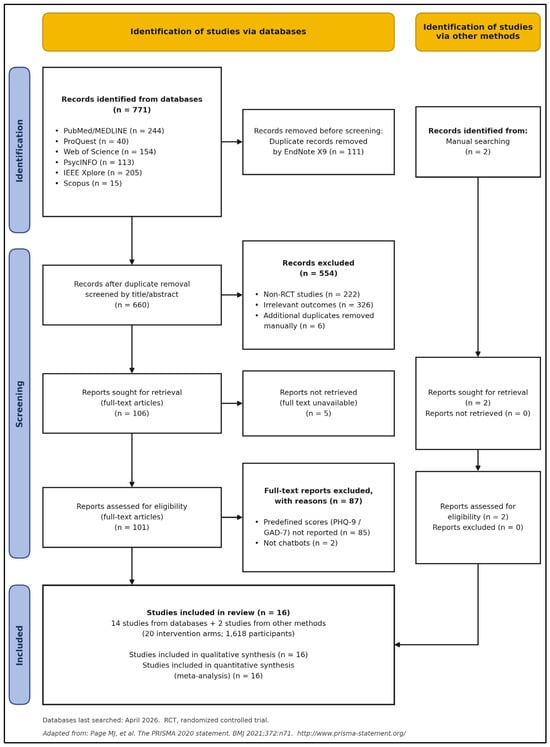
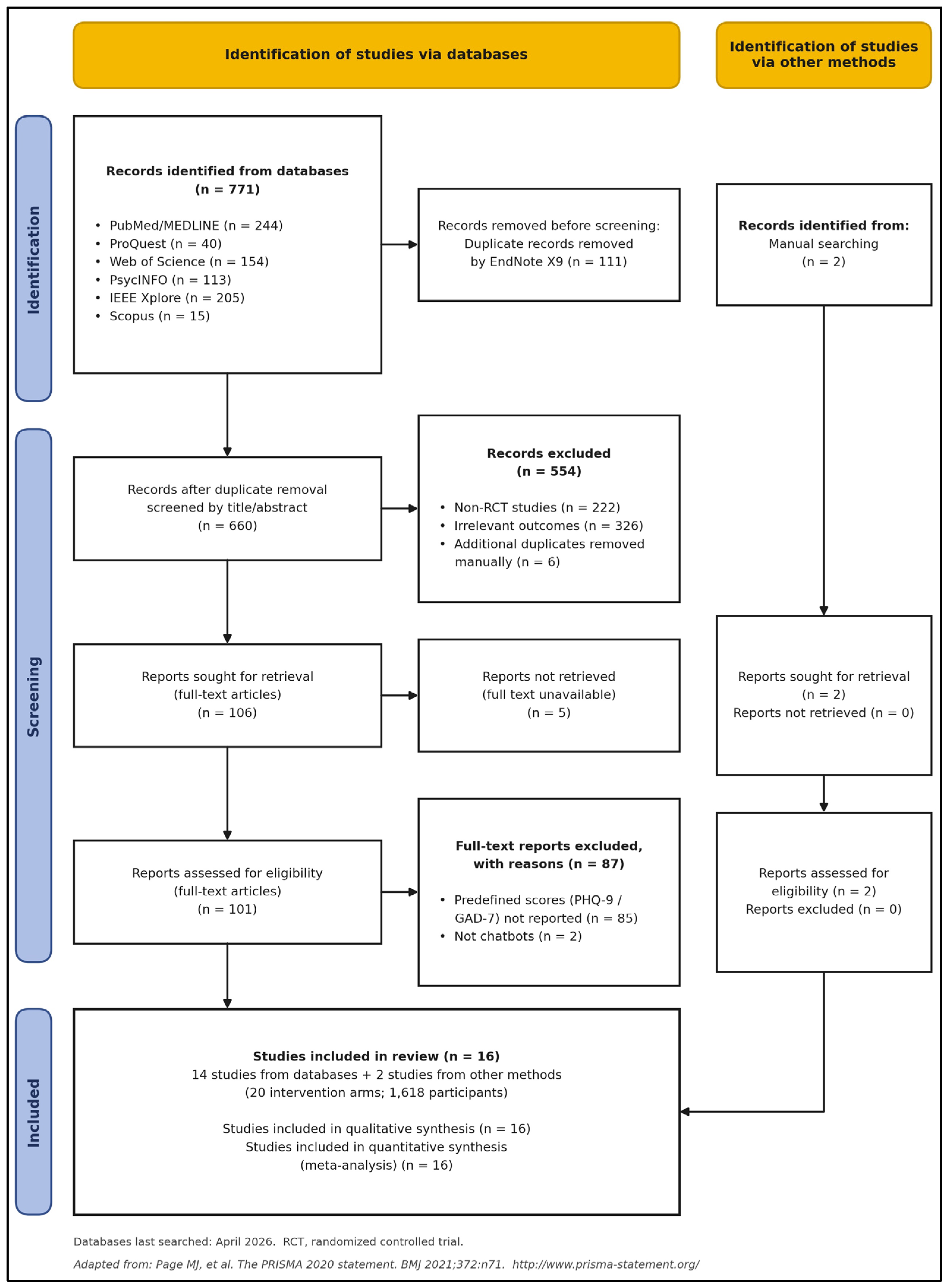
All retrieved records were imported into Endnote X9, and duplicates were removed. A total of 771 records were identified (PubMed = 244, ProQuest = 40, WOS = 154, PsycINFO = 113, IEEE Xplore = 205, and Scopus = 15), of which 111 duplicates were removed, leaving 660 studies for title and abstract screening. All records were imported into Rayyan for title and abstract screening; two independent reviewers screened titles and abstracts (A.A-G. and R.A.), and 222 non-RCT studies, 326 studies with irrelevant outcomes, and 6 additional duplicates were removed manually.
Six additional duplicates identified during title/abstract screening in Rayyan were removed manually. Of the 106 reports sought for retrieval, five could not be obtained despite repeated contact with the corresponding authors over four weeks, and 101 full-text reports were assessed for eligibility. Of these, 87 were excluded (85 did not report the predefined PHQ-9/GAD-7 scores, and 2 did not evaluate chatbots), leaving 14 studies. Two further studies identified through manual searching were added, giving 16 included studies. Discrepancies between reviewers were resolved by a third reviewer (A.A-H.). Inter-rater reliability between reviewers during study selection was assessed using Cohen’s kappa. In Figure 1, the reviewer agreement was 0.85 for title and abstract screening and 0.9 for the full-text screening.
Figure 1.
PRISMA flowchart [4,13,21,23,24,25,26,27,28,29,30,31,32,33,34,35,36].
2.5. Data Extraction
Data were independently extracted by two reviewers (A.A-G. and R.A.) using a standardized data extraction Excel sheet, with any discrepancies resolved through discussion or consultation with a third reviewer (A.A-H.). The extraction process was conducted systematically to capture comprehensive information from each included study, organized across multiple domains. Study characteristics were recorded, including author names, publication year, country and geographical region, study design and setting, sample size per group, duration of intervention, and follow-up periods. Participant demographics were extracted, encompassing total number of participants, age, sex/gender distribution, and baseline mental health status. Intervention details were meticulously documented, including the type of AI-based intervention (chatbot, mobile app, or hybrid model), the specific name of the AI tool (e.g., Woebot, Tess, Elomia, Xiaoai, Emohaa), and the therapeutic framework (iCBT or positive psychology). Comparator groups were also characterized by capturing the type of control condition (waitlist, no intervention, treatment as usual, psychoeducation, bibliotherapy, or active control) and corresponding control intervention details.
Outcome measures were extracted with particular attention to psychometric instruments, including pre- and post-intervention scores with means and standard deviations for the PHQ-9 assessing depression, the GAD-7 assessing anxiety, and the Positive and Negative Affect Schedule capturing both positive and negative affect. Change scores and corresponding standard deviations were recorded when available or calculable, along with all assessment time points. In multi-arm trials with shared control groups, the sample size of the control group was split equally across comparisons to avoid double-counting, in accordance with Cochrane recommendations. All extracted data were entered into a structured database and cross-verified by both reviewers to ensure accuracy and completeness, facilitating a comprehensive synthesis of evidence across the included studies.
2.6. Risk of Bias Assessment
The methodological quality of the included studies was assessed using the Cochrane risk-of-bias tool (RoB 2), which evaluates five domains: randomization process, deviations from intended interventions, missing outcome data, outcome measurement, and selection of the reported result. Each domain was rated as “low risk,” “some concerns,” or “high risk,” with an overall judgment assigned accordingly. Two authors (A.A.-G. and R.A.) independently assessed each study, resolving any disagreements through discussion or consultation with a third reviewer (A.A.-H.) when necessary. Inter-rater reliability was assessed to ensure consistency. The assessment results were presented using traffic light plots and summary bar charts. Studies were not excluded based on risk of bias; instead, sensitivity analyses were conducted to evaluate the robustness of pooled estimates when high-risk studies were removed. The risk of bias assessment also served as a moderator in subgroup analyses and meta-regression to examine whether methodological quality significantly influenced effect size estimates, thereby providing valuable context for interpreting the overall findings.
2.7. Publication Bias Assessment
Publication bias was assessed using a comprehensive approach combining visual and statistical methods to evaluate the potential influence of unpublished or missing studies on the pooled effect estimates. Funnel plots were generated for each outcome measure to visually inspect the symmetry of study distribution around the pooled effect estimate, where asymmetry may indicate the presence of publication bias or other systematic differences between smaller and larger studies. For outcomes with at least ten included studies, Egger’s regression test was employed as a quantitative measure of funnel plot asymmetry, testing the null hypothesis that there is no association between effect estimates and their standard errors. Statistical significance for Egger’s test was set at p < 0.05. Additionally, for outcomes with smaller numbers of studies, the trim-and-fill method was considered to estimate the number of potentially missing studies and to adjust the pooled effect sizes accordingly, thereby providing a more conservative estimate of the intervention effect in the presence of possible publication bias. This dual approach—combining visual inspection with formal statistical testing—allowed for a robust assessment of publication bias across all outcomes, enhancing the validity and reliability of the meta-analytic findings.
2.8. Certainty Assessment
The overall quality of evidence for each outcome (PHQ-9, GAD-7, PANAS-P, and PANAS-N) was assessed using the Grading of Recommendations Assessment, Development and Evaluation (GRADE) framework. Two independent reviewers rated the evidence as high, moderate, low, or very low based on five domains: risk of bias, inconsistency, indirectness, imprecision, and publication bias. Any disagreements were resolved by discussion or consultation with a third reviewer.
2.9. Statistical Analysis
All analyses were conducted using R software version 4.3.2. The primary effect size for continuous outcomes (e.g., depression, anxiety, and PANAS scores) was calculated using the standardized mean difference (SMD) with Hedges’ g correction to adjust for small sample bias.
Change scores were calculated for studies that reported pre- and post-intervention means. The standard deviation (SE) of change was calculated in accordance with the Cochrane Handbook for Systematic Reviews of Interventions by assuming a within-person correlation coefficient of r = 0.6 when it was not explicitly reported. Sensitivity analyses using r = 0.3 and r = 0.8 were performed to test the robustness of the assumed correlation (r = 0.6). Effect sizes were subsequently determined as standardized mean differences based on change scores, utilizing Hedges’ g to account for variations in measurement scales and partially address baseline variability. Pooled effect sizes were estimated using both fixed-effect and random-effects models, with the random-effects model designated as the primary analysis; between-study variance was estimated using REML, and confidence intervals were derived using the Hartung-Knapp adjustment. The fixed-effect model was reported only as a sensitivity analysis. Estimates were reported with 95% confidence intervals (CI). Publication bias was assessed visually using funnel plots and statistically using Egger’s regression test when at least 10 studies were available.
Statistical heterogeneity was assessed using the Chi-square (Q) test and quantified with the I2 statistic, with I2 values interpreted according to conventional thresholds (0–40%: unimportant; 30–60%: moderate; 50–90%: substantial; 75–100%: considerable). The between-study variance was further quantified using the τ2 statistic. To explore potential sources of heterogeneity, subgroup analyses were conducted based on relevant study characteristics, including risk of bias (low, some concerns, or high), intervention duration, and geographic region. Subgroup differences were evaluated using interaction tests, with statistical significance assessed using the Q-between statistic.
Meta-regression analyses were performed when sufficient studies were available to examine the impact of potential moderators on effect size estimates. This analytical approach was employed to investigate sources of heterogeneity and to determine whether specific study-level characteristics significantly influenced the magnitude of treatment effects across included trials. The meta-regression models incorporated relevant covariates identified a priori based on clinical and methodological considerations, including intervention characteristics (e.g., follow-up period), study quality indicators (e.g., risk of bias assessment), and continent. Each moderator was entered into a mixed-effects meta-regression model, which assumes a random-effects distribution for residual heterogeneity while estimating fixed coefficients for the moderator variables. The proportion of between-study heterogeneity explained by the included moderators was quantified using the R2 statistic, indicating the percentage of variance in effect sizes accounted for by the model. Statistical significance for each moderator was assessed using the z-test or t-test, with p < 0.05 considered statistically significant. The meta-regression findings were interpreted cautiously, acknowledging the limited number of studies available for these analyses and the potential for overfitting, particularly when examining multiple moderators across a relatively small number of trials. Where appropriate, univariate meta-regressions were conducted to avoid model instability, and the results were used to generate hypotheses regarding sources of heterogeneity rather than to draw definitive causal conclusions.
2.10. Software and Packages
All statistical analyses were conducted using R software version 4.3.2. The primary meta-analytic computations were performed using the meta package for pooled effect size estimation, heterogeneity assessment, and forest plot generation. The metafor package was employed for advanced analyses, including meta-regression, subgroup analyses with interaction tests, and sensitivity analyses. Data manipulation and management were facilitated using the tidyverse package, while the dmetar package provided supplementary meta-analysis functions. Publication bias assessment utilized the meta package for funnel plot generation and Egger’s regression test, with visual outputs refined using ggplot2 and gridExtra. All analyses were conducted in RStudio as the integrated development environment, with R scripts maintained to ensure full reproducibility of the findings.
3. Results
3.1. Study Characteristics
A total of 20 intervention arms, which were derived from 16 studies, were included, comprising 1618 participants across the intervention and control groups. Sensitivity analyses using correlation coefficients of r = 0.3 and r = 0.8 yielded consistent results, with no meaningful change in the direction or magnitude of the pooled effect estimates, indicating robustness of the findings. The studies were conducted in a variety of geographic regions, such as the United States (n = 4), China (n = 6), Taiwan (n = 1), Italy (n = 1), Poland (n = 1), Japan (n = 1), Canada (n = 1), and Ukraine (n = 1). The intervention period for the majority of studies was 2–8 weeks, while the follow-up duration varied from 7 days in the trial conducted by Yahui Wang [23] to 16 weeks in the study conducted by Hao Liu [24]. The size of the sample ranged from small experimental trials like Ginger Nicol [25] (10 vs. 7 participants) and Morena Danieli [26] (8 vs. 15 participants) to large-scale trials like Alan C Y Tong (140 vs. 145 participants). The proportion of female participants varied substantially across the included studies, ranging from 6% (Nicol) to 87% (Chiu). For instance, Yi-Hang Chiu [4] reported 86% and 87% female participants in the intervention and control groups, respectively. The mean age of the participants varied from 14.7 years in Ginger Nicol [25] to 55.6 years in Morena Danieli [26]. The therapeutic framework and chatbot design of the interventions included in the study exhibited variability. Numerous studies have assessed conversational agents that are based on CBT. These include Woebot, Emohaa CBTBot and Emohaa Full, and chatbot-delivered CBT, iCBT plus chatbot support, and autonomous emotional-support chatbots such as Tess, Xiaoai, XiaoE, Elomia, and Chatbot-UNIT, which were also implemented in other interventions. The control conditions were also highly variable and encompassed waitlist controls, no intervention, psychoeducational publications from the National Institute of Mental Health, bibliotherapy, self-help books, sleep education websites, treatment as usual, traditional therapy, CBT, and online psychologists. This substantial clinical and methodological heterogeneity among the included studies is suggested by the variability in intervention modalities, comparator types, treatment duration, and participant characteristics, as seen in Table 1.
Table 1.
Characteristics of the included studies.
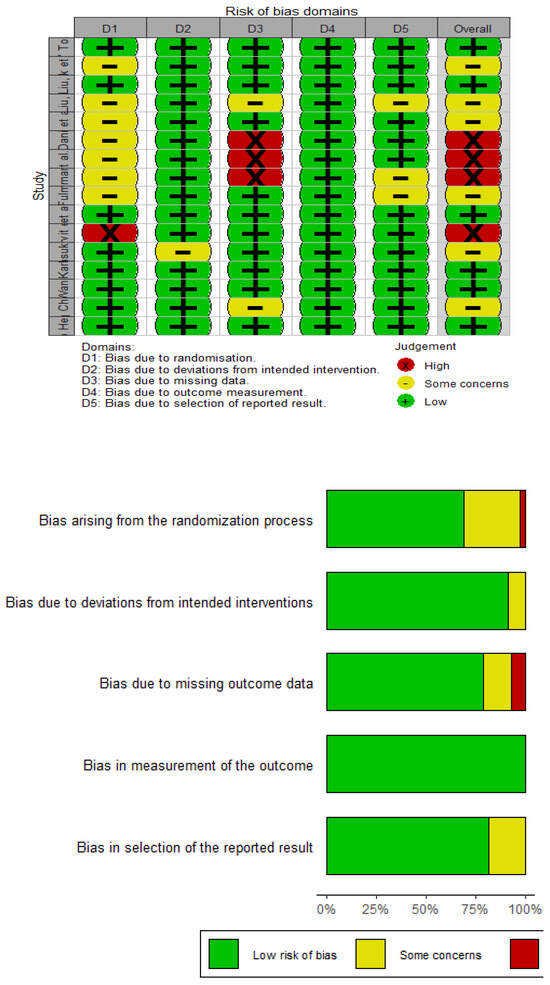
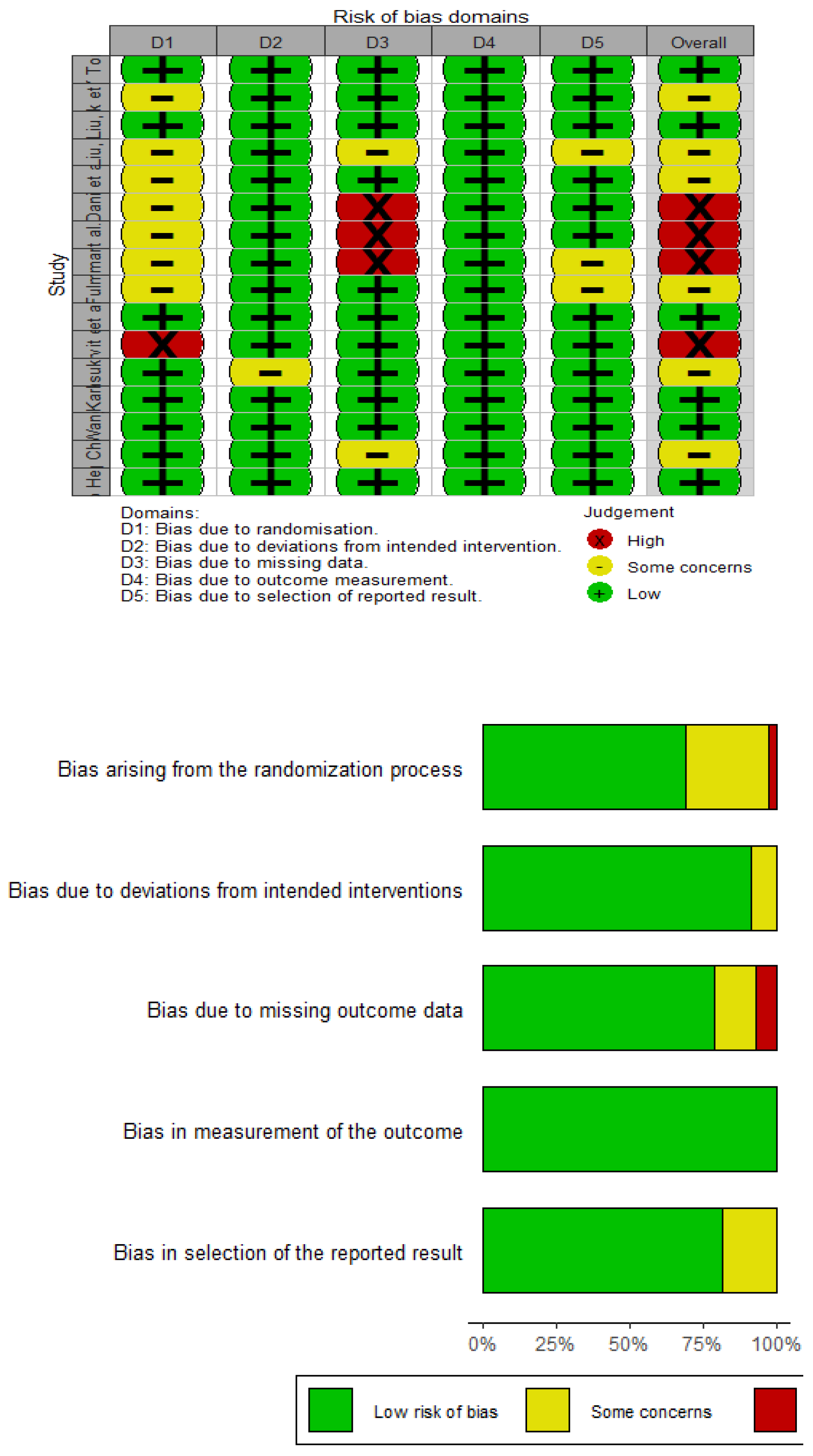
Risk of bias for 16 studies was assessed using the ROB 2 tool. The overall bias judgment was “low” for six studies [23,24,27,28,30,35], while six studies showed “some concerns” and four studies were flagged with “ high risk of bias” [25,26,34,36], primarily due to concerns in randomization and missing outcome data, which may influence the robustness of pooled estimates, as seen in Figure 2.
Figure 2.
Risk of bias of the included studies.
3.2. Depression Outcome
Depressive symptoms were evaluated in 16 studies and contributed to twenty effect size comparisons due to multi-arm trial designs. Across the included studies, reductions in PHQ-9 scores varied considerably between interventions. The largest decreases in depressive symptoms were observed in Hao Liu and Yuhao He [24,27], as well as Russell Fulmer [13], indicating great improvements following the interventions. In contrast, minimal changes were observed in studies such as Yi-Hang Chiu and Sahand Sabour [4,35], where post-intervention scores showed little difference from baseline or control conditions. Overall, while most studies demonstrated a trend toward symptom reduction, the magnitude of improvement was highly heterogeneous across trials, as seen in Table 2.
Table 2.
PHQ-9 mean ± SD pre- and post-intervention in both groups.
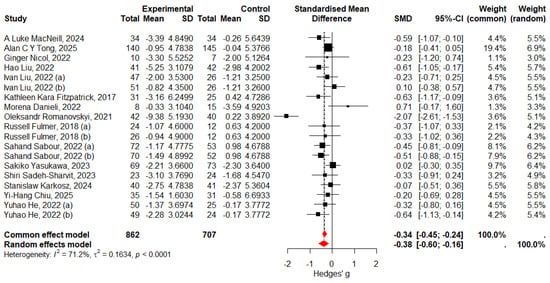
For depressive symptoms measured using PHQ-9, the pooled analysis demonstrated, among 15 studies, a small but statistically significant effect favoring the intervention. Under the random-effects model, the standardized mean difference (Hedges’ g = −0.38; 95% CI [−0.60, −0.16]), although substantial heterogeneity was observed (I2 = 71.2%; p < 0.001). The most pronounced effect favoring the intervention group was observed in the study by Oleksandr Romanovskyi, 2021 [34]. (Hedges’ g = −2.07, 95% CI: −2.61 to −1.53). The smallest effect was observed in Sakiko Yasukawa (2023) (Hedges’ g = 0.02, 95% CI: −0.30 to 0.35) [31], favoring the control group, as seen in Figure 3.
Figure 3.
Forest plot of change in PHQ-9 score [1,2,3,4,5,6,7,8,9,10,11,12,13,14,15,16,17,18,19,20,21,22,23,24,25,26,27,28,29,30,31,32,33,34,35,36].
The funnel plot for PHQ-9 SMD shows an overall asymmetrical distribution of studies around the pooled effect estimate, although Egger’s regression test was not statistically significant (t = −0.70, p = 0.497), as seen in Figure S1.
The leave-one-out sensitivity analysis revealed that Oleksandr Romanovskyi was identified as a major contributor to heterogeneity, with I2 decreased to 22.9%. Although classified within the high-risk of bias subgroup, this study appeared as an outlier relative to the other high-risk studies, likely due to its substantially larger sample size, as seen in Figure S2.
The subgroup analysis shows significant differences between risk of bias (ROB) groups under the common effect model (p = 0.004), driven by the “High” ROB group. However, under the random-effects model (p = 0.609), the observed subgroup variation is inconsistent when accounting for high within-group heterogeneity (I2 = 91.7% in the High ROB group), as seen in Figure S3.
The subgroup analysis based on follow-up period did not show a significant difference: the <4 weeks subgroup (SMD = −0.36, CI [−0.56; −0.16]) and the ≥4 weeks subgroup (SMD = −0.39, CI [−0.71; −0.07]) (p = 0.8832), as seen in Figure S9.
A mixed-effects meta-regression model including ten studies (k = 10) and predictors, including intervention type, risk of bias, age, and sex, was implemented for PHQ-9 and explained 98% of the observed between-study heterogeneity (R2 = 98%). These results are interpreted cautiously given that only four moderators were examined across 10 studies. Risk of bias was significantly associated with treatment effects, as studies rated as low risk of bias showed significantly lower effect sizes compared with the reference category (β = −1.14 [−2.13, −0.16], p = 0.022). Studies with some concerns in risk of bias also tended to show lower effect sizes, although this did not reach statistical significance (β = −1.04 [−2.13, −0.06, p = 0.065). Intervention automation status was not significantly associated with outcomes (β = 0.44[−0.09, 0.97], p = 0.106), indicating no clear difference between fully automated and comparator interventions. Likewise, the age (β = −0.21[−0.67, 0.25], p = 0.372) and sex proportion (β = 1.05[−0.17,2.28], p = 0.093) were not significant predictors of effect size.
3.3. Anxiety Outcome
Anxiety outcome was assessed using the Generalized Anxiety Disorder-7 (GAD-7) questionnaire. The severity of anxiety varied among the studies that were included, with baseline intervention scores ranging from 3.14 ± 2.04 in Morena Danieli [26] to 18.05 ± 5.89 in Kathleen Kara Fitzpatrick, 2017. Most chatbot-based interventions, such as Alan C Y Tong (8.34 ± 5.81 to 6.40 ± 5.14) and Sahand Sabour, exhibited numerical reductions in anxiety symptoms following treatment. Oleksandr Romanovskyi [34] reported the most significant improvement, with a change score of Δ −13.48 ± 4.20, in contrast to Δ −1.18 ± 3.71 in the control group, as seen in Table 3.
Table 3.
The mean score of GAD-7 pre- and post-intervention in both groups.
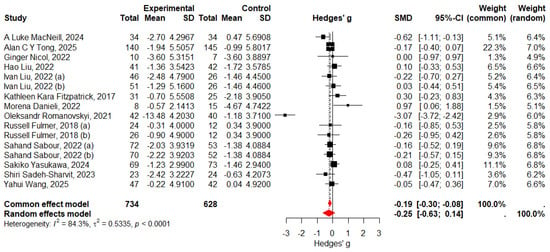
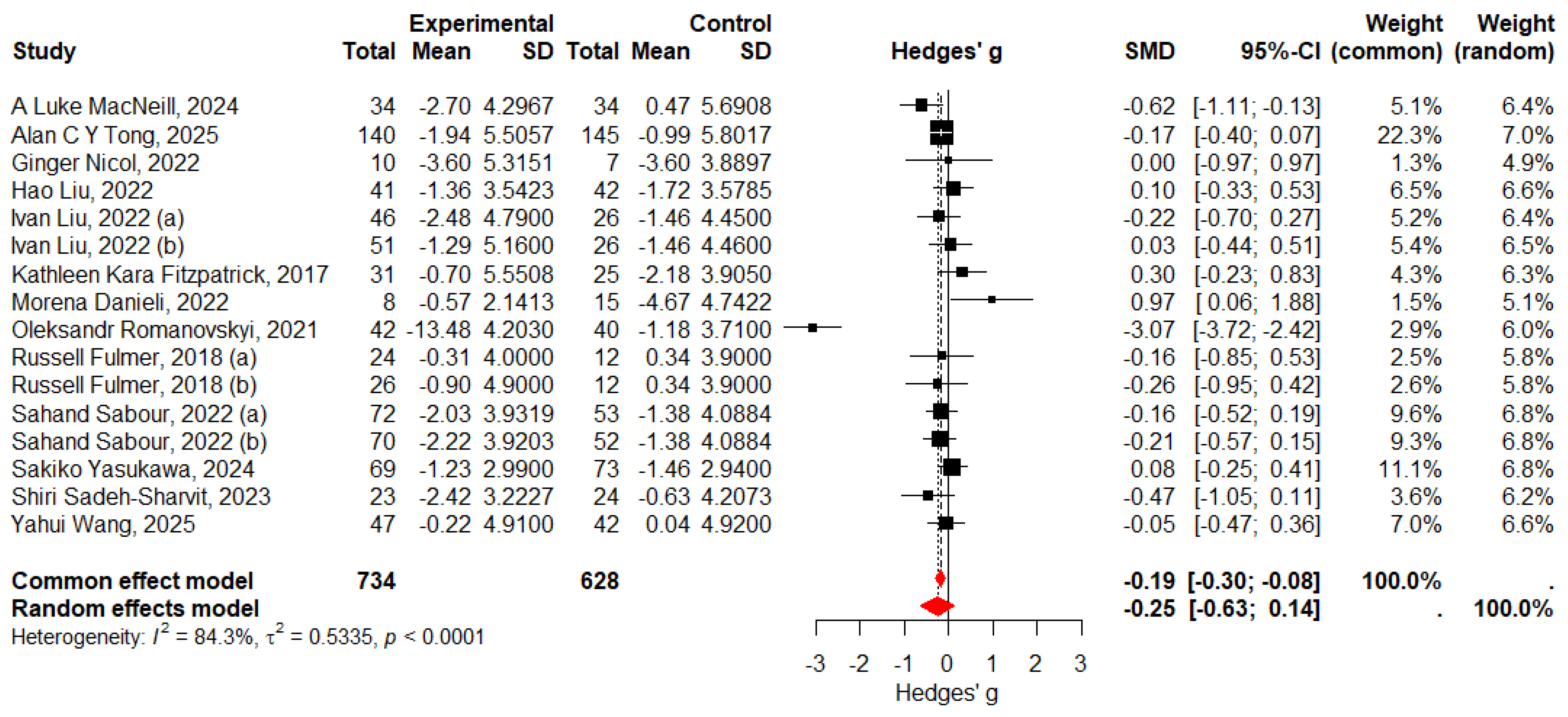
The pooled random-effects estimate indicated a small-to-moderate, non-statistically significant reduction in the outcome in the experimental group compared with controls (Hedges’ g = −0.25, 95% CI −0.63 to 0.14), with the confidence interval crossing the line of no effect, suggesting that the overall effect was not statistically significant. A significant degree of between-study heterogeneity was observed (I2 = 84.3%, p < 0.001), indicating substantial variability in effect sizes across included studies. The SMD ranged from (Hedges’ g = 0, 95%CI −0.97 to 0.97) in Ginger Nicol (2022) [25] and the largest effect in Oleksandr Romanovskyi (2021) [34], as seen in Figure 4.
Figure 4.
Forest plot of GAD-7 score studies [13,23,24,25,26,29,30,31,32,33,34,35,36].
Visual inspection of the funnel plot for GAD-7 scores revealed a generally asymmetrical distribution of studies around the pooled effect size. Although quantitative assessment using Egger’s test was not significant (p = 0.577), this finding does not exclude the possibility of publication bias, particularly given the potential influence of between-study heterogeneity and the limited power of statistical tests when few studies are available. Therefore, the presence of publication bias cannot be ruled out, as seen in Figure S4.
The leave-one-out analysis shows a stable overall effect, with most studies contributing a consistently moderate-to-large effect size (Hedges’ g around −0.11 to −0.31). Oleksandr Romanovskyi (2021) [34] reported heterogeneity (I2 = 17.8%), as seen in Figure S5.
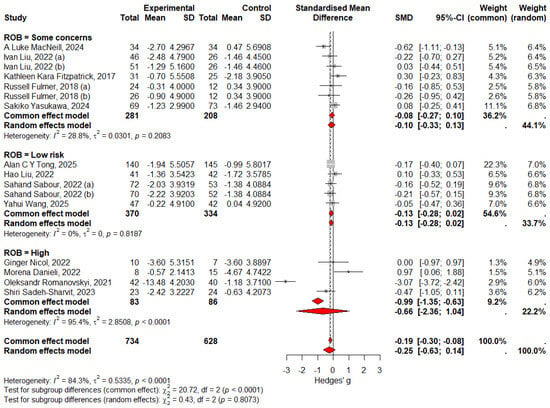
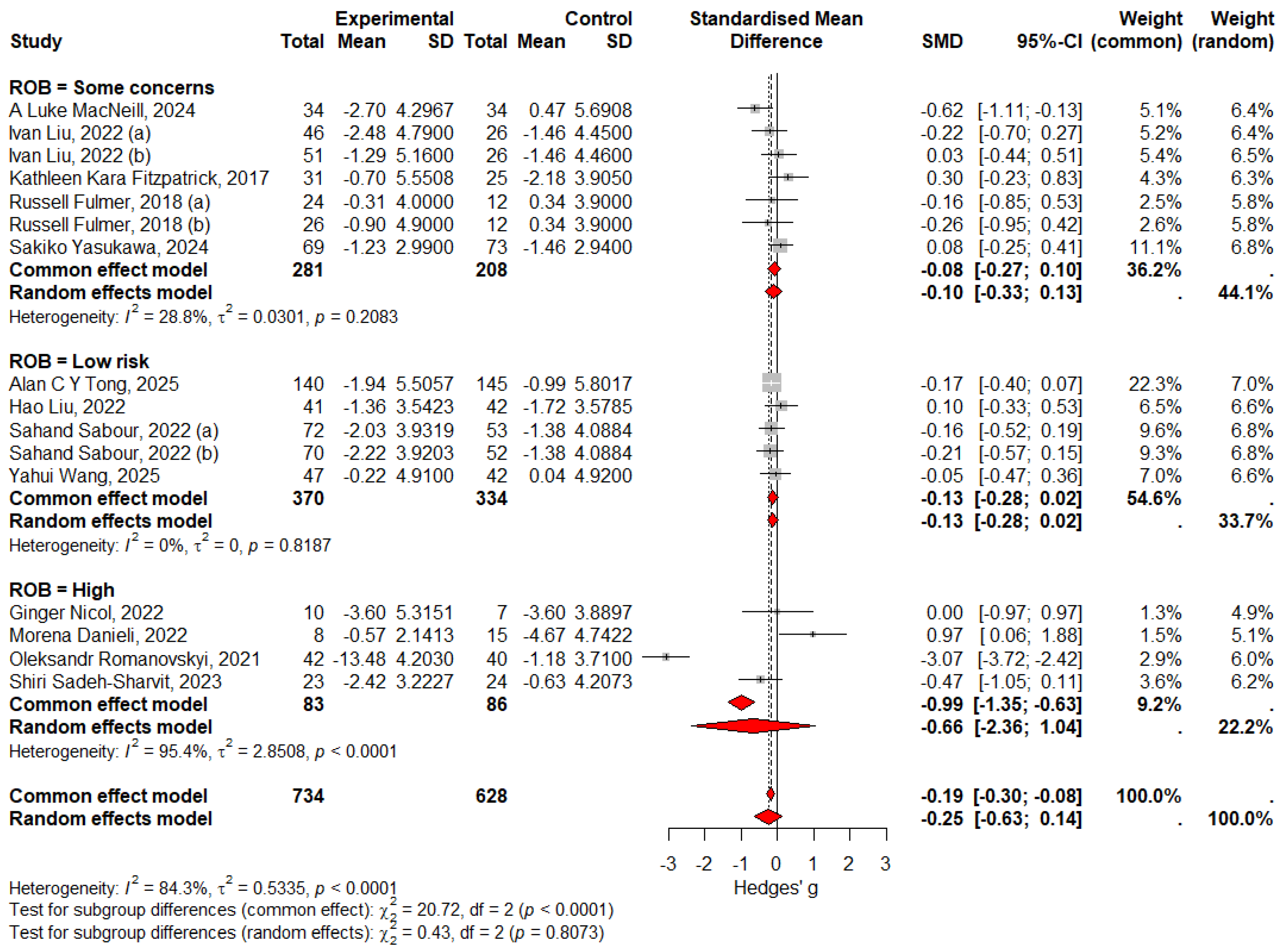
Subgroup analysis based on risk of bias did not meaningfully explain the substantial heterogeneity observed across studies. Although high-risk studies showed larger effect estimates, heterogeneity remained considerable within high-risk subgroups (I2 = 86.8% and 95.4%). However, the heterogeneity for low and some concern risk dropped to I2 = 28.8% and I2 = 0%, respectively, as seen in Figure 5.
Figure 5.
Subgroup analysis of GAD-7 studies according to ROB [13,23,24,25,26,29,30,31,32,33,34,35,36].
The subgroup analysis based on the follow-up period did not show a significant difference. Neither the <4 weeks (CI [−0.26; 0.08]) nor the ≥4 weeks subgroup (CI [−1.10; 0.31]) was significant (p = 0.4162), as seen in Figure S10.
The substantial between-study heterogeneity overall could not be explained by the meta-regression analysis, which included ten studies (k = 10), automation level, and country type. The residual heterogeneity remained substantial (I2 = 90.33%). The moderators that were included in the analysis accounted for approximately 7.8% of the observed heterogeneity (R2 = 7.8%). Anxiety effect estimates were not significantly associated with entirely automated interventions (p = 0.844) and the effect sizes of studies conducted in European countries were substantially less than those of the East Asian (β = −1.16, 95% CI: −2.41 to 0.09, p = 0.068), whereas studies conducted in the United States/Canada did not demonstrate a significant association (β = −0.14, 95% CI: −0.94 to 0.66, p = 0.727).
3.4. Positive and Negative Affect Outcome
Eight effect-size comparisons derived from six unique studies, with two studies (Ivan Liu, 2022 [29] and Sahand Sabour, 2022 [22]) contributing three-arm designs (control, intervention 1, intervention 2). The effects of PANAS were inconsistent across studies. Stanisław Karkosz and Oleksandr Romanovskyi were among the chatbot interventions that demonstrated improvements in positive affect (PANAS-P). Conversely, Hao Liu and Sahand Sabour reported negligible changes. Chatbot-based interventions generally favored reductions in negative emotions for negative affect (PANAS-N), with the greatest improvement observed in Oleksandr Romanovskyi (Δ −16.88 ± 8.40 vs. Δ −0.78 ± 2.54 in controls), as seen in Table 4.
Table 4.
The mean PANAS-P and PANAS-N scores 7 pre- and post-intervention in both groups.
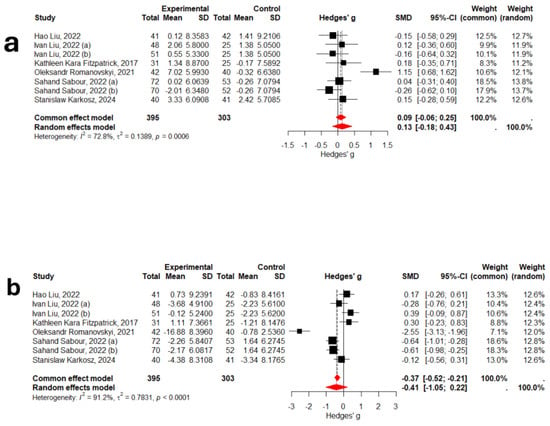
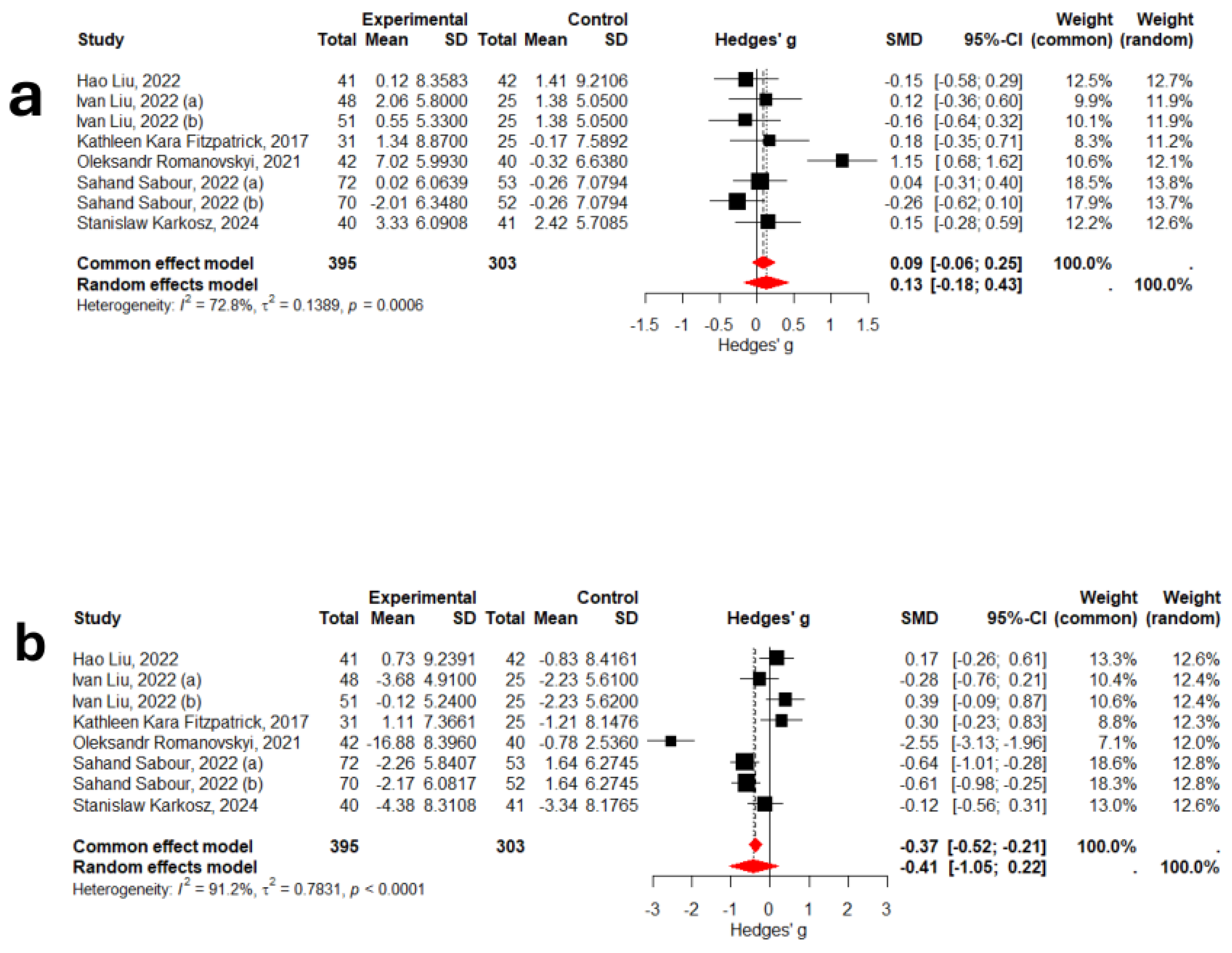
The pooled SMD of six studies assessing the PANAS-P (positive affect) scores revealed no statistically significant difference between the experimental and control groups. The random-effects model yielded Hedges’ g = 0.13 (95% CI: −0.18 to 0.43). There was substantial heterogeneity among the included studies (I2 = 72.8%, p < 0.001), where Oleksandr Romanovskyi (2021) showed the highest effect favoring the intervention [34], although this study had a high risk of bias, followed by Kathleen Kara Fitzpatrick (2017) with Hedges’g = 0.18 (95%CI: −0.35 to 0.71) favoring the intervention [33]. Eight study arms were included in the aggregated analysis of PANAS-N outcomes, the random-effects model, primary analysis (Hedges’ g = −0.41, 95% CI: −1.05 to 0.22) (I2 = 91.2%, τ2 = 0.7831, p < 0.001), indicating significant variability in effect estimates across studies. Substantial between-study heterogeneity was also observed. Oleksandr Romanovskyi reported the most significant effect in favor of chatbot interventions (SMD = −2.55, 95% CI: −3.13 to −1.96) [34], as seen in Figure 6.
Figure 6.
Forest plot of (a) PANAS-P and (b) PANAS-N scores [24,28,29,33,34,35].
No evidence of funnel plot asymmetry was detected for PANAS-P and PANAS-N using the trim-and-fill method (k0 = 0). Nevertheless, the high level of heterogeneity (I2 = 91.2%) limits the reliability of this method, and therefore the possibility of publication bias cannot be definitively excluded, as seen in Figure S6.
To assess the robustness of the pooled effect magnitude on PANAS-P, a leave-one-out sensitivity analysis was implemented. The most significant reduction in heterogeneity (I2 = 0%) and the shift in the aggregated estimate towards the null effect (SMD = −0.03, 95% CI: −0.19 to 0.13) were the results excluding Oleksandr Romanovskyi. This suggests that this study significantly contributed to the observed between-study heterogeneity. Conversely, the pooled effect size was the largest when Sahand Sabour (b) was omitted (SMD = 0.17, 95% CI: 0.00 to 0.34; p = 0.0453), a result that was borderline statistically significant. Leave-one-out was implemented to PANAS-N revealed that Romanovskyi (2021) [34] study was identified as a significant aberration in the analysis. The heterogeneity (I2) was significantly reduced from 91.2% to 73.7%, and the pooled SMD was reduced from −0.37 (95% CI: −0.52 to −0.21) to −0.20 (95% CI: −0.36 to −0.04) with the exclusion of this study, as seen in Figure S7.
Subgroup analysis based on risk of bias meaningfully explained the substantial heterogeneity observed across studies. Heterogeneity decreased to I2 = 0% for the low risk of bias subgroup in PANAS-P, whereas the “some concerns” subgroup showed significant heterogeneity (χ2 = 22.18, p < 0.001). In contrast, risk of bias did not substantially affect heterogeneity in PANAS-N, where I2 was 73.2% and 52.4% for the low risk and “some concerns” subgroups, respectively, with a significant overall subgroup difference (χ2 = 55.80, p < 0.001), as seen in Figure S8.
The subgroup analysis for PANAS-N based on follow-up period did not show a significant difference. Neither subgroup was significant under random effects (FU > 4 weeks: CI [−2.50; 0.86]; FU ≤ 4 weeks: CI [−0.63; 0.24]), (p = 0.4783), as seen in Figure S11.
3.5. GRADE Assessment
Across all outcomes, the conviction of the evidence was rated as low to very low. The evidence for PHQ-9 was downgraded as a result of substantial heterogeneity and the risk of bias. The certainty rating for GAD-7 was extremely low, with downgrades attributed to the risk of bias (4/15 studies at high risk), substantial inconsistency (I2 = 84.3%), and imprecision due to wide confidence intervals crossing the line of no effect. The primary reason for the low assurance rating of PANAS outcomes was the significant heterogeneity and imprecision. Egger’s tests were non-significant, and funnel plots were asymmetric. However, publication bias cannot be definitively ruled out. No major concerns regarding indirectness were identified. In general, the results should be interpreted with prudence, as the quality of the studies and the estimates of their effects are subject to variation, as seen in Table 5.
Table 5.
GRADE assessment of the conducted meta-analysis.
4. Discussion
4.1. Summary of the Main Findings
To assess the efficacy of AI-based chatbot interventions on mental health outcomes, specifically depression, anxiety, and affective states, this systematic review and meta-analysis synthesized evidence from 16 randomized controlled trials, which included 1618 participants and 20 intervention arms. The combined results suggest that chatbot-based interventions resulted in a statistically significant reduction in depressive symptoms (Hedges’ g = −0.38), a non-significant trend towards anxiety reduction (Hedges’ g = −0.25), and inconsistent effects on positive and negative affect. These findings are in accordance with the expanding body of evidence that indicates that digital and AI-powered mental health tools may function as scalable, accessible supplements to traditional care. However, they also emphasize the necessity of methodological rigor in the assessment of their efficacy [19,20]. Fabeha Zafar et al. claimed that the current potential of AI in mental health is not to replace clinicians, but rather to provide them with vital insights and tools [37].
4.2. Depression Outcomes
The aggregated effect on PHQ-9 scores (Hedges’ g = −0.38, 95% CI: −0.60 to −0.16) is in accordance with previous meta-analyses that have investigated digital mental health interventions. Karyotaki et al. (2021) demonstrated that guided internet-based cognitive behavioral therapy (CBT) produced small-to-moderate reductions (Hedges’ g = −0.07, 95% CI: −0.51 to 0.36) in depressive symptoms across diverse populations, while Linardon et al. (2019) reported comparable effect sizes for app-based interventions targeting depression [19,38]. The substantial heterogeneity observed in our results (I2 = 71.2%) implies that the treatment response is significantly influenced by the individual study characteristics, such as the design of the chatbot, the therapeutic framework, and the type of comparator. It is important to note that the meta-regression accounted for 98% of the between-study heterogeneity (R2 = 98%), with the risk of bias arising as the most significant moderator. A pattern that has been previously documented in AI health meta-analyses, where low-quality trials tend to inflate treatment estimates, was observed in studies rated as low risk of bias, as evidenced by substantially attenuated effect sizes (β = −1.15, p = 0.022). The present findings remain consistent with previous meta-analyses of AI psychological interventions, which reported small-to-moderate beneficial effects of AI interventions on depressive symptoms despite including studies that used different depression assessment scales [39]. However, these findings should be considered exploratory due to the limited number of studies. This discovery underscores the significance of methodological rigor in the assessment of AI-based interventions and warns against the overinterpretation of effect estimates as they are derived from high-risk studies.
4.3. Anxiety Outcomes
The pooled effect on GAD-7 scores did not attain statistical significance, as evidenced by the confidence interval crossing the null (Hedges’ g = −0.25, 95% CI: −0.63 to 0.14), in contrast to depression. The interpretation is further complicated by the meta-regression model’s limited explanatory power (R2 = 7.8%) and the exceedingly high between-study heterogeneity (I2 = 90.33%). In East Asian studies, the geographic subgroup analysis revealed lower effect sizes than studies conducted in European countries (β = −1.16, p = 0.068). This discrepancy may be indicative of cultural differences in the acceptability of AI-delivered mental health support, varying baseline levels of mental health literacy, differential stigma surrounding help-seeking, or merely differences in the integration of digital tools into the healthcare system [40]. In general, AI-based interventions have the potential to enhance access to mental healthcare and alleviate anxiety symptoms. Nevertheless, the results are still inconsistent, and future research should concentrate on the optimization of effectiveness, the integration of human support, and the resolution of ethical issues, data privacy, and user-centered care to guarantee secure and equitable mental health support [41].
4.4. Affective Outcomes (PANAS)
The pooled positive effect (PANAS-P) was non-significant with respect to the affective dimensions of well-being (Hedges’ g = 0.13, 95% CI: −0.18 to 0.43), indicating that current AI-based chatbot interventions are largely ineffective at actively cultivating positive emotional states. Conversational AI systems may still contribute to emotional support, engagement, and well-being promotion, even though AI-based interventions did not demonstrate a significant aggregate improvement in positive affect, as indicated by several studies. This discovery is in accordance with prior research that indicates that active control conditions may not consistently outperform chatbot-based interventions. In a mixed-method systematic review conducted by Gaffney et al. (2019) [42], it was found that while certain controlled studies demonstrated substantial reductions in psychological distress when compared to inactive controls, studies that compared interventions with active controls generally failed to demonstrate superior effects. This suggests that the benefits of conversational agents in such contexts are comparable rather than additive [42]. Although there is currently insufficient evidence to demonstrate consistent improvements in positive affect outcomes, these findings suggest that AI systems may have broader psychosocial and supportive functions beyond direct symptom reduction [43]. The reductions in negative affect may be achievable with chatbot interventions, but the evidence base is insufficiently robust to draw firm conclusions. These findings are consistent with observations by Alves-Noreña, who reported that although AI systems may provide efficiency [44] and accessibility, they often fail to establish the interpersonal resonance necessary for emotionally meaningful interactions. This may partially explain why no statistically significant effect on positive affect was detected despite reducing certain negative emotional symptoms (Alves-Noreña et al., 2025 [43]). Van Der Maden et al. [45] reported in a large-scale study involving 1719 participants that context-sensitive, AI-driven well-being assessment systems improved user experience and emotional sensitivity in human–computer interaction. However, these process-level improvements may not necessarily result in significant changes in positive affect measures. This discrepancy may indicate that, although AI systems can enhance perceived responsiveness and engagement in well-being monitoring, this does not necessarily result in measurable increases in positive emotional states. This highlights a potential gap between measurable improvements in user experience and actual affective outcomes [16,46].
4.5. Implications for the Saudi Arabian Mental Health System and Vision 2030
These results are particularly pertinent to Saudi Arabia, where the reform of the mental health system is a critical element of Vision 2030. This initiative emphasizes the development of digital health infrastructure, preventive care, and increased access to mental health services [47]. This is consistent with the National Mental Health Policy (NMHP), which advocates for technology-enabled care, early intervention, and reduced treatment gaps areas in which AI-based chatbot interventions have demonstrated preliminary potential [48]. The need for scalable and accessible digital mental health solutions is further underscored by the high burden of psychiatric disorders in Saudi Arabia, where the point prevalence of depression (49.9%) and lifetime prevalence of anxiety (23.2%) exceed global averages [17,49,50]. Despite this growing burden, mental health service utilization remains limited due to persistent stigma, low mental health literacy, workforce shortages, and geographical barriers to care [51]. It is crucial to recognize that numerous mental health chatbots may not be entirely artificial intelligence-driven systems from an implementation perspective. Abd-alrazaq et al. (2019) [52] conducted a comprehensive review that identified 41 distinct mental health chatbots. Most of these chatbots were designed for therapy (n = 17), training (n = 12), and screening (n = 10). Additionally, 92.5% of the chatbots were rule-based rather than AI-driven. This implies that the majority of evaluated “chatbots” depend on scripted or rule-based logic rather than adaptive learning systems. This could potentially account for the inconsistent or modest effects observed in the current meta-analysis, as rule-based systems may not possess the adaptive capabilities necessary to generate long-term psychological enhancements. Within this context, national initiatives such as the Sehhaty platform and the National Center for Mental Health Promotion (NCMH) reflect Saudi Arabia’s increasing investment in digital health as a key strategy for expanding mental health access and service delivery [47].
It is crucial to note that none of the studies included were conducted in Arabic-speaking populations, which underscores a significant evidence deficit. The efficacy of AI-based mental health interventions in Saudi Arabia and the broader Arabic region may be significantly influenced by cultural and contextual factors, including religious interpretations of distress, language limitations in Arabic NLP systems, gender norms, and attitudes towards emotional disclosure [53].
Several practical recommendations for policymakers, healthcare providers, developers, and researchers are supported by the findings of this review. Policymakers in Saudi Arabia and the broader Arabic region should establish clear regulatory frameworks that ensure patient safety, cultural validation, and Arabic-language adaptation, while incorporating AI-based mental health chatbots into national digital health strategies as adjunctive tools for depression prevention and early intervention. The integration of validated AI tools into platforms like Sehhaty may bolster the digital health objectives of Vision 2030 [48,53]. Healthcare providers should employ these tools as supportive interventions, rather than as a substitute for psychotherapy. In order to guarantee the safe implementation of technology in non-Western environments, technology developers should prioritize the design of Arabic-language chatbots that are culturally adapted, transparent, include prejudice monitoring, and have human escalation pathways [54]. Lastly, in order to fortify the evidence base and inform regionally pertinent mental health policy and practice, future research should concentrate on large, methodologically rigorous RCTs with extended follow-up periods, standardized outcome measures, and a greater representation of Arab and Middle Eastern populations [53].
Despite their potential benefits, AI-based mental health chatbots raise concerns regarding the privacy and confidentiality of sensitive mental health data, as well as the risk of inaccurate or inappropriate advice that may delay access to professional assessment and evidence-based treatment. Accordingly, these tools should complement rather than replace qualified mental health care, with robust data protection measures, clear disclosure of their limitations, and reliable pathways for referral to human professionals when clinically indicated [44].
4.6. Strengths and Limitations
This review exhibited a variety of methodological strengths, such as the utilization of standardized outcome measures (PANAS, GAD-7, and PHQ-9) to enhance comparability across studies, an exhaustive multi-database search strategy, and PRISMA-guided methodology. Independent dual-reviewer assessment and rigorous statistical methods, such as meta-regression analyses, sensitivity analyses, and subgroup analyses, were implemented to enhance reliability.
Several limitations should be acknowledged. First, substantial between-study heterogeneity persisted across all outcomes despite subgroup analyses and meta-regression, suggesting unmeasured moderators. This may reflect differences in AI technologies, comparator types, and intervention characteristics, including dose, therapeutic framework, and level of human support, which were inconsistently reported. Second, the small number of included studies, particularly for PANAS outcomes, limited the statistical power of subgroup and meta-regression analyses; these findings should therefore be considered exploratory rather than confirmatory. Third, restricting outcomes to PHQ-9 and GAD-7 enhanced comparability but may have excluded relevant trials using other validated instruments. Similarly, focusing on Domain 5 of the proposed 10-domain application taxonomy may limit the applicability of findings to other domains. Fourth, most studies had short follow-up periods (2–8 weeks), limiting conclusions about the long-term sustainability of treatment effects. Fifth, insufficient reporting of safety outcomes restricted the assessment of adverse events and safety procedures. Sixth, GRADE certainty ranged from low to very low, primarily due to heterogeneity, risk-of-bias concerns in some trials, and imprecision, with confidence intervals crossing the null for several outcomes. Variability in study quality and effect estimates further limits confidence in the robustness and generalizability of the findings. Seventh, Concomitant treatments (e.g., medications and psychotherapy) and diagnostic methods (clinical diagnosis versus self-report) were inconsistently reported, preventing assessment of their potential influence on the pooled results. Finally, the protocol was not prospectively registered, representing an additional methodological limitation.
5. Conclusions and Recommendations
Although AI chatbots showed a small statistically significant effect on depressive symptoms, the clinical relevance of this effect remains uncertain. No statistically significant effects were observed for anxiety or affect outcomes. These findings reflect short-term changes in psychometric scores and should not be interpreted as evidence of long-term effectiveness, adherence, safety, preventive benefits, or improved access to healthcare. Further high-quality RCTs with longer follow-up are needed to assess the durability of symptom changes and evaluate outcomes not addressed by the current evidence. Dedicated economic evaluations are also required before firm clinical or policy recommendations can be made.
The implementation of AI-based mental health interventions, particularly in vulnerable populations and under-resourced health systems, raises important ethical concerns, including transparency, informed consent, and appropriate safeguards for crisis situations [41]. Users should be informed that they are interacting with an automated system and made aware of its limitations. The potential role of large language model (LLM)-based conversational agents is an emerging area of research. A 28-day randomized controlled trial by Zhao et al. (2025) [55], involving 865 young adults, evaluated an LLM-based AI agent for depressive and anxiety symptoms. However, a single short-term trial does not establish the long-term effectiveness, safety, scalability in routine care, or superiority of LLM-based systems overrule-based or hybrid chatbots. These outcomes require further direct and longer-term evaluation.
Supplementary Materials
The following supporting information can be downloaded at: https://www.mdpi.com/article/10.3390/psychiatryint7060254/s1, Figure S1: PHQ-9 funnel plot, Figure S2: PHQ-9 leave-one out sensitivity analysis. Figure S3: PHQ-9 subgroup analysis (ROB), Figure S4: GAD-7 funnel plot, Figure S5: GAD-7 leave-one out analysis, Figure S6: Funnel plot with trim and fill for PANAS-P and PANAS-N, Figure S7: Leave-one out sensitivity analysis (a) PANAS-P, (b) PANAS-N studies, Figure S8: Sub-group analysis by ROB for (a) PANAS-P and (b) PANAS-N, (c) PANAS-N by intervention fully automated or not, Figure S9: PHQ-9 subgroup analysis (follow-up period 4 weeks), Figure S10: GAD-7 subgroup analysis (follow-up period 4 weeks), Figure S11: PANAS-N subgroup analysis (follow-up period 4 weeks). Table S1: Supplementary: Database search strategy, Table S2: Supplementary of excluded studies on full-text.
Author Contributions
Conceptualization: A.M.A.-G.; Methodology: A.M.A.-G., A.S.A. and A.A.-H.; Literature Search and Study Selection: A.M.A.-G. and R.A.; Data Extraction: A.M.A.-G. and R.A.; Risk of Bias Assessment: A.M.A.-G. and R.A.; Statistical Analysis: A.M.A.-G. and A.S.A.; Interpretation of Results: A.M.A.-G., A.S.A. and A.A.-H.; Writing—Original Draft Preparation: A.M.A.-G.; Writing—Review and Editing: all authors; Supervision: A.A.-H. All authors have read and agreed to the published version of the manuscript.
Funding
This research received no external funding.
Institutional Review Board Statement
Not applicable.
Informed Consent Statement
Not applicable.
Data Availability Statement
The original contributions presented in this study are included in the article/Supplementary Materials. Further inquiries can be directed to the corresponding author.
Conflicts of Interest
The authors declare no conflicts of interest.
References
- Pandey, H.M. Artificial intelligence in mental health and well-being: Evolution, current applications, future challenges, and emerging evidence. arXiv 2024, arXiv:2501.10374. [Google Scholar]
- Olawade, D.B.; Wada, O.Z.; Odetayo, A.; David-Olawade, A.C.; Asaolu, F.; Eberhardt, J. Enhancing mental health with Artificial Intelligence: Current trends and future prospects. J. Med. Surg. Public Health 2024, 3, 100099. [Google Scholar] [CrossRef] [Scilit]
- Pavlopoulos, A.; Rachiotis, T.; Maglogiannis, I. An overview of tools and technologies for anxiety and depression management using AI. Appl. Sci. 2024, 14, 9068. [Google Scholar] [CrossRef] [Scilit]
- Chiu, Y.-H.; Lee, Y.-F.; Lin, H.-L.; Cheng, L.-C. Using cognitive behavioral therapy-based chatbots to alleviate symptoms of insomnia, depression, and anxiety: A randomized controlled trial. Health Inform. J. 2025, 31, 14604582251396428. [Google Scholar] [CrossRef] [Scilit]
- Humayun, A.; Madawana, A.M.; Hassan, A.; Mahmud, A.; Kamaruddin, N.; Noor, S.H.; Nawi, M.A.A. Artificial intelligence as a predictive tool for mental health status: Insights from a systematic review and meta-analysis. PLoS ONE 2025, 20, e0332207. [Google Scholar] [CrossRef] [Scilit]
- Bodner, R.; Lim, K.; Schneider, R.; Torous, J. Efficacy and risks of artificial intelligence chatbots for anxiety and depression: A narrative review of recent clinical studies. Curr. Opin. Psychiatry 2026, 39, 19–25. [Google Scholar] [CrossRef] [Scilit]
- Kuta, B.; Novak, L.; Zidkova, R.; Furstova, J.; Malinakova, K.; De Winter, A.; Husek, V. Effectiveness of a fully automated mobile therapeutic versus a general chatbot in reducing depression and anxiety and improving well-being: Feasibility randomized controlled trial. JMIR Ment. Health 2026, 13, e82642. [Google Scholar] [CrossRef] [Scilit]
- Abu-Mahfouz, M.S.; AlFehaid, S.; Burqan, H.M.; El Arab, R.A. Artificial intelligence in mental health care: A scoping review of reviews. Front. Psychiatry 2026, 17, 1688043. [Google Scholar] [CrossRef] [Scilit]
- Inkster, B.; Sarda, S.; Subramanian, V. An empathy-driven, conversational artificial intelligence agent (Wysa) for digital mental well-being: Real-world data evaluation mixed-methods study. JMIR mHealth uHealth 2018, 6, e12106. [Google Scholar] [CrossRef] [Scilit]
- Vaidyam, A.N.; Wisniewski, H.; Halamka, J.D.; Kashavan, M.S.; Torous, J.B. Chatbots and conversational agents in mental health: A review of the psychiatric landscape. Can. J. Psychiatry 2019, 64, 456–464. [Google Scholar] [CrossRef] [Scilit]
- Li, Y.; Liang, S.; Zhu, B.; Liu, X.; Li, J.; Chen, D.; Qin, J.; Bressington, D. Feasibility and effectiveness of artificial intelligence-driven conversational agents in healthcare interventions: A systematic review of randomized controlled trials. Int. J. Nurs. Stud. 2023, 143, 104494. [Google Scholar] [CrossRef] [Scilit]
- Andersson, G.; Titov, N. Advantages and limitations of Internet-based interventions for common mental disorders. Appl. Sci. 2014, 13, 4–11. [Google Scholar] [CrossRef] [Scilit]
- Fulmer, R.; Joerin, A.; Gentile, B.; Lakerink, L.; Rauws, M. Using psychological artificial intelligence (Tess) to relieve symptoms of depression and anxiety: Randomized controlled trial. JMIR Ment. Health 2018, 5, e9782. [Google Scholar] [CrossRef] [Scilit]
- Bendig, E.; Erb, B.; Schulze-Thuesing, L.; Baumeister, H. The next generation: Chatbots in clinical psychology and psychotherapy to foster mental health–a scoping review. Verhaltenstherapie 2022, 32, 64–76. [Google Scholar] [CrossRef] [Scilit]
- Fiske, A.; Henningsen, P.; Buyx, A. Your robot therapist will see you now: Ethical implications of embodied artificial intelligence in psychiatry, psychology, and psychotherapy. J. Med. Internet Res. 2019, 21, e13216. [Google Scholar] [CrossRef] [Scilit]
- Abd-Alrazaq, A.A.; Rababeh, A.; Alajlani, M.; Bewick, B.M.; Househ, M. Effectiveness and safety of using chatbots to improve mental health: Systematic review and meta-analysis. J. Med. Internet Res. 2020, 22, e16021. [Google Scholar] [CrossRef] [Scilit]
- Altwaijri, Y.A.; Al-Subaie, A.S.; Al-Habeeb, A.; Bilal, L.; Al-Desouki, M.; Aradati, M.; King, A.J.; Sampson, N.A.; Kessler, R.C. Lifetime prevalence and age-of-onset distributions of mental disorders in the Saudi National Mental Health Survey. Int. J. Methods Psychiatr. Res. 2020, 29, e1836. [Google Scholar] [CrossRef] [Scilit]
- Alarabi, M.A.; Alosaimi, F.D. Mental Healthcare in Saudi Arabia. In Mental Health Care in the Middle East; Springer: Berlin/Heidelberg, Germany, 2025; pp. 251–279. [Google Scholar]
- Linardon, J.; Cuijpers, P.; Carlbring, P.; Messer, M.; Fuller-Tyszkiewicz, M. The efficacy of app-supported smartphone interventions for mental health problems: A meta-analysis of randomized controlled trials. World Psychiatry 2019, 18, 325–336. [Google Scholar] [CrossRef] [Scilit]
- Torous, J.; Myrick, K.J.; Rauseo-Ricupero, N.; Firth, J. Digital mental health and COVID-19: Using technology today to accelerate the curve on access and quality tomorrow. JMIR Ment. Health 2020, 7, e18848. [Google Scholar] [CrossRef] [Scilit]
- Page, M.J.; McKenzie, J.E.; Bossuyt, P.M.; Boutron, I.; Hoffmann, T.C.; Mulrow, C.D.; Shamseer, L.; Tetzlaff, J.M.; Akl, E.A.; Brennan, S.E.; et al. The PRISMA 2020 statement: An updated guideline for reporting systematic reviews. BMJ 2021, 372, n71. [Google Scholar] [CrossRef] [Scilit]
- Keyes, C.; Psychology, C.L. Mental illness and/or mental health? Investigating axioms of the complete state model of health. J. Consult. Clin. Psychol. 2005, 73, 539. [Google Scholar] [CrossRef] [Scilit]
- Wang, Y.; Li, X.; Zhang, Q.; Yeung, D.; Wu, Y. Effect of a cognitive behavioral therapy–based AI chatbot on depression and loneliness in chinese university students: Randomized controlled trial with financial stress moderation. JMIR mHealth uHealth 2025, 13, e63806. [Google Scholar] [CrossRef] [Scilit]
- Liu, H.; Peng, H.; Song, X.; Xu, C.; Zhang, M. Using AI chatbots to provide self-help depression interventions for university students: A randomized trial of effectiveness. Internet Interv. 2022, 27, 100495. [Google Scholar] [CrossRef] [Scilit]
- Nicol, G.; Wang, R.; Graham, S.; Dodd, S.; Garbutt, J. Chatbot-delivered cognitive behavioral therapy in adolescents with depression and anxiety during the COVID-19 pandemic: Feasibility and acceptability study. JMIR Form. Res. 2022, 6, e40242. [Google Scholar] [CrossRef] [Scilit]
- Danieli, M.; Ciulli, T.; Mousavi, S.M.; Silvestri, G.; Barbato, S.; Di Natale, L.; Riccardi, G. Assessing the impact of conversational artificial intelligence in the treatment of stress and anxiety in aging adults: Randomized controlled trial. JMIR Ment. Health 2022, 9, e38067. [Google Scholar] [CrossRef] [Scilit]
- He, Y.; Yang, L.; Zhu, X.; Wu, B.; Zhang, S.; Qian, C.; Tian, T. Mental health chatbot for young adults with depressive symptoms during the COVID-19 pandemic: Single-blind, three-arm randomized controlled trial. J. Med. Internet Res. 2022, 24, e40719. [Google Scholar] [CrossRef] [Scilit]
- Karkosz, S.; Szymański, R.; Sanna, K.; Michałowski, J. Effectiveness of a web-based and mobile therapy chatbot on anxiety and depressive symptoms in subclinical young adults: Randomized controlled trial. JMIR Form. Res. 2024, 8, e47960. [Google Scholar] [CrossRef] [Scilit]
- Liu, I.; Xiao, Y.; Liu, F.; Wu, S.; Ni, S. (Eds.) Assessing the effectiveness of using chatbots for positive psychological intervention: A randomized control study. In Proceedings of the Tenth International Symposium of Chinese CHI (Chinese CHI 2022); ACM: New York, NY, USA, 2022. [Google Scholar]
- Tong, A.C.; Wong, K.T.; Chung, W.W.; Mak, W.W. Effectiveness of topic-based chatbots on mental health self-care and mental well-being: Randomized controlled trial. J. Med. Internet Res. 2025, 27, e70436. [Google Scholar] [CrossRef] [Scilit]
- Yasukawa, S.; Tanaka, T.; Yamane, K.; Kano, R.; Sakata, M.; Noma, H.; A. Furukawa, T.; Kishimoto, T. A chatbot to improve adherence to internet-based cognitive–behavioural therapy among workers with subthreshold depression: A randomised controlled trial. BMJ Ment. Health 2024, 27, e300881. [Google Scholar] [CrossRef] [Scilit]
- MacNeill, A.L.; Doucet, S.; Luke, A. Effectiveness of a mental health chatbot for people with chronic diseases: Randomized controlled trial. JMIR Form. Res. 2024, 8, e50025. [Google Scholar] [CrossRef] [Scilit]
- Fitzpatrick, K.K.; Darcy, A.; Vierhile, M. Delivering cognitive behavior therapy to young adults with symptoms of depression and anxiety using a fully automated conversational agent (Woebot): A randomized controlled trial. JMIR Ment. Health 2017, 4, e7785. [Google Scholar] [CrossRef] [Scilit]
- Romanovskyi, O.; Pidbutska, N.; Knysh, A.Y. Elomia chatbot: The effectiveness of artificial intelligence in the fight for mental health. In Proceedings of the 5th International Conference on Computational Linguistics and Intelligent Systems (COLINS 2021), Lviv, Ukraine, 22–23 April 2021. [Google Scholar]
- Sabour, S.; Zhang, W.; Xiao, X.; Zhang, Y.; Zheng, Y.; Wen, J.; Zhao, J.; Huang, M. A chatbot for mental health support: Exploring the impact of Emohaa on reducing mental distress in China. Front. Digit. Health 2023, 5, 1133987. [Google Scholar] [CrossRef] [Scilit]
- Sadeh-Sharvit, S.; Camp, T.D.; Horton, S.E.; Hefner, J.D.; Berry, J.M.; Grossman, E.; Hollon, S.D. Effects of an artificial intelligence platform for behavioral interventions on depression and anxiety symptoms: Randomized clinical trial. J. Med. Internet Res. 2023, 25, e46781. [Google Scholar] [CrossRef] [Scilit]
- Zafar, F.; Alam, L.F.; Vivas, R.R.; Wang, J.; Whei, S.J.; Mehmood, S.; Sadeghzadegan, A.; Lakkimsetti, M.; Nazir, Z. The role of artificial intelligence in identifying depression and anxiety: A comprehensive literature review. Cureus 2024, 16, e56472. [Google Scholar] [CrossRef] [Scilit]
- Karyotaki, E.; Efthimiou, O.; Miguel, C.; Maas Genannt Bermpohl, F.; Furukawa, T.A.; Cuijpers, P.; Riper, H.; Patel, V.; Mira, A.; Gemmil, A.W.; et al. Internet-based cognitive behavioral therapy for depression: A systematic review and individual patient data network meta-analysis. JAMA Psychiatry 2021, 78, 361–371. [Google Scholar]
- Cuijpers, P.; Cristea, I.A.; Karyotaki, E.; Reijnders, M.; Huibers, M.J. How effective are cognitive behavior therapies for major depression and anxiety disorders? A meta-analytic update of the evidence. World Psychiatry 2016, 15, 245–258. [Google Scholar] [CrossRef] [Scilit]
- World Health Organization. World Mental Health Report: Transforming Mental Health for All; World Health Organization: Geneva, Switzerland, 2022. [Google Scholar]
- Luxton, D.D.; June, J.D.; Kinn, J.T. Technology-based suicide prevention: Current applications and future directions. Telemed. E-Health 2011, 17, 50–54. [Google Scholar] [CrossRef] [Scilit]
- Gaffney, H.; Mansell, W.; Tai, S. Conversational agents in the treatment of mental health problems: Mixed-method systematic review. JMIR Ment. Health 2019, 6, e14166. [Google Scholar] [CrossRef] [Scilit]
- Alves-Noreña, A.C.; Rodríguez-Conde, M.-J.; Hernández-Ramos, J.P.; Castro-Salgado, J.W. Technology and emotions: AI-driven software prototyping for the analysis of emotional states and early detection of risky behaviors in university students. Educ. Sci. 2025, 15, 350. [Google Scholar] [CrossRef] [Scilit]
- Hussein, M.F.; Othman, S.S.; Ismail, G.M.; Abdelmoneim, S.A.; Naguib, M.; El-Shistawy, M.; Gebreal, A.; Hassan, M.Z.A.; Alshehri, M.M.; Alabdo, N.; et al. Acceptance and trust of general population toward medical artificial intelligence across three MENA countries: A multicountry cross-sectional study. Int. J. Med. Inform. 2026, 222, 106726. [Google Scholar] [CrossRef] [Scilit]
- Van Der Maden, W.; Lomas, D.; Hekkert, P. A framework for designing AI systems that support community wellbeing. Front. Psychol. 2023, 13, 1011883. [Google Scholar] [CrossRef] [Scilit]
- Manole, A.; Cârciumaru, R.; Brînzaș, R.; Manole, F. Harnessing AI in anxiety management: A chatbot-based intervention for personalized mental health support. Information 2024, 15, 768. [Google Scholar] [CrossRef] [Scilit]
- Alasiri, A.A.; Mohammed, V.J. Healthcare transformation in Saudi Arabia: An overview since the launch of vision 2030. Health Serv. Insights 2022, 15, 11786329221121214. [Google Scholar] [CrossRef] [Scilit]
- Almubarak, L.N.; Alhabeeb, A.A. The mental health system in the Kingdom of Saudi Arabia. J. Biomed. Res. Environ. Sci. 2024, 2766, 2276. [Google Scholar] [CrossRef] [Scilit]
- Al-Qadhi, W.; Ur Rahman, S.; Ferwana, M.S.; Abdulmajeed, I.A. Adult depression screening in Saudi primary care: Prevalence, instrument and cost. BMC Psychiatry 2014, 14, 190. [Google Scholar] [CrossRef] [Scilit]
- Al-Garni, A.M.; Shati, A.A.; Almonawar, N.A.; Alamri, G.M.; Alasmre, L.A.; Saad, T.N.; Alshehri, F.M.; Hammouda, E.A.; Ghazy, R.M. Prevalence of depression, anxiety, and stress among students enrolled at King Khalid University: A cross-sectional study. BMC Public Health 2025, 25, 354. [Google Scholar] [CrossRef] [Scilit]
- Alosaimi, F.D.; Kazim, S.N.; Almufleh, A.S.; Aladwani, B.S.; Alsubaie, A.S. Prevalence of stress and its determinants among residents in Saudi Arabia. Saudi Med. J. 2015, 36, 605. [Google Scholar] [CrossRef] [Scilit]
- Abd-Alrazaq, A.A.; Alajlani, M.; Alalwan, A.A.; Bewick, B.M.; Gardner, P.; Househ, M. An overview of the features of chatbots in mental health: A scoping review. Int. J. Med. Inform. 2019, 132, 103978. [Google Scholar] [CrossRef] [Scilit]
- Rathod, S.; Pinninti, N.; Irfan, M.; Gorczynski, P.; Rathod, P.; Gega, L.; Naeem, F. Mental health service provision in low-and middle-income countries. Health Serv. Insights 2017, 10, 1178632917694350. [Google Scholar] [CrossRef] [Scilit]
- Greenhalgh, T.; Wherton, J.; Papoutsi, C.; Lynch, J.; Hughes, G.; Hinder, S.; Fahy, N.; Procter, R.; Shaw, S. Beyond adoption: A new framework for theorizing and evaluating nonadoption, abandonment, and challenges to the scale-up, spread, and sustainability of health and care technologies. J. Med. Internet Res. 2017, 19, e8775. [Google Scholar] [CrossRef] [Scilit]
- Zhao, Y.; Qian, W.; Chen, Y.; Wu, D.; Luo, Y.; Gao, C.; Wu, K.; Liu, Z. Effect of an AI Agent Trained on a Large Language Model (LLM) as an Intervention for Depression and Anxiety Symptoms in Young Adults: A 28-Day Randomized Controlled Trial. Appl. Psychol. Health Well-Being 2025, 17, e70067. [Google Scholar] [CrossRef] [Scilit]

Disclaimer/Publisher’s Note: The statements, opinions and data contained in all publications are solely those of the individual author(s) and contributor(s) and not of MDPI and/or the editor(s). MDPI and/or the editor(s) disclaim responsibility for any injury to people or property resulting from any ideas, methods, instructions or products referred to in the content. |
© 2026 by the authors. Licensee MDPI, Basel, Switzerland. This article is an open access article distributed under the terms and conditions of the Creative Commons Attribution (CC BY) license.