


Abstract
Background: Safewards is an evidence-based model designed to reduce conflict and restrictive practices in mental health inpatient settings. Although Safewards has been evaluated in multiple international contexts, evidence from routine implementation in open-door settings remains limited, particularly within Southern European healthcare systems. This study examined changes in the frequency and nature of conflict events and the use of containment measures following Safewards implementation in an open-door acute mental health inpatient unit. Methods: A retrospective before-and-after analysis was conducted using prospectively recorded routine clinical data from a 14-bed acute mental health unit in a public hospital in Spain. Conflict and containment events were recorded at the end of nursing shifts using the Patient–Staff Conflict Checklist–Shift Report (PCC-SR). The primary comparison included 242 baseline shifts (29 July–27 October 2019) and 162 post-implementation shifts (1 November 2021–30 January 2022). Safewards was implemented progressively, with the COVID-19 interruption excluded from the primary comparison. Shift-level event rates were compared using negative-binomial regression with calendar-date cluster-robust standard errors. For outcomes with no post-implementation events, Fisher’s exact test and exact Clopper–Pearson confidence intervals were used. Results: During the post-implementation period, verbal aggression decreased from 0.40 to 0.01 events/shift (IRR = 0.031, 95% CI 0.007–0.131, p < 0.0001), and verbal containment decreased from 1.93 to 0.09 events/shift (IRR = 0.048, 95% CI 0.022–0.104, p < 0.0001). Physical aggression towards objects decreased from 0.14 to 0.00 events/shift, while forced medication and environmental seclusion fell to zero recorded events. Overall containment interventions decreased from 2.21 to 0.10 events/shift (IRR = 0.048, 95% CI 0.023–0.098, p < 0.0001), and coercive containment from 0.27 to 0.01 events/shift (IRR = 0.045, 95% CI 0.011–0.194, p < 0.0001). Mechanical restraint remained infrequent and did not differ between periods (0.01 events/shift in both; IRR = 1.49, 95% CI 0.14–16.30, p = 0.74). A total of 404 shift reports were completed, representing 74% of expected shifts. Conclusions: The period following Safewards implementation was associated with reductions in several conflict behaviours and containment interventions in this open-door acute mental health unit, while overall recorded conflict remained broadly stable. Mechanical restraint did not decrease in the primary comparison, and differential PCC-SR recording completeness between study periods warrants cautious interpretation. Controlled, multicentre studies with longer follow-up are needed to determine the effectiveness and sustainability of Safewards in open-door mental health settings.
1. Introduction
In acute mental health inpatient care, conflict refers to patient behaviours that threaten the safety of themselves or others, including aggression, suicide attempts, self-harm, absconding, and rule violations [1]. Containment refers to the range of staff responses used to manage these situations, spanning coercive measures (e.g., forced medication, seclusion, mechanical restraint) and non-coercive strategies [2]. Reducing reliance on coercive containment while maintaining safe and therapeutic inpatient environments remains a central challenge for mental health services internationally.
The Safewards model was developed to address this challenge by reducing conflict and the use of coercive interventions on acute psychiatric wards [3,4]. It comprises ten structured interventions grounded in mental health nursing theory, targeting staff–patient interactions and situational factors that may contribute to conflict [5,6]. The model conceptualises conflict and containment as influenced by multiple interacting factors, including patient characteristics, staff practices, organisational structures, and the ward environment, and uses proactive and relational approaches to reduce the emergence of conflict and minimise reliance on restrictive interventions [4,5,6,7].
Safewards has been evaluated in a range of mental health settings and countries, with most studies reporting reductions in conflict and/or containment following its implementation [3,8,9,10]. Findings have nonetheless been heterogeneous, with differences across settings related to implementation fidelity, organisational culture, staff engagement, and the sustainability of outcomes across settings [4,7,9]. Evidence on the long-term integration of Safewards within routine clinical practice also remains limited [7,11].
Open-door policies represent a significant shift in the organisation of mental health inpatient units and have been associated with a reduction in coercive practices, including seclusion and other coercive measures [12,13]. Such open environments may influence both the baseline level of conflict on a ward and the scope for an intervention such as Safewards to have an additional effect.
Despite growing interest in both Safewards and open-door models, little evidence has examined their combined effects under routine clinical conditions, particularly using longitudinal, shift-level data on conflict and containment. To our knowledge, no study has evaluated these outcomes following Safewards implementation in an open-door acute inpatient unit within the Spanish healthcare context. Therefore, this study aimed to examine changes in the frequency and nature of conflict events and the use of containment interventions following Safewards implementation on an open-door acute mental health unit. We conducted a retrospective before-and-after analysis of prospectively recorded routine clinical data. Based on the Safewards theoretical model, we formulated two a priori hypotheses: (H1) the post-implementation period would show lower frequencies of restrictive or coercive containment measures, as measured with the Patient–Staff Conflict Checklist—Shift Report (PCC-SR [1]) and (H2) the post-implementation period would show a lower frequency of conflict events, as measured with the same instrument.
2. Materials and Methods
2.1. Study Design
We conducted a retrospective before-and-after analysis of prospectively recorded routine clinical data to examine changes in conflict and containment following Safewards implementation in routine clinical practice. This approach is consistent with an effectiveness–implementation perspective, in which intervention outcomes are examined under routine clinical conditions alongside consideration of implementation processes [14]. The study did not include a parallel control group and was not designed to establish causal effects.
Conflict and containment events were recorded prospectively as part of routine clinical documentation at the end of each nursing shift. The research team subsequently defined the study periods, variables, and analysis plan and retrospectively extracted and analysed the pre-existing records corresponding to these periods.
2.2. Setting
The study was conducted in a 14-bed acute mental health inpatient unit within a public hospital in Spain. The unit operated under a predominantly open-door policy, with doors remaining open during daytime hours and closed overnight for safety reasons. This organisational model remained stable throughout the main observation periods included in the analysis.
Bed occupancy was high and relatively stable across the two study periods. During the baseline phase, mean occupancy was 86.7% (12.14 patients per shift; 235 valid shifts), compared with 88.1% (12.33 patients per shift; 154 valid shifts) during the post-implementation phase. The recorded census did not exceed the unit’s capacity of 14 beds in either period. These figures were calculated after correction of one corrupted baseline record dated 23 September 2019, which contained an impossible census value of 1312 patients and was therefore excluded from the occupancy calculation.
Administrative activity data were available by calendar year rather than for the exact observation windows. The calendar years corresponding most closely to the baseline and post-implementation periods were therefore used as contextual information rather than as denominators for the primary shift-level analyses. In 2019, there were 218 admissions and 273 psychiatric discharges (277 total unit discharges), whereas in 2021 there were 206 admissions and 188 psychiatric discharges (251 total unit discharges). Mean length of stay was 16.4 days in 2019 and 17.35 days in 2021. The difference between psychiatric and total discharges in 2021 reflects the temporary use of the unit for patients from other specialties during the COVID-19 period, when mental health services were partially reorganised.
The proportion of involuntary admissions was similar in the two calendar years most closely corresponding to the study periods: 33.95% in 2019 (74/218 admissions) and 33.90% in 2021 (70/206 admissions). In 2020, which included the COVID-19 interruption, the proportion was higher (41.70%; 78/187 admissions).
The multidisciplinary team included psychiatrists, registered nurses, auxiliary nursing care technicians, healthcare orderlies, clinical psychologists, and a social worker. Staffing arrangements were comparable across the study periods. Two registered nurses were present during all three shifts. During the morning shift, staffing comprised two psychiatrists, two registered nurses, two auxiliary nursing care technicians, one healthcare orderly, and one psychologist. During the afternoon shift, staffing comprised two registered nurses, two auxiliary nursing care technicians, and one healthcare orderly, while during the night shift staffing comprised two registered nurses, two auxiliary nursing care technicians, and one healthcare orderly. No systematic change in the staffing structure occurred between the baseline and post-implementation periods.
2.3. Study Population and Unit of Analysis
The study did not use individual patients as the unit of analysis. All nursing shifts for which PCC-SR records were available during the defined study periods were eligible for inclusion in the analysis. No individual inclusion or exclusion criteria were applied, as the unit of analysis was the nursing shift rather than the individual patient. Accordingly, patient-level demographic and diagnostic data were not collected as part of the study protocol.
2.4. Intervention: Safewards Implementation
The Safewards model was implemented through its ten core interventions: Clear Mutual Expectations, Soft Words, Talk Down, Positive Words, Bad News Mitigation, Know Each Other, Mutual Help Meeting, Calm Down Methods, Reassurance and Discharge Messages [5,6].
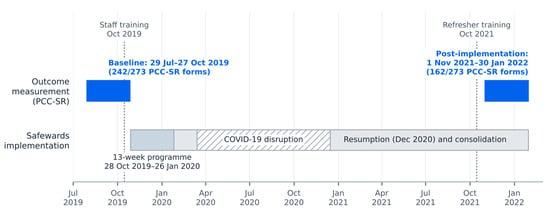
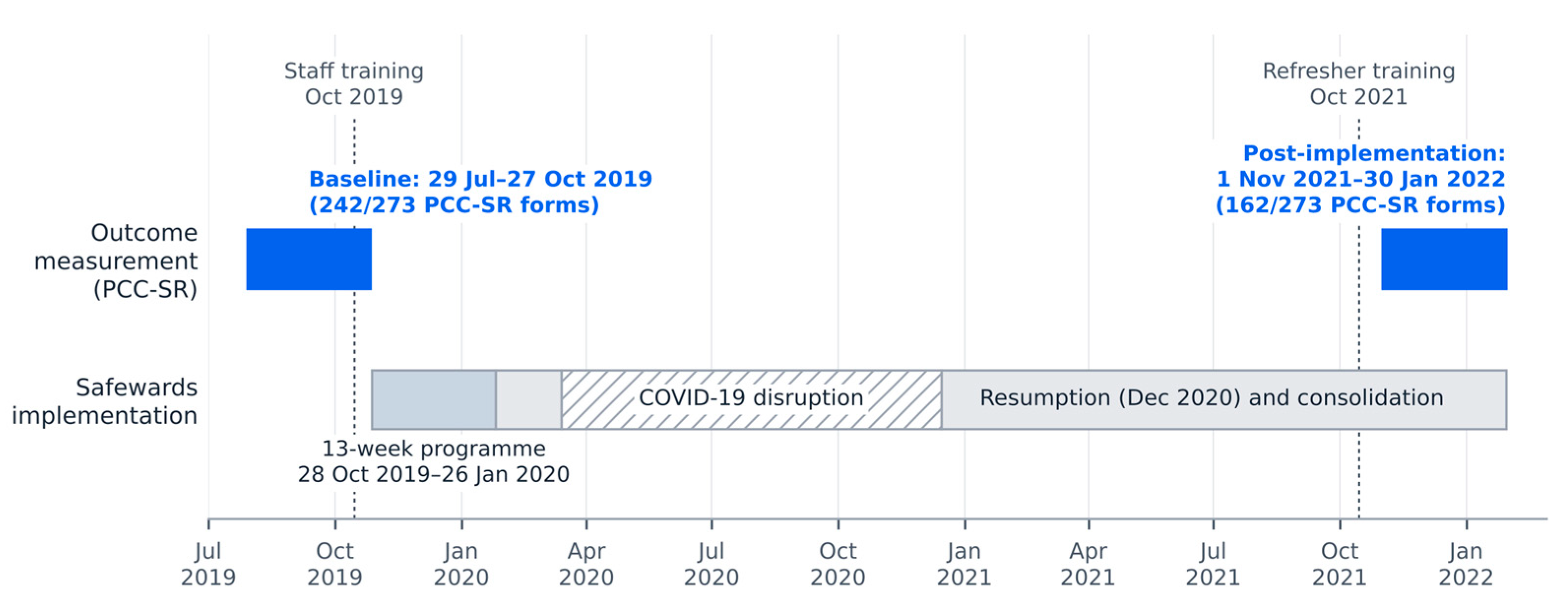
All staff received 15 h of structured training delivered through three standardised workshops (5 h each), followed by ongoing support throughout the preparation, implementation, and consolidation phases. Staff training took place in October 2019. An initial structured 13-week implementation programme, beginning on 28 October 2019, was used to introduce the ten interventions progressively. The COVID-19 pandemic disrupted subsequent implementation and consolidation from March 2020; activities resumed in December 2020. Refresher training was delivered in October 2021. The implementation chronology and study periods are shown in Figure 1.
Figure 1.
Timeline of Safewards implementation and study periods. Staff training was delivered in October 2019 and the initial 13-week implementation programme ran from 28 October 2019 to 26 January 2020. The COVID-19 pandemic disrupted subsequent implementation and consolidation from March 2020; activities resumed in December 2020. Refresher training was delivered in October 2021. Outcomes were compared between the baseline (29 July–27 October 2019; 242/273 PCC-SR forms completed) and post-implementation (1 November 2021–30 January 2022; 162/273 PCC-SR forms completed) windows. Blue bars indicate the outcome measurement windows; in the implementation row, the darker grey segment indicates the initial 13-week programme, light grey segments indicate ongoing implementation and consolidation, and the hatched segment indicates the COVID-19 disruption. PCC-SR, Patient–Staff Conflict Checklist–Shift Report.
Implementation took into account hospital management approval, clear definition of operational tasks, and consistency with methods described in earlier Safewards studies [8,9,10,15]. An expert panel comprising the department head, the nursing supervisor, the head of the unit’s medical section, and a clinical psychologist was convened to support implementation. Each intervention was assigned a designated leader responsible for planning, supervision, and implementation support. Progress, challenges, and contextual adaptations were monitored by an implementation committee comprising the intervention leaders and the expert panel. Minor adaptations were made to ensure compatibility with local clinical practice while preserving the core theoretical principles of the model. Implementation progress was monitored internally throughout the consolidation period to support consistency and sustainability. Implementation fidelity was assessed using the Safewards fidelity checklist used in the Victorian evaluation [9]. Each of the ten interventions was scored from 0 to 10, and the total fidelity score was expressed as a percentage of the maximum possible score (0–100%). The same trained rater completed assessments weekly during the initial implementation phase and monthly thereafter.
2.5. Data Collection and Measures
Data collection focused on routinely recorded conflict and containment outcomes.
Conflict and containment
Conflict events and containment responses were recorded using the Patient–Staff Conflict Checklist—Shift Report (PCC-SR [1]), completed prospectively at the end of each nursing shift (morning, afternoon, and night).
The PCC-SR captures counts of both attempted and actual conflict behaviours, as well as staff responses. Conflict variables included verbal aggression, physical aggression, escape attempts or escapes, self-harm or suicide attempts, noncompliance with rules, medication incidents, and alcohol or substance use. The medication-incidents composite included seven PCC-SR sub-items, including PRN-related medication events. Containment outcomes analysed separately were verbal containment, oral or intramuscular forced medication, environmental seclusion, and mechanical restraint. PRN-related events were included within medication incidents and were not counted as a separate containment outcome or in the total containment measure.
‘Medication incidents’ was defined as a composite of seven PCC-SR sub-items: refusal of medication that the patient ultimately accepted; outright refusal of medication; initial refusal of suggested PRN medication that was ultimately accepted; refusal of suggested PRN medication; patient-requested PRN medication; staff-suggested PRN medication accepted; staff-suggested PRN medication refused. ‘Noncompliance with rules’ is a composite of seven further items: smoking on the unit; refusal to eat; refusal to drink; refusal of personal hygiene care; refusal to wake/get out of bed; refusal to go to bed; refusal to be attended to by staff.
An operational distinction was made between Safewards Talk Down intervention and the PCC-SR outcome of verbal containment. Talk Down is a structured Safewards de-escalation intervention intended to manage situations in which a patient is agitated, angry or distressed, using self-control, respect, empathy, clarification of the problem, and collaborative resolution through negotiation, compromise, or offering choices. It is an intervention within the Safewards model and is not itself the verbal containment outcome reported in Table 1. In contrast, verbal containment in the PCC-SR refers to a staff containment response recorded as an event during the nursing shift. Therefore, the reduction in verbal containment reported in this study should not be interpreted as a direct measure of the use or fidelity of the Safewards Talk Down intervention.
Translation and cross-cultural adaptation
The PCC-SR was translated into Spanish alongside the Safewards model materials, and the Spanish version is published on the Safewards website together with the intervention materials. The cross-cultural adaptation of the instrument was carried out by the research team together with two collaborators experienced in instrument translation, followed by a 15-day pilot test assessing comprehensibility among ward staff. The overall methodology was agreed with the research group led by Prof. Len Bowers, which developed the original UK version, with their authorisation and collaboration. Spanish-sample-specific inter-rater or test–retest reliability coefficients are not available for the adapted PCC-SR. This is acknowledged as a limitation, alongside the reliability and validity reported for the original English-language version [3,9,16,17].
Local adaptation
The PCC-SR was locally adapted to include mechanical restraint as an explicit item because this restrictive practice is routinely monitored in Spanish mental health services but was not included as a separate item in the original UK instrument. This adaptation preserved the broader structure of the instrument while allowing for a restrictive practice relevant to the local Spanish context to be captured explicitly.
Data collection procedure
Conflict and containment events were documented by the nursing staff responsible for each shift as part of routine clinical practice, based on direct clinical observation, incident reports, and routine ward documentation; the PCC-SR was not introduced as a research-specific instrument, and no additional prospective data collection was carried out for this study. Staff received standardised training on PCC-SR completion as part of routine clinical practice, to promote consistency in event classification and reporting.
The research team subsequently defined the study periods, variables, and analysis plan, and retrospectively extracted and analysed the existing clinical records corresponding to these periods; the principal investigator reviewed data completeness and consistency and clarified reporting procedures where required.
Data quality checks. Before analysis, all PCC-SR records were screened for duplicate forms, out-of-range values and inconsistencies between count fields and their corresponding detail fields. One duplicate baseline form (18 August 2019, morning shift) was excluded. One medication-refusal value of 10 was identified as a data-entry error and recoded as 1. One baseline form (23 September 2019) contained an implausible census value (1312 patients); as its conflict and containment fields were plausible, it was retained in the event analyses and excluded only from the occupancy calculation. In the 2021–2022 records, the mechanical restraint count field had on several occasions been completed with the number of restraint points (3 or 5) rather than the number of restraint episodes, as indicated by its agreement with the “type of restraint (restraint points)” field and by a single patient identifier per shift. Mechanical restraint was therefore recounted as the number of episodes documented per shift. Within the primary post-implementation window, one night shift (9 November 2021) recorded as “5” was recounted as one episode, and one form (7 January 2022) documented a restraint episode (patient identifier and cause) with the count field left blank, which was counted as one episode. A sensitivity analysis using the uncorrected values is reported in the Results.
Safewards was introduced through a 13-week programme from 28 October 2019 to 26 January 2020. The COVID-19 pandemic disrupted subsequent implementation and consolidation from March 2020; activities resumed in December 2020. Monthly total fidelity first reached 80% in October 2021 and remained at or above this level through April 2022. This threshold refers to the aggregate score across the ten interventions and does not indicate that every intervention was implemented at or above 80%. Following refresher training in October 2021, the primary post-implementation measurement window (1 November 2021–30 January 2022) began after the aggregate fidelity score had first reached 80%. The extended interval between the beginning of implementation and the post-implementation assessment reflects the disruption caused by the pandemic and the subsequent re-embedding and consolidation of the model within routine clinical practice, rather than a single, uninterrupted implementation period.
Staff turnover also occurred during this period, particularly among weekend nursing and support staff, partly related to pandemic-related service reorganisation. Approximately 70–75% of staff who received Safewards training in 2019 were retrospectively estimated to remain in the unit during the post-implementation phase; however, this estimate was based on team estimates rather than formal human-resources records and should therefore be interpreted cautiously
2.6. Ethical Considerations
The study protocol was reviewed and approved by the Research Ethics Committee of Hospital Universitari Germans Trias i Pujol (Badalona, Spain), reference PI-22-231, on 7 October 2022. The study was designed as a retrospective quasi-experimental analysis of pre-existing clinical data routinely collected as part of usual clinical practice. The PCC-SR shift records were generated prospectively as part of routine clinical documentation and were not collected specifically for research purposes. The research team subsequently identified the study periods and retrospectively extracted and analysed the corresponding records from an existing anonymised database.
The protocol submitted to the Research Ethics Committee explicitly described the retrospective analysis of pre-existing anonymised data. As the study involved no identifiable personal information and no additional research-specific data collection, the requirement for informed consent was waived by the Research Ethics Committee.
2.7. Statistical Analysis
Descriptive statistics were used to summarise mean counts of conflict and containment events per shift across study phases.
Comparisons between baseline and post-implementation periods focused on observed differences in mean event rates per shift. These differences were interpreted as temporal changes associated with the implementation period rather than as evidence of causal effects. Initial comparisons between study phases were performed using one-way analysis of variance (ANOVA). Raw, uncorrected p-values are reported in Table 1 and Table 2. Bonferroni-adjusted significance thresholds were used to interpret these p-values, with α = 0.00625 for the eight comparisons in Table 2 and α = 0.00714 for the seven inferential comparisons in Table 1, including the coercive containment total. Bonferroni adjustment was applied only to the ANOVA comparisons. p-values from the negative-binomial models and Fisher’s exact tests were not adjusted for multiple comparisons and are reported as unadjusted. All primary findings remained significant when the corresponding Bonferroni thresholds were also applied to the model-based and exact p-values.
Table 1.
Incidence of Containment Interventions.
Table 2.
Incidence of conflict by subcategories.
Because shift-level event counts showed a high proportion of zero values and overdispersion (variance exceeding the mean), negative-binomial generalised linear models were used as the primary inferential approach for outcomes for which the models converged. Cluster-robust standard errors were calculated by calendar date to account for potential dependence between observations recorded on the same date. Results are reported as incidence rate ratios (IRRs) with 95% confidence intervals. Patient-level clustering was not possible because the PCC-SR is a shift-level instrument and the available records did not contain a consistent patient identifier linking observations across shifts.
For outcomes with zero events in the post-implementation period, negative-binomial models were affected by complete separation and therefore did not provide valid inferential estimates. For these outcomes, between-period differences in event occurrence were assessed using Fisher’s exact test, and exact 95% confidence intervals for post-implementation event proportions were calculated using the Clopper–Pearson method.
Descriptive statistics and initial comparisons were conducted using IBM SPSS Statistics version 29 (IBM Corp., Armonk, NY, USA). Negative-binomial models with cluster-robust standard errors were fitted using the statsmodels package in Python 3.10 (Python Software Foundation, Wilmington, DE, USA).
The manuscript was prepared in accordance with the STROBE guidelines for observational studies. The completed STROBE checklist was submitted to the journal as part of the submission process.
3. Results
In total, 404 PCC-SR forms were completed out of 546 expected shifts across the two comparison periods (74.0%; baseline, 29 July–27 October 2019; post-implementation, 1 November 2021–30 January 2022; 91 days and 273 expected shifts each). Completion was significantly lower in the post-implementation period (162/273, 59.3%) than at baseline (242/273, 88.6%; χ2 = 60.912, df = 1, p < 0.001, OR = 0.187, 95% CI 0.120–0.292).
Monthly total fidelity ranged from 55.5% to 92.0% between January 2021 and April 2022. The aggregate score first reached 80% in October 2021 and remained at or above this level through April 2022. During the primary post-implementation window, total fidelity was 81.5% in November 2021, 81.0% in December 2021, and 80.5% in January 2022 (three-month mean, 81.0%). Across these three months, mean intervention-specific scores ranged from 83% to 100% for eight interventions, were 58% for Know Each Other, and were 0% for Clear Mutual Expectations.
3.1. Conflict Events
The overall number of conflict events per shift remained stable between the baseline and post-implementation phases (3.43 vs. 3.36 events per shift; ANOVA p = 0.84). However, the pattern differed across conflict categories.
Verbal aggression decreased markedly from 0.40 events per shift at baseline to 0.01 post-implementation. The negative-binomial model showed a corresponding reduction in event rates (IRR = 0.031, 95% CI 0.007–0.131, p < 0.0001).
Physical aggression against objects decreased from 0.14 events per shift at baseline to no recorded events post-implementation. Because the negative-binomial model was affected by complete separation owing to the absence of post-implementation events, Fisher’s exact test was used and showed a significant difference between phases (p < 0.0001). The exact 95% Clopper–Pearson confidence interval for the post-implementation event proportion was 0–2.25%.
Noncompliance with unit rules increased from 1.07 to 1.72 events per shift (negative-binomial model: IRR = 1.62, 95% CI 1.15–2.27, p = 0.0057; ANOVA p = 0.014). The two analyses therefore led to different conclusions: the negative-binomial estimate, which is the primary analysis, fell below the Bonferroni-corrected threshold of α = 0.00625, whereas the ANOVA comparison did not. Other conflict categories, including medication incidents, alcohol or substance use, physical aggression against people, escape attempts or escapes, and suicide attempts or self-harm, were infrequent or showed no statistically significant differences between phases (Table 2).
3.2. Containment Measures
Substantial reductions were observed in several containment measures in the post-implementation phase. Verbal containment decreased from 1.93 events per shift at baseline to 0.09 post-implementation. The negative-binomial model showed a corresponding reduction in event rates (IRR = 0.048, 95% CI 0.022–0.104, p < 0.0001).
Forced medication also decreased, with no oral or intramuscular forced medication events recorded during the post-implementation phase. For oral forced medication, Fisher’s exact test showed a significant difference between phases (p = 0.0022), with an exact 95% Clopper–Pearson confidence interval of 0–2.25% for the post-implementation event proportion. The corresponding result for intramuscular forced medication was also significant (p = 0.0023), with an exact 95% Clopper–Pearson confidence interval of 0–2.25%.
Environmental seclusion similarly decreased from 0.10 events per shift at baseline to no recorded events post-implementation. Because the negative-binomial model was affected by complete separation, Fisher’s exact test was used as the primary inferential analysis and showed a significant difference between phases (p < 0.0001); the exact 95% Clopper–Pearson confidence interval for the post-implementation event proportion was 0–2.25%.
Mechanical restraint remained infrequent in both periods (2 episodes at baseline and 2 post-implementation; 0.01 events per shift in each). The negative-binomial model did not indicate a difference between phases (IRR = 1.49, 95% CI 0.14–16.30, p = 0.74), consistent with the ANOVA result (p = 0.69). A sensitivity analysis using the uncorrected recorded values (see Methods 2.5) led to the same conclusion (IRR = 3.73, 95% CI 0.23–60.0, p = 0.35). The monthly distribution of mechanical restraint episodes between July 2021 and March 2022 is reported in Supplementary Table S2.
Coercive containment (oral and intramuscular forced medication, environmental seclusion and mechanical restraint combined) decreased from 0.27 to 0.01 events per shift (66 vs. 2 events; IRR = 0.045, 95% CI 0.011–0.194, p < 0.0001). The total number of containment interventions decreased from 2.21 events per shift at baseline to 0.10 post-implementation. The negative-binomial model showed a corresponding reduction in event rates (IRR = 0.048, 95% CI 0.023–0.098, p < 0.0001). This reduction was primarily attributable to the marked decrease in verbal containment, together with the absence of oral and intramuscular forced medication and environmental seclusion events during the post-implementation period (Table 1).
4. Discussion
4.1. Principal Findings
To our knowledge, no previous study has examined changes in conflict and containment following Safewards implementation in an open-door acute mental health unit in Spain. In the primary baseline-to-post-implementation comparison, overall conflict rates remained broadly stable, whereas containment measures decreased substantially. The pattern of conflict also changed, with marked reductions in verbal aggression and physical aggression against objects, alongside an increase in noncompliance with unit rules. These findings provide stronger support for the hypothesis concerning reductions in restrictive or containment practices than for the hypothesis concerning an overall reduction in conflict frequency. Taken together, the findings suggest that Safewards implementation may be associated with changes in how conflict is expressed and managed in acute inpatient care, rather than necessarily reducing the overall occurrence of conflict. This interpretation is consistent with the core principles of Safewards, which emphasise de-escalation, relational care, and the minimisation of restrictive interventions [3].
A preliminary version of this analysis was made available as a preprint prior to peer review [18].
4.2. Changes in the Pattern of Conflict
Previous studies have reported reductions in conflict following Safewards implementation [4,15], although findings have not been entirely consistent across settings. In the present study, the overall rate of recorded conflict remained essentially unchanged between the baseline and post-implementation phases (3.43 vs. 3.36 events per shift), despite marked reductions in specific forms of conflict. Verbal aggression decreased from 0.40 to 0.01 events per shift, while physical aggression against objects decreased from 0.14 to no recorded events. Conversely, noncompliance with unit rules increased from 1.07 to 1.72 events per shift (IRR = 1.62, 95% CI 1.15–2.27). Thus, the findings do not support a simple reduction in the overall frequency of conflict; rather, they suggest that the distribution of recorded conflict events may have changed following implementation.
In an open-door setting, where opportunities for autonomy and interaction are greater and environmental restrictions are minimised, changes in the pattern of conflict may be clinically relevant even when the overall frequency of recorded incidents remains stable. However, because the present study did not directly assess autonomy, patient experience, or the clinical severity of individual conflict events, this interpretation should be considered cautiously.
4.3. Reductions in Containment and Coercive Practice
The most pronounced finding was the reduction in containment measures. Total containment interventions decreased from 2.21 to 0.10 events per shift, representing an approximately 95% reduction. Verbal containment decreased from 1.93 to 0.09 events per shift, while oral and intramuscular forced medication and environmental seclusion fell to zero in the post-implementation phase. When verbal containment was excluded, coercive containment measures decreased from 0.27 to 0.01 events per shift (66 vs. 2 events; IRR = 0.045, 95% CI 0.011–0.194), indicating that the reduction was not restricted to verbal responses but also involved coercive practices. These findings are consistent with previous Safewards evaluations reporting reductions in coercive or restrictive practices [3,8,9,10,19,20,21].
The magnitude of the reduction in verbal containment nevertheless requires particular caution in interpretation. As specified in Methods 2.5, Safewards’ Talk Down intervention is a structured de-escalation strategy used when a patient is already agitated, angry, or distressed, whereas verbal containment is a separate item recorded in the PCC-SR. Although the two constructs are conceptually related, the present study did not measure the use or fidelity of Talk Down directly against verbal containment events. The near-total reduction in recorded verbal containment should therefore not be interpreted as evidence of reduced use of verbal de-escalation or as a direct indicator of fidelity to the Talk Down intervention. We also cannot exclude the possibility that changes in staff documentation or in the threshold for classifying an interaction as verbal containment contributed to the observed reduction. This consideration is particularly important because verbal containment accounted for most of the reduction in the overall containment total.
The stability of overall recorded conflict alongside a 95% reduction in recorded verbal containment requires direct consideration. The categories that remained frequent or increased after implementation were predominantly low-intensity conflict behaviours, namely medication incidents (1.76 vs. 1.62 events per shift) and noncompliance with rules (1.07 vs. 1.72), which typically do not prompt a containment response, whereas verbal aggression, the behaviour most likely to elicit verbal containment, fell from 0.40 to 0.01 events per shift. Even so, the ratio of recorded verbal containment events to recorded conflict events fell from 0.56 to 0.03, indicating that staff recorded almost no verbal containment in response to the conflict that did occur. This pattern is compatible with a genuine shift towards non-containing, relational responses consistent with the Safewards model, but also with a change in documentation practice or in staff thresholds for classifying an interaction as verbal containment after training. The present data cannot distinguish between these explanations, and the reduction in verbal containment should therefore be interpreted with particular caution.
The approximately 95% reduction in total containment interventions was substantially larger than the reductions reported in previous Safewards evaluations. The UK study reported a 24% reduction in coercive measures [3], while the Australian study reported a 36% reduction in coercive measures [15]. In a recent Swedish trial, overall coercive measures decreased by approximately 31%, although this reduction was not statistically significant (IRR = 0.69, 95% CI 0.37–1.29, p = 0.246) [22]. These percentages refer to different outcomes and should therefore not be interpreted as directly equivalent estimates. Nevertheless, the larger reduction observed in the present study may reflect differences in baseline rates, service organisation, outcome definitions and recording practices, or local implementation conditions. It may also partly reflect secular changes in coercive practice during the prolonged period between the beginning of implementation and the post-implementation measurement window. Accordingly, the magnitude of the reduction should be interpreted as a temporal association rather than as an isolated estimate of the causal effect of Safewards.
The timing of the post-implementation assessment is relevant to this interpretation. Although implementation began in October 2019, subsequent implementation and consolidation were disrupted by the COVID-19 pandemic from March 2020 and resumed in December 2020. The aggregate fidelity score first reached 80% in October 2021, although intervention-specific fidelity varied: Clear Mutual Expectations was not implemented during the primary post-implementation window, and Know Each Other had a mean fidelity score of 58%. The primary post-implementation measurement period therefore began shortly after the aggregate fidelity threshold had been reached, but two years after the initial implementation had begun. During this interval, the unit underwent pandemic-related organisational changes and staff turnover, particularly among weekend nursing and support staff. Approximately 70–75% of staff who had received Safewards training in 2019 were retrospectively estimated by the clinical team to remain in the unit during the post-implementation period, although this estimate was not based on formal human-resources records. These factors provide plausible alternative explanations for some of the observed changes and reinforce the need for cautious interpretation of the temporal association.
Mechanical restraint did not follow the pattern of reduction observed for other coercive measures. In the primary comparison, it remained infrequent and unchanged (2 vs. 2 episodes; 0.01 events per shift in both periods; IRR = 1.49, 95% CI 0.14–16.30, p = 0.74), with substantial uncertainty around the estimate. A separate descriptive summary for July 2021–March 2022 recorded 30 episodes across 483 completed PCC-SR forms (0.062 episodes per completed form); monthly episode counts and completed-form denominators are presented in Supplementary Table S2. This descriptive summary is separate from the primary baseline-to-post-implementation comparison. Findings from other settings have also been mixed: reductions in mechanical restraint have been reported in Poland and Germany, whereas other studies have found no statistically significant reduction [8,10,15,21]. The recent Swedish trial reported a 65% reduction in mechanical restraint, although this was not statistically significant (IRR = 0.35, 95% CI 0.12–1.05, p = 0.061) [22]. The divergent pattern observed in the present study therefore warrants further investigation rather than being interpreted as evidence against the broader reduction in containment.
4.4. Safewards in an Open-Door Context
The open-door context is an important feature of the present study. In acute mental health care, reducing environmental restrictions places greater emphasis on relational approaches to maintaining safety and managing distress while limiting the use of coercive responses. Most previous Safewards evaluations have been conducted in inpatient settings in which environmental and organisational restrictions are more prominent [3,8,9,10,15]. In the present study, substantial reductions in recorded containment and coercive containment occurred alongside a broadly stable overall rate of recorded conflict. This pattern suggests that changes in restrictive responses do not necessarily need to be accompanied by a reduction in the overall frequency of recorded conflict and may be particularly relevant in services seeking to maintain an open-door model while minimising coercive practices.
The findings are also consistent with the broader emphasis of Safewards on therapeutic relationships, patient involvement, and the management of conflict through relational and de-escalatory approaches [3,11,15,23,24]. Previous research has suggested potential improvements in perceptions of safety, hope, and therapeutic relationships following Safewards implementation [11,15]. However, these relational processes were not directly measured in the present study, and the observed changes cannot be attributed specifically to any individual Safewards intervention. Further research in open-door settings is therefore warranted, particularly using prospective, multi-site designs that combine measures of conflict and coercion with patient-reported outcomes, staff-reported fidelity, and qualitative assessment of how Safewards is incorporated into everyday clinical practice.
4.5. Strengths and Limitations
This study has several strengths. The study was based on routine clinical practice in an acute mental health unit and used routinely collected shift-level data to examine both conflict and containment outcomes over defined observation periods. The study also distinguished between overall containment and coercive containment, allowing for changes in verbal responses to be considered separately from forced medication, seclusion, and mechanical restraint. In addition, the use of negative-binomial models with cluster-robust standard errors by calendar date, together with exact methods for outcomes with no post-implementation events, provided an analytical approach that accounted for the distribution and sparsity of several outcomes.
Several limitations should nevertheless be considered when interpreting the findings. First, the absence of a control group means that the observed changes can only be interpreted as temporally associated with Safewards implementation and cannot establish causality. The implementation period was also substantially affected by the COVID-19 pandemic, including changes in service organisation, patient admission patterns, and staff composition. Although local fidelity was monitored using a checklist covering the ten Safewards interventions, this was not an independently validated or externally assessed measure, and fidelity was not directly linked to individual outcome events. The prolonged interval between the beginning of implementation and the post-implementation assessment therefore leaves open the possibility that secular changes in clinical practice, staff composition, or organisational context contributed to the observed differences.
Second, the available case-mix information was based largely on annual administrative data rather than patient-level data restricted to the exact observation windows. Differences in patient population across the study period, including temporary admissions from other specialties during the pandemic, could therefore not be fully controlled for. Patient diagnosis was not available for the comparison periods, and the available annual information on age, sex, involuntary admission, and length of stay provides only an approximate description of case mix.
Third, completion of the PCC-SR differed substantially between phases, with 88.6% of expected shifts represented at baseline compared with 59.3% post-implementation. Reduced recording cannot therefore be completely excluded as a partial explanation for some of the observed reductions. No forced medication or environmental seclusion was documented in either the count or the detail fields of the post-implementation PCC-SR forms; however, these zeros could not be independently cross-checked against the hospital’s incident-reporting records.
Fourth, the PCC-SR records were collected at shift level and did not contain a consistent patient identifier across shifts. Consequently, patient-level clustering could not be modelled. The primary analyses therefore used the shift as the unit of observation, with clustering by calendar date incorporated into the negative-binomial models as a partial adjustment. This approach does not address potential within-patient dependence.
Finally, Spanish-sample-specific inter-rater or test–retest reliability data for the adapted PCC-SR were not available. The absence of a reduction in mechanical restraint also remains incompletely explained, particularly given the small number of events and the divergent pattern from several other containment outcomes. These limitations indicate that the findings should be interpreted as evidence of changes observed during a period of Safewards implementation and consolidation, rather than as definitive evidence of a causal effect.
4.6. Implications for Practice and Future Research
From a practice perspective, the findings support the potential value of integrating structured relational and de-escalation approaches into routine care in acute mental health units, including open-door settings. The observed reduction in coercive containment, alongside the absence of an overall increase in recorded conflict, suggests that efforts to minimise restrictive practices can be pursued without assuming that this will necessarily result in more frequent conflict. For nursing teams, this reinforces the importance of consistent relational approaches, early recognition of escalation, collaborative de-escalation, and the use of non-coercive responses as part of everyday clinical practice [3,8,11,15]. Implementation should nevertheless be accompanied by ongoing monitoring of both fidelity and outcomes, with attention to staff engagement and the organizational context in which Safewards is embedded [19,25,26]. Mechanical restraint and other low-frequency coercive practices should also be monitored separately rather than being obscured within an overall containment measure.
Future research should use controlled or multi-site designs to distinguish changes associated with Safewards implementation from secular changes in clinical practice and organisational context. Studies in open-door units are particularly needed, as this setting may provide a different balance between autonomy, conflict management, and coercive practice from more restrictive inpatient environments. Future evaluations should combine shift-level measures of conflict and containment with patient-level case-mix information and consistent patient identifiers, allowing for clustering and longitudinal patterns to be appropriately modelled. Fidelity should be assessed using standardised and, where possible, independently assessed measures and examined in relation to specific outcomes rather than only as an overall implementation indicator. Incorporating patient-reported outcomes, staff perspectives, and qualitative process data would also help clarify how Safewards interventions are experienced and embedded in routine care [19,25]. Finally, longer follow-up periods would be valuable to determine whether reductions in coercive practices are sustained over time and to better understand the factors associated with changes in mechanical restraint and other rare but clinically important events.
5. Conclusions
In this acute mental health open-door unit, the period following Safewards implementation was associated with substantial reductions in recorded containment and coercive containment, while the overall rate of recorded conflict remained broadly stable. Reductions were observed in verbal containment, forced medication, and environmental seclusion, whereas mechanical restraint remained infrequent and unchanged. These findings describe changes observed during the period of Safewards implementation and consolidation but do not establish a causal effect of the model. The absence of a control group, differences in recording completeness, contextual changes during the implementation period, and the lack of an independent fidelity assessment limit causal interpretation. Controlled, multi-site studies with longer follow-up, standardised fidelity assessment, patient-level case-mix data, and consistent outcome measurement are needed to determine the effectiveness and sustainability of Safewards in open-door acute mental health settings.
What is already known? Safewards is an evidence-based model that has been associated with reductions in conflict and containment in acute mental health inpatient settings. Open-door approaches aim to reduce coercive practices while maintaining patient and staff safety. Evidence on Safewards implementation and outcomes in routine open-door acute mental health units remains limited, particularly in Southern European healthcare systems.
What this paper adds? This study provides real-world evidence of Safewards implementation in an open-door acute mental health inpatient unit in Spain. During the post-implementation period, reductions were observed in verbal aggression, aggression towards objects, verbal containment, forced medication, environmental seclusion, and overall containment interventions, while overall recorded conflict remained broadly stable. Mechanical restraint remained infrequent and did not change between periods, in contrast to the reductions observed in other coercive measures.
What are the implications for practice? Safewards can be implemented in routine open-door acute mental health settings. During the primary post-implementation window, the aggregate fidelity score averaged 81%, although implementation varied across interventions and Clear Mutual Expectations was not implemented. In this single unit, the post-implementation period was associated with reductions in several conflict and containment outcomes, although these findings cannot establish a causal effect. A nursing-led implementation approach may provide a feasible framework for promoting less restrictive responses, but differential recording completeness and the observed pattern of mechanical restraint highlight the need for careful local monitoring. Controlled, multicentre studies are needed to assess effectiveness and sustainability.
Supplementary Materials
The following supporting information can be downloaded at: https://www.mdpi.com/article/10.3390/psychiatryint7060239/s1. Table S1: STROBE Statement—checklist of items that should be included in reports of observational studies; Table S2: Monthly mechanical restraint episodes and completed PCC-SR forms, July 2021–March 2022.
Author Contributions
Conceptualization, A.M.-O., A.R.M.-P., Z.A., T.L.-C., J.D.P.R., T.B.C. and J.C.-E.; Methodology, A.M.-O., L.M.-M., J.D.P.R. and J.C.-E.; Software, L.M.-M.; Validation, A.M.-O. and J.C.-E.; Formal analysis, A.R.M.-P., J.D.P.R. and J.C.-E.; Investigation, A.M.-O. and J.C.-E.; Resources, A.M.-O.; Data curation, A.M.-O.; Writing—original draft, A.M.-O.; Writing—review & editing, A.M.-O., A.R.M.-P., Z.A., T.L.-C., L.M.-M. and J.C.-E.; Visualization, Z.A. and T.B.C.; Supervision, A.M.-O., A.R.M.-P., Z.A., T.L.-C. and J.C.-E. All authors have read and agreed to the published version of the manuscript.
Funding
This research was supported by the Pla Estratègic de Recerca i Innovació en Salut (PERIS) of the Departament de Salut de la Generalitat de Catalunya, under grant number PERIS—SLT035/24/000005. The funders had no role in the study design, data collection, analysis, decision to publish, or preparation of the manuscript.
Institutional Review Board Statement
The study was conducted in accordance with the Declaration of Helsinki, and approved by the Research Ethics Committee (CEIm) of Hospital Universitari Germans Trias i Pujol (approval code: PI-22-231), approval date: 7 October 2022.
Informed Consent Statement
Patient consent was waived by the Research Ethics Committee (CEIm) of Hospital Universitari Germans Trias i Pujol, as the study was conducted using fully anonymized data and did not involve identifiable personal information.
Data Availability Statement
The data presented in this study are available from the corresponding author upon reasonable request. The data are not publicly available due to privacy and institutional restrictions.
Acknowledgments
We extend our gratitude to the care team involved in the implementation of the model, and especially to the nursing team for their dedicated hours, commitment, and valuable contributions, which have been an invaluable aid to our study.
Conflicts of Interest
The authors declare no conflicts of interest.
References
- Bowers, L.; Douzenis, A.; Galeazzi, G.M.; Forghieri, M.; Tsopelas, C.; Simpson, A.; Allan, T. Disruptive and Dangerous Behaviour by Patients on Acute Psychiatric Wards in Three European Centres. Soc. Psychiatry Psychiatr. Epidemiol. 2005, 40, 822–828. [Google Scholar] [CrossRef] [Scilit] [PubMed]
- Bowers, L.; van der Werf, B.; Vokkolainen, A.; Muir-Cochrane, E.; Allan, T.; Alexander, J. International Variation in Containment Measures for Disturbed Psychiatric Inpatients: A Comparative Questionnaire Survey. Int. J. Nurs. Stud. 2007, 44, 357–364. [Google Scholar] [CrossRef] [Scilit] [PubMed]
- Bowers, L.; James, K.; Quirk, A.; Simpson, A.; Stewart, D.; Hodsoll, J. Reducing Conflict and Containment Rates on Acute Psychiatric Wards: The Safewards Cluster Randomised Controlled Trial. Int. J. Nurs. Stud. 2015, 52, 1412–1422. [Google Scholar] [CrossRef] [Scilit] [PubMed]
- Dickens, G.L.; Tabvuma, T.; Frost, S.A. Safewards: Changes in Conflict, Containment, and Violence Prevention Climate during Implementation. Int. J. Ment. Health Nurs. 2020, 29, 1230–1240. [Google Scholar] [CrossRef] [Scilit] [PubMed]
- Bowers, L.; Alexander, J.; Bilgin, H.; Botha, M.; Dack, C.; James, K.; Jarrett, M.; Jeffery, D.; Nijman, H.; Owiti, J.A.; et al. Safewards: The Empirical Basis of the Model and a Critical Appraisal. J. Psychiatr. Ment. Health Nurs. 2014, 21, 354–364. [Google Scholar] [CrossRef] [Scilit] [PubMed]
- Bowers, L. Safewards: A New Model of Conflict and Containment on Psychiatric Wards. J. Psychiatr. Ment. Health Nurs. 2014, 21, 499–508. [Google Scholar] [CrossRef] [Scilit] [PubMed]
- Mullen, A.; Browne, G.; Hamilton, B.; Skinner, S.; Happell, B. Safewards: An Integrative Review of the Literature within Inpatient and Forensic Mental Health Units. Int. J. Ment. Health Nurs. 2022, 31, 1090–1108. [Google Scholar] [CrossRef] [Scilit] [PubMed]
- Baumgardt, J.; Jäckel, D.; Helber-Böhlen, H.; Stiehm, N.; Morgenstern, K.; Voigt, A.; Schöppe, E.; Cutcheon, A.K.M.; Velasquez Lecca, E.E.; Löhr, M.; et al. Preventing and Reducing Coercive Measures-an Evaluation of the Implementation of the Safewards Model in Two Locked Wards in Germany. Front. Psychiatry 2019, 10, 340. [Google Scholar] [CrossRef] [Scilit] [PubMed]
- Fletcher, J.; Spittal, M.; Brophy, L.; Tibble, H.; Kinner, S.; Elsom, S.; Hamilton, B. Outcomes of the Victorian Safewards Trial in 13 Wards: Impact on Seclusion Rates and Fidelity Measurement. Int. J. Ment. Health Nurs. 2017, 26, 461–471. [Google Scholar] [CrossRef] [Scilit] [PubMed]
- Stensgaard, L.; Andersen, M.K.; Nordentoft, M.; Hjorthøj, C. Implementation of the Safewards Model to Reduce the Use of Coercive Measures in Adult Psychiatric Inpatient Units: An Interrupted Time-Series Analysis. J. Psychiatr. Res. 2018, 105, 147–152. [Google Scholar] [CrossRef] [Scilit] [PubMed]
- Fletcher, J.; Buchanan-Hagen, S.; Brophy, L.; Kinner, S.A.; Hamilton, B. Consumer Perspectives of Safewards Impact in Acute Inpatient Mental Health Wards in Victoria, Australia. Front. Psychiatry 2019, 10, 461. [Google Scholar] [CrossRef] [Scilit] [PubMed]
- Hochstrasser, L.; Voulgaris, A.; Möller, J.; Zimmermann, T.; Steinauer, R.; Borgwardt, S.; Lang, U.E.; Huber, C.G. Reduced Frequency of Cases with Seclusion Is Associated with “Opening the Doors” of a Psychiatric Intensive Care Unit. Front. Psychiatry 2018, 9, 57. [Google Scholar] [CrossRef] [Scilit] [PubMed]
- Krückl, J.S.; Moeller, J.; Imfeld, L.; Schädelin, S.; Hochstrasser, L.; Lieb, R.; Lang, U.E.; Huber, C.G. The Association between the Admission to Wards with Open- vs. Closed-Door Policy and the Use of Coercive Measures. Front. Psychiatry 2023, 14, 1268727. [Google Scholar] [CrossRef] [Scilit] [PubMed]
- Curran, G.M.; Bauer, M.; Mittman, B.; Pyne, J.M.; Stetler, C. Effectiveness-Implementation Hybrid Designs: Combining Elements of Clinical Effectiveness and Implementation Research to Enhance Public Health Impact. Med. Care 2012, 50, 217–226. [Google Scholar] [CrossRef] [Scilit] [PubMed]
- Maguire, T.; Ryan, J.; Fullam, R.; McKenna, B. Evaluating the Introduction of the Safewards Model to a Medium- to Long-Term Forensic Mental Health Ward. J. Forensic Nurs. 2018, 14, 214–222. [Google Scholar] [CrossRef] [Scilit] [PubMed]
- Bowers, L.; Simpson, A.; Alexander, J. Patient-Staff Conflict: Results of a Survey on Acute Psychiatric Wards. Soc. Psychiatry Psychiatr. Epidemiol. 2003, 38, 402–408. [Google Scholar] [CrossRef] [Scilit] [PubMed]
- Baker, J.A.; Bowers, L.; Owiti, J.A. Wards Features Associated with High Rates of Medication Refusal by Patients: A Large Multi-Centred Survey. Gen. Hosp. Psychiatry 2009, 31, 80–89. [Google Scholar] [CrossRef] [Scilit] [PubMed]
- Moreno-Orea, A.; Miró Mezquita, L.; De Pablo Rabasso, J.; Bustos Cardona, T.; Moreno-Poyato, A.R.; Lluch-Canut, M.T.; Cuevas-Esteban, J. Evaluation of the Implementation of the Safewards Model in an Open-Door Acute Inpatient Unit: A Quasi-Experimental Study. medRxiv 2025. [Google Scholar] [CrossRef] [Scilit]
- Dickens, G.L.; Schoultz, M.; Hallett, N. Mental Health Nurses’ Measured Attitudes to People and Practice: Systematic Review of UK Empirical Research 2000–2019. J. Psychiatr. Ment. Health Nurs. 2022, 29, 788–812. [Google Scholar] [CrossRef] [Scilit] [PubMed]
- Kipping, S.M.; De Souza, J.L.; Marshall, L.A. Co-Creation of the Safewards Model in a Forensic Mental Health Care Facility. Issues Ment. Health Nurs. 2019, 40, 2–7. [Google Scholar] [CrossRef] [Scilit] [PubMed]
- Lickiewicz, J.; Adamczyk, N.; Hughes, P.P.; Jagielski, P.; Stawarz, B.; Makara-Studzińska, M. Reducing Aggression in Psychiatric Wards Using Safewards—A Polish Study. Perspect. Psychiatr. Care 2021, 57, 50–55. [Google Scholar] [CrossRef] [Scilit] [PubMed]
- Karlsson, J.; Björkdahl, A.; Gårevik, N.; Kjellin, L.; Pelto-Piri, V.; Johansson, N. Exploring the Impact of Safewards on Aggression and Coercion in Psychiatric Inpatient Care: Findings from a Swedish Longitudinal Quasi-Experimental Trial. Int. J. Ment. Health Nurs. 2026, 35, e70228. [Google Scholar] [CrossRef] [Scilit] [PubMed]
- Pelto-Piri, V.; Kjellin, L.; Backman, G.; Carlsson, K.; Björkdahl, A. Patient Responsiveness as a Safewards Fidelity Indicator: A Qualitative Interview Study on an Acute Psychiatric in-Patient Ward. BMC Health Serv. Res. 2024, 24, 922. [Google Scholar] [CrossRef] [Scilit] [PubMed]
- Lantta, T.; Anttila, M.; Kontio, R.; Adams, C.E.; Välimäki, M. Violent Events, Ward Climate and Ideas for Violence Prevention among Nurses in Psychiatric Wards: A Focus Group Study. Int. J. Ment. Health Syst. 2016, 10, 27. [Google Scholar] [CrossRef] [Scilit] [PubMed]
- Fletcher, J.; Hamilton, B.; Kinner, S.A.; Brophy, L. Safewards Impact in Inpatient Mental Health Units in Victoria, Australia: Staff Perspectives. Front. Psychiatry 2019, 10, 462. [Google Scholar] [CrossRef] [Scilit] [PubMed]
- Price, O.; Burbery, P.; Leonard, S.-J.; Doyle, M. Evaluation of Safewards in Forensic Mental Health. Ment. Health Pract. 2016, 19, 14–21. [Google Scholar] [CrossRef] [Scilit]
Disclaimer/Publisher’s Note: The statements, opinions and data contained in all publications are solely those of the individual author(s) and contributor(s) and not of MDPI and/or the editor(s). MDPI and/or the editor(s) disclaim responsibility for any injury to people or property resulting from any ideas, methods, instructions or products referred to in the content. |
© 2026 by the authors. Licensee MDPI, Basel, Switzerland. This article is an open access article distributed under the terms and conditions of the Creative Commons Attribution (CC BY) license.