


Abstract
Parents of children with autism spectrum disorder (ASD) and other communication-related conditions may experience substantial emotional demands, yet depressive symptoms have been underexamined in Greek families. This exploratory cross-sectional study assessed depressive symptoms in 164 Greek parents using the Greek-language Beck Depression Inventory-II (BDI-II). Of the participants, 117 reported having a child with ASD, and 47 reported having a child with another communication-related condition. Mean BDI-II scores were significantly higher among parents of children with ASD than among parents of children with other communication-related conditions (17.65 vs. 9.36; Welch’s t(140.19) = 5.73, p < 0.001, Cohen’s d = 0.80). This association remained significant after adjustment for parent-reported functional-speech status and available parent characteristics (B = 8.27, 95% CI [4.73, 11.80], p < 0.001). Parent-reported functional-speech status was also associated with the distribution of BDI-II symptom-severity categories (exact p = 0.002); however, the continuous-score difference and adjusted association for absence of functional speech were not statistically significant (p = 0.086 and p = 0.080, respectively). These findings suggest that parent-reported ASD status was more consistently associated with depressive-symptom severity than functional-speech status in this exploratory sample. Cross-sectional design, convenience sampling, parent-reported child characteristics, and limited measurement of potential confounders warrant cautious interpretation.
1. Introduction
Parents of children with autism spectrum disorder (ASD) and other communication-related conditions often face substantial emotional demands. These challenges can affect nearly every aspect of family life. ASD is a neurodevelopmental condition that often involves communication delays, social interaction difficulties, sensory sensitivities, and a need for structured routines [1]. These characteristics can create ongoing emotional, social, and economic pressures that affect parental psychological well-being and daily caregiving. Children with other speech, language, fluency, or developmental communication-related conditions may also require long-term support, therapy, and family adaptation. Earlier and more recent studies link developmental caregiving demands and parenting stress with reduced parental well-being and emotional strain [2,3,4]. Emerging evidence further suggests that autistic traits may heighten parental emotional distress by increasing parents’ exposure to social stigma and feelings of judgment from others, adding another layer of psychosocial pressure beyond the child’s clinical presentation [5].
In Greece, ASD has an estimated prevalence of 0.94% among children aged 2–17 years, corresponding to approximately 1 in 106 children, with higher prevalence reported in boys than in girls [6]. However, Greek research on parents of children with ASD and other communication-related conditions has focused mainly on stress, coping, stigma, fatigue, and family quality of life, with less direct attention to depressive symptom severity. Ntre et al. [3] found that mothers who used passive appraisal coping strategies reported higher depressive symptoms. Efstratopoulou et al. [7] showed that children’s nonverbal status and self-regulation difficulties increased parental stress. Halki et al. [4] reported substantial mental and physical fatigue among parents of children with ASD, while noting potentially protective roles of social support and spirituality.
Greek adaptations of the Autism Parenting Stress Index, the Parental Stress Scale for parents of children with Developmental Language Disorder, and the Affiliate Stigma Scale have strengthened the assessment of stress and stigma in ASD and other communication-related populations [8,9,10], but these instruments do not directly assess depressive symptom severity.
During the COVID-19 pandemic, Greek caregivers of children with developmental disabilities reported greater psychological distress than caregivers of typically developing children [11], while studies of family quality of life and coping [12] and parental self-compassion and psychological distress [13] likewise documented broader psychological burden. Together, this literature indicates that parents across diagnostic groups may experience substantial emotional strain, but direct comparative evidence on depressive symptoms remains limited.
Depression is related to stress, stigma, and psychological distress, but it is not identical to them. Stress may reflect the demands placed on parents, stigma may reflect social judgment or internalized shame, and quality of life may reflect broader family functioning. Depression, however, involves a specific pattern of affective, cognitive, and somatic symptoms that may require clinical attention [1,14]. Direct assessment of depressive symptom severity is therefore clinically relevant, particularly where families face high caregiving demands and limited support. Research using the Beck Depression Inventory has also linked parental depressive symptoms with quality of life [15].
Outside Greece, research points to the importance of spoken-language level in shaping parental emotional outcomes. Studies of minimally speaking autistic children suggest that lower communication skills are associated with higher parenting stress and greater parental emotional strain [16,17]. To our knowledge, parent-reported absence of functional speech has not been systematically examined in relation to depressive symptoms in Greece, particularly in studies comparing parents of children with ASD and parents of children with other communication-related conditions.
In this study, we classified a child as having no functional speech when the parent stated in an open-ended response that the child did not speak. This spoken-language indicator is distinct from broader functional communication: children may communicate through gestures, signs, picture exchange systems, speech-generating devices, or other forms of augmentative and alternative communication (AAC). Because AAC and other nonspoken communication modalities were not separately assessed, the indicator should not be interpreted as a comprehensive measure of the child’s communicative ability.
Parental well-being may also be influenced by child age, age at diagnosis, co-occurring conditions, medication use, family circumstances, stigma, and access to services or support [5,10,18,19]. These factors underscore the need to treat any association between functional-speech status and depressive symptoms as exploratory rather than causal.
The present study addresses three principal gaps. First, few Greek studies have directly measured depressive symptom severity using a standardized depression instrument. Second, few studies have compared depressive symptoms between parents of children with ASD and parents of children with other communication-related conditions. In the present study, this group included parents of children with a range of communication-related and developmental conditions, including speech and language disorders and fluency disorders. Since this was a heterogeneous group, comparisons with the ASD group should be interpreted as exploratory. Third, few studies have examined whether the absence of functional speech is associated with depressive symptoms in parents. Questions about counseling and support groups were included only to describe parents’ experiences and views, not to evaluate the effectiveness of these services.
A previously reported U.S. dataset using the BDI with parents of children with communication disorders and autism provides useful background for comparison, but differences in the depression measure, scoring, available variables, and sample characteristics mean that direct comparisons between countries should be made with caution [20,21].
To address these gaps, the present study focuses on assessing depressive symptoms among Greek parents of children with ASD and other communication-related conditions, using the Greek-language 21-item Beck Depression Inventory-II (BDI-II) as the primary measure. The study is guided by three main aims:
- To quantify depressive symptoms among parents of children with ASD and other communication-related conditions and to compare depressive symptom levels between these groups;
- To examine parent-reported absence of functional speech as a potential factor associated with parental depressive symptoms;
- To describe parents’ experiences with and opinions about counseling and support groups, including perceived usefulness and barriers.
This approach extends Greek research by directly assessing depressive symptom severity, comparing parents across diagnostic groups, examining parent-reported functional-speech status separately from diagnosis, and describing experiences with counseling and support groups.
2. Materials and Methods
2.1. Design
This study employed an exploratory cross-sectional survey design to examine depressive symptoms and related factors among parents of children with autism spectrum disorder (ASD) and other communication-related conditions in Greece. A survey approach was selected to gather primary data from a geographically diverse population and to allow parents to report on their own emotional well-being, their child’s diagnosis and communication profile, and their experiences with counseling and support services.
The design also reflects the limited availability of Greek research directly measuring depressive symptom severity in this population. Although previous Greek studies have examined parental stress, stigma, coping, fatigue, and family quality of life, fewer studies have focused specifically on depressive symptoms using a standardized depression measure. The study was exploratory because the child-related variables, including diagnostic group and functional-speech status, were based on parent report and were not independently verified through clinical assessment or medical records.
2.2. Participants
Participants were eligible to participate if they met the following inclusion criteria:
- Be a parent or legal guardian of a child with ASD or another communication-related condition,
- Be residing in Greece at the time of participation, and
- Be able to complete the questionnaire in Greek.
These eligibility criteria were specified in the recruitment information. For construction of the analytic sample, inclusion could be verified directly from two questionnaire items: provision of electronic informed consent and parent report of at least one child with a communication-related condition. Of the 188 available questionnaire records, 164 met both requirements and were retained for analysis. The remaining 24 records were excluded because one or both requirements were not met. Participants were recruited through social media parenting groups, private speech-language therapy clinics, and the researchers’ professional networks. Convenience sampling was used because eligible parents were difficult to identify and recruit. No a priori sample-size calculation was conducted, and all eligible responses obtained during the recruitment period were retained. The analyses were therefore considered exploratory, and effect sizes and 95% confidence intervals were reported to support interpretation of the magnitude and precision of the findings.
Within the analytic sample, 117 respondents reported having a child with ASD, and 47 reported having a child with another communication-related condition. These group sizes reflected the eligible responses obtained during recruitment and were not determined in advance.
2.3. Measures
2.3.1. Survey Structure
The questionnaire contained 56 items organized into seven sections:
- Informed consent and confidentiality assurances.
- Parental demographics (age, gender, education, marital status, region).
- Child characteristics, including parent-reported diagnosis, age at diagnosis, parent-reported functional speech status, and co-occurring behavioral, sensory, social, language, and communication difficulties.
- Use of services, including counseling and other therapeutic services.
- Support groups, including participation, interest, and barriers.
- Open-ended comments on challenges and experiences.
- Beck Depression Inventory-II (BDI-II), Greek-language version [14,22].
The demographic, child-characteristic, service-use, counseling, and support-group items were adapted from the earlier U.S. survey and translated into Greek using a forward- and back-translation procedure to assess consistency with the original wording. Except for the BDI-II, these items were used for descriptive and exploratory purposes and were not treated as validated diagnostic measures or standardized measures of functional speech, service access, or counseling outcomes.
2.3.2. Beck Depression Inventory-II
Depressive symptoms were assessed using a Greek-language version of the Beck Depression Inventory-II (BDI-II) [14,22]. The BDI-II is a 21-item self-report measure of depressive-symptom severity. Each item was scored from 0 to 3. Items 16 and 18 contain seven response alternatives reflecting increases or decreases in sleeping patterns and appetite, respectively. These alternatives were scored 0, 1, 1, 2, 2, 3, and 3 so that each item contributed a maximum of three points to the total score. Scores for all 21 items were summed to produce a corrected total score ranging from 0 to 63, with higher scores indicating greater depressive-symptom severity. BDI-II scoring was performed by the psychologist member of the research team. The standard BDI-II symptom-severity classifications were used: minimal, 0–13; mild, 14–19; moderate, 20–28; and severe, 29–63 [14]. Valid total scores of zero were retained and classified in the minimal range.
All 164 participants had complete data for the 21 BDI-II items. Internal consistency of the BDI-II in the present sample was assessed using Cronbach’s α.
The BDI-II was used to assess depressive-symptom severity and not to establish a clinical diagnosis of major depressive disorder. Accordingly, the four score ranges are described as symptom-severity classifications rather than diagnostic categories of depression.
2.3.3. Child Diagnostic and Communication-Related Variables
ASD status was determined from the direct survey question asking whether the respondent had a child or children with autism. Respondents answering yes were assigned to the ASD group, including those who also described an additional speech, language, or developmental condition. Respondents who did not report ASD were assigned to the other-communication-related-conditions group. The two analytic groups were therefore mutually exclusive.
The other-conditions group included a heterogeneous range of parent-reported conditions, including speech and language disorders, fluency disorders, and other developmental or communication-related conditions. These conditions were pooled because the numbers in the individual categories were too small to support reliable separate statistical comparisons. The pooled category should therefore be interpreted as an exploratory comparison group rather than a homogeneous clinical population.
Family history of communication-related difficulties was assessed with the item, “Are there other family members (e.g., grandparent, cousin) who have or have had a communication disorder? If yes, please describe the communication disorder.” Responses were coded as yes or no.
2.3.4. Parent-Reported Absence of Functional Speech
Functional speech was examined separately from diagnostic category. Parent-reported absence of functional speech was derived from the open-ended survey item, “Please describe the communication-related condition”. Before examining associations with BDI-II outcomes, the coding rule was specified such that responses were classified as indicating absence of functional speech only when the parent explicitly reported “does not speak”. Three researchers independently reviewed the open-ended responses and resolved any discrepancies through consensus. No formal inter-rater reliability coefficient was calculated. Twenty participants met this criterion, while all remaining participants were classified as reporting at least some functional speech. This variable was analyzed because spoken-language limitations may affect daily parent–child interaction, service needs, and parental emotional burden.
Because this information was based on parent report, it should not be interpreted as a clinician-rated language classification. In addition, the survey did not include separate questions about augmentative and alternative communication (AAC), sign language, gestures, picture exchange, speech-generating devices, or other nonspoken communication modalities. Therefore, parent-reported absence of functional speech in this study refers specifically to spoken-language status and should not be interpreted as a comprehensive measure of functional communication.
2.3.5. Service Use, Counseling, and Support Groups
Items assessed parents’ experiences with counseling and support groups. Counseling items asked whether respondents had ever personally attended counseling and, if so, how they rated their experience. A separate item assessed their general opinion of counseling for parents of children with ASD. These questions referred to counseling attended by the respondent and not to therapy or consultation received by the child.
Support-group items were administered to respondents who reported having a child with ASD and assessed whether parents had participated in support groups, whether they were interested in joining a support group, how they viewed support groups, and what barriers limited participation. Reported barriers included lack of availability, lack of information, and time constraints.
These items were analyzed descriptively to document service accessibility and parental attitudes within the Greek context. They were not intended to measure counseling effectiveness or support-group outcomes.
2.4. Procedure
The survey was administered online using secure, anonymous links distributed through social media, email, private speech-language therapy clinics, and the researchers’ professional networks. Data were collected between 14 May 2022 and 17 June 2023. Prior to participation, respondents were informed of the study’s purpose, data confidentiality, anonymity, and voluntary nature. No identifying information was collected.
Online administration was chosen to reach families across urban and rural regions, minimize costs, facilitate participation for parents with caregiving responsibilities, and allow geographically diverse data collection across Greece.
Survey responses were initially stored in Microsoft Excel version 2608 (Microsoft Corporation, Redmond, WA, USA). An analytic dataset containing the 164 eligible participants was subsequently prepared for analysis in IBM SPSS Statistics, version 31 (IBM Corporation, Armonk, NY, USA). Original response fields were retained alongside derived analytic variables to permit verification of eligibility, BDI-II scoring, and functional-speech classifications.
2.5. Ethical Considerations
The study was conducted in accordance with ethical principles for research involving human participants. Before completing the questionnaire, participants received information about the purpose of the study, anonymity, confidentiality, voluntary participation, and their right not to participate. Informed consent was obtained electronically before survey completion. No identifying information was collected.
Formal ethical review and approval were not required for this anonymous, non-funded survey under the applicable local institutional and legislative requirements. Specifically, the study was considered exempt under Greek Law 4957/2022, Article 279, Paragraph 2(b). Measures were taken to maintain participant anonymity and protect personal data.
2.6. Statistical Analysis
Data preparation was conducted using Microsoft Excel version 2608 (Microsoft Corporation, Redmond, WA, USA), and statistical analyses were performed using IBM SPSS Statistics, version 31 (IBM Corporation, Armonk, NY, USA). All statistical tests were two-sided, and p < 0.05 was considered statistically significant. Because the analyses were exploratory, effect sizes and 95% confidence intervals were considered alongside p-values. No adjustment for multiple comparisons was applied.
Participant characteristics and questionnaire responses were summarized using raw frequencies and percentages for categorical variables and means, standard deviations, medians, and ranges, as appropriate, for continuous variables. Denominators were reported separately for questions administered only to eligible subsamples or for branching follow-up items.
The primary inferential analysis examined the association between parent-reported absence of functional speech and the four standard BDI-II symptom-severity categories. Since several expected cell counts were small, the Fisher-Freeman-Halton exact test for the 2 × 4 table was used instead of the Pearson chi-square test. Raw cell frequencies, group percentages, expected counts, and Cramer’s V were reported.
Two binary BDI-II threshold analyses were conducted as secondary exploratory analyses: minimal or mild symptoms versus moderate or severe symptoms, using a threshold of 20, and severe versus non-severe symptoms, using a threshold of 29. Fisher’s exact test was used for these 2 × 2 comparisons. These threshold analyses did not replace the primary four-category analysis.
The corrected continuous BDI-II total score was examined as a sensitivity outcome. Score distributions were assessed using histograms, normal quantile-quantile plots, Shapiro–Wilk tests, boxplots, and inspection of extreme observations. Homogeneity of variance was examined using Levene’s test. Because the equal-variance assumption was not satisfied for the primary group comparison, Welch’s independent-samples t-test was reported. Results included group means and standard deviations, the mean difference, t statistic, degrees of freedom, two-sided p value, 95% confidence interval, and Cohen’s d.
The Mann–Whitney U test was additionally conducted as a distribution-free sensitivity analysis of the continuous BDI-II scores.
Multiple linear regression was used to examine whether parent-reported absence of functional speech was associated with the continuous BDI-II total score after adjustment for available potential confounders. The model included functional-speech status as the focal predictor and adjusted for parent-reported ASD status, parent age group, respondent role coded as mother versus other respondent, educational attainment coded as university or postgraduate education versus lower education, and marital status coded as married versus other.
Regression coefficients, standard errors, standardized coefficients, 95% confidence intervals, p-values, collinearity statistics, and residual diagnostics were examined. All variables included in this model were complete, so all 164 participants were included in the adjusted analysis.
Current child age could not be reliably identified across the entire sample because some respondents provided information for more than one child. Child age was therefore considered only in a separate ASD-only sensitivity analysis when a single numeric age for the child with ASD could be identified.
The comparison between parents reporting a child with ASD and parents reporting another communication-related condition was treated as a secondary analysis. Continuous BDI-II scores were compared using Welch’s t-test because the homogeneity-of-variance assumption was not satisfied, with the Mann–Whitney U test used as an additional sensitivity analysis. Exact categorical procedures were used where expected cell counts were sparse.
Parents’ counseling experiences, support-group participation, perceived usefulness, interest, and reported barriers were analyzed descriptively using the appropriate eligible denominators. These analyses were not treated as tests of counseling or support-group effectiveness.
Previously reported U.S. data were included only for descriptive comparison. We did not perform statistical comparisons between countries because comparable individual-level data on demographic characteristics, functional speech, and service use were not available. For this reason, differences between the U.S. and Greek samples were not interpreted as national or cultural differences.
3. Results
3.1. Participant Characteristics
A total of 188 individuals accessed the questionnaire. Four respondents did not provide consent. Of the 184 consenting respondents, 20 did not report having a child with a communication-related condition and were excluded, resulting in a final analytic sample of 164 participants. The sample consisted primarily of mothers (90.2%, n = 148), followed by fathers (9.8%, n = 16). Most participants were married (86.0%), between 35 and 44 years old (54.9%), and held a university or postgraduate degree (59.1%). Participants were drawn from regions across Greece, with the highest concentrations in Attica (33.5%) and Crete (21.3%). Table 1 summarizes the demographic characteristics of the parent sample.
Table 1.
Demographic characteristics of the parent sample.
3.2. Child Characteristics
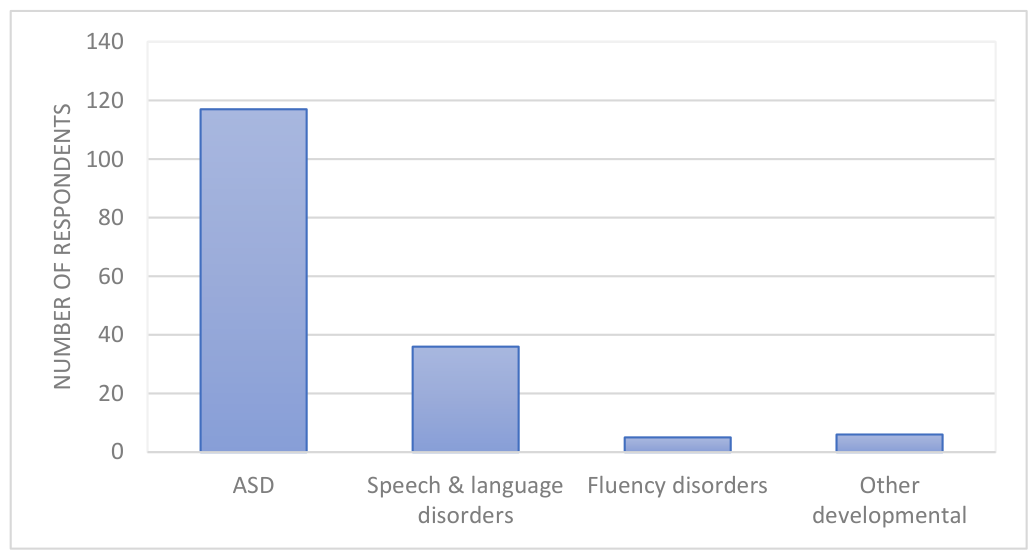
Parents reported a range of child diagnostic and communication-related conditions (N = 164) (Figure 1). The majority of children were reported to have Autism Spectrum Disorder (ASD) (71.3%, n = 117), followed by speech and language disorders (22.0%, n = 36), fluency disorders such as stuttering (3.0%, n = 5), and other developmental conditions (3.7%, n = 6). These categories were treated as mutually exclusive for the diagnostic comparison. Thus, respondents who reported ASD together with another speech, language, or developmental condition were retained in the ASD group. The remaining 47 participants constituted the other-communication-related-conditions comparison group.
Figure 1.
Distribution of respondents according to parent-reported mutually exclusive child diagnostic group (N = 164).
Functional-speech status was examined separately and did not represent an additional diagnostic group. Twenty parents (12.2%) met the criterion for parent-reported absence of functional speech based on the response “does not speak”. The remaining 144 parents (87.8%) were classified as reporting at least some functional speech.
A family history of communication-related difficulties was reported by 31 of 164 parents (18.9%), while 133 (81.1%) did not report such a history. The previously reported 81% therefore represented the proportion reporting no family history rather than a positive family history.
For 114 of the 117 ASD cases, a single numeric current age could be identified for the child with ASD. The mean age was 8.89 years (SD = 5.72), the median was 7 years, and the range was 3–29 years.
3.3. Service Use, Counseling, and Support Groups
A total of 107 of the 164 respondents (65.2%) reported that they had personally attended counseling, whereas 57 (34.8%) had not. This item referred to counseling received by the respondent parent or guardian and not to therapy or consultation received by the child. Among the 107 respondents who had attended counseling, 37 (34.6%) described their experience as absolutely good, 48 (44.9%) as quite good, 8 (7.5%) as somewhat good, 13 (12.1%) as neither good nor bad, and 1 (0.9%) as absolutely bad. Among the 117 parents of children with ASD, 102 (87.2%) considered counseling for parents to be quite or absolutely useful.
In contrast, participation in support groups was limited. Support-group questions were administered to the 117 respondents who reported having a child with ASD. Of these, 80 (68.4%) had never attended a parent support group, and 37 (31.6%) had attended one. A total of 106 respondents (90.6%) indicated that they would definitely or probably consider participating in a support group in the future. Ninety-seven (82.9%) rated their opinion of support groups as somewhat, quite, or extremely positive. Reported barriers included lack of availability in their region, insufficient information, and time constraints. These results describe parents’ experiences and views and do not show whether counseling or support groups are effective.
3.4. Depressive Symptom Outcomes Based on the BDI-II
All 164 participants were included in the BDI-II analyses. Internal consistency was excellent (Cronbach’s α = 0.928).
The following analyses examined depressive symptom severity by parent-reported child diagnostic group and by parent-reported absence of functional speech. Because child diagnosis and functional-speech status were based on parent report, these findings should be interpreted as exploratory associations rather than causal relationships.
3.4.1. Depressive Symptoms Across the Sample
BDI-II total scores ranged from 0 to 55 (M = 15.27, SD = 10.99). Using the standard four-level BDI-II classification, 81 parents (49.4%) were in the minimal range, 37 (22.6%) in the mild range, 30 (18.3%) in the moderate range, and 16 (9.8%) in the severe range. Overall, 46 participants (28.0%) had scores in the moderate or severe ranges.
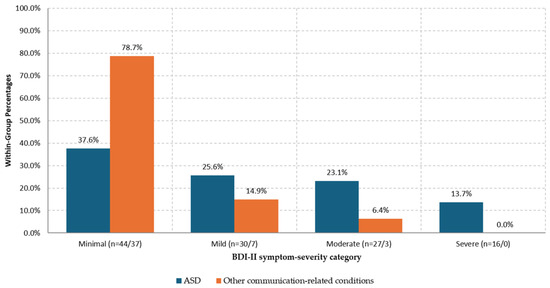
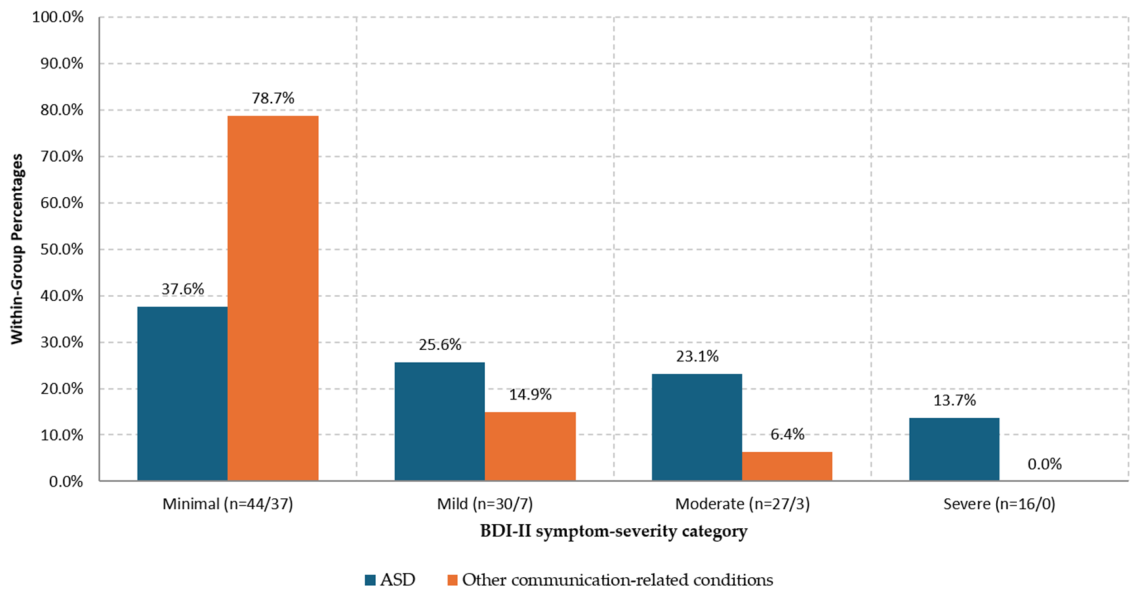
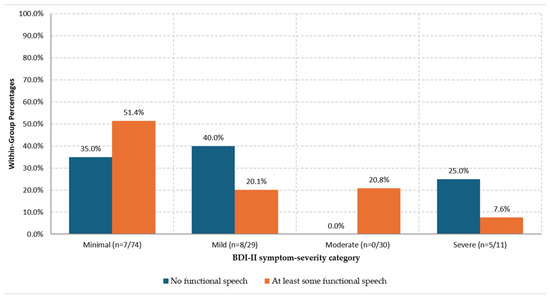
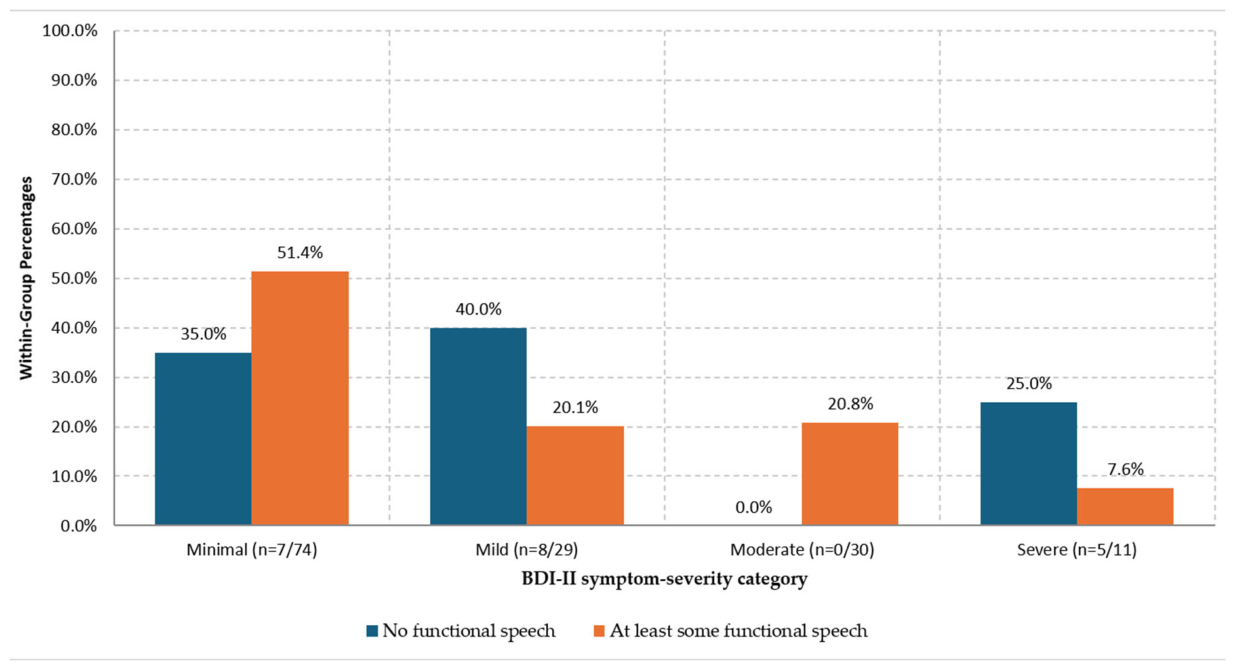
Figure 2 presents the BDI-II severity distribution according to diagnostic group, and Figure 3 presents the distribution according to parent-reported functional-speech status. Descriptive and inferential statistics are summarized in Table 2.
Figure 2.
Distribution of standard four-level BDI-II symptom-severity categories among parents of children with ASD (n = 117) and parents of children with other communication-related conditions (n = 47). Values shown are raw frequencies and within-group percentages.
Figure 3.
Distribution of standard four-level BDI-II symptom-severity categories among parents reporting no functional speech (n = 20) and parents reporting at least some functional speech (n = 144). Values shown are raw frequencies and within-group percentages.
Table 2.
Descriptive and inferential BDI-II results by diagnostic group and parent-reported functional-speech status.
3.4.2. ASD Versus Other Communication-Related Conditions
Parents of children with ASD had higher BDI-II scores (M = 17.65, SD = 11.48) than parents of children with other communication-related conditions (M = 9.36, SD = 6.74). Shapiro–Wilk tests suggested that BDI-II scores were not normally distributed in both groups (ASD, p < 0.001; other communication-related conditions, p = 0.046), and Levene’s test indicated unequal variances (F = 9.25, p = 0.003). Accordingly, Welch’s independent-samples t-test was used, with the Mann–Whitney U test conducted as a distribution-free sensitivity analysis. The difference was statistically significant, t(140.19) = 5.73, p < 0.001, mean difference = 8.29, 95% CI [5.43, 11.15], Cohen’s d = 0.80. The Mann–Whitney sensitivity analysis supported the same conclusion (U = 1488.00, p < 0.001).
The four-category BDI-II severity distribution also differed significantly between the diagnostic groups, Fisher-Freeman-Halton exact p < 0.001, Cramer’s V = 0.388. As shown in Figure 2, 78.7% of parents in the other-communication-related-conditions group were in the minimal range, compared with 37.6% of parents in the ASD group. Moderate or severe scores were correspondingly more frequent among parents in the ASD group.
3.4.3. Parent-Reported Absence of Functional Speech
Twenty parents were classified as reporting no functional speech, and 144 as reporting at least some functional speech. In the 2 × 4 contingency table, 3 of 8 cells (37.5%) had expected counts below 5, with a minimum expected count of 1.95. Because of these sparse expected frequencies, the Fisher-Freeman-Halton exact test was used for the four-category analysis. The overall BDI-II severity distribution differed significantly according to functional-speech status, exact p = 0.002, Cramer’s V = 0.288.
As shown in Figure 3, 25.0% of parents reporting no functional speech were in the severe range, compared with 7.6% of parents reporting at least some functional speech. However, the overall pattern was not a simple progressive increase across BDI-II categories.
On the continuous measure, parents reporting no functional speech had a higher mean BDI-II score (M = 20.70, SD = 14.89) than parents reporting at least some functional speech (M = 14.52, SD = 10.17), but the Welch comparison was not statistically significant, t(21.53) = 1.80, p = 0.086, mean difference = 6.18, 95% CI [−0.96, 13.31], Cohen’s d = 0.57. The Mann–Whitney sensitivity analysis was also nonsignificant (U = 1114.50, p = 0.102).
A secondary severe-versus-nonsevere comparison showed severe-range scores in 5 of 20 parents reporting no functional speech (25.0%) and 11 of 144 parents reporting at least some functional speech (7.6%), Fisher’s exact p = 0.029, OR = 4.03, 95% CI [1.23, 13.17]. In contrast, the combined moderate-or-severe comparison did not differ significantly between groups (25.0% vs. 28.5%, Fisher’s exact p = 1.000).
Because 18 of the 20 children reported as having no functional speech were also in the ASD group, an ASD-only sensitivity analysis was conducted. Among parents of children with ASD, mean BDI-II scores were 21.50 (SD = 15.48) for those reporting no functional speech (n = 18) and 16.95 (SD = 10.54) for those reporting at least some functional speech (n = 99). The continuous difference was not statistically significant, Welch’s t(19.97) = 1.20, p = 0.245, mean difference = 4.55, 95% CI [−3.37, 12.48]. The four-category severity distribution differed significantly between the two ASD subgroups (Fisher-Freeman-Halton exact p = 0.009). The severe vs. non-severe comparison did not reach statistical significance (p = 0.071).
3.4.4. Multivariable Analysis
Multiple linear regression was used to examine BDI-II total scores after adjustment for parent-reported ASD status, functional-speech status, parent age group, respondent role, educational attainment, and marital status. All 164 participants were included in the model. The overall model was statistically significant, F(6, 157) = 6.14, p < 0.001, R2 = 0.190, adjusted R2 = 0.159. Full results from the adjusted regression model are presented in Table 3. Parent-reported ASD status was independently associated with higher BDI-II scores (B = 8.27, SE = 1.79, β = 0.341, 95% CI [4.73, 11.80], p < 0.001). Parent-reported absence of functional speech was not statistically significant after adjustment (B = 4.32, SE = 2.45, β = 0.129, 95% CI [−0.52, 9.16], p = 0.080). University or postgraduate education was associated with lower BDI-II scores (B = −3.86, SE = 1.62, β = −0.173, 95% CI [−7.06, −0.66], p = 0.018). Parent age group, respondent role, and marital status were not statistically significant in the adjusted model.
Table 3.
Multiple linear regression predicting BDI-II total score (N = 164).
Because current child age could not be assigned consistently across the full sample, an ASD-only sensitivity analysis was conducted among the 114 respondents for whom a single numeric age for the child with ASD was available. In this model, parent-reported absence of functional speech was not significantly associated with BDI-II total score after adjustment for child age and the available parent characteristics (B = 5.47, SE = 2.99, β = 0.169, 95% CI [−0.47, 11.40], p = 0.071). Child age was also not significantly associated with BDI-II score (B = 0.36, SE = 0.25, β = 0.176, 95% CI [−0.14, 0.86], p = 0.161). The overall model was significant, F(6, 107) = 2.70, p = 0.018, R2 = 0.131, adjusted R2 = 0.083.
3.5. Exploratory Comparison with U.S. Data
To provide descriptive context, the Greek findings were considered alongside previously reported U.S. data from Gonzalez et al. [20] and Kollia et al. [21]. In the previously reported U.S. sample, approximately 66.0% of parents of children with ASD and 63.2% of parents of children with communication disorders without ASD were classified in the minimal BDI range. In the present Greek sample, 37.6% of parents of children with ASD were in the minimal range, compared with 78.7% of parents of children with other communication-related conditions. Moderate or severe BDI-II scores were observed in 36.8% of Greek parents of children with ASD and 6.4% of Greek parents of children with other communication-related conditions.
4. Discussion
The present study examined depressive symptoms among Greek parents of children with autism spectrum disorder (ASD) and other communication-related conditions and explored whether parent-reported functional-speech status was associated with depressive symptoms. The findings offer important insights into parental mental health in the Greek context and show that parents of children with ASD had higher depressive symptom levels than parents of children with other communication-related conditions.
Overall, parents of children with ASD reported significantly higher mean BDI-II scores and a more severe distribution of depressive symptoms than parents of children with other communication-related conditions. This difference remained significant in the multivariable analysis after adjustment for available parent characteristics and functional-speech status. Parent-reported absence of functional speech showed a less consistent pattern. Although parents of children described as having no functional speech had higher mean BDI-II scores and differed in the distribution of symptom-severity categories, the continuous difference was not statistically significant, and functional-speech status did not remain significant after adjustment. These findings suggest that parent-reported ASD status was the factor most consistently associated with parental depressive symptoms in this sample, while functional-speech status may still warrant further investigation as a secondary factor.
4.1. Depressive Symptoms in Greek Parents of Children with ASD and Other Communication-Related Conditions
Consistent with previous literature documenting elevated psychological distress among parents of children with ASD, the current study found significantly higher depressive symptoms among Greek parents of children with ASD than among parents of children with other communication-related conditions. Both the continuous BDI-II analysis and the categorical severity analysis showed clear differences between the diagnostic groups. The magnitude of the continuous difference was substantial, and ASD status remained significantly associated with higher BDI-II scores in the multivariable model.
These findings suggest that, within this sample, parenting a child with ASD was associated with greater depressive symptom burden than parenting a child with another communication-related condition. This pattern is broadly consistent with previous research showing elevated rates of depression, stress, and psychological distress among parents of autistic children [23]. Although some previous studies have examined diagnosed depression rather than symptom severity, the present findings support the broader conclusion that parents of children with ASD may represent a group at increased risk for poorer emotional well-being.
At the same time, the comparison group should not be interpreted as an unaffected or typically developing group. Parents of children with speech, language, fluency, or other communication-related conditions may also experience uncertainty, frustration, service-navigation burden, social isolation, and concern about their child’s future. The present findings therefore indicate a relative difference in depressive symptom severity between the diagnostic groups rather than an absence of emotional burden among parents in the comparison group.
This interpretation also fits with the broader literature showing that parental mental health is shaped by multiple interacting factors, including child functioning, communication level, behavioral difficulties, family support, stigma, coping resources, and access to services. In the Greek context, where service availability may vary by region and families may carry much of the responsibility for coordinating care, these pressures may affect parents across diagnostic groups. However, the present results suggest that these broader pressures did not eliminate the difference associated with ASD status.
4.2. Parent-Reported Absence of Functional Speech and Depressive Symptom Severity
Parent-reported absence of functional speech showed some association with depressive symptom severity, although the overall pattern was not consistent across analyses. Parents of children described as having no functional speech were more likely to fall into the severe depressive-symptom category, and the overall distribution across BDI-II severity categories differed between groups. However, mean BDI-II scores did not differ significantly, and functional-speech status was not statistically significant after adjustment for other variables. These findings suggest that spoken-language limitations may be relevant to parental emotional burden, but they should not be interpreted as an independent predictor of depressive symptoms in the present study. This interpretation is broadly consistent with prior research in which limited expressive communication has been associated with higher parenting stress, uncertainty, and emotional strain. When a child does not use functional speech, parents may have greater difficulty understanding the child’s needs, responding to frustration, supporting social interaction, and managing daily routines. Communication barriers may also affect therapy planning, family relationships, social participation, and parents’ confidence in their ability to support their child. These mechanisms were not directly measured in the present study, but they provide possible explanations that warrant further investigation.
At the same time, this finding must be interpreted carefully. In the present study, absence of functional speech was based on parent report and was not assessed through a standardized language measure or clinician-rated communication assessment. Most children reported as having no functional speech were also in the ASD group, making it difficult to separate the potential effects of functional-speech status from diagnostic group. In addition, the survey did not ask about AAC, sign language, gestures, picture exchange, speech-generating devices, or other nonspoken communication strategies. Therefore, this variable should be understood as parent-reported spoken-language status, not as a complete measure of functional communication. Future studies should examine both spoken and nonspoken communication abilities so that the emotional impact of communication limitations can be understood more fully.
4.3. Counseling, Support Groups, and Family Support Needs
The descriptive findings on counseling and support groups provide additional context for understanding parental emotional well-being. Nearly two-thirds of respondents reported that they had personally attended counseling, and most parents who had accessed counseling viewed it positively. These findings suggest that counseling was generally viewed favorably among respondents who had used it.
However, participation in support groups was limited. Among parents of children with ASD, most had never attended a support group, even though many expressed interest in joining one and viewed support groups positively. Reported barriers included lack of availability, insufficient information, and time constraints. These findings suggest a gap between parents’ interest in support and their actual access to support services.
This gap has clinical relevance. Parents of children with ASD and other communication-related conditions may benefit from family-centered services that include not only child-focused therapy but also parental emotional support, counseling referrals, peer-support options, and information about available community resources. Speech-language pathologists, educators, psychologists, pediatricians, and other professionals may be well positioned to identify parents who are struggling and to guide families toward appropriate support. Families of children with substantial spoken-language limitations may also warrant additional attention, although the present findings do not establish absence of functional speech as an independent predictor of parental depressive symptoms.
4.4. Findings in the Context of Previous Research
The present findings are broadly consistent with previous Greek research showing that parents of children with ASD and other developmental or communication-related conditions may experience substantial psychological burden [3,4,7,10,11,12,13]. Much of that work has focused on stress, fatigue, stigma, coping, or psychological distress rather than depressive-symptom severity specifically. The current findings therefore add a more direct assessment of depressive symptoms within this population.
Previously reported U.S. studies by Gonzalez et al. [20] and Kollia et al. [21] also provide useful context because they examined depressive symptoms among parents of children with autism and communication-related conditions. Direct numerical comparison with the present Greek sample is not appropriate; however, because the studies differed in the depression measure or scoring classification, available variables, and sample characteristics. Their findings are therefore better viewed as contextual evidence that depressive symptoms are relevant across different parent populations rather than as a direct cross-national comparison.
4.5. Clinical Implications
Together, the findings highlight the need to monitor parental depressive symptoms among families of children with ASD and other communication-related conditions. Although parents of children with ASD reported higher depressive symptoms in the present study, parents of children with other communication-related conditions may also experience substantial emotional strain and should not be overlooked in screening and support efforts.
The findings also suggest that families of children with parent-reported absence of functional speech may warrant additional attention. However, this should be interpreted cautiously because functional-speech status was not independently associated with BDI-II scores after adjustment. Interventions that support communication, increase parent confidence, provide counseling, and improve access to family-centered services may be relevant for families of children with limited spoken language. Although the present study did not assess AAC use, future clinical practice and research should consider AAC as part of a broader communication-support approach. Clinical practice should consider spoken and nonspoken communication together rather than focusing on speech alone.
Professionals working with these families should consider routine discussion of parental well-being as part of care. This does not mean pathologizing parents, but rather recognizing that parental mental health is part of the child’s support system. Counseling, support groups, parent training, psychoeducation, and service-navigation support may all play a role in helping families manage the emotional demands associated with ASD and other communication-related conditions. In this context, structured service-navigation approaches may be especially relevant. Because Family Navigation interventions explicitly target emotional support, care coordination, and service-system barriers [24], such approaches may be worth exploring within Greek early-intervention and family-support services.
4.6. Limitations
Several limitations should be acknowledged. First, the cross-sectional design limits causal interpretation. The study can identify associations between parent-reported child characteristics and parental depressive symptom severity, but it cannot determine the direction or cause of these associations. In particular, the findings do not establish that parent-reported ASD status or absence of functional speech causes higher depressive symptoms.
Second, child diagnosis was based on parent report and was not independently verified through clinical records or standardized diagnostic assessment. Therefore, diagnostic categories should be interpreted as parent-reported groupings. In addition, the comparison group included several communication-related conditions, including speech and language disorders, fluency disorders, and other developmental or communication-related conditions. Although these conditions were combined because of the small numbers in individual categories, this heterogeneity may have obscured differences within the comparison group. The diagnostic groups were also unequal in size (ASD, n = 117; other communication-related conditions, n = 47), which may have reduced the precision of between-group comparisons, particularly for the smaller comparison group. The survey did not systematically assess specific clinical co-occurring diagnoses such as intellectual disability or epilepsy. Therefore, these factors could not be described comprehensively or included in the adjusted analyses.
Third, parent-reported absence of functional speech was not assessed using a standardized language measure or clinician-rated communication assessment. Although three researchers independently reviewed the open-ended responses and resolved discrepancies through consensus, no formal inter-rater reliability coefficient was calculated. The survey also did not include questions about AAC use, sign language, gestures, picture exchange, speech-generating devices, or other nonspoken communication modalities. Therefore, the functional-speech variable reflects parent-reported spoken-language status rather than a comprehensive measure of functional communication. Only 20 children were classified as having no functional speech, and 18 of these were also in the ASD group. This small subgroup and substantial overlap with ASD status limited the ability to distinguish the association of functional-speech status from that of diagnostic group.
Fourth, the sample was composed primarily of mothers. This limits the ability to examine differences between mothers and fathers and means that the findings mainly reflect maternal experiences. The mother-heavy composition of the sample may also have influenced the observed depressive symptom patterns.
Fifth, the sample was recruited through online methods, social media parenting groups, private speech-language therapy clinics, and professional networks. Although this allowed participation from multiple regions of Greece, the convenience-sampling approach limits the generalizability of the findings and may have excluded families who were less connected to services, had limited internet access, or were more socially isolated. These families may have different experiences with depressive symptoms and support services.
Sixth, the counseling and support-group questions were designed for this survey and were analyzed descriptively. They were not intended to function as validated measures of service access, counseling quality, or intervention effectiveness. The findings regarding counseling and support groups therefore describe respondents’ experiences and views but cannot establish whether participation was associated with better mental-health outcomes.
Seventh, although the multivariable analysis adjusted for several available parent characteristics, other factors that may influence parental depressive symptoms were not measured comprehensively. Current child age could not be included in the full-sample multivariable model because a single age corresponding to the relevant child could not be reliably identified for all respondents, particularly when information was provided for more than one child. An ASD-only sensitivity analysis incorporating available child-age data did not identify a statistically significant association between child age and parental BDI-II scores. However, this analysis was limited to respondents for whom a single numeric age for the child with ASD could be identified. Several other factors that may be relevant were not measured and could not be included in the adjusted analyses. These include child behavioral severity, caregiving burden, socioeconomic circumstances, social support, parental psychiatric history, and other family-level factors. Such unmeasured factors may also have influenced the observed associations.
Finally, depressive symptoms were assessed using the BDI-II, which is a self-report measure of symptom severity rather than a clinical diagnostic assessment. The findings should therefore not be interpreted as estimates of the prevalence of clinically diagnosed depressive disorders.
5. Conclusions and Future Work
Parents of children with ASD reported higher depressive symptoms than parents of children with other communication-related conditions, and this difference remained significant after adjustment for available parent characteristics. Parent-reported absence of functional speech showed some associations with depressive-symptom severity, but the overall findings were less consistent and should be considered exploratory. Counseling was commonly reported and generally viewed positively, while support-group participation remained relatively low despite strong interest in future participation. These findings highlight the importance of considering parental mental health alongside the developmental and communication needs of the child.
Future studies should recruit larger and more balanced samples, including more fathers and other caregivers, and should verify child diagnoses and communication characteristics where possible. Standardized measures of spoken language, broader functional communication, and AAC use would help clarify whether particular communication profiles are associated with parental depressive symptoms independently of parent-reported ASD status.
Longitudinal research would also be valuable for examining how parental depressive symptoms change over time and whether they are associated with changes in child communication, behavioral needs, caregiving demands, social support, or access to services. Future work should also examine counseling and support-group use in greater depth, including barriers to participation and whether different forms of support are associated with parental mental-health outcomes.
Author Contributions
Conceptualization, B.K. and V.C.G.; Methodology, B.K., V.N. and V.C.G.; Data collection, E.A.F., P.M. and E.T.; Formal analysis, V.C.G. and V.N.; Writing—Original draft preparation, B.K., E.A.F., P.M., E.T. and V.C.G.; Writing—editing, B.K., V.N. and V.C.G. All authors have read and agreed to the published version of the manuscript.
Funding
This research received no external funding.
Institutional Review Board Statement
This study was conducted in accordance with the Declaration of Helsinki. All measures for keeping anonymity and protecting personal data were taken, while the researchers followed the rules of Research Ethics and Deontology. Ethical review and approval were not required for the study on human participants, in accordance with the local legislation and institutional requirements. Specifically, in Greece, the approval of research protocols for non-funded projects is not mandatory, as outlined in the local legislation, specifically Law 4957/2022, Article 279, Paragraph 2(b).
Informed Consent Statement
Informed consent was obtained from all subjects involved in the study.
Data Availability Statement
The data presented in this study are available on request from the corresponding authors. The data are not publicly available due to ethical/privacy issues.
Conflicts of Interest
The authors declare no conflicts of interest.
Abbreviations
The following abbreviations are used in this manuscript:
| AAC | Augmentative and Alternative Communication |
| APSI | Autism Parenting Stress Index |
| ASD | Autism Spectrum Disorder |
| BDI | Beck Depression Inventory |
| DLD | Developmental Language Disorder |
References
- American Psychiatric Association. Diagnostic and Statistical Manual of Mental Disorders, 5th ed.; American Psychiatric Association Publishing: Washington, DC, USA, 2022. [Google Scholar]
- Baker-Ericzén, M.J.; Brookman-Frazee, L.; Stahmer, A. Stress levels and adaptability in parents of toddlers with and without autism spectrum disorders. Res. Pract. Pers. With Sev. Disabil. 2005, 30, 194–204. [Google Scholar] [CrossRef] [Scilit]
- Ntre, V.; Papanikolaou, K.; Amanaki, E.; Triantafyllou, K.; Tzavara, C.; Kolaitis, G. Coping strategies in mothers of children with autism spectrum disorder and their relation to maternal stress and depression. Psychiatriki 2022, 33, 210–218. [Google Scholar] [CrossRef] [Scilit] [PubMed]
- Halki, E.; Kapiri, M.; Plakas, S.; Tsiou, C.; Govina, O.; Galanis, P.; Alikari, V. Fatigue among Greek parents of children with autism spectrum disorder: The roles of spirituality and social support. Healthcare 2024, 12, 455. [Google Scholar] [CrossRef] [Scilit] [PubMed]
- Chan, K.K.S.; Leung, D.C.K. Linking child autism to parental depression and anxiety: The mediating roles of enacted and felt stigma. J. Autism Dev. Disord. 2021, 51, 527–537. [Google Scholar] [CrossRef] [Scilit] [PubMed]
- Kouznetsov, R.; Angelopoulos, P.; Moulinos, S.; Dimakos, I.; Gourzis, P.; Jelastopulu, E. Epidemiological study of autism spectrum disorders in Greece for 2021: Nationwide prevalence in 2-17-year-old children and regional disparities. J. Clin. Med. 2023, 12, 2510. [Google Scholar] [CrossRef] [Scilit] [PubMed]
- Efstratopoulou, M.; Sofologi, M.; Giannoglou, S.; Bonti, E. Parental stress and children’s self-regulation problems in families with children with autism spectrum disorder (ASD). J. Intell. 2022, 10, 4. [Google Scholar] [CrossRef] [Scilit] [PubMed]
- Papadopoulos, A.; Fouska, S.; Tafiadis, D.; Trimmis, N.; Plotas, P.; Siafaka, V. Psychometric properties of the Greek version of the Autism Parenting Stress Index (APSI) among parents of children with autism spectrum disorder. Diagnostics 2023, 13, 3259. [Google Scholar] [CrossRef] [Scilit] [PubMed]
- Kotsis, K.; Boukouvala, M.; Serdari, A.; Koullourou, I.; Siafaka, V.; Hyphantis, T. Parental stress scale: Psychometric properties in parents of preschool children with developmental language disorder. Healthcare 2023, 11, 1332. [Google Scholar] [CrossRef] [Scilit] [PubMed]
- Papadopoulos, A.; Tafiadis, D.; Tsapara, A.; Skapinakis, P.; Tzoufi, M.; Siafaka, V. Validation of the Greek version of the Affiliate Stigma Scale among mothers of children with autism spectrum disorder. BJPsych Open 2022, 8, e30. [Google Scholar] [CrossRef] [Scilit] [PubMed]
- Papadopoulos, D. Impact of child and family factors on caregivers’ mental health and psychological distress during the COVID-19 pandemic in Greece. Children 2023, 11, 7. [Google Scholar] [CrossRef] [Scilit] [PubMed]
- Papadopoulos, A.; Tsapara, A.; Gryparis, A.; Tafiadis, D.; Trimmis, N.; Plotas, P.; Siafaka, V. A prospective study of the family quality of life, illness perceptions, and coping in mothers of children newly diagnosed with autism spectrum disorder and communication difficulties. Eur. J. Investig. Health Psychol. Educ. 2024, 14, 2187–2204. [Google Scholar] [CrossRef] [Scilit] [PubMed]
- Karakasidou, E.; Papadimitriou, A.; Triantafyllou, L. Parental self-compassion and psychological distress in families of children with language and speech disorders: A mixed-methods study in the Greek context. Children 2025, 12, 1456. [Google Scholar] [CrossRef] [Scilit] [PubMed]
- Beck, A.T.; Steer, R.A.; Brown, G.K. Manual for the Beck Depression Inventory-II; Psychological Corporation: San Antonio, TX, USA, 1996. [Google Scholar]
- Konowałek, Ł.; Kotowska-Bąbol, M.; Łukasik, J.; Remiszewski, P.; Wolańczyk, T. Quality of life among parents of autistic children: Questionnaire validation study and multivariate analysis of associated factors. Front. Psychiatry 2025, 16, 1554368. [Google Scholar] [CrossRef] [Scilit] [PubMed]
- Suswaram, S.; Brady, N.C.; Boyd, B. The impact of parenting stress and cultural orientation on communication skills in minimally verbal children with autism spectrum disorders: A comparative study in India and the US. Res. Autism Spectr. Disord. 2024, 112, 102337. [Google Scholar] [CrossRef] [Scilit]
- Guerrera, S.; Fucà, E.; Petrolo, E.; De Stefano, A.; Casula, L.; Logrieco, M.G.; Vicari, S. Exploring the clinical features of minimally verbal autistic children. Front. Psychiatry 2025, 16, 1549092. [Google Scholar] [CrossRef] [Scilit] [PubMed]
- Papadopoulos, D. Mothers’ experiences and challenges raising a child with autism spectrum disorder: A qualitative study. Brain Sci. 2021, 11, 309. [Google Scholar] [CrossRef] [Scilit] [PubMed]
- Chan, K.K.S.; Lam, C.B. Self-stigma among parents of children with autism spectrum disorder. Res. Autism Spectr. Disord. 2018, 48, 44–52. [Google Scholar] [CrossRef] [Scilit]
- Gonzalez, M.; Maloney, S.; Nass, J. Emotional Well-being and Depressive Symptoms in Parents of Children with Communication Disorders; Research Study; William Paterson University of New Jersey: Wayne, NJ, USA, 2019. [Google Scholar]
- Kollia, B.; Maloney, S.; Gonzalez, M.; Nass, J.; Marshall, B. Emotional well-being and depressive symptoms in parents of children with communication disorders and autism. Presented at the ASHA Convention, Orlando, FL, USA, 21–23 November 2019. [Google Scholar]
- Giannakou, M.; Roussi, P.; Kosmides, M.E.; Kiosseoglou, G.; Adamopoulou, A.; Garyfallos, G. Adaptation of the Beck Depression Inventory-II to the Greek population. Hell. J. Psychol. 2013, 10, 120–146. [Google Scholar]
- Cohrs, A.C.; Leslie, D.L. Depression in parents of children diagnosed with autism spectrum disorder: A claims-based analysis. J. Autism Dev. Disord. 2017, 47, 1416–1422. [Google Scholar] [CrossRef] [Scilit] [PubMed]
- Broder-Fingert, S.; Stadnick, N.A.; Hickey, E.; Goupil, J.; Diaz Lindhart, Y.; Feinberg, E. Defining the core components of family navigation for autism spectrum disorder. Autism 2020, 24, 526–530. [Google Scholar] [CrossRef] [Scilit] [PubMed]

Disclaimer/Publisher’s Note: The statements, opinions and data contained in all publications are solely those of the individual author(s) and contributor(s) and not of MDPI and/or the editor(s). MDPI and/or the editor(s) disclaim responsibility for any injury to people or property resulting from any ideas, methods, instructions or products referred to in the content. |
© 2026 by the authors. Licensee MDPI, Basel, Switzerland. This article is an open access article distributed under the terms and conditions of the Creative Commons Attribution (CC BY) license.