


Abstract
AI-generated war imagery is increasingly produced and made available through platformized visual environments in which photographic appearance has traditionally signaled evidence, testimony, and historical credibility. This article offers a theoretical and interpretive examination of how synthetic war images complicate the relationship between visual evidence, collective memory, and visual trust, treating collective memory and trust as conceptual concerns rather than measured audience outcomes. Moving beyond debates centered on falsity, it conceptualizes such imagery as a post-indexical mnemonic form capable of mobilizing affective legibility and the appearance of testimony despite the absence of documentary witness. Drawing on the philosophy of photography, collective memory theory, visual communication, and scholarship on generative imagery, the study analyzes a purposively selected corpus of six AI-generated war-related images identified through Freepik platform. The platform is treated as a searchable repository, not as evidence of actual circulation or audience reception. Semiotic analysis identifies recurring visual codes; hermeneutic analysis interprets their mnemonic and evidentiary implications across three theoretically informed formations: the synthetic victim, the synthetic camp, and the synthetic ruin. The analysis shows how the selected images reactivate established visual grammars of suffering, displacement, and destruction, reproducing recognizable conventions of photographic evidence without documentary grounding. The article introduces memory without witness to theorize a displacement in the visual foundations through which mnemonic authority may be claimed: from documentary trace to synthetic recognizability. This conceptual distinction concerns the representational conditions through which conflict becomes available for remembrance, rather than empirically demonstrated effects on collective memory. It also raises questions about forms of violence that remain less readily represented within established visual repertoires.
1. Introduction
This article does not begin from the proposition that AI-generated war images are simply false. That claim remains relevant, but it is insufficient to the scale of the problem. The more difficult question is what such images do when they enter the visual field of war as plausible representations of suffering, displacement, and destruction. A child covered in dust, a camp suspended between waiting and flight, or a city reduced to ruin may refer to no photographed event, yet still appear historically suggestive, affectively persuasive, and immediately memorable. What is at stake, therefore, is not only a crisis of photographic trust, but a shift in the cultural and mnemonic conditions through which war becomes visible and collectively intelligible. Recent scholarship has begun to register this shift by showing that AI-generated images of war increasingly participate in memory-making, while generative systems reshape the forms and values through which collective remembering is mediated (Laba et al., 2025; Theodosiou et al., 2026; Matei, 2024).
The problem exceeds the replacement of one image type by another. Photography historically derived much of its authority from indexical contact—from the assumption that something had stood before the lens and left a trace (Barthes, 1980/1981). AI-generated imagery, by contrast, preserves the visual rhetoric of photographic credibility while suspending its evidentiary ground. The distinction between photography and photorealism is therefore decisive: what can now acquire persuasive force is not necessarily the photograph as trace, but the synthetic image as a highly legible depiction. Recent philosophical work has clarified that generated images cannot be understood adequately through the vocabulary of fraud or authenticity alone, because synthetic depiction remains adjacent to photography without being reducible to it (Hausken, 2024).
In the context of war, this transformation acquires particular gravity. Modern conflict has long been condensed into recognizable visual figures and places: the wounded child, the displaced crowd, the camp, and the ruined city. Generative systems do not simply fabricate new instances of these scenes; they intensify their reproducibility and detach them from witnessed occurrence while preserving recognizable affective and mnemonic structures (Laba et al., 2025; Theodosiou et al., 2026). Recent work has shown that synthetic conflict imagery reproduces recurring aesthetic patterns around civilians, destruction, childhood, and resilience (Theodosiou et al., 2026), while Laba et al. (2025) examine AI-generated war imagery in relation to processes of memory-making. The present study builds on these contributions but asks a different question: not primarily which visual patterns recur, or whether generative imagery participates in remembrance, but how synthetic images reconstruct the visual conditions through which mnemonic and quasi-testimonial authority may be claimed in the absence of an originating witnessed event. It therefore approaches AI-generated war imagery as a symptom of a changing mnemonic order in which visual authority increasingly depends on recognizability rather than documentary encounter.
The visual memory of war, however, is neither universal nor historically neutral. What is recognized as war imagery has been shaped by selective traditions of documentary photography and photojournalism, especially those associated with modern armed conflict. The child, the camp, and the ruin are not timeless forms; they belong to sedimented repertoires through which suffering has become publicly visible and morally legible (Allan & Zelizer, 2004; Campbell, 2004; Zelizer, 2010). Synthetic imagery therefore reactivates inherited visual grammars rather than generating representations ex nihilo (Theodosiou et al., 2026). This selectivity also establishes a limit: forms of direct suffering and physical devastation that possess stable image-schemas are more readily visualized and remembered, whereas symbolic, structural, cultural, or epistemic violence may remain less visible and less mnemonically available.
Against this background, the article asks how AI-generated war images appropriate the visual authority of war photography, condense conflict into recurrent mnemonic templates of victimhood, displacement, and ruin, and acquire affective and historical force without the evidentiary bond of photographic witnessing. It argues that synthetic war imagery does not merely imitate documentary visuality; it reorganizes the mnemonic function of the war image by producing what may be called memory without witness. This concept names a form of mediated remembrance in which the image no longer derives authority from having been there, yet continues to structure what can be seen, felt, and retained as war. The decisive conceptual displacement lies in the shift from documentary trace to synthetic recognizability as a possible basis for mnemonic authority. Collective memory thus provides the theoretical horizon of this inquiry, while the analysis addresses the visual and interpretive conditions through which synthetic images become available for remembrance.
Methodologically, the article develops a qualitative interpretive analysis of a purposively selected corpus of six publicly accessible AI-generated war-related images identified through Freepik–Magnific.com. The platform is not treated as evidence of actual circulation, journalistic use, or audience reception, but as a platformized repository through which synthetic images are generated, categorized, searched, and made available for subsequent reuse. The corpus is organized around three representational formations—the synthetic victim, the synthetic camp, and the synthetic ruin—and analyzed through complementary semiotic and hermeneutic procedures. Semiotic analysis identifies recurring formal codes and visual structures, while hermeneutic analysis interprets their historical, mnemonic, and evidentiary implications.
The article proceeds through four substantive stages. The theoretical framework revisits photography, indexicality, testimony, and memory under generative conditions. The methodology explains corpus construction, purposeful sampling, and the complementary analytical procedures. The findings examine the three visual formations through which synthetic war imagery standardizes conflict into affectively legible and mnemonically efficient forms. The discussion then develops the broader philosophical implications of memory without witness and the migration of authority from documentary trace to synthetic recognizability.
2. Theoretical Framework
The theoretical problem begins when the synthetic image ceases to be treated merely as a deceptive artifact and is approached instead as a form capable of entering the cultural organization of remembrance. At that point, the question is no longer confined to whether the image is true or false, but concerns how it acquires mnemonic force without documentary presence. AI-generated war imagery may carry no indexical relation to a witnessed event, yet it can still organize suffering, displacement, and destruction into culturally recognizable forms. Recent scholarship has begun to register this transformation by showing that generative imagery participates increasingly in processes of memory-making and reshapes the technological forms through which collective remembering is mediated (Laba et al., 2025; Matei, 2024; Hoskins, 2024).
This transformation becomes intelligible only against the philosophical legacy of photography. Photographic authority has historically been tied to the conviction that something stood before the lens and left a material trace. Barthes’s account remains decisive because it defines the photograph not merely through resemblance, but through its paradoxical relation to presence, absence, and what has been (Barthes, 1980/1981; Brookes, 2025). Generative imagery unsettles this relation while preserving much of its visual rhetoric. It can appear evidentiary without having encountered the world it seems to present. The distinction between photography and photorealism is therefore not a technical distinction alone, but an ontological one: synthetic depiction may remain adjacent to photography while lacking the indexical ground from which photographic testimony historically derived its force (Hausken, 2024).
The weakening of trace, however, does not abolish the mnemonic life of the image. It reveals that collective memory has never depended on indexicality alone. Halbwachs (1992) established that remembrance is structured through social frameworks, while Assmann (2011) showed that cultural memory requires mediating forms capable of stabilizing and transmitting the past. The image matters, therefore, not only because it records, but because it furnishes a structure through which experience becomes culturally retainable. AI-generated war imagery should consequently not be understood as failed documentation alone. It must also be read as a mnemonic form whose force arises from mediation, repetition, and symbolic availability. Generative systems do not simply produce images subsequently absorbed into memory; they increasingly shape the formal conditions through which remembering itself becomes possible (Matei, 2024). This development also complicates the relation between photographic appearance, archival logic, and possible memory (Yacavone, 2026).
Within the visual culture of war, this transformation becomes especially consequential because conflict has long been mediated through a limited repertoire of highly recognizable figures and spaces. The wounded child, the displaced crowd, the camp, and the ruined city do not simply illustrate war; they condense it into affectively charged and historically portable forms. Images of suffering, as Sontag (2003) argues, do not merely present pain but organize the terms through which pain becomes visible and repeatable.
Benjamin’s (1968) account of technological reproducibility provides a historical point of departure for understanding how technical mediation transforms the relationship between images, singular presence, and cultural availability. Generative imagery, however, introduces a different mode of production: rather than reproducing an existing photographic image, it synthesizes new visual instances through learned patterns and computational models. Baudrillard’s (1993, 1996) analyses of seriality and model-mediated representation offer a conceptual perspective on this displacement, particularly the possibility that recognizable representational effects may be repeatedly produced without dependence on a singular referent. These accounts do not anticipate generative AI directly; rather, they help situate its specificity within a longer transformation of visual reproduction. The distinction becomes central to the concept of the synthetic trace: what appears to be the residue of an encountered event is instead a configuration generated through inherited visual conventions. The synthetic trace therefore designates neither material evidence nor an indexical relation to an originating event, but the production of an evidentiary appearance without the event it seems to record.
This distinction becomes clearer when generative imagery is considered alongside cinema, television, and the standardized production of mass culture. As Morin’s (1962) analysis suggests, cultural production had already established recurrent genres, narrative structures, and visual codes through which audiences learned to recognize familiar representational forms. Cinema could produce fictional scenes through staged performances, while subsequent digital techniques also made photorealistic fabrication possible without recording the events represented. The distinction introduced by contemporary generative systems is therefore not the invention of eventless representation. Rather, it concerns the scalable, prompt-conditioned synthesis of photorealistic images through the recombination of learned visual patterns, including conventions historically associated with documentary photography and photojournalism. This comparison requires distinguishing three levels of visual authority. Code recognizability concerns the identification of familiar representational patterns; apparent documentary credibility concerns the resemblance of an image to established conventions of factual recording; and testimonial authority requires a warranted relationship to an event through provenance, contextualization, or witnessing. Synthetic imagery can reproduce the first and evoke the second without independently establishing the third. Its theoretical significance lies in this separation between documentary appearance and evidentiary grounding.
The visual memory of war is neither universal nor historically neutral. What becomes recognizable as war imagery has been shaped through selective traditions of documentary photography, photojournalism, and media circulation, particularly those associated with modern inter- and intrastate conflict (Allan & Zelizer, 2004; Campbell, 2004; Zelizer, 2010). The wounded child, the displaced population, and the devastated city are therefore not timeless visual forms. They belong to historically sedimented repertoires through which war has been made publicly visible, morally legible, and culturally transmissible. AI-generated war imagery does not emerge outside these regimes of representation. It inherits their visual hierarchies and reproduces the distinctions through which some forms of suffering acquire mnemonic priority over others.
This selectivity has ethical consequences. War imagery does not merely expose suffering; it frames whose suffering becomes recognizable, grievable, and culturally retained (Butler, 2009; Zelizer, 2010). The problem posed by synthetic imagery is therefore not only that it can fabricate scenes of victimhood and destruction, but that it may intensify inherited expectations of what legitimate suffering is supposed to look like. Repetition elevates particular bodies, spaces, and atmospheres into mnemonic icons, while forms of violence that lack stable visual codes remain less available to public recognition and remembrance. Generative imagery thus reproduces not only images, but inherited hierarchies of visual legibility through which some forms of suffering become more readily recognizable and culturally retainable than others (Butler, 2009; Zelizer, 2010; Theodosiou et al., 2026).
The concept that organizes the present study emerges from this tension: memory without witness. The phrase does not imply that witnessing has disappeared as an ethical or political category. It names instead a post-indexical condition in which images can reproduce the visual structures associated with mnemonic and quasi-testimonial functions after the relation of direct documentary encounter has been displaced. Azoulay’s account remains indispensable because it situates photography within relations of appearance, responsibility, and claim-making rather than treating the image as an autonomous object (Azoulay, 2008). Under generative conditions, those relations are not abolished but reconstituted without documentary encounter. Synthetic refugee imagery, for example, may continue to articulate political and testimonial claims despite lacking the evidentiary ground of classical documentary photography (Braeunert, 2026). The image becomes historically suggestive not because it was present, but because it mobilizes plausibility, affective legibility, and symbolic familiarity. Memory without witness therefore names the mnemonic condition of a post-indexical image that functions as though historical presence had already been secured.
Memory without witness must also be distinguished from postmemory and prosthetic memory. Postmemory describes the affective relation of later generations to traumatic events transmitted through familial and cultural forms, while prosthetic memory concerns memories acquired through mediated encounters with histories not directly lived (Hirsch, 2012; Landsberg, 2004; Breazu, 2024). Both remain, however indirectly, anchored in events understood to have occurred. Memory without witness names a more radical displacement: the image itself may have no documentary relation to any particular event, yet still reproduce the visual conditions of mnemonic and quasi-testimonial force through recognizability and inherited visual grammar. The concept therefore concerns not simply mediated distance from experience, but the synthetic reconstruction of the visual foundations through which mnemonic authority may be claimed without an originating visual encounter.
The research gap lies at the intersection of several bodies of scholarship that have remained insufficiently integrated. Studies of generative imagery have concentrated substantially on questions of misinformation, authenticity, and visual credibility (Hausken, 2024). Memory scholarship has begun to examine how generative systems reshape the mediation and technological conditions of remembrance (Hoskins, 2024; Laba et al., 2025; Matei, 2024). Critical scholarship on war imagery and distant suffering has shown how victimhood, displacement, and destruction become visually legible through historically coded repertoires, and how mediated suffering is organized for spectators at a distance (Allan & Zelizer, 2004; Boltanski, 1999; Chouliaraki, 2006; Zelizer, 2010). These accounts are indispensable for understanding the representational grammar that synthetic imagery inherits; their primary concern, however, is the mediation and spectatorship of suffering rather than the mnemonic authority of images that lack an originating photographed event. Scholarship on mediated suffering and visual repertoires helps explain how recurrent image-types acquire portability and moral legibility across contexts, while work on distant suffering clarifies why particular figures of victimhood become especially recognizable within public cultures of compassion (Boltanski, 1999; Chouliaraki, 2006; Zelizer, 2010). Memory without witness addresses a different problem: how such recognizable visual forms can acquire mnemonic and quasi-testimonial force when the image itself has no originating documentary encounter with the event it appears to evoke. What remains under-theorized is how synthetic imagery reactivates these inherited repertoires while displacing the documentary relation on which visual testimony has conventionally depended. The present study addresses this gap by bringing the philosophy of photography, collective memory theory, and critical accounts of mediated suffering into direct conceptual relation. Its contribution lies not in treating repetition or affective legibility as new, but in explaining how these established visual mechanisms reconstruct the conditions under which mnemonic and quasi-testimonial authority may be claimed after documentary witness has been displaced.
This inquiry extends earlier work on photography, memory, and visual mediation, including studies of photography as a repository of vernacular memory and of the transformations in image authority accompanying the transition from traditional to digital photography (Al Sheikh, 2023, 2024). The present study narrows that trajectory to a more specific problem: how war becomes collectively memorable through synthetic images that retain mnemonic force after the weakening of photographic trace. Its theoretical framework rests on four claims. First, photographic authority must be distinguished from photorealistic plausibility. Second, collective memory depends on mediated forms that acquire unequal mnemonic priority. Third, generative imagery standardizes inherited templates of victimhood, exile, and ruin. Fourth, the synthetic war image constitutes a post-indexical mnemonic form that reorganizes the relation among memory, testimony, and visual evidence. These claims ground the analytical categories developed in the study: memory without witness, iconization of victimhood, suspended temporality of exile, synthetic trace, and mnemonic standardization.
For analytical clarity, the study distinguishes three levels of mnemonic inference. Mnemonic potential refers to the formal and culturally established features through which an image may become available for recognition and possible remembrance. Interpretive mnemonic function refers to the role these features perform within the semiotic and hermeneutic analysis developed in this article. Empirically demonstrated mnemonic effects, by contrast, require evidence concerning how identifiable audiences encounter, interpret, circulate, trust, or remember particular images. The present study examines the first two levels but does not investigate the third. Accordingly, references to mnemonic and quasi-testimonial authority designate interpretive possibilities and visual claims to authority rather than empirically verified effects on collective memory.
3. Materials and Methods
This study adopts a qualitative interpretive methodology to examine AI-generated war imagery as a mnemonic and representational formation. It does not seek to verify image authenticity, measure audience response, document actual circulation, or determine the factual relation of synthetic images to particular photographed events. Rather, it investigates how AI-generated war images construct recognizable visual patterns of victimhood, displacement, and ruin, and how these patterns illuminate the visual conditions of mnemonic recognition under post-indexical conditions. Visual form is therefore approached not as a neutral surface of appearance, but as a culturally coded organization of visibility through which affect, mnemonic authority, and quasi-testimonial force are mediated. The selected images are not treated as making explicit testimonial or evidentiary claims, since they are not presented with captions or event-specific assertions. Rather, the analysis examines the extent to which their visual organization reproduces conventions historically associated with documentary credibility and photographic witnessing. In this study, “quasi-testimonial” therefore refers to an interpretive property of visual form, not to an empirically established claim to truth or audience belief.
All six images in the final analytical corpus are reproduced in the article. Two figures are presented for each of the three formations—the synthetic victim, the synthetic camp, and the synthetic ruin—providing a balanced basis for sustained close analysis across the three representational fields. The complete corpus, including source records and analytical coding, is provided in the Supplementary Materials. Individual Premium License Certificates have been retained for all six images. Adobe Stock was consulted during the exploratory scoping stage, but its images were excluded from the final corpus in order to maintain platform consistency across the analytical sample. Freepik is not treated as evidence of downstream journalistic circulation, social-media use, or audience exposure. Rather, it is approached as a platformized repository and infrastructural site through which synthetic images are generated or aggregated, categorized, searched, and made available for subsequent reuse. The study therefore examines visual forms made available for circulation, rather than their documented circulation or reception within specific information environments.
The search process began on 3 March 2026 and continued through successive stages of review, refinement, source verification, and licensing documentation, with the final corpus formally consolidated on 24 July 2026. Search phrases included combinations such as “war child AI generated,” “war refugee AI generated,” “humanitarian crisis AI generated,” and “war ruins AI generated.” These phrases were selected to retrieve visually dominant and historically sedimented representations of war-related suffering rather than to encompass all manifestations of armed conflict or violence. For each retained image, the corpus record documented the platform, asset identifier, search phrase, visual category, formal characteristics, primary and secondary analytical codes, rationale for inclusion, and use within the article. The complete corpus record is provided in Supplementary Table S1, while Table 1 documents the six images reproduced as analytical figures. Because commercial platform inventories and search rankings may change over time, corpus verification is based on the retained asset identifiers rather than on the reproducibility of the original search ranking. Each reproduced image can therefore be independently checked through its recorded asset ID and corresponding source-platform documentation.
Table 1.
Reproduced AI-generated images used in the analysis.
Figure 1.
AI-generated child-centered humanitarian image used in the analysis of the synthetic victim. Source: Freepik–Magnific.com. Reproduced under an individual Premium License Certificate.
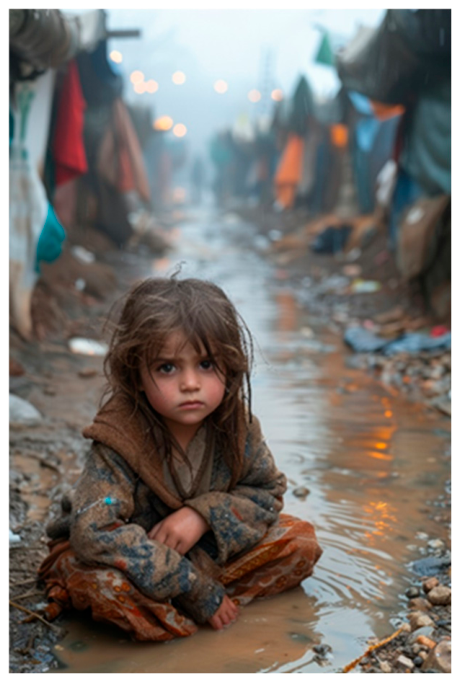
Figure 2.
AI-generated child image used in the analysis of affective authority and iconized victimhood. Source: Freepik–Magnific.com. Reproduced under an individual Premium License Certificate.
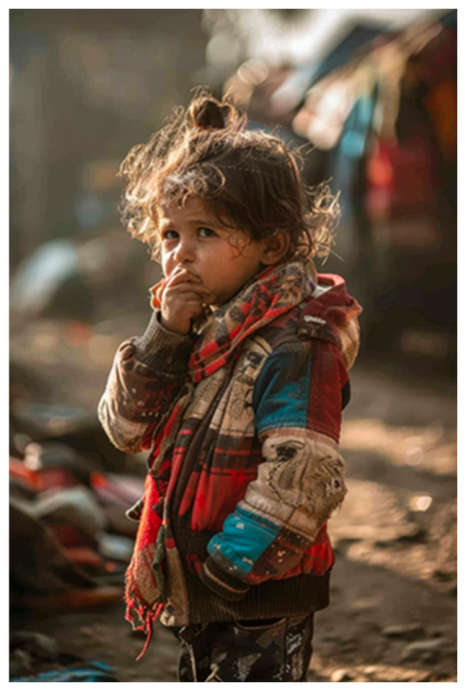
Figure 3.
AI-generated refugee-camp image used in the analysis of suspended temporality and spatial precarity. Source: Freepik–Magnific.com. Reproduced under an individual Premium License Certificate.
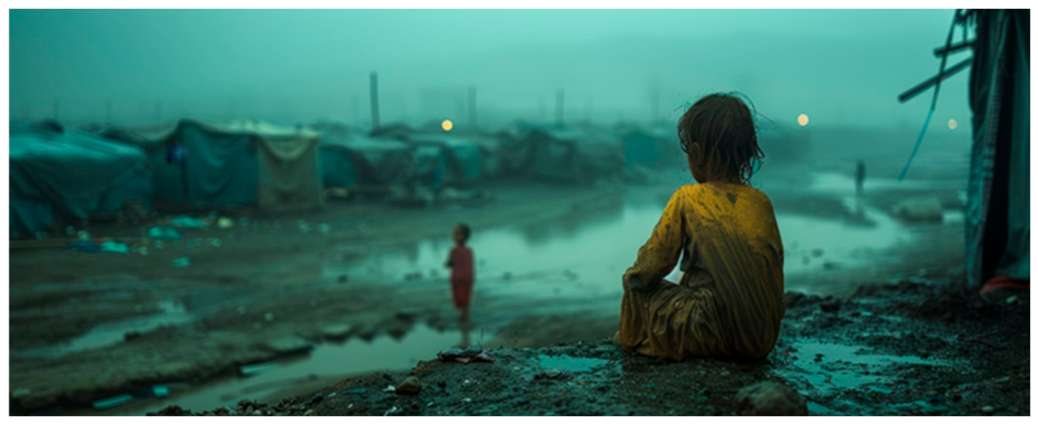
Figure 4.
AI-generated camp image used in the analysis of collectivized displacement and the camp as mnemonic space. Source: Freepik–Magnific.com. Reproduced under an individual Premium License Certificate.
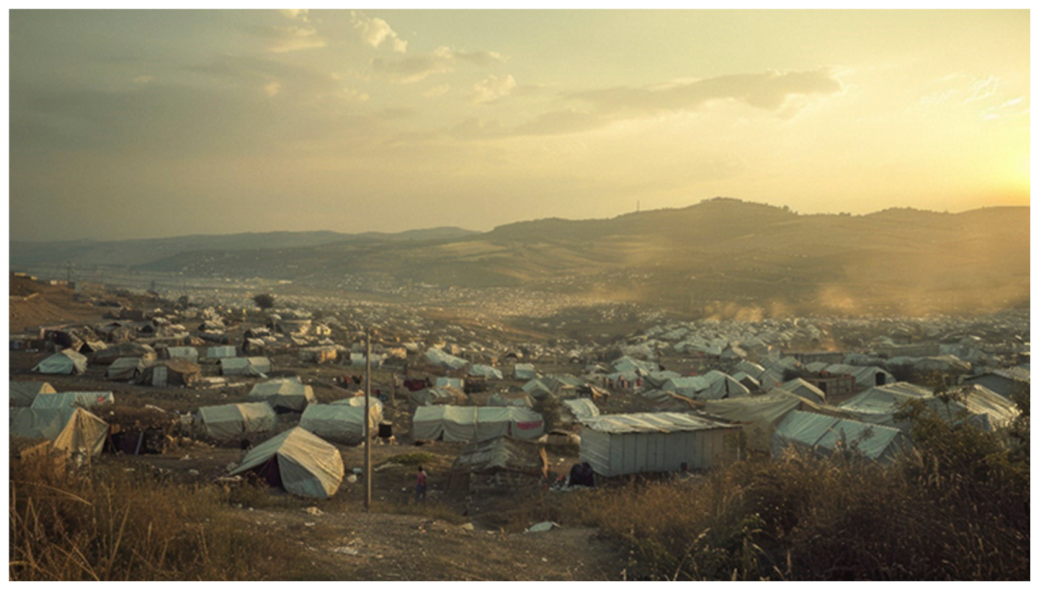
Figure 5.
AI-generated ruin image used in the analysis of synthetic aftermath and devastated space as a carrier of collective memory. Source: Freepik–Magnific.com. Reproduced under an in-dividual Premium License Certificate.
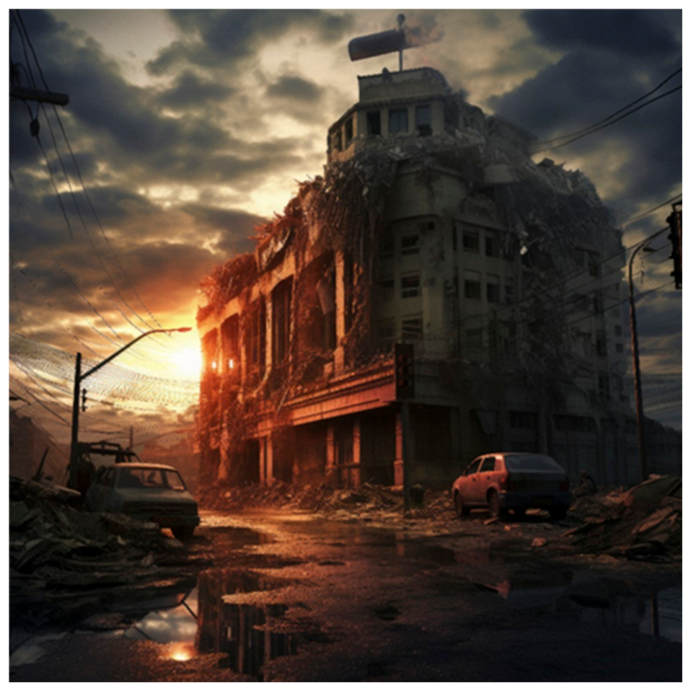
Figure 6.
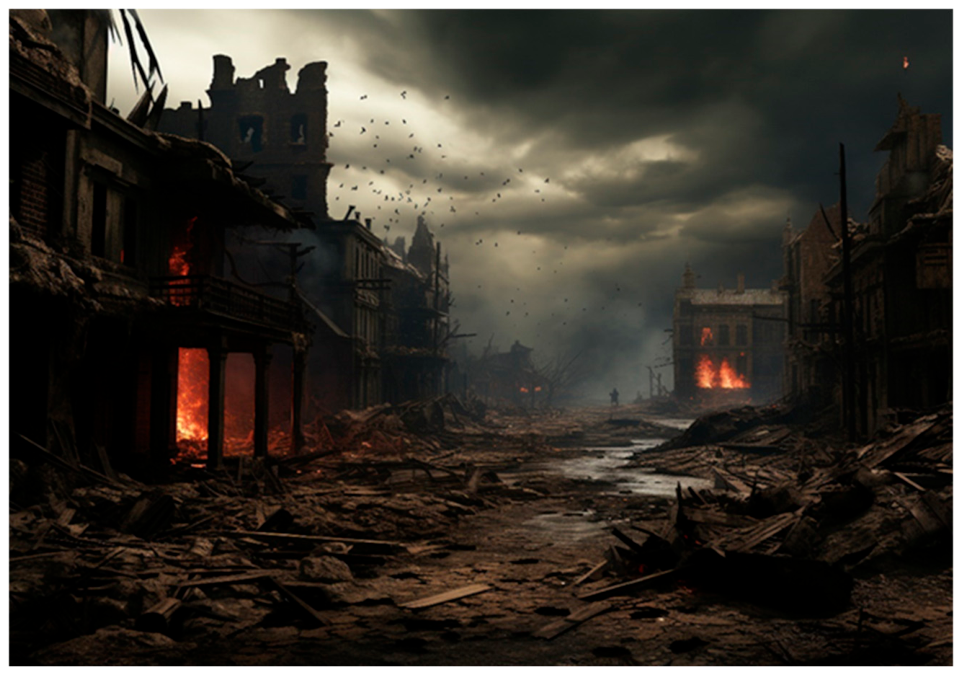
AI-generated urban-destruction image used in the analysis of synthetic trace and post-indexical ruin. Source: Freepik–Magnific.com. Reproduced under an individual Premium License Certificate.
The final corpus was constructed through purposeful sampling. Images were retained when they were explicitly associated with AI-generated production through platform-level information, preserved a photorealistic or quasi-documentary visual language, foregrounded one or more of the study’s central representational fields—victimhood, displacement, exile, or ruin—and offered distinct interpretive value in relation to memory, testimony, trace, and affect. Images were excluded when they were predominantly militaristic, excessively fantastical or cinematic, conceptually marginal to the study, insufficiently connected to the visual grammar of war, or near-duplicates of already retained images in motif, composition, and affective structure. The resulting corpus was organized around three analytical formations: the synthetic victim, the synthetic camp, and the synthetic ruin. These formations are not treated as exhaustive representations of war, but as historically established visual structures through which particular forms of suffering and devastation acquire cultural legibility. The three formations functioned as theoretically informed sampling strata rather than as categories claimed to have emerged inductively from an unrestricted corpus. Synthetic origin was established from the platform-level labeling and metadata associated with each retained asset. Because this classification depends on the source platform’s own metadata rather than independent forensic verification of image generation, it is treated as a source-level attribution and acknowledged as a limitation of the corpus. The analysis therefore examines how these established formations are visually organized and mnemonically activated, rather than estimating their prevalence across AI-generated war imagery as a whole.
The final analytical corpus comprises six images selected for close, theory-driven interpretation rather than statistical representation. Its purpose is not to establish the prevalence of particular visual patterns across AI-generated war imagery, but to examine how three theoretically defined formations—the synthetic victim, the synthetic camp, and the synthetic ruin—are visually constructed within a bounded set of cases. Two images were retained for each formation to allow sustained comparison while preserving sufficient formal variation for close analysis. During corpus refinement, additional candidates increasingly repeated already identified motifs, compositional arrangements, and affective structures without adding materially distinct analytical relations. The six-image corpus is therefore treated as analytically sufficient for the limited interpretive claims advanced here, but not as representative of AI-generated war imagery as a whole.
Selection decisions were based on visual and analytical fit rather than on asset titles or search phrases alone. Figure 1, Figure 2 and Figure 3 belong to a closely related asset series and are therefore not treated as statistically independent cases; they were retained because they instantiate different analytical roles within the victim and camp formations. Likewise, the retrieval phrase attached to Figure 4 functioned as a search route rather than as an analytical label. Figure 5 was retained despite its commercial title, “Darkly Atmospheric Retail Environment Rendering,” because its visual structure met the study’s criteria for synthetic ruin, while Figure 6 was retained despite its explicitly apocalyptic source title because its photorealistic organization remained analytically consistent with the ruin formation rather than predominantly fantastical. Items excluded during corpus refinement included predominantly militaristic, excessively cinematic or fantastical, conceptually marginal, and near-duplicate images; these exclusions are documented in Supplementary Table S3.
The analytical procedure comprised three distinct but iterative operations. First, semiotic and formal analysis identified the visual codes through which war was made legible within each image. Attention was directed to composition, framing, scale, bodily posture, gaze, spatial arrangement, perspectival organization, figure–ground relations, environmental texture, atmospheric treatment, tonal composition, and recurrent motifs of dust, enclosure, displacement, and ruin. This stage examined how visual elements were organized into recognizable structures of vulnerability, aftermath, and evidentiary plausibility, drawing on established accounts of visual grammar and contemporary multimodal semiotic analysis (Kress & van Leeuwen, 2021; al-Ali & Khaled, 2025).
Second, hermeneutic analysis interpreted these formal and symbolic configurations within historically sedimented traditions of war representation and in relation to the philosophical problems of memory, testimony, indexicality, absence, and witness. Whereas semiotic analysis clarified how meaning was visually structured, hermeneutic analysis addressed how those structures acquired historical, cultural, and mnemonic significance. The relation between the two approaches was therefore complementary rather than rigidly sequential. Formal observations informed philosophical interpretation, while interpretation directed renewed attention to the organization of the image. This movement between visible form and conceptual meaning made it possible to examine not only what the images depicted, but how their visual organization enabled them to operate as memory-bearing and quasi-testimonial forms.
Third, a comparative synthesis was conducted across the corpus. Recurring visual structures and interpretive relations were consolidated into the categories of memory without witness, iconization of victimhood, suspended temporality of exile, synthetic trace, mnemonic standardization, and affective legibility. The analysis thus moved from visible configuration to mnemonic operation: from what the image depicts, to how it organizes recognition, and finally to how that recognition participates in the cultural retainability of war. The theoretical framework was not imposed upon the images as a closed external coding scheme, but functioned as an interpretive architecture developed through repeated movement between image, concept, and comparison. The three formations—victim, camp, and ruin—were established in advance as theory-informed sampling strata, whereas the higher-order interpretive concepts, including iconization of victimhood, suspended temporality, synthetic trace, and mnemonic standardization, were refined iteratively through analysis rather than applied as fixed coding categories.
Analytically, the study distinguishes between three levels of reading. The first records directly observable visual features, including composition, gaze, spatial organization, bodily positioning, environmental texture, and recurrent motifs. The second identifies the semiotic relations through which those features organize recognizability, such as vulnerability, displacement, aftermath, or evidentiary appearance. The third develops the hermeneutic interpretation by relating these visual structures to the study’s theoretical concerns with memory, trace, testimony, and recognizability. Interpretive claims were therefore not inferred directly from subject matter alone, but developed from the relation between observable form, culturally established visual codes, and the conceptual framework.
For example, in the synthetic victim images, the central positioning of the child, direct or near-direct gaze, bodily vulnerability, and reduced contextual specificity are first treated as observable formal features. Their organization is then read semiotically as concentrating vulnerability and affective address, before being interpreted hermeneutically as part of the inherited visual grammar through which injured childhood becomes recognizable as a condensed figure of wartime suffering. The same analytical sequence was applied across the camp and ruin formations.
Because the analysis was conducted by a single researcher, the interpretations are presented as situated hermeneutic readings rather than as intersubjectively validated coding consensus. Interpretive decisions were anchored in observable formal features and reconsidered through the repeated movement between image, concept, and cross-corpus comparison described above. As an additional interpretive safeguard, the analytical reasoning for a small subset of images was discussed with an academic peer to assess the clarity of the distinction between observable visual features and subsequent hermeneutic interpretation. This debriefing was used to refine analytical transparency rather than to establish intercoder reliability or empirical validation. The three formations are therefore treated as analytical lenses rather than exhaustive or exclusive categories, leaving open alternative readings that may complicate or cut across the proposed framework.
The study does not construct a parallel corpus of documentary war photographs because its purpose is neither forensic comparison nor authenticity testing. Documentary war photography instead functions as a historical and theoretical comparator: whereas the documentary photograph derives its evidentiary claim from an encounter between camera and event, the synthetic image reproduces recognizable conventions of photographic witnessing without that originating encounter. The analytical focus therefore remains on the representational logic of AI-generated imagery while using documentary photography to clarify what changes when visual credibility is detached from indexical presence. The study likewise does not trace the subsequent circulation of the selected images, assess their journalistic deployment, analyze platform recommendation systems, or measure audience trust and reception. Its claims therefore concern the representational and mnemonic conditions under which synthetic war imagery becomes available for recognition and reuse. They do not establish that the selected images have circulated widely, entered collective memory, or produced measurable effects on identifiable audiences; such questions require a distinct reception-oriented research design.
Because the study analyzes publicly accessible synthetic visual materials and does not involve human participants, interviews, personal data, or biological material, formal human-subject ethics approval was not required. Ethical sensitivity nevertheless remained integral to the research design. The images are not treated as documentary records of actual victims or events, but as synthetic constructions whose visual conventions and mnemonic implications require critical scrutiny. The six reproduced figures were obtained under individual Freepik–Magnific.com Premium License Certificates, and the relevant asset identifiers, source records, and licensing documentation are retained by the author. The licensed images are reproduced solely as objects of scholarly criticism and analysis and are not offered for independent redistribution.
4. Findings and Analysis
The analysis is organized through the three theoretically informed formations used to structure the corpus: the synthetic victim, the synthetic camp, and the synthetic ruin. These formations operate not merely as recurring subjects, but as mnemonic structures through which war becomes visually legible, affectively transferable, and culturally retainable under generative conditions. Together, they mark an analytical progression in scale—from the injured body, to the displaced collectivity, to the damaged world—without claiming to exhaust the visual forms of conflict. Their selection also raises a broader question concerning forms of violence that lack stabilized visual codes and may be less readily accommodated within inherited repertoires of war imagery.
4.1. The Synthetic Victim: Innocence as Mnemonic Compression
Some images do not merely depict suffering; they appear to determine in advance what suffering must look like in order to be remembered. Across the corpus, war first becomes legible not as strategy, geography, or historical process, but as a child. In Figure 1 and Figure 2, the synthetic victim is presented as the privileged site through which conflict acquires immediate moral and affective intelligibility. Compositional concentration reinforces this operation: the child occupies the visual center, environmental complexity recedes into blurred or atmospheric residue, and the gaze or near-gaze establishes a direct relation of affective address. Dust, mud, and damaged surroundings function less as historically specific evidence than as culturally recognizable signs of crisis. The result is a mnemonic compression in which innocence, exposure, and injury are condensed into a single visual claim: war becomes readable through the figure of violated childhood.
The significance of this compression becomes clearer when read against the inherited authority of photography. Within documentary logic, however unstable that logic may have been in practice, the force of the photograph remained tied to the conviction that the event had passed before the lens and left a trace (Barthes, 1980/1981). Figure 1 and Figure 2 derive no such authority from encountered presence. Their force emerges instead from the reactivation of an established visual code: the dust-covered face, the vulnerable gaze, the exposed child-body, and the implied absence of protection. At this point, the distinction between photography and photorealism becomes ontologically decisive. Synthetic depiction may preserve the visual rhetoric of evidentiary seriousness without sharing the indexical ground of photographic testimony (Hausken, 2024). What these images provide is therefore not documentary trace, but synthetic recognizability: a culturally familiar structure capable of producing mnemonic force without witnessed occurrence.
From this follows a decisive shift from witness to recognizability. The synthetic victim can evoke the visual conventions of moral and mnemonic authority without establishing documentary presence; it activates a familiar code in which childhood is already positioned as innocence under assault. Sontag’s argument that images of suffering organize the terms through which pain becomes visible remains crucial here (Sontag, 2003). Under generative conditions, however, this operation acquires intensified repeatability. The child becomes a reproducible mnemonic shorthand through which conflict is rendered intimate and immediately affective. This repetition is never neutral: it privileges the figure most readily stabilized within public cultures of compassion and grief, revealing that what becomes memorable is inseparable from what has already become culturally legible as suffering.
The philosophical importance of the synthetic victim lies in this mnemonic efficiency. The image does not preserve the historical thickness of conflict; it compresses conflict into an icon of violated innocence in which actors, durations, and geopolitical asymmetries are subordinated to concentrated affect. The child becomes the point at which war can be held in a single glance, not because the image recounts a singular event, but because it crystallizes a culturally persuasive moral residue. Laba et al. (2025) show that AI-generated war imagery increasingly participates in processes of memory-making; the present analysis clarifies how that participation is formally achieved. Within the present interpretation, the synthetic victim exemplifies memory without witness: it does not testify to an encountered event, yet reproduces the visual conventions through which testimonial authority is conventionally claimed.
4.2. The Synthetic Camp: Exile as Suspended Historical Time
If the synthetic victim condenses war into the singular figure of injured innocence, the synthetic camp performs a different mnemonic operation: it extends conflict into a condition. In Figure 3 and Figure 4, war no longer appears at the moment of impact, but in the space where rupture has already occurred and historical movement has stalled. What becomes visible is the slow grammar of displacement—waiting, provisional shelter, exposed collectivity, and life organized around suspension rather than arrival. This effect is produced formally through widened framing, repeated temporary structures, receding spatial lines, and the diminished individuation of bodies within the visual field. Mud, enclosure, and exposed terrain do not merely describe a humanitarian setting; they convert the camp into an image of duration. The camp becomes the form through which war persists after the event by reorganizing life into a temporality without resolution.
The mnemonic significance of the camp lies in its capacity to make the duration of war recognizable without referring to a documented site. Its force derives from an already stabilized image-schema: clustered bodies, provisional structures, exposed terrain, muted atmosphere, and the absence of settled continuity. These elements do not testify to a particular displacement; they reactivate the cultural image of displacement as such. Halbwachs (1992) showed that memory is organized within social frameworks, while Assmann (2011) demonstrated that cultural memory depends on transmissible symbolic forms. The synthetic camp belongs precisely to this order. Through repetition, it ceases to function only as a representation of one humanitarian environment and becomes, within this interpretation, a mnemonic structure through which war is rendered recognizable as durable precarity. What becomes available for mnemonic interpretation is not a particular documented camp or population, but exile presented through a recognizable and repeatable visual condition.
This abstraction changes how conflict is apprehended. The images do not direct attention first toward singular biography, location, or historical cause; they organize recognition around a generalized condition in which belonging has become provisional and movement has lost its destination. The camp is therefore not merely a spatial arrangement but a temporal image. Its temporary structures signify non-arrival, its collectivities imply continuity without settlement, and its atmosphere suggests life held between departure and return. This is what may be called the suspended temporality of exile: not transition in the active sense, but time experienced as interruption. The synthetic camp secures mnemonic endurance not by representing the moment of violence, but by giving form to the unfinished duration through which violence remains present.
Azoulay’s account of photography remains important here because it situates visual appearance within political and civic relations of recognition and responsibility (Azoulay, 2008). Under generative conditions, however, that relation is reconstructed without documentary encounter. The synthetic camp assembles visible collectivities whose precarity continues to make a claim upon the viewer, even though no singular witnessed event grounds their appearance. It therefore occupies a paradoxical position: it cannot bear witness in the classical documentary sense, yet it preserves the visual structure through which displacement becomes recognizable as a collective historical condition. Memory without witness takes shape here not through the immediacy of the wounded body, but through the normalization of exile as an enduring visual form. The synthetic camp is thus not a secondary humanitarian motif; it is a mnemonic mechanism through which conflict becomes culturally retainable as suspended life.
4.3. The Synthetic Ruin: The City as Collective Residue
If the synthetic victim condenses war into the injured body and the synthetic camp extends it into suspended collective life, the synthetic ruin transfers conflict into space itself. In Figure 5 and Figure 6, destruction is no longer merely damage occurring within a place; the place becomes the bearer of war’s afterlife. Fractured façades, hollowed interiors, atmospheric haze, interrupted depth, and exposed urban surfaces organize devastation into a coherent visual residue. The city therefore ceases to function as a background to suffering and assumes the mnemonic work of the image. War is no longer read only through vulnerable bodies or displaced collectivities, but through the breakdown of inhabitable order. The ruin becomes the form through which loss survives as environment, texture, and spatial memory.
The synthetic ruin is philosophically distinct from both the photograph of destruction and the material trace of an actual devastated site. Within documentary logic, the ruined city could derive authority from an event that had materially occurred before the camera. In the generated image, that referential bond is absent, yet the image continues to appear as though it carried the residue of conflict. Rubble, dust, fractured walls, hollowed interiors, and disrupted horizons assemble an evidentiary atmosphere that resembles aftermath without emerging from it. This is the operation of synthetic trace. The image does not bear the indexical trace described by Barthes (1980/1981); it reconstructs the visual conditions through which trace has historically become recognizable. What appears is therefore not evidence left by an event, but a synthetic reconstruction of the visual conventions through which evidentiary traces become recognizable. Within the present interpretive analysis, this configuration performs a quasi-testimonial function without establishing that viewers would attribute documentary credibility or actual testimonial authority to the image.
The mnemonic significance of the synthetic ruin lies in its capacity to gather individual injury and collective displacement into a broader image of damaged common life. The city is not merely an accumulation of buildings; it is a framework through which habitation, continuity, and shared existence acquire material form. When the city appears as ruin, the image signifies more than destruction of place: it visualizes the breakdown of a world. Halbwachs (1992) showed that collective memory is organized through social frameworks that bind groups to continuity and place, while Assmann (2011) emphasized the mediating forms through which historical experience becomes culturally transmissible. The synthetic ruin belongs to this mnemonic order. It transforms devastated space into a transferable container of collective loss, capable of carrying historical significance without referring to a singular documented geography.
This transferability gives the synthetic ruin its symbolic power, but also marks its historical limitation. The city appears not as one determinate city, but as any city after bombardment: a generalized image of civilizational interruption. By reducing geographical and historical specificity while preserving photorealistic plausibility, the image converts devastation into a portable schema of collective loss. Sontag’s account of images of suffering remains relevant because visual representation does not simply expose destruction; it regulates the forms through which destruction becomes graspable and repeatable (Sontag, 2003). In the synthetic ruin, chaos is arranged into legibility and devastation into coherent aftermath. What is diminished is the historical density of place—its interrupted lives, layered temporalities, and political causes. What is intensified is mnemonic efficiency: the capacity of ruin to become immediately recognizable and culturally retainable as the image of a shattered world.
The movement from victim to camp to ruin is therefore structural rather than chronological. It marks an expansion in mnemonic scale: war is personalized in the injured body, socialized in the displaced collectivity, and spatialized in the damaged world. The synthetic ruin completes this progression because the city can retain the loss of bodies and communities after their disappearance from the visual field. Within this interpretive framework, the ruined city becomes available as a recognizable post-indexical representation of shared loss rather than as a photographic record of a historically specific place. In this sense, devastated space becomes a visual archive of memory without witness: an image that does not preserve the past by tracing an encountered event, but reconstructs the recognizable form through which collective destruction can be imagined and retained.
5. Discussion
The significance of the findings lies not simply in the recurrence of the victim, the camp, and the ruin as recognizable image-types. Such recurrence is partly expected, since generative systems inherit and recombine historically dominant visual repertoires of war (Allan & Zelizer, 2004; Zelizer, 2010). What is more consequential is how these formations reconstruct the visual conditions under which mnemonic authority can be claimed when documentary grounding is absent but affective legibility remains intact. The three formations identified in the corpus therefore operate not merely as recurring subjects, but as mechanisms through which conflict becomes culturally recognizable and retainable under generative conditions. In this sense, the present analysis suggests that synthetic war imagery can reconfigure the visual conventions through which conflict becomes recognizable and potentially available for collective remembrance (Laba et al., 2025; Matei, 2024).
These findings also qualify Laba et al.’s (2025) observation that generative systems may sanitize war by reducing the visibility of injury, children, refugees, and other direct signs of suffering. The present corpus, constructed through targeted platform searches, reveals a different but compatible operation: once victimhood and displacement are explicitly indexed as searchable categories, they reappear as highly standardized visual templates. The contrast suggests that mnemonic visibility depends not only on model output, but also on prompt and platform ecologies that organize what becomes retrievable, reusable, and culturally available. This also extends Theodosiou et al.’s (2026) identification of recurrent aesthetic patterns by treating such recurrence not only as a feature of synthetic conflict imagery, but as a condition through which mnemonic recognizability can be produced without documentary witness.
This mnemonic reorganization is ethically selective. War imagery has historically framed whose suffering becomes recognizable, grievable, and publicly consequential (Butler, 2009; Zelizer, 2010). Generative systems inherit this hierarchy of visibility rather than beginning from a neutral visual field. The child, the camp, and the ruin persist because they already occupy stabilized positions within public cultures of compassion, displacement, and historical loss. Their synthetic repetition may therefore intensify the mnemonic priority of forms of suffering that possess recognizable visual schemas, while symbolic, structural, epistemic, or culturally diffuse violence remains less available to representation and remembrance. Mnemonic standardization is thus not merely a formal effect of repetition; it is a political distribution of visual legibility through which some injuries become culturally retainable while others remain at the threshold of memory.
The commercial status of the corpus sharpens this argument. The images analyzed here are not only synthetic representations but licensed stock assets made available for repeated use across contexts. Their availability through a searchable commercial platform does not demonstrate actual circulation or audience uptake; however, it situates mnemonic standardization within an economy of reusable visual forms. Under such conditions, affective legibility acquires an infrastructural as well as representational dimension: suffering becomes not only recognizable, but also searchable, licensable, and readily redeployable.
The deeper philosophical consequence is that the synthetic image weakens and intensifies the mnemonic function of the image at the same time. It weakens it by severing the evidentiary bond through which photography historically claimed a privileged relation to what had been (Barthes, 1980/1981). Yet it intensifies mnemonic efficiency by reducing historical density, concentrating affect, and reactivating familiar visual schemas through which war is already culturally intelligible. What the synthetic image loses in indexical grounding, it regains through photorealistic plausibility, symbolic familiarity, and recognizability. Memory without witness names this displacement in the structure of visual authority. In the documentary image, however unstable its truth claims may have been, testimony remained grounded in an encounter between camera and world. In the synthetic image, that encounter is absent, yet its visual organization can reproduce the appearance of testimonial authority through inherited conventions of recognition (Brookes, 2025). This distinction marks the study’s central comparison with documentary photography: the latter anchors mnemonic authority, however contingently, in an event–image relation, whereas synthetic imagery can reproduce comparable visual claims to authority through inherited codes of recognizability without having witnessed the event it appears to recall.
The progression from victim to camp to ruin should therefore be understood as analytical rather than chronological, and as a widening of mnemonic scale rather than a hierarchy of moral value. War is personalized through the injured body, socialized through the displaced collectivity, and spatialized through the damaged world. The ruin completes this progression because devastated space can gather the loss of bodies and communities into a more durable image of broken continuity. Halbwachs’s account of socially framed memory and Assmann’s emphasis on transmissible cultural forms clarify why this movement matters: the image becomes available for collective mnemonic interpretation when it furnishes a visual structure through which individual injury can be understood as damage to a shared world. (Halbwachs, 1992; Assmann, 2011). The three formations thus disclose different scales of the same post-indexical operation rather than separate or successive types of war imagery.
These claims must nevertheless be understood within the methodological limits of the study. The corpus was constructed through images made searchable and available for reuse within Freepik–Magnific.com; it does not document their subsequent journalistic deployment, social-media circulation, algorithmic amplification, or reception by identifiable audiences. The study therefore theorizes the visual and mnemonic conditions of synthetic recognizability rather than measuring the empirical effects of particular images on public trust or collective memory. This limitation also defines an agenda for further research: future studies may trace how synthetic conflict imagery moves across journalistic and social platforms, how disclosure and contextual framing affect audience interpretation, and how prompt systems and recommendation infrastructures contribute to mnemonic standardization.
From an audience perspective, the present framework suggests that the repetition of familiar documentary codes may shape how synthetic conflict imagery is initially recognized and interpreted, even when its provenance is uncertain. This does not establish actual trust or mnemonic effects, but identifies conditions under which apparent documentary credibility may arise. For visual journalism and public communication, the implication is that provenance, disclosure, captioning, and contextual framing become especially important where synthetic images reproduce conventions historically associated with photographic evidence.
Within these limits, the findings suggest a broader proposition for future research rather than an empirical generalization beyond the present corpus. AI-generated war imagery may compete for mnemonic functions historically associated with documentary photography even when it cannot inherit its evidentiary ground, a possibility that resonates with wider changes in photojournalistic practice under AI conditions (Ditlhokwa et al., 2025). In visual journalism, this proposition could be tested by examining whether inherited documentary codes shape editorial selection, verification, captioning, and subsequent public interpretation. The framework may likewise be tested across synthetic humanitarian, historical, commemorative, and archival imagery. Its claim here remains more restricted: generative images can reproduce recognizable visual structures of conflict without an originating photographed event; whether those structures subsequently shape collective remembrance is an empirical question for further research.
6. Conclusions
This article has argued that AI-generated war imagery should be understood not primarily as a problem of visual falsity, but as a philosophical problem concerning the foundations of mnemonic authority when documentary witness is absent. Synthetic war images do not merely imitate the appearance of documentary photography; they reconstruct the visual conditions through which conflict may become recognizable, culturally available, and historically imaginable. The decisive conceptual displacement lies not simply in the absence of indexical reference, but in the shift from documentary trace to synthetic recognizability as a possible basis for mnemonic authority. An image may no longer derive its force from having encountered an event, yet it may still activate the visual forms through which war has already become culturally intelligible.
The three theoretically informed formations applied to the purposive corpus—the synthetic victim, the synthetic camp, and the synthetic ruin—allow this conceptual displacement to be examined across different mnemonic scales. The victim compresses conflict into the icon of injured innocence; the camp converts displacement into suspended historical time; and the ruin spatializes loss as the destruction of a shared world. These formations do not constitute a chronological sequence or an exhaustive taxonomy of war imagery. They disclose a common mnemonic operation through which inherited visual grammars of suffering are detached from witnessed occurrence and reconstituted as repeatable structures of recognition. Memory without witness names this condition. It does not imply that witness has ceased to matter ethically or politically, but that images may continue to perform mnemonic and quasi-testimonial work after the documentary relation between image and event has been displaced.
This displacement is simultaneously productive and reductive. It enables synthetic images to acquire affective force and mnemonic portability, but it also compresses historical complexity into highly recognizable visual schemas. The child, the camp, and the ruin become culturally retainable partly because they already possess stabilized forms of visual legibility. Other forms of violence—structural, symbolic, epistemic, or culturally diffuse—may fit less readily within these established visual schemas, raising the possibility of mnemonic exclusion. The politics of synthetic remembrance consequently lies not only in the fabrication of what did not occur before a camera, but in the unequal distribution of what can become visible, recognizable, and memorable at all.
The present analysis points toward a broader proposition for future research: generative visuality may be participating in a wider restructuring of remembrance in contemporary visual culture, but establishing this requires empirical work on circulation, reception, and platform-specific use. Further research should therefore examine how synthetic images move through journalistic and social-media environments, how disclosure and contextual framing affect interpretation, and how platforms, prompt systems, and recommendation infrastructures reinforce particular visual templates of conflict. The conclusion supported by the present corpus is more specific: synthetic war imagery can reproduce recognizable visual structures of conflict without the evidentiary grounding historically associated with photography, thereby preformatting forms through which war may subsequently become available for imagination and remembrance. Memory without witness thus names a post-indexical condition in which synthetic images reconstruct the visual appearance of evidentiary traces without the documentary encounter on which photographic testimony conventionally depends.
Supplementary Materials
The following supporting information can be downloaded at https://www.mdpi.com/article/10.3390/journalmedia7040245/s1, Table S1: Final analytical corpus of six AI-generated war-related images; Table S2: Reproduced analytical figures and source documentation; Table S3: Excluded items; Table S4: Final thematic coding structure for the article; Table S5: Corpus-to-figure mapping; Table S6: Licensing documentation for reproduced figures.
Funding
This research received no external funding.
Institutional Review Board Statement
Not applicable. This study analyzed publicly accessible synthetic visual materials and did not involve human participants, interviews, identifiable personal data, or biological material.
Informed Consent Statement
Not applicable.
Data Availability Statement
The corpus documentation supporting the findings of this study is provided in Supplementary Materials (Tables S1–S6). Source-platform records, asset identifiers, search phrases, and analytical coding are included in the manuscript and materials. The reproduced images constitute third-party licensed materials and are therefore not redistributed as a separate dataset.
Conflicts of Interest
The author declares no conflicts of interest.
References
- al-Ali, M. N., & Khaled, M. M. (2025). The effectiveness of sarcastic multimodal semiotic analysis in revealing deficiencies among authority officials: A case study of Bus Rapid Transit (BRT). Social Semiotics. [Google Scholar] [CrossRef] [Scilit]
- Allan, S., & Zelizer, B. (Eds.). (2004). Reporting war: Journalism in wartime. Routledge. [Google Scholar]
- Al Sheikh, H. M. (2023). Portrait photography as a visual repository of vernacular memory: Interplay of memory, identity and culture. Journal of the International Society for the Study of Vernacular Settlements, 10(10), 127–142. [Google Scholar] [CrossRef] [Scilit]
- Al Sheikh, H. M. (2024). Shifting perspectives: Exploring the intersection of traditional and digital photography in contemporary artistic practices. Visual Studies, 1–12. [Google Scholar] [CrossRef] [Scilit]
- Assmann, A. (2011). Cultural memory and Western civilization: Functions, media, archives. Cambridge University Press. [Google Scholar]
- Azoulay, A. (2008). The civil contract of photography. Zone Books. [Google Scholar]
- Barthes, R. (1981). Camera lucida: Reflections on photography (R. Howard, Trans.). Hill and Wang. (Original work published 1980). [Google Scholar]
- Baudrillard, J. (1993). Symbolic exchange and death (I. H. Grant, Trans.). SAGE Publications. [Google Scholar]
- Baudrillard, J. (1996). The system of objects (J. Benedict, Trans.). Verso. [Google Scholar]
- Benjamin, W. (1968). The work of art in the age of mechanical reproduction. In H. Arendt (Ed.), Illuminations (H. Zohn, Trans.; pp. 217–251). Harcourt, Brace & World. [Google Scholar]
- Boltanski, L. (1999). Distant suffering: Morality, media and politics (G. D. Burchell, Trans.). Cambridge University Press. [Google Scholar]
- Braeunert, S. (2026). From evidence to testimony: How AI-generated images of refugees can make demands. Photographies, 19(1), 103–124. [Google Scholar] [CrossRef] [Scilit]
- Breazu, R. (2024). Violence in mass-mediated images and memory. Phenomenological account of prosthetic memories. Phenomenology and the Cognitive Sciences. [Google Scholar] [CrossRef] [Scilit]
- Brookes, G. (2025). Truth claims and trace: The autographic witness in the algorithm. Memory, Mind & Media, 4, e21. [Google Scholar] [CrossRef] [Scilit]
- Butler, J. (2009). Frames of war: When is life grievable? Verso. [Google Scholar]
- Campbell, D. (2004). Horrific blindness: Images of death in contemporary media. Journal for Cultural Research, 8(1), 55–74. [Google Scholar] [CrossRef] [Scilit]
- Chouliaraki, L. (2006). The spectatorship of suffering. SAGE Publications. [Google Scholar] [CrossRef] [Scilit]
- Ditlhokwa, G., Ncube, L., & Munoriyarwa, A. (2025). Shifting the gaze? Photojournalism practices in the age of artificial intelligence. Journalism Practice, 19(10), 2380–2401. [Google Scholar] [CrossRef] [Scilit]
- Halbwachs, M. (1992). On collective memory (L. A. Coser, Eds. & Trans.). University of Chicago Press. [Google Scholar]
- Hausken, L. (2024). Photorealism versus photography: AI-generated depiction in the age of visual disinformation. Journal of Aesthetics & Culture, 16(1), 1–13. [Google Scholar] [CrossRef] [Scilit]
- Hirsch, M. (2012). The generation of postmemory: Writing and visual culture after the Holocaust. Columbia University Press. [Google Scholar]
- Hoskins, A. (2024). AI and memory. Memory, Mind & Media, 3, e18. [Google Scholar] [CrossRef] [Scilit]
- Kress, G., & van Leeuwen, T. (2021). Reading images: The grammar of visual design (3rd ed.). Routledge. [Google Scholar]
- Laba, N., Roman, N., & Parmelee, J. H. (2025). Memory of the multitude and representation in AI-generated images of war. Memory, Mind & Media, 4, e14. [Google Scholar] [CrossRef] [Scilit]
- Landsberg, A. (2004). Prosthetic memory: The transformation of American remembrance in the age of mass culture. Columbia University Press. [Google Scholar]
- Matei, S. (2024). Generative artificial intelligence and collective remembering: The technological mediation of mnemotechnic values. Journal of Human-Technology Relations, 2(1), 1–22. [Google Scholar] [CrossRef] [Scilit]
- Morin, E. (1962). L’esprit du temps: Essai sur la culture de masse. Grasset. [Google Scholar]
- Sontag, S. (2003). Regarding the pain of others. Farrar, Straus and Giroux. [Google Scholar]
- Theodosiou, Z. T., Papa, V., & Markou, G. E. (2026). Visualizing conflict: Tracing aesthetic patterns in AI-generated images of the 2023 Israel-Hamas war. Frontiers in Communication, 11, 1731105. [Google Scholar] [CrossRef] [Scilit]
- Yacavone, K. (2026). Virtual photographs, possible memories: AI images, the archive, and the works of August Sander and Elena Efeoglou. Photographies, 19(1), 59–79. [Google Scholar] [CrossRef] [Scilit]
- Zelizer, B. (2010). About to die: How news images move the public. Oxford University Press. [Google Scholar]
Disclaimer/Publisher’s Note: The statements, opinions and data contained in all publications are solely those of the individual author(s) and contributor(s) and not of MDPI and/or the editor(s). MDPI and/or the editor(s) disclaim responsibility for any injury to people or property resulting from any ideas, methods, instructions or products referred to in the content. |
© 2026 by the author. Licensee MDPI, Basel, Switzerland. This article is an open access article distributed under the terms and conditions of the Creative Commons Attribution (CC BY) license.