


Abstract
This article develops a middle-range theory of audience appropriation of journalistic messages in multi-screen, platform-mediated environments through a theory-building systematic review of the literature. This study draws upon a corpus of peer-reviewed research in mass communication, journalism studies, platform studies, and digital media (2000–2025) in order to apply an abductive analytical strategy. This strategy is intended to identify recurring empirical regularities and integrate them into a coherent explanatory framework. The review systematically examines how audiences engage with media across platforms, focusing on processes of content selection, interpretation, and circulation under algorithmically structured conditions. Through iterative comparison and conceptual synthesis, the article identifies three fundamental mechanisms that structure audience appropriation: algorithmic selection, interactive modulation, and social circulation. Rather than conceptualising audience activity as isolated practices, the proposed framework explains appropriation as a socio-technical process shaped by platform architectures, cultural contexts, and levels of media literacy. The study proposes a series of theoretical propositions that are intended to provide a framework for future empirical research. The integration of fragmented empirical findings into a mechanism-based framework is a significant contribution to cumulative theory-building in mass communication, thereby advancing the understanding of audience–platform dynamics in contemporary journalism ecosystems.
1. Introduction
The contemporary journalistic environment is undergoing a structural transformation driven by connected screens and platform-based infrastructures. Journalistic messages are no longer confined to institutional channels; rather, they are recontextualised, reinterpreted, and redistributed across a variety of platforms. This challenges assumptions about press authority, message control, and audience reception. This shift necessitates the development of novel theoretical frameworks to elucidate the process by which content is appropriated in platform-mediated environments. Research on convergence and digitisation has documented these changes (Jenkins, 2006), while recent studies emphasise the role of platforms, algorithms, and datafication in shaping visibility and access (van Dijck et al., 2018; Napoli, 2019; Carlson, 2018; Nielsen & Ganter, 2022). The concept of audience participation has evolved to encompass dynamic, multi-screen interactions.
Audience appropriation, however, should not be understood as a phenomenon created by digitalisation or platformisation. Audiences have historically interpreted, recontextualised, and recirculated mediated messages across interpersonal and mass-communication settings. Reception studies have long demonstrated that meaning is reconstructed rather than simply received (Staiger, 2005), while research on news production has shown how journalistic reality is constructed and negotiated through organisational and social interactions (Tuchman, 1978). Earlier communication technologies likewise enabled messages to travel rapidly across social contexts and acquire meanings beyond those intended by their original producers (Standage, 1998). From this historical perspective, digital platforms do not originate audience appropriation; rather, they reconfigure its technological conditions, scale, speed, visibility, and capacity for redistribution. The theoretical problem addressed here therefore concerns not the emergence of appropriation itself, but its transformation under multi-screen, algorithmically mediated conditions.
A growing body of research documents multiscreen use, media multitasking, and second-screen practices, showing how audiences integrate television with social media, messaging, and online searches, generating hybrid patterns of attention and engagement (Segijn et al., 2017; Wohn & Na, 2011). The practices in question are shaped by platform affordances, interface design, and recommendation systems, which in turn influence exposure and engagement (Thorson & Wells, 2016; Napoli, 2019). However, despite the extensive empirical evidence, research in the field of mass communication is lacking in an integrative framework explaining how audiences appropriate content across screens. This results in fragmented and weakly generalisable explanations.
Despite the existence of substantial empirical evidence, theoretical integration remains limited. Conventional theoretical frameworks, including uses and gratifications and the active audience paradigm, place significant emphasis on the concept of media usage characterised by deliberate intention and active agency (Katz et al., 1973; Livingstone, 1998). However, these frameworks were developed within the context of stable, pre-algorithmic environments, which limits their ability to adequately explain phenomena in contemporary, platform-driven, multiscreen contexts. Research on participation highlights practices such as sharing and remixing (Carpentier, 2011) yet often prioritises visible interaction while overlooking socio-technical conditions such as algorithmic selection, interface design, and unequal visibility across platforms.
This has produced a persistent theoretical gap in mass communication research. While empirical studies describe multiscreen practices and platform-specific behaviours, the field lacks an integrated framework identifying mechanisms, conditions, and generalisable propositions on audience appropriation across screens. Existing literature remains fragmented, limiting cumulative knowledge and connections with broader processes of meaning, power, and symbolic influence. This is critical in a discipline seeking sociological explanation: without articulated mechanisms, findings remain context bound. As Napoli (2019) argues, understanding media systems requires moving beyond description, while Livingstone (2018) calls for rethinking audiences within digitally constrained environments.
In addressing this challenge, the article proposes the development of a middle-range theory of audience appropriation of journalistic messages in multi-screen environments. In accordance with Merton’s (1968) seminal work, this study places particular emphasis on analytically precise constructs and causal mechanisms that elucidate recurring audience behaviour patterns across diverse contexts. The concept of audience appropriation is theorised as a socio-technical process that is influenced by the architecture of platforms, the algorithms that govern them, and the social norms that shape them. Beyond mere participation, the text underscores the manner in which practices are shaped by technological constraints. The framework delineates three pivotal mechanisms: namely, algorithmic selection, interactive modulation, and social circulation. These mechanisms are posited to structure the manner in which audiences engage with media across screens, a proposition that is supported by a substantial corpus of empirical research.
This article also contributes to ongoing debates on platform power, algorithmic mediation, and news exposure in digital journalism by offering a mechanism-based explanation of how audiences appropriate journalistic content across multi-screen environments. In doing so, it bridges audience studies and platform research within a coherent sociotechnical framework.
The primary objective of this article is to elucidate these mechanisms and delineate their interactions under varying conditions, such as platform design, media literacy levels, and cultural context. In doing so, the article makes three interrelated contributions to mass communication research. Firstly, it identifies the causal mechanisms that explain how audience appropriation works in contemporary media ecosystems. Secondly, it is able to formulate explicit and generalisable propositions that can guide empirical research and hypothesis testing in the future. Thirdly, it serves to bridge the gap between empirical audience research and sociological communication theory, integrating fragmented findings into a coherent explanatory framework.
2. Methodology
This study employs a qualitative research design with the objective of developing a theoretical framework through a systematic and critical review of the extant literature, with a particular focus on the development of a middle-range theory of audience appropriation in multi-screen, platform-mediated environments.
Instead of relying on primary empirical data collection, the article employs a theory-building systematic review approach (Snyder, 2019), which facilitates the integration of accumulated empirical findings into a coherent explanatory framework. The methodological strategy combines systematic procedures for literature selection with an abductive logic of theory construction (Timmermans & Tavory, 2012), allowing the identification of recurring empirical regularities and their transformation into analytically precise mechanisms.
2.1. Search Strategy and Data Sources
This literature search was conducted across three major academic databases that are widely used in the field of communication research: Scopus, Web of Science, and Google Scholar. The selection of these sources was meticulous, ensuring comprehensive coverage of peer-reviewed research in mass communication, journalism studies, platform studies, and digital media.
The search process concentrated on publications from 2000 to 2025, a period that encompasses both foundational developments in audience research and recent transformations associated with platformisation, algorithmic mediation, and multi-screen environments.
A combination of keywords and Boolean operators was employed to identify relevant studies. The search strings comprised variations and combinations of the following terms:
- *
- “audience appropriation” OR “media appropriation”;
- *
- “audience activity” OR “active audience”;
- *
- “multi-screen” OR “multiscreen” OR “media multitasking”;
- *
- “platforms” OR “platform mediation” OR “algorithmic mediation”;
- *
- “news consumption” OR “journalistic messages” OR “digital journalism”.
These terms were combined using Boolean operators (AND/OR) to refine results and ensure relevance to the socio-communicative focus of the study.
2.2. Inclusion and Exclusion Criteria
In order to ensure analytical coherence and relevance, explicit criteria were applied in the selection of studies.
The inclusion criteria for the study are as follows:
- *
- Peer-reviewed journal articles and academic books;
- *
- Studies addressing audience practices, media use, or platform-mediated communication;
- *
- Research with explicit socio-communicative implications;
- *
- Empirical and theoretical works contributing to understanding audience behaviour, media interaction, or content circulation;
- *
- Publications in English and Spanish, the two languages in which the researcher could conduct direct and systematic assessment of the full texts without relying on translation.
The following criteria were used to determine exclusion from the study:
- *
- Purely technical or engineering-oriented studies (e.g., algorithm design without communicative implications);
- *
- Studies lacking a clear connection to audience practices or media processes;
- *
- Duplicated records across databases.
Publications without sufficient methodological or theoretical development were also excluded (e.g., abstracts, editorials).
2.3. Selection Process
The selection process was conducted in accordance with a structured, multi-stage procedure, the aim of which was to ensure transparency and replicability.
- Initial identification: The search yielded an initial corpus of publications across the three databases;
- A screening procedure was implemented that entailed the evaluation of records according to their title and abstract. The assessment of relevance was conducted on the basis of three criteria: scope, keywords, and alignment with the research objective;
- Full-text assessment: A selection of studies were examined in detail to evaluate their theoretical contribution, empirical grounding, and relevance to audience appropriation in platform-mediated environments;
- The final corpus selection is as follows: Only studies which met all of the inclusion criteria and which contributed to the identification of recurring patterns in audience behaviour were retained for analysis.
The iterative filtering process was undertaken with a view to prioritising analytical relevance over exhaustiveness, in accordance with theory-building review approaches. This process ensured that the final corpus provided a robust empirical basis for conceptual synthesis.
The search yielded an initial corpus of approximately 1248 records across databases. After screening titles and abstracts, 186 studies were retained for full-text assessment. The final corpus consisted of 94 publications that met all inclusion criteria and were included in the analysis.
2.4. Analytical Strategy: Abductive Theory Construction
The analytical strategy is grounded in an abductive approach to theory construction, which combines inductive sensitivity to empirical findings with deductive engagement with existing theoretical frameworks (Timmermans & Tavory, 2012).
The analysis was conducted through the following three iterative stages:
- Thematic coding of empirical regularities: A selection of studies was examined in order to identify recurring patterns related to audience behaviour, including content selection, interaction practices, and content circulation across platforms;
- A comparative synthesis has been conducted across a number of studies. The identification of patterns was achieved through systematic comparison across various contexts, encompassing different platforms, media types and cultural settings. This approach was adopted to detect underlying regularities that extend beyond specific cases;
- Mechanism identification and conceptual abstraction: Through iterative refinement, these regularities were conceptualised into three core mechanisms that structure audience appropriation: namely, algorithmic selection, interactive modulation, and social circulation.
This abductive process enables progression from descriptive aggregation to causal explanation, aligning with the logic of middle-range theory (Merton, 1968), wherein mechanisms connect empirical observations to generalisable propositions.
2.5. Sociotechnical Perspective and Scope Conditions
The analysis draws upon a sociotechnical perspective, which conceptualises audience appropriation as emerging from the interaction between:
- *
- The analysis conceptualises audience appropriation as emerging from the interaction between technological infrastructures (platforms, algorithms, interfaces), audience practices (selection, interpretation, participation), and cultural conditions (norms, media literacy, communicative contexts);
- *
- The following aspects of audience practices are to be considered: selection, interpretation and participation;
- *
- Furthermore, the consideration of cultural conditions is imperative, encompassing norms, media literacy, and communicative contexts.
This perspective facilitates the identification of scope conditions, including platform type, cultural context, and levels of media literacy, which moderate the operation of the proposed mechanisms.
2.6. Validity and Limitations
While the systematic procedures adopted enhance transparency and analytical rigour, this study does not aim to provide exhaustive coverage of all existing literature on the subject. Instead, it prioritises conceptual depth and theoretical integration, consistent with theory-building review methodologies.
The linguistic scope constitutes an additional limitation. The review was restricted to publications in English and Spanish because these were the languages in which the researcher could systematically assess the full texts without translation. Spanish was therefore included not because it was assumed to be the only relevant non-English scholarly literature, but because its inclusion broadened the corpus beyond Anglophone scholarship while maintaining analytical consistency. Relevant research published in other languages may consequently fall outside the corpus, and future reviews could extend the framework through multilingual comparative searches.
The validity of the framework lies in its capacity to integrate heterogeneous empirical findings, identify recurring mechanisms across contexts, and generate testable propositions. While the approach prioritises conceptual depth over exhaustiveness, it ensures analytical transparency and theoretical coherence. Future research may complement this framework through quantitative meta-analyses and empirical testing across platforms and cultural contexts.
3. Theoretical and Empirical Foundations
This section provides a comprehensive review of the theoretical and empirical foundations underpinning contemporary research on audience behaviour in mass communication. The objective of this study is to identify the accumulated insights and persistent limitations that motivate the development of a middle-range theory of audience appropriation across multiple screens.
3.1. Audience Activity in Mass Communication Research
Research on audiences in mass communication has undergone a significant conceptual shift over the past five decades, moving from early hypotheses about passive reception to models that emphasise audience agency and activity. Fundamental works on uses and gratifications theory challenged effects-centred paradigms by conceptualising media users as active agents who selectively interact with content to satisfy psychological and social needs (Katz et al., 1973). This perspective repositioned audiences as purposeful actors rather than passive receivers, a shift that profoundly influenced subsequent audience research.
Subsequent advancements have served to expand this notion of activity by placing greater emphasis on interpretation, meaning-making, and the contextualised use of media. Cultural and reception-oriented approaches have been shown to demonstrate how audiences actively construct meanings based on social position, cultural resources, and everyday practices (Livingstone, 1998; Morley, 2006). Within the domain of mass communication research, this paradigm shift contributed to a more comprehensive understanding of audience participation, which expanded beyond mere exposure to encompass interpretation and response.
Empirical research in digital media environments has further reinforced the relevance of audience activity, particularly through studies on media multitasking, second screen viewing, and cross-platform engagement. A substantial body of evidence demonstrates that audiences frequently utilise multiple screens concurrently, integrating television viewing with social media interaction, messaging, or online information seeking (Segijn et al., 2017; Voorveld & Van der Goot, 2013). These practices are not arbitrary, but rather follow a pattern, often motivated by social connection, information seeking, or greater interaction with media content (Wohn & Na, 2011).
Research on participatory practices has similarly documented how audiences comment on, share, and remix content across different platforms, blurring traditional distinctions between consumption and production (Carpentier, 2011). Nevertheless, while the extant literature provides valuable empirical insights, it is often limited in its theoretical integration across contexts, focusing instead on specific practices or platforms. Moreover, audience activity is frequently regarded as a consequence rather than as a process influenced by broader socio-technical conditions.
Consequently, while the active audience paradigm continues to exert influence, its capacity to provide a comprehensive explanation is progressively constrained by the intricacy of contemporary media environments. Empirical findings suggest a deep interconnection between audience activity and technological infrastructures, platform logic, and algorithmic systems. These factors were not anticipated or systematically theorised in early audience theories.
3.2. Audiovisual Media and Platform Mediation
The advent of platform-based media has precipitated a fundamental shift in the conditions that facilitate audience participation. Screens are no longer regarded as neutral channels for content distribution; rather, they are considered interfaces integrated into complex socio-technical systems that determine visibility, access and interaction. Increasingly, scholars have emphasised the role of platform mediation, highlighting how algorithms, interfaces, and data-driven architectures structure communicative processes (van Dijck et al., 2018). Recent studies have further emphasised the role of platforms in structuring news exposure and audience behaviour, particularly through algorithmic curation and personalised distribution systems (Fletcher & Nielsen, 2018; Thurman et al., 2019; Molyneux & Mourão, 2019).
Empirical research has demonstrated that algorithmic personalisation exerts a substantial influence on media exposure by means of content selection based on users’ inferred behaviour, preferences, and interests (Napoli, 2019; Thurman et al., 2019; Fletcher & Nielsen, 2018; Molyneux & Mourão, 2019). Research conducted on the subject of political communication and news consumption has demonstrated that algorithmic systems have the capacity to both expand and limit exposure, thereby shaping the content to which audiences are exposed and the frequency with which certain types of content are encountered (Beam & Kosicki, 2014; Thurman et al., 2019). These findings do not negate audience choice or imply a return to direct-effects models of mass communication. Rather, they suggest that choice operates within technologically structured opportunity environments. Audiences may actively seek, ignore, accept, or move beyond algorithmically recommended content, consistent with the agency emphasised by uses and gratifications approaches. At the same time, recommendation systems influence which options become immediately visible, salient, or convenient. Audience selection should therefore be understood neither as fully autonomous nor as technologically determined, but as the outcome of an ongoing interaction between user agency and platform-mediated choice architectures.
The design of interfaces and the configuration of choice architectures have a further influence on the manner in which audiences interact with media across a variety of screens. Research on digital possibilities demonstrates that features such as notifications, recommendations, and interaction buttons modulate attention, engagement, and participation (Bucher & Helmond, 2018). In multiscreen contexts, these possibilities facilitate simultaneous, fragmented, and socially integrated forms of interaction, reinforcing the need to conceptualise audience behaviour as a dynamic process rather than as discrete acts of use.
The analysis is further enriched by studies on visibility and circulation. The circulation of content shared by audiences is not uniform; rather, it is subject to the influence of algorithmic rankings, network effects, and platform-specific norms (Tufekci, 2015). Empirical evidence indicates that these dynamics affect not only the content that gains prominence, but also how audiences perceive relevance, credibility, and social importance (Thorson & Wells, 2016). These processes establish a direct correlation between audience practices and the broader mechanisms of symbolic power that are embedded within the framework of mass communication systems.
A synthesis of research on platform mediation indicates that audience activity is inextricably linked to the technological and institutional environments in which it transpires. However, a significant proportion of this research remains analytically isolated, with a focus on either technological systems or user behaviour, and there is limited integration into a unified explanatory framework.
3.3. Limits of Existing Frameworks
Notwithstanding considerable theoretical and empirical advances, extant frameworks in audience research face three interrelated limitations. Firstly, the extant literature is characterised by conceptual fragmentation. A review of studies on multitasking, participation, personalisation, and platform use reveals the employment of different concepts and theoretical perspectives, which hinders the integration of findings and comparison of results across contexts. Consequently, empirical knowledge accumulates horizontally rather than cumulatively.
Secondly, there is a persistent lack of integration between media use, technological mediation, and communicative effects. Audience activity is frequently examined independently of its consequences for exposure patterns, meaning-making, or the dynamics of public communication. Conversely, studies of algorithmic systems frequently lack sufficient theoretical analysis of how audiences appropriate and respond to these structures in everyday practice.
Thirdly, and most importantly for socio-scientific research, the field lacks generalisable causal models that specify the mechanisms linking audience practices to broader outcomes in mass communication. A significant number of extant approaches are descriptive or correlational in nature, thus offering limited guidance for the testing of theories or comparative research. As Livingstone (2018) observes, the challenge lies not merely in documenting audience behaviour, but in elucidating the interplay between agency and structure in data- and platform-mediated environments.
These limitations underscore the necessity for theoretical development that transcends isolated concepts and case-specific explanations. It is imperative that a framework is established which is capable of integrating empirical evidence from a variety of studies, identifying recurring mechanisms and generating propositions that can be empirically tested in a range of contexts.
3.4. Towards a Middle-Range Theory
In summary, extant research provides a substantial empirical basis for understanding audience behaviour in contemporary media environments but fails to offer an integrated explanation. The transition from passive to active audiences, the rise in multiscreen practices, and the increasingly important role of platform mediation call for a theoretical approach that bridges audience agency and technological structure.
An intermediate theory of audience appropriation is proposed as a productive way forward. By focusing on identifiable mechanisms, specifying conditions of reach, and articulating generalisable propositions, such a theory can connect fragmented empirical findings and enhance the accumulated knowledge in mass communication research. The following sections develop this theoretical framework by conceptualising audience appropriation as a socio-technical process structured by recurring mechanisms in screen-based media environments. This theoretical gap becomes particularly relevant in journalism studies, where the transformation of journalistic messages across platforms challenges traditional models of production, distribution, and reception.
4. Conceptualisation of Audience Appropriation Across All Screens
This section establishes the fundamental conceptual foundations of the proposed theory. It defines “audience appropriation” as a socio-technical process and distinguishes its analytical dimensions. Furthermore, it delineates the pivotal conditions that moderate the progression of appropriation in disparate media environments.
4.1. Definition of Audience Appropriation
The term ‘appropriation’ has been extensively employed in media and cultural studies to denote the manner in which audiences assume proprietorship of media content, frequently reinterpreting, reusing and reshaping meanings that diverge from the intentions of producers (Fiske, 2010; de Certeau, 1984). However, the manner in which these practices are employed varies significantly, ranging from individual interpretive acts to collective remixing practices. In order to support cumulative theorisation and empirical testability, it is necessary to establish a precise operational definition.
Within the paradigm of multi-screen mass communication, audience appropriation signifies the socio-technical process by which audiences select, adapt and redistribute media and journalistic content across interconnected screens and media environments. When discussing the field of journalism, the term “appropriation” refers to the process by which news and informational content is not only consumed but also actively reinterpreted, reframed, and redistributed by audiences. This process frequently occurs beyond the control of news institutions. The concept of audience appropriation, as delineated herein, does not pertain to individual attitudes or discrete acts of participation. Rather, it refers to a patterned socio-technical process that operates across diverse platforms and screens. This delineation facilitates the differentiation of appropriation from related constructs, thereby circumventing excessive conceptual expansion:
- Selection: the ways in which audiences choose the content they interact with on different screens (e.g., selecting a television programme while browsing social media);
- Adaptation: the modification or reinterpretation of content through user practices (e.g., adding comments, mixing clips, annotating screenshots);
- Redistribution: the exchange or circulation of content through networks and platforms, contributing to visibility and social dissemination.
By placing emphasis on the dynamic nature of the process rather than on static attributes, this definition finds congruence with recent research in the field of digital participation, which conceptualises audience practices as being both dynamic and iterative (cf. Burgess & Green, 2018; Napoli, 2019). The concept of appropriation is not confined to utilisation or engagement; rather, it encompasses a spectrum of practices that are influenced by technological infrastructures and social contexts. This socio-technical perspective is consistent with studies on participatory culture, which emphasise both audience agency and the material conditions that enable or limit it (Jenkins et al., 2016).
The concept of “appropriation” in this framework deviates from more limited interpretations of “activity” or “participation” by placing greater emphasis on the meaningful integration and transformation of media content. The term does not refer merely to attention or ephemeral interaction, but rather to situated audience practices that redefine the significance, interpretation, or dissemination pathways of content, whether these practices are fully deliberate, habitual, or shaped by platform affordances.
4.2. Analytical Dimensions of Appropriation
In order to comprehend audience appropriation as a process, it is imperative to analytically disaggregate its fundamental dimensions, thereby facilitating conceptual clarity and empirical measurement. In this subsection, three analytical dimensions that constitute appropriation on different screens are distinguished: selection practices, interpretive adaptation, and circulatory redistribution.
Selection practices: The selection process encompasses the decisions made by audiences regarding the content they consume and the circumstances in which they do so. In a multiscreen environment, selection is influenced not only by personal preferences, but also by platform architectures and algorithmic recommendations (Thurman et al., 2019). Research indicates that audiences seldom make wholly autonomous selections; rather, platform design and algorithmic signals exert a substantial influence on what is viewed, clicked on, or prioritised (Bruns & Burgess, 2015). Consequently, selection should be conceptualised as a socio-technically mediated choice.
Interpretive adaptation: Interpretive adaptation can be defined as the process by which audiences comprehend content, reinterpret its meanings, and integrate media experiences into personal or collective narratives. As Hall (1980) asserted, the field of reception studies has historically placed significant emphasis on the notion of meaning-making as a pivotal component of audience engagement. In the digital realm, adaptation frequently occurs through the processes of remixing, annotation, or contextualisation of content across diverse communicative environments. Empirical research on participatory culture highlights how users co-create meanings through comments, edits, and cultural references (Jenkins et al., 2016). This dimension has the effect of situating the audience at the forefront as an interpreter, rather than a mere passive receiver.
Circulatory redistribution: The term ‘redistribution’ refers to the process by which content is propagated across networks and platforms by audiences. This encompasses the sharing, forwarding, reposting, or otherwise increasing the visibility of media content in social and algorithm-mediated environments. Research on content circulation demonstrates that the redistribution of content is determined by both social ties and platform algorithms, which serve to amplify or attenuate visibility based on engagement metrics (Tufekci, 2015; Bruns, 2019). Circulation can be defined as both a practice and a mechanism of influence, linking individual appropriation with the dynamics of collective visibility.
The distinction between these dimensions enables the conceptual linkage of appropriation to traditional constructs such as use, participation, or engagement, whilst preserving analytical separation. The term ‘use’ is typically understood to refer to the frequency, duration, or context of media exposure (Rubin, 2009), whereas ‘participation’ is understood to emphasise interaction or contribution to media environments. The concept of appropriation encompasses these notions but goes further by focusing on meaningful integration and transformation of content across all screens.
4.3. Scope Conditions
A middle-range theory must elucidate the conditions under which its propositions hold. The subsequent fundamental factors influence the manner in which the audience’s appropriation of media evolves in diverse environments:
The term platform is used here in its contemporary socio-technical sense rather than as a synonym for communication channel. Historically, mediated appropriation has occurred through numerous channels, including print, broadcasting, interpersonal discussion, and other material forms of communication. The present framework deliberately narrows its explanatory scope to interconnected digital and screen-based environments because these introduce distinctive conditions of algorithmic selection, programmable interaction, datafication, and networked redistribution. Accordingly, the framework does not claim that appropriation is exclusive to platforms, but seeks to explain how longstanding audience practices are reconfigured under platform-mediated conditions.
Platform type: It is evident that divergent platforms proffer a range of technological possibilities, thus giving rise to either the facilitation or restriction of appropriation practices. For instance, social media prioritises the sharing and circulation of content, whereas streaming services emphasise personalised selection. Empirical research indicates that platform architecture exerts a significant influence on both the distribution of attention and interaction practices (Bucher & Helmond, 2018). Platforms designed for social integration (e.g., TikTok, X) have been observed to facilitate rapid dissemination and remixing. Conversely, information platforms (e.g., news apps) may encourage selective attention but limit participatory adaptation.
Cultural context: The interpretation, adaptation, and redistribution of content by audiences is determined by prevailing cultural norms. Cross-cultural studies demonstrate that appropriation practices vary depending on cultural values, media norms, and regulatory environments (Couldry & Hepp, 2018). Collectivist contexts, for instance, may prioritise community sharing and co-creation, while individualistic contexts emphasise personal expression. Furthermore, media systems with a strong tradition of public broadcasting may generate different patterns of appropriation than highly commercialised markets.
Level of media literacy: Media literacy has been demonstrated to have a significant influence on the public’s ability to engage with content in a meaningful way. Higher levels of critical media literacy have been shown to be associated with more thoughtful selection, nuanced interpretation, and strategic circulation practices (Livingstone & Helsper, 2009). Conversely, inadequate media literacy has been demonstrated to result in superficial engagement or uncritical sharing, which in turn affects the social impact of appropriation practices. Empirical research has demonstrated the pivotal role of skills in shaping online behaviour patterns, particularly in contexts of disinformation and algorithmic filtering (Guess et al., 2019).
These conditions of scope function as moderators of appropriation processes, influencing their intensity, form, and consequences. By delineating the conditions, the theory transcends abstract characterisation and approaches propositions that can be empirically tested in different contexts.
4.4. Conceptual Synthesis: From Dimensions to Mechanisms
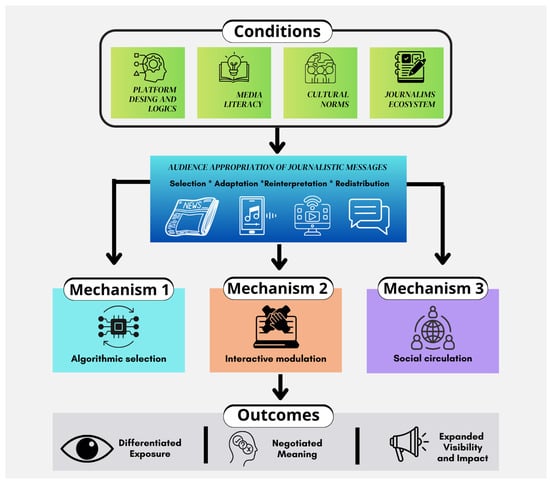
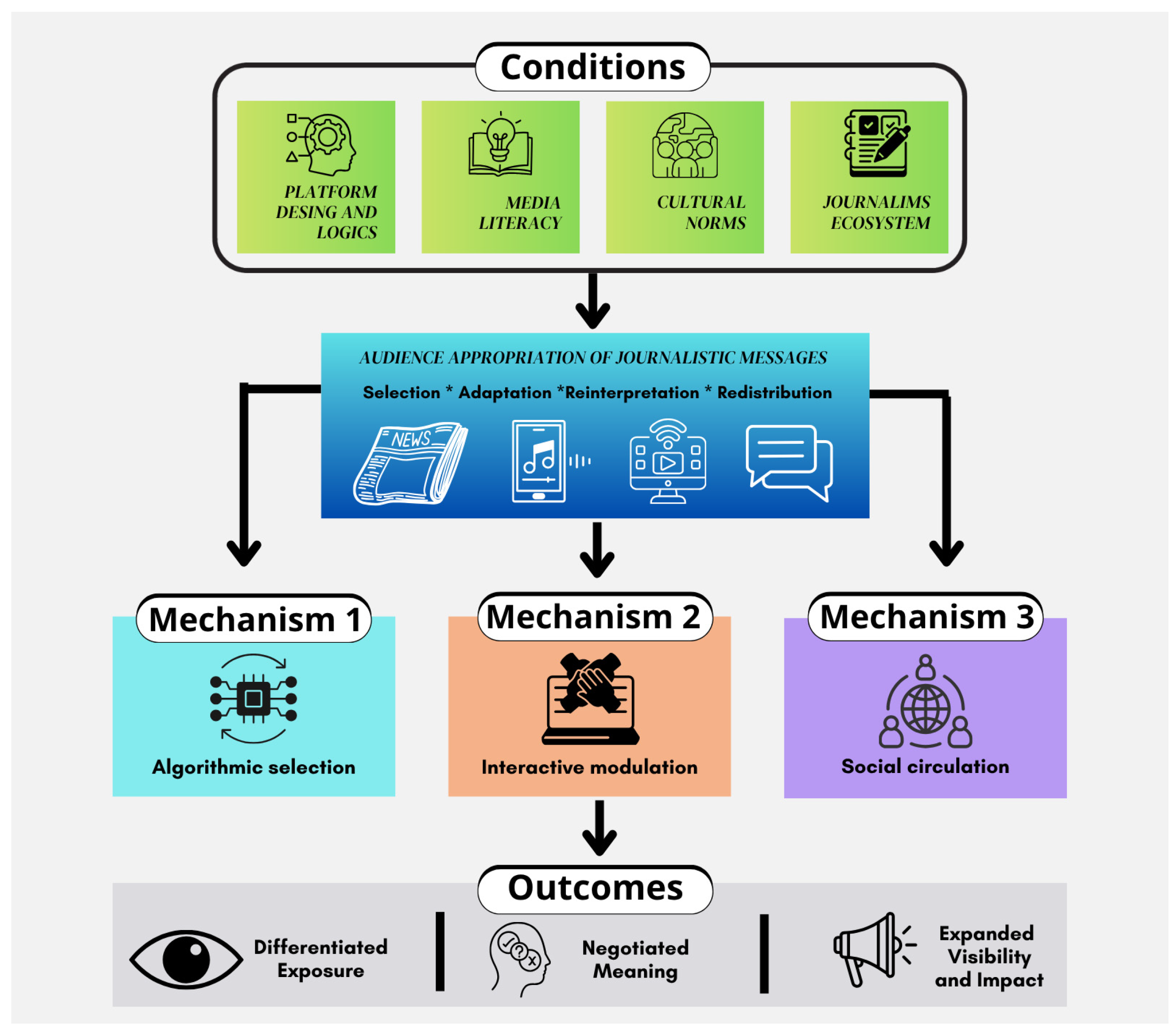
This section establishes the conceptual basis for the articulation of causal mechanisms and theoretical propositions developed in the following sections. The text has delineated the key analytical dimensions that distinguish the appropriation of related constructs and specified conditions of scope that moderate how appropriation manifests itself in different environments. This conceptual foundation provides the necessary basis for the subsequent articulation of causal mechanisms and theoretical propositions (Figure 1).
Figure 1.
Mid-range model of audience appropriation of journalistic messages across multiple screens.
Figure 1 illustrates audience appropriation as a socio-technical process structured by three interrelated mechanisms: algorithmic selection, interactive modulation, and social circulation. These mechanisms operate under specific conditions of reach. Collectively, these mechanisms influence patterns of attention, meaning construction, and participation in screen-based media environments. The model provides the conceptual basis for the mechanisms and theoretical propositions developed in the following sections.
5. Fundamental Mechanisms of Audience Appropriation
The following mechanisms are theorised as causal processes that link media environments with patterned forms of appropriation by the audience. In order to elucidate the manner in which audiences appropriate media content across a variety of screens, this article identifies three fundamental mechanisms that mediate the socio-technical processes of selection, interaction, and circulation. These mechanisms are based on empirical evidence and link audience practices to broader communicative structures that condition visibility, participation, and meaning.
5.1. Algorithmic Selection
Algorithmic selection is defined as the process by which recommendation systems and personalisation algorithms structure the set of media and journalistic content options available to users. In journalistic contexts, algorithmic selection plays a crucial role in determining the visibility of news content, influencing which journalistic messages reach audiences and under what conditions. In the context of multi-screen environments, audiences are subject to a constant barrage of algorithmically selected content feeds (e.g., on social platforms, streaming services, and search results), with these systems exerting a pervasive influence through implicit prioritisation mechanisms.
Algorithmic systems depend on interaction metrics, such as likes, clicks, shares, and viewing time, in order to infer user preferences and select subsequent recommendations. This recursive feedback loop elevates certain content not on the basis of its intrinsic quality, but rather because it aligns with inferred popularity or attention potential, thereby reshaping selection environments (Madsen & Slåtten, 2025).
Empirical studies have documented this phenomenon in the context of political communication and news media. For instance, large-scale experimental tests of the Twitter platform demonstrate how algorithmic personalisation systematically amplifies certain political content in comparison to a non-personalised timeline, affecting visibility and consumption patterns (Huszár et al., 2021). Research on filter bubbles and recommender bias demonstrates that algorithmic selection can contribute to the segmentation of information environments, although the extent of opinion change remains context-dependent (Flaxman et al., 2016; Pariser, 2011).
Algorithmic selection, therefore, functions as a mechanism that structures the audience’s choice architecture, rather than as an autonomous discovery process. Instead, it is an exposure process that is mediated and shaped by the logic of the platform. This mechanism interacts with audience practices by privileging some content routes over others and influencing the distribution of attention across screens. In the context of algorithmic selection, the range of available options is structured, and audience attention is probabilistically channelled. This process has a shaping effect on patterns of content appropriation across different screens.
Importantly, probabilistic channelling does not eliminate audience agency. Users can accept, reject, circumvent, or deliberately move beyond algorithmically prioritised options. Algorithmic selection therefore conditions the field of possible encounters rather than determining individual responses. In this sense, the mechanism extends rather than replaces active-audience perspectives: appropriation emerges from the interaction between intentional or habitual audience choices and technologically organised visibility.
5.2. Interactive Modulation
Interactive modulation refers to the manner in which audiences engage with media content through interactive features. In relation to journalistic messages, interactive modulation enables audiences to reinterpret news through comments, reactions, and participatory practices, contributing to the social construction of meaning around current events. These interactions influence the dynamics of interpretation and participation.
The possibilities are relational in nature; that is to say, they are characteristics of a technology that permit certain user actions while restricting others (Bucher & Helmond, 2018). Within digital media ecosystems, low-effort interactions, such as likes and shares, coexist with opportunities for deeper engagement, including comments and remixes. Empirical research has demonstrated that the majority of interactions with content remain at a level of participation that requires minimal effort. Nevertheless, this phenomenon feeds back into algorithms and increases the visibility of certain types of content (Solvoll & Larsson, 2020; de Vries et al., 2012; Sabate et al., 2014).
Greater interaction has the potential to significantly alter the meaning and circulation of content. For instance, comment threads on social media frequently co-produce collective interpretations, thereby functioning as distributed sites of meaning-making that extend beyond the confines of passive reception. Secondly, the concept of “second screening” has emerged, whereby users engage with social media or related applications while concurrently consuming content on a primary screen, such as a television. This phenomenon exemplifies the interactive modulation by establishing connections between mediated experiences across diverse contexts (Wohn & Na, 2011).
Interactive modulation operates at the interface between audience agency and platform structure: as users generate and co-construct meanings, algorithms respond to these interactions by reinforcing or diminishing certain interactions within feed curation. The result is a dynamic interaction in which possibilities shape possible practices and, in turn, practices determine what content is highlighted within socio-technical systems. Interactive modulation serves as a mechanism that facilitates the relationship between exposure and the creation of meaning, consequently leading to the emergence of varied forms of appropriation. These forms are contingent on the available possibilities and the dynamics of social feedback.
5.3. Social Circulation
The term ‘social circulation’ is employed to denote the redistribution of media content through social networks. Social circulation is particularly relevant for journalism (Tufekci, 2015; van Dijck et al., 2018; Nielsen & Schrøder, 2014; Chadwick, 2017), as the redistribution of news content by audiences contributes to agenda-setting dynamics and the amplification or distortion of journalistic messages. In this context, audiences function as nodes that propagate content within and between communities. Circulation integrates individual appropriation practices into broader visibility dynamics that influence public discourse.
In the context of mediated environments, circulation is not neutral; platform algorithms are designed to reward certain patterns of exchange, amplify specific messages more than others, and determine which narratives come to the fore in the collective attention of the users. This phenomenon is intricately linked to established communication theories, including agenda setting and framing, particularly within the context of digital networks. Research on agenda setting demonstrates the capacity of the media to influence the public relevance of issues by prioritising specific topics (McCombs & Shaw, 1972). In digital contexts, social circulation has been shown to accelerate agenda dynamics by enabling user-generated avenues of prominence that compete with and complement traditional media agendas (Diéguez & Gonzalo, 2020).
The intersection of framing and circulation is evident in the public’s active engagement with content, characterised by the act of sharing, contextualising, and interpreting content through the use of captions, hashtags, and comments. This collaborative process of co-production contributes to the formation of frames that exert a significant influence on how others understand and prioritise content (Scheufele, 2022). These practices transform circulation into a mechanism of symbolic influence, where visibility becomes a marker of social relevance within networked audiences.
Empirical evidence has demonstrated that social circulation plays a central role in shaping mediated visibility. Analyses of algorithmic mediation in information ecosystems demonstrate that content disseminated among users tends to gain prominence through a combination of social links and algorithmic amplification, rendering circulation a concurrently social and technical process (van Dijck et al., 2018). Consequently, social circulation functions as a mechanism that connects individual practices of appropriation with collective patterns of attention, meaning, and visibility, linking audience agency with broader processes of agenda dissemination and interpretive framing.
6. Theoretical Propositions
The following propositions are particularly applicable to the appropriation of journalistic content in platform-mediated environments. This section translates the conceptual framework and fundamental mechanisms of audience appropriation into explicit and verifiable theoretical propositions. Each proposition is founded on empirical findings and theoretical reasoning, rendering them suitable for guiding future research and hypothesis testing in the field of mass communication. In accordance with the mechanisms delineated above, the subsequent propositions specify generalisable relationships that can serve as a guide for future empirical research.
Proposal 1 (P1): Algorithmic diversification of content exposure is positively associated with higher levels of audience appropriation.
Justification: Algorithmic personalisation has been demonstrated to influence exposure by shaping the set of content options that users encounter (Thurman et al., 2019). Algorithms have been demonstrated to increase perceived diversity of content through novel recommendations or exposure to links between contexts (Napoli, 2019). This expansion of opportunities for appropriation, in turn, has the potential to broaden the range of stimuli encountered by audiences, thereby enhancing their experiences. This proposition posits that the practices of appropriation (selection, adaptation, and circulation) will be more prevalent in environments where algorithmic mediation introduces diverse content signals than in those where algorithms reinforce small groups of similar content.
Empirical anchor: Research conducted on recommendation systems has demonstrated that the provision of a variety of recommendations has the capacity to counteract the effects of siloisation and to encourage exploratory selection (Song et al., 2019). Conversely, feeds which are highly homogenised have been shown to correlate with less diverse interaction (Flaxman et al., 2016).
Proposal 2 (P2): Interactive modulation mediates the relationship between media exposure and meaning construction in audience appropriation.
Justification: The advent of interactive possibilities has enabled audiences to evolve from mere consumers of content to active interpreters and co-constructors of meaning. Research indicates that both low-threshold interactions (e.g., likes, shares) and high-threshold interactions (e.g., comments, remixes) influence how audiences interpret content (Bruns & Burgess, 2015). As interaction levels increase, construction becomes a collaborative and reflective process that is amplified by discursive practices embedded in social platforms (Jenkins et al., 2016). Interactive modulation is therefore proposed as a mechanism that links mere exposure to more profound outcomes, such as collective interpretation and identity negotiation.
Empirical anchor: Research on second viewing highlights how comments and social exchanges contribute to reinterpreting television content, shaping the audience’s construction of meaning beyond the initial exposure (Wohn & Na, 2011).
Proposal 3 (P3): Social circulation amplifies the symbolic effects of audience appropriation in highly connected networks.
Justification: The term ‘social circulation’ is employed to denote the redistributive practices that facilitate the dissemination of media content through networked links. This mechanism has been demonstrated to increase visibility and symbolic influence, as circulation patterns determine which messages gain prominence in public discourse. In highly connected contexts, the effects of circulation interact with algorithmic amplification, rendering the results of appropriation more socially relevant (Tufekci, 2015). This proposition posits that the act of appropriation will yield more potent symbolic consequences, including agenda prominence and framing resonance, in circumstances where audiences are ensconced within intricate networks that enable expeditious dissemination.
Empirical anchor: Research on the utilisation of hashtags in mobilisation and the dissemination of digital news has demonstrated that content which finds a high degree of resonance within groups characterised by extensive connectivity is able to achieve greater visibility and influence on the agenda than content of a similar nature in networks exhibiting reduced connectivity (Bruns, 2019).
Proposal 4 (P4): The effects of algorithmic selection, interactive modulation, and social circulation vary according to socio-technical and cultural conditions.
Justification: The functionality of fundamental mechanisms is influenced by a variety of environmental factors, including platform design, cultural context, and media literacy. For instance, the logic of algorithms differs across platforms, thereby determining the variety and diversity of content options (Bucher & Helmond, 2018). As posited by Couldry and Hepp (2018), cultural norms exert an influence on interpretive practices and the motivations behind the sharing of cultural products. Media literacy has been shown to influence users’ ability to navigate, interpret, and redistribute content in a critical manner (Livingstone & Helsper, 2009). This proposition underscores the notion that a comprehensive interpretation of the outcomes of appropriation is contingent upon the consideration of structural and contextual modifiers.
Empirical anchor: Cross-cultural research on participation in digital news demonstrates significant variations in the interpretation and dissemination of politically relevant content, attributable to differing media environments and cultural norms (Poster, 2013).
Proposal 5 (P5): Multi-screen environments reconfigure, rather than originate, audience appropriation by generating patterns of attention, interaction, and circulation that differ from those found in single-screen contexts.
Justification: Appropriation is not exclusive to multi-screen environments: audiences have historically interpreted, recontextualised, and redistributed mediated messages in single-screen and offline settings. What distinguishes multi-screen environments is the simultaneous combination of multiple content streams, interfaces, and opportunities for interaction and circulation. The concurrent utilisation of multiple screens engenders intricacy in the distribution of attention and participatory practices. Multiscreen environments distribute cognitive resources across different tasks, often resulting in overlapping patterns of attention and interaction (Segijn et al., 2017). Multiscreen appropriation integrates cross-platform signals, social interactions, and algorithmic signals that are less prominent in traditional single-screen contexts. The proposition posits that appropriation in multiscreen contexts will vary both qualitatively and quantitatively, generating distinctive patterns of attentional engagement and participation.
Empirical anchor: Empirical studies demonstrate that the utilisation of a secondary screen exerts a distinct influence on memory and engagement when compared with the use of a singular screen. This observation suggests that multiscreen environments serve as a determining factor in the manner in which audiences allocate their attention and contribute to discourse (Choi & Jung, 2016).
The propositions hereby established propose a medium-range theoretical framework, the purpose of which is to articulate the mechanisms, conditions, and expected outcomes of audience appropriation in multi-screen mass communication environments. Each proposition is supported by both theoretical underpinnings and empirical evidence, rendering them suitable for implementation and testing in a range of research methodologies, including quantitative, qualitative, and mixed-methods approaches. Collectively, these scholars provide support for cumulative research on the subject of how audiences negotiate content selection, meaning-making, and social circulation within platform-mediated media ecosystems.
7. Implications for Mass Communication Research
This section delineates the manner in which the proposed mid-range theory of audience appropriation not only advances theoretical understanding but also influences future empirical research. The study emphasises the disciplinary value of redefining audiences as socio-technical appropriators of media content in multiscreen environments.
7.1. Implications for Theory
The theoretical framework of audience appropriation contributes to mass communication research in three interrelated domains: agenda setting, mediation, and audience studies.
Firstly, it is argued that this study expands on agenda-setting theory by going beyond linear models that conceive of the media as centralised gatekeepers of thematic relevance. The prevailing theoretical framework asserts that media exposure exerts a significant influence on the public’s perception of salient issues (McCombs & Shaw, 1972). However, in multi-screen and algorithm-mediated environments, audience appropriation interacts with algorithmic selection and social circulation, producing differentiated and segmented exposure patterns. Consequently, distributed agendas emerge that may align with or diverge from traditional media priorities, reflecting a joint configuration of agency and structure.
Secondly, the framework contributes to mediation theory by conceptualising technological and algorithmic infrastructures as active actors in communication processes, rather than neutral channels. In this context, mediation is conceptualised as an integral component of selection processes, interactive modulation, and circulation, thereby reinforcing contemporary conceptions of media as networked infrastructures that shape visibility and the production of meaning.
Thirdly, the theory clarifies the field of audience studies by overcoming the limitations of classical approaches focused on intentional choice (Katz et al., 1973). The framework conceptualises appropriation as a multidimensional socio-technical process, integrating individual motivations, technological mediation and network dynamics. This integration favours greater conceptual precision and theoretical accumulation.
This approach has been shown to facilitate integration between research on media effects and practice-oriented studies, allowing for the simultaneous analysis of macrostructural and microbehavioural dynamics in mass communication. For journalism studies, this framework contributes to understanding how journalistic messages lose their fixed meaning and become dynamic elements shaped by audience practices, platform logics, and algorithmic mediation.
This reconfiguration challenges traditional models of journalistic communication based on linear transmission and reinforces the need to conceptualise journalism as a socio-technical process. This perspective is especially relevant in contemporary journalism, where the boundaries between production, distribution, and reception are increasingly blurred by platform logics and audience practices.
7.2. Implications for Empirical Research
Beyond its theoretical contributions, the audience appropriation framework provides clear guidelines for empirical development in mass communication research. Future research should operationalise algorithmic selection through perceived diversity of exposure, interactive modulation through frequency of interaction between screens, and social circulation through network-based amplification measures. The employment of comparative designs across diverse platforms and cultural contexts would facilitate systematic testing of the conditions of reach delineated within the framework.
The relevance of comparative studies in this context is twofold. Firstly, as appropriation processes are shaped by socio-technical and cultural factors, comparative studies can provide valuable insights into the dynamics of these processes. Secondly, comparative studies can offer a more comprehensive understanding of the complex interplay between socio-technical and cultural factors, thereby contributing to a more nuanced understanding of the issue at hand. A comparison of countries, platforms, or demographic groups can reveal how structural variables interact with audience practices. For instance, experimental surveys or transnational studies can assess whether algorithmic diversity differentially influences the intensity of appropriation in different media systems. This strategy has proven useful in research on multiscreen use (Segijn & Kononova, 2018).
The conceptual clarity of the framework facilitates rigorous operationalisation of variables. Algorithmic selection can be approximated using diversity indices in recommendations; interactive modulation, through interaction records (e.g., likes, comments, time spent); and social circulation, through metrics of centrality and diffusion in networks. These definitions enable propositions to be subjected to quantitative or mixed tests (McIntyre & Lough, 2019).
Promising methodological strategies include large-scale behavioural analysis, multilevel modelling, and mixed methods, which have proven effective in capturing both contextual variations and interpretative processes (Boomgaarden & Song, 2019). The framework as a whole is oriented towards the promotion of integrated empirical research. This is research that goes beyond the analysis of isolated practices or individual platforms. It is research that conceives of appropriation as a dynamic and contextualised process. This also enables the integration of platform analytics and audience metrics into theoretically grounded models of communication research.
8. Conclusions
This article addresses a pivotal challenge in contemporary mass communication research, namely the explanation of audience activity in platform-mediated, multi-screen environments without the reduction in said activity to fragmented practices or platform-specific analyses. In response to this challenge, the study develops a middle-range theory of audience appropriation of journalistic messages. This theory is grounded in a theory-building systematic review of the literature.
The study identifies three core mechanisms, namely algorithmic selection, interactive modulation, and social circulation, which explain how audiences engage with, reinterpret, and redistribute journalistic content across platforms. By focusing on mechanisms and scope conditions, the article moves beyond mere description to provide a basis for generalisable explanations in the field of journalism studies.
This contribution is of particular pertinence within a media environment in which the stabilisation of journalistic meaning is no longer confined to the point of production but rather undergoes continuous reshaping through audience practices and platform dynamics. The findings emphasise the necessity to conceptualise journalism not as a linear transmission process, but as a dynamic field shaped by the interaction between audiences, infrastructures, and networked visibility.
The proposed propositions provide a foundation for empirical research, enabling the operationalisation of key dimensions such as exposure diversity, interaction intensity, and content circulation. This facilitates the development of comparative, quantitative, and mixed-methods studies across various platforms and media systems. Future research should empirically test the proposed mechanisms across different platforms, cultural contexts, and media systems to refine and validate the explanatory scope of the theory.
Funding
This research received no external funding.
Institutional Review Board Statement
Not applicable.
Informed Consent Statement
Not applicable.
Data Availability Statement
No new data were created or analysed in this study. All materials used in the review are derived from publicly available published sources cited in the article.
Conflicts of Interest
The author declares no conflicts of interest.
References
- Beam, M. A., & Kosicki, G. M. (2014). Personalized news portals: Filtering systems and increased news exposure: Filtering systems and increased news exposure. Journalism & Mass Communication Quarterly, 91(1), 59–77. [Google Scholar] [CrossRef] [Scilit]
- Boomgaarden, H. G., & Song, H. (2019). Media use and its effects in a cross-national perspective. KZfSS Kölner Zeitschrift für Soziologie und Sozialpsychologie, 71(Suppl. S1), 545–571. [Google Scholar] [CrossRef] [Scilit]
- Bruns, A. (2019). Are filter bubbles real? John Wiley & Sons. [Google Scholar]
- Bruns, A., & Burgess, J. (2015). Twitter hashtags from ad hoc to calculated publics. In N. Rambukkana (Ed.), Hashtag publics: The power and politics of discursive networks (Vol. 103, pp. 13–27). Digital Formations. Peter Lang Publishing. Available online: https://eprints.qut.edu.au/90461/ (accessed on 12 January 2026).
- Bucher, T., & Helmond, A. (2018). The affordances of social media platforms. In J. Burgess, A. Marwick, & T. Poell (Eds.), The SAGE handbook of social media. SAGE Publications Ltd. [Google Scholar] [CrossRef] [Scilit]
- Burgess, J., & Green, J. (2018). YouTube: Online video and participatory culture (2nd ed.). Polity Press. [Google Scholar]
- Carlson, M. (2018). Confronting measurable journalism. Digital Journalism, 6(4), 406–417. [Google Scholar] [CrossRef] [Scilit]
- Carpentier, N. (2011). Media and participation: A site of ideological-democratic struggle. Intellect. Available online: http://www.jstor.org/stable/j.ctv9hj9qt (accessed on 12 January 2026).
- Chadwick, A. (2017). The hybrid media system: Politics and power. Oxford University Press. [Google Scholar]
- Choi, B., & Jung, Y. (2016). The effects of second-screen viewing and the goal congruency of supplementary content on user perceptions. Computers in Human Behavior, 64, 347–354. [Google Scholar] [CrossRef] [Scilit]
- Couldry, N., & Hepp, A. (2018). The mediated construction of reality. John Wiley & Sons. [Google Scholar]
- de Certeau, M. (1984). The practice of everyday life. University of California Press. [Google Scholar]
- de Vries, L., Gensler, S., & Leeflang, P. S. H. (2012). Popularity of brand posts on brand fan pages: An investigation of the effects of social media marketing. Journal of Interactive Marketing, 26(2), 83–91. [Google Scholar] [CrossRef] [Scilit]
- Diéguez, A. S., & Gonzalo, S. B. (2020). Agenda setting en la era digital: Nuevas tendencias sobre el tercer nivel de agenda setting a través de las aportaciones de McCombs (2010–2017). Mediapolis–Revista de Comunicação, Jornalismo e Espaço Público, (10), 37–46. [Google Scholar] [CrossRef] [Scilit] [PubMed]
- Fiske, J. (2010). Television culture. Routledge. [Google Scholar]
- Flaxman, S., Goel, S., & Rao, J. M. (2016). Filter bubbles, echo chambers, and online news consumption. Public Opinion Quarterly, 80(S1), 298–320. [Google Scholar] [CrossRef] [Scilit]
- Fletcher, R., & Nielsen, R. K. (2018). Are people incidentally exposed to news on social media? A comparative analysis. New Media & Society, 20(7), 2450–2468. [Google Scholar] [CrossRef] [Scilit]
- Guess, A., Nagler, J., & Tucker, J. (2019). Less than you think: Prevalence and predictors of fake news dissemination on Facebook. Science Advances, 5(1), eaau4586. [Google Scholar] [CrossRef] [Scilit] [PubMed]
- Hall, S. W. (1980). Encoding/Decoding. In S. Hall, D. Hobson, A. Lowe, & P. Willis (Eds.), Culture, media, language: Working papers in cultural studies (pp. 63–87). Hutchinson. [Google Scholar]
- Huszár, F., Ktena, S. I., O’Brien, C., Belli, L., Schlaikjer, A., & Hardt, M. (2021). Algorithmic amplification of politics on Twitter. Proceedings of the National Academy of Sciences of the United States of America, 119(1), e2025334119. [Google Scholar] [CrossRef] [Scilit] [PubMed]
- Jenkins, H. (2006). Convergence culture: Where old and new media collide. NYU Press. [Google Scholar]
- Jenkins, H., Ito, M., & Boyd, D. (2016). Participatory culture in a networked era: A conversation on youth, learning, commerce, and politics. Polity Press. [Google Scholar]
- Katz, E., Blumler, J. G., & Gurevitch, M. (1973). Uses and gratifications research. The Public Opinion Quarterly, 37(4), 509–523. [Google Scholar] [CrossRef] [Scilit]
- Livingstone, S. (1998). Audience research at the crossroads: The “implied audience” in media and cultural theory: The “implied audience” in media and cultural theory. European Journal of Cultural Studies, 1(2), 193–217. [Google Scholar] [CrossRef] [Scilit]
- Livingstone, S. (2018). Audiences in an age of datafication: Critical questions for media research. Television & New Media, 20(2), 170–183. [Google Scholar] [CrossRef] [Scilit]
- Livingstone, S., & Helsper, E. (2009). Balancing opportunities and risks in teenagers’ use of the internet: The role of online skills and internet self-efficacy. New Media & Society, 12(2), 309–329. [Google Scholar] [CrossRef] [Scilit]
- Madsen, D. Ø., & Slåtten, K. (2025). The algorithmic mediation of management fashions: Authority, amplification, communication. Frontiers in Communication, 10, 1713428. [Google Scholar] [CrossRef] [Scilit]
- McCombs, M. E., & Shaw, D. L. (1972). The agenda-setting function of mass media. The Public Opinion Quarterly, 36(2), 176–187. Available online: http://www.jstor.org/stable/2747787 (accessed on 12 January 2026). [CrossRef] [Scilit]
- McIntyre, K. E., & Lough, K. (2019). Toward a clearer conceptualization and operationalization of solutions journalism. Journalism, 22(6), 1558–1573. [Google Scholar] [CrossRef] [Scilit]
- Merton, R. K. (1968). Social theory and social structure. NYU Press. [Google Scholar]
- Molyneux, L., & Mourão, R. R. (2019). Political journalists’ normalization of Twitter: Interaction and new affordances. Journalism Studies, 20(2), 248–266. [Google Scholar] [CrossRef] [Scilit]
- Morley, D. (2006). Media, modernity and technology: The geography of the new. Routledge. [Google Scholar]
- Napoli, P. M. (2019). Social media and the public interest: Media regulation in the disinformation age. Columbia University Press. [Google Scholar]
- Nielsen, R. K., & Ganter, S. A. (2022). The power of platforms: Shaping media and society. Oxford University Press. [Google Scholar]
- Nielsen, R. K., & Schrøder, K. C. (2014). The relative importance of social media for accessing, finding, and engaging with news: An eight-country cross-media comparison. Digital Journalism, 2(4), 472–489. [Google Scholar] [CrossRef] [Scilit]
- Pariser, E. (2011). The filter bubble: What the Internet is hiding from you. Penguin UK. [Google Scholar]
- Poster, M. (2013). Cyber democracy: The internet and the public sphere. In M. Poster, & S. Aronowitz (Eds.), Information subject (pp. 95–115). Routledge. [Google Scholar]
- Rubin, A. M. (2009). Uses-and-gratifications perspective on media effects. In J. Bryant, & M. B. Oliver (Eds.), Media effects (pp. 181–200). Routledge. [Google Scholar]
- Sabate, F., Berbegal-Mirabent, J., Cañabate, A., & Lebherz, P. R. (2014). Factors influencing popularity of branded content in Facebook fan pages. European Management Journal, 32(6), 1001–1011. [Google Scholar] [CrossRef] [Scilit]
- Scheufele, B. (2022). Framing: Toward clarification of a fractured paradigm. In R. Spiller, C. Rudeloff, & T. Döbler (Eds.), Schlüsselwerke: Theorien (in) der Kommunikationswissenschaft. Springer VS. [Google Scholar] [CrossRef] [Scilit]
- Segijn, C. M., & Kononova, A. (2018). Audience, media, and cultural factors as predictors of multiscreen use: A comparative study of the Netherlands and the United States. International Journal of Communication, 12, 23. [Google Scholar]
- Segijn, C. M., Voorveld, H. A., Vandeberg, L., & Smit, E. G. (2017). The battle of the screens: Unraveling attention allocation and memory effects when multiscreening. Human Communication Research, 43(2), 295–314. [Google Scholar] [CrossRef] [Scilit]
- Snyder, H. (2019). Literature review as a research methodology: An overview and guidelines. Journal of Business Research, 104, 333–339. [Google Scholar] [CrossRef] [Scilit]
- Solvoll, M. K., & Larsson, A. O. (2020). The (non)use of likes, comments and shares of news in local online newspapers. Newspaper Research Journal, 41(2), 204–217. [Google Scholar] [CrossRef] [Scilit]
- Song, Y., Sahoo, N., & Ofek, E. (2019). When and how to diversify—A multicategory utility model for personalized content recommendation. Management Science, 65(8), 3737–3757. [Google Scholar] [CrossRef] [Scilit]
- Staiger, J. (2005). Media reception studies. New York University Press. [Google Scholar] [CrossRef] [Scilit]
- Standage, T. (1998). The Victorian Internet: The remarkable story of the telegraph and the nineteenth century’s on-line pioneers. Walker and Co. [Google Scholar]
- Thorson, K., & Wells, C. (2016). Curated flows: A framework for mapping media exposure in the digital age. Communication Theory, 26(3), 309–328. [Google Scholar] [CrossRef] [Scilit]
- Thurman, N., Moeller, J., Helberger, N., & Trilling, D. (2019). My friends, editors, algorithms, and I: Examining audience attitudes to news selection. Digital Journalism, 7(4), 447–469. [Google Scholar] [CrossRef] [Scilit]
- Timmermans, S., & Tavory, I. (2012). Theory construction in qualitative research: From grounded theory to abductive analysis: From grounded theory to abductive analysis. Sociological Theory, 30(3), 167–186. [Google Scholar] [CrossRef] [Scilit]
- Tuchman, G. (1978). Making news: A study in the construction of reality. Free Press. [Google Scholar]
- Tufekci, Z. (2015). Algorithmic harms beyond Facebook and Google: Emergent challenges of computational agency. Colorado Technology Law Journal, 13, 203–218. [Google Scholar]
- van Dijck, J., Poell, T., & De Waal, M. (2018). The platform society: Public values in a connective world. Oxford University Press. [Google Scholar]
- Voorveld, H. A., & Van der Goot, M. (2013). Age differences in media multitasking: A diary study. Journal of Broadcasting & Electronic Media, 57(3), 392–408. [Google Scholar] [CrossRef] [Scilit]
- Wohn, D. Y., & Na, E.-K. (2011). Tweeting about TV: Sharing television viewing experiences via social media message streams. First Monday, 16(3). [Google Scholar] [CrossRef] [Scilit]
Disclaimer/Publisher’s Note: The statements, opinions and data contained in all publications are solely those of the individual author(s) and contributor(s) and not of MDPI and/or the editor(s). MDPI and/or the editor(s) disclaim responsibility for any injury to people or property resulting from any ideas, methods, instructions or products referred to in the content. |
© 2026 by the author. Licensee MDPI, Basel, Switzerland. This article is an open access article distributed under the terms and conditions of the Creative Commons Attribution (CC BY) license.