


Abstract
This paper analyzes the systemic threat of election-related Foreign Information Manipulation and Interference (FIMI) and Generative Artificial Intelligence (GAI) across recent Latin American electoral cycles in Guatemala (2023), Ecuador (2025), and Honduras (2025). Integrating the FIMI behavioral taxonomy with the DISARM framework and systems dynamics, we compare the transition from traditional digital propaganda to industrialized “algorithmic campaigns” driven by deepfakes, voice cloning, and media impersonation. Methodologically, we audit a database of documented media impersonations alongside international electoral observation reports. Our comparative analysis suggests that even if synthetic content cannot be shown to directly alter individual votes, it appears to reshape the emotional and symbolic climate of elections, which appears to exacerbate affective polarization and institutional distrust. We contextualize these dynamics within the slop economy—a structural digital divide in information quality between digital elites and digital commoners. Arguing that top-down regulations are insufficient against these decentralized threats, we propose a decentralized democratic defense model based on Jean Cloutier’s émirec concept, introducing cognitive friction into digital consumption to foster bottom-up epistemic resilience.
1. Introduction
The stability of contemporary democratic systems is facing a structural crisis rooted in the deep fragmentation of truth within the public sphere (Marino-Jiménez et al., 2025). Globally, and with acute severity across Latin America, the erosion of citizen trust in representative institutions and traditional press environments has created a landscape of systemic vulnerability (Serrano & Corredoira, 2024; Suing et al., 2026). Electoral disinformation is no longer a marginal, accidental byproduct of digital communication; rather, it has consolidated into a centralized, highly industrialized, and technologically sophisticated political strategy designed to capture or retain power (International IDEA, 2025; World Economic Forum, 2026). By weaponizing digital ecosystems, leveraging algorithmic amplification, and incorporating generative artificial intelligence (GAI), malign political campaigns deliberately exploit pre-existing societal, economic, and regional fissures, which is associated with increase affective polarization (Al-Raggad, 2026; Hidalgo, 2026).
While highly contested, close-margin elections are inherently vulnerable to subtle shifts in public opinion, this industrialization of deceit extends far beyond the ballot box; our comparative evidence suggests that rather than directly altering individual votes, it systematically erodes the epistemic security and the shared factual baseline required for meaningful civic deliberation. When GAI is weaponized to pollute public discourse, it illustrates a capacity to transform political adversaries from programmatic opponents into existential threats, correlating with the replacement of deliberative consensus with intense affective polarization (Hameleers & van der Meer, 2026). Representative democracy cannot function in a fractured reality; without an authoritative, mutually recognized epistemological framework, information ecosystems undergo a form of structural decay that fundamentally nullifies the democratic social contract from within (Łabuz & Nehring, 2024; Suing, 2025).
This phenomenon is particularly embedded in regimes characterized as hybrid and flawed democracies, which are highly susceptible to autocratization and polarization (Marino-Jiménez et al., 2023; Economist Intelligence Unit [EIU], 2025). According to the Varieties of Democracy (V-Dem) Institute, almost half of all autocratizing countries are increasingly spreading disinformation, and a quarter of all countries in the world are affected by increasing political polarization (V-Dem, 2023). In these environments, a profound communicative disconnect occurs: the reality narrated by official channels and state-allied media diverges from the daily experiences of the citizenry, producing a credibility vacuum that is rapidly exploited by hostile, manipulative narratives (Becker Castellaro, 2025). Within this fractured ecosystem, the strategic deployment of clickbait serves as a critical structural catalyst (Jácobo-Morales & Marino-Jiménez, 2024). Clickbait provides structural and behavioral architecture, while GAI provides the industrial scale and efficiency. Together, they form a self-reinforcing loop that accelerates the slop economy—a structural digital divide where cheap, AI-generated content pollutes the public sphere for platform engagement—and may contribute to affective polarization in fragile democracies.
The mass adoption of GAI has fundamentally altered the parameters of this information disorder (Suing, 2025). The transition from traditional digital propaganda to algorithmic campaigns is characterized by the automated generation of hyper-realistic synthetic media, voice cloning, psychometric microtargeting, and coordinated bot networks (De-Santis et al., 2026). According to the European External Action Service (EEAS, 2026), these technologies have drastically lowered the financial barrier to entry for high-impact manipulation, allowing domestic and transnational threat actors to conduct cognitive warfare at an unprecedented scale and low cost.
This structural evolution requires a fundamental paradigm shift away from traditional, content-focused definitions of disinformation toward a behavioral and operational approach. To address this, the EEAS has conceptualized Foreign Information Manipulation and Interference (FIMI), defining it as a mostly non-illegal pattern of behavior that threatens or has the potential to negatively impact democratic values, procedures, and political processes (EEAS, 2023a). Crucially, the FIMI framework shifts academic and regulatory focus away from subjective content moderation (what is being said) to objective, coordinated, and intentional manipulative behavior (how it is being amplified and by whom) (EEAS, 2024). By mapping these operations through Tactics, Techniques, and Procedures (TTPs), FIMI addresses the intersection of cyber threat intelligence and cognitive warfare, exposing how state and non-state threat actors exploit the openness of democratic public spheres to destabilize institutional trust from the outside and through domestic proxies (EEAS, 2025). During electoral processes, these synthetic narratives are deployed with surgical precision, targeting neurocognitive vulnerabilities—specifically exploiting fear and urgency—to bypass rational critical thinking, reduce cognitive capabilities, and stimulate tribal, emotional responses (EEAS, 2026). Understanding this threat landscape requires transitioning from a linear analysis of isolated falsehoods to a holistic, structural framework that maps behavioral manipulation and institutional responses across the region (Becker Castellaro, 2025).
To address this shifting paradigm of digital subversion, this study shifts away from post-facto linear debunking to map the systemic, socio-technical architectures that sustain contemporary information disorders in Latin America. The primary objective of this study is to analyze and compare the systemic threat of election-related FIMI and GAI across the electoral cycles of Guatemala (2023), Ecuador (2025), and Honduras (2025), evaluating how these technologies reshape the emotional, symbolic, and institutional integrity of flawed and hybrid democracies.
To achieve this comprehensive aim, the paper fulfills the following specific research objectives:
- RO1: Deconstruct the behavioral lifecycle of AI-driven algorithmic campaigns. By integrating the FIMI behavioral taxonomy with the DISARM ontology (Terp & Breuer, 2022), this study aims to systematically classify the specific TTPs—such as deepfakes, voice cloning, and media impersonation—coordinated inauthentic networks and anonymous threat actors within regional electoral processes.
- RO2: Model the systemic feedback loops of the digital attention economy. Using systems thinking (Arnold & Wade, 2015; Rodrich-Portugal et al., 2023; Senge, 2006), this research seeks to structurally model how the symbiotic relationship between clickbait architectures and automated GAI content production accelerates a slop economy, rewarding sensationalism and creating reinforcing loops that marginalize high-quality, verified journalism.
- RO3: Document and triangulate institutional vulnerabilities and the systemic manifestations of manipulation. This objective entails conducting a descriptive quantitative audit of our empirical database mapping documented media impersonations. By evaluating these digital forensic metrics alongside the final reports of international electoral observation missions, this research aims to isolate the specific institutional and regulatory leverage points exploited by threat actors, as well as outline their potential public implications.
- RO4: Formulate a bottom-up model of democratic cognitive defense. Moving beyond top-down state regulations, the final objective is to operationalize Cloutier’s (1973) émirec concept within modern Media and Information Literacy (MIL) frameworks, proposing practical mechanisms of cognitive friction to foster citizen-led epistemic resilience from the ground up.
2. Theoretical Paradigm: Integrating FIMI, DISARM, and Systems Thinking in Domestic Political Contexts
2.1. The Systemic Architecture of Information Disorders
To move beyond a linear analysis of isolated falsehoods, this study conceptualizes contemporary information disorder as a dynamic, complex system governed by interconnected feedback loops rather than isolated, cause-and-effect occurrences (Arnold & Wade, 2015; Senge, 2006). Within hybrid and flawed democracies, information manipulation does not operate in a vacuum; instead, it behaves as a cybernetic structure where adversarial inputs dynamically interact with, and mutate alongside, institutional vulnerabilities and civic cognitive biases (Marino-Jiménez et al., 2025).
When threat actors deploy automated content, they trigger a cascade of systemic reactions: algorithmic recommendation engines reward the emotional intensity of clickbait hooks, which starves factual journalism of reach, potentially driving public discourse into a reinforcing loop of institutional cynicism and affective polarization (Jácobo-Morales & Marino-Jiménez, 2024).
This cybernetic vulnerability is explicitly magnified by the emergence of the slop economy, a structural paradigm shift in platform capitalism that marks a new global digital divide (Miklian & Hoelscher, 2026). The digital ecosystem has bifurcated into digital elites—who can afford premium, paywalled, and verified information—and digital commoners, who are forced to subsist on a free, near-zero-cost information diet completely dominated by low-quality, AI-generated, ad-driven content. In these environments, platform scaling mechanisms reward automated engagement over objective truth, creating a self-funding infrastructure where GAI infinitely reproduces cheap variations in sensationalist clickbait to exploit the public sphere for economic and political capital (Miklian & Hoelscher, 2026).
2.2. The FIMI Framework and the “5 Ds” Taxonomy
To systematically analyze and classify these socio-technical vulnerabilities, international security organizations and research hubs have increasingly relied on the FIMI framework (EEAS, 2026). Developed and conceptualized by the EEAS to counter hybrid geopolitical threats, the FIMI model emphasizes manipulative behavior—specifically TTPs—and strategic intent, rather than focusing solely on the factual veracity of the content being transmitted (EEAS, 2023a). FIMI is formally defined as a mostly non-illegal pattern of behavior that threatens or has the potential to negatively impact democratic values, procedures, and political processes, conducted in an intentional and coordinated manner by state or non-state actors, including their local proxies inside and outside of their own territory (EEAS, 2026).
In the Latin American context, academic research has successfully adapted this international taxonomy to analyze domestic, endogenous threat landscapes. Prominent examples include institutional monitoring deployments by the Observatorio Complutense de Desinformación (2026), which established localized observation initiatives such as the Observatorio Desinformación Chile (2026) and the Observatorio de la Desinformación: Misión Perú (OD MP, 2026). While the original EEAS conception of FIMI explicitly focused on cross-border, state-sponsored foreign interference, our study applies this behavioral taxonomy to domestic contexts. We argue that domestic political factions and their local proxies have structurally adopted identical TTPs and ‘5 Ds’ objectives to execute industrialized information manipulation from within their own borders (Adria Digital Media Observatory [ADMO], 2024; EEAS, 2023a; Marino-Jiménez et al., 2026).
The operational mechanics and systemic objectives of these five behavioral vectors are categorized in the typological summary below:
Dismiss (source-degradation and hijacked victimhood): This tactic entails the systematic denial of institutional accusations and the strategic reframing of accountability. The threat actor projects himself as the victim of a coordinated, malicious campaign while aggressively denigrating the credibility, independence, and legal authority of the critical investigative or journalistic source.
Distort (asymmetric framing and factual modification): Rather than fabricating narratives entirely from scratch, this vector relies on modifying pre-existing factual data, retorquing legitimate storylines, and presenting selective facts. The goal is to alter the baseline reality just enough to create a plausible alternative interpretation, successfully exploiting cognitive vulnerabilities regarding information asymmetry.
Distract (aura-shifting and narrative diversion): This operational behavior purposefully redirects public attention away from structural state failures or high-profile political scandals. By injecting a highly sensationalized, unrelated sidebar narrative or assigning political blame to external actors, threat actors induce ambient noise into the media landscape to evade legal or democratic scrutiny.
Dismay (cognitive intimidation and civic suppression): This vector focuses on deploying fear-mongering rhetoric, extreme administrative threats, or manufactured moral panics. By intentionally elevating the perceived risks of civic participation, it seeks to induce public paralysis, suppress targeted voter turnout, or completely disenfranchise vulnerable societal groups during volatile electoral windows.
Divide (tribal polarization and cleavage exploitation): This tactic is designed to identify and aggressively weaponize pre-existing social, economic, ethnic, or regional fissures within the body politic. By amplifying affective polarization and transforming programmatic political adversaries into existential enemies, this behavior paralyses democratic consensus-building and fractures the shared epistemological framework of the public sphere.
2.3. Operationalizing the Cyber-Kill Chain via DISARM Ontology
To operationalize the behavioral lifecycle of these adversarial campaigns within the systemic pipeline, the FIMI model is integrated with the DISARM (Disinformation Analysis and Risk Management) ontology (Terp & Breuer, 2022). Adapted from cybersecurity architecture standards such as the MITRE ATT&CK matrix and encoded via the Structured Threat Information Expression (STIX) language, the DISARM framework maps the threat “kill chain” across distinct, interacting operational phases. Recent algorithmic mappings confirm that AI-driven electoral subversion cannot be solved by isolated content-veracity filters; rather, it requires modeling automated coordination, diffusion metrics, and platform-asymmetric error costs during tight electoral windows (Díaz et al., 2026).
By mapping the threat ecosystem through this structural taxonomy, analysts move beyond reactive, post-facto debunking. Instead, this multi-dimensional framework allows researchers to isolate the specific structural leverage points where cognitive or institutional friction can be mathematically applied to disrupt the cycle of algorithmic manipulation (EEAS, 2024). The specific socio-technical components, indicators, and systemic transitions of this ontological pipeline are formalized in Table 1.
Table 1.
The DISARM Ontological Pipeline for Domestic Information Operations.
2.4. Analytical Synthesis: From Ontological Taxonomy to Empirical Tracking
By operationalizing the structural alignment between systems dynamics and the cyber-kill chain, this integrated paradigm shifts the study of digital subversion from static, post-facto content evaluation to dynamic behavioral mapping. The four sequential phases of the DISARM ontology—extending from initial endogenous intent to systemic cognitive impact—do not function as isolated thresholds. Instead, they constitute the exact socio-technical parameters through which industrialized, AI-driven algorithmic campaigns are manufactured, accelerated, and normalized within volatile electoral environments. Recent multi-methodological evaluations confirm that while synthetic narratives rarely alter an individual’s vote directly, they appear to significantly degrade public trust and challenge the operational parameters of democratic legitimacy (Suing et al., 2026).
Consequently, this multi-tiered framework provides the precise diagnostic categories required to process our empirical data. In the following sections, this theoretical paradigm is applied directly to the recent electoral cycles of Guatemala, Ecuador, and Honduras. By utilizing these systematic entry points, we trace how distinct threat actors exploit local regulatory vacuums, weaponize generative artificial intelligence via clickbait architectures, and systematically execute information laundering to undermine institutional integrity across the region.
3. Comparative Empirical Reconstruction of AI-Driven Disinformation Campaign Archetypes
The manifestation of GAI-driven information manipulation is not uniform across Latin America; rather, it adapts dynamically to the institutional, socio-cultural, and regulatory characteristics of each nation (Becker Castellaro, 2025; Suing et al., 2026). To anchor our analysis, we triangulate international observer reports with the Media Impersonation and Digital Attacks Database (Database, 2026). This centralized ledger, compiled to track computational propaganda campaigns in the region, records structured fields—including event detection dates, social platforms, source and original disinformative URLs, supplanted media outlets, targeted actors, and official press debunks—providing a precise forensic trace of coordinated digital attacks.
3.1. Case Selection and Procedures
To empirically ground our comparative analysis of algorithmic campaigns, this study employs a multi-methodological approach that triangulates forensic digital tracking with institutional observation data.
The selection of Guatemala (2023), Ecuador (2025), and Honduras (2025) provides a robust comparative spectrum of information disorders across Central and South America. These three nations were chosen because they represent fragile, hybrid, or flawed democracies currently facing severe autocratization pressures and high affective polarization. More crucially, their consecutive electoral cycles illustrate the rapid, structural escalation of GAI-driven Foreign Information Manipulation and Interference (FIMI), transitioning from basic text and image manipulation in Guatemala to highly sophisticated, industrialized voice cloning and synthetic video generation in Ecuador and Honduras. Analyzing these specific windows allows us to trace the real-time evolution of adversarial Tactics, Techniques, and Procedures (TTPs) within comparable institutional environments.
The primary empirical instrument of this study is the Media Impersonation and Digital Attacks Database. This proprietary dataset was constructed through systematic digital monitoring of the respective electoral processes. It comprises 62 verified forensic entries of computational propaganda (Guatemala: 6; Ecuador: 26; Honduras: 30).
To ensure empirical rigor, the database was built using strict inclusion criteria. Data points were initially detected through real-time civil society alerts and systematic audits of platform advertising repositories (e.g., the Meta Ad Library). Each logged incident captures structured forensic metadata, specifically:
- Event detection date (Fecha)
- Targeted digital platform (Plataforma)
- The original disinformative URL or source link (Enlace fuente)
- The legitimate media outlet being hijacked (Medio suplantado)
- The political or institutional victim (Actor atacado)
- The formal factual correction or debunk (Desmentida oficial del medio)
To transition from isolated digital anomalies to structural FIMI analysis, all database entries underwent a rigorous two-step verification process. First, the synthetic nature of the media was authenticated by cross-referencing independent fact-checking networks (such as AFP Factual and Lupa Media) and the official disclaimers issued by the impersonated press outlets.
Second, the structural impact of these operations was triangulated against the official final reports of international Electoral Observation Missions (EOMs) deployed by the European Union (EU EOM) and the Organization of American States (OAS EOM). By matching the timestamped digital attacks in our database with the institutional vulnerabilities, cyber-threats, and political violence documented on the ground by international specialists, we ensured that the selected cases accurately reflect systemic threats to democratic integrity rather than marginal digital noise.
Finally, while this study utilizes international observer reports as structural baselines to verify digital incidents, it is important to acknowledge that these missions operate within their own geopolitical mandates and are not entirely devoid of institutional interests. However, their technical audits of digital advertising regulations and electoral frameworks provide the most robust, standardized data available for cross-referencing domestic digital anomalies.
3.2. Guatemala 2023: In a Political and Social Tension
Guatemala’s 2023 General Elections and subsequent presidential runoff took place in an environment of acute institutional tension and intense judicialization. The European Union Election Observation Mission (EU EOM) classified this cycle as one of the most highly contested and volatile since the country’s transition to democracy in 1985, characterized by systematic interference from the Office of the Public Prosecutor (Ministerio Público) to disqualify leading opposition choices—such as Carlos Pineda of Prosperidad Ciudadana—and alter the implementation of genuine election results. This legal instability was mirrored by an equally hostile digital information environment, where online networks became primary vectors for highly coordinated campaigns of character assassination, institutional delegitimization, and targeted attacks against the Supreme Electoral Tribunal (Tribunal Supremo Electoral [TSE]).
According to the EU EOM’s digital monitoring, social media platforms were extensively misused to distort political discourse and generate massive information disorders. While broad civil society monitoring identified a surge in GAI to manipulate voter perception, the core operational threat shifted from simple textual fabrications to sophisticated multimedia manipulation. Coordinated networks widely deployed anonymous fake accounts across TikTok, Meta platforms, and X (Twitter) to push trending topics, drive smear campaigns, and fuel widespread narratives of nationwide fraud.
Forensic tracking inside the Database (2026) reveals that one TTP utilized to bypass public skepticism was advanced media impersonation. Malicious actors built coordinated inauthentic networks that replicated the logos, custom typography, studio layouts, and branding of reputable national and international news outlets—specifically targeting platforms like CNN and local digital media giants like Soy502. By cloaking manufactured falsehoods and manipulated graphics in the symbolic authority of recognized media brands, threat actors successfully executed “information laundering,” with the aim of lending immediate credibility to highly damaging attacks.
The empirical ledger inside the Database (2026) documents the comprehensive scale of this cloning infrastructure across distinct phases of the electoral timeline:
- On 8 May 2023, during the first-round campaign window, a highly targeted visual impersonation of CNN was deployed via Meta’s Ad Library to attack congressional candidate Cristian Álvarez.
- On 20 June 2023, just five days before the general election, threat actors launched an aggressive international media impersonation campaign mimicking Radio Canada through paid Facebook advertising to undermine the campaign of frontrunner Edmund Mulet (Cabal).
- Following the unexpected transition of Bernardo Arévalo (Movimiento Semilla) to the presidential run-off, the tactical deployment of cloned media assets experienced a severe escalation on 29–30 July 2023. In a single 48 h window, independent monitoring captured a barrage of distinct paid campaigns on Facebook and Instagram using forged graphical templates from global networks like CNN and Deutsche Welle (DW), alongside prominent national digital outlets like Soy502, specifically designed to broadcast synthetic poll metrics and fake candidate declarations to derail Arévalo’s progressive base.
The institutional response to this socio-technical threat was severely hampered by regulatory and structural constraints. The TSE lacked the technical capacity and the regulatory framework to monitor and trace digital deception. While legacy campaign expenditure limits were strictly maintained for traditional media, a profound statutory lacuna regarding online paid advertising allowed well-funded political establishments to execute massive, structurally unmapped digital outlays. Empirical audits of Facebook’s Ad Library documented by the EU EOM illustrated that the final winner, the Semilla Movement, relied predominantly on organic online mobilization, whereas the opposition party, Unidad Nacional de la Esperanza (UNE), deployed an asymmetric financial investment. UNE outspent Semilla more than ten-to-one in paid Facebook advertisements during the first round (UNE: Q1,067,439 vs. Semilla: Q95,561), relying heavily on these digital structures to scale conservative messaging across the electorate, while anonymous corporate factions and state-tied “netcenters” weaponized the slop economy from the outside.
3.3. Ecuador 2025: Deepfakes, Synthetic Presenters, and Public Perception Cascades
Ecuador’s 2025 general elections occurred against a complex backdrop of acute institutional crises, soaring criminal violence (following the high-profile assassination of candidate Fernando Villavicencio in 2023), and deep political polarization. The transition to algorithmic campaigns within the country was marked by the systematic use of GAI to distort voter perception, disrupt democratic integrity, and aggressively attack candidate credibility (López-Paredes et al., 2025). In an information ecosystem already struggling with historically weak trust in public infrastructure, the introduction of highly realistic synthetic content posed a severe threat to the epistemic security of the public square (Suing, 2025).
To systematically monitor these systemic vulnerabilities, the Organization of American States (OAS) deployed a comprehensive Electoral Observation Mission (EOM) led by the former Foreign Minister of Chile, Heraldo Muñoz. This high-level technical deployment mobilized 88 international specialists and observers from 20 different nationalities across 21 provinces and five strategic transnational voting hubs—including Madrid, Barcelona, London, New York, and Washington, D.C.—to evaluate the baseline integrity of the election day. Rather than executing a standard administrative observation, the specialized units of the OAS EOM focused on cross-cutting thematic indicators (OAS, 2025). They scrutinized the intersection of political-electoral financing, institutional technology systems, media landscapes, and digital communication networks.
The structural baseline mapped by the Mission revealed a deeply polarized information environment where traditional regulatory control mechanisms were completely outpaced by decentralized digital subversion. While the OAS EOM officially praised the professional commitment of the National Electoral Council (Consejo Nacional Electoral [CNE]) and high citizen turnout, its technical indicators documented how the integrity of the public debate was severely threatened by advanced information operations. The institutional framework observed by the Mission was exposed to unprecedented risk because threat actors capitalized on a systemic credibility vacuum to deploy highly sophisticated GAI incidents designed to destroy the reputations of leading contenders.
Empirical triangulation with the Database (2026) ledger demonstrates that these computational campaigns were structurally timed to exploit the exact parameters monitored during the electoral cycle. For instance, while official observation tracked political financing and legacy media balances, malicious actors completely bypassed domestic oversight by executing asymmetric visual hijackings of high-prestige international and domestic broadcast networks—including CNN, Teleamazonas, NTN24, and Ecuavisa. These operations, documented across 26 distinct forensic entries in the database, weaponized paid digital outlays (Meta Ad Library) and anonymous TikTok matrices to distribute synthetic content. Given these vulnerabilities, the OAS EOM issued an explicit, formal warning to all political contenders, emphasizing their ethical responsibility to verify facts before amplifying narratives. This standard of verification was highlighted as an essential prerequisite to prevent citizens from receiving a structurally manipulated version of empirical reality. Some of the most prominent media impersonation cases documented during this window included:
- The Luisa González voice clone: Threat actors engineered a highly realistic deepfake video of presidential candidate Luisa González. The audio payload cloned her voice to show her synthetically endorsing the controversial legalization of fentanyl in Ecuador, a sophisticated montage that was formally debunked by AFP Factual on 7 February 2025.
- The Daniel Noboa IMF attack: A parallel synthetic operation directly targeted candidate Daniel Noboa. This campaign deployed forged television news broadcasts to falsely accuse him of misusing a credit line provided by the International Monetary Fund (IMF), a coordinated piece of digital subversion debunked by AFP Factual on 31 March 2025.
- The “Noticieros Falsos” matrix: Beyond individual candidate attacks, threat actors deployed completely synthetic news presenters. Anonymous channels on TikTok and X (Twitter) systematically cloned the graphical layouts, typography, and visual identities of prestigious networks like CNN and Teleamazonas. These AI-generated avatars read fabricated scripts reporting fake financial collapses and corruption metrics, weaponizing the professional aura of journalism to run automated black-campaign operations.
Crucially, the impact of these campaigns was highly asymmetric. Severe Media and Information Literacy (MIL) gaps within rural areas and older demographics generated a state of differentiated vulnerability, where citizens lacked the defensive cognitive friction required to separate verified journalism from synthetic fabrications. Furthermore, GAI was systematically weaponized to execute digital gender-based political violence, targeting female candidates with non-consensual synthetic media designed to humiliate and disincentivize their institutional participation.
Ecuador’s Código de la Democracia contained no historical statutory provisions for labeling AI-generated content, auditing automated coordination networks, or sanctioning targeted deepfakes, leaving oversight mechanisms highly vulnerable to digital subversion. This institutional fragility directly extended into subsequent phases of direct democracy (Suing, 2025). When a follow-up OAS Electoral Observation Mission consisting of 16 international specialists led by Nicolás Albertoni was deployed to monitor the 16 November 2025 Referendum and Popular Consultation, the Mission’s technical report explicitly warned against compressed operational timelines. To safeguard democratic integrity, the Mission issued a priority recommendation urging authorities to adjust national electoral calendars to the innate complexities of direct democracy, ensuring that public options can be debated with sufficient time, minimizing information manipulation, and guaranteeing the electorate’s right to cast an informed vote (OAS, 2025).
3.4. Honduras 2025: Voice Cloning, Shadow Portals, and State-Backed Information Laundering
The 30 November 2025 General Elections in Honduras took place under conditions of extreme tripartisan polarization and a severely degraded media freedom environment (International IDEA, 2025). The European Union Election Observation Mission (EU EOM) documented pervasive institutional gridlock, political hostility, and systemic verbal and judicial intimidation directed at journalists. This hostile atmosphere was fueled by structural friction within the National Electoral Council (Consejo Nacional Electoral [CNE]) and the Electoral Justice Tribunal (Tribunal de Justicia Electoral [TJE]), where partisan divisions frequently paralyzed independent decision-making (EU EOM, 2025). This localized institutional instability was amplified across digital networks, which became hyper-polarized battlegrounds for sophisticated, state-aligned and candidate-driven computational propaganda campaigns.
The 2025 Honduran cycle was characterized by a critical escalation in GAI capabilities, transitioning from primitive text automation to highly realistic multimedia subversion. Annex III of the EU EOM final report documented the widespread circulation of conspiracy theories, inauthentic network behaviors, and at least 11 sophisticated deepfakes specifically engineered to mislead the electorate by impersonating candidates, institutional leaders, and high-profile journalists (EU EOM, 2025). A prominent example occurred in October 2025, when coordinated networks on TikTok deployed a forged visual layout imitating the national newspaper El Heraldo, synthetically hijacking the image and cloning the voice of a female CNE councilor—reflecting the severe climate of political intimidation and systemic audio manipulation documented during that operational window (Database, 2026; EU EOM, 2025).
To bypass natural civic skepticism, threat actors relied heavily on advanced media impersonation to execute a process of “information laundering”. Rather than inventing alternative news outlets, anonymous networks hijacked the visual authority, logos, and graphic identities of established media brands to validate black-campaign operations. Empirical tracking within the database, which logs exactly 30 systematically verified rows of media fabrications for Honduras, maps the extensive scale of this operational vector:
- The global broadcast vector: On 18 September 2025, threat actors deployed a cloned visual template of CNN on TikTok, weaponizing the international network’s branding and journalistic prestige to push inauthentic content.
- The national media hijackings: Throughout October 2025, the ledger tracks a concentrated barrage of local media cloning on TikTok. Coordinated accounts forged the visual identity, studio environments, and banners of dominant domestic networks—including Canal 10 (10 October), HCH (9 October), and the prominent political forum Frente a Frente (7 October)—to broadcast fabricated news stories under the cover of independent journalism.
- The print press forgeries: This mechanism extended to print press templates; the database records instances where the custom layout, headlines, and corporate typography of leading national newspapers—such as El Heraldo (8 October) and La Prensa (11 November)—were synthetically generated to manipulate narratives surrounding frontrunners, like Rixi Moncada of the ruling party.
This distributed machinery operated alongside an extensive infrastructure of shadow portals. A landmark structural audit titled Operación Desinformación, published by the think tank ASJ (Asociación para una Sociedad más Justa), deconstructed this framework, exposing a hierarchical digital proxy network that spent L 1.6 million in paid social media advertising since June 2024, maintaining monthly operating budgets of approximately L 400,000 to sustain its distribution channels. A primary asset was the shadow site MiNotaHN (minotahn.com), which duplicated the exact color palette, line graphics, and branding of the legitimate news portal TuNota.com (owned by Corporación Televicentro). By May 2025, MiNotaHN had laundered exactly 3558 articles since September 2023, mixing general commodity content with targeted disinformation to feed automated bot networks on X and closed groups on WhatsApp.
The institutional capacity to counter this digital warfare was structurally paralyzed by a combination of communication failures and political gridlock. First, the CNE failed to implement a cohesive public communication strategy to address disinformation. Second, the Unidad de Financiación, Transparencia y Fiscalización (UFTF) was effectively defunded when Congress refused to approve its election oversight budget. Consequently, digital political advertising operated in a total regulatory vacuum. The ruling Liberty and Refoundation Party (LIBRE) capitalized on this void, executing digital campaign expenditures that vastly exceeded those of the opposition National Party (PNH) and Liberal Party (PLH). Ultimately, this unchecked financial asymmetry severely distorted the electoral playing field, accelerating the mechanics of the slop economy (EU EOM, 2025).
4. Systemic-Comparative Matrix of AI-Driven Manipulation and Institutional Vulnerabilities
To synthesize the empirical and conceptual insights detailed across the regional case studies, this section establishes a multi-dimensional typological framework. By treating FIMI not as isolated content anomalies, but as a cybernetic system of input vectors, Table 2 maps the structural interdependencies between adversarial tactics, media hijacking mechanisms, target profiles, and institutional defensive thresholds within the three Central and South American electoral contexts analyzed.
Table 2.
A Systemic-Comparative Typology of Generative AI Weaponization and Electoral Responses (2023–2025).
By systematizing these cross-regional data points into a vertical, portrait-optimized architecture, this comparative matrix transitions our analysis from isolated historical reviews to a structural, multi-layered paradigm of digital subversion. The empirical linkages demonstrate that despite differences in democratic stability or geographical boundaries, threat actors in Guatemala, Ecuador, and Honduras utilize identical, industrialized media impersonation tactics to exploit platform vulnerabilities. The variations in primary systemic leverage points—ranging from algorithmic containment gaps to environmental co-governance failures—confirm that a country’s socio-technical vulnerability is directly shaped by its domestic legislative and administrative infrastructure.
Consequently, this tripartite typological architecture provides the precise empirical baseline and categorical inputs required to model the underlying systemic dynamics of the digital attention economy. To analyze how these localized vulnerabilities are scaled and sustained over time, the following section moves beyond this descriptive mapping to formalize the mathematical and causal logic of these information operations. By applying advanced causal loop diagrams and system dynamics modeling, Section 5 deconstructs the self-reinforcing loops, algorithmic incentives, and compounding feedback mechanisms that drive the slop economy, which may accelerate affective polarization and institutional cynicism across fragile democracies.
5. Systemic Modeling of Information Disorders: Dynamic Archetypes and Feedback Loops
To move beyond episodic, post-facto fact-checking, the structural behavior of Latin American digital campaigns must be analyzed through systems thinking. Rather than treating FIMI as a series of isolated, linear incidents, it must be mapped as a cybernetic structure where adversarial inputs dynamically exploit pre-existing institutional vulnerabilities and civic cognitive biases.
It is important to state clearly that the mathematical equations and causal-loop diagrams (CLDs) presented in the following subsections serve exclusively as part of a conceptual and theoretical framework. Because they are not applied to our empirical database to estimate specific numerical parameters or statistical effects, they should not be interpreted as quantitative or predictive econometric models. Their purpose is strictly to provide qualitative, structural representations of the feedback loops—specifically the Success to the Successful and Escalate archetypes—that govern the digital attention economy (Arnold & Wade, 2015; Marino-Jiménez et al., 2025; Senge, 2006).
5.1. The Success to the Successful Archetype and the Slop Economy
In the contemporary digital attention economy, information quality and virality exist in a state of intense structural tension. The integration of GAI into computational propaganda networks creates a profound systemic imbalance (Laitinen, 2026). When threat actors deploy GAI tools, they achieve the instantaneous, near-zero-cost production of hyper-realistic synthetic media, automated script variants, and emotionally charged clickbait (Jácobo-Morales & Marino-Jiménez, 2024; Suing, 2025).
Because platform recommendation engines are mathematically optimized to maximize user engagement metrics—such as click-through rates, impressions, and screen watch-time—sensationalist synthetic content is immediately rewarded with massive visibility. This operational dynamic establishes a self-reinforcing feedback loop that fuels the slop economy (Miklian & Hoelscher, 2026): a distorted digital ecosystem where low-quality, AI-generated content pollutes the public sphere. Ultimately, this phenomenon exacerbates a deep structural divide. While affluent digital elites can afford premium, verified, and paywalled investigative journalism, digital commoners are forced to subsist on a free, ad-driven information diet saturated by automated content.
To conceptually illustrate the reinforcing loop that drives this allocation of user attention, we can formalize this theoretical dynamic through the following relational equation:
Vt+1 = α · (Et · Gt ·Rt)
Here, V represents systemic virality, E denotes the emotional intensity of the content payload, G is the generative GAI-driven generation velocity, and R is the platform recommendation scaling factor. As political campaigns, proxy actors, and digital-native content farms observe this algorithmic success, they face a powerful strategic and financial incentive to divert operational capital away from slow, expensive, and human-intensive journalism. Capital is instead reinvested into automated content generation systems, giving rise to a secondary theoretical reinforcing loop, conceptualized as
where A is the AI content accumulation rate, P represents the algorithmic engagement reward, M is programmatic ad-revenue reinvestment, and K is the system amplification coefficient.
At+1 = β · (Pt · Mt · Kt)
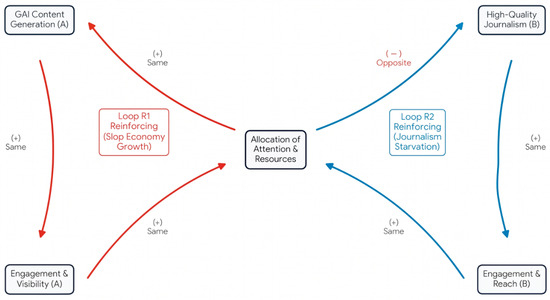
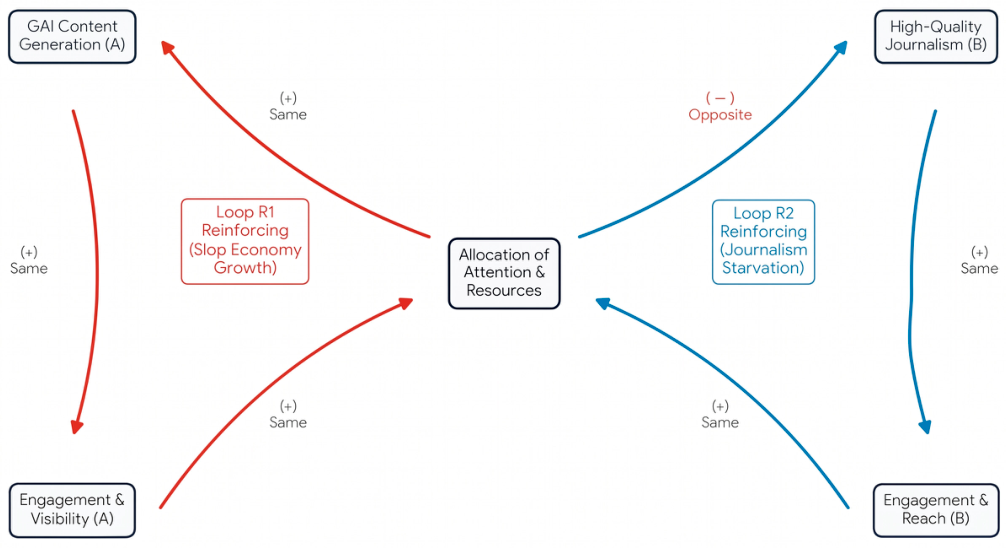
This dual-loop system structurally starves factual communication of digital reach. It isolates the electorate within self-validating echo chambers, erodes the shared factual baseline required for democratic deliberation, and systematically hollows out the financial model of independent journalism. It also can be represented through Senge’s (2006) Success to the Successful archetype. Figure 1 models the systemic feedback loops governing the distribution of user attention and structural capital across competing information streams during digital political campaigns. Loop R1 (the slop economy) demonstrates a self-reinforcing process where the high generation velocity of generative artificial intelligence (GAI) content triggers an immediate algorithmic engagement reward from platform recommendation systems. This algorithmic success siphons a disproportionate share of finite campaign funding, digital ad revenue, and citizen attention away from Loop R2 (Factual Journalism Starvation). Because high-quality investigative journalism requires significant temporal and financial resources, it is structurally starved of reach. This dynamic creates a negative link polarity (−) between the centralized resource allocation pool and Node B, establishing a systemic path dependency that accelerates affective polarization and hollows out the financial viability of independent regional press networks.
Figure 1.
Conceptual Causal Loop Diagram (CCLD) of the Successful Archetype within the Electoral Attention Economy. Adapted from qualitative case tracks in the Database and official election observation reports.
While these equations are presented here as conceptual representations of system dynamics, future empirical research could operationalize these models by quantifying the parameters. For instance, the emotional intensity (Et) could be measured through natural language processing (NLP) sentiment analysis, and the algorithmic engagement reward (Pt) could be calculated using platform API diffusion metrics.
5.2. The Escalate Archetype
The political sphere in highly polarized environments is further degraded by a digital arms race of reciprocal aggression governed by the Escalate archetype. Under this, a hostile intervention by one political faction triggers an immediate, retaliatory defensive response from an opposing faction.
This systemic pattern was clearly visible in the Guatemala 2023 electoral cycle, where targeted visual attacks using cloned media layouts from CNN and Radio Canada forced opposing campaigns to shift their resources away from programmatic debates to launch hyper-targeted digital counter-offensives. Similarly, during the Ecuador 2025 presidential campaign, the deployment of sophisticated voice clones—such as the synthetic fabrication depicting candidate Luisa González endorsing fentanyl—instantly accelerated a toxic retaliatory cycle of deepfakes and automated visual discredits across TikTok networks.
This escalatory feedback loop can be structurally modeled using a systemic causal chain:
Adversarial Input A → Civic Anxiety → Retaliatory Payloads B → Systemic Polarization.
As the velocity of this loop increases, mutual distrust intensifies, institutional transparency collapses, and political adversaries are redefined as existential threats.
The public square undergoes a process of structural decay, replacing deliberative consensus with intense affective polarization. Factual corrections issued by state authorities are caught in this crossfire. For example, when the Councilor of the Honduran National Electoral Council (CNE), Cossette López-Osorio, publicly denounced a deepfake audio that cloned her voice to spread false narratives about the vote-counting process, the correction was immediately captured and weaponized by opposing political factions to fuel deeper conspiratorial narratives of systemic fraud (EU EOM, 2025). Highly polarized electorates reject official evidence due to deep-seated confirmation bias, viewing the electoral arbiter itself not as an objective referee, but as a partisan threat.
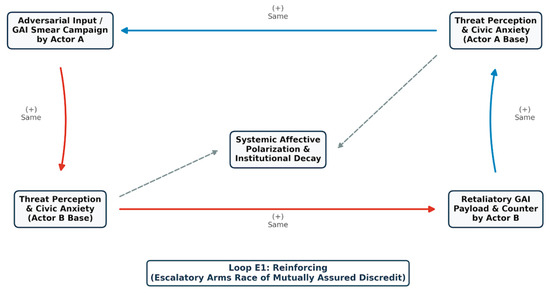
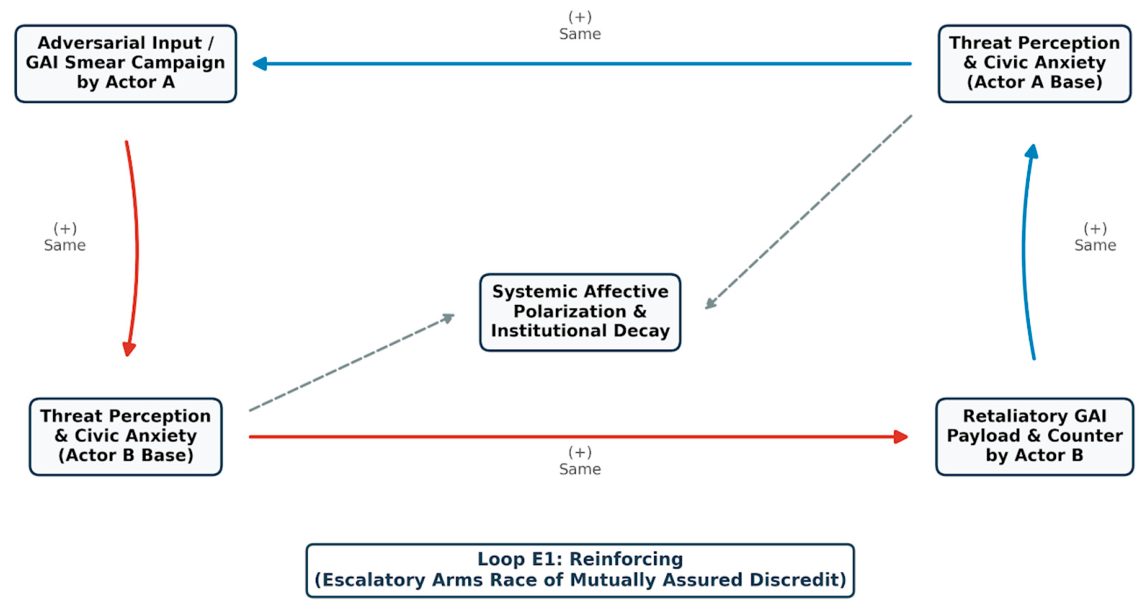
Figure 2 models the self-reinforcing cybernetic feedback loop governing the Escalate information archetype across competitive election environments. Under this structural dynamic, an initial adversarial campaign payload deployed by Actor A triggers elevated threat perception and civic anxiety within Actor B’s base. Because hybrid and fragile systems lack algorithmic containment boundaries, Actor B is strategically forced to bypass programmatic policy debate and immediately launch an equally aggressive, GAI-fabricated counter-offensive to protect its political capital. This action creates a reciprocal channel where counter-anxiety feeds back into Actor A’s vector, locking both parties into a zero-sum digital arms race of mutually assured discredit. As the velocity of Loop E1 accelerates, the output vectors (indicated by the gray dashed channels) converge directly upon the central public sphere, transforming democratic competition into structural affective polarization and hollow-out institutional decay.
Figure 2.
Conceptual Causal Loop Diagram (CCLD) of the Escalate Archetype within Polarized Information Ecosystems. Note: This model is a theoretical representation mapped from comparative case tracks in the Database (2026) and official election observation reports.
6. Structural Resilience and the Civic Transition to the Émirec
The comparative diagnoses of Guatemala, Ecuador, and Honduras demonstrate that top-down, centralized institutional containment strategies are necessary but structurally insufficient to counter decentralized, industrialized GAI campaigns. State-run debunking portals, regulatory spending audits, and centralized fact-checking initiatives consistently collide with the psychological barriers of tribal polarization and confirmation bias. When an electoral management body (EMB)—such as the National Electoral Council (CNE) in Honduras or the Supreme Electoral Tribunal (TSE) in Guatemala—issues an official verification statement, highly partisan voters frequently dismiss it as state censorship, institutional bias, or systemic cover-up, rendering the factual correction ineffective.
To dismantle the self-reinforcing dynamics of the Success to the Successful and Escalate archetypes, which inherently advantage automated disinformation—democratic defense must transition from centralized, top-down arbitration to decentralized, civic-led resilience. Because platform moderation is mathematically incapable of outpacing generative AI velocity, defense mechanisms must be distributed to the very edge of the network. This paradigm shift requires operationalizing a fundamental transformation of the electorate: moving individuals away from their current roles as passive prosumers—unwitting algorithmic accelerants who seamlessly lubricate viral feedback loops—and elevating them into critically empowered émirecs (critical sender-receivers).
Originally conceptualized by Cloutier (1973) for the audiovisual age, the émirec model must be structurally adapted for the era of generative content. It redefines the digital citizen not merely as a consumer, but as an active, conscious node within the information topology. Rather than serving as a frictionless conduit for synthetic slop, the émirec functions as a decentralized firewall. They act as active communicative agents who structurally verify provenance, evaluate contextual integrity, and critically manage information payloads, intentionally deciding whether to halt or transmit data across their personal digital networks.
Operationalizing the émirec model requires engineering systemic cognitive friction directly into the electorate’s daily digital consumption habits, effectively acting as a behavioral dampener against artificial virality. Traditional Media and Information Literacy (MIL) frameworks—which often stall at basic, binary fake-news detection—are fundamentally obsolete against sophisticated, highly engineered synthetic media. Instead, modern MIL must train citizens to dissect the structural mechanics of the platforms themselves. By teaching electorates to recognize and deconstruct the specific emotional intensities and semiotic triggers weaponized by algorithmic campaigns to bypass rational evaluation (Conoscenti, 2026), society can neutralize the content payload before it catalyzes the next cycle of the viral feedback loop.
In the Honduran context, this decentralized resilience was exemplified by the civil society umbrella network OEH25. By deploying independent, sample-based verification audits (PRVT methodology), OEH25 managed to independently validate election results trends, effectively introducing factual stability from the ground up and neutralizing the top-down fraud narratives pushing for institutional collapse.
When the electorate functions as a collective of émirecs, they introduce critical systemic friction into the propagation vectors of FIMI operations:
- Pausing and evaluating: Citizens consciously slow down consumption speed when encountering high-intensity emotional hooks, checking for GAI watermarks or synthesis anomalies.
- Source verification: Users trace the provenance of media pieces, identifying whether a video originates from a verified newsroom or an unauthenticated proxy page designed to simulate journalistic authority.
- Tracing shadow duplications: Emitters actively cross-reference suspicious web portals with verified databases, exposing fraudulent duplication links such as the MiNotaHN shadow architecture.
This collective cognitive resistance breaks the algorithmic feedback loops, diminishes the viral coefficient of disinformation payloads, and gradually restores institutional trust and democratic integrity from the bottom up.
7. Conclusions and Recommendations
The electoral cycles of Guatemala, Ecuador, and Honduras provide comparative evidence that the weaponization of GAI is no longer a peripheral threat, but a central, industrialized mechanism for democratic subversion in Latin America. By integrating the FIMI behavioral taxonomy with the DISARM ontology, this comparative analysis illustrates that algorithmic campaigns rarely aim to simply alter individual votes through isolated falsehoods. Instead, they appear to systematically exploit the cybernetic architecture of the modern digital ecosystem, weaponizing the slop economy’s self-reinforcing feedback loops in ways that threaten to replace an authoritative, shared epistemological reality with extreme affective polarization and paralyzing institutional cynicism. In hybrid and flawed democracies, this structural decay creates a severe asymmetric vulnerability where malicious actors can bypass institutional checks with mathematically optimized, hyper-realistic synthetic media.
Addressing this crisis requires acknowledging that top-down, state-centric regulations and reactive content moderation are computationally and procedurally insufficient against the sheer velocity of GAI. The preservation of democratic integrity depends on shifting our defensive posture to the edge of the network. By fundamentally transforming the digital electorate from passive accelerants into critically empowered émirecs, and by hardwiring cognitive friction into daily media consumption, democracies can establish a resilient, decentralized firewall. Only through this bottom-up paradigm shift—where citizens actively deconstruct the emotional and semiotic payload of synthetic narratives—can the structural incentives of the slop economy be neutralized, safeguarding the epistemic foundation required for civic deliberation and representative governance.
The comparative findings of this research highlight several structural policy recommendations designed to safeguard the integrity of future electoral processes across hybrid and fragile democracies:
- Algorithmic transparency and digital spending ceilings: Electoral management bodies must transition away from legacy monitoring frameworks to enforce strict disclosure rules for digital outlays. As documented by the EU EOM in Guatemala, the complete absence of spending rules for paid social media advertising allowed wealthy party structures to execute massive, untraceable guidelines on Meta and TikTok. Tech platforms must be legally compelled to provide transparent, auditable repositories of political ad metrics, implementing standardized labeling mandates for all GAI-generated campaign material, like the risk-tiered protocols of the EU AI Act.
- Multisectoral co-governance table frameworks: Governments and electoral management bodies must build horizontal defense ecosystems that integrate state authorities, technology conglomerates (such as Meta, TikTok, and X), academic networks, independent fact-checkers, and civil society. This multisectoral framework is essential to synchronize real-time threat intelligence sharing, map coordinated inauthentic behavior (CIB) signatures, and counter state-directed or candidate-driven information laundering operations before they scale.
- Decentralized media and information literacy (MIL) policies: National education ministries must integrate comprehensive MIL courses into standard secondary and higher education curricula. These programs should focus on the cognitive mechanics of algorithmic recommendation engines, the structural attributes of the slop economy, and practical GAI verification techniques, providing the educational baseline required to scale the émirec model across the citizenry.
- Protection of press freedom and judicial safeguards: Given that independent, digital-native media platforms serve as the primary counterweight to both candidate-driven GAI and state-directed FIMI, states must enforce strict physical and legal protections for investigative journalists. This requires the urgent decriminalization of defamation laws in favor of civil frameworks and the strict prohibition of politically motivated legal persecution or strategic lawsuits against public participation (SLAPPs), which are systematically deployed by captured judicial structures to induce self-censorship and silence critical coverage.
Limitations and Future Research
It is important to acknowledge the limitations of this comparative study. First, the proprietary database utilized for this analysis comprises detected and verified incidents of computational propaganda, which represents only a highly visible fragment rather than the total universe of electoral disinformation circulating across these platforms. Consequently, the volume of documented cases differs considerably across the three countries, reflecting variations in detection capacity and electoral timelines as much as the true scale of the operations. Second, while the study maps the behavioral lifecycle of algorithmic campaigns and triangulates them with institutional vulnerabilities, it does not directly measure the causal effects of these operations on individual citizen behavior, voting patterns, or psychological polarization. Finally, the causal-loop diagrams and system dynamics equations presented in Section 5 remain theoretical, conceptual models designed to illustrate the structural mechanics of the slop economy. Future research should seek to operationalize these models through empirical validation, utilizing quantitative metrics such as platform API diffusion rates or NLP sentiment analysis to mathematically test the strength of these feedback loops.
Author Contributions
Conceptualization, M.M.-J. and A.C.; methodology, M.M.-J. and A.C.; software, A.C.; validation, M.M.-J. and A.C.; formal analysis, M.M.-J.; investigation, A.C.; resources, M.M.-J.; data curation, M.M.-J.; writing—original draft preparation, M.M.-J. and A.C.; writing—review and editing, M.M.-J. and A.C.; visualization, M.M.-J.; supervision, M.M.-J.; project administration, M.M.-J.; funding acquisition, M.M.-J. All authors have read and agreed to the published version of the manuscript.
Funding
This work is part of the research projects PID2022-1372450B-100 (Ministry of Science and Innovation and the State Research Agency). No financial support was received by the authors for the conduct of the research, authorship, or publication of the article.
Institutional Review Board Statement
Not applicable.
Informed Consent Statement
Not applicable.
Data Availability Statement
The dataset supporting the findings of this comparative analysis, including the forensic registry of media impersonation and digital attacks, is openly available to the public and can be accessed via the following link: https://doi.org/10.5281/zenodo.22032838 (accessed on 30 August 2026).
Acknowledgments
This work is part of the research projects PID2022-1372450B-100 (Ministry of Science and Innovation and the State Research Agency). The authors wish to thank the Observatorio Complutense de la Desinformación for its guidance on the phenomena analyzed in this article.
Conflicts of Interest
The authors declare no conflicts of interest.
Abbreviations
The following abbreviations are used in this manuscript:
| ADMO | Adria Digital Media Observatory |
| ASJ | Asociación para una Sociedad más Justa |
| CIB | Coordinated Inauthentic Behavior |
| CCLD | Conceptual Causal Loop Diagram |
| CNE | Consejo Nacional Electoral (National Electoral Council) |
| DISARM | Disinformation Analysis and Risk Management |
| DW | Deutsche Welle |
| EEAS | European External Action Service |
| EIU | Economist Intelligence Unit |
| EMB | Electoral Management Body |
| EU EOM | European Union Election Observation Mission |
| FIMI | Foreign Information Manipulation and Interference |
| GAI | Generative Artificial Intelligence |
| IMF | International Monetary Fund |
| LIBRE | Liberty and Refoundation Party |
| MIL | Media and Information Literacy |
| OAS | Organization of American States |
| OD MP | Observatorio de la Desinformación: Misión Perú |
| OEH25 | Observadores electorales por Honduras |
| PLH | Liberal Party |
| PNH | National Party |
| PRVT | Sample-based verification audits methodology |
| SLAPPs | Strategic Lawsuits Against Public Participation |
| STIX | Structured Threat Information Expression |
| TJE | Tribunal de Justicia Electoral (Electoral Justice Tribunal) |
| TREP | Vote-counting architecture |
| TSE | Tribunal Supremo Electoral (Supreme Electoral Tribunal) |
| TTPs | Tactics, Techniques, and Procedures |
| UFTF | Unidad de Financiación, Transparencia y Fiscalización |
| UNE | Unidad Nacional de la Esperanza |
| V-Dem | Varieties of Democracy |
References
- Adria Digital Media Observatory (ADMO). (2024). Content analysis of disinformation and narratives related to the war in Ukraine (ADMO Report No. 7). European Digital Media Observatory. Available online: https://edmo.eu/wp-content/uploads/2024/06/ADMO_report_7-1.pdf (accessed on 28 July 2026).
- Al-Raggad, M. (2026). Deepfake crimes in the age of AI: A bibliometric study of emerging risks and research trends. International Journal of Data and Network Science, 10(10), 15–26. [Google Scholar] [CrossRef] [Scilit]
- Arnold, R., & Wade, J. (2015). A definition of systems thinking: A systems approach. Procedia Computer Science, 44(44), 669–678. [Google Scholar] [CrossRef] [Scilit]
- Becker Castellaro, S. (2025). From recognition to resilience: Methodology to counter foreign information manipulation and interference. International IDEA. Available online: https://www.idea.int/news/recognition-resilience-methodology-counter-foreign-information-manipulation-and-interference (accessed on 28 July 2026).
- Cloutier, J. (1973). La communication audio-visuelle: Les messages, les media, la communication. Presses de l’Université de Montréal. [Google Scholar]
- Conoscenti, M. (2026). Countering FIMI by digital authoritarianisms: Audience architecture and reverse language engineering. Global Policy, 17(52), 1–16. [Google Scholar] [CrossRef] [Scilit]
- Database. (2026). Media impersonation and DIGITAL ATTACKS in Latin American electoral processes (Guatemala 2023, Ecuador 2025, Honduras 2025). Database. [Google Scholar] [CrossRef]
- De-Santis, A., Torres-Toukoumidis, Á., & Morejón-Vallejo, R. (2026). Artificial intelligence in political communication and citizens’ perceptions of disinformation and democratic legitimacy in Ecuador. Social Sciences and Humanities Open, 13(13), 102562. [Google Scholar] [CrossRef] [Scilit]
- Díaz, F., Cerna, N., Liza, R., & Motta, B. (2026). Artificial intelligence for detecting electoral disinformation on social media: Models, datasets, and evaluation. Information, 17(3), 292. [Google Scholar] [CrossRef] [Scilit]
- Economist Intelligence Unit (EIU). (2025). Democracy index 2024: What’s wrong with representative democracy? EIU. Available online: https://www.eiu.com/n/global-themes/democracy-index/ (accessed on 28 July 2026).
- European External Action Service (EEAS). (2023a). 1st EEAS report on Foreign Information Manipulation and Interference (FIMI) threats. European Union. Available online: https://euvsdisinfo.eu/eeas-1st-fimi-threat-report-february-2023/ (accessed on 28 July 2026).
- European External Action Service (EEAS). (2024). 2nd EEAS report on Foreign Information Manipulation and Interference (FIMI) threats: A framework for networked defence. European Union. Available online: https://www.eeas.europa.eu/eeas/2nd-eeas-report-foreign-information-manipulation-and-interference-threats_en (accessed on 28 July 2026).
- European External Action Service (EEAS). (2025). 3rd EEAS report on Foreign Information Manipulation and Interference (FIMI) threats: Exposing the architecture of FIMI operations. European Union. Available online: https://www.eeas.europa.eu/eeas/3rd-eeas-report-foreign-information-manipulation-and-interference-threats-0_en (accessed on 28 July 2026).
- European External Action Service (EEAS). (2026). 4th EEAS annual report on Foreign Information Manipulation and Interference (FIMI) threats. European Union. Available online: https://www.eeas.europa.eu/eeas/4th-eeas-annual-report-foreign-information-manipulation-and-interference-threats_en (accessed on 28 July 2026).
- European Union Election Observation Mission Honduras 2025 (EU EOM). (2025). European Union Election Observation Mission HONDURAS 2025 final report. European Union. Available online: https://www.eeas.europa.eu/eom-honduras-2025/european-union-election-observation-mission-honduras-2025-final-report_en?s=410510 (accessed on 28 July 2026).
- European Union Electoral Observation Mission (EU EOM). (2023). Informe final MOE UE Guatemala 2023. European Union. Available online: https://www.eeas.europa.eu/eom-guatemala-2023/final-report-eu-eom-guatemala-2023_en?s=410316 (accessed on 28 July 2026).
- Hameleers, M., & van der Meer, T. (2026). Beyond textual disinformation: Comparing the effects of textual disinformation to AI-generated and video-based visual disinformation across different issues. New Media & Society, 1–22. [Google Scholar] [CrossRef] [Scilit]
- Hidalgo, O. (2026). Conceptualising digital democracy—From technocracy and populism to a new concept of democratic authority and participation? Social Sciences, 15(3), 175. [Google Scholar] [CrossRef] [Scilit]
- International IDEA. (2025). Elections in Honduras 2025: Democratic resilience in the face of persistent challenges. Available online: https://www.idea.int/news/elections-honduras-2025-democratic-resilience-face-persistent-challenges (accessed on 28 July 2026).
- Jácobo-Morales, D., & Marino-Jiménez, M. (2024). Clickbait: Research, challenges and opportunities—A systematic literature review. Online Journal of Communication and Media Technologies, 14(4), e202458. [Google Scholar] [CrossRef] [Scilit]
- Laitinen, I. (2026). The government of the people, by the people, for the people facing challenges of AI. In J. Stenvall, T. Kinder, & H. Vakkala (Eds.), Emerging technologies and innovative problem solving in public administration (pp. 245–267). Palgrave Studies in Sub-National Governance. Palgrave Macmillan. [Google Scholar] [CrossRef] [Scilit] [PubMed]
- López-Paredes, M., Andrade, A. C., Cruz-Silva, J., & Di Fátima, B. (2025). Among pinocchios and indifferents: Memetics’ evolution in Latin America. In D. B. Ibáñez, E. Gallardo-Echenique, H. Siringoringo, & N. L. Diez (Eds.), Communication and applied technologies. ICOMTA 2024. Smart innovation, systems and technologies (Vol. 427). Springer. [Google Scholar] [CrossRef] [Scilit]
- Łabuz, M., & Nehring, C. (2024). On the way to a deepfake democracy? Deepfakes in election campaigns in 2023. European Political Science, 23(4), 454–473. [Google Scholar] [CrossRef] [Scilit]
- Marino-Jiménez, M., Flores-Núñez, A., Rojas-Noa, F., & Vásquez-Espinoza, P. (2023). Independent journalism for hybrid democracies: A systemic vision in three Latin American countries. Journalism Practice, 19(7), 1421–1440. [Google Scholar] [CrossRef] [Scilit]
- Marino-Jiménez, M., Rodrich-Portugal, R., Aliaga-Lodtmann, C., & Ramos-Rugel, R. (2026). The endogenous threat: Adapting the FIMI framework to analyze state-directed information manipulation in fragile democracies. Frontiers in Communication, 11(11), 1739581. [Google Scholar] [CrossRef] [Scilit]
- Marino-Jiménez, M., Rodrich-Portugal, R., & Zapata-Vásquez, M. (2025). Key terms in public communication: A systemic reflection on journalism, politics, and social movements. Cogent Social Sciences, 11(1), 2584871. [Google Scholar] [CrossRef] [Scilit]
- Miklian, J., & Hoelscher, K. (2026). A new digital divide? Coder worldviews, the ‘slop economy,’ and democracy in the age of AI. Information, Communication & Society, 29, 2412–2428. [Google Scholar] [CrossRef] [Scilit]
- Observatorio Complutense de Desinformación. (2026). Available online: https://www.ucm.es/observatoriodesinformacion/ (accessed on 28 July 2026).
- Observatorio de la Desinformación: Misión Perú (OD MP). (2026). Análisis FIMI a un mes de la primera vuelta electoral peruana. Available online: https://observatorioperu.org/publicacion/analisis-fimi-a-un-mes-de-la-primera-vuelta-electoral-peruana (accessed on 28 July 2026).
- Observatorio Desinformación Chile. (2026). Available online: https://observatoriodesinformacion.cl/ (accessed on 28 July 2026).
- Organization of American States (OAS). (2025). Preliminary report of the OAS electoral observation mission in Ecuador for the second round. Available online: https://www.oas.org/ext/es/principal/documentos/publicaciones/moduleid/7650/id/1458/lang/1/controller/item/action/download (accessed on 28 July 2026).
- Rodrich-Portugal, R., Marino-Jiménez, M., Mayuri-Aguilar, G., & Abad-Neyra, S. A. (2023). The purpose of the company beyond its position in the market: The new agent of social development. Business Strategy & Development, 6(4), 931–941. [Google Scholar] [CrossRef] [Scilit]
- Senge, P. (2006). La quinta disciplina en la práctica. Granica. [Google Scholar]
- Serrano, I., & Corredoira, L. (2024). Democracia y desinformación: Nuevas formas de polarización, discursos de odio y campañas en redes. Respuestas regulatorias de Europa y América Latina. Editorial Dykinson. [Google Scholar]
- Suing, A. (2025). Disinformation, AI, and regulation in Ecuador’s 2025 presidential election. Frontiers in Political Science, 7(7), 1624206. [Google Scholar] [CrossRef] [Scilit]
- Suing, A., Barredo-Ibáñez, D., & Ortiz-Sobrino, M. A. (2026). Media and information literacy in the face of election disinformation generated by artificial intelligence: Experiences from Ecuador. Frontiers in Political Science, 8(8), 1834093. [Google Scholar] [CrossRef] [Scilit]
- Terp, S., & Breuer, P. (2022). DISARM: A framework for analysis of disinformation campaigns. In 2022 IEEE conference on cognitive and computational aspects of situation management (CogSIMA), Salerno, Italy (pp. 1–8). IEEE. [Google Scholar] [CrossRef] [Scilit]
- Varieties of Democracy (V-Dem) Institute. (2023). Democracy report 2023: Defiance in the face of autocratization. University of Gothenburg. Available online: https://www.v-dem.net/documents/29/V-dem_democracyreport2023_lowres.pdf (accessed on 28 July 2026).
- World Economic Forum. (2026). The global risks report 2026. World Economic Forum. Available online: https://www.weforum.org/publications/global-risks-report-2026 (accessed on 28 July 2026).

Disclaimer/Publisher’s Note: The statements, opinions and data contained in all publications are solely those of the individual author(s) and contributor(s) and not of MDPI and/or the editor(s). MDPI and/or the editor(s) disclaim responsibility for any injury to people or property resulting from any ideas, methods, instructions or products referred to in the content. |
© 2026 by the authors. Licensee MDPI, Basel, Switzerland. This article is an open access article distributed under the terms and conditions of the Creative Commons Attribution (CC BY) license.