


Abstract
Grounded in the MAIN model and multidimensional information-quality frameworks, this research conceptualizes news evaluation through three distinct lenses: credibility, newsworthiness, and readability. Through a 2 (authorship: AI vs. human) × 3 (news domain: finance, weather, sports) mixed experiment (N = 301), participants evaluated identical articles attributed to either an AI system or a human journalist. The results reveal a consistent “credibility penalty” for AI-labeled news across all domains, suggesting that authorship serves as a domain-general source heuristic. However, the effects on newsworthiness and readability were domain-contingent, shifting based on genre-specific expectations and the informational stakes of the topic. These findings demonstrate that audience responses to AI journalism are multidimensional and context-sensitive rather than uniform. This study offers significant implications for communication theory, transparency in disclosure practices, and the strategic adoption of AI in modern newsrooms.
1. Introduction
In contemporary digital contexts, news judgments are increasingly driven by heuristics activated by visible cues (including bylines), which can influence audience evaluations of news. Machine-authored labels, even when the text is held constant, can affect perceptions about message and source credibility (S. Wang & Huang, 2024) partly through humanness and expectancy–violation pathways (Jia et al., 2024; Waddell, 2017). According to MAIN-model scholarship, agency cues like AI bylines trigger heuristic processing, which can change how easily a reader processes the text (Sundar, 2008). Labeling content as AI-generated tends to reduce perceived trustworthiness and lower perceived accuracy and willingness to share headlines (Altay & Gilardi, 2024; Toff & Simon, 2024). Audiences express strong preferences for transparency about AI use in journalism, yet disclosure of AI involvement is often associated with increased skepticism, particularly among audiences with higher baseline trust in news (Newman et al., 2024; Simon et al., 2025). Algorithms, which remain uneven and opaque, can affect audience interpretations of authorship labels and readability expectations (Cools & Koliska, 2024).
Further, news type appears to moderate audience responses to authorship cues. In sports, readers usually expect expressive, idiomatic, and narrative-laden prose, and automated sports articles are sometimes rated more credible than human-created content (Sadri et al., 2025; Wölker & Powell, 2018). In finance, baseline textual complexity (i.e., long sentences, specialized terminology) is higher, and audience suspicion of obfuscation makes readability fragile (Lesmy et al., 2025; Li et al., 2022). In weather articles, clarity and actionability norms dominate; readers often use probabilistic information when it is presented appropriately, but trust and interpretive burden strongly condition understandability (Morss et al., 2008; Ripberger et al., 2022). Taken together, news-type-linked expectations may create theoretically plausible moderation of declared authorship effects on audience evaluation of news.
Research has examined audience responses to AI-labeled news across multiple evaluative dimensions, including credibility, readability, and overall news evaluation (Graefe et al., 2018; Graefe & Bohlken, 2020; S. Wang & Huang, 2024). However, findings remain inconsistent and, at times, contradictory. Moreover, effects vary across content domains, with audience evaluations differing depending on topic types (S. Wang & Huang, 2024; Wölker & Powell, 2018). Despite this growing body of work, the literature remains theoretically dispersed, with limited integration across evaluative dimensions and frameworks (Danzon-Chambaud, 2021; Hilligoss & Rieh, 2008).
Two specific limitations define the gap the present study addresses. First, prior studies that measured multiple dimensions typically did not explain, within an integrated theoretical framework, why credibility, newsworthiness, and readability should respond differently to the same authorship cue or under what conditions domain moderation should appear for some dimensions but not others. Graefe et al. (2018) found divergent authorship effects across credibility, readability, and expertise but found no topic differences and offered no theoretical account of dimensional divergence. Second, prior studies that varied topic type collapsed evaluative dimensions rather than examining them separately. S. Wang and Huang’s (2024) meta-analysis demonstrated that topic type moderates machine authorship effects but treated news evaluation as a single outcome, leaving unanswered how moderation operates across credibility, newsworthiness, and readability independently.
By simultaneously examining three theoretically distinct evaluative dimensions across three domains that differ systematically in informational stakes and genre conventions, this study tests whether authorship effects are uniform or structurally differentiated. Grounded in source credibility theory (Hovland & Weiss, 1951; Metzger & Flanagin, 2013), dual-process models (Chaiken, 1980; Petty & Cacioppo, 2012), and the MAIN model (Sundar, 2008), this study examines whether credibility, newsworthiness and readability operate as domain-general epistemic heuristics or domain-contingent heuristics.
Taken together, this study examines (1) whether authorship labels act as agency cues with predictable heuristic consequences for perceived credibility, newsworthiness and readability; and (2) whether those consequences are news-type-contingent, given divergent audience expectations and textual conventions across finance, weather and sports domains. To answer the research questions, we conducted an online experiment with 301 adults at an American public university in 2025.
2. Literature Review
Multidimensionality of Audience Evaluations of News
Audience evaluations of news are inherently multidimensional rather than reducible to a single global judgment. Research demonstrates that individuals assess content across intrinsic, contextual, and representational dimensions, including accuracy, relevance, and clarity (Rieh, 2002; R. Y. Wang & Strong, 1996). These dimensions operate through distinct evaluative logics: intrinsic judgments concern believability and objectivity, contextual judgments address relevance and importance, and representational judgments focus on clarity and ease of processing (Hilligoss & Rieh, 2008). These evaluations are not derived solely from textual features. Instead, audiences rely heavily on source cues and metadata—such as authorship labels—to infer information quality, particularly under conditions of uncertainty (Graefe et al., 2018; Sundar, 2008).
Authorship labels function as heuristic signals that shape audience perceptions even when textual content is identical. Research shows that machine authorship can produce inconsistent effects across evaluative dimensions, including negative, null, or even positive effects on credibility (Graefe et al., 2018; Graefe & Bohlken, 2020; S. Wang & Huang, 2024). These mixed findings reflect the layered nature of information evaluation. Hilligoss and Rieh (2008) conceptualize credibility assessment as operating across multiple levels—construct, heuristic, and interactional, while Rieh (2002) demonstrates that judgments are shaped by the interplay among source characteristics, content features, and user context. Together, these perspectives indicate that credibility, newsworthiness, and readability emerge from distinct but interacting cognitive processes.
Research further suggests that audience responses vary across content domains. Machine authorship effects differ by topic type, with stronger negative reactions observed in socio-political contexts than in routine domains (S. Wang & Huang, 2024; Wölker & Powell, 2018). These findings underscore the importance of distinguishing between domain-general and domain-contingent effects. However, existing research remains theoretically fragmented, often examining single dimensions or collapsing multiple outcomes into aggregate measures without explaining why evaluative dimensions diverge (Danzon-Chambaud, 2021).
To address this gap, the present study integrates three complementary frameworks: source credibility theory, dual-process models of persuasion, and the MAIN model. Source credibility theory specifies that judgments hinge on perceived expertise and trustworthiness (Hovland & Weiss, 1951; Metzger & Flanagin, 2013). Dual-process models explain when audiences rely on heuristic cues rather than message content (Chaiken, 1980; Petty & Cacioppo, 2012). The MAIN model identifies how technological cues—particularly agency cues such as authorship—trigger heuristic processing in digital environments (Sundar, 2008). The MAIN model—Modality, Agency, Interactivity, Navigability—provides a heuristic framework for understanding how structural features of digital media shape credibility judgments (Sundar, 2008). Within this model, the agency dimension is particularly relevant: authorship cues trigger heuristic inferences about who or what produced the content, shaping expectations of expertise, accountability, and fluency. Together, these frameworks operate at distinct levels of analysis: evaluative criteria, cognitive processing conditions, and technological mechanisms.
Building on this integration, we conceptualize audience evaluation across three analytically distinct dimensions: credibility (epistemic believability), newsworthiness (contextual relevance and importance), and readability (processing fluency). Although these dimensions may covary empirically, they derive from different evaluative logics. Credibility is closely tied to source trustworthiness and is particularly sensitive to metadata cues under uncertainty. Newsworthiness reflects judgments of societal importance shaped by event characteristics and normative expectations (Galtung & Ruge, 1965; Shoemaker & Cohen, 2012). Readability captures the processing experience and is influenced by expectations about stylistic quality and fluency (Sundar, 2008).
We conceptualize authorship (AI vs. human) as a metadata cue that activates heuristic reasoning about agency and responsibility. Within the MAIN model, authorship functions as an agency cue that prompts inferences about expertise, accountability, and communicative intent (Sundar, 2008). Source credibility theory further suggests that these inferences are rooted in perceptions of trustworthiness rather than technical competence alone (Metzger & Flanagin, 2013). Dual-process models predict that such cues become particularly influential when direct evaluation of content is costly or uncertain (Chaiken, 1980).
This integrated perspective allows us to reconcile competing theoretical accounts. Expectancy Violation Theory predicts credibility penalties when AI authorship violates expectations (Burgoon, 1993), while the machine heuristic suggests that automation may signal objectivity and consistency (Sundar, 2008). In contrast, the inhumanity heuristic emphasizes perceived lack of judgment and accountability (Toff & Simon, 2024; Waytz et al., 2014). Each framework captures part of the phenomenon but fails to explain why effects differ across evaluative dimensions and domains. The present study advances a layered heuristic-schema framework, in which authorship cues activate both domain-general epistemic heuristics and domain-contingent evaluative schemas.
Under this framework, credibility operates as a domain-general heuristic tied to accountability and epistemic authority, whereas newsworthiness and readability are shaped by domain-specific expectations and genre conventions. In high-stakes contexts, such as weather reporting, accountability concerns may amplify the impact of authorship on both credibility and perceived importance. In contrast, narrative-driven domains such as sports may place greater weight on perceived humanness in shaping readability judgments (Graefe & Bohlken, 2020). This distinction clarifies why identical content can produce divergent evaluations across dimensions and domains.
In sum, a key limitation of the literature on AI-generated journalism is the lack of theoretical differentiation between evaluative dimensions, as many studies treat credibility, quality, and engagement as interchangeable outcomes. This study addresses this gap by conceptualizing audience evaluation as a multidimensional construct comprising credibility, newsworthiness, and readability, each grounded in distinct evaluative logics. Building on this distinction, we propose a layered heuristic-schema framework in which authorship cues activate both domain-general epistemic heuristics and domain-contingent evaluative schemas. This framework provides a theoretically grounded explanation for why prior findings diverge across contexts and outcome variables, thereby advancing a more systematic understanding of audience responses to AI-authored news.
3. AI Authorship and Perceived Credibility
Credibility represents a foundational dimension of news evaluation, reflecting whether information is perceived as true, reliable, and trustworthy. Rooted in classical rhetorical concept of ethos (Aristotle, 2007), modern scholarship defines credibility as the perceived believability of a source rather than an inherent property of a message (Berlo et al., 1969; Metzger & Flanagin, 2013). In digital environments characterized by information abundance and source opacity, credibility judgments increasingly rely on heuristic cues such as bylines and labels (Sundar, 2008).
Authorship cues signal who is responsible for knowledge claims, thereby shaping perceptions of expertise, trustworthiness, and accountability (Graefe et al., 2018; Waddell, 2017). When audiences encounter AI-labeled news, they may infer reduced accountability, as responsibility is attributed to an autonomous system rather than a human journalist (Jia et al., 2024). This shift weakens epistemic trust, particularly in contexts where human oversight is normatively expected (Waytz et al., 2014).
Study findings are mixed. Some studies report equal or higher credibility for machine-generated content in data-driven contexts (Graefe et al., 2018; van der Kaa & Krahmer, 2014). However, most research identifies a credibility penalty associated with AI labeling, driven by concerns about transparency, accountability, and authenticity (Leuppert et al., 2025; Waddell, 2017). Meta-analytic evidence confirms a small but consistent negative effect, particularly for high-stakes topics (S. Wang & Huang, 2024).
These findings suggest that credibility judgments reflect broader epistemic considerations regarding legitimate knowledge authority rather than purely technical competence (Hilligoss & Rieh, 2008). Even when content quality is held constant, authorship labels exert a durable influence on perceived credibility (Nakano et al., 2025; Toff & Simon, 2024). Accordingly:
H1.
News articles labeled as AI-authored will be perceived as less credible than identical articles labeled as human-authored.
4. AI Authorship and Perceived Newsworthiness
Newsworthiness refers to judgments of relevance, importance, and societal impact. Classical news-values theory identifies factors such as timeliness, proximity, and significance as primary drivers of perceived news value (Galtung & Ruge, 1965; Shoemaker & Cohen, 2012). Unlike credibility, which centers on epistemic trust, newsworthiness reflects contextual evaluations of whether content matters.
Although newsworthiness is primarily driven by event characteristics, it is indirectly shaped by source credibility. Content perceived as less credible is less likely to be considered important or worth engaging with (Shah & Wei, 2022). AI authorship may reduce perceived newsworthiness by undermining trust and authenticity, particularly when audiences associate journalism with human judgment and contextual interpretation (Jia et al., 2024).
Research shows that AI-labeled content reduces perceived accuracy and willingness to share, even when factually correct (Altay & Gilardi, 2024). Automated news is often perceived as more objective but less engaging, weakening dimensions of novelty and human interest (Clerwall, 2014). Audience discomfort with AI in journalism further diminishes engagement and perceived value (Nakano et al., 2025).
However, these effects are likely to be domain-contingent. In routine or low-stakes domains, such as sports, authorship may have limited influence on perceived importance. In high-stakes domains, such as weather, where information may have direct consequences for public safety, authorship cues may play a stronger role. Accordingly:
H2.
News articles labeled as AI-authored will be perceived as less newsworthy than identical articles labeled as human-authored.
5. AI Authorship and Perceived Readability
Readability reflects perceived clarity, fluency, and ease of processing. As a representational dimension, it captures the experiential aspect of news consumption (Hilligoss & Rieh, 2008). While readability is partly determined by textual features, it is also shaped by expectations activated by source cues (Sundar, 2008). Research consistently finds that AI-labeled news is perceived as less readable than human-authored content, even when objective measures show no difference (Graefe et al., 2018; Clerwall, 2014). This effect is attributed to heuristic expectations that machine-generated text is formulaic or stylistically rigid, leading readers to experience identical content as less engaging (Graefe & Bohlken, 2020).
Readability judgments are particularly susceptible to expectancy effects because they depend on processing experience during exposure. When readers anticipate impersonal or mechanical prose, perceived fluency declines (Sundar, 2008). Meta-analytic evidence confirms a general advantage for human-authored content in perceived readability (S. Wang & Huang, 2024).
These effects are likely moderated by genre conventions. In narrative-driven domains, such as sports, readability is closely tied to expressive and idiomatic language, making perceived humanness especially salient. In technical domains, such as finance, readability may depend more on information structure than stylistic qualities. Accordingly:
H3.
News articles labeled as AI-authored will be perceived as significantly less readable than identical articles labeled as human-authored.
6. Interaction of AI Authorship and News Type
Audience evaluations are shaped by both source cues and genre-specific expectations. Different news domains vary in informational stakes, cognitive demands, and communicative purposes (Eilders, 2006; Reinemann et al., 2011). As a result, audiences apply domain-specific schemas when evaluating credibility, newsworthiness, and readability. Research reports inconsistent findings regarding interactions between authorship and topic type (Clerwall, 2014; Waddell, 2017). While some studies suggest domain variation, others find no significant moderation effects. This inconsistency reflects the lack of theoretical differentiation between evaluative dimensions.
Drawing on the layered heuristic-schema framework, we expect credibility to function as a domain-general heuristic, while newsworthiness and readability are likely to vary across domains. Dual-process models suggest that contextual features influence the extent to which source cues are used (Chaiken, 1980). News-values theory further indicates that perceived importance is primarily driven by event characteristics rather than production cues (Shoemaker & Cohen, 2012). Accordingly, we examine whether news type moderates authorship effects across each evaluative dimension:
- RQ1: Does news type (specifically finance, weather, sports) moderate the effect of authorship on perceived credibility?
- RQ2: Does news type (specifically finance, weather, sports) moderate the effect of authorship on perceived newsworthiness?
- RQ3: Does news type (specifically finance, weather, sports) moderate the effect of authorship on perceived readability?
7. Method
7.1. Design
This study received Institutional Review Board approval (IRB Protocol #18298). Participants provided informed consent before beginning the experiment. Data were collected online between April and November 2025 at a large public university in the south-central United States. As a result, the sample is likely to reflect relatively high levels of education and familiarity with academic and informational texts. Such characteristics are relevant for interpreting evaluative judgments, particularly readability, as individuals with greater exposure to formal writing conventions may apply different standards when assessing clarity, fluency, and stylistic quality. While convenience sampling is common in experimental research aimed at identifying causal relationships, the composition of the sample should be considered when interpreting the generalizability of the findings. However, because this study examines heuristic processing rather than population estimates, a university-based sample is appropriate for isolating causal effects of authorship cues. The final sample consisted of 301 adult participants (aged 18 or over). The average age was 22.4 years old, and 52.5% of participants were females.
Participants were recruited through a convenience sampling approach using a campus-wide mass email distributed by the university, which invited eligible students to participate. Campus-wide email recruitment is a common and accepted method in experimental research on media effects, particularly when the goal is to examine causal relationships under controlled exposure conditions rather than to estimate population parameters (Mutz, 2011; Shadish et al., 2002). To encourage participation, respondents were entered into a raffle for two $25 gift cards.
An a priori power analysis using G*Power 3.1 indicated that 214 participants were needed to detect interaction effects (f = 0.10) in a 2 × 3 mixed ANOVA with 0.90 power and α = 0.05. A total of 459 responses were initially collected. Each individual provided written informed consent, confirming their understanding that their data would remain confidential and that they could withdraw from the survey at any time without penalty. The consent form also briefed the study’s purpose and procedures. Following data screening, 158 responses were excluded following established data-quality screening criteria commonly applied in online experimental research if they were incomplete or if completion time was under 60 s, a threshold used to identify insufficient effort responding when task demands make such rapid completion implausible (Meade & Craig, 2011).
This study employed a 2 (news source: AI vs. human) × 3 (news type: finance, weather, sports) mixed factorial design. News source served as a between-subjects factor, while news type operated as a within-subjects factor, allowing participants to read one article from each domain. This mixed approach allowed differentiation of source effects from content-specific variation. To ensure experimental control: (1) All articles were written by professional journalists to keep content constant; (2) Articles were matched for length, tone, and factual density; and (3) Byline placement, typography, and formatting were held constant. The human condition was displayed as “By A. J. Smith,” and the AI condition was displayed as “AI-generated.” The full article stimuli are provided in Appendix A.
Participants were randomly assigned to either the human-written or AI-generated condition through a quasi-random birth-month allocation procedure, a method shown to preserve randomization integrity by preventing self-selection bias (Mutz, 2011). Although the use of fully AI-generated content may enhance ecological validity, it introduces uncontrolled variability in linguistic style, coherence, and perceived quality. Such variability would make it difficult to disentangle whether audience responses are driven by authorship perceptions or by detectable differences in the text itself. By using controlled stimuli, the present design prioritizes internal validity and enables a precise test of authorship as a heuristic cue.
The sample consisted of 301 participants (159 in the AI-authored condition, 142 in the human-authored condition) who evaluated news articles across six conditions: three news types (finance, weather, sports) × two authorship types (AI-generated, human-written). Following Montgomery (2017), demographic equivalence between conditions (age, gender) was assessed to confirm randomization integrity. No significant differences emerged. Participants resulted in 815 total observations.
For manipulation check, participants answered a single forced-choice item identifying who they believed authored each article. This approach is consistent with best practices in message–source manipulation validation (Jia et al., 2024). Overall, 3 participants failed the manipulation check. Consistent with standard experimental practice, the main analyses reported below include all participants. Robustness analyses remain unchanged when excluding participants who failed the manipulation check1.
7.2. Measures
Drawing upon Appelman and Sundar (2015), credibility was measured using four items on a 5-point Likert scale (1 = strongly disagree, 5 = strongly agree): The news article is (1) accurate, (2) authentic, (3) believable, and (4) authoritative. Responses were averaged (AI authorship: α = 0.93, M = 2.89, SD = 0.86; Human authorship: α = 0.90, M = 3.45, SD = 0.69).
Newsworthiness was measured with four items adapted from Mayo and Leshner (2000): The article is (1) important, (2) relevant to the public, (3) informative, and (4) timely. Responses were recorded on a 5-point Likert scale and averaged to form an index (AI authorship: α = 0.92, M = 3.15, SD = 0.87; Human authorship: α = 0.88, M = 3.42, SD = 0.72).
Drawing upon prior work on perceived readability and processing fluency (e.g., Graefe et al., 2018), readability was measured with three items on a 5-point Likert scale: (1) The article is pleasant to read; (2) I like reading this article; and (3) I would be interested in reading articles like this one. Responses were averaged to form a readability index (AI authorship: α = 0.93, M = 2.56, SD = 0.96; Human authorship: α = 0.84, M = 2.95, SD = 0.75; Table 1).
Table 1.
Descriptive statistics for credibility, newsworthiness, and readability by authorship and news type.
8. Results
Primary Analysis: Multivariate Analysis of Variance (MANOVA)
A one-way multivariate analysis of variance (MANOVA) was conducted to examine whether AI-generated and human-generated news differed across three audience perceptions (credibility, newsworthiness, and readability). MANOVA can compare multiple dependent variables simultaneously between groups and help manage overall error rates compared with running separate ANOVAs (Warne, 2014).
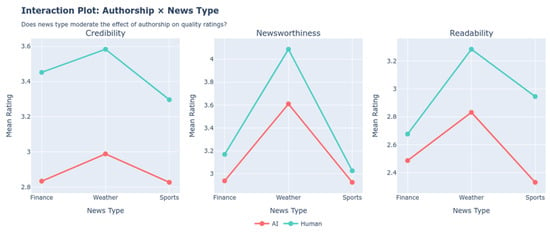
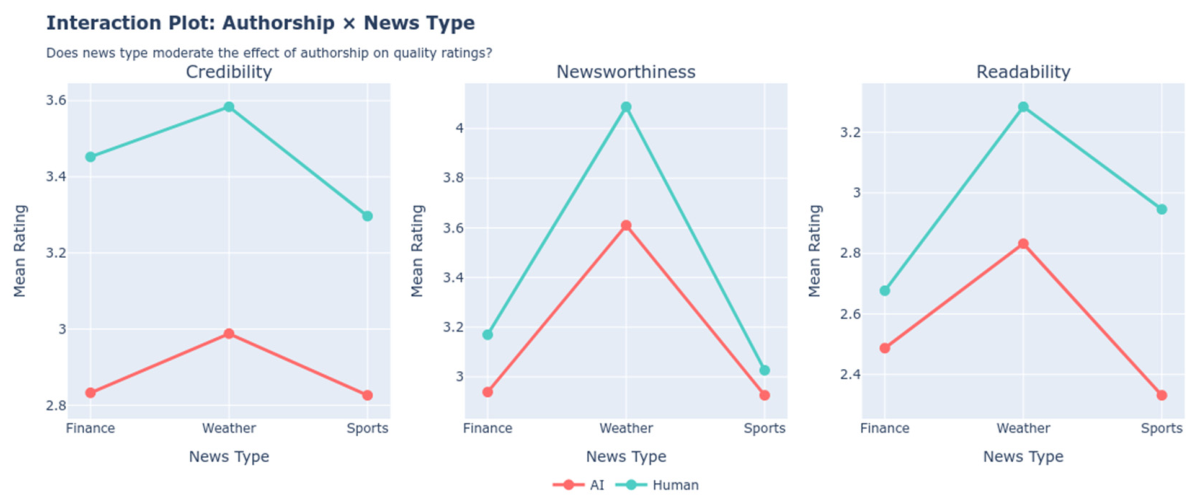
The results indicate a statistically significant multivariate effect of authorship type on the combined dependent variables, Wilks’ Λ = 0.84, F(3, 246) = 15.19, p < 0.001, partial η2 = 0.16 (Table 2, Figure 1). The effect size is large (partial η2 = 0.16)—approximately 15.6% of the variance in the combined dependent variables was explained by authorship type. The large effect size suggests that these are not merely statistical artifacts but represent meaningful practical difference in how audiences perceive the two author types.
Table 2.
Factorial MANOVA results: Wilks’ Lambda tests for main effects and interaction.
Figure 1.
Interaction plot: Authorship × News Type.
Follow-up univariate ANOVAs revealed that human-generated content received significantly higher ratings than AI-generated content on credibility, F(1, 248) = 33.39, p < 0.001, η2 = 0.12 (H1); newsworthiness, F(1, 248) = 7.5, p = 0.007, η2 = 0.03 (H2); and readability, F(1, 248) = 12.69, p < 0.001, η2 = 0.05 (H3). Human-generated content (M = 3.45) was rated as significantly more credible than AI-generated content (M = 2.89), with a large effect size (η2 = 0.12). Human-generated content (M = 3.42) was rated as significantly more newsworthy than AI-generated content (M = 3.15), with a small effect size (η2 = 0.03). Human-generated content (M = 2.95) was rated as significantly more readable than AI-generated content (M = 2.56), with a small-to-medium effect size (η2 = 0.05). Overall, audiences perceived human-authored content as substantially more credible, newsworthy, and readable than AI-authored content (Table 3).
Table 3.
Univariate ANOVA results for credibility, newsworthiness, and readability.
A 2 (Authorship: AI vs. human) × 3 (News Type: finance, weather, sports) factorial multivariate analysis of variance (MANOVA) was conducted to examine whether news type moderates the effect of authorship. The results indicate significant main effects for both authorship, Wilks’ Λ = 0.89, F(3, 810) = 32.4, p < 0.001, partial η2 = 0.11 (approximately 10.7% of the variance in the combined dependent variables is explained by authorship type), and news type, Wilks’ Λ = 0.8, F(3, 809) = 31, p < 0.001, partial η2 = 0.1 (approximately 10.3% of the variance is explained by news type). The multivariate interaction effect was statistically significant, Wilks’ Λ = 0.97, F(3, 810) = 4.24, p = 0.006, partial η2 = 0.02, but with a negligible effect size, meaning that it has minimal practical significance (Table 4).
Table 4.
Simple Effects Tests: Authorship Effect Within Each News Type.
To determine which specific variables contributed to this multivariate interaction, follow-up univariate analyses were conducted. The univariate ANOVAs revealed that the interaction was not significant for credibility, F(2, 809) = 0.33, p = 0.720, η2 = 0, RQ1; newsworthiness, F(2, 809) = 2.32, p = 0.099, η2 = 0.01, RQ2; or readability, F(2, 809) = 2.81, p = 0.061, η2 = 0.01, RQ3 (Table 5). A marginal interaction suggests that news type may slightly influence the effect of authorship on readability, though the impact is minimal. Overall, news type does not meaningfully moderate the effect of authorship on any of the three news quality dimensions. Instead, authorship and news type operate as independent main effects, with human-authored content consistently receiving higher ratings than AI-authored content across all news types.
Table 5.
Post Hoc Tests: Pairwise News Type Comparisons (Bonferroni-Corrected).
Although the multivariate interaction reached statistical significance, follow-up univariate tests showed no meaningful interaction for any individual outcome. Given the negligible effect size, we interpret authorship and news type as operating primarily through independent main effects.
9. Simple Effects Tests: Authorship Effect Within Each News Type
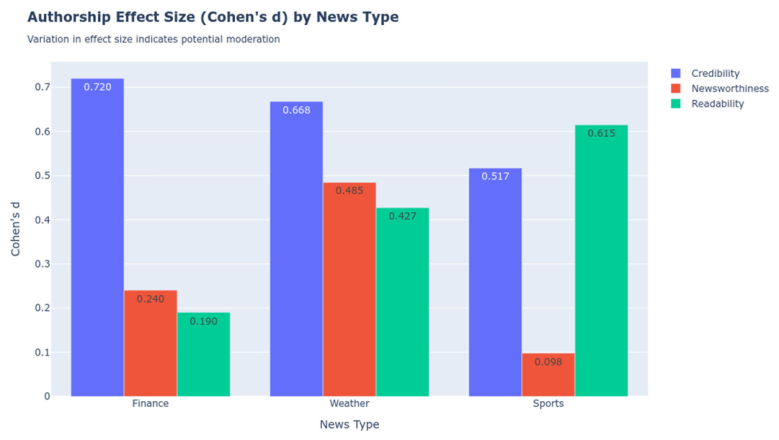
To further examine the potential moderation effect, simple effects tests were conducted to evaluate the effect of authorship separately within each news type. Within finance news, human-authored content (M = 3.45) was rated as significantly more credible than AI-authored content (M = 2.83), t(268) = −5.89, p < 0.001, d = 0.72. Within weather news, human-authored content (M = 3.58) was rated as significantly more credible than AI-authored content (M = 2.99), t(282) = −5.60, p < 0.001, d = 0.67. Within sports news, human-authored content (M = 3.3) was rated as significantly more credible than AI-authored content (M = 2.83), t(259) = −4.15, p < 0.001, d = 0.52. The authorship effect on credibility was consistent across all news types, with effect sizes ranging from medium to large (d = 0.52 to 0.72).
Within finance news, the authorship effect on newsworthiness was not significant, with human-authored content (M = 3.17) rated only slightly higher than AI-authored content (M = 2.94), t(268) = −1.97, p = 0.050, d = 0.24. Within weather news, human-authored content (M = 4.09) was rated as significantly more newsworthy than AI-authored content (M = 3.61), t(282) = −4.07, p < 0.001, d = 0.49. Within sports news, the authorship effect was not significant, with human-authored content (M = 3.03) rated only marginally higher than AI-authored content (M = 2.93), t(259) = −0.79, p = 0.432, d = 0.1. The authorship effect on newsworthiness varied substantially by news type, with the strongest effect observed for weather news (d = 0.49) and negligible effects for finance and sports news.
Within finance news, the authorship effect on readability was not significant, with human-authored content (M = 2.68) rated only slightly higher than AI-authored content (M = 2.49), t(268) = −1.56, p = 0.121, d = 0.19. Within weather news, human-authored content (M = 3.29) was rated as significantly more readable than AI-authored content (M = 2.83), t(282) = −3.59, p < 0.001, d = 0.43. Within sports news, human-authored content (M = 2.95) was rated as significantly more readable than AI-authored content (M = 2.33), t(259) = −4.94, p < 0.001, d = 0.62. The authorship effect on readability varied substantially by news type, with the strongest effect observed for sports news (d = 0.62) and no significant effect for finance news.
10. Post Hoc Tests: News Type Comparisons
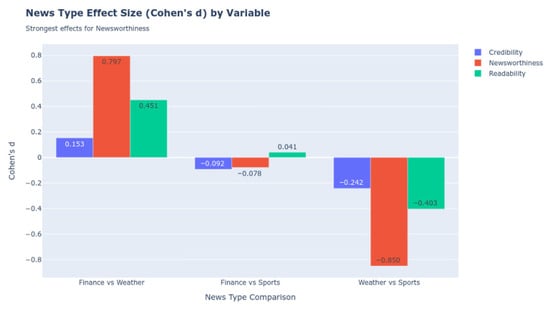
To identify which news types differed significantly from one another, pairwise comparisons were conducted with Bonferroni correction (α = 0.05/3 = 0.0167). For credibility, the pairwise comparisons revealed minimal differences between news types. Finance (M = 3.13) and weather (M = 3.28) did not differ significantly, t(552) = −1.80, p = 0.218 (Bonferroni-corrected), d = 0.15. Finance and sports (M = 3.05) also did not differ significantly, t(529) = 1.06, p = 0.869 (Bonferroni-corrected), d = −0.092. Weather and sports differed significantly, t(543) = 2.82, p = 0.015 (Bonferroni-corrected), d = −0.242, with weather news rated as slightly more credible. Overall, the effect of news type on credibility was negligible.
For newsworthiness, the pairwise comparisons revealed substantial differences between news types. Finance (M = 3.05) and weather (M = 3.84) differed significantly, t(552) = −9.36, p < 0.001 (Bonferroni-corrected), d = 0.8, with weather news rated as significantly more newsworthy. Finance and sports (M = 2.97) did not differ significantly, t(529) = 0.9, p = 1 (Bonferroni-corrected), d = −0.078. Weather and sports differed significantly, t(543) = 9.9, p < 0.001 (Bonferroni-corrected), d = −0.850, with weather news rated as significantly more newsworthy. The news type effect on newsworthiness was large, with weather news receiving substantially higher ratings than both finance and sports news.
For readability, the pairwise comparisons revealed small-to-medium differences between news types. Finance (M = 2.58) and weather (M = 3.05) differed significantly, t(552) = −5.30, p < 0.001 (Bonferroni-corrected), d = 0.45, with weather news rated as more readable. Finance and sports (M = 2.62) did not differ significantly, t(529) = −0.47, p = 1 (Bonferroni-corrected), d = 0.04. Weather and sports differed significantly, t(543) = 4.7, p < 0.001 (Bonferroni-corrected), d = −0.403, with weather news rated as more readable. The news type effect on readability was small-to-medium, with weather news receiving higher ratings than both finance and sports news.
11. Effect Size Comparisons
To assess the relative importance of news type effects across variables, average effect sizes were calculated. For credibility, the average effect size across pairwise comparisons was d = 0.16, indicating negligible news type effects. For newsworthiness, the average effect size was d = 0.58, indicating medium news type effects. For readability, the average effect size was d = 0.3, indicating small news type effects. These results indicate that news type is most important for newsworthiness and least important for credibility (Figure 2 and Figure 3).
Figure 2.
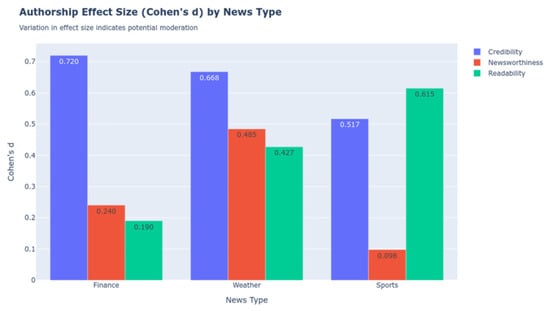
Authorship effect size (Cohen’s d) by variable.
Figure 3.
News type effect size (Cohen’s d) by variable.
To compare the relative magnitudes of authorship and news type effects, all effects were ranked by absolute effect size. The average authorship effect size across all conditions was d = 0.44, while the average news type effect size was d = 0.35. This indicates that authorship effects are approximately 1.3 times stronger than news type effects on average, although news type effects remained substantial, particularly for newsworthiness.
The factorial MANOVA revealed statistically significant main effects for both authorship and news type, as well as a statistically significant but very small interaction effect. Follow-up univariate analyses indicated that the interaction was not significant for any individual dependent variable. Simple effects tests reveal that the authorship effect on credibility is consistent across all news types, while the authorship effects on newsworthiness and readability vary substantially by news type. Post hoc tests revealed that news type effects are strongest for newsworthiness and weakest for credibility, with weather news consistently receiving higher ratings than finance and sports news. Overall, while news type does not meaningfully moderate the authorship effect in a statistical sense, there is evidence of practical variation in the authorship effect across news types for newsworthiness and readability.
12. Discussion
The present study demonstrates that declared authorship functions as a consequential cognitive cue in audience evaluations of news when textual content is held constant. Across finance, weather and sports, articles labeled as human-authored were judged to be more credible than those labeled as AI-authored, with medium-to-large differences by domain (see simple effects tests). By contrast, newsworthiness and readability exhibited domain-contingent variation: authorship mattered most for weather (higher stakes and public relevance), least for sports (more routinized/entertainment-oriented), and modestly for finance. While H2 and H3 were supported in aggregate, the effects were concentrated in specific domains, indicating that authorship cues influence contextual and representational judgments only when aligned with domain expectations.
These results indicate that audiences do not apply a single, undifferentiated attitude toward AI-labeled journalism. Our findings extend prior research, which has documented divergent effects across credibility, readability, and quality dimensions but has not provided a theoretical account of why these dimensions respond differently or when domain moderation should appear for some but not others. Credibility operates as a domain-general source heuristic, while newsworthiness and readability track domain-specific expectations and informational stakes, a distinction that source credibility theory, dual-process models, and the MAIN model collectively predict but has not been systematically examined across multiple evaluative dimensions and news domains simultaneously.
The credibility penalty for AI labels coheres with source credibility theory, which locates judgment in perceived expertise, trustworthiness, and accountability of the source (Hovland & Weiss, 1951; Metzger & Flanagin, 2013). In contemporary digital contexts, audiences often rely on metadata cues, including bylines, to economize judgment under uncertainty (Sundar, 2008). Our finding that the credibility penalty persisted across domains (finance, weather, and sports), even when the content was identical, aligns with the claim that AI-labeled news tends to be viewed as less trustworthy than human-labeled news, independent of accuracy or fairness assessments (Graefe et al., 2018; Waddell, 2017). It is also consistent with some recent studies showing that trust decreases when AI use is signaled, especially among audiences already predisposed to trust news (Altay & Gilardi, 2024; Toff & Simon, 2024). Theoretically, this implies that authorship labels activate accountability schemas, “who is responsible for knowledge claims?”, which remain salient even in data-forward news types. Because this study does not directly measure perceived agency, instrumentality, or related anthropomorphic judgments, these psychological processes are treated as theoretically specified mechanisms rather than empirically tested mediators.
In contrast, newsworthiness, a contextual evaluation of relevance, timeliness, and impact, proved highly sensitive to domain. The strongest authorship effect appeared in weather, where public risk and collective decision-making frequently heighten expectations for human judgment and responsibility. Sports and finance showed smaller or negligible authorship effects on newsworthiness, echoing classic news-values theory: perceived importance is driven first by event characteristics and social stakes, with production cues (like authorship) exerting secondary influence. This pattern suggests that audiences differentiate epistemic trust (credibility) from societal salience (newsworthiness), such that authorship matters most for news judged consequential. Dual-process models account for this directly: when informational stakes are high, source legitimacy cues are weighted more heavily in contextual judgments (Chaiken, 1980; Petty & Cacioppo, 2012).
Readability, a representational judgment focused on processing fluency, also varied by domain, with the strongest human-label advantage in sports and little to no effect in finance. This is theoretically consistent with the MAIN model, in which agency cues (e.g., AI bylines) can bias fluency expectations before reading (Sundar, 2008). Studies show that readers often perceive automated prose as formulaic even when objective readability metrics are similar (Clerwall, 2014; Graefe & Bohlken, 2020). The stronger readability impact in sports likely reflects a narrative norm (expressive, idiomatic prose) where perceived humanness enhances engagement; the weaker impact in finance may reflect baseline complexity and task orientation, where readability judgments hinge more on information structure than authorship cues. These results suggest that representational and affective experiences of news are especially susceptible to genre conventions, consistent with the MAIN model’s prediction that agency cues bias fluency expectations differently depending on the communicative norms of the domain (Sundar, 2008).
Notably, while the multivariate interaction of authorship × news domain reached significance with a small effect, univariate interactions for credibility, newsworthiness, and readability were non-significant. Our simple effects analyses nevertheless revealed practical variation across domains (e.g., consistent credibility differences, heterogeneous readability/newsworthiness). This pattern advances theory in two ways. First, it supports a layered heuristic-schema account in which audiences apply domain-general source heuristics to credibility but domain-contingent evaluative schemas to contextual (newsworthiness) and representational (readability) judgments, a process-oriented framework that advances beyond prior single-dimension accounts. Second, it provides a theoretical account of why evaluative dimensions diverge in response to the same authorship cue—a question that prior multidimensional studies documented empirically but left theoretically unexplained (Graefe et al., 2018; Graefe & Bohlken, 2020). Different dimensions follow distinct logics and respond differently to the same cue, and treating audience evaluation of AI journalism as a single overall response obscures this structure.
These findings carry practical implications for AI disclosure strategy in newsrooms. Because credibility costs for AI labeling appear domain-general, transparent communication may require paired assurances—for example, visible human oversight, named editors, and source lists—to mitigate trust penalties (Altay & Gilardi, 2024; Simon et al., 2025; Toff & Simon, 2024). At the same time, disclosure should be calibrated by genre: in high-stakes domains (e.g., weather), emphasizing accountability controls is pivotal; in low-stakes/entertainment domains (e.g., sports), disclosure may have limited downside if audiences are primarily seeking narrative or outcome information. Policy-wise, our results recommend hybrid-attribution frames (“human-reported with AI assistance”) and artifact-focused transparency (what the AI did, what the human verified) rather than binary author labels.
Taken together, this study offers three theoretical contributions. First, it introduces a layered heuristic-schema framework of AI authorship effects, in which authorship cues simultaneously activate domain-general epistemic heuristics and domain-contingent evaluative schemas. By integrating source credibility theory, dual-process models, and the MAIN model as frameworks operating at distinct but complementary levels of analysis, this study specifies which evaluative dimensions are structurally sensitive to authorship cues and which are not, a contribution that has not been jointly pursued in this context. Second, it integrates news-values and genre schema perspectives to show that authorship cues are amplified by informational stakes—most visible in weather—thereby clarifying boundary conditions for cue utilization. Third, it demonstrates empirically that identical texts yield divergent evaluations across dimensions when metadata cues vary, showing that treating audience perception of AI journalism as a single construct obscures important structural differences in how audiences evaluate news. Taken together, these contributions reframe AI authorship effects as a structurally differentiated, domain-sensitive phenomenon rather than a uniform credibility penalty.
13. Limitations and Future Research
This study has several limitations that suggest directions for future inquiry. First, each of the three news domains was represented by a single stimulus article. While weather, finance, and sports were selected to vary in informational stakes and genre conventions, future research should employ multiple exemplars per domain to assess whether authorship effects generalize across different narrative styles and story formats. Second, the experimental design held textual content constant to isolate labeling effects—a deliberate methodological choice grounded in the study’s theoretical objective. Because the aim was to examine how authorship labels function as heuristic cues independent of content quality, holding the text constant was necessary to attribute observed differences directly to the label rather than to confounded variation in writing style or factual density. This logic follows established experimental traditions in source credibility research (Hovland & Weiss, 1951; Waddell, 2017). However, the design does not speak to contexts where actual AI-generated text may itself differ systematically from human-written content. Future work should compare AI-written and human-written articles while independently manipulating disclosure conditions, to disentangle content quality effects from source attribution effects. Third, the outcome variables were moderately to strongly correlated.
Additionally, the use of a university-based convenience sample warrants consideration. University students may have higher baseline familiarity with digital content production and stronger sensitivity to stylistic features of written prose, which could inflate readability differences between AI-authored and human-authored conditions relative to general population samples. Future research should replicate these findings with more diverse samples to assess whether readability judgments, and potentially newsworthiness evaluations, generalize beyond university-affiliated audiences.
While analyzed separately due to their theoretical distinctness, future research could employ structural equation modeling to test whether credibility functions as an upstream judgment shaping downstream evaluations of newsworthiness and affect, or whether these dimensions operate independently. Finally, this study used a simple AI versus human byline, but newsrooms may describe AI involvement more variably, emphasizing collaboration, assistance, or human oversight. Experimental comparison of alternative disclosure formats could inform transparent yet trust-preserving communication strategies. Longitudinal research examining whether authorship heuristics shift as AI becomes institutionalized in journalism would also be valuable.
Author Contributions
M.A.M.M.—conception and design; analysis and interpretation of the data; drafting of the paper. C.S.P.—conception; analysis and interpretation of the data; visualization of the results; critical revision; final approval of manuscript submission. All authors have read and agreed to the published version of the manuscript.
Funding
This research received no external funding.
Institutional Review Board Statement
The study was conducted in accordance with the Declaration of Helsinki, and approved by the University of Oklahoma Institutional Review Board (protocol code 18298 and date of approval 22 April 2025).
Informed Consent Statement
Informed consent was obtained from all subjects involved in the study.
Data Availability Statement
The aggregated data presented in this study are available on request from the corresponding author.
Conflicts of Interest
The authors declare no conflicts of interest.
Appendix A. News Articles/Stimuli
Company Warns Cocoa Costs Will Drive Down Earnings Per Share 10%
By A. J. Smith (Another version—AI-generated)
Great Foods International Inc. shares slumped in after-hours trading after the company’s executive said “unprecedented cocoa cost inflation” would drive down earnings this year.
The company expects adjusted earnings per share in 2025 to decline by approximately 10%. Cocoa prices remain substantially elevated from prior years, more than doubling since the end of 2023.
Chief Executive Officer of Great Foods said the company was focused on navigating cocoa cost inflation in 2025.
The company said that it expects cocoa prices to eventually come down from their current highs, but they will remain higher than they have historically.
Ice storm to jolt the upper Midwest
By A. J. Smith (Another version—AI-generated)
A winter storm could bring sleet and freezing rain to Montana and the Dakotas late this week, potentially causing treacherous travel conditions and power outages for millions of Americans from Montana to the Dakotas, meteorologists say.
According to the weather forecast, warm, humid air from the south will collide with arctic air from the north as a low-pressure system moves east—atmospheric ingredients that could trigger accumulating snow and dangerous ice along its northern edge.
As the mild air mass clashes with frigid air farther north, the ingredients for a major ice storm are expected to be in place beginning Wednesday across a zone spanning from Montana to the Dakotas, forecasters warned.
Video Assistant Referee makes fewer mistakes this year
By A. J. Smith (Another version—AI-generated)
There have been 13 video assistant referee (VAR) mistakes in the Premier League so far this season—down from 20 at the same point last term, say league bosses.
Four incorrect VAR interventions and nine missed interventions from the first 23 rounds of games have been found by the competition’s Key Match Incidents (KMI) panel.
There have been 70 VAR interventions in 239 league games this season—around one every three matches.
The league says the accuracy of ‘Key Match Incidents’ is at 96.4%—up from 85.7% at the corresponding point last term.
Nobody here underestimates the significance and the impact of one single error, chief football officer said. It is known that one single error can cost clubs. Points and results can cost managers positions, potentially players their place, the official said.
Note
| 1 | We re-estimated all models after excluding participants who failed the manipulation check. The results are consistent with the main analyses. In particular, AI authorship continues to exert a negative and statistically significant effect on perceived credibility. Effects for newsworthiness and readability also remain directionally consistent, with no substantive changes in statistical significance. These findings indicate that the observed authorship effects are not driven by participants who failed to recognize the experimental manipulation. |
References
- Altay, S., & Gilardi, F. (2024). People are skeptical of headlines labeled as AI-generated, even if true or human-made, because they assume full AI automation. PNAS Nexus, 3(10), 1–11. [Google Scholar] [CrossRef] [Scilit]
- Appelman, A., & Sundar, S. S. (2015). Measuring message credibility. Journalism & Mass Communication Quarterly, 93(1), 59–79. [Google Scholar] [CrossRef] [Scilit]
- Aristotle. (2007). On rhetoric: A theory of civic discourse (G. A. Kennedy, Trans.). Oxford University Press. (Original work published ca. 4th century BCE). [Google Scholar]
- Berlo, D. K., Lemert, J. B., & Mertz, R. J. (1969). Dimensions for evaluating the acceptability of message sources. Public Opinion Quarterly, 33(4), 563–576. [Google Scholar] [CrossRef] [Scilit]
- Burgoon, J. K. (1993). Interpersonal expectations, expectancy violations, and emotional communication. Journal of Language and Social Psychology, 12(1–2), 30–48. [Google Scholar] [CrossRef] [Scilit]
- Chaiken, S. (1980). Heuristic versus systematic information processing and the use of source versus message cues in persuasion. Journal of Personality and Social Psychology, 39(5), 752–766. [Google Scholar] [CrossRef]
- Clerwall, C. (2014). Enter the robot journalist: Users’ perceptions of automated content. Journalism Practice, 8(5), 519–531. [Google Scholar] [CrossRef] [Scilit]
- Cools, H., & Koliska, M. (2024). News automation and algorithmic transparency in the newsroom: The case of the Washington post. Journalism Studies, 25(6), 662–680. [Google Scholar] [CrossRef] [Scilit]
- Danzon-Chambaud, S. (2021). A systematic review of automated journalism scholarship: Guidelines and suggestions for future research. Open Research Europe, 1, 4. [Google Scholar] [CrossRef] [Scilit]
- Eilders, C. (2006). News factors and news decisions: Theoretical and methodological advances in Germany. Communications, 31(1), 5–24. [Google Scholar] [CrossRef] [Scilit]
- Galtung, J., & Ruge, M. H. (1965). The structure of foreign news. Journal of Peace Research, 2(1), 64–90. [Google Scholar] [CrossRef] [Scilit]
- Graefe, A., & Bohlken, N. (2020). Automated journalism. Media and Communication, 8(3), 50–59. [Google Scholar] [CrossRef] [Scilit]
- Graefe, A., Haim, M., Haarmann, B., & Brosius, H.-B. (2018). Readers’ perception of computer-generated news: Credibility, expertise, and readability. Journalism, 19(5), 595–610. [Google Scholar] [CrossRef] [Scilit]
- Hilligoss, B., & Rieh, S. Y. (2008). Developing a unifying framework of credibility assessment. Information Processing & Management, 44(4), 1467–1484. [Google Scholar] [CrossRef] [Scilit]
- Hovland, C. I., & Weiss, W. (1951). The influence of source credibility on communication effectiveness. Public Opinion Quarterly, 15(4), 635–650. [Google Scholar] [CrossRef] [Scilit]
- Jia, H., Appelman, A., Wu, M., & Bien-Aimé, S. (2024). News bylines and perceived AI authorship. Computers in Human Behavior: Artificial Humans, 2(2), 100093. [Google Scholar] [CrossRef] [Scilit]
- Lesmy, D., Muchnik, L., & Mugerman, Y. (2025). Lost in the fog: Growing complexity in financial reporting. Humanities and Social Sciences Communications, 12(1), 1813. [Google Scholar] [CrossRef] [Scilit]
- Leuppert, R., Weinmann, C., & Eiden, J. (2025). AI-reporters as the future of journalism? investigating recipients’ credibility evaluations of ai-authored news. Journalism. [Google Scholar] [CrossRef] [Scilit]
- Li, Y., Yu, M., & Li, S. (2022). Technology or content. Telematics and Informatics Reports, 8, 100031. [Google Scholar] [CrossRef] [Scilit]
- Mayo, J., & Leshner, G. (2000). Assessing the credibility of computer-assisted reporting. Newspaper Research Journal, 21(4), 68–82. [Google Scholar] [CrossRef] [Scilit]
- Meade, A. W., & Craig, S. B. (2011). Identifying careless responses in survey data. Psychological Methods, 17(3), 437–455. [Google Scholar] [CrossRef] [Scilit]
- Metzger, M. J., & Flanagin, A. J. (2013). Credibility and trust of information in online environments: The use of cognitive heuristics. Journal of Pragmatics, 59, 210–220. [Google Scholar] [CrossRef] [Scilit]
- Montgomery, D. C. (2017). Design and analysis of experiments. John Wiley & Sons. [Google Scholar]
- Morss, R. E., Demuth, J. L., & Lazo, J. K. (2008). Communicating uncertainty in weather forecasts: A survey of the U.S. public. Weather and Forecasting, 23(5), 974–991. [Google Scholar] [CrossRef] [Scilit]
- Mutz, D. C. (Ed.). (2011). Analysis of population-based survey experiments. In Population-based survey experiments (pp. 108–128). Princeton University Press. [Google Scholar]
- Nakano, H., Takezawa, J., Matulic, F., Yang, C. L., & Yatani, K. (2025). Understanding reader perception shifts upon disclosure of AI authorship. arXiv, arXiv:2510.24011. [Google Scholar]
- Newman, N., Fletcher, R., Robertson, C., Ross Arguedas, A., & Nielsen, R. (2024). Reuters institute digital news report 2024. ORA. [Google Scholar]
- Petty, R. E., & Cacioppo, J. T. (2012). Communication and persuasion: Central and peripheral routes to attitude change. Springer Science & Business Media. [Google Scholar]
- Reinemann, C., Stanyer, J., Scherr, S., & Legnante, G. (2011). Hard and soft news: A review of concepts, operationalizations and key findings. Journalism, 13(2), 221–239. [Google Scholar] [CrossRef] [Scilit]
- Rieh, S. Y. (2002). Judgment of information quality and cognitive authority in the web. Journal of the American Society for Information Science and Technology, 53(2), 145–161. [Google Scholar] [CrossRef]
- Ripberger, J., Bell, A., Fox, A., Forney, A., Livingston, W., Gaddie, C., Silva, C., & Jenkins-Smith, H. (2022). Communicating probability information in weather forecasts: Findings and recommendations from a living systematic review of the research literature. Weather, Climate, and Society, 14(2), 481–498. [Google Scholar] [CrossRef] [Scilit]
- Sadri, S. R., Payne, J. L., Brown, K. A., & Billings, A. C. (2025). Sports news and the artificial-intelligence-generated article. International Journal of Sport Communication, 18(2), 160–174. [Google Scholar] [CrossRef] [Scilit]
- Shadish, W. R., Cook, T. D., & Campbell, D. T. (2002). Experimental and quasi-experimental designs for generalized causal inference. Houghton, Mifflin and Company. [Google Scholar]
- Shah, Z., & Wei, L. (2022). Source credibility and the information quality matter in public engagement on social networking sites during the COVID-19 crisis. Frontiers in Psychology, 13, 882705. [Google Scholar] [CrossRef] [Scilit]
- Shoemaker, P. J., & Cohen, A. A. (2012). News around the world: Content, practitioners, and the public. Routledge. [Google Scholar]
- Simon, F. M., Nielsen, R. K., & Fletcher, R. (2025). Generative AI and news report 2025: How people think about AI’s role in journalism and society. Reuters Institute for the Study of Journalism. [Google Scholar]
- Sundar, S. S. (2008). The MAIN model: A heuristic approach to understanding technology effects on credibility (pp. 73–100). MacArthur Foundation Digital Media and Learning Initiative. [Google Scholar]
- Toff, B., & Simon, F. M. (2024). “Or they could just not use it?”: The dilemma of ai disclosure for audience trust in news. The International Journal of Press/Politics, 30(4), 881–903. [Google Scholar] [CrossRef] [Scilit]
- van der Kaa, H. A., & Krahmer, E. J. (2014, October 24–25). Journalist versus news consumer: The perceived credibility of machine written news. Computation + Journalism Symposium 2014, New York, NY, USA. [Google Scholar]
- Waddell, T. F. (2017). A robot wrote this? Digital Journalism, 6(2), 236–255. [Google Scholar] [CrossRef] [Scilit]
- Wang, R. Y., & Strong, D. M. (1996). Beyond accuracy: What data quality means to data consumers. Journal of Management Information Systems, 12(4), 5–33. [Google Scholar] [CrossRef] [Scilit]
- Wang, S., & Huang, G. (2024). The impact of machine authorship on news audience perceptions. Communication Research, 51(7), 815–842. [Google Scholar] [CrossRef] [Scilit]
- Warne, R. (2014). A primer on multivariate analysis of variance (MANOVA) for behavioral scientists. Practical Assessment, Research, and Evaluation, 19(1), 17. [Google Scholar]
- Waytz, A., Heafner, J., & Epley, N. (2014). The mind in the machine: Anthropomorphism increases trust in an autonomous vehicle. Journal of Experimental Social Psychology, 52, 113–117. [Google Scholar] [CrossRef] [Scilit]
- Wölker, A., & Powell, T. E. (2018). Algorithms in the newsroom? News readers’ perceived credibility and selection of automated journalism. Journalism, 22(1), 86–103. [Google Scholar] [CrossRef] [Scilit]

Disclaimer/Publisher’s Note: The statements, opinions and data contained in all publications are solely those of the individual author(s) and contributor(s) and not of MDPI and/or the editor(s). MDPI and/or the editor(s) disclaim responsibility for any injury to people or property resulting from any ideas, methods, instructions or products referred to in the content. |
© 2026 by the authors. Licensee MDPI, Basel, Switzerland. This article is an open access article distributed under the terms and conditions of the Creative Commons Attribution (CC BY) license.