


Abstract
The mineral resources sector has faced intense social and environmental scrutiny in recent years, often driven by a perceived lack of information and transparency regarding projects. Due to a perceived lack of information and transparency regarding projects, local communities have increasingly opposed them, leading to the revision of the Portuguese Decree-Law Nº. 30/2021, which now mandates public clarification sessions for communities in affected territories. This study reviews the state of the art concerning socio-environmental conflicts and analyses the role of social awareness within the context of Corporate Social Responsibility (CSR). A survey was conducted in the parish of Alqueidão da Serra (Central Portugal), a community historically exposed to stone extraction, to assess perceptions of sustainability and the sector’s impact. The methodology combined the literature review with a statistical analysis of the population’s views. Results indicate that the community recognises both the economic relevance and necessity of the sector, while simultaneously expressing concerns regarding local impacts. In this context, an exploratory Not In My Back Yard (NIMBY) tendency is identified in 45 ± 6% of the population, with women showing a greater propensity. The study concludes that socio-environmental issues are the primary drivers of conflict. These findings support recommendations for enhanced population sensitivity studies and structured public clarification sessions to mitigate conflict.
1. Introduction
Under the argument of lack of information and transparency, the populations of the territories covered by projects in the mineral resources sector (mines and quarries) have consistently increased the degree of contestation and objection.
In Vintróa et al. [1], it is stated that during the last two decades, society has become more concerned about environmental and social issues, forcing companies to redefine their strategy. According to Reisch [2], there is a growing number of conflicts related to natural resource extraction. Several reports [3,4,5] highlight that restrictions on the operational space of human rights defenders are particularly severe in the extractive and natural resource sectors. As mentioned in Veldhuizen et al. [6], in a world approaching climate and biodiversity tipping points, a widening range of stakeholders is demanding a say in operations. Nevertheless, companies often fall short of societal expectations, leading to controversy and discord. This has consequences for perceptions regarding the legitimacy of companies and the social licence to operate (SLO) [6]. Lamas [7] mentions that mining corporations can be seen as engines of dispossession and violence, including environmental degradation and unfulfilled promises.
For Mateus and Martins [8], mining conflicts are increasing in number and intensity worldwide. Regarding Corporate Social Responsibility (CSR), they refer to the fact that originally the purpose was to provide social advantages beyond legal compliance, which might not necessarily include specific concerns raised by local communities [8]. As mentioned by Dubiński [9], the sustainable development of mineral resources mining is a major challenge for today’s global world; companies must provide sustainable and socially acceptable development, as mineral resources are invariably needed by people.
At the national level, specifically in Portugal, the populations of territories covered by projects in the mineral resources sector have consistently increased the degree of contestation. This led to the review of Portuguese Decree-Law Nº. 30/2021, of 7 May [10], which now mandates public clarification sessions for populations in affected territories. Considering the complexity of the issue due to the great population diversity, it required the need to study awareness-related issues within the scope of the mineral resources sector. This was experienced with each session prioritising the consolidation of knowledge under a “case-based application” methodology, avoiding the “trial and error” methodology.
1.1. Theoretical Framework: Socio-Environmental Conflicts and the NIMBY Effect
The acronym NIMBY (Not In My Back Yard) is widely used to describe the opposition of residents to a proposed development in their local area, despite often recognising the need for the facility in a broader context [11,12]. Coined in the 1980s, the term suggests that resistance is driven by proximity and self-interest, such as the fear of pollution or a reduction in property value. However, Johnson [11] argues that NIMBY psychology is a simplistic explanation for a multifaceted problem. O’Hare [12] identified the strategic importance of compensation early on to address local opposition. This phenomenon is not limited to traditional industrial projects; Wolsink [13] and Horst [14] extensively studied the concept in the context of wind energy, questioning its validity as a comprehensive explanation for social non-acceptance—often referring to it as the “NIMBY-myth”. They argue that institutional capacity and the nature of public consultation play a more significant role than mere proximity. Similarly, Warren et al. [15] explored the “Green on green” debate, noting that abstract support for renewable energy often conflicts with local implementation. Furthermore, Kraft and Clary [16] highlighted the intense public response to perceived high-risk facilities, such as radioactive waste disposal. Recent studies by Lu [17], Gu [18], and Hu and Han [19] continue to illustrate the global relevance and evolving nature of this socio-environmental conflict.
The analysis of these conflicts reveals a complex interplay between local communities, mining companies, and state institutions. Walter and Martinez-Alier [20] describe a mechanism often observed in these disputes as the “revolving door” of conflict. This concept explains how conflicts shift between institutional and non-institutional spheres: when communities feel ignored by formal channels, they resort to direct action to force the conflict back into the institutional arena under more favourable terms. Muradian et al. [21] frame these conflicts as a clash between international capital and local populations, highlighting the disparity in power and resources. This asymmetry is often exacerbated in areas of limited statehood, where the state lacks the capacity to enforce regulations, leaving a governance void filled by corporate interests [22]. Haslam [23] delves into the micro-politics of corporate responsibility, suggesting that while companies may adopt CSR policies, the on-the-ground reality often involves a struggle for legitimacy. In this context, Gundermann et al. [24] note that the maturation of civil society has led to more organised opposition, challenging traditional top-down mining governance. A critical backdrop is the “Commodities Consensus” described by Svampa [25], where high raw material prices drive an expansion of extractive frontiers. Ultimately, Veldhuizen et al. [6] identify a “social gap”—the discrepancy between the mining industry’s expectations of acceptance and the actual perceptions of the public.
1.2. Mitigation Strategies, Legislation, and SDG
In the search for solutions to mitigate the identified conflicts, Gugerell et al. [26] identify territorial governance as gaining increasing importance in policy debates, closely related to the normative notions of territorial cohesion and spatial planning. From a policy perspective, territorial governance is crucial to achieve territorial cohesion, which is a core component of the EU 2020 strategy; the EU [27] advocates the importance of area-based, territorially sensitive, and integrated approaches. Since mineral resources are bound to their locality, they can play an important role in local and regional development [26]. In a broader view, Mateus and Martins [8] analyse the balance between social acceptance and secure supply at the European level. They note that roadmaps oriented toward eco-efficient economies stimulate reliance on a large number of minerals. Despite efforts to dematerialize the economy, Graedel et al. [28] and McCarthy and Börkey [29] argue that while recycling and consumption reduction are major guidelines, inputs from primary resources will always be necessary.
To address societal reluctance, Mateus and Martins [8] argue that an open and systematically updated database about ongoing or planned industrial activities should be created and disclosed to the public to minimise polarisation caused by biassed interpretations. Johnston-Billings et al. [30] point out that narratives about mineral resources are often shaped by people with no direct interaction with companies, meaning that obtaining an SLO is no longer just an interpersonal process with nearby communities. Innovative approaches to effective social engagement are required. In the national panorama regarding land-use planning (LUP), Carvalho et al. [31] provide a multi-criteria assessment of mineral resources safeguarding in Portugal, noting that land scarcity and competing interests increase tensions. As identified by Kot-Niewiadomska and Galos [32], the list of elements considered in such assessments is extensive. To bridge the information gap, the Portuguese legal framework evolved with the enactment of Decree-Law Nº. 30/2021 [10], which mandates public clarification sessions to manage “social acceptability risk” through mandatory participation mechanisms.
The implementation of sustainable development requires the integration of technical, economic, ecological, and social dimensions [9]. In 2015, the United Nations (UN) adopted the 2030 Agenda, centred on the 17 Sustainable Development Goals (SDGs) [33]. Although the mining industry has an unprecedented opportunity to advance these goals [34], a recent analysis by the Responsible Mining Foundation (RMF) and the Columbia Center on Sustainable Investment (CCSI) [35] highlights a risk of “SDG-Washing”. The report concludes that while companies mention SDGs in reports, practical application remains limited. In Portugal, the sector aligns with these goals through representative associations. The Cluster Portugal Mineral Resources (ACPMR) [36] promotes the “REVIVING” concept to give new life to stone resources. Similarly, the Portuguese Association of the Mineral Resources Industry (ASSIMAGRA) [37] has developed the “Sustainable Stone by Portugal Agenda” and is actively involved in the “Roadmap for Carbon Neutrality 2050”, aiming to align the national extractive industry with decarbonization goals.
Building on existing research on NIMBY phenomena, recent studies highlight the complexity of these conflicts, particularly through the interaction between risk perception, institutional trust and environmental factors [38]. Other approaches have examined these dynamics from a systemic perspective, showing how opposition may emerge from interconnected risk factors within socio-technical systems [39], while more applied research has emphasised the role of stakeholder engagement and communication processes in shaping conflict outcomes [40]. Despite these contributions, empirical evidence remains limited for communities with long-term exposure to extractive activities, especially in Southern European contexts where such industries have historically influenced local economies and social structures. This study addresses this gap by combining a survey-based analysis of sustainability perceptions with a contextual interpretation of prolonged territorial exposure, allowing for an examination of the “social gap” between general acceptance and local resistance.
This study addresses this gap by examining a Portuguese community historically exposed to mineral resource extraction, providing an integrated empirical analysis of perceptions, information needs, and NIMBY-related tendencies. There are three main objectives: (i) the analysis of the compatibility between environmental sustainability, economic sustainability of extraction, and social sustainability of the community surrounding industries in the mineral resources sector; (ii) fieldwork to collect opinion data from a population exposed to the exploitation of mineral resources (Parish of Alqueidão da Serra, Central Portugal), using a survey to understand their perspective on sustainable development and the sector’s history; and (iii) to systematise a model of preparation and assistance for clarification and awareness sessions. Secondary objectives include understanding the extractive industry’s perspective on sustainability, exploring the presence of NIMBY-related tendencies through an exploratory operational approach, and understanding the United Nations Sustainable Development Goals (UN SDGs) context and role of the sector.
2. Materials and Methods
2.1. Study Area
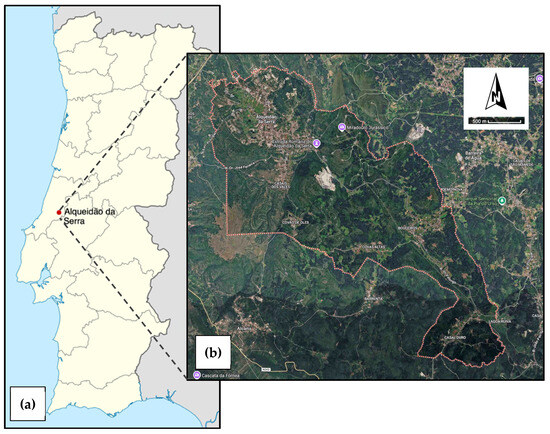
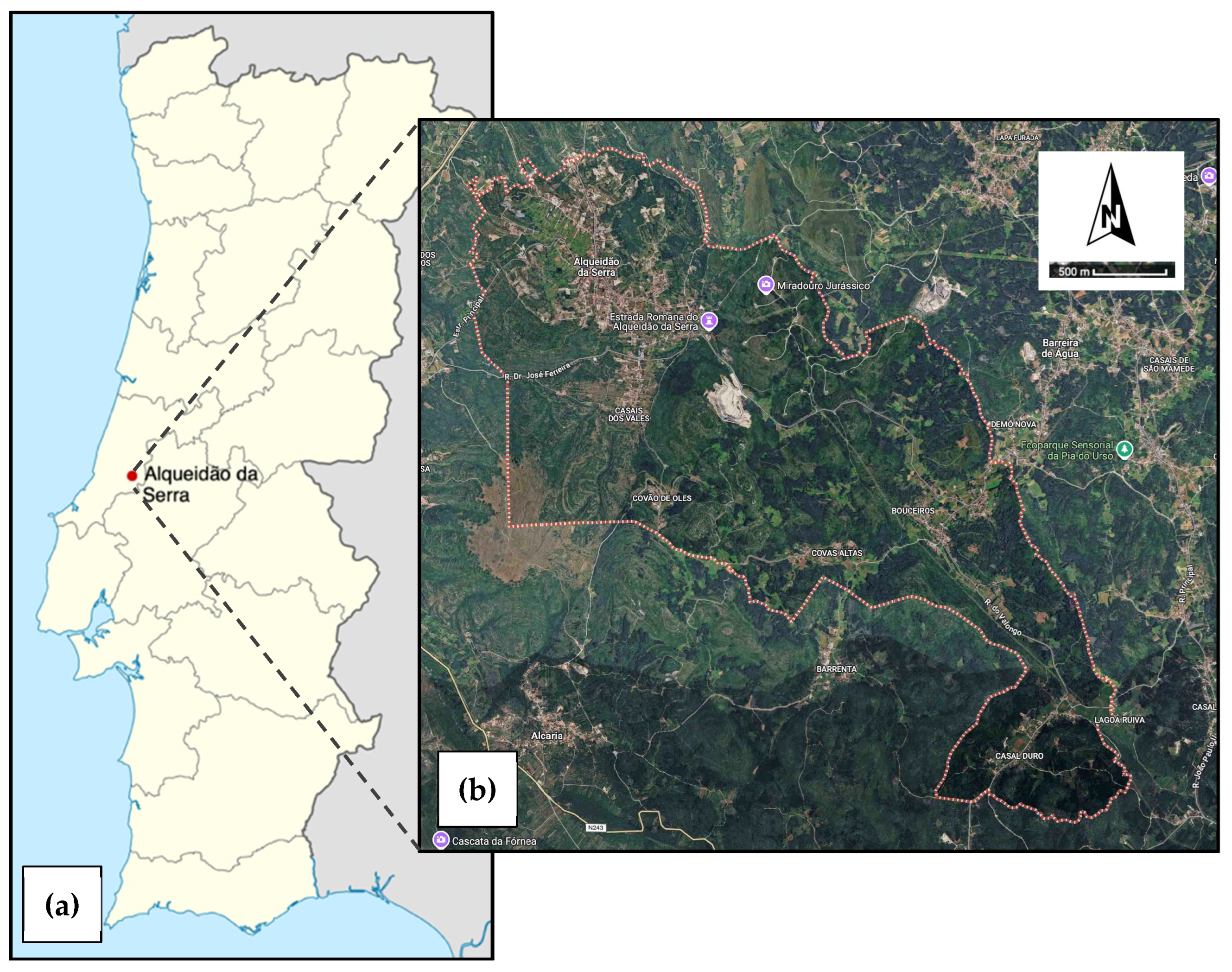
The parish of Alqueidão da Serra belongs to the Municipality of Porto de Mós, in the district of Leiria, in Central Portugal. Located within the Aire mountains, it is partially included in the Serra de Aire e Candeeiros Natural Park. In the region, Middle Jurassic limestones predominate, which historically and currently enable the opening and operation of several quarries for various purposes. The parish covers an area of 21.27 km2 and has 1549 inhabitants [41]. The geographical framework and the specific configuration of the parish boundaries can be observed in Figure 1.
Figure 1.
(a) Geographical framework of Alqueidão da Serra parish (adapted from Wikipédia, 2024); (b) Configuration of the parish of Alqueidão da Serra, with boundaries delineated with a red line (photography adapted from Google Maps, version 11.110.x).
According to the Parish Council of Alqueidão da Serra [42], the extensive extraction and cutting of limestone for sidewalks did not survive the 2011 economic crisis. This activity had a significant economic impact over the previous three decades, and Alqueidão da Serra was known as the “capital of Portuguese sidewalks”. In spatial terms, there were two main “cores” of limestone exploitation near the village: the Cabeça da Vaca (“moinhos”) and Zambujal area to the south-west, and the Cumeira and Vale das Matas area to the north-east. The parish also contains a Class 2 quarry producing limestone for civil construction and industrial use.
This long-standing presence of quarrying activity provides an important contextual basis for interpreting the survey results. The population under study has not been exposed merely to recent or sporadic extractive activity, but rather to a sector that has historically played a relevant role in local economic activity and the organisation of the territory. This activity represented a significant component of the local economy over several decades, contributing to employment while shaping the broader socioeconomic structure of the parish. Although its intensity declined following the 2011 economic crisis, quarrying activity remains present and continues to influence current local dynamics.
In this sense, the case of Alqueidão da Serra supports the analysis of perceptions within a context of prolonged coexistence between the local community and mineral resource exploitation, in which economic relevance, environmental concerns, and social acceptance have evolved together over time.
2.2. Survey Design and Sample
The study was carried out through a questionnaire applied to the inhabitants of the parish of Alqueidão da Serra between 1 December 2023 and 31 January 2024. To maximise participation and avoid digital exclusion, the survey was available in both paper format and online (via Google Forms). The online version restricted responses to one per email address, and all answers were anonymous.
The survey consists of eighteen thematically grouped questions (the full questionnaire is provided as Supplementary Material Questionnaire S1). It was structured to cover different analytical dimensions, including: (i) demographic characteristics (gender, age, and education level), (ii) awareness level and proximity to extractive activities, (iii) perceptions of necessity and impacts, (iv) expectations related to environmental compensation, and (v) access to information and perception of legacy issues. These dimensions support the analysis of acceptance, local opposition, and NIMBY tendencies, while allowing the identification of relationships between demographic characteristics and response patterns.
The target population included 1327 residents aged 18 or over [41]. A total of 210 responses were obtained (134 online and 76 on paper). According to Cochran’s modified formula for finite populations, this sample corresponds to a 95% confidence level and a maximum margin of error of 6.21%, indicating a satisfactory and representative sample. Age was grouped into predefined intervals starting at 18 years (the legal age of adulthood in Portugal) and organised into ten-year classes. This grouping was adopted to ensure statistical robustness and to facilitate cross-analysis between demographic variables and perception indicators. Given the sample size and distribution, broader age intervals allow more consistent comparisons across groups. This approach is intended for analytical purposes and does not aim to replicate official statistical classifications.
The use of a structured questionnaire is consistent with the objectives of this study, as it enables the systematic collection of perceptions on environmental, social, and economic aspects among a population directly exposed to mineral resource exploitation. This approach is commonly used in studies of social acceptance and NIMBY phenomena, where perceptions and attitudes are central to interpreting local responses. The survey design supports the identification of perception patterns and their relationship with demographic variables, allowing a more structured interpretation of the results.
2.3. Statistical Analysis
The analysis of the data collected in the population survey is based on the systematisation of the data recorded in a spreadsheet and the statistical software IBM SPSS (version 29.0.2.0). The software allows the answers obtained to be cross-analysed. This means that it is possible to understand how the differences in the respondent’s age, gender, or educational level influence other questions.
In this study, the independent variables correspond to the respondents’ characterisation variables (gender, age class, and educational level). The dependent variables correspond to the responses obtained for the perception-related questionnaire items analysed across the different subchapters. Accordingly, the statistical analysis tests whether the distribution of responses differs significantly between independent groups defined by the characterisation variables—such as gender, age and education level.
After checking the normality of the sample (and having verified in the present case that the data obtained do not follow a normal distribution), non-parametric tests were used to carry out a statistically significant analysis. The normality tests used were the Kolmogorov–Smirnov and Shapiro–Wilk. Consequently, a statistical test called Kruskal–Wallis one-way ANOVA by ranks was carried out. This is a non-parametric method that allows two or more independent samples of equal or different sizes to be compared.
2.4. Model of NIMBY Effect Estimation
To estimate the NIMBY effect within the surveyed population, two survey items were analysed addressing preference regarding proximity to quarrying activity and the perceived necessity of mineral resource exploration. Respondents who supported mineral resource exploration in general but rejected nearby quarries were interpreted as displaying a locally self-protective bias. Based on the literature [6,12], the method quantifies this attitude by calculating the overlap between recognising the overall need for mineral resources and opposing their local impacts. In this way, the “social gap” is translated into a measurable indicator. This simplified operationalization should be interpreted as an exploratory first approach, intended to support the interpretation of survey results rather than to provide a model of NIMBY dynamics.
3. Results
3.1. Respondents’ Profile and General Awareness
The study sample comprises 210 respondents, including 110 women (52%) and 100 men (48%). The distribution of respondents by age class is presented in Table 1. The most represented age group is 38–47, followed by 48–57 and 28–37, while younger and older groups show lower representation.
Table 1.
Distribution of respondents by age class.
The sample shows a relatively high educational level; 53% (112 respondents) hold a higher education degree. In addition, 22% completed secondary education (12th grade), 11% completed the ninth grade, and about 12% completed only basic education (sixth grade or primary level). Overall, more than 75% have completed at least secondary education, indicating a well-educated sample. It is important to note that the high educational attainment observed in the sample is not representative of the Portuguese population as a whole and should be interpreted considering the specific territorial context and the characteristics of the surveyed community.
The survey began by assessing familiarity with the topic. When asked whether they could identify/define a mineral resource, 93% responded positively, and 91% provided valid examples, most commonly stone, limestone, and coal. Local awareness of extractive activities is also significant: 92% identified one or more mineral resource operations within a 5 km radius of their residence. Regarding perceived density, 45% reported between one and five explorations, and 25% between six and ten, meaning that around 70% perceive no more than ten nearby sites.
The survey further explored perceptions linked to the social licence to operate. Responses to whether respondents would prefer no nearby quarries were almost evenly split: 51% expressed such a preference, while 49% did not. However, when asked about acceptable coexistence, 68% stated that up to five quarries could operate nearby without generating significant disturbance. At the same time, 94% acknowledged that mineral resource exploration is necessary for society, with only 6% disagreeing.
These findings highlight a clear distinction between local preferences and broader societal recognition of the sector’s importance. While a slight majority would prefer not to have quarries close to their homes (51%), an overwhelming majority (94%) recognise their necessity, providing the empirical basis for analysing the “social gap”.
3.2. Perception of Necessity, Impacts, and Coexistence
Following broad recognition of the sector’s necessity, the survey examined the motivations underlying this position. Respondents were asked to classify the following statements regarding the need for mineral resource exploration, based on the five statements of agreement. The results, detailed in Table 2, show a clear prioritisation of economic factors over social or environmental justifications.
Table 2.
Balance between agreeing, neutral, and disagreeing opinions in responses to statements regarding the need for mineral resource exploration.
The detailed analysis of the aggregated data in Table 2 reveals a clear hierarchy of motivations, with a predominance of economic reasoning over social or environmental arguments. Economic support for families achieved the highest level of agreement (66%), followed by construction needs (63%) and boosting the local economy (61%). Conversely, the statement suggesting that the landscape and environment are worth less than the resource was strongly rejected, with 70% disagreeing. This indicates that acceptance of quarrying is not grounded in the devaluation of the environment. The broader structural argument—“without quarries there is no society as we know it”—received limited support (20% agreement), with substantial disagreement and neutrality, suggesting that the systemic role of mineral resources in modern society is not fully perceived. Only 12 respondents considered exploration unnecessary; for that, no detailed statistical analysis was undertaken.
Perceived impacts were assessed by asking respondents what they consider the main problem/annoyance associated with a quarry. An overwhelming majority (81%) identified destruction of the surrounding landscape and environment as the principal concern, clearly outweighing issues such as dust, traffic, noise or scale. This reinforces the centrality of landscape in local perceptions. Nevertheless, respondents demonstrate confidence in mitigation. When asked whether quarrying can be reconciled with environmental protection, 69% agreed that quarrying can be reconciled with environmental protection (40% partially; 29% totally), while only 3% totally disagreed. Similarly, 85% believe compensatory measures for environmental damage are possible. The alignment between variables—94% recognising necessity (from earlier results), 81% identifying landscape impacts, and 85% expressing confidence in compensation—shows limited variation (Δmax 13%). This consistency suggests a structured perception: quarrying is necessary, environmentally impactful, yet manageable through appropriate mitigation and compensation.
The survey also explored historical and personal connections to the sector. Respondents were also asked how long they believe quarrying has been present near their location, using five predefined time-interval options. The distribution of responses was 3% for less than 30 years, 17% for 30 to 45 years, 29% for 45 to 60 years, 23% for 60 to 75 years, and 27% for more than 75 years. The results indicate that 79% of respondents consider that nearby quarries have operated for more than 45 years, while 50% indicate durations exceeding 60 years. In this context, these values support the interpretation of a population widely exposed to long-term quarrying activity. This pattern is consistent with the average respondent age (46 years) and reinforces the interpretation of generational exposure within the study population. Personal ties are equally strong: 91% know someone who works or has worked in quarrying. However, responses concerning the size of these personal networks showed a polarised distribution, limiting the robust interpretation of workforce dimension.
Overall, the findings indicate that economic considerations underpin acceptance, landscape impacts dominate concern, and coexistence is viewed as feasible within a framework of environmental mitigation and long-standing social embeddedness.
3.3. Collective Memory Analysis
The results presented so far show that age does not have a statistically significant influence on most of the responses obtained. However, to further interpret these findings, it is important to consider how respondents perceive the duration of quarrying activity in the territory in which they live. In this context, the analysis explores the relationship between age groups and the perceived longevity of mineral resource exploitation as a way to assess whether the population retains a form of collective memory associated with the sector.
The analysis was conducted based on aggregated age groups, combining adjacent age classes to facilitate interpretation and ensure consistency with the methodological approach described above. The results of this aggregation are presented in Table 3.
Table 3.
Results aggregation of the cross-table between age class and longevity perception.
Table 3 was built based on the combination of the available response options regarding the perceived duration of quarrying activity, organised by age class, specifically:
- Age classes 18–27 and 28–37 together have an average age of around 28 years, analysing the number of answers obtained above and below the options that mark the limit of 30 years.
- Age classes 38–47 and 48–57 together have an average age of around 48 years, analysing the number of answers obtained above and below the options that mark the limit of 45 years.
- Age classes 58–67 and 68–77 together have an average age of around 68 years, analysing the number of answers obtained above and below the options that mark the limit of 60 years.
Analysis of Table 3 by age group reveals consistent recognition of the long-standing presence of quarries in the locality, supporting the existence of a “collective memory” associated with the mineral resources sector:
- In the 18–27 and 28–37 age groups, 88% and 94% of respondents, respectively, consider that quarries have operated nearby for more than 30 years. Given that the average age within these groups is around 28 years, quarrying has effectively existed for longer than their own lifetimes. For these respondents, the presence of quarries has therefore always been a lived reality.
- Among respondents aged 38–47 and 48–57, 84% and 87%, respectively, state that quarries have been present for over 45 years. Considering that, for the vast majority of these interviewees, the average age of these groups is 48 years, the duration of quarrying closely matches their lifespan. So, for the majority within these age groups, extractive activity has consistently formed part of the local context.
- The older groups (58–67 and 68–77) show more differentiated perceptions. A total of 41% and 62%, respectively, believe that quarries have existed for more than 60 years. Given an average age of roughly 68 years across these groups, it cannot be conclusively stated that quarrying predates all respondents. Nevertheless, they confirm recognition of a long-established sector deeply embedded in the locality.
Overall, the evidence supports the presence of a collective memory, particularly among respondents aged 18–57, reflecting prolonged exposure to quarrying activities. This sustained coexistence does not necessarily imply positive or negative attitudes towards the industry. The existence of such collective memory strengthens the robustness of the survey findings and provides additional support for the study’s broader conclusions.
3.4. NIMBY Effect Estimation and Sustainability Perception
The analysis of the NIMBY effect was based on a cross-comparison between responses reflecting preference regarding proximity to quarrying activity and the perceived necessity of mineral resource exploitation, allowing the identification of potential inconsistencies between general acceptance of the sector and local opposition.
Given the number of possible combinations between survey items, the cross-analysis was restricted to the pair of questions directly related to the identification of NIMBY-related behaviour. This approach focuses the analysis on the relationship between general acceptance of mineral resource exploitation and local proximity preference, ensuring a clear and targeted interpretation of the observed responses. Table 4 summarises the results obtained.
Table 4.
Quantification of cross-answers between perceived necessity of mineral resource exploitation and preference regarding proximity to quarrying activity.
A strict NIMBY interpretation reflects a potential contradiction between the recognition of the need for mineral resource exploitation and the rejection of its proximity to the respondents’ place of residence. In operational terms, two response patterns are analytically relevant: (i) respondents who do not oppose nearby quarrying and simultaneously recognise the necessity of mineral resource exploitation; and (ii) respondents who recognise the necessity of mineral resource exploitation while expressing a preference against nearby quarrying.
The second pattern captures this internal inconsistency, where general acceptance coexists with local opposition, and is therefore used as the basis for the NIMBY-related indicator reported below.
Table 4 shows that respondents who do not oppose nearby quarrying consistently recognise the necessity of mineral resource exploitation. However, among those who express a preference for the absence of nearby quarries, most still consider mineral resource exploitation to be necessary. This inconsistency between acceptance at a general level and rejection at a local level is characteristic of NIMBY-type behaviour and supports its identification within the study population.
The response pattern described above, in which respondents simultaneously recognise the necessity of mineral resource exploitation while expressing a preference against nearby quarrying, is used as the basis for estimating NIMBY behaviour, which can be defined as the proportion of respondents exhibiting this pattern relative to the total number of valid responses. This definition provides a direct and measurable way to capture the coexistence of general acceptance and local opposition within the study population. allowing us to propose the following Equation (1):
where
- —NIMBY effect of the sampled population (%);
- YY—number of interviewees who answered “yes” to both questions;
- —total interviewees who answered both questions;
- e—margin of error associated with the sampled universe (6.2%).
Applying Equation (1), the presence of the NIMBY effect is estimated at:
The estimated value of this indicator summarises the relationship observed between general acceptance and local opposition within the study population. The tendency reflects a consistent pattern in respondents’ perceptions, rather than an isolated behaviour. This suggests that local resistance is not associated with a rejection of the sector itself, but with concerns related to proximity and perceived impacts.
Furthermore, the number of women and men who simultaneously answered “yes” to both questions was counted, resulting in Table 5, which shows a difference (Δ 20%), indicating a greater propensity for women to manifest the NIMBY effect.
Table 5.
Distribution of women and men simultaneously expressing general acceptance of mineral resource exploration and preference against nearby quarrying activity.
The estimated NIMBY effect values derived from the formulation presented in Equation (1) and supported by the cross-analysis presented in Table 5 should be interpreted as exploratory and context-specific indicators, rather than constituting a comprehensive or definitive measure of NIMBY behaviour.
To understand the consistency of the population’s view, cross-analyses were performed regarding the environmental and social pillars. So, Table 6 summarises the relationship between the perceived necessity of mineral resource exploitation and agreement with environmental protection compatibility.
Table 6.
Quantification of cross-responses between perceived necessity of mineral resource exploitation and agreement with environmental protection compatibility.
Interpreting Table 6, the results indicate that 70% of interviewees who consider it necessary to explore mineral resources show agreement with the possibility of reconciling exploitation with environmental protection. This points to a context of environmental sustainability, where the population believes in the coexistence of the sector with environmentally demanding standards.
Finally, Table 7 summarises the relationship between the perceived necessity of mineral resource exploitation and the recognition of its socioeconomic importance.
Table 7.
Quantification of cross-responses between perceived necessity of mineral resource exploitation and recognition of socioeconomic importance.
Based on this analysis, it is possible to interpret that the surveyed population shows a very consolidated recognition of the social and economic importance of the sector (90% agreement). By expressing high levels of agreement with the need to explore resources, with the socioeconomic importance, and cumulatively with the possibility of environmental reconciliation, the results solidify the interpretation of a general context of sustainability. The population understands the mineral resources sector where the environmental, social, and economic pillars are present, corresponding to the definition of UN SDG’s.
3.5. Compensatory Measures and CSR
In light of the NIMBY tendency identified in the previous section, the survey examined which specific measures are valued by the community. Respondents who agreed that compensatory measures are possible were asked to rate ten compensation strategies (179 respondents who answered affirmatively in the previous item). The results, summarised in Table 8, establish a detailed hierarchy of the population’s preferences across landscape restoration, operational mitigation, and social awareness.
Table 8.
Agreeing, neutral, and disagreeing opinions about compensatory measures.
The detailed analysis of Table 8 reveals a strong coherence with the environmental concerns previously identified. The three measures with the highest agreement are directly related to the physical integrity of the territory: “Restore the landscape of the quarry site” (63%), “Correct routing of waste produced” (62%), and “Implement measures to minimise impact on the landscape” (60%). This prioritisation of landscape restoration over other operational mitigations (such as reducing noise or truck traffic, which received the highest disagreement rates of 19% and 16%, respectively) confirms that visual impact is the primary driver of community grievance. Furthermore, measures of a purely social or bureaucratic nature, such as “Create an environmental office” or “Carry out awareness-raising actions”, fell below the 50% agreement threshold. This suggests that the population prioritises tangible, visible environmental remediation over administrative solutions.
The survey then addressed the broader role of companies in the community. Respondents were asked whether operating companies have or can have social responsibility in the locality, and there was a clear consensus: 89% of respondents answered “Yes”, affirming that companies bear a duty beyond their operational footprint. To understand how this responsibility should materialise, they were then asked to classify specific CSR measures. The preferences for corporate social intervention are detailed in Table 9.
Table 9.
Agreeing, neutral, and disagreeing opinions regarding social responsibility measures.
Analysing Table 9, a distinct preference for educational and cultural initiatives emerges. The statement “Build a mineral resources interpretation centre” received the highest agreement (55%), followed by “Implement support for the education of local students” (52%) and “Develop cultural actions in the locality” (51%). This indicates that the community values knowledge transfer and cultural preservation over direct financial subsidies; notably, “Create financial birth support” received the lowest agreement (42%) and significant disagreement. Additionally, Table 9 displays a marked increase in “neutral” opinions (averaging 20–29%) compared to previous tables. This rise in neutrality suggests a “gap” in the population’s understanding of CSR.
3.6. Information Access and Legacy of Abandoned Quarries
The information available to the population regarding quarrying activities plays a role in shaping local perceptions and may contribute to explaining the NIMBY tendency identified in the preceding sections. In this context, the survey explored the community’s perspective on the sector; the survey sought to understand the community’s perspective on the sector.
Respondents were asked whether quarrying in their locality is, or was, important economically and/or socially. In general, there are 86% of agreeing opinions about the importance of quarrying, only 5% of disagreeing opinions, despite concerns related to proximity and local impacts. This finding helps to substantiate the results obtained, where the economic context represented a solid justification for accepting the exploration of mineral resources. However, regarding the accessibility of data, when asked whether there is sufficient information about nearby quarries, a significant deficit was reported, which may contribute to the persistence of local concerns related to quarrying activities.
The results show that 75% of the respondents say they do not have enough information. Consequently, a large majority indicated that access to information about nearby quarries is important, meaning that 89% of those interviewed say “Yes”. Doing a cross-analysis with responses related to perceived information availability, it was found that the percentage of individuals who think more information is needed is higher by 14% than those who currently feel uninformed, reinforcing the active demand for transparency.
To determine who holds the duty to inform, respondents identified which entities should be responsible for providing information. They could choose more than one option. For a general analysis, it is considered the number of times each entity was mentioned, as shown in Table 10.
Table 10.
Entities identified as responsible for making information available.
Analysing Table 10, it can be seen that the Parish Board is the entity that respondents hold most responsible (135 references), closely followed by the Operating Company (132 references). From this accounting, it is clear that respondents attribute greater responsibility to the public entity closest to the location (Parish Board) and the private entity on site, rather than more distant entities like the City Hall or the DGEG.
Following the confirmation that respondents consider it important to have access to information, the survey assessed specifically what kind of data they value, asking respondents to classify different information categories related to nearby quarrying activities. This question was answered by the 186 respondents who answered affirmatively in the previous item. The results, balanced between agreeing, neutral, and disagreeing opinions, are presented in Table 11.
Table 11.
Agreeing, neutral, and disagreeing opinions regarding information categories.
Regarding the aggregated data in Table 11, the statement that deserves the greatest agreement is “Environmental information” with 74% of respondents expressing agreement. It is possible to see some logic in that, since if respondents previously agreed that reconciling quarrying with environmental protection is possible, then it makes sense that they would indicate a demand for information on monitoring and compliance to support that perception. “Historical and cultural information” appears as the second priority (59%), which is coherent with the strong support for a “mineral resources interpretation centre” identified in the Social Responsibility section. “Socioeconomic information”, while important, appears in the background (58%), suggesting that the community’s primary anxieties—and thus their information needs—are environmental rather than financial.
The final section of the survey addressed a sensitive issue in the territory: the existence of environmental liabilities. Respondents were asked whether they were aware of abandoned quarries in their locality, revealing a high level of awareness, with 186 respondents (89%) answering “Yes”. This likely drives the concern about landscape destruction identified previously. To examine how responsibility is attributed, respondents identified the entities they consider primarily responsible for the existence of abandoned quarries. The results are summarised in Table 12.
Table 12.
Entities identified as responsible for the existence of abandoned quarries.
In Table 12, it can be seen that the “Operating company” is the entity that respondents hold most responsible, with 174 references (83%). Public entities appear significantly behind, with the Parish Board, City Hall, and DGEG all hovering around 35–37%. Comparing this with the results of Table 10, a clear shift is visible. While for providing information, the main responsibility was attributed to the closest public entity (Parish Board), regarding environmental liabilities, the responsibility is attributed to the private operator in a very strong manner. It is therefore fair to say that the respondents are very aware of the allocation of responsibilities, distinguishing between the duty to inform (public) and the duty to restore (private).
Regarding the rehabilitation of abandoned quarry sites, there is near-unanimous agreement, with 93% of respondents expressing a positive view. Finally, respondents were asked to assess whether the recovery of abandoned quarries could be considered a positive factor for enabling new quarrying activities. The results show that 54% of respondents agree, while 19% are neutral and 27% disagree. Although there is a majority of favourable opinions, it cannot be ignored that a significant part of the respondents disagrees. This question assumes greater interest since the Serra de Aire e Candeeiros Natural Park has regulatory force, provided in Articles 25 and 26 of the Deliberation Nº. 1049-A/2023 [43]; a Portuguese legal framework regulating both the management of the protected area and the conditions for mineral resource exploration within its boundaries.
3.7. Influence of Demographic Variables
To further interpret the NIMBY tendency identified in the previous sections, it is relevant to examine whether demographic variables influence the observed response patterns.
This analysis aims to assess whether the observed perceptions are consistent across the population or vary according to specific characteristics. A statistical analysis was performed using the Kruskal–Wallis test. The effect of gender on the responses was assessed through a total “sweep” of all the answers obtained. It is important to note that in a considerable part of the responses obtained, gender did not show a statistically significant influence. However, those where there was a gender effect were identified. Having carried out the question-by-question analysis, the results indicate that the gender of the respondents had a partial significant influence on some types of questions, namely, in questions of a general nature, questions related to exploration of resources, of a social nature, information, and environmental nature.
It is also possible to say that women demonstrate a more focused perspective on environmental conservation, expressing a need for more information. In relation to men, they show more openness to the sector, in what simultaneously appears to be some “lack of direction” in relation to environmental issues, although they consider the existence of impacts.
In relation to the age characterisation in the answers given, the main reading that can be obtained from the results is that age is not a factor capable of having significant effects on the responses given. The statistical analysis of the effect significance of age (Kruskal–Wallis test: X2(51) = 79.209; p = 0.007|[p < 0.05]) showed that only one of the analysed variables had a significant age effect. Therefore, it is safe to say that the age of the respondents does not influence the answers given. Similar to the age characterisation, the education level does not have significant effects on the responses given, since in only three cases statistically significant effects were identified. Therefore, it can be safely stated that the respondent’s educational level does not influence the answers.
The analysis suggests that the NIMBY tendency identified is only partially associated with demographic characteristics. While some differences are observed, particularly in relation to gender, most variables do not show a statistically significant influence.
4. Discussion
To provide a structured overview of the results, Table 13 summarises the main findings and their corresponding interpretations across the different subchapters.
Table 13.
Answers summary and line of conclusion in each subchapter.
The synthesis of results presented in Table 12 highlights a consistent pattern of perceptions regarding the mineral resources sector, characterised by the coexistence of general acceptance and localised concerns regarding its impacts. This pattern is consistent with the NIMBY framework described in the literature, where individuals recognise the broader necessity of an activity while opposing its local implementation [6,11,12,13,14,15].
The findings demonstrate that compatibility between environmental sustainability, the economic viability of extraction, and the social sustainability of the surrounding community is achievable within the mineral resources sector. This interpretation is consistent with previous studies highlighting the need to balance economic benefits with environmental protection and social acceptance in extractive industries [8,9]. Survey responses reveal a structured and coherent understanding among the population, consistent with the principles of the SDGs, reflecting a balanced environmental, social, and economic context.
The fieldwork provided a comprehensive insight into how a population historically exposed to mineral resources exploitation perceives the sector. The analysis also enabled the identification of potential NIMBY-related attitudes and the proposal of a methodology for estimating this phenomenon. This is particularly relevant, as much of the existing literature focuses on newly proposed extractive projects rather than on communities with long-term exposure to such activities [6,13].
Overall, the survey made it possible to interpret how the community views mineral resources exploration, including expectations regarding environmental performance, social responsibility, historical integration, economic contribution, and corporate communication. Such factors have been identified in previous research as key dimensions influencing social acceptance and local opposition in extractive contexts [6,14]. It also clarified perceptions of local institutional responsibility.
All initial research objectives were achieved. Based on these findings, informed proposals can be advanced to strengthen acceptance and generate added value in the relationship between the mineral resources sector and the exposed populations.
4.1. Proposal for NIMBY Effect Estimation
Based on the results obtained, it is possible to propose the estimation of NIMBY tendencies as a key methodological contribution of this study.
Following the same logical framework applied in the present study, the formulation developed to estimate the NIMBY effect may be applicable to populations operating under comparable conditions of exposure. However, this proposal should be understood as an initial and exploratory step, requiring further refinement and validation across different territorial and social contexts.
The survey instrument applied in this study, if replicated in populations with similar exposure profiles, has the potential to provide a credible basis for estimating NIMBY-related perceptions. Nevertheless, additional empirical applications, methodological adjustments, and complementary qualitative analyses are necessary to strengthen the robustness of the proposed estimation. In this sense, the NIMBY effect estimate associated with mineral resource projects represents an added value as an indicative tool, while also highlighting the need for continued research and methodological development.
4.2. Proposal for Awareness and Public Clarification Sessions
The analysis of the data collected allowed us to identify the need for information about the mineral resources sector, also allowing us to identify the topics on which the needs for information are felt, namely: environmental, historical and cultural, and socioeconomic.
On the basis of needs, the development and implementation of clarification and awareness actions are considered important (adopting as a basis of necessity the free interpretation of point n.º 9 in Article 6 of Decree-Law Nº. 30/2021, of 7 May [10]), and combining it with the data analysis of the survey, a methodology of approach is proposed.
The public clarification sessions should be supported by a digital presentation of the prospection and/or exploration project, to be projected to the audience. It should address the topics identified in Table 14 (suggested thematic order). The structure presented can also be interpreted as a contribution to public policy, providing a practical framework to support communication and engagement strategies in territories affected by mineral resource activities.
Table 14.
Topics that should be part of the clarification presentation to the population.
4.3. Proposal for Population Sensitivity Studies
Given the information gaps and perception patterns identified in the surveyed population, it is considered relevant, and therefore capable of being implemented, that simultaneously with the definition in the Municipal Master Plan (PDM) of reserve areas for the exploration of mineral resources, a sensitivity survey of the populations potentially exposed to the reserve areas is prepared by the municipalities and other relevant entities in the context of mineral resources.
Understanding the sensitivity of the populations to the sector should not be a limiting factor in the definition of reserve areas for the exploration of mineral resources (it is important to take into account that the location and potential for the exploration of mineral resources are aspects that cannot be “relocated”). Instead, it should function primarily as a tool that enhances or creates methodologies and/or tools that provide responses to the fears and constraints that the populations may demonstrate.
Based on the present research conducted in a population already exposed to the sector, key dimensions for inclusion are identified: (i) demographic characterisation (gender, age, level of education); (ii) existing knowledge about the mining resources sector; (iii) openness to nearby industrial activity; (iv) social, historical, and economic connections to the sector; (v) information needs; (vi) perceptions of environmental and social compensation measures; and (vii) specific local factors influencing sector interaction.
Systematic analysis of these variables would enable the design of targeted responses to perceived risks and constraints. Such measures could be incorporated into the PDM framework or implemented through dedicated programmes tailored to affected communities, thereby strengthening social acceptance and informed decision-making.
5. Conclusions
The findings demonstrate that the surveyed population considers the mineral resources exploration necessary while acknowledging that coexistence between quarrying and local communities is feasible within an environmental, social and economic framework. Although landscape and environmental aspects are regarded as highly significant and must not be disregarded, respondents also recognise the possibility of implementing effective mitigation and compensation measures to address environmental impacts, a pattern that reflects the coexistence of general acceptance and local opposition and aligns with the NIMBY framework described in the literature [6,11,12,13,14,15].
Economic considerations constitute a robust justification for public acceptance of quarrying. At the same time, the results reveal a perceived information gap, with strong demand for improved communication, awareness, and educational initiatives, consistent with the concept of a ‘social gap’ identified in the literature [6]. Most respondents attribute economic and social importance to the sector locally, yet maintain concern regarding environmental impacts and emphasise the responsibility of operating companies, particularly in relation to abandoned quarries.
Gender differences were observed: women tend to express stronger environmental sensitivity and a greater propensity towards NIMBY attitudes, whereas men show comparatively greater openness to the sector, despite recognising its impacts. Age and educational level do not appear to significantly influence overall responses. Nevertheless, the relatively high proportion of respondents with higher education aligns with the literature suggesting a potential association between educational attainment and NIMBY tendencies.
The population’s responses reflect a structured understanding of sustainability consistent with the environmental, social, and economic pillars underpinning the UN Sustainable Development Goals. Evidence of a “collective memory” linked to prolonged exposure to the mineral resources sector was also identified, reinforcing the contextual robustness of the findings without implying inherently positive or negative attitudes, while contributing to the literature by addressing communities with long-term exposure to extractive activities, a context that remains underexplored in NIMBY-related research.
Future research should further examine the social dimension of sector acceptance, particularly among younger generations; clarify the type and format of information demanded by communities; investigate the gender disparity in NIMBY expression; and deepen analysis of collective memory as a factor shaping perceptions of mineral resource activities.
Supplementary Materials
The following supporting information can be downloaded at: https://www.mdpi.com/article/10.3390/earth7030093/s1, Supplementary Material Questionnaire S1—Survey on Sustainability Perceptions and Mineral Resource Extration.
Author Contributions
Conceptualization, P.S.S., A.V. and S.M.; methodology, P.S.S.; software, P.S.S.; validation, P.S.S., A.V. and S.M.; formal analysis, P.S.S.; investigation, P.S.S.; resources, A.V. and S.M.; data curation, P.S.S., A.V. and S.M.; writing—original draft preparation, P.S.S., A.V. and S.M.; writing—review and editing, A.V. and S.M.; visualization, P.S.S.; supervision, S.M.; project administration, A.V. and S.M.; funding acquisition, not applicable. All authors have read and agreed to the published version of the manuscript.
Funding
This research received no external funding.
Institutional Review Board Statement
According to the applicable national legislation implementing the General Data Protection Regulation (Law No. 58/2019 of 8 August) and the Portuguese Data Protection Authority Regulation No. 1/2018, ethical approval from an Ethics Committee was not required for this research. The study involved a non-interventional, anonymous questionnaire conducted exclusively for scientific purposes. No personal or sensitive data were collected, and the research does not fall under data processing activities subject to a Data Protection Impact Assessment. Participation was entirely voluntary, and all participants were informed about the purpose of the study prior to their involvement. Note: Please note that Portuguese Data Protection Authority Regulation Nº. 1/2018 is published as part of Regulation No. 798/2018 of the Comissão Nacional de Proteção de Dados (CNPD), which establishes the list of data processing activities subject to Data Protection Impact Assessment under Article 35 of the GDPR. Law No. 58/2019 of 8 August Link: https://files.diariodarepublica.pt/1s/2019/08/15100/0000300040.pdf (accessed on 27 April 2026). Portuguese Data Protection Authority Regulation link: https://www.cnpd.pt/organizacoes/outras-obrigacoes/avaliacao-de-impacto/ (accessed on 27 April 2026).
Data Availability Statement
The data presented in this study are available on reasonable request from the corresponding author. The datasets are not publicly deposited in a repository but can be shared for academic and research purposes upon request.
Acknowledgments
The authors would like to thank all participants who voluntarily took part in the survey. The authors acknowledge the R&D unit MED—Mediterranean Institute for Agriculture, Environment and Development (https://doi.org/10.54499/UID/05183/2025), the Associate Laboratory CHANGE—Global Change and Sustainability Institute (https://doi.org/10.54499/LA/P/0121/2020), and CGeo—Geosciences Center (https://sciproj.ptcris.pt/176855UID, accessed on 27 April 2026).
Conflicts of Interest
The authors declare no conflicts of interest.
Abbreviations
| SLO | Social Licence to Operate |
| CSR | Corporate Social Responsibility |
| NIMBY | Not In My Back Yard |
| EU | European Union |
| SDG | Sustainable Development Goals |
| LUP | Land-Use Planning |
| RMF | Responsible Mining Foundation |
| ACPMR | Cluster Portugal Mineral Resources |
| * ASSIMAGRA | Portuguese Association of the Mineral Resources Industry |
| * DGEG | Directorate-General for Energy and Geology |
| * PDM | Municipal Master Plan |
| UN | United Nations |
| UN SDG | United Nations Sustainable Development Goals |
| Note: * acronyms in portuguese. | |
References
- Vintró, C.; Sanmiquel, L.; Freijo, M. Environmental sustainability in the mining sector: Evidence from Catalan companies. J. Clean. Prod. 2014, 84, 155–163. [Google Scholar] [CrossRef] [Scilit]
- Reisch, N. Digging for Justice: Human Rights in the Extractive Industries; Amnesty International: London, UK, 2023. [Google Scholar]
- Forst, M. World Report on the Situation of Human Rights Defenders; United Nations Human Rights Council: Geneva, Switzerland, 2018; Available online: https://forum-asia.org/wp-content/uploads/2018/12/UNSR-HRDs-World-report-2018-compressed.pdf (accessed on 30 October 2023).
- Front Line Defenders. Front Line Defenders Global Analysis 2019; Front Line Defenders: Dublin, Ireland, 2020; Available online: https://www.frontlinedefenders.org/sites/default/files/global_analysis_2019_web.pdf (accessed on 30 October 2023).
- Global Witness. Last Line of Defence—The Industries Causing the Climate Crisis and Attacks Against Land and Environmental Defenders; Global Witness: London, UK, 2021; Available online: https://globalwitness.org/en/campaigns/land-and-environmental-defenders/last-line-of-defence/ (accessed on 30 October 2023).
- Veldhuizen, C.; Desouza, K.C.; Bandara, W.; Chang, A. How much is not enough: Corporate social responsibility and beyond in the resources sector. Resour. Policy 2022, 79, 103091. [Google Scholar] [CrossRef] [Scilit]
- Indigenist Missionary Council. Violence Against Indigenous Peoples in Brazil: 2023 Data; Cimi: Brasília, Brazil, 2023; Available online: https://cimi.org.br/wp-content/uploads/2024/10/report-violence-against-indigenous-peoples-brazil-2023-cimi.pdf (accessed on 30 October 2023).
- Mateus, A.; Lopes, C.; Martins, L.; Carvalho, J. Towards a multi-dimensional methodology supporting a safeguarding decision on the future access to mineral resources. Miner. Econ. 2017, 30, 229–255. [Google Scholar] [CrossRef] [Scilit]
- Dubiński, J. Sustainable Development of Mining Mineral Resources. J. Sustain. Min. 2013, 12, 1–6. [Google Scholar] [CrossRef] [Scilit]
- Presidency of the Council of Ministers. Decree-Law No. 30/2021 of 7 May. Diário Repúb. 2021, 88, 4–52. [Google Scholar]
- Johnson, L.C. NIMBY Psychology: The Simplest Explanation for the Most Complex Problem; PlaceMakers: Edmonton, AB, Canada, 2013. [Google Scholar]
- O’Hare, M. “Not on my block you don’t”: Facility siting and the strategic importance of compensation. Public Policy 1977, 25, 407–458. [Google Scholar]
- Wolsink, M. Wind power and the NIMBY-myth: Institutional capacity and the limited significance of public support. Renew. Energy 2000, 21, 49–64. [Google Scholar] [CrossRef] [Scilit]
- Horst, D.V.D. NIMBY or not? Exploring the relevance of NIMBY for the social acceptance of wind energy and the role of public consultation. Wind Energy 2007, 10, 275–286. [Google Scholar] [CrossRef] [Scilit]
- Warren, C.R.; Lumsden, C.; O’Dowd, S.; Birnie, R.V. ‘Green on green’: Public perceptions of wind power in Scotland and Ireland. J. Environ. Plan. Manag. 2005, 48, 853–875. [Google Scholar] [CrossRef] [Scilit]
- Kraft, M.E.; Clary, B.B. Citizen participation and the NIMBY syndrome: Public response to radioactive waste disposal. West. Polit. Q. 1991, 44, 299–328. [Google Scholar] [CrossRef] [Scilit]
- Lu, Y. Analysis of the Not-In-My-Backyard (NIMBY) Phenomenon in Waste Management Projects. Highlights Bus. Econ. Manag. 2023, 12, 223–228. [Google Scholar]
- Gu, H. NIMBYism in China: A review of the literature. J. Plan. Lit. 2016, 31, 327–344. [Google Scholar]
- Hu, H.; Han, H. NIMBYism in China: Review and typology. J. Environ. Plan. Manag. 2023, 66, 1599–1620. [Google Scholar]
- Walter, M.; Martinez-Alier, J. How to be heard when nobody wants to listen: Community action against mining in Argentina. Can. J. Dev. Stud. 2010, 30, 281–301. [Google Scholar] [CrossRef] [Scilit]
- Muradian, R.; Martinez-Alier, J.; Correa, H. International Capital Versus Local Population: The Environmental Conflict of the Tambogrande Mining Project, Peru. Soc. Nat. Resour. 2003, 16, 775–792. [Google Scholar] [CrossRef] [Scilit]
- Börzel, T.A.; Risse, T. The Oxford Handbook of Governance and Limited Statehood; Oxford University Press: Oxford, UK, 2018; ISBN 978-0-19-879720-3. [Google Scholar]
- Haslam, P.A. The micro-politics of corporate responsibility: How companies shape protest in communities affected by mining. World Dev. 2021, 139, 105322. [Google Scholar] [CrossRef] [Scilit]
- Gundermann, H.; Aliste, E.; Przybylski, M. Civil society, mining and conflict in Chile: A review of the literature (2000–2015). Extr. Ind. Soc. 2018, 5, 103–113. [Google Scholar]
- Svampa, M. Neo-Extractivism in Latin America: Socio-environmental Conflicts, the Territorial Turn, and New Political Narratives; Cambridge University Press: Cambridge, UK, 2019. [Google Scholar] [CrossRef] [Scilit]
- Gugerell, K.; Endl, A.; Gottenhuber, S.L.; Ammerer, G.; Berger, G.; Tost, M. Regional implementation of a novel policy approach: The role of minerals safeguarding in land-use planning policy in Austria. Extr. Ind. Soc. 2020, 7, 87–96. [Google Scholar] [CrossRef] [Scilit]
- EU. The European Green Deal; European Commission: Brussels, Belgium, 2019. [Google Scholar]
- Graedel, T.E.; Harper, E.M.; Nassar, N.T.; Reck, B.K. On the materials basis of modern society. Proc. Natl. Acad. Sci. USA 2015, 112, 6295–6300. [Google Scholar] [CrossRef] [Scilit] [PubMed]
- McCarthy, A.; Börkey, P. Mapping Support for Primary and Secondary Metal Production; OECD Environment Working Papers No. 135; OECD Publishing: Paris, France, 2018. [Google Scholar] [CrossRef]
- Johnston-Billings, A.; Pogmore, L.; Kaiser, M. Social licence has changed. It is time to build trust with society using the tools of today. Aust. Energy Prod. J. 2019, 59, 615–618. [Google Scholar] [CrossRef] [Scilit]
- Carvalho, J.; Galos, K.; Kot-Niewiadomska, A.; Gugerell, K.; Raaness, A.; Lisboa, V. A look at European practices for identifying mineral resources that deserve to be safeguarded in land-use planning. Resour. Policy 2021, 74, 102248. [Google Scholar] [CrossRef] [Scilit]
- Kot-Niewiadomska, A.; Galos, K. Existing Valorisation and Classification Schemes and Valuation Methods for Mineral Land Use Practices (Deliverable 4.1, MINLAND Project); Mineral and Energy Economy Research Institute of the Polish Academy of Sciences: Kraków, Poland, 2019. [Google Scholar] [CrossRef]
- United Nations. The Sustainable Development Goals Report 2023; United Nations: New York, NY, USA, 2023; ISBN 9789210028301. [Google Scholar]
- Columbia Center on Sustainable Investment; UNDP; UN SDSN; World Economic Forum. Mapping Mining to the Sustainable Development Goals: An Atlas; WEF: Geneva, Switzerland, 2016. [Google Scholar]
- Responsible Mining Foundation; Columbia Center on Sustainable Investment. Mining and the SDGs: A 2020 Status Update; RMF/CCSI: Geneva, Switzerland; New York, NY, USA, 2020. [Google Scholar]
- ACPMR. Cluster Portugal Mineral Resources Website/Strategic Orientation; Lisboa, Portugal, 2024. [Google Scholar]
- ASSIMAGRA. Agenda Sustainable Stone by Portugal/Roadmap for Carbon Neutrality; ASSIMAGRA: Lisboa, Portugal, 2024. [Google Scholar]
- Geng, X.; Liu, H.; Zhang, L.; Li, H.; Fu, Y. How does public perception influence resistance in NIMBY conflicts? A qualitative comparative analysis of 25 cases in China. Cities 2026, 168, 106398. [Google Scholar] [CrossRef] [Scilit]
- Xu, J.; Ling, R.; Yang, M.; Miao, R.; Zhou, H.; Xiang, H.; Jing, Y.; Ma, R.; Xu, G. A comprehensive risk management framework for NIMBY projects: Integrating social network analysis and risk transmission chains. Ecol. Indic. 2024, 169, 112942. [Google Scholar] [CrossRef] [Scilit]
- Hu, R.; Han, X. Study on the path toward solutions for NIMBYism in China: A case study based on the qualitative comparative analysis method. Heliyon 2023, 9, e20269. [Google Scholar] [CrossRef] [Scilit] [PubMed]
- National Institute of Statistics. Censos 2021; INE: Lisboa, Portugal, 2024. [Google Scholar]
- Junta de Freguesia de Alqueidão da Serra. History and Characterization. Available online: https://jf-alqserra.com (accessed on 18 April 2024).
- ICNF (Instituto da Conservação da Natureza e das Florestas). Deliberação n.º 1049-A/2023 of 19 October. Approves the Management Regulations for the Serras de Aire and Candeeiros Natural Park. Diário Repúb. 2023, 203, 168–198. [Google Scholar]

Disclaimer/Publisher’s Note: The statements, opinions and data contained in all publications are solely those of the individual author(s) and contributor(s) and not of MDPI and/or the editor(s). MDPI and/or the editor(s) disclaim responsibility for any injury to people or property resulting from any ideas, methods, instructions or products referred to in the content. |
© 2026 by the authors. Licensee MDPI, Basel, Switzerland. This article is an open access article distributed under the terms and conditions of the Creative Commons Attribution (CC BY) license.