


Abstract
This study presents the results of investigations into a new low-alloyed steel grade CT80 designed for coiled tubing (CT) with increased cold resistance requirements. Based on data concerning the structural-phase transformations of overcooled austenite, various thermomechanical treatment modes were defined and tested on a reversing hot rolling mill DUO-500 combined with an accelerated cooling system. Controlled rolling and accelerated cooling regimes were established, ensuring the formation of the most favorable microstructure for achieving a high level of ductile-plastic properties at the specified strength level of CT80-class steel.
1. Introduction
The work is aimed at creating new import-substitute materials for the oil and gas complex of Russia, specifically steels for coiled tubing (CT), which are particularly promising for extracting hard-to-retrieve reserves as well as enhancing oil recovery from old fields.
Within Russia, Engelsspetstrubmash LLC is engaged in CT production. However, this company used hot-rolled coil made from low-alloy steel produced by foreign companies as raw material, whose supplies became complicated due to sanctions pressure.
At the same time, apart from the issue of import substitution, there is currently a necessity to use CT in remote regions of the Far North and Arctic areas. The specifics of operation in northern regions dictate the need for CT materials that meet both the requirements of international standard API Specification 5ST “Specification for Coiled Tubing” for CT80-grade steel: ultimate tensile strength UTS ≥ 610 MPa, elongation A50 ≥ 20%, hardness HRC ≤ 22/HRB ≤ 99, and also exhibit improved cold resistance down to temperatures of minus 60 degrees Celsius compared to imported analogs. Achieving such a combination of properties will enable their application in conditions of the Far North and Arctic regions.
The high demand for such rolled strips necessitates the development of domestic production technology. Obtaining a sufficiently narrow range of strength characteristics (UTS ≥ 610 MPa and HRC ≤ 22) on rolled strips is a challenging task. This can be achieved through the use of a regulated chemical composition and parameters of thermomechanical processing technology combining controlled rolling with accelerated cooling.
Thus, the objective of the work is to identify thermomechanical processing temperature parameters that provide maximum impact toughness values at the specified strength level of CT80 steel for a new chemical composition steel for coiled tubing.
2. Materials and Methods
The work was carried out on laboratory samples of CT80-grade steel with an original chemical composition containing no more than the following percentages (% mass): ≤0.16% C; ≤0.50% Si; ≤1.00% Mn; ≤0.70% Cr; ≤0.80% (Ni + Cu + Mo); ≤0.050% (Nb + V + Ti). Melting, continuous casting, and thermomechanical processing of steel with the specified chemical composition were performed using equipment from the scientific and production complex of the Engineering Center of FSBEI HE “Nosov Magnitogorsk State Technical University”.
Dilatometric tests of the steel were conducted on the Pocket Jaw module of the Gleeble 3500 complex. Heating of samples with diameters of 6–10 mm to the austenitic state was carried out in vacuum at a rate of 3.3 °C/s by direct current passage up to a temperature of 930 °C. Subsequent cooling was performed at rates ranging from 1 to 100 °C/s.
Metallographic studies of samples after different modes of controlled rolling and accelerated cooling were carried out at the Shared Use Center of the Nanosteel Research Institute of FSBEI HE “Nosov Magnitogorsk State Technical University”. Microsections were prepared according to standard methodology on Buehler’s sample preparation line. Analysis of microstructure was performed on a light microscope Zeiss Axio Observer with the Thixomet PRO image analysis system and scanning electron microscope (SEM) JSM 6490 LV. Quantitative analysis was carried out using the Thixomet PRO 4 (2020) software package based on light and electron microscopic images of the microstructure.
A comprehensive set of mechanical tests was performed according to standard methodologies. Tensile mechanical tests were conducted on no fewer than 6 specimens for each processing regime, and impact toughness tests were performed on no fewer than 12 specimens from a single billet.
3. Results and Discussion
To effectively manage the properties of rolled strip, phase-structural transformations during the decomposition of undercooled austenite were investigated, and a thermokinetic diagram was constructed for steel with an original chemical composition containing no more than the following percentages (% mass): ≤0.16% C; ≤0.50% Si; ≤1.00% Mn; ≤0.70% Cr; ≤0.80% (Ni + Cu + Mo); ≤0.050% (Nb + V + Ti) [1,2]. As a result, temperature-rate conditions were identified for forming fine-dispersed ferrite–bainite structures, providing CT80 steel with hardness within the specified range (from 190 HV/90 HRB to 240 HV/99 HRB).
Based on the obtained data, thermomechanical processing modes for experimental CT steel were developed and implemented on a reversing hot rolling mill DUO-500 integrated with an accelerated cooling system. The results of mechanical testing of laboratory samples of hot-rolled coil manufactured according to the selected modes are presented in Table 1.
Table 1.
Temperature regime of controlled rolling and accelerated cooling.
Metallographic studies showed that in steel samples with a chemical composition (% mass) of ≤0.16 C, ≤0.50 Si, ≤1.00 Mn, ≤0.70 Cr, ≤0.80 (Ni + Cu + Mo), ≤0.050 (Nb + V + Ti), post-deformation spray cooling at a rate of 10–25 °C/s allowed for the formation of a mixed ferrite–bainite structure.
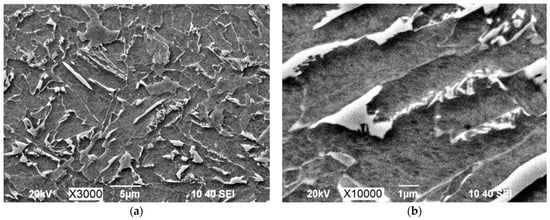
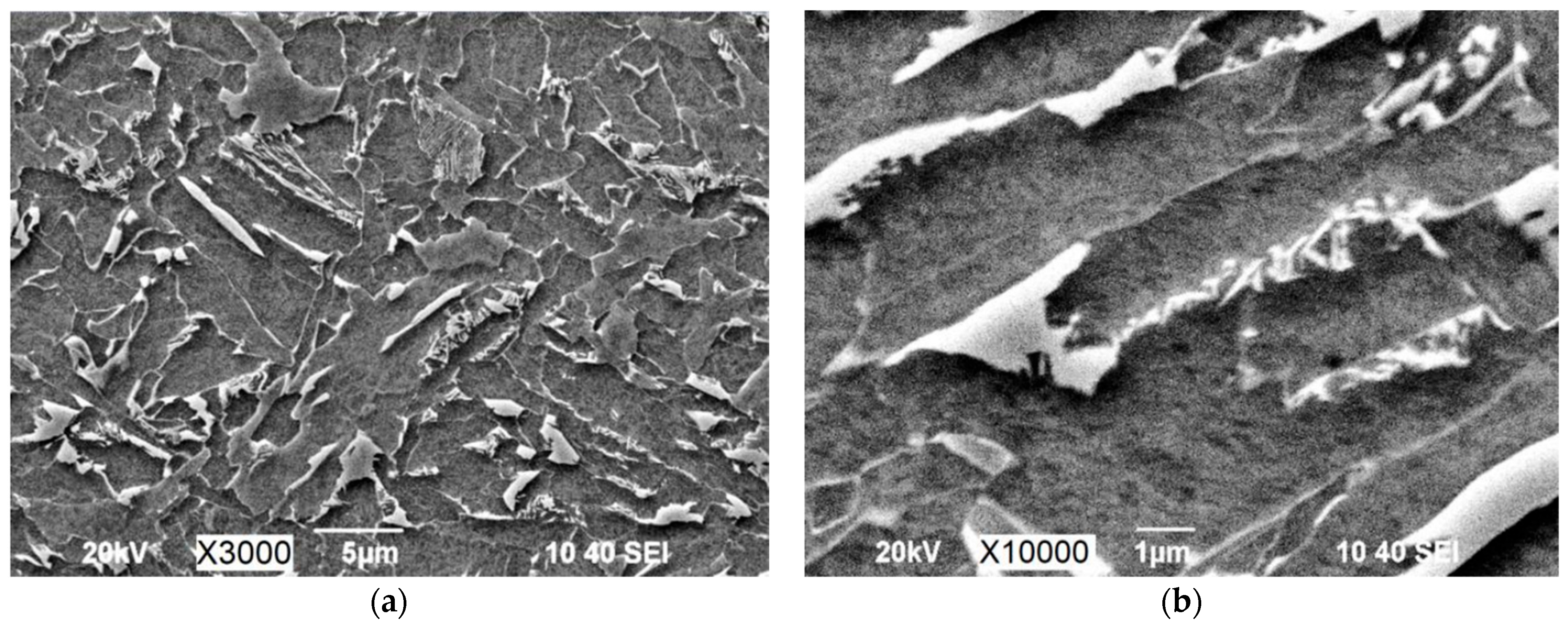
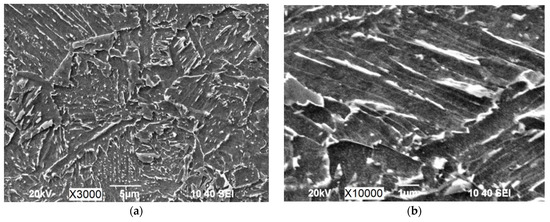
After controlled rolling and accelerated cooling according to mode No. 1 (start temperature of accelerated cooling Ta.c.s. = 870 °C and end temperature of accelerated cooling Ta.c.e. = 650 °C), the microstructure contains ferrite (30%), bainite, and a small amount (5%) of pearlite regions (Figure 1a).
Figure 1.
Microstructure of the studied steel according to mode No. 1: Ta.c.s. = 870 °C and Ta.c.e. = 650 °C. (a) 3000×, (b) 10,000×.
The presence of ferrite phase in such volume is due to the completion of accelerated cooling in the ferrite interval of the transformation temperature. The bainite has predominantly granular morphology.
However, lath bainite regions are also observed in the structure. Granular bainite represents quasi-polygonal ferrite with islands of the second component distributed between its grains. In this case, the second component in such bainite may have different structures: cementite particles, martensite–austenite (MA) zones, pearlite, and degenerate pearlite in the form of small regions. Lath bainite consists of elongated α-phase plates organized into packets with extended MA zones located at the boundaries of the plates (Figure 1b).
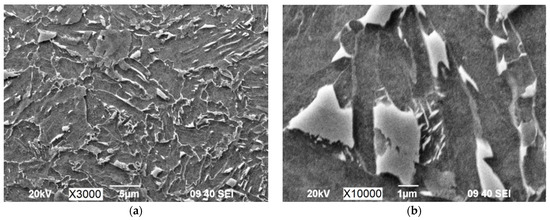
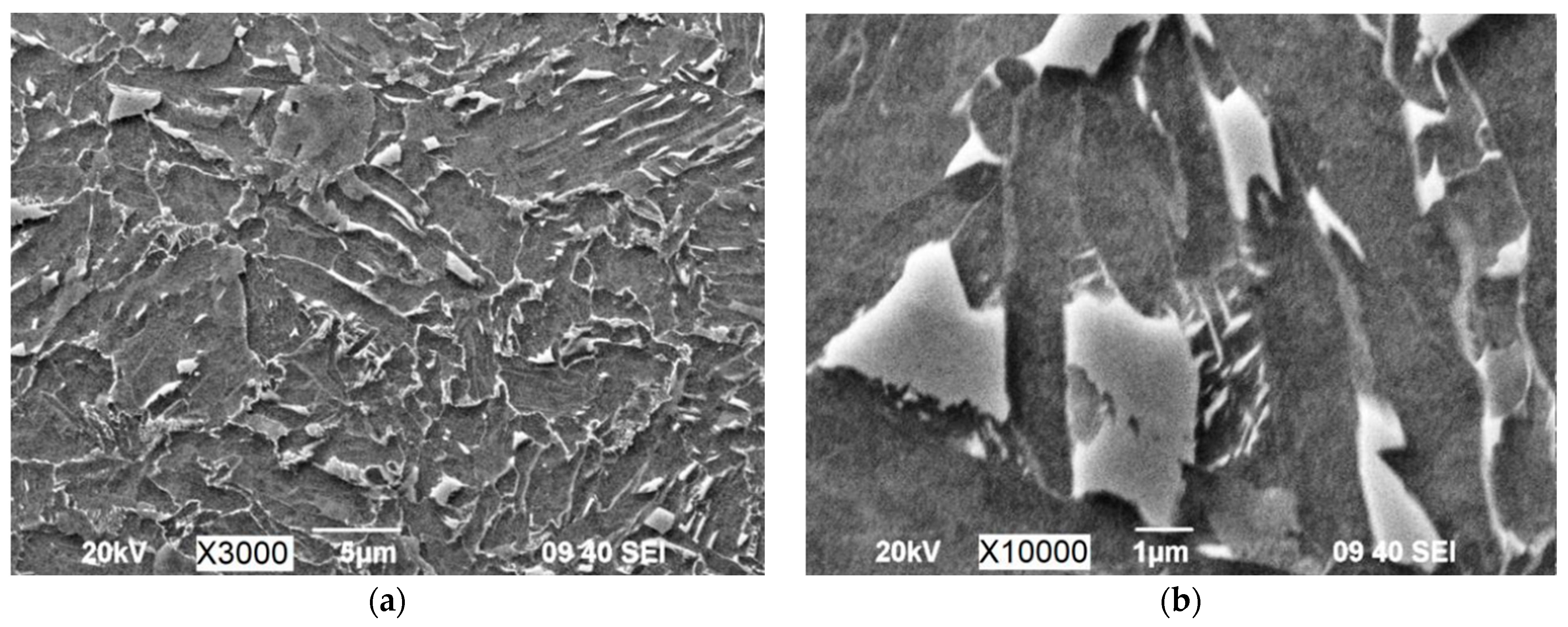
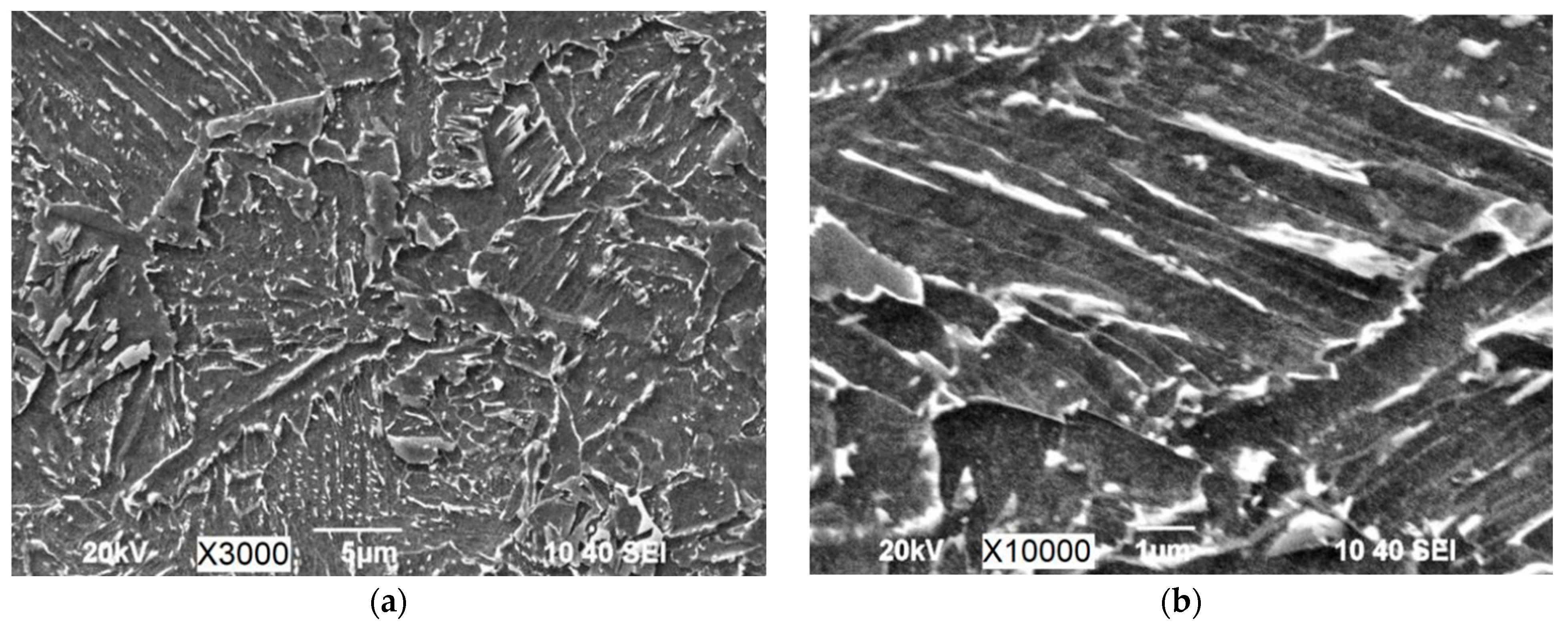
After processing according to mode No. 2 (Ta.c.s. = 870 °C and Ta.c.e. = 600 °C), the amount of ferrite decreases (<5%). Compared to roll No. 1, this is explained by the reduction in the temperature at the end of accelerated cooling. The bainite mainly consists of granular bainite (80%) and a small amount of lath bainite (15%) (Figure 2a). The second component, both in granular and lath bainite, is MA zones and pearlite (Figure 2b), which is also associated with the relatively high temperature at the end of accelerated cooling.
Figure 2.
Microstructure of the studied steel according to mode No. 2: Ta.c.s. = 870 °C and Ta.c.e. = 600 °C. (a) 3000×, (b) 10,000×.
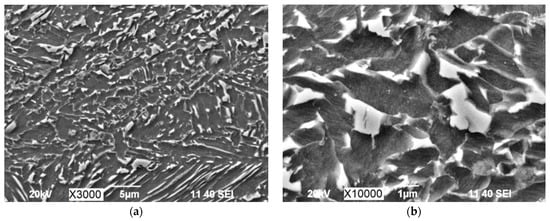
After processing according to mode No. 3 (Ta.c.s. = 870 °C, Ta.c.e. = 550 °C), the microstructure also contains a small amount (<5%) of quasi-polygonal ferrite and bainite, which morphologically divides into granular and lath types in approximately equal quantities (Figure 3a). For this mode, the second component in the bainite consists only of martensite–austenite regions in the form of islands and lamellae (Figure 3b).
Figure 3.
Microstructure of the studied steel according to mode No. 3: Ta.c.s. = 870 °C and Ta.c.e. = 550 °C. (a) 3000×, (b) 10,000×.
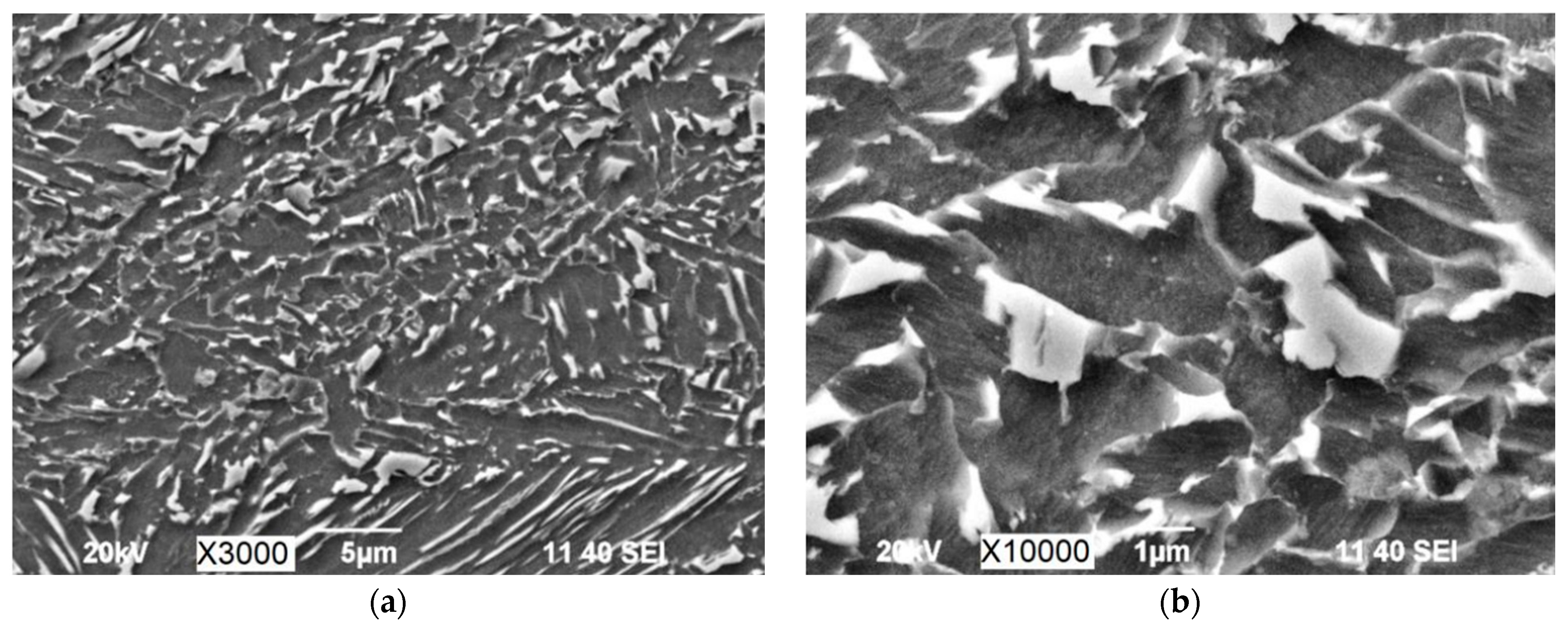
After processing according to mode No. 4 (Ta.c.s. = 830 °C and Ta.c.e. = 600 °C), the microstructure (Figure 4) is similar to that shown in Figure 2, obtained according to mode No. 2 (Ta.c.s. = 870 °C and Ta.c.e. = 600 °C). However, it differs since it has smaller ferrite grain sizes and higher dispersion of the bainitic component. This is explained by lower values of the finishing rolling temperature and the starting temperature of accelerated cooling.
Figure 4.
Microstructure of the studied steel according to mode No. 4: Ta.c.s. = 830 °C and Ta.c.e. = 600 °C. (a) 3000×, (b) 10,000×.
Comparison of the microstructures and mechanical properties of samples No. 2 and No. 4 revealed that reducing the temperature at the end of controlled rolling from 870 °C to 830 °C contributed to the formation of a finer-grained structure. In sample No. 4, the maximum diameter of ferrite grains is 5 μm, the maximum thickness of laths in lath bainite is 1 μm, and the size of MA regions in granular bainite is 2 μm. In sample No. 2, these values are grade 7 μm, 5 μm, and 3 μm, respectively.
Additionally, there is an increase in the proportion of lath bainite in the steel structure from 15% to 50%. This resulted in an improvement in the strength characteristics of the steel strip, as well as an increase in impact toughness values at test temperatures of −40 °C and −60 °C.
Fine-grain ferritic structure and the presence of bainitic phase with lath morphology consisting of thin α-phase plates separated by thin layers of carbon-enriched stable residual austenite favorably affect resistance to brittle fracture at low temperatures [3,4,5,6,7]. At the same time, the presence of pearlite as the second constituent in bainite (samples No. 1 and No. 2) may negatively influence impact toughness [8,9].
The best results in terms of mechanical properties for the selected chemical composition of steel were obtained on sample No. 4 after thermomechanical treatment involving accelerated cooling from rolling heat from 840 °C to the final cooling temperature of 600 °C. Under these conditions, a structure forms consisting of lath bainite (48%) and granular bainite (48%), along with a negligible amount of quasipolygonal ferrite (up to 5%). These conditions yield the following mechanical properties: YS—583 MPa, UTS—723 MPa, A50—22.5%, hardness—96 HRB, impact toughness KCV−40—122 J/cm2; KCV−60—110 J/cm2.
4. Conclusions
Based on the results of structural-phase transformation studies conducted at the Laboratory Complex of the Engineering Center of FSBEI HE “Nosov Magnitogorsk State Technical University” on the reversing hot rolling mill DUO-500 combined with an accelerated cooling system, experimental thermomechanical processing modes were implemented for CT80-grade steel for coiled tubing with an original chemical composition containing no more than the following percentages (% mass): ≤0.16% C; ≤0.50% Si; ≤1.00% Mn; ≤0.70% Cr; ≤0.80% (Ni + Cu + Mo); ≤0.050% (Nb + V + Ti).
As a result of the conducted research on the effect of various thermomechanical processing modes on the formation of structure and properties of the developed materials, it was found that achieving the highest level of ductile-plastic properties (KCV−40 = 122 J/cm2 and KCV−60 = 110 J/cm2) at the achieved strength level of CT80 steel according to API Specification 5ST (YS = 583 MPa, UTS = 723 MPa, 96 HRB (HRC < 20)) is ensured after controlled rolling with subsequent accelerated deformation cooling under the following conditions: acceleration cooling start temperature of 830 °C and acceleration cooling end temperature of 600 °C. This is achieved through the formation of a target fine-dispersed ferrite–bainite structure.
Author Contributions
Conceptualization, A.K., Y.E. and D.A.; methodology, Y.E.; software, D.A. and A.G.; validation, P.P., N.K. and D.E.; formal analysis, A.K., Y.E. and D.A.; investigation, A.K., Y.E., D.A. and Ekaterina Utkina; resources, P.P.; data curation, A.K., Y.E., D.A. and E.U.; writing—A.K., Y.E., D.A. and E.U.; writing—review and editing, P.P., N.K. and D.E.; visualization, D.A.; supervision, A.K. All authors have read and agreed to the published version of the manuscript.
Funding
The study was carried out at the FSBEI of HE «Nosov Magnitogorsk State Technical University» through the Russian Science Foundation Grant No. 25-29-20085 dated 14 May 2025, as well as funds from the Ministry of Education and Science of Chelyabinsk Region (Agreement No. 30-2026-004094 dated 26 June 2026), https://rscf.ru/project/25-29-20085/ (accessed on 14 July 2026).
Institutional Review Board Statement
Not applicable.
Informed Consent Statement
Not applicable.
Data Availability Statement
Data is contained within the article.
Acknowledgments
The authors thank the administration of FSBEI of HE NMSTU for providing the research facilities and technical assistance.
Conflicts of Interest
The authors declare no conflict of interest.
References
- Kuznetsova, A.S.; Poletskov, P.P.; Koptseva, N.V.; Efimova, Y.Y. Features of forming the structural and phase state of low-alloy steel for flexible tubing pipes depending on thermokinetic transformation conditions. CIS Iron Steel Rev. 2025, 30, 41–45. [Google Scholar] [CrossRef] [Scilit]
- Kuznetsova, A.; Poletskov, P.; Koptseva, N.; Efimova, Y.; Alekseev, D.; Gulin, A.; Emaleeva, D.; Mishukov, M. Features of the structure of rolled steel sheet of strength class CT80 after different thermomechanical treatment regimes. J. Phys. Conf. Ser. 2025, 3127, 012011. [Google Scholar] [CrossRef] [Scilit]
- De-Castro, D.; Eres-Castellanos, A.; Vivas, J.; Caballero, F.G.; San-Martin, D.; Capdevila, C. Morphological and crystallographic features of granular and lath-like bainite in a low carbon microalloyed steel. Mater. Charact. 2022, 184, 111703. [Google Scholar] [CrossRef] [Scilit]
- Maisuradze, M.V.; Yudin, Y.V.; Kuklina, A.A. Increase in Impact Strength During Bainite Structure Formation In HY-TUF High-Strength Steel. Metallurgist 2019, 63, 849–859. [Google Scholar] [CrossRef] [Scilit]
- Caballero, F.G.; Roelofs, H.; Hasler St Capdevila, C.; Chao, J.; Cornide, J.; Garcia-Mateo, C. Influence of Bainite Morphology on Impact Toughness of Continuously Cooled Cementite Free Bainitic Steels. Mater. Sci. Technol. 2012, 28, 95–102. [Google Scholar] [CrossRef] [Scilit]
- Rampelberg, C.; Allain, S.Y.P.; Geandier, G.; Teixeira, J.; Lebel, F.; Sourmail, T. Carbide-Free Bainite Transformations above and Below Martensite Start Temperature Investigated by In-Situ High-Energy X-Ray Diffraction. JOM 2021, 73, 3181–3194. [Google Scholar] [CrossRef] [Scilit]
- Maysuradze, M.V.; Kuklina, A.A.; Ryzhkov, M.A.; Nazarova, A.V. Osobennosti obrazovaniya beynita v stali 20Kh2G2SNMA pri izoter-micheskoy zakalke (Features of Bainite Formation in Steel 20Kh2G2SNMA During Iso-thermal Quenching). Metallurgist 2023, 7, 23–32. (In Russian) [Google Scholar]
- Zikeev, V.N.; Kornushchenkova, Y.V.; Konnova, I.Y.; Myasnikov, Y.F. Strukturnye parametry konstrukcionnoy stali, opredelyayuschie stoykost’ protiv sernovodorodnogo rastreschivaniya (Structural Parameters of Construction Steel Determining Resistance to Hydrogen Sulfide Cracking). Metalloved. Termicheskaya Obrab. Met. (MiTOM) 1991, 11, 19–20. (In Russian) [Google Scholar]
- Charbonnier, J.C.; Margot-Marette, H.; Moussy, F.; Bridoux, D.; Perdrix, C. Influence of Metallurgical Parameters on HIC and SSC Behavior of Linepipe Steel. NACE Corros. 1988, 85, 91–105. [Google Scholar] [CrossRef] [Scilit]

Disclaimer/Publisher’s Note: The statements, opinions and data contained in all publications are solely those of the individual author(s) and contributor(s) and not of MDPI and/or the editor(s). MDPI and/or the editor(s) disclaim responsibility for any injury to people or property resulting from any ideas, methods, instructions or products referred to in the content. |
© 2026 by the authors. Licensee MDPI, Basel, Switzerland. This article is an open access article distributed under the terms and conditions of the Creative Commons Attribution (CC BY) license.