


Abstract
Type 2 diabetes mellitus, commonly known as diabetes, is a chronic and multifactorial disease that is increasingly prevalent worldwide. An ageing population will double the number of individuals who need medical attention during the next decade, putting a greater strain on healthcare systems everywhere but especially in developing nations. The prevention and treatment of diabetes and its complications have become major health concerns in modern society. Once diabetes-related problems manifest, they tend to be permanent and challenging to treat effectively. Amidst this health crisis, nanotechnology has emerged as a promising avenue for addressing various issues associated with diabetes. Over the past few years, scientists have increasingly used nanotechnology to investigate diabetic complications, focusing on areas including prevention and treatment. When it comes to detecting and treating illness, nanotechnology (the exploration of nanoscale materials) has opened up new avenues of inquiry. With its applications spanning materials science, environment, biology, healthcare, and biochemistry, nanotechnology has garnered attention for exploring diabetic complications and interventions. In particular, it has paved the way for less intrusive and more effective diabetes management options. The development of nanocarriers, such as nanoparticles (NPs), liposomes, carbon nanotubes, nanoemulsions, and micelles, has revolutionized the transport of oral hypoglycemic drugs. These nanocarriers offer superior efficiency compared to traditional therapeutic approaches, enabling better control of elevated blood glucose levels. The integration of multiple ligands into nanostructures further enhances targeted drug delivery while safeguarding the encapsulated hypoglycemic drugs from degradation. The net result is a greater and sustained reduction in blood glucose levels, offering new hope for improved diabetes control with reduced short- and long-term consequences. Thus, nanotechnology holds the potential to transform diabetes management into a state-of-the-art and highly promising field, presenting novel and useful solutions to combat this global health challenge.
1. Introduction
Type 2 diabetes mellitus (T2DM) is a prevalent chronic metabolic disorder characterized by insulin resistance and impaired insulin secretion [1]. It represents a significant global health challenge, with its prevalence steadily increasing worldwide. The rise in sedentary lifestyles, unhealthy diets, and obesity has contributed to the surge in T2DM cases, making it a major public health concern for both developed and developing nations. According to the International Diabetes Federation (IDF), the prevalence of diabetes is projected to increase significantly over the years. In 2021, there were approximately 537 million individuals aged 20 to 79 with diabetes worldwide. However, this number is expected to rise to 643 million by 2030 and further to 783 million by 2045 [2,3]. As the number of individuals affected by T2DM continues to grow, so does the burden on healthcare systems. The escalating demand for medical attention, diabetes-related complications management, and associated comorbidities put a strain on healthcare resources and infrastructure. Furthermore, T2DM’s long-term consequences significantly impact the patients’ quality of life and lead to increased healthcare costs. Traditional therapeutic approaches for T2DM management primarily include lifestyle modifications, oral hypoglycemic agents, and insulin therapy. While these methods have shown some efficacy, they also come with limitations such as suboptimal drug delivery, poor patient compliance, and potential adverse effects [4]. Consequently, researchers have been exploring innovative and targeted strategies to address the challenges in T2DM treatment. Nanotechnology has emerged as a promising and revolutionary field that holds great potential in transforming the management of T2DM [5]. By exploiting the unique properties of nanoscale materials, scientists have begun to develop novel nanocarriers and nanosensors tailored for diabetes management. These advancements in nanotechnology offer exciting opportunities to enhance drug delivery, improve glucose monitoring, and provide innovative solutions for T2DM complications [6].
In this comprehensive review, we delve into significant advancements and breakthroughs in the application of nanotechnology and nanocarriers for T2DM management. Furthermore, this review will shed light on future directions and limitations.
2. Brief about Type 2 Diabetes Mellitus (T2DM)
Type 2 diabetes (T2DM) is the predominant form of diabetes, characterized by insulin resistance and impaired insulin secretion [7]. Risk factors include genetics, obesity, sedentary lifestyle, and advancing age. Symptoms may include increased thirst, frequent urination, fatigue, and blurred vision. Management involves lifestyle changes and medication, with insulin therapy in severe cases. Left untreated, T2DM can lead to serious complications including cardiovascular diseases, kidney damage, nerve damage (neuropathy), and eye-related problems (retinopathy), emphasizing the importance of early diagnosis and effective management for improved quality of life [1,7].
3. Use of Nanotechnology in the Detection of Insulin and Blood Sugar [Figure 1]
Figure 1.
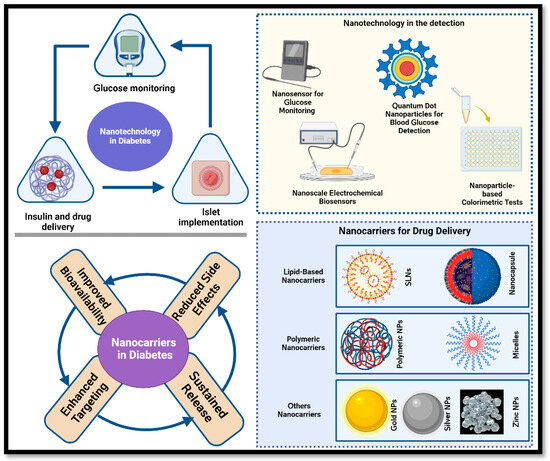
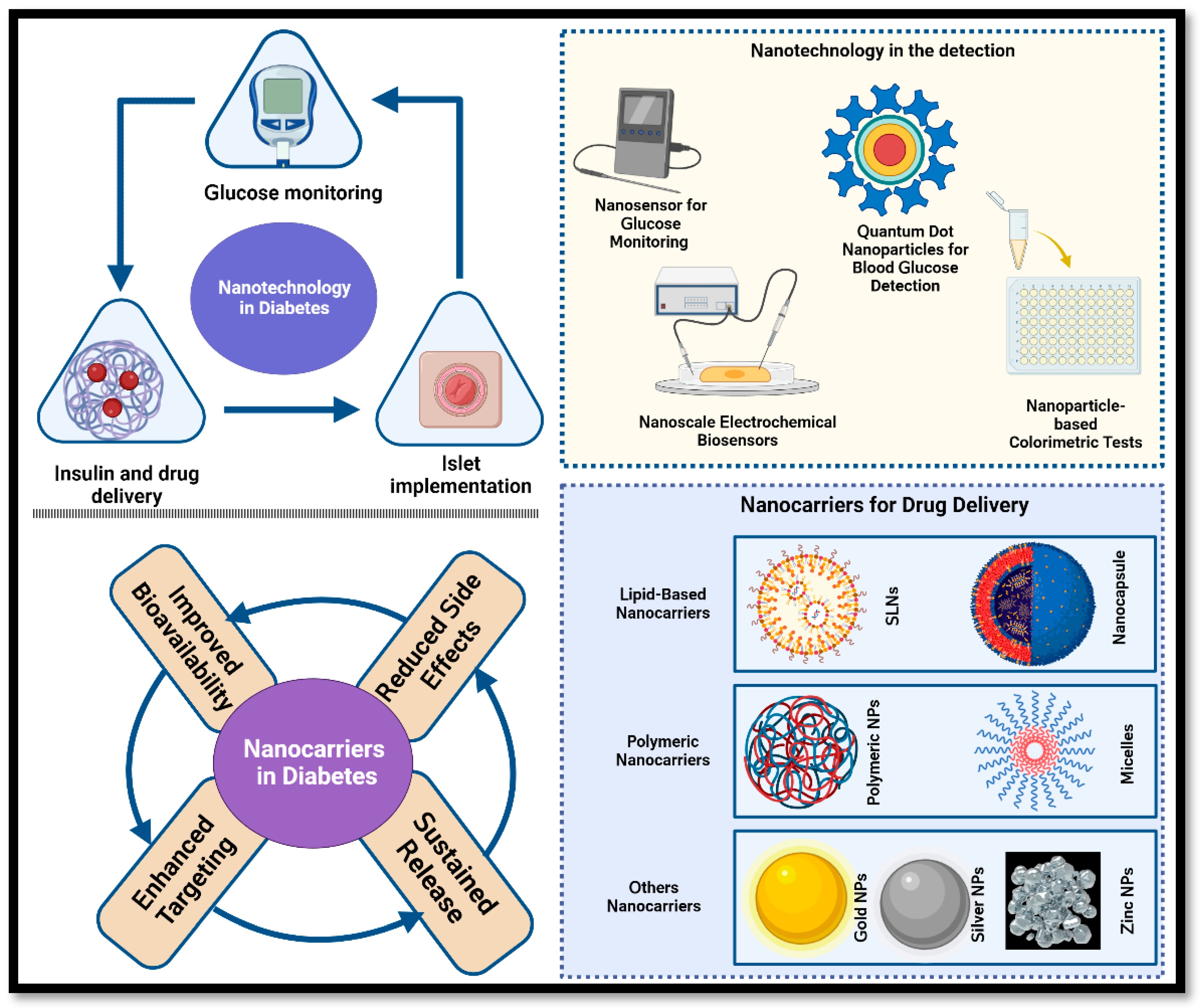
Nanotechnology uses in diabetes detection and treatment (SLNs = Solid Lipid Nanoparticles, NPs = Nanoparticles).
Nanotechnology offers innovative approaches for the detection of insulin and blood sugar levels in diabetes management. Nanoscale sensors and devices enable real-time, highly sensitive, and minimally invasive monitoring of glucose levels, providing crucial data for precise insulin administration and optimizing diabetes treatment [8]. Additionally, nanotechnology-based biosensors offer potential advancements in insulin detection, allowing for early diagnosis of insulin-related disorders and improving overall patient care [9]. Some examples are enlisted.
Nanosensors for Continuous Glucose Monitoring (CGM): Nanoscale sensors in wearable devices provide real-time glucose data for effective diabetes management, reducing the need for frequent fingerstick tests [10].
Quantum Dot Nanoparticles for Blood Glucose Detection: Glucose-sensitive quantum dots emit fluorescent signals, offering higher sensitivity and specificity in blood sugar measurement [11].
Nanoparticle-based Colorimetric Tests: Simple and rapid tests utilizing nanoparticles undergo color changes to indicate glucose concentration, suitable for point-of-care monitoring in resource-limited settings [11,12].
Nanoscale Electrochemical Biosensors: Electrochemical biosensors with nanomaterials like graphene and carbon nanotubes improve glucose detection sensitivity and response [13].
The integration of nanotechnology in insulin and blood sugar detection has revolutionized diabetes management. These innovative approaches provide accurate and sensitive monitoring, empowering individuals to make informed decisions about treatment and lifestyle adjustments.
4. Nanocarriers for Drug Delivery for Type 2 Diabetes
Nanotechnology has shown great promise in improving the delivery of oral hypoglycemic drugs, which are commonly used to manage Type 2 Diabetes (T2DM) [5,8]. Nanocarriers are nano-sized delivery systems that can encapsulate and protect drugs, enhancing their efficacy, bioavailability, and targeted delivery. In the context of T2DM, nanocarriers offer several advantages for drug delivery, making them a promising approach in diabetes management [5]. There are several advantages of nanocarrier-based drug delivery:
Improved Bioavailability: Nanocarriers can protect drugs from degradation in the gastrointestinal tract and improve their absorption, resulting in higher drug bioavailability [14].
Enhanced Targeting: Nanocarriers can be designed to target specific tissues or cells, such as pancreatic beta cells or insulin-resistant tissues, thereby increasing drug delivery to the desired sites of action [15].
Reduced Side Effects: By targeting drug delivery to specific tissues, nanocarriers can minimize off-target effects, reducing side effects and improving patient tolerability [16].
Sustained Release: Nanocarriers can provide controlled and sustained drug release, leading to more stable and prolonged therapeutic effects, reducing the frequency of drug administration [17].
4.1. Lipid-Based Nanocarriers
Solid lipid nanoparticles- Solid lipid nanoparticles (SLNs) have emerged as a promising nanotechnology-based approach for diabetes management. These nanoparticles are composed of biocompatible lipids and offer several advantages, including improved drug delivery, enhanced stability of encapsulated drugs, and reduced toxicity compared to traditional drug delivery systems [18]. For, e.g., Ansari et al. have formulated insulin-loaded solid lipid nanoparticles to enhance the bioavailability of insulin [19].
Lipid-based nanocapsules: Lipid-based nanocapsules have shown promise as a delivery system for various therapeutic applications, including diabetes treatment. These nanocapsules are typically composed of a lipid bilayer that encapsulates the therapeutic agent, such as insulin or other antidiabetic drugs. Such nanocapsule had been made by Xu et al. for the oral delivery of peptides [20].
4.2. Polymeric Nanocarriers
Nanoparticles (NPs): Polymeric nanoparticles are solid particles made from biodegradable polymers. They offer controlled drug release and protection against enzymatic degradation. Polymeric nanoparticles have been used to deliver oral hypoglycemic drugs, improving their solubility and bioavailability. They can also be functionalized to target specific tissues or cells, making them valuable tools for personalized diabetes therapy [21]. For, e.g., Damgé et al. have formulated polymeric NPs for the oral delivery of insulin [22].
Micelles: Micelles are colloidal structures formed by self-assembly of amphiphilic molecules in aqueous solutions. They have a hydrophilic shell and a hydrophobic core, making them suitable for encapsulating poorly water-soluble drugs [23]. Micellar nanocarriers have shown promise in enhancing the oral delivery of antidiabetic drugs, optimizing drug absorption, and reducing dosing frequency. Singh et al. have designed Quercetin enveloped Soluplus®/P407 micelles in diabetes treatment [24].
4.3. Others
Gold, silver, and zinc nanoparticles are being investigated for their potential in diabetes treatment. These nanoparticles can be functionalized with insulin and other diabetes-related drugs for improved delivery. Some formulations are enlisted in Table 1.
Table 1.
Different types of nano-formulations for type II diabetes care.
5. Challenges and Safety Considerations
Although nanotechnology-based medication systems offer several benefits, there are some limitations and challenges which are discussed below:
Biocompatibility and Toxicity Concerns: Assessing the safety of nanoparticles used as drug carriers is crucial as some may persist and lead to adverse effects.
Regulatory Considerations: Clear guidelines and standardized protocols are needed for evaluating nanotechnology-based products, ensuring their safe development.
Ethical Implications: Responsible ethical discussions are necessary, considering patient consent, privacy, and equitable access to advanced therapies.
Patient Acceptance and Affordability: Ensuring patient education, engagement, and equitable access to advanced treatments are vital.
Long-Term Stability: Maintaining nanocarriers’ integrity over time is essential for practical application.
Combination Therapies and Drug Interactions: Understanding potential drug interactions and optimizing combination therapies is critical for effective diabetes management.
Addressing these challenges will enhance the successful integration of nanotechnology in diabetes care, improving patients’ quality of life.
6. Future Directions and Promising Applications
A. Personalized Nanomedicine:
Tailoring nanotherapeutics: Nanotechnology enables customized diabetes treatments based on individual characteristics, optimizing drug delivery and minimizing side effects.
Nanoparticle-based insulin delivery: Innovative insulin delivery systems using nanoparticles offer precise glucose control, potentially replacing conventional injections.
B. Nanotechnology and Artificial Pancreas Development:
Continuous glucose monitoring: Nanosensors integrated with monitoring technology enable real-time and minimally invasive glucose level tracking.
Closed-loop insulin delivery: Nanotechnology-driven closed-loop systems mimic a healthy pancreas, autonomously adjusting insulin delivery for better glucose management.
Nanotechnology offers transformative possibilities in Type 2 diabetes management, enabling personalized nanomedicine for improved drug delivery and precise glucose control. The integration of nanosensors and nanocarriers in artificial pancreas systems holds the potential to revolutionize diabetes care, enhancing patients’ well being and treatment outcomes.
7. Conclusions
Nanotechnology holds immense promise in revolutionizing Type 2 diabetes management through personalized medicine, improved drug delivery, and advanced glucose monitoring. While various nanocarriers and nanosensors offer potential benefits, addressing safety concerns and regulatory challenges will be crucial for successful clinical translation. Embracing these advancements will propel diabetes care towards a more effective, patient-centric future, enhancing overall well being and reducing the burden of the disease.
Author Contributions
Conceptualization, D.M.; methodology, D.M., J.K.S. and J.G.; formal analysis, D.M., J.K.S. and J.G.; investigation, D.M.; data curation, D.M.; writing—original draft preparation, D.M., J.K.S. and J.G.; writing—review and editing, D.M., J.K.S. and J.G. All authors have read and agreed to the published version of the manuscript.
Funding
This research received no external funding.
Institutional Review Board Statement
Not applicable.
Informed Consent Statement
Not applicable.
Data Availability Statement
Not applicable.
Conflicts of Interest
The authors declare no conflict of interest.
References
- DeFronzo, R.A.; Ferrannini, E.; Groop, L.; Henry, R.R.; Herman, W.H.; Holst, J.J.; Weiss, R. Type 2 diabetes mellitus. Nat. Rev. Dis. Primers 2015, 1, 1–22. [Google Scholar] [CrossRef] [Scilit] [PubMed]
- International Diabetes Federation. IDF Diabetes Atlas 9th Edition 2019, Global Estimates for the Prevalence of Diabetes for 2019, 2030 and 2045. Available online: http://www.diabetesatlas.org/ (accessed on 30 January 2023).
- Mandal, D.; Gupta, J. Burgeoning Nanotechnology for Diabetic Wound Healing: A Novel Approach to the Future. Med. Sci. Forum 2023, 21, 33. [Google Scholar]
- Jain, S.; Saraf, S. Type 2 diabetes mellitus—Its global prevalence and therapeutic strategies. Diabetes Metab. Syndr. Clin. Res. Rev. 2010, 4, 48–56. [Google Scholar] [CrossRef] [Scilit]
- Tiwari, P. Recent trends in therapeutic approaches for diabetes management: A comprehensive update. J. Diabetes Res. 2015, 2015, 340838. [Google Scholar] [CrossRef] [Scilit]
- Simos, Y.V.; Spyrou, K.; Patila, M.; Karouta, N.; Stamatis, H.; Gournis, D.; Peschos, D. Trends of nanotechnology in type 2 diabetes mellitus treatment. Asian J. Pharm. Sci. 2021, 16, 62–76. [Google Scholar] [CrossRef] [Scilit]
- Malecki, M.T. Genetics of type 2 diabetes mellitus. Diabetes Res. Clin. Pract. 2005, 68, S10–S21. [Google Scholar] [CrossRef] [Scilit]
- Arya, A.K.; Kumar, L.; Pokharia, D.; Tripathi, K. Applications of nanotechnology in diabetes. Dig. J. Nanomater. Biostruct. 2008, 3, 221–225. [Google Scholar]
- Shoaib, A.; Darraj, A.; Khan, M.E.; Azmi, L.; Alalwan, A.; Alamri, O.; Khan, A.U. A Nanotechnology-Based Approach to Biosensor Application in Current Diabetes Management Practices. Nanomaterials 2023, 13, 867. [Google Scholar] [CrossRef] [Scilit]
- Huang, C.; Hao, Z.; Qi, T.; Pan, Y.; Zhao, X. An integrated flexible and reusable graphene field effect transistor nanosensor for monitoring glucose. J. Mater. 2020, 6, 308–314. [Google Scholar] [CrossRef] [Scilit]
- Chen, S.; Hai, X.; Chen, X.W.; Wang, J.H. In situ growth of silver nanoparticles on graphene quantum dots for ultrasensitive colorimetric detection of H2O2 and glucose. Anal. Chem. 2014, 86, 6689–6694. [Google Scholar] [CrossRef] [Scilit]
- Brasiunas, B.; Popov, A.; Ramanavicius, A.; Ramanaviciene, A. Gold nanoparticle based colorimetric sensing strategy for the determination of reducing sugars. Food Chem. 2021, 351, 129238. [Google Scholar] [CrossRef] [Scilit] [PubMed]
- Zhu, Z.; Garcia-Gancedo, L.; Flewitt, A.J.; Xie, H.; Moussy, F.; Milne, W.I. A critical review of glucose biosensors based on carbon nanomaterials: Carbon nanotubes and graphene. Sensors 2012, 12, 5996–6022. [Google Scholar] [CrossRef] [Scilit] [PubMed]
- Dixit, P.V.; Mishra, D.K.; Sharma, S.; Gautam, R.K. Nanocarriers and Diabetes: New Vistas and the Way Ahead. Curr. Pharm. Biotechnol. 2023, 24, 1420–1429. [Google Scholar] [PubMed]
- El-Dakroury, W.A.; Zewail, M.B.; Amin, M.M. Design, optimization, and in-vivo performance of glipizide-loaded O-carboxymethyl chitosan nanoparticles in insulin resistant/type 2 diabetic rat model. J. Drug Deliv. Sci. Technol. 2023, 79, 104040. [Google Scholar] [CrossRef] [Scilit]
- Patel, K.; Atkinson, C.; Tran, D.; Nadig, S.N. Nanotechnological approaches to immunosuppression and tolerance induction. Curr. Transplant. Rep. 2017, 4, 159–168. [Google Scholar] [CrossRef] [Scilit] [PubMed]
- Natarajan, J.V.; Nugraha, C.; Ng, X.W.; Venkatraman, S. Sustained-release from nanocarriers: A review. J. Control. Release 2014, 193, 122–138. [Google Scholar] [CrossRef] [Scilit]
- Rajpoot, K. Solid lipid nanoparticles: A promising nanomaterial in drug delivery. Curr. Pharm. Des. 2019, 25, 3943–3959. [Google Scholar] [CrossRef] [Scilit]
- Ansari, M.J.; Anwer, M.K.; Jamil, S.; Al-Shdefat, R.; Ali, B.E.; Ahmad, M.M.; Ansari, M.N. Enhanced oral bioavailability of insulin-loaded solid lipid nanoparticles: Pharmacokinetic bioavailability of insulin-loaded solid lipid nanoparticles in diabetic rats. Drug Deliv. 2016, 23, 1972–1979. [Google Scholar] [CrossRef] [Scilit]
- Xu, Y.; Van Hul, M.; Suriano, F.; Préat, V.; Cani, P.D.; Beloqui, A. Novel strategy for oral peptide delivery in incretin-based diabetes treatment. Gut 2020, 69, 911–919. [Google Scholar] [CrossRef] [Scilit]
- Peng, S.; Song, H.; Chen, Y.; Li, S.; Guan, X. Oral Delivery of food-derived bioactive peptides: Challenges and strategies. Food Rev. Int. 2023, 39, 5297–5325. [Google Scholar] [CrossRef] [Scilit]
- Damgé, C.; Maincent, P.; Ubrich, N. Oral delivery of insulin associated to polymeric nanoparticles in diabetic rats. J. Control. Release 2007, 117, 163–170. [Google Scholar] [CrossRef] [Scilit] [PubMed]
- Malo de Molina, P.; Gradzielski, M. Gels obtained by colloidal self-assembly of amphiphilic molecules. Gels 2017, 3, 30. [Google Scholar] [CrossRef] [Scilit] [PubMed]
- Singh, J.; Mittal, P.; Vasant Bonde, G.; Ajmal, G.; Mishra, B. Design, optimization, characterization and in-vivo evaluation of Quercetin enveloped Soluplus®/P407 micelles in diabetes treatment. Artif. Cells Nanomed. Biotechnol. 2018, 46 (Suppl. S3), S546–S555. [Google Scholar] [CrossRef] [Scilit]
- Sarmento, B.; Martins, S.; Ferreira, D.; Souto, E.B. Oral insulin delivery by means of solid lipid nanoparticles. Int. J. Nanomed. 2007, 2, 743–749. [Google Scholar]
- Elbahwy, I.A.; Ibrahim, H.M.; Ismael, H.R.; Kasem, A.A. Enhancing bioavailability and controlling the release of glibenclamide from optimized solid lipid nanoparticles. J. Drug Deliv. Sci. Technol. 2017, 38, 78–89. [Google Scholar] [CrossRef] [Scilit]
- Xu, Y.; De Keersmaecker, H.; Braeckmans, K.; De Smedt, S.; Cani, P.D.; Préat, V.; Beloqui, A. Targeted nanoparticles towards increased L cell stimulation as a strategy to improve oral peptide delivery in incretin-based diabetes treatment. Biomaterials 2020, 255, 120209. [Google Scholar] [CrossRef] [Scilit]
- Xu, M.; Qin, H.; Zheng, Y.; Chen, J.; Liang, X.; Huang, J.; Guan, Y.Q. Construction of a double-responsive modified guar gum nanoparticles and its application in oral insulin administration. Colloids Surf. B Biointerfaces 2022, 220, 112858. [Google Scholar] [CrossRef] [Scilit]
- Wen, N.; Lü, S.; Xu, X.; Ning, P.; Wang, Z.; Zhang, Z.; Liu, M. A polysaccharide-based micelle-hydrogel synergistic therapy system for diabetes and vascular diabetes complications treatment. Mater. Sci. Eng. C 2019, 100, 94–103. [Google Scholar] [CrossRef] [Scilit]
- Oladipo, I.C.; Lateef, A.; Azeez, M.A.; Asafa, T.B.; Yekeen, T.A.; Ogunsona, S.B.; Abbas, S.H. Antidiabetic properties of phytosynthesized gold nanoparticles (AuNPs) from Datura stramonium seed. IOP Conf. Ser. Mater. Sci. Eng. 2020, 805, 012035. [Google Scholar] [CrossRef] [Scilit]
- Karthick, V.; Kumar, V.G.; Dhas, T.S.; Singaravelu, G.; Sadiq, A.M.; Govindaraju, K. Effect of biologically synthesized gold nanoparticles on alloxan-induced diabetic rats—An in vivo approach. Colloids Surf. B Biointerfaces 2014, 122, 505–511. [Google Scholar] [CrossRef] [Scilit]
- Sengottaiyan, A.; Aravinthan, A.; Sudhakar, C.; Selvam, K.; Srinivasan, P.; Govarthanan, M.; Selvankumar, T. Synthesis and characterization of Solanum nigrum-mediated silver nanoparticles and its protective effect on alloxan-induced diabetic rats. J. Nanostructure Chem. 2016, 6, 41–48. [Google Scholar] [CrossRef] [Scilit]
- Siddiqui, S.A.; Or Rashid, M.M.; Uddin, M.G.; Robel, F.N.; Hossain, M.S.; Haque, M.A.; Jakaria, M. Biological efficacy of zinc oxide nanoparticles against diabetes: A preliminary study conducted in mice. Biosci. Rep. 2020, 40, BSR20193972. [Google Scholar] [CrossRef] [Scilit] [PubMed]

Disclaimer/Publisher’s Note: The statements, opinions and data contained in all publications are solely those of the individual author(s) and contributor(s) and not of MDPI and/or the editor(s). MDPI and/or the editor(s) disclaim responsibility for any injury to people or property resulting from any ideas, methods, instructions or products referred to in the content. |
© 2023 by the authors. Licensee MDPI, Basel, Switzerland. This article is an open access article distributed under the terms and conditions of the Creative Commons Attribution (CC BY) license (https://creativecommons.org/licenses/by/4.0/).