


Abstract
In this paper, we investigate a fractional-order predator–prey model incorporating prey harvesting. In a non-delayed model, the Crowley–Martin functional response is studied. We first prove the existence, uniqueness, non-negativity and boundedness of the solutions for the proposed model. Furthermore, the existence of various equilibrium points is analyzed to examine the local asymptotically stable properties, and the suitable Lyapunov function is used to study the globally asymptotic stability. Finally, some numerical simulations are verified for the analytic results.
1. Introduction
Fractional calculus (FC) is a general field that attempts to understand real-world phenomena. A non-integer sequence is modeled with derivatives and is a field of differentiation and integrations are performed with non-integer order derivatives. The memory impact and conserved relevant physical properties are the benefits of fractional derivatives. The predator–prey models developed by Lotka and Voltera are considered to be early developments in contemporary mathematical ecology in a coupled system of nonlinear differential equations [1,2]. Since Kermack-Mckendrick’s pioneering work on SIRS, epidemiological models have attracted much interest from researchers [3]. In general, there are two main types of mathematical models: ecological and epidemiological models. The relations between the populations of a certain community are explored in ecological models [4]. Epidemiology models are studies of how illnesses spread between humans and animals. This article’s major objective is to investigate how infection affects prey during prey harvesting in a predator–prey system. Here, we examined the local and global stabilities of the equilibrium points of this system, as well as the boundedness and positivity of the solution [5,6]. An eco-epidemiological predator–prey system with disease affecting only prey species and the harvesting of both susceptible and infected prey has been taken into consideration by Bhattacharya et al. [7,8]. Agnihotri and Gakkhar studied a prey–predator system with disease affecting both species and only the prey species being harvested [9,10]. The SIRS-type models are mathematically similar to models of the s-called geometric Brownian motion (GBM): both predict an exponential growth of infected individuals or of the value of the process. The state of dead individuals in the SIRS models is akin to the so-called resetting in the GBM model [11,12]. The very relevant model of GBM with resetting was recently considered in refs. Ecologists, economists, and those involved in natural resource management were interested in the studies on harvesting in predator–prey systems for some time. A few people have specifically included a harvested parameter in a predator–prey–parasite model and analyzed the system’s response to it [13]. In this article, we examine the function of harvesting in an eco-epidemiological system where susceptible and diseased prey are harvested together [14,15]. This study applies the Caputo fractional derivative and the harvesting rate to the predator–prey model. This author’s major objective is to investigate the effects of prey infection and prey harvesting in a predator–prey system. Here, we examined the boundedness, positivity, local and global stabilities, and stability of the system’s equilibrium points.
2. Model Formulation
The model explains how the diseased prey system interacts with harvesting, which results in the following set of equations. The dynamic prey and predator mathematical model was investigated using the proposed model,
Subject to initial conditions , , .
The detailed biological meanings of parameters are given in Table 1.
Table 1.
Biological representation of the system (1) parameters.
3. Existence and Uniqueness of the Solutions
In this section, the boundedness of the solution of the system (3) was examined. The fractional-order system as follows:
Theorem 1.
The fractional-order system (3) has a unique solution for the non-negative initial conditions.
4. Equilibrium Points and Stability Analysis
In this section, the system (3) has the following possible equilibrium points:
- (i)
- The trivial equilibrium point is .
- (ii)
- is the boundary equilibrium point.
- (iii)
- is the infected prey free equilibrium point, where ,.
- (iv)
- is the predator free equilibrium point, where ,.
- (v)
- The interior equilibrium point . Where,and is the unique positive root of the quadratic equation where , , .Now, we want to calculate the Jacobian matrix for a local stability analysis around different equilibrium points. The Jacobian matrix at an arbitrary point is given bywhere, ,, , , ,, , .
Theorem 2.
The trivial equilibrium point of a system (3) is stable if ; otherwise, it is unstable.
Proof.
Here, eigenvalues are , and .
The Jacobian matrix of the system (3) at an equilibrium point is given by
Hence, the trivial equilibrium point is stable if , otherwise, it is unstable. □
Theorem 3.
The infected free and predator free equilibrium point of a system (3) is stable if .
Proof.
Here, eigenvalues are , and .
The Jacobian matrix of the system (3) at an equilibrium point is given by
Hence, the infected prey and predator free equilibrium point is stable. □
Theorem 4.
The disease free equilibrium point of a system (3) is locally asymptotically stable if .
Proof.
where, , , ,
, , , , ,
Here, the characteristic equation of the above Jacobian matrix is
where , , .
According to the Routh–Hurwitz criteria [16], , , and .
Hence, is locally asymptotically stable. □
Theorem 5.
The equilibrium point of a system (3) is locally asymptotically stable if .
Proof.
where , , , ,
The Jacobian matrix at is given by
, , , , and .
Here, the characteristic equation of the above Jacobian matrix is
where , , .
According to the Routh–Hurwitz criteria [16], , , and .
Hence, is locally asymptotically stable. □
Theorem 6.
The endemic equilibrium point of system (3) is locally asymptotically stable.
Proof.
where , ,
The Jacobian matrix at is given by
, , , ,
, , .
Here, the characteristic equation of the above Jacobian matrix is
where , , .
According to the Routh-Hurwitz criteria [16], , , and .
Hence, is locally asymptotically stable. □
5. Numerical Analysis
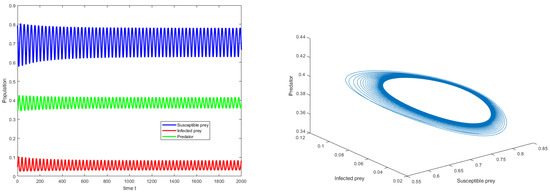
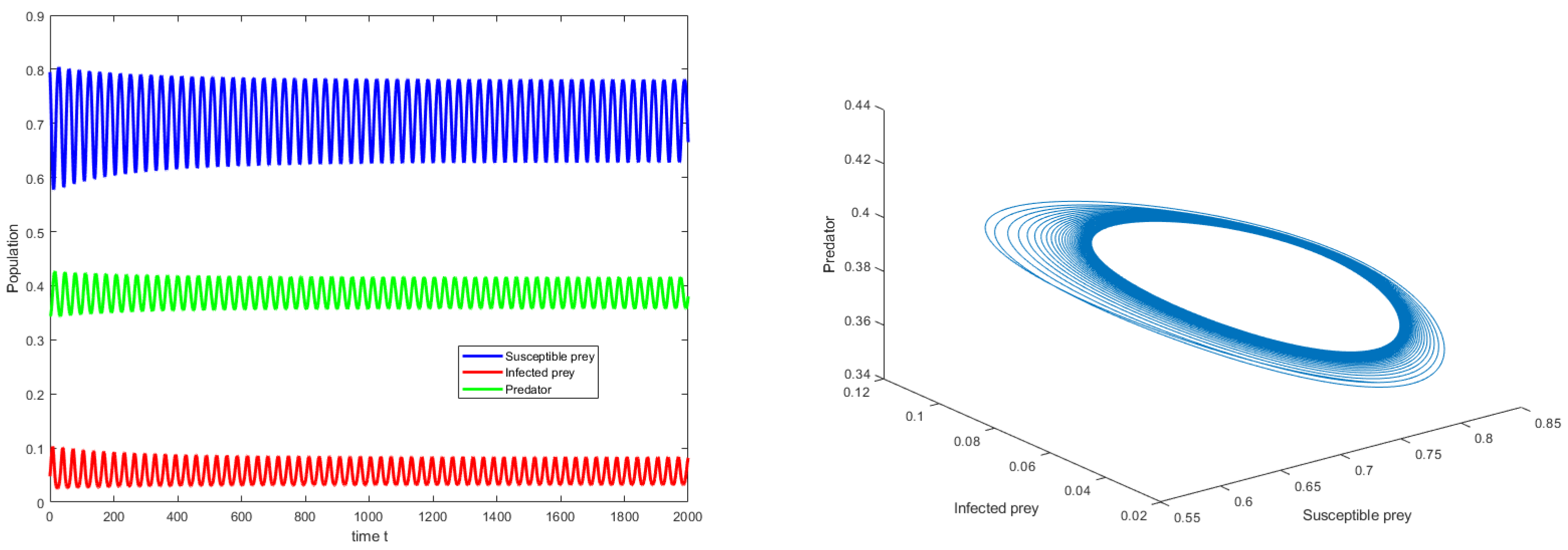
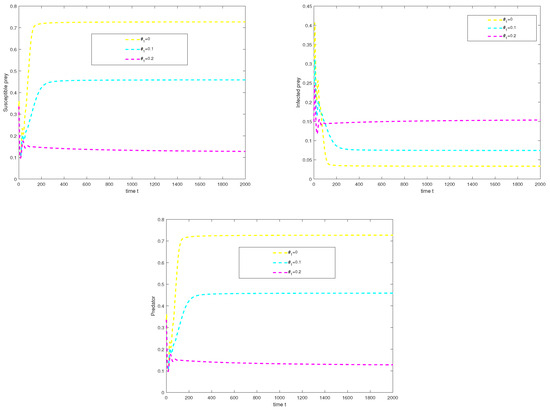
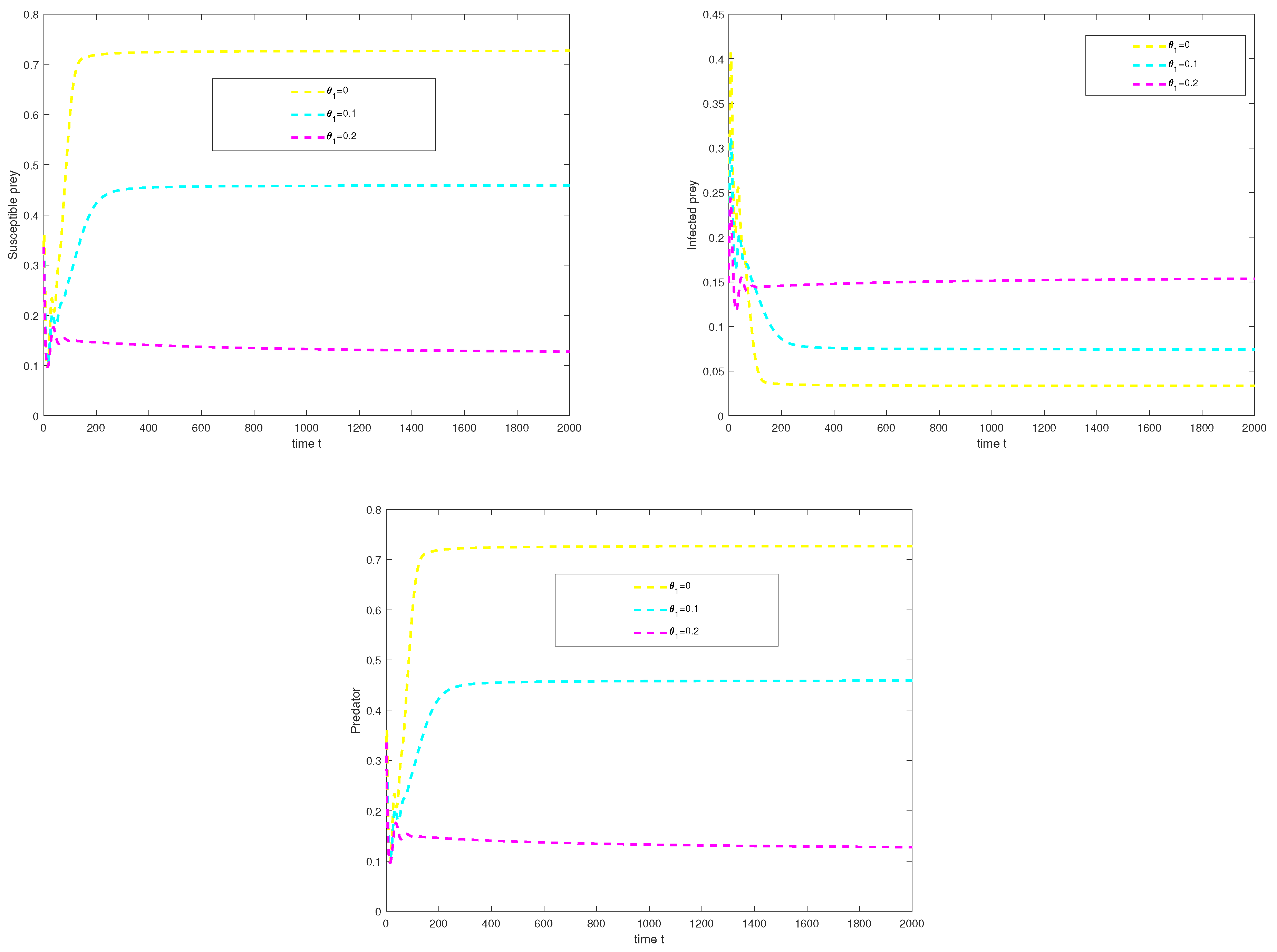
In this section, we present some numerical simulation results for the Caputo-sense fractional-order eco-epidemic models. To accomplish this, we use Diethelm et al.’s predictor–corrector approach to solve the defined model. The parameter values are chosen as , , , , , , , , , and the different values of and then the equilibrium point are unstable (see Figure 1). Fixing the derivative as a variable. Here, we consider the derivative value as , and the effect of the predator harvesting on the evolution of the three species clearly influences the final size of the three populations, as shown in Figure 2.
Figure 1.
Unstable solution for the interior equilibrium point .
Figure 2.
It is varying the harvesting rate of susceptible prey, infected prey, and a predator population with different values of for the fractional-order derivative .
6. Conclusions
In this study, we investigated a fractional-order derivative-based model of a three-species food web. Each equilibrium point’s local stability in our proposed fractional-order system has also been examined. The suggested mathematical model’s numerical simulation results show that the proposed system changes from unstable to stable as the order of the fractional derivative’s value, , goes from 0 to 1. It is obvious that for the different values of in the range , the unstable system with the integer-order becomes a stable system. For the interior equilibrium point, when the derivative of , the system becomes unstable, and if we change the order to fractional order, , and the system becomes stable. When the susceptible prey population harvesting rate increases, then the infected prey population harvesting rate decreases in the fractional order derivative. Since the susceptible prey population is inversely proportional to the infected prey population in the system, then the derivative of the fractional-order alpha makes an important contribution to the proposed system’s dynamical stability.
Author Contributions
D.N.P., M.S., S.P.M. and N.G.T. contribute equally to this work. All authors have read and agreed to the published version of the manuscript.
Funding
This research received no external funding.
Institutional Review Board Statement
Not applicable.
Informed Consent Statement
Not applicable.
Data Availability Statement
Data are contained within the article.
Conflicts of Interest
The authors declare no conflict of interest.
References
- Lotka, A.J. Elements of Physical Biology; Williams & Wilkins: Philadelphia, PA, USA, 1925. [Google Scholar] [CrossRef] [Scilit]
- Volterra, V. Variazioni e Fluttuazioni del Numero d’Individui in Specie Animali Conviventi; Societa Anonima Tipografica “Leonardo da Vinci”: Citta di Castello, Italy, 1926. [Google Scholar] [CrossRef]
- Kermack, W.O.; McKendrick, A.G. A contribution to the mathematical theory of epidemics. Proc. R. Soc. Lond. Ser. Contain. Pap. Math. Phys. Character 1927, 115, 700–721. [Google Scholar] [CrossRef] [Scilit]
- Ashwin, A.; Sivabalan, M.; Divya, A.; Siva Pradeep, M. Dynamics of Holling type II eco-epidemiological model with fear effect, prey refuge and prey harvesting. In Proceedings of the 1st International Online Conference on Mathematics and Applications, online, 1–15 May 2023; MDPI: Basel, Switzerland, 2023. [Google Scholar]
- Panigoro, H.S.; Suryanto, A.; Kusumawinahyu, W.M.; Darti, I. Dynamics of an eco-epidemic predator–prey model involving fractional derivatives with power-law and Mittag–Leffler kernel. Symmetry 2021, 13, 785. [Google Scholar] [CrossRef] [Scilit]
- Ramesh, P.; Sambath, M.; Mohd, M.H.; Balachandran, K. Stability analysis of the fractional-order prey-predator model with infection. Int. J. Model. Simul. 2021, 41, 434–450. [Google Scholar] [CrossRef] [Scilit]
- Ahmed, E.; El-Sayed, A.M.; El-Saka, H.A. Equilibrium points, stability and numerical solutions of fractional-order predator–prey and rabies models. J. Math. Anal. Appl. 2007, 325, 542–553. [Google Scholar] [CrossRef] [Scilit]
- Stojkoski, V.; Sandev, T.; Kocarev, L.; Pal, A. Geometric Brownian motion under stochastic resetting: A stationary yet nonergodic process. Phys. Rev. E 2021, 104, 014121. [Google Scholar] [CrossRef] [Scilit]
- Yang, W. Dynamical behaviors of a diffusive predator–prey model with Beddington–DeAngelis functional response and disease in the prey. Int. J. Biomath. 2017, 10, 1750119. [Google Scholar] [CrossRef] [Scilit]
- Divya, A.; Sivabalan, M.; Ashwin, A.; Siva Pradeep, M. Dynamics of Ratio dependent eco epidemiological model with prey refuge and prey harvesting. In Proceedings of the 1st International Online Conference on Mathematics and Applications, online, 1–15 May 2023; MDPI: Basel, Switzerland, 2023. [Google Scholar]
- Burov, S.; Jeon, J.H.; Metzler, R.; Barkai, E. Single particle tracking in systems showing anomalous diffusion: The role of weak ergodicity breaking. Phys. Chem. Chem. Phys. 2011, 13, 1800–1812. [Google Scholar] [CrossRef] [Scilit]
- Metzler, R.; Jeon, J.H.; Cherstvy, A.G.; Barkai, E. Anomalous diffusion models and their properties: Non-stationarity, non-ergodicity, and ageing at the centenary of single particle tracking. Phys. Chem. Chem. Phys. 2014, 16, 24128–24164. [Google Scholar] [CrossRef] [Scilit]
- Vinod, D.; Cherstvy, A.G.; Wang, W.; Metzler, R.; Sokolov, I.M. Nonergodicity of reset geometric Brownian motion. Phys. Rev. E 2022, 105, L012106. [Google Scholar] [CrossRef] [Scilit] [PubMed]
- Das, M.; Maiti, A.; Samanta, G.P. Stability analysis of a prey-predator fractional order model incorporating prey refuge. Ecol. Genet. Genom. 2018, 7–8, 33–46. [Google Scholar] [CrossRef] [Scilit]
- Mondal, S.; Lahiri, A.; Bairagi, N. Analysis of a fractional order eco-epidemiological model with prey infection and type 2 functional response. Math. Methods Appl. Sci. 2017, 40, 6776–6789. [Google Scholar] [CrossRef] [Scilit]
- Murray, J.D. Mathematical Biology I: An Introduction; Springer: Berlin/Heidelberg, Germany, 2002. [Google Scholar] [CrossRef] [Scilit]

Disclaimer/Publisher’s Note: The statements, opinions and data contained in all publications are solely those of the individual author(s) and contributor(s) and not of MDPI and/or the editor(s). MDPI and/or the editor(s) disclaim responsibility for any injury to people or property resulting from any ideas, methods, instructions or products referred to in the content. |
© 2023 by the authors. Licensee MDPI, Basel, Switzerland. This article is an open access article distributed under the terms and conditions of the Creative Commons Attribution (CC BY) license (https://creativecommons.org/licenses/by/4.0/).