


Abstract
This systematic literature review examines how support organizations facilitate Industry 4.0 startup success amid the “Digital Paradox” of high tool access yet elevated technical complexity. Following the Preferred Reporting Items for Systematic Reviews and Meta-Analyses (PRISMA) guidelines, we analyzed 19 empirical studies (2019–2026) investigating incubators, accelerators, and innovation hubs. Our analysis reveals three “Golden Rules” for effective support: Network Orchestration (partner matching and knowledge mobility), Context Specificity (domain-tailored programs mitigating the Performance Paradox), and Hybrid Virtualization (digital-first delivery with critical physical infrastructure). The proposed framework reconceptualizes support organizations as ecosystem architects rather than space providers, offering actionable insights for hub managers navigating deep-tech entrepreneurship.
1. Introduction
The modern startup ecosystem is an interesting paradox: today, founders have access to more advanced digital tools, cloud infrastructure, and connectivity than any prior generation, but they have exponentially greater technical complexity and failure rates when operating in the Industry 4.0 (I4.0) ecosystem. This Digital Paradox summarizes the conflict between democratized access to foundational technologies and the specialization and high-stakes needs of deep-tech startups that are working at the intersection of artificial intelligence (AI), the Internet of Things (IoT), and cyber-physical systems [1,2].
The I4.0 projects demand a large initial investment in hardware prototyping, regulatory compliance testing, and domain expertise, unlike traditional software startups that can iterate fast on a small capital investment. The entry barriers have not disappeared; instead, they have shifted to technical complexity as opposed to financial gatekeepers. According to Boyer, the adoption of I4.0-enabling technologies in a manufacturing setting necessitates a complicated association with heterogeneous actors in an ecosystem of innovation, which implies that single startups will not be able to navigate the landscape on their own [3]. The contradiction is further enhanced by the fact that the cost of digital infrastructure has dropped significantly but the expertise needed to utilize these tools effectively in industrial settings has become less common and more valuable.
Conventional business incubation paradigms, which involve the delivery of discounted office space, generic business planning courses, and some networking events, are inherently poorly suited to meet the special needs of deep-tech entrepreneurship. This model, which thrived in the dot-com days when startups only required internet connectivity and some basic administrative support, does not acknowledge the material realities of I4.0 ventures. According to the research on born-digital healthcare platforms, the performance of startups can be more directly connected to intrinsic capabilities and industry-specific issues, including regulatory complexity, than to external support provided by accelerators in traditional formats [1].
The gap between generic and high-tech demands is expressed in several dimensions. First, physical infrastructure needs vary greatly: a software-as-a-service (SaaS) startup will require little equipment to operate, including laptops and access to servers, whereas an industrial IoT project will require access to manufacturing testbeds, sensor networks, and interoperability test facilities [4]. Second, the quality of mentorship requires sectoral specificity; a generalized set of recommendations about customer acquisition is not enough when it comes to managing the procurement cycles of industrial clients or the safety regulations of healthcare equipment [5]. Third, capital structures and fundraising plans of deep-tech startups are fundamentally different from those of consumer internet startups, which require advanced financial engineering and long-term capital structures [6].
Modern literature proposes a paradigm shift between space-centric and resource-centric support models. Ecosystem knowledge, resource planning and utilization, and the capability to transition between the early phases are skills that generic incubators seldom develop to succeed in I4.0 acceleration [7]. Equally, digital incubation initiatives should be structured around eight core dimensions, ranging from program operation and participants’ selection to the onboarding and incubation processes and digital tools, rather than around co-location [8]. All these findings indicate that the value proposition of support organizations has shifted to knowledge brokering and resource orchestration, as opposed to real estate arbitrage.
Based on these changing needs, this systematic literature review will answer the following research question: What are the particular processes in support organizations that bring value to Industry 4.0 startups?
This question goes beyond general analyses of the support of startups to explore the detailed, evidence-based practices that enable growth in high-technical-complexity environments. Specifically, we concentrate on four types of support organizations: Corporate Accelerators (CACs), University Incubators, Digital Innovation Hubs, and Science Parks. This review synthesizes the results about high-tech specific support systems, such as access to IoT labs, Big Data infrastructure, AI mentoring, and Corporate-Startup pilot matching, which go beyond the generic advice historically provided by startup support programs.
The rest of this paper will be organized as follows: Section 2 will describe the systematic literature review procedure, including the Preferred Reporting Items for Systematic Reviews and Meta-Analyses (PRISMA) framework [9] and inclusion criteria. The results are presented in Section 3 in the form of two thematic categorization tables and synthesize the most important empirical findings. Section 4 explains these findings within the framework of entrepreneurial ecosystem theory and outlines the emergent trends in the virtualization of support structures. Section 5 sums up with some practical advice to hub managers, and outlines some of the gaps that must be tackled in future studies.
2. Methods and Materials
To make the identification of empirical findings on Industry 4.0 startup support mechanisms transparent, this study uses a Systematic Literature Review (SLR) based on PRISMA 2020 guidelines [9]. The query that we used was: ((“incubator” OR “accelerator” OR “tech-hub*”) AND (“digital*” OR “Industry 4.0” OR “smart city”) AND (“start-up*” OR “startup*” OR “scale-up*”)). We used Web of Science (WoS) and Scopus to search for records. Only open-access, peer-reviewed journal articles in English published between 2019 and 2026 were included in the search.
The selection process was conducted in four steps (Table 1): the initial database search yielded 374 records (WoS: 127; Scopus: 247); restricting results to English-language, open-access journal articles reduced these to 108 records, and removing duplicates left 76 unique records; title and abstract screening against the thematic scope excluded 44 records, leaving 32 full-text articles assessed for eligibility; finally, the full-text assessment excluded 13 further studies, resulting in 19 studies for final synthesis.
Table 1.
PRISMA 2020 study selection process and inclusion flow.
Inclusion criteria were that the study must contain: (IC1) original empirical data (case studies, surveys, interviews, or quantitative analysis); (IC2) explicit analysis of structured organizational support mechanisms (incubators, accelerators, or innovation hubs); (IC3) focus on Industry 4.0 settings (AI, IoT, Big Data, Smart Cities); and (IC4) publication in peer-reviewed academic journals. Exclusion criteria filtered out: (EC1) conceptual papers, theoretical frameworks, and secondary literature reviews; (EC2) studies of generic small and medium-sized enterprises (SMEs) or digital marketing agencies without deep-tech/I4.0 components; (EC3) technical engineering papers that do not involve support organizations; and (EC4) financial-only analyses (venture capital or crowdfunding) lacking associated support organization involvement.
The 19 articles were extracted into a structured table with data on author/year, classification of support mechanism, technological context, and key empirical findings. Thematic analysis then identified patterns across geographic regions and technology sectors.
3. Results
3.1. Overview of the Evidence Base
The 19 articles represent a wide geographic and sectoral range where empirical settings include Swiss innovation parks [10], Indonesian university incubators [4], and Spanish FinTech accelerators [6]. The corpus includes 11 case studies, 6 quantitative survey-based analyses, and 2 mixed-method designs, which is methodologically representative of how the field has emerged, and how difficult it is to do large-N research on populations of high-tech startups.
3.2. Support Organization Archetypes and Their Value-Creation Logics
Table 2 shows the classification of included studies by the support organization archetype, where Corporate Accelerators (CACs), University Incubators, Digital Innovation Hubs, and Science Parks are distinguished. This classification also shows clear epistemological approaches and value-creation logics between types of support.
Table 2.
Thematic Classification by Support Organization Type.
The recent literature is dominated by Corporate Accelerators, and research has been conducted to study the way established firms use startup engagement to transform digitally. A detailed case study of the SAP Industry 4.0 Startup Program reveals that there are three types of benefits to startups: operational Go-to-Market acceleration (product development, sales), strategic business development (business model improvements, financing access), and ecosystem integration [11]. The analysis is further developed in terms of Network Orchestration, which has shown that the creation of value in CACs relies on five key activities, namely knowledge mobility, innovation appropriability, network stability, innovation coherence, and resource leveraging [12].
University Incubators are looked at through the perspective of knowledge transfer and human capital development. A university-based marketplace systems enterprise architecture framework unites scientific knowledge with societal business interests [4], whereas some of the key competencies of I4.0 startups are knowledge of the ecosystem, resource planning and use, and awareness of communication methods [7]. Particular attention to the education of digital entrepreneurship reveals that FinTech literacy in the areas of crowdfunding, blockchain, and AI can greatly improve digital entrepreneurial intentions through self-efficacy processes [15].
3.3. Sector-Specific Support Mechanisms
Table 3 aligns the identified support services in the literature with the primary technology areas of interest: FinTech, HealthTech/MedTech, Industrial IoT, and AI/Data-Driven ventures.
Table 3.
The Sector-Specific Support Mechanisms.
This matrix indicates that there is significant sectoral heterogeneity in terms of support needs. HealthTech startups exhibit the highest dependency on domain-specific accelerators because of regulatory complexity, but paradoxically, exhibit the lowest performance correlation with acceleration participation. In born-digital healthcare platforms, non-accelerated startups are more likely to succeed than those which have gone through accelerator programs, indicating that generic acceleration could be disruptive to sector-specific learning curves [1]. This finding is also compounded by research showing that responsible innovation in digital healthcare needs intermediary organizations, like living labs, incubators and accelerators, to assist in bridging gaps in stakeholder inclusion despite unclear direct performance effects [5].
FinTech projects have special support needs that revolve around banking partnerships and regulatory navigation. The effective acceleration of FinTech involves the presence of so-called ambidextrous internal champions or suppliers of the banks to enable cooperation [20], whereas empirical evidence shows that FinTech startups established in incubator or accelerator programs are more prone to be profitable and successful, especially when they receive seed capital funding [6]. The overlap between financial regulation and technological innovation generates a so-called legitimacy gap that support organizations fill through providing credibility signaling and compliance advice.
3.4. Synthesis: The Performance Paradox and Network Orchestration
The synthesis creates two important theoretical tensions. First, the so-called Performance Paradox, which is observed in the recent literature, questions the belief that accelerator participation universally improves startup outcomes [1]. In a quasi-experimental study of 235 born-digital health platform startups, it is found that domain-specific accelerators do not provide a meaningful benefit over general ones, and that non-accelerated startups are often more successful than accelerated ones. This observation implies that in industries with high complexity, the opportunity cost of engaging in structured programs, especially the time diverted from technical development and customer validation, can be more than the networking benefits.
Second, the move towards Network Orchestration [12] redefines support organizations from service providers to relational architects. Instead of necessarily providing resources, effective I4.0 hubs coordinate the synergy between companies and startups by organizing five orchestration activities: knowledge mobility to create novelty, innovation appropriability and network stability for lock-in effects, innovation coherence for complementarity, and resource leveraging for efficiency. This orchestration position is especially crucial in the context of industrial IoT where studies have found that business-to-business relationships were decisive in I4.0 implementation and that the more a particular company establishes various types of relationships with other companies within the innovation ecosystem (IES), the greater the level of I4.0 implementation-enabling technologies [3].
The data also indicate a bifurcation of support models between light-touch digital platforms and deep-engagement corporate programs. There are four unique routes to high use of generative AI in accelerator-based startups, with absorptive capacity and industry dynamism acting as moderating variables [2]. In the meantime, the so-called “Sustainable Startup Success Framework (S3F)” recognizes six pillars, Founder Factors, Financial Factors, Organizational Factors, Product Factors, Team Factors, and Customer Factors, which support organizations should balance [17]. All these frameworks help to point out that successful I4.0 support must use granular, context-specific intervention in place of standardized programming.
4. Discussion
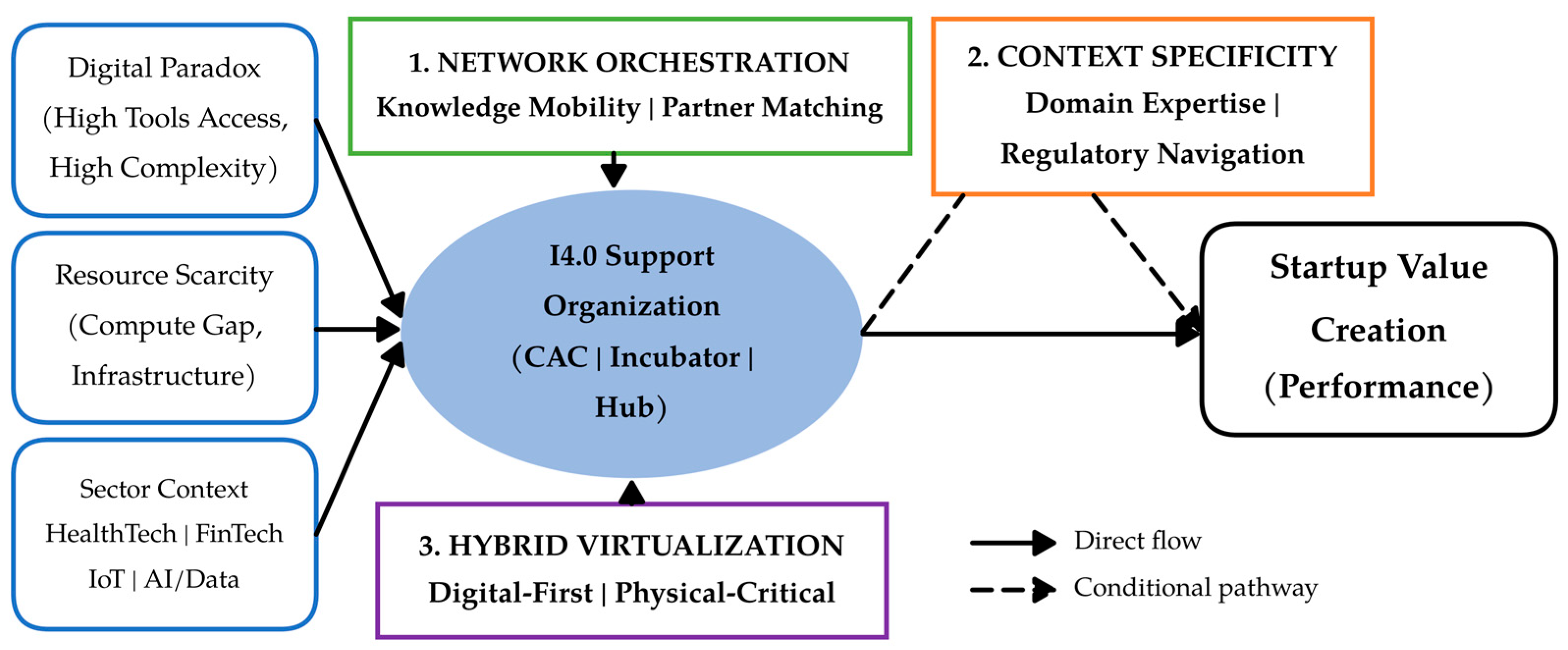
Figure 1 shows a synthesized framework of the value creation process in I4.0 startup support ecosystems. The model assumes that three input conditions, Digital Paradox, Resource Scarcity, and Sector Context, are directed into a central Support Organization (Hub/Incubator/CAC), which converts these problems into startup value in three different ways. Network Orchestration (green) deals with ecosystem integration by matching partners and facilitating knowledge mobility [12]; Context Specificity (orange) provides domain-aligned support by alleviating the Performance Paradox [1]; and Hybrid Virtualization (purple) facilitates efficient delivery of resources by using digital-physical hybrid models [8,19].
Figure 1.
Industry 4.0 startup support ecosystem framework. Left boxes represent the input conditions faced by I4.0 startups. The three numbered boxes are the value-creation pathways enacted by the support organization: Network Orchestration (green), Context Specificity (orange), and Hybrid Virtualization (purple). Solid arrows indicate direct flows; dashed arrows indicate the conditional pathway through which domain-aligned support mitigates the Performance Paradox.
4.1. Theoretical Implications: Support Organizations as Ecosystem Architects
The results of this review require a reconceptualization of support organizations in the established entrepreneurial ecosystem theory. Conventional ecosystem frameworks locate incubators and accelerators as supportive but peripheral infrastructure to the central entrepreneurial process [21]. Nonetheless, the empirical data presented beforehand indicate that in I4.0 settings, these organizations operate as central nodes in knowledge networks, actively building the relational infrastructure with the help of which deep-tech projects can navigate the intricate innovation ecosystems.
Studies indicate that I4.0 implementation is not a firm-level phenomenon, but an ecosystem-level realization, which requires complexities of relationships between actors, complementarities among actors, especially between start-ups and other ecosystem actors [3]. This is in line with the Network Orchestration framework that views accelerators as administrators of innovation networks and not mere service providers [12]. The theoretical lesson here is profound: in high-tech industries, where the level of technological interdependence is high, and where the regulatory complexity is high, the entrepreneurial ecosystem cannot be self-organizing without active orchestration. The support organizations therefore play the role of institutional entrepreneurs, establishing the governance structures and trust systems that are required to facilitate multi-actor cooperation.
This reconceptualization contradicts the arms-length policy strategies which view startup support as a real estate or training subsidy problem. Rather, the data points to the creation of the so-called Innovation Middleware, organizations that specialize in the translation of the divergent logics of academic research, corporate research and development (R&D), and startup agility. An example of this is the Switzerland Innovation model which provides the means of cooperation between industry, research and startups to speed up the process of transforming research results into marketable products [10]. These middleware functions demand unique skills beyond traditional incubation, such as advanced technical translation skills, regulatory navigation skills, and network governance skills.
4.2. The Virtualization of Support: From Physical Co-Location to Digital Orchestration
Another major theme that has appeared throughout the literature reviewed is the virtualization of support infrastructure, which is being expedited by the COVID-19 pandemic but is indicative of more fundamental structural changes in I4.0 entrepreneurship. Discussion of post-pandemic accelerator models reveals that the accelerated digital transformation that has arisen due to the needs-must approach to interact with start-ups via remote means has also brought new opportunities to accelerators in order to enhance their programs [19]. This discussion indicates that hybrid models of delivery, which combine online and remote interactions, could maximize the startup experience and resource use.
This discussion is furthered by a holistic virtual business incubator model, co-designed with 23 incubator managers and startup founders, which is structured around eight dimensions: key qualities and purpose, program operation, communication strategy, application stage, participants’ selection, onboarding process, incubation process, and digital tools [8]. This model is especially applicable to AI and data-driven startups, where computational resources can be provided remotely through cloud infrastructure, minimizing the historical reliance on physical labs. The trend of virtualization does not, however, remove the requirement for physical infrastructure, instead it decouples access from location, permitting startups to use specialized testbeds and manufacturing facilities when they need them, and not on a permanent basis through co-location.
The virtualization has significant implications for entrepreneurial ecosystem theory. When support services can be delivered efficiently via digital platforms, then ecosystem boundaries are less space-based and more relationally based. Studies indicate that data-driven startups show the most interest in the following offerings: fundraising, acceleration, and data skills provided by means of flexible programming, as opposed to the standardized legal and intellectual property (IP) services that were historically prioritized by European policy [16]. This suggests a demand-side move toward modular, on-demand assistance that contests the supply-side reasoning of comprehensive, cohort-based programs.
4.3. Resource Scarcity and the “Compute Gap” in AI Ventures
A particular example of AI startups can be used to show resource limitations that should be considered by support organizations. Research into factors affecting the adoption of generative AI in accelerator-based startups reveals that high usage requires the configurations of creativity, proactivity, industry dynamism, and absorptive capacity [2]. It is worth noting that technical access is not enough; startups need absorptive capacity, the capacity to perceive, absorb, and utilize outside knowledge, to utilize AI technologies successfully.
This discovery sheds light on what can be called the Compute Gap: the gap between the democratization of AI algorithms (through open-source platforms) and the concentration of computational resources and knowledge needed to train and deploy more advanced models. This gap is filled by support organizations in two ways. First, infrastructure provisioning: making graphics processing unit (GPU) clusters, cloud computing credits, and specialized AI testbeds available to individual startups at a cost that single startups would have otherwise not been able to afford. Second, epistemic mediation: linking startups to academic researchers and corporate AI laboratories to pass tacit knowledge about model creation, data management, and ethical AI implementation [5].
Nonetheless, the Compute Gap also indicates the shortcomings of the existing support models. Research underlines that the precondition of successful digital entrepreneurship is FinTech literacy, including AI and blockchain understanding, which numerous support organizations are not technologically proficient enough to deliver [15]. In the same vein, the research observes that enterprises need corporate venture funds, business incubators, and digital factories to support innovative startups, which are still scarce in emerging innovation ecosystems [18]. This implies that support organizations themselves are experiencing an Orchestration Capability Gap, the difficulty of having adequate technical knowledge to mediate knowledge between the most specialized realms.
5. Conclusions
According to the systematic synthesis of empirical data, this review condenses three actionable principles, so-called Golden Rules, for managers of Industry 4.0 support organizations:
Rule 1: Context-Specificity Over Standardization. The Performance Paradox demonstrates that generic acceleration can harm startup performance in complex sectors [1]. Effective I4.0 hubs need to build domain-specific program architectures that are sensitive to the distinctive regulatory, technical, and commercial timelines of their target industries. In the case of HealthTech ventures, this means long paths to clinical validation; in the case of Industrial IoT, it means deep integration with manufacturing partner ecosystems instead of the pressure of rapid scale.
Rule 2: Network Orchestration Over Service Provision. Support organizations are supposed to stop service delivery and move to relational orchestration [12]. This involves actively managing relationships between startups, corporates, and research institutions on the basis of technical complementarity instead of generic networking. Studies have established that business-to-business relationships played a decisive role in implementation of I4.0, meaning that hub managers must act as strategic matchmakers with advanced knowledge of technical interoperability and market needs [3].
Rule 3: Hybrid Virtualization with Critical Infrastructure Preservation. The evidence after the pandemic has shown that a hybrid model, in which administrative, educational, and networking functions are moved to digital platforms, and physical infrastructure (testbeds, manufacturing facilities, wet labs) is shared on an as-needed basis, is feasible [8,19]. This physical-critical, digital-first model is efficient in terms of resources and still allows access to the specialized equipment that is needed to create deep-tech.
This review highlights some of the critical gaps that need to be investigated in the future. First, the incubator model is not yet well-charted because of the long-term effects of Generative AI. Since the pattern of AI adoption remains under study, future research should focus on understanding whether AI copilots and automated coding tools decrease the demand for technical mentorship in accelerators, or vice versa, whether they increase the standard of specialized expertise support that organizations need to offer [2].
Second, remote support models should be validated longitudinally to make them sustainable. Although virtualization provides short-term efficiency benefits, there are concerns about how tacit knowledge, serendipitous encounter generation, and trust formation can be developed in digitally mediated ecosystems. The comparative research of the five-year survival rate of startups in virtual and physical programs would be invaluable in this argument.
Third, geographic differences in the effectiveness of support require attention. The re-examined studies represent both developed European ecosystems (Switzerland, Germany, Spain) and emerging settings (Tanzania, Indonesia, Pakistan), but comparative study of the ways support mechanisms operate in different institutional voids remains in its infancy. In particular, the studies need to investigate whether the Network Orchestration model that presupposes the presence of dense networks of corporates and research institutions can be applied to ecosystems where these actors are not present or are underdeveloped.
Lastly, the causal processes that contribute to the Performance Paradox need to be looked into further. Although it has been established that non-accelerated startups occasionally do better than accelerated ones, the mediating factors, either selection effects, opportunity costs, or imperfect program design, are not specified [1]. These mechanisms would be better understood with experimental or quasi-experimental designs that compare sector-specific and generalist acceleration in the same population of startups to optimize programs.
The Industry 4.0 entrepreneurship landscape is more challenging than ever and requires new support mechanisms. It is not the growth of generic services, as this systematic review shows, but the development of advanced orchestration solutions to bridge technical, regulatory, and network barriers that will define the future of startup support. The transformative potential of deep-tech entrepreneurship in the next decade will require the support of organizations that understand themselves as ecosystem architects, rather than space providers.
Author Contributions
Conceptualization, W.D. and D.R.; methodology, W.D. and M.I.; validation, D.R. and M.I.; formal analysis, W.D.; investigation, W.D.; resources, W.D.; data curation, W.D.; writing—original draft preparation, W.D.; writing—review and editing, W.D., D.R. and M.I.; visualization, W.D.; supervision, D.R.; project administration, W.D.; funding acquisition, W.D. All authors have read and agreed to the published version of the manuscript.
Funding
This research was funded by the National Center for Scientific and Technical Research (CNRST), Morocco, through the PhD-Associate Scholarship (PASS) program, grant number 8UCD2024.
Institutional Review Board Statement
Not applicable.
Informed Consent Statement
Not applicable.
Data Availability Statement
This study is a systematic literature review based on bibliographic records retrieved from Web of Science and Scopus, which are licensed databases. The search query, inclusion and exclusion criteria, and selection process are fully described in Section 2 and Table 1. The 19 studies included in the synthesis are cited in the reference list and in Table 2 and Table 3.
Conflicts of Interest
The authors declare no conflicts of interest.
Abbreviations
The following abbreviations are used in this manuscript:
| AI | Artificial Intelligence |
| B2B | Business-to-Business |
| CAC | Corporate Accelerator |
| FinTech | Financial Technology |
| GPU | Graphics Processing Unit |
| HealthTech | Healthcare Technology |
| ICT | Information and Communication Technology |
| I4.0 | Industry 4.0 |
| IoT | Internet of Things |
| MedTech | Medical Technology |
| PRISMA | Preferred Reporting Items for Systematic Reviews and Meta-Analyses |
| S3F | Sustainable Startup Success Framework |
| SLR | Systematic Literature Review |
| SME | Small and Medium Enterprise |
| WoS | Web of Science |
References
- Geryba, L.; Narbón-Perpiñá, I.; Prior, D.; Rialp, J. The role of accelerators in enhancing the performance of born-digital healthcare platforms. Eur. J. Innov. Manag. 2025, 28, 419–443. [Google Scholar] [CrossRef] [Scilit]
- Donaldson, C.; Linton, G.; McDowell, W.C.; Bendickson, J. Determinants of generative artificial intelligence use in startups. J. Innov. Knowl. 2026, 12, 100885. [Google Scholar] [CrossRef] [Scilit]
- Boyer, J. Industry 4.0 and the Importance of an Ecosystem-Based Approach: An Empirical Investigation Based on a Mixed-Method Analysis. Growth Change 2025, 56, e70020. [Google Scholar] [CrossRef] [Scilit]
- Slamet, C.; Budiman, I.; Al-Amin, M.I.; Ramdhani, M.A.; Gojali, D. Designing a marketplace system to assist incubators in higher education in fostering technopreneurship. Telkomnika 2025, 23, 90–107. [Google Scholar] [CrossRef] [Scilit]
- Thapa, R.K.; Iakovleva, T. Governing digital innovations for responsible outcomes—The case of digital healthcare and welfare services. J. Responsible Innov. 2026, 13. [Google Scholar] [CrossRef] [Scilit]
- Carbó-Valverde, S.; Cuadros-Solás, P.J.; Rodríguez-Fernández, F. Entrepreneurial, institutional and financial strategies for FinTech profitability. Financ. Innov. 2022, 8, 15. [Google Scholar] [CrossRef] [Scilit]
- Hudáková, M.; Urbancová, H.; Vnoučková, L. Key criteria and competences defining the sustainability of start-up teams and projects in the incubation and acceleration phase. Sustainability 2019, 11, 6720. [Google Scholar] [CrossRef] [Scilit]
- Vaz, R.; de Carvalho, J.V.; Teixeira, S.F. Developing a Digital Business Incubator Model to Foster Entrepreneurship, Business Growth, and Academia-Industry Connections. Sustainability 2023, 15, 7209. [Google Scholar] [CrossRef] [Scilit]
- Page, M.J.; McKenzie, J.E.; Bossuyt, P.M.; Boutron, I.; Hoffmann, T.C.; Mulrow, C.D.; Shamseer, L.; Tetzlaff, J.M.; Akl, E.A.; Brennan, S.E.; et al. The PRISMA 2020 statement: An updated guideline for reporting systematic reviews. BMJ 2021, 372, n71. [Google Scholar] [CrossRef] [Scilit] [PubMed]
- Tschanz, R.; Cristo, S.; Delgado, L.; Hiroz, V.; Jordan, M.; Kalt, R.; Mitchell, I.; Müller, N.; Roeoesli, C.; Tamburello, V.; et al. “No Innovation without cooperation”—How Switzerland Innovation promotes cooperation between industry, research and startups. Chimia 2020, 74, 755. [Google Scholar] [CrossRef] [Scilit]
- Gutmann, T.; Kanbach, D.; Seltman, S. Exploring the benefits of corporate accelerators: Investigating the SAP Industry 4.0 Startup program. Probl. Perspect. Manag. 2019, 17, 218–232. [Google Scholar] [CrossRef] [Scilit]
- Noviaristanti, S.; Acur, N.; Mendibil, K.; Miranda, E. The Network Orchestration Role of Accelerators for Value Creation. IEEE Trans. Eng. Manag. 2024, 71, 3795–3806. [Google Scholar] [CrossRef] [Scilit]
- Joseph, D.; Boni, A.A.; Abremski, D. A note on corporate open innovation: Engagement with startups. J. Commer. Biotechnol. 2021, 26, 33–35. [Google Scholar] [CrossRef] [Scilit]
- Ibwe, K.; Mwantimwa, K. Influence of ICT incubator on graduates’ innovations and entrepreneurship activities. Int. J. Innov. 2025, 13, e26939. [Google Scholar] [CrossRef] [Scilit]
- Pham, S.L.; Do, A.D.; Ha, D.L.; Trinh, M.V.; Le, A.D.; Tran, T.P.H. The impact of FinTech literacy on digital entrepreneurial intentions: Exploring crowdfunding, blockchain, and AI through a social cognitive career theory lens. Entrep. Bus. Econ. Rev. 2025, 13, 79–94. [Google Scholar] [CrossRef] [Scilit]
- Priestley, M.; Simperl, E. Open innovation programmes related to data and AI: How do the entrepreneurial orientations of startups align with the objectives of public funders? Data Policy 2022, 4, e16. [Google Scholar] [CrossRef] [Scilit]
- Umbreen, J.; Abbas, S.; Mirza, M.Z.; Naseem, A.; Ahmad, Y. Exploring the Determinants of Sustainable Digital Startups in a Developing Country: A Qualitative Analysis. IEEE Access 2025, 13, 166569–166580. [Google Scholar] [CrossRef] [Scilit]
- Zgalat-Lozynska, L.; Kryshtal, H.; Drinke, Z.; Lych, V.; Kulikov, O.; Panin, Y. Impact of digital transformation on business structures. Nauk. Visnyk Natsionalnoho Hirnychoho Universytetu 2023, 4, 144. [Google Scholar] [CrossRef] [Scilit]
- Suárez, T.; Iborra, A.; Alonso, D.; Alvarez, B. Supporting Tech Founders-A Needs-Must Approach to the Delivery of Acceleration Programmes for a Post-Pandemic World. Appl. Sci. 2023, 13, 3130. [Google Scholar] [CrossRef] [Scilit]
- Horváth, D.; Kerényi, Á.; Szabó, R.Z. Intended benefits and challenges of cooperation between FinTechs and commercial banks. Acta Oecon. 2022, 72, 289–308. [Google Scholar] [CrossRef] [Scilit]
- Stam, E.; Spigel, B. Entrepreneurial ecosystems. In The SAGE Handbook of Small Business and Entrepreneurship; SAGE Publications: London, UK, 2018; pp. 407–421. [Google Scholar] [CrossRef] [Scilit]

Disclaimer/Publisher’s Note: The statements, opinions and data contained in all publications are solely those of the individual author(s) and contributor(s) and not of MDPI and/or the editor(s). MDPI and/or the editor(s) disclaim responsibility for any injury to people or property resulting from any ideas, methods, instructions or products referred to in the content. |
© 2026 by the authors. Licensee MDPI, Basel, Switzerland. This article is an open access article distributed under the terms and conditions of the Creative Commons Attribution (CC BY) license.