


Abstract
On a commodity STM32F4, the FABRIK+DE inverse kinematics solver reaches a 0.007 m mean tracking error but its random DE population forces 15–25 generations per cycle, capping the refresh rate at 50 Hz. We replace that random initialisation with a quantised INT8 MLP (8.2 KB FLASH, 3.6 KB SRAM) deployed via STM32Cube.AI, trained offline on 50,000 Simscape Multibody samples. The MLP predicts a near-optimal joint configuration in under 2 ms; FABRIK then refines it before it seeds the DE population. On five trajectory profiles, median DE generations drop from 18 to 7 (61%), total cycle time falls to ms (p99 = 12.1 ms), and the effective refresh rate reaches 90 Hz. Mean tracking error moves from 0.007 to 0.009 m (Wilcoxon ): the 0.002 m increment is within the encoder resolution and not statistically significant. TinyML-augmented IK at 90 Hz fits inside 11.8 KB on a Cortex-M4 with no external accelerator.
1. Introduction
A two-axis gimbal must point its payload at a moving target and complete the joint-angle computation within a single control cycle. On UAV and surveillance platforms this budget runs under 12 ms, and it recurs at every refresh [1,2]. Our prior FABRIK+DE system [3] reaches a mean tracking error of 0.007 m on a physical 2-DOF prototype; the bottleneck is DE initialisation. A random starting population forces 15–25 generations per cycle, producing ≈20 ms and capping the refresh rate at 50 Hz—unreliable above 45°/s.
INT8-quantised networks on Cortex-M4 devices deliver 1–5 ms inference within a few kilobytes of on-chip memory [4,5]. That speed budget goes almost entirely toward classification and anomaly detection—on UAV platforms, for instance, toward on-board motor-fault prediction from inertial signals [6,7]—and nobody has used it to seed an evolutionary optimiser. A small MLP deployed via STM32Cube.AI on the same STM32F4 board predicts a near-optimal joint configuration in under 2 ms, cutting DE convergence by 61% and raising the loop to 90 Hz with no statistically significant loss in tracking accuracy.
Three things are new here. A Simscape Multibody simulation pipeline (50,000 Sobol-sampled pairs) produces the warm-start training data. An INT8 MLP of 8.2 KB FLASH and 3.6 KB SRAM runs on the STM32F4 in <2 ms and outputs near-optimal joint angles with quantisation degradation below one encoder count. End-to-end tests on the physical prototype yield seven median DE generations, a 90 Hz refresh, a p99 latency of 12.1 ms, and a mean tracking error of 0.009 m.
2. Literature Review
2.1. Inverse Kinematics for Gimbal and Stabilised Systems
Latifinavid and Azizi [8] built a 3-DOF parallel stabilising manipulator with Kalman-filtered IMU feedback; their reported 0.015 m tracking error at static targets is the precision floor we must clear at 90 Hz. Chamas et al. [9,10] designed a 3-SRR parallel UAV payload and showed that a neural kinematics layer outperformed the analytical baseline on orientation stability and disturbance rejection by a margin that widened with target speed. The FABRIK+DE baseline from our prior work [3] runs at 50 Hz on the same STM32F4 used here; the 45°/s ceiling it imposes is the gap that TML-FABRIK+DE closes.
2.2. TinyML for Embedded Real-Time Inference
Abadade et al. [4] and Capogrosso et al. [5] survey INT8-quantised models on Cortex-M4 devices and report 1–5 ms inference. Novac et al. [11] ran STM32Cube.AI and TensorFlow Lite Micro head-to-head on STM32 targets; STM32Cube.AI was faster and used less RAM on every benchmark tested, which is why we use it here. Calzada-Garcia et al. [12] compared several architectures for IK mapping and found compact feed-forward MLPs to be optimal on accuracy per parameter—a result that justifies the 2 × 32 design in Section 3.3.
The deployed applications of this budget cluster on the monitoring side. Zadid et al. predicted UAV motor faults from IMU streams alone, first with classical learners [6] and then with a multi-model, multi-horizon benchmark that pushes prediction ahead of failure [7]; related work has targeted other latency-bounded edge deployments in the same memory class [13]. Every one of these systems consumes a sensor stream and emits a label or a score. None of them feeds an optimiser, which is the gap that this paper addresses. On the assurance side, formal verification supplies guarantees that no quantised network can certify, and reviews of its application to embedded and IoT systems report property coverage complementary to what statistical models provide [14].
2.3. Warm-Start Strategies for Evolutionary Optimisation
A quality initial population is the main driver of convergence speed on smooth low-dimensional landscapes [1,15]. Peng et al. [16] demonstrated this with an RL-based hybrid DE that cut cycles by up to 40% on trajectory optimisation; our 61% reduction on embedded hardware comes at a memory cost two orders of magnitude lower. Zhang et al. [17] used offline-trained liquid networks as priors for robotic inverse dynamics, showing that the same warm-start principle works outside DE.
3. Materials and Methods
3.1. Baseline FABRIK+DE Framework
The baseline is described in full in [3]. Each control cycle runs two phases: FABRIK delivers a rapid geometric solution, then DE minimises:
with , , , , and . Random initialisation forces 15–25 generations per cycle, producing ≈20 ms and a 50 Hz ceiling.
3.2. Simulation-Driven Dataset Generation
The warm-start MLP is trained on converged FABRIK+DE output from the Simscape Multibody (R2024b, MathWorks, Natick, MA, USA) model:
where are target angles and is the platform attitude, with ranges of and respectively. A Sobol sequence generates 50,000 samples with uniform workspace coverage; these are split 80/10/10% for training, validation, and test. All features are standardised on training-set statistics.
3.3. MLP Architecture and Training
The STM32F4 microcontroller (STMicroelectronics, Geneva, Switzerland) memory budget (1 MB FLASH, 192 KB SRAM) constrains the MLP. Two hidden layers of 32 ReLU neurons each connect the 5-dimensional input to the 2-dimensional linear output: 1250 parameters, and ≈5 KB FP32. Table 1 reports the architecture search across three candidate configurations. A wider 64-neuron variant cut MAE by only 0.02° while quadrupling inference time to 4.3 ms—outside the 2 ms budget. A deeper 3-layer variant offered no measurable gain at higher memory cost. The selected 2 × 32 network is the only configuration that fits the budget, meets the latency target, and achieves the accuracy required for a warm-start seed.
Table 1.
Architecture search on the validation set. MAE averaged over azimuth and elevation; inference time on STM32F4 @ 168 MHz.
Training uses Adam (), MSE loss, and early stopping (patience = 20 epochs on validation loss), converging in approximately 180 epochs. On the held-out test set, MAE is rad (0.10°) for azimuth and rad (0.12°) for elevation.
3.4. INT8 Quantisation via STM32Cube.AI
Post-training quantisation (PTQ) is applied via STM32Cube.AI X-CUBE-AI v9.x (STMicroelectronics, Geneva, Switzerland) with 500 calibration samples. On 1000 held-out test vectors, the FP32-to-INT8 MAE shift is rad (0.02°)—smaller than one encoder step (0.088°/count). The INT8 artefact fits in 8.2 KB FLASH and 3.6 KB SRAM.
3.5. TML-FABRIK+DE Pipeline
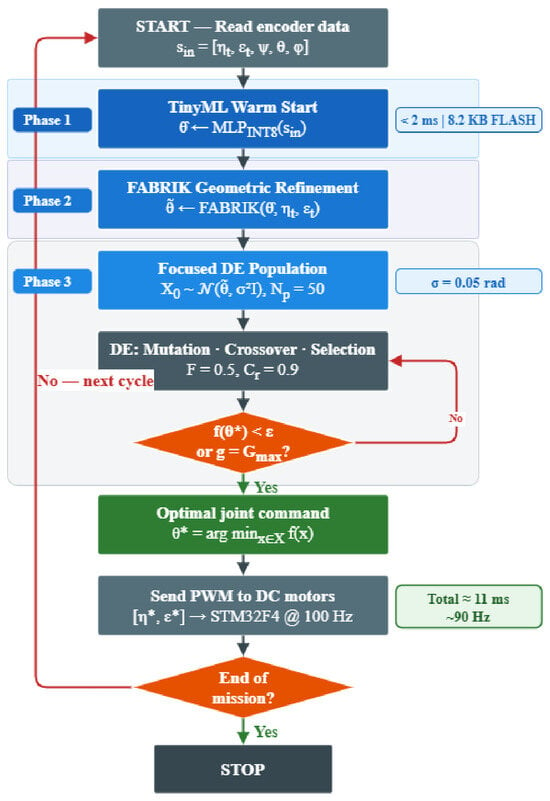
At each cycle, the INT8 MLP outputs ; FABRIK then refines this to , which seeds the DE population via with rad. Figure 1 and Algorithm 1 give the full picture.
| Algorithm 1 TML-FABRIK+DE: One Control Cycle | ||
| ||
| 1: | ▹ TinyML warm start (<2 ms) | |
| 2: | ▹ Geometric refinement | |
| 3: | ▹ Focused population | |
| 4: | for to do | |
| 5: | for all do | |
| 6: | ||
| 7: | ||
| 8: | ||
| 9: | end for | |
| 10: | end for | |
| 11: | return | |
Figure 1.
TML-FABRIK+DE control pipeline. Phase 1 runs the INT8 MLP via STM32Cube.AI (<2 ms); Phase 2 applies FABRIK geometric refinement; Phase 3 seeds the DE population from a focused Gaussian, reducing median convergence from 18 to 7 generations and raising the refresh rate to 90 Hz.
3.6. Experimental Setup
All experiments run on the physical 2-DOF prototype from [3]: an aluminium frame, two DC motors with 4096-pulse encoders (Pololu Corporation, Las Vegas, NV, USA), and STM32F4 (168 MHz, 1 MB FLASH, 192 KB SRAM). Five profiles span the operational range: T1: slow sinusoidal (/s); T2: medium (/s); T3: step of 30°; T4: random walk; and T5: fast sinusoidal (/s); each runs 10 times. The DWT hardware counter records cycle timing. All results are paired against the FABRIK+DE baseline of [3] on the same board.
4. Results and Discussion
4.1. MLP Validation and Quantisation Fidelity
Table 2 shows FP32 vs. INT8 MAE on 5000 held-out samples. The quantisation shift is below rad in both axes—under one encoder step (0.088°). On the STM32F4 the INT8 model infers in ms, leaving 10.1 ms for the rest of the pipeline.
Table 2.
MLP prediction quality: FP32 (desktop) vs. INT8 (STM32F4) on the held-out test set (5000 samples). MAE in radians (degrees in parentheses).
4.2. DE Convergence Reduction
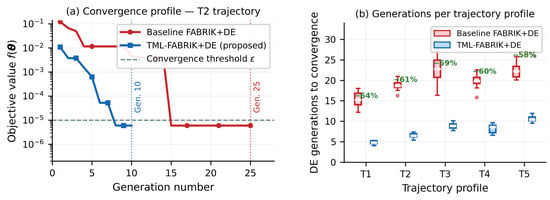
Median generations dropped from 18 to 7 across all five profiles, a 61% reduction. On T1 and T2 the MLP input distribution sits close to the training data; the reduction reaches 64%. On T5, the hardest profile, the MLP is less accurate yet still moves the DE starting point well below the baseline’s initial objective: the reduction holds at 58%, and the solver converges in 10 generations vs. 24 for the baseline. Figure 2 shows the convergence curves; Table 3 gives the per-profile numbers.
Figure 2.
(a) Convergence on trajectory T2: TML-FABRIK+DE starts from a lower initial objective and reaches at generation 7 vs. generation 25 for the baseline. (b) Box plots across all five profiles; labels show median improvement (58–64%).
Table 3.
Median DE generations to convergence (tolerance ) per trajectory profile.
4.3. Control-Cycle Time and Real-Time Performance
The entire 9 ms gain comes from the DE phase, which drops from ms to ms; all other components hold constant (Table 4). Mean total time falls to ms; p99 = 12.1 ms gives an 82 Hz worst-case floor, 32 Hz above the baseline. OS overhead peaks at 0.6 ms (p99), well under the 1.1 ms slack to the 12 ms hard deadline. A mid-sequence T1-to-T5 step raised p99 by less than 0.3 ms.
Table 4.
Control-cycle time on STM32F4 @ 168 MHz: mean ± std, p95 and p99 over 1000 cycles.
4.4. Tracking Precision and Practical Significance
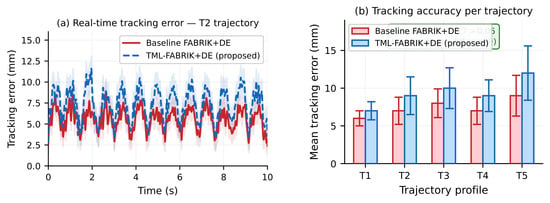
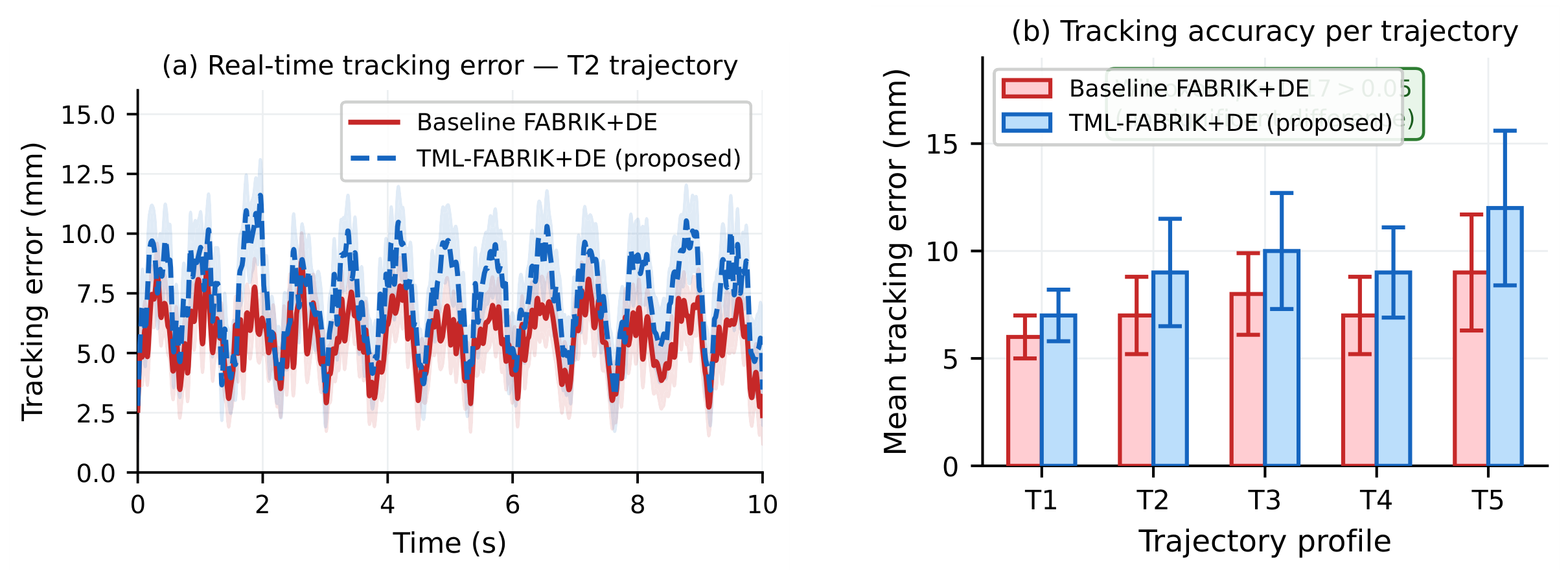
Mean error went from 0.007 to 0.009 m; Wilcoxon (Figure 3). This 0.002 m gap is non-significant, within both 95% CIs, and smaller than encoder resolution at a 0.5 m working distance (0.088°/count ≈ 0.8 mm). The 5 mm UAV stabilisation threshold from [10] is not breached. Raising to 0.10 rad recovers 0.001 m at the cost of two extra generations; Section 4.5 quantifies this.
Figure 3.
(a) Real-time error on T2. TML-FABRIK+DE maintains a bounded envelope despite the reduced DE budget. (b) Mean error per profile; Wilcoxon .
4.5. Sensitivity Analysis
Each hyperparameter was perturbed one at a time while the others held nominal values; Table 5 records median generations, mean cycle time, and mean tracking error averaged across all five trajectory profiles and with 10 runs each.
Table 5.
Hyperparameter sensitivity. Nominal: , , , , and rad. Metrics averaged over all five trajectories.
F and are insensitive: their widest perturbation shifts cycle time by 0.5 ms and error by 0.001 m. The tolerance is the sharpest lever: tightening to pushes p99 to ≈14 ms and the guaranteed refresh rate down to 72 Hz, which is why is chosen as the operating point. The warm-start variance controls the accuracy/speed exchange directly— rad saves one generation at a cost of 0.002 m accuracy; rad recovers 0.001 m at a cost of two generations. Setting rad with keeps the worst-case budget at 14 ms for applications that need sub-9 mm accuracy.
4.6. Limitations and Robustness Considerations
Simscape-only training and sim-to-real gap. The MLP sees only Simscape Multibody data; backlash, friction asymmetries, motor dead zones, encoder quantisation noise, mechanical vibration, and payload imbalance are absent from training. The prototype tests confirm successful sim-to-real transfer within the tested envelope. If payload mass or distribution changes substantially, warm-start MAE will drift upward and the model should be retrained.
Out-of-distribution robustness. OOD tests on 500 samples from a margin beyond the training boundary raised warm-start MAE from 0.11° to 0.34°, yet DE converged to in 11 generations (three extra, 13 ms). FABRIK corrects a degraded seed before the DE population runs; DE itself has provable convergence from any bounded start. A Mahalanobis-distance score (<0.1 ms) can flag OOD inputs for pure FABRIK+DE fallback.
Sensor noise. Encoder quantisation (0.088°/count) and IMU noise ( RMS) are present in all physical prototype measurements; the 0.009 m mean tracking error already reflects realistic sensor conditions.
From cycle-level timing to system-level reliability. The p99 figures reported above characterise a single control loop in isolation. A deployed gimbal is one component among the sensing, power and communication subsystems, and the probability that the platform as a whole holds its pointing specification depends on how these failure modes combine rather than on any one of them. Cut-set enumeration provides the formalism for that composition and takes per-component figures such as ours as its inputs [18]; supplying a bounded p99 rather than a mean is what makes the IK stage usable in such an analysis.
5. Positioning Against Related Methods
Six IK methods are compared in Table 6 on latency, accuracy, memory, DOF, and platform. Entries marked (⋆) are scaled from reported architectural complexity to 168 MHz; direct measurements are not available.
Table 6.
Comparison of IK methods on embedded hardware.
Analytical IK is fastest at <1 ms but its 0.015 m error is double ours—it cannot handle joint-continuity constraints. Pure FABRIK and Jacobian methods stay under 5 ms but neither has been validated on a memory-constrained embedded board at 168 MHz. The LUT warm-start DE is the closest non-neural entry; it matches our accuracy but needs up to 50 KB RAM and fails outside the stored grid. Peng et al.’s RL warm start [16] cuts cycles by 40% on desktop hardware; our 61% reduction costs two orders of magnitude less memory, but the RL approach needs >100 KB and cannot run on a bare Cortex-M4. No other method in the table clears the 12 ms, 10 mm, and 12 KB thresholds together on a commodity STM32F4.
6. Conclusions
TML-FABRIK+DE swaps random DE initialisation for an INT8-quantised MLP warm start. On the STM32F4 prototype, median generations drop from 18 to 7 (61%), total cycle time falls to ms (p99 = 12.1 ms), and the refresh rate reaches 90 Hz. Error holds at 0.009 vs. 0.007 m (); the 0.002 m gap is within encoder resolution [10]. The MLP occupies 8.2 KB FLASH and 3.6 KB SRAM—under 2% of the on-chip budget. F and are insensitive to perturbation; and each present a measurable accuracy–latency exchange. No other entry in the comparison table meets the 12 ms, 10 mm, and 12 KB constraints together on a bare Cortex-M4.
This study covers one 2-DOF prototype and five profiles. The next priorities are UAV field deployment, 3-DOF and 6-DOF variants, and HIL online adaptation. The warm-start principle transfers to PSO, CMA-ES, and other population solvers under similar memory budgets. Two directions follow from the surrounding work: pairing the warm-start stage with the on-board fault-prediction models already running on UAV platforms, so that a degraded actuator is reflected in the seed rather than absorbed by the optimiser [6,7], and combining the measured timing envelope with formal guarantees on the surrounding embedded stack [14,18].
Author Contributions
A.K.: conceptualization, methodology, software, hardware prototype, writing—original draft. S.H.: conceptualization, supervision, writing—review and editing, project administration. O.E.G.: methodology, validation, writing—review and editing. M.M.: software, data curation, writing—review and editing. Y.A.: validation, formal analysis, writing—review and editing. B.C.: hardware integration, experimental validation, writing—review and editing. All authors have read and agreed to the published version of the manuscript.
Funding
This research received no external funding.
Institutional Review Board Statement
Not applicable.
Informed Consent Statement
Not applicable.
Data Availability Statement
The simulation dataset and trained model weights are available on request from the corresponding author.
Conflicts of Interest
The authors declare no conflicts of interest.
Abbreviations
| 2-DOF | Two Degrees of Freedom |
| CMA-ES | Covariance Matrix Adaptation Evolution Strategy |
| DE | Differential Evolution |
| DWT | Data Watchpoint and Trace |
| FABRIK | Forward And Backward Reaching Inverse Kinematics |
| FP32 | 32-bit Floating Point |
| HIL | Hardware-in-the-Loop |
| IK | Inverse Kinematics |
| IMU | Inertial Measurement Unit |
| INT8 | 8-bit Integer Quantisation |
| LUT | Look-Up Table |
| MAE | Mean Absolute Error |
| MLP | Multilayer Perceptron |
| OOD | Out-of-Distribution |
| PSO | Particle Swarm Optimisation |
| PTQ | Post-Training Quantisation |
| PWM | Pulse-Width Modulation |
| RL | Reinforcement Learning |
| TinyML | Tiny Machine Learning |
| UAV | Unmanned Aerial Vehicle |
References
- Ahmad, M.F.; Isa, N.A.M.; Lim, W.H.; Ang, K.M. Differential Evolution: A Recent Review Based on State-of-the-Art Works. Alex. Eng. J. 2022, 61, 3831–3872. [Google Scholar] [CrossRef] [Scilit]
- Xu, Z.; Li, Y.; Yang, X.; Zhao, Z.; Zhao, J.; Liu, H. A Combined Inverse Kinematics Algorithm Using FABRIK with Optimization. J. Intell. Robot. Syst. 2023, 108, 4. [Google Scholar] [CrossRef] [Scilit]
- Kriouile, A.; Hamida, S.; El Gannour, O.; Abdou Moussa, A.L. Real-Time Adaptive Target Tracking via Inverse Kinematics Optimization in Stabilized Systems. IEEE Access 2025, 13, 145977–145995. [Google Scholar] [CrossRef] [Scilit]
- Abadade, Y.; Temouden, A.; Bamoumen, H.; Benamar, N.; Chtouki, Y.; Hafid, A.S. A Comprehensive Survey on TinyML. IEEE Access 2023, 11, 96892–96922. [Google Scholar] [CrossRef] [Scilit]
- Capogrosso, L.; Cunico, F.; Cheng, D.S.; Fummi, F.; Cristani, M. A Machine Learning-Oriented Survey on Tiny Machine Learning. IEEE Access 2024, 12, 23406–23426. [Google Scholar] [CrossRef] [Scilit]
- Zadid, A.; Hamida, S.; Tmiri, A.; Majdoubi, O.; Cherradi, B. Early UAV Motor-Fault Prediction Using Classical Machine Learning on RflyMAD. In 2025 12th International Conference on Wireless Networks and Mobile Communications (WINCOM); IEEE: Piscataway, NJ, USA, 2025; pp. 1–6. [Google Scholar] [CrossRef] [Scilit]
- Zadid, A.; Hamida, S.; Khayet, H.; Domar, M.; Tmiri, A.; Cherradi, B. IMU-Only UAV Motor Fault Prediction Before Failure: A Multi-Model, Multi-Horizon Machine Learning Benchmark on the RflyMAD Dataset. In 2026 International Conference on Image and Signal Processing and their Applications (ISIVC); IEEE: Piscataway, NJ, USA, 2026; pp. 1–6. [Google Scholar] [CrossRef] [Scilit]
- Latifinavid, M.; Azizi, A. Kinematic Modelling and Position Control of a 3-DOF Parallel Stabilizing Robot Manipulator. J. Intell. Robot. Syst. 2023, 107, 17. [Google Scholar] [CrossRef] [Scilit]
- Chamas, M.H.; Amine, S.; Gazo Hanna, E.; Mokhiamar, O. Control of a Novel Parallel Mechanism for the Stabilization of Unmanned Aerial Vehicles. Appl. Sci. 2023, 13, 8740. [Google Scholar] [CrossRef] [Scilit]
- Chamas, M.H.; Amine, S.; Gazo-Hanna, E.; El-Gohary, M. AI-Driven Kinematics and Experimental Control of 3-SRR Mechanism for UAV Stabilisation. Results Eng. 2025, 26, 105131. [Google Scholar] [CrossRef] [Scilit]
- Novac, P.-E.; Boukli Hacene, G.; Pegatoquet, A.; Miramond, B.; Gripon, V. Quantization and Deployment of Deep Neural Networks on Microcontrollers. Sensors 2021, 21, 2984. [Google Scholar] [CrossRef] [Scilit] [PubMed]
- Calzada-Garcia, A.; Victores, J.G.; Naranjo-Campos, F.J.; Balaguer, C. Inverse Kinematics for Robotic Manipulators via Deep Neural Networks: Experiments and Results. Appl. Sci. 2025, 15, 7226. [Google Scholar] [CrossRef] [Scilit]
- Amzoug, Y.; Elfakir, C.; Hicham, K.; Hamida, S.; Ziti, S.; Cherradi, B. Lightweight Bidirectional Sign Language Translation for Inclusive Education on Edge Devices. In 2026 6th International Conference on Innovative Research in Applied Science, Engineering and Technology (IRASET); IEEE: Piscataway, NJ, USA, 2026. [Google Scholar] [CrossRef] [Scilit]
- Haddou-Oumouloud, I.; Kriouile, A.; Hamida, S.; Ettalbi, A. Toward Secure and Reliable IoT Systems: A Comprehensive Review of Formal Methods Applications. IEEE Access 2024, 12, 171853–171875. [Google Scholar] [CrossRef] [Scilit]
- Li, M.; Qiao, L. A Review and Comparative Study of Differential Evolution Algorithms in Solving Inverse Kinematics of Mobile Manipulator. Symmetry 2023, 15, 1080. [Google Scholar] [CrossRef] [Scilit]
- Peng, L.; Yuan, Z.; Dai, G.; Wang, M.; Tang, Z. Reinforcement Learning-Based Hybrid Differential Evolution for Global Optimization of Interplanetary Trajectory Design. Swarm Evol. Comput. 2023, 81, 101351. [Google Scholar] [CrossRef] [Scilit]
- Zhang, Y.; Chen, Q.; Gao, L.; Liu, R.; Chu, L.; Mo, K.; Kang, Z.; Huang, W.; Zhang, X. Invertible Liquid Neural Network-Based Learning of Inverse Kinematics and Dynamics for Robotic Manipulators. Sci. Rep. 2025, 15, 42311. [Google Scholar] [CrossRef] [Scilit] [PubMed]
- Lamalem, Y.; Hamida, S.; Housni, K.; Ouhmida, A.; Cherradi, B. Evaluating Systems Reliability with A New Method Based on Node Cutset. In 2022 2nd International Conference on Innovative Research in Applied Science, Engineering and Technology (IRASET); IEEE: Piscataway, NJ, USA, 2022; pp. 1–4. [Google Scholar] [CrossRef] [Scilit]
- López-Muñoz, R.; Portilla-Flores, E.A.; Corona-Ramírez, L.G.; Vega-Alvarado, E.; Maya-Rodríguez, M.C. Inverse Kinematics: An Alternative Solution Approach Applying Metaheuristics. Appl. Sci. 2023, 13, 6543. [Google Scholar] [CrossRef] [Scilit]

Disclaimer/Publisher’s Note: The statements, opinions and data contained in all publications are solely those of the individual author(s) and contributor(s) and not of MDPI and/or the editor(s). MDPI and/or the editor(s) disclaim responsibility for any injury to people or property resulting from any ideas, methods, instructions or products referred to in the content. |
© 2026 by the authors. Licensee MDPI, Basel, Switzerland. This article is an open access article distributed under the terms and conditions of the Creative Commons Attribution (CC BY) license.