


Abstract
Recent developments within machine learning (ML) models for predicting maintenance (PdM) and prescriptions of maintenance (PsM) in vehicles are discussed in this paper. Even though PdM has been widely used for fault detection and Remaining Useful Life (RUL) prediction, little work has been done on how to translate predictions into maintenance actions. In this paper, recent ML and Deep learning (DL) techniques, including architectures such as LSTM networks, CNNs and reinforcement learning (RL), are explored, along with their use cases for fault detection and decision-making processes. Furthermore, this study investigates the challenges related to the application of ML techniques in vehicle maintenance. These challenges include limited data availability, generalization of models, and absence of a decision-making framework.
1. Introduction
As both modern industrial and vehicular systems become increasingly complex, the importance of maintenance management has been elevated to a critical role to ensure the reliability of the systems, their safe operation, as well as cost efficiency [1]. With the rapid advancements of digital technology associated with Industry 4.0, which includes the connectivity of various sensors and devices, as well as the establishment of extensive data infrastructures, the practice of maintenance management has been moving in the direction of more intelligent approaches. The evolution described above is based on the use of AI, Time-Sensitive Networking, and data-based decision-making, especially for Industrial Internet of Things (IIoT) systems [2]. In transportation systems, including vehicular communication systems, the ability to predict the behavior of machines and their faults is indispensable to ensure high system availability and avoid unexpected failures [3].
With regard to science and industry, improving maintenance management is an essential goal because it can affect system efficiency and cost savings. Classical methods such as corrective and preventive maintenance are frequently related to unintended malfunctions, which has led researchers to explore PdM techniques [4]. Studies suggest that ML methods can help detect faults, predict failures, and determine the RUL [5]. Both ML and DL algorithms are capable of analyzing large sensor datasets to identify patterns related to machine health. In particular, real-time PdM systems that leverage IoT data streams have demonstrated the ability to continuously monitor equipment conditions and enhance fault-detection accuracy [6]. Despite this progress, a major problem still exists. Most of the research efforts focus on improving the accuracy of the predictions, with comparatively little attention paid to the application of these predictions in actual maintenance decisions. Thus, PdM may not be enough to guide maintenance management decisions entirely. In light of the above, a comprehensive review of current research on ML techniques for PdM and PsM of vehicle systems is carried out. This research seeks to improve knowledge on the use of ML techniques in maintenance and how this affects system performance. Furthermore, unlike many existing studies that primarily focus on fault diagnosis, failure prediction, or general industrial maintenance applications, this review places particular emphasis on the transition from PdM to PsM within vehicle systems. It also examines how recent AI-driven approaches can support maintenance decision-making beyond traditional prediction tasks. There are several contributions made by this study. Firstly, maintenance methodologies are discussed, alongside their transition from PdM to PsM in the field of vehicle systems. Secondly, different methods of ML and DL employed for fault detection and diagnosis and RUL estimation are reviewed. Thirdly, a comparative assessment of the identified AI approaches is provided, highlighting their strengths, limitations, and suitability for different maintenance applications. Lastly, some of the methodological problems encountered in the use of PdM are highlighted, together with emerging research directions aimed at bridging the gap between predictive analytics and maintenance decision support.
The paper is organized as follows. The methodology for the current research is presented in Section 2. The theoretical framework concerning maintenance strategies and methods of ML is introduced in Section 3. The main results of the literature review are reported in Section 4. Section 5 deals with the development of maintenance strategies and research gaps.
2. Review Methodology
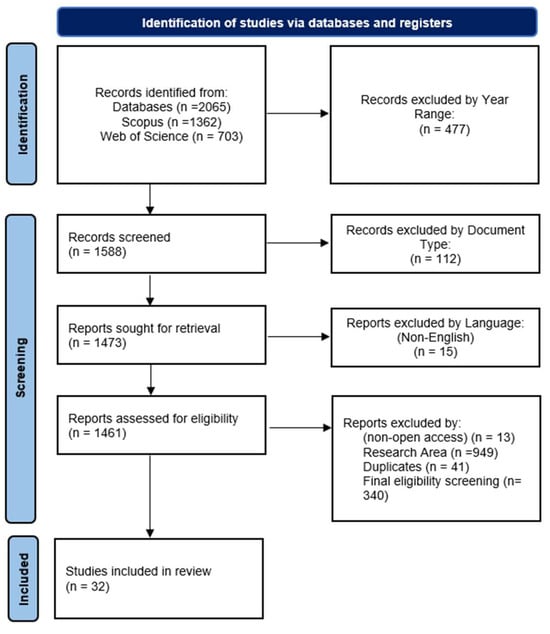
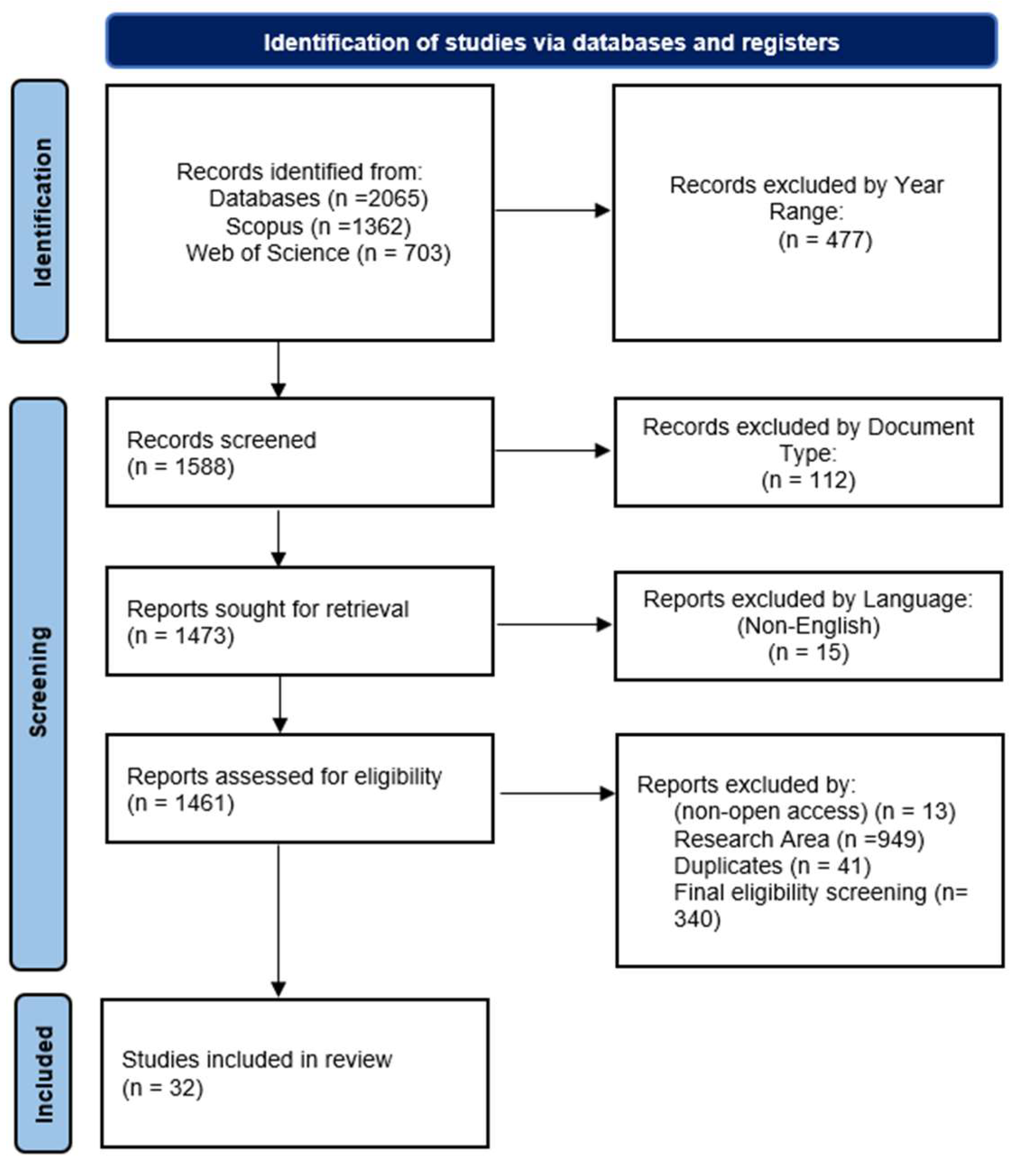
This part describes the methodology used for carrying out the literature review on the application of ML in PdM and PsM. The literature review was designed to identify and analyze relevant literature pertaining to the maintenance strategies, predictive analytics, and decision support methods used in the vehicle system. The methodological framework illustrated in Figure 1 outlines the major steps involved in the literature exploration and analysis process.
Figure 1.
PRISMA article selection process.
2.1. Research Questions
The research questions developed for this literature review are as follows:
- Which ML and DL methods are most often used for PdM in automobile systems, and how are they utilized in fault diagnosis, predicting failures, and estimating the RUL of a system?
- What are the current shortcomings in the field of PdM, and how does it evolve into PsM-driven e systems?
2.2. Database and Keyword Selection
In carrying out this review, the literature obtained from databases such as Scopus and Web of Science was used. In order to make sure that the articles are up-to-date, the period from which articles have been selected ranges from 2020 to 2025. The terms used in conducting a literature search include “vehicle maintenance”, “PdM”, “PsM”, “ML”, “DL”, “RUL”, “vehicle fault diagnosis”, and “prognostics and health management (PHM)”.
Boolean operators such as AND and OR were used to further narrow down the research approach and obtain literature that falls within the scope of this study. Only peer-reviewed journal publications and proceedings from conferences that had been listed in Scopus and Web of Science databases were considered for analysis. Further screening by applying certain filters concerning publication year, article type, language, accessibility, and related subject categories enabled a decrease in the number of datasets from 1362 to 238 in Scopus and from 703 to 175 in Web of Science. Removal of duplicates left a total of 372 documents. Inclusion in further stages of analysis was determined based on relevance and adherence to study criteria; consequently, only 32 papers were selected.
2.3. Study Selection Criteria
In order to ensure that only relevant articles were included, some inclusion and exclusion criteria were put into use. Table 1 presents the main criteria that were used for selecting articles for this review.
Table 1.
Criteria for inclusion and exclusion.
3. Theoretical Foundations
3.1. Vehicle Maintenance
Maintenance of vehicles refers to the actions that are necessary for keeping or restoring the system to working order. The key goals of vehicle maintenance include ensuring that the system functions effectively while at the same time cutting down on expenses related to the process [7,8]. With the increasing complexity of vehicle systems, coupled with the emergence of Industry 4.0, maintenance systems have evolved from the conventional method to more advanced methods such as RCM and LCM [7,9].
3.2. ML in Maintenance
ML refers to the process whereby computer programs can learn using datasets to perform functions like fault analysis and predictive analysis in car maintenance applications [3,8,9,10]. ML techniques may be classified as supervised learning for classification purposes and RUL estimation [11,12]; unsupervised learning for pattern recognition and outlier analysis [9,13]; and RL, which focuses on optimizing the decision process through interaction with its environment [14,15].
3.3. DL for Maintenance Applications
DL, a subset of ML, employs multi-layer neural networks to automatically learn complex patterns from raw data, making it particularly suitable for processing noisy and non-linear vehicle data [3,10,16]. Common DL architectures include Artificial Neural Networks (ANNs) for diagnostics and maintenance prediction [16,17], CNNs for fault diagnosis through feature extraction from sensor signals [16], and RNN/LSTM models for RUL prediction and degradation monitoring in time-series data [11].
3.4. Prognostic and Health Management—PHM
PHM is a maintenance strategy that relies on the use of sensors to keep track of equipment health status and enable PdM operations [12,18]. There are three major elements in PHM strategy: (i) diagnostic assessment to detect early failure indications [12], (ii) PHM for RUL estimation and failure prediction [11,12], and (iii) decision-making to take necessary measures based on expected behavior of the system [19].
4. Results
There is a clear increasing trend of research papers on ML-based PdM and PsM between 2020 and 2025, reflecting the growing attention of the scientific community toward intelligent maintenance systems and Industry 4.0.
4.1. Maintenance Strategies in the Reviewed Literature
Table 2 offers a summary of the definitions and contributions associated with the different approaches to maintenance as discussed by the articles reviewed, with importance placed on the evolution towards the predictive and prescriptive concepts.
Table 2.
Comparison of maintenance strategy definitions.
It can be noted from the academic literature that there has been a shift from the traditional approach of “running to failure” to more progressive approaches to maintenance [7,9]. The former is considered less efficient owing to high costs associated with downtime [22,25], while the latter can cause unwanted maintenance interventions, thereby resulting in the early replacement of healthy components [7,26]. The shift towards PdM has made way for PsM. PdM relies on data analytics to predict the RUL of various components of an asset [11,12,26]. PsM is based on PdM and focuses on optimizing decisions through the alignment of maintenance activities with operational constraints and goals [15,20,23].
4.2. Comparison of AI Techniques Used in Maintenance
Table 3 summarizes the evaluated papers that employ a diverse array of AI methodologies, with a focus on ML and DL methodologies to support the predictive and PsM activities [3,7,9]. From the reviewed literature, there is a clear trend towards the adoption of methodologies, such as RNNs and LSTMs, for time series forecasting and RUL prediction due to their inherent ability to deal with time series data [11,26]. There is also an increasing use of ensemble methodologies such as XGBoost and Random Forest for effective fault classification and diagnosis activities [18,26]. From recent studies, there is a clear trend towards the use of RL methodologies for autonomous decision support activities to optimize maintenance activities under different constraints [14,15]. Finally, the importance of Explainable Artificial Intelligence (XAI) methodologies such as SHAP and LIME is also recognized as a critical factor to build trust through transparency in the decision-making process [18].
Table 3.
Comparison of AI methods used in maintenance applications.
4.3. Comparative Assessment of AI Methods
To begin with, the discussed literature reviews differences between predictive and prescriptive AI approaches applied in intelligent vehicle maintenance systems. In particular, CNNs, LSTM networks, Autoencoders, and XGBoost models are used in fault diagnostics, anomaly detection, RUL estimation, and failure prediction [3,10,11,16,18]. As a result, modern solutions in the field seem to be focused on improving prediction accuracy and estimating the RUL of smart systems. On the contrary, few papers deal with prescriptive ML models (RL, generative learning) application to maintenance-related decisions. Moreover, there is a connection between a model’s ability to make accurate predictions and its explainability that could affect intelligent systems’ ability to help with making proper maintenance decisions. For example, CNNs and LSTMs are often used due to their high effectiveness in detecting patterns from high-dimensional feature vectors and temporal degradation [10,11,16]. Still, these models lack a good explanation of why specific predictions were made, thus making them inadequate for maintenance decisions based on them. The mentioned trend towards explainability includes using the XGBoost model in the intelligent vehicle maintenance system with SHAP explanations proposed by Souza et al. [18]. Data availability also seems to influence the modeling approach. CNNs, LSTMs, and XGBoost models are often preferred when historical failure data are available [3,10,11,16]. In the absence of data, intelligent systems usually rely on autoencoders and CVAE generative models to estimate the health state of components using semi-supervised learning, generative adversarial training, and other techniques for anomaly detection and health state estimation [18,27]. Finally, the problem of transferring failure predictions into recommendations should be pointed out as an issue affecting intelligent maintenance systems. Although CNNs, LSTMs, and XGBoost demonstrated great results in failure prediction and fault diagnosis, it still lacks practical implications, especially taking into consideration the necessity of considering operational and financial factors in intelligent maintenance decisions [14,27,28].
4.4. Integrative Synthesis
The reviewed studies, on the whole, demonstrate how the evolution of maintenance has moved from reactive and preventive maintenance approaches towards the use of intelligent approaches to maintenance based on artificial intelligence and ML technologies [3,7,12]. PdM has become the most popular type of maintenance because the data-driven approaches to analysis make it possible to predict failure and assess the equipment before failure [3,11,16]. In addition to predicting problems, modern inquiries are more focused on using prognostic information for decision-making about maintenance [14,27,28]. The described change can be viewed as a shift from PdM to PsM where maintenance decisions consider not only the state of equipment but also the goals of operations [23,25,29]. In conclusion, it should be noted that maintenance is evolving towards making decisions based on predictions, thus moving from predicting failure toward decision support [14,23,25]. To conclude, the latest research directions indicate a trend towards intelligent maintenance solutions that encompass fault detection, RUL prediction, and decision-making processes. However, making such a system applicable in a real-life environment continues to be an important research issue.
5. Discussion
5.1. The Evolution of Maintenance Strategies
The progression from reactive to proactive maintenance strategies is well documented in the literature and is attributed to the increasing complexity of industrial systems and the arrival of Industry 4.0 [7,9]. Conventional maintenance strategies, such as corrective maintenance, have been referred to as a “run-to-failure” strategy in which maintenance is carried out only to restore equipment to its original condition after a failure event [22,25]. Although preventive maintenance strategies were implemented to address the issue of equipment failures by carrying out scheduled maintenance activities on the basis of time and/or usage to minimize equipment failures, such strategies have been linked to inefficiencies arising from over-maintenance, which results in the premature replacement of functioning equipment components [7,26,30]. CBM, which entails the real-time monitoring of equipment to carry out maintenance activities when a specific failure level is reached, is a major development in the progression from reactive to proactive maintenance paradigms [3,12]. The progression of the maintenance paradigms is also spurred by the development of PdM, which relies on advanced analytics to predict the future condition of equipment and to ascertain the RUL of equipment components [11,25]. At the moment, the maintenance field is witnessing the development of PsM, which is perceived to be the most advanced maintenance paradigm in the field of maintenance science [14,15,23].
5.2. Identified Research Gaps and Deployment Barriers
Despite the various advancements in technology, there are several gaps in the adoption of new and sophisticated maintenance techniques.
Transition from PdM to PsM: The evolution from PdM to PsM indicates a move from the sole ability of failure prediction (prognostics) to a prescription of the best possible actions (decision support) [21,23,24]. PdM focuses on “what” and “when” of possible failures, mainly utilizing RUL predictions [15,23]. On the other hand, an important limitation of PdM is its inability to implement decision-making algorithms considering limited resources and uncertainties associated with the environment [23]. This means that, in aviation operations, the detection of a task that requires restoring the tire pressure would be insufficient due to a lack of available ground resources or scheduling issues associated with the flight plan [19,20]. As a result, prediction results may become practically ineffective without incorporation into production and maintenance planning [4,21]. Therefore, the authors recommend the use of RL and Markov Decision Processes (MDPs) as the two methods that can facilitate decision-making in conditions of uncertainty in terms of maximizing cost or availability [14,15,23].
Asset-Centric Limitations: Present-day maintenance approaches tend to be very asset-oriented, focused on the condition of a particular part or a particular machine instead of taking into account the whole ecosystem [15,19,20]. Such an approach fails to take into account the interdependencies between various parts and the conflicting interests of various stakeholders, for instance, vehicle drivers and Maintenance, Repair, and Overhaul (MRO) service providers [20]. To illustrate, an analytical approach that aims at calculating RUL for a fleet of mining trucks may miss the chance to use opportunity-based maintenance practices during downtime [20,25]. As a result, decision-making remains far from optimal as maintenance actions are taken at the level of a separate part of the vehicle without taking into consideration neighboring processes [15,20]. Possible methodological solutions for solving this problem include utilizing Digital Twins to estimate system interactions and Horizontal and Vertical Integration (H&VI) strategies to align operational goals with maintenance actions across multiple fleets [4,21,23,31].
Data limitations and Quality: Indeed, “garbage in, garbage out” still remains a primary limitation since any AI system is reliant on quality data [1,4]. It should be noted that in relation to the current task, there will always be a problem of data scarcity, considering that failure in vehicles does not happen all that often, thus leading to imbalanced sets where the normal state dominates [1,4,5,7,27]. On top of that, gathering of data is often hindered due to issues of confidentiality, as companies do not want their faults exposed [7,13]. In general, when studying diagnostic trouble codes (DTCs) and on-board diagnostics (OBD), it usually becomes evident that gathered data is sporadic and often lacks necessary labels for supervised learning [4,10,13]. Such limitations result in non-reproducibility of results and inability to validate the model [7]. Possible solutions may involve the use of Generative AI systems (GANs and VAEs) for generating synthetic data and Federated Learning for training models from multiple stakeholders [1,3,23,24].
Generalization and Deployment: A main problem in deployment lies in the premise of data drawn from the same distribution, which is hardly met in the context of vehicle technology due to the phenomenon of concept drift [5,7]. The virtual concept drift, known as covariate shift, occurs when a car performs its functions in climates or applications other than those experienced in training, while actual concept drift involves temporal changes in the degradation pattern itself [7]. For instance, the model determining the condition of the Li-ion battery should be able to manage different levels of degradation caused by various charging procedures and temperatures [15]. A model trained in laboratory settings cannot generalize to real-life cases and can only be applied to homogeneous cars [4,24]. It is important to keep models valid for longer periods of time; for that purpose, Transfer Learning and Domain Adaptation are recommended for leveraging existing knowledge in different assets [3,4,7,23,24]. At the same time, XAI allows the stakeholders to have confidence in maintenance recommendations based on clear decision-making logic [15].
6. Conclusions and Future Research Directions
The literature has identified various promising avenues to address the current challenges and move forward to achieve the goals of Industry 5.0. First, the use of Digital Twins is expected to increase. In future studies, real-time digital models of physical machines are expected to be used to simulate the process of maintenance with high accuracy [21,32]. Second, the use of sophisticated AI techniques is increasingly being applied. In this regard, DRL is found to be an effective technique to improve the decision-making process of the maintenance system [14,15]. In addition, the use of other Generative AI tools like Generative Adversarial Networks (GANs) and Variational Autoencoders (VAEs) is progressing to address the problem of data availability in the maintenance system. Third, trust is becoming an essential aspect of the adoption of AI-based intelligent maintenance systems. In this regard, the development of XAI techniques is progressing to provide explanations for the recommended actions to improve human–AI collaboration and the practical implementation of PsM [27]. Finally, the concept of causal and sustainable maintenance is becoming an important aspect of the intelligent maintenance system. In this regard, the use of Causal ML is under investigation to distinguish between correlation and causation in the data, with the incorporation of sustainability aspects into the decision-making process of the intelligent system [9]. Overall, the emerging trends of future research highlight the increasing use of intelligent technology with the concept of sustainability. The future of the intelligent maintenance system is expected to be integrated to provide a reliable, transparent, and sustainable system.
Author Contributions
J.M.: Writing—review & editing, Writing—original draft, Visualization, Resources, Methodology, Investigation, Formal analysis, Conceptualization. W.D., H.G., N.B., and N.M.: Writing—review & editing, Supervision and validation. H.M.: Supervision and validation. All authors have read and agreed to the published version of the manuscript.
Funding
This research did not receive any specific grant or external funding.
Institutional Review Board Statement
Not applicable.
Informed Consent Statement
Not applicable.
Data Availability Statement
Data will be made available upon request.
Acknowledgments
The authors would like to express their gratitude to the Research Foundation for Development and Innovation in Science and Engineering (FRDISI) for providing technical support.
Conflicts of Interest
The authors declare no conflicts of interest.
References
- Peres, R.S.; Jia, X.; Lee, J.; Sun, K.; Colombo, A.W.; Barata, J. Industrial Artificial Intelligence in Industry 4.0—Systematic Review, Challenges and Outlook. IEEE Access 2020, 8, 220121–220139. [Google Scholar] [CrossRef] [Scilit]
- Kliestik, T.; Nica, E.; Durana, P.; Popescu, G.H. Artificial Intelligence-Based Predictive Maintenance, Time-Sensitive Networking, and Big Data-Driven Algorithmic Decision-Making in the Economics of Industrial Internet of Things. Oeconomia Copernic. 2023, 14, 1097–1138. [Google Scholar] [CrossRef] [Scilit]
- Mahale, Y.; Kolhar, S.; More, A.S. A Comprehensive Review on Artificial Intelligence Driven Predictive Maintenance in Vehicles: Technologies, Challenges and Future Research Directions. Discov. Appl. Sci. 2025, 7, 243. [Google Scholar] [CrossRef] [Scilit]
- Ramzan, F.; Reforgiato Recupero, D. A Literature Review on Enhancing Predictive Maintenance in Smart Manufacturing Industries: Fostering Human-Technology Collaboration and Overcoming Data Scarcity Limitations with Advanced AI Models. Oper. Res. Forum 2025, 6, 181. [Google Scholar] [CrossRef] [Scilit]
- Ferreira, C.; Gonçalves, G. Remaining Useful Life Prediction and Challenges: A Literature Review on the Use of Machine Learning Methods. J. Manuf. Syst. 2022, 63, 550–562. [Google Scholar] [CrossRef] [Scilit]
- Ayvaz, S.; Alpay, K. Predictive Maintenance System for Production Lines in Manufacturing: A Machine Learning Approach Using IoT Data in Real-Time. Expert Syst. Appl. 2021, 173, 114598. [Google Scholar] [CrossRef] [Scilit]
- Theissler, A.; Pérez-Velázquez, J.; Kettelgerdes, M.; Elger, G. Predictive Maintenance Enabled by Machine Learning: Use Cases and Challenges in the Automotive Industry. Reliab. Eng. Syst. Saf. 2021, 215, 107864. [Google Scholar] [CrossRef] [Scilit]
- Jain, M.; Vasdev, D.; Pal, K.; Sharma, V. Systematic Literature Review on Predictive Maintenance of Vehicles and Diagnosis of Vehicle’s Health Using Machine Learning Techniques. Comput. Intell. 2022, 38, 1990–2008. [Google Scholar] [CrossRef] [Scilit]
- Çınar, Z.M.; Abdussalam Nuhu, A.; Zeeshan, Q.; Korhan, O.; Asmael, M.; Safaei, B. Machine Learning in Predictive Maintenance towards Sustainable Smart Manufacturing in Industry 4.0. Sustainability 2020, 12, 8211. [Google Scholar] [CrossRef] [Scilit]
- Hossain, M.N.; Rahman, M.M.; Ramasamy, D. Artificial Intelligence-Driven Vehicle Fault Diagnosis to Revolutionize Automotive Maintenance: A Review. Comput. Model. Eng. Sci. 2024, 141, 951–996. [Google Scholar] [CrossRef] [Scilit]
- Yan, J.; He, Z.; He, S. Multitask Learning of Health State Assessment and Remaining Useful Life Prediction for Sensor-Equipped Machines. Reliab. Eng. Syst. Saf. 2023, 234, 109141. [Google Scholar] [CrossRef] [Scilit]
- Santiago, R.A.D.F.; Barbosa, N.B.; Mergulhão, H.G.; Carvalho, T.F.D.; Santos, A.A.B.; Medrado, R.C.; Filho, J.B.D.M.; Pinheiro, O.R.; Nascimento, E.G.S. Data-Driven Models Applied to Predictive and Prescriptive Maintenance of Wind Turbine: A Systematic Review of Approaches Based on Failure Detection, Diagnosis, and Prognosis. Energies 2024, 17, 1010. [Google Scholar] [CrossRef] [Scilit]
- Calabrese, F.; Regattieri, A.; Bortolini, M.; Gamberi, M.; Pilati, F. Predictive Maintenance: A Novel Framework for a Data-Driven, Semi-Supervised, and Partially Online Prognostic Health Management Application in Industries. Appl. Sci. 2021, 11, 3380. [Google Scholar] [CrossRef] [Scilit]
- Nguyen, V.-T.; Do, P.; Vosin, A.; Iung, B. Artificial-Intelligence-Based Maintenance Decision-Making and Optimization for Multi-State Component Systems. Reliab. Eng. Syst. Saf. 2022, 228, 108757. [Google Scholar] [CrossRef] [Scilit]
- Ordieres-Meré, J.; Sánchez-Herguedas, A.; Mena-Nieto, Á. A Data-Driven Monitoring System for a Prescriptive Maintenance Approach: Supporting Reinforcement Learning Strategies. Appl. Sci. 2025, 15, 6917. [Google Scholar] [CrossRef] [Scilit]
- Souza, R.M.; Nascimento, E.G.S.; Miranda, U.A.; Silva, W.J.D.; Lepikson, H.A. Deep Learning for Diagnosis and Classification of Faults in Industrial Rotating Machinery. Comput. Ind. Eng. 2021, 153, 107060. [Google Scholar] [CrossRef] [Scilit]
- Rababaah, A.R. Comparative Study of Deep Learning Models Versus Machine Learning Models for Wind Turbine Intelligent Health Diagnosis Systems. Arab J. Sci. Eng. 2023, 48, 10875–10899. [Google Scholar] [CrossRef] [Scilit]
- Hoffmann Souza, M.L.; Da Costa, C.A.; De Oliveira Ramos, G. A Machine-Learning Based Data-Oriented Pipeline for Prognosis and Health Management Systems. Comput. Ind. 2023, 148, 103903. [Google Scholar] [CrossRef] [Scilit]
- Meissner, R.; Meyer, H.; Wicke, K. Concept and Economic Evaluation of Prescriptive Maintenance Strategies for an Automated Condition Monitoring System. Int. J. Progn. Health Manag. 2021, 12, 1–17. [Google Scholar] [CrossRef] [Scilit]
- Meissner, R.; Rahn, A.; Wicke, K. Developing Prescriptive Maintenance Strategies in the Aviation Industry Based on a Discrete-Event Simulation Framework for Post-Prognostics Decision Making. Reliab. Eng. Syst. Saf. 2021, 214, 107812. [Google Scholar] [CrossRef] [Scilit]
- Padovano, A.; Longo, F.; Nicoletti, L.; Gazzaneo, L.; Chiurco, A.; Talarico, S. A Prescriptive Maintenance System for Intelligent Production Planning and Control in a Smart Cyber-Physical Production Line. Procedia CIRP 2021, 104, 1819–1824. [Google Scholar] [CrossRef] [Scilit]
- Scaife, A.D. Improve Predictive Maintenance through the Application of Artificial Intelligence: A Systematic Review. Results Eng. 2024, 21, 101645. [Google Scholar] [CrossRef] [Scilit]
- Orošnjak, M.; Saretzky, F.; Kedziora, S. Prescriptive Maintenance: A Systematic Literature Review and Exploratory Meta-Synthesis. Appl. Sci. 2025, 15, 8507. [Google Scholar] [CrossRef] [Scilit]
- Pop-Suărășan, A.-D.; Ungureanu, N.S.; Petrovan, A. Analytical Research Regarding the Implementation of a Prescriptive Maintenance System Applied to IT&C Equipment. Machines 2025, 13, 412. [Google Scholar] [CrossRef] [Scilit]
- Fox, H.; Pillai, A.C.; Friedrich, D.; Collu, M.; Dawood, T.; Johanning, L. A Review of Predictive and Prescriptive Offshore Wind Farm Operation and Maintenance. Energies 2022, 15, 504. [Google Scholar] [CrossRef] [Scilit]
- Kumar, R.S.; Singh, A.R.; Narayana, P.L.; Chandrika, V.S.; Bajaj, M.; Zaitsev, I. Hybrid Machine Learning Framework for Predictive Maintenance and Anomaly Detection in Lithium-Ion Batteries Using Enhanced Random Forest. Sci. Rep. 2025, 15, 6243. [Google Scholar] [CrossRef] [Scilit] [PubMed]
- Zhai, S.; Gehring, B.; Reinhart, G. Enabling Predictive Maintenance Integrated Production Scheduling by Operation-Specific Health Prognostics with Generative Deep Learning. J. Manuf. Syst. 2021, 61, 830–855. [Google Scholar] [CrossRef] [Scilit]
- Cho, A.D.; Carrasco, R.A.; Ruz, G.A. Improving Prescriptive Maintenance by Incorporating Post-Prognostic Information Through Chance Constraints. IEEE Access 2022, 10, 55924–55932. [Google Scholar] [CrossRef] [Scilit]
- Tiddens, W.; Braaksma, J.; Tinga, T. Decision Framework for Predictive Maintenance Method Selection. Appl. Sci. 2023, 13, 2021. [Google Scholar] [CrossRef] [Scilit]
- Florian, E.; Sgarbossa, F.; Zennaro, I. Machine Learning-Based Predictive Maintenance: A Cost-Oriented Model for Implementation. Int. J. Prod. Econ. 2021, 236, 108114. [Google Scholar] [CrossRef] [Scilit]
- Pejić Bach, M.; Topalović, A.; Krstić, Ž.; Ivec, A. Predictive Maintenance in Industry 4.0 for the SMEs: A Decision Support System Case Study Using Open-Source Software. Designs 2023, 7, 98. [Google Scholar] [CrossRef] [Scilit]
- Zhang, B.; Hu, C.; Zheng, J.; Pei, H. Maintenance Decision-Making Using Intelligent Prognostics Within a Single Spare Parts Support System. Sensors 2025, 25, 837. [Google Scholar] [CrossRef] [Scilit] [PubMed]

Disclaimer/Publisher’s Note: The statements, opinions and data contained in all publications are solely those of the individual author(s) and contributor(s) and not of MDPI and/or the editor(s). MDPI and/or the editor(s) disclaim responsibility for any injury to people or property resulting from any ideas, methods, instructions or products referred to in the content. |
© 2026 by the authors. Licensee MDPI, Basel, Switzerland. This article is an open access article distributed under the terms and conditions of the Creative Commons Attribution (CC BY) license.