


Abstract
Autonomous distributed database systems are increasingly deployed to manage heterogeneous and independently governed data sources. While substantial research has addressed self-tuning, self-healing, and autonomous performance optimization in such systems, data quality management has remained predominantly data-agnostic: quality enforcement mechanisms operate without knowledge of data semantics, domain constraints, or the meaning of the values being assessed. This paper provides an analysis of data-agnostic versus data-aware approaches to quality management in autonomous distributed databases. We examine how the absence of semantic awareness limits existing quality frameworks, characterize the spectrum from purely statistical quality assessment to fully context-aware semantic quality enforcement, and analyze the gap between current state-of-the-art autonomous database capabilities and the requirements of truly data-aware quality management. Data-agnostic approaches, while scalable and domain-independent, systematically fail to detect semantic errors, domain violations, and context-dependent quality degradation. Data-aware approaches, though limited in scope and maturity, demonstrate substantially higher quality recall in domain-specific settings.
1. Introduction
The emergence of autonomous database systems that manage themselves through machine learning and artificial intelligence without human intervention represents one of the most significant shifts in data management research over the past decade [1]. Systems such as Oracle Autonomous Database, openGauss [2], NeurDB [3], and the Holon self-driving DBMS [4] have demonstrated that performance-oriented tasks such as index selection, query optimization, knob tuning, and workload scheduling can be substantially or fully automated.
Distributed settings amplify both the promise and the challenges of autonomy. Federated databases, cloud-native multi-node systems, and edge-cloud architectures require autonomous management across nodes that may operate independently, enforce different schemas, and exhibit heterogeneous data quality characteristics. The data residing across these nodes is not merely distributed in volume; it is distributed in provenance, governance, and semantic meaning.
Yet, a foundational assumption pervades most autonomous database research: data quality is either uniformly acceptable or is treated as a statistical anomaly to be detected without reference to what the data means. We call this the data-agnostic assumption. Under this assumption, a quality management system can decide that a column has too many NULL values, or that a value falls outside a learned statistical distribution, without understanding whether that NULL represents a missing patient diagnosis or an inapplicable field, and without knowing whether an outlier value is a genuine measurement or a data entry error.
In contrast, a data-aware quality management approach exploits knowledge of data semantics—domain constraints, entity relationships, temporal validity rules, and context-dependent fitness-for-purpose—to make quality assessments that go beyond statistical deviation. Such an approach would know that a blood pressure reading of 400 mmHg is physiologically impossible, that a product price of $0.00 is semantically suspicious for a non-promotional item, or that a patient record missing a diagnosis code is qualitatively different from one missing a fax number.
This paper provides an analysis of these two paradigms in the specific context of autonomous distributed databases. We do not propose a new system or present experimental results. Instead, we establish a conceptual and analytical framework with the following contributions:
- We characterize the data-agnostic and data-aware paradigms and the spectrum between them in the autonomous distributed database context.
- We compare existing autonomous database quality mechanisms against the requirements of semantic quality awareness.
- We identify the structural reasons why the intersection of autonomy, distribution, and data-awareness remains an open research problem.
- We establish a research agenda for future work toward semantically grounded autonomous quality management.
The remainder of this paper is organized as follows. Section 2 defines key concepts and quality dimensions. Section 3 analyzes data-agnostic approaches. Section 4 characterizes data-aware approaches. Section 5 presents the comparative analysis. Section 6 reviews related work. Section 7 discusses the open research landscape, and Section 8 concludes this paper.
2. Background
2.1. Autonomous Distributed Databases
Autonomous databases are systems that automate their own administration through machine learning and artificial intelligence. The five self-management goals articulated in the autonomic computing initiative and refined for the database context [1] are: self-configuration, self-optimization, self-healing, self-protection, and self-management of data quality.
In distributed settings, autonomous management must operate across nodes that may have independent governance, heterogeneous schemas, and inconsistent quality levels. This introduces a fundamental tension: autonomy implies decentralized decision-making, but quality enforcement, especially semantic quality enforcement, has traditionally required centralized rule specification.
Recent systems address performance autonomy comprehensively. The Holon system [4] tunes multiple components simultaneously using proto-action synthesis. NeurDB [3] integrates neural components directly into the query execution pipeline. openGauss [2] provides autonomous index recommendation, knob tuning, and SQL diagnosis. However, none of these systems addresses data quality beyond anomaly detection at the statistical level. Distribution further compounds the challenge: nodes may update at different frequencies, replicate inconsistently, and serve different population segments, so quality characteristics that hold globally in a centralized system fragment locally in a distributed one.
2.2. Data Quality Dimensions
Quality of data is a concept with many sides [5,6]. We concentrate on the five dimensions that are most important for autonomous distributed databases, starting with the ones that automated systems most often cover and ending with the ones that are most often ignored.
Completeness is how much of the required data values are there [5]. In distributed environments, completeness fluctuates significantly by node due to variations in collection pipelines, schema versions, and governance maturity among sources. In one node, a field may be required, while in another, it may be optional or not even exist. This makes it much harder to enforce federated completeness than local completeness.
Consistency checks to see if values that describe the same real-world things agree with each other, either across nodes or within a single node over time [5]. Because of replication lag, schema heterogeneity, and the lack of global integrity enforcement, distributed systems are structurally more likely to have consistency violations. Distributed nodes cannot use global transaction isolation to stop conflicting writes like centralized systems can.
Timeliness and Freshness show whether the data is up-to-date with the current state of the domain [6]. Different autonomous nodes update at different times. For example, real-time pipelines and daily batch jobs can run on the same federation, which means that data can be new on one node and old on another at the same time. Query results that join across nodes have mixed-staleness properties that a single-node freshness model cannot capture.
Accuracy measures how well stored values match the real world [5]. You cannot check accuracy just by looking at the data; you need to compare it to something real or a reliable source. This makes it the hardest dimension to automate and the one most likely to hit the data-agnostic ceiling: a system that does not know what a value should mean cannot tell if it is right.
Semantic Validity is the dimension that standard frameworks deal with the most incompletely [5,6,7]. It checks if a value is not only syntactically or statistically valid, but also meaningful and correct in the context of its domain. Setting a date of birth in the future is grammatically correct and statistically uncommon, but it is not possible to do so. A diagnosis code that does not match a patient’s symptoms is statistically possible but not semantically correct. Semantic validity is the main goal of quality management that takes data into account, and it is also the main weakness of quality management that does not.
3. Data-Agnostic Quality Management
3.1. Definition
A data-agnostic quality management system evaluates and enforces quality solely based on the structural and statistical characteristics of the data—such as schema metadata, value distributions, null rates, and format patterns—disregarding the real-world significance of those values. The system sees data as a group of typed tokens that can be profiled and compared to learned or set baselines. The meaning of the domain is not part of the quality model. This is not a flaw in the implementation; it’s a design choice. Data-agnostic systems are meant to be general, so you do not need to know anything about the domain to use them.
3.2. Approaches
Statistical anomaly detection is the dominant paradigm in automated quality assessment. Monte Carlo’s metric monitors use machine-learning models to select thresholds based on patterns observed in data series and flag anomalies [8]. More generally, statistical monitors track freshness (elapsed time since last update), volume (row counts versus expected ranges), distributional shift (Kolmogorov–Smirnov or similar divergence from learned baselines), and schema conformance (type and format adherence). Statistical detection scales naturally to distributed architectures because each node’s profile can be computed independently and shipped as compact summaries [8].
Rule-based quality enforcement supplements statistical monitoring with explicit predicates: NOT NULL constraints, foreign key references, range checks, and regular-expression pattern matching. These rules are encoded in database schemas, ETL pipelines, or dedicated frameworks such as Great Expectations [9]. Unlike statistical detection, rule-based enforcement is deterministic and interpretable—a violation identifies exactly which constraint was breached.
ML-driven data cleaning uses machine learning to detect and repair errors by learning from integrity constraints, statistical patterns, and external knowledge bases. HoloClean [9] models data repair as probabilistic inference over user-specified integrity constraints and a statistical co-occurrence model. Raha and Baran [10] ensemble signals from multiple heterogeneous detectors—pattern violations, outlier scores, knowledge-base lookups—to classify cells as erroneous and propose repairs. ActiveClean [11] integrates cleaning into ML pipelines by prioritizing the repair of training records most influential to model accuracy.
3.3. The Agnostic Ceiling
Despite their practical dominance, data-agnostic approaches share a structural limitation: without knowing what data values mean, a system can determine only whether a value is unusual or structurally non-conformant—not whether it is semantically wrong. We call this the agnostic ceiling. Table 1 characterizes each approach against the five quality dimensions defined in Section 2. A critical observation is that all three approaches fail to address semantic validity, and each also fails to provide meaningful coverage of accuracy. In distributed settings, the ceiling is lower still: statistical baselines fragment across nodes, rule sets drift from one schema version to the next, and ML models trained on one node’s distribution may silently misclassify errors on another.
Table 1.
Data-agnostic quality approaches across the five quality dimensions.
4. Data-Aware Quality Management
4.1. Definition
A data-aware quality management system incorporates knowledge of data semantics—the real-world meaning of values, domain constraints, entity relationships, and context-dependent fitness-for-purpose—into its quality model. Rather than asking whether a value deviates from a learned distribution, a data-aware system asks whether the value is meaningful and correct given what it represents. This requires externally grounded knowledge that is domain-specific and cannot be derived from data statistics alone.
4.2. Approaches
Context-aware quality assessment formalizes quality as a function of usage context: the combination of the application domain, the organizational policy governing the data, and the specific task for which quality is being evaluated [7]. Fadlallah et al. [7] provide the most comprehensive review of this research thread and conclude that none of the existing data quality assessment solutions could guarantee context awareness with the ability to handle big data. This finding directly establishes the research gap this paper addresses.
LLM-augmented semantic quality uses large language models as semantic quality oracles. The LOTUS system [12] introduces semantic operators—filter, join, and ranking operations that evaluate LLM-grounded predicates with statistical accuracy guarantees. A semantic filter can ask whether a diagnosis is consistent with recorded symptoms, not merely whether the code is a valid format. The ADP-MA system [13] extends this to multi-agent autonomous data processing, coordinating schema contracts and quality validation across a processing pipeline through hierarchical agent orchestration.
Knowledge-graph-based validation uses structured domain knowledge to check semantic integrity [14]. A knowledge graph entity has type constraints, relationship constraints, and attribute value ranges that make domain knowledge clear. SHACL and ShEx are examples of constraint languages that make these checks work on RDF or property-graph data. Quality validation using a knowledge graph can find mistakes that statistical methods miss all the time. For example, a company with a founding date after its IPO, a person listed as their own parent, or a drug interaction marked safe that the knowledge graph says is dangerous [14].
4.3. Limitations in Distributed Settings
Despite their semantic richness, data-aware approaches face compounded limitations in autonomous distributed databases. Table 2 characterizes each approach by its coverage of the five quality dimensions and its applicability to distributed autonomous settings.
Table 2.
Data-aware quality approaches across the five quality dimensions and distributed applicability.
Two structural problems arise specifically in distribution. Semantic divergence: autonomous nodes may develop different semantic conventions for the same schema element, making a single semantic rule correct for one node and incorrect for another—for instance, two hospitals recording under the same field name with different clinical coding standards. Autonomy cost: semantic approaches require human-specified or LLM-generated domain knowledge; in autonomous distributed systems where no human administrator governs the full federation, sourcing and maintaining this knowledge across independently evolving nodes remains an open problem.
5. Comparative Analysis
5.1. Fundamental Epistemic Difference
The main difference between data-agnostic and data-aware quality management is epistemic: it has to do with what the quality system can know about the data it handles. Data-agnostic systems are aware of the schema (types, constraints, relationships), statistical properties (distributions, cardinalities, null rates), access patterns, and historical norms. Data-aware systems also know what values mean in the real world, how they are used, what makes them fit, and how they relate to other domains. This difference in knowledge creates the systematic gap in the ability to detect quality that is shown in Table 3.
Table 3.
Data-agnostic vs. data-aware quality management across the five quality dimensions.
5.2. Failure Modes of Each Paradigm
Data-agnostic failure shows up as a consistent inability to see semantic errors that fit into learned distributions. If a hospital has a history of recording 5% of patients with implausibly young ages because of mistakes in data entry, a statistical system will learn that this is normal and stop flagging it. The mistake is invisible because it happens over and over again.
Data-aware failure shows up as being brittle when the domain changes or new situations arise. A semantic quality rule that encodes drug dosage limits for adult patients gives false positives for pediatric data. A knowledge-graph validator set up to work with one country’s rules misclassifies valid records from other countries as mistakes. As domains change, semantic rules need to be kept up to date.
5.3. The Autonomy–Awareness Trade-Off and Distributed Amplification
There is a serious structural tension between the goals of autonomy and data-awareness. Autonomy necessitates that quality management functions independently of human-determined regulations. To be data-aware, you need to know about semantic domains. This knowledge can only come from domain experts, not just from looking at data statistics. Statistical methods are self-sufficient, whereas semantic methods necessitate human expertise, even when LLM-based systems depend on pre-trained global knowledge that may not align with the particular deployment domain.
Distribution makes this tension worse in two ways. For data-agnostic methods, distribution causes reference fragmentation: each node learns its own statistical baseline, which makes it impossible to compare quality across nodes without a shared reference distribution. For data-aware approaches, distribution causes semantic divergence: independent nodes may encode the same schema fields with different meanings in the real world, making any globally uniform semantic rule invalid.
6. Related Work
Autonomous database systems. The vision of self-driving databases was articulated by Pavlo et al. [1]. Subsequent systems have realized substantial parts of this vision for performance management: openGauss [2] for comprehensive self-management, NeurDB [3] for neural-symbolic integration, and the Holon system [4] for multi-component simultaneous tuning. None of these systems addresses data quality beyond performance-proximate signals.
Data quality frameworks. Batini and Scannapieco [5] provide the canonical quality dimension taxonomy. Wang and Strong [6] established quality as fitness-for-use, anticipating the data-aware paradigm. The context-aware quality scoping review by Fadlallah et al. [7] is the most directly relevant prior work, establishing that no existing solution guarantees context awareness at big data scale.
Automated data cleaning. HoloClean [9] combines integrity constraints, statistical learning, and external knowledge for holistic repair. Raha and Baran [10] address error detection and repair using ensemble signal aggregation. ActiveClean [11] addresses cleaning in the context of ML pipelines. None of these systems is designed for autonomous distributed settings.
LLM-augmented data management. LOTUS [12] and related work on semantic operators represent the frontier of LLM integration into data processing. The ADP-MA system [13] explores multi-agent autonomous data processing with quality validation. Data quality awareness in the LLM context has been surveyed by Sijie et al. [15].
Federated quality. Prior work on federated systems [16,17] addresses heterogeneous sources but treats quality as secondary to capability and cost. Big data integration research also highlights source heterogeneity and variation in source quality [18], while recent work discusses data quality management challenges in distributed big-data environments [19]. Our companion paper establishes the quality-optimizer gap in federated settings, which the present paper extends to the autonomous and semantic dimensions.
7. Open Research Directions
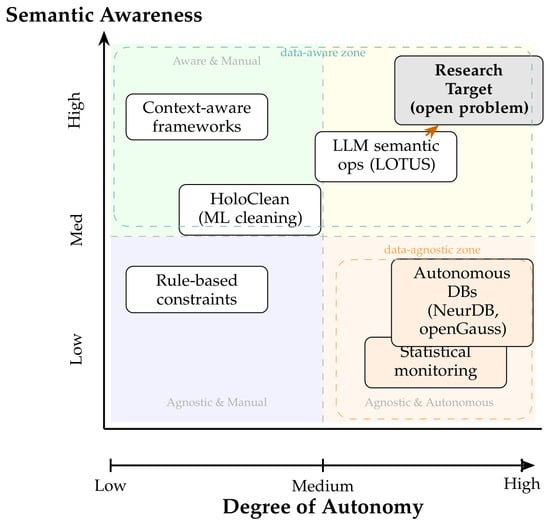
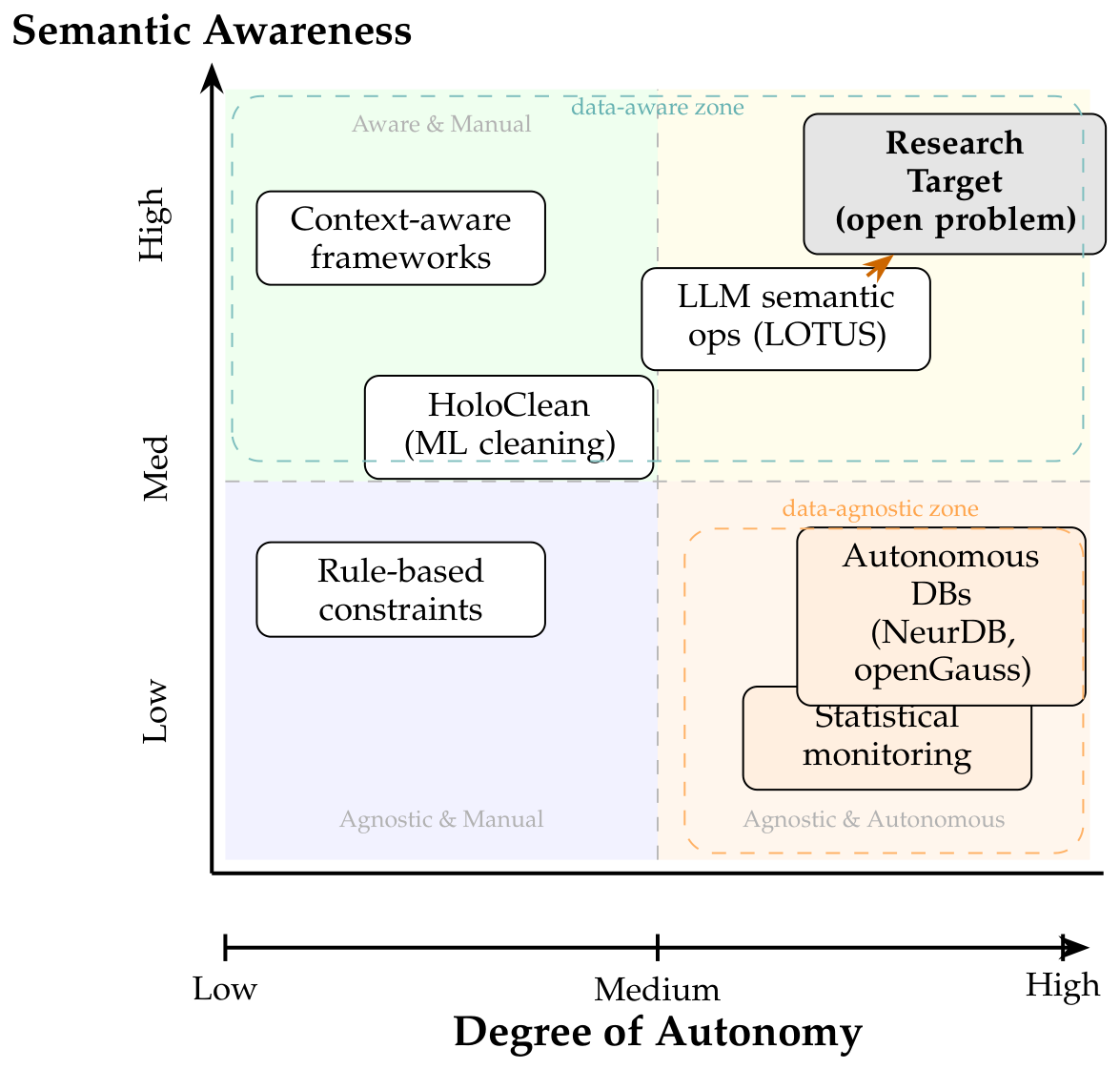
Figure 1 positions existing systems in the Autonomy–Awareness space and identifies the research target. Current autonomous systems (NeurDB, openGauss, statistical monitors) cluster in the bottom-right quadrant: high autonomy with near-zero semantic awareness. Context-aware frameworks occupy the top-left: high awareness but requiring human rule specification. LLM-based semantic operators approach the target from the left. The top-right quadrant—combining high autonomy with high semantic data-awareness—remains largely unoccupied. This figure organizes the four research directions below.
Figure 1.
The Autonomy–Awareness space for data quality management in autonomous distributed databases. Orange-shaded nodes are data-agnostic; plain nodes are data-aware or transitional. The dashed orange rectangle marks the data-agnostic zone; the dashed teal rectangle marks the data-aware zone. The top-right quadrant—high autonomy combined with high semantic awareness—is the open research target.
7.1. Autonomous Semantic Rule Discovery
The most fundamental open problem is how a distributed database system can discover semantic quality rules without human specification. LLM-assisted rule induction: given a schema and sample values, an LLM can propose plausible domain constraints. The research challenge is formalizing natural language proposals into verifiable, executable rules and managing inference cost at scale. Cross-source semantic alignment: in federated settings, semantic invariants consistent across all nodes likely encode genuine domain knowledge. Federated pattern mining that aggregates semantic signals without centralizing raw data could derive quality rules that generalize across the federation.
7.2. Quality-Propagating Query Execution
Current query optimizers treat quality as invisible—it is not tracked through joins, aggregations, or projections. A distributed system needs to know not just how fast a query ran, but what quality the result carries across all five dimensions. This requires: (i) quality metadata propagation, formalizing how each relational operator transforms completeness, consistency, and semantic validity scores; and (ii) quality-aware cost models that estimate quality-handling overhead as a function of quality metrics, learned from execution history.
7.3. Federated Semantic Quality Protocols
Autonomous distributed databases require protocols by which nodes can coordinate on quality without centralized governance. Research is needed into schema-independent quality representation, quality-aware routing (directing queries to nodes with the best quality profiles for the query’s requirements), and semantic divergence handling—recognizing when two nodes’ use of the same field is semantically incompatible and resolving conflicts while preserving node autonomy.
7.4. Self-Evolving Quality Rules
Static quality rules become incorrect as domains change. Self-evolving rules require: concept drift detection adapted to quality rule monitoring (distinguishing genuinely degraded data from a miscalibrated rule); automated rule revision that identifies the minimal update restoring validity while preserving original intent; and minimum-supervision escalation for semantically significant changes in high-stakes domains such as medical, financial, and legal settings.
8. Conclusions
This paper provided an analysis of data-agnostic versus data-aware quality management approaches in autonomous distributed databases. Data-agnostic approaches dominate current autonomous database systems because they are compatible with the core requirement of autonomy: they derive quality criteria from data statistics without requiring human specification of domain knowledge. However, this compatibility comes at a fundamental cost. Data-agnostic systems cannot detect semantic errors, cannot assess fitness-for-purpose, and cannot distinguish meaningful heterogeneity from genuine quality degradation in distributed settings. As shown in Table 1 and Table 3, the semantic validity and accuracy dimensions are entirely outside their reach.
Data-aware approaches achieve substantially higher quality recall for domain-specific errors but require semantic knowledge that is difficult to acquire autonomously. The context-aware quality research community has established that fully context-aware quality management over big data remains an open problem [7]. In autonomous distributed databases, this problem is compounded by semantic divergence across nodes and the absence of a central governance authority.
The intersection of three requirements—autonomy, distribution, and semantic quality awareness—defines the essentially unoccupied top-right quadrant of Figure 1. We identified four specific directions for future work: autonomous semantic rule discovery using LLMs and cross-source alignment; quality-aware query optimization with quality metadata propagation across the five dimensions; federated semantic quality protocols for distributed coordination; and self-evolving quality rules to address concept drift.
As autonomous database systems mature and take on greater responsibility for data governance, the limitation of data-agnostic quality management will become increasingly consequential. The research agenda established in this paper provides a foundation for developing the next generation of semantically grounded, self-managing quality enforcement systems.
Author Contributions
Conceptualization, T.O. and R.S.; methodology, T.O.; investigation, T.O.; writing—original draft preparation, T.O.; writing—review and editing, R.S.; supervision, R.S. All authors have read and agreed to the published version of the manuscript.
Funding
This research received no external funding.
Institutional Review Board Statement
Not applicable.
Informed Consent Statement
Not applicable.
Data Availability Statement
All sources supporting this conceptual analysis are cited in the manuscript.
Conflicts of Interest
The authors declare no conflicts of interest.
Abbreviations
The following abbreviations are used in this manuscript:
| DB | Database |
| DBMS | Database Management System |
| DQ | Data Quality |
| DQM | Data Quality Management |
| ETL | Extract, Transform, Load |
| KG | Knowledge Graph |
| LLM | Large Language Model |
| ML | Machine Learning |
| SQL | Structured Query Language |
References
- Pavlo, A.; Angulo, G.; Arulraj, J.; Lin, H.; Lin, J.; Ma, L.; Menon, P.; Mowry, T.C.; Perron, M.; Quah, I.; et al. Self-driving database management systems. In Proceedings of the 8th Biennial Conference on Innovative Data Systems Research (CIDR’17), Chaminade, CA, USA, 8–11 January 2017. [Google Scholar]
- Li, G.; Zhou, X.; Sun, J.; Yu, X.; Han, Y.; Jin, L.; Li, W.; Wang, T.; Li, S. openGauss: An autonomous database system. Proc. VLDB Endow. 2021, 14, 3028–3041. [Google Scholar] [CrossRef] [Scilit]
- Zhao, Z.; Cai, S.; Gao, H.; Pan, H.; Xiang, S.; Xing, N.; Chen, G.; Ooi, B.C.; Shen, Y.; Wu, Y.; et al. NeurDB:On the Design and Implementation of an AI-powered Autonomous Database. In Proceedings of the 15th Annual Conference on Innovative Data Systems Research, CIDR 2025, Amsterdam, The Netherlands, 19–22 January 2025. [Google Scholar]
- Zhang, W.; Lim, W.S.; Butrovich, M.; Pavlo, A. The Holon Approach for Simultaneously Tuning Multiple Components in a Self-Driving Database Management System with Machine Learning via Synthesized Proto-Actions. Proc. VLDB Endow. 2024, 17, 3373–3387. [Google Scholar] [CrossRef] [Scilit]
- Batini, C.; Scannapieco, M. Data Quality: Concepts, Methodologies and Techniques; Springer: Berlin/Heidelberg, Germany, 2009. [Google Scholar]
- Wang, R.Y.; Strong, D.M. Beyond accuracy: What data quality means to data consumers. J. Manag. Inf. Syst. 1996, 12, 5–33. [Google Scholar] [CrossRef] [Scilit]
- Fadlallah, H.; Kilany, R.; Dhayne, H.; El Haddad, R.; Haque, R.; Taher, Y.; Jaber, A. Context-aware big data quality assessment: A scoping review. ACM J. Data Inf. Qual. 2023, 15, 1–33. [Google Scholar] [CrossRef] [Scilit]
- Monte Carlo. Anomaly Detection. Monte Carlo Documentation. Available online: https://docs.getmontecarlo.com/docs/anomaly-detection-overview (accessed on 12 November 2026).
- Rekatsinas, T.; Chu, X.; Ilyas, I.F.; Re, C. HoloClean: Holistic data repairs with probabilistic integrity constraints. Proc. VLDB Endow. 2017, 10, 1190–1201. [Google Scholar]
- Mahdavi, M.; Abedjan, Z.; Castro Fernandez, R.; Madden, S.; Ouzzani, M.; Stonebraker, M.; Tang, N. Raha: A configuration-free error detection system. In Proceedings of the 2019 International Conference on Management of Data, Amsterdam, The Netherlands, 30 June–5 July 2019; pp. 865–882. [Google Scholar] [CrossRef] [Scilit]
- Krishnan, S.; Wang, J.; Wu, E.; Franklin, M.J.; Goldberg, K. ActiveClean: Interactive data cleaning for statistical modeling. Proc. VLDB Endow. 2016, 9, 948–959. [Google Scholar] [CrossRef] [Scilit]
- Patel, L.; Jha, S.; Asawa, P.; Pan, M.; Guestrin, C.; Zaharia, M. Semantic operators: A declarative model for rich, AI-based analytics over text data. arXiv 2024, arXiv:2407.11418. [Google Scholar]
- Ghazal, R.; Dolby, J. Autonomous data processing using meta-agents. arXiv 2026, arXiv:2602.00307. [Google Scholar]
- Kontokostas, D.; Martin, M.; Lehmann, J.; Hellmann, S.; Bremer, D.; Moreau, S. Test-driven evaluation of linked data quality. In Proceedings of the 23rd International World Wide Web Conference (WWW), Seoul, Korea, 7–11 April 2014; pp. 747–758. [Google Scholar] [CrossRef] [Scilit]
- Sijie, D.; Soror, S.; Themis, P. Data quality awareness: A journey from traditional data management to data science systems. arXiv 2024, arXiv:2411.03007. [Google Scholar]
- Sheth, A.P.; Larson, J.A. Federated database systems for managing distributed, heterogeneous and autonomous databases. ACM Comput. Surv. 1990, 22, 183–236. [Google Scholar] [CrossRef] [Scilit]
- Pentaris, F.; Ioannidis, Y.E. Query optimization in distributed networks of autonomous database systems. ACM Trans. Database Syst. 2006, 31, 537–583. [Google Scholar] [CrossRef] [Scilit]
- Dong, X.L.; Srivastava, D. Big data integration. Proc. VLDB Endow. 2013, 6, 1188–1189. [Google Scholar] [CrossRef] [Scilit]
- Nguyen, T.; Nguyen, H.-T.; Nguyen-Hoang, T.-A. Data quality management in big data: Strategies, tools, and educational implications. J. Parallel Distrib. Comput. 2025, 200, 105067. [Google Scholar] [CrossRef] [Scilit]

Disclaimer/Publisher’s Note: The statements, opinions and data contained in all publications are solely those of the individual author(s) and contributor(s) and not of MDPI and/or the editor(s). MDPI and/or the editor(s) disclaim responsibility for any injury to people or property resulting from any ideas, methods, instructions or products referred to in the content. |
© 2026 by the authors. Licensee MDPI, Basel, Switzerland. This article is an open access article distributed under the terms and conditions of the Creative Commons Attribution (CC BY) license.