


Abstract
In this study, a semi-synthetic, biocompatible hydrogel composite was fabricated using gelatin (natural polymer) and hydroxypropyl methylcellulose (HPMC) chemically crosslinked with glutaraldehyde (GA). Whitlockite was incorporated as the bioactive ceramic filler to enhance mechanical reinforcement. The hydrogel composite was prepared via a facile solution-casting method that showed hydrophilic characteristics. Moreover, the prepared composite exhibited good mechanical properties upon the addition of whitlockite, attributed to interfacial interactions between the polymer matrix and whitlockite, including hydrogen bonding and ionic interactions involving phosphate groups. MTT assay results for biocompatibility and cytotoxicity demonstrated that the composite supported the growth of Human Embryonic Kidney 293 (HEK293) cell lines, maintaining cell viability around 70% after 72 h of incubation. These findings indicate the potential suitability of the developed hydrogel composite for biomedical applications.
1. Introduction
Calcium phosphate (CaP)-based bioceramics are chemically similar to mineralized tissues and possess excellent biocompatibility, making them one of the main materials to be studied for biomedical applications [1]. One promising bioceramic phase is a magnesium-containing calcium phosphate known as whitlockite (WH), represented by Ca18Mg2(HPO4)2(PO4)12 [2]. Since magnesium plays a significant role in biological systems such as cellular metabolism, mineralization processes and enzymatic reactions, Whitlockite holds considerable research importance [3]. Despite its potential, the main challenge concerning Whitlockite is its phase-pure synthesis as its formation is sensitive to parameters such as pH, temperature, precursor composition, reaction time and the presence of additives [4]. Among wet chemical precipitation synthesis methods, hydrothermal synthesis allows better control over phase formation and particle morphology, which is why this method is widely employed for preparing crystalline calcium phosphate phases. However, improper control may result in the formation of competing phases such as HA or β-tricalcium phosphate (TCP) [5]. The controlled use of additives during hydrothermal synthesis provides a practical strategy for tailoring whitlockite formation and morphology.
These bioceramics are usually incorporated in polymer blends to improve overall mechanical properties, cell adhesion and control over shape [6]. Numerous polymers broadly categorized as natural, synthetic and semi-synthetic biopolymers such as gelatin, chitosan, starch, hyaluronic acid, alginate, collagen, poly butylene succinate, poly L lactic acid and HPMC have been studied extensively for numerous biomedical applications [7,8]. Gelatin (Gel) has been widely investigated as a biomaterial for three-dimensional cell culture systems and scaffold fabrication in tissue engineering. On the other hand, Hydroxypropyl Methyl Cellulose (HPMC), also known as Hypromellose, is a hydrocolloid of cellulose ether. Owing to its water solubility, non-toxicity, affordability, easy processing and commendable drug-loading capacity, it is used in numerous biomedical composites for drug loading and sustained drug release [9]. Blending gelatin with HPMC has been reported as an efficient method for improving the overall functionality of the individual polymers [10].
In this study, we synthesized whitlockite through a hydrothermal route using trisodium citrate as a stabilizer. Subsequently, whitlockite-loaded gelatin/HPMC composite hydrogels were prepared and evaluated to investigate the influence of bioceramics incorporation on hydrogel characteristics.
2. Materials and Methods
2.1. Materials
Calcium hydroxide was purchased from GPR Rectapur, magnesium hydroxide from Duksan (Ansan, Republic of Korea), orthophosphoric acid from Honeywell (Morris Plains, NJ, USA), and trisodium citrate from Merck (Darmstadt, Germany). Gelatin was purchased from Daejung (Siheung-si, Republic of Korea), and 25% glutaraldehyde solution from Sigma-Aldrich (St. Louis, MO, USA). All these chemicals were used as received without any further purification.
2.2. Synthesis of Whitlockite
In this method, 0.13 M Mg(OH)2 and 0.37 M Ca(OH)2 solutions were prepared, mixed, and stirred at 40 °C for 20 min. Then, a 0.052 M trisodium citrate solution was added to the mixture, which was stirred for an additional ten minutes, and then 0.5 M H3PO4 was added at the rate of 10 mL/5 min to achieve pH 5 under constant stirring. This mixture was then transferred to a Teflon-lined hydrothermal reactor, heated at 150 °C for 12 h, and allowed to cool down to room temperature. The prepared precipitates were filtered and washed thrice with de-ionized water and ethanol to remove unreacted precursors. The powder was dried at 50 °C overnight to obtain crystals, which were preserved for physicochemical analysis.
2.3. Preparation of Gel/HPMC/WH Composite Hydrogels
A well-known and widely employed method of solution casting was used to prepare composite hydrogels. Table 1 provides the composition details of 8 samples that were prepared for this study. For the preparation of pure Gel/HPMC hydrogel (G0), 1.95 g of gelatin and 0.05 g of HPMC were added to a media bottle containing 20 mL of deionized (DI) water that was already heated to 100 °C on a hot plate. The solution was stirred until complete dissolution of the polymers was achieved. The solution was then transferred to a sterilized polystyrene Petri plate and kept at room temperature for drying. After complete drying, the film was peeled off and stored properly in a desiccator. The same procedure was followed to prepare the pure crosslinked Gel/HPMC hydrogel; however, after dissolution at 100 °C, the temperature was lowered to 50 °C, and 0.15% v/v (3 µL) of glutaraldehyde (GA) was added to it dropwise at constant stirring for 30 s.
Table 1.
Composition of prepared hydrogel samples.
To prepare the Gel/HPMC/WH composite, WH (see Table 1) was taken in a glass vial and 20 mL of DI water was added to it. This vial was bath sonicated for 6 h, and the obtained suspension was transferred to a media bottle. The solution was constantly stirred overnight to obtain the dispersion of WH particles. In the next step, the solution was heated to 100 °C on a hot plate followed by a similar procedure as described above to obtain the films.
2.4. Materials Characterization
The combined use of X-ray diffraction (Bruker D2 Phaser, Bruker AXS SE, Karlsruhe, Germany), Fourier transform infrared spectroscopy (PerkinElmer Spectrum 100, PerkinElmer, Shelton, CT, USA), Raman spectroscopy (BWS415-532S-iRaman manufactured by BW TEK INC., Newark, DE, USA), and scanning electron microscopy (JEOL JSM-6490A, Jeol Ltd., Akishima, Tokyo, Japan) provided comprehensive confirmation of successful whitlockite synthesis.
The morphology of composite hydrogels was studied by SEM. Mechanical properties of composite hydrogels (in dry form) were measured using a Linkam TST350 (Linkam Scientific Instruments Ltd., Redhill, Surrey, UK) micro tensile testing setup, with a 200 N load cell, according to ASTM D882 (Standard Test Method for Tensile Properties of Thin Plastic Sheeting) [11]. A wettability test to check the hydrophobicity was performed using a Kruss DSA 25 Goniometer (KRUSS GmbH, Hamburg, Germany). To check the swelling capacity of hydrogels, a swelling test was performed in DI water at ambient laboratory temperature (approximately 35 °C). A 1 cm2 piece was cut from each hydrogel and placed in 10 mL of DI water for 24 h. Before placement, the initial weight (Wo) of the samples was recorded. The final weight (Wf) of the samples was measured after taking them out and gently tap-drying them using cellulose filter paper to remove surface moisture. Swelling capacity was measured using the following formula:
Percentage Swelling (%) = (Wf − Wo)/Wo × 100
HEK293 (Human Embryonic Kidney) cells were used to evaluate the biocompatibility of the hydrogel samples. The cells were revived and cultured in DMEM (Dulbecco’s Modified Eagle Medium) in a T-25 flask at 37 °C under 5% CO2 until 80% confluency was reached. Cells were then trypsinized and seeded into a 96-well plate at a density of 10,000 cells per well in a total volume of 100 µL RPMI (Roswell Park Memorial Institute) medium, followed by incubation for 24 h under the same conditions. Sterilized hydrogel samples (5 mm × 5 mm), treated with 70% ethanol and washed with 1× PBS (Corning), were placed into the wells and incubated for 48 and 72 h.
After the respective incubation periods, cell viability was assessed using the MTT assay(3-(4,5-dimethyldiazol-2-yl)-2,5-diphenyltetrazolium bromide). MTT solution (5 mg/mL in PBS) was added (10 µL per well) and incubated for 4 h to allow the formation of formazan crystals. The medium was aspirated, and the crystals were dissolved in lysis buffer (10% SDS in 0.01 M HCl), then incubated overnight. Absorbance was measured at 570 nm using a microplate reader, and percentage cell viability was calculated using:
where As = Absorbance of sample, Ab = Absorbance of blank (empty wells) and Ac = Absorbance of control (cells)
% Cell Viability (CV) = (As − Ab)/Ac × 100
3. Results and Discussion
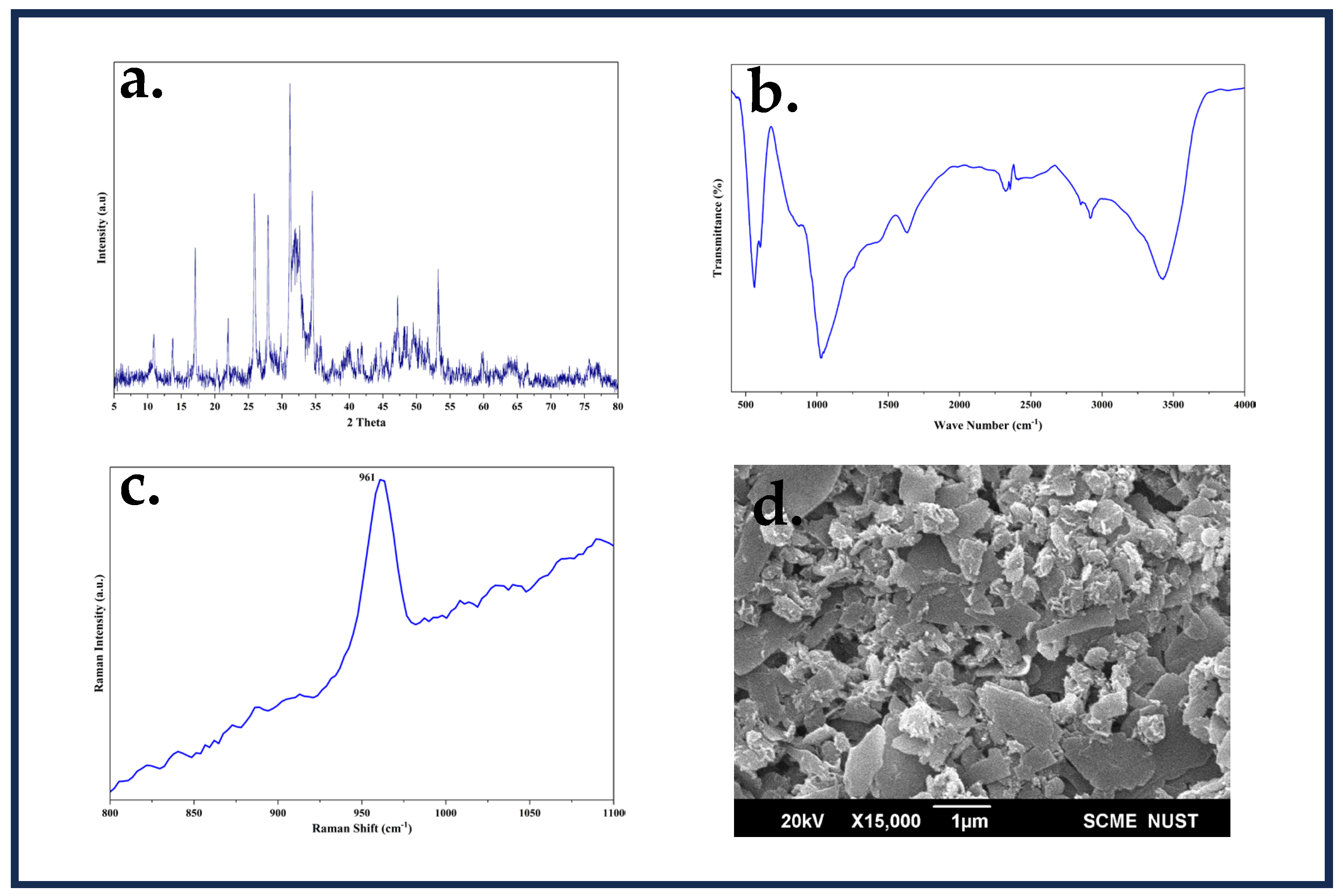
X-ray diffraction analysis was performed to confirm the phase purity of the prepared whitlockite. The XRD diffractogram in Figure 1a shows characteristic diffraction at 25.9°, 27.9°, 31.2°, 34.4°, and 33.7° theta that are in good agreement with the literature [12] and JCPDS (00-042-0578,01-070-2064,01-077-6692) [13], confirming the successful synthesis of phase pure bone whitlockite as no secondary CaP phases are observed. In the FTIR analysis (Figure 1b), a characteristic peak of HPO42−, a group of bone WH, is found at 863 cm−1, confirming bone whitlockite [14]. HPO42− is the characteristic of bone WH that makes it different from other whitlockites, i.e., β-TCP, magnesian whitlockite, β-tricalcium magnesium phosphate (β-TCMP), and CaPs. The peaks found at 609 cm−1 and 558 cm−1 are characteristic of υ4 vibrations of the PO43− group [15]. A peak found at 1026 cm−1 represents the υ3 vibration of the phosphate group [16]. To further verify FTIR results, Raman spectroscopic analysis was carried out. The Raman spectrum of the prepared samples (Figure 1c) shows a characteristic peak of bone apatite at 960 cm−1, which represents the υ1 vibration of the PO43− ion [17]. The υ1 vibration of the phosphate group of bone WH is broad, while other CaP phases show a sharp peak in the range of 959 to 975 cm−1. Scanning electron microscopy (SEM) analysis of the sample (Figure 1d) reveals a large flake-like/sheet-like structure with noticeable agglomeration. The particles are distributed in the sub-micron to micron scale, indicating controlled nucleation and growth influenced by the citrate-assisted stabilization during synthesis.
Figure 1.
(a) XRD, (b) FTIR, (c) Raman, and (d) SEM micrograph of synthesized whitlockite.
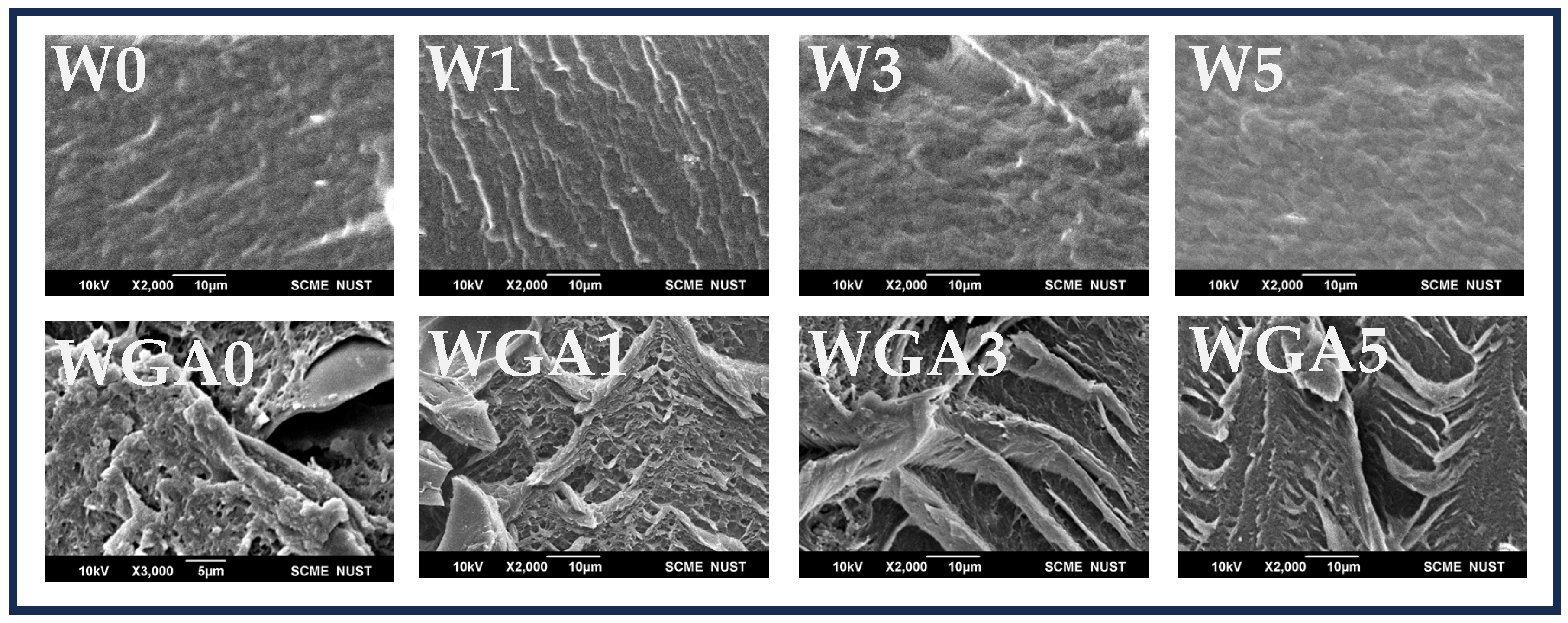
The SEM analysis of hydrogels (Figure 2) reveals clear morphological differences between the non-crosslinked (W) and glutaraldehyde-crosslinked (WGA) hydrogels, as is visible in cross-sectional SEM images. The non-crosslinked hydrogels predominantly exhibit surface-level morphology with relatively compact structures and limited visible porosity. With increasing whitlockite content, the surface texture showed a transition from mild uniform (W0) to aligned ridge-like features (W1), followed by irregular and more compact morphologies at higher concentrations (W3 and W5). In contrast, the crosslinked hydrogels show a distinctly interconnected three-dimensional porous structure with well-defined pore walls. The crosslinked hydrogels display lamellar and sheet-like structures with angular cavities and channels. Increasing whitlockite concentration in the WGA samples results in thicker, more consolidated, and sharply defined structural features. Overall, glutaraldehyde-crosslinked hydrogels displayed enhanced structure and porosity compared to the non-crosslinked hydrogels.
Figure 2.
SEM images of prepared hydrogels.
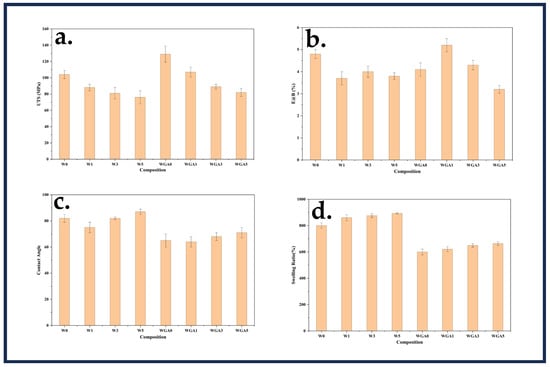
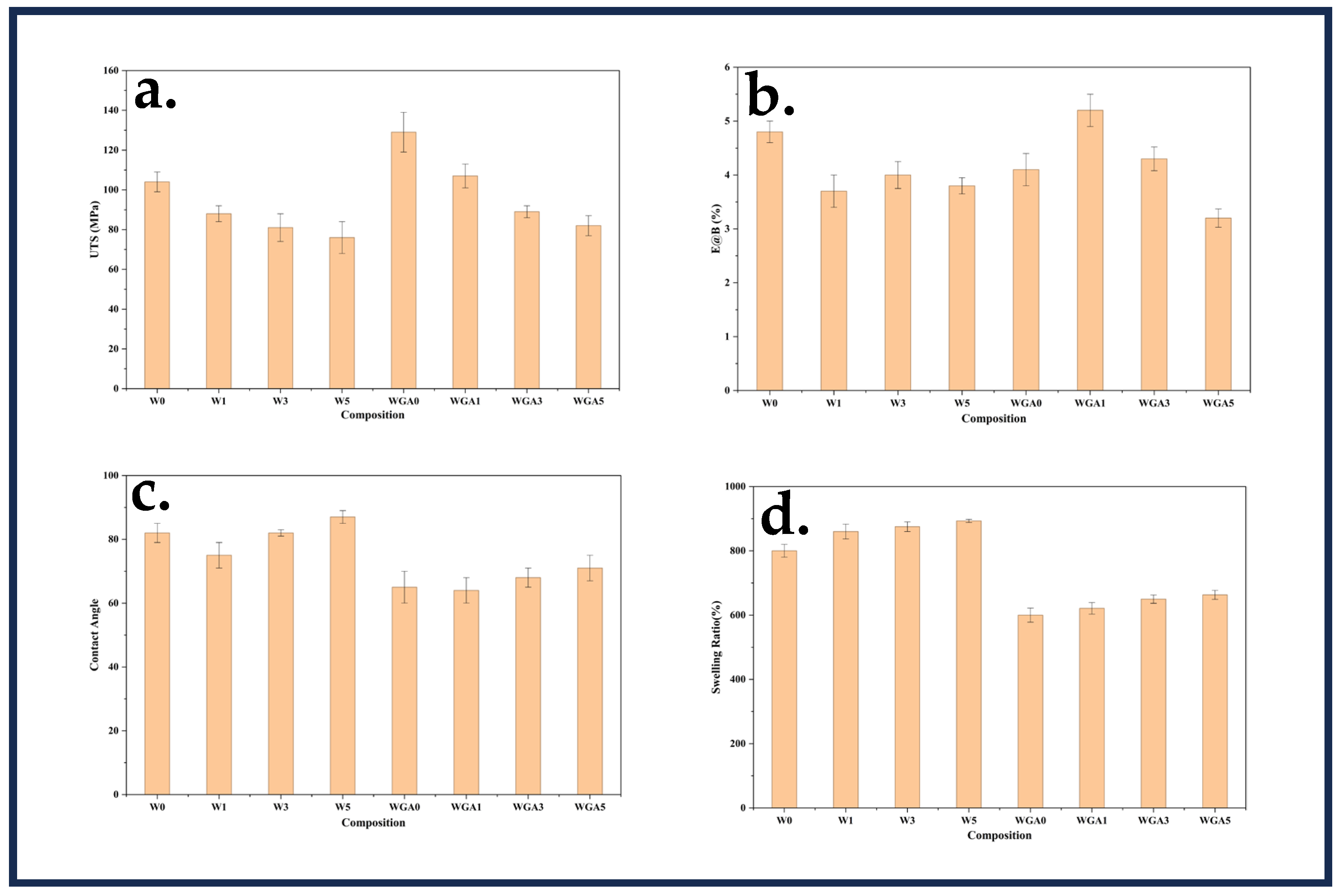
The ultimate tensile strength (UTS) and elongation at break (E@B) of the hydrogels are reported in Figure 3a,b. In the W series, the decrease in UTS from W0 to W5 corresponds to a change in structural heterogeneity and the presence of whitlockite particle-rich regions, which act as stress concentration sites. The relatively compact but less integrated internal morphology with an increase in Whitlockite content supports the observed reduction in tensile strength and slight fluctuations in elongation at break. In contrast, WGA0 exhibits the highest UTS, which can be due to improved network cohesion as glutaraldehyde crosslinks the two polymers. The WGA series shows that while crosslinking enhances overall structural integrity compared to their W series counterparts, increasing whitlockite content results in thicker and more rigid internal features, limiting polymer chain mobility. The gradual reduction in both UTS and E@B from WGA1 to WGA5 may be due to possible interfacial stress concentration at higher filler loadings.
Figure 3.
(a) UTS, (b) E@B, (c) contact angle, and (d) swelling ratio graphs of prepared hydrogels.
The contact angle (Figure 3c) and swelling ratio (Figure 3d) indicate that surface wettability and bulk hydration are controlled by different structural factors. In the W series, the swelling ratio increases progressively from 800% (W0) to 893% (W5), suggesting that increasing whitlockite content enhances water uptake within the scaffold. This can be attributed to the incorporation of calcium–magnesium phosphate particles composed of charged ionic species Ca2+ and Mg2+ cations and PO43− phosphate anions, which introduce polar and hydrophilic sites that promote water interaction and retention inside the polymer network. However, the contact angle values (75–87°) do not follow a linear trend, indicating that surface wettability is influenced not only by chemical composition but also by surface roughness and the extent of particle exposure at the outermost layer. In contrast, the WGA series shows lower contact angles (64–71°), reflecting improved surface hydrophilicity, due to the increased presence or exposure of polar functional groups after crosslinking. Despite this enhanced wettability, the swelling ratio decreases significantly (600–663%), demonstrating that bulk swelling is predominantly governed by crosslink density. The covalent bonds formed during glutaraldehyde crosslinking restrict polymer chain mobility and network expansion, thereby limiting overall water absorption even in the presence of hydrophilic ionic components.
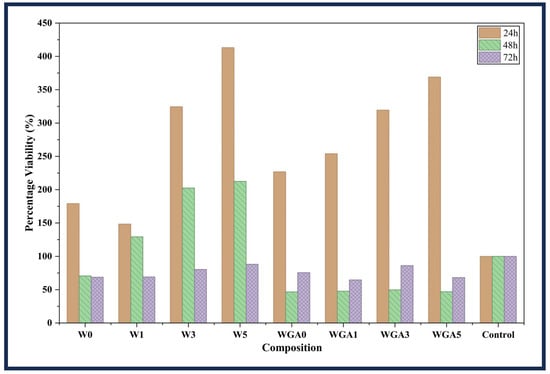
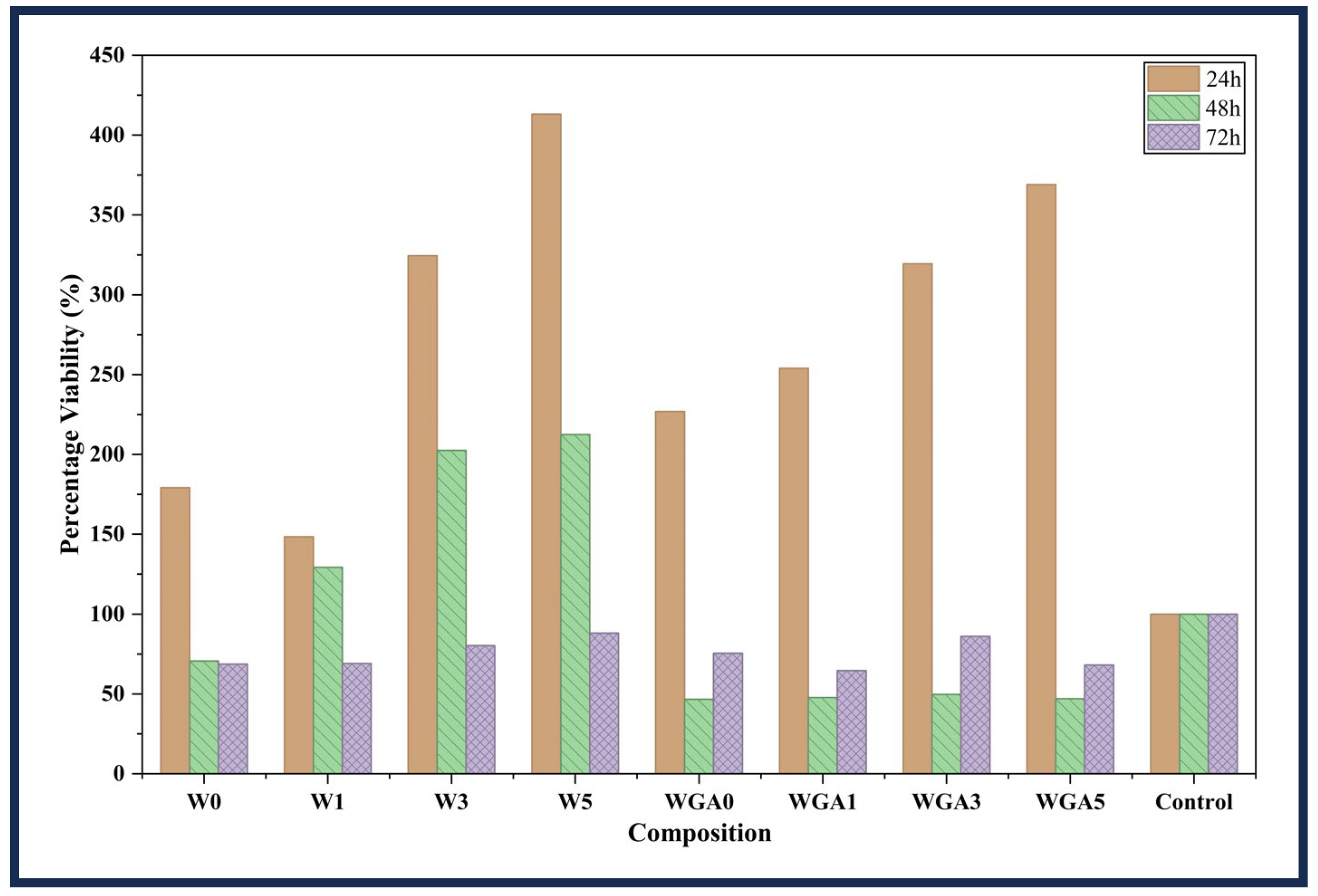
The MTT assay results for cell viability and cytotoxicity were recorded via an ELISA microplate reader, and the readings were plotted in the graph shown in Figure 4. At 24 h, most samples exhibited viability values equal to or greater than the control, indicating good initial cytocompatibility and favorable conditions for early cell attachment and metabolic activity. However, a reduction in viability was observed at 48 h in several groups due to a transient cellular adaptation phase to the hydrogel environment. By 72 h, cell viability showed a stabilized nature, with most samples remaining above the 70% cytotoxicity threshold, confirming relatively non-toxic behavior. Comparatively, the WGA series maintained consistent viability levels, indicating that glutaraldehyde crosslinking did not induce significant cytotoxic effects. The slight variations among compositions may be attributed to differences in hydrogel structure, crosslink density, and filler content influencing cell–material interactions. Importantly, no drastic decline in viability was observed across the tested time points, demonstrating good cellular compatibility. Overall, the hydrogels showed support for cell survival and metabolic activity over 3 days of incubation, suggesting that they can be studied for biomedical applications.
Figure 4.
Percentage viability of cell lines at 24 h, 48 h and 72 h.
4. Conclusions
The developed gelatin/HPMC/whitlockite hydrogel composites exhibited composition-dependent structural, mechanical, and biological performance. It was observed that increasing whitlockite content improved swelling capacity in non-crosslinked hydrogels due to the presence of hydrophilic ionic species (Ca2+, Mg2+, PO43−), but crosslinking reduced swelling by restricting network expansion. Importantly, all hydrogels exhibited favorable cytocompatibility over 72 h, indicating their potential for biomedical and tissue engineering applications.
Author Contributions
Data Curation, M.A.K. and S.B.; methodology, M.A.K. and S.B.; writing—original draft preparation, M.A.K. and S.B.; writing—review and editing, Z.H.; supervision, Z.H.; project administration, Z.H. All authors have read and agreed to the published version of the manuscript.
Funding
This research received no external funding.
Institutional Review Board Statement
Not applicable.
Informed Consent Statement
Not applicable.
Data Availability Statement
Data is contained within the article.
Conflicts of Interest
The authors declare no conflicts of interest.
References
- Furko, M.; Balázsi, K.; Balázsi, C. Calcium Phosphate Loaded Biopolymer Composites—A Comprehensive Review on the Most Recent Progress and Promising Trends. Coatings 2023, 13, 360. [Google Scholar] [CrossRef] [Scilit]
- Afonina, A.; Kizalaite, A.; Zarkov, A.; Drabavicius, A.; Goto, T.; Sekino, T.; Kareiva, A.; Grigoraviciute-Puroniene, I. Synthesis of whitlockite nanopowders with different magnesium content. Ceram. Int. 2022, 48, 32125–32130. [Google Scholar] [CrossRef] [Scilit]
- Adhikari, U.; An, X.; Rijal, N.; Hopkins, T.; Khanal, S.; Chavez, T.; Tatu, R.; Sankar, J.; Little, K.J.; Hom, D.B.; et al. Embedding magnesium metallic particles in polycaprolactone nanofiber mesh improves applicability for biomedical applications. Acta Biomater. 2019, 98, 215–234. [Google Scholar] [CrossRef] [Scilit]
- Afonina, A.; Dubauskas, A.; Klimavicius, V.; Zarkov, A.; Kareiva, A.; Grigoraviciute, I. Phase transformations during the dissolution-precipitation synthesis of magnesium whitlockite nanopowders from gypsum. Ceram. Int. 2023, 49, 38157–38164. [Google Scholar] [CrossRef] [Scilit]
- Maximiano, L.V.; Correa, L.B.; Gomes-Da-Silva, N.C.; da Costa, L.S.; Da Silva, M.G.P.; Chaves, A.V.; Franco, M.L.; Fechine, P.B.A.; de Menezes, A.S.; Santos-Oliveira, R.; et al. Magnesium whitlockite nanoparticles: Hydrothermal synthesis, anti-inflammatory and anti-cancer potential. Colloids Surf. B Biointerfaces 2024, 239, 113931. [Google Scholar] [CrossRef] [Scilit]
- Kim, H.; Hwangbo, H.; Koo, Y.W.; Kim, G. Fabrication of mechanically reinforced gelatin/hydroxyapatite bio-composite scaffolds by core/shell nozzle printing for bone tissue engineering. Int. J. Mol. Sci. 2020, 21, 3401. [Google Scholar] [CrossRef] [Scilit]
- Fazal, T.; Murtaza, B.N.; Shah, M.; Iqbal, S.; Rehman, M.-U.; Jaber, F.; Dera, A.A.; Awwad, N.S.; Ibrahium, H.A. Recent developments in natural biopolymer based drug delivery systems. R. Soc. Chem. 2023, 13, 23087–23121. [Google Scholar] [CrossRef] [Scilit]
- Khan, M.A.; Hussain, Z.; Liaqat, U.; Liaqat, M.A.; Zahoor, M. Preparation of pbs/plla/hap composites by the solution casting method: Mechanical properties and biocompatibility. Nanomaterials 2020, 10, 1778. [Google Scholar] [CrossRef] [Scilit]
- Novak, S.D.; Šporar, E.; Baumgartner, S.; Vrečer, F. Characterization of physicochemical properties of hydroxypropyl methylcellulose (HPMC) type 2208 and their influence on prolonged drug release from matrix tablets. J. Pharm. Biomed. Anal. 2012, 66, 136–143. [Google Scholar] [CrossRef] [Scilit]
- Shen, W.; Li, J.; Hu, X.; Hu, Z.; Jin, W.; Ji, Z. Preparation and characterization of gelatin/hydroxypropyl methylcellulose blended films incorporating zein/pectin composite particles. LWT 2025, 238, 118863. [Google Scholar] [CrossRef] [Scilit]
- ASTM D882-18; Standard Test Method for Tensile Properties of Thin Plastic Sheeting. ASTM International: West Conshohocken, PA, USA, 2018.
- Batool, S.; Liaqat, U.; Hussain, Z.; Sohail, M. Synthesis, characterization and process optimization of bone whitlockite. Nanomaterials 2020, 10, 1856. [Google Scholar] [CrossRef] [Scilit]
- Debroise, T.; Colombo, E.; Belletti, G.; Vekeman, J.; Su, Y.; Papoular, R.; Hwang, N.S.; Bazin, D.; Daudon, M.; Quaino, P.; et al. One Step Further in the Elucidation of the Crystallographic Structure of Whitlockite. Cryst. Growth Des. 2020, 20, 2553–2561. [Google Scholar] [CrossRef] [Scilit]
- Marahat, M.H.; Zahari, M.A.A.; Mohamad, H.; Kasim, S.R. Effect of magnesium ion (Mg2+) substitution and calcination to the properties of biphasic calcium phosphate (BCP). AIP Conf. Proc. 2019, 2068, 020074. [Google Scholar] [CrossRef] [Scilit]
- Wang, C.; Jeong, K.-J.; Park, H.J.; Lee, M.; Ryu, S.-C.; Hwang, D.Y.; Nam, K.H.; Han, I.H.; Lee, J. Synthesis and formation mechanism of bone mineral, whitlockite nanocrystals in tri-solvent system. J. Colloid Interface Sci. 2020, 569, 1–11. [Google Scholar] [CrossRef] [Scilit]
- Trinkunaite-Felsen, J.; Stankeviciute, Z.; Yang, J.C.; Yang, T.C.K.; Beganskiene, A.; Kareiva, A. Calcium hydroxyapatite/whitlockite obtained from dairy products: Simple, environmentally benign and green preparation technology. Ceram. Int. 2014, 40, 12717–12722. [Google Scholar] [CrossRef] [Scilit]
- Diallo-Garcia, S.; Laurencin, D.; Krafft, J.-M.; Casale, S.; Smith, M.E.; Lauron-Pernot, H.; Costentin, G. Influence of magnesium substitution on the basic properties of hydroxyapatites. J. Phys. Chem. C 2011, 115, 24317–24327. [Google Scholar] [CrossRef] [Scilit]

Disclaimer/Publisher’s Note: The statements, opinions and data contained in all publications are solely those of the individual author(s) and contributor(s) and not of MDPI and/or the editor(s). MDPI and/or the editor(s) disclaim responsibility for any injury to people or property resulting from any ideas, methods, instructions or products referred to in the content. |
© 2026 by the authors. Licensee MDPI, Basel, Switzerland. This article is an open access article distributed under the terms and conditions of the Creative Commons Attribution (CC BY) license.