


Abstract
This study proposes ClutchMind, a conceptual digital twin framework for clutch plate monitoring that combines an ANSYS-based thermo-mechanical model with IoT sensing and lightweight, uncertainty-aware machine learning for prognostics. The framework outlines how CAD-to-FEA analysis would estimate stresses, deformations, safety factors, and modal behavior, while CFD/thermal analysis would capture slip-induced heating and its effect on friction and structure. Denoised vibration, temperature, and torque/pressure signals are envisioned to form a twin state vector, from which physics-guided features would feed compact 1D CNN/Transformer models for fault detection, severity grading, and remaining useful life estimation with calibrated confidence. A closed-loop calibration strategy is proposed to narrow the sim-to-real gap, with a decision layer designed to convert predictions into severity bands and maintenance work orders. This study presents the framework’s architecture, reviews the enabling literature, and discusses implementation challenges, research gaps, and a roadmap toward experimental validation.
1. Introduction
The clutch plates are critical parts of the vehicle gearing system that ensure a smooth shifting of the engine on and off the wheels. They play a fundamental role in ensuring efficient work of vehicles and preventing failures in the system. The conventional forms of monitoring may not be sufficient to give real-time information on their status. A more effective solution would be provided by Virtual Twin technology that integrates AI-based fault diagnosis with ANSYS Workbench simulations (ANSYS Student 2026 R1). The objective of the work is to create a complex system of monitoring the clutch plates, which will also improve the predictive maintenance based on the analysis of real-time data and virtual simulation.
The potential of this integrated approach has been revealed in a few recent developments. The study by Deshbhratar et al. [1] discusses the application of ANSYS simulations to design clutch plates and minimize structural stress, and other research by Xu et al. [2] provides a 1D-ViT model of fault detection in mechanical systems. Their research on the use of AI in fault diagnosis is promising in enhanced system reliability. Somnath et al. [3] dwelled upon the application of finite element analysis (FEA) in the optimization of the clutch design with emphasis on the structural integrity in determining the performance of the clutch system. All these advancements help to highlight the increasing role of AI and simulations in improving the reliability of clutch systems.
In spite of these developments, it is difficult to combine ANSYS simulations and AI-based fault detection. According to Tikhomollov et al. [4], the non-linear dynamics, as well as the vibration effects in the mode of the clutch system, were found to complicate the modeling of the complexities that make it hard to precisely simulate. Moreover, sensor data quality and noise usually do not contribute to the successful work of AI models in practice. Although AI has huge potential when it comes to detecting faults, it is challenging and computationally expensive to incorporate it with simulations within a seamless, real-time system.
There are still a number of research gaps. To begin with, dynamic behaviour of clutch systems under real-world conditions should be better modeled, because the existing methods do not sufficiently consider the effects of real-world behaviour. Somnath et al. [3] discussed clutch design optimization on a component basis but did not account for dynamics that occur under real-time operating conditions. Moreover, the incorporation of multi-source information, like vibration, temperature, stress, et al., into coherent diagnostic models is under-explored. Yan et al. [5] recommended that the inclusion of real-time feedback between physical simulations and fault detection can be used to improve the accuracy, but the portion remains under development.
This study proposes a conceptual framework intended to close these gaps by combining AI-based fault diagnosis with ANSYS-based digital twin simulation of clutch plates. This study is structured as a conceptual/framework proposal grounded in a critical review of the existing literature: it synthesizes prior work on digital twins, IoT sensing, and AI-based fault diagnosis (Section 2) to motivate and specify the architecture of ClutchMind (Section 4), rather than reporting experimental results from a completed implementation. It focuses more on enhancing the detection of faults, predictive maintenance and optimization of the system through improved integration of the real-time and simulation models. Helping in overcoming the integration issues and constraints presented in the previous studies, the research will develop the monitoring and maintenance strategies of the clutch systems, providing a more effective method for handling the mechanical parts. The subsequent literature survey will be further discussing the ways in which the issues mentioned above have been addressed in previous studies and in what aspects the field of AI and simulations is yet to be improved in order to introduce more effective solutions to real-time monitoring and fault detection in mechanical systems.
2. Literature Review
This literature survey provides an overview of the current advancements in digital twin (DT) technology, AI applications in fault detection and predictive maintenance, and the use of ANSYS simulations in mechanical system optimization. It also explores how the integration of AI with simulation tools, such as ANSYS, has enhanced the monitoring and fault diagnosis of complex mechanical and automotive systems.
2.1. Recent Advances in Research on Digital Twins
Digital twin (DT) technology has transformed monitoring, optimization, and maintenance in the work of such industries as automotive, aerospace, and energy. DT helps to simulate, predict and maintain, and decide on the system by providing real-time digital copies of physical systems, enhancing the efficiency and reliability of the system. DT particularly comes in handy in offshore wind farms (OWFs), where the loop of operation and maintenance (O&M) can be up to 30 percent of the total lifecycle cost, owing to the complexity of the system and the distance.
DT is also important in fault diagnosis in aerospace. To optimize the fault detection performance in flight test sensors, Wang et al. [6] came up with a hybrid deep learning architecture based on Sparse Autoencoders (SAEs) and Convolutional Neural Networks (CNNs) that facilitates the detection of faults. Chen et al. [7] suggested a deep residual network (DRN) to locate and identify fault location and severity in bearing systems. Their concept of multi-task learning has shown a big step forward in fault detection accuracy, although engineering of features is not necessary, a trait of DT that can be used in predictive maintenance. This is a method to enhance the quality of fault detection through the use of multi-sensor data to identify faults despite the noises in the workplace, which enhances operational safety. The study by Farzan et al. [8] debated the effect of thermostatic regulation in building energy consumption demonstrating that DT is able to optimize the energy systems, particularly in hot climates. Equally, Thaiprayoon et al. [9] used the thermostat control models featured in [10] and improved the stability and performance of temperature regulation systems through the application of a fractional calculus, which demonstrates the application of DT in saving energy.
In the case of automotive systems, Purohit et al. [10] used DT technology in the design and finite element analysis (FEA) of automotive clutch assemblies. They maximized the design in terms of safety and performance and used simulation programs such as SolidWorks and ANSYS to demonstrate how the design can be refined through DT.
Liu et al.’s [11] work in the domain of wind energy with self-diagnosis of wind turbines blade sensor faults using deep learning delivered a recall rate of 98.43. Their solution shows that DT and deep learning can be more effective in detecting and diagnosing failures in turbine systems. An O&M optimization framework with a combination of failure analysis, intelligent decision making, and multi-objective optimization that was proposed by Xia et al. [12] incorporates cost reduction, increasing safety and reliability.
Similarly, Shi et al. [13] proposed a digital-twin-based model-updating method for mechanical behavior analysis of cable truss structures, demonstrating how DT frameworks can maintain fidelity between simulated and physical structural responses over time—a challenge directly relevant to clutch plate digital twins. These studies illustrate the various uses of DT including maximization of O&M of offshore wind farms and optimization of fault detection in aerospace, automotive, and wind energy. In spite of these developments, there still exist issues of enhancing the fidelity of DT models, incorporating real-time information as well as automation in monitoring and maintenance of systems. A bibliometric analysis by Sheuly et al. [14] traces the evolution of machine-learning-based digital twins in manufacturing, highlighting a growing convergence between DT and AI-driven diagnostics—the same convergence this study builds on for clutch plate monitoring. Such spheres will play a major role in developing DT technology. After discussing the advances made by DT, the research shifted to the incorporation of Artificial Intelligence (AI) with DT in order to improve fault detection, diagnosis and predictive maintenance.
2.2. AI in Fault Detection
Recent surveys confirm that digital-twin-enabled fault diagnosis has matured rapidly across mechanical and electrical systems, spanning signal-driven, model-driven, and hybrid diagnostic paradigms [15]. The future of fault detection and diagnosis has been revolutionized by Artificial Intelligence (AI), which is utilized in industries to improve predictive maintenance and operational efficiency. Conventional techniques, e.g., decision trees and support vector machines (SVMs), tend to suffer imbalances in data, spurious signals, and manual feature engineering is required. These problems are solved by recent state-of-the-art innovations like deep learning networks, like Generative Adversarial Networks (GANs) and Transformer-based models. As an example, Wang et al. [16] suggested Improved Auxiliary Classifier GAN (IACGAN) paired with a Swin Transformer in bearing fault diagnosis, with a maximum diagnostic accuracy of 99.1%. It involves Continuous Wavelet Transform (CWT) as an enhancement of feature extraction and Swin Transformers as an enhancement of feature representation, even in the face of whether a complex signal is present.
The ConvFormer-SENet framework proposed by He et al. [17] is a convolution-Transformer model of gear fault diagnosis in turbulent industrial conditions. The model incorporates multi-scale convoluting modules and sparse self-attention mechanisms with a dual-step Squeeze-and-Excitation (SENet) process to enhance the robustness, noise suppressing, and generalization with 100 percent classification in noise-free conditions and high accuracies in noises. Palacios et al. [18] devoted their interest to the diagnosis of stator faults in induction motors where AI-based tools such as multilayer perceptron (MLP) Artificial Neural Network (ANNs) and multi-agent systems (MASs) are used to determine the severity of the fault. Their methodology utilized current signals as input parameters and showed a good working quality in classifying faults in different load and voltage conditions, which are helpful in fault monitoring and preventive maintenance in real time. Han et al. [19] developed a regularized sparse filtering model for intelligent fault diagnosis under large speed fluctuations, addressing the robustness challenge that variable operating speeds pose for AI-based diagnostic models—a condition also relevant to clutch engagement/disengagement cycles.
Cohen et al. [20] introduced the EveSyncIAI framework that combines Timed Petri Nets (TPNs) as well as machine learning to detect faults in discrete event systems. The hybrid model applied to sequence data of the PLC sequence extracts time delay features to detect faults with little supervision, which increases diagnostic performance in complex systems such as semiconductor manufacturing. In a study by Corradini et al. [21], the research studied how digital twins (DTs) could be applied in material extrusion 3D printing, where AI was used to monitor the process in real time and identify its abnormalities. It is a system that includes sensors, simulations, and machine data to predictive maintenance to optimize the production process and avoid faults.
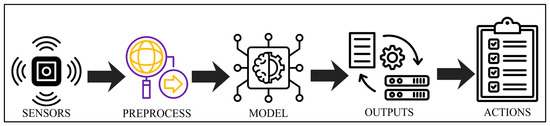
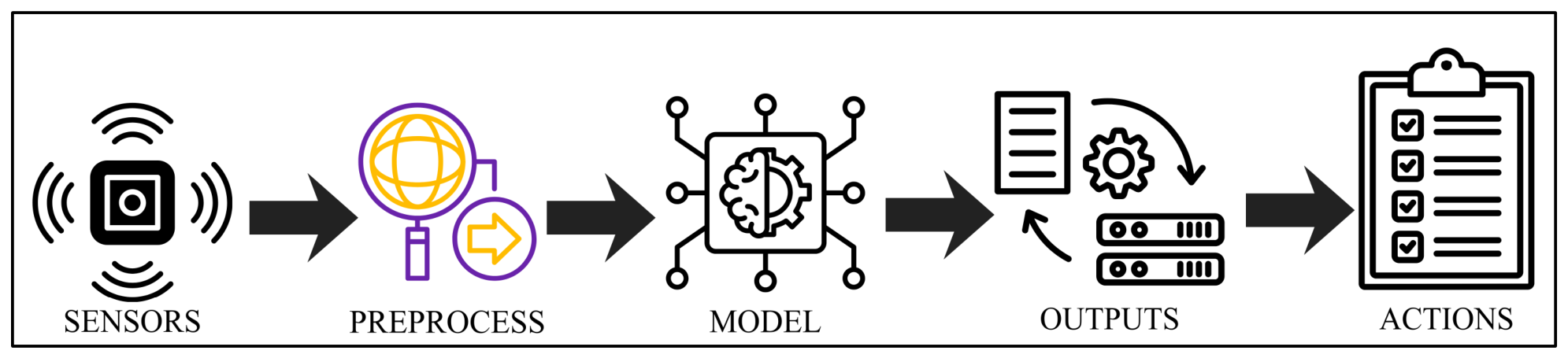
Figure 1 shows the streamlined flow from sensors (vibration/temperature/current) to preprocessing (denoise, normalize, optional CWT) into the model (e.g., GAN-Transformer, ConvFormer-SENet, ANN/MAS), producing outputs (fault label, severity, RUL, confidence) that drive actions (alert, inspection, spares, scheduling) for predictive maintenance. These innovations underscore the importance of AI in enhancing fault detection, diagnosis and predictive maintenance in the manufacturing, automotive, and aerospace sectors. Advanced machine learning models with sensor technologies are increasing operational reliability, decreasing downtimes, and decreasing repair costs. This study next discusses how ANSYS simulations can be used in mechanical systems for structural analysis and the optimization of automotive parts.
Figure 1.
End-to-End AI fault diagnosis pipeline.
2.3. Simulations for Mechanical Systems
Simulation tools like ANSYS are also important in improving the design and operation stability of mechanical systems, particularly in structural analysis, optimization and performance monitoring of components such as clutch plates in mechanical systems simulations. Sowmya et al. [22] discussed the application of AI in diagnostics of faults in rotating machinery and the significance of simulations in monitoring and anticipating the worsening of the state of work, in this case, with variable speed conditions. Simulations in ANSYS add fault diagnostics, which offers real-time information used to interpret structural integrity and reliability when applied in different circumstances of operation.
To optimize the thermal conditions of friction discs in the dry clutch, Jin et al. [23] used ANSYS and finite element methods (FEMs) to run thermal analyses of friction discs in the dry clutches under a prolonged period of slipping. Their results also explored the application of simulations to evaluate the localized heat generation of cooling down surface cracks and deformation of the components of the clutch systems, which also control the heat stresses. GearFaultNet is an AI-based gearbox fault detection system developed by Dutta et al. [24] that incorporates ANSYS simulation to compare the predicted fault conditions with experimental data. This integration improves fault detection accuracy and supports predictive maintenance through optimized operation.
The analysis by Karimi et al. [25] examined the reliability modeling of intelligent mechatronic systems, which make use of ANSYS to model failure mode and evaluate system performance. Such application of simulations is involved in the design of robust control systems and dependable mechanical elements in robotics and automotive engineering applications. Xue et al. [26] provided a mechanical model representing a recently designed double arc sprag overrunning clutch (DASOC), which was simulated in ANSYS to evaluate the measures of stress and torsional stiffness enhancement. Those findings ratified the high load capacity and low contact stress of DASOC, which showed that simulations can lead to innovation in mechanical parts.
Lei et al. [27] studied intelligent fault diagnosis of bearings, and simulations with ANSYS provided dynamic mechanical behavior and benefited the fault detection models with accuracy and robustness in different conditions of operation. Mahesh et al. [28] introduced a data-driven condition-adaptive feature extraction approach for bearing fault detection using deep responsible active learning, complementing Zhang, Y et al.’s [29] simulation-driven method by improving label efficiency in real-world diagnostic pipelines. These researchers bring to attention the use of simulations using software such as ANSYS as critical in optimizing mechanical systems. Simulations are important in increasing fault diagnosis and predictive maintenance functions by forecasting the performance, designing the best and ensuring the components last and work more efficiently. This study next discusses how AI and simulations such as ANSYS can be combined in order to enhance these functions in mechanical systems.
2.4. Integration of AI and Simulations
Combining AI and simulation programs such as ANSYS has been thoroughly researched to enhance monitoring process, fault diagnosis and performance optimization in the machine systems. The complex fault patterns, non-stationary conditions, and the necessity of real-time diagnostics are the challenges that this combined approach can help deal with. Sharma et al. [30] investigated the ANSYS structural evaluation of a plate in the form of a single clutch in a static and dynamic analysis. There were some composite materials like E-Glass Epoxy and Aluminum metal matrix composite, which were modeled in CATIA and analyzed using ANSYS to check stress and deformation. The use of AI in simulations was used to improve the prediction of faults and performance optimization, making the design process simpler.
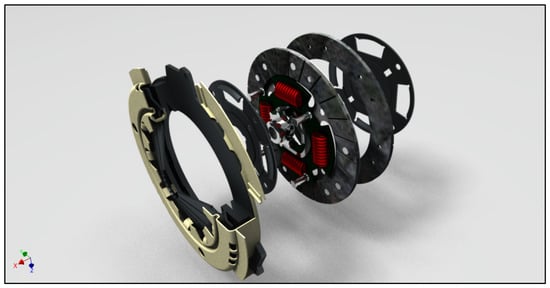
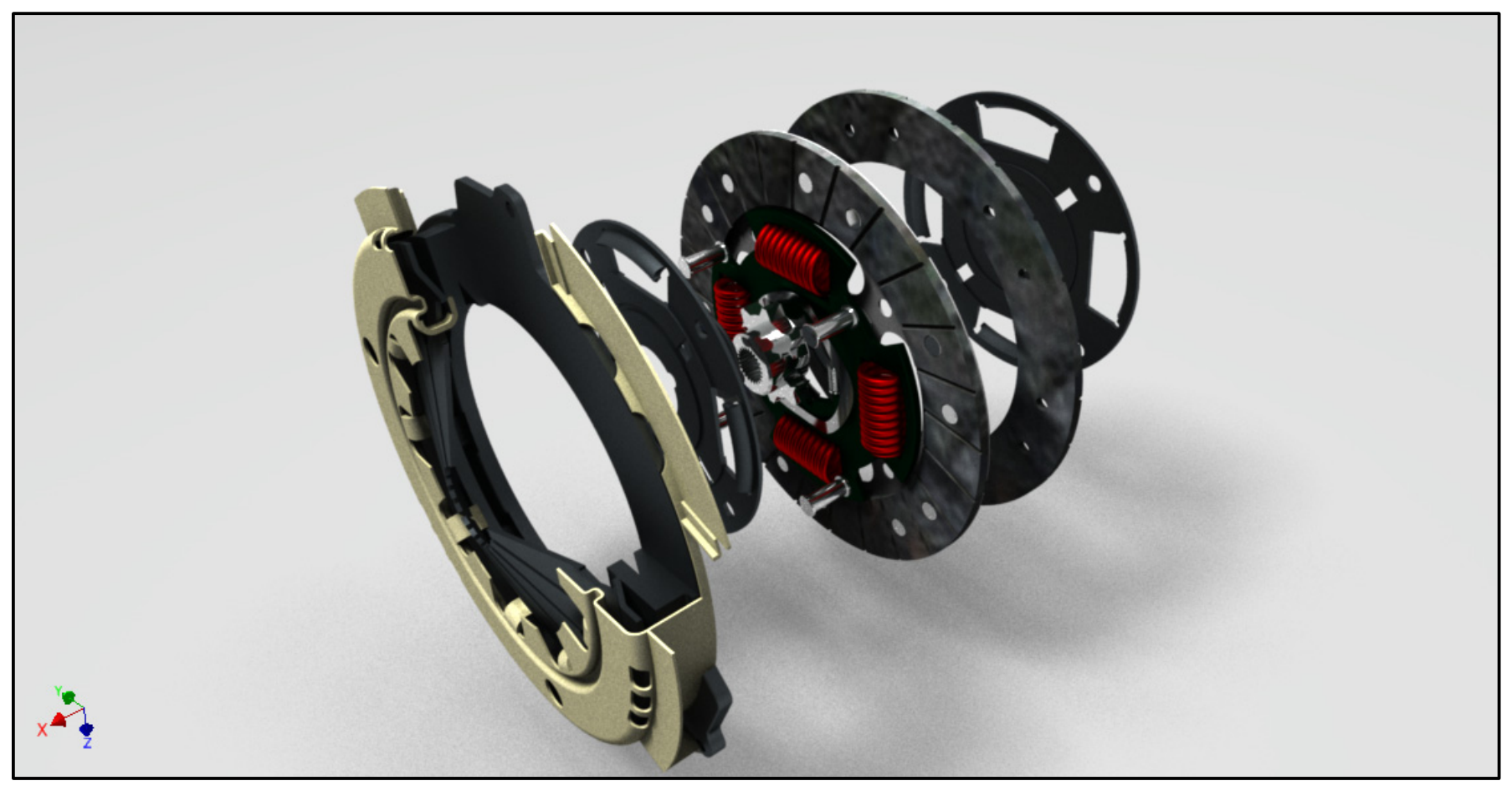
Figure 2 shows an exploded view of the clutch assembly, which displays the different parts which are separated. It consists of the pressure plate, clutch disc and release mechanism, which are indicated in the rendering. The clutch disc has friction materials (under red springs), and the pressure plate is made to make contact and release contact with the mechanism of the clutch. This perspective helps one to comprehend how the internal working and arrangement of parts in the clutch system are arranged. Zhang et al. [31] developed a search-based domain adaptation network for rotating machinery fault diagnosis, which involves adaptation to different operating environments with the combination of AI and simulations. Due to the accuracy of fault diagnosis in cases with strong simulations, AI models develop synthetic datasets and diagnostic errors are eliminated, particularly when real-world information is deemed untrustworthy. Wang et al. [32] addressed the topic of fault-tolerant PMSM aircraft design, including AI-based fault detection using simulation tools. Faults are modeled through simulations, and Artificial Intelligence algorithms tend to forecast possible failures, thus leading to safe operation in high-stakes aerospace applications. Zhang et al. [29] similarly applied a digital mirror approach to fault diagnosis in heavy-loaded automated guided vehicles (AGVs), reinforcing the applicability of digital-twin-based diagnostics to load-bearing mechanical systems under continuous duty cycles.
Figure 2.
Exploded view of clutch assembly.
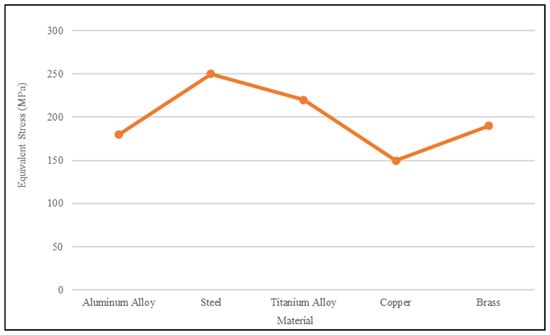
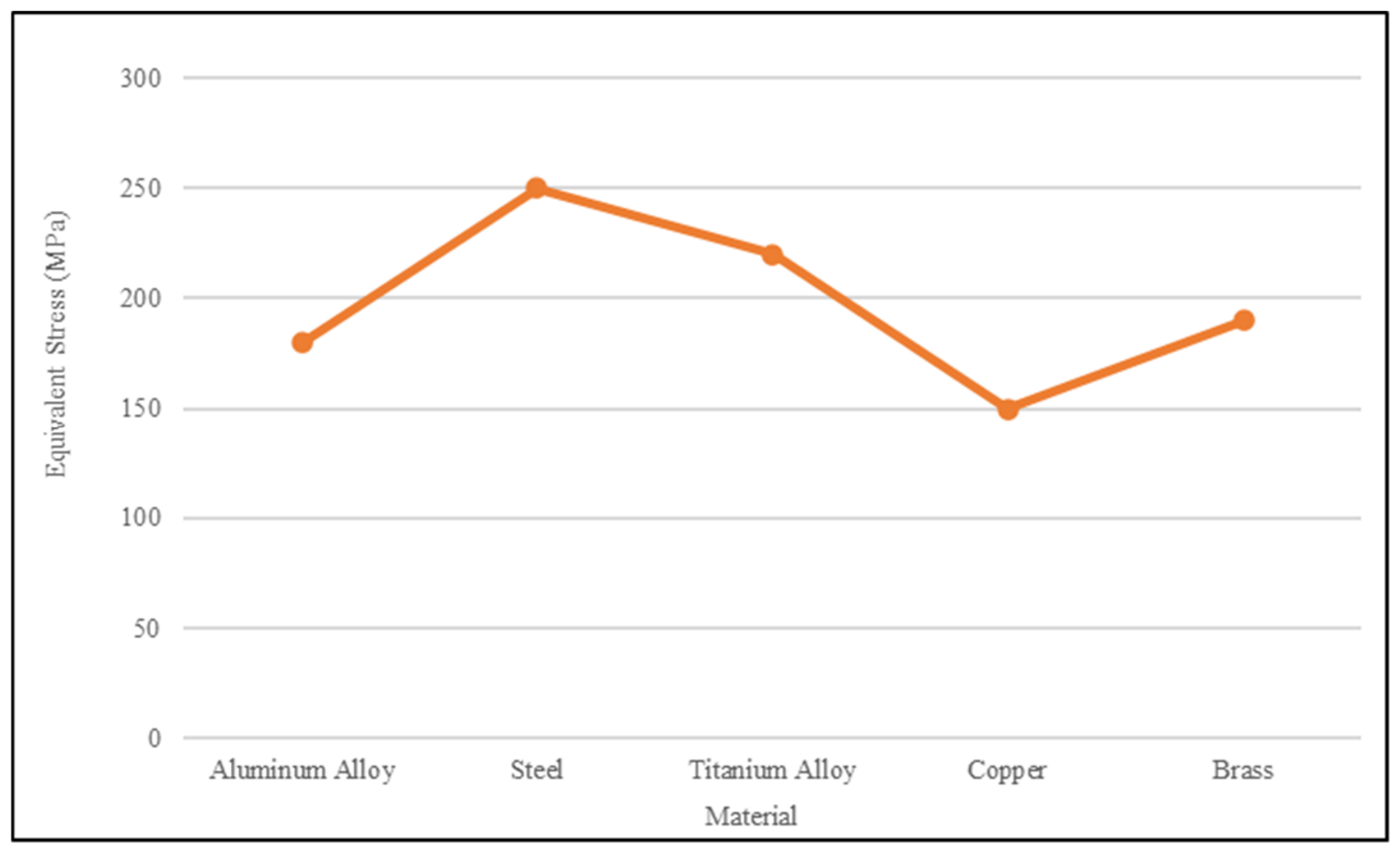
Figure 3, adapted from the ANSYS structural evaluation reported by Sharma et al. [30], illustrates representative equivalent-stress trends among five candidate clutch materials—Aluminum Alloy, Steel, Titanium Alloy, Copper, and Brass—under a uniform static load and is included here to motivate the material selection considerations relevant to the proposed framework. The graph shows that Steel exhibits the highest equivalent stress (≈250 MPa), indicating superior strength and load-bearing capacity, while Copper records the lowest (around 150 MPa). Titanium Alloy and Brass maintain moderate stress levels, and Aluminum Alloy shows relatively lower strength but good lightweight characteristics. This comparison highlights the mechanical performance of each material for clutch plate applications. Bai et al. [33] used CFD simulations using FLUENT to streamline the wax-type thermostats in engines during the cooling process. The use of AI with the CFD simulations optimizes the performance in an automated way and gives real-time predictions and enhances system stability. Chen et al. [34] proposed a model that integrates Artificial Neural Networks (ANNs) and Spiking Neural Networks (SNNs) to diagnose faults that are borne. AI models are trained using simulations to improve the real-time speed and accuracy of the diagnostic process in actual industrial use.
Figure 3.
Comparison of equivalent stress for different clutch materials under uniform load.
Wen et al. [35] researched the idea of employing digital twin technology to forecast mechanical structure fatigue existence. Their AI-based infrastructure uses real-time data with simulated stress-and-strain models to improve the integrity of mechanical systems and allow early fault discovery. He et al. [36] designed a fault-bearing diagnosis technique to use AI and simulations to enhance the effectiveness of fault detection involving signal decomposition and sophisticated classification. They combine simulations to produce synthetic data, which boosts the performance of models in different conditions.
Ding et al. [37] addressed AI applications in smart manufacturing, namely fault diagnosis and prediction of the remaining useful life. Their use of both AI and simulations leads to more accuracy in finding faults and the adaption to changing industrial conditions and predictive maintenance. These works emphasize the increased significance of the integration of AI and simulation software such as ANSYS to enhance fault diagnostics, system performance, and optimization. This not only makes the systems much more accurate but also leads to the growth of efficient, predictive, and fault-tolerant systems in different industries.
3. Applications, Challenges and Research Gaps
3.1. Application and Use Cases
Digital twin (DT) technology is revolutionizing industries such as automotive, aerospace, and energy by enhancing the monitoring, fault diagnosis, and performance optimization of mechanical systems. In the automotive industry, simulation tools like ANSYS are used to assess clutch plates, helping optimize design and identify potential faults under different conditions [30]. For aerospace applications, AI-driven fault detection models combined with simulations are improving the accuracy and reliability of aircraft systems, particularly for sensor health monitoring [32]. In wind energy, DT technology is applied to offshore wind farms to reduce maintenance costs by integrating real-time monitoring and failure prediction [12]. Similarly, in manufacturing, AI and DT are used to monitor 3D-printing processes and automate diagnostics, improving system efficiency [33]. In rotating machinery, AI and simulation techniques are employed to predict faults in bearings and gears, improving predictive maintenance [29]. Simulations are also crucial for optimizing components in vehicles, like thermostats, to enhance energy efficiency [33]. DT models, paired with real-time data, help predict fatigue life and failure in critical structures, such as vehicle axles [35]. These advancements demonstrate how integrating simulations with AI technologies significantly improves the performance, reliability, and efficiency of mechanical systems across various industries.
3.2. Challenges and Limitations
In spite of high advancements, there are rough obstacles in practical implementation. Ineffective data are noisy, lop-sided, and vary in the speeds, loads and the environments, which results in false alarms and drift. The fidelity of high-fidelity simulation is not often as close to real hardware as it would be with actual hardware (sim-to-real gap), and reducing the gap requires expensive tuning and craftsmanship. Real-time demands conflict with compute-intensive AI, which restricts on-edge usage. Interpretability, validation and lifecycle maintenance (updates, versioning and monitoring) are still difficult. Lastly, governance concerns—compliance with data quality, security, IP, and safety requirements —slow the integration of production workflows and safety-important environments.
Table 1 distills the main pain points in building a digital twin for a clutch plate that combines ANSYS-based simulation with AI fault diagnosis. For each challenge, it explains what the issue looks like in practice (e.g., noisy, shifting signals; model–hardware mismatch; real-time compute limits) and spells out why it matters, such as increased false alarms, costly calibration, weaker generalization, and slower certification. Together, the entries highlight where engineering effort, data strategy, and governance need to focus to move from promising prototypes to reliable, production-grade deployments.
Table 1.
Overview of key challenges and limitations in digital twin integration.
3.3. Research Gaps
In spite of boundless prototypes, there are critical gaps preventing trusted, scalable deployment. Clutch-oriented digital twins do not have a uniform, open field of data or a benchmark that would be difficult to compare results with. Weak thermal–mechanical coupling, wear, and friction variability in sim-to-real transfer are also weakly validated on hardware. On-edge pipelines in real time do not have tested latency/energy budgets. Resilience to domain shift (speed, load, driver, environment) and scarcity of labels is not yet resolved, and even less uncertainty quantification is being used or continual learning. Last but not the least, there is still a lack of explainability, lifecycle governance (versioning, monitoring) and explicit V&V protocols of safety-critical use.
Table 2 organizes the key research gaps for clutch-focused digital twins into three columns: what is missing, why it matters, and what to do next. It separates concise problem statements (e.g., sim-to-real transfer, domain shift, label scarcity) from clear, actionable steps (data releases, hybrid physics-ML, on-edge optimization, uncertainty quantification, V&V, and secure integration with maintenance workflows). We use it as a roadmap to prioritize experiments, datasets, and engineering work needed to move prototypes into reliable, production-grade systems.
Table 2.
Strategic overview of research gaps and actionable steps for advancing technology.
4. Proposed Methodology
ClutchMind is proposed as a conceptual framework that would fuse ANSYS-based simulation with real-time sensing and lightweight AI to monitor a single-plate clutch, diagnose faults, and drive predictive maintenance. The following subsections describe the framework’s architecture and intended workflow.
4.1. Building the Clutch and Running FEA
We created the CAD model of the single-plate clutch, running ANSYS FEA to compute static stresses, deformations, factors of safety, and modal behavior; we then added thermo-mechanical loads to reflect slip-induced heating and to initialize digital twin parameters.
4.2. Modeling Heat and Flow (CFD/Thermal)
We simulated airflow and heat transfer around the clutch to predict temperature fields, friction changes, and thermal expansion that couple back into structural response during transient engagement/disengagement.
4.3. Streaming and Synchronizing IoT Data
We collected vibration, temperature, and torque/pressure signals from embedded sensors, time-aligning, filtering, and normalizing them into a synchronized state vector that mirrors the twin’s simulated states.
4.4. Extracting Physics-Guided Features
We derived interpretable features—order tracking, envelope spectra, slip/temperature trends—anchored to FEA/CFD modes so that signatures map to physical components (friction lining, pressure plate, diaphragm spring).
4.5. Diagnosing on the Edge with ML
We ran compact 1D CNN/Transformer models on edge hardware to detect anomalies, estimate severity and remaining useful life (RUL), and output calibrated uncertainty to support safe decision thresholds.
4.6. Closing the Sim-to-Real Gap
We periodically identified parameters by minimizing residuals between simulated and sensed responses, using domain randomization and scheduled calibration to maintain accuracy across speeds, loads, drivers, and environments.
4.7. Turning Predictions into Actions (V&V)
We converted model outputs into severity bands, RUL ranges, and recommended inspections/spares, enforcing latency and energy budgets, drift monitoring, and acceptance tests to validate performance and support deployment in production maintenance workflows.
5. Future Developments and Impact
Since the central platform is ClutchMind, the next step is to ensure the clutch digital twin is faster, more reliable, and scalable. Methodologically, ClutchMind will incorporate hybrid physics-ML models that more precisely capture the evolution of wear and friction through stronger thermal–mechanical coupling; self-/weak-supervision and test-time adaptation to handle label scarcity and domain shift; and calibrated uncertainty with conformal prediction to issue graded, risk-aware warnings. On the efficiency side, ClutchMind drives edge readiness using pruning, quantization and distillation in order to achieve hard latency/energy constraints. Standardizing data schema on the tooling side, it automates the split of benchmarks splits when working with a clutch DT, and it locates drift, rollback finds spot, and it uses HIL rigs to do V&V quickly under transitory slip and variable loads. On the workflow and security side, ClutchMind further secures role access and encryption and connects straight to CMMS/ERP to make predictions work as work orders, sparing reservations and technician checklists.
The effect of these upgrades is obvious. Openly, ClutchMind aims at fewer false alarms, earlier and higher confidence notifications, fewer unplanned stops, and a smaller mean time to repair and cutting-edge compute costs and quicker certification using auditable model cards and acceptance assessments. It reduces the lifecycle cost per clutch economically and environmentally, has an extended component life through soft engagement techniques, scrap reduction by isolating failures earlier, and reduces CO2 through avoided breakdowns and efficient maintenance. Tactically, a production-grade ClutchMind can serve as a template for neighboring drivetrain components (brakes, transmissions), enabling fleet-wide learning, over-the-air model updates, and a feedback loop into design and PLM workflows—accelerating iteration, supporting supplier collaboration, and meeting safety-critical certification standards.
6. Conclusions
In this study, the authors introduced a conceptual digital twin framework for clutch plates, named ClutchMind, that can be combined with ANSYS thermo-mechanical simulation, synchronized IoT sensing, and lightweight, uncertainty-aware machine learning to enable real-time diagnosis and predictive maintenance of clutch plates. The framework is physics-driven with periodic sim-to-real calibration and is designed for deployment on the edge with a realistic latency and power constraint, and for translation of the model output to severity bands, RUL, and actionable maintenance work orders. This study also highlighted the main challenges and research gaps that need to be addressed to make this framework a reality: lack of standardized datasets, domain shift generalization, validated thermo-mechanical coupling, and a robust verification and validation process. It also provided concrete ideas for future directions. The next step and main test for the practical feasibility of ClutchMind are experimental implementation and validation on a physical test rig.
Author Contributions
Conceptualization, S.J.; methodology, S.J.; software, S.J.; validation, S.J. and N.A.; formal analysis, S.J.; investigation, S.J.; resources, S.J.; data curation, S.J.; writing—original draft preparation, S.J.; writing—review and editing, N.A.; visualization, S.J.; supervision, N.A.; project administration, S.J. All authors have read and agreed to the published version of the manuscript.
Funding
This research received no external funding.
Institutional Review Board Statement
Not applicable.
Informed Consent Statement
Not applicable.
Data Availability Statement
No new data were created or analyzed in this study.
Conflicts of Interest
The authors declare no conflicts of interest.
References
- Deshbhratar, V.J.; Kakde, N.U. Design and structural analysis of single plate friction clutch. Int. J. Eng. Res. Technol. 2013, 2, 3726–3732. [Google Scholar]
- Xu, P.; Zhang, L. A fault diagnosis method for rolling bearing based on 1D-ViT model. IEEE Access 2023, 11, 39664–39674. [Google Scholar] [CrossRef] [Scilit]
- Somnath, L.N.; Satish, G.R. Design Modelling & Analysis of Automotive Single Plate Friction Clutch. Int. J. Innov. Res. Technol. 2018, 4, 669–672. [Google Scholar]
- Tikhomolov, A. Analytische, Numerische und Messtechnische Untersuchung der Dynamik von Fahrzeugkupplungen am Beispiel des Trennproblems; KIT Scientific Publishing: Karlsruhe, Germany, 2015; Volume 26. [Google Scholar]
- Yan, X.; Liu, Y.; Jia, M.; Zhu, Y. A multi-stage hybrid fault diagnosis approach for rolling element bearing under various working conditions. IEEE Access 2019, 7, 138426–138441. [Google Scholar] [CrossRef] [Scilit]
- Wang, H.; Xu, D.; Wen, X.; Song, J.; Li, L. Flight test sensor fault diagnosis based on data-fusion and machine learning method. IEEE Access 2022, 10, 120013–120022. [Google Scholar] [CrossRef] [Scilit]
- Chen, L.; Xu, G.; Tao, T.; Wu, Q. Deep residual network for identifying bearing fault location and fault severity concurrently. IEEE Access 2020, 8, 168026–168035. [Google Scholar] [CrossRef] [Scilit]
- Farzan, H. The study of thermostat impact on energy consumption in a residential building by using TRNSYS. J. Renew. Energy Environ. 2019, 6, 15–20. [Google Scholar] [CrossRef] [Scilit]
- Thaiprayoon, C.; Sudsutad, W.; Alzabut, J.; Etemad, S.; Rezapour, S. On the qualitative analysis of the fractional boundary value problem describing thermostat control model via ψ-Hilfer fractional operator. Adv. Differ. Equ. 2021, 2021, 201. [Google Scholar] [CrossRef] [Scilit]
- Purohit, R.; Khitoliya, P.; Koli, D.K. Design and finite element analysis of an automotive clutch assembly. Procedia Mater. Sci. 2014, 6, 490–502. [Google Scholar] [CrossRef] [Scilit]
- Liu, W.-X.; Yin, R.-P.; Zhu, P.-Y. Deep learning approach for sensor data prediction and sensor fault diagnosis in wind turbine blade. IEEE Access 2022, 10, 117225–117234. [Google Scholar] [CrossRef] [Scilit]
- Xia, J.; Zou, G. Operation and maintenance optimization of offshore wind farms based on digital twin: A review. Ocean Eng. 2023, 268, 113322. [Google Scholar] [CrossRef] [Scilit]
- Shi, G.; Liu, Z.; Lu, D.; Zhang, Q.; Wang, Z.; Zhao, Y. Digital twin-based model updating method for mechanical behaviors analysis of cable truss structure. J. Constr. Steel Res. 2024, 221, 108917. [Google Scholar] [CrossRef] [Scilit]
- Sheuly, S.S.; Ahmed, M.U.; Begum, S. Machine-learning-based digital twin in manufacturing: A bibliometric analysis and evolutionary overview. Appl. Sci. 2022, 12, 6512. [Google Scholar] [CrossRef] [Scilit]
- Hu, C.; Zhang, Z.; Li, C.; Leng, M.; Wang, Z.; Wan, X.; Chen, C. A state of the art in digital twin for intelligent fault diagnosis. Adv. Eng. Inform. 2025, 63, 102963. [Google Scholar] [CrossRef] [Scilit]
- Wang, H.; Guan, S.; Wang, X.; Wang, L.; Zhang, Q.; Liu, K.; Fang, Z.; Wang, H. IACGAN-ST: A fault diagnosis method for scraper conveyor bearings under imbalanced data conditions. IEEE Access 2025, 13, 41011–41024. [Google Scholar] [CrossRef] [Scilit]
- He, Q.; Kang, B.; Fan, S.; Li, X. Hierarchical Convolution-Transformer Framework for Gear Fault Diagnosis Under Severe Noise. IEEE Access 2025, 13, 105492–105504. [Google Scholar] [CrossRef] [Scilit]
- Palácios, R.H.C.; da Silva, I.N.; Goedtel, A.; Godoy, W.F.; Lopes, T.D. Diagnosis of stator faults severity in induction motors using two intelligent approaches. IEEE Trans. Ind. Inform. 2017, 13, 1681–1691. [Google Scholar] [CrossRef] [Scilit]
- Han, B.; Zhang, G.; Wang, J.; Wang, X.; Jia, S.; He, J. Research and application of regularized sparse filtering model for intelligent fault diagnosis under large speed fluctuation. IEEE Access 2020, 8, 39809–39818. [Google Scholar] [CrossRef] [Scilit]
- Cohen, J.; Jiang, B.; Ni, J. EveSyncIAI: Event synchronization industrial augmented intelligence for fault diagnosis. IEEE Trans. Semicond. Manuf. 2022, 35, 446–456. [Google Scholar] [CrossRef] [Scilit]
- Corradini, F.; Silvestri, M. Design and testing of a digital twin for monitoring and quality assessment of material extrusion process. Addit. Manuf. 2022, 51, 102633. [Google Scholar] [CrossRef] [Scilit]
- Sowmya, S.; Saimurugan, M.; Edinbarough, I. Rotational machine Fault diagnosis using Artificial Intelligence (AI) strategies for the operational challenges under variable speed condition: A Review. IEEE Access 2024, 12, 144870–144889. [Google Scholar] [CrossRef] [Scilit]
- Jin, Y.; Chen, L.; Cheng, C. Thermal behavior of friction discs in dry clutches based on a non-uniform pressure model. Case Stud. Therm. Eng. 2022, 32, 101895. [Google Scholar] [CrossRef] [Scilit]
- Dutta, P.; Podder, K.K.; Sumon, S.I.; Khandakar, A.; Al-Emadi, N.; Chowdhury, M.H.; Murugappan, M.; Ayari, M.A.; Mahmud, S.; Muyeen, S.M. GearFaultNet: Novel network for automatic and early detection of gearbox faults. IEEE Access 2024, 12, 188755–188765. [Google Scholar] [CrossRef] [Scilit]
- Karimi, H.R.; Du, H.; Lin, J.; Zeng, X. Guest Editorial: Focused Section on Reliability Design and Resilient Control for Intelligent Mechatronic Systems (RDRC-IMS). IEEE-ASME Trans. Mechatron. 2019, 24, 2437–2440. [Google Scholar] [CrossRef] [Scilit]
- Xue, Y.; Wang, Z.; Chen, D.; Tao, S.; Lu, Y. Design and test of a new type of overrunning clutch. Machines 2022, 10, 1188. [Google Scholar] [CrossRef] [Scilit]
- Lei, Y.; Jia, F.; Lin, J.; Xing, S.; Ding, S.X. An intelligent fault diagnosis method using unsupervised feature learning towards mechanical big data. IEEE Trans. Ind. Electron. 2016, 63, 3137–3147. [Google Scholar] [CrossRef] [Scilit]
- Mahesh, T.R.; Chandrasekaran, S.; Ram, V.A.; Kumar, V.V.; Vivek, V.; Guluwadi, S. Data-driven intelligent condition adaptation of feature extraction for bearing fault detection using deep responsible active learning. IEEE Access 2024, 12, 45381–45397. [Google Scholar] [CrossRef] [Scilit]
- Zhang, Y.; Gao, Y.; Zhang, X.; Song, L.; Zhao, B.; Liu, J.; Liang, L.; Jiao, J. Fault diagnosis of heavy-loaded AGV based on digital mirror. IEEE Access 2024, 12, 162894–162907. [Google Scholar] [CrossRef] [Scilit]
- Sharma, N.; Bhoi, A.; Mahato, N. Design and Structural Assessment of Single Clutch Plate with Variant of Materials; IJCRT: Jamshedpur, India, 2020. [Google Scholar]
- Zhang, J.; Sun, H.; Yuan, T. A search-based domain adaptation network for fault diagnosis of rotating machinery under cross-operating conditions. IEEE Access 2025, 13, 57650–57661. [Google Scholar] [CrossRef] [Scilit]
- Wang, B.; Wang, Y.; Zhang, Z.; Tang, M.; Vakil, G.; Yang, T. Review of Fault-Tolerant Permanent Magnet Synchronous Machine Design and Control for Future Aircraft Application. Chin. J. Electr. Eng. 2025, 11, 165–187. [Google Scholar] [CrossRef] [Scilit]
- Bai, L.; Yang, M.; Li, Y. CFD simulation analysis for the wax-type thermostat. In 2014 International Conference on Mechatronics, Electronic, Industrial and Control Engineering (MEIC-14); Atlantis Press: Dordrecht, The Netherlands, 2014; pp. 1357–1361. [Google Scholar]
- Chen, X.; Li, J.; Yu, A.; Cai, B.; Wu, Q.; Xia, M. Ultra-Low Latency ANN-SNN Conversion for Bearing Fault Diagnosis. IEEE Trans. Instrum. Meas. 2025, 74, 3518010. [Google Scholar] [CrossRef] [Scilit]
- Wen, C.; Liu, Z.-Y.; Wu, G.-W.; Zhao, C.-J.; Chen, L.-P.; Yin, Y.-X.; Meng, Z.-J. Digital twin-driven fatigue life prediction framework of mechanical structures using a power density theory: Application to off-road vehicle front axle housing. Measurement 2023, 220, 113352. [Google Scholar] [CrossRef] [Scilit]
- He, G.; Feng, L.; Yang, G. A new method for bearing fault diagnosis based on adaptive SVMD and RCMDSE-IDHT. IEEE Access 2024, 12, 169467–169486. [Google Scholar] [CrossRef] [Scilit]
- Ding, H.; Gao, R.X.; Isaksson, A.J.; Landers, R.G.; Parisini, T.; Yuan, Y. State of AI-based monitoring in smart manufacturing and introduction to focused section. IEEE/ASME Trans. Mechatron. 2020, 25, 2143–2154. [Google Scholar] [CrossRef] [Scilit]

Disclaimer/Publisher’s Note: The statements, opinions and data contained in all publications are solely those of the individual author(s) and contributor(s) and not of MDPI and/or the editor(s). MDPI and/or the editor(s) disclaim responsibility for any injury to people or property resulting from any ideas, methods, instructions or products referred to in the content. |
© 2026 by the authors. Licensee MDPI, Basel, Switzerland. This article is an open access article distributed under the terms and conditions of the Creative Commons Attribution (CC BY) license.