


Abstract
Audio identification systems often face high computational cost when large numbers of audio features are extracted and matched directly. This paper presents a reference-based audio identification framework that combines Chromaprint fingerprinting with Random Forest-based candidate filtering and pairwise verification. Audio tracks are segmented into overlapping 10-second clips, processed with Essentia to generate compact Chromaprints, and matched through offset-aware cosine similarity. Experimental results on local audio, YouTube-derived audio, mixed-video queries, and GTZAN clips show promising identification performance under a known-reference evaluation setting. Additional discussion on parameter selection and similarity-score behavior is provided to clarify the influence of masking, classifier confidence, and verification thresholds.
1. Introduction
In recent years, the rapid expansion of digital audio libraries has posed significant challenges for efficient audio identification and management. Traditional approaches to audio identification often rely on extracting a large number of features from audio signals, leading to high computational and memory overheads [1]. Such resource-intensive methods become impractical for large-scale applications, particularly in scenarios demanding real-time performance and scalability [2,3].
To address these limitations, this paper proposes an audio identification framework based on Chromaprint-based audio fingerprinting [4,5,6]. Unlike conventional techniques that depend on dense spectral or learned feature representations, Chromaprint captures harmonic characteristics through a compact binary representation, substantially reducing the dimensionality of the feature space [7]. This representation mitigates computational complexity while preserving discriminative musical information across diverse acoustic conditions.
The proposed methodology begins by segmenting audio files into 10-second clips with a 5-second overlap, ensuring that essential musical features are preserved across neighboring segments. The Essentia library [8] is employed for audio processing; specifically, its MonoLoader and Chromaprinter modules are used to extract Chromaprints from each segment. A Random Forest model is then trained on the segmented Chromaprint database to support candidate filtering, after which pairwise fingerprint matching is used to verify the final track identity.
This work focuses on audio identification against a known reference database, where the objective is to retrieve and verify the correct track from indexed fingerprints rather than to perform fully generalized classification on unseen songs. In this setting, the Random Forest model is used primarily as a candidate-selection mechanism, while the final decision is made through direct fingerprint verification.
The contribution of this work is not a new fingerprinting algorithm, but a lightweight system-level design for known-reference audio identification. The main contribution lies in combining compact Chromaprint representations, Random Forest-based candidate filtering, and offset-aware pairwise verification into a practical retrieval pipeline.
Related Work
Audio fingerprinting has significantly evolved over the past two decades, driven by the need for robust and efficient techniques suitable for audio identification. Early approaches typically relied on transforming audio signals using time–frequency analyses, most notably the Short-Time Fourier Transform (STFT), to generate spectral representations. Prominent spectral features were then extracted and encoded into hash keys or fingerprints, providing resilience against noise, compression, and other audio distortions.
Notable contributions include Wang’s method [9], which employed spectral peaks to construct robust constellation maps, and the compact hash-based approach by Haitsma and Kalker [10], designed to maintain reliability under common audio transformations. More recent work by Borkar et al. [11] combined fingerprinting with segment matching for plagiarism detection, achieving good accuracy but struggling with complex melodic or rhythmic variations. Similarly, STFT-based time–frequency representations have been applied to music genre classification [12], and Convolutional Neural Networks (CNNs) can learn discriminative features directly from such representations. Although effective for clean signals, such approaches may require greater computational resources and are not always extensively evaluated under real-world distortions such as noise or compression.
Several other works have contributed insights into robust acoustic pattern matching. Viet et al. [13] presented a hybrid Gaussian Mixture Model–Support Vector Machine (GMM–SVM) framework for speaker verification under noisy and reverberant conditions. Their results showed that combining probabilistic modeling with margin-based classification effectively filtered out unlikely candidates before detailed matching, a concept that motivates the lightweight candidate-selection stage in our pipeline. Vu and Truong [14] employed Dynamic Time Warping (DTW) with coefficient of correlation to align Vietnamese speech signals, achieving high accuracy despite temporal distortions. While their work focused on speech rather than musical fingerprints, the DTW-correlation approach underscores the importance of temporal alignment, which informed the design of the pairwise Chromaprint comparison module in the proposed system.
Beyond foundational methods, comparative analyses have evaluated open-source fingerprinting systems under realistic conditions. Chikanbanjar [15] compared Chromaprint, Echoprint, and Panako in terms of robustness against noise, playback-speed variation, and sampling-rate mismatch. The results indicated that Chromaprint performed well when the query segment was sufficiently long and taken from the beginning of a track, but its accuracy declined under heavy noise or short-segment queries. These findings highlight Chromaprint’s limitations in handling incomplete or degraded inputs, which the proposed system addresses through enhanced segmentation, candidate filtering, and offset-aware pairwise verification. Recent studies have also explored deep learning and graph-based architectures to enhance audio identification and music information retrieval. Kamuni et al. [16] investigated Jukebox-based deep vector quantization representations for music genre recognition and showed that conventional Mel spectrograms can still outperform deep VQ encodings when trained on limited datasets. Their findings emphasize the continuing relevance of perceptually aligned frequency representations in music information retrieval [17]. Kamuni et al. [18] further proposed an AI- and ML-enhanced audio fingerprinting system based on the open-source Dejavu framework, integrating signal denoising, peak extraction, and hashing strategies to improve accuracy under noisy and distorted conditions. More recently, Bhattacharjee et al. [19] introduced GraFPrint, a graph neural network-based framework for large-scale audio identification, achieving high top-1 hit rates on noisy and reverberant datasets. These works demonstrate the growing role of learning-based representations, while also motivating lightweight alternatives that can operate efficiently in known-reference settings.
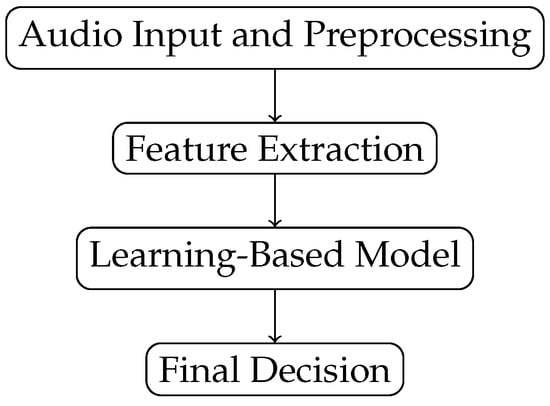
Several real-world projects and commercial systems have adopted architectures similar to Figure 1, integrating feature extraction, learning-based classification, and final decision-making based on detailed matching. Notably, the AcousticID project employs Chromaprint-based fingerprinting alongside efficient search algorithms to support open-source audio identification applications. These systems demonstrate the practical effectiveness of combining robust feature representations, scalable classification mechanisms, and precise matching strategies, which collectively lay the foundation for reliable audio identification solutions.
Figure 1.
Overview of typical architectures used in prior audio identification systems.
Recent learning-based audio identification methods have explored CNN-, GNN-, and embedding-based representations to improve robustness under noise, reverberation, and compression. These approaches can achieve strong performance but often require larger training datasets and higher computational resources. In contrast, the proposed method focuses on a lightweight known-reference setting by reusing compact Chromaprint descriptors, applying Random Forest only for candidate filtering, and retaining an interpretable pairwise verification stage.
2. Materials and Methods
The proposed system is designed to improve audio identification efficiency by combining compact Chromaprint representations with probabilistic candidate selection and pairwise verification. Unlike traditional methods that rely on extensive feature extraction and large-scale direct matching, the framework reduces computation while preserving discriminative harmonic information.
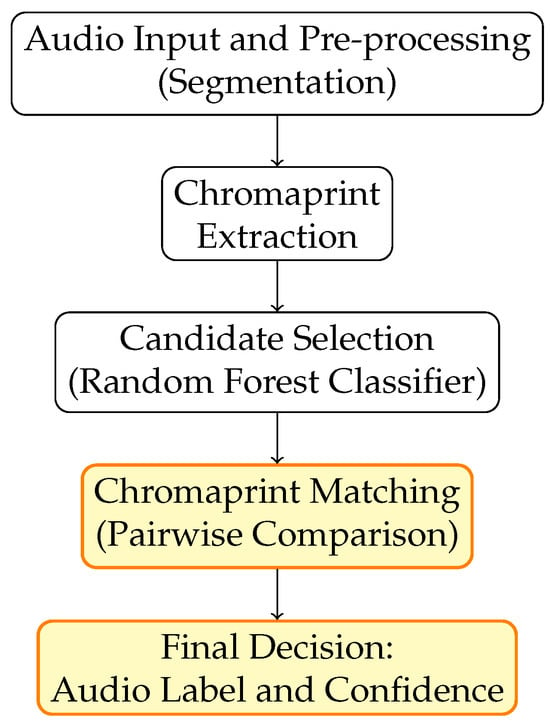
As shown in Figure 2, the system consists of four main stages: audio preprocessing and segmentation, Chromaprint extraction, candidate selection using a Random Forest classifier, and final verification through pairwise Chromaprint matching. The main novelty of the proposed architecture lies in the final two stages, where probabilistic filtering is combined with detailed fingerprint comparison to improve both efficiency and accuracy.
Figure 2.
Overview of the proposed audio identification architecture.
2.1. Audio Preprocessing and Chromaprint Extraction
Input audio is converted to mono and segmented into overlapping clips to preserve continuity across neighboring regions. Each segment is then transformed into a compact Chromaprint representation using Essentia. Instead of retaining the full spectral representation, the method maps the signal into 12 chroma bins and binarizes the integrated chroma vector, producing a lightweight fingerprint that preserves harmonic structure while reducing storage and computation.
2.2. Candidate Selection via Random Forest
Each binary Chromaprint is used as input to a RandomForestClassifier for candidate filtering within the reference database. The classifier outputs posterior probabilities over candidate audio labels using predict_proba, and the top candidate is selected for detailed verification. This stage reduces the search space and improves runtime efficiency before fingerprint-level matching.
2.3. Chromaprint Matching and Final Decision
After candidate selection, the test and reference Chromaprint sequences are compared in a pairwise manner. Each 32-bit Chromaprint value is masked to retain only the lower 20 bits, which were found to provide better robustness to noise and production variability while preserving discriminative information. Let and denote the reference and query Chromaprint sequences, respectively. The masked sequences are defined as
where & denotes the bitwise AND operator. This operation keeps only the lower 20 bits of each 32-bit Chromaprint value.
To compensate for temporal misalignment between the reference and query sequences, an offset search is performed over the set of feasible temporal shifts . For each offset , the number of exact matches between the aligned masked fingerprints is computed as
where is the set of query indices for which both and exist. The optimal offset is obtained by exhaustive search as
After applying the optimal offset , two aligned vectors are constructed from the corresponding subsequences of the masked reference and query Chromaprints:
The cosine similarity between the aligned subsequences is then computed as
Let denote the posterior probability assigned by the Random Forest classifier to candidate class c for query fingerprint x. The highest candidate confidence is defined as
where is the set of candidate audio labels.
The final match decision is based on both the classifier confidence and the similarity score:
In the experiments, both thresholds were set to 0.85. This two-stage design improves efficiency by reducing exhaustive search over the reference database, while maintaining strong verification performance under the current known-reference setting.
The thresholds and were selected empirically based on preliminary system observations during development. Lower thresholds increased tolerance to noisy or degraded queries but also increased the risk of accepting incorrect matches. Higher thresholds reduced false matches but could reject difficult queries with speech overlap, background noise, or recording-quality degradation. The value 0.85 was therefore used as a practical trade-off between robustness and verification strictness in the current known-reference setting.
3. Results
This section evaluates the proposed Chromaprint–Random Forest audio identification system on local audio files, YouTube videos, mixed-video queries, and the GTZAN dataset.
3.1. Experimental Setup
Experiments were conducted on a dataset of 50 songs segmented into approximately 2100 overlapping clips of 10 s with a 5 s step. Audio segments were processed using Essentia’s (version 2.1b6.dev1110) MonoLoader, converted into Chromaprints, and used to train a Random Forest classifier. Additional evaluations were performed on audio extracted from YouTube videos using yt_dlp. The experiments were run on a machine with 16 GB RAM, an Intel Core i5-11320H CPU (Intel Corporation, Santa Clara, CA, USA), and an NVIDIA GeForce GTX 1650 GPU (NVIDIA Corporation, Santa Clara, CA, USA).
The current study is conducted under a reference-based identification setting rather than a conventional supervised train/test classification protocol. All segmented Chromaprints extracted from the reference songs are used to construct the candidate-selection stage and the matching database. Evaluation is then performed by querying the system with local audio files, YouTube-derived audio, mixed-video segments, and benchmark clips in order to assess practical identification behavior. It should be noted that the present experiments do not employ a fully disjoint track-level train/validation/test split. In particular, the reference database is constructed from segment-level fingerprints, and the reported results should therefore be interpreted as system-level identification performance under the present protocol rather than strict generalization accuracy on unseen songs.
3.2. Parameter Selection Rationale
The selected parameters were determined empirically based on preliminary system observations during development. They are not claimed to be globally optimal, but they provided a practical configuration for the current known-reference evaluation setting. The selected parameters and their roles are summarized in Table 1.
Table 1.
Summary of selected parameters and their roles in the proposed system.
3.3. Results on Local, YouTube, and Mixed-Video Scenarios
For all scenarios, the system followed the same two-stage pipeline: candidate selection by Random Forest using predict_proba, followed by pairwise Chromaprint verification using offset alignment and cosine similarity on masked fingerprints.
In the local audio scenario, the proposed method showed reliable identification behavior, confirming the effectiveness of compact Chromaprint features combined with detailed verification.
To evaluate robustness under more realistic conditions, the system was further tested on mixed-video queries in which audio segments may begin at arbitrary offsets and may contain interference such as speech, applause, or background noise. Across 100 diverse video samples, including YouTube Shorts, live performances, cover videos, and mixed-audio uploads, the system correctly identified all evaluated mixed-video queries under the present experimental protocol. Although three cases produced cosine similarity scores below the operational threshold, the correct labels were still retrieved. These lower scores were mainly associated with strong background noise, speech overlap, or recording-quality variations. Overall, the results demonstrate that the proposed method is robust to non-aligned and noisy real-world inputs in a known-reference setting. These findings should not be interpreted as evidence of strict generalization to unseen tracks under a fully disjoint train/test protocol.
Figure 3 depicts a histogram of the number of occurrences for each range of cosine similarity scores across the 100 test samples, illustrating the distribution and highlighting the three lower-scoring cases.
Figure 3.
Distribution of cosine similarity scores for the 100 video samples, indicating the frequency of samples within each similarity interval.
From the 100 mixed-video queries, three samples produced cosine similarity scores below the operational threshold. These lower-scoring cases were associated mainly with speech overlap, strong background noise, or recording-quality variation. This observation indicates that the proposed system can still retrieve the correct label in difficult cases, although the verification confidence may decrease under degraded audio conditions.
3.4. Evaluation on the GTZAN Dataset
The proposed framework was also evaluated on GTZAN clips as an additional benchmark source for examining the discriminative capability of the fingerprint representation under the current evaluation setting. The results remained consistently high, suggesting that the proposed combination of candidate filtering and pairwise matching can effectively separate diverse musical patterns in this benchmark.
3.5. Contextual Comparison with Existing Methods
This comparison is intended to position the proposed system relative to representative existing methods rather than to claim direct superiority, since the datasets, task definitions, and evaluation protocols differ across studies.
Table 2 compares the proposed method with the CNN-based approach in [20] on the GTZAN benchmark. Under the current evaluation protocol, the proposed framework correctly identified all evaluated queries in the present setting, whereas [20] reported 98.9% accuracy under its own GTZAN benchmark configuration. Because the protocols differ, the comparison should be interpreted only as contextual positioning rather than direct evidence of superiority. For the current known-reference protocol, the reported metric is the correct retrieval rate for evaluated queries, defined as the proportion of evaluated query samples whose correct reference track was retrieved by the system:
where is the number of evaluated queries, is the ground-truth reference label, is the predicted label, and is the indicator function.
Table 2.
Illustrative comparison with the previously reported result in [20]. The values are not directly comparable because the evaluation protocols and datasets differ.
The comparison is illustrative rather than directly conclusive because the datasets and protocols differ across studies.
To further examine robustness, Table 3 summarizes illustrative comparisons with the original Chromaprint-based approach reported in [15]. Although the datasets and settings are not strictly identical, the comparison provides contextual evidence that a two-stage design combining probabilistic candidate filtering and pairwise verification may be beneficial under noisy and offset conditions. Therefore, the values should not be interpreted as a direct benchmark comparison.
Table 3.
Illustrative comparison with the Chromaprint-based approach in [15].
4. Discussion
This section discusses the effectiveness of the proposed system, its main methodological contributions, and several limitations observed from the experiments.
4.1. Main Contributions
The proposed system makes two main contributions. First, it introduces a lightweight two-stage reference-based identification pipeline that combines Random Forest candidate filtering with Chromaprint-based pairwise verification. The Random Forest stage reduces the search space by selecting likely candidates, while the final Chromaprint matching stage verifies the predicted track through direct fingerprint comparison.
Second, the verification stage uses offset-aware matching with masked 20-bit Chromaprint values and cosine similarity. This design improves robustness to temporal misalignment and degraded query conditions while maintaining low computational cost. The results on local audio, YouTube-derived audio, mixed-video queries, and GTZAN clips indicate strong identification behavior under the evaluated known-reference setting. At the same time, the study acknowledges the limitations of segment-level reference-based evaluation and the need for stricter track-level validation in future work.
4.2. Analysis of Experimental Results
The experimental results show that the system can reliably identify audio from multiple sources, including datasets, local files, YouTube videos, and mixed media. The combination of Random Forest classification and fine-grained Chromaprint matching provides both confident candidate selection and precise verification, leading to strong overall performance.
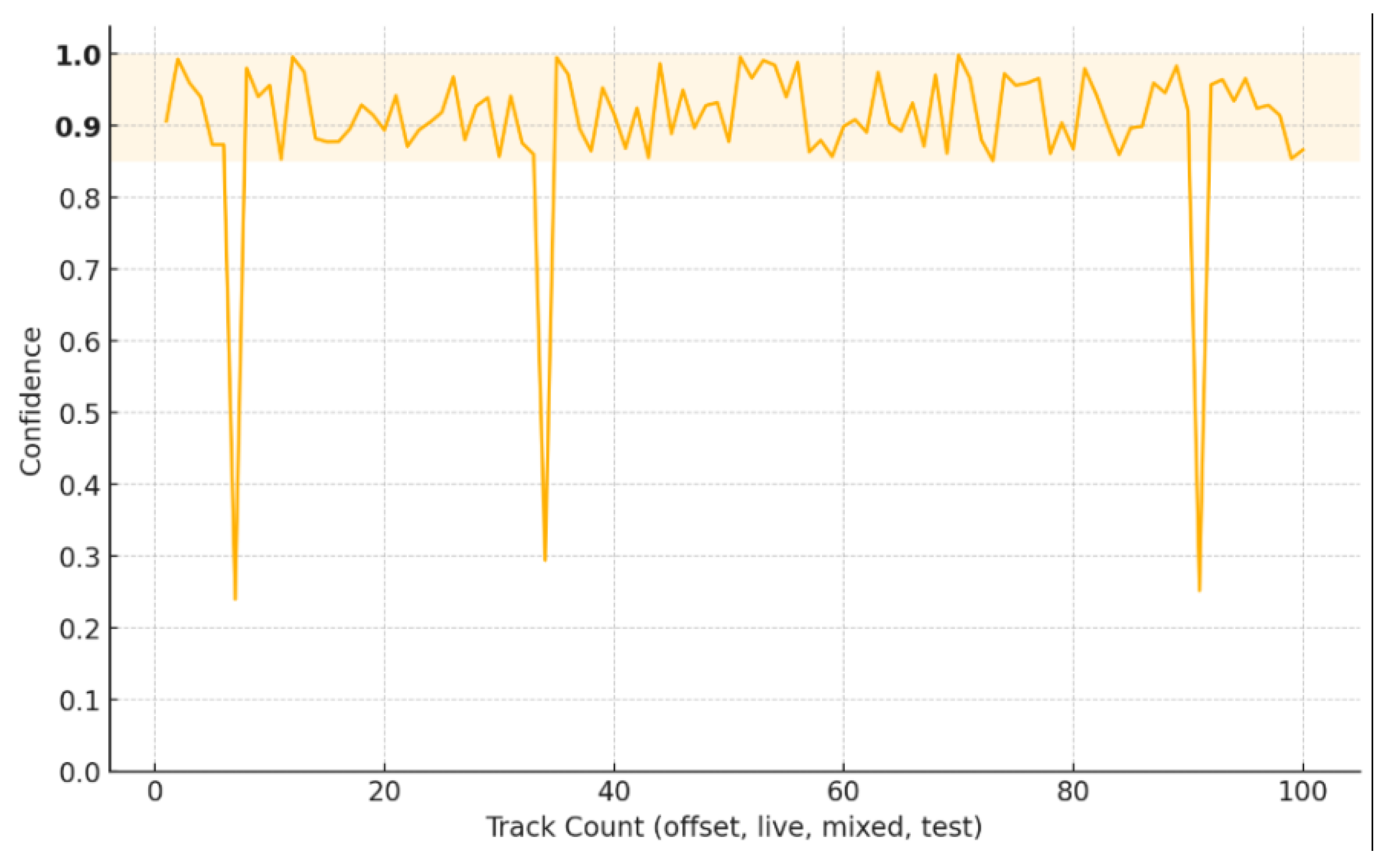
In addition, the probability and similarity analyses indicate that high classifier confidence is generally associated with high cosine similarity, confirming that the method captures discriminative harmonic information from the audio tracks.
A key limitation of this study is that evaluation is conducted under a segment-level reference-based setting without a fully disjoint track-level train–test split. Consequently, the reported performance may be optimistic compared with a stricter protocol where entire songs are excluded from training. Thus, the results mainly demonstrate the effectiveness of the proposed identification pipeline in a known-reference scenario.
Another limitation is scalability. As the reference database grows, similar fingerprint patterns across tracks may increase ambiguity during candidate selection and verification, particularly for short, noisy, or partially aligned queries.
4.3. Storage and Computational Efficiency
Another advantage of the proposed approach is its storage and computational efficiency. Instead of using full audio signals for matching, the system uses compact binary Chromaprints, which need much less memory than raw audio. This reduces storage, I/O overhead, and computation cost, leading to faster retrieval and inference. Therefore, the method is suitable for real-time audio identification on edge and embedded IoT devices with limited resources.
5. Conclusions
This paper presented a lightweight reference-based audio identification system that combines Chromaprint fingerprinting, Random Forest-based candidate selection, and pairwise fingerprint verification. The proposed framework reduces the computational cost of direct large-scale matching by first selecting likely candidates and then applying offset-aware Chromaprint comparison with cosine similarity. Experimental results on local audio files, YouTube-derived audio, mixed-video queries, and GTZAN clips indicate strong identification behavior under the current known-reference evaluation protocol.
The proposed approach is particularly suitable for environments where a known audio reference database is available and efficient retrieval is required, such as media monitoring, copyright support, and large-scale audio library management. Nevertheless, the present results should be interpreted within the limitations of the current reference-based protocol. Future work will focus on stricter evaluation with track-level train/validation/test separation, deeper integration with Elasticsearch for scalable storage and fuzzy retrieval, and RabbitMQ-based asynchronous processing to improve throughput in practical deployments. Incremental learning will also be explored to improve adaptability when new reference songs are added to the system.
Author Contributions
Conceptualization, P.-T.L., N.-V.T. and D.-L.V.; methodology, P.-T.L., D.-L.V. and P.-T.N.; software, P.-T.L. and P.-T.N.; validation, P.-T.L. and D.-L.V.; formal analysis, P.-T.L.; investigation, P.-T.L.; resources, D.-L.V.; data curation, P.-T.L.; writing, original draft preparation, P.-T.L. and P.-T.N.; writing, review and editing, P.-T.L. and D.-L.V.; visualization, P.-T.L.; supervision, D.-L.V.; project administration, D.-L.V.; funding acquisition, D.-L.V. All authors have read and agreed to the published version of the manuscript.
Funding
This research was supported by The VNUHCM-University of Information Technology’s Scientific Research Support Fund under Grant No. CS1-2026-80633.
Institutional Review Board Statement
Not applicable.
Informed Consent Statement
Not applicable.
Data Availability Statement
The source code of the proposed system is publicly available at https://github.com/lyphucthanh1010/advance_dsp (accessed on 10 November 2026).
Acknowledgments
During the preparation of this manuscript, the authors used Claude with the Claude Sonnet 5 and Claude Opus 4.8 models (Anthropic) for improving the language, grammar, and readability of the text, suggesting related literature, and assisting in the creation of Figure 1 and Figure 2. All suggested references were subsequently verified by the authors against their original sources. The authors have reviewed and edited the output and take full responsibility for the content of this publication.
Conflicts of Interest
The authors declare no conflicts of interest.
Abbreviations
The following abbreviations are used in this manuscript:
| CNN | Convolutional Neural Network |
| DTW | Dynamic Time Warping |
| GMM | Gaussian Mixture Model |
| GNN | Graph Neural Network |
| GTZAN | A benchmark dataset for music genre classification |
| MIR | Music Information Retrieval |
| RF | Random Forest |
| STFT | Short-Time Fourier Transform |
| SVM | Support Vector Machine |
References
- Chen, B. Music Audio Rhythm Recognition Based on Recurrent Neural Network. Mob. Inf. Syst. 2022, 2022, 6249798. [Google Scholar] [CrossRef] [Scilit]
- Tzanetakis, G.; Cook, P. Musical Genre Classification of Audio Signals. IEEE Trans. Speech Audio Process. 2002, 10, 293–302. [Google Scholar] [CrossRef] [Scilit]
- Kavitha, N.; Rashmika, S.J.; Reshika, A.S. Perceptual Hash Techniques for Audio Copyright Protection in Decentralized Systems. Int. J. Adv. Comput. Sci. Appl. 2025, 16, 291. [Google Scholar] [CrossRef] [Scilit]
- Cano, P.; Batlle, E.; Kalker, T.; Haitsma, J. A Review of Audio Fingerprinting. J. VLSI Signal Process. 2005, 41, 271–284. [Google Scholar] [CrossRef] [Scilit]
- Reddy, B.S.N.; Venkat, B.S.; Manohar, I.; Abhishek, S.; Anjali, T. Aural Signatures: Audio Fingerprinting Techniques for Real-Time Audio Recognition. In Proceedings of the 3rd International Conference on Sentiment Analysis and Deep Learning (ICSADL), Bhimdatta, Nepal, 13–14 March 2024; pp. 22–30. [Google Scholar]
- Patil, A.P.; Itagi, L.J.; CS, A.; G, A.; Ravi, M. Design and Implementation of an Audio Fingerprinting System for the Identification of Audio Recordings. In Proceedings of the 2021 IEEE 9th Region 10 Humanitarian Technology Conference (R10-HTC), Bangalore, India, 30 September–2 October 2021. [Google Scholar]
- López Pedrosa, A. Identificación de Canciones Usando Chromaprint y la Base de Datos Free Music Archive. Bachelor’s Thesis, Escola Superior d’Enginyeries Industrial, Aeroespacial i Audiovisual de Terrassa, Universitat Politècnica de Catalunya, Barcelona, Spain, 2021. [Google Scholar]
- Bogdanov, D.; Wack, N.; Gómez, E.; Gulati, S.; Herrera, P.; Mayor, O.; Roma, G.; Salamon, J.; Zapata, J.R.; Serra, X. Essentia: An Audio Analysis Library for Music Information Retrieval. In Proceedings of the 21st ACM International Conference on Multimedia, Barcelona, Spain, 21–25 October 2013; pp. 855–858. [Google Scholar]
- Wang, A. An Industrial-Strength Audio Search Algorithm. In Proceedings of the 4th International Conference on Music Information Retrieval (ISMIR), Baltimore, MD, USA, 26–30 October 2003. [Google Scholar]
- Haitsma, J.; Kalker, T. A Highly Robust Audio Fingerprinting System. In Proceedings of the 3rd International Conference on Music Information Retrieval (ISMIR), Paris, France, 13–17 October 2002. [Google Scholar]
- Borkar, N.; Patre, S.; Khalsa, R.S.; Kawale, R.; Chakkurkar, P. Music Plagiarism Detection Using Audio Fingerprinting and Segment Matching. In Proceedings of the 2021 Smart Technologies, Communication and Robotics (STCR), Sathyamangalam, India, 9–10 October 2021. [Google Scholar]
- Elbir, A.; Ilhan, H.O.; Serbes, G.; Aydin, N. Short Time Fourier Transform Based Music Genre Classification. In Proceedings of the 2018 Electric Electronics, Computer Science, Biomedical Engineering’s Meeting (EBBT), Istanbul, Turkey, 18–19 April 2018. [Google Scholar]
- Viet, Q.N.; Tran, B.H.; Phuong, B.N.; Vu, D.L. A Combination of Gaussian Mixture Model and Support Vector Machine for Speaker Verification. In Proceedings of the 2017 IEEE International Symposium on Medical Measurements and Applications (MeMeA), Rochester, MN, USA, 7–10 May 2017; pp. 432–436. [Google Scholar] [CrossRef] [Scilit]
- Vu, D.L.; Truong, V.N. Vietnamese Speech Recognition Using Dynamic Time Warping and Coefficient of Correlation. In Proceedings of the 2013 International Conference on Control, Automation and Information Sciences (ICCAIS), Nha Trang, Vietnam, 25–28 November 2013; pp. 64–67. [Google Scholar] [CrossRef] [Scilit]
- Chikanbanjar, M. Comparative Analysis between Audio Fingerprinting Algorithms. Int. J. Comput. Sci. Eng. Technol. 2017, 8, 185–194. [Google Scholar] [CrossRef] [Scilit]
- Kamuni, N.; Jindal, M.; Soni, A.; Mallreddy, S.R.; Macha, S.C. Exploring Jukebox: A Novel Audio Representation for Music Genre Identification in MIR. In Proceedings of the 2024 3rd IEEE International Conference on Artificial Intelligence for Internet of Things (AIIoT), Vellore, India, 3–4 May 2024; pp. 1–8. [Google Scholar]
- Casey, M.A.; Veltkamp, R.C.; Goto, M.; Leman, M.; Rhodes, C.; Slaney, M. Content-Based Music Information Retrieval: Current Directions and Future Challenges. Proc. IEEE 2008, 96, 668–696. [Google Scholar] [CrossRef] [Scilit]
- Kamuni, N.; Chintala, S.; Kunchakuri, N.; Narasimharaju, J.S.A.; Kumar, V. Advancing Audio Fingerprinting Accuracy with AI and ML: Addressing Background Noise and Distortion Challenges. In Proceedings of the Twelfth IEEE International Workshop on Semantic Computing for Social Networks and Organization Sciences: From User Information to Social Knowledge, Laguna Hills, CA, USA, 5–7 February 2024; pp. 1–7. [Google Scholar]
- Bhattacharjee, A.; Singh, S.; Benetos, E. GraFPrint: A GNN-Based Approach for Audio Identification. arXiv 2025, arXiv:2410.10994v2. [Google Scholar]
- SuriyaPrakash, J.; Kiran, S. Obtain Better Accuracy Using Music Genre Classification System on GTZAN Dataset. In Proceedings of the 2022 IEEE North Karnataka Subsection Flagship International Conference (NKCon), Vijayapura, India, 20–21 November 2022. [Google Scholar]

Disclaimer/Publisher’s Note: The statements, opinions and data contained in all publications are solely those of the individual author(s) and contributor(s) and not of MDPI and/or the editor(s). MDPI and/or the editor(s) disclaim responsibility for any injury to people or property resulting from any ideas, methods, instructions or products referred to in the content. |
© 2026 by the authors. Licensee MDPI, Basel, Switzerland. This article is an open access article distributed under the terms and conditions of the Creative Commons Attribution (CC BY) license.