


Abstract
Accurate estimation of battery state of health (SOH) from charging data is essential for reliable battery management systems. In practice, sensor measurements may be incomplete due to noise or telemetry limitations, reducing prediction reliability in electric vehicles (EVs). This paper proposes a dependable SOH estimation framework under partial loss of charging health indicators. Feature-group analysis identifies influential descriptors, and a recovery Long Short-Term Memory (LSTM) reconstructs missing voltage trajectory features prior to SOH prediction. Experiments on the MIT fast-charging dataset show significant performance degradation when voltage descriptors are unavailable. The proposed approach maintains stable accuracy across missing ratios, improving robustness compared to incomplete feature inputs.
1. Introduction
Lithium-ion batteries are a key technology for electric vehicles (EVs) due to their high energy density and long cycle life [1]. At the vehicle level, thermal conditions generated by interacting components such as power electronics, motors, and battery packs influence operating temperature and stress conditions [2]. As batteries age, electrochemical degradation leads to capacity loss and performance degradation, affecting driving range, safety, and operational reliability [3]. Accurate estimation of battery state of health (SOH) is therefore a critical function of battery management systems (BMSs) [4].
Data-driven approaches have demonstrated strong capability in learning degradation behavior from measurable signals such as voltage, current, and temperature [5,6]. In practical EV operation, charging data are more consistently available than full discharge profiles, making charging-derived indicators suitable for SOH estimation [6].
However, real-world BMS measurements are often imperfect due to sensor noise, telemetry limitations, and missing segments caused by irregular sampling or communication constraints [7]. In particular, voltage trajectory indicators derived from charging curves may not always be extractable when measurement resolution is insufficient [8]. Such incomplete information can reduce prediction reliability and limit the applicability of data-driven models in practical EV environments.
Most existing studies assume complete and consistently available measurements, which may not reflect realistic sensing conditions in EV systems [9]. Developing models that remain reliable under partial feature loss is therefore important for practical deployment.
Dependable learning refers to the ability of a model to maintain stable performance under imperfect or partially degraded input conditions [10]. In battery health estimation, this requires identifying influential health indicators and compensating for missing features.
This study proposes a dependable framework for SOH estimation using charging-derived health indicators. The approach evaluates feature influence and reconstructs missing voltage trajectory indicators using a temporal learning model, enabling more reliable SOH prediction under incomplete sensing conditions. The contributions of this work are summarized as follows:
- We analyze the influence of charging-derived health indicator groups on SOH prediction accuracy using feature-group ablation.
- We propose a Recovery-LSTM model to reconstruct missing voltage trajectory indicators from available charging descriptors.
- We evaluate robustness under progressive feature missingness scenarios, demonstrating stable SOH prediction performance even when critical voltage indicators are partially unavailable.
2. Materials and Methodology
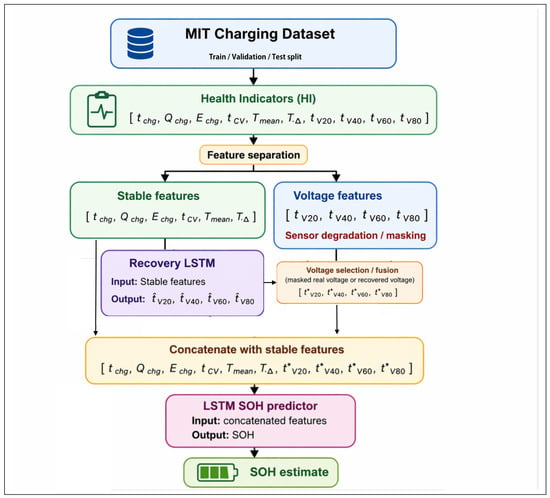
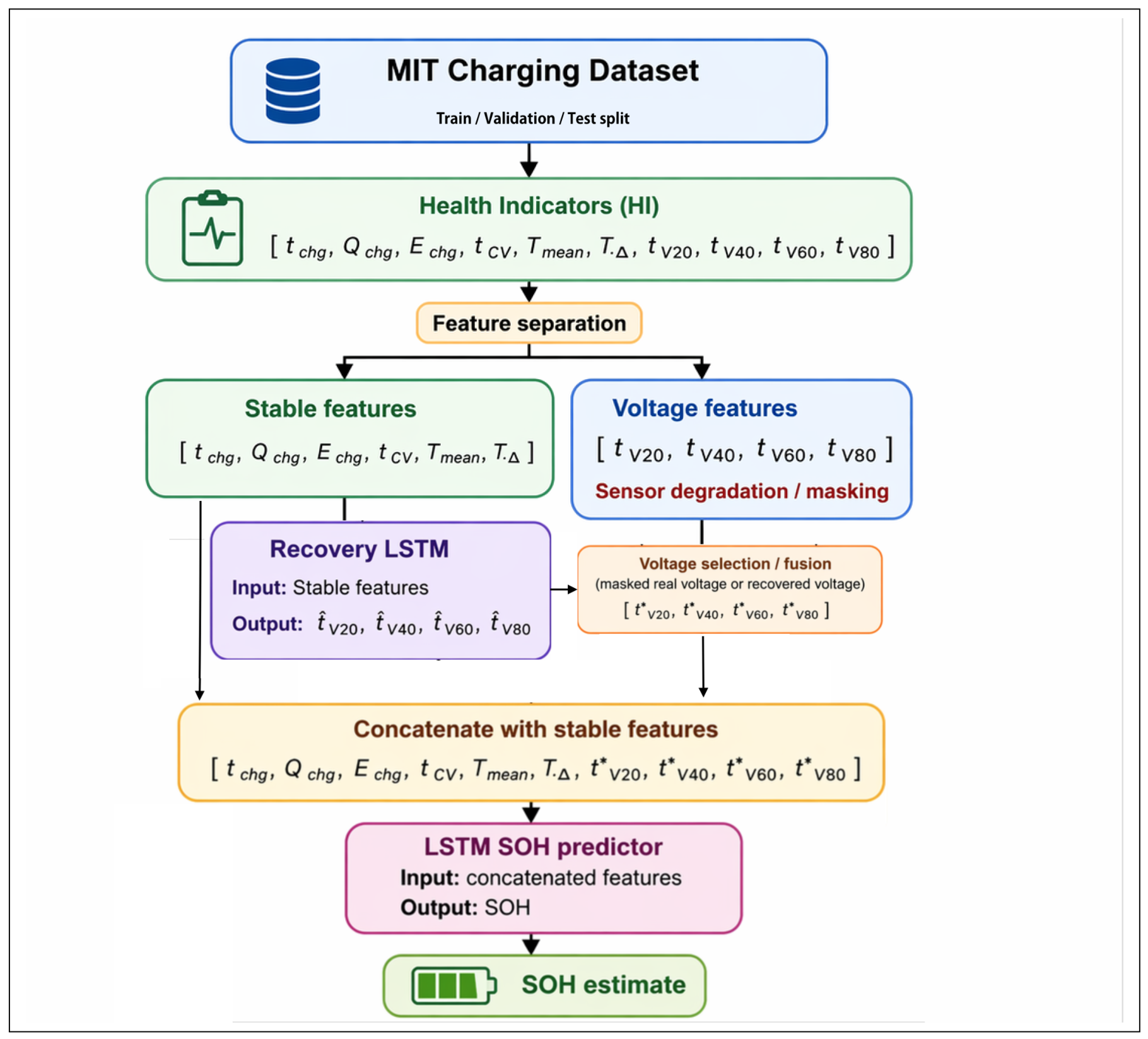
This study proposes a dependable framework for SOH estimation under partial loss of charging health indicators. Missing measurements caused by sensor noise or faults may degrade prediction reliability. The approach improves robustness by identifying influential indicators and reconstructing missing critical features before SOH prediction as illustrated in Figure 1.
Figure 1.
Dependable SOH estimation framework with voltage recovery under sensor degradation.
The framework includes (i) influential indicator identification, (ii) feature recovery, and (iii) robust SOH prediction.
2.1. Dataset
Experiments use the MIT fast-charging dataset [11], containing 45 LiFePO4 cells cycled under controlled fast-charging conditions at 30 °C with degradation trajectories up to 2000 cycles. The data are split into 31 training, 6 validation, and 8 testing cells.
Battery SOH is defined as the ratio between the available capacity and the nominal capacity measured over the lifetime of each cell.
2.2. Charging Health Indicators
From each charging cycle, a set of health indicators (HIs) is extracted from voltage, current, temperature, and time signals. These indicators summarize charging dynamics that evolve with battery aging.
The feature vector for cycle n is defined as
where:
- represents total charging duration;
- denote the time required for the terminal voltage to reach specific normalized voltage levels;
- denotes charged capacity;
- denotes charged energy;
- denotes constant-voltage phase duration;
- represents mean temperature during charging;
- represents temperature variation.
Voltage milestone indicators capture electrochemical behavior such as internal resistance growth and polarization effects, while temperature-related indicators reflect thermal dynamics associated with degradation mechanisms.
2.3. SOH Definition
State of health of a battery at cycle n is defined from its discharge capacity :
where denotes the nominal capacity of the fresh cell.
2.4. Baseline SOH Prediction Model
Temporal degradation is modeled using a two-layer LSTM. Let L denote the sequence window length (number of charging cycles). The model predicts the change in state of health over the window as,
Absolute SOH estimate is constructed recursively:
The configuration of the LSTM neural network used for this work is summarized in Table 1.
Table 1.
LSTM configuration.
2.5. Identification of Influential Health Indicators
By using vector defined in Section 2.2 as the health indicator (HI), features are regrouped into the following descriptors:
A feature-group ablation analysis is performed to evaluate the influence of each descriptor on SOH prediction accuracy. In practical battery management systems (BMSs), charging throughput and voltage trajectory behavior are typically available, while temperature sensing may be noisy or partially unavailable.
Two degraded feature vectors are considered:
The temperature removal experiment evaluates dependence on thermal sensing signals, while voltage removal simulates incomplete trajectory observation due to limited telemetry resolution or irregular sampling intervals.
Results indicate that voltage trajectory descriptors provide stronger degradation information, motivating their reconstruction in the dependable learning stage.
2.6. Voltage Feature Recovery Model
Voltage descriptors are selected for recovery because feature ablation indicates they provide the strongest degradation information, while in practical BMS logs voltage trajectories may be partially missing due to sampling limitations.
To improve robustness under incomplete measurements, missing voltage trajectory descriptors are reconstructed from available charging features.
Here, voltage-feature missingness is simulated by randomly masking voltage descriptors with a missing ratio
The masked HI vector becomes
where denotes partially observed voltage descriptors.
The final dependable feature vector is defined as
where is obtained from either the real measurement or the recovered estimate.
The dependable prediction framework combines first a Recovery-LSTM for reconstructing missing voltage indicators. Then, after concatenation with the remaining stable features in (1), another SOH-LSTM is deployed for degradation estimation. The overall pseudo code is summarized in Algorithm 1.
| Algorithm 1 Dependable SOH prediction |
| Require: feature sequence x Ensure: predicted SOH
|
2.7. Evaluation Metrics
Prediction accuracy is evaluated using Mean Absolute Error (MAE) and Root Mean Square Error (RMSE). Let N denote the number of samples. MAE is used to evaluate for cases involving average error, while RMSE emphasizes larger deviations:
To quantify the benefit of the recovery mechanism under missing feature conditions, the relative improvement in RMSE is computed as
2.8. Experimental Scenarios
Two scenario groups evaluate dependable SOH prediction:
(1) Feature-group ablation: Models are trained by using:
- The full feature set;
- Without temperature descriptors;
- Without voltage trajectory descriptors.
(2) Partial feature missingness: Voltage descriptors are randomly masked with various ratios whereby recovered features replace missing values prior to SOH prediction and the case corresponds to the complete absence of voltage descriptors.
This setup evaluates both feature influence and robustness under degraded sensing conditions.
3. Results
SOH prediction performance is evaluated under partial loss of charging indicators, in terms of sensitivity to feature removal and robustness under progressive voltage missingness. Prediction accuracy is measured using MAE (Equation (15)) and RMSE (Equation (16)).
3.1. Influence of Health Indicator Groups
Feature-group ablation experiments were conducted following the experimental scenarios described in Section 2.8. Selected health indicator groups were removed, and the resulting prediction accuracy was compared against the full-feature baseline. Table 2 reports average performance across eight test cells.
Table 2.
Influence of feature groups on SOH prediction accuracy (average across 8 cells).
Interestingly, removing the temperature descriptors improves prediction accuracy, suggesting that they provide limited additional predictive value under the controlled conditions of this dataset.
3.2. Recovery Performance Under Missing Voltage Indicators
Voltage milestone indicators were randomly masked at different ratios following the experimental scenarios defined in Section 2.8. Missing indicators were reconstructed using the proposed recovery model.
Table 3 reports SOH prediction accuracy under increasing missing ratios, evaluated using MAE, RMSE, and RMSE improvement percentage using Equation (17).
Table 3.
SOH prediction under progressive voltage feature loss.
3.3. Statistical Reliability Analysis
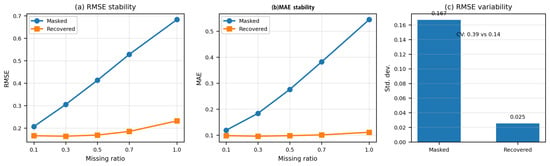
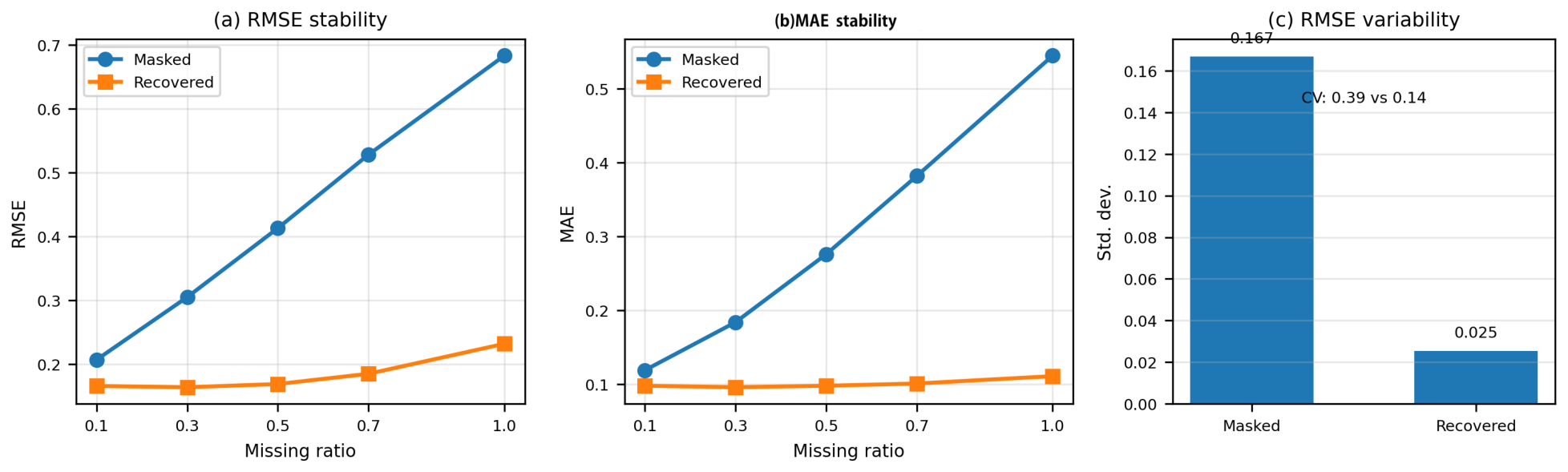
In this section, a statistical analysis is presented to evaluate the performance of the proposed framework for SOH estimation under increasing voltage feature missingness, e.g., due to sensor degradation. Figure 2 summarizes reliability using RMSE, MAE, and RMSE standard deviation. Therein:
Figure 2.
Reliability under voltage feature loss: (a) RMSE, (b) MAE, (c) RMSE variability. Recovery improves stability.
- -
- RMSE versus missing ratio is shown in Figure 2a, where the masked baseline exhibits rapidly increasing error, while the recovered model maintains stable RMSE.
- -
- Figure 2b displays a consistence in MAE performance across missing conditions, and
- -
- Figure 2c presents RMSE variability, where the recovered model achieves substantially lower standard deviation (0.025) than the masked baseline (0.167), indicating improved stability.
3.4. Discussion
The results described above demonstrate that the recovery mechanism improves prediction robustness when voltage features are partially or fully missing. They indicate that SOH prediction performance is sensitive to the availability of voltage trajectory indicators. Feature-group ablation shows that removing voltage milestone descriptors leads to noticeable degradation compared to the full-feature baseline, confirming their importance for capturing degradation-related characteristics of the charging process.
The proposed Recovery-LSTM leverages correlations between charging duration, delivered energy, and temperature behavior to reconstruct missing voltage indicators. These recovered descriptors preserve critical degradation information required for accurate SOH estimation when detailed voltage trajectory measurements are unavailable.
Robustness evaluation under progressive feature missingness shows that prediction accuracy remains stable across different missing ratios. Statistical analysis further indicates substantially reduced RMSE variability (std reduced from 0.167 to 0.025), demonstrating consistent prediction behavior under degraded sensing conditions.
These results show that combining feature importance analysis with targeted reconstruction enables dependable battery health estimation under imperfect sensing conditions relevant to practical EV battery management systems.
4. Conclusions
This paper proposes a dependable SOH estimation framework under partial loss of charging health indicators. Feature-group analysis shows voltage trajectory descriptors provide critical degradation information in charging-only data.
A Recovery-LSTM reconstructs missing voltage features from remaining descriptors. Results show stable MAE and RMSE across increasing missing ratios, achieving up to 66% RMSE improvement and reduced error variability under degraded sensing conditions.
The framework improves the robustness of data-driven battery models with incomplete measurements. Future work will investigate multi-head dependable learning and integration with similarity-aware transfer learning.
Author Contributions
Conceptualization, A.K.C. and Q.P.H.; methodology, A.K.C.; software, A.K.C.; validation, A.K.C.; formal analysis, A.K.C.; investigation, A.K.C.; data curation, A.K.C.; writing—original draft preparation, A.K.C.; writing—review and editing, Q.P.H.; visualization, A.K.C.; supervision, Q.P.H.; project administration, Q.P.H.; funding acquisition, Q.P.H. All authors have read and agreed to the published version of the manuscript.
Funding
This research was supported by the Australian Research Council (ARC) under project DP250102421 and by a Higher Committee for Education Development (HCED) scholarship from the Government of Iraq.
Institutional Review Board Statement
Not applicable.
Informed Consent Statement
Not applicable.
Data Availability Statement
A publicly available dataset was used in this study. The MIT fast-charging dataset is available from the repository cited in Reference [11].
Acknowledgments
The authors acknowledge the University of Technology Sydney for providing research infrastructure and computational resources. During the preparation of this manuscript, the authors used ChatGPT (GPT-6, OpenAI) solely for English language editing and refinement to improve grammatical accuracy, clarity, and readability. The authors reviewed the AI-assisted revisions and take full responsibility for the final content of the manuscript.
Conflicts of Interest
The authors declare no conflicts of interest.
Abbreviations
| SOH | State of Health |
| EV | Electric Vehicle |
| BMS | Battery Management System |
| LSTM | Long Short-Term Memory |
| RMSE | Root Mean Square Error |
| MAE | Mean Absolute Error |
| HI | Health Indicator |
| NASA | National Aeronautics and Space Administration dataset |
References
- Demirci, O.; Taskin, S.; Schaltz, E.; Demirci, B.A. Review of battery state estimation methods for electric vehicles Part II: SOH estimation. J. Energy Storage 2024, 96, 112703. [Google Scholar] [CrossRef] [Scilit]
- Challab, A.K.; Pham, Q.H.; Hoang, T.-D.; Ha, Q.P. Component-level heat generation in electric vehicles across driving scenarios: A literature-based study. In IEEE PES Australasian Universities Power Engineering Conference (AUPEC); IEEE: Piscataway, NJ, USA, 2025. [Google Scholar] [CrossRef] [Scilit]
- Du, Z. Research on health status assessment of power batteries for new energy vehicles combined with machine learning. In International Conference on Electronics, Circuits and Information Engineering (ECIE); IEEE: Piscataway, NJ, USA, 2025; pp. 433–438. [Google Scholar] [CrossRef] [Scilit]
- Batta, M.S.; Mabed, H.; Aliouat, Z.; Harous, S. Battery state-of-health prediction-based clustering for lifetime optimization in IoT networks. IEEE Internet Things J. 2023, 10, 81–91. [Google Scholar] [CrossRef] [Scilit]
- Li, X.; Ju, L.; Geng, G.; Jiang, Q. Data-driven state-of-health estimation for lithium-ion battery based on aging features. Energy 2023, 274, 127378. [Google Scholar] [CrossRef] [Scilit]
- Liu, R.; Huang, W.; Li, X.; Cheng, B.; Zhang, M. A transfer learning-based method for state of health estimation of distributed energy storage batteries. In International Conference on Mechatronics, Robotics, and Artificial Intelligence (MRAI); IEEE: Piscataway, NJ, USA, 2025; pp. 220–223. [Google Scholar] [CrossRef] [Scilit]
- Moayyed, H.; Abdeltawab, H.; Jayakumar, R.; Ma, L. Accelerated battery state-of-health estimation using conditional autoencoders for intelligent frequency band selection. J. Power Sources 2026, 667, 239247. [Google Scholar] [CrossRef] [Scilit]
- Zhang, Y.; Xiong, R.; He, H.; Pecht, M. A robust state-of-health estimation method for lithium-ion batteries using incremental capacity analysis and Gaussian process regression. Appl. Energy 2020, 207, 358–369. [Google Scholar]
- Viktor, P.; Kiss, G. Sensors in self-driving vehicles: A detailed literature review and new trends. Sensors 2026, 26, 2153. [Google Scholar] [CrossRef] [Scilit]
- Hanif, M.A.; Shafique, M. Dependable deep learning: Towards cost-efficient resilience of deep neural network accelerators against soft errors and permanent faults. In IEEE International Symposium on On-Line Testing and Robust System Design (IOLTS); IEEE: Piscataway, NJ, USA, 2020; pp. 1–4. [Google Scholar] [CrossRef] [Scilit]
- Attia, P.M.; Grover, A.; Jin, N.; Severson, K.A.; Markov, T.M.; Liao, Y.-H.; Chen, M.H.; Cheong, B.; Perkins, N.; Yang, Z.; et al. Closed-loop optimization of fast-charging protocols for batteries with machine learning. Nature 2020, 578, 397–402. [Google Scholar] [CrossRef] [Scilit]

Disclaimer/Publisher’s Note: The statements, opinions and data contained in all publications are solely those of the individual author(s) and contributor(s) and not of MDPI and/or the editor(s). MDPI and/or the editor(s) disclaim responsibility for any injury to people or property resulting from any ideas, methods, instructions or products referred to in the content. |
© 2026 by the authors. Licensee MDPI, Basel, Switzerland. This article is an open access article distributed under the terms and conditions of the Creative Commons Attribution (CC BY) license.